FULL STORY:HOA Queen Cut Power to My House, Slapped $8,500 in Fake Fines on My Deed, and Picked the Wrong Homeowner to Threaten
FULL STORY CONTINUATION
Alina did not waste time.
That was one of the reasons I called her.
She listened without interrupting while I gave her the chronology.
I had purchased the house fourteen months earlier.
No mandatory HOA covenant.
The first voluntary membership application arrived three weeks after closing.
I declined.
Barbara continued demanding participation.
Violation notices followed.
I responded repeatedly with the deed and the relevant legal provisions.
The claimed balance reached $5,500.
Then my electrical service was cut because of a supposed compliance problem.
When I finished, Alina asked:
“You still have everything?”
“Every notice.”
“Envelopes?”
“Yes.”
“Emails?”
“Yes.”
“Your responses?”
“All of them.”
“Good.”
She paused.
“Don’t contact Barbara about the disconnection yet.”
“I wasn’t planning to.”
“I mean it, Marcus.”
“I heard you.”
“Let me trace the request first.”
I leaned back in my chair.
My office had electricity.
My house did not.
I had slept badly and showered at a gym before work.
That alone made me angry.
Not because I couldn’t survive inconvenience.
Because someone had apparently decided they were entitled to make my own house unlivable as punishment for refusing to join an organization I had no legal obligation to join.
Alina continued.
“Also, don’t tell the board what we’re doing.”
“You think they all know?”
“I don’t know what they know.”
That mattered.
Barbara was president.
That did not automatically mean every director had participated in every action.
“You think she did this personally?”
“I think we should follow the records instead of guessing.”
Lawyers say that when they are trying to keep another lawyer from doing something emotionally satisfying and strategically stupid.
She was right.
I waited.
Meanwhile, I accelerated the solar installation.
People sometimes assume I bought the system as some grand symbolic statement against the HOA.
Not originally.
I bought it because my power had been disconnected and I had no intention of letting somebody else decide whether my house could function.
A professional installer completed the system within ten days.
Panels on the roof.
Properly installed.
Battery storage.
The house came back to life.
Lights.
Refrigerator.
Computers.
Everything I needed.
For the first time since the utility shutoff, I slept in my own home without wondering how long a reinstatement request would take.
Then Alina called.
“Are you sitting down?”
“That usually means you found something.”
“I found the account.”
I walked into my study and closed the door.
“What account?”
“The third-party property management account used to submit your disconnection.”
“And?”
“It was opened using Oakmont Heights HOA credentials.”
Exactly what I had suspected.
I did not feel satisfaction.
I felt my jaw tighten.
“Can you prove that?”
“Yes.”
“Who submitted the request?”
“We’re still documenting the chain.”
“What did they send the utility?”
“A compliance request claiming an unresolved HOA violation at 42 Maple Crest Way.”
I stood.
“I’m not in the HOA.”
“I know.”
“So the entire basis for disconnecting service was false.”
“Yes.”
Then her voice changed.
“There’s more.”
I waited.
“The authorization packet appears to contain a forged signature.”
Silence.
“A forged property management authorization?”
“Yes.”
“Whose signature?”
“We’re working through that.”
I looked out the window.
The solar panels were visible from where I stood.
“Have you notified Edison?”
“Their compliance team is already involved.”
“Anyone else?”
“I forwarded the findings to the California Public Utilities Commission.”
Pause.
“And the Orange County District Attorney’s Office.”
That made the situation feel different.
Until then, every problem with Barbara had lived in the strange gray psychological world of HOA intimidation.
Letters.
Threats.
Pretend authority.
Now an investigative trail existed outside the association.
Utility records.
Account credentials.
Submitted documents.
A potentially forged signature.
Barbara had spent more than a year acting like the worst thing I could do was refuse to pay her fines.
Now people with actual authority were asking how my electricity had been shut off.
I asked Alina:
“Should I tell Barbara?”
“No.”
“You really enjoy saying that.”
“Because you enjoy confrontation more than you admit.”
“I don’t enjoy confrontation.”
“You became a real estate litigator.”
“That’s different.”
“It really isn’t.”
I smiled despite myself.
She continued.
“Let the investigation develop. If she sends another notice, send it to me.”
Barbara sent another notice four days later.
Not by mail.
In person.
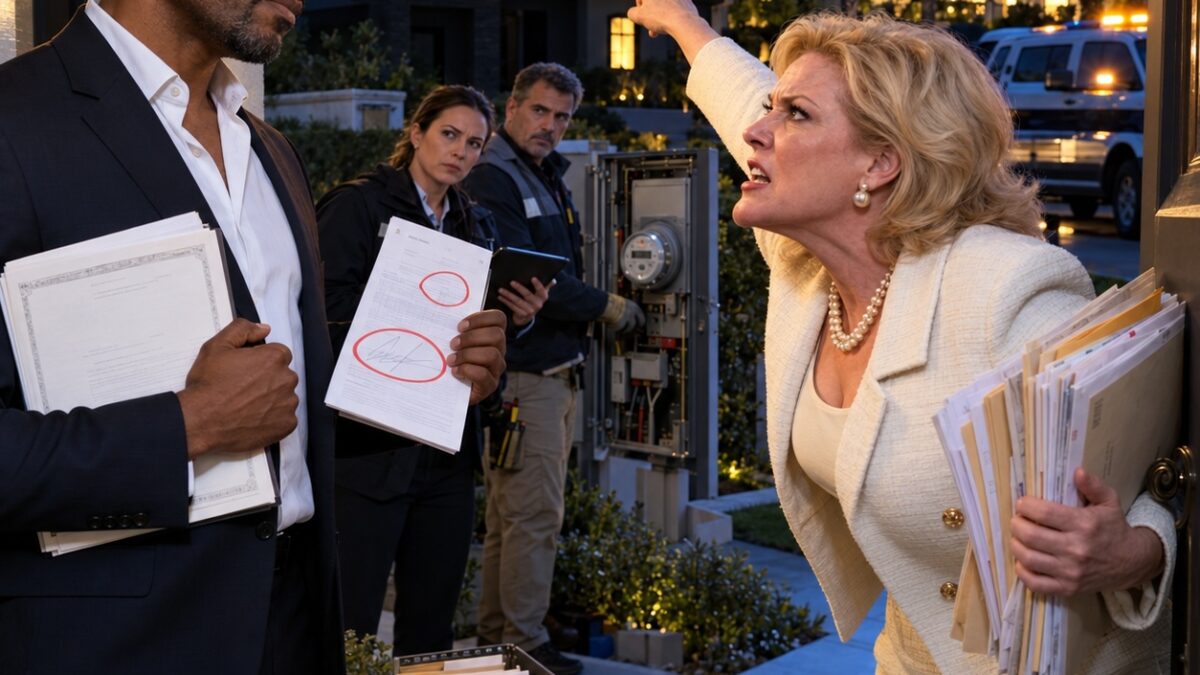
I had just pulled into my driveway when I saw her crossing the sidewalk toward me.
White blouse.
Clipboard.
Sunglasses.
The posture of someone who believed she was about to deliver the final word.
She pointed at the roof.
“Those panels are coming down.”
I got out of the car.
“Hello, Barbara.”
“I don’t care what you think your deed says. Nothing goes on any roof in this neighborhood without board approval.”
“My deed is not an opinion.”
She held up a notice.
“These panels are an unapproved structural modification under Oakmont Heights architectural standards.”
“I’m not an HOA member.”
“I don’t need jurisdiction. I need compliance.”
That sentence almost made me laugh.
It also told me more about Barbara than the previous fourteen months of letters.
I don’t need jurisdiction.
I need compliance.
There it was.
Not law.
Not authority.
Obedience.
She thrust the document toward me.
“Three-thousand-dollar fine.”
I took it.
Looked at the amount.
Then looked back at her.
“You already claim I owe fifty-five hundred.”
“You do.”
“And now another three thousand.”
“Correct.”
“For solar panels.”
“Yes.”
I nodded slowly.
Then told her three things.
In order.
“First, my deed contains no mandatory HOA covenant. You have no authority to impose this fine.”
Barbara opened her mouth.
I raised one hand.
“Second, California Civil Code Section 714 protects residential solar installations against the kind of restriction you’re trying to impose.”
Her face tightened.
“And third…”
I let the silence sit between us.
“The utility disconnection from last week is now under formal investigation.”
For the first time in fourteen months, Barbara looked genuinely confused.
“What investigation?”
“The one involving the third-party management account opened with Oakmont Heights HOA credentials.”
She said nothing.
I continued.
“The one used to submit a fraudulent compliance-based disconnection request against my address.”
Her face lost some color.
“The documentation includes what appears to be a forged authorization signature.”
Barbara stared at me.
I watched several possible responses pass across her expression.
Denial.
Anger.
Dismissal.
Eventually she chose indignation.
“I have no idea what you’re talking about.”
“Check your email.”
“What email?”
“You’ll know when you see it.”
Then I stepped inside and closed the door.
I stood behind it for a moment.
My heart was beating much faster than I wanted to admit.
People imagine lawyers feel calm during confrontations because we are trained to argue.
We don’t.
Training teaches you what to do while adrenaline is making your body stupid.
That is not the same thing as calm.
I walked to my kitchen.
Set the $3,000 fine beside the old folder.
The claimed total was now $8,500.
Eight thousand five hundred dollars in fines from an association I had never joined.
I photographed the notice.
Sent it to Alina.
Her reply came almost immediately.
Perfect.
I wrote back:
You have an odd definition of perfect.
She called.
“We file tomorrow.”
“The civil case?”
“Yes.”
“Against the HOA?”
“And Barbara personally.”
I leaned against the counter.
“You think we’re ready?”
“I think she just handed us another exhibit.”
The following morning, Alina filed suit in Orange County Superior Court.
Barbara Higgins was named personally.
The Oakmont Heights HOA board was named collectively.
The claims centered on the sustained harassment campaign, the attempt to enforce restrictions against a non-member, and the deliberate interference with my utility service through allegedly forged documentation.
Separate from that civil action, the criminal referral was already active.
Pacific Edison froze the third-party management account.
Their compliance team cooperated with investigators.
The documentation surrounding my disconnection became evidence rather than just another bureaucratic annoyance.
Then the district attorney moved.
Barbara was charged on three criminal counts tied to the conduct described in the investigation.
Utility fraud.
Forgery involving a legal document.
Fraudulent use of the third-party property management account.
When Alina told me criminal charges had been filed, I sat quietly for a while.
I expected satisfaction.
Instead, I thought back to the welcome packet.
The first membership application.
Barbara’s first letter.
All of this could have ended there.
I decline membership.
Thank you.
Nothing else.
She could have disliked that.
She could have complained privately.
She could have thought I was arrogant.
None of that would matter.
Instead, she had apparently spent more than a year trying to manufacture consequences for a legal decision she didn’t like.
Landscaping.
Lighting.
Driveway parking.
Fines.
Lien threats.
Foreclosure language.
Then electricity.
That was the escalation I could not understand.
Not rationally.
Alina understood it better.
“Control,” she said when we discussed it.
We were sitting in her office reviewing the complaint.
“What about it?”
“This was never about annual dues.”
“I know.”
“Do you?”
She turned one of Barbara’s early notices toward me.
“If it were about dues, she would have stopped when you showed her the deed.”
“True.”
“If it were about community aesthetics, she would have stopped when you established she had no authority.”
“Also true.”
“She kept going because your refusal itself became the problem.”
I leaned back.
“You’re saying she couldn’t tolerate someone outside her control.”
“I’m saying nine years as president may have taught her that enough pressure usually produces compliance.”
I thought about her sentence on my driveway.
I don’t need jurisdiction.
I need compliance.
“That tracks.”
Alina nodded.
“You kept refusing. So she kept increasing the cost of refusing.”
“Until she cut my power.”
“Yes.”
“And I bought solar.”
Alina smiled.
“That part is objectively funny.”
It was.
From Barbara’s perspective, shutting off my electricity was probably supposed to be the ultimate pressure point.
Make the house inconvenient.
Make me call.
Make me surrender.
Instead, she created the reason I installed an independent power system.
Then, once I installed it, she fined me for the solution.
There is something almost elegant about self-defeating authoritarian logic.
You create a problem.
Someone solves it without you.
You punish them for solving it.
By then, the story had begun circulating inside Oakmont Heights.
Neighbors who had never spoken to me suddenly wanted conversations.
One man caught me at the mailbox.
“Marcus, is it true you’re suing the HOA?”
“Yes.”
“Because of the solar panels?”
“No.”
He lowered his voice.
“Barbara says the panels violate architectural rules.”
“My house isn’t subject to HOA architectural rules.”
He looked surprised.
“How?”
“No covenant.”
“But everybody in here is HOA.”
“No. Most are.”
He stared.
I could see him processing that.
“She told us membership was automatic.”
“For some recorded properties, perhaps. Not mine.”
“What about the power thing?”
I looked at him.
“What have you heard?”
“That Edison disconnected you because you had unresolved violations.”
“That is what somebody told Edison.”
He frowned.
Then realized I had phrased it carefully.
“Somebody?”
“There’s an investigation.”
I did not tell him more.
Within days, rumors changed.
The story of the stubborn lawyer refusing architectural rules became the story of the HOA president facing criminal scrutiny over a utility shutoff.
Board members began calling emergency meetings.
Then Barbara hired a criminal defense attorney.
According to the source material I was working from, the retainer was $28,000.
I remember seeing that number and thinking about the original membership application sitting in my old files.
A thirty-second decision could have prevented everything.
Accept no.
Move on.
Instead, twenty-eight thousand dollars just to begin defending herself.
The civil case moved quickly because the legal question at the center was not especially mysterious.
Was my property subject to a mandatory HOA covenant?
No.
My deed showed it.
The court confirmed it.
The violation notices were unenforceable.
Landscaping.
Lighting.
Driveway.
Every accumulated charge.
Void.
The $5,500 balance disappeared because legally it should never have existed.
Then came the solar penalty.
Barbara’s $3,000 fine received even less patience.
My property was not subject to her HOA authority in the first place.
And beyond that, California law specifically limited the kind of HOA restriction she was trying to impose against residential solar.
The fine was dismissed in a hearing that lasted less than twenty minutes.
Fourteen months of threats.
Three thousand dollars.
A personal confrontation on my driveway.
Less than twenty minutes.
I watched Barbara across the courtroom.
She looked furious.
Not defeated.
Furious.
As if the law had violated her expectations.
That expression told me she still did not fully understand what had happened.
She had confused repeated enforcement with valid enforcement.
The court did not care how many notices she had mailed.
Ten void notices do not become authority by accumulation.
Fifty do not.
Five thousand five hundred dollars written on an HOA ledger does not become debt simply because someone keeps updating the balance.
That principle mattered beyond my case.
We did not know how far beyond until later.
The civil case addressed the utility interference separately.
That was the part that carried the most weight.
A homeowner can ignore an invalid fine.
He cannot ignore a dark house indefinitely.
Barbara’s conduct had crossed from pretending to regulate me into interfering with an essential service through documentation investigators believed had been falsified.
The court found that she had deliberately interfered with my utility service.
The damages reflected that.
The cost of the solar installation was covered.
Legal fees were covered.
Additional compensation was awarded for the sustained harassment campaign against a homeowner the association had no legal right to regulate.
People asked whether I felt vindicated.
Yes.
But not because of the money.
The money mattered.
Legal fights are expensive.
Solar equipment is expensive.
Having another person deliberately create those costs should have consequences.
But the most important sentence was simpler.
No mandatory covenant.
No authority.
For fourteen months, I had said it alone.
Now a court had said it.
The board could no longer pretend Barbara and I were simply two stubborn people arguing over an interpretation.
There was a legal answer.
She had been wrong.
The day after criminal charges were filed, the Oakmont Heights board removed Barbara from the presidency.
Unanimously.
Nine consecutive years in that office ended in one vote.
I heard about it from Alina.
“That was quick.”
“It needed to be.”
“Did the board know about the utility request?”
“That’s what their audit is going to determine.”
“Audit?”
“They’re reviewing her enforcement actions.”
I sat up.
“All of them?”
“All nine years.”
That interested me.
Not because I wanted every technical mistake turned into a scandal.
Because behavior this persistent rarely begins with the most extreme act.
People test boundaries.
If Barbara had been willing to spend fourteen months harassing a lawyer who answered every notice with legal citations, what had she done when homeowners did not know how to respond?
The audit found eleven other non-member homeowners in Oakmont Heights who had received violation notices from Barbara despite having no mandatory covenant.
Eleven.
I read that number twice when Alina sent it to me.
My first emotion was anger.
My second was embarrassment.
I had spent more than a year thinking Barbara’s obsession with me was personal.
Maybe part of it became personal.
But I was not unique.
I was simply one of the people who resisted long enough for the pattern to become visible.
Some of those other owners had apparently received violations and simply dealt with them.
Maybe paid.
Maybe ignored.
Maybe argued.
The specifics varied.
The key fact did not.
No mandatory covenant.
No valid enforcement authority.
Every one of those notices had to be voided.
Some homeowners filed their own actions afterward.
I understood why.
Once you discover an institution demanded money from you without legal authority, the amount almost becomes secondary.
The violation is psychological too.
You organize your behavior around someone else’s power because you believe resisting will make things worse.
You move the car.
Change the light.
Cut the plant.
Pay the fine.
Not because the rule is valid.
Because the letterhead looks official.
That was Barbara’s real leverage.
People’s reluctance to test authority.
It worked until she met someone who spent his professional life testing documents.
I do not say that proudly.
Mostly I think about the fact that people should not need a law degree to be left alone on property that is not bound by an association.
The deed should have been enough for anyone.
It was enough for me.
It should have been enough for Barbara.
Her refusal to accept it was not my responsibility.
The criminal case continued.
That process was slower than the civil rulings.
Eight months passed after the indictment before Barbara entered a guilty plea on the utility fraud charge.
By then, life inside Oakmont Heights had changed.
The board had new leadership.
The audit had been completed.
My name had become strangely familiar to residents I barely knew.
Some apologized.
One woman approached me while I was walking near the entrance.
“I voted for Barbara every year.”
I smiled politely.
“That was your right.”
“I didn’t know.”
“About what?”
“That some people weren’t legally in the HOA.”
“Most people probably didn’t.”
“She always said the community had to be uniform.”
“That doesn’t create a covenant.”
She nodded.
“I know that now.”
Then she hesitated.
“She fined me once for my garage door being open too long.”
I almost asked how long too long was.
Decided I didn’t want to know.
She continued.
“I just paid it.”
I said, “If your property is actually bound, that’s a different issue.”
“I know. I checked.”
That sentence made me smile.
I checked.
If nothing else, Barbara had created a neighborhood full of people suddenly interested in reading their own property documents.
That might have been the healthiest consequence of the entire disaster.
After her plea, the sentence came.
Two years of probation.
Significant financial restitution.
And a permanent prohibition on serving in HOA leadership in California.
That final part felt oddly appropriate.
Not prison.
Not some theatrical ending.
A boundary.
You used organizational authority improperly.
You no longer get to hold that kind of authority.
Barbara had spent years trying to expand the boundaries of her power.
The legal system finally placed one around her.
Permanent.
The board’s audit and the criminal case also changed how I thought about Oakmont Heights itself.
Early on, I was angry at the HOA as a whole.
Easy target.
They sent letters.
Their president stood on my porch.
Their name appeared on notices.
Their credentials were tied to the utility account.
But organizations are made of individuals with different levels of knowledge.
Once the board acted—removing Barbara, auditing her enforcement history, voiding improper notices—I stopped treating every director as equivalent to her.
Some had failed by not scrutinizing what their president was doing.
That deserved criticism.
But failure of oversight is different from deliberate forgery.
The distinction matters.
Especially to lawyers.
Especially when anger wants everything simplified.
I never joined the HOA.
That did not change.
The new president approached me once about whether I would reconsider.
Not aggressively.
Almost apologetically.
“We’re trying to rebuild trust.”
“I appreciate that.”
“Would you consider voluntary membership?”
“No.”
He nodded immediately.
“Fair.”
That response earned more respect from me than anything the old leadership had done.
Ask.
Receive answer.
Respect answer.
Imagine the amount of money Oakmont Heights could have saved if Barbara had understood that process.
I kept my solar panels.
Of course.
By the time Pacific Edison restored my conventional grid service, I had no intention of removing the system that had kept my house functional through the mess Barbara created.
Restoration took place after the investigation worked through the fraudulent disconnection.
Eventually, both systems operated together.
Grid service.
Solar.
Battery support.
My electric bill fell to almost nothing.
That may have been the funniest practical outcome.
Barbara tried to punish me by taking away my electricity.
The result was that I installed solar and dramatically reduced how much electricity I had to buy.
Then she tried to punish me for the solar.
The court voided that too.
So the punishment became an upgrade.
Not because I masterminded some revenge strategy.
Because when someone creates a problem, sometimes the best answer is to solve the problem in a way they cannot control.
That principle became the emotional center of the whole story for me.
Barbara’s power depended on reaction.
She sent a fine.
Homeowner pays.
She sends a threat.
Homeowner complies.
She invokes the board.
Homeowner backs down.
When I refused to follow the expected sequence, she escalated.
The disconnection was supposed to restore the old pattern.
Pressure.
Compliance.
Instead:
Pressure.
Independence.
I built around her.
Then I investigated.
The moment I did those two things, the balance changed.
She could keep printing notices.
They were paper.
The solar panels still generated electricity.
My deed still contained no covenant.
Pacific Edison had records.
The management account had a trail.
The forged authorization existed.
County prosecutors had evidence.
Reality had become larger than Barbara’s office.
I think that was when she lost, long before the guilty plea.
People sometimes describe these stories as revenge.
I understand.
There is satisfaction in seeing somebody abuse authority and face consequences.
But revenge was never my main goal.
I wanted three things.
My utility service protected.
My property rights recognized.
And the harassment stopped.
The criminal consequences came from the choices Barbara made pursuing the opposite.
That distinction matters.
If I had tried to retaliate illegally, vandalized HOA property, tampered with systems, threatened Barbara, or done anything equally stupid, I would have weakened my own position.
Instead, I kept records.
Bought a legal solar system.
Called a lawyer.
Let investigators follow documentation.
That is less cinematic in real time.
Much more effective later.
The folder I started with the first violation notice became enormous.
I kept it after the cases concluded.
Welcome packet.
My refusal.
Her second application.
My deed.
Legal citation.
Landscaping violation.
Lighting violation.
Driveway violation.
Lien threats.
Foreclosure threats.
The $5,500 balance.
Utility correspondence.
Disconnection records.
Solar contract.
The $3,000 solar violation.
Complaint.
Court orders.
Settlement and damage documents.
Board apology.
Sometimes I opened it and wondered how a thirty-day membership application had evolved into all of that.
The answer was always the same.
Barbara could not accept the first no.
Everything after came from trying to override it.
People tend to think abuse of power begins with dramatic corruption.
Often it starts smaller.
A person in authority deciding their preference is more important than someone else’s legal boundary.
Participation is expected.
The phrase from Barbara’s second letter.
Not required.
Expected.
That was the seed.
Expected became violation.
Violation became fine.
Fine became lien threat.
Lien threat became utility interference.
Authority expanded because nobody forced it to stop early.
Until I did.
Actually, that is not quite accurate.
The deed stopped it.
I simply refused to pretend otherwise.
There is an important difference.
I was not magically stronger than Barbara.
I happened to know how to read the document that defined her limit.
Any homeowner should be able to do the same.
That was why the audit bothered me so much.
Eleven non-members.
How many had assumed an HOA envelope automatically meant obligation?
How many had paid something they did not owe because hiring a lawyer cost more than the fine?
That is one of the uncomfortable realities behind petty enforcement abuse.
A $100 or $300 notice can be strategically difficult to fight.
You may be legally right but economically irrational if proving it costs thousands.
People pay to make the problem disappear.
That teaches bad leadership the wrong lesson.
Pressure works.
Barbara may have learned that repeatedly during nine years as president.
With me, the economics changed once she shut off the power.
Now the problem was not a small notice.
It was serious enough to justify a full investigation.
Once that happened, all the smaller behavior came with it.
Her own escalation exposed the pattern.
There is another irony.
If she had limited herself to unenforceable letters, she might have continued much longer.
Annoying.
Improper.
Perhaps challenged eventually.
But cutting the power created records outside the HOA.
A utility company had to process the request.
An account existed.
Authorization documents existed.
Credentials existed.
Compliance systems had logs.
The moment she reached into regulated utility infrastructure, she left footprints somewhere she did not control.
That was the technical mistake behind the legal one.
Internal HOA paperwork can be manipulated if oversight is weak.
External institutional records are harder to rewrite.
Pacific Edison did not care whether Barbara had been president for nine years.
Investigators did not care about her landscaping standards.
The question was simple.
Who submitted this?
Under what authority?
With what documentation?
Was the signature real?
That stripped away all the neighborhood theater.
It became evidence.
Barbara could dominate a board meeting.
She could not intimidate metadata.
I appreciated that professionally.
The solar system itself became a daily reminder.
Every morning, light hit the panels.
Battery levels rose.
My house ran.
The first few weeks, I checked the system constantly.
Partly because it was new.
Partly because independence felt satisfying.
Eventually, it became background.
Which is exactly what good infrastructure should become.
Reliable.
Boring.
Barbara had turned electricity into a weapon.
I turned it back into a utility.
That may have been my favorite victory.
Not the courtroom.
Not the audit.
Not the permanent leadership ban.
Walking into my own house and knowing a vindictive administrator could not turn the lights off because I declined a membership application.
That is what autonomy feels like when someone has tried to take it.
My relationship with neighbors improved after the dust settled.
Some had avoided me during the dispute.
I understood.
HOA politics can make ordinary people nervous.
You do not want to become the next target.
After Barbara was removed, conversations became easier.
A neighbor invited me over one evening.
We sat outside.
He asked:
“Did you know from the beginning this would turn criminal?”
“No.”
“You knew the fines were fake.”
“I knew they were legally unenforceable against my property.”
“But the power thing?”
“I knew it was serious. I didn’t know who had submitted it until Alina traced the account.”
He nodded slowly.
“I would have just paid the HOA.”
I looked at him.
“Even if you weren’t a member?”
“I probably wouldn’t have checked.”
That answer stayed with me.
Most people are busy.
Jobs.
Families.
Bills.
Health.
They do not want to become experts in recorded covenants.
They see a notice from an association in their gated community and assume somebody else already verified authority.
That assumption is exactly what makes overreach possible.
“You should know what your deed says,” I told him.
“I checked after your lawsuit.”
“Good.”
He laughed.
“Everyone did.”
Maybe that was Barbara’s accidental legacy.
The most document-literate neighborhood in Orange County.
The board itself changed procedures.
Enforcement actions had to be verified against actual property obligations.
Membership status had to be checked.
No more assuming every address behind the gate carried the same covenant structure.
Again, this was not revolutionary governance.
It was basic competence.
But competence often becomes fashionable only after incompetence gets expensive.
Barbara’s criminal defense alone had cost her heavily.
Restitution added more.
The civil damages added financial consequences.
The HOA had to deal with litigation and audit costs.
Other homeowners filed actions.
Years of casual assumptions now required review.
One person’s refusal to accept “no” had created liabilities for everybody around her.
That is another lesson about leadership.
Power multiplies consequences.
If an ordinary neighbor dislikes your solar panels, you have an annoying neighbor.
If an HOA president decides she can weaponize institutional credentials against your utility service, suddenly the entire organization is exposed.
Leadership should make a person more cautious.
Barbara had treated it as permission to be less cautious.
She believed the title insulated her.
The criminal case proved the opposite.
Titles attract scrutiny when abused.
During the eight months before her plea, I occasionally saw Barbara around the neighborhood.
The first encounter after she was removed as president happened near the mailboxes.
She saw me first.
I saw the hesitation.
I expected anger.
Instead, she looked away.
No greeting.
No confrontation.
I let her pass.
There was nothing left to argue about.
The law had answered the jurisdiction question.
The board had removed her.
The criminal case was active.
Words would only make the moment smaller.
Months earlier, she had stood at my front door saying:
I don’t care what your deed says.
Now the deed had outlasted her presidency.
That was enough.
I did not need the final speech people imagine in stories.
No:
I told you so.
No dramatic revelation.
The panels were still on the roof.
Sometimes the object itself is the speech.
She wanted them down.
They stayed.
She wanted me in the HOA.
I stayed out.
She claimed $8,500.
I paid zero.
She tried to remove my power.
I ended up with solar plus restored grid service and an electric bill close to nothing.
She wanted compliance.
She lost her office.
The facts delivered the ending more efficiently than anything I could say.
Alina became almost unbearably pleased with herself whenever she visited.
She once stood in my driveway looking at the panels.
“You realize these are now my favorite solar panels in California.”
“They’re panels.”
“They’re evidence with photovoltaic capability.”
“That’s a terrible phrase.”
“Still true.”
She had earned the joke.
Without her, I would have eventually traced the issue.
Maybe.
But timing mattered.
She knew where to look.
Utilities law.
Property management accounts.
Authorization documents.
Regulatory referrals.
That expertise turned suspicion into evidence quickly.
I appreciated something else about her.
She did not let my anger control the strategy.
Every time I wanted to confront Barbara, Alina redirected me toward records.
Every time I wanted an immediate answer, she asked whether we had proof.
That discipline matters.
People tell themselves they want justice.
Often they want emotional release.
Those are not always aligned.
Yelling at Barbara after the disconnection would have felt good for five minutes.
Saying nothing while Alina traced the account gave us the case.
I learned from that.
The strongest response to harassment is not always the loudest.
Sometimes it is the one that creates the cleanest record.
Barbara’s own letters helped us.
Her repeated insistence that she had authority after receiving contrary legal documentation showed persistence, not misunderstanding.
My replies mattered because they proved notice.
She could not later claim no one had explained the covenant issue.
I had explained.
Repeatedly.
The deed was attached.
The statute was cited.
She received it.
Then continued.
Documentation transforms:
He said, she said.
Into:
On this date, this was sent.
On this date, this was received.
On this date, this action followed.
Chronology is powerful.
Especially when arrogance creates a very consistent chronology.
Barbara had effectively written part of the case against herself.
Notice by notice.
By the time the audit discovered eleven other non-members, her behavior looked less like a single legal error and more like a management pattern.
That probably mattered emotionally to the board.
They had trusted her for nine years.
Imagine discovering that some of the enforcement history you assumed was legitimate involved properties the HOA could not legally regulate.
I did not envy the new leadership.
They inherited a mess.
To their credit, they did not hide it.
The improper notices were declared void.
Homeowners were informed.
The board commissioned the audit rather than waiting for more lawsuits to reveal problems piecemeal.
I respected that.
Accountability should include repair.
Not merely replacement of the person at the top.
Oakmont Heights remained an HOA community.
It did not collapse.
The gate still functioned.
Landscaping still looked immaculate.
Actual members still followed actual covenants.
That fact mattered because it exposed Barbara’s favorite false argument.
She often implied that my refusal to join threatened community order.
It didn’t.
One non-member homeowner exercising his legal rights did not destroy Oakmont Heights.
Removing an abusive president did not destroy it either.
The community survived.
Probably improved.
Organizations do not need unchecked authority to function.
They need legitimate authority.
There is a world of difference.
The guilty plea came eight months after indictment.
I was at work when Alina sent me a short message.
Plea entered.
I called her.
“Utility fraud?”
“Yes.”
“What happens next?”
“Probation. Restitution. Permanent HOA leadership ban.”
I sat silently.
“You okay?”
“Yeah.”
“You sound disappointed.”
“I’m not.”
“What did you expect?”
“I don’t know.”
That was true.
For more than a year, Barbara had been an active source of stress.
Then for eight months, the case had moved in the background.
Now legal resolution had arrived and it felt strangely quiet.
Alina said:
“Marcus, closure is mostly paperwork.”
I laughed.
“That may be the most lawyer sentence you’ve ever said.”
“You are also a lawyer.”
“Exactly why I recognize it.”
Closure was paperwork.
Court orders.
A plea.
Probation terms.
Restitution.
Board audit.
Permanent ban.
No dramatic soundtrack.
The neighborhood continued.
I went home that evening.
The solar system was operating normally.
Grid service was available.
I made dinner.
That was it.
And I realized ordinary life was the reward.
Barbara had spent fourteen months inserting herself into my property.
Letters.
Threats.
Notices.
Dark house.
Solar confrontation.
Now she had no role in my evening.
That was peace.
I stopped keeping the violation folder on my kitchen counter.
Moved it to my office archives.
That small act mattered.
For more than a year, I had kept documents within reach because another notice could arrive anytime.
Now the case was resolved enough that I did not need Barbara occupying physical space in my home.
She could live in a file.
Exactly where expired problems belong.
The panels stayed on the roof.
Neighbors stopped talking about them.
Within months, they were simply part of the house.
Somebody else in Oakmont Heights installed solar later.
Properly.
Nobody declared the neighborhood ruined.
No aesthetic apocalypse.
No collapse of property values.
Sunlight remained visually tolerable.
I enjoyed that too.
A rule often feels sacred until someone successfully ignores an invalid version of it and the world fails to end.
Barbara had treated uniformity as a moral virtue.
I never understood that.
A neighborhood can look polished without making every homeowner subordinate to one person’s preferences.
My panels did not harm anybody.
They reduced my dependence on the grid.
After what happened, that seemed especially sensible.
There were people who told me I should run for the HOA board.
I gave them the obvious answer.
“I’m not a member.”
They laughed.
One neighbor said:
“You’d be better than what we had.”
“Low bar.”
He couldn’t argue.
I had no interest in joining.
My entire fight began with the right not to.
Turning around and volunteering for board politics would have been a strange victory.
I preferred being the homeowner at 42 Maple Crest Way who knew where his property rights began and ended.
Nothing more.
The new leadership left me alone.
Perfect governance from my perspective.
I later heard that Barbara’s name came up whenever someone proposed an aggressive enforcement strategy.
Nobody wanted “another Higgins situation.”
That phrase amused me.
A human being had become a procedural warning.
Maybe that was fitting.
Do not skip covenant verification.
Do not threaten non-members.
Do not forge utility documents.
Do not cut somebody’s electricity because they refuse to obey rules that do not apply.
Basic lessons.
Expensive tuition.
Sometimes I thought about what would have happened if I had signed the membership application three weeks after moving in.
Life would have been easier in the short term.
No confrontation.
No notices.
No disconnection.
Probably no solar system.
Barbara would have won something she had no legal right to demand.
Would that matter?
Some people would say no.
Pay the dues.
Avoid drama.
You live behind the same gate.
Why make a point?
Because rights erode exactly that way.
Not usually through one grand seizure.
Through people deciding resistance is inconvenient.
I had chosen the house partly because there was no mandatory covenant.
That choice was reflected in the purchase price, my due diligence, and my understanding of what I was buying.
Barbara did not get to rewrite the transaction after closing because uniform membership made her job easier.
If I had wanted mandatory HOA governance, I could have bought a property carrying that covenant.
I deliberately did not.
That decision deserved the same respect as someone else choosing a fully governed property because they valued consistency.
Different owners want different structures.
The deed tells you what you bought.
Read it.
That became the part of the story people repeated most.
Not the criminal charges.
Read your deed.
I received messages from people elsewhere saying they had finally looked at their own closing documents.
Some discovered restrictions they had never understood.
Some confirmed their HOA membership.
Others realized certain rules being discussed did not apply the way they assumed.
Knowledge is not anti-HOA.
It is anti-confusion.
I liked that outcome.
The source story that inspired this account ended with the same idea.
Reading before signing may be one of the most powerful things a homeowner can do.
I would expand that.
Read after signing too.
Keep the documents.
Know where they are.
Understand the difference between:
A community rule.
And a recorded obligation.
Between:
A letter saying you owe money.
And an enforceable debt.
Between:
A person asserting authority.
And a document actually granting it.
Barbara exploited those blurred lines.
My defense was clarity.
My deed said no covenant.
There was the answer.
Everything else was noise until she created conduct serious enough to become another legal question.
The utility fraud was not abstract.
I remember the house that night.
Dark kitchen.
Laptop glowing.
Neighbors illuminated on both sides.
That image still irritates me.
There is something violating about being deliberately deprived of something as basic as electricity inside property you own.
It is not simply inconvenience.
Someone has reached into the operation of your home.
Refrigeration.
Lighting.
Security.
Communication.
Comfort.
Work.
All suddenly dependent on paperwork a stranger filed.
Barbara knew enough about that power to use it.
She apparently did not understand what happens when false utility documents are investigated.
That was her failure.
She saw power as leverage.
Regulators saw it as infrastructure.
Courts saw it as an essential service deliberately interfered with.
Words change depending on who is looking.
That night, Barbara may have thought she had finally forced me toward compliance.
I thought:
Never again.
That decision produced the solar panels.
Which produced the $3,000 fine.
Which gave Alina another clean example of Barbara trying to exercise authority she did not have.
Escalation kept creating evidence.
Barbara was not unlucky.
She was consistent.
That consistency made her easier to prove.
The solar confrontation remains the scene I remember most clearly.
Not because she yelled.
Barbara rarely needed to yell.
Her confidence was colder than that.
“Those panels are coming down.”
As though she were discussing a scheduled maintenance job.
“I don’t care what you think your deed says.”
That sentence.
Coming from an HOA president to a commercial real estate attorney.
It was almost too perfect.
The deed is exactly what matters.
Not what either of us thinks it says.
What it says.
Recorded property obligations are not mood-based.
She could hate the result.
The result remained.
Then:
“I don’t need jurisdiction. I need compliance.”
If I had heard someone quote that in a movie, I might have called it heavy-handed dialogue.
She said it.
That was Barbara.
Jurisdiction was an inconvenience.
Compliance was the goal.
The entire legal system exists partly to prevent those two ideas from becoming interchangeable.
Government needs jurisdiction.
Courts need jurisdiction.
Private associations certainly need jurisdiction.
Without it, you are just a person giving orders.
Barbara learned the difference.
Three criminal counts made the lesson unusually concrete.
The board learned too.
After the audit, no one could pretend the problem was limited to one argument about solar panels.
Eleven other non-member homeowners.
That number changed the narrative inside the community.
People who had initially thought:
Marcus is a lawyer being difficult.
Started thinking:
How many times has this happened?
Patterns destroy convenient explanations.
One conflict can be personality.
Eleven additional owners suggest process.
That was why the audit mattered so much.
Not only legally.
Culturally.
Oakmont Heights had to ask itself whether “community standards” had become a phrase used to avoid verifying authority.
New leadership had an opportunity to fix that.
From what I saw, they did.
I rarely attended any HOA-related gathering because, again, I was not a member.
But information traveled.
Verification procedures.
Better review.
Clearer separation between member and non-member properties.
No third-party utility nonsense.
Normal organizational hygiene.
The kind of things people create after discovering why they should have existed before.
Barbara’s permanent ban from HOA leadership was perhaps the cleanest ending possible.
She could still live where she lived.
Still have opinions.
Still dislike solar panels if she wanted.
What she could not do was use a leadership title to convert those preferences into institutional pressure.
That was proportionate in a way I appreciated.
The law did not need to erase her from society.
It removed access to the specific kind of authority she had abused.
Two years of probation.
Restitution.
Leadership prohibition.
Boundaries.
Again.
The story began because Barbara refused to respect mine.
It ended with the legal system giving her new ones.
I never celebrated publicly.
No social media post.
No photograph beside the panels.
No caption:
WHO’S IN COMPLIANCE NOW?
Tempting.
But unnecessary.
The people who needed to understand already did.
And there was another reason.
I did not want the victory to turn me into Barbara.
She loved public dominance.
Loved being seen enforcing.
Loved the performance of authority.
My goal was not to become the person everyone in Oakmont Heights feared crossing.
I wanted to be left alone.
So after the cases resolved, I behaved like someone who wanted to be left alone.
That meant letting the story end.
Occasionally a reporter or online page picked it up.
People loved the numbers.
$5,500 in accumulated fake violations.
$3,000 solar fine.
$28,000 criminal defense retainer.
Eleven other non-member homeowners.
Two years of probation.
It all made for dramatic summaries.
Numbers help people understand scale.
But the most important number to me remained zero.
Zero mandatory HOA covenant on my deed.
Zero legal obligation to join.
Zero dollars I should ever have owed Barbara’s association.
Everything began there.
She tried to turn zero into $8,500.
The court turned it back into zero.
Clean.
The solar panels ended up paying their own kind of dividend.
Lower electricity bills.
Backup capability.
A sense of independence.
I became the annoying person who checked production numbers on sunny days.
Alina mocked me.
“You are enjoying this far too much.”
“I’m monitoring my investment.”
“You’re watching sunlight become spite.”
“Renewable spite.”
“Very sustainable.”
Lawyers cope through bad jokes.
The system performed well.
Eventually, Pacific Edison fully restored normal grid service, and I ran both sources together.
I no longer needed solar purely because Barbara had made me afraid of another disconnection.
It became the better energy setup I would probably have installed eventually anyway.
That is the funniest thing about some acts of petty retaliation.
They force the target to improve.
Barbara wanted my house less independent.
She made it more independent.
She wanted me financially pressured.
Her actions resulted in damages and fee awards to me.
She wanted the board’s control expanded.
Her conduct triggered an audit that narrowed and clarified it.
She wanted visible uniformity.
Her solar fight helped establish that the panels were staying.
Every move produced the opposite.
That is not because I was a strategic genius.
She simply kept pushing against legal facts.
Facts are exhausting opponents.
They do not get emotional.
My deed never became intimidated.
California law never got tired of receiving notices.
Utility records never decided litigation was inconvenient.
The forged form did not forget whose account submitted it.
Barbara was fighting objects incapable of surrender.
I happened to stand behind them.
That is why documentation matters.
Humans get tired.
Paper doesn’t.
I did get tired.
That part does not usually appear in viral versions of stories like this.
Fourteen months of being targeted wears on you.
Even when you know you’re right.
Every envelope creates a little adrenaline.
Every subject line.
Every certified letter.
You think:
What now?
I would arrive home from a long day dealing with other people’s property disputes and find my own waiting in the mailbox.
The irony was not charming.
There were evenings I considered joining simply to shut her up.
Not seriously.
But the thought appeared.
How much is peace worth?
Then I would pull out the deed.
No.
This was my home.
I was not going to enter a private governance structure because someone harassed me until the alternative became exhausting.
That would reward the harassment.
So I documented.
Responded.
Waited.
The disconnection broke the stalemate.
It was more severe.
But in a strange way, it was freeing.
Once Barbara crossed that line, I stopped wondering whether ignoring her might eventually make things calm down.
It wouldn’t.
We needed formal intervention.
Alina.
Utility compliance.
Regulators.
Court.
District attorney.
Barbara had converted a private pressure campaign into something institutions could evaluate.
That gave me allies with actual authority.
The same thing happened to the board.
As long as Barbara’s actions looked like ordinary enforcement, directors could defer to her experience.
Nine years as president.
She knows the rules.
Once criminal investigators appeared, deference became risk.
Suddenly everyone wanted to know exactly what she had done.
External scrutiny improves internal curiosity.
That may be cynical.
Still true.
I never learned precisely what Barbara told herself through those fourteen months.
Maybe she genuinely believed every property behind the gate should be under HOA control, law or not.
Maybe she knew the jurisdiction problem and simply assumed I would eventually submit.
Maybe each escalation felt justified by the previous conflict.
Humans can rationalize almost anything when they believe the other person is the problem.
I do not need to know.
Intent mattered legally in specific contexts.
But emotionally, I stopped trying to understand her.
Understanding is not always required for boundaries.
You can say:
No.
Even if the person on the other side believes they are right.
That lesson extended beyond HOAs.
I had spent my professional life negotiating commercial real estate.
Developers.
Landlords.
Tenants.
Lenders.
Municipalities.
Everyone has a story about why they need one more concession.
Documentation keeps relationships from depending entirely on stories.
Barbara hated that because the document did not support hers.
That was not my problem.
The first new HOA president once told me:
“We should have caught it sooner.”
I appreciated the admission.
“Yes.”
He nodded.
“No defense.”
That was refreshing.
He continued.
“Nine years is a long time for one person to control the enforcement process.”
I said nothing.
He did not need me to agree.
The board changed internal procedures afterward.
Good.
Organizations should be designed for imperfect humans.
If your system works only because the president is honest, the system is weak.
Checks.
Review.
Documentation.
Separation of authority.
Those things sound boring until you need them.
Oakmont Heights needed them.
Barbara proved why.
There was another uncomfortable question.
How had a third-party management account using HOA credentials been created and used without immediate detection?
The investigation and audit dealt with that.
I was less interested in the technical internal failure than in the outcome.
Credentials were no longer treated casually.
Utility requests received scrutiny.
No homeowner should ever lose electrical service because an HOA officer decided a private compliance dispute justified it.
That should not need explanation.
Apparently it did.
My house became normal again.
That was perhaps the strangest part.
After months of litigation, “normal” arrived quietly.
No violation notices.
No Barbara at the door.
No calls about power.
I would come home.
Lights on.
Solar battery healthy.
Mail boring.
I had forgotten how much I valued boring mail.
Insurance.
Bank.
Advertisements.
Anything but Oakmont Heights Enforcement Notice.
The first month without one felt suspicious.
The third felt peaceful.
The folder moved off my desk.
My nervous system slowly stopped expecting conflict every time the doorbell rang.
People talk about legal victory as though the moment is a judge’s order.
Sometimes victory is realizing you haven’t thought about the case all day.
That came later.
I was grateful.
I kept working.
Life got larger than Barbara again.
That is what I wanted.
The source ended by noting that my electric bill dropped to almost nothing.
True within the story.
There was a satisfying practicality to that.
The system Barbara called an eyesore became one of the best upgrades I made to the house.
I sometimes wondered whether she could see the panels from wherever she was driving through the neighborhood.
Probably.
They reflected the California sun just fine.
No structural apocalypse.
No collapsing home values.
No neighborhood revolt.
Just electricity.
I never joined Oakmont Heights HOA.
That remained true through the end.
People occasionally found that strange.
“You live inside the gated community but you’re not a member?”
“Yes.”
“How?”
“Property documents.”
“Can the HOA still tell you what to do?”
“Not under covenants that do not bind my property.”
“Why was your lot different?”
Historical recording differences.
Property structures evolve.
Not every parcel inside what looks like one development necessarily carries identical recorded obligations.
That is exactly why homeowners should read documents rather than assume.
Visual boundaries are not always legal boundaries.
A staffed gate certainly is not a substitute for a deed.
Barbara relied on the visual impression.
You’re inside Oakmont Heights.
Therefore you’re under Oakmont Heights HOA.
Simple.
Wrong.
Law is full of things that look simple until the recorded instrument says otherwise.
I bought the house because I understood that distinction.
Her mistake was assuming I didn’t.
Maybe that was the unexpected part for her.
She had apparently never encountered a homeowner who read his deed carefully enough to refuse membership on legal grounds.
Bad luck choosing the commercial real estate attorney.
Though again, it should not require one.
The deed was readable.
The boundary was clear.
The covenant was absent.
I simply knew those details mattered before the first welcome packet arrived.
That head start saved me.
If I had thrown my closing documents into a box and forgotten them, I still could have discovered the truth.
But discovery would take longer.
Barbara’s confidence might have felt more persuasive.
Keep your closing documents.
Another boring piece of advice that becomes exciting only when someone tries to invent a right over your property.
The permanent leadership ban eventually became the fact people around Oakmont Heights referenced most.
Not the probation.
Not even restitution.
“She can never run an HOA again.”
Correct.
I had mixed feelings about how much people enjoyed that.
Consequences were appropriate.
Humiliation did not need to become entertainment forever.
Barbara had done serious things.
The legal system responded.
Enough.
I wanted the community to learn and move on.
Not build a new culture around hating the old president.
Otherwise you remain organized by the same person after she is gone.
That is another form of control.
The board moved on.
So did most residents.
So did I.
There were still lawsuits from some of the other eleven non-member homeowners.
Those were their matters.
I hoped they got fair outcomes.
I did not involve myself unless asked for factual information relevant to the pattern.
That boundary mattered too.
I was not becoming the neighborhood’s anti-HOA attorney.
I had clients.
A life.
And, ironically, plenty of real estate disputes that paid me.
The entire Oakmont episode had already provided enough unpaid legal drama.
Alina joked that I should bill myself.
“Conflict of interest.”
“Also you would refuse to pay.”
“Absolutely.”
She remained one of the few people who could make me laugh about it consistently.
We had dinner after Barbara’s plea.
Not celebratory champagne.
Just dinner.
She raised a glass.
“To reading documents.”
I raised mine.
“To third-party account logs.”
“Very romantic.”
“Evidence usually is.”
That was our version of closure.
I realized later that the story contained two types of power.
Barbara’s kind:
Position.
Title.
Institutional appearance.
My kind:
Knowledge.
Documentation.
Patience.
Neither is inherently moral.
But one is harder to fake for long.
A title can make people obey before checking.
Knowledge gives them a reason to check.
Barbara controlled the board for nine years.
My deed sat quietly in a file for fourteen months.
Guess which survived.
That is why the opening confrontation over the solar panels became so satisfying in retrospect.
She stood there saying:
“I don’t care what your deed says.”
But the deed was the one thing that did not need to care what Barbara said.
It existed independently.
Recorded.
Objective.
Not dramatic.
Powerful.
The $3,000 notice was just another piece of paper pretending to outrank it.
It didn’t.
The court needed less than twenty minutes to deal with that part.
Sometimes justice is slow.
Sometimes nonsense is easy to dispose of once it reaches a room where titles do not impress anyone.
Barbara had spent years inside meetings where “HOA president” mattered.
In court, it meant almost nothing.
What matters?
Authority.
Evidence.
Statute.
Covenant.
Record.
That was an environment built for the kind of argument I had been making since my first response.
I almost felt sorry for how different it must have seemed to her.
Almost.
The utility fraud was different because it went beyond invalid enforcement.
That was the point where her actions had caused direct external harm.
The solar installation costs were not theoretical.
I spent real money because my service had been cut.
The legal fees were real.
The disruption was real.
The court recognized that.
Compensation did not erase the dark house.
But it placed the cost where it belonged.
Consequences matter because otherwise abuse becomes cheap.
If the worst thing that happens after someone wrongfully interferes with your power is that they say sorry, the incentive structure is terrible.
Barbara’s choices became expensive.
Personally.
Professionally.
Institutionally.
That should discourage repetition.
The HOA’s unanimous removal vote told me the directors understood the risk.
The audit told me they were willing to look backward.
The new procedures told me they were willing to change forward.
Those three things mattered more than an apology letter.
Anyone can apologize.
Systems prove lessons through redesign.
Oakmont Heights redesigned.
Not dramatically.
Enough.
Sometimes I walked past the clubhouse after everything settled.
I wondered how many meetings Barbara had chaired there.
Nine years.
How many homeowners sat in front of her explaining something she had already decided not to hear?
Maybe many.
Maybe few.
I refused to invent stories.
We had eleven verified non-member enforcement cases from the audit.
That was enough.
I did not need to imagine fifty.
Source fidelity matters.
Reality already made the point.
Eleven people.
One was too many.
Barbara’s ability to keep doing it came partly from the assumption that homeowners would not compare notes.
That is another advantage institutions have.
They see all cases.
Individuals see only theirs.
You think:
Why is this happening to me?
Meanwhile, the same pattern may exist elsewhere.
The audit connected those dots.
Transparency can equalize power.
Once the eleven owners knew about one another, each case stopped looking isolated.
That made further actions predictable.
Several sued.
Again, not surprising.
I sometimes imagined Barbara seeing the audit results and realizing how many old notices were returning at once.
A paper boomerang.
She sent them out over years.
Then they came back as evidence.
That is the risk of documenting your own overreach.
A bureaucracy creates records.
Records can eventually be read by people who do not share the bureaucracy’s assumptions.
The same filing system used to pressure homeowners can later prove what happened.
That is why I never threw away a single envelope.
Dates matter.
Postmarks matter.
Language matters.
One notice can be dismissed as misunderstanding.
A year of notices after repeated legal correction looks different.
Pattern.
Intent.
Persistence.
Courts understand chronology.
Investigators do too.
People ask whether being an attorney made me less afraid.
No.
It made me afraid in more specific ways.
I understood enough to know legal processes can be expensive even when you’re right.
I knew a frivolous lien could create real complications if filed.
I knew a foreclosure threat, however baseless, could still require immediate response.
I knew utility disputes could get bureaucratically tangled.
Knowledge does not always reduce anxiety.
Sometimes it gives anxiety better vocabulary.
What helped was knowing what to do next.
Document.
Respond.
Escalate appropriately.
Bring in Alina where her specialty exceeded mine.
That is another professional lesson people forget.
Lawyers need lawyers too.
I practiced commercial real estate.
Utilities and property regulatory work was Alina’s world.
Could I have tried to handle everything myself?
Probably.
Would that be smart?
No.
Expertise includes knowing where yours stops.
Barbara could have benefited from that idea before inventing authority over solar systems and utility compliance.
Hire actual experts.
Listen when they say something inconvenient.
She did neither.
Her board later paid for it.
By the end, my relationship with the phrase “community standards” had changed.
I used to hear it neutrally.
Now I always ask:
Whose community?
Which standard?
What recorded authority?
Vague phrases can hide huge assumptions.
Oakmont Heights had legitimate standards for properties subject to its covenants.
Fine.
I had legitimate rights outside those covenants.
Also fine.
Conflict became inevitable only when Barbara insisted one framework had to swallow the other.
Pluralism is messy.
Law handles mess through boundaries.
She tried to replace boundaries with uniformity.
Failed.
That sounds philosophical.
In practical terms, it meant I kept my panels.
Which is a much simpler sentence.
I kept the panels.
I kept my independence.
I kept my house functioning.
I paid no fake fines.
My power came back.
My bills dropped.
Barbara lost her presidency.
The HOA corrected eleven other improper enforcement cases.
She pleaded guilty to utility fraud.
She received probation, restitution obligations, and a permanent ban from HOA leadership.
That is the source-supported ending.
No extra twist needed.
No secret inheritance.
No hidden judge friendship.
No billionaire client.
No television revenge stunt.
Just documents doing what documents are supposed to do.
That is satisfying enough.
The last time Barbara and I spoke directly was not dramatic.
We crossed paths.
She looked at the roof.
Maybe at me.
I could not be sure.
For a second, I thought she might say something.
She didn’t.
Neither did I.
The panels caught afternoon light.
That was all.
I remember thinking how much noise she had created around such a quiet object.
Solar panels do not care about HOA politics.
They sit.
Collect sunlight.
Generate power.
Her entire campaign had been human drama projected onto hardware.
Eventually, the hardware outlasted the drama.
I liked that.
My home now runs on both systems.
Grid and solar.
Redundancy.
If one source has a problem, I have options.
That technical resilience mirrors something I learned legally.
Do not let one person become your only source of truth.
Check the deed.
Check the statute.
Check the utility record.
Check the county filing.
Institutions become safer when information has multiple independent points of verification.
Barbara relied on people accepting her interpretation as the only one.
The moment other systems were consulted, her story collapsed.
Maybe that is the broader lesson.
Power dislikes cross-checks.
Healthy systems require them.
I still live at 42 Maple Crest Way.
That alone is ordinary.
But after everything, ordinary feels earned.
The entrance gate still has a guard.
The streets are still lined with trees.
The houses still look immaculate.
Oakmont Heights did not fall apart because one homeowner declined membership.
It did not fall apart when Barbara lost power.
It did not fall apart when improper notices were voided.
The idea that aggressive enforcement was necessary for community survival turned out to be nonsense.
The neighborhood continued.
Probably healthier.
Rules do not need to disappear.
They need to stay inside the authority that makes them legitimate.
My house sits inside the same physical neighborhood.
Legally, it remains outside mandatory HOA membership.
Both facts coexist perfectly well.
They always could.
Barbara simply refused to allow it.
That refusal cost her more than accepting reality ever would have.
If I had one image to summarize the entire story, it would not be Barbara in court.
Not the criminal plea.
Not even the board voting her out.
It would be the night my house went dark.
Neighbors glowing on both sides.
My kitchen black.
Laptop on battery.
The folder of violation notices nearby.
That was the moment her campaign stopped being noise.
And the moment I decided dependence itself was the vulnerability.
Before midnight, I ordered solar.
Ten days later, my house powered itself.
Four days after Barbara noticed, she fined me another $3,000.
And by then, investigators were already tracing her HOA’s credentials through the utility system.
She believed the panels were evidence that I was refusing to comply.
She was right about one part.
I was refusing.
Not recklessly.
Not emotionally.
Legally.
I refused to join an association my deed did not require.
I refused to pay fines it had no authority to issue.
I refused to remove a lawful solar system because a nonbinding architectural committee disliked it.
And when someone used fraudulent paperwork to interfere with my electricity, I refused to treat that as normal HOA politics.
That refusal changed everything.
The best part is that none of it required me to become more aggressive than Barbara.
I became more precise.
She sent volume.
I sent documents.
She escalated.
I investigated.
She used institutional credentials.
We traced them.
She threatened a lien.
The court confirmed the fines were void.
She wanted compliance.
The legal system wanted authority.
Those are different questions.
Only one mattered.
Years later, the folder will probably still exist somewhere in my records.
I doubt I will open it often.
But I will keep the first membership application.
There is something almost funny about it now.
A form.
Annual dues.
Thirty-day deadline.
The smallest seed of an enormous conflict.
Barbara expected a signature.
I sent a refusal.
She could not accept it.
Everything afterward was her attempt to replace consent with pressure.
Everything afterward was also the record proving why that should never have worked.
I sometimes wonder how many people saw my house during the conflict and thought:
That guy is difficult.
Maybe I was.
There are worse things than being difficult when someone wants you to surrender a right simply because asserting it inconveniences them.
Politeness is useful.
Compliance is not always virtue.
If somebody has real authority, follow lawful obligations.
If they do not, making them comfortable is not your duty.
Barbara taught me that more vividly than any law school class.
Though I would have preferred the cheaper lesson.
The criminal defense retainer alone was $28,000 on her side.
The HOA spent money.
I spent money before damages and fees were awarded.
The utility spent resources investigating.
The district attorney spent resources prosecuting.
The court spent time.
Eleven other property cases had to be audited.
Additional homeowners filed actions.
All because one president could not accept a deed.
Institutional arrogance has an enormous administrative footprint.
People think abuse of power benefits the powerful.
Sometimes it simply creates paperwork for everybody.
At least lawyers stay employed.
That joke is darker than I intended.
Still true.
The Oakmont Heights board eventually sent communications emphasizing clearer enforcement procedures.
I read one that reached me even though I was not a member.
For once, I appreciated the envelope.
It clarified that enforcement would be based on verified covenant status.
Basic.
Beautiful.
No invented universal membership.
No expectation masquerading as obligation.
I put it in the folder.
Not because I feared them.
Because I respected improvement enough to document that too.
A record should include repair, not only harm.
That mattered to me.
Barbara’s story ended legally with the plea and sentence.
My story ended differently.
It ended when I stopped checking the mailbox with suspicion.
When I came home and the lights were on.
When the solar system became just another part of the house.
When the new HOA president accepted “no” the first time.
When neighbors talked about weather instead of lawsuits.
When the conflict shrank to something I could tell over dinner rather than something structuring every week.
That is real closure.
Ordinary life returning.
I kept the panels.
I kept the deed.
I kept the house.
I kept my name off the HOA membership list.
And every sunny California afternoon, the same roof Barbara ordered me to strip keeps quietly generating electricity she once tried to use as leverage against me.
She wanted compliance.
What she created instead was evidence.
A lawsuit.
An audit.
Criminal charges.
Restitution.
And a permanent lesson written into Oakmont Heights history:
Before you threaten a homeowner over his property, read the deed.
Because sometimes the person standing across from you already has.
And sometimes he has been keeping every single piece of paper you sent him.








