FULL STORY:HOA Queen Cut 50 Yards of My Ranch Fence While I Was in Surgery—She Never Expected Me to Take Back the 7-Minute Shortcut Her Entire Neighborhood Used
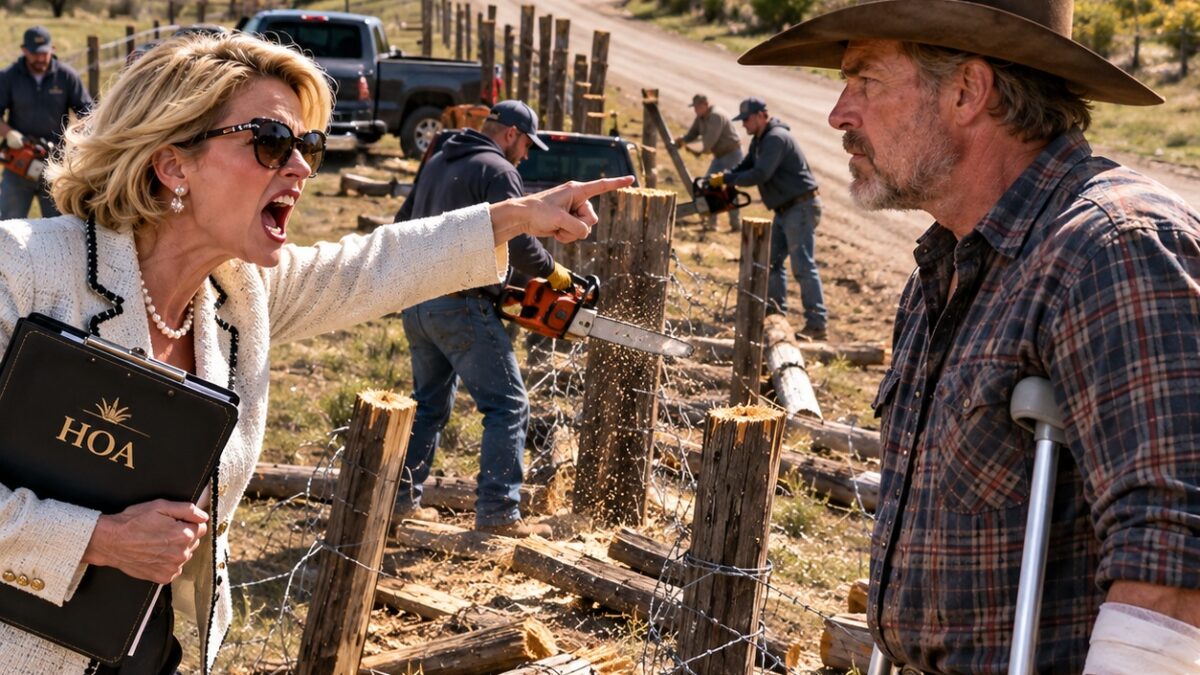
FULL STORY CONTINUATION
For a few seconds, I just stood there.
My hospital bracelet was still on my wrist.
I had not even unpacked the bag from the car.
Every breath tugged at the stitches in my abdomen.
The doctor had told me not to lift anything heavy.
Not to strain.
Not to do ranch work.
Apparently he had forgotten to tell the HOA.
The cut fence ran across the north line like an open wound.
Six posts.
About fifty yards of wire.
Not one strand clipped by somebody trying to get through during an actual emergency.
This had been cleared.
Deliberately.
Posts cut low.
Wire dragged back.
Room wide enough for vehicles and people to pass comfortably.
I followed the tracks.
Small SUV tires had left a repeating chevron in the dry dirt.
On the HOA side of the line, two lawn chairs sat in flattened grass.
Someone had been watching.
Waiting.
Supervising.
A plastic sports drink bottle lay near one of the cut posts.
I picked it up automatically.
Then looked at my hand.
“Damn it.”
If this became evidence, I had just put my fingerprints all over it.
I set it down exactly where I had found it and took out my phone.
Photographs.
Fence.
Posts.
Wire.
Tracks.
Bottle.
Chairs.
Everything.
Then I called the sheriff.
He knew my family.
He was also the man who had stood beside the river the morning they pulled my sister’s truck out.
Seeing his cruiser come up my drive brought back more than I wanted.
I forced myself to stay upright.
He got out, looked at me once, and immediately saw the hospital posture.
“You supposed to be home?”
“I am home.”
“You know what I mean.”
“I know.”
He walked the damage slowly.
Did not touch anything at first.
Looked at the tire tracks.
Saw the sawdust.
Studied the cut posts.
Then he took off his hat.
“We got a call last week.”
“About what?”
“Dangerous livestock.”
I stared at him.
“Where?”
“Near the HOA trail.”
“What HOA trail?”
He gave me a look.
Exactly.
“The caller claimed livestock were threatening residents and emergency access was needed.”
“My livestock?”
“Your cows.”
“My Angus have the personality of bread.”
He coughed into his hand to hide a laugh.
“The caller said they appeared aggressive.”
“And that gave them permission to cut my fence?”
“No.”
“Who called?”
He hesitated only because he already knew how I would react.
“HOA president.”
Of course.
“She said they needed an emergency egress route in case residents had to get away from the animals.”
I stared through the opening.
“So they brought a chainsaw.”
“Her husband apparently did.”
I closed my eyes.
The pain in my stomach pulsed with my heartbeat.
“They trespassed while I was in the hospital.”
“Yes.”
“They knew I was gone.”
“Looks that way.”
“They cut a livestock fence and opened my property toward their development.”
“Yes.”
“My horses could have gotten through there.”
“Yes.”
“And County 12 is right beyond their streets.”
“Yes.”
He waited.
“You want to press charges?”
That question was heavier than it should have been.
My father had believed in peace whenever peace was still available.
He would repair somebody else’s fence before starting an argument over who broke it.
He loaned equipment.
Let neighbors cross the road.
Ignored small mistakes.
“Think long term,” he always said.
“People remember how you treat them when things go wrong.”
For one second, I could hear him.
Fix the fence.
Keep the peace.
Then I heard my mother.
Not literally.
But I knew exactly what she would have said.
This is about the line.
My sister would have laughed from somewhere behind both of them.
Try again, slowpoke.
I looked at the sheriff.
“Yes.”
“You sure?”
“Yes. I want a report, and I want charges pursued.”
He nodded.
No judgment.
“I’ll talk to them.”
“Good.”
“Get the fence repaired today if you can.”
“I just had surgery.”
“I know.”
He looked toward the open pasture.
“But if one of your animals gets through there, they’ll use it against you.”
He was right.
Of course he was.
That was the infuriating part.
Someone else could destroy my boundary and somehow I still had to move faster than they did to keep their misconduct from becoming my liability.
I called the neighbor who owned the post driver.
He arrived twenty minutes later.
Did not ask why.
He saw the hole.
Saw me standing there pale and bent slightly at the waist.
Then unloaded T-posts.
“Doctor say you can work?”
“No.”
“Then don’t.”
“I can pull wire.”
“No.”
“I can use one hand.”
He stared at me.
“Your parents didn’t raise you right.”
“They absolutely did.”
“You’re an idiot.”
“That too.”
We rebuilt it together.
He drove posts.
I reran wire more carefully than quickly.
Every movement hurt.
The fence went back together one section at a time.
Post.
Wire.
Staple.
Tension.
It felt almost surgical.
Stitches in the land.
By sunset the line was closed again.
I stood looking at it.
Exhausted.
Sweaty.
Sore enough that the pain medication waiting inside suddenly seemed religious.
My neighbor wiped his hands.
“They come back?”
“I’m changing the rules.”
He looked at me.
“What rules?”
I did not know yet.
But something had changed.
For decades, my family had treated access to the ranch as a matter of trust.
The road.
The creek.
Neighbors crossing.
People hunting coyotes with permission.
Everybody understood that permission was not ownership.
The HOA did not understand that distinction.
Worse.
They understood and were trying to erase it.
The next afternoon, Karen came back.
Two board members with her.
No casserole.
No soft sympathy voice.
No one pretending they cared about my grief.
Just clipboards and crossed arms.
I stayed on the porch.
“You cut my fence.”
Karen did not deny it.
“We created temporary emergency access.”
“On my property.”
“Because of your aggressive livestock.”
I laughed once.
It hurt my abdomen.
“You trespassed.”
“There were cows.”
“Yes.”
“Large cows.”
“They’re cattle, Karen. They live here.”
“We had residents who felt unsafe.”
“Then your residents should remain on your property.”
She tilted her head.
“We needed an emergency exit.”
“Through a barbed-wire livestock fence?”
“It was the most direct route.”
“That does not make it yours.”
One board member shifted.
Karen continued.
“We heard you were hospitalized.”
That sentence did something to me.
Not because it admitted knowledge.
Because of the casual way she said it.
As though my absence had simply been a scheduling detail.
A convenient opening.
“And instead of calling me?”
“We needed to act.”
“You knew I was unavailable.”
“We understood you were recovering.”
“You cut fifty yards of fence while I was in surgery.”
She sighed.
The way people sigh when they believe your emotions are making a business matter unnecessarily complicated.
“We made a decision for the safety of the community.”
“The community does not include my ranch.”
Her smile returned.
“It will.”
There it was.
Not fence.
Not cows.
Not emergency access.
Expansion.
The ranch was still a problem waiting to be absorbed.
She continued.
“We’re improving the trail network, and the developer guaranteed creek access.”
“No.”
“Excuse me?”
“There is no creek easement across my land.”
“Our documents—”
“Show me the recorded easement.”
She opened her mouth.
I pointed toward the folder beside my chair.
Inside were copies of every relevant plat and deed because I had learned never to meet HOA people without paper nearby.
“The developer cannot grant access across property he doesn’t own.”
She looked at the two board members.
Neither helped.
“If you bring a chainsaw onto my ranch again,” I said, “I won’t only sue the HOA.”
Her eyebrow lifted.
“I’ll sue you personally.”
That changed her expression.
Only slightly.
Enough.
“You would sue the HOA president personally?”
“If the HOA president personally participates in trespass and property destruction? Yes.”
She folded her arms.
“You people are unbelievably ungrateful.”
I almost missed the phrase because my anger rose so fast.
Ungrateful.
“For what?”
“We have maintained your road for years.”
I stared at her.
“My road.”
“We’ve paid for gravel.”
“Without permission.”
“We improved it.”
“We have maintained that road since before your development existed.”
“Our residents rely on it.”
“That doesn’t make it yours.”
“It’s functionally a community asset.”
“No.”
That word came out quieter than the others.
“No?”
“No.”
I looked beyond her toward the road.
The gravel line running east, then north to County 12.
My father had taught me to run the tractor blade down it after heavy rain.
My mother complained every spring about potholes near the culvert.
My sister and I had patched ruts when we were teenagers because Dad refused to let us borrow the truck unless we helped maintain the road we drove it on.
It was not an HOA asset.
It was another kindness they had reclassified as entitlement.
“You think you’ve maintained my road?”
Karen’s jaw tightened.
“We have invoices.”
“Good.”
My voice went even quieter.
“You can keep them.”
“What does that mean?”
“It means your residents are done using it.”
The board members looked at each other.
Karen laughed.
Actually laughed.
“You can’t close that road.”
“I can.”
“It’s an established access.”
“By permission.”
“Our residents have used it for years.”
“With permission.”
“We have a prescriptive right.”
“No, you don’t.”
“You’re not an attorney.”
“My attorney is.”
I leaned against the porch railing because my stomach hurt.
“And we already recorded the permissive nature of that access.”
Her face changed again.
Not much.
But enough.
“As of right now, the HOA, its residents, board members, agents, contractors, and guests do not have permission to use my private road.”
“You can’t just decide that.”
“It’s my road.”
“This will create traffic problems.”
“Use the county road.”
“It adds almost ten minutes.”
“Seven.”
“What?”
“It adds seven minutes.”
She stared.
“Then your residents can spend seven more minutes respecting property rights.”
One of the board members muttered:
“This is ridiculous.”
I looked at him.
“Cutting somebody’s fence while they’re in the hospital is ridiculous.”
Karen stepped closer.
“You’ll be hearing from our attorney.”
“I look forward to it.”
And strangely, I meant that.
Because lawyers use paper.
Paper had never been the HOA’s strongest environment.
I had photographs of the fence.
Sheriff report.
Recorded deeds.
Road ownership.
Recorded permission history.
Their own correspondence.
The more formal they made the dispute, the less useful Karen’s confident tone became.
They left.
Karen spun gravel backing out.
I watched until the SUV disappeared.
Then I called my lawyer.
“I withdrew road permission.”
Long pause.
Then:
“All HOA residents?”
“Yes.”
“Because?”
“They cut my fence.”
“While you were hospitalized.”
“Yes.”
“Do you still permit historical neighbors?”
“Yes.”
“Good.”
“Can I gate it?”
“Let me check the record again.”
Twenty minutes later:
“Yes.”
I closed my eyes.
“Good.”
“But do it correctly.”
“I was planning to use dynamite.”
“I hate talking to you.”
“You bill by the hour.”
“Exactly.”
We did it correctly.
Very correctly.
I reconfirmed county ownership records.
My lawyer sent written notice.
Certified copies to the HOA.
Sheriff.
County attorney.
We cited the pattern of trespass and property damage.
Then I went to the hardware store.
Ten large PRIVATE ROAD — NO THROUGH TRAFFIC signs.
More NO TRESPASSING signs.
Warning signs.
Posts.
Bolts.
The employee at the counter looked at the pile.
“Trouble?”
“Nuisance.”
He nodded like I had named a familiar animal.
My neighbor lent me a post pounder.
For two days I installed signs along the road.
Not decorative little signs anybody could pretend not to see.
Large.
Black letters.
Clear.
Then I ordered a ranch gate for the entrance where our road met County 12.
Heavy enough for ranch use.
Wide enough for hay deliveries and equipment.
I mounted it properly.
Chain.
Lock.
I made keys.
The old farm south of us got one.
My retired-teacher neighbor got one.
The hunter who helped control coyotes got one.
People who had treated permission like permission kept access.
The HOA did not.
At the gate I put a smaller notice:
ACCESS BY PERMISSION ONLY
HOA MEMBERS, OFFICERS, AGENTS AND CONTRACTORS PROHIBITED DUE TO REPEATED TRESPASS, PROPERTY DAMAGE AND ADVERSE PROPERTY CLAIMS
That wording came from my lawyer.
My preferred version had profanity.
He said no.
I mailed another certified copy to the HOA.
Then I did something petty.
I made coffee.
Parked my truck where I could see the gate.
And watched.
The first SUV stopped around 7:20.
Brake lights.
Pause.
Driver got out.
Read sign.
Looked through gate.
Looked back toward County 12.
Got in.
Attempted a multi-point turn on the narrow shoulder.
Nearly dropped a wheel into the ditch.
Then drove away.
Ten minutes later, minivan.
Same.
Then Tesla.
Pickup.
Another SUV.
The seven-minute shortcut had apparently become a constitutional right overnight.
One teenager in a convertible rolled down his window.
“This is public!”
“No, it isn’t!”
He flipped me off.
Then stalled during his turn.
I almost felt bad.
Almost.
By noon, Karen arrived.
Three SUVs this time.
Board member.
Someone filming with an iPad.
A man in a suit I assumed was counsel.
They parked outside the gate like protesters arriving at an embassy.
Karen marched forward.
“What is this?”
“A gate.”
“Don’t be cute.”
“Then ask more interesting questions.”
She pointed.
“You are obstructing an established easement.”
“Show me the recorded easement.”
She looked toward the man in the suit.
He checked his phone.
I almost laughed.
He started:
“There may be a prescriptive—”
“No.”
He looked up.
“The road has been used openly and continuously by residents—”
“By permission.”
I had copies ready.
I held one up.
“My family has explicitly retained the right to allow and withdraw use. It has been recorded.”
Karen stepped toward the bars.
“We paid for improvements.”
“You spread gravel twice without asking.”
The lawyer looked at her.
I caught that.
Small.
Important.
“We have invoices,” she repeated.
“Keep them.”
“This gate is illegal.”
The lawyer did not endorse that sentence.
Also important.
Karen turned.
“Tell him.”
He adjusted his glasses.
“We’re reviewing the legal status.”
That was attorney language for:
Please stop talking.
Karen ignored him.
“We’ll sue.”
“Please do.”
“You’re making enemies.”
I looked at her.
“I have enough.”
That ended something.
Maybe in me.
I had spent two years afraid of loss.
Parents.
Sister.
Health.
Ranch.
Every new conflict felt like one more thing life might take.
Standing behind that locked gate, I realized Karen could not frighten me the way she expected.
What was she going to threaten me with?
Unpopularity?
I had buried my family.
Seven extra minutes did not make the list of things I feared.
They left.
The gate stayed.
For several days, things were quiet physically.
Online?
Apparently not.
I did not use the HOA Facebook group.
Neighbors sent screenshots.
SELFISH RANCHER BLOCKS CRITICAL COMMUNITY ACCESS
DANGEROUS LIVESTOCK THREATENS CHILDREN
FARM OWNER RETALIATES AGAINST HOA
They kept calling me a farmer like it was an insult.
I was a rancher, technically.
But that felt like correcting somebody who was already wrong in larger ways.
I did not respond.
No post.
No video.
No public argument.
My lawyer told me:
“Let them talk.”
“They’re lying.”
“Document the lies.”
“I hate lawyers.”
“Good.”
Then two mornings later, I woke to a diesel engine.
Close.
Too close.
I walked outside in sweatpants, boots, and an unzipped jacket.
Stopped.
A full-size red semi-truck sat sideways across my gate.
Not on County 12.
Not legally parked along a public shoulder.
On my property.
The rear wheels had crushed into my ditch.
The trailer blocked the entire entrance.
Karen stood on the far side with her arms folded.
Smiling.
The driver leaned out his window.
Backward cap.
Big grin.
“Nice place.”
I stared.
“Get off my property.”
Karen stepped forward.
“We’re exercising our right to protest.”
“By trespassing?”
“You’ve blocked a major thoroughfare.”
“My private road.”
“We are making a point.”
I looked at the truck.
Then the driver.
Then the tire ruts.
A thought came into my head.
Tractor.
Chain.
See who wins.
My father would have killed me.
Not literally.
But the lecture would last longer than the towing process.
Use the law when the law is on your side.
Another one of his rules.
I took out my phone.
Called the sheriff.
He arrived faster than expected.
Pulled up.
Looked at the semi.
Looked at Karen.
Removed his sunglasses slowly.
“No.”
Karen started:
“We’re engaged in a lawful protest—”
“No.”
“We have a right to—”
“No, ma’am.”
“This is an access road.”
“This is private property.”
“We’re on the road.”
“Which is private property.”
The driver’s grin disappeared.
Karen pointed at me.
“He illegally blocked community access.”
The sheriff looked at my gate.
Then at her.
“Recorded private road.”
Her lawyer was not present.
That told me something.
“He cannot do this.”
“He already did.”
She kept arguing.
Emergency access.
Community dependence.
Safety.
The sheriff let the words wash over him.
Then pointed at the driver.
“Move the truck.”
The driver said:
“I’m just here because she hired me.”
Karen spun.
“Do not move that truck.”
He looked at her.
Then at the sheriff.
“I ain’t getting arrested for your HOA.”
He started the engine.
Karen stepped in front.
The sheriff pinched the bridge of his nose.
“Ma’am.”
She refused.
The deputy moved toward her.
“Step aside.”
Karen pulled away.
“Don’t touch me.”
The board member filming everything moved closer.
Karen raised her voice.
“This is harassment.”
The deputy tried again.
“You are trespassing and obstructing the removal of a trespassing vehicle. Move.”
“I am the president of the HOA.”
I still do not understand why she thought that sentence had law-enforcement power.
The deputy cuffed her.
She went completely rigid.
The board member shrieked.
The driver put the semi in reverse.
Very carefully.
He backed out of my ditch and onto County 12.
I stayed where I was.
The cruiser door shut behind Karen.
Heavy.
Final.
She was not ultimately charged with anything serious that stuck.
County officials preferred de-escalation.
Fine.
I was not trying to send a middle-aged HOA president to prison.
I wanted the report.
Paper mattered.
The driver later found my number and texted an apology.
He said he thought he was participating in a political-style protest.
He had not understood the truck would be positioned on private land.
I believed him.
He told me he would never work for that board again.
Good.
Nobody should risk a commercial driving license over someone else’s property tantrum.
I hoped that would finally end the escalation.
Cut fence.
Locked road.
Semi.
Police.
Handcuffs.
Surely there was a point where reasonable adults said:
This has gone far enough.
I underestimated them again.
Several days later, I found two HOA board members inside my pasture.
Near the horse paddock.
Bucket.
Grain.
Rope.
My horses stood several feet away staring at them with the suspicion horses usually reserve for veterinarians and plastic bags.
“What are you doing?”
Both women jumped.
One recovered.
“We got a report.”
“From whom?”
No answer.
“What report?”
“We’re concerned about the animals.”
“On whose authority?”
“The HOA.”
I stared.
“The HOA has no authority over my horses.”
“They look neglected.”
I looked at the horses.
Sleek coats.
Good weight.
Trimmed hooves.
Clean water.
Hay.
Expressions of perfect equine disrespect.
“Leave.”
“We’re checking—”
“You are trespassing.”
One woman crossed her arms.
“We have a responsibility to protect community safety.”
“Get off my land.”
They eventually did.
One caught her yoga pants on barbed wire while climbing back.
I did not laugh.
Externally.
That night I sat at the kitchen table.
Cold coffee.
Dark windows.
The house felt too quiet again.
My parents gone.
My sister gone.
One empty chair after another.
I had repaired fences.
Filed reports.
Locked gates.
Sent notices.
Still I was waiting for the next ridiculous intrusion.
I could not be at every boundary all day.
I needed the fence itself to stop becoming an invitation.
Ranchers use electric fencing all the time.
Nothing exotic.
Proper livestock equipment.
Installed legally.
Clearly marked.
I called the feed store.
Ordered a manufacturer-rated system appropriate for cattle and horses.
My neighbor helped install it along the north boundary—the side the HOA kept touching.
We posted large yellow warning signs at regular intervals.
English.
Spanish.
Lightning-bolt graphics.
Impossible to miss.
I checked local requirements.
My lawyer checked.
The sheriff knew it was going in.
Everything legal.
Everything visible.
Nothing hidden.
No booby trap.
No trick.
A livestock fence.
The first night after installation, I slept better than I had in months.
Not because electricity made me feel powerful.
Because I finally believed the boundary could defend itself while I slept.
Two afternoons later, I heard yelling.
I stepped out of the barn.
Two HOA board members stood beside the north fence.
Polo-shirt guy.
Another man with a large stomach hanging over his belt.
They were on their side.
Good.
Then Polo reached out and touched the clearly marked electric wire.
He jerked backward.
Swore.
Stared at his hand.
The second man watched this demonstration of cause and effect and apparently concluded he needed independent verification.
He grabbed the wire.
He screamed.
Fell backward into the grass.
For a second he stayed there staring upward like electricity had introduced him personally to God.
Polo shook his hand.
Then, because intelligence had clearly left the property, touched another strand.
Another yell.
Little dance.
I walked toward them.
“It’s electric.”
Polo glared.
“You can’t have that.”
I pointed at the yellow sign less than ten feet from him.
“I can.”
“That’s dangerous.”
“Not if you leave it alone.”
The other man sat up.
“You assaulted us.”
I actually smiled.
“No.”
My smile was not generous.
“Physics assaulted you.”
Polo’s face reddened.
“You’re going to regret this.”
“The fence is legal.”
“We’re suing.”
“Please do.”
They went to the emergency room.
I know because the sheriff called later and because somebody’s wife posted online about my “electrified booby trap.”
The sheriff requested photographs.
I sent them.
Signs.
Fence.
Manufacturer information.
Location.
He called back.
“You’re fine.”
“They keep coming to the fence.”
“Which is why you installed it.”
Exactly.
The online story collapsed faster than their legal one.
They posted:
RANCHER ELECTROCUTES HOA OFFICIALS
Somebody else posted a photograph of the yellow warning signs.
Residents began asking:
“Why were they touching his fence?”
Then:
“Why were they there at all?”
Then:
“Why is the board still going after this ranch?”
That was the shift.
For years, the board had controlled the narrative by speaking first and loudly.
The ranch is difficult.
The ranch refuses community standards.
The ranch blocks access.
The ranch is unsafe.
Now their own behavior forced people to look closer.
Fence cut while owner hospitalized.
Semi parked on private property.
President cuffed after refusing a sheriff’s order.
Board members caught inside horse pasture.
Two other board members voluntarily touch marked electric fence.
At some point, even residents who had believed Karen started asking whether the ranch was actually the problem.
Without the private shortcut, daily life inside the development became more inconvenient.
Those seven minutes multiplied.
Work.
School.
Soccer.
Deliveries.
Garbage collection.
Service contractors.
Everybody went around.
Maple Street traffic increased.
The county curve carried more vehicles than residents liked.
Minor fender benders.
Late packages.
Complaints.
Suddenly the board’s obsession had a cost for people who had never cared about my ranch one way or the other.
HOA meetings got louder.
Real questions appeared.
Why had the board antagonized the landowner whose private road residents relied on?
Why did they believe they owned creek access?
Why were board members entering private pasture?
What exactly had happened with the fence?
Why was HOA insurance now involved?
I did not attend.
Not my HOA.
That was the whole point.
I stayed on the ranch.
Fed cattle.
Worked.
Fixed whatever broke.
Let the community argue with itself.
Long-term residents began defending us publicly.
One woman wrote that she had moved there partly because she liked seeing open ranchland.
Another said hearing a rooster did not make her property less valuable.
Someone else said:
“Maybe stop trying to turn every inch around us into HOA property.”
I liked that person.
Never met them.
Online, the famous “assault” gradually became:
They touched an electric fence.
Which became:
They touched an electric fence after reading signs.
Which became:
Why?
Facts are stubborn once people finally look at them.
The road was mine.
The fence was mine.
No recorded creek easement existed.
The ranch predated the development.
They had cut my fence.
They had blocked my gate.
They had trespassed repeatedly.
None of those things made them victims.
My lawyer sent formal claims.
Not full lawsuits.
Yet.
Fence repairs.
Ditch damage from the semi.
Other documented losses.
We sent photographs.
Estimates.
Sheriff reports.
Certified notices.
Copied the HOA’s insurer.
The board ignored the demand initially.
The insurance company did not.
An adjuster called.
“What’s the minimum amount that resolves the fence claim?”
“The amount we sent.”
He laughed slightly.
“Had to ask.”
They paid the fence damage.
The ditch became an argument.
I resent photographs.
Repair estimates.
They paid part.
Good enough.
Not because I was giving up.
Because I cared more about creating consequences than turning every rut into years of litigation.
Paper mattered.
Insurance mattered.
Financial pain mattered.
Karen had treated trespass as an HOA tool.
Now each incident had a claim number.
That changed behavior faster than anger did.
Then something happened I had not expected.
The HOA had an election.
People were tired.
Not heroic.
Not suddenly anti-HOA.
Just embarrassed.
They wanted to get to work.
Wanted their kids not to grow up thinking cows were monsters.
Wanted deliveries.
Wanted their neighborhood to stop becoming the punchline at local stores.
Somebody had posted video of Karen being escorted into the cruiser.
The caption was something like:
WHEN HOA KAREN MEETS THE REAL WORLD
It traveled.
Small-town viral.
Feed store.
Facebook.
Phones.
Enough.
Karen hated it.
But the video also showed residents what had happened.
Their president had refused a direct instruction from law enforcement while standing on private property after using a semi to block somebody’s gate.
Hard to spin.
A group of homeowners started a “Restore Sanity” campaign.
That name still makes me laugh.
They ran two candidates.
One was a retired school principal.
The other owned a small landscaping business.
Their promises were not complicated.
Stop claiming ranch property.
Stop trespassing.
Solve internal traffic problems internally.
Do not use chainsaws on fences the HOA does not own.
Remarkably popular platform.
They won.
Karen’s board was out.
The first thing the new leadership did was send me a letter.
I almost threw it into the drawer unopened.
Same place I had tossed the sympathy card after my sister died.
But the envelope looked different.
No aggressive legal language outside.
No “compliance.”
No “community asset.”
I opened it.
The letter apologized for actions of the previous board.
Plainly.
No passive voice.
No:
Mistakes were made.
It said they would cease all attempts to claim any portion of my ranch.
They acknowledged the road as privately owned.
They would instruct residents not to use it.
They wanted to reimburse remaining ditch damage.
Then they asked for something.
Not demanded.
Asked.
Would I consider granting emergency access through the gate for fire-department use only?
Actual emergencies.
Nothing else.
I read the letter twice.
Then sent it to my lawyer.
He called.
“This is what reasonable looks like.”
“I barely remember.”
“Me either.”
We met in town.
Coffee shop.
Bad muffins.
Good coffee.
The retired principal arrived with a binder.
Of course.
Principal.
Binders are biological.
The landscaper had dirt under his fingernails.
I liked him immediately.
Neither brought counsel.
No clipboard.
No speech about community values.
The principal started:
“We owe you an apology.”
I said nothing.
“The previous board crossed lines.”
“Yes.”
“We are not going to defend that.”
Good.
“We understand the road is private.”
“Yes.”
“We’re rerouting neighborhood signage and communications so residents stop approaching your gate expecting access.”
Better.
The landscaper slid an estimate across the table.
“We’ll reimburse the remaining ditch repair.”
I looked at the number.
Fair.
Then came the emergency question.
There was a far north section of their development where county-road congestion could slow fire response.
Would I allow fire apparatus through my gate only during genuine emergencies?
They proposed a Knox Box—secure emergency-access key system—so firefighters could open the ranch gate without giving everyday residents access.
The HOA would pay.
I did not answer.
The principal nodded.
“You don’t have to decide today.”
That sentence earned more trust than anything Karen had said in years.
Choice.
Actual choice.
I took two weeks.
Walked the north pasture.
Mostly at dusk.
That was the time my parents used to walk.
Sometimes my sister raced ahead when we were kids.
The land held memories whether I wanted it to or not.
Cottonwoods moving.
Grass.
The creek.
Birds settling.
Fence humming faintly where the electric section ran.
I thought about why I had closed the road.
Not revenge.
Protection.
Permission had been abused.
Closing access restored the boundary.
Would emergency fire access weaken that?
Only if we blurred the terms again.
So I called the fire chief.
Old guy.
Hands that looked like they had held frozen hose lines in January.
“What do you think?”
“I’d appreciate emergency access.”
“Only emergencies.”
“Only emergencies.”
“No HOA use.”
“I don’t care about their commute.”
I laughed.
“Good.”
“If there’s a structure fire and County 12 is jammed, seven minutes could matter.”
That sentence was different.
Seven minutes for yoga class?
No.
Seven minutes for a burning house?
Yes.
My parents would have agreed.
My sister definitely would have.
Protecting a boundary did not require becoming cruel with it.
So I agreed.
Written agreement.
Narrow.
Clear.
Emergency services only.
No general traffic.
No resident access.
No adverse claim.
My lawyer made sure everything said exactly what it needed to say.
The Knox Box went on the gate.
The HOA paid.
The new president sent a letter to every homeowner explaining the road had never belonged to the association.
Use was by permission.
Permission was permanently withdrawn from residents, officers, contractors and guests.
Emergency services retained limited access under a new written agreement.
Trespass would be reported.
That letter probably did more good than ten arguments with Karen ever could.
It stated reality.
No performance.
No threat.
The angry social-media posts gradually disappeared.
Some residents still complained.
Fine.
People are allowed to dislike consequences.
They are not automatically entitled to relief from them.
The seven-minute shortcut was gone.
Permanently.
I kept the gate locked.
The electric fence remained.
Warning signs stayed.
Life became quieter.
There was no dramatic day when I declared victory.
One morning I simply noticed no one had come to the gate in weeks.
No SUV idling.
No board member photographing my fence.
No letter.
No chainsaw.
Nothing.
I stood in the barn listening.
Cattle.
Wind.
Metal bucket shifting.
Normal.
I had forgotten what normal sounded like.
Grief had distorted normal too.
For two years, every part of the ranch had been attached to someone dead.
Dad’s tools.
Mom’s books.
My sister’s coffee mug.
The road where we learned to drive.
The creek where we raced as kids.
Then the HOA layered conflict on top of mourning.
Fence.
Road.
Letters.
Sheriff reports.
It gave my anger somewhere external to go.
When the fighting stopped, grief returned differently.
Not as violently.
Still there.
One evening I walked down to the creek.
Sat where my sister and I used to throw rocks.
Found a flat one.
Skipped it twice.
Terrible.
She would have gotten five.
“Try again, slowpoke.”
I could hear it.
So I did.
Three.
Better.
I laughed alone.
That was the first time the creek felt like ours again instead of the place where my mind connected water only with the river that took her.
Healing is strange.
Land stores pain.
Then sometimes gives something back.
The ranch survived.
That mattered.
People say land is just land.
Maybe if you have never lived somewhere long enough to know it through generations.
Our ranch was not valuable because every acre generated maximum economic return.
If that were the standard, the developer would win.
They could build more houses per acre than I could raise cattle.
Money per square foot was never the point.
My father’s hands were in the fence lines.
My mother’s notes were in the calving records.
My sister’s laughter lived somewhere between the road and creek whether science approved or not.
When Karen looked at the ranch, she saw undeveloped opportunity.
When I looked at it, I saw family.
Those valuations were never going to reconcile.
And they did not have to.
Ownership meant I got to decide.
That was the thing the old board refused to understand.
They kept treating neighborliness as preliminary ownership.
You let us use the road.
Therefore the road is communal.
You let people walk near the creek.
Therefore we have access.
You did not complain when gravel was spread.
Therefore we maintain the road.
You have livestock near our houses.
Therefore we regulate livestock.
You did not join us.
Therefore eventually you will.
Every courtesy became evidence of entitlement.
That is how you kill neighborliness.
If kindness can later be used against you, people stop being kind.
The new board understood that.
They never asked me to reopen the road.
That mattered.
They asked for one narrow public-safety exception.
Documented.
Controlled.
I said yes.
That was neighborliness.
Choice freely given.
Very different from someone arriving with a clipboard and telling you they had already decided.
Sometimes homeowners from the development saw me in town.
At first conversations were awkward.
A woman approached near the grocery store.
“I’m sorry about what the board did.”
“You weren’t on the board.”
“I voted for them.”
That surprised me.
She looked embarrassed.
“We thought Karen was organized.”
“She was.”
That answer surprised her.
Bad leaders are not always incompetent.
Karen got things done.
That was part of the problem.
Efficiency can hide boundary problems until somebody outside the system says no.
The woman continued.
“I didn’t know they cut your fence while you were hospitalized.”
“I know.”
“They told us there was an animal emergency.”
“I know.”
“My husband touched that electric fence story online and thought your side was crazy.”
I stared.
“Your husband touched it?”
“No. He read about it.”
“Good.”
She laughed.
Then became serious.
“People should have asked more questions.”
Maybe.
I did not need apologies from every resident.
Most were simply living their lives while their board behaved badly.
That does not make silence harmless.
But I had no interest in treating ninety-seven families as copies of Karen.
The new election proved they were not.
A neighborhood is not its worst board.
That lesson took me time.
I had started seeing every vehicle from Anon Estates as intrusion.
Understandable.
Not healthy forever.
Once leadership changed, I let individual people become individuals again.
The road remained closed.
Forgiveness does not require restoring the conditions that allowed harm.
That is important.
We could become civil neighbors without reopening the shortcut.
Some residents thought the new board should negotiate for it.
The principal apparently told them:
“No.”
I heard this from someone else.
They asked why.
She said:
“Because he withdrew permission after we abused it. We are not rewarding ourselves by asking him to trust us with the exact same access.”
That woman understood boundaries.
I liked her.
The landscaping guy eventually came to the ranch to inspect the damaged ditch before reimbursement.
He looked at my fence.
“Nice charger.”
“Works.”
“I heard.”
We both laughed.
He had no problem with livestock fencing.
Occupational reality.
Then he looked down the private road.
“I understand why people miss it.”
“Seven minutes.”
“Seven minutes feels big when you’re late.”
“So leave earlier.”
He grinned.
“Exactly what the principal says.”
Their HOA meetings must have become less fun.
Good.
Leadership should occasionally be boring.
The insurance payments came.
Fence repairs covered.
Most ditch work covered.
I fixed the remaining damage myself because I wanted the ground correct.
I seeded the torn area.
Rain came.
Ruts softened.
Grass returned.
Months later, you could barely tell where the semi had backed in.
That physical erasure gave me more satisfaction than the video of Karen in cuffs.
People expected the handcuffs to be my favorite part.
They weren’t.
Temporary consequence.
Grass growing over the damage?
Better.
Fence upright?
Better.
Gate working?
Better.
No trespass?
Best.
I never needed Karen humiliated forever.
I needed her unable to keep entering my life.
She lost the election.
That accomplished more than any punishment I could have pursued.
Her board disappeared.
I do not know or care about every detail of what happened to her socially afterward.
The source does not support a criminal conviction, lawsuit ruin, foreclosure, divorce, or any of the dramatic things people might add.
So I won’t.
She lost authority.
The system corrected direction.
Enough.
The semi driver’s apology also stayed with me.
He could have disappeared.
Instead he admitted:
I didn’t know.
Sorry.
That mattered.
People make mistakes inside other people’s conflicts.
He believed he was participating in a protest.
When law enforcement clarified the property issue, he moved.
He chose his livelihood over Karen’s ego.
Smart.
I did not hold a grudge.
That is the difference between somebody making a bad decision and somebody repeatedly insisting the bad decision creates authority.
Karen had exits.
After the fence.
After the gate.
After the sheriff arrived.
After he said move the truck.
After the deputy told her to step aside.
Every time, she escalated.
I think about that pattern.
People sometimes destroy themselves not because one mistake was unforgivable, but because admitting the mistake becomes more frightening than making a larger one.
The first HOA request years earlier had been almost harmless.
Would you join?
No.
Healthy response:
Okay.
Instead:
Fence complaint.
Road claim.
Creek easement.
Code reports.
Grief exploitation.
Trespass.
Fence cutting.
Semi.
Horse pasture.
Electric-fence outrage.
Each escalation protected the previous claim.
By the end, the board was defending actions nobody sensible would have proposed at the beginning.
That happens in institutions.
Pride becomes policy.
The new board broke the chain by saying one sentence the old one could not.
We were wrong.
Powerful.
Cheap.
Available from the beginning.
The retired principal told me at coffee:
“The previous board created a conflict we cannot win and should not have started.”
I almost laughed.
Not because it was funny.
Because hearing reality stated plainly after years of nonsense felt surreal.
“You know the road is mine.”
“Yes.”
“No easement.”
“Yes.”
“The ranch isn’t subject to your HOA.”
“Yes.”
“My fence stays.”
“Yes.”
“Your residents stay off my property.”
“Yes.”
Then she asked for emergency access.
See how easy that was?
No manipulation.
No fake maintenance claim.
No threatening attorney.
A specific request.
A specific reason.
I got time to think.
Then answered.
Civil society restored.
It made the years before feel even more absurd.
My father had believed most neighbor problems could be solved with direct conversation before they became legal fights.
He was right.
But direct conversation requires accepting the possibility of no.
Karen wanted dialogue only if the answer was yes.
That is not negotiation.
That is a delayed order.
My mother recognized that the first day.
Karen said:
“Not yet.”
Mom’s face changed.
She knew.
Some people hear your boundary as incomplete consent.
Mom never trusted that.
I wish I had listened sooner.
We tolerated more than we should.
The repeated pitches.
Notes.
Road assertions.
Maybe if we had shut the road years earlier, none of this would have happened.
Maybe.
Maybe it would have accelerated sooner.
There is no useful answer.
You cannot retroactively optimize family history.
My parents chose neighborliness.
That was not wrong.
Karen abused it.
That was wrong.
Responsibility belongs where the decision was.
I refuse to turn my family’s kindness into a mistake just because someone exploited it.
I can change future practice without condemning the past.
That distinction helped.
The road stays private now.
Historical neighbors retain keys.
I still let people use it when I choose.
That is important.
Karen did not turn me into somebody who locks everyone out.
She taught me to document permission.
Old farmer to the south?
Key.
Retired teacher?
Key.
Hunter?
Key.
Fire department?
Emergency key.
Random HOA commuter late for Pilates?
County road.
Seven minutes.
I sleep well.
The electric fence remained too.
People sometimes laugh about the board members getting shocked.
Yes, visually ridiculous.
Two grown men standing beside multiple warning signs deciding to test electricity personally.
But the fence was not installed to hurt people.
That matters.
It was installed because repeated trespass made passive wire insufficient.
After those two incidents, nobody touched it again.
Which is exactly how livestock fencing is supposed to work.
Boundary recognized.
No continuing harm.
One lesson.
Distance.
The fence did what police reports and letters had not.
It made the abstract line physically undeniable.
The old barbed wire had become something HOA members considered negotiable.
The electric wire reminded them the ranch existed outside their governance.
I do not romanticize pain.
One shock would convince me.
Apparently Polo needed two.
Personal growth has individual timelines.
The “physics assaulted you” line became local legend.
I regret that slightly.
Only because now people repeat it to me in the feed store.
“Careful, physics might get you.”
Very funny.
Small towns never let anything die.
Someone printed it on a mug.
No.
I am not inventing that.
The source does not say anyone printed a mug.
See?
This is how stories grow.
Reality is already funny enough.
The actual feed-store people did know.
Everybody knew.
The video traveled.
The fence photos traveled.
Our county had entertainment for weeks.
I avoided it.
The ranch did not need more attention.
That was always the irony.
The HOA claimed we were hurting their property values through appearance.
Then their campaign made the entire development locally famous for entitlement.
They manufactured the reputational damage they blamed on cattle.
No marketing consultant could have done better.
Long-term residents understood that eventually.
They wanted out of the joke.
Restore Sanity.
Good slogan.
The retired principal and landscaper won because people were tired of drama.
That is another lesson.
Most communities do not want war.
They want trash collected.
Roads functional.
Pool clean.
Dues understandable.
Kids safe.
Karen’s board had turned administration into identity.
When leadership becomes entertainment, members eventually receive the bill.
Insurance claims helped them notice.
Money clarifies.
Fence repair costs.
Ditch damage.
Attorney letters.
Probably legal consultation on their side.
All because someone wanted seven minutes and creek access.
I never calculated the total.
Not my problem.
My lawyer asked whether I wanted to pursue broader damages.
Harassment.
Repeated trespass.
Other costs.
I thought about it.
Then said no, at least not beyond the documented claims we already sent.
Why?
I wanted peace more than another year of conflict.
A lawsuit can be justified and still consume your life.
I had lost enough life.
If they stopped, paid the direct damage, respected the boundary, and changed leadership, I did not need a courtroom victory.
That decision surprised my lawyer.
“You sure?”
“Yes.”
“You could have viable claims.”
“I know.”
“You’re the one who said make it expensive.”
“They lost their board.”
“True.”
“They lost road access.”
“True.”
“They’re paying repairs.”
“True.”
“I want to check cattle without thinking about depositions.”
He paused.
“Good reason.”
That may have been the moment I knew the fight was ending.
Not when Karen was cuffed.
Not election night.
When I chose not to keep the conflict alive simply because I had legal grounds.
There is a difference between defending a boundary and making the enemy part of your identity.
I did not want Karen living in my calendar for three more years.
She had taken enough mental space.
I chose the ranch.
Again.
The first winter after the new board took over felt quiet.
Snow came.
Not much.
Enough to turn the pastures white in the morning.
The HOA used its own roads.
Their contractor did not plow mine.
I did.
Same tractor.
Same blade.
Dad taught me how when I was sixteen.
I drove slowly.
Snow rolled to the side.
Gate ahead.
Locked.
Knox Box attached.
No one waiting.
I stopped.
Engine idling.
Looked north toward the development.
Smoke from chimneys.
Lights.
Normal neighborhood.
Not enemy territory.
Just houses.
Then I looked south.
Ranch.
Home.
For the first time, both could exist in my mind without one trying to consume the other.
That is what boundaries do when respected.
They allow proximity without ownership.
You live there.
I live here.
We cooperate where useful.
We do not absorb each other.
Simple.
Humans make it complicated.
Spring followed.
Calves again.
That season always gets me.
The first calf born after my parents died nearly destroyed me.
Mom would have known which cow was close before I did.
Dad would have complained about weather.
My sister would have named something stupid even though we did not name market calves.
Now I handled it alone.
Not entirely.
Real neighbors still came.
The man with the post driver.
Retired teacher.
South farm.
They checked in.
Not because an association assigned them.
Because community existed before bylaws.
That difference mattered more after everything.
Karen had constantly used the word community.
Join the community.
Community access.
Community safety.
Community standards.
But the people who actually showed up while I was in the hospital were not her board.
My neighbors fed animals.
Locked gates.
Drove posts.
Brought food after funerals.
Sat in silence.
Community is behavior.
HOA is structure.
Sometimes they overlap.
Not automatically.
The new board came closer because they behaved like neighbors.
They asked.
Apologized.
Respected no.
Paid damage.
That earned cooperation.
No amount of glossy membership brochures ever could.
I never joined.
Obviously.
No reason.
The ranch remained outside.
That was not hostility.
It was simply the legal arrangement that had always existed.
The principal understood.
“We’re not asking you to join.”
“Good.”
“I assumed.”
“You’d be amazed.”
She laughed.
I liked her.
Still did not join.
The creek remained private too.
No pedestrian easement.
No HOA dog trail.
Residents sometimes asked whether I would reconsider.
Not formally.
Passing conversation.
I usually said:
“No.”
No speech.
No debate.
That is another thing I learned.
You do not owe everyone a courtroom argument for your boundary.
No can be complete.
Karen trained me to over-explain because every no triggered a challenge.
The new board helped me remember reasonable people can hear one.
No.
Okay.
Move on.
Beautiful.
My sister would have loved that part.
She had never been patient with unnecessary explanation.
When someone asked why she did something, she often said:
“Because I wanted to.”
Infuriating.
Efficient.
I missed her every day.
The HOA story cannot have a clean triumphant ending because my parents and sister remain dead.
Saving the ranch did not bring anyone back.
That is important.
Sometimes revenge stories lie emotionally.
Hero loses something.
Villain attacks.
Hero wins.
Loss feels resolved.
No.
My losses stayed.
The empty bedrooms.
Photos.
Dad’s jacket.
Mom’s handwriting.
My sister’s coffee mug.
What changed was that I stopped letting strangers use my grief as evidence I could not defend what remained.
That was the real counterattack.
Not the gate.
Not electricity.
Decision.
I was still alive.
The ranch was still mine.
Grief had made me passive in some ways.
Understandably.
Karen mistook exhaustion for surrender.
Those are not the same.
A person can be brokenhearted and still own a deed.
Can cry in the barn and still file a police report.
Can miss three people desperately and still install a gate.
Strength after loss rarely looks dramatic.
Sometimes it is signing a certified letter.
Sometimes getting out of bed.
Sometimes rerunning fifty yards of wire with stitches pulling at your abdomen because someone else created a hole where your family line belonged.
I do not recommend that last one medically.
Listen to your surgeon.
My neighbor should have tied me to a chair.
But emotionally, repairing the fence mattered.
I had come home from the hospital feeling fragile.
Then saw someone had treated my absence as permission.
Every post we reset said:
No.
Still here.
Every wire:
No.
Still ours.
The gate later made that permanent.
The seven minutes became symbolic.
Karen thought removing them would make me unpopular enough to surrender.
Instead, losing the shortcut made residents examine why they had ever believed it belonged to them.
Convenience disguises property relationships.
Drive somewhere for years.
It starts feeling public.
Use a path.
Feels shared.
But feeling is not title.
My lawyer said that constantly.
“Use doesn’t automatically create the right they think it creates, especially where permission is documented.”
That permission record saved us enormous trouble.
Dad had updated it in 1999.
We updated again after the first HOA threats.
Thank God.
Good paperwork is boring until someone lies.
Then boring becomes armor.
If there is one practical thing I learned, it is this:
Document kindness.
That sounds sad.
It is not.
You can let someone use your road and still make clear it is permission.
You can share without surrendering.
Boundaries make generosity safer.
My parents operated mostly by handshake because they knew their neighbors.
Different world.
Once development arrived, scale changed.
Ninety-seven households.
Board.
Developer.
Turnover.
Nobody remembered the original conversation.
Paper had to replace memory.
We adapted.
The new board wrote everything too.
Emergency fire access.
Exact.
Limited.
Recorded.
No ambiguity.
That is how trust rebuilt.
Not by pretending paper is unfriendly.
By using paper so friendliness does not have to carry legal weight.
The fire chief tested the emergency access once after installation.
He opened the Knox Box.
Unlocked the gate.
Drove through.
Closed it.
Worked.
He called me.
“Good setup.”
“Don’t let Karen know.”
Silence.
Then laughter.
“Too soon?”
“Probably never.”
That was enough.
I liked knowing the gate could help someone in a real emergency.
A burning home.
Medical response.
Wildfire.
Those uses aligned with why my family had historically let neighbors use the road.
Help people.
Difference:
Residents no longer turned help into right.
The line held.
That phrase became important to me.
The line holds.
Physical fence.
Legal boundary.
Emotional boundary.
I could remember my family without allowing the ranch to become a shrine nobody touched.
Could cooperate without surrender.
Could forgive residents without reopening the road.
Could stop pursuing Karen without pretending she had done nothing wrong.
Boundaries let conflicting truths coexist.
My mother understood that.
She was kind.
Also absolutely willing to tell someone to get off her property.
No contradiction.
Kindness without boundaries becomes exhaustion.
Boundaries without kindness become isolation.
We needed both.
The electric fence hummed.
The gate opened for people with permission.
Good system.
One dusk I walked the north line.
The development sat beyond.
Kids somewhere shouting.
Dog barking.
My cattle moving slowly through grass.
The fence signs were still bright yellow.
No damage.
No footprints.
Nothing.
I stopped where the fifty-yard cut had been.
If you did not know, you would not notice.
Replacement posts weathered now.
Wire blended with old.
Grass covered sawdust.
The land had healed faster than I had.
I touched one post.
Thought about the day I came from the hospital.
I had believed the fence damage was another loss.
Instead it became a boundary clarified.
I would never thank Karen for that.
Some lessons are useful and still not gifts.
She did not teach me kindly.
But I learned.
My phone buzzed.
Message from the retired teacher asking if I wanted pie.
Community.
I answered yes.
Obviously.
Some boundaries should remain open.
Pie access is sacred.
I walked home.
The house still felt too big sometimes.
That never fully changed.
But it no longer felt like a tomb.
Work helped.
Time.
Neighbors.
The creek.
Maybe defending the ranch gave me a reason to imagine staying.
Before the conflict, after my sister died, there were days I considered selling.
Not seriously enough to list it.
Enough to think:
Why am I doing this?
Four generations became heavy when I was the only one at the table.
Then the HOA started acting like the ranch’s future had already been decided.
That anger clarified something.
I did not want to sell.
Not then.
Maybe someday.
Choice was mine.
Funny how somebody trying to take something can remind you why you still want it.
Karen probably thought she was pressuring me toward surrender.
She anchored me instead.
Again—not gratitude.
Just consequence.
I began making improvements.
Small.
The better squeeze chute my sister and I had talked about.
A windbreak along the north pasture.
Repair on the barn roof.
Things that meant future.
That was new.
For months after her death, every chore had been maintenance of the past.
Keep Dad’s fence.
Feed Mom’s herd.
Hold on.
Now:
Build.
Prepare.
Improve.
Future.
That mattered more than winning against an HOA.
My sister’s phrase changed meaning.
Try again.
Not merely fight again.
Live again.
I did.
Slowly.
The new HOA leadership occasionally contacted me.
Normal matters.
Drainage near shared boundary.
Loose dog once.
We solved them.
No lawyers.
No chainsaw.
Progress.
One resident’s dog got through near the creek.
He came to my gate instead of crossing.
Called the number on the sign.
“My dog may be on your property.”
“Describe him.”
Golden retriever.
Of course.
I found the dog ten minutes later trying to become friends with a cow.
Returned him.
Owner apologized.
“Thanks for not calling animal control.”
“Thanks for calling before climbing my fence.”
He laughed.
See?
Civilization.
Tiny thing.
Huge difference.
The old board would have created a subcommittee.
The new reality:
Ask.
Help.
Done.
The private road remained tempting.
Occasionally somebody new to the development followed outdated GPS directions and arrived at the gate.
Most saw signs and turned.
One person called the HOA office.
New board told them:
Private road.
Use County 12.
No drama.
Over time, mapping apps updated.
Traffic stopped arriving.
Silence.
Seven minutes permanently restored to the owner, if you want to think of it that way.
I never timed my own route.
I had always driven our road because it was home.
Residents experienced it as efficiency.
I experienced cottonwoods.
Fence.
Creek turn.
Where Dad once pulled me from a ditch after I learned rear-wheel-drive pickups and mud are enemies.
You cannot price that in commute minutes.
Different maps.
One practical.
One personal.
Both real.
Ownership decided.
At some point, someone asked whether I would ever reopen the shortcut if the HOA paid.
I said no.
“How much?”
“No amount right now.”
They looked surprised.
Money is not always the relevant variable.
Opening it again would recreate traffic.
Liability.
Expectations.
The road was built for ranch use, not subdivision volume.
Closing it improved my peace.
That had value.
Maybe someday circumstances change.
No promise.
Property rights include the right not to maximize revenue.
Developers hate that concept.
So do some HOAs.
I love it.
My parents never squeezed every dollar out of the ranch.
They measured wealth differently.
Food.
Land.
Enough.
Neighbors.
Family.
I had lost most of family.
The land remained.
Enough took on another meaning.
I did not need the HOA’s money.
I needed distance.
The gate gave it.
The biggest shift inside the development was apparently cultural.
People became suspicious of grand claims from board members.
Healthy.
Meeting minutes got read.
Questions asked.
Insurance reviewed.
I heard this secondhand.
Not my business.
But I was glad.
HOAs are not inherently villains.
They are structures.
Structures amplify whoever controls them.
Karen used authority as personality.
The new board used it administratively.
Boring.
Better.
People sometimes need a bad leader to remember governance is supposed to contain leaders too.
Rules apply upward.
The old board acted as though the HOA’s internal bylaws created rights against outside property.
They did not.
An HOA rule saying “pedestrian access preferred” cannot create an easement on my creek.
A board vote cannot transfer my road.
A developer promise cannot rewrite my deed.
Internal authority has edges.
That lesson cost everybody unnecessary time.
Still learned.
The sheriff became friendlier after the election.
He had always been professional.
Now he could joke.
He drove by once.
Stopped.
“Any protests scheduled?”
“Waiting for the marching band.”
“Fence hot?”
“Yes.”
He kept his hands in his pockets.
“Smart man.”
We laughed.
Then he asked about cattle.
Normal.
I preferred that version of knowing law enforcement.
Not river recovery.
Not trespass reports.
Just conversation.
The county was full of ghosts for me.
Every official intersection carried some family memory.
Healing partly meant creating new ones.
Sheriff at fence instead of river.
Gate as emergency access instead of conflict.
Creek as childhood again.
Land changes meaning without moving.
I learned that.
My parents’ sunset photograph—the last one Mom sent my sister—eventually became my phone background.
I had avoided it for almost two years.
Could not look.
Then one day I could.
West pasture.
Orange sky.
Fence line dark at bottom.
Nothing dramatic.
Her final message had been beauty.
Not death.
I decided I wanted that back.
The HOA conflict indirectly pushed me toward separating those things.
They kept reducing the ranch to a dispute.
I refused.
The ranch was bigger than Karen.
Bigger than grief.
Bigger than me eventually.
Four generations.
Maybe five someday.
Who knows.
I updated estate documents.
That was hard.
No sister.
No parents.
Different beneficiaries.
Plans.
My lawyer guided me.
The ranch had taught me records protect the future.
I took that seriously.
Road permission.
Boundary.
Emergency access.
Everything organized.
Whoever handles the place after me will not have to dig through drawers while some clipboard president claims a forty-year-old courtesy became a right.
That may be my most useful revenge.
Good paperwork for the next generation.
Karen fades.
Records stay.
I never found out exactly when the old board decided cutting the fence was acceptable.
Was there a meeting?
Text chain?
Did Karen simply tell her husband to bring the saw?
The source does not tell us.
I do not need to invent it.
The sheriff report captured the result.
That is enough.
Sometimes knowing every detail becomes another form of being trapped by the event.
I know what I need.
They cut it.
I repaired it.
They claimed access.
I withdrew permission.
They escalated.
The community replaced them.
The line holds.
Complete.
The semi video remains online somewhere.
Probably.
I do not search.
The internet can keep Karen if it wants.
I do not need her.
One neighbor joked that I should frame a still image of her in cuffs.
No.
That would make my home about her.
Absolutely not.
I would rather frame Mom’s sunset.
I did.
Kitchen wall.
Across from the window.
Morning light hits it sometimes.
That is what gets space.
Not Karen.
That choice feels important.
Victory is partly deciding what deserves to stay visible after conflict.
The repaired fence stays visible because functional.
Gate.
Signs.
Family photos.
Karen?
No.
I do not need enemies as decoration.
The old board’s sympathy cards ended up in the trash eventually.
I found the one after my sister when cleaning the drawer.
Unopened.
For a moment, I considered reading it.
Then didn’t.
Whatever it said belonged to a period when they mistook grief for opportunity.
I threw it away.
No ceremony.
Some paper matters.
Some does not.
Deeds?
Keep.
Sheriff reports?
Keep.
Certified letters?
Keep.
Manipulative sympathy card?
Trash.
Paper matters, but discernment matters too.
My lawyer would probably disagree and scan everything.
Lawyers.
The principal later invited me to a neighborhood community day.
I declined the first year.
Not ready.
The second time, I went briefly.
Not as an HOA member.
As neighbor.
People were polite.
Some awkward.
Kids wanted to see cattle from a distance.
We talked.
Nobody died.
One child asked:
“Are your cows really aggressive?”
His mother looked mortified.
I crouched.
“No.”
“Then why did everyone say that?”
I looked at his mother.
She looked at me.
I answered carefully.
“Adults sometimes say things when they’re scared or angry that aren’t true.”
He nodded.
“Can I pet one?”
“No.”
“Why?”
“Because they’re still thousand-pound animals.”
His mother laughed.
“Fair.”
We arranged a safer ranch visit months later with a small supervised group.
That is not in the source, so I am not going to develop it into a storyline.
The relevant point remains:
Fear decreased once leadership stopped feeding it.
My cattle went back to being cattle.
Not evidence in an HOA campaign.
Good.
The ranch road also became less emotionally charged.
At first every locked gate felt like defiance.
Later, it was simply locked.
That is healing too.
Security measures become infrastructure instead of statements.
Electric fence hums.
Gate swings.
Signs weather.
I stop thinking about why.
Normal.
The seven-minute penalty remained.
I did not feel bad.
Still don’t.
People adjusted.
Humans are remarkable.
Commutes absorb seven minutes.
Routes change.
Life continues.
Nobody’s constitutional rights collapsed.
The amount of outrage had been absurd.
Convenience creates entitlement faster than hardship.
People who had survived mortgages, careers, kids, and pandemics apparently believed a slightly longer drive was unbearable.
Then it became normal within months.
That tells you how much of the original fight was ego.
Karen wanted to win because I said no.
Once she was gone, residents adapted.
The world did not end.
The county curve probably became annoying.
They worked on internal traffic solutions.
Good.
Solve your infrastructure on your land.
That sentence sums up half the conflict.
The other half:
Leave my cows alone.
Sometimes I think of the two board members with the bucket of grain.
Of all the incidents, that one frightened me most.
Not the semi.
Not the fence shocks.
They were trying to coax horses near a compromised boundary.
Animals do not understand property disputes.
A horse gets loose.
Runs.
Hits road.
Driver swerves.
People die.
My parents died on County 12 because one animal entered a roadway at the wrong moment.
Karen knew that history.
Maybe the board members did not.
Either way, using animals inside a property fight crossed something deep in me.
That was why I installed the electric fence immediately afterward.
No more chances.
Protect the animals from people.
Usually fencing protects people’s property from livestock.
Mine had become the reverse too.
I still feel anger about that.
Some anger is useful.
It tells you where the boundary needs reinforcement.
Then you act.
Do not feed it forever.
Fence up.
Done.
My horses eventually stopped reacting to activity on the other side because activity stopped.
Peace returned physiologically.
Animals notice tension.
They had watched strangers.
Vehicles.
Cut wire.
People with buckets.
Afterward, back to grass.
Good.
I think my father would approve of the final arrangement.
Private road.
Keys for trusted neighbors.
Emergency-access provision.
Clear documents.
He might complain the signs are ugly.
He hated visual clutter.
Mom would tell him the signs were necessary.
Sister would probably paint something rude on the back where HOA members could not see it.
I miss them.
That remains the truest sentence.
Everything else sits around it.
I miss them.
The fight mattered because they mattered.
Not because property itself is sacred beyond humanity.
The ranch was where their lives happened.
Protecting it protected continuity.
Had all three been alive, maybe we would have handled Karen differently.
Dad would negotiate longer.
Mom would see through her faster.
My sister would probably get us sued by saying exactly what everybody else was thinking.
Instead, I carried pieces of all three.
Dad:
Use the law.
Mom:
This is about the line.
Sister:
Try again.
That became my strategy without realizing it.
Law.
Boundary.
Persistence.
Enough.
The day the new HOA letter arrived, I put it beside a photograph of the repaired fence.
Two pieces of paper.
Old conflict.
New agreement.
I did not frame either.
Filed.
Then went outside.
That is the ranch answer to most things.
Do paperwork.
Then work.
A water trough was leaking.
More urgent than philosophical victory.
I fixed it.
That normal task made the whole story feel complete.
A year earlier, I could not repair anything without wondering who would trespass next.
Now a leak was just a leak.
That is peace.
Not fireworks.
No enemy begging.
No giant court judgment.
The absence of conflict.
I think viral stories sometimes oversell revenge because quiet endings sound less satisfying.
But if you have lived under harassment, quiet is the most satisfying thing available.
No truck at dawn.
No chainsaw.
No certified threat.
No stranger photographing your horses.
No board claiming your road.
Silence.
Wind in cottonwoods.
Cattle.
That was the sound I wanted back.
I got it.
The HOA also got something.
Better leadership.
More realistic traffic planning.
Emergency access based on permission rather than theft.
Maybe some humility.
I hope.
The old board lost their shortcut and their positions.
Fair.
The new board inherited consequences they did not create personally.
Also fair.
Leadership means repairing previous leadership sometimes.
They did.
That earned respect.
I never told them:
You are responsible for Karen.
I said:
Show me what you are doing now.
They did.
Apology.
Payment.
Clear communication.
Restraint.
That allowed reset.
People are allowed to build better systems after bad ones.
If we make institutional forgiveness impossible, nobody has incentive to reform.
I did not forget.
That is different.
Gate stays.
Documentation stays.
Trust can return in a new form without returning to naive access.
Mature trust has records.
Maybe cynical.
Also peaceful.
The ranch is still not inside the HOA.
Never will be while I own it.
Their bylaws do not control my fence style.
My rooster does not have quiet hours.
My hay does not relocate for somebody’s patio experience.
Cows smell like cows.
Wind blows where it wants.
Development residents who dislike that can close windows.
Development residents who enjoy it can enjoy it from their property.
Everyone survives.
The ranch was there first.
Being first does not grant infinite moral superiority.
It does establish practical expectations.
If you move next to agriculture, agriculture will occur.
Tractors start early.
Animals make noise.
Hay smells.
Dust blows.
That is not nuisance by default.
It is land use you knowingly approached.
The county guy understood.
Karen refused.
Her replacement did.
Progress.
One morning at dawn I heard the rooster.
Loud.
Annoying.
Perfect.
I laughed.
Mom used to threaten to cook him every morning.
Never did.
Another family echo.
I fed cattle.
Checked north fence.
Electric system functioning.
Signs intact.
No footprints.
Walked east road.
Gate locked.
Knox Box untouched.
Sunrise over development roofs.
Everything in its place.
That phrase brings me peace.
Everything in its place.
Not development erased.
Not HOA destroyed.
Not ranch triumphant over civilization.
Just boundaries.
Houses there.
Cattle here.
Fire access available if someone’s life depends on it.
Commuter shortcut gone.
Reasonable.
Karen had made it feel impossible.
It was not.
She was the complication.
Once she lost control, solutions were straightforward.
That may be the most embarrassing part for old leadership.
Years of conflict solved by adults asking instead of demanding.
The principal once said at coffee:
“I wish we had done this from the beginning.”
“Me too.”
“How much would it have saved?”
“Money?”
“Everything.”
I thought.
“My fence.”
She smiled sadly.
“Your fence.”
Maybe my health too.
Stress after surgery certainly did not help recovery.
I did not tell the surgeon why I had been pulling wire.
Some truths should not reach medical professionals.
They would have yelled.
Correctly.
Emotionally, though, repairing it kept me from feeling helpless.
I had been helpless too often.
Could not save parents from a deer.
Could not save sister from the river.
Could not remove my own appendix.
Fence?
I could fix that.
Maybe I needed something fixable.
Karen accidentally chose the wrong symbol.
A fence is designed to be repaired.
Cut it.
We rebuild.
Post by post.
Try again.
My sister would appreciate that.
The final time I want to remember Karen is actually not the semi.
Not cuffs.
Not electric fence.
It is the first afternoon years earlier.
Clipboard.
Smile.
“Not yet.”
My mother standing in front of our garage.
“We won’t be joining.”
Everything was already there.
Two worldviews.
One believed no meant no.
The other believed no meant later.
All conflict came from that difference.
Consent is simple until someone benefits from pretending it is complicated.
We did not join.
We did not grant easement.
We did not transfer road rights.
We did not authorize fence cutting.
Nothing about proximity changed that.
The new board accepted it.
Conflict ended.
That is the lesson.
Not all HOAs are monsters.
Not all ranchers are saints.
Documents matter.
Behavior matters.
Boundaries matter.
And when somebody repeatedly turns courtesy into entitlement, you may have to stop extending the courtesy.
That is not revenge.
It is self-protection.
The road closure felt harsh at first because innocent residents lost access.
I struggled with that.
But the access existed through my permission.
Their board used that generosity while damaging the property itself.
Continuing unchanged would teach the wrong lesson.
Permission without consequences becomes entitlement.
So I withdrew it.
Residents elected people who respected that.
The system adjusted.
Sometimes a boundary has social cost.
Still necessary.
Seven minutes.
They survived.
I got my peace.
Fair trade.
The private-road signs faded slightly over time.
Sun.
Dust.
I considered replacing them.
Then realized faded did not mean unreadable.
Still clear.
I liked that.
Not aggressive.
Just fact.
PRIVATE ROAD.
ACCESS BY PERMISSION.
Sometimes truth does not need fresh paint every year.
Just enough visibility.
The NO TRESPASSING signs remained too.
I wish I did not need them.
Maybe one day.
For now, fine.
They are less ugly than cut fence.
The electric-warning signs remain very bright.
For obvious reasons.
Polo apparently moved away later.
I heard through someone.
I do not know whether because of the HOA controversy.
I will not invent.
Beer-belly guy still lived there last I knew.
No further electrical research conducted.
Good.
Karen faded from local conversation eventually.
Internet moves on.
Another scandal.
Another video.
Small towns remember longer but not forever.
That is healthy.
I did not want to be “the rancher who fought the HOA” for life.
I wanted to be the guy buying feed.
The guy whose calf got stuck once.
The guy whose truck needs a wash.
Normal identity.
Conflict had consumed enough.
When somebody new asked about the gate:
“Why no HOA?”
I usually answered:
“Long story.”
Sometimes that was all.
I no longer needed every person to understand.
Court records.
Sheriff reports.
Deeds.
Those understood enough.
Closure does not require universal agreement.
That lesson helped.
Karen’s greatest weapon early was making me feel I had to defend reality every time she challenged it.
Fence line.
Road ownership.
Livestock.
No.
Eventually I learned truth can remain true while someone disagrees loudly.
You do not have to exhaust yourself proving gravity to every person touching an electric fence.
Gravity will help.
Physics too.
Maybe I still enjoy that part.
A little.
I am not saintly.
Watching two men voluntarily learn electricity made me smile.
Seeing the semi reverse while Karen yelled?
Also satisfying.
Election result?
Very satisfying.
But none of those moments outrank one evening months later.
I was walking the east road.
Sun going down.
The same kind of sunset Mom photographed before she died.
Orange over west pasture.
Cottonwoods black against sky.
I stopped.
Took a picture.
Almost sent it to my sister.
Muscle memory.
For one second, grief opened fully again.
Then I looked at the photo.
Saved it.
Did not collapse.
Walked home.
The ranch felt alive.
Not haunted.
That was victory.
Karen never understood what she was trying to take.
She thought land.
Access.
Creek trail.
Road.
Future expansion.
Maybe she thought I was selfish for protecting unused potential.
But land carries lives.
Not legally.
Emotionally.
The law protected title.
Love explained why I used it.
Both mattered.
If the ranch had meant nothing to me, I still had every legal right to defend it.
Do not misunderstand.
Property rights do not require sentiment.
But sentiment gave me endurance.
Every time I wanted to stop fighting, I remembered somebody.
Dad at the fence.
Mom at the books.
Sister at the creek.
Try again.
So I did.
Not forever.
Only until the line held.
Then I stopped.
That is also part of trying again.
Knowing when enough has been achieved.
We did not destroy the HOA.
We did not sue every resident.
We did not close emergency services out.
We created a workable boundary.
That is grown-up victory.
Less viral.
More useful.
The gate still swings.
Electric fence still hums.
Seven-minute shortcut still gone.
Fire department still has emergency access.
The HOA stays on its side.
I stay on mine.
The road is still mine.
The creek is still mine.
Cattle remain cattle.
Rooster still has no respect for sleep.
My family is still gone.
And I am still here.
All of those things can be true together.
Sometimes when I reach the north fence, I rest a hand on the wooden post beside the electric line—not the wire; I learned enough watching other people—and look toward the development.
No anger.
Mostly.
There are children over there who had nothing to do with Karen.
Families.
People going to work.
Maybe they tell the story differently.
Fine.
My version has documents.
More importantly, my version has peace.
I do not need their agreement anymore.
That may be the final boundary.
I spent too long letting strangers’ opinions enter my house.
Online posts.
Board accusations.
Community rumors.
Once the physical property was secure, I learned to close that gate too.
Let them think what they want.
My father used to say:
“A good fence doesn’t hate anybody.”
He meant cattle.
Mostly.
But I think about it differently now.
A boundary is not aggression.
The gate did not hate HOA residents.
It simply told them where their access ended.
The electric fence did not seek out board members.
They came to it.
The deed did not insult Karen.
It said ownership.
She took the existence of a limit personally.
That was her issue.
Not mine.
The new board understood.
That is why we could cooperate.
Healthy people can hear a boundary without converting it into a war.
I wish I had learned that outside this story.
Maybe I did.
Grief has boundaries too.
You cannot outrun it by doing chores.
My sister and I tried.
After my parents died, we moved constantly.
Feed.
Fence.
Calves.
Repairs.
If we stopped, sadness caught up.
Then she died, and there was nobody to run beside me.
The HOA fight gave me another way to keep moving.
Calls.
Letters.
Signs.
Gate.
Repairs.
Insurance.
Election.
When it ended, I finally had to stop.
I started talking to people more.
Real people.
Neighbors.
Not just about fences.
About my family.
That helped.
The source does not mention therapy, new romance, or some dramatic healing journey.
So I won’t create one.
Healing can remain incomplete.
The ranch can be enough for the endpoint.
I continue.
That is all.
The retired teacher still brings pies.
The south neighbor still has a key.
Sometimes the hunter calls before crossing.
“Fence hot?”
“North line only.”
“Still asking.”
“Smart.”
Permission.
Respect.
Easy.
Why was that so hard?
Because entitlement hates asking.
Asking admits another person controls the answer.
Karen wanted control.
The new neighbors wanted function.
Function is negotiable.
Control fights.
That distinction explains almost everything.
If someone needs emergency access:
Ask.
If someone wants a shortcut:
Ask.
If answer is no:
Use another road.
Civilization.
No chainsaw required.
One day the principal sent a holiday card from the HOA.
I opened it.
Simple.
“Wishing you a peaceful season.”
No membership brochure.
No proposal.
No access request.
I laughed.
Put it on the refrigerator for a week.
Progress.
Then threw it away after New Year’s like normal people do.
The first HOA sympathy card had felt predatory.
This one felt like paper.
Normal again.
That is how far the temperature had dropped.
The story could end with Karen in cuffs.
It would be punchier.
Could end with the men screaming at the electric fence.
Funnier.
Could end with the election.
More political.
But for me it ends with something quieter.
The north pasture at dusk.
The line intact.
Gate locked.
No one coming.
My father’s road where he left it.
My mother’s ranch still functioning.
My sister’s creek still outside HOA maps.
Wind.
Birds.
Cattle.
A piece of earth that survived everyone’s plans for it.
I stood there one evening and realized I was no longer waiting.
Not for another letter.
Not another SUV.
Not another loss.
Just standing.
That was new.
My whole life had become reaction for two years.
Death.
Death.
Death.
Hospital.
Trespass.
Fight.
Finally:
Nothing happened.
Beautiful.
I leaned on the fence.
The electric strand was a safe distance away.
Learn from others.
The sky went purple.
A pickup moved slowly through the development.
Turned toward County 12 instead of my gate.
I smiled.
Seven minutes.
They would be fine.
The ranch would be fine too.
Not forever.
Nothing is forever.
But today.
The line held today.
Maybe that is all my family had ever done.
Grandparents.
Parents.
Sister and me.
One season.
One repair.
One fence post.
One difficult year.
Keep it going.
Hold the line.
Not because land is more important than people.
Because caring for something across generations means refusing to let somebody else decide it became theirs merely because they wanted it.
Karen had waited until I was at my weakest.
Parents dead.
Sister dead.
Body cut open in a hospital.
She looked at that situation and apparently saw a ranch without defenders.
She was wrong.
My family had already taught me how to defend it.
Dad gave me the law of patience.
Mom gave me the certainty of boundaries.
My sister gave me two words.
Try again.
So I did.
I repaired the fence.
Filed the report.
Locked the road.
Let physics explain the signs.
Let residents see their board.
Let an election do what arguments had not.
Then, when reasonable people finally arrived and asked instead of demanded, I opened the gate exactly as far as safety required.
No farther.
That was the difference between the old board and the new one.
Karen wanted ownership of my yes before asking the question.
The new board accepted that the answer belonged to me.
That is what respect looks like.
The fire department has access in an actual emergency.
The HOA does not.
My trusted neighbors still have keys.
Random commuters do not.
The road is private.
The documents say so.
The signs say so.
The gate says so.
And after everything, nobody argues anymore.
Sometimes I walk the road at sunset just because I can.
No destination.
Gravel under boots.
Cottonwoods.
Fence shadows.
I pass the place where the semi tore up the ditch.
Grass.
Nothing else.
Pass the north opening Karen’s people cut.
Repaired fence.
Weathered post.
No scar unless you know.
Then I reach the creek.
Pick up a flat rock.
Throw.
Two skips.
Maybe three on a good day.
Still not as good as my sister.
Never will be.
I can almost see her grin.
“Try again, slowpoke.”
So I find another rock.
And I do.








