FULL STORY:HOA Queen Claimed She Had Sold My Dead Grandfather’s 40-Acre Ranch; One County Record Made Her “Legal Foreclosure” Start Looking Criminal
FULL STORY CONTINUATION
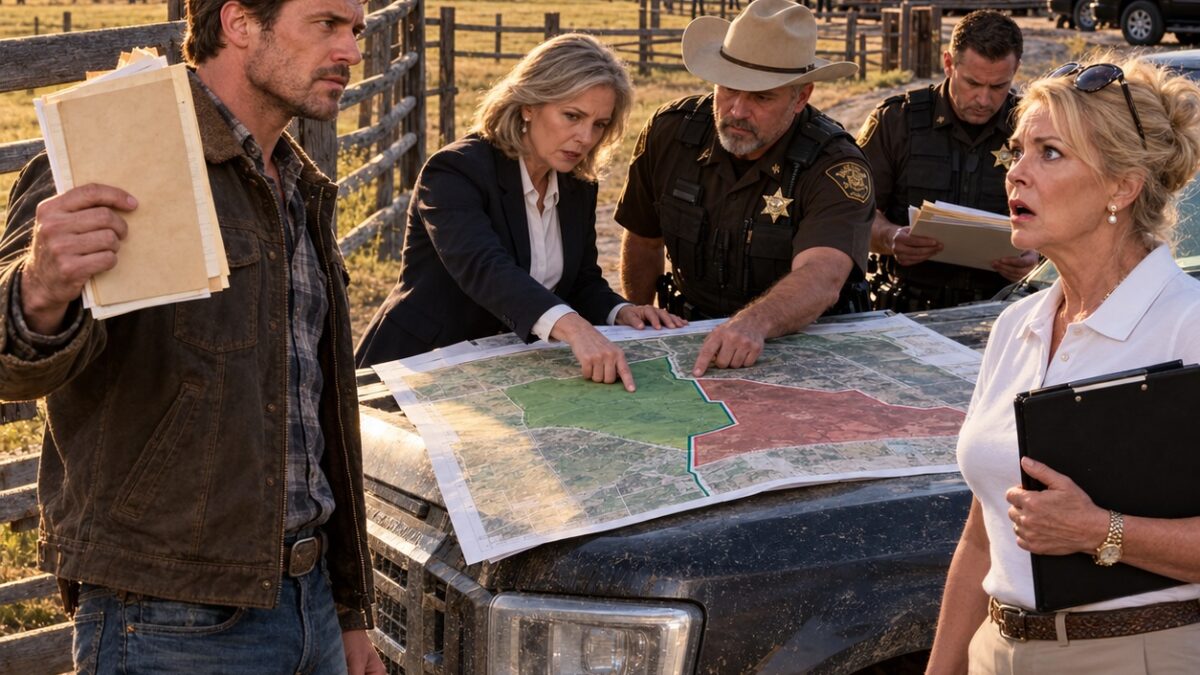
The sheriff’s deputies arrived about thirty minutes later.
By then, Beatrice had repositioned herself near her spotless white Lexus and somehow managed to look like the victim of an ordeal I had created.
The first patrol vehicle stopped near the driveway.
Two deputies got out.
Beatrice moved before I did.
“Officers, thank goodness.”
She hurried toward them, clipboard in hand.
“This man has been yelling at me and threatening me. I told him politely that the property now belongs to the HOA, but he refuses to leave.”
I stood beside my truck and forced myself not to react.
That was harder than it sounds.
When someone lies about you in front of law enforcement, instinct tells you to interrupt.
Correct them.
Defend yourself.
Raise your voice because the lie feels urgent.
Elena’s words stayed in my head.
Be polite.
Show them the documents.
Do not let them intimidate you into leaving.
One deputy, a tired-looking man in his forties, approached me.
His name tag read HARRISON.
“Sir, can you explain what’s happening?”
I opened the folder.
“My name is Caleb Vance.”
I handed him the deed.
“My grandfather, Silas Vance, died three months ago. He left me this ranch.”
Then the will.
The death certificate.
The transfer documents.
“I arrived today to take possession of my inheritance. Mrs. Kensington claims an HOA my grandfather never belonged to foreclosed on the property and sold it two weeks ago.”
Deputy Harrison began reading.
He did not rush.
That alone calmed me.
Across the driveway, his partner, Deputy Brooks, was talking with Beatrice.
Harrison looked at the deed again.
“This appears legitimate.”
“It is.”
“It shows ownership by Silas Vance.”
“Yes.”
“And transfer to you upon his death.”
“Yes.”
Beatrice heard enough to walk over.
“That deed does not supersede HOA covenants.”
Harrison looked at her.
“Ma’am, do you have documentation showing this specific property is part of the HOA?”
“Of course.”
She began flipping through the papers on her clipboard.
“It’s clearly included in our master plat filed with the county.”
Deputy Brooks joined us.
“And do you have proof Mr. Vance received notice of HOA membership and foreclosure proceedings?”
Beatrice hesitated.
Only slightly.
But it was the first crack I had seen in her certainty.
“The certified letters were sent directly to the property address.”
“My grandfather wasn’t living here,” I said.
She looked at me.
“He was in hospice.”
Harrison turned back toward Beatrice.
“Were any notices personally served?”
“The bylaws do not require—”
“That wasn’t my question.”
She stiffened.
“No.”
“Did Mr. Vance ever sign anything acknowledging membership in Eagle Ridge Estates?”
“The property falls within our boundary.”
“Do you have that document here?”
“It’s filed.”
“With the county?”
“Yes.”
Harrison nodded slowly.
Then he looked at me.
“This appears to be a civil ownership dispute.”
Beatrice immediately interrupted.
“There is no dispute. The property was legally foreclosed.”
“Ma’am, he has a deed showing inherited ownership.”
“The HOA foreclosure supersedes—”
“You’ll need to establish that in court.”
Her face went red.
“I called because he is trespassing.”
Harrison’s tone stayed calm.
“You cannot have someone arrested for trespassing on property when ownership is actively disputed and he has facially valid documents showing a legal interest.”
Beatrice looked almost offended that the sheriff’s department had not accepted her authority on sight.
“I have a fiduciary duty to our homeowners.”
“Then you should preserve your documents and speak to your attorneys.”
She glanced at me.
Then back at Harrison.
“So you’re just going to let him stay?”
“He has as much right to stand here as anyone else until a court tells us otherwise.”
I felt some of the tension leave my shoulders.
Not all.
The deputies had not declared me the winner.
They had not invalidated whatever Beatrice claimed.
But they had refused to remove me from my grandfather’s land.
That mattered.
My land.
I had to keep reminding myself of those words.
The ranch had always been Grandpa Silas’s in my mind.
His chair on the porch.
His barn.
His fence lines.
His tools.
His view of the mountains.
Legally, it was now mine.
Emotionally, I had not caught up.
The deputies gave both of us stern instructions.
No threats.
No physical confrontation.
Let the lawyers handle ownership.
Then they left.
Beatrice remained near the property line.
Her composure was gone.
“You haven’t heard the last of this.”
“I’m counting on it.”
“The HOA has attorneys.”
“So do I.”
“Very good attorneys.”
“Congratulations.”
Her jaw tightened.
“When we prove this sale was legal, you will owe the association every dollar we spend dealing with this childish obstruction.”
I almost laughed.
“My childish obstruction is the deed.”
She pointed toward me.
“You are making a serious mistake.”
“No, Beatrice. One of us definitely is.”
She turned hard enough to kick dust with one of those spotless shoes.
Then she marched back to the Lexus.
The tires threw dirt as she sped away.
I stood alone in the driveway.
For the first time since arriving, everything was quiet.
No Beatrice.
No deputies.
No phones.
Just the ranch.
I turned toward the house.
The porch sagged slightly in the same place it had for years.
The old barn needed paint.
A section of fence beyond the drive had tilted.
For half a second I could almost see Grandpa sitting there.
Not literally.
Just memory.
The strange way a place can hold someone after they are gone.
I walked onto the porch and sat.
My hands were still shaking.
I had acted confident with Beatrice.
I was not confident.
If there was even a small chance her documents were real, the ranch could be tied up in court.
A developer could appear tomorrow.
Years of legal fighting could begin before I even unpacked.
That land was not simply real estate to me.
It was the only physical inheritance I cared about.
I had not driven eighteen hours to acquire acreage.
I had driven eighteen hours because Grandpa was gone and this was where the best parts of my childhood still lived.
Two hours later, another vehicle came down the road.
Elena.
She got out carrying a stack of documents thick enough to look like she intended to build something with paper.
I met her on the porch.
She hugged me briefly.
Then immediately became the lawyer again.
“Show me exactly where she was standing.”
I pointed.
“And tell me everything again.”
I did.
Elena listened without interrupting.
Then she laid documents across Grandpa’s porch table.
County maps.
Property descriptions.
Plat records.
Old deeds.
The Eagle Ridge Estates filings.
I sat opposite her.
She placed one map between us.
“Here is the HOA.”
Her finger traced the legal boundary.
Then moved.
“Here is the ranch.”
The gap between them was obvious.
“How far?”
“Approximately a quarter mile outside their legal boundary.”
I stared at the map.
“So they have no jurisdiction.”
“None.”
Relief came so fast it nearly made me dizzy.
I leaned back.
“Then the foreclosure isn’t legal.”
Elena did not smile.
“That’s where this gets worse.”
I looked at her.
She pulled another record forward.
“I called the county recorder’s office.”
“And?”
“No foreclosure was filed against this property.”
I frowned.
“What do you mean?”
“There is no HOA lien.”
She tapped the page.
“No foreclosure filing.”
Another.
“No auction record.”
Another.
“No deed transfer.”
I stared.
“But Beatrice told me the property sold two weeks ago.”
“Yes.”
“She said the new owner takes possession tomorrow.”
“Yes.”
“There is no new owner?”
“Not legally.”
I felt my stomach tighten again.
“So what exactly did she do?”
Elena folded her hands.
“She appears to have fabricated the entire thing.”
For several seconds, all I could hear was wind across the porch.
“Fabricated what?”
“The foreclosure.”
“The auction?”
“Yes.”
“The sale?”
“Yes.”
I stared at her.
“That’s fraud.”
“Yes.”
“Not HOA nonsense.”
“No.”
“Actual fraud.”
“Yes, Caleb.”
I got up and walked to the edge of the porch.
I needed movement.
The anger returned, but it was different now.
When Beatrice first confronted me, I had thought she was an arrogant HOA president who had somehow convinced herself my grandfather’s property fell under her authority.
That was bad enough.
This was something else.
If Elena was right, Beatrice had not misunderstood the boundary.
She had invented a foreclosure process that never happened.
I turned.
“Why?”
Elena’s face darkened.
“I spent part of the drive making calls.”
“To whom?”
“People at the county. A few attorneys who know land issues out here.”
“And?”
“There’s a developer in Bozeman who has been trying to buy land in this area for years.”
I knew where this was going before she finished.
“Grandpa refused.”
“Repeatedly, apparently.”
That sounded like him.
Not because I had personally sat in on the offers.
Because Grandpa loved the ranch.
He had never treated it like a financial instrument.
Land was land.
Something you maintained.
Something you respected.
Something you did not sell because somebody showed up with a glossy development plan.
Elena continued.
“My working theory is that Beatrice saw an opportunity after Silas died.”
“What kind of opportunity?”
“To frighten the heir off the land using official-looking HOA documents.”
I felt sick.
“She thought I’d believe her.”
“Possibly.”
“And then?”
“She claimed the land had already been sold to a developer. If you left, if you didn’t challenge it immediately, they could try to manufacture enough paperwork to create confusion.”
“To steal forty acres.”
“That appears to be where this was headed.”
I sat down again.
Elena leaned forward.
“Caleb, listen to me. Do not sign anything. Do not let anyone onto the property claiming possession without contacting me. Photograph every document. Save every text, email, voicemail.”
“What about tomorrow?”
“What about it?”
“She said the new owners take possession tomorrow.”
Elena looked almost amused for the first time.
“No legitimate new owner exists.”
“What if somebody shows up?”
“Call me. Call the sheriff.”
I looked at the county map again.
A quarter mile.
The ranch was not even touching the HOA.
Not borderline.
Not ambiguous.
Not a disputed subdivision parcel.
A quarter mile outside.
“How could she possibly think this would work?”
Elena gave me the answer lawyers probably give themselves all the time.
“Because some people rely on confidence more than legality.”
That sentence stayed with me.
Beatrice had arrived with a clipboard.
An embroidered polo.
A title.
President.
She had spoken in complete sentences with perfect certainty.
Legal auction.
Foreclosure.
Unpaid dues.
New owners.
Possession tomorrow.
Every phrase was designed to make resistance feel foolish.
If I had arrived without my documents?
If I had been younger?
If I had believed an official-looking letter over my own understanding?
If I had panicked when she called police?
Maybe I would have driven away.
Maybe that was the plan.
Elena pulled out her phone.
“There’s more.”
“What?”
“I contacted the district attorney’s office.”
I stared at her.
“Already?”
“Yes.”
“What did you tell them?”
“Exactly what we know.”
“And?”
“They’re interested.”
That was an understatement.
Over the next several days, the situation accelerated beyond anything I had imagined during that first argument in the driveway.
I stayed at the ranch.
I slept badly.
Every unfamiliar vehicle made me look up.
Every sound near the road made me wonder whether Beatrice had sent someone.
No developer arrived to take possession the next morning.
That was the first confirmation.
No moving equipment.
No survey crew.
No legitimate representative carrying a recorded deed.
Nothing.
Elena began sending formal notices.
One to the HOA.
One to Beatrice.
One to the supposed developer.
The language made the situation clear.
Caleb Vance held legal title.
Silas Vance had never been part of Eagle Ridge Estates.
The ranch fell outside the HOA boundaries.
No valid lien existed.
No foreclosure proceeding existed.
No lawful auction had occurred.
Any attempt to enter, sell, transfer, develop, or otherwise claim ownership would be challenged immediately.
I watched copies go out.
For the first time since Beatrice arrived, I felt like I was no longer only defending myself.
The paper was pushing back.
County records.
Deeds.
Maps.
Recorded facts.
The things she had treated as outdated were becoming the walls around her story.
The HOA’s reaction was immediate.
Not from Beatrice.
From other board members.
Apparently, some of them had not understood the details of what she had been doing.
Calls went to Elena.
Questions.
Confusion.
One director insisted he believed Beatrice was handling a legitimate delinquent property.
Another claimed the board had been told the owner had ignored all notices.
Someone else said he had never seen a foreclosure file.
Elena told me not to talk to any of them directly.
“Let them talk through counsel.”
“So she may have done this without the full board?”
“Possibly.”
I felt something complicated.
I had been angry at Eagle Ridge Estates as an institution.
But if Beatrice had manipulated her own board, the problem was becoming narrower.
And worse.
The HOA existed.
Its actual boundaries existed.
The board had legitimate authority over its real members.
But somebody seemed to have used the appearance of that authority to reach beyond it.
I thought about Grandpa in hospice.
That part stayed with me most.
He had spent the last year of his life unable to respond properly to letters sent to an empty ranch.
Whether those letters existed or not, Beatrice had used his silence as part of her justification.
He died.
Three months later, I arrived.
And she was ready.
That did not feel accidental.
The district attorney’s office began reviewing records.
Elena kept me updated carefully.
“They’re looking at signatures.”
“Whose?”
“Several.”
“Forged?”
“That’s what they’re determining.”
She asked me for examples of Grandpa’s signature from older property documents.
I found what I could.
That hurt more than expected.
His handwriting.
His name.
Silas Vance.
Seeing it on old ranch paperwork turned legal evidence into grief.
I had to stop for a moment.
Elena noticed.
“You okay?”
“Yeah.”
“You don’t have to do all of this tonight.”
“Yes, I do.”
“No, you don’t.”
I looked at the page.
“If somebody used his name after he was in hospice…”
She understood.
The investigation uncovered enough that the case stopped looking like a boundary mistake.
The supposed foreclosure documentation did not align with county filings.
The auction had no valid county trail.
The alleged transfer to the developer had no legitimate recorded deed.
And the developer himself began attracting attention.
He was from Bozeman.
He had indeed been interested in land near Eagle Ridge.
He had indeed wanted acreage Grandpa would not sell.
Then we learned the personal connection.
He was Beatrice’s brother-in-law.
When Elena told me, I actually laughed.
Not because it was funny.
Because sometimes corruption is so unsubtle that disbelief becomes humor.
“Her brother-in-law?”
“Yes.”
“The developer she said bought the ranch.”
“Yes.”
“She stood in my driveway pretending this was an ordinary HOA foreclosure.”
“Yes.”
“And the buyer was family.”
“Yes.”
I shook my head.
“This is insane.”
“It’s also becoming a very coherent motive.”
The theory sharpened.
Grandpa refused to sell.
Grandpa became ill.
Grandpa died.
I inherited.
Beatrice appeared before I had even settled in, claiming the ranch had already been legally taken and sold.
If I believed her, I might leave.
If I left, the people behind the fake transaction would gain time.
Maybe enough to create more documents.
Maybe enough to pressure me into settlement.
Maybe enough to make the ownership situation so tangled that I would accept money rather than spend years fighting.
I will never know exactly what they thought would happen if I complied that first day.
What mattered was that I did not.
The ranch kept me anchored.
Every morning, I walked part of the property.
The fences needed repair.
The barn paint was peeling.
Grass had grown where Grandpa once kept things trimmed.
Small signs of the year he had spent away in hospice.
I started fixing them.
Not because the legal situation was resolved.
Because I needed to do something with my hands that was not paperwork.
I replaced fence boards.
Cleared around the barn.
Sorted old tools.
Every task felt like an argument against Beatrice’s claim.
She called this HOA property.
I knew which fence posts Grandpa had replaced when I was twelve.
She called it a parcel.
I knew where the ground dipped after spring rain.
She called it a development opportunity.
I knew the porch board that creaked.
The law mattered.
So did memory.
Those two things were finally on the same side.
About a week into the investigation, I saw Beatrice again.
Not at the ranch.
At the county building.
Elena and I were leaving after dealing with records.
Beatrice was coming down the hall with a lawyer.
She saw me.
Stopped.
Her lawyer said something quietly.
Beatrice ignored him.
“This is unnecessary.”
I stared.
“What is?”
“All of this.”
“You called 911 on me.”
“You were refusing to leave property that was under dispute.”
“No. You told police I was aggressive.”
Her lawyer touched her arm.
“Beatrice.”
She pulled away.
“The board had legitimate concerns.”
“Elena has the boundary map.”
Her face tightened.
“There are incorporation issues that remain unresolved.”
Elena stepped forward.
“No, there aren’t.”
Beatrice looked at her.
Elena’s voice was calm.
“The Vance property is approximately a quarter mile outside Eagle Ridge Estates. No covenant attaches it to the association. No recorded lien exists. No lawful foreclosure was filed. No auction occurred. No transfer deed exists.”
Beatrice’s face went pale.
Her lawyer spoke quickly.
“We’re not discussing facts in the hallway.”
Elena nodded.
“Excellent advice.”
I looked at Beatrice.
“Where did the auction happen?”
She stared at me.
“Caleb.”
“What date?”
Nothing.
“Who conducted it?”
Her lawyer moved between us.
“We’re leaving.”
Beatrice said one last thing before he guided her away.
“You think you’ve won.”
I watched her.
“This isn’t about winning. It’s my land.”
That was the difference she never seemed to understand.
To her, the ranch had become a prize.
To me, it was not something I was trying to acquire.
It was something I was trying to keep from being stolen.
The investigation expanded.
Other property owners were contacted.
That was when the situation became even uglier.
I learned there were at least two other properties involving elderly or recently deceased owners where similar irregularities appeared.
I did not know those people personally.
I did not need to.
The pattern mattered.
Properties vulnerable because the owners were old.
Ill.
Dead.
Families grieving.
Records slow to catch up.
Exactly the kind of circumstances where someone with a confident voice and official-looking documents might frighten an heir into believing a sale had already happened.
When Elena told me investigators were examining those cases, I sat quietly for a while.
“What if I hadn’t come when I did?”
She did not answer immediately.
Then:
“You did.”
“I know.”
“That matters.”
“What if someone else didn’t?”
“That’s why they’re investigating.”
I looked toward the field.
I understood then that the criminal case no longer revolved only around Grandpa’s ranch.
What had happened to me might have exposed something larger.
That did not make me feel heroic.
Mostly it made me angry.
Beatrice had chosen people she thought would be easy to push.
A man in hospice.
An heir three states away.
Elderly owners.
Families still dealing with death.
If the allegations were true, the vulnerability was part of the strategy.
That is what disgusted me most.
Not greed by itself.
Predatory timing.
I kept working on the ranch while investigators worked elsewhere.
Grandpa’s old barn became my project.
The wood was still sound.
The paint was not.
I spent two days scraping loose sections.
Then another day repairing boards.
Physical work helped.
When my mind started replaying Beatrice’s voice—
The property was seized.
The sale is finalized.
You are trespassing.
—I hammered something.
When I pictured her reporting me as hostile to 911, I fixed fence.
When I thought about Grandpa receiving or not receiving fake notices while lying in hospice, I painted.
Grief and anger are both easier when they have somewhere to go.
The ranch became that place.
Three weeks after the day Beatrice first marched across my driveway, I was sitting on Grandpa’s porch in the morning.
I had coffee beside me.
A section of fence I repaired the previous day was visible from where I sat.
A vehicle came slowly down the road.
Then another.
Not Beatrice.
Law enforcement.
I stood.
They were not coming to my house.
They continued toward Eagle Ridge Estates.
I knew before Elena called.
My phone rang.
“Caleb.”
“Is it happening?”
“Yes.”
I walked to the edge of the porch.
From where I stood, I could not see everything clearly, but I knew the direction.
Beatrice Kensington was being arrested.
Later, I saw the footage.
Heavy steel handcuffs.
Her white-collar confidence gone.
No clipboard.
No phone raised dramatically.
No HOA polo granting invisible authority.
Just law enforcement.
The charges included fraud.
Forgery.
Attempted theft.
The developer from Bozeman—her brother-in-law—was arrested too.
The story hit local news almost immediately.
The words used in coverage were far more serious than anything I had imagined during that first afternoon.
HOA foreclosure fraud.
Property theft scheme.
Forged documents.
Multiple properties under investigation.
Beatrice’s face appeared on television.
For weeks she had relied on appearances.
Now the appearance was a mugshot.
I expected to feel triumphant.
Instead, I felt tired.
Maybe relief is too quiet after sustained fear.
For three weeks, part of me had been waiting for some hidden document to appear.
Some legal loophole.
Some developer with a real deed.
Some technical problem with Grandpa’s estate.
Now law enforcement was saying the fraud appeared to be exactly what Elena had suspected.
The ranch had never legally left the family.
The supposed sale was fiction.
I walked back onto the porch.
Sat in Grandpa’s chair.
And cried.
Not because of Beatrice.
Because suddenly I could stop fighting long enough to miss him.
I had spent three months grieving his death.
Then the moment I reached the place that should have helped me process it, somebody turned his ranch into a battlefield.
I had not had time to simply sit there and feel the loss.
So I did.
For a long time.
The summer that followed became one of the most important seasons of my life.
Not dramatic.
That was the point.
I fixed fences.
Repainted the barn.
Cleared weeds.
Went through old equipment.
Learned which parts of the ranch had suffered most during Grandpa’s final year away.
I slept with the windows open when the weather allowed.
Some mornings I woke before sunrise.
The land was quiet in a way cities never are.
Every morning felt like reclaiming something.
Not from Beatrice anymore.
From grief.
I would stand near the barn and remember being a kid.
Grandpa showing me how to do something simple.
Hold the tool correctly.
Do the job once instead of badly twice.
Respect animals.
Respect weather.
Respect land.
I did not invent conversations with him.
I did not need to.
Memory is often made of gestures more than speeches.
His hand pointing.
His pace walking a fence line.
The sound of boots on the porch.
Those things came back.
The ranch stopped feeling like the place where Beatrice tried to steal my inheritance.
It became Grandpa’s place again.
Then gradually mine.
The Eagle Ridge Estates HOA went through its own reckoning.
Once the investigation made clear Beatrice had acted far beyond legitimate association authority, the board moved quickly to separate itself from her.
They elected a new president.
The new leadership sent me a formal apology letter.
I opened it at the kitchen table.
The language was careful.
Eagle Ridge Estates acknowledged that the Vance ranch had never been part of its association.
It clarified that the property was outside the HOA boundaries.
It confirmed the association had no authority over my land and no basis to claim dues.
The letter apologized for the confrontation and confusion created under the prior leadership.
I read it twice.
Then I walked outside.
Grandpa’s old wooden ranch sign was still hanging where it had for years.
Weathered.
Solid.
VANCE RANCH.
I framed the HOA apology.
Hung it nearby inside the house where I could see it.
Not because I needed revenge on the association.
Because the two objects together told the whole story.
Grandpa’s sign represented decades of real ownership.
The apology represented what happened when fake authority collided with records.
I kept Beatrice’s original foreclosure claim too.
Not displayed proudly.
Filed.
Evidence.
There is value in remembering how convincing lies can sound when delivered confidently.
Legal.
Finalized.
Certified.
Foreclosed.
Sold.
Possession tomorrow.
Each word had been false.
But on the first day, standing exhausted beside my truck after eighteen hours on the road, I had felt each one hit me physically.
That was her weapon.
Certainty.
Not law.
Certainty.
She expected me to become intimidated before I became curious.
Expected a grieving heir to believe the woman with the title.
President.
Expected a police call to finish what the clipboard started.
The plan failed because I had documents.
Because Elena answered her phone.
Because the deputies looked at the deed instead of Beatrice’s confidence.
Because county records existed.
Because recorded boundaries are harder to bully than people.
That became the lesson I carried from the entire thing.
Authority has to come from somewhere.
A badge.
A statute.
A contract.
A deed.
A signed covenant.
Recorded ownership.
Not tone of voice.
Not a polo shirt.
Not a clipboard.
Not the sentence, “I’m the HOA president.”
Beatrice had become so used to being obeyed inside Eagle Ridge Estates that she acted as though the title followed her everywhere.
It didn’t.
An HOA is not a government with unlimited borders.
Its powers stop.
Grandpa’s ranch sat a quarter mile beyond them.
That distance might as well have been a thousand miles legally.
The most absurd part was how close she came to making me doubt what I already knew.
For several minutes on that first afternoon, I wondered whether there was some obscure legal process Grandpa had missed.
Something filed while he was sick.
Some annexation.
Some covenant.
Some document buried in county records.
That is what confidence can do.
It makes the victim start researching whether the lie might somehow be true.
She did not need me to believe forever.
Only long enough to leave.
I thought about the two other property owners investigators believed she had targeted.
That bothered me for months.
I do not know every detail of their cases.
I will not pretend I do.
But the fact that authorities found enough similarity to treat them as part of the broader investigation made the pattern difficult to ignore.
Beatrice had not simply lost control during a dispute with me.
This was not an argument that escalated.
The documents suggested planning.
The connection to her brother-in-law suggested motive.
That changed how I remembered the first confrontation.
Her speed.
Her certainty.
The statement that new owners were coming tomorrow.
The threat to call police.
She had not been improvising.
She had expected the scene.
Maybe not me specifically.
But an heir.
Someone arriving.
Someone confused.
The foreclosure story was ready.
I wonder how many times she had rehearsed it.
I stopped wondering after a while.
Beatrice’s criminal case belonged to prosecutors.
The ranch belonged to me.
That was enough.
Local reporters called.
At first I declined.
I had no desire to become the man on television complaining about an HOA.
Then one reporter asked a question that changed my mind.
“Why do you think this worked as long as it did?”
I thought about it.
“Because official-looking language scares people.”
She waited.
“And because grief makes people tired.”
That was the part I understood personally.
When Grandpa died, I did not feel sharp.
I felt hollow.
Paperwork already exhausted me.
Death certificate.
Will.
Calls.
Travel.
Everything that happens after someone dies feels insulting because bureaucracy keeps demanding tasks when you barely want to get out of bed.
Then imagine an official-looking organization arriving during that period and saying:
You missed a notice.
You owe money.
The property is already gone.
People may surrender not because the claim is believable after careful review.
Because they do not have the strength for careful review.
That is why Elena mattered.
She had the strength that day.
I called.
She said:
Do not leave.
Sometimes the most important sentence anyone can give you is not complicated legal advice.
It is a simple instruction that stops panic from becoming irreversible action.
Do not leave.
So I stayed.
I showed the deputies my deed.
I sat on the porch.
I waited.
That changed everything.
The criminal proceedings took longer than the dramatic part people remember.
Arrests are fast.
Cases are not.
There were hearings.
Lawyers.
Evidence.
Records.
I did not attend every development.
I gave what was required.
Statements.
Documents.
Descriptions of my confrontation with Beatrice.
The 911 call became part of the record.
So did the fake foreclosure paperwork.
The supposed HOA authority.
The nonexistent auction.
The connection to her brother-in-law.
By then, I had stopped needing emotional closure from the case.
I already had the land.
That was my closure.
Every morning I woke at the ranch, the truth was physically around me.
Forty acres.
Still there.
Barn.
Still there.
Porch.
Still there.
Fence lines.
Still there.
No developer.
No equestrian subdivision.
No luxury construction crews carving up Grandpa’s past.
That was victory.
I never objected to development as a concept.
People need places to live.
Land changes.
Communities grow.
But buying land and stealing land are different things.
Grandpa had been asked to sell.
He refused.
That should have been the end.
Property rights mean very little if “no” lasts only until the owner becomes vulnerable.
That was what Beatrice and the developer apparently failed to understand.
They treated death like an opening in a negotiation.
I treated Grandpa’s will like the final answer.
He wanted the ranch to stay in the family.
It did.
The new HOA president came to see me once.
He did not march onto the land.
He parked near the drive and waited.
Already an improvement.
I walked over.
“Mr. Vance?”
“Caleb.”
He nodded.
“I wanted to apologize in person.”
“The letter was enough.”
“Maybe. But I wanted to.”
I let him speak.
He told me the board had reviewed its records.
The ranch had never been in Eagle Ridge.
No legitimate dues had ever been owed.
The HOA would not claim jurisdiction.
Ever.
“We’ve also changed internal approval procedures for anything involving liens or property enforcement.”
“That sounds wise.”
He looked embarrassed.
“It should have already been wise.”
I appreciated that.
No excuses.
No speech about one bad apple.
Just:
This happened.
We are changing things.
He glanced toward the ranch.
“I understand your grandfather had been here a long time.”
“Forty-seven years.”
He nodded.
“I’m sorry his name got dragged into this.”
That sentence mattered more than I expected.
“Thank you.”
We shook hands.
No feud.
I had no interest in inheriting Beatrice’s habit of turning every boundary into a war.
Eagle Ridge could exist.
My ranch could exist.
The law had already drawn the line.
Respect it.
Simple.
The local story spread farther than I expected.
People loved the contrast.
HOA president.
Fake foreclosure.
Dead grandfather.
Forty-acre ranch.
Police called on the actual owner.
County map showing the property a quarter mile outside the HOA.
Brother-in-law developer.
Handcuffs.
It had everything people expect from some exaggerated internet story.
The frustrating part was that the central facts did not need exaggeration.
Beatrice had already provided enough.
Online comments turned her into a cartoon villain.
I avoided most of them.
Real life is more complicated than comment sections.
I did not need to imagine her as evil from birth.
I needed only to know what she had done.
Or what prosecutors alleged and records supported.
She had abused the appearance of HOA authority.
She had participated in false documentation.
She had attempted to claim property outside her association.
That was enough.
You do not need fictional cruelty when real misconduct is already serious.
I felt the same way about Grandpa.
People who heard the story sometimes wanted me to turn him into a perfect wise rancher from a movie.
He wasn’t.
He was my grandfather.
He had good days and stubborn days.
He taught me things.
We argued sometimes when I was younger.
He loved the ranch.
That was enough.
The emotional value of the property did not need mythology.
It mattered because I had lived there with him during summers.
Because I had memories in every practical corner.
One fence line reminded me of learning to ride.
The barn reminded me of work.
The porch reminded me of evenings.
The quiet reminded me why Grandpa stayed.
Beatrice’s scheme attacked all of that accidentally because she saw only acreage.
The proposed developer apparently saw the same thing.
Forty acres near an upscale community.
Potential.
Opportunity.
Equestrian development.
I saw Grandpa.
That difference made surrender impossible.
By late summer, the barn looked better.
Fresh paint.
Fence repairs complete in the worst sections.
The ranch still needed years of work.
I liked that.
A finished property would have felt like a museum.
This was alive.
Maintenance never ends.
I began understanding why Grandpa kept old tools that made no sense to me as a kid.
Out there, you fix things.
You do not always replace them because something newer looks cleaner.
Maybe that mindset shaped how I handled the legal fight too.
Beatrice told me ownership had been replaced.
I checked the foundation.
The deed.
Still sound.
No need to surrender.
One evening, I stood outside after sunset.
The sky over rural Montana looked enormous.
No city glow.
No traffic noise.
I thought about Portland.
The eighteen-hour drive.
How angry and exhausted I had been when I arrived.
Then Beatrice crossing the dirt with her clipboard.
It seemed almost absurd now.
That afternoon had felt like my entire future collapsing.
Now it was one scene in a much larger summer.
Fear distorts time.
When you think your inheritance has been stolen, ten minutes feels permanent.
Then documents arrive.
Facts accumulate.
The world becomes normal again.
I wish I could tell anyone facing a similar threat to stay perfectly calm.
That would be dishonest.
I was not calm.
My hands shook.
My voice shook when I told Beatrice my grandfather was in hospice.
I wanted to yell.
When she called me threatening, I wanted to become exactly as angry as she claimed I was.
What mattered was not feeling calm.
It was behaving carefully enough that the truth had room to catch up.
That is different.
You can be furious and still hand the deputy your deed.
You can be terrified and still call the lawyer.
You can be grieving and still refuse to leave.
Courage is often much less impressive than people think.
Sometimes it is staying on a porch until the person with the county map arrives.
I still have the original deed.
Of course.
It is stored properly now.
Copies too.
Several.
Elena made sure of that.
She also made me update other estate and property records so nobody could claim confusion about my ownership later.
“You’re becoming paranoid,” I told her.
“No. You’re becoming organized.”
“Same feeling.”
“Different legal outcome.”
She was right.
I owed her more than I could properly express.
If I had called someone less familiar with Grandpa’s affairs, the response might have been slower.
Elena knew immediately.
No HOA.
No dues.
No consent.
She did not need to research before telling me not to leave.
That certainty countered Beatrice’s certainty.
Only one was backed by records.
I asked Elena once whether she had known Grandpa refused developers.
She nodded.
“He had offers.”
“How many?”
“Enough.”
“What did he say?”
She smiled slightly.
“He said he wasn’t interested.”
That sounded exactly like him.
No dramatic ranch speech.
No declaration about legacy.
Not interested.
End of conversation.
The developers apparently had trouble accepting simplicity.
Beatrice even more so.
The strange thing about fraud is how much complexity people build to defeat a simple answer.
No.
Grandpa said no.
Instead of accepting it, somebody allegedly created:
HOA claims.
Fake dues.
Certified notices.
Foreclosure language.
Auction fiction.
Developer transfer.
All to overcome one old man’s refusal to sell.
And in the end, one county map destroyed the whole structure.
The property was a quarter mile outside Eagle Ridge.
That line fascinated me.
Physical lines on maps can feel abstract.
Here, it became everything.
On one side:
HOA authority.
On the other:
None.
Beatrice had acted as though authority expands when you say it confidently.
It does not.
Land records are wonderfully indifferent to personality.
That is what made the final outcome feel so satisfying.
No one needed to defeat her in a shouting match.
The county records simply disagreed with her.
And records are hard to bully.
The HOA apology remained framed near Grandpa’s sign.
Visitors noticed.
Some knew the story.
Others asked.
I would explain.
Usually shorter than this.
“HOA president tried to fake a foreclosure.”
They would laugh at first.
Then realize I was serious.
“She actually sold it?”
“Claimed she did.”
“To who?”
“Her brother-in-law’s development interest.”
“What happened?”
I would point at the land.
“This is what happened.”
Still here.
That became my favorite answer.
People wanted the handcuffs.
I understood.
Handcuffs are dramatic.
But the land remaining mine was the real consequence.
A criminal case punishes wrongdoing.
Property records restore truth.
I needed the second more.
The first belonged to the state.
The ranch belonged to me.
As fall approached, the mornings became colder.
I made coffee before sunrise and walked the porch.
Grandpa used to do that.
Again, not in some poetic ceremony.
It was simply the routine of someone who owned land and liked mornings.
I began doing it without consciously imitating him.
That was when I realized the ranch had started becoming home rather than inheritance.
Inheritance is something transferred.
Home is something repeated.
Wake.
Check weather.
Fix something.
Eat.
Work.
Sit outside.
Sleep.
Again.
Beatrice had nearly turned the ranch into a legal abstraction before I could build that routine.
Now I had it.
Nothing she did could take those first months back.
The Eagle Ridge sign remained far enough away that I rarely thought about it.
New leadership kept to itself.
Exactly what I wanted.
No surprise violation letters.
No fines.
No declarations that my fence paint threatened community values.
My property was not and never would be part of their association.
They put that in writing.
I trusted the writing more than promises.
When the criminal case appeared again in the news, I watched with distance.
The reporting described Beatrice’s alleged scheme involving multiple properties.
It described the forged documents.
The attempted transfers.
The developer connection.
I saw her image.
Then turned off the television.
Some people might find that anticlimactic.
I had simply reached the point where her story mattered less to me than mine.
She had occupied too much space already.
Grandpa deserved more.
The ranch deserved more.
I deserved more.
Revenge can become another kind of captivity if you need the other person to suffer before you can enjoy what you saved.
I did not want that.
I wanted breakfast on the porch.
I got it.
That was enough.
Still, I would be lying if I said I felt nothing when I remembered the arrest.
Three weeks earlier, Beatrice had stood on my land telling me I would “owe dearly” for resisting her.
Three weeks later, she was being led from her own house in handcuffs.
You notice symmetry like that.
I am human.
I noticed.
But the satisfaction was not really about humiliation.
It was about the speed with which false authority disappeared once actual authority arrived.
Sheriff.
County recorder.
District attorney.
Recorded deed.
Those institutions have flaws like any others.
But in this case, they functioned.
The woman who used 911 to accuse me of trespassing eventually faced authorities because the property claim itself appeared fraudulent.
That reversal was hard to miss.
The police officers from the first day became important in my memory too.
Deputy Harrison could have taken the easy route.
HOA president says trespasser.
Man visibly angry.
Remove man.
Sort documents later.
He did not.
He read.
Asked.
Separated civil dispute from criminal trespass.
Refused to let Beatrice convert uncertainty into an arrest.
That gave Elena time.
Sometimes fairness is not dramatic.
It is a tired deputy reading a deed carefully.
I appreciated that more the longer I thought about it.
Beatrice tried to use the performance of danger.
“He is aggressive.”
“I feel unsafe.”
Those claims should always be taken seriously enough to assess.
But seriousness does not mean blind acceptance.
The deputies listened to both sides.
Looked at paper.
Asked whether she could prove HOA membership.
She could not.
That prevented a false accusation from becoming another layer of damage.
I wish every situation worked that carefully.
Mine did.
That mattered.
I never spoke to the developer, her brother-in-law.
There was no need.
Investigators handled him.
The ranch was not transferred to him legally.
He never owned it.
That is the only relationship between us that mattered.
He wanted the acreage.
He did not get it.
I did not need a confrontation scene.
Real property law is satisfying precisely because it can make confrontation unnecessary.
Do you own it?
No.
Conversation over.
Grandpa’s will did more talking than I ever could.
That is one reason people should take estate planning seriously.
He had done the paperwork.
The ranch passed to me clearly.
No mystery.
No fight among relatives.
No informal promise.
A will.
A deed.
Legal transfer.
Beatrice tried to manufacture ambiguity from outside the family.
Grandpa’s preparation made that harder.
I was grateful.
One afternoon, while repairing a fence, I found an old piece of wood where Grandpa had marked measurements years earlier.
His handwriting again.
Small numbers.
Nothing sentimental.
I sat in the grass holding it.
Three months after his death, I was still finding him in ordinary places.
That is grief.
You expect photographs to hurt.
Instead, a measurement on scrap wood does it.
I thought about how close I had come to driving away after Beatrice’s threat.
Not literally close.
I do not think I would have left permanently.
But imagine if I had obeyed police fear.
Gotten a motel.
Waited.
Maybe the property would have remained physically empty while lawyers argued.
Instead I stayed.
I slept under Grandpa’s roof.
I occupied what I owned.
That mattered emotionally even if the legal title never changed.
I did not abandon the land because someone told me it was already lost.
Maybe that was the central conflict.
Not fraud versus law.
Certainty versus doubt.
Beatrice wanted me to doubt myself faster than I could verify her.
I verified.
She lost.
The new HOA president once joked that Eagle Ridge had become “the most boundary-conscious association in Montana.”
Good.
If true, Grandpa contributed indirectly.
His ranch would never join them.
But perhaps it taught them where they ended.
That is a healthy lesson for any organization.
Know your border.
Inside it, govern according to legitimate rules.
Outside it, mind your own business.
Simple.
The apology letter specifically clarifying that the ranch had never been and would never be part of Eagle Ridge became something I valued almost as much as the legal documents.
Not because an HOA could grant me freedom.
It could not.
Because it showed the organization itself had acknowledged the truth publicly enough that future leadership would have difficulty recreating Beatrice’s fiction.
Institutional memory matters.
People leave.
Paper remains.
That is why I framed it.
Grandpa’s old sign.
HOA apology.
Side by side.
One says:
This is ours.
The other says:
We finally understand.
That is satisfying.
The criminal proceedings eventually moved beyond the stage where I needed regular updates.
I checked in when required.
Otherwise, ranch life continued.
Winter preparation.
Equipment.
Fences.
The old barn.
Land gives you too much work to spend every day thinking about the woman who tried to take it.
That may be one of the best things about rural property.
It redirects obsession.
Something always needs attention.
By then, I understood Grandpa’s refusal to sell more deeply.
The value of the ranch was not purely market value.
A developer could calculate acreage.
Road access.
Potential lots.
Premium homes.
Equestrian amenities.
He could produce a number.
Grandpa was calculating something else.
Continuity.
Privacy.
Memory.
Autonomy.
Things difficult to price because they become visible only after someone tries to remove them.
Beatrice thought she could convert one category into the other.
Take land with emotional value.
Turn it into developer value.
The law stopped her before that conversion happened.
I remain grateful.
People sometimes ask if I ever considered selling afterward.
No.
Not then.
Maybe one day life changes.
But selling under my decision would be fundamentally different from losing it through fraud.
Choice matters.
Ownership is partly the right to choose.
Keep.
Sell.
Build.
Leave alone.
Grandpa exercised that choice for forty-seven years.
Then he transferred it to me.
Beatrice attempted to substitute hers.
That was the violation beneath everything else.
Not simply money.
Choice.
The first time I repainted the ranch sign, I did it carefully.
VANCE RANCH.
The letters were worn.
I considered replacing the whole board.
Then decided against it.
Repair.
Not replacement.
I sanded it.
Painted.
Preserved the wood.
When it dried, I rehung it.
The HOA apology remained inside.
I stood outside for a while looking at the sign.
No cameras.
No viral moment.
No one applauding.
That was probably when the story ended emotionally for me.
The name remained.
The land remained.
I remained.
Everything else was paperwork.
Months earlier, Beatrice had told me the property was already gone.
New owners tomorrow.
Finalized.
Now winter was approaching, and I was still there.
No developer had broken ground.
No equestrian community.
No forced sale.
Just the ranch.
Exactly like Grandpa intended.
That phrase became important.
Not exactly like Grandpa left it.
Things change.
Paint fades.
People die.
New owners make new choices.
But the essential direction remained.
Family land.
Legally transferred.
Kept.
The story people tell online usually ends with Beatrice in handcuffs.
I understand why.
It is visually satisfying.
But if I could choose one final image, it would not be the arrest.
It would be an ordinary Montana morning.
Cold enough that my coffee steamed.
Grandpa’s sign near the drive.
Fresh paint on the barn.
Fence repaired.
No white Lexus.
No clipboard.
No argument.
I would be standing on the porch looking over forty acres that still belonged exactly where the deed said they belonged.
Mine.
Not because I shouted louder.
Not because I had more connections.
Not because I was HOA president of anything.
Because Silas Vance owned that ranch for forty-seven years.
Because he legally left it to me.
Because Eagle Ridge Estates ended a quarter mile away.
Because no real foreclosure was filed.
Because no real auction happened.
Because no real deed transferred.
Because confidence is not evidence.
And because county records do not care how expensive your sunglasses are.
That is the truth Beatrice could not talk her way around.
She tried to turn a grieving grandson into a trespasser on his own inheritance.
She tried to make a fake foreclosure sound final.
She tried to use an HOA name like a weapon.
She called the police.
She threatened lawyers.
She told me new owners were arriving the next day.
None of it changed the land.
None of it changed the deed.
None of it changed the boundary.
In the end, her entire scheme failed on facts that had been sitting quietly in county records the whole time.
The ranch was outside Eagle Ridge.
My grandfather never joined.
The foreclosure did not exist.
The auction did not exist.
The sale did not exist.
The only real transfer was the one Grandpa had planned.
From him.
To me.
I still have the apology letter framed near his old ranch sign.
Sometimes I look at the two together.
One came from a man who spent nearly half a century caring for that land.
The other came from an organization forced to admit it never had a right to touch it.
Between those two pieces of paper is one of the hardest months of my life.
Grief.
Fear.
Anger.
Police.
Lawyers.
County maps.
Investigators.
Arrests.
And beneath all of that, something much simpler.
Grandpa kept his word.
He left me the ranch.
And after everything Beatrice Kensington tried to do, I kept mine too.
I stayed.








