FULL STORY:HOA Queen Charged $35 a Head to Party on My Private Lakefront—She Had No Idea the Man in the Cabin Was Building Her Federal-Grade Case
FULL STORY CONTINUATION
The violation packet was impressive in the same way a counterfeit hundred-dollar bill can be impressive.
It looked official.
That did not make it real.
Dock aesthetics.
Vehicle parking.
Lawn height.
Cabin paint.
Daily penalties.
Fourteen-day compliance deadline.
Cheryl had signed every notice herself.
I opened the Stillwater Bluffs governing documents and read them line by line.
None of the rules existed.
Not one.
No dock-aesthetic standard matching Cheryl’s notice.
No vehicle rule she cited.
No paint restriction written the way she claimed.
Nothing.
Even if those provisions had existed, the HOA’s own procedures required violations to be approved through the board process.
I checked the minutes.
No votes.
No hearings.
No board action.
Just Cheryl’s signature.
I responded in writing.
Short.
No emotion.
I identified each fabricated rule.
Referenced the sections requiring board approval.
Noted the absence of votes.
Requested that all fines be withdrawn.
Then I scanned everything and saved it.
People misunderstand paperwork.
They think documents slow things down.
Often they do.
But when somebody abuses authority, paper becomes memory that cannot be intimidated.
I wanted memory.
The following Tuesday, Nolan called.
“You’re going to love this.”
“I doubt it.”
“Cheryl announced another lakefront event.”
I stared through the cabin window.
“My lakefront?”
“Summer Splash Cookout.”
“When?”
“Saturday.”
I leaned back.
“She got the letter.”
“The whole board got it.”
“And she’s doing it anyway.”
“She’s Cheryl.”
Saturday morning was warm.
Still.
I sat on the porch with coffee and watched a great blue heron near the shallows.
Around nine, cars began arriving.
Then a pickup pulling folding chairs.
A setup crew walked directly onto my property.
Tents went up.
Tables.
Large portable speakers.
Three charcoal grills.
Someone drove stakes into the grass.
Then a sign appeared beside the path.
STILLWATER BLUFFS HOA
COMMUNITY LAKEFRONT AREA
I walked down.
Pulled the sign from the ground.
Set it beside the road.
By noon, between forty-five and fifty people were on my property.
Children jumped from my dock.
Someone tied an inflatable flamingo to one of my cleats.
A teenager was doing cannonballs beside my fishing rods.
Sweet Home Alabama shook the windows of my cabin.
Near the shoreline, a man mixed margaritas on a folding table.
Then Cheryl arrived.
White sundress.
Straw hat.
Clipboard.
She moved through the crowd greeting people and directing vendors like the event belonged exactly where she had placed it.
When she saw me, she waved.
“Oh, Garrett. So glad you decided to join us.”
I walked toward her.
“This is my property.”
She laughed.
Then turned toward several guests.
“Did everybody hear that? He wants to take away our lakefront.”
A few people laughed.
Others looked uncomfortable.
Most avoided looking at me.
That told me something.
Cheryl had already spent time preparing them.
At the entrance path sat a registration table.
Metal cash box.
Printed Venmo QR code.
And a sign.
SUMMER SPLASH
$25 PER PERSON
I stopped.
She was not simply trespassing.
She was selling tickets.
I took out my phone.
Started photographing.
The tents.
Cash box.
Venmo sign.
Registration table.
Grills.
Vehicles.
License plates.
Dock.
Crowd.
Cheryl watched me.
“Taking pictures?”
“Yes.”
“Cute.”
I pulled the HOA sign out of the grass again.
That was when she called 911.
Twenty minutes later, a Bedford County officer arrived.
Young guy.
Polite.
He asked what happened.
Cheryl talked first.
She said I had destroyed HOA property.
Disrupted an established community event.
Was attempting to deny residents access to shared lakefront amenities.
The officer listened.
Then looked at me.
“Sir, do you have your deed?”
“Inside.”
I brought it down.
He read.
Checked the parcel description.
Compared it to the county map on his system.
Then looked toward Cheryl.
“Ma’am, this is his property.”
“The HOA has always used it.”
“That doesn’t transfer ownership.”
“He pulled up our sign.”
“The sign was installed on his private property without permission.”
Cheryl crossed her arms.
“So you’re doing nothing?”
“I’m recommending that you relocate this event.”
He left.
The party did not.
Cheryl continued until dark.
After everyone was gone, I walked the shoreline with a flashlight.
Beer cans.
Cigarette butts.
Pool noodles floating in the shallows.
Deep tire ruts.
Charcoal damage.
Trash.
I photographed everything.
Wide shots.
Close shots.
Distances.
Context.
Same way I would document a scene before somebody had time to clean it.
The next morning I found white spray paint on the wooden post near the shoreline path.
COMMUNITY ACCESS
The paint was still tacky.
Photograph.
Timestamp.
Peton file.
Cheryl followed that with an email to the entire subdivision.
She accused me of attempting to claim exclusive ownership over a shared amenity.
Then announced a $300 special assessment to fund legal action against me.
My neighbors were being asked to pay so Cheryl could sue me for controlling my own shoreline.
Then came the dock notice.
According to Cheryl, she had visually inspected my thirty-year-old dock and determined it was unsafe.
She threatened emergency demolition unless I brought it into compliance within ten days.
That was when Todd Peton called.
Cheryl’s husband.
Fifty-eight.
Bedford County Planning Commission member.
His voice was smooth.
Professional.
The voice of somebody who understood that an implied threat can sometimes be more useful than a direct one.
“Garrett, just giving you a heads-up. Some concerns have been raised about your cabin’s zoning compliance.”
“By who?”
“I’m not at liberty to say.”
“Of course.”
“I’d hate to see this become a larger county matter.”
I let the silence sit.
People hate silence on phones.
They fill it.
Todd did not.
That meant he was experienced.
Finally, I said:
“Thanks for calling.”
“No problem.”
“One more thing.”
“Yes?”
“Virginia is a one-party-consent state.”
Nothing.
“So only one person on this call needed to know it was being recorded.”
Todd hung up.
My cabin had been built in 1987.
Its grandfathered status was clean.
If Todd expected a zoning review to frighten me, he had chosen the wrong leverage.
I saved the recording.
Added it to the file.
Then the case changed.
I had to leave town for two days.
When I returned, I walked to the dock to check my boat line.
The third plank from the end felt strange.
I knelt.
Ran my hand underneath.
The supporting wood had been cut halfway through.
Clean saw marks.
Fresh.
Deliberate.
Not rot.
Not weather.
Somebody had taken a handsaw to a dock where children had been jumping only days earlier.
I crouched there smelling freshly cut cedar.
That was the moment irritation ended.
A damaged mailbox is property.
A fake fine is paperwork.
A sabotaged dock can put a child in the hospital.
I climbed the rise.
Pulled the trail-camera card.
Timestamp:
2:14 a.m.
A man walked toward the dock.
Dark clothes.
Handsaw in his right hand.
When he turned, the infrared image caught his face.
Todd Peton.
His vehicle plate was visible too.
I watched the clip twice.
Then once more.
I did not call the sheriff immediately.
That may sound strange.
But I had spent eighteen years watching cases collapse because somebody got excited about the arrest before understanding the full conduct.
Arrest is not the finish line.
A case is.
Todd had just given me criminal mischief.
Maybe more.
Cheryl was still running illegal events.
Money was disappearing.
The HOA documents were being used as cover.
I wanted to know the structure.
So I drove to the Bedford County courthouse.
For three hours I pulled financial records connected to Stillwater Bluffs.
Six years.
Budgets.
Disclosures.
Statements.
I searched for event revenue.
Nothing.
Not one recorded line.
No Summer Splash income.
No holiday lakefront proceeds.
No registration fees.
Nothing.
I took out a legal pad.
Estimated.
Twenty to thirty-five dollars per head.
Forty to eighty attendees.
Four to six events each year.
Four years.
Conservative total:
$47,200.
The money had existed.
It simply did not exist inside the HOA’s books.
I also learned that Cheryl had refused three written homeowner requests to inspect the financial records.
That mattered.
Then Nolan called.
Someone wanted to meet.
Ellen Trevino.
HOA treasurer.
We met at a Bedford diner called Biscuit and Barrel.
Ellen was forty-eight.
Quiet.
Hands shaking around a coffee mug she never drank.
She pushed a manila envelope toward me.
“I’ve been keeping two sets of books.”
I did not touch the envelope immediately.
“Why?”
“Because Cheryl told me to.”
“The real records are in there?”
She nodded.
“The ones she gives the board are not complete.”
I opened the envelope.
Bank statements.
Deposit slips.
LLC documents.
PETON EVENT SERVICES LLC
Sole member:
Cheryl Anne Peton.
Every lakefront event payment went into that account.
Cash deposits.
Venmo transfers.
$47,200.
Exactly what the public HOA records did not show.
I looked at Ellen.
“How long?”
“Four years.”
“You knew?”
She started crying.
Quietly.
“I was afraid.”
That answer comes up more often than people think.
The public imagines crimes survive because nobody knows.
Many survive because somebody knows and is afraid.
I thanked Ellen.
Told her to keep copies.
Then I drove home with the envelope on the passenger seat.
That night, the Peton file stopped being a neighborhood dispute.
It became a criminal case.
I called Cal Whitfield.
Bedford County deputy.
Fifty.
Twenty-two years with the department.
Fishing buddy for six.
Straight cop.
No interest in neighborhood politics.
“I need to show you something.”
“How bad?”
“Come see.”
He arrived the next evening.
I covered the kitchen table.
Deed.
Survey.
Certified warnings.
Photographs.
Fake fines.
911 incident.
Todd’s recorded call.
Trail-camera footage of the dock sabotage.
HOA financials.
Ellen’s records.
Peton Event Services deposits.
Four months of documentation in order.
Cal watched the Todd footage twice.
Then leaned back.
“You built this like a federal fugitive case.”
“Habit.”
He rubbed his jaw.
“Cheryl knows what you do?”
“No.”
“Anybody in the HOA?”
“No.”
“Keep it that way.”
We talked for two hours.
Quiet arrest?
Possible.
But I knew how Cheryl controlled information.
Arrest her at home and within twenty minutes the community would hear that Garrett Holloway had weaponized his law-enforcement connections because he hated HOA events.
The financial evidence would become “accounting confusion.”
Trespass would become “traditional access.”
Todd’s sabotage would become “maintenance dispute.”
People believe the first coherent story they hear.
Cheryl was very good at telling the first story.
I wanted witnesses.
Not for humiliation.
For clarity.
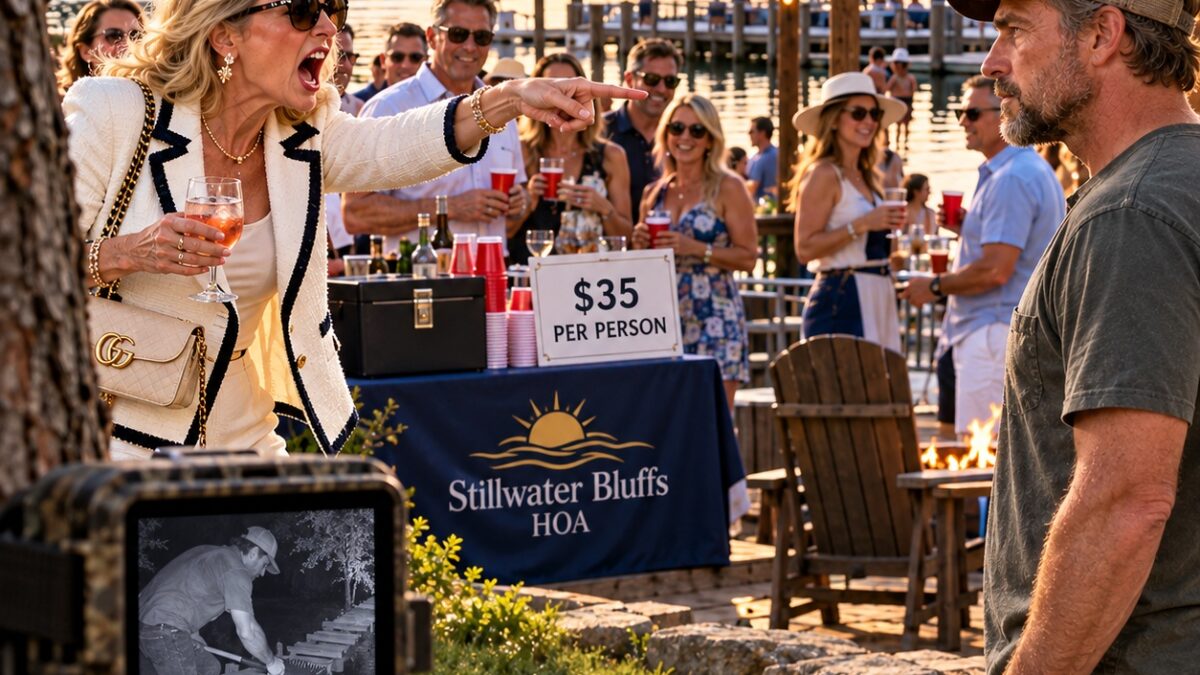
Cheryl had already announced her Fourth of July Lakeside Spectacular.
Her biggest event.
Thirty-five dollars a person.
Country band.
Fireworks.
Eighty to one hundred guests expected.
On my land.
Perfect.
Cal prepared everything through proper channels.
Warrants.
Review.
Evidence.
No shortcuts.
Cheryl:
criminal trespass.
Fraud.
Felony embezzlement.
Todd:
criminal mischief.
Conspiracy.
Abuse of public office.
The warrants were signed and sealed.
Then we waited.
I posted steel no-trespassing signs at every reasonable shoreline access point.
Not paper.
Metal.
Bolted to posts.
I had already sent written warnings.
Now nobody could claim the boundary was unclear.
I installed three more high-definition cameras.
Dock.
Shoreline.
Driveway.
Cloud synced.
Even if somebody destroyed one, the footage would survive.
Then I repaired the dock.
I removed the sabotaged board.
Replaced it with pressure-treated lumber.
Changed bolts around it.
Tested every adjacent plank with my full weight.
Solid.
That work mattered more to me than the arrests.
A case can wait.
A dangerous dock cannot.
Over the next two weeks, I also spoke with neighbors Cheryl had bullied.
Nolan.
Fined $3,000 over a storage shed on his own property.
The Westbrooks.
Forced to remove a safety fence around their pool because Cheryl called it aesthetically inconsistent.
The Crawfords.
Threatened because they walked their golden retriever near the beach.
Six neighbors agreed to testify if necessary.
Then Cheryl launched another campaign.
Email subject:
COMMUNITY SAFETY ALERT
She described me as a reclusive man living alone with an extensive firearms collection and hostile behavior toward community leadership.
The “extensive firearms collection” was one government-issued duty weapon.
She did not mention my career.
She did not mention that I had spent most of my adult life in federal law enforcement.
She only needed enough truth-shaped language to create fear.
It worked.
Neighbors who had waved stopped.
One mother pulled her children inside as I drove by.
I found a handwritten note under my windshield wiper.
WE DON’T WANT TROUBLE.
That bothered me more than Cheryl’s fines.
Because the note was not hateful.
It was scared.
Fear travels fast when one person controls the story.
The Henderson family showed me what that control had already done.
Young couple.
Five-year-old daughter.
They had installed a swing set in their backyard.
Bolted properly into concrete footings.
Cheryl fined them $400 for an unapproved recreational structure.
They appealed.
She rejected the appeal.
Added a $50 processing fee.
They removed the swing set.
Their daughter watched through the kitchen window while her father unbolted it.
Nolan told me that story.
I remembered it.
Todd escalated too.
He used Planning Commission contacts to arrange an expedited waterfront-compliance inspection of my property.
A county inspector came.
Foundation.
Roofline.
Setbacks.
Cabin.
Everything.
Nothing wrong.
The cabin’s 1987 construction predated the newer zoning provisions and retained grandfathered status.
Before leaving, the inspector looked at me.
“Your property is fine.”
“Thank you.”
“Someone pushed hard to get this inspection moved ahead. We’re normally eight weeks out.”
“I had a feeling.”
Three days later, Nolan received a $500 noise fine.
His offense?
Standing in his own driveway talking to me at normal volume.
I called him.
“You don’t need to get dragged into this.”
He laughed.
“Garrett, I survived two deployments, a divorce, and a kidney stone the size of a walnut.”
I waited.
“I’m not afraid of a woman with a clipboard.”
That was the first time Nolan made me laugh in months.
A week before the Fourth, Ellen called again.
Prepaid number.
“I found something else.”
“What?”
“Insurance.”
I sat down.
“Peton Event Services has liability insurance?”
“Yes.”
“For how long?”
“Three years.”
That mattered.
A lot.
Cheryl had insured the event company.
An event business operating repeatedly on property she did not own.
This was not somebody honestly believing the shoreline belonged to the HOA.
She had created a separate company.
Collected admission.
Carried insurance.
Kept the income off HOA books.
The structure was deliberate.
July third arrived quiet.
Mist covered the lake.
A loon called somewhere out in the fog.
I stood on the dock with a fishing rod and memorized the silence.
At 8:15 that morning, a white box truck arrived.
Then a flatbed carrying a portable stage.
Then Cheryl’s Escalade.
They drove directly past the no-trespassing signs.
The setup crew moved quickly.
Tents.
Tables.
String lights.
Portable bars.
Sound system.
Stage.
A banner.
FOURTH OF JULY LAKESIDE SPECTACULAR
HOSTED BY PETON EVENT SERVICES
Someone plugged an extension cable into my utility pole.
My power.
My meter.
The foreman found me at the dock.
“Are you the property owner?”
“Yes.”
“The lady told us this is HOA-managed land.”
“It isn’t.”
He looked back at his crew.
“We have a contract.”
“Keep a copy.”
“Why?”
“You may need it.”
His face changed.
One of his workers had already stopped unloading.
He was photographing the no-trespassing signs.
Smart.
By afternoon, the registration table was ready.
Cash box.
Venmo.
$35 admission.
Peton Event Services displayed openly.
No more pretending the money was an HOA fee.
Cheryl arrived wearing an event-coordinator badge on a lanyard.
She walked the shoreline checking tent stakes.
Speaker placement.
Tables.
I met her near the dock.
She pointed toward the posted signs.
“These are harassment.”
“Get off my property.”
She removed her sunglasses.
“This lakefront belongs to the community.”
“No.”
“It always has.”
“No.”
“Tomorrow, after the fireworks, everyone here will remember who gives them something and who tries to take it away.”
I said nothing.
That frustrated her more than an argument would have.
She walked away.
That evening I called Cal.
“Everything set?”
“Two units staged by the marina tomorrow.”
“What time?”
“Come in around seven.”
“The band ends about then.”
“Good.”
“How many witnesses?”
“Expected eighty.”
“Plenty.”
Across the water, somebody tested a firework.
One red-and-gold burst opened over the lake.
Then disappeared.
The Fourth came hot.
Ninety-one degrees by noon.
By two in the afternoon, I counted eighty-three people on my shoreline.
Country band.
Families.
Children jumping from my dock.
Couples in lawn chairs.
Brisket smoke.
Coolers.
Red-white-and-blue decorations.
Cheryl moved through the crowd in a patriotic sundress shaking hands and taking photographs.
Every few minutes, she checked the cash box.
From a distance, the scene looked lovely.
That was the strange part.
People were having fun.
Most of them were not bad people.
They believed they had paid for access to a legitimate event.
That distinction mattered to me.
The crowd was not the case.
Cheryl and Todd were.
At 6:45, the summer light turned gold.
The band finished.
Cheryl walked onto the portable stage.
Tapped the microphone.
“Can everyone hear me?”
Applause.
She welcomed everyone to the Fourth Annual Lakeside Spectacular.
Thanked them for supporting community tradition.
Mentioned the fireworks scheduled for 8:30.
Then she stopped.
Her eyes had moved past the audience.
Two Bedford County Sheriff’s cruisers waited near the end of my driveway.
No sirens.
No lights.
Cal stepped out.
Three deputies with him.
They walked toward the shoreline at an easy pace.
The crowd opened.
Cal reached the stage.
Cheryl recovered quickly.
“Officer. Welcome.”
He looked up.
“Cheryl Peton?”
“That’s me.”
“Ma’am, I have a warrant for your arrest.”
The entire shoreline went silent.
Cheryl laughed.
Small.
Nervous.
“This is a joke.”
“No, ma’am.”
“Cal, come on.”
He began reading the charges.
Criminal trespass.
Fraud.
Felony embezzlement.
The clipboard fell out of Cheryl’s hand.
Hit the plywood.
Bounced once.
I could see the printed schedule taped to the back.
Dessert.
Raffle.
Fireworks.
Everything timed perfectly.
Except this.
“This is ridiculous,” she said.
Cal waited.
“I’m the president of this HOA.”
Nobody moved.
“I built this community.”
Cal stayed still.
“You can’t do this.”
He could.
He had a valid warrant.
Then Cheryl pointed toward me.
“That man has no authority. He’s nobody. He lives in a shack.”
Cal glanced toward me.
Then back at her.
“Ma’am, Garrett Holloway is a United States deputy federal marshal.”
You could feel eighty-three people reconsider the previous several months at the same time.
Cheryl’s face changed.
Not dramatically.
Just enough.
Cal continued.
“And you have repeatedly entered his private property after written warnings.”
He stepped onto the stage.
Turned Cheryl gently.
Placed the cuffs on her wrists.
Metal clicked.
Across the crowd, two deputies approached Todd.
He had been sitting near the beer table.
Unlike Cheryl, he did not argue.
They read the charges.
Criminal mischief.
Conspiracy.
Abuse of public office.
He stood.
Placed his hands behind his back.
No protest.
There are people who are shocked by consequences.
There are others who always knew the bill would eventually arrive.
Todd looked like the second kind.
They walked both of them up the road.
Past the cash box.
Past the Peton Event Services banner.
Past the shoreline tents.
Past the steel no-trespassing signs they had driven by that morning.
At 8:30, the fireworks started.
They had been set on a timer.
Red.
White.
Blue.
Explosions reflected across Smith Mountain Lake while deputies photographed the registration table and bagged Cheryl’s clipboard.
The event she designed as her grandest community celebration had become a crime scene under her own fireworks.
People remained for a long time afterward.
Nobody knew quite what to do.
Small groups formed.
Whispering.
Comparing stories.
One woman approached me.
Sundress.
Embarrassed expression.
“We had no idea.”
“I know.”
“She told us this was HOA property.”
“I know.”
An older man stopped beside us.
“I paid thirty-five dollars.”
I nodded.
“I thought I was paying the HOA.”
“You were paying Cheryl’s company.”
His face fell.
Nolan joined me after the last vehicle left.
Firework smoke floated over the lake.
Sulfur.
Charred paper.
Water.
He stood beside me at the end of the dock.
“Took you long enough.”
“Needed enough tickets.”
Nolan laughed.
A real laugh.
Then we sat.
The charges moved forward from there.
Cheryl faced felony embezzlement tied to the $47,200 routed through Peton Event Services.
Also fraud.
Trespass.
Todd faced charges tied to the dock sabotage, conspiracy and his use of public-office influence.
He resigned from the Planning Commission the next week.
The public statement said he wanted to focus on family.
I did not comment.
The HOA held an emergency meeting.
Cheryl was removed as president.
Vote:
89 to 4.
Ellen testified before the Bedford County Grand Jury.
She received immunity in exchange for cooperation.
She told them about the two sets of books.
The deposits.
The pressure.
The threats.
The years she had spent afraid that Cheryl would destroy her reputation if she spoke.
Recovery proceedings began for the missing funds.
Peton Event Services was dissolved by the state.
Then something almost funny happened.
Stillwater Bluffs HOA dues dropped by thirty percent.
Not because services disappeared.
Because the money finally started making sense.
Phantom expenses vanished.
Fake committees disappeared.
Invented enforcement costs stopped.
Every fabricated violation Cheryl had issued was reviewed.
Dock fines.
Paint fines.
Lawn citations.
Others.
Vacated where unsupported.
Nolan Briggs became interim HOA president.
His first move was simple.
He published the actual financial records.
Income.
Expenses.
Budget.
Nothing hidden.
Nothing routed through a private company.
They were posted at the mailbox station and emailed to every household.
Transparency looked almost disappointingly easy once nobody was stealing.
His second move was abolishing the so-called facilities committee.
It had never really been a committee.
Mostly Cheryl walking around the neighborhood with a clipboard.
His third was writing apologies.
Every homeowner who had been fined without proper cause received one.
The Hendersons rebuilt their daughter’s swing set.
This time, she helped.
Nobody fined them.
Three months later, Stillwater Bluffs held its first legitimate community gathering.
They called it Stillwater Community Day.
Free.
Properly permitted.
Held on actual common-area property.
No ticket table.
No Peton Event Services.
No strangers being charged to enter somebody else’s land.
Nolan brought homemade lemonade.
The Westbrooks brought their children.
Their pool safety fence was back where it belonged.
The Crawfords brought their golden retriever.
The dog jumped into the lake within four minutes and refused to come out for two hours.
I grilled burgers on my property.
With my permission.
That detail made me smile.
The older man who had paid thirty-five dollars at Cheryl’s last event walked over carrying two beers.
He handed me one.
“This is what community is supposed to feel like.”
I took it.
“Yes.”
That evening, after everyone left, I sat alone on the dock.
Fireflies floated above the shoreline.
A whip-poor-will called from the ridge.
Warm pine.
Clean water.
Faint charcoal.
No portable stage.
No cash box.
No clipboard.
Just the lake.
I thought about Renee.
She would have loved that place.
The cabin.
The porch.
The stupid leaning dock I kept repairing instead of replacing.
She would have organized Community Day better than Nolan.
Color-coded food assignments.
Dessert table.
Backup dessert table.
She would have made people wear name tags and somehow convinced them they were enjoying it.
And she would have hated Cheryl.
That thought made me smile.
I poured a little bourbon.
Placed the empty chair beside me the way I sometimes did when the evening was quiet enough.
Then raised the glass.
“We made it to the lake, sweetheart.”
A breeze crossed the cove.
Small ripples caught the last light.
For the first time since I had moved there, the silence felt like the silence I came looking for.
Not isolation.
Peace.
There is a difference.
Cheryl never understood what she was taking from me when she turned my shoreline into an event venue.
To her, the lakefront was unused capacity.
Open grass.
Good access.
Nice view.
A place that could generate money and make her look important.
To me, it was the first place I had found after Renee died where I could sit for an hour without feeling like every object in the room was asking where she went.
That mattered.
I was not trying to isolate Stillwater Bluffs.
I was trying to own the quiet I had paid for.
Property rights sound abstract until somebody drives tent stakes into the grass where you are trying to grieve.
Then the abstraction disappears quickly.
The law did not protect my lakefront because I was a federal marshal.
That is important.
My badge had nothing to do with the deed.
I would have owned those 3.2 acres if I worked at a gas station.
Cheryl’s trespass would still have been trespass.
Todd’s saw cut would still have been dangerous.
The missing $47,200 would still have belonged in the criminal investigation.
My profession helped me recognize patterns.
Document.
Wait.
Build.
But authority came from the evidence and the law, not my job title.
That was why I kept the badge quiet.
The moment Cheryl learned what I did, her behavior would change.
I did not want better behavior performed for a federal officer.
I wanted the behavior she chose when she believed the property owner was powerless.
She gave me plenty.
Certified warning ignored.
Paid events.
Fake fines.
Cash collection.
Threats.
Planning pressure.
Dock sabotage.
Financial records.
Her own separate event company.
Insurance.
The case largely built itself because she kept assuming nothing serious could happen to her.
People sometimes ask why I let the Fourth of July party continue until the arrest.
Why allow eighty-three people onto the land?
Why wait after I already had Todd on camera?
Because by then the trespass was controlled and documented.
The dock had been repaired.
The cameras were live.
The warrants were signed.
Law enforcement was staged.
And Cheryl was committing the exact conduct at the center of the case in front of nearly everyone she had misled.
There are moments when waiting adds risk.
Then you do not wait.
There are other moments when waiting adds clarity.
That day, it did.
Every guest could see the registration table.
The Peton Event Services sign.
The cash box.
The no-trespassing signs.
The arrest.
Nobody needed Cheryl’s explanation afterward.
They had seen enough.
That shattered the system faster than months of private arguments ever could.
Cheryl’s power depended heavily on interpretation.
She told people the shoreline was community property.
Most never checked.
She told them fines were official.
Most paid.
She called committees into existence.
People assumed procedures existed behind them.
She claimed the HOA needed a special assessment for legal action.
People trusted that the action served the HOA.
Then eighty-three residents watched deputies place her in handcuffs beside a private cash box for a business they had never been told existed.
Interpretation became difficult after that.
Facts took over.
Ellen’s courage mattered more than mine in some ways.
I had experience.
A badge.
Connections.
I knew how to protect evidence.
Ellen had spent four years inside Cheryl’s system.
Every month she carried books she knew were false.
Every meeting she watched neighbors trust numbers she knew were incomplete.
She had been threatened.
Afraid.
When she finally slid that envelope across the diner table, she changed the case.
Without her, we still had trespass and sabotage.
We did not yet have the inside financial record proving exactly where the event money went.
People love decisive heroes.
Real cases are usually collections of ordinary people deciding, at different moments, to stop participating in a lie.
Ellen stopped.
Nolan stopped.
The Westbrooks stopped.
The Crawfords stopped.
Eventually almost the entire HOA stopped.
Eighty-nine to four.
Those four votes never interested me as much as people expected.
Maybe friendship.
Maybe denial.
Maybe they simply disliked me.
They were allowed.
The important thing was that the institution changed.
New president.
Books opened.
Fake rules reviewed.
Money accounted for.
Events moved onto actual common property.
That is what accountability is supposed to do.
It should repair function.
Not merely produce punishment.
Stillwater Bluffs did not need to disappear because Cheryl abused it.
An HOA is a tool.
A private organization for managing shared obligations.
Roads.
Common spaces.
Maintenance.
Budgets.
It becomes dangerous when the person holding the clipboard starts believing the tool belongs to her personally.
Cheryl blurred every boundary.
HOA money became her business revenue.
HOA access became her right to trespass.
Planning connections became Todd’s way of threatening county review.
Board authority became self-signed fines.
Community tradition became a substitute for ownership.
The same pattern repeated:
If Cheryl wanted it, Cheryl treated it as legitimate.
That is not governance.
It is appetite.
The new board proved the difference.
Nolan did not need a dramatic title.
He did not call himself the heart and soul of Stillwater Bluffs.
He was a sixty-two-year-old Navy veteran and carpenter who liked coffee and complained about his knees.
Perfect.
He opened the books.
That did more for the community than nine years of Cheryl’s leadership.
He also stopped treating disagreement as betrayal.
The first meeting he ran lasted forty minutes.
Someone questioned a budget line.
He answered.
No retaliation.
Nobody received a lawn citation the next morning.
Remarkable.
Ordinary democracy looks unimpressive compared with control.
That is why control photographs better.
It has one face.
One voice.
One person saying:
I take care of everything.
Healthy systems are slower.
Messier.
Questions.
Votes.
Records.
Annoying.
Safer.
The Henderson swing set became my favorite symbol of that change.
Their daughter had watched her father remove it because one woman decided it did not match the neighborhood.
Months later, they put it back.
Same yard.
Same child.
Same equipment.
Different leadership.
Nothing catastrophic happened.
Property values did not collapse.
Civilization survived.
A five-year-old got her swing back.
Sometimes that is what freedom looks like at neighborhood scale.
Small.
Almost silly.
Until you are the family being told no.
Todd’s dock sabotage remained the part I found hardest to think about calmly.
Financial theft is cold.
Trespass is infuriating.
But cutting halfway through a load-bearing piece of wood where children jump?
That risk was physical.
Immediate.
Todd knew events brought kids onto the dock.
He had been there.
He had watched them.
Then he walked onto the property at 2:14 in the morning with a handsaw.
I never needed to know exactly what outcome he imagined.
Maybe he expected the dock to fail later so Cheryl could say:
See? Dangerous property.
Maybe he simply wanted repair costs.
Maybe intimidation.
Intent beyond the act belonged to prosecutors.
The act itself was enough for me.
That was why I repaired it before doing anything else.
When you work law enforcement long enough, you learn cases can distort priorities.
You become so focused on preserving evidence that you forget real life is happening around it.
A sabotaged dock is evidence.
It is also a sabotaged dock.
Fix the danger.
Photograph first.
Preserve the cut board.
Then repair.
Simple.
I kept the old plank.
Tagged.
Stored.
Not as a trophy.
As evidence until nobody needed it.
After that, I wanted it gone.
Some objects belong in files.
Not homes.
Same with Cheryl’s notices.
I had stacks.
Eventually the cases moved far enough that I no longer needed personal copies of everything.
I kept the important record.
Discarded the rest.
I did not move to a lake to build a shrine to conflict.
I moved because Renee wanted a lake.
That truth needed to become larger again.
For months, every time I looked at the shoreline I saw tents.
Cash box.
Trespass signs.
Cameras.
Then Community Day happened.
Families gathered somewhere they were actually invited to be.
My own grill on my own property.
Nolan’s lemonade.
Golden retriever in the water.
Nobody charging admission.
That gave the lake another memory.
Then more ordinary days came.
Fishing.
Rain.
A heron.
A storm rattling the windows.
Repairing the dock after winter.
Small boats passing.
Normal life gradually overlaid the case.
That was healing.
Not forgetting.
Rebalancing.
Renee’s death worked the same way.
For the first year, every memory ended in the hospital.
Then slowly the hospital stopped being the only ending.
Tomatoes.
Her laugh.
A terrible vacation in Myrtle Beach when it rained five days straight.
Her obsession with cinnamon candles.
How she stole the blankets.
The lake dream.
More memories returned.
Grief became less like a courtroom where the final evidence overruled everything before it.
The diagnosis stopped defining the marriage.
Cheryl had tried to do something similar to the property.
Make conflict the defining feature.
I refused.
Eventually the lake became a lake again.
I still sat alone some evenings.
People sometimes assume loneliness is a problem to solve.
After losing Renee, I learned some forms of solitude are necessary.
Being alone with someone’s memory is not always unhealthy.
Sometimes it is the closest thing left to conversation.
I would sit on the dock.
Pour bourbon.
Occasionally say something out loud.
No expectation of an answer.
The water does not answer either.
Still useful.
On the evening after Community Day, I told Renee:
“We made it.”
That sentence held more than real estate.
I meant:
I got through the Richmond house.
Through selling.
Through the first silent nights.
Through Cheryl.
Through the case.
Through the moment when neighbors looked at me like I was dangerous because a woman had sent one email.
Through remembering how easy it is for a life to become defined by somebody else’s story.
We made it to the place we had talked about.
Not together in the way we planned.
Still.
The lake was there.
I was there.
That had to count.
Nolan eventually came by without needing a crisis.
That was another sign things had improved.
He brought coffee.
Sometimes lumber.
Once he brought an old tackle box Renee would have called disgusting.
We repaired things.
Fished badly.
Complained about weather.
Never talked much about Cheryl after the first few months.
That was intentional.
An antagonist should not become the most important person in the story simply because she caused trouble.
Cheryl did not deserve more emotional space than Renee.
Or Nolan.
Or Ellen.
Or the people trying to rebuild the neighborhood.
So I stopped giving it to her.
The official process continued.
I cooperated when asked.
Provided records.
Testified where necessary.
Answered calls.
Then returned to the cabin.
That separation kept me sane.
Law enforcement already teaches compartmentalization.
You work a case.
Then come home.
Sometimes badly.
Sometimes not enough.
With Cheryl, home had become the case.
I needed to reverse that once the arrests happened.
The cameras stayed for security.
But I stopped checking them every ten minutes.
The steel no-trespassing signs remained.
They were not hostile.
They were clear.
That was the thing Cheryl claimed not to understand.
A posted boundary does not mean you hate your neighbors.
It means consent matters.
Community Day proved you can welcome people without surrendering ownership.
The problem was never neighbors enjoying the lake.
The problem was somebody else deciding she could grant access to land she did not own and profit from it.
Ask me.
Maybe I say yes to something.
Maybe no.
That is what ownership means.
Choice.
The first day Cheryl approached me, she actually asked.
I answered no.
Everything after came from refusing to accept that answer.
That pattern appears in more serious crimes too.
People who believe another person’s no is merely the start of negotiation.
No becomes something to overcome.
Pressure.
Manipulation.
Threat.
Force.
Cheryl’s world was smaller than the fugitive cases I had worked, but the underlying psychology was familiar.
Entitlement converts boundaries into challenges.
My no offended her identity.
She had been president nine years.
People obeyed.
She used the shoreline four years.
Nobody stopped her.
Then a widower bought the cabin and said:
No more.
She could have moved the events.
Found lawful space.
Worked with the HOA.
Instead she needed to prove the no did not count.
That decision cost her.
Not my refusal.
Her response to it.
Todd made the same mistake.
He treated his Planning Commission position like a private lever.
County inspection as intimidation.
The cabin passed.
Of course.
The expedited inspection only added another independent witness to the pattern.
Pressure creates records.
Abusers often forget that.
Every false or exaggerated complaint generates a file somewhere.
One file looks like concern.
Ten begin to look like retaliation.
That is why I saved dates.
Context.
Who called.
What happened next.
Chronology turns noise into pattern.
I used that lesson professionally for years.
A fugitive buys gas in three towns.
Calls one cousin.
Uses one motel chain.
Nothing separately.
Together, direction.
Same principle here.
Lake events.
Fake fines.
Financial denials.
Todd’s call.
Dock sabotage.
Private LLC.
Insurance.
Money.
Together, case.
Ellen’s second set of books gave us the center.
I always wondered how long she had planned to keep them.
Maybe forever.
Maybe she was waiting for somebody who would listen.
Fear has its own timetable.
I did not judge her.
Four years under Cheryl had taught everyone in Stillwater Bluffs the cost of dissent.
Nolan had more appetite for conflict.
Others had families.
Mortgages.
Jobs.
People make compromises to get through a day.
Then sometimes somebody arrives and changes the risk calculation.
Not because he is braver.
Because he brings another structure.
In my case, experience.
Cal.
Documentation.
Once Ellen knew there was a path that did not leave her alone against Cheryl, she stepped into it.
That is why systems matter.
Courage is easier when support exists.
After Nolan published the true financials, several homeowners apologized to Ellen.
That mattered.
Some had blamed her as treasurer.
She had signed reports.
She was not entirely free of responsibility.
Immunity did not mean innocence in the moral sense.
It meant her cooperation was valuable enough to the case that prosecutors made a decision.
She still carried what she had done and failed to do.
She knew that.
Her testimony was part of repairing it.
Accountability is rarely clean.
People want heroes and villains sorted neatly.
Real cases contain frightened accomplices.
Passive spouses.
Misled neighbors.
People who should have spoken earlier.
People who speak eventually.
You deal with the facts you have.
Cheryl’s case was clearer.
She knew.
The liability policy helped establish that.
Three years of insurance for Peton Event Services.
You do not insure an imaginary enterprise accidentally.
She had formalized the business enough to protect herself financially while refusing to recognize the property owner whose land made the events possible.
That detail bothered Cal.
It bothered the prosecutors.
It showed preparation.
Not misunderstanding.
The Fourth of July banner openly naming Peton Event Services made it even harder to argue the payments were informal HOA collections.
Private company.
Private account.
Public deception.
The homeowners deserved to know.
That was why the public arrest mattered.
I have seen defendants arrested quietly and then spend months reshaping the story.
Sometimes successfully.
People cling to familiar narratives.
Cheryl had nine years of social capital.
If she disappeared into a cruiser at six in the morning, the rumors would have begun before breakfast.
Garrett set her up.
Federal officer abused power.
Personal revenge.
Financial paperwork misunderstanding.
Instead, eighty-three people saw the warrants executed at the same event where they had paid her private company to enter posted private property.
They saw the cash box bagged.
The sign photographed.
The deputies.
Todd.
Everything.
The event itself became explanation.
The funny part is that I never planned the fireworks.
Obviously.
At 8:30, when they started over the crime scene, even Cal looked up and shook his head.
The sky filled red and blue.
Evidence tags under string lights.
Deputies taking statements beside coolers.
It was absurd.
Renee would have laughed until she cried.
That thought almost made me laugh then too.
Not at Cheryl.
At the scene.
Life sometimes has a sense of timing no investigator could manufacture.
The fireworks ended.
Smoke drifted.
The lake went dark again.
And after the cars finally left, the property belonged to silence.
That was all I had asked for at the beginning.
Silence.
Permission.
Ownership respected.
It took four months of documentation and an arrest operation to get something that should have taken one conversation.
“No, I don’t want HOA events here anymore.”
“All right.”
End.
People create enormous consequences by refusing small boundaries.
That may be the simplest thing I took from the case.
Accept no early.
It is cheaper.
For everyone.
Stillwater Bluffs survived Cheryl.
Of course it did.
Communities often believe one controlling leader is indispensable because that leader has spent years saying so.
Then she leaves.
The mail still arrives.
Grass grows.
Budgets get paid.
People organize events.
Sometimes better.
HOA dues dropped.
Swing sets returned.
Dogs went swimming.
Life continued.
Nolan never called himself the heart and soul of anything.
Good.
Healthy systems do not need a monarch.
They need somebody willing to open the spreadsheet and answer questions.
The community eventually became something I could belong near without feeling like it wanted to absorb me.
That distinction mattered.
I never joined an HOA crusade.
Never ran for its board.
My property remained mine.
Their common property remained theirs.
We became neighbors.
That was enough.
The old man who handed me the beer at Community Day said it perfectly.
“This is what community is supposed to feel like.”
Nobody had to own my dock to talk with me beside it.
Nobody had to charge admission.
Nobody needed a clipboard.
Community is voluntary proximity made humane.
The moment coercion becomes the main glue, something has gone wrong.
That evening, I stayed on the dock until the stars came out.
The empty chair beside me caught a little moonlight.
I thought about Renee planting tomatoes.
About the Richmond house I could not bear to keep.
About buying the cabin because I wanted to finish a dream for both of us.
About Cheryl standing on the same shoreline telling me I did not matter.
She was wrong about that.
But not because I was a federal marshal.
Not because I could build a criminal case.
Not because Cal had warrants.
I mattered because the property was mine.
Because consent matters even when the person saying no is ordinary.
Maybe especially then.
A title is not supposed to determine whether your boundaries deserve respect.
Cheryl thought status created rights.
HOA president.
Planning Commission husband.
Event coordinator.
Community leader.
I had spent my career dealing with men who thought different titles or reputations put them outside ordinary limits.
They were usually wrong too.
Law is imperfect.
Institutions fail.
People abuse positions.
Still, the principle remains useful.
You do not get to take what is not yours because nobody stopped you yesterday.
Four years of illegal events did not create ownership.
Nine years as HOA president did not turn Cheryl’s signature into law.
Todd’s Planning Commission seat did not make sabotage legitimate.
Popularity did not transform private grass into common area.
Use does not automatically become right merely because it has gone unchallenged.
That is why records exist.
Deeds.
Surveys.
Bank statements.
Contracts.
Camera footage.
When memory and confidence collide, documents give the argument somewhere solid to stand.
I had arrived at the lake looking for quiet.
Instead I got another case.
Maybe that was inevitable.
I had spent too many years seeing patterns to ignore one developing thirty feet from my porch.
But after everything ended, the quiet came back.
Slowly.
No Escalade in the driveway.
No workers setting up tents.
No strange cars.
No event music shaking the windows.
No email accusing me of being dangerous.
Just the ordinary sounds Renee would have loved.
Water.
Birds.
Dock boards shifting under weight.
Wind through pine.
Sometimes Nolan’s truck.
Sometimes laughter from real community events elsewhere.
The lake did not become silent.
It became honest.
That was better.
One evening near the end of summer, I repaired another dock plank.
This one had actually rotted.
Nothing criminal.
Just water and time.
I smiled when I found it.
Normal maintenance.
I removed the board.
Cut the replacement.
Bolted it down.
Checked the fit.
Then sat on the edge with my feet over the water.
A bass broke the surface.
Osprey cried from somewhere behind the cabin.
The sun dropped toward the ridge.
I poured a little bourbon.
Set the second chair beside me.
“Still here,” I said.
The lake answered with one small wave against the piling.
Good enough.
I stayed until dark.
No clipboard.
No cash box.
No strangers paying admission.
No one telling me who mattered.
Just the place Renee wanted.
The place I had finally made it to.
And a community beyond the trees that had learned, at considerable cost, that belonging does not begin with authority.
It begins with permission.








