FULL STORY:HOA Queen Called My Late Wife’s 32-Year Vineyard “Disgusting Weeds”—Then the Police Pulled the Property Map and Went Quiet
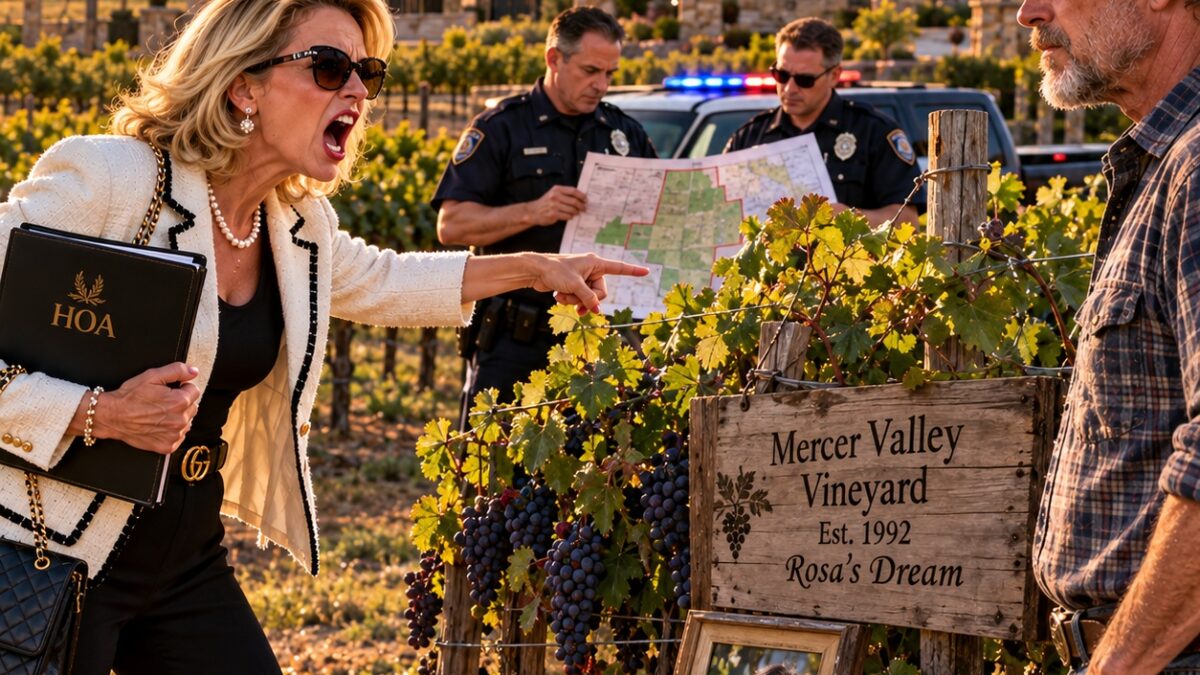
FULL STORY CONTINUATION
Denise had moved to Summit Ridge from Houston.
She was fifty and carried herself with the polished certainty of someone who had spent decades in corporate sales and had become accustomed to treating resistance as a temporary objection waiting for the right pressure.
She had worked twenty-two years as a pharmaceutical sales manager.
That background showed in everything she did.
Every conversation had a goal.
Every disagreement became an objection to overcome.
Every person seemed to be either an ally, a prospect, or an obstacle.
She ran unopposed for HOA president.
No one else wanted the job.
Within months, Summit Ridge began changing around her.
She resurfaced the clubhouse parking lot in the precise shade of stone she preferred.
Installed an outdoor kitchen nobody had requested.
Redesigned the community newsletter into a glossy publication.
Her professional headshot appeared on every cover.
Then came the enforcement campaign.
A family was fined $350 because their son’s basketball hoop could be seen from the street.
The boy had just made his school team.
Denise decided the hoop did not match Summit Ridge’s “aesthetic maturity.”
A retired Air Force colonel received a letter demanding his flagpole be shortened eighteen inches under a rule Denise had recently created.
Another family was cited because their garage door was the wrong shade of gray.
Not the wrong color.
The wrong shade.
A ten-year-old girl running a lemonade stand for an animal shelter was told she needed approval for an unauthorized commercial enterprise.
One dollar per cup.
Denise wanted an application.
Site plan.
Insurance certificate.
Most residents grumbled and complied.
That is how small overreach becomes normal.
Nobody wants to spend a Saturday arguing at an HOA meeting over a basketball hoop.
So people pay.
Adjust.
Move the thing.
Repaint.
Eventually the person issuing the demands learns the wrong lesson.
She believes compliance proves authority.
Then Denise turned her attention to land outside Summit Ridge.
My land.
The first letter arrived in March.
Heavy paper.
Embossed HOA logo.
NOTICE OF AESTHETIC AND AGRICULTURAL CONCERN REGARDING ADJACENT LAND USE
That was how she described Rosa’s vineyard.
Adjacent land use.
The letter said our vines were inconsistent with the residential character of Summit Ridge, generated agricultural noise, attracted pests, and reduced surrounding property values.
The demand appeared near the bottom.
Cease agricultural operations within sixty days.
I read the letter twice.
Then once more because I wanted to be certain I had not misunderstood.
An HOA on fifty acres my family once owned was ordering me to shut down a thirty-two-year-old vineyard on land it had never controlled.
I wrote back politely.
Four paragraphs.
Vineyard predates subdivision.
Mercer property outside HOA jurisdiction.
Existing agricultural operations explicitly protected by recorded deed covenant.
No authority for the demand.
I ended by wishing the board a pleasant spring.
Denise replied that my answer was “non-responsive.”
Then:
This is a courtesy, not a request.
I created a folder.
Labeled it:
PRIOR
I suspected I would need room.
Four weeks later, Denise arrived in person.
White Escalade.
No call.
No appointment.
She parked diagonally in front of the tasting room.
Two people got out with her.
A contractor.
A photographer.
I was in row twelve thinning canopy.
Rosa’s old hat was on my head.
Pruning shears in my hand.
Denise walked toward me.
“Mr. Mercer, I’ve brought professionals to evaluate the removal process.”
I looked past her.
The contractor was measuring row spacing.
The photographer was taking pictures.
“Removal of what?”
“The vines.”
I walked down the row.
Thirty-two-year-old trunks stood on both sides of us.
Some had been in the soil longer than Summit Ridge’s youngest residents had been alive.
Denise continued.
“If you cooperate, this can be resolved without unnecessary legal costs.”
I stopped.
“Ms. Prior, you’re standing on private property.”
“I represent sixty-one homeowners.”
“This vineyard was planted before your subdivision existed.”
“The board has full authority to address nuisance conditions affecting community values.”
“Not here.”
She smiled.
“I have a legal team and the full authority of the Summit Ridge board behind me.”
Then she looked at my boots.
Rosa’s hat.
My work clothes.
“You have this situation.”
That line told me more than the letters had.
Denise believed appearance established hierarchy.
She saw an older man pruning vines.
She saw work boots.
Dust.
A farm.
She did not see thirty years at the Texas General Land Office.
She did not see the deed.
She did not see Section 4.1.
Or 4.3.
Or 4.5.
She saw somebody she expected to pressure.
“You can cooperate,” she said, “or I can make your life extremely difficult.”
I held her gaze.
“I appreciate the offer.”
Her smile returned.
“Now get off my land.”
She stood still.
Then turned.
The contractor followed.
The photographer took one last image.
The Escalade drove down Mercer Road.
My road.
A road my grandfather paved in 1952 because the county had promised to get around to it and never did.
Three weeks later, Denise started calling the police.
The first complaint alleged illegal commercial operations.
A deputy came out.
Checked the vineyard.
Confirmed permitted agricultural use.
Left.
The second complaint alleged chemical spraying near homes.
We used organic sulfur dust Rosa had used for years.
Again:
No violation.
The third complaint alleged operation of unpermitted heavy machinery.
The machinery was my old John Deere.
Again:
Nothing.
Then came the fourth call.
Tuesday morning.
April.
Clear sky.
Low seventies.
I was working in row eight.
Rosa’s row.
I heard vehicles climbing Mercer Road.
Three county vehicles.
Two patrol SUVs.
Sergeant’s vehicle.
I set down the shears.
Denise was already near the vineyard.
Clipboard.
Folder.
She had apparently decided one officer had not been enough.
Now she had summoned a small convoy.
Sergeant Ray Torres stepped out.
Sixty-one.
Broad-shouldered.
Calm.
The demeanor of a man who had spent decades listening to people describe what they believed happened before checking what actually happened.
Denise began immediately.
“This property is operating an illegal agricultural enterprise in violation of residential zoning.”
Torres raised one hand.
“Ma’am, let me look first.”
He walked the vineyard edge.
Touched an old vine trunk.
Looked at the farmhouse.
Stone barn.
Tasting room.
Then came back.
“Sir, this your property?”
“Yes.”
“How long has the vineyard been here?”
“My wife planted it in 1992.”
“Thirty-two years?”
“Yes.”
He wrote something.
“Give me a minute.”
Torres returned to his cruiser.
He started working through the county property records.
Parcel maps.
GIS overlays.
Deeds.
The same kinds of documents I had spent my career reading.
Denise stood nearby with her arms folded.
At first, she looked impatient.
Then Torres kept reading.
Five minutes.
His deputy walked over.
Leaned toward the window.
Torres said something quietly.
The deputy pulled out his phone.
Opened the Hays County GIS map.
Scrolled.
His expression changed.
I recognized that look.
I had seen it on young surveyors when a complicated chain of title suddenly made sense.
The deputy looked toward the ridge.
Then the road.
Then the ground.
“Sarge…”
Torres got out.
Adjusted his belt.
Walked toward Denise.
“Ma’am, do you know whose land you’re standing on?”
Denise blinked.
“I’m adjacent to Summit Ridge Estates. I’m the HOA president, and—”
Torres pointed at the ground.
Then Mercer Road.
Then across the valley.
“I just checked the county records.”
He paused.
“This valley is Mercer property.”
Denise’s clipboard lowered slightly.
“The road your subdivision uses is on Mercer land.”
Another pause.
“The well serving your neighborhood is on Mercer land.”
He looked toward me.
“You called us to report an illegal vineyard on a man’s property that his family has owned since 1889.”
Denise tried again.
“The noise and chemical use—”
“The chemical is agricultural sulfur dust. The noise is a tractor.”
Torres’s voice stayed calm.
“There is no crime here.”
The younger deputy looked at me.
“Sir, is this Mercer Valley Vineyards? The one that won at the Houston Livestock Show?”
“2019. Rosa’s Reserve Tempranillo.”
He looked embarrassed.
Torres turned back to Denise.
Then his tone changed.
“Ms. Prior, you’ve called this office four times.”
She said nothing.
“Four times we have found no violation.”
He removed his sunglasses.
“If you knowingly file another false complaint, we won’t be coming here to investigate Mr. Mercer.”
He let that settle.
“We’ll be coming to speak with you.”
The deputies left.
All three vehicles drove back down Mercer Road.
Denise remained beside the vineyard.
For perhaps thirty seconds.
No speech.
No clipboard argument.
Then she walked to the Escalade.
I watched her leave.
I thought the map had ended the matter.
I was wrong.
That evening, Tom Wilder called.
Tom lived inside Summit Ridge.
Retired CPA.
Member of the HOA board.
He had joined mostly because somebody needed to watch the finances.
“Hank.”
“Tom.”
“Denise called an emergency meeting after the deputies left.”
“That was fast.”
“She says law enforcement failed to respect the HOA’s compliance authority.”
I laughed once.
Tom did not.
“That’s not why I’m calling.”
He explained what happened next.
The board secretary, Janet Lou, had gone home and done something nobody on the board had apparently bothered to do before.
She researched me.
Property records.
Road agreement.
Well agreement.
Deed restrictions.
My career.
The vineyard.
Everything.
At the emergency meeting, she turned her laptop toward the board.
According to Tom, her hands were shaking.
“This man’s family owns the road we drive on.”
Then:
“They own the well.”
Then:
“He wrote the covenants.”
Tom said Janet looked directly at Denise.
“Our access is conditional. Our water agreement is conditional. The covenants specifically prohibit interference with Mercer agricultural operations, and you’ve called the police on his vineyard four times.”
Denise’s response told the board everything.
“I don’t care if his family owns the entire county.”
She apparently closed the discussion and moved on to pool resurfacing.
Three board members resigned the next morning.
Janet was one of them.
By Friday, Denise had replaced them with neighbors who would not challenge her.
Tom called again that night.
This time his voice was different.
“I’ve been watching the finances.”
“How bad?”
“Fourteen months. Fifty-two thousand dollars paid to Barrett and Lyall in Austin.”
“What for?”
“Real estate litigation.”
“Against who?”
“That’s the problem. There isn’t a case.”
“Any file number?”
“No.”
“Invoice detail?”
“Pre-litigation assessment for community protection.”
I sat back.
That phrase did not mean anything by itself.
But fifty-two thousand dollars meant something.
“So what are they preparing for?”
“I’ve asked twice. Denise won’t answer.”
I knew that feeling.
A boundary description that does not close.
A monument that does not match the plat.
Something was missing.
I began pulling records the next morning.
Thirty years with the General Land Office had taught me where people hide the part of a transaction they hope nobody connects.
Entity filings.
Managing members.
Applications.
Cross-referenced names.
Dates.
Ownership chains.
Nine months before Denise sent her first letter about Rosa’s vines, an LLC had filed a development application.
HILL COUNTRY PREMIER DEVELOPMENT LLC
Proposed development:
120 luxury homes.
Ninety-five acres along Mercer Valley’s western slopes.
Phase Two estate homes.
Starting near $950,000.
The architectural renderings showed vineyard views.
Rosa’s vines.
Again.
Used as a selling feature by people who wanted the vineyard removed.
I opened the entity registration.
Registered agent:
Brett Langston.
Managing members:
Brett Langston.
Denise Marie Prior.
I sat there a long time.
Then I pulled the zoning application.
The proposed development required agricultural land to be rezoned residential.
The vineyard was part of what made that difficult.
Existing agricultural operation.
Protected by recorded covenant.
A nuisance campaign against that agriculture could help manufacture a public narrative supporting rezoning.
The letters were not about beauty.
The police complaints were not about sulfur.
Denise needed the agricultural operation weakened or removed because it stood between her and a development worth roughly $114 million in projected home sales.
The $52,000 in HOA legal spending suddenly made sense.
Homeowners thought their dues protected Summit Ridge.
Instead, those dues were financing legal preparation connected to a private development venture Denise personally stood to profit from.
Even the petition made sense now.
Sixty-one homeowners had signed believing they were protecting their existing property values.
They were unknowingly building political support for a development that would add 120 houses and transform the valley views they had paid to enjoy.
I called my daughter.
Sophia.
Environmental and land-use attorney in Austin.
Rosa’s intelligence with a law degree.
I explained everything.
Her first question:
“Tell me you documented it.”
“Sophia.”
“I know. I know.”
“I spent thirty years documenting land.”
“Then let’s finish it.”
She drove out.
We spread records across Rosa’s old kitchen table.
Deeds.
Plat maps.
HOA letters.
Road easement.
Water agreement.
Entity registrations.
Invoices.
Development application.
Four main issues emerged.
First:
Section 4.1.
Agricultural Protection Covenant.
The HOA had already interfered with Mercer agriculture repeatedly.
Second:
Section 4.3.
Road easement.
Summit Ridge’s only access road remained subject to compliance with 4.1.
Material breach could trigger revocation.
Third:
Section 4.5.
Water use.
Same condition.
Same non-interference requirement.
Fourth:
The $52,000.
Homeowners’ money used in connection with Denise’s personal venture.
Any one of those could become a serious problem.
Together?
The HOA’s position was dangerous.
But Denise still had one move left.
And it was worse than every letter and police call combined.
I discovered it at dawn.
Thursday morning.
Coffee in one hand.
Rosa’s hat on my head.
I was walking the south ridge when I saw the leaves.
Rows fourteen through twenty.
Seven rows.
The canopy looked wrong.
Leaves had curled sharply.
Edges brittle.
Yellow streaks where there should have been healthy green.
Cane tips darkening.
I stopped.
Drought stress does not look like that.
We had not had rain in nine days.
I touched the soil near row seventeen.
Damp.
Slick.
An oily residue.
My stomach tightened.
I had trail cameras.
Not because I expected sabotage.
Wildlife.
Equipment.
Security.
I pulled the footage.
2:17 a.m.
White panel van.
Company markings:
LONE STAR PEST & TURF
Two men in coveralls.
Backpack sprayers.
They entered Rosa’s vineyard in darkness.
Worked downhill for forty-two minutes.
Seven rows.
I sent samples to a lab.
Result:
Triclopyr.
Broadleaf herbicide.
Applied at roughly double concentration.
I called the pest company.
The owner cut me off before I finished.
“Mr. Mercer, I know exactly why you’re calling.”
“Then explain it.”
“We were told it was HOA common property.”
“It’s not.”
“I know that now.”
“Who gave you the work order?”
A pause.
“Denise Prior.”
“How were you paid?”
“Cash.”
“How much?”
“Twenty-eight hundred.”
He sent the paperwork.
Summit Ridge letterhead.
Denise’s signature.
TARGET: INVASIVE VINE GROWTH ON COMMUNITY PERIMETER
TREATMENT: BROADLEAF HERBICIDE — FULL REMOVAL
Full removal.
Thirty-two-year-old Tempranillo vines.
Rosa’s vineyard.
Classified as invasive growth.
I sat on Rosa’s bench that evening.
Row eight remained healthy.
Rows farther down the slope carried patches of yellow and brown.
About 140 feet of damaged vineyard.
Above row seventeen, an old ribbon moved in the wind.
Rosa had tied it there in 1995 when one of the first Tempranillo clusters ripened.
It had once been red.
Now it was pale pink.
Still tied to the trellis.
Below it, poisoned leaves curled.
I could almost hear Rosa.
Not words.
Presence.
Those vines were mornings.
Decades.
Hands.
Pruning.
Harvest.
Drought.
Rain.
A woman talking to limestone as if soil could answer.
Denise had tried to kill them because they interfered with a real-estate plan.
I did not drive to Summit Ridge.
Did not knock on her door.
Did not threaten her.
I went inside.
Opened the Prior file.
Added:
Trail-camera footage.
Laboratory results.
Pest-company statement.
Signed work order.
Then I filed formal complaints.
Texas Department of Agriculture.
Texas Real Estate Commission.
Texas Attorney General.
Hays County District Attorney.
I called Sophia.
“It’s time.”
The county hearing took place in October.
A government meeting room.
Metal chairs.
Fluorescent lights.
Denise came prepared.
Eighteen slides.
Photographs of the vineyard.
She used the herbicide damage she had caused as evidence the vines were neglected.
She described agricultural blight.
Property-value risk.
Incompatibility with future residential planning.
She spoke for sixteen minutes.
Calm.
Polished.
Professional.
Then I stood.
Work boots.
Khakis.
Corduroy jacket Rosa had given me.
No slides.
First:
The deed.
Then:
Section 4.1.
I read it aloud.
No activity by the purchaser or any homeowners association shall interfere with existing agricultural operations on adjacent Mercer land.
Denise stopped taking notes.
Next:
Section 4.3.
Conditional road access.
Then:
Section 4.5.
Conditional water agreement.
I watched the planning board members begin exchanging looks.
Then Sophia stood.
She was better at this part than I was.
She held up the Hill Country Premier Development filing.
“Managing members: Brett Langston and Denise Marie Prior.”
Denise’s attorney turned toward her.
Sophia continued.
“Proposed development: 120 homes.”
Then the financial records.
“Fifty-two thousand dollars of Summit Ridge HOA funds paid to outside real-estate counsel during the period Ms. Prior was advancing this private development venture.”
Next:
The letters.
Police reports.
Rezoning campaign.
Then:
The trail-camera still.
Two men spraying at 2:17 a.m.
Then:
The work order.
Signed by Denise.
Then:
The lab analysis.
Triclopyr.
Double concentration.
Applied to a vineyard operating continuously since 1992.
Sophia faced the board.
“This was not a nuisance proceeding.”
No one moved.
“It was a development application disguised as community protection.”
She placed the records down.
“When letters and police reports failed, Ms. Prior paid cash to have the agricultural operation chemically damaged.”
Denise’s attorney looked down.
The nuisance complaint was dismissed unanimously.
The rezoning request was denied.
The chairman thanked us.
Then he apologized.
Nine days later, Summit Ridge held its own meeting.
Sixty-three of sixty-eight households attended.
Denise opened by trying to call the county hearing a procedural misunderstanding.
Tom Wilder interrupted.
“Denise, we’ve all read the filings.”
People started talking.
Not politely.
They had been paying $420 a month.
Now they knew $52,000 had gone toward legal work tied to a development venture they had never approved.
Carla Reeves stood.
“You told us the vineyard was hurting our home values.”
Then she pointed toward the phase-two plans.
“You were going to build one hundred twenty houses behind us.”
Another homeowner, David Yun, spoke.
He had moved there partly for the vineyard view.
“She told me the vines were hurting my investment.”
He looked around the room.
“She was going to replace the view with another subdivision and use my dues to help do it.”
Denise tried to regain control.
“This is being completely mischaracterized.”
Tom answered before she could continue.
“Your development would have enhanced your bank account.”
That ended the room.
The removal vote followed.
Sixty-one to four.
Three abstentions.
Denise voted for herself.
She left the clubhouse.
Outside, two deputies waited.
One was the younger deputy who had stood beside Sergeant Torres months earlier and looked at the GIS map.
This time, they were not there because Denise had called them.
They had a warrant.
Criminal trespass.
Destruction of agricultural property.
The aftermath moved steadily.
The Texas Department of Agriculture assessed $24,000 in penalties against the pest company.
The vineyard damage was calculated around $148,000.
That figure accounted for more than dead leaves.
Heritage rootstock.
Thirty-two years of maturity.
Lost production.
Time.
You cannot plant a new vine and manufacture three decades.
Rosa’s cousin Robert Garza, a land-use attorney in San Antonio, filed the civil case.
Destruction of agricultural property.
Trespass.
Fraud.
Breach of deed covenants.
Agricultural damages.
The total claim reached approximately $492,000.
Sophia filed a separate complaint involving Brett Langston and the nondisclosure of deed restrictions affecting road and water access.
That issue mattered enormously.
People had bought homes in Summit Ridge believing their access and water arrangements were stable.
They were stable—
as long as the HOA complied with the non-interference covenant.
Denise had nearly placed every homeowner in conflict with the only landowner controlling both systems.
Hill Country Premier Development LLC dissolved within forty-five days.
Phase Two disappeared.
The application was withdrawn permanently.
The renderings showing Rosa’s vineyard behind rows of new luxury homes never became reality.
Denise eventually pleaded guilty to misdemeanor destruction and trespass.
Her sentence included eighteen months probation.
Full restitution.
Two hundred hours of community service at a Hill Country agricultural extension office.
When Sophia told me that part, I stared at her.
“Agricultural extension?”
She nodded.
I almost laughed.
The woman who had signed a work order labeling thirty-two-year-old Tempranillo vines invasive growth would spend weekends around people whose entire profession involved understanding crops.
She was also permanently barred from serving on an HOA board in Texas.
Denise sold her Summit Ridge house.
The sale closed at a reported $51,000 loss.
She moved back to Houston.
I did not follow what happened after that.
I had vines to save.
Tom Wilder became HOA president.
Not because he wanted the title.
That was probably the best qualification available.
He came to my house carrying the revised easement agreement.
Full compliance with the original non-interference covenant.
No further HOA action against Mercer agricultural operations.
Clear acknowledgment of the road and water conditions.
We signed at Rosa’s kitchen table.
Tom sat quietly after.
“Hank, I’m sorry.”
“You didn’t do this.”
“I signed her petition.”
“So did sixty others.”
“We should’ve checked.”
“Yes.”
He nodded.
Then reached into a canvas bag.
A clay pot.
Dark soil.
One young Tempranillo cutting.
“Sophia gave me this.”
I looked closer.
“Original rootstock.”
He nodded.
“From Rosa’s line.”
That spring, Sophia came home.
Father and daughter replanted the damaged stretch together.
One hundred forty feet.
New Tempranillo from cuttings tied back to Rosa’s original stock.
The same material she had brought from Rioja decades earlier.
Sophia dug.
I set plants.
We tied thin young canes to wire.
The old vines around us had trunks dark and thick as wrists.
The new vines looked fragile beside them.
That did not bother me.
Everything old had once looked fragile.
Rosa used to say:
“The best vines are the ones that remember where they came from.”
These would.
Same slope.
Same limestone.
Same Texas sun.
Same rootstock.
Different generation.
I built another bench.
This one at row seventeen.
Live oak from the north ridge.
Sanded smooth.
Oil finish.
Small brass plate.
PARA ROSA
WHO PLANTED WITH PATIENCE
AND HARVESTED WITH GRACE
Every morning I walked the rows.
The damaged section recovered slowly.
Some vines could not be saved.
Those were replaced.
Others survived.
Agriculture teaches you not to demand symbolic perfection from biology.
A plant lives or it does not.
A cutting takes or it does not.
You work with what survives.
The new vines grew.
Thin canes.
Small leaves.
Roots beginning the long descent into limestone.
They would need years.
That was fine.
Rosa had understood patience better than anybody I knew.
The rest of the vineyard still produced.
Old vines carrying fruit.
Dark clusters.
The taste remained what Rosa had built.
Flint.
Dark cherry.
Hill Country limestone.
By harvest season, grapes were measuring around twenty-three Brix.
I walked the rows checking clusters.
Rosa’s hat stayed on my head.
Not every day.
Most days.
Summit Ridge changed too.
Tom ran the board like an accountant.
Meetings.
Minutes.
Budgets.
No crusades against vineyards.
No police calls.
No effort to turn an HOA presidency into private development leverage.
People began coming across the valley differently.
Not as complainants.
Neighbors.
That fall, Summit Ridge held its first Mercer Valley Harvest Festival.
About 150 people came.
Families from the subdivision.
People from around the county.
They walked between vineyard rows.
Watched the sun drop behind the western ridge.
The limestone turned gold in the October light.
Tom brought his grandchildren.
Carla Reeves brought tamales.
The younger deputy who had looked up the Mercer GIS map months earlier came with his daughter.
She wandered beside him picking wildflowers and asking why the grapes were purple.
Sophia stood near row seventeen talking with people about the replanting.
For the first time since Denise started sending letters, the residents of Summit Ridge were enjoying the vineyard without trying to control it.
That mattered.
The original development brochures had sold Rosa’s vineyard as scenery.
Denise had later called it an eyesore when it blocked her private plans.
Both views made the same mistake.
The vineyard was not a backdrop.
It was work.
Soil.
Agriculture.
Family.
It could be beautiful and still belong to itself.
People did not need to own it to appreciate it.
That evening proved it.
Near sunset, I noticed a little boy standing beside the new bench.
He leaned close to the brass plaque.
Slowly sounded out the words.
Then looked up at me.
“Who’s Rosa?”
I stopped.
“My wife.”
He looked down the rows.
Old vines.
New vines.
Thirty-two-year trunks beside thin new canes.
“She planted these?”
“Yes.”
“All of them?”
“Most of the old ones.”
He looked impressed.
“She must’ve really liked grapes.”
I smiled.
“She really did.”
He ran back toward his family.
I stayed beside the bench.
The sun dropped lower.
Warm stone.
Cedar.
Ripe fruit.
The valley stretched below.
Mercer Creek.
Meadow.
Road.
Sixty-eight houses on the eastern plateau.
The same houses whose residents once signed Denise’s petition were now bringing their children to harvest.
That did not make them hypocrites.
It made them people who had learned more.
Tom had learned.
Carla had learned.
David had learned.
Even the deputies had learned what a parcel map can change when somebody finally reads it.
Denise’s mistake had been assuming quiet meant powerless.
I had not raised my voice when she insulted Rosa.
I had not threatened her when she brought a demolition contractor.
I had not driven to her house after the police calls.
I had not confronted her after the poisoning.
I documented.
Every letter became evidence.
Every police report created a record.
Every dollar in the HOA ledger created a trail.
Every application connected a name.
Every trail-camera frame fixed a time.
Every deed clause sat exactly where my father and I had placed it twelve years earlier, waiting for somebody to read it.
Rosa used patience on vines.
I used it on Denise.
There is a difference between patience and passivity.
A vine looks still while its roots work through stone.
That does not mean nothing is happening.
For months, Denise saw me pruning, filing letters, answering deputies, tending rows.
She thought I was an old widower who did not understand the scale of the fight she was bringing.
She had sixty-one petition signatures.
Lawyers.
HOA money.
A developer.
I had documents.
And land.
More importantly, I understood both.
Thirty years as a surveyor had taught me something I wished more property owners knew.
Most serious land disputes are decided long before anyone becomes angry.
They are decided when the deed is written.
When an easement is defined.
When one sentence says conditional instead of permanent.
When a seller reserves a well.
When a covenant anticipates future interference.
My father had been careful.
I had been careful for him.
Section 4.1 did not sound dramatic in 2012.
It was just protection for an operating ranch and vineyard beside a future subdivision.
Twelve years later, it became the foundation of everything.
The road mattered.
Mercer Road was the only practical entrance into Summit Ridge.
The water mattered more.
The primary well sat on ten acres my father never sold.
Denise had nearly placed sixty-eight households in material breach of agreements controlling both because she wanted a development deal.
That was not leadership.
It was recklessness.
And the people living there eventually understood that Denise had risked their access while telling them she was defending their property values.
The $52,000 mattered for the same reason.
Those residents paid monthly dues believing the money supported the community.
Pool.
Clubhouse.
Roadside maintenance.
Common expenses.
Instead, part of it went toward legal groundwork connected to a company Denise partly owned.
She had used their money to work toward a project that would add 120 homes to the valley.
The same people signing her petition against the vineyard would eventually have looked out their windows at another subdivision.
They were not partners in the plan.
They were cover.
That betrayal removed Denise more effectively than anything I could have said.
People will tolerate a lot from somebody they believe is acting for them.
The moment they discover she was acting for herself, everything changes.
That is what happened in the clubhouse.
Sixty-one to four.
The same broad group that had once believed her argument rejected her once they had the missing information.
I respected that.
It would have been easy to remain angry with everyone who signed the petition.
I was, for a while.
Rosa would have handled it better.
She had a way of separating ignorance from malice.
Denise knew what she was doing.
Most residents did not.
Once they learned, they corrected course.
That counts.
Tom’s cutting meant more to me because of that.
Not the plant itself.
We had access to rootstock.
Sophia had arranged it.
The meaning was in him carrying it to my table.
He had once signed Denise’s petition.
Now he was helping replant.
That is accountability without performance.
No grand speech.
Just a pot of dark soil.
One young vine.
Sometimes that is enough.
The pest-control company was another complicated piece.
They caused real damage.
The Department of Agriculture penalized them.
That was appropriate.
But their owner had also been lied to.
Denise told them they were treating HOA common property.
They still had a professional responsibility to verify what and where they were spraying.
That failure cost them.
But the signed work order showed the origin.
Denise had taken her authority claim outside the HOA and converted it into chemical damage on private agricultural land.
That crossed a line even she could not describe as aesthetic enforcement.
The trail camera removed ambiguity.
White van.
2:17 a.m.
Forty-two minutes.
You can argue language.
You cannot argue timestamps easily.
I spent most of my career telling young surveyors the same thing.
Do not rely on memory when a coordinate is available.
Do not rely on assumption when a monument can be located.
Do not rely on somebody’s confidence when the deed can be read.
The same principle protected Rosa’s vineyard.
Facts.
Location.
Time.
Ownership.
Documents.
Denise operated almost entirely through presentation.
Heavy stationery.
Official letters.
Meetings.
Votes she controlled.
Police complaints.
PowerPoint slides.
She believed form could create substance.
Sometimes it does persuade people for a while.
But eventually the land remains where the survey says it is.
The road remains on Mercer property.
The well remains on Mercer property.
A vine planted in 1992 remains older than a subdivision built twelve years ago.
Reality has tremendous patience.
It can wait for people to catch up.
Sergeant Torres understood that the moment he opened the GIS map.
I remember his face more than Denise’s.
Not because he was shocked by wealth.
The Mercer family was not some secret billionaire dynasty.
What changed was jurisdiction.
He arrived believing he might be looking at an agricultural nuisance inside or beside a residential development.
The map showed something else.
Summit Ridge was the small carve-out.
Mercer Valley was the surrounding reality.
The scale reversed.
That is why the deputy went quiet.
Every parcel around him carried the same family name.
Road.
Well.
Land.
Vineyard.
The caller had described me as the problem adjacent to her community.
The records showed her community existed inside a much older property system whose agreements she had never bothered to read.
The map did not make me more deserving of respect.
Even if I owned forty acres, she would have had no right to poison vines.
But it exposed the size of her assumption.
She had stepped onto land she did not understand and began issuing orders.
That is dangerous anywhere.
In Texas land law, especially.
Our title history reaches through Spanish and Mexican grants, Republic patents, old metes-and-bounds descriptions, survey monuments that may be stones placed by people dead for a century.
You do not guess.
You read.
You verify.
I had spent thirty years doing exactly that.
Denise had spent perhaps thirty minutes deciding the vineyard looked wrong.
That difference mattered.
Rosa understood the land in another language.
Not deeds.
Roots.
Aspect.
Sun.
Soil moisture.
She could look at a vine and tell whether it needed water before the leaves visibly changed.
She knew which limestone pockets held enough moisture through August.
Which rows ripened earliest.
Where the wind broke.
Where frost settled.
My expertise mapped ownership.
Hers mapped life.
The vineyard existed because those two understandings shared the same valley.
That is why Denise’s insult cut so deeply.
“Disgusting weeds.”
She was not insulting landscaping.
She was dismissing thirty-two years of knowledge she had never taken time to recognize.
Rosa’s vines had survived droughts Denise never experienced.
Spring freezes.
Disease pressure.
Heat.
Years when fruit set was poor.
Years when harvest filled the crush pad.
They had outlasted Rosa.
They nearly outlasted Denise’s attack too.
Some did not.
I will never pretend every vine recovered.
The damage calculation recognized seven years of production loss for a reason.
Mature vines cannot be duplicated instantly.
The replacement cuttings had heritage.
They did not have age.
That is why I refused to turn replanting into a false restoration story.
We did not get Rosa’s original row back exactly.
We got continuity.
Different.
Still meaningful.
The old vines beside the new ones made that clear every morning.
Thick trunks.
Thin canes.
Same sun.
Same wire.
Same rootstock.
Time would do what time does.
The new vines would either survive and mature or they would not.
We would care for them.
That was our role.
The brass plate on the bench was enough memorial.
I never put Rosa’s name on the winery label in some grand rebranding campaign.
She would have hated that.
The vineyard itself carried her name privately.
Every row.
Every cluster.
Every bottle shaped by decisions she had made years earlier.
A memorial does not need marketing.
That had been Denise’s mistake about the valley too.
She believed value needed presentation.
Luxury homes.
Views.
Brand.
Expansion.
Rosa believed value could sit quietly in limestone for thirty years.
I know which philosophy lasted longer.
The new board’s relationship with us became straightforward.
No interference.
No attempted regulation of Mercer land.
Road agreement honored.
Water agreement honored.
That was all we ever needed.
I had no interest in turning those agreements into weapons.
People sometimes asked whether I seriously would have revoked Summit Ridge’s road or water access.
That was never the outcome I wanted.
Sixty-eight families lived there.
Children.
Retirees.
People who had bought homes in good faith.
The covenants were protections.
Leverage to stop interference.
Not excuses to hurt innocent residents.
Once the HOA complied, the issue ended.
A contract can be powerful without being used cruelly.
That difference separates authority from abuse.
Denise never understood it.
She treated every power available to her as something to exercise.
Fine authority?
Fine someone.
Complaint process?
Complain.
HOA money?
Spend.
Police access?
Call.
Board control?
Replace dissenters.
Her mistake was not merely misunderstanding jurisdiction.
It was believing unused power was wasted power.
My father thought differently.
He retained the road and well because he wanted safeguards.
For twelve years, those safeguards sat quietly.
No need to threaten anybody.
That is what good protection looks like.
You hope never to use it.
Rosa’s vineyard had worked the same way.
The vines were not there to prove anything.
They produced fruit.
That was enough.
Denise turned them into a conflict because she wanted land beyond what she controlled.
Phase Two explained the obsession.
Ninety-five acres.
One hundred twenty houses.
Projected value above one hundred million.
Suddenly every bizarre claim about agricultural blight became logical.
Not legitimate.
Logical.
If agriculture remained protected, rezoning became harder.
If the vineyard disappeared, Denise could argue the valley’s character was already transitioning away from agricultural use.
The homeowners’ petition created a narrative.
Residents wanted change.
Property values were threatened.
Agriculture was incompatible.
Except the residents did not know their signatures were supporting Denise’s business position.
That was the fraud at the center.
She had converted community fear into private leverage.
The irony was brutal.
Many residents bought at Summit Ridge because of vineyard views.
Denise convinced them the vineyard reduced their property values.
Then planned to replace open slopes with 120 houses.
Once they saw the renderings, persuasion collapsed.
You do not need a surveyor to understand a wall of new rooftops changes a view more than grapevines do.
David Yun said it plainly.
He had moved there for the vineyard views.
Denise used his dues to help finance a plan that would take them away.
That anger was earned.
The county planning board saw the same thing.
When Sophia connected the LLC to Denise personally, the nuisance case stopped looking like land-use concern and started looking like manufactured pressure.
Then the herbicide evidence destroyed whatever credibility remained.
There is something almost unbelievable about causing damage and then photographing the damage as evidence of neglect.
But that was exactly the sequence.
Seven rows chemically burned.
Denise presented images of deteriorating vines as proof the vineyard was blighted.
Without lab results and trail-camera footage, somebody unfamiliar with agriculture might have believed her.
That is why documentation mattered again.
Visual evidence alone can mislead.
Context matters.
Who created the condition?
When?
How?
The laboratory answered part.
The camera answered another.
The signed work order connected both.
Once those pieces came together, the photographs no longer supported Denise’s claim.
They supported ours.
I remember watching her attorney at the hearing.
At first he was taking notes.
Then less.
Then almost none.
Lawyers depend on clients telling them important facts before public hearings.
I have no idea what Denise told him.
But his face suggested some information was arriving in real time.
The development LLC.
Cash payment.
Herbicide.
Trail camera.
Signed work order.
No attorney enjoys discovering his case contains facts the opposing side can prove more easily than his client can explain.
The rezoning denial came quickly after that.
The Phase Two project dissolved even faster.
Forty-five days.
A company formed for a nine-figure development disappearing in a month and a half.
That is what happens when the foundation is not merely weak but contaminated.
No covenant compliance.
No credible nuisance claim.
Homeowners in revolt.
Regulatory complaints.
Criminal investigation.
Civil exposure.
The project stopped making economic sense.
That was enough.
I did not need to destroy Brett Langston.
Sophia’s complaint addressed the disclosure issue.
Hill Country Premier dissolved.
The project disappeared.
Rosa’s ridge remained vineyard.
Goal accomplished.
The criminal matter against Denise also remained proportionate.
Misdemeanor destruction and trespass.
Probation.
Restitution.
Community service.
No invented prison drama.
No need.
The consequences matched the documented conduct in the story.
The agricultural-extension service was almost too perfect, but it came from the judge, not me.
I hoped she learned something there.
Not for my satisfaction.
Because understanding is useful.
Maybe somebody showed her how long mature vines take.
Maybe she learned root systems are not decorative.
Maybe she learned what triclopyr does.
Maybe not.
Her later life was no longer my business.
She sold.
Moved.
Left the board.
That was enough distance.
The permanent HOA-board ban mattered more than humiliation.
The pattern of authority misuse had been established.
Removing future access to that role protected somebody else.
That is a legitimate public consequence.
I did not need a spectacle.
By the time she left Summit Ridge, I was already thinking about spring planting.
That is the healthiest way conflict ends.
Not when your opponent suffers enough.
When you become more interested in rebuilding than watching them leave.
Sophia understood that.
She arrived with boots and work gloves.
No law books.
For two days, she stopped being an attorney.
She was Rosa’s daughter.
We planted.
I watched her hands in the soil.
Same slope where Rosa had knelt in 1992.
Same wind.
Same limestone beneath us.
For a moment, thirty-two years felt strangely close.
I remembered Rosa returning from Spain with cuttings wrapped carefully in damp burlap.
Everyone thought she was ambitious.
Texas wine was not yet what it would become.
The Hill Country had potential.
Rosa saw it before most people around us.
She planted anyway.
Those first vines struggled.
Some died.
She replaced them.
Waited.
First real clusters arrived years later.
The pale red ribbon she tied in 1995 remained on the trellis through everything.
Drought.
Harvests.
Cancer.
Her death.
Denise.
Herbicide.
Still there.
I considered removing it because the fabric was almost gone.
Never did.
Not because it had magical value.
Because Rosa tied it.
That was enough.
The new vines grew beneath it.
That image said everything I needed about inheritance.
Old thing.
New thing.
Connection.
Not duplication.
Sophia did not become Rosa.
The new row did not become the old row.
I did not become the viticulturist Rosa had been.
Continuity does not require replacement.
It requires care passing hands.
That was what Rosa asked on her last October morning.
Take care of them.
Not freeze them in time.
Not make sure nothing bad ever happens.
Nobody can promise that.
Take care.
After damage too.
Especially then.
I had almost forgotten that during the fight.
For months, protecting the vineyard meant legal defense.
Complaints.
Hearings.
Files.
Maps.
But Rosa’s instruction had always been agricultural.
Prune.
Water.
Watch.
Harvest.
Replant when necessary.
The morning after the Summit Ridge vote, I still had to walk the rows.
Nothing in a legal victory removes mildew risk.
That made me smile.
The vineyard did not care about Denise’s removal.
Plants operate on a different schedule.
Sun.
Temperature.
Water.
Season.
That grounded me.
Same with harvest.
Grapes reached twenty-three Brix whether I was ready emotionally or not.
We picked because fruit does not wait for closure.
Fermentation began.
Life continued.
Rosa knew that rhythm.
I was still learning.
The Harvest Festival came later.
That event meant more precisely because it was not something I had demanded.
Summit Ridge residents organized it with us.
Not as an HOA appropriation of the vineyard.
As guests.
That distinction made participation possible.
They came onto Mercer land because invited.
Walked rows respectfully.
Asked questions.
Brought food.
Watched sunset.
No one measured anything.
No one photographed “nuisance conditions.”
No one told me what needed removal.
They saw the vineyard as agriculture and memory, not an amenity they controlled.
The young deputy’s daughter picked wildflowers.
I noticed him keeping her close to the edge of the rows.
He recognized me.
We nodded.
No awkward conversation needed.
He had been part of the morning when the property map changed everything.
Now he was simply a father at a harvest festival.
That is better than living forever inside conflict roles.
Tom brought grandchildren.
Carla brought tamales.
David came.
People who had once believed Denise’s claims now stood among the vines.
I did not make them apologize one by one.
What good would that do?
They showed up differently.
That was enough.
The little boy at the bench gave me the final perspective.
“Who’s Rosa?”
He did not know anything about police calls.
Or deed covenants.
Or $52,000 legal payments.
Or herbicide.
Or a 61–4 vote.
He saw a name on brass.
Then rows of grapes.
“My wife.”
“She planted these?”
“Yes.”
“She must’ve really liked grapes.”
Children have a way of collapsing complicated adult history into the simple truth.
She really did.
That is why the vineyard existed.
Not because of property values.
Not because Summit Ridge wanted a view.
Not because wine competitions gave medals.
Because Rosa loved vines enough to believe that Texas limestone could grow something worth waiting for.
Everything else came after.
Her father’s nursery.
Texas A&M.
Rioja.
The cuttings.
Three years to the first meaningful fruit.
Decades of tending.
Cancer.
A final October morning.
Take care of them.
Then Denise.
Then damage.
Then replanting.
The boy did not need any of that to understand the central fact.
Rosa liked grapes.
I smiled.
“She really did.”
He ran away.
I stood by the bench.
The sun dropped behind the ridge.
Limestone turned gold.
The old vines cast longer shadows.
New canes moved in the wind beside them.
Sixty-eight houses sat on the eastern plateau.
Their residents now understood the valley differently.
Not as empty scenery surrounding their development.
Not as underused land waiting for a second phase.
Mercer Valley had history.
Ownership.
Agriculture.
Water.
Road.
People.
Memory.
Things existed there before Summit Ridge.
Things would remain after any one HOA president.
Denise thought authority began with her election.
The deed began in 1889.
Rosa planted in 1992.
Mercer Road had been paved in 1952.
The well descended six hundred feet into an aquifer no board had created.
Some systems are older than your title.
That should make any leader humble.
It made Denise angry instead.
Maybe that is why she lost.
Not because I was richer.
Not because I shouted louder.
I did neither.
She underestimated what quiet systems can hold.
An old deed.
A conditional easement.
A well agreement.
Thirty years of surveying knowledge.
Thirty-two years of roots.
Sixty-eight homeowners capable of changing their minds once given the truth.
A daughter who knew land-use law.
A trail camera.
A laboratory report.
A CPA following money.
A sheriff’s sergeant willing to read the map.
None of those things looked dramatic alone.
Together, they were stronger than Denise’s certainty.
I sometimes think about the first thing she said in the vineyard.
“Those disgusting weeds are a stain on this community.”
She saw vines.
That is all.
She did not see Rosa.
Did not see the first cuttings from Spain.
Did not see the gold medal.
Did not see roots fifteen feet into limestone.
Did not see the deed beneath her feet.
Did not see the road beneath her tires.
Did not see the aquifer supplying the homes she represented.
Did not see the covenants holding that access together.
Surface judgment.
Again and again.
When Sergeant Torres opened the GIS map, the problem was not that the map suddenly gave me power.
The power had always been where the documents put it.
The map simply forced someone to see it.
Same with the development filing.
Denise’s conflict of interest already existed.
We found it.
Same with the herbicide.
Damage existed.
Lab revealed what caused it.
Evidence does not create reality.
It makes reality harder to deny.
That is what my whole career had been.
Surveying is the art of making boundaries visible.
A line on the ground may have no fence.
A corner may be a buried rod.
A deed may refer to bearings somebody wrote generations ago.
Your job is to find the physical and legal truth and connect them.
Denise created another kind of boundary dispute.
She believed her authority extended wherever she wanted Summit Ridge’s influence to reach.
The deed said otherwise.
The vineyard said otherwise.
The law said otherwise.
Eventually her own residents said otherwise.
That is the cleanest ending.
Not that I beat an HOA president.
The boundary was restored.
Property.
Authority.
Trust.
All of it.
The new easement agreement Tom signed did not invent new protections.
It reaffirmed the old ones.
No interference.
That was always the condition.
Simple.
If Summit Ridge respected Mercer agriculture, Mercer Road remained their road access.
The well continued supplying water under the agreement.
Nobody needed to lose anything.
That is why Denise’s behavior was so unnecessary.
Coexistence had worked for ten years before her.
It worked afterward.
Conflict was not inevitable.
She created it because her development plan needed something the existing agreement would not allow.
Once that plan disappeared, peace returned almost immediately.
That tells you where the problem lived.
Not in the vines.
Not in the residents.
Not in the valley.
In one person’s undisclosed financial interest combined with too much unchallenged authority.
Tom’s presidency proved that.
Same HOA.
Same deeds.
Same road.
Same water.
Same vineyard.
No police calls.
No cease-and-desist letters.
No one trying to poison row seventeen.
Nothing magical changed.
Just leadership.
I think Rosa would have liked Tom.
Not because he signed the new agreement.
Because he brought the cutting.
That was the part she would notice.
She cared about whether people learned enough to change what they did.
Not whether they delivered perfect apologies.
A cutting is a practical apology.
Plant this.
Help repair.
Let time do the rest.
That is agricultural logic.
Maybe civic life could use more of it.
You damage trust?
Plant something.
Maintain it.
Do not demand instant maturity.
Thirty-two-year-old vines taught me that.
The new rows are still young.
They are not Rosa’s mature vines yet.
They may never taste exactly the same because seasons differ.
Weather differs.
Roots choose their own routes through stone.
That is fine.
Their value is not in becoming copies.
Their value is continuity.
Same lineage.
Same ridge.
Same care.
When I walk row seventeen now, the brass plaque is visible from several points.
PARA ROSA.
I do not stop every morning.
Sometimes I am checking irrigation.
Sometimes pruning.
Sometimes trying to beat heat.
Grief eventually becomes integrated into chores.
That is healthy.
You do not need to make a ceremony every time you miss someone.
Rosa is in the work.
That is enough.
Harvest week remains busy.
Measure fruit.
Watch weather.
Prepare equipment.
Coordinate picking.
The grapes do not know they survived an HOA dispute.
Good.
They should not.
They should ripen.
The old vines are still muscular.
Trunks twisted.
Dark.
The new canes look almost delicate between them.
They will thicken.
Or some will fail and be replaced.
That is farming.
The valley itself looks much as it did before Denise arrived.
That may be the best outcome.
No second phase on the western slope.
No 120 new roofs.
No bulldozers.
The vineyard remains visible from Summit Ridge.
The residents still receive the view they were originally sold.
The difference is they now understand the view belongs to somebody.
That matters.
Beauty does not create entitlement.
Proximity does not create ownership.
A brochure does not grant control.
Those seem like obvious statements.
Yet half the dispute existed because Summit Ridge had been marketed around Mercer Valley as though scenery functioned like a shared amenity.
The original brochures used Rosa’s vines.
People absorbed the image.
Then Denise converted that emotional association into a governance claim.
Adjacent became ours.
Ours became regulate.
Regulate became remove.
That chain should frighten property owners.
Stop it at the first word.
Adjacent is not owned.
Visible is not common property.
Enjoyed is not controlled.
The new board finally understood.
The festival worked because invitation replaced assumption.
Come walk the rows.
Come watch sunset.
Come eat.
Then go home down Mercer Road.
Simple neighborliness.
No one needs a covenant for that.
Covenants become important when neighborliness fails.
I still keep Section 4.1 memorized.
Occupational hazard.
Thirty years of survey work does that.
But most mornings, I would rather think about Rosa’s line.
“The best vines are the ones that remember where they came from.”
Maybe people too.
Mercer land carries five generations.
I carry Samuel.
My father.
My grandfather.
Rosa’s vines carry Spain, Fredericksburg, Texas A&M, decades of Hill Country weather.
Sophia carries Rosa and me into another generation.
The young Tempranillo carries the old rootstock.
Memory does not require standing still.
It requires knowing origin while growing forward.
That is why Denise’s development never fit.
Not because development is inherently wrong.
My father sold fifty acres.
Summit Ridge exists because we chose to sell.
Those homes brought families into the valley.
Some became good neighbors.
The problem was development without respect for what already existed.
Phase Two required pretending agriculture was disposable.
It was not.
If somebody someday approaches me with another proposal, I will read it.
Maybe say no.
Maybe not.
The point is choice.
The Mercers do not refuse all change.
We refuse having change imposed through deception.
That distinction is everything.
My father sold when he wanted.
Protected what mattered.
Road.
Water.
Minerals.
Agriculture.
Then wrote the deal so coexistence remained possible.
That is responsible development.
Denise tried to bypass those protections because they interfered with profit.
That is exploitation.
The documents told the difference.
I have wondered whether she ever reread the deed after everything ended.
Maybe.
The words were not complicated.
No HOA shall interfere with existing agricultural operations.
What made the dispute complicated was refusing to accept a sentence that blocked her objective.
People often say contracts are hard to understand.
Sometimes.
Sometimes the hard part is that the contract is clear and somebody dislikes the answer.
Denise disliked the answer.
So she behaved as if clarity could be worn down by repetition.
Letters.
Police.
Petitions.
Lawyers.
Herbicide.
It could not.
The further she escalated, the more evidence she created.
That is almost always the danger of using pressure against a stable legal right.
You may eventually document your own bad faith.
She did.
The $52,000 was not hidden cleverly.
It was in the books.
Tom found it because he looked.
The LLC was publicly registered.
I found it because I looked.
The development application was in county records.
The road and water agreements were recorded.
The police reports existed.
The work order carried her signature.
The entire scheme relied less on secrecy than on everyone remaining incurious.
That is common.
People imagine corruption requires locked rooms and burner phones.
Sometimes it only requires nobody connecting ordinary documents stored in different offices.
Surveying taught me connection.
Parcel A.
Owner B.
Easement C.
Entity D.
Once connected, the pattern appears.
That is what happened.
Denise’s confidence probably came from years of nobody checking.
Basketball hoop family paid.
Colonel adjusted the flagpole or fought alone.
Lemonade stand shut down.
Each small success trained her.
Then she reached Mercer Valley.
The scale was different.
More importantly, the documents were ready.
My father had anticipated conflict without knowing her name.
That is good drafting.
Protect against behavior, not personalities.
Section 4.1 did not say:
Denise Prior shall not interfere.
It said no purchaser or HOA.
Anyone.
Any future board.
That is how rights survive people.
The road will probably outlast me.
The well too if maintained.
The vineyard may.
I hope so.
But eventually somebody else will need to read the same agreements.
That is why records matter.
Memory dies with people.
Documents can carry intention forward.
Rosa carried intention differently.
Plants.
Rootstock.
A living record.
The new cuttings are documents written in biology.
Same genetic line.
Different vines.
That thought makes me smile when I am walking early.
The legal record keeps the boundary.
The vineyard keeps the love.
Both matter.
At the first Harvest Festival, late light settled across row seventeen.
The new vines were still small enough that you could see more trellis than canopy.
Children ran between adults.
People asked questions.
Somebody opened bottles from earlier vintages.
Rosa’s 2019 Reserve was not something I poured casually.
But I brought one bottle.
We opened it near sunset.
Not for a toast to winning.
For Rosa.
Sophia held her glass.
Tom had one.
A few neighbors stood nearby.
Dark cherry.
Flint.
That limestone finish Rosa had spent decades coaxing out of stressed vines.
Nobody made a speech.
We did not need one.
Rosa had already said what mattered.
Take care of them.
We had.
Not perfectly.
We failed to prevent damage.
But care includes what happens after prevention fails.
We fought.
Documented.
Replanted.
Opened the gates later to neighbors willing to come respectfully.
The vineyard survived without becoming a fortress.
That mattered to me.
It would have been easy after Denise to distrust everybody from Summit Ridge.
Lock gates.
End access agreements if I could justify it.
Refuse festivals.
Treat every resident as part of what happened.
That would have allowed Denise to damage the valley even after leaving.
I did not want that.
Boundaries can protect without becoming walls around the heart.
Rosa would have said that more gracefully.
She was better with living things.
I was better with lines.
Between us, we managed.
Now it is mostly me.
Sophia helps.
Tom helps in his way.
The community learned.
The vines keep growing.
When people ask what finally defeated Denise, they often expect one dramatic answer.
The police map.
The herbicide video.
The development filing.
The county hearing.
The vote.
All mattered.
But if I had to choose the beginning of her defeat, it happened twelve years before she became president.
My father sat with me over the development deed.
I wrote:
No activity by the purchaser or any HOA shall interfere with existing agricultural operations on adjacent Mercer land.
Then I tied road and water access to that sentence.
My father read it.
“That’ll hold.”
It did.
Everything Denise did later collided with language already waiting for her.
That is the part I find most satisfying.
Not because I outsmarted her personally.
Because good preparation protected something valuable long after the people who prepared it were gone.
My father died five years before the conflict.
Rosa died two years before.
Neither saw Denise.
Neither saw the hearing.
Neither saw the poisoned vines.
But their decisions shaped the outcome.
My father kept the road and water.
Rosa built an agricultural operation impossible to dismiss honestly as temporary.
I carried both forward.
Legacy is not speeches.
It is usable things left behind.
A deed.
A vine.
A road.
A habit of checking the facts.
Late in the Harvest Festival, after the little boy asked about Rosa, I sat on the bench at row seventeen.
People were beginning to head home.
Headlights moved slowly toward Mercer Road.
The valley quieted.
Sophia came over.
Sat beside me.
For a while, we watched the last families disappear toward Summit Ridge.
“You okay?” she asked.
“Yeah.”
“You miss Mom.”
“Every day.”
She nodded.
“So do I.”
The new vines moved in the breeze.
“Think she’d like this?”
“The festival?”
“All of it.”
Sophia looked down the rows.
“She’d complain everyone was walking too close to the fruit.”
I laughed.
“That sounds right.”
“And she’d tell you the new vines need less water than you think.”
“That also sounds right.”
Then Sophia leaned against my shoulder for a moment.
Nothing dramatic.
Just my daughter.
Rosa’s daughter.
On the same ridge.
The sun finally disappeared.
We went inside.
The next morning, I was back among the vines.
No cameras.
No board meeting.
No deputies.
Just work.
That is where the story really ends for me.
Not with Denise leaving.
Not with the guilty plea.
Not with the 61–4 vote.
With ordinary work returning.
Pruning shears.
Soil.
Fruit.
A young vine needing to be tied more securely to the wire.
The old row beside it producing as though nothing had happened.
Rosa planted in 1992 because she believed roots could make something extraordinary out of difficult ground.
She was right.
The vines struggled.
Deepened.
Adapted.
Produced.
Then when seven rows were poisoned decades later, cuttings from those same roots gave us a way to begin again.
The lesson was never that stress automatically makes something better.
Some stress kills.
Some damage remains.
The lesson was that deep roots give you options after damage.
Rosa’s vines had deep roots.
So did the Mercer family.
Denise looked at both and saw only what was above ground.
That was her mistake from the beginning.
She saw an old man in work boots.
A widower.
A vineyard.
A road.
A rural valley.
Things she assumed could be pushed aside for something newer and more profitable.
She never looked deep enough.
Not into the deed.
Not into the roots.
Not into the history.
Not into the people paying her dues.
By the time she finally understood what she was standing on, Sergeant Torres had already read the map aloud.
Mercer.
Mercer.
Mercer.
The road.
The well.
The valley.
But ownership alone was never the point.
Stewardship was.
My great-great-grandfather bought the land.
My grandfather protected the water.
My father protected the easements.
Rosa planted the vineyard.
I documented the boundaries.
Sophia helped defend them.
Then neighbors helped celebrate the harvest.
Five generations do not keep land by refusing every change.
They keep it by knowing what must not be surrendered.
For me, that line was Rosa’s vineyard.
Thirty-two years.
A lifetime of mornings.
A dying woman’s request.
Take care of them.
I could not stop Denise from hurting some of the vines.
But I could make sure she did not decide their ending.
The new Tempranillo is still young.
Thin canes.
New roots.
Every season they reach a little deeper into the same limestone Rosa chose all those years ago.
The older vines stand beside them.
Dark trunks.
Thick shoulders.
Still producing.
Still facing the Texas sun.
Nobody has called the police since.
And every time I walk past the bench at row seventeen, I see Rosa’s name on the brass plate, look across old vines and new ones reaching toward the same light, and remember that she was right.
The best vines remember where they came from.
So do I.








