FULL STORY:HOA Queen Called 911 on My Backyard BBQ—She Had No Idea the Fire Chief Was Already Standing at My Grill
FULL STORY CONTINUATION
The second letter arrived Tuesday.
Same cream-colored envelope.
Same HOA letterhead.
Same carefully written signature at the bottom.
This one was no longer a courtesy.
It was a formal warning.
Repeated violation of Section 7.4.
Smoke odor.
Noise.
Disturbance to neighboring residents.
Fine:
$150.
Future violations could result in escalating penalties and legal action.
I sat at my kitchen table and read it twice.
Then I pulled out the CC&Rs.
Forty-seven pages.
I read every one of them.
Then I read them again.
Section 7.4 was exactly what I suspected.
Broad language about nuisances, hazards, and activities that materially interfered with other residents.
Nothing specifically prohibited outdoor cooking.
The word smoke appeared only once elsewhere, in a section involving chimney maintenance.
My smoker sat on a dedicated concrete pad.
Clear of the house.
Clear of the fence.
Spark arrester in place.
Extinguisher mounted nearby.
It met county fire standards.
So I wrote Valerie a one-page response.
Polite.
Professional.
I explained that outdoor cooking was not prohibited.
That residential grilling using wood was permitted under Brazos County fire code.
That my equipment met the applicable clearances and safety requirements.
And that I would not pay the fine.
Valerie came to my house the following Wednesday.
Navy blazer.
White shirt.
Tan heels.
Pearl earrings.
Everything about her looked controlled.
“Jake, I received your letter.”
“Yes, ma’am.”
“I think there’s been a miscommunication.”
“There hasn’t.”
Her smile held.
“The covenants give the board broad authority to address quality-of-life concerns.”
“My smoker complies with county fire code.”
“Smoke is smoke.”
“It’s a smoker.”
“I’m aware.”
She looked toward the backyard.
“Residents have concerns.”
“Which residents?”
“That’s confidential.”
“Then what exactly are they concerned about?”
“The smoke. Noise. Gatherings. General impact.”
“Saturday barbecue.”
Her smile thinned.
“Call it whatever you want.”
“I do.”
She clasped her hands.
“Use a gas grill, Jake. Something quieter. Something that doesn’t send smoke signals over the neighborhood.”
“My smoker stays.”
That was the first time I watched Valerie’s expression change completely.
Not dramatically.
Just enough.
The pleasant neighborhood-president mask disappeared.
Her jaw tightened.
“You’re making a mistake.”
Then she left.
I knew she would not stop.
People who use authority well can hear no.
People who need authority emotionally hear no as disrespect.
A week later, a county code inspector showed up.
Name tag:
Reynolds.
He had received a complaint about a potential fire hazard.
I showed him everything.
He measured clearances.
Checked the firebox.
Spark arrester.
Concrete pad.
Distance from structures.
Twenty minutes later, he stood beside the smoker.
“Sir, this is one of the best-maintained outdoor cooking setups I’ve inspected.”
“No violations?”
“None.”
Then he lowered his voice.
“I get anonymous calls from HOA neighborhoods all the time.”
His eyes drifted toward the corner house.
“Usually nothing.”
I thought that would end it.
Instead, Valerie escalated.
Another complaint.
Excessive smoke creating a health hazard.
Reynolds came back.
Same result.
A third complaint followed.
Illegal open fire.
By then even Reynolds looked embarrassed.
“Mr. Mercer, whoever keeps filing these is wasting county time.”
He made a note in the file that my property had been inspected three times.
Zero violations.
That should have mattered.
It did not matter to Valerie.
The HOA fines continued.
$150.
$300.
$500.
Each envelope described continuing nuisance activity.
Each one referenced “multiple resident complaints.”
I never saw those complaints.
Then the anonymous letters started.
Plain envelopes.
No return address.
Printed text.
One said my smoke was “trespassing” onto other property.
Another told me Stonebrook Heights was “not a trailer park.”
Another suggested I consider whether I was “the right fit” for the neighborhood.
I saved them.
Photographed each one.
Logged the dates.
Put everything in a folder.
A friend of mine, Dave Hoffman, told me Valerie was holding what she called community-concern meetings at her house.
Wine.
Cheese.
Neighbors.
She told them my smoker was unsafe.
That the smoke was triggering asthma in children.
That I was deliberately antagonizing the HOA.
That the trucks parked near my home on Saturdays were attracting a “transient element.”
The trucks belonged mostly to Tommy and other firefighters.
Working men in pickups.
Boots.
Ball caps.
Apparently that now counted as a transient element.
The change in the neighborhood became obvious.
People who used to wave stopped.
A woman I had once helped carry groceries in the rain avoided me at H-E-B.
The Hoffman children stopped coming for burgers.
Valerie was not beating me through law.
She was controlling a story.
And because most of those people had never actually stood in my backyard on a Saturday, they had no competing version.
I kept cooking.
And documenting.
Then Valerie called an emergency board meeting.
Forty-two residents attended.
She had prepared a twelve-slide presentation.
COMMUNITY SAFETY AND QUALITY OF LIFE
Slide one:
Stock photograph of a house fire.
Not Stonebrook Heights.
Not Brazos County.
Not even Texas.
Just fire.
Slide two:
National statistics about grilling-related fires.
Again, nothing local.
Slide three:
Neighborhood map.
My house highlighted in red.
Small flame icon beside it.
Then came the proposed rules.
No charcoal or wood-burning grill within fifty feet of a property line.
No visible cooking smoke between eight in the morning and eight at night.
Architectural approval required for outdoor cooking equipment.
Community-impact review for gatherings larger than six people.
I almost admired the precision.
Fifty feet would effectively eliminate my smoker’s legal placement.
The smoke language would eliminate wood cooking.
Architectural approval would give Valerie direct control.
And the six-person rule would mean a backyard barbecue required HOA review.
Dave Hoffman stood.
“This is ridiculous. The man cooks in his own yard.”
Several people agreed.
Seven residents spoke against it.
Three spoke in favor.
But Valerie controlled three of the five board votes.
The amendments passed three to two.
That was when I hired Paul Estrada.
Paul practiced real-estate law in College Station and had spent twenty years dealing with HOA disputes.
I brought him everything.
Original covenants.
New amendments.
Fines.
Inspection reports.
Anonymous letters.
He leaned back after reading.
“These new rules are a problem.”
“For me?”
“For them.”
He explained that HOA restrictions still had to operate within Texas law and could not simply contradict county fire rules.
Brazos County permitted ordinary residential grilling with wood, charcoal, and gas under standard safety conditions.
My smoker complied.
The board could regulate reasonable placement.
It could not manufacture a targeted prohibition and pretend county-compliant activity had suddenly become illegal.
The gathering restriction concerned him too.
Paul drafted a three-page letter.
Citations.
State law.
County code.
Prior cases.
Demand:
Rescind the new amendments.
Cancel all fines.
Stop selective enforcement.
Copies went to all five board members.
Brazos County Fire Marshal.
Texas Real Estate Commission.
Valerie responded three days later.
New fine.
$750.
Failure to submit outdoor equipment for architectural approval.
She had just received a lawyer’s explanation that the rule was unenforceable.
Her answer was another fine under the rule.
That was when I stopped trying to persuade her.
Instead, I decided to let the neighborhood see for itself.
I called Tommy.
“You free Saturday after next?”
“Jake, I’ve been showing up at your place on Saturdays for twenty years.”
“This one’s different.”
“How different?”
“Whole neighborhood.”
Silence.
“Whole neighborhood?”
“Every house.”
“Including Valerie?”
“Especially Valerie.”
He laughed.
“What are you planning?”
“A barbecue.”
“Only you could say that like it’s a tactical operation.”
“It’s food.”
“How much food?”
“Two eighteen-pound briskets. Four racks of ribs. Twelve pounds of sausage. Burgers.”
Tommy whistled.
“That’s not food. That’s an event.”
“Bring the guys if they’re off.”
“Half the fire station?”
“Whoever wants to eat.”
The idea was simple.
Valerie had spent months controlling rooms I was not in.
Whispering.
Letters.
Complaints.
Private meetings.
I could keep answering each accusation individually.
Or I could invite the entire neighborhood into my yard and let them meet the man they had been told to fear.
I printed fifty invitations.
NEIGHBORHOOD BBQ
408 MAGNOLIA COURT
SATURDAY, JUNE 14
NOON TO DARK
BRING NOTHING. EAT EVERYTHING.
ALL WELCOME.
I walked them door to door.
Forty-eight homes.
Introduced myself to people who had lived less than two hundred yards away for years.
Some looked surprised.
A few embarrassed.
Others smiled.
I put one invitation in Valerie’s mailbox.
She never responded.
The week before the barbecue, I installed four security cameras.
Two backyard.
Two front.
High definition.
Wireless.
Cloud upload.
Not because I expected some dramatic event.
I simply knew Valerie was escalating.
And by then I had learned:
Document first.
Friday night, I trimmed briskets.
Salt.
Pepper.
Garlic.
At four Saturday morning, I lit the firebox.
Briskets went on at four-thirty.
Ribs at seven.
By nine, the smoker was running beautifully.
Thin blue smoke.
Eighty-two degrees.
Clear Texas sky.
Tommy arrived at ten-thirty.
Old F-250.
Yeti cooler.
Griddle.
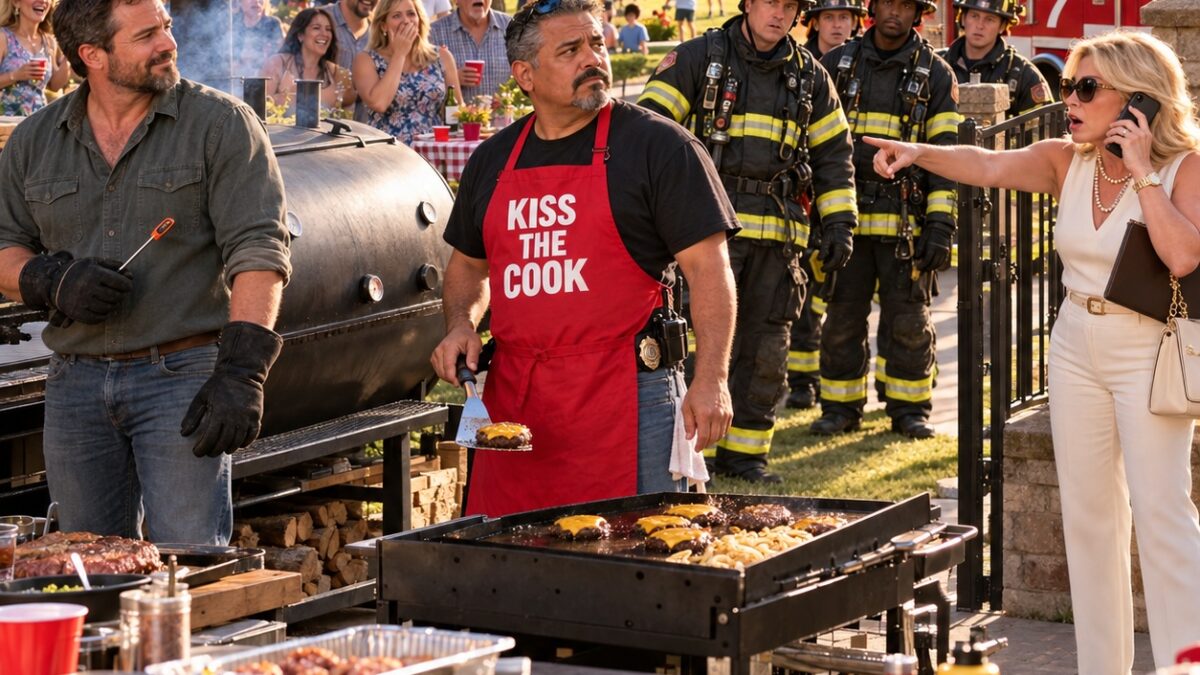
And a bright red apron with white letters:
KISS THE COOK
I stared at it.
“Seriously?”
“Sale rack.”
“You’re the fire chief.”
“Not until Monday.”
He tied it on.
The first guests arrived around eleven-thirty.
Dave and Linda Hoffman.
Potato salad.
Case of beer despite the invitation saying bring nothing.
Their kids went directly to the sprinkler.
By noon, twenty people were in the backyard.
By twelve-thirty, around thirty-five.
Families.
Retired couples.
People I recognized only from driveways.
Tess, a single mother four houses away, told me she had wanted to come before but had heard I only invited certain people.
I knew where that rumor came from.
Ray Castellano brought a speaker.
George Strait.
Selena.
Country.
Tejano.
Anything people could eat to.
Tommy’s off-duty guys started arriving around noon.
Reyes.
Booker.
Walsh.
Personal vehicles.
T-shirts.
Ball caps.
Nobody introduced Tommy by title.
To the neighborhood, he looked like what he was that Saturday.
My friend.
Standing beside a griddle.
Making burgers.
The brisket came off around one.
I sliced it on a red-oak cutting board.
Dark bark.
Rendered fat.
Pink smoke ring.
Steam rising.
People went quiet long enough to eat.
An older neighbor took one bite.
Closed his eyes.
“Son, if the HOA has a problem with this, the HOA has lost its mind.”
People laughed.
A few uncomfortably.
But they kept eating.
By two, my backyard looked nothing like the danger Valerie had spent months describing.
People were sitting under the oak.
Kids were in the sprinkler.
Somebody was cutting tres leches cake.
Tommy was flipping four burgers at once.
The smoke rose clean and thin.
Then I saw Valerie.
Across the street.
Standing inside her front yard.
White linen shirt.
Tan pants.
Sunglasses.
Arms crossed.
She watched for about two minutes.
Not the children.
Not the food.
Me.
Then she turned and went inside.
Something in my stomach tightened.
I had seen that look before.
The cameras were recording.
I went back to the brisket.
At 2:47 p.m., Valerie called 911.
I heard the recording weeks later.
Her voice was calm.
Measured.
“I need to report a fire hazard at 408 Magnolia Court.”
Then the claims came.
Heavy smoke.
Thick black smoke.
Open flames visible.
Twenty or thirty people crowded into the backyard.
Children present.
Immediate danger.
Illegal fire pit.
Ongoing violations.
She identified herself as the HOA president.
Asked for emergency response before somebody got hurt.
Every significant claim was false.
The smoker was producing clean blue smoke.
The firebox was enclosed.
No open flame could be seen from surrounding properties.
The decorative fire ring in the yard had not been used in months.
The children were eating hamburgers and running through water.
But dispatchers do not investigate from behind the phone.
They hear:
Smoke.
Fire.
Children.
Danger.
And send an engine.
Six minutes later, I heard the siren.
At first I did not realize it was coming for us.
Tommy did.
His head came up.
He stopped flipping a burger.
“That’s one of ours.”
Reyes looked toward the street.
Booker stopped talking.
The siren grew louder.
Then the air horn.
Diesel.
Engine 7 turned onto Magnolia Court.
Every conversation stopped.
Forty-three people looked toward the front yard.
Tommy set down his spatula.
Removed the KISS THE COOK apron.
The change in him was immediate.
Buddy to chief.
“Stay here.”
I pulled up the camera feed on my phone.
Engine 7 stopped in front of my house.
Four firefighters climbed down in full turnout gear.
Lieutenant Danny Soto led them.
Tablet strapped to his arm.
Dispatch report open.
Tommy walked around the corner.
T-shirt.
Cargo shorts.
Sweat.
A grease spot from the griddle.
Soto stopped.
His hand paused halfway to his radio.
“Chief?”
“Hey, Danny.”
Soto looked at Tommy.
Then the house.
Then his screen.
“We received a fire-hazard report at this address.”
“I heard.”
“Caller reports heavy smoke, open flames, children in danger.”
“I know.”
Tommy looked down at his shirt.
“I’ve been in the backyard since ten-thirty making burgers.”
Soto stared at him.
Behind him, one firefighter looked away because he was trying not to laugh.
Tommy did not.
“Do it by the book.”
His voice had changed again.
“Full inspection. Document everything.”
Soto nodded.
“Yes, Chief.”
The crew entered my backyard.
Forty-three people watched four firefighters move past folding tables, coolers, potato salad, cake, children and lawn chairs.
Soto inspected the smoker.
Measured clearances.
Checked firebox temperature.
Spark arrester.
Concrete pad.
Fence distance.
House distance.
Then Tommy’s griddle.
Propane connection.
Extinguisher.
He walked the entire perimeter.
The decorative fire ring was cold.
Empty.
Unused.
Drainage easement clear.
Hose nearby.
Twelve minutes later, Soto returned to Tommy.
He opened his notebook.
“Chief, I’m documenting a false alarm.”
Nobody spoke.
“Residential barbecue. All equipment compliant with Brazos County fire code.”
He continued.
“Proper clearances. Spark arrester. Fire extinguisher within ten feet. No open flames visible from adjacent property.”
Then:
“Smoke consistent with normal wood-burning smoker operation. Thin blue smoke. Properly ventilated.”
Tommy looked toward the sprinkler.
“And the children?”
Three kids had started splashing water toward one firefighter’s boots.
Soto looked over.
“The children appear to be in extreme danger of having a really good time.”
Laughter broke across the yard.
Tommy’s mouth barely moved.
His eyes did.
“Caller?”
Soto checked.
“Valerie Ashford. Four-twelve Magnolia Court. Across the street. Identified herself as HOA president.”
Tommy looked toward Valerie’s house.
White Mercedes in the driveway.
Blinds shut.
“Preserve the dispatch recording.”
“Yes, sir.”
“Full report by end of shift.”
“Yes, sir.”
Tommy nodded.
Then picked up his red apron.
Put it back on.
Tied the strings.
Grabbed the spatula.
“I have four patties about to burn.”
He looked at Soto’s crew.
“You boys hungry?”
Every one of them ate.
Helmets off.
Coats opened.
Standing beside the griddle.
Tommy made fresh doubles.
Cheese.
Onions.
Jalapeños.
A little girl handed one firefighter a potato chip like she was presenting a medal.
The whole neighborhood watched.
That afternoon did more to undo nine months of Valerie’s story than anything my lawyer had written.
People had seen the smoker.
Seen the fire crew inspect it.
Seen children playing safely.
Seen the county fire chief standing there before the engine ever arrived.
And most important:
They had heard exactly who made the call.
Monday morning changed everything.
Tommy filed the official report with the Brazos County Fire Marshal.
False fire-hazard report.
No danger found.
Equipment fully compliant.
Reporting party:
Valerie Ashford.
Classification:
Intentional false alarm.
Paul Estrada sent another letter to the HOA.
This one was sharper.
Nine months of harassment.
Repeated unsubstantiated complaints.
Targeted and unenforceable amendments.
False 911 report.
Fines totaling $2,700.
Demand:
Cancel every fine.
Repeal the new rules.
Formal apology.
He also noted the criminal consequences associated with knowingly making a false fire report.
Then the Brazos County District Attorney’s Office opened an investigation.
The 911 recording mattered.
Valerie did not sound confused.
She did not sound frightened.
She did not say:
I think I see flames.
She made definitive claims.
Heavy smoke.
Open flames.
Children at risk.
The responding crew’s report contradicted each one.
The DA eventually charged her with a Class A misdemeanor.
That legal process moved on its own.
But inside Stonebrook Heights, something happened faster.
Neighbors started talking to one another without Valerie in the middle.
Dave forwarded me the email chain.
One message said:
I owe Jake an apology. I believed Valerie and never once talked to him.
Another:
My kids had the best Saturday they’ve had all summer.
Another:
She called 911 over hamburgers?
Then the question that broke everything open:
How many of those HOA fines were actually valid?
Once people asked that, Valerie’s entire presidency came under examination.
Old violation notices.
Anonymous complaints.
Selective enforcement.
Rules she had written.
Courtesy visits.
Threats.
All the little things people had tolerated individually suddenly existed in one shared pattern.
Three weeks after the barbecue, the HOA held a special meeting.
Eighty-one residents came.
Largest turnout Stonebrook Heights had ever had.
Valerie sat at the front.
Black silk blouse.
Perfect posture.
Clipboard.
But for the first time, people noticed her hands were shaking.
Dave Hoffman stood first.
Valerie had once threatened to fine him because a garden hose could be seen from the street.
He looked directly at her.
“How many violations you issued were actual covenant violations?”
She said nothing.
“And how many were personal grudges?”
Still nothing.
Nobody needed a long speech.
The vote of no confidence followed.
Sixty-seven in favor of removing her.
Nine against.
Five abstentions.
Valerie stood.
Picked up the same color-coded clipboard she had used for years.
Walked out.
No one stopped her.
No one called after her.
Tom Castellano, a retired principal, became the new HOA president.
One of his first acts was to review contested fines.
Three hundred twelve fines were rescinded.
Combined value:
Approximately $94,000.
The anti-barbecue amendments were repealed unanimously.
Then I received a letter.
Not a violation.
An invitation.
Dear Mr. Mercer,
The Stonebrook Heights HOA Board would be honored if you would host our first official community barbecue. We’ll cover the meat.
I put it on the refrigerator.
Right beside the old fine that had started the whole mess.
Valerie’s criminal case resolved in November.
She pleaded no contest.
Sentence:
Twelve months probation.
Forty hours community service.
$1,000 fine.
Restitution connected to the unnecessary emergency response.
I attended the proceeding but did not enjoy it the way people might expect.
There was no triumphant feeling.
The court handled the case.
That was enough.
Valerie had picked up a phone and knowingly used an emergency system against a neighbor because she wanted to stop a barbecue.
The law measured that conduct.
Consequences followed.
I did not need more.
Two weeks later, she listed her house.
The sale price ended up roughly twenty-two percent below what she had paid.
More than $170,000 in reported loss.
A young couple bought it.
Twin boys.
Golden retriever.
The wife brought brownies after they moved in.
The husband asked if I knew anybody who could refinish floors.
“Yeah,” I said.
“I know a guy.”
Valerie moved out on a Tuesday morning.
Nine o’clock.
A time when most of the subdivision was at work.
I was in my shop.
I heard the moving truck.
Did not watch it leave.
There was nothing left I needed to see.
The Saturday barbecues continued.
Then they grew.
Not because I decided they should become some formal neighborhood program.
People simply showed up.
The Peterson family began bringing homemade egg rolls.
Tess brought peach cobbler.
Dave and Linda came back.
Their kids returned to the sprinkler.
Tommy still arrived in the same beat-up F-250.
Still carried the griddle.
Still wore the ridiculous red apron.
Still made the best smash burgers I knew how to eat.
His firefighters rotated through whenever they were off shift.
Nobody discussed fire code unless somebody actually burned something.
Last Fourth of July, sixty-one people came.
Four briskets.
Ninety burgers.
A kid named Marco fell asleep in a lawn chair with barbecue sauce on his chin after dark.
His grandmother carried him home.
Fireflies rose over the drainage easement.
The smoker’s coals were almost finished by the time the last family left.
Tommy had forgotten his apron on the griddle handle.
I folded it.
He would be back the next Saturday.
There was always another Saturday.
That was what Valerie had never understood.
She spent years trying to create community through enforcement.
Approved colors.
Approved decorations.
Approved equipment.
Approved behavior.
Rules can maintain common property.
Rules can prevent genuine nuisance.
But rules alone cannot make people belong to each other.
You cannot fine people into friendship.
You cannot threaten them into trust.
You cannot build community by making everybody afraid that one wrong paint shade will bring a certified letter.
Our backyard barbecues had no architectural committee.
No application.
No community-impact study.
People brought chairs.
Food.
Kids.
Stories.
Some stayed twenty minutes.
Some stayed until dark.
No one cared what their garage door looked like.
That did more for Stonebrook Heights than Valerie’s clipboard ever had.
I do not believe every HOA is bad.
I build houses for a living.
Shared neighborhoods require some standards.
Drainage easements matter.
Road maintenance matters.
Common facilities matter.
Reasonable restrictions can protect people.
But authority needs limits.
Valerie’s problem was not simply that she liked control.
She had stopped distinguishing between what annoyed her and what harmed the community.
My smoker annoyed her.
Therefore it became a nuisance.
My guests annoyed her.
Therefore they became a safety concern.
Pickup trucks bothered her.
Therefore they became undesirable traffic.
Children making noise bothered her.
Therefore they became uncontrolled behavior.
Once personal preference becomes enforcement policy, the rules stop protecting the neighborhood.
They start protecting the person enforcing them.
That is what happened.
The county inspections should have ended the smoker dispute.
Three separate visits.
Zero violations.
Instead, every clean inspection made Valerie more determined.
Reality disagreed with her.
So she tried changing the rules.
Paul’s legal letter should have ended it.
Instead she issued a new fine under the rule he had just challenged.
Then came the barbecue.
Forty-three actual witnesses changed the balance.
People who had only heard Valerie’s version finally experienced the thing themselves.
They smelled the smoke.
Saw the equipment.
Watched Tommy cook.
Saw the children.
Then watched Engine 7 inspect every inch.
That mattered more than argument.
Truth becomes powerful when people encounter it directly.
I had spent months telling Valerie:
The smoker is safe.
She replied:
No.
Reynolds said:
The smoker is safe.
She complained again.
Paul said:
These restrictions are unenforceable.
She fined me again.
Then twenty-five neighbors, firefighters, children, and a fire chief were all standing in the backyard when her 911 accusation arrived.
She had finally created an accusation too large to keep private.
That was her mistake.
The secret complaints worked because nobody else saw the process.
The 911 call created records she did not control.
Dispatch audio.
Response log.
Engine report.
Inspection findings.
Names.
Times.
Everything.
Once an emergency system is activated, documentation follows.
Valerie had spent years using ambiguity.
The fire department produced specifics.
No visible open flames.
Compliant clearances.
Proper spark arrester.
Extinguisher present.
Thin blue smoke consistent with ordinary smoker use.
No hazard.
Facts.
That is why Tommy told Soto:
“By the book.”
He could have simply said:
I’m the chief. I’ve been here all day. Cancel the call.
He did not.
That would have turned the incident into Tommy’s word against Valerie’s.
Instead, the crew completed the inspection.
They measured.
Checked.
Wrote.
A proper record protects everybody.
That detail mattered to me.
Tommy was my friend.
He also understood his position.
He did not use his title to make the complaint disappear.
He used procedure to establish what was true.
That is what authority should do.
The contrast with Valerie could not have been clearer.
She used authority to create the result she wanted.
Tommy used authority to document the result the evidence supported.
One is power.
The other is public service.
That Saturday, he happened to be standing at my grill in a ridiculous apron.
But when Engine 7 arrived, he knew exactly where the line was.
That may be why the moment became so devastating for Valerie.
The fire department was the institution she had chosen to weaponize.
The highest-ranking local fire official present immediately ordered a neutral inspection.
And the inspection destroyed her claim.
Not because Tommy protected me.
Because my equipment was safe.
That is the part I always correct when neighbors tell the story.
People like saying:
“She called the fire department and didn’t know the chief was already there.”
True.
Funny.
But the chief’s presence was not what made my barbecue legal.
My barbecue was legal before Tommy arrived.
It was legal when Reynolds inspected it.
It was legal under county code.
Tommy’s presence simply made it impossible for Valerie to control what happened next.
Even if Tommy had been somewhere else that day, the crew should still have reached the same conclusion.
His being there meant everybody saw the contradiction immediately.
That is different.
I never wanted the story to become:
Know important people and you win.
I wanted it to remain:
Follow the rules, document harassment, and eventually somebody has to deal with the facts.
I also learned something about neighbors.
People are easier to divide when they know each other only through other people’s descriptions.
Valerie had called my guests a transient element.
Then neighbors met Tommy.
Reyes.
Booker.
Walsh.
Men who worked in their county.
People they might someday depend on during the worst ten minutes of their lives.
She had described my backyard as unsafe.
Then families saw extinguishers, concrete, proper clearances.
She had described me as hostile.
Then I served them brisket.
A rumor survives best at a distance.
That is why the invitations mattered.
I did not print a rebuttal flyer.
I did not list every lie Valerie told.
I invited them to lunch.
There is something disarming about being handed a plate of food by somebody you have been told is unreasonable.
Suddenly the story has a face.
Maybe that is why communities need ordinary gathering more than they realize.
It is harder to believe ridiculous things about a person whose kids play with yours.
Harder to describe somebody as dangerous after you have stood beside him discussing lawn sprinklers.
Harder to maintain social fear around a man who is currently asking whether you want lean brisket or point.
Valerie’s influence depended on mediation.
She stood between people.
Once people started speaking directly, her power shrank.
The email chain proved it.
“I never talked to Jake.”
That sentence stayed with me.
How many neighborhood wars exist because nobody walks thirty yards and asks:
Is this true?
Probably too many.
It is easier to receive a narrative than investigate it.
Especially when the narrator sounds confident.
Valerie always sounded confident.
That was one of her greatest strengths.
She delivered subjective preferences as though reading building code.
Wrong gray.
Improper doormat.
Unapproved basketball hoop.
Unsafe smoker.
Enough certainty makes ordinary people wonder whether they missed something.
Maybe there really is a rule.
Maybe everyone else agreed.
Maybe I am the unreasonable one.
That psychological advantage disappeared once residents started reading the CC&Rs themselves.
After her removal, old fines were reviewed.
Three hundred twelve contested citations.
Ninety-four thousand dollars.
That number embarrassed the neighborhood more than my $2,700 ever could.
Because it revealed scale.
My barbecue had not been a special case.
I was simply the homeowner who refused to accept the first letter.
Others had paid.
Removed.
Repainted.
Adjusted.
Valerie had learned from every successful demand.
By the time she reached my smoker, escalation felt normal to her.
That is why boundaries matter early.
The first unreasonable rule is easier to stop than the fiftieth.
Not because every dispute deserves litigation.
Most do not.
But somebody should ask:
Where is this written?
Does the board have authority?
Is the rule applied equally?
What problem are we solving?
Valerie disliked those questions.
Questions turn power back into procedure.
Procedure requires reasons.
Reasons can be tested.
She preferred discretion.
Her discretion.
After Tom Castellano became president, the HOA did not collapse.
That amused me.
Basketball hoops remained in driveways.
People still maintained their houses.
Property values did not disappear because a child’s lemonade stand operated without an insurance certificate.
The world continued.
That exposed another myth Valerie had relied on.
She treated her constant intervention as though it were the only thing preventing Stonebrook Heights from becoming chaos.
Then she left.
People mowed their lawns.
Picked up trash cans.
Paid dues.
Used the pool.
Life.
A healthy neighborhood should not depend on one person’s daily patrol.
If it does, something is wrong.
Tom ran meetings differently.
Shorter.
Records distributed.
Questions allowed.
When somebody objected, he did not immediately classify disagreement as defiance.
That alone changed the tone.
Then came the official HOA barbecue letter.
I laughed when I opened it.
Months earlier, the board had tried to regulate gatherings larger than six people.
Now the board wanted to pay for brisket.
The easiest answer would have been no.
I had every reason to feel bitter.
Sixty-seven people voted Valerie out, but plenty had believed her first.
Some stopped waving.
Some avoided me.
Some let their children stop coming.
Why reward that?
Because resentment would only preserve the neighborhood she created.
I did not want that.
So we hosted it.
The board paid for meat.
I cooked.
Tommy cooked.
People brought everything else despite being told not to.
Food has a way of creating loopholes in instructions.
The barbecue did not erase the previous months.
It gave us something else to build on.
That mattered more.
Community is not restored by deciding nobody was wrong.
People had been wrong.
I had been judged unfairly.
Valerie had lied.
Some residents had repeated those lies.
But once they acknowledged it and behaved differently, what was I supposed to do?
Spend ten years reminding them?
No.
Apology followed by better behavior is useful.
Guilt without change is not.
The Hoffmans returned.
Tess returned.
Others came for the first time.
That was change.
Good enough.
The new family in Valerie’s old house became part of the neighborhood almost immediately.
Twin boys.
Golden retriever.
Brownies.
The father needed his floors refinished.
That interaction felt wonderfully ordinary.
No cosmic symbolism.
Just a contractor meeting a neighbor.
Exactly what Magnolia Court should have been.
People asked whether I told them what Valerie had done.
They already knew some.
The rest was not necessary.
A house does not inherit the sins of its previous owner.
Neither does a street.
They moved in.
We welcomed them.
The boys eventually showed up at a barbecue.
The golden retriever learned where dropped sausage tended to land.
Life reclaimed the address.
I liked that.
The criminal case ended with probation.
Community service.
Fine.
Restitution.
Some neighbors wanted harsher punishment.
I did not.
The false emergency report mattered because emergency resources are real.
Engine 7 had four firefighters and an expensive apparatus tied up on a fabricated call.
A real fire could have happened elsewhere.
That is why false reports cannot be treated as neighborhood drama.
Once Valerie called 911, the dispute left HOA territory.
That was her choice.
The court addressed it.
Enough.
I was not interested in seeing her jailed.
I wanted the calls to stop.
The fines gone.
The targeted rules gone.
The neighborhood able to function without fear.
All happened.
Her house sale was her business.
Her financial loss was not something I needed to celebrate.
She had consequences.
Then she left.
The smoker remained.
That contrast mattered more to me.
Fourteen hundred pounds of steel.
Built with my hands.
Sitting on the same concrete pad.
Still cooking.
Valerie spent nine months trying to establish that it did not belong there.
County inspectors disagreed.
Firefighters disagreed.
Law disagreed.
Neighbors eventually disagreed.
The smoker never moved.
Sometimes standing still is the entire victory.
Every Saturday at six, I light post oak.
I still watch the smoke carefully.
Good fire management matters.
Thin blue smoke.
Clean burn.
The kind you can smell before you see.
Tommy still arrives late morning.
He still claims his burgers need no changes after twenty years.
He is probably right.
The red apron has faded slightly.
The lettering remains.
KISS THE COOK
Firefighters make fun of him.
He wears it anyway.
I asked him once whether he realized how ridiculous the 911 incident looked from my side.
He laughed.
“Jake, imagine Danny’s side.”
“I saw his face.”
“He thought he was responding to a backyard structure fire.”
“And found his boss making cheeseburgers.”
“Exactly.”
“He almost laughed.”
“He did laugh later.”
“I knew it.”
Tommy smiled.
Then went back to the griddle.
That is how most of the story lives now.
As something funny.
That took time.
During the worst months, nothing felt funny.
Seeing cream envelopes in the mailbox tightened my chest.
Hearing a county truck outside made me wonder what new accusation had arrived.
Watching neighbors avoid me hurt more than I expected.
The BBQ was supposed to be simple.
Food.
Friends.
A place where people did not need invitations.
Valerie managed to make it feel like evidence against my character.
That part was harder than the money.
I could fight a $150 fine.
Harder to fight a neighborhood looking at you differently.
That is why the big barbecue was not really about smoke.
It was about being seen directly.
I needed my neighbors to meet me without Valerie translating.
Not because I needed them to like me.
Because I wanted them to judge something real.
If they came, saw the setup, ate nothing, hated the music, and still decided my Saturday gathering bothered them?
Fine.
At least it was their opinion.
Not hers.
Most came away with a different view.
That was enough.
The kids mattered most.
They never understood why adults had made it complicated.
Sprinkler.
Burgers.
Cake.
Lawn.
That was Saturday.
Soto’s line about them being in danger of having a good time became neighborhood legend.
People repeated it every summer.
Whenever kids got too loud, somebody would shout:
“Extreme danger!”
Everybody laughed.
I imagine Valerie would hate that.
I do not think about whether she would.
That is another mark of moving on.
At some point the person who dominated your thoughts becomes irrelevant.
The backyard did not belong to the conflict anymore.
It belonged to the people using it.
Last Fourth of July proved that.
Sixty-one people.
Four briskets.
Ninety burgers.
Music.
Lawn chairs.
Children.
Marco falling asleep with barbecue sauce on his face.
Fireflies rising beyond the yard.
After everybody left, I stood beside the smoker.
The coals were low.
Post oak smell hanging in the warm air.
The yard looked tired in the best way.
Paper plates gone.
Chairs folded.
A few toys near the sprinkler.
Tommy’s apron hanging from the griddle.
I folded it.
The quiet after a good gathering feels different from loneliness.
It carries evidence that people were there.
That is what Valerie never understood.
She thought order created belonging.
Order can create neatness.
Belonging is messier.
Cars along the curb.
Children making noise.
Somebody bringing too much dessert.
A folding chair left in the wrong place.
Neighbors laughing louder than planned.
Those things are not failures of community.
They are often proof of one.
The HOA still has rules.
Of course.
Nobody decided garbage could pile up in front yards.
No one turned Magnolia Court into commercial property.
But the new board started asking a better question.
Does this rule protect something real?
Safety?
Shared property?
Access?
Drainage?
Or is it merely enforcing one person’s preference?
That question eliminated a lot of nonsense.
Including the barbecue restrictions.
There was never a genuine fire problem.
Reynolds had established that three times.
Engine 7 established it again.
The conflict survived only because Valerie needed the smoker to be wrong.
When facts interfere with your identity as the person who is always right, you have two options.
Change your opinion.
Or attack the facts.
Valerie attacked the facts.
New rule.
New fine.
New complaint.
Finally a false emergency call.
Each escalation increased the stakes.
That is why learning to accept a small loss matters.
If she had accepted Reynolds’s first inspection, none of the rest happens.
No legal letters.
No 911 charge.
No no-confidence vote.
No review of 312 fines.
No house sale connected to the scandal.
One inspector saying:
Everything is compliant.
That could have been the end.
Pride made it the beginning.
I try to remember that in my own life.
Contractors can be stubborn.
We look at a wall and know we built it right.
Sometimes we did not.
Another set of eyes finds something.
Measure again.
Fix it.
Move on.
Being wrong early is cheap.
Being wrong and escalating for nine months gets expensive.
Valerie proved that better than any business course.
I also learned to respect documentation more than I already did.
As a contractor, paperwork is part of life.
Permits.
Inspections.
Change orders.
Invoices.
Photographs.
People complain about it.
Then something goes wrong and everybody asks:
What was documented?
My cameras mattered.
Reynolds’s reports mattered.
The 911 recording mattered.
Engine 7’s inspection mattered.
Paul’s letters mattered.
The HOA vote mattered.
Without records, a long harassment campaign becomes:
Jake says.
Valerie says.
With records, chronology appears.
First complaint.
Inspection.
No violation.
Second complaint.
No violation.
Third.
No violation.
New targeted rule.
Legal warning.
New fine.
Community barbecue.
False emergency report.
Once lined up, the pattern speaks for itself.
That is why I never responded to the anonymous letters with anonymous letters of my own.
Never retaliated.
Never called in fake complaints about Valerie.
The temptation existed.
Her front yard probably contained something I could have questioned.
Not interested.
If I became her, the story became two neighbors fighting.
I wanted a clean record.
Her actions.
My compliance.
That difference eventually mattered.
Tommy understood instinctively.
“By the book.”
Those four words may have been the smartest thing anybody said that day.
By the book protects truth from accusations of favoritism.
The fire chief was my best friend.
Fine.
Then do the most formal inspection possible.
Measure everything.
Write everything.
If the smoker failed?
We fix it.
If it passed?
Record it.
That is integrity.
Valerie had spent years treating rules as weapons.
Tommy treated rules as standards.
Same concept.
Different ethics.
I still host Saturdays.
No official name.
No sign.
Nobody calls it Mercer Community Barbecue.
It does not need branding.
Some Saturdays fifteen people come.
Some thirty.
Sometimes only Tommy and a few old friends.
Rain changes things.
Football changes things.
People have lives.
The value is not attendance.
It is openness.
If you smell the brisket and you are a neighbor?
Come over.
That is enough.
The new HOA once suggested setting up a yearly formal neighborhood cookout with permits and committees.
I said:
“Don’t ruin it.”
Tom Castellano laughed.
He understood.
Some things work because they are ordinary.
Too much administration kills them.
That might be the final lesson Valerie never learned.
Not everything needs to be governed.
People can sit in a yard without a rule.
Children can run without a policy.
A grill can make smoke without becoming a neighborhood threat.
Sometimes responsible adults can simply behave responsibly.
Trust reduces the amount of control required.
Valerie trusted nobody.
Therefore everything needed approval.
The new board trusted people until they gave a reason not to.
Stonebrook Heights became easier to live in.
Not perfect.
No neighborhood is.
Someone still complains about parking occasionally.
Somebody’s dog barks too much.
A teenager plays music too loud.
People discuss it.
Sometimes HOA gets involved.
Usually the world keeps turning.
That is normal.
Normal feels good after months of certified letters.
I kept the original $300 fine.
It is still on the refrigerator near the official barbecue invitation.
Not because I need a trophy.
Because together they tell the story better than I can.
One piece of paper says:
Your Saturday barbecue is a problem.
The other says:
Would you host one for all of us?
Same house.
Same smoker.
Same cook.
What changed?
Information.
People stopped accepting somebody else’s description and looked themselves.
That is powerful.
The smoker is older now.
Paint has needed touch-ups.
One hinge has been replaced.
Thermometer too.
But the steel holds.
Fourteen hundred pounds.
Sometimes a newcomer asks why I built something so big for a backyard.
I tell them:
“I like brisket.”
That answer is enough.
They do not need the full story unless somebody brings it up.
Eventually every neighborhood legend becomes shorter.
There used to be this HOA president.
She hated Jake’s smoker.
Called the fire department.
Didn’t know the fire chief was at the party.
Everybody laughs.
Then reaches for another rib.
That is exactly where I want the story to end up.
Not as a wound.
As a funny thing that happened before the neighborhood learned how to be neighbors.
Valerie believed authority meant being the person who could stop things.
Stop the smoke.
Stop the parties.
Stop basketball hoops.
Stop lemonade stands.
Stop whatever did not fit her picture of Stonebrook Heights.
Tommy’s job gave him real authority over actual life-and-death emergencies.
He spent Saturday making burgers.
That contrast still makes me smile.
Real authority does not always need to announce itself.
Tommy never introduced himself as fire chief at the barbecue.
He did not need to.
When the siren arrived, he handled what needed handling.
Then put the apron back on.
Maybe that is the best image from the whole thing.
Not Valerie losing the vote.
Not the courtroom.
Not the moving truck.
Tommy standing in my backyard after the fire inspection.
Red apron.
Spatula.
Four firefighters waiting for burgers.
Children already back in the sprinkler.
Everybody laughing.
Emergency over.
Truth documented.
Lunch continuing.
Valerie tried to turn my backyard into a hazard.
Instead, she accidentally gave forty-three people the same story.
That story broke the one she had been telling for months.
After that, Stonebrook Heights changed.
People came over.
Brought chairs.
Brought food.
Apologized without always using the word apology.
Children returned.
The neighborhood became louder.
Messier.
Friendlier.
And every Saturday, the smoker kept doing exactly what it had done from the beginning.
Burning post oak.
Cooking meat.
Putting a little smoke into the Texas sky.
Nobody calls 911 anymore.
Tommy still parks the dented F-250 near the curb.
Still ties on the same ridiculous apron.
I still tell him the burgers need more pepper.
He still tells me I am wrong.
People show up.
That is the part I care about.
I built that smoker with my own hands.
Fourteen hundred pounds of steel.
But the heaviest thing in my backyard on a good Saturday is not the smoker.
It is the feeling that settles over the place when forty people who once barely knew each other decide to stay until dark.
You cannot fine somebody into creating that.
You cannot vote it into existence.
You cannot enforce it with a clipboard.
You build it one plate at a time.








