FULL STORY:HOA Queen Buried the Creek on My 47-Acre Property While We Were Away—Then the First Storm Showed 300 Homeowners What She’d Actually Done
FULL STORY CONTINUATION
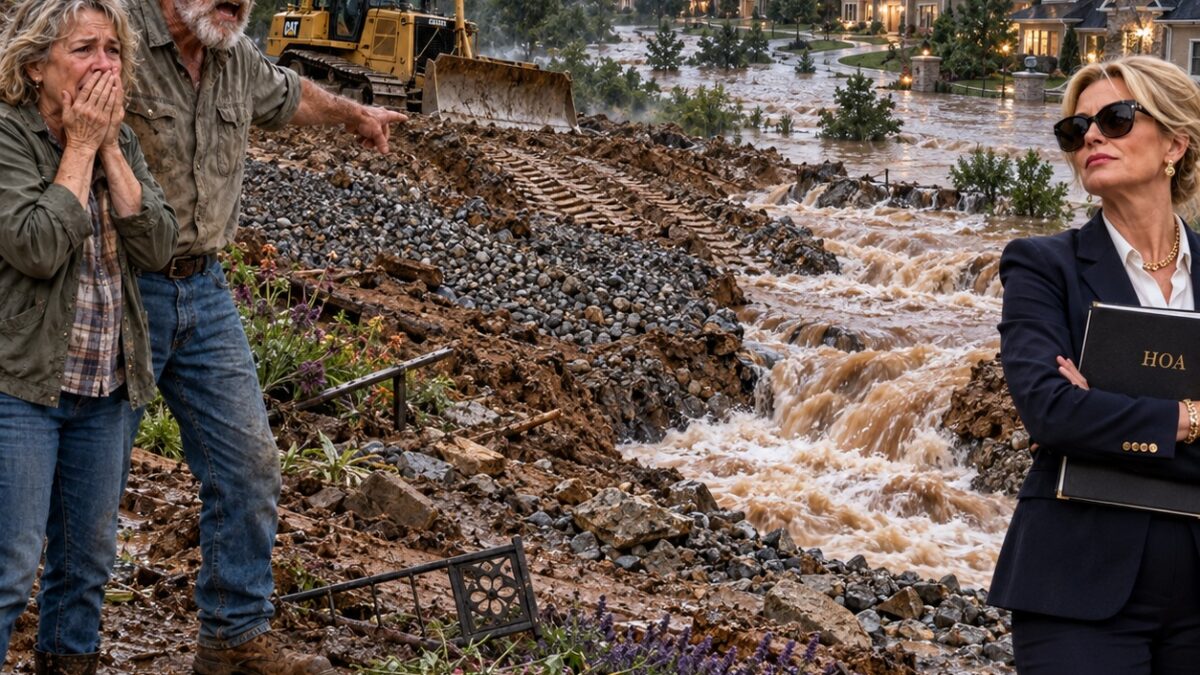
The creek had disappeared.
Not diverted.
Not piped.
Buried.
Where 280 feet of clear water had once curved through the property, there was now a flat brown strip roughly twelve feet wide.
Packed earth.
Crushed gravel.
Bulldozer tracks.
Dump-truck ruts.
Gray fill piled along unfinished edges.
For a few seconds, my mind refused to process the scene.
I understood what I was looking at technically.
Fill.
Compaction.
Grading.
Channel obliteration.
But none of those words belonged to the place where I was standing.
This was Willow Branch.
I had watched spring floods rise over those rocks.
Watched kingfishers dive there.
Watched Clare sit beside it with coffee.
Then she opened the passenger door.
I said her name.
“Clare.”
She did not answer.
She walked toward the east bank.
Except there was no east bank anymore.
The wildflower garden had been flattened under machinery.
Twelve years of work.
Lavender she had started from seed.
Black-eyed Susans that returned larger each June.
Columbine that brought hummingbirds every spring.
Coneflowers she had divided again and again until the bank bloomed purple and gold from one end to the other.
Gone.
Under gravel and fill.
Clare stood there.
Hands over her mouth.
Then she knelt.
Touched the packed dirt.
Her shoulders shook once.
That was all.
She never screamed.
Never cursed Brenda.
Never threw anything.
She just touched the place where her garden had been.
I remember that more clearly than almost anything else.
Five minutes later, a white Range Rover turned into our drive.
Brenda stepped out.
Perfect hair.
Blazer.
Heels.
Sunglasses.
She walked around the fill piles like she was touring a landscaping project.
“I’m so glad you’re back to see it.”
I stared at her.
“What did you do?”
“The board approved a community aesthetic renewal.”
“What board?”
“Willow Creek.”
“You buried my creek.”
“That ditch was dragging down everyone’s property values.”
Clare was still kneeling behind me.
Brenda glanced toward her.
“Honestly, Tom, you should be sending me flowers.”
I felt something inside me become very still.
“When did the board vote?”
Brenda waved one hand.
“It was fast-tracked.”
“Who did the work?”
“Dale handled logistics.”
Of course he did.
Dale Whitfield owned Whitfield Grading and Excavation.
The tracks on my property belonged to his equipment.
I said nothing else.
Brenda mistook silence for defeat.
That mistake would repeat.
That night, I pulled the HOA meeting minutes.
There was no vote.
No quorum.
No motion.
No approval.
Brenda had authorized the work herself.
Then I found the invoice.
Whitfield Grading and Excavation had billed the HOA general fund:
$34,600
Description:
SITE REMEDIATION AND ENVIRONMENTAL IMPROVEMENT SERVICES
Brenda authorized the job.
Her husband performed it.
His company invoiced the HOA.
Brenda approved payment.
Three hundred households had funded the destruction of a creek they did not own.
The same evening, Brenda posted online.
A photograph of the flattened area.
The caption announced:
Phase One of our Community Aesthetic Renewal is officially complete. A cleaner, more elevated Willow Creek starts today.
Hashtags followed.
Glow up.
Curated community.
Fourteen people liked it.
Two left heart emojis.
Nobody asked whose property appeared in the photograph.
That night I sat on the back porch.
Clare had gone to bed.
The air still smelled faintly of diesel.
I listened.
Nothing.
For twenty-six years, water had been background sound.
Now the absence had weight.
I had spent my career dealing with people who believed bulldozers created legality.
Move earth first.
Ask questions later.
Call destruction improvement.
Hope the government never notices.
I knew how these cases worked.
I knew which records mattered.
Which maps.
Which agency.
Which permit.
Which chain of evidence.
I also knew anger makes people sloppy.
So I waited until morning.
Then I drove to Henderson County Code Enforcement.
I filed a formal complaint.
Unauthorized earthwork.
Destruction of a natural waterway.
No permits on record.
I included photographs.
The woman behind the counter studied them.
“Someone did all this on your property?”
“Yes.”
“Without your permission?”
“Yes.”
She stamped the intake form.
An inspector would visit.
Brenda learned about it within forty-eight hours.
I never learned exactly how.
Her response arrived Wednesday morning.
Five certified envelopes.
All HOA violations.
The first claimed my fence exceeded maximum allowable height by two inches.
The second said our garden shed lacked an “aesthetic compatibility certificate,” a document Brenda had recently invented.
The third cited my pickup for remaining visible in the driveway longer than permitted.
The fourth classified a garden hose connected to an exterior spigot as an unapproved permanent fixture.
The fifth almost made me laugh.
Failure to maintain wildflower landscaping consistent with community visual standards.
Brenda had bulldozed Clare’s garden.
Then fined us because the garden she destroyed no longer met her standards.
Each violation carried a $150-per-day penalty.
Five violations.
$750 per day.
Potentially $22,500 a month.
Clare read them at the kitchen table.
She set the pages down.
Poured coffee.
Then walked to the back porch.
She sat facing the place where the creek used to be.
I watched through the window.
The feeling that settled over me was not rage anymore.
It was organization.
Brenda had started giving me documents.
I decided to keep every one.
Two days later, Hank Sorenson came to our door.
Seventy-three.
Retired Air Force.
Quiet man.
Lived four houses into Willow Creek.
“Tom, I need to tell you something.”
We sat on the porch.
He told me about the Peterson family.
Two children.
Golden retriever.
Normal people.
Three years earlier, Brenda decided their backyard playset violated community aesthetics.
They pushed back.
Then came noise citations.
Lawn inspections.
County complaints.
Letters suggesting their property damaged neighborhood values.
Eight months later, they sold at roughly a twenty-percent loss and moved to Greenville.
Hank leaned toward me.
“You know who bought the property?”
I had a feeling.
“Dale?”
“Through an LLC tied to his business partner.”
That changed the shape of what I was looking at.
“She doesn’t just bully people,” Hank said.
“She profits when they leave.”
I added his statement to the file.
Three weeks after the creek was filled, the first serious rain arrived.
Three-point-two inches in six hours.
Nothing extraordinary for western North Carolina.
Before Brenda’s project, the runoff from Willow Creek Estates had traveled downhill toward Willow Branch.
Exactly as the approved drainage design intended.
But the channel no longer existed.
The storm water came down the slopes.
Reached the packed fill.
And found the route blocked.
Water does not care about aesthetic renewal.
It follows gravity.
If one route disappears, it finds another.
The runoff spread sideways.
Into yards.
Across driveways.
Against foundations.
Fourteen backyards became shallow ponds.
Six basements flooded.
Two garages took roughly half a foot of water.
One HVAC unit shorted out.
A retaining wall along Magnolia Court started leaning.
Our property?
Dry.
We were upstream and slightly higher.
The irony did not need explanation.
By Thursday, the county drainage office had received eleven calls.
An inspector walked the area with several angry homeowners.
He pointed toward my filled creek.
“Your subdivision’s approved drainage plan relies on the natural channel through the Callaway property.”
Someone asked what had happened.
“That channel has been filled.”
“Was it approved?”
“No.”
That should have been the moment Brenda admitted what she had done.
Instead, she held an emergency HOA meeting.
She called it:
RESILIENCE AND RENEWAL: WILLOW CREEK’S PATH FORWARD
White linens.
Flameless candles.
Cucumber water.
Slides.
Brenda stood in front of families whose basements were still drying and described the flood as a “temporary inconvenience.”
Then she called it the community’s “chrysalis moment.”
After that came the proposal.
Special assessment:
$4,800 per household
Purpose:
A new engineered storm-water management system.
She wanted the neighborhood to pay almost five thousand dollars per home to repair the drainage problem she had created by destroying the existing drainage channel.
Clare and I sat in the back.
A homeowner named Ray Kulvin raised his hand.
His garage had flooded.
“Why are we paying for this if nobody voted to fill the creek?”
Brenda smiled.
“The board has already addressed the authorization question internally.”
Then she told everyone to remain solution-oriented.
I looked down at the assessment schedule.
Lot numbers.
Amounts.
Every lot owed $4,800.
Almost.
Lot 1 was missing.
Lot 7 was missing.
Brenda and Dale’s properties.
No explanation.
No assessment.
Clare saw it at the same time.
We left without speaking.
In the parking lot she said:
“You saw it.”
“Yes.”
“What now?”
“Not yet.”
I wanted the entire structure before I moved.
The next morning, I started with federal maps.
National Wetlands Inventory.
USGS topographic records.
Older surveys.
Willow Branch appeared repeatedly.
Perennial.
Spring-fed.
Flowing toward Cane Creek and into the larger French Broad system.
Then I contacted the Asheville District of the Army Corps of Engineers.
I checked the permit files.
No Section 404 application.
No pre-application conference.
No delineation.
No authorization to place fill into the stream.
Nothing.
I already knew what that meant.
But I wanted the documentation.
Then I went to the county Register of Deeds.
That produced the first major surprise.
Three properties near the creek—
Lots 14, 15 and 22—
had changed ownership roughly six months before Brenda filled the channel.
The buyer was an LLC called Blue Ridge Development Partners.
Registered agent:
Keith Sutherland.
Dale Whitfield’s business partner.
I pulled the sales records.
The lots had sold below typical market value.
There was a reason.
They bordered the creek corridor.
Wetland setbacks.
Buffer requirements.
Flood restrictions.
Development constraints.
Then I found the permit applications.
Two weeks after the creek was buried, Dale submitted plans for three luxury houses.
Project name:
WHITFIELD ESTATES AT WILLOW CREEK
Estimated combined value:
$2.4 million.
I sat in my truck outside the county building and read the permits again.
Then a third time.
The creek fill was not simply Brenda hating the way our property looked.
The “community aesthetic renewal” had cleared a barrier to a private development scheme.
Brenda had used her HOA position to authorize work on my land.
She paid her husband’s company using HOA funds.
The work removed environmental restrictions that made three connected lots difficult to develop.
Then Dale applied to build millions of dollars in houses.
I took everything home.
Deeds.
LLC records.
Permit applications.
Invoice.
Photographs.
HOA minutes.
Assessment documents.
Clare read them one by one.
When she reached the permit applications, she sat down.
“She buried twelve years of my garden so she could build herself more houses.”
“Yes.”
“And everybody’s dues paid Dale to do it.”
“Yes.”
Clare looked toward the window.
The flat brown scar was visible beyond the yard.
Then she said:
“Make it count.”
I called Phil Keer the next morning.
Phil and I had worked together for eleven years at the Asheville District Office.
Permit reviews.
Inspections.
Enforcement.
He had retired after me but still consulted.
“Phil, I need you to look up Willow Branch.”
A pause.
“Your creek?”
“Yes.”
“Why?”
“Someone filled it.”
Silence.
“How much?”
“About two hundred eighty feet.”
“You’re joking.”
“No.”
“Permit?”
“None.”
Phil pulled the record.
Willow Branch had been field-verified during the 2003 subdivision review.
Mapped.
Documented.
Protected.
No ambiguity.
Whoever filled it had done exactly the kind of work Section 404 exists to regulate.
Phil’s voice became flat and professional.
“Tom, they’re looking at federal enforcement, restoration, civil penalties and potentially a criminal referral depending on the facts.”
“I know.”
“Who did it?”
I looked at the invoice.
“The HOA president’s husband.”
“Of course.”
Next came Nina Graves.
Real-estate attorney.
Land-use experience.
HOA governance work.
I gave her everything.
She spread the documents across a conference table.
Read quietly.
Then looked up.
“They’re completely exposed.”
She began separating claims.
Federal waterway enforcement.
Trespass.
Property destruction.
Breach of fiduciary duty.
Misuse of association funds.
Fraud implications tied to the private development.
Self-dealing.
Each issue could stand alone.
Together, they told one story.
While Nina organized the law, I returned to fieldwork.
That part felt familiar.
GPS receiver.
Old Army Corps data.
Satellite imagery.
Measurements.
I mapped the creek’s original alignment against the 2003 federal survey.
Estimated fill volume.
Measured altered grades.
Documented compaction.
Compared spring imagery showing flowing water and Clare’s garden against later images showing bare fill and equipment tracks.
Then I mapped what the altered grade had done to runoff.
The subdivision had not flooded because of mysterious weather.
The water was being redirected.
That was measurable.
Repeatable.
Obvious.
Clare built the human side of the file.
She went door to door.
No petitions.
No speeches.
Coffee.
Conversation.
Families who had flooded gave her photographs.
Repair estimates.
Insurance denials.
Receipts.
Statements.
By the time she finished, twenty-two households had documented more than $340,000 in uninsured losses connected to the drainage alteration.
She labeled folders by address.
I labeled mine by statute.
Every evening, our kitchen table disappeared beneath paper.
We barely talked.
We knew what we were building.
I filed the formal Army Corps complaint on a Friday.
EPA referral followed.
Then we waited.
Brenda learned soon enough.
Her first response was to call an emergency board session and push through a retroactive resolution claiming the creek work had been a properly authorized community project.
She needed board support.
Gerald Hunt signed.
His landscaping company did HOA work.
Patty Simmons signed.
She had admitted privately that she feared Brenda.
Carol Jennings refused.
Carol was sixty-one.
Retired middle-school principal.
The only board member willing to say:
“No.”
She told Brenda she would not put her name on a document making the board liable for work nobody had voted on.
Two days later, Carol received an HOA violation.
Her crime:
Wrong-colored fall wreath.
Same wreath she had used for seven autumns.
Fine:
$75 per day.
Carol left it hanging.
That small act mattered.
Brenda also forced the $4,800 special assessment through a proxy vote.
The mailing package ran about thirty pages.
It called the assessment necessary infrastructure investment.
It never explained that Brenda had authorized the project that destroyed the original drainage system.
Never disclosed her own properties were exempt.
Seventy-one proxies came back.
Sixty-three yes.
Many from older homeowners who trusted the board.
Then Dale came to see me.
Black BMW.
Suit.
Rolex.
He walked onto my porch smiling.
“Tom, I wanted to clear the air.”
I waited.
“No lawyers. No drama.”
Still waited.
“I understand you’re upset about the creek, but it’s done.”
He leaned against my railing.
“The board approved it. The community is moving forward.”
Then:
“Lawyers are expensive.”
I looked at him.
He continued.
“Court takes years. At the end of the day, it’s just a creek.”
Just a creek.
I thought of Clare kneeling in the dirt.
The flooded basements.
The permit applications.
Federal maps.
I said:
“I appreciate the advice, Dale.”
He smiled as if we understood each other.
Then drove away.
He did not understand what I meant.
He had just confirmed the attitude behind the project.
No mistake.
No misunderstanding.
No remorse.
Within two weeks, Brenda filed three more complaints against me.
Untreated wastewater discharge.
Dismissed after inspection.
Unauthorized wildlife.
She apparently meant deer.
Dismissed.
Obstruction of community drainage infrastructure.
That one accused me of failing to maintain the creek she had buried.
Dismissed.
The inspector handling the complaints finally told me:
“I’ve worked fourteen years and never seen this many complaints from one address against one neighbor.”
Then Brenda hosted a neighborhood healing circle.
Saturday yoga.
Citronella candles.
Wet community lawn.
Instagram livestream.
Nine viewers at peak.
I was one of them.
Only because I was taking screenshots.
The second major storm hit in late October.
Four-point-seven inches over eight hours.
Again, not extraordinary enough to explain what happened without the buried creek.
This time, twenty-two homes flooded.
Seven houses along Magnolia Court took water into ground-floor rooms.
The leaning retaining wall failed.
Mud and gravel went into a sunroom.
Three driveways buckled.
Willow Creek Boulevard became a brown river from curb to curb.
Insurance companies began denying claims.
The language was nearly identical.
Damage resulting from man-made alteration of natural drainage was excluded.
Twenty-two families.
More than $340,000.
Brenda’s house sat on the highest lot.
No flooding.
She posted a photograph from her back deck.
Cream sweater.
Wine.
Rain behind her.
Caption:
We’re all in this together.
That was when neighborhood anger changed.
People stopped complaining quietly.
Eighty-seven homeowners signed a petition demanding a special meeting.
The governing documents required twenty percent.
They had almost thirty.
Two other things happened that week.
First, Eddie Watts walked into county offices.
Eddie had driven the bulldozer that filled Willow Branch.
Dale still owed him $4,000.
Eddie brought his work order.
He told the inspector what Dale had said.
No permits.
HOA approved.
Get it done before the owners come back.
The work order carried Dale’s signature.
Beside it:
Per B. Whitfield authorization — Community Aesthetic Renewal Project.
Then Carol Jennings came to my house.
She carried a printed email.
“Found this on the shared drive.”
Brenda had sent it to Dale the day before the creek fill.
Subject:
Creek Project
I read the body.
Then read it again.
Just do it fast before anyone checks. I’ll handle the board. If the old guy complains, I’ll bury him in violations until he shuts up or sells. Same playbook as the Petersons.
I looked up.
Carol looked sick.
“Same playbook.”
The Peterson family.
Harassed.
Pressured.
Sold at a loss.
Then property tied to Dale’s business circle.
What Hank had suspected now had written support.
This was not one bad HOA decision.
It was a pattern.
That same week, Brenda received a certified federal notice.
Army Corps of Engineers.
Unauthorized discharge of fill into a jurisdictional waterway.
Formal enforcement process.
Immediate response required.
Brenda did not tell the board.
Did not tell homeowners.
Did not post it online.
She hid it.
Then quietly changed her social-media profile description.
The special meeting took place the first Saturday in November.
The community center held around 160 people.
Every chair filled.
Another group stood at the back.
One hundred forty-three homeowners signed in.
Deputy Sheriff Kyle Patterson stood near the exit.
Brenda arrived fifteen minutes before the meeting.
Black dress.
Leather portfolio.
Iced matcha.
She arranged herself behind the front table.
Then tapped a pen against her water glass.
“Good evening, everyone.”
The room quieted.
“I understand emotions are running high, but Willow Creek values elevated discourse.”
Nina stood from the third row.
“Mrs. Whitfield, Article 7 allows homeowners to address the membership during a special meeting called by petition. I represent Tom Callaway.”
Brenda smiled.
“Of course. We welcome all perspectives.”
I stood.
No projector.
No presentation board.
No mood board.
One manila folder.
I began with the oldest evidence.
The USGS topographic map.
Willow Branch clearly shown.
Then the March satellite image.
Flowing creek.
Green banks.
Clare’s garden.
Then August.
Fill.
Bare ground.
Equipment tracks.
I held up the 2003 Army Corps jurisdictional record.
“This creek was mapped and field-verified during the original development process.”
People shifted in their seats.
I showed the HOA minutes.
No vote.
No motion.
No quorum approving the fill.
Then Dale’s invoice.
$34,600.
Paid from HOA funds.
Brenda authorized.
Dale collected.
I moved to the property records.
Lots 14, 15 and 22.
Purchased through Blue Ridge Development Partners.
Connection to Dale.
Below-market prices.
Development restrictions tied to the creek.
Then the permit applications.
Three luxury homes.
$2.4 million combined projected value.
Two weeks after the creek disappeared.
Nobody interrupted.
Then I unfolded Brenda’s email.
I read every word.
“Just do it fast before anyone checks.”
Silence.
“I’ll handle the board.”
Someone near the back whispered something.
“If the old guy complains, I’ll bury him in violations until he shuts up or sells.”
I paused.
Then the final sentence.
“Same playbook as the Petersons.”
The room changed.
Not louder.
Colder.
People were not simply hearing about my creek anymore.
They were hearing that the system Brenda used against individual homeowners had been deliberate.
I held up the federal notice of violation.
“Army Corps investigation is open.”
Then the county stop-work order affecting lots 14, 15 and 22.
“The creek restoration issue is now under federal enforcement.”
Brenda stood.
Her hands trembled slightly.
“This is a personal vendetta.”
No one responded.
“He is weaponizing federal agencies because he cannot accept that this community has evolved beyond his little creek.”
Clare stood.
She was four rows ahead of me.
She did not raise her voice.
“You buried twelve years of my garden under six feet of dirt so you could build yourself more houses.”
Brenda looked at her.
Clare continued.
“You used our neighbors’ money to pay your husband’s company.”
Another pause.
“Then you fined me for the mess you made.”
The room stayed silent.
“That’s not leadership, Mrs. Whitfield.”
Clare’s voice remained calm.
“That’s theft.”
Everything broke open after that.
Questions.
Anger.
People standing.
Board members talking over one another.
Then someone called the motion.
Remove Brenda Whitfield as HOA president immediately.
Hands went up.
One hundred thirty-six in favor.
Two against.
The two opposing votes came from the front table.
Brenda stood behind her portfolio and flowers while the entire structure of authority she had built disappeared in a few minutes.
Then Deputy Patterson stepped forward.
He handed Dale a folded document tied to the investigation.
Dale looked at it.
Then down at the carpet.
I gathered my folder.
Turned toward the door.
Someone called from behind me.
“Tom, anything you want to say?”
I stopped.
Looked at Brenda.
I had not prepared anything.
“That creek was there sixty years before your mood board.”
The room went quiet again.
“It’ll be there long after your hashtags are gone.”
Then I left.
Clare was already by the truck.
She smiled.
That was enough.
The Army Corps restoration order came in December.
Every cubic yard of unauthorized fill had to be excavated.
The creek bed had to be reconstructed to within six inches of its documented 2003 alignment.
Both banks required native riparian replanting according to the approved federal restoration plan.
The cost:
Approximately $223,000.
Brenda and Dale were responsible.
The federal civil penalty added another $47,000.
The amount could have climbed higher, but their eventual cooperation affected the final number.
The HOA, now under Carol Jennings’s leadership, sued Brenda individually for breach of fiduciary duty.
The case centered on self-dealing.
The payment to Dale’s company.
The special assessment.
Their own exemptions.
Use of HOA power for private financial benefit.
The settlement required approximately $89,000 in restitution plus legal fees.
The association’s insurance did not rescue them from intentional misconduct.
The three Whitfield Estates building permits were denied.
The creek corridor now carried stronger conservation restrictions.
The federal enforcement record remained.
The fraud investigation remained active within the source timeline.
The three lots Dale had bought cheaply because he expected the creek restrictions to disappear became the opposite of the investment he planned.
Still constrained.
Still beside a protected waterway.
Still difficult to build.
Dale sold Whitfield Grading and Excavation the following spring to cover penalties and legal expenses.
The company name changed soon after.
Brenda listed their house in March.
It remained on the market sixty-two days.
Then sold at a loss.
According to a neighbor, prospective buyers kept asking the same thing.
“Isn’t this the house from the HOA scandal?”
The morning the moving truck came, Brenda made one final social-media post.
Hank Sorenson printed it and carried the page to our porch with a grin.
It said the universe was redirecting her toward larger, more aligned opportunities.
New chapter.
Elevate and evolve.
Grateful heart.
Three likes.
One from her mother.
I folded the page.
Set it down.
Then Clare started laughing.
That was the first time I realized how long it had been since I heard her laugh about anything connected to Brenda.
The new HOA board operated differently.
Carol opened the meetings.
Published minutes.
Ended the constant aesthetic decrees.
The $4,800 assessment was rescinded.
Brenda’s approved plant list disappeared.
The retaliatory violation notices were voided.
No more lifestyle-director title.
No more community acoustic harmony rules.
Nobody seemed to miss them.
The settlement money helped establish the Willow Creek Conservation Fund.
Creek maintenance.
Native plant restoration.
Annual water-quality testing.
Hank chaired the oversight committee.
He treated it with the seriousness of a military assignment.
Then the physical restoration began.
Heavy equipment returned to our property.
That was difficult at first.
The first time I heard diesel near the creek corridor again, every muscle in my back tightened.
But this time there were permits.
Survey stakes.
Engineers.
Army Corps oversight.
Approved plans.
The machines were not erasing the creek.
They were finding it.
Load after load of fill came out.
The packed channel reopened slowly.
Some parts of the original bed had survived beneath the material.
Others needed careful reconstruction.
Grade mattered.
Alignment mattered.
Bank stability mattered.
Water does not respond to sentimental restoration.
It responds to elevation.
Slope.
Soil.
Flow.
That part I understood.
Clare watched from a distance.
She did not interfere.
Neither did I.
This was one time when letting professionals rebuild what somebody else destroyed was enough.
Four months later, water ran through Willow Branch again.
The first time the spring flow reached the restored section, Clare and I stood beside it.
Not speaking.
The water looked almost hesitant at first.
Thin.
Clear.
Moving over exposed stone.
Then it followed the grade.
Curved.
Continued.
Exactly where it had before.
I listened.
There it was.
That sound.
Low.
Steady.
Water over rock.
I had spent most of the case thinking in statutes.
Permits.
Hydrology.
Evidence.
Penalties.
That sound almost undid me.
Clare reached for my hand.
Neither of us needed to say anything.
The Corps inspector signed off in May.
He shook my hand.
“In twenty years of enforcement, I don’t think I’ve ever seen a cleaner case.”
“She documented herself pretty well.”
He laughed.
“She really did everything wrong.”
That was accurate.
But once the enforcement file closed, I found myself caring less about Brenda.
The creek was back.
That was what mattered.
Clare replanted the wildflower garden that spring.
She started with lavender.
Then black-eyed Susans.
Coneflowers.
Columbine.
She worked in the mornings before the temperature climbed.
Some days I helped.
Most days I stayed out of her way.
The old garden had taken twelve years to become what it was.
The new one could not be recreated in a season.
That was hard.
People like restoration stories because they want the repaired thing to look instantly unchanged.
It does not.
A restored creek is still restored.
A replanted garden is young.
Loss remains visible.
That does not make the repair meaningless.
By September, the east bank had color again.
Not the dense sweep of flowers Clare once had.
But enough.
Purple.
Gold.
Green.
Hummingbirds returned.
Dragonflies hovered over the water.
One Saturday morning in late September, Clare and I sat on the back porch with coffee.
The creek moved below us.
A kingfisher landed on an oak limb.
The water caught the morning light.
The lavender was still too young to fill the air with scent.
But wet stone was back.
Pine.
Creek mud warming in the sun.
Clare listened for a while.
Then she said:
“It sounds the same.”
I looked toward the water.
“It always did.”
That was the thing Brenda never understood.
She believed the creek was an aesthetic choice.
A visual element.
Something ugly enough to remove.
But Willow Branch was infrastructure before anybody used that word.
It had been moving storm water through that land long before the first Willow Creek house was built.
The original developer understood that.
His engineers understood it.
The county drainage plan understood it.
The Army Corps understood it.
Brenda looked at water and saw something that did not match her brand.
Then she learned what happens when a person mistakes appearance for function.
The subdivision flooding was not revenge.
It was physics.
Water coming downhill.
A blocked channel.
Nowhere to go.
The creek did not punish Brenda.
It simply stopped doing the job she had prevented it from doing.
That distinction mattered to me.
People sometimes told the story afterward as if I had known the neighborhood would flood and simply waited.
I knew blocking drainage creates risk.
Any engineer would.
But I did not control the weather.
I filed a complaint the morning after we returned.
I started the process immediately.
Government processes take time.
Rain did not wait.
That is one reason environmental regulation exists before construction.
A permit review asks the question before the bulldozer arrives:
What happens if you do this?
Brenda did not ask.
Dale did not ask.
They acted first.
Everybody downstream paid for that shortcut.
The first storm produced six flooded basements.
The second hit twenty-two homes.
That escalation was not dramatic storytelling.
It was cumulative exposure.
More rain.
Same blocked system.
Greater damage.
And the worst part was how avoidable it all had been.
Do nothing.
That was the original solution.
Leave the creek alone.
Zero-dollar engineering project.
No $34,600 invoice.
No $4,800 assessment.
No $340,000 in uninsured household losses.
No $223,000 restoration.
No federal penalty.
No fiduciary lawsuit.
No flooded homes.
No destroyed garden.
Just water flowing where water had already learned to flow.
Sometimes the smartest infrastructure decision is respecting the infrastructure nature already built.
Twenty-eight years with the Corps taught me that.
Modern engineering is valuable.
Necessary.
But sometimes engineering begins with humility.
Do not move what you do not understand.
Do not fill what you have not modeled.
Do not assume an old creek is obsolete because it is not landscaped.
Brenda wanted a modern storm-water system after destroying the natural one.
That was almost the perfect summary of her worldview.
Replace function with appearance.
Then spend more money trying to recreate function after the appearance fails.
I do not hate HOAs.
That surprises people.
I hate bad governance.
An HOA can manage common property.
Maintain roads.
Handle shared facilities.
Coordinate legitimate community obligations.
What it cannot responsibly do is become one person’s private instrument.
Brenda blurred every boundary.
Her taste became policy.
Her grievance became enforcement.
Her husband’s company became vendor.
Their investment became community project.
Their personal lots disappeared from the assessment sheet.
Her enemies received violations.
That was not governance.
That was self-interest wearing official letterhead.
Carol’s presidency showed the difference.
Same HOA.
Same 300 homes.
Same bylaws.
Different conduct.
Open meetings.
Published minutes.
Actual votes.
Transparent funds.
No one’s basement flooded because Carol had fewer mood boards.
The neighborhood did not lose value because children played outside.
Nobody’s life collapsed because mailboxes stopped being treated as sacred design objects.
That matters.
Bad leaders often convince communities that control is the same thing as order.
It is not.
Willow Creek became calmer after Brenda left.
Not more chaotic.
People began attending meetings again.
Not because they loved HOA procedure.
Because they had learned what happens when nobody watches.
Brenda had been elected unopposed.
That gave her space.
Then board members became dependent on her.
Contractors depended on HOA work.
Residents became afraid of notices.
The system centralized quietly.
By the time she buried our creek, she seemed to believe authorization was whatever she said it was.
That is how small power becomes dangerous.
Not because HOA presidents control armies.
Because people become accustomed to letting small abuses pass.
Garden flag.
Playset.
Wreath.
Mailbox.
Then fence.
Then property.
Then a federally protected waterway.
The scale changes.
The habit does not.
The Peterson family mattered for that reason.
I never knew them well.
Their story sounded petty at first.
Playset dispute.
Noise citations.
Lawn measurements.
Then Hank showed me the financial aftermath.
They sold at a loss.
Someone connected to Dale bought the property.
Then Carol found Brenda’s email.
Same playbook as the Petersons.
That sentence changed everything.
The cruelty was not random.
Pressure had economic value.
Push someone until they sell.
Buy cheaply.
Profit later.
Our creek project was simply the largest version.
Destroy the environmental limitation.
Use HOA money to pay for the destruction.
Develop constrained lots.
Private profit.
If Eddie Watts had been paid his $4,000, maybe his work order would have stayed in a drawer longer.
That detail always reminds me how fragile dishonest schemes are.
They depend on many people staying quiet.
Contractors.
Board members.
Bookkeepers.
Neighbors.
Eventually someone gets angry.
Or scared.
Or ethical.
Or unpaid.
Eddie walked into the county because Dale owed him money.
Carol spoke because she refused to sign a lie.
Hank spoke because he remembered the Petersons.
Clare talked to flooded families because somebody needed to document human damage.
Accountability rarely arrives through one heroic person.
It arrives when separate pieces finally meet.
I knew water law.
Nina knew land-use and HOA law.
Phil knew the Corps record.
Clare knew neighbors.
Carol knew the board.
Eddie knew the jobsite instructions.
Hank knew the pattern.
The families knew their damages.
Together, the case became impossible to explain away.
That is why I never thought of what happened as me “taking down” Brenda.
She built the case.
We organized it.
Her own email said what no lawyer could have written more clearly.
Do it fast before anyone checks.
That was the whole strategy.
Speed over process.
Authority over consent.
Appearance over legality.
Then:
I’ll bury him in violations until he shuts up or sells.
She did exactly that.
Five notices arrived after my county complaint.
Then three more later.
The retaliation did not need interpretation.
It had chronology.
That is one thing my career taught me.
Chronology is powerful.
Who knew what?
When?
What happened next?
Brenda could say the violations were legitimate.
Fine.
Why did five suddenly arrive immediately after I challenged the creek fill?
Why did Carol’s seven-year-old wreath become illegal two days after she refused to sign the retroactive resolution?
Patterns turn isolated excuses into evidence.
I kept dates.
Every letter.
Every photograph.
Every screenshot.
Every map.
Every invoice.
That discipline was more useful than anger.
If I had screamed at Brenda on the first afternoon, it might have felt good.
It would not have restored one foot of creek.
Evidence did.
The Corps restoration order did.
The board vote did.
The civil case did.
Sometimes restraint is not weakness.
It is preparation.
Clare understood that better than anyone.
“Make it count.”
Three words.
She never asked me to destroy Brenda.
She wanted the damage to matter.
The garden mattered.
The creek mattered.
The neighbors’ homes mattered.
That is why restoration was the correct ending.
Not punishment alone.
If Brenda and Dale had paid every fine but the creek stayed buried, we would still have lost.
If they had been humiliated online but Clare’s garden remained gravel, we would still have lost.
Justice had to include water.
That was the center.
The Corps order required a near-original alignment for a reason.
Hydrology depends on shape.
The restored channel had to function.
Native vegetation had to return because roots stabilize banks.
Riparian plants filter runoff.
Shade changes water temperature.
A creek is not simply a trench with water in it.
It is a system.
Clare’s garden had always been part of that system in its own way.
Not federally designed.
Not engineered.
But rooted.
Living.
Holding soil.
Feeding insects.
Bringing birds.
When she replanted, she did not recreate the exact old garden.
She could not.
Twelve years cannot be purchased in one nursery trip.
Instead she started again.
That felt more honest.
The new garden carried the old one without pretending loss had vanished.
I watched her kneel in the same soil where she had once knelt after the bulldozers.
Completely different posture.
That image replaced the first one slowly.
Hands in dirt.
Plants going into the ground instead of disappearing beneath it.
Restoration gives memory another picture.
Not erasure.
Competition.
You need enough good images that the worst one stops being the only thing you see.
The same happened with the creek sound.
For months, silence meant Brenda.
Then machinery meant enforcement.
Then water returned.
After enough mornings, water became ordinary again.
That was the goal.
Not to spend the rest of our lives thinking about the scandal every time Willow Branch moved over stone.
Ordinary is underrated.
A functioning creek should be boring.
A transparent HOA meeting should be boring.
A legal drainage system should be boring.
People notice infrastructure mainly when it fails.
Brenda had turned our creek into a crisis because she could not tolerate something ordinary that did not match her preferred view.
Afterward, we wanted ordinary back.
We got it.
Hank took his conservation committee job seriously enough that Clare joked he probably inspected water quality with more discipline than the Corps.
He carried a notebook.
Scheduled testing.
Checked plantings.
That made me happy.
The neighborhood that once helped fund the creek’s burial now funded its protection.
That is meaningful correction.
Not because every homeowner had been guilty.
They were not.
Most never knew what Brenda authorized.
Some had trusted her.
Some had ignored HOA politics.
Some had clicked a heart on the announcement because they thought a legitimate project had improved a shared area.
Once they learned the truth, the overwhelming majority acted.
One hundred thirty-six to two.
I remember that vote less as Brenda losing and more as the community waking up.
Those people had just discovered their dues had been used against their own interests.
Their homes flooded.
Their insurance denied claims.
Their president exempted herself from the proposed fix.
Then hid a federal notice.
Trust disappeared.
Governance cannot survive that.
The new board had to rebuild trust the same way we rebuilt the creek.
Remove what should never have been there.
Restore the original function.
Stabilize.
Then maintain.
Carol did.
I respected her for leaving the wreath on her door.
That sounds small.
It was not.
Retaliation works because people decide resistance is not worth the inconvenience.
A $75-a-day wreath fine could become painful quickly.
Carol knew.
She left it.
By itself, a wreath did not stop Brenda.
But refusing to sign the retroactive resolution prevented Brenda from pretending unanimous board support.
Small acts preserve records.
That matters later.
Dale’s porch visit mattered too.
He thought he was reducing tension.
Perhaps intimidating me.
Lawyers are expensive.
It is just a creek.
Move on.
He assumed cost would make me retreat.
He did not know my professional background had spent nearly three decades on exactly this kind of violation.
But even if I had known nothing about federal water law, the principle would remain.
He had entered my property.
Destroyed a waterway.
Destroyed Clare’s garden.
Then used HOA money to pay his own company.
Expertise made the response stronger.
It did not create the wrongdoing.
People sometimes enjoy stories where a bully accidentally chooses the one victim with the perfect professional background.
There is satisfaction in that.
But nobody should need to be a retired Army Corps employee to have their property respected.
I happened to know where to look.
That saved time.
Another owner could have hired someone who knew.
That is one lesson I would preserve.
When a dispute crosses into a technical field, stop arguing only in the bully’s system.
Brenda controlled the HOA.
So I went to county records.
Federal maps.
Army Corps jurisdiction.
Land-use counsel.
Hydrology.
She could manipulate violation notices.
She could not rewrite USGS maps.
She could pressure board members.
She could not erase a 2003 federal jurisdictional determination.
She could exempt herself from an HOA assessment.
She could not exempt herself from gravity.
Or federal enforcement.
Jurisdiction matters.
The creek connected into a larger water system.
That changed the legal framework.
The source record identified Section 404 permitting as the controlling issue.
No permit had been sought.
That was the federal problem.
Then there was the local problem.
Unauthorized work.
Then property law.
Trespass.
Then association governance.
Self-dealing.
Then private fraud.
Different systems.
Same conduct.
Brenda had treated all of them as if her HOA presidency sat at the top.
It did not.
An HOA can be powerful inside its narrow lane.
Outside that lane, it is just another organization subject to law.
That distinction destroyed her confidence.
The first time she told me “we’ll see,” she believed authority expanded with determination.
By the special meeting, determination did not matter.
Documents did.
The funniest part, years later, is still the $4,800 assessment.
Not because flooding was funny.
Because the structure of the proposal exposed Brenda before anyone even understood the full scheme.
Every household pays.
Except hers.
Except Dale’s.
Leadership through shared sacrifice—
with two strategically missing lot numbers.
Clare noticed immediately.
So did I.
Once you see the exemption, every phrase around it changes meaning.
Community investment.
Shared resilience.
Collective responsibility.
Words are cheap if the person saying them writes herself out of the bill.
That page deserved a place in Nina’s file.
It helped show self-interest.
The same pattern appeared in the $34,600 invoice.
Community aesthetic renewal.
Paid to her husband.
Then the private development.
Same pattern.
Public language.
Private benefit.
That was Brenda’s method.
The new board rejected it completely.
That was wise.
No new slogans.
No replacement lifestyle director.
No attempt to create a kinder version of the same personality-centered structure.
Open meetings.
Minutes.
Real oversight.
That is the institutional lesson.
Do not replace a tyrant with another charismatic tyrant you happen to like.
Fix the process.
Good governance survives boring people.
Maybe especially boring people.
I do not mean Carol was boring.
She had courage.
But she did not need to be a brand.
She needed to run meetings legally.
Publish records.
Avoid conflicts.
Listen.
That is enough.
Hank’s conservation committee was similar.
No Instagram campaign.
Water tests.
Native plants.
Maintenance.
Useful work.
That became Willow Creek’s actual “elevated living.”
Clean water.
Dry basements.
Honest books.
No slogan required.
I occasionally wondered whether Brenda understood any of that after leaving.
The source does not tell me.
I have no need to invent an awakening for her.
Her last public message framed the move as redirection toward a better opportunity.
That was consistent.
Maybe she believed it.
Maybe not.
It no longer mattered to us.
She was gone.
Dale’s company was gone under that name.
Their development plan failed.
The creek remained.
That is the correct proportion.
People pass through.
Land keeps memory differently.
The fill had changed the soil.
The new plants were younger.
The restoration was visible if you knew where to look.
But water moved again.
Sometimes repair does not return something to untouched condition.
It returns function.
That is enough.
Clare’s words on the porch captured it.
“It sounds the same.”
Not:
It looks exactly the same.
Not:
Nothing happened.
Sound.
Function.
Water moving where it belonged.
That was victory.
I kept the case files.
Of course.
Old habits.
Maps.
Photographs.
Invoices.
Brenda’s email.
The original violations.
Federal notice.
Restoration plans.
Final inspection.
I do not take them out often.
They served their purpose.
The better record is outside.
Creek.
Flowers.
Kingfisher.
Dragonflies.
That is the evidence I prefer now.
The original garden taught me another thing.
People sometimes undervalue what takes a long time because the work becomes invisible.
Clare’s twelve years looked like flowers.
You did not see the mornings.
Dividing plants.
Pulling weeds.
Replanting after floods.
Learning which spots stayed wet.
Which got sun.
The bulldozer destroyed it in hours.
That imbalance is painful.
Building is slow.
Destruction is fast.
Restoration is slow again.
That is why prevention matters.
Permits can feel bureaucratic.
Environmental review can feel slow.
But slowing down before damage is often far cheaper than moving fast and restoring afterward.
Dale’s crew worked quickly because Brenda told them to finish before we returned.
That speed was treated like an advantage.
It became evidence of intent.
“Just do it fast before anyone checks.”
Exactly.
Checking is what permits force.
Survey.
Notice.
Jurisdiction.
Alternatives.
Impacts.
Brenda wanted none of that because review would have stopped the project.
So she removed review.
Then paid far more later.
That pattern exists far beyond creeks.
Cut process to save time.
Create a bigger problem.
Then call the consequence unforeseeable.
The floods were foreseeable.
I did not need twenty-eight years with the Corps to understand that water blocked at the only drainage channel will seek another route.
My experience simply let me document it professionally.
Grade changes.
Original alignment.
Compaction.
Runoff redirection.
Satellite imagery.
Evidence translated intuition into something agencies and courts could use.
That is what professionals do at their best.
Not create reality.
Measure it.
The flooded homeowners helped too.
Repair estimates made damage concrete.
Insurance denials connected cause.
Photographs fixed water levels in time.
Statements established experience.
Clare collected twenty-two of them.
That may have been harder than my hydrology report.
She sat with people who were angry, scared and financially strained.
Some had once supported Brenda.
Clare did not punish them.
That matters.
One of the easiest ways to lose a righteous case is turning everyone who was previously misled into an enemy.
Those families were victims too.
Their dues had funded the project.
Their homes flooded because of it.
Once they understood, they became part of the correction.
Clare knew that instinctively.
I probably would have been less patient.
That is why marriage works.
Different strengths.
She dealt with people.
I dealt with maps.
Together, stronger case.
Emily, our daughter, asked once whether we regretted going to Asheville those four days.
I thought about it.
If we had stayed home, the crew probably would not have filled the creek then.
Maybe Brenda would have tried something else.
Maybe we could have stopped the bulldozers at the gate.
Clare’s garden might have survived.
Of course I wished that.
But regret can become endless.
We left our own home for four days to see family.
That was normal.
The fault belonged to the people who used our absence deliberately.
Not to us for leaving.
The email removed any doubt.
Before anyone checks.
The old guy.
Bury him in violations.
That clarity was ugly but useful.
We did not need to wonder whether it had been an unfortunate misunderstanding.
It was deliberate.
That made emotional recovery easier in one strange way.
No need to negotiate memory.
No:
Maybe she thought she had permission.
No:
Maybe the contractor crossed the line accidentally.
No.
They knew.
Then the law answered.
I am grateful nobody died in the flooding.
That could have happened.
People think basement flooding is property damage.
Often it is.
But water around electrical systems, retaining-wall failures and fast runoff can become life safety quickly.
A three-inch layer across a room does not sound dramatic until you imagine a child waking at night or an older person navigating stairs.
Dale and Brenda were lucky the consequences stopped where they did.
Financial penalties are survivable.
A death would not have been.
That is another reason I never experienced the floods as satisfying revenge.
I hated seeing the neighborhood underwater.
Those homes belonged to families.
Brenda sat high enough to stay dry.
The people paying the physical price were not the people who made the decision.
That is common in bad governance.
Decision-makers externalize consequences.
Someone else’s basement.
Someone else’s garden.
Someone else’s dues.
Someone else’s creek.
Then leadership posts a photograph saying:
We’re all in this together.
No.
Real leadership shares risk.
Brenda exempted her lots from the assessment.
Her property stayed dry.
Her husband received the payment.
Everyone else absorbed the cost.
Once homeowners saw that clearly, her authority ended.
The 136–2 vote was almost inevitable.
Trust can tolerate mistakes.
It cannot tolerate discovering the mistake was part of a private deal.
If Brenda had filled the creek through ignorance and then admitted it, the story would still be serious.
Federal law would still matter.
Restoration still required.
But the moral structure would be different.
Instead, she tied everything to self-interest.
The lots.
The email.
The payment.
The exemptions.
The retaliation.
That is why the board sued her personally.
Intentional misconduct breaks the protective assumptions organizations usually provide leaders.
You cannot treat collective funds as private capital and expect the collective to absorb all consequences.
Carol understood that.
“Governance means something.”
She did not say those exact words to me, but everything she did communicated it.
Authority creates duties.
Not just privileges.
When people forget that, titles become dangerous.
I returned to the creek almost every evening during restoration.
Sometimes I sat where the garden had been.
Not to supervise.
The contractors knew their jobs.
I watched progress.
Fill pile smaller.
Channel deeper.
Old stone exposed.
Bank shaped.
Then eventually water.
A creek looks inevitable after it exists.
Restoration reminds you how specific it is.
One inch of grade can matter.
One obstruction changes velocity.
One badly placed bank angle invites erosion.
Nature is resilient.
Not careless.
You still have to rebuild intelligently.
The new plants needed the same humility.
Native species.
Right elevation.
Wet tolerance.
Root structure.
Clare combined the federal planting requirements with the flowers she loved.
The result was not exactly the old garden.
It was stronger in some ways.
Not because destruction was good.
It was not.
Because restoration gave us a chance to incorporate what had been learned.
That is different.
People like saying:
Everything happens for a reason.
I do not.
Sometimes terrible things happen because somebody makes a selfish decision.
Meaning comes afterward from what you choose to do.
We chose restoration.
The HOA chose conservation funding.
Hank chose oversight.
Carol chose transparency.
Clare chose to replant.
Those are reasons we made after damage.
Not reasons the damage needed to happen.
That distinction protects gratitude from becoming denial.
I am grateful for the restored creek.
I am not grateful Brenda buried it.
I am grateful the community changed.
I am not grateful twenty-two families flooded.
You can appreciate repair without blessing the wound.
By the following autumn, Willow Branch had begun looking less restored and more simply alive.
Vegetation softened the banks.
New roots held soil.
Insects returned.
Birds stopped treating the construction zone as a disturbance.
The water ran clear most mornings.
Heavy rain made it brown briefly, as creeks do.
Then it cleared.
Normal.
That word again.
Normal became beautiful.
One afternoon, a young boy from Willow Creek stood on the public side of the property boundary with his father.
They were looking at the stream.
The father waved.
I waved back.
No conflict.
No HOA argument.
No sign saying community amenity.
Just neighbors acknowledging water.
That is how it should have been from the beginning.
Willow Creek Estates benefited from the channel.
That did not make it their property.
Our ownership did not mean we could obstruct its regulated function however we pleased either.
Rights and responsibilities can coexist.
That concept had been central to my whole career.
Private land.
Public environmental interest.
Downstream effects.
Upstream choices.
Water connects people whether they like each other or not.
That is why waterways generate law.
What I do on my bank can affect your basement.
Brenda proved that spectacularly.
Maybe the conservation fund was the community finally accepting that connection.
Annual water tests.
Maintenance.
Native replanting.
Those are collective activities that make sense.
Not because the HOA owns Willow Branch.
Because the neighborhood depends on its function.
Respect is not ownership.
You can value something without possessing it.
Brenda never understood that.
She saw proximity and imagined authority.
The original developer had understood better.
He preserved the creek in the drainage plan.
Not sentimental.
Practical.
Good planning often looks like leaving an existing system alone.
Fifteen problem-free years demonstrated that.
One unauthorized fill demonstrated the opposite.
The numbers tell the story brutally.
Zero major drainage issue for fifteen years.
Creek buried.
Three weeks later:
first flood.
Then second.
That timeline was hard to argue with.
Yet Brenda tried.
“Recent weather events.”
“Growing pains.”
“Chrysalis moment.”
Language is powerful until water reaches the living room.
Then vocabulary loses.
A homeowner standing in ruined carpet does not care about branding.
That was perhaps the moment Willow Creek matured as a community.
Not the flood itself.
The realization that polished language could not replace accountability.
Carol’s new board stopped talking like a lifestyle magazine.
Good.
A neighborhood does not need a brand identity to be livable.
It needs functioning infrastructure and people who behave lawfully.
Everything else is decoration.
Clare’s flowers were decoration too, technically.
But they never pretended to be authority.
They simply made a bank beautiful.
That is the difference between beauty and control.
Brenda loved beauty as a justification for control.
Clare loved beauty as care.
One destroys what does not match.
The other tends what is already alive.
I know which version I prefer.
The day the kingfisher returned felt almost ceremonial.
No one scheduled it.
No ribbon cutting.
No newsletter.
The bird landed.
Looked into the water.
Stayed a while.
Then flew.
Clare smiled.
“Think he approves?”
“He didn’t file a complaint.”
“High praise.”
We laughed.
That was enough ceremony.
I never wanted a plaque saying we won.
The creek did not need a monument to conflict.
Let the story fade.
Let water become ordinary.
The best environmental restoration eventually stops looking like a story.
People forget the machinery.
Young plants grow.
Children later assume the creek was always there.
Good.
That is success.
The files can hold the history.
The land can hold the future.
I kept one thing from the destroyed garden.
A small piece of lavender root we found during excavation.
It had not survived.
Dry.
Broken.
Clare almost threw it away.
Then kept it in the shed for a while.
Eventually she did discard it.
I was glad.
Not every remnant needs preservation.
Sometimes holding onto damage gives it too much space.
The living lavender mattered more.
That lesson applied to Brenda too.
For months, people in Willow Creek talked about her constantly.
Then less.
Then rarely.
Carol’s minutes replaced Brenda’s posts.
Maintenance replaced scandal.
Life moved.
That was healthy.
Brenda became a past president.
Dale became a former owner of a grading company.
Their three lots became a failed development idea.
The creek became current again.
That is how time should rank things.
Temporary people.
Longer-lived water.
My grandfather bought the land in 1962.
I do not know who will own it sixty years from now.
Maybe family.
Maybe not.
But whoever does will inherit more than acreage.
They will inherit a channel that has already survived one person’s attempt to erase it.
That matters.
Not because the creek is invincible.
It is not.
A bulldozer proved how quickly humans can damage something old.
Its survival depended on law.
Documentation.
Restoration work.
People.
Natural systems are resilient only when given a chance.
That is why stewardship cannot be passive.
Clare’s garden required work.
The creek needs monitoring.
The conservation fund exists for a reason.
Protection is not simply leaving something alone forever.
It is knowing when leaving alone is the correct management choice and when intervention is needed.
Brenda intervened where she had no right and no technical understanding.
Then tried to make everyone else pay.
The new system intervenes differently.
Testing.
Maintenance.
Native plants.
Oversight.
Same human capacity to act.
Different purpose.
That is the difference between stewardship and domination.
Sometimes visitors ask me whether I knew immediately that Brenda had violated federal law.
Yes.
Broadly.
I had spent twenty-eight years with the Corps.
I knew enough from the first look to understand the seriousness.
But professional habits mattered.
Knowing is not the same as proving.
So I gathered.
Map.
Jurisdictional determination.
Permit record.
Site measurements.
Satellite images.
Invoice.
Ownership records.
Development permits.
Hydrology.
Witnesses.
That is the lesson I would pass to anyone dealing with an institution abusing power.
Do not rely on being right.
Build proof.
Right without proof becomes argument.
Right with documents becomes a case.
Brenda built her power through confidence.
We dismantled it through records.
Confidence is louder.
Records last longer.
Her own words lasted longest.
“Before anyone checks.”
That line belongs in every training presentation about why oversight exists.
Checking protects everyone.
The landowner.
The residents.
Even the decision-maker from making a catastrophic mistake.
If Brenda had been forced to submit the project for review, an engineer would have said no.
The Corps would have said no.
The county would have said no.
A responsible board might have said no.
That would have protected Brenda from herself.
Procedures are not always obstacles.
Often they are guardrails.
She removed every guardrail because she believed her judgment was enough.
Then she drove the whole community into a ditch.
Or, more accurately, into the place where the ditch no longer existed.
Clare still drinks coffee on the porch.
Sometimes barefoot.
The new lavender has grown.
Black-eyed Susans spread easily.
Coneflowers do what cone flowers do and take over more space than planned.
She complains.
Then lets them.
Hummingbirds returned to the columbine.
Dragonflies never seemed personally invested in the legal history.
Good.
The creek murmurs over stone.
Exactly as it did before.
Not every stone is the same.
Not every plant.
The channel is restored, not untouched.
But function has memory too.
Water found the path.
The French Broad still receives what flows downstream.
Willow Creek Estates drains safely again.
That is enough.
Some mornings I sit beside Clare and think about the first afternoon after we came home from Asheville.
Her hands over her mouth.
The silence.
Diesel smell.
The flat brown strip.
It still hurts.
Then I look at the water.
That image no longer stands alone.
Now there is another.
Clare planting lavender.
Another.
The first restored flow.
Another.
Kingfisher.
Another.
Dragonflies.
Another.
Coffee.
Memory becomes less cruel when it has competition.
We cannot undo what Brenda did.
We can make sure it is not the final image.
That is what restoration means to me now.
Not pretending damage never happened.
Giving the damaged place another future.
Brenda wanted us to sell.
Her email said it plainly.
Violations until he shuts up or sells.
We did neither.
We stayed.
The creek stayed.
The garden returned.
The HOA changed.
In the end, the thing Brenda considered ugly became the most valuable piece of infrastructure in the entire neighborhood.
Not because its market value suddenly increased.
Because everyone finally understood what it was doing.
That may be the simplest lesson.
People often do not recognize value until they destroy it.
Better to understand first.
My grandfather understood enough in 1962 to buy the land.
The original subdivision engineer understood enough in 2004 to preserve the drainage channel.
Clare understood enough to make the bank beautiful without trying to control the water.
Brenda saw only a ditch.
Then the rain explained the difference.
Now, when storms move over the Blue Ridge foothills, I still watch Willow Branch rise.
Water darkens.
Speeds up.
Carries leaves.
Pushes around stone.
Then drops again after the clouds pass.
Willow Creek homeowners no longer panic every time rain starts.
They do not need a $4,800 special assessment.
They do not need a new engineered channel.
The old one works.
Just like it always did.
One Saturday morning, Clare and I sat on the porch after overnight rain.
The creek was louder than usual.
Not dangerous.
Full.
Alive.
She wrapped both hands around her coffee.
Listened.
Then smiled.
“It still sounds the same.”
I looked across the wildflowers toward the water.
For twenty-eight years before Brenda, it had sounded that way.
Through four days while we were gone, someone tried to erase it.
For months afterward, people fought over what that erasure meant.
Lawyers.
Inspectors.
Federal notices.
Votes.
Penalties.
Restoration crews.
All that human noise.
And once it was over, the creek returned to the one thing it had always been best at.
Moving water downhill.
Clare leaned against me.
Neither of us spoke.
We did not need to.
The creek had the last word.








