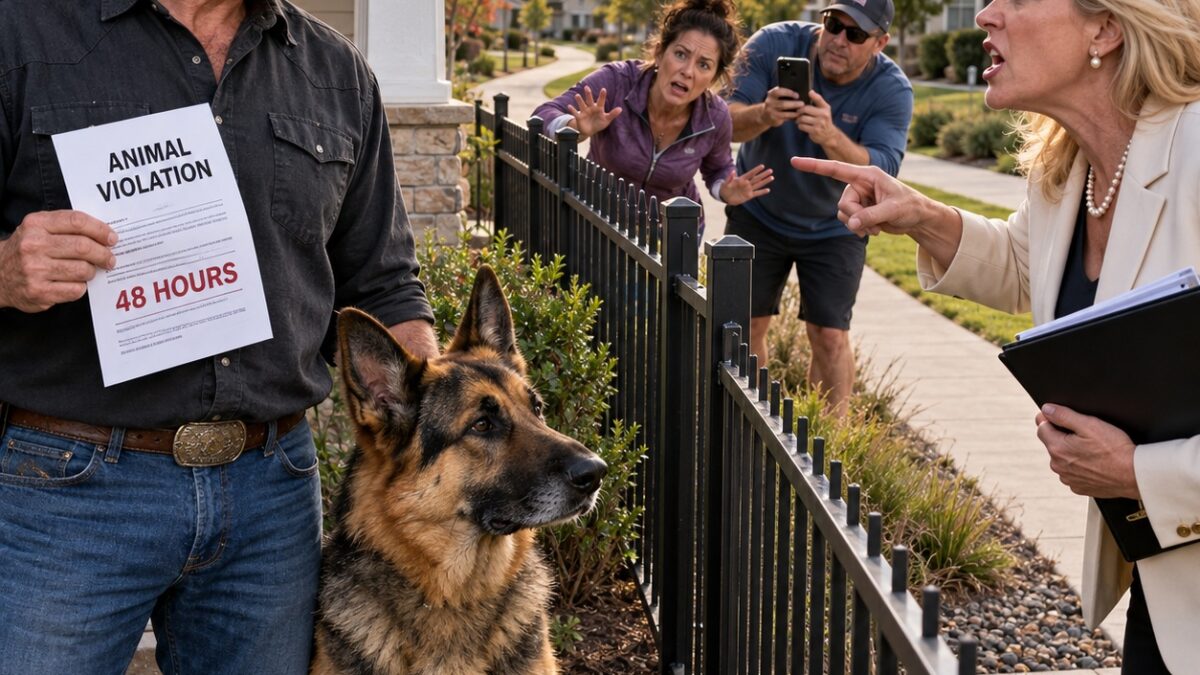
FULL STORY:HOA Queen Branded My German Shepherd a “Dangerous Animal” and Gave Me 48 Hours to Remove Him—Her Star Witness Forgot My Fence Had a Camera
FULL STORY CONTINUATION
I replayed the clip.
Once.
Twice.
Three times.
The same sequence every time.
The woman approached.
Ranger stood.
She reached toward the fence.
She screamed.
The man raised his phone.
Then both of them walked away.
No dog outside the yard.
No lunge through the fence.
No attack.
No contact at all.
I sat back in my chair.
Something was wrong.
Not merely mistaken.
Wrong.
Because if a frightened resident had misunderstood Ranger’s behavior, I could imagine that.
Dogs are large.
People get nervous.
Someone might hear a bark, see a German Shepherd shape near a fence, panic, and describe the experience differently afterward.
But this woman had walked deliberately toward him.
She had touched the fence.
Then screamed almost on cue.
And the man beside her had his phone ready.
I saved the original footage.
Then backed it up twice.
One copy on an external drive.
One online.
Only then did I call Mark.
“Come over.”
He arrived fifteen minutes later.
We sat at my kitchen table.
Ranger settled underneath it.
I played the clip.
Mark leaned toward the screen.
“Again.”
I replayed it.
He shook his head.
“That doesn’t look like an attack.”
“It wasn’t.”
“She walked toward him.”
“Yes.”
“She touched the fence.”
“Yes.”
“And Ranger never got out.”
“No.”
Mark scratched his jaw.
“Then why would she claim he attacked her?”
“I don’t know.”
That was not completely true.
I had a theory.
The HOA wanted Ranger gone.
Or at least somebody inside the HOA wanted him gone badly enough to construct a story.
What I did not know was why.
The next morning, Melissa escalated.
Email subject:
FINAL NOTICE — DANGEROUS ANIMAL.
My forty-eight hours had somehow become twenty-four.
The fine had increased to $1,000.
I called.
She answered with the impatient tone of someone already tired of a conversation she had created.
“You’ve received multiple notices.”
“I’ve also found something.”
“What?”
“Security footage.”
Silence.
Not long.
But noticeable.
Her voice changed.
“What footage?”
“The incident.”
Another silence.
“You have video?”
“Yes.”
“From where?”
“My property.”
“What exactly does it show?”
“Send me the email address you want evidence delivered to.”
“The board already has sufficient evidence.”
“Then mine should be easy to review.”
She did not answer.
I sent the clip anyway.
Ten minutes later, an email arrived.
The HOA declines to comment on private surveillance footage.
I stared at those words.
Private surveillance footage.
As though my camera had recorded something unrelated.
They were accusing my dog of an attack.
The camera covered the exact place where they claimed it happened.
And now the board did not want to comment on the evidence.
That was when I called Sandra Ellis.
Sandra was an attorney who had helped me understand HOA documents during an earlier property dispute.
I sent her everything.
Violation notice.
Three complaints.
Email chain.
Security clip.
She called later that afternoon.
“Daniel.”
“Yes?”
“This footage matters.”
“I figured.”
“Preserve the original.”
“Already backed up.”
“Do not trim it.”
“I won’t.”
“Don’t add text.”
“Wasn’t planning to.”
“Don’t upload it online.”
“Also wasn’t planning to.”
“Good.”
She paused.
Then asked:
“Do you know who that woman is?”
“No.”
“Find out.”
That did not take long.
Neighborhoods are strange ecosystems.
Nobody knows anything until you ask one question.
Then everybody knows everything.
One homeowner recognized her immediately.
Karen Willis.
Three streets away.
I had never spoken to her.
Mark had.
Apparently Karen had complained about Ranger for months.
That surprised me.
“Months?”
“Mostly barking.”
“He barely barks.”
“I know.”
“Did she ever say anything to me?”
“No.”
“Why?”
Mark shrugged.
Then another neighbor gave me the next piece.
Karen was close friends with Melissa.
They attended committee meetings together.
Helped with neighborhood landscaping.
Frequently arrived at association events in the same car.
None of that proved wrongdoing.
Friendship is not conspiracy.
But it explained how a complaint could move quickly.
Then Mark found an old neighborhood-group screenshot.
Two weeks before the alleged attack, Karen had posted:
That large dog near the trail is destroying the peaceful character of the neighborhood with constant barking. Something needs to be done.
The replies had not gone the way she wanted.
One resident:
I walk past Daniel’s property every morning. Ranger barely makes a sound.
Another:
I’ve never had a problem with that dog.
Another:
Are we talking about the German Shepherd mix? He just watches people.
Karen deleted the post.
Somebody had taken a screenshot first.
I saved it.
Now the sequence looked different.
Complaint about barking.
Little support.
Then aggression complaints.
Then alleged attack.
Then a demand to remove Ranger.
I told Sandra:
“This looks coordinated.”
“It looks suspicious.”
“Same thing.”
“No.”
She corrected me immediately.
“Suspicious is what we can say. Coordinated is what we have to prove.”
I respected that.
“What do we need?”
“More.”
Three days later, we got our opportunity.
The HOA called a special meeting.
Subject:
COMMUNITY ANIMAL SAFETY.
Nobody needed translation.
The clubhouse was packed when I arrived.
Residents filled almost every chair.
Melissa sat at the front table.
Karen sat directly behind her.
The HOA attorney was there.
Sandra sat beside me.
I had the original video on a laptop.
Backup copy on a flash drive.
Printed still frames.
The complaints.
The emails.
The governing documents Sandra had marked.
Ranger stayed home.
That mattered to me.
I was not going to parade him into a hostile meeting like evidence.
Melissa opened with a speech.
“The board has received multiple reports concerning a dangerous animal near the community walking trail.”
People shifted in their seats.
“The animal in question has demonstrated aggressive behavior.”
She looked directly at me.
“Mr. Mercer has refused to cooperate.”
I stood.
“I’ve cooperated with every request supported by evidence.”
“Please wait until you’re recognized.”
I sat.
She continued.
“The board recommends permanent removal of the animal for community safety.”
A murmur spread.
Not agreement exactly.
Confusion.
Several residents had seen Ranger.
Some knew him.
Nobody seemed to understand how the quiet dog beside my porch had suddenly become Cujo.
Melissa kept going.
“We have witnesses.”
I raised my hand.
She reluctantly recognized me.
“Then let’s hear from them.”
Her expression tightened.
I looked toward Karen.
“If somebody was attacked, let them describe the attack.”
Melissa started:
“That isn’t—”
The HOA attorney leaned slightly toward her.
She stopped.
Karen stood.
She walked to the microphone.
She wore an expression that looked prepared.
That bothered me.
Not because prepared means dishonest.
Because the story she delivered had dramatic detail but almost no verifiable detail.
She said she had been walking along the trail.
Ranger charged toward her.
She believed he was going to bite.
She was terrified.
She had barely escaped.
“I don’t feel safe walking near that property anymore,” she finished.
The room went quiet.
I waited.
Then asked:
“Would you like to see the video?”
Karen’s face changed.
Tiny.
But visible.
“What video?”
“The video of the incident.”
Melissa interrupted.
“This isn’t necessary.”
I turned toward the projector.
“I brought it.”
“Daniel—”
The HOA attorney spoke.
“If there’s footage of the alleged event, I think the board should review it.”
Melissa stared at him.
He did not change his expression.
Sandra connected my laptop.
The lights dimmed.
The image appeared on the wall.
My fence.
Walking trail.
Ranger lying in the yard.
Timestamp.
4:35:51.
People leaned forward.
At 4:36, Greg Willis entered frame.
Then Karen.
They talked.
Karen pointed toward my property.
Walked closer.
Ranger stood.
Still behind the fence.
Karen reached out.
Touched the fence.
Screamed.
Greg lifted his phone.
They walked away.
Video ended.
Silence.
Not the kind before applause.
The kind where dozens of people realize they have been told something that does not match what they just saw.
I replayed it.
This time somebody near the back spoke.
“He never left the yard.”
Another voice:
“She walked toward him.”
Another:
“She touched the fence first.”
Karen started talking.
“That video doesn’t show everything.”
I turned.
“It shows the entire time you were near my fence.”
“You don’t know what I experienced.”
“I know Ranger did not attack you.”
“He charged.”
“No.”
“He moved toward me.”
“He stood up.”
“You weren’t there.”
“No.”
I pointed toward the screen.
“But the camera was.”
Melissa reached for her microphone.
“This footage is from a private camera and may not reflect the full circumstances.”
Sandra leaned toward me.
“Stay quiet.”
I did.
That was difficult.
Then Mark stood.
“I have another video.”
Every head turned.
Melissa said:
“This meeting is becoming chaotic.”
The HOA attorney asked:
“What video?”
“My house has a camera covering part of the trail.”
He walked toward the projector.
Connected his phone.
His recording began earlier than mine.
Karen and Greg stood farther down the trail.
Talking.
The audio was not clear enough to hear every word.
But their body language was easy to see.
Karen pointed toward my property.
Greg looked.
They waited.
Then began walking toward the fence.
Someone whispered:
“They planned it.”
Sandra immediately leaned toward me.
“Do not agree out loud.”
I nodded.
The HOA attorney paused the footage.
“Who is the man?”
Mark answered.
“Greg Willis.”
Karen’s husband.
The room erupted.
Melissa struck the table.
“Everyone calm down.”
Nobody really did.
A homeowner stood.
“I have something too.”
She held up her phone.
The screenshot of Karen’s barking complaint.
It went onto the projector.
That large dog near the trail is destroying the peaceful character of the neighborhood… Something needs to be done.
Then the replies.
People defending Ranger.
Then evidence the post had been deleted.
Karen crossed her arms.
“So what? I complained about barking.”
Another resident stood.
“I have another message.”
She read from her phone.
Karen had said privately:
I want the HOA to force Daniel to get rid of that dog.
Now people were openly talking.
Melissa tried to regain control.
“None of this changes the board’s authority to protect residents.”
Sandra stood.
She had been silent until then.
That silence made everyone listen when she finally spoke.
“My name is Sandra Ellis. I represent Mr. Mercer.”
Melissa’s expression changed again.
Sandra placed a copy of the HOA pet regulations on the table.
“The association’s governing documents allow action against a dangerous animal after verification of an actual violation.”
She pointed toward the screen.
“There is no attack shown.”
Then the complaints.
“There is no animal-control report.”
She looked toward Melissa.
“No police report.”
Then Karen.
“And video evidence directly contradicts the central allegation that Ranger left his yard and attacked Ms. Willis.”
The HOA attorney took the documents.
Read.
Flipped pages.
Then looked at Melissa.
“Did the board independently verify any of the complaints before issuing the removal order?”
Melissa sat very still.
“We relied on resident reports.”
“That wasn’t my question.”
Silence.
“Did anyone from the board inspect the location?”
“No.”
“Review surveillance footage?”
“No.”
“Contact animal control?”
“No.”
“Was Ranger ever classified as dangerous by any public agency?”
“No.”
“Previously cited?”
“No.”
“Prior bite?”
“No.”
“Previous attack?”
Melissa’s answer became quieter.
“No.”
The attorney closed the documents.
“Then the removal notice should be withdrawn.”
Melissa stared.
“But we have a responsibility to ensure community safety.”
“You do.”
He looked directly at her.
“And that responsibility includes following your own governing documents.”
That ended it.
Not emotionally.
Melissa clearly wanted to continue.
But procedurally, the argument was gone.
The dangerous-animal designation was withdrawn.
The $1,000 fine canceled.
The violation removed from my property record.
I should have felt triumphant.
Instead, I felt tired.
Because Ranger had been safe at home the entire time.
Probably sleeping near the porch.
Completely unaware that a room full of adults had spent an hour debating whether he deserved to keep living where he had lived for years.
The meeting broke into conversations.
People came toward me.
Some apologized.
Some wanted to see the footage again.
One man said:
“I believed the notice because I figured the board must have checked.”
That sentence stayed with me.
The board must have checked.
That was the danger.
Official-looking paper creates borrowed credibility.
A bold heading.
A logo.
A deadline.
A fine.
Most people assume somebody verified something before printing it.
Sometimes nobody did.
Karen left early.
Greg with her.
Melissa stayed behind talking to the HOA attorney.
Sandra packed her papers.
I asked:
“Is this over?”
“The dog issue probably.”
“Probably?”
“She may try another angle.”
“Why?”
Sandra looked toward the empty chair where Karen had been sitting.
“Because we still don’t know what she wanted.”
That bothered me.
If Karen simply disliked dogs, maybe the exposure would end it.
But the escalation felt too specific.
She had gone from barking complaint to dangerous-animal removal.
Why?
Mark found the answer the following week.
Not through espionage.
Through HOA documents.
Karen had been helping with a proposed landscaping project near the walking trail.
Decorative plantings.
Drainage improvements.
A small retaining feature.
And part of the planned work required moving a section of fencing near my property.
My fence.
Months earlier, somebody had approached me casually about granting access.
I had refused.
Not angrily.
The fence sat on my land.
The proposed move would have interfered with the way Ranger used that side of the yard and changed a boundary area I had no interest in modifying.
Karen had apparently taken that refusal personally.
Once Ranger was labeled dangerous, the HOA could try arguing that the fence configuration had to change as a safety measure.
Remove Ranger.
Gain access.
Move fence.
Suddenly the entire sequence made sense.
It had never really been about barking.
Or fear.
Or children.
The dog was leverage in a property disagreement.
I called Sandra.
She read the project paperwork.
Then said:
“Well.”
“What?”
“You wanted motive.”
“There it is.”
“Possible motive.”
“You really enjoy ruining sentences.”
“That’s why you pay me.”
The board launched an internal review.
This time, Melissa did not control it.
The HOA attorney insisted other board members handle the process.
Karen was removed from the landscaping committee.
The project near my fence was suspended.
Any future work affecting my boundary would require actual written permission.
Exactly how it should have been in the first place.
Melissa’s position became harder.
Residents began asking why the board had issued a removal order without verification.
Why a $1,000 fine appeared before any investigation.
Why private footage had initially been dismissed.
Why Karen’s prior complaints were not disclosed.
Why her relationship with Melissa had not triggered more independent review.
Melissa defended herself.
She said she had acted on information presented to her.
Maybe she had.
That was possible.
I did not claim she personally planned Karen’s performance at the fence.
The evidence did not prove that.
But Melissa had taken accusations from a close associate and converted them into official HOA punishment without doing basic verification.
That part was undeniable.
A month after the meeting, Melissa resigned from the board.
No giant public meltdown.
No police.
No lawsuit.
A resignation.
Simple.
Karen was off the committee.
The landscaping plan was rewritten away from my property.
My fence stayed exactly where it was.
And Ranger?
Ranger became famous.
Which he found deeply inconvenient.
People who had never spoken to me began stopping near the house.
“Is that Ranger?”
He would look at them.
“Yes.”
“The famous Ranger?”
“He has no idea he’s famous.”
Kids asked whether they could pet him.
If I knew the family and Ranger was comfortable, I allowed it.
He would stand there receiving attention with the bored dignity of a dog who believed human beings had finally figured out his obvious importance.
One neighbor brought him treats.
Another joked:
“That dog has better legal representation than most of us.”
Sandra heard about that and said:
“Correct.”
The funny part was Ranger had not changed.
Before the accusation:
Quiet dog.
After the accusation:
Same quiet dog.
People’s perception had changed.
That is one of the strangest things about accusations.
The subject can remain completely still while the social world around them transforms.
One day Ranger is a dog people barely notice.
Next morning:
Dangerous animal.
Then video appears:
Victim.
Then the story spreads:
Neighborhood celebrity.
Same dog.
Humans changing labels.
Ranger mostly wanted dinner.
I envied him.
For weeks after the meeting, I found myself checking the cameras more often than before.
Not because I expected Karen back.
Because being falsely accused changes your relationship with evidence.
Before, the cameras were security.
After, they were witnesses.
At 4:36 that afternoon, none of us had known a camera would decide whether Ranger stayed in my home.
The device simply recorded.
No loyalty.
No anger.
No friendships.
No HOA politics.
Light.
Movement.
Timestamp.
That neutrality saved him.
I thought about what would have happened without it.
Karen tells story.
Greg backs her up.
Three written complaints appear.
Melissa says multiple witnesses.
Board issues notice.
I say Ranger never left the yard.
They say:
Prove it.
How?
Ranger cannot testify.
There were no neutral witnesses beside him.
No animal-control report because there was no attack.
And the absence of a report might not have been enough against several coordinated complaints.
Without video, the argument becomes credibility.
HOA president and multiple residents on one side.
One homeowner defending his dog on the other.
I did not like imagining how easily that could have gone wrong.
A dog cannot understand why he is being removed.
That thought bothered me most.
If I had obeyed the notice, Ranger would have experienced only the result.
His home disappearing.
Me handing him somewhere else.
No explanation.
No understanding of Karen.
No concept of HOA rules.
Animals trust our control of their world.
That makes threatening them uniquely cruel.
Not because dogs matter more than people.
Because they cannot participate in the process being used against them.
We have to.
That responsibility changed the way I felt about the entire incident.
At first, I thought:
They’re coming after my dog.
Later:
They’re testing whether accusation is enough.
That was bigger.
Not dramatically bigger.
Practically.
Because the next target could be a fence.
A shed.
A vehicle.
A tree.
A resident.
If three unverified complaints automatically became punishment, the governing documents meant nothing.
Sandra explained that at a later board session.
HOA boards do have authority.
Real authority.
Communities need rules.
Shared property.
Safety.
Maintenance.
Noise.
Pets.
All legitimate.
But authority requires procedure.
Otherwise complaints become weapons.
You dislike somebody?
File three statements.
Your friend chairs the board?
Issue a fine.
Call the target uncooperative when they ask for evidence.
That is not governance.
It is social power wearing administrative clothing.
The new board understood.
They adopted better procedures after Melissa resigned.
Animal complaints involving alleged attacks required more specific information.
Date.
Approximate time.
Location.
Nature of contact.
Whether there was a bite.
Whether medical help was needed.
Whether animal control was contacted.
Evidence if available.
A complaint alone could trigger investigation.
Not automatic removal.
That distinction matters.
Residents still deserved the right to report dangerous behavior.
I did not want the opposite extreme.
If Ranger ever truly attacked someone, I would take it seriously.
Of course.
Responsible dog ownership means accountability.
But responsibility goes both ways.
If you’re going to accuse a dog of being dangerous, be accurate.
The new process protected residents and owners.
That was better than simply making the HOA afraid to act.
A few people suggested I sue.
Maybe I could have pursued something.
Sandra and I discussed options.
But what did I actually want?
Ranger safe.
Fine canceled.
Record removed.
Fence untouched.
Board procedure corrected.
Karen off the committee.
Melissa gone.
I had those.
I did not need three years of litigation to feel victorious.
Lawsuits are tools.
Not trophies.
So I moved on.
Mostly.
One afternoon, a little boy stopped with his mother near the fence.
“Is that the attack dog?”
His mother looked mortified.
“I’m sorry.”
I laughed.
“Technically, he’s the dog accused of attacking.”
The boy looked at Ranger.
Ranger sat.
The boy said:
“He doesn’t look mean.”
“No.”
“Can I pet him?”
“Not through the fence.”
That was important.
“Come around with your mom.”
They did.
I put Ranger on leash because responsible habits do not disappear because your dog was falsely accused.
The boy held out his hand.
Ranger sniffed.
Then leaned against him.
The kid laughed.
“He’s heavy.”
“Yes.”
“What does he attack?”
I thought.
“Squirrels.”
That was accurate.
Ranger had a long-running conflict with one particular squirrel that seemed entirely one-sided because the squirrel did not respect him enough to be afraid.
The boy scratched Ranger’s ears.
That became the neighborhood version of justice.
Not Karen losing a committee seat.
A child seeing the supposed dangerous dog and discovering nothing frightening.
I did not turn Ranger into a public mascot.
He was still my dog.
Not everyone needed access.
Some dogs dislike strangers.
Some situations are stressful.
I respected his comfort.
But the people he already knew treated him differently.
More affection.
More jokes.
He had no idea why.
Good.
Let humans carry stupid human history.
There was one person I did not expect to see again.
Melissa.
Several months after resigning, she walked past my property.
No blazer.
Casual clothes.
Ranger was beside me on the porch.
She slowed.
Stopped.
For a second, I wondered whether she was going to say something about the dog.
She looked at him.
Then at me.
“I owe you an apology.”
I said nothing immediately.
She continued.
“I should have verified the complaints before the board acted.”
That was more specific than I expected.
“Yes.”
Her mouth tightened.
“I thought I was protecting the neighborhood.”
“I believe you thought that.”
She looked surprised.
That was not forgiveness.
Just accuracy.
“Karen made it sound serious.”
“You still signed the notice.”
“I know.”
“Forty-eight hours.”
She nodded.
“I know.”
“Then twenty-four.”
“I know.”
“Thousand-dollar fine.”
She looked down.
“I know.”
Ranger stood.
Melissa instinctively stiffened.
He stretched.
Turned in a circle.
Lay back down.
I almost smiled.
She noticed.
“I was wrong about him.”
“Yes.”
“I’m sorry.”
I nodded.
She walked away.
I did not feel the dramatic release people imagine.
No triumph.
No vindication thunder.
Mostly, I felt finished.
That was enough.
An apology cannot rewind fear.
But a specific apology can acknowledge reality.
She had not said:
I’m sorry you were upset.
She had said she should have verified.
Good.
That was the failure.
Verification.
The entire story turned on it.
Karen’s claim.
Melissa’s assumption.
My camera.
Mark’s camera.
The difference between a rumor and a fact.
I kept the original violation notice.
Folded.
Desk drawer.
DANGEROUS ANIMAL.
Sometimes I pulled it out.
Not often.
The bold lettering looked ridiculous now.
Official.
Certain.
Wrong.
That piece of paper had once carried enough psychological weight that for several hours I genuinely considered what I would do if the HOA somehow forced me to choose between Ranger and my home.
Move?
Fight?
Temporary foster?
Court order?
Lawyer?
How fast can a board act?
Could animal control get involved?
All because of words on one page.
I kept it as a reminder.
Certainty in typography is still just typography.
Evidence matters.
One complaint can be written in five minutes.
Three complaints can be written in fifteen.
A board can turn them into an official notice before lunch.
A rumor can travel through a neighborhood before anyone asks:
Did this actually happen?
That question should come first.
In Ranger’s case, the answer was preserved at 4:36 p.m.
Karen approached.
Ranger stayed behind the fence.
That was the fact.
Everything else had been narrative added around it.
She said he charged.
Video showed standing.
She said he nearly bit.
No contact.
She said she feared walking near the property.
Video showed her voluntarily approaching.
Melissa said multiple complaints established danger.
No independent verification.
The evidence did not require interpretation from me.
That was its strength.
I could have stood at the special meeting and given a twenty-minute speech about Ranger’s temperament.
How he slept beside the porch.
How he followed me around the property.
How kids had seen him before.
How he had never bitten anybody.
All true.
Still subjective.
The video lasted less than a minute.
More powerful.
That taught me humility too.
Sometimes your strongest argument is not your explanation.
It is the record.
Shut up.
Press play.
Let people see.
Sandra understood that instinctively.
Before the meeting, she told me:
“Do not narrate the video while it runs.”
“Why?”
“Because Melissa will say you’re influencing people.”
“So just play it.”
“Exactly.”
“What if someone misunderstands?”
“Then we replay.”
That is what happened.
First playback:
Shock.
Second:
Observation.
He never left the yard.
She touched the fence first.
Truth became clearer under repetition.
No dramatic legal trick.
Just footage.
Mark’s camera helped because it widened context.
That mattered too.
One camera can show event.
Another can show lead-up.
His footage did not prove exactly what Karen and Greg said because audio was unclear.
We never claimed it did.
It showed them discussing my property before approaching.
Suspicious.
Combined with Karen’s earlier messages, motive strengthened.
Then the landscaping documents completed the picture.
Each piece had limits.
Together, enough.
Sandra made me respect evidentiary boundaries.
When I said:
“They planned the fake attack.”
She said:
“You can say the video shows deliberate approach and later evidence shows motive. Do not say you know every word they discussed unless you heard it.”
Annoying.
Correct.
If I exaggerated one part, Melissa could attack credibility of everything.
So we stayed precise.
That discipline eventually mattered more than anger.
Karen had created an incident.
That much the video showed.
She claimed an attack that did not occur.
That much the video showed.
She previously wanted Ranger removed.
Messages showed that.
She was involved in a landscaping project affected by my fence.
Documents showed that.
I had refused access.
That happened.
From those facts, people could draw reasonable conclusions without me inventing hidden conversations.
The board did.
Karen lost her committee position.
The fence project changed.
Enough.
I never confronted Karen privately.
People found that surprising.
“After she tried to get Ranger removed?”
Yes.
What useful conversation could we have?
She knew what she did.
I knew.
The board knew.
Neighbors knew.
A driveway confrontation would provide no new information.
At best, she apologized.
At worst, another argument.
I preferred peace.
I also had no desire to give her a clip of me yelling she could twist into:
Aggressive homeowner threatens resident.
Once someone shows willingness to manipulate narrative, do not donate new material.
Sandra would have been proud.
Maybe horrified that I learned.
Mark joked that Ranger had made me smarter.
“Dog did more for your legal education than college.”
“I did not go to law school.”
“Exactly.”
The neighborhood settled.
The special meeting stopped being daily conversation.
New drama replaced it.
Somebody parked a trailer too long.
Someone painted a front door a color the architectural committee disliked.
Normal HOA life.
Wonderful.
Ranger returned to being Ranger.
Morning porch.
Fence patrol.
Squirrel.
Nap.
Following me while I worked.
That return to ordinary behavior felt important.
I had worried the attention would change our routines.
It didn’t.
Animals are good at moving forward when humans stop creating chaos.
Months later, I reviewed the footage once more before archiving everything.
I noticed something I had missed emotionally the first hundred times.
When Karen screamed, Ranger took one small step backward.
Not forward.
Backward.
He was startled.
That hurt me unexpectedly.
The dog she accused of terrifying her had been surprised by her scream.
Maybe nervous.
Maybe confused.
Then she walked away and told people he had attacked.
I closed the file.
I did not need to watch again.
People often use the word dangerous too casually with dogs.
A dangerous-dog label can carry enormous consequences.
Insurance.
Housing.
Restrictions.
Removal.
In some places, worse.
That does not mean the label should never be used.
Truly dangerous animals exist.
Serious attacks happen.
Victims deserve protection.
But precisely because consequences are serious, accuracy has to be serious too.
Fear is evidence of a person’s emotional experience.
It is not automatically evidence of what the dog did.
Karen may have been nervous around Ranger.
She also walked toward him.
Both can be true.
The camera separated the emotional claim from observable behavior.
That distinction saved us.
I began encouraging neighbors to understand dog behavior better.
Not formally.
I am not a trainer.
But simple things.
Do not reach over fences toward unfamiliar dogs.
Do not encourage kids to run up screaming.
Ask the owner.
Respect space.
Ranger was friendly under controlled introductions.
That did not make every fence interaction appropriate.
Responsible ownership includes preventing situations where misunderstandings can happen.
I made a few practical changes after the incident.
Not because Ranger was wrong.
Because experience teaches.
A small sign:
DOG ON PROPERTY — PLEASE DO NOT REACH THROUGH FENCE.
Camera angle adjusted slightly.
Better coverage of trail.
Locks checked.
I also kept copies of vaccination records and license information easier to access.
Again:
Prevention.
Doing those things afterward did not mean Karen’s accusation had been justified.
Improving safety after an event is not admitting previous negligence.
It is learning.
The HOA’s new procedures did the same.
Melissa’s failure exposed a weakness.
They repaired it.
Good.
That is what organizations should do after mistakes.
Not merely replace one president and pretend structure was perfect.
The board had moved too quickly because procedures allowed subjective complaints to gain momentum.
Now documentation came earlier.
Review before penalty.
Conflict-of-interest disclosure.
Basic fairness.
Some residents complained the process became slower.
I had little sympathy.
If the choice is:
Take twenty-four extra hours before ordering someone to remove a family dog
or
act quickly because three unsigned narratives feel urgent,
take the extra day.
Real emergencies can still be handled immediately through animal control or police.
Ranger’s case had neither.
No injury.
No loose dog.
No call.
No immediate danger.
Only paper urgency.
That phrase became one I used often afterward.
Paper urgency.
FINAL WARNING.
IMMEDIATE ACTION REQUIRED.
24 HOURS.
Bold red text can make your body react before your mind checks whether the sender has authority or evidence.
Melissa knew that, consciously or not.
The first notice placed me on defense.
It said:
Do something now.
The proper response was:
Prove why.
That shift saved me.
If I had panicked, I might have called friends asking who could temporarily take Ranger.
Might have missed the footage.
Might have treated the order as legitimate simply because it came from the HOA.
Instead:
When?
Where?
Who?
Report?
Evidence?
Each question slowed the narrative until facts caught up.
That is a skill I wish more homeowners had before they receive threatening letters.
Not defiance for its own sake.
Verification.
What document creates this authority?
What rule?
What evidence?
What appeal?
What deadline actually exists?
Fear loves speed.
Facts often need ten minutes.
Take them.
I was lucky that Mark told me to check the cameras.
I asked him later:
“How did you know?”
He leaned against my porch railing.
“I saw Karen and Greg on the trail.”
“You saw the whole thing?”
“Not clearly. Trees blocked part of it.”
“So why the text?”
“Because later I heard Karen telling someone the dog had attacked her.”
“And?”
“And I knew I had just seen them walk away normally.”
He shrugged.
“Didn’t add up.”
One neighbor noticing inconsistency.
That mattered.
Again, no single hero.
The camera.
Mark.
Sandra.
Residents who kept screenshots.
HOA attorney willing to tell Melissa no.
Board members willing to reverse the decision.
Truth usually arrives through multiple people doing small correct things.
I appreciated that.
Especially the HOA attorney.
He worked for the association.
Not me.
Some residents assumed he would automatically defend Melissa.
But his responsibility included protecting the organization from acting outside its governing documents.
When he said:
“The removal notice should be withdrawn,”
he did his job.
Good.
Institutions function when advisers can tell leaders something they do not want to hear.
Melissa had initially surrounded herself with agreement.
That failed when someone independent read the actual rules.
Another useful lesson.
A title does not make you the HOA.
The governing documents do.
Melissa could say:
The board has decided.
Sandra could point to:
The board must first establish an actual violation.
One sentence had emotion.
One had authority.
Authority won.
I kept that in mind every time somebody later told the story as:
Daniel destroyed the HOA president with a security camera.
No.
I did not destroy anybody.
Melissa resigned after her choices lost confidence.
Karen lost her committee role because her allegation was contradicted and motive became apparent.
The board corrected its actions.
Ranger stayed home.
That is not destruction.
That is consequence.
The distinction matters because revenge stories tempt people to celebrate suffering rather than correction.
My dog did not need Melissa’s life ruined.
He needed the notice canceled.
I did not need Karen humiliated forever.
I needed her away from decisions affecting my fence.
Those outcomes matched the harm.
Enough.
One afternoon, months later, I found Ranger lying exactly where he had been at 4:36 on the day of the incident.
Same section of fence.
Same trail beyond.
Sunlight across the grass.
A couple walked past.
Ranger lifted his head.
Watched.
They waved.
I waved back.
He put his head down.
Nothing happened.
That ordinary moment felt almost profound.
Same environment.
No crisis.
The difference was nobody had decided to create one.
Safety often looks like nothing happening.
I began valuing that.
Nothing.
No notices.
No fines.
No meetings.
No accusations.
Dog naps.
People walk.
Fence stands.
A peaceful neighborhood is not one where every possible concern becomes enforcement.
It is one where ordinary behavior is allowed to remain ordinary.
Karen had turned standing up into “charging.”
Looking into “aggression.”
Existing beside a trail into “danger.”
Once fear language takes over, everything can be reinterpreted.
The camera restored scale.
Ranger stood.
That is all.
Perspective matters.
Years of living around animals taught me not to romanticize them.
Ranger was not a saint.
He stole food if you left it low enough.
He dug one corner of the yard despite repeated arguments.
He had an irrational hatred of delivery carts.
Once he destroyed a garden hose and looked proud of it.
He was a dog.
Not a furry angel.
But he did not attack Karen.
Defending him did not require pretending he was perfect.
Only truthful.
That is something else accusation culture gets wrong.
People think to defend someone, you must claim flawlessness.
No.
Ranger could be mischievous.
He could bark occasionally.
He could look intimidating because he was large.
None of those equal attack.
Keep categories accurate.
That was our entire case.
Barking complaint?
Discuss barking.
Fence concern?
Discuss fence.
Landscaping access?
Discuss property.
Do not convert each into:
Dangerous dog must disappear.
Problem escalation often happens because someone cannot win the actual argument.
Karen could not persuade me to move the fence.
So another argument appeared.
That was motive.
Once exposed, the issue became manageable.
The rewritten landscaping plan stayed on HOA property.
My fence stayed.
Nobody died.
The trail remained attractive.
Residents still walked it.
Imagine that.
A project survived without taking what somebody refused to give.
Just like most conflicts, there had been alternatives.
Karen chose the most aggressive one.
That is what made everything worse.
Had she come to me with a revised design, maybe we would have found something mutually acceptable.
Perhaps not.
Still legitimate.
Instead, she tried to make Ranger the obstacle.
People often call another person’s boundary unreasonable when they hoped there would be no boundary.
My fence was literal.
The principle behind it was not.
No.
Simple word.
Karen did not like it.
Melissa converted her frustration into administrative pressure.
Camera restored the no.
That was satisfying.
Ranger grew older.
His muzzle became grayer.
He slowed slightly.
The squirrel remained undefeated.
He still followed me outside.
Still slept near my chair.
Whenever somebody new heard the story, they would look at him and say:
“That’s the dangerous dog?”
I usually said:
“Extremely.”
Then Ranger would yawn.
Good joke.
But underneath it I always remembered how close a label came to becoming reality through paperwork.
If Melissa had succeeded in officially classifying him as dangerous, future people might have treated the designation as evidence independent of the original event.
That is how administrative records gain power.
One bad entry.
Then another institution reads it.
Insurance.
Property management.
Animal control.
Future board.
Suddenly the false accusation acquires a documented history.
That is why Sandra insisted we get the violation removed completely.
Not marked resolved.
Removed.
I had originally said:
“The fine is canceled. Good enough.”
She said:
“No.”
“Why?”
“Because five years from now someone sees ‘dangerous animal violation’ and not the meeting transcript.”
Good lawyer.
Again.
The board corrected the record.
Written confirmation.
No dangerous-animal finding.
No violation.
No fine.
I saved it.
Of course.
Paperwork.
My desk drawer eventually contained two pages side by side.
Original:
DANGEROUS ANIMAL — IMMEDIATE ACTION REQUIRED.
Final:
Violation withdrawn. No substantiated dangerous-animal incident established.
Same organization.
Different relationship with evidence.
I kept both.
One showed how quickly authority can move.
The other showed it can move backward when challenged.
That is important too.
People sometimes assume once an official body decides something, reversal is impossible.
Not always.
Boards are human.
Records can be corrected.
Pressure can work both directions.
Use procedures.
Appeal.
Present facts.
Especially when you are right.
Rage may feel better for five minutes.
Evidence lasts longer.
That line became almost a family joke.
Whenever Mark saw me installing another camera or organizing documents:
“More evidence?”
“Evidence lasts longer.”
He would roll his eyes.
But he also upgraded his cameras after the meeting.
Half the street did.
Maybe surveillance companies should have sent Karen a commission.
I never told her.
One thing I was careful about after the story spread was privacy.
People asked for copies of the clip.
Some wanted to post it online.
I declined.
The board had seen it.
Residents involved had seen it.
It served its purpose.
I did not need Karen’s face circulating forever attached to a humiliating moment.
That might surprise people.
She had tried to get my dog removed.
Why protect her embarrassment?
Because accountability had happened.
Public internet punishment has no natural endpoint.
A local mistake can become entertainment for strangers years later.
I wanted Ranger safe.
Not Karen hunted.
The evidence remained preserved in case needed.
That was enough.
Sandra agreed.
“Rare sign of maturity.”
“Thank you.”
“Don’t get used to it.”
Lawyers.
Melissa’s apology reinforced that choice.
People can make terrible decisions and later recognize them.
If I had turned her into a permanent online villain, maybe apology never happens.
Maybe she doubles down forever.
I cannot know.
But leaving room for consequence to end felt right.
Ranger certainly did not care.
He accepted no apology because none was necessary from his perspective.
Melissa had once been tense around him.
Later she walked past.
He watched.
Then went back to resting.
Dogs can teach humans something about not maintaining unnecessary feuds.
Not always.
Some dogs remember the vacuum cleaner for years.
Still.
Ranger was better at it than I was.
The final landscaping project looked fine when finished.
Shrubs.
Drainage stones.
Benches.
All within association property.
No need to move my fence.
I walked past once.
Mark said:
“All that over this?”
“Yes.”
He stared.
“They nearly got rid of Ranger for decorative landscaping?”
“When you say it like that, it sounds stupid.”
“It is stupid.”
Fair.
Many conflicts look absurd once the hidden objective becomes visible.
At the beginning:
Dangerous animal threatens residents.
Serious.
End:
Committee member wanted fence access for landscaping after property owner said no.
Very different.
That is why motive matters.
Not because motive changes whether an attack occurred.
Video did that.
But motive explains why weak evidence became aggressive enforcement.
Melissa wanted to support Karen.
Karen wanted access.
Ranger became the lever.
Once lever disappeared, urgency disappeared.
No new attacks.
No new complaints.
No frightened residents.
Interesting.
If Ranger truly had been dangerous, removing Karen from a committee should not have made the safety concern vanish.
Yet it did.
That told me everything.
After the new board procedures went into place, I attended one meeting.
Only one.
I hate HOA meetings.
But I wanted to hear the animal-policy amendment.
The new president read it.
Verified incident information.
Prompt evidence review.
Opportunity for owner response.
Emergency action still available when genuine immediate danger exists.
Conflict-of-interest disclosure.
Reasonable.
A resident asked:
“Does this mean we can’t complain about dogs anymore?”
The president said:
“No. It means complaints trigger review rather than automatic punishment.”
Exactly.
That sentence was worth the entire process.
Review rather than punishment.
Healthy systems distinguish them.
Melissa had merged the two.
Complaint received.
Punishment issued.
Then evidence requested afterward.
Backward.
The new process reversed it.
Complaint.
Investigate.
Then act if justified.
Basic due process in miniature.
I left before the landscaping discussion.
Life is short.
Ranger was waiting at home.
The porch light was on when I returned.
He stood as my truck came down the drive.
Tail moving.
I parked.
Got out.
He walked over.
No idea that his situation had rewritten HOA policy.
Good.
“Come on, famous.”
He followed me inside.
That became our life again.
Years later, when I think about the story, I do not remember Melissa’s face at the meeting first.
I remember Karen’s hand reaching toward the fence.
Then the scream.
Because that moment contained the entire lie.
Ranger was where he belonged.
The accusation came toward him.
That is exactly how it felt later too.
He did nothing.
Someone brought conflict to the boundary.
Then claimed he caused it.
The camera preserved the order.
Sequence matters.
Who approached whom?
Who left property?
Who touched the fence?
Who screamed?
Who recorded?
Without sequence, people can rearrange responsibility.
With timestamped footage, harder.
That is why evidence feels so powerful.
It keeps chronology honest.
Karen’s story began with:
The dog charged me.
Video began with:
Karen approached dog.
Different sequence.
Different conclusion.
I do not claim cameras are perfect.
Angles miss things.
Audio fails.
Context matters.
But in our case, coverage was clear enough.
Two cameras.
Continuous time.
No gaps.
Ranger behind fence throughout.
That was stronger than memory.
Stronger than friendship.
Stronger than Melissa’s confidence.
Stronger than three written complaints.
I often wondered about those other complaints.
The man Ranger supposedly lunged at.
Children he allegedly frightened.
Were those fabricated?
Exaggerated?
Secondhand?
I never got definitive answers.
I will not invent them.
The board’s review found none sufficient to establish a violation.
That is what I know.
Maybe Ranger barked one day.
Maybe somebody disliked him watching from behind the fence.
Maybe Karen encouraged others to formalize ordinary encounters.
Whatever happened, no verified attack existed.
That was enough.
Accuracy matters even when the other side was wrong.
If I start claiming every complaint was fake without proof, I become less different from Melissa.
No.
Say what records show.
Three complaints lacked specifics.
No verified incidents.
No official reports.
Central attack allegation contradicted by video.
Clean.
The strongest truth rarely needs decoration.
Ranger eventually developed a habit of sleeping with his head over the porch step.
People on the trail could see him.
Sometimes somebody waved.
He would lift one ear.
That image became the real ending.
Not Melissa resigning.
Not Karen losing the committee.
Not even the special meeting.
Dog beside porch.
People passing.
No fear manufactured.
No notice on door.
Just coexistence.
I wanted that from the beginning.
The HOA thought safety required removing something.
It turned out safety required accurate information.
That is less dramatic.
More useful.
The original notice remains in my office drawer.
The paper is slightly creased now.
I once considered throwing it away.
Didn’t.
Not because I enjoy remembering Melissa.
Because it reminds me of the gap between accusation and proof.
At the top:
DANGEROUS ANIMAL.
Below:
Forty-eight hours.
Daily fines.
Confident.
Formal.
Wrong.
Whenever somebody tells me:
“The board says…”
I think of that page.
Maybe the board is right.
Often boards are.
Ask anyway.
What rule?
What evidence?
What procedure?
Legitimate authority survives questions.
It may even welcome them.
Weak authority treats questions as insubordination.
Melissa treated mine that way.
“You’re making this unnecessarily difficult.”
No.
I was making it verifiable.
Different.
That lesson became more useful than the conflict itself.
A rumor can spread in an hour.
A complaint can be written in minutes.
Authority can move faster than truth because authority already has letterhead.
Truth often needs retrieval.
Find camera.
Pull timestamp.
Call neighbor.
Save screenshot.
Read bylaws.
Get attorney.
That takes time.
So when somebody gives you a twenty-four-hour deadline, sometimes the first question should be whether the deadline is designed to beat the evidence.
I cannot know whether Melissa consciously thought that way.
But speed would have helped her.
Time helped me.
Check the footage.
That was Mark’s message.
Four words.
Those four words changed everything.
I am grateful he sent them.
People talk about surveillance negatively for good reason.
Privacy matters.
But a camera pointed toward your own property boundary can also protect against invented events.
Mine did.
The device did not know Ranger.
Did not love him.
Did not care whether he stayed.
Its indifference made it credible.
A strange comfort.
One night, years after the incident, I sat on the porch with Ranger.
He was older.
Gray around the eyes now.
Slower getting up.
Still alert when footsteps passed the trail.
Melissa no longer lived at the center of neighborhood politics.
Karen kept her distance.
The fence remained.
The landscaping had grown in.
Most new residents had probably never heard the story.
Ranger rested against my boot.
I scratched the torn patch of fur near his shoulder where he had once scraped himself under the porch.
He sighed.
I thought about the absurdity.
Forty-eight hours.
They had once given me forty-eight hours to remove this dog from his home.
Because somebody said he attacked.
No bite.
No report.
No proof.
Only a story.
Then the camera showed another story.
No.
Not another story.
That distinction matters.
It showed an event.
Stories came afterward.
The event was simple.
Ranger stayed inside the yard.
Karen approached the fence.
Karen screamed.
Ranger never touched her.
Facts.
Everything built on top of those facts had to adjust.
Melissa’s authority.
Karen’s claim.
Fine.
Removal order.
Landscaping plan.
Board leadership.
All of it.
One clip under a minute long.
People sometimes say:
“The truth always comes out.”
I do not believe that automatically.
Truth can disappear.
Files get deleted.
Cameras fail.
Witnesses stay quiet.
People forget.
Truth needs preservation.
That is a more responsible lesson.
Evidence does not save itself.
Back up the file.
Keep the notice.
Save the screenshot.
Write down the date.
Ask the question.
Truth had help in Ranger’s case.
I gave it help.
Mark did.
Sandra did.
Residents did.
That is why it came out.
I do not want to rely on fate.
Documentation is better.
Ranger stretched beside me.
A couple passed on the trail.
One of them called:
“Evening, Daniel.”
“Evening.”
The woman looked toward Ranger.
“Hey, Ranger.”
His tail moved once.
Nothing happened.
Exactly.
Nothing.
The neighborhood did not need saving from my dog.
It needed saving from the idea that an accusation becomes true because somebody with a title repeats it.
Melissa learned that.
Karen learned that.
The board learned that.
I did too.
Today, the original violation notice is still folded in that drawer.
Sometimes I see the words when looking for something else.
DANGEROUS ANIMAL.
I never cross them out.
Never write “FALSE” across the page.
Never frame the security screenshot beside it.
I don’t need to.
Ranger stayed.
That is the answer.
The fence stayed.
The fine disappeared.
The accusation disappeared.
The committee position disappeared.
The presidency disappeared.
The dog remained exactly where he had been all along.
Beside me.
Safe.
And whenever somebody tells me a complaint is “already decided” before anyone has looked at the evidence, I remember 4:36 p.m.
Karen walking toward the fence.
Ranger standing behind it.
The scream.
Greg raising his phone.
Then the camera doing the one thing nobody in that HOA meeting could argue with.
Recording exactly what happened.
They tried to make Ranger the problem.
In the end, all I had to do was press play.








