FULL STORY:HOA President Cut Power to My Million-Dollar Home Over $5,500 in Fake Fines—She Never Expected One Forged Form to Put Her Entire Empire at Risk
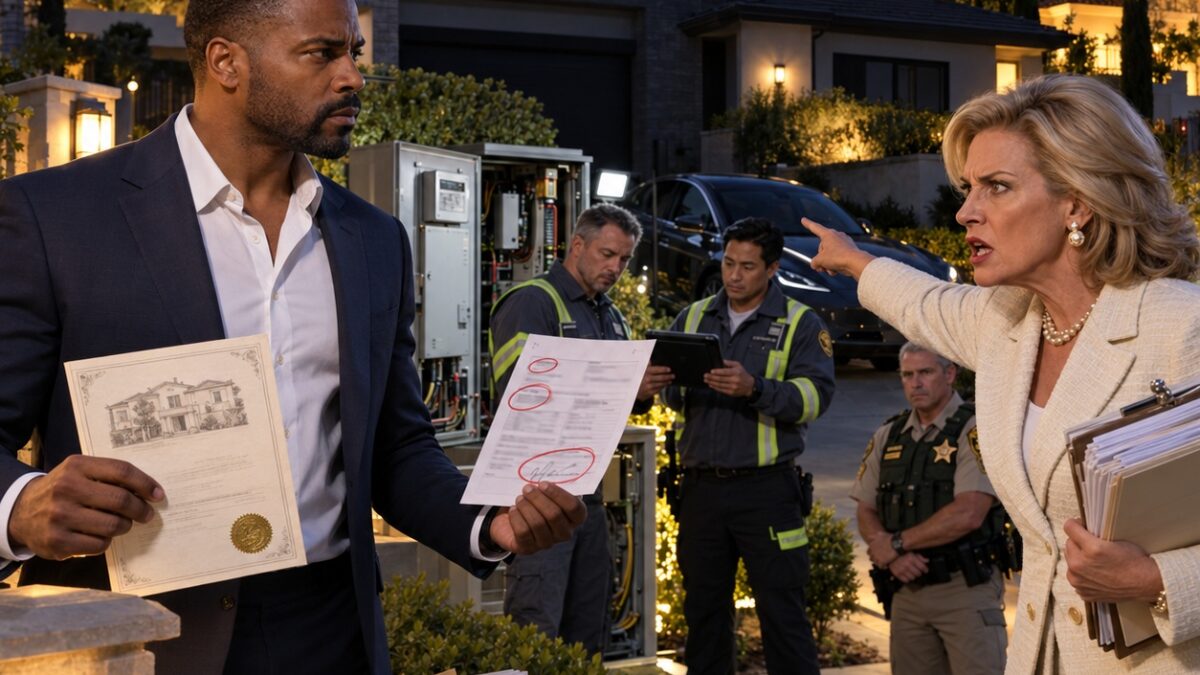
FULL STORY CONTINUATION
At first, the violation notices were almost funny.
That was my mistake.
Not legally.
Emotionally.
I underestimated how personally Barbara Higgins took the word no.
She had been president of Oakmont Heights for nine consecutive years.
Fifty-five years old.
Immaculately organized.
Always professionally dressed.
The kind of person who did not merely volunteer for authority but seemed to arrange her whole identity around possessing it.
I learned from neighbors that Barbara knew everything.
Which homeowner had repainted a door.
Who had left a trash container visible after collection day.
Whose landscaper arrived before approved working hours.
Which teenager parked on the street overnight.
Some residents admired her.
“She keeps standards high.”
Others lowered their voices before saying her name.
That told me more.
One neighbor, Gary, stopped beside my driveway one Saturday while I was washing my car.
“You’re the new holdout.”
I looked over.
“Excuse me?”
He smiled.
“The HOA.”
“Oh.”
“You didn’t join.”
“No.”
Gary glanced toward the street as though Barbara might emerge from a hedge.
“You know she’s not going to let that go.”
“She doesn’t have to like it.”
“That’s not what I mean.”
I shut off the hose.
“What do you mean?”
Gary hesitated.
“She’s used to people complying.”
“I noticed.”
“You a lawyer?”
“Real estate.”
He laughed.
“Oh, she picked the wrong house.”
I smiled.
At the time, I thought so too.
I assumed the problem would remain paperwork.
Barbara sends nonsense.
I document nonsense.
Eventually she gets bored.
Instead, she escalated.
The first notice carried no dollar amount.
The next did.
Then another.
Administrative fine.
Architectural fine.
Late charge.
Compliance review fee.
She began creating a running balance as if inventing accounting terminology could manufacture jurisdiction.
I responded to each notice the same way.
Attached deed.
Attached legal provision.
Short letter.
Your association has no mandatory jurisdiction over this parcel.
Please cease unauthorized enforcement activity.
Barbara stopped responding directly.
She kept sending notices.
By late fall, the fake balance had climbed above three thousand dollars.
By the end of the year, it was $5,500.
She began using more aggressive language.
LIEN PROCEEDINGS.
BOARD RESOLUTION.
FURTHER COLLECTION ACTION.
FORECLOSURE REMEDIES MAY BE AVAILABLE.
That last one made me put the letter down and stare at it.
Foreclosure.
Against a property that did not belong to her association.
I called my friend and attorney, Alina Rostova.
Alina specialized in utility and property law.
We had worked opposite one another years earlier on a commercial dispute and somehow ended up becoming friends.
She answered on the third ring.
“What did you do?”
“Why do you assume I did something?”
“Because you never call before seven unless someone has become legally interesting.”
I read her the letter.
Silence.
Then:
“She used the word foreclosure?”
“Yes.”
“Against your deed?”
“Yes.”
“You’re still not in the HOA?”
“I have not secretly joined since we last discussed this.”
Alina sighed.
“Send me everything.”
“I’m already documenting.”
“Marcus.”
“What?”
“Everything.”
I sent the entire folder.
She called an hour later.
“You really did keep every envelope.”
“I’m charming like that.”
“She has no enforcement basis here.”
“I know.”
“Then why isn’t she stopping?”
“That’s the interesting question.”
Alina made the kind of sound lawyers make when something stops being annoying and starts becoming professionally offensive.
“Do not throw anything away.”
“I won’t.”
“And if she files anything with the county recorder, call me before you respond.”
“Already planned.”
“At some point you need hobbies.”
“I bought a house. Apparently this is the hobby.”
January passed.
Barbara kept sending notices.
I ignored the monetary demands but answered the legal assertions.
Every response stayed professional.
That mattered to me.
No threats.
No insults.
No dramatic confrontations.
When somebody wants to turn a dispute into an emotional war, boredom is underrated.
My letters said the same thing over and over.
My deed contains no mandatory HOA covenant.
Your fines are unenforceable.
Do not represent otherwise.
Barbara behaved as if repetition itself could change land records.
Then February came.
I worked late one evening at my Los Angeles office.
By the time I drove home to Irvine, it was after dark.
Oakmont Heights looked normal when I passed the security booth.
Porch lights.
Landscape lighting.
Warm windows.
I turned onto Maple Crest Way.
My neighbors’ homes were lit.
Mine was black.
Completely black.
No front lights.
No interior lights.
Nothing.
I parked.
For a second, I assumed a breaker problem.
I entered through the garage.
Dead.
I checked the panel using my phone flashlight.
Nothing had tripped.
I walked outside again.
House to my left: power.
House to my right: power.
Streetlights: power.
My house alone was dark.
That stopped feeling electrical.
It started feeling personal.
I called the utility company listed in my service documents.
After a hold long enough to make me reconsider civilization, a representative answered.
I gave my address.
She typed.
Paused.
Then said:
“Your service was disconnected pursuant to a compliance order.”
I thought I had misheard.
“A what?”
“A compliance disconnection.”
“For nonpayment?”
“No.”
“My account is current.”
“Yes, sir.”
“So what compliance issue?”
“I only see the notation attached to the work order.”
“What does it say?”
Another pause.
“Unresolved property compliance matter.”
I laughed once.
Not because anything was funny.
“Who submitted it?”
“I’m not showing an individual name.”
“What entity?”
“I can’t release that information at this level.”
“Get me a supervisor.”
The supervisor was less vague and somehow more alarming.
A third-party property-management account had submitted the request.
The supporting documentation claimed authority over my property.
Restoration could take three to five business days because the service interruption had been categorized as compliance-related rather than accidental.
“Three to five days?”
“That’s the current timeframe.”
“You disconnected residential electric service based on a third party claiming some unidentified compliance authority?”
“I understand your frustration.”
“You do not understand my frustration.”
I stopped myself.
The person on the phone had not forged anything.
“Please preserve every record attached to that order.”
“Sir?”
“Every submission. Every authorization. Every account log. I’m telling you now this will be disputed formally.”
The supervisor’s tone changed.
“Are you alleging fraud?”
“I’m telling you I own this property, there is no entity with authority to order a compliance disconnection, and I want the entire record preserved.”
I ended the call.
Then I stood in the middle of my dark living room.
Battery light from my laptop illuminated half the kitchen.
Outside, Oakmont Heights glowed politely.
Inside 42 Maple Crest Way, I could hear my refrigerator no longer running.
That was the moment I stopped treating Barbara Higgins like an irritating HOA president.
Someone had crossed from fake paperwork into interference with essential utility service.
I still did not have proof it was Barbara.
But I knew where the trail probably led.
I called Alina.
She answered:
“What happened?”
“My power is off.”
“Outage?”
“Compliance disconnection.”
Silence.
Then her voice changed.
“Say that again.”
I explained.
“Do you know who submitted it?”
“Third-party property-management account.”
“Do not call Barbara.”
“I wasn’t planning to.”
“Good.”
“I want the utility records.”
“I’ll start tomorrow morning.”
“I want the account owner, authorization document, submission history, and whoever opened it.”
“I know.”
“And Alina?”
“Yes?”
“Don’t warn them.”
She paused.
“I wasn’t going to.”
I looked around the dark house.
“One more thing.”
“What?”
“I’m ordering solar.”
She laughed.
I wasn’t joking.
Before midnight, using the remaining battery in my laptop, I purchased a professionally installed residential solar system substantial enough to support the house.
If somebody had decided darkness was leverage, I wanted that leverage gone.
The installation company moved quickly.
Within ten days, panels covered the appropriate portions of my roof.
Battery support was integrated.
The house was fully powered independently before Barbara apparently realized anything had changed.
During those ten days, Alina worked faster than the utility’s restoration department.
Forty-eight hours after my first call, she phoned.
“I found the account.”
I stepped out of a meeting.
“Whose?”
“Third-party property management account. Opened using Oakmont Heights HOA credentials.”
I closed my office door.
“Authorized by?”
“That’s where it gets interesting.”
“Go.”
“The account was only used once.”
“For my house.”
“For your house.”
“What documentation?”
“A property-management authorization form.”
“Signed by whom?”
“There is a signature purporting to authorize the management account to act on compliance issues relating to Oakmont Heights.”
“Purporting?”
“I don’t like the signature.”
I sat down.
“What does that mean?”
“It means the authority claimed on the form does not match the records I’ve reviewed, and the signature itself raises forgery concerns.”
Now I stopped smiling.
“Who submitted the disconnection?”
“The account created under HOA credentials.”
“Barbara?”
“I’m not giving you a courtroom answer yet.”
“Give me your answer.”
“My answer is that the trail goes back to Oakmont Heights, the supporting authorization is suspicious, and this needs to leave private correspondence.”
“DA?”
“Yes.”
“Utilities commission?”
“Yes.”
“Do it.”
“I already prepared the package.”
That was Alina.
She never asked permission after asking the important question.
The materials went to the Orange County District Attorney’s Office and the California Public Utilities Commission.
The utility company’s compliance department froze the third-party account.
Nobody from the HOA called me.
Barbara sent no explanation.
Nothing.
Then she saw the panels.
Four days after installation, my doorbell rang.
I opened it.
Barbara Higgins stood on my porch holding a violation notice.
She looked up at my roof before she looked at me.
“Those panels are coming down.”
No hello.
No introduction.
Straight to ownership of something she did not own.
I leaned against the doorframe.
“No.”
Her mouth tightened.
“They violate Oakmont Heights architectural standards.”
“I’m not a member of Oakmont Heights HOA.”
“We’ve been through this.”
“Yes. Fourteen months’ worth.”
She held the notice out.
I took it.
Three thousand dollars.
Unauthorized structural modification.
Fourteen days to remove.
I almost admired the commitment to bad strategy.
Barbara folded her arms.
“I don’t care what you think your deed says. This is my community. Nothing goes on any roof in this neighborhood without my board’s approval.”
“My deed is not a matter of opinion.”
“You have been obstructive since you arrived.”
“I declined voluntary membership.”
“You refused to cooperate with standards every other homeowner follows.”
“Other homeowners may have mandatory covenants.”
“They understand community responsibility.”
“I understand property law.”
She stepped closer.
That old HOA-president confidence came back.
“Then you understand liens.”
I looked at her.
“Are you threatening another fake lien?”
“The board has accumulated fifty-five hundred dollars in violations against your property already. This makes eighty-five hundred.”
“No. You have printed eighty-five hundred dollars’ worth of paper.”
Her expression hardened.
“You think being an attorney means rules don’t apply to you.”
“That’s an interesting accusation coming from you.”
She pointed toward the roof.
“Those panels are an eyesore.”
“They are legal.”
“They are unapproved.”
“By an association that has no authority over me.”
“I don’t need jurisdiction.”
The words came out before she could reconsider them.
“I need compliance.”
For a moment, I simply looked at her.
There it was.
The entire dispute in five words.
Not law.
Not covenant.
Not actual authority.
Compliance.
Barbara did not care whether I belonged to her HOA.
She cared that I lived inside the geographic space she had mentally claimed.
My deed said no.
She heard challenge.
The law said no.
She heard disrespect.
My independence existed, therefore it needed correcting.
I looked at the new violation notice.
Then back at Barbara.
“I’m going to tell you three things.”
She rolled her eyes.
“First, my deed contains no mandatory HOA covenant. That makes this fine just as void as every other notice you’ve issued.”
She opened her mouth.
I continued.
“Second, California law specifically protects residential solar installations from the kind of restriction you’re attempting to impose.”
That slowed her.
“Third…”
I folded the notice once.
“The utility-fraud investigation involving the disconnection order submitted against my property opened last week.”
Barbara’s face did not immediately move.
It was almost impressive.
Then one blink.
“What investigation?”
I held her gaze.
“Check your email.”
For the first time in fourteen months, Barbara Higgins had nothing ready.
No policy.
No board standard.
No claim about community expectations.
She stood there.
I closed the door.
Then I called Alina.
“She came.”
“For the panels?”
“Three-thousand-dollar fine.”
Alina laughed.
“Of course.”
“I told her about the investigation.”
“Good.”
“She asked what investigation.”
“Even better.”
“What do you have ready?”
“A complaint.”
“How ready?”
“Filed tomorrow if you tell me yes.”
“Yes.”
“You don’t want to read it?”
“I pay you because I assume you can write.”
“Flattering.”
“Send it anyway.”
I read every page that night.
Civil action against Barbara Higgins personally and the Oakmont Heights HOA board.
Unauthorized enforcement.
Harassment.
Interference with property rights.
Fraudulent utility disconnection.
Damages.
Declaratory relief regarding every supposed fine.
Legal fees.
The solar installation cost.
Alina had not written angry prose.
She had written something much worse for Barbara.
Clean facts.
Dates.
Attachments.
Exhibits.
My deed.
Every notice.
Every response.
The fake balance.
The utility records.
The questionable authorization form.
The solar fine.
Fourteen months of arrogance converted into numbered paragraphs.
We filed the next morning in Orange County Superior Court.
The criminal referral was already active.
That was when the dispute stopped belonging to Barbara.
She had spent more than a year controlling the format.
Her letters.
Her board.
Her notices.
Her deadlines.
Her dollar amounts.
Now other institutions had the paperwork.
The court.
The District Attorney.
The utilities commission.
The utility company’s compliance investigators.
And those institutions did not care who controlled landscaping standards in Oakmont Heights.
Pacific Edison froze the management account and cooperated.
The forged authorization document became central.
The trail that Barbara apparently thought would disappear inside administrative bureaucracy did the opposite.
It created records.
Timestamped submissions.
Credentials.
Supporting files.
Authorization documents.
Electronic logs.
People who abuse paper authority often make one strange mistake.
They believe paperwork protects them because paperwork has frightened everyone else.
But paperwork also preserves evidence.
Barbara had created a magnificent record.
Against herself.
I received a call from Alina several days later.
“Charges are coming.”
I closed my office door again.
“What charges?”
“Utility fraud. Forgery. Fraudulent use of the third-party management account.”
“Barbara personally?”
“Yes.”
I leaned back.
For all my anger, the reality of criminal charges felt heavier than I expected.
This was no longer a neighbor dispute.
No longer a fake fine.
A criminal case can rearrange a person’s life.
“You okay?” Alina asked.
“Why wouldn’t I be?”
“You sound quiet.”
“I wanted her to stop.”
“She had fourteen months.”
“I know.”
“You sent written notice repeatedly.”
“I know.”
“She escalated.”
“I know.”
“Marcus.”
“What?”
“This is not revenge.”
I looked at the folder on my desk.
“I know.”
And I did.
Mostly.
But there is a difference between being legally right and emotionally enjoying consequences.
I did not need Barbara destroyed.
I needed the interference to end.
She had chosen methods that came with consequences much larger than the original dispute.
That was hers.
The Orange County District Attorney’s Office filed three criminal counts.
Utility fraud.
Forgery of a legal document.
Fraudulent use of the third-party account.
Barbara hired a criminal defense attorney.
I heard through the civil filings that the initial retainer was twenty-eight thousand dollars.
That number spread through Oakmont Heights faster than any landscaping rumor.
Neighbors began calling me.
Some supportive.
Some curious.
Some suddenly interested in whether their own violation notices had ever been valid.
Gary came to my door.
I opened it.
He looked toward Barbara’s side of the neighborhood as if expecting surveillance.
“Is it true?”
“What?”
“She got charged.”
“The filing is public.”
He gave a low whistle.
“For your electricity?”
“For allegedly submitting fraudulent documentation related to it.”
“You lawyers never say anything normally.”
“We’re trained badly.”
Gary laughed.
Then his expression changed.
“She sent my neighbor fines years ago.”
“Is your neighbor in the HOA?”
“I don’t think so.”
That caught my attention.
“Tell them to check their deed.”
“How many houses aren’t actually members?”
“I have no idea.”
Gary looked uneasy.
“Barbara always acts like everybody is.”
“That doesn’t make it true.”
Apparently, that question reached the board too.
Once criminal charges were filed, Oakmont Heights HOA removed Barbara from the presidency unanimously.
Nine years.
Gone in one vote.
The same title she had wielded as if it were permanent authority disappeared immediately when the board realized her actions could expose all of them.
Then they ordered a full audit.
That was when the story became bigger than my house.
Eleven other homeowners.
Eleven.
Properties within the subdivision whose owners had received violation notices despite having no mandatory covenant binding them to the HOA.
Some had paid.
Some had argued.
Some had ignored the notices.
Some had apparently assumed Barbara must know what she was doing because she was president.
That number made me angrier than what she had done to me.
I knew how to read my deed.
I had Alina.
I knew what a lien required.
I understood the difference between recorded authority and a threatening letter.
Other homeowners had received official-looking notices from an organization embedded in their neighborhood.
They had every reason to assume the woman signing them was acting within legal authority.
One man named Richard called me after the audit.
We had never spoken before.
“Mr. Vance?”
“Marcus is fine.”
“Barbara fined me for replacing my garage door.”
“Are you a member?”
“That’s the thing. I didn’t think I was. The original owner told me this parcel wasn’t subject to it.”
“Check your deed.”
“I did. After all this.”
“And?”
“No covenant.”
“How much did you pay?”
Silence.
Then:
“Thirty-two hundred over four years.”
I closed my eyes.
“Talk to your own attorney.”
“You think I can get it back?”
“I’m not giving you legal advice on a call like this.”
“I understand.”
“But I would absolutely have the notices and your deed reviewed.”
Richard thanked me.
Before hanging up, he said:
“I thought if I fought her, she’d put a lien on my house.”
That sentence stayed with me.
Fear had done the work jurisdiction could not.
Barbara did not need actual authority if homeowners believed she had it.
My refusal had threatened more than her control over one house.
It threatened the illusion sustaining years of behavior.
No wonder she had escalated.
The civil case moved faster than I expected.
The evidence was unusually clean.
My deed contained no mandatory covenant.
That fact was not debatable.
The violation notices existed.
Barbara’s correspondence existed.
My repeated notices to her existed.
The solar fine contradicted both my nonmembership and state protections.
The utility submission had its own documentation trail.
The court declared every HOA violation against my property void.
All of them.
Landscaping.
Lighting.
Driveway.
Fake late charges.
Collection threats.
The accumulated $5,500.
The new $3,000 solar assessment.
Gone.
Not reduced.
Not negotiated.
Void.
The solar issue itself was resolved in a hearing that lasted less than twenty minutes.
Barbara’s old language about aesthetics suddenly sounded ridiculous inside a courtroom.
The panels stayed.
The serious damages question centered on the power disconnection.
Alina presented the record.
The court found deliberate interference with my utility service using forged documentation.
My solar installation costs were included in the damages.
Legal fees.
Compensation for the sustained harassment campaign.
Fourteen months converted from annoyance into liability.
I remember leaving court with Alina.
She carried a file box.
I carried nothing.
“Happy?” she asked.
“Ask me when the lights stay on for six consecutive months.”
She smiled.
“You have solar now.”
“Exactly.”
“You realize Barbara accidentally made your electric bill better.”
I looked at her.
“Do not give her credit.”
Alina laughed.
The grid service was eventually restored.
I kept both systems.
Solar plus grid.
My monthly electricity bill dropped to almost nothing.
The panels Barbara demanded I remove became one of the best upgrades I made to the property.
There was something satisfying about that.
Not because solar itself was revenge.
Because her attempt to inconvenience me pushed me toward a permanent engineering solution she could not control.
Every sunny day felt mildly disrespectful.
I admit that.
Barbara’s criminal case continued separately.
She initially fought.
Her attorneys challenged portions of the investigation.
There were filings.
Negotiations.
Months.
The HOA had already removed her.
The audit had exposed eleven other questionable enforcement targets.
Several homeowners started their own legal actions.
For the first time in years, Barbara no longer entered Oakmont Heights as the person everyone expected to obey.
She was the former president whose enforcement history was being dismantled one file at a time.
Eight months after the indictment, she entered a guilty plea on the utility-fraud charge.
Two years of probation.
Significant financial restitution.
And a permanent ban from serving in HOA leadership anywhere in California.
When Alina told me, I was sitting at my office desk.
“That’s the disposition.”
I leaned back.
“Probation.”
“Yes.”
“Restitution.”
“Yes.”
“Permanent HOA leadership ban?”
“Yes.”
I laughed.
“What?”
“Nothing.”
“Marcus.”
“Of everything, that last part may bother her most.”
Alina laughed too.
“You’re probably right.”
I looked out my office window.
Los Angeles traffic below.
Fourteen months earlier, I had written Barbara Higgins a polite letter saying I would not join her association.
That should have been the whole story.
One homeowner.
One deed.
One voluntary organization.
No.
Barbara could not accept a boundary that did not originate from her.
She kept pushing until the dispute became something no board title could protect her from.
The HOA later sent me a formal letter.
Not Barbara.
The new leadership.
It confirmed that 42 Maple Crest Way was not subject to mandatory membership.
No enforcement action would be taken against the property absent an actual legal basis.
The old notices had been removed from their records.
I read the letter twice.
Then filed it.
Not because I needed confirmation.
My deed had always been enough.
But institutional humility deserves preservation too.
Gary saw me outside a few days later.
“So are you joining now?”
I stared at him.
He held the expression for two seconds before laughing.
“Had to ask.”
“No.”
“Not even after all the hospitality?”
“Especially after.”
He looked up at the roof.
“Panels look good.”
“Careful.”
“What?”
“Barbara might hear you.”
We both laughed.
For the first time since moving into Oakmont Heights, the neighborhood felt different.
Not because rules disappeared.
The legitimate HOA continued operating for its actual members.
People still had meetings.
Budgets.
Landscaping.
Architectural requests.
Nothing about my case meant homeowners associations were inherently illegitimate.
The issue had always been simpler.
Authority has limits.
If you do not have it, you cannot manufacture it through confidence.
That seems obvious.
Barbara had built nine years of leadership around testing how far confidence could substitute for legal boundaries.
With most people, it worked.
A letter with a logo arrived.
They paid.
A threat mentioned a lien.
They complied.
A notice invoked “community standards.”
They assumed the organization must have jurisdiction.
Barbara confused repeated compliance with proof of authority.
Then she reached my mailbox.
I had spent ten years reading deeds for a living.
The first welcome packet told me almost everything.
It included a membership application.
That alone was interesting.
Why ask me to apply if membership were already mandatory?
Then my deed confirmed it.
I declined.
Barbara could have moved on.
Instead, my no became a personal insult.
The later court cases and criminal investigation were dramatic.
But the entire collapse began with something extremely boring.
Reading.
One document.
A deed.
The thing homeowners often sign after flipping straight to the signature page because everyone else says the transaction is standard.
My deed did not make me powerful.
It made the facts clear.
That is often enough.
I kept every record after the case.
Not because I expected Barbara to return.
She could not.
But because legal fights teach habits.
My folder eventually contained hundreds of pages.
Welcome packet.
My first letter.
Her second membership application.
Violation notices.
Fake balances.
Lien threats.
County recorder copies.
Utility documents.
Solar contract.
Investigation materials.
Court filings.
Final orders.
The file told a story far better than memory could.
Barbara’s escalation looked almost absurd when arranged chronologically.
Week three:
Please join.
Then:
Participation expected.
Then:
Fine.
Then:
More fines.
Then:
Lien threats.
Then:
Foreclosure language.
Then:
My lights go out.
Then:
I install solar.
Then:
Fine the solar.
Then:
Criminal referral.
It was a perfect record of someone repeatedly being shown the exit and choosing a deeper hallway instead.
One of the eleven other nonmember homeowners eventually stopped me near the community entrance.
A woman named Teresa.
She looked nervous.
“Can I ask you something?”
“Sure.”
“Did you know from the beginning?”
“Know what?”
“That Barbara couldn’t fine you.”
“Yes.”
“How?”
“My deed.”
She nodded.
“I paid two notices.”
I said nothing.
“I thought… I mean, the letters looked official.”
“They were official HOA letters.”
“But not official for me.”
“No.”
Her eyes watered.
“I feel stupid.”
That bothered me.
“You shouldn’t.”
“I paid.”
“You trusted an organization operating inside your subdivision to tell the truth about its authority.”
She looked down.
“That doesn’t make you stupid.”
“It makes me feel stupid.”
“Then be angry instead.”
She laughed through the emotion.
“I am.”
“Good.”
I meant it.
Shame protects the wrong people.
Barbara’s entire system depended on residents assuming they should have known better instead of asking why an HOA president knowingly pursued nonmembers.
The audit changed that.
People compared notes.
Documents.
Dates.
What had once been isolated embarrassment became pattern.
That is why transparency matters.
Bad authority loves private conflict.
One homeowner thinks:
Maybe I’m wrong.
Another thinks the same thing.
Nobody talks.
The institution looks stronger because every target believes they are alone.
The audit made them visible to one another.
Several filed legal claims afterward.
I was not involved in those cases.
I did not need to be.
Each homeowner had their own facts.
Their own damages.
Their own choices.
But I was glad they asked questions.
Oakmont Heights also changed its procedures after Barbara.
Again, I will not invent details beyond what the source supports.
What mattered was the board’s audit and removal of her enforcement legacy.
Those eleven notices were declared void.
For people who had spent months or years afraid of liens, that mattered more than any dramatic courtroom speech.
Paper in.
Paper out.
Authority corrected.
Sometimes justice is administrative.
I used to think revenge stories required an opponent to suffer exactly the harm they caused.
After Barbara, I stopped thinking that.
The best retaliation was never turning off her power.
Never trespassing.
Never yelling on her porch.
Never touching her property.
I did not need to imitate her.
I needed to let records work.
She relied on unauthorized power.
I relied on documented rights.
She created notices.
I saved them.
She submitted a fraudulent order.
The utility preserved it.
She used a forged authorization.
Investigators examined it.
She fined legal solar panels.
We added the notice as another exhibit.
Every escalation she chose became evidence.
There is a particular satisfaction in not needing to raise your voice because the other person keeps strengthening your case.
Barbara did most of Alina’s work for her.
Alina once said exactly that.
We were having coffee after a hearing.
“I have to admit,” she said, “I appreciate an opposing party who self-documents.”
“She’s generous.”
“Extremely.”
“She sent everything certified.”
“Even better.”
I laughed.
“But seriously.”
Alina stirred her coffee.
“If she had stopped after your first response, nothing happens.”
“Correct.”
“If she had stopped after three notices, maybe you eventually send a cease-and-desist.”
“Probably.”
“If she had stopped before the power issue…”
“No criminal referral.”
“Exactly.”
I looked at her.
“She needed compliance.”
Alina rolled her eyes.
“That sentence.”
“I know.”
“I don’t need jurisdiction. I need compliance.”
“That was basically the confession.”
“Not legally.”
“I know.”
“But spiritually?”
I laughed.
“Spiritually, yes.”
Barbara had told me exactly what motivated her.
Control detached from authority.
That is dangerous anywhere.
An HOA.
A workplace.
A family.
A government office.
A school board.
The context changes.
The instinct does not.
Someone experiences voluntary cooperation long enough that they stop noticing it is voluntary.
Then a person says no.
The reaction reveals everything.
Healthy authority asks:
Do I actually have the right to require this?
Unhealthy authority asks:
How do I punish the refusal?
Barbara never seriously asked the first question.
My deed answered it anyway.
One Saturday months after everything ended, I climbed onto a ladder to clean debris near one of the gutters.
From there, I could see the solar panels clearly.
Black glass.
Orderly lines.
Sunlight.
I remembered Barbara standing below that roof.
“Those panels are coming down.”
No.
They did not.
The grid power had been restored.
The solar system remained.
Both operated.
My bills were almost nothing.
I laughed alone on the ladder.
A neighbor across the street called:
“You okay up there?”
“Fine.”
“You’re laughing.”
“Long story.”
He looked at the panels.
Then understood.
“Ah.”
Sometimes that was enough.
Barbara’s name gradually stopped being the center of neighborhood conversation.
That was healthy.
For nine years, she had apparently made herself synonymous with Oakmont Heights.
Then she was gone.
The streets remained.
Homes remained.
People still walked dogs.
Kids rode bikes.
Landscapers worked.
The gate opened.
The community survived without her control.
That may have been one of the most difficult truths for Barbara.
Institutions rarely need us as much as we imagine.
Titles end.
The neighborhood continued.
My house continued.
The panels kept generating power.
I never joined the HOA.
That part deserves emphasis because several people assumed the lawsuit somehow resulted in a negotiated membership.
No.
There was nothing to negotiate.
I bought a property without a mandatory covenant because I wanted a property without a mandatory covenant.
The whole point of enforcing my rights was not to secure better HOA terms.
It was to remain outside an association I never agreed to join.
I remained a nonmember.
No dues.
No architectural applications.
No fake landscaping fines.
No board votes concerning my roof.
My relationship with neighbors remained normal.
That distinction mattered.
Community and HOA are not the same thing.
I could help a neighbor move furniture without joining an association.
Attend a barbecue.
Watch someone’s house while they traveled.
Wave at security.
Pick up trash blown into the road.
Being outside the HOA did not mean being outside the community.
Barbara had weaponized that confusion.
Join or you are selfish.
Comply or you are disruptive.
Obey our standards or you do not care about neighbors.
No.
Community is mutual behavior.
An HOA is a legal structure.
You can value one without voluntarily joining the other if your deed allows it.
Mine did.
That truth should never have required a criminal case.
It did because Barbara decided legal structure was optional when inconvenient.
One afternoon, I found the original HOA welcome packet while reorganizing my office at home.
Fourteen months of fighting condensed into glossy paper.
Welcome to Oakmont Heights.
Membership application enclosed.
Barbara’s signature at the bottom.
I sat at the kitchen island.
The same counter where I had placed it three weeks after moving in.
I remembered thinking:
Easy.
I’ll send a letter.
Then life.
Funny.
I considered throwing it away.
Instead I put it in the case folder.
The first exhibit in the story.
An invitation.
That was all it should have been.
Barbara turned it into a demand.
Everything followed from that refusal to distinguish invitation from obligation.
I think about homeowners buying properties all the time.
People obsess over interest rates.
Square footage.
Schools.
Countertops.
Resale value.
All reasonable.
But paperwork determines the invisible boundaries.
Can someone cross your land?
Can an association regulate your exterior?
Are there recorded restrictions?
Who maintains the road?
Can you build?
Can you install?
Can you refuse?
A deed is not decoration.
Mine was the difference between Barbara’s claims and reality.
If I had not read it, I might have signed the welcome packet voluntarily.
Then the entire legal relationship would have changed.
That thought unsettled me.
The easiest time to understand property obligations is before you agree to them.
Afterward, freedom gets more expensive.
Barbara expected people not to know that.
At least one person did.
That should have ended the issue.
The irony is that she accused me repeatedly of believing rules did not apply because I was an attorney.
The opposite was true.
I cared about the rules precisely because I was an attorney.
The rule said no mandatory covenant.
I followed it.
The rule said she lacked jurisdiction.
I relied on it.
The rule protected lawful residential solar installations.
I relied on that too.
The rules were inconvenient for Barbara, so she treated them as negotiable.
Then, when outside authorities became involved, suddenly rules mattered very much.
Criminal procedure.
Civil evidence.
Restitution.
Probation.
Board eligibility.
That is another thing about rules.
People who disrespect limits often become extremely interested in limits once consequences reach them.
I did not celebrate Barbara’s probation.
Not exactly.
I celebrated closure.
The uncertainty ended.
The association could not resurrect the fake fines.
Barbara could not return as HOA president.
My utility interference had been formally recognized.
Restitution addressed part of the harm.
The other homeowners had records to support their own claims.
That was enough.
Justice does not always feel like fireworks.
Sometimes it feels like finally deleting reminders from your calendar.
I had one labeled:
CHECK HOA RESPONSE / PRESERVE DEADLINE.
I deleted it.
Another:
FOLLOW UP UTILITY INVESTIGATION.
Gone.
Another:
SOLAR HEARING.
Gone.
My calendar became boring again.
Beautiful.
There is a cost to harassment beyond money.
Attention.
Barbara occupied attention.
Each notice required reading.
Scanning.
Logging.
Responding.
Every threat created mental space.
Every escalation forced another task.
People underestimate that harm because it does not appear on a property line.
When it ended, I noticed silence.
No envelope from Oakmont Heights.
No email.
No threat.
Just mortgage.
Work.
Laundry.
Normal things.
I appreciated them more.
One night I sat in my living room with every light on.
Not because I needed them.
Because I could.
Ridiculous, I know.
The solar battery indicator showed healthy production and storage.
Grid connection active.
I remembered sitting in the same room during the disconnection.
Laptop battery fading.
Refrigerator dead.
Neighbors glowing through the windows.
That night Barbara—or whoever she believed she was empowering through the account—wanted darkness to pressure me.
Now both power systems operated.
I turned off half the lights.
No need to waste electricity just to prove a philosophical point.
Even lawyers have limits.
Months later, Gary came by with a beer.
We sat outside.
He nodded toward my roof.
“Your electric bill still nothing?”
“Almost.”
“I should get panels.”
“Do your research.”
“Will the HOA approve?”
I looked at him.
He laughed.
“Too soon?”
“Never.”
He opened his beer.
“People still talk about Barbara.”
“I don’t.”
“That’s probably healthier.”
“Yes.”
He sat quietly for a moment.
“You know what she hated about you?”
“What?”
“You didn’t get scared.”
I thought about that.
“I did.”
Gary looked surprised.
“When the power went out?”
“Of course.”
“You didn’t act like it.”
“That’s different.”
Fear does not mean surrender.
I knew enough law to understand how ugly fraudulent property claims can become.
I knew enough about bureaucracy to understand correcting false records can take time.
I absolutely worried.
What if someone had successfully recorded a lien?
What if forged records spread?
What if utility companies accepted more submissions?
What if I spent years untangling something I never joined?
The difference was I had a plan.
Fear with a plan behaves differently.
Document.
Investigate.
Escalate legally.
Do not retaliate emotionally.
Gary nodded slowly.
“She counted on people not wanting the fight.”
“Yes.”
“I was one of them.”
He looked down at the bottle.
“I paid one fine I probably didn’t owe.”
“Check your deed.”
“I did.”
“And?”
He smiled bitterly.
“You know the answer.”
I did.
Another nonmember.
Another payment.
“Talk to counsel.”
“I am.”
Good.
Barbara’s nine years were unraveling in places I would never fully see.
That was not my victory to claim.
Those homeowners had their own stories.
Mine was enough.
A million-dollar home.
A deed.
An HOA president who thought geography created jurisdiction.
$5,500 in fictional fines.
A fraudulent utility shutoff.
Solar panels.
A forged form.
A criminal referral.
A civil judgment.
An audit.
Eleven other homeowners.
A guilty plea.
Probation.
Restitution.
Leadership ban.
And through all of it, the most important fact never changed.
I was never in the HOA.
Everything else was noise generated by someone refusing to accept that sentence.
I sometimes wonder whether Barbara ever reread my first letter.
The polite one.
Probably not.
If she had, maybe she would see how small the original issue was.
I did not insult her.
Did not threaten litigation.
Did not challenge her presidency.
I said:
Thank you.
I will not be joining.
My deed does not require it.
That was all.
She turned no into war.
People often assume legal battles begin with complicated disagreements.
Sometimes they begin because one person believes another person is not allowed to say no.
That is more dangerous.
Complex disputes can be negotiated.
Entitlement does not negotiate easily because it interprets compromise as loss of rank.
Barbara never needed me as a member for financial survival.
One set of dues would not make or break Oakmont Heights.
She needed the symbolic compliance.
One house outside her authority made the boundaries of her authority visible.
So she attacked the exception.
First paper.
Then money.
Then threats.
Then essential service.
The escalation exposed what the original conflict was really about.
If her concern had been community aesthetics, my deed would have ended it.
If her concern had been legal uniformity, recorded covenants would have ended it.
If her concern had been fairness, she would not have targeted nonmembers.
It was control.
“I don’t need jurisdiction. I need compliance.”
I still hear it.
I wish every homeowner who receives an official-looking threat could hear it too.
Not because every HOA notice is fraudulent.
Most are not.
Not because every association president is Barbara.
Most are not.
But because people should ask the first question before fighting about the tenth.
What authority actually applies here?
Documents.
Not tone.
Recorded obligations.
Not expectations.
Law.
Not volume.
Once you know that, everything else becomes clearer.
My professional life returned fully to normal.
Commercial closings.
Lease negotiations.
Property disputes where nobody forged utility documents, thankfully.
Every so often a colleague heard about Oakmont Heights and laughed.
“You bought in an HOA?”
“No.”
“But the whole case—”
“Exactly.”
That was always the joke.
I did not spend fourteen months fighting an HOA I belonged to.
I spent fourteen months telling an HOA I didn’t belong to them.
The distinction is the entire story.
Alina occasionally used my case as an example when talking about documentation.
She never used my name publicly without permission.
But privately, she loved saying:
“Keep the stupid envelope.”
She was right.
Postmarks matter.
Dates matter.
Originals matter.
Screenshots matter.
Call logs matter.
The boring habits become valuable exactly when someone lies.
Barbara’s notices showed a timeline.
My responses showed knowledge.
Her continued enforcement after receiving the deed and legal citation showed persistence despite notice.
The utility record showed escalation beyond paper.
The solar fine showed she continued after the investigation had already begun.
If I had thrown everything away because the notices were “obviously fake,” the case would still have been strong.
But it would have been harder.
Records turn memory into evidence.
I tell clients that.
Now I had lived it.
One year after Barbara’s removal, Oakmont Heights held a neighborhood event near the common area.
I was not an HOA member.
The event was open to residents.
I went.
Not as a statement.
There was food.
I am not complicated.
Gary was there.
Teresa too.
Several people I had barely known before the dispute came over.
We talked about work.
Kids.
Solar.
Everything except Barbara for almost an hour.
Then an older man approached.
“You’re Marcus?”
“Yes.”
He extended a hand.
“Thank you.”
I frowned.
“For what?”
“My daughter owns one of the nonmember houses.”
I understood.
“She had been paying fines.”
“I’m sorry.”
“She stopped.”
“Good.”
“She thought she couldn’t fight.”
I looked around at the neighborhood.
“I didn’t do her case.”
“I know.”
“You don’t owe me thanks.”
He shook his head.
“Sometimes one person has to say no first.”
I did not know what to do with that.
So I nodded.
Maybe Gary had been right.
Maybe refusal itself changes things.
But I do not romanticize it.
Saying no can be expensive.
If I had not been a property attorney with resources and access to Alina, Barbara’s tactics might have hurt me more.
That is why institutional checks matter.
People should not need specialized expertise to resist unauthorized authority.
The audit was important because it corrected records beyond mine.
The board’s removal of Barbara mattered because individual homeowners should not have to repeat the same fight forever.
Systems need correction too.
Otherwise the next person becomes the next target.
I never ran for HOA office.
Obviously.
People joked that I should.
“Marcus for president.”
I always answered:
“Of an organization I refuse to join?”
That usually ended the campaign.
No desire.
I liked my house.
My solar panels.
My low electric bill.
My independence.
That was enough.
The panels became almost invisible to me over time.
At first they represented defiance.
Then they were simply infrastructure.
That is how good solutions should evolve.
You stop thinking about them.
Sun hits roof.
Power generates.
Battery charges.
Life continues.
Barbara wanted them removed because she thought they symbolized disobedience.
I kept them because they worked.
That may be the cleanest difference between us.
She cared about what things represented for her authority.
I cared about whether things functioned.
Deed.
Functions.
Solar.
Functions.
Law.
Functions when people actually enforce it.
Title?
Only functions within its limits.
Barbara learned that last one too late.
I received the final restitution-related paperwork and put it into the case box.
The box was heavy now.
I lifted it onto a shelf in my home office.
There.
Done.
I did not build a shrine.
Did not frame the court order.
Did not post Barbara’s mugshot anywhere.
I went downstairs.
Made dinner.
The house lights stayed on.
Sometimes a satisfying ending is that simple.
No dramatic soundtrack.
No enemy watching from across the street.
Your electricity works.
Your property stays yours.
The person harassing you can no longer do it.
Peace returns.
I had spent years in law learning that winning does not always feel victorious.
Sometimes it feels like being allowed to stop thinking about the problem.
That was my win.
I stopped thinking about Barbara every day.
She became a story I told occasionally.
Usually when someone complained about reading closing documents.
Then I would say:
“Read your deed.”
They would laugh.
I would not.
Not at first.
Then I told them why.
The story tended to change their attitude.
Good.
If Barbara Higgins contributed anything useful to my life, it was becoming an excellent cautionary tale.
Read before signing.
Know what runs with the land.
Know what does not.
Do not confuse a neighborhood organization with automatic ownership over every property inside a gate.
And if someone sends you an official-looking demand, verify the authority before sending a check.
That is not rebellion.
That is adulthood.
The last time I saw Barbara was not dramatic.
No confrontation.
No shouting.
I was driving through Oakmont Heights.
She was near another car.
We saw each other.
Recognition.
Nothing else.
She looked away.
I drove home.
I did not need anything from her.
No apology.
No admission.
No final speech.
Courts had spoken.
Records had spoken.
The board had spoken.
Her guilty plea spoke clearly enough.
Sometimes closure is not the other person saying you were right.
It is realizing you no longer care whether they say it.
I parked at 42 Maple Crest Way.
Looked up.
Panels still there.
I smiled.
Inside, the house was cool.
Lights on.
Grid connection healthy.
Solar production logged.
No violation notice waiting.
No envelope from Barbara.
Nothing.
I put my keys on the counter.
The same counter where I had opened that first welcome packet.
For a moment, I saw the entire fourteen months stacked on top of each other.
Barbara’s letter.
My response.
Her second application.
The first violation.
The fake fines.
The threats.
The night without power.
The laptop glowing in the dark.
My solar order.
Alina’s call.
The forged form.
Barbara on the porch.
“What investigation?”
The lawsuit.
Criminal charges.
Audit.
Eleven homeowners.
Court.
Restitution.
Probation.
Silence.
Then the image disappeared.
It was just my kitchen again.
Exactly what I wanted.
I poured water.
Walked toward the window.
Oakmont Heights looked the same as the day I bought there.
Tree-lined streets.
Expensive houses.
Order.
The appearance of a community run on professionalism and mutual respect.
Maybe now it was a little closer to actually being one.
Not because everyone complied.
Because somebody finally remembered that respect and compliance are different things.
Barbara wanted compliance.
I wanted my rights respected.
Only one of those positions required forged documents.
That was the difference.
People later called what I did revenge.
I never liked the word.
Revenge would have meant hurting Barbara because she hurt me.
I did not.
I documented.
Investigated.
Filed.
Defended property rights.
Let the evidence travel where it belonged.
If consequences followed, they followed the conduct.
Legal accountability can feel like revenge to someone who has never been held accountable.
That does not make it revenge.
Barbara cost herself.
Every step she took after receiving my deed increased that cost.
Another notice.
Another threat.
Another representation of authority she did not have.
The forged utility paperwork.
The solar fine.
She kept placing chips on the table long after the cards were visible.
Eventually the bill arrived.
Twenty-eight-thousand-dollar criminal retainer.
Civil damages.
Restitution.
Lost presidency.
Nine years of enforcement audited.
Other homeowners filing claims.
Permanent exclusion from HOA leadership.
All because a homeowner said:
“No, thank you. I’m not joining.”
That is the part that still amazes me.
She could have won by doing nothing.
Not legally.
Emotionally.
She could have left me alone and remained HOA president.
Kept her reputation.
Kept her money.
Kept nine years of authority unexamined.
My house would have sat inside Oakmont Heights outside her association.
That would have been the only thing she had to tolerate.
One independent property.
She could not.
So she reached farther than her authority.
Then farther.
Then farther.
Until she grabbed something that could grab back.
Not me.
The law.
That was the counterattack she never expected.
Not screaming.
Not sabotage.
Not some clever illegal trick.
Her own paper trail handed to people with actual jurisdiction.
There is a reason that ending satisfies me more than any revenge fantasy.
I never had to become Barbara to defeat Barbara.
I did not need to misuse power.
I needed to know where power legitimately lived.
The deed.
The court.
The utility records.
The District Attorney.
The law.
Real authority looks boring next to an angry HOA president on a porch.
Until it arrives.
Then volume stops mattering.
Titles stop mattering.
And a phrase like “my community” becomes exactly what it always was.
An opinion.
I still own 42 Maple Crest Way.
The solar panels are still on the roof.
My grid service works.
My electricity bill is almost nothing.
I never joined Oakmont Heights HOA.
And I never paid Barbara Higgins one dollar of the $5,500 she invented against my deed.
Not because I was stubborn.
Because the debt never existed.
That distinction matters.
You do not compromise with a fictional obligation just to prove you are reasonable.
You prove you are reasonable by asking for legal authority.
Barbara never had it.
In the end, the thing that protected my house was not being a lawyer.
That helped.
The thing that protected it was a document any homeowner should understand before signing.
My deed.
Barbara spent fourteen months acting as though her title outranked it.
It did not.
She threatened liens.
Foreclosure.
Fines.
Utility compliance.
Solar removal.
None of those words became stronger than the property record simply because she printed them on HOA letterhead.
That is the final lesson I took from Oakmont Heights.
Authority is not created by stationery.
A threat is not a lien.
A fine is not valid because someone puts a dollar sign beside it.
A president is not a government.
And a community does not become someone’s private kingdom because they have held a volunteer title for nine years.
There are boundaries.
Some physical.
Some legal.
Some written quietly inside closing documents nobody wants to read.
Barbara crossed mine.
The first time, I sent a letter.
The second, another.
And another.
For fourteen months, I gave her the easiest possible way out.
Stop.
She chose everything after that.
So when people ask whether I feel bad about what happened to her, I give the same answer.
I did not cut off Barbara’s power.
She cut off mine.
I simply made sure the paperwork showing how she did it reached people with the authority to respond.
And once they saw what was there, her HOA title could not protect her anymore.
Mine was never the house she should have tried to control.
Not because I was dangerous.
Not because I was richer.
Not because I was connected.
Because I had read the deed.
And I knew exactly where her authority ended.
She just refused to believe me until the law drew the line for her.








