FULL STORY:HOA President Called My $4 Steel Box Junk, but Her Panic Over What Was Inside Exposed a Seven-Figure Property Scheme
FULL STORY CONTINUATION
We rolled the container carefully onto one side.
Ethan found four mounting points underneath.
Not random wear.
Actual bolts.
Then he uncovered a faded yellow stripe.
Beneath layers of paint was an old infrastructure symbol.
Daniel recognized it first.
“Utility.”
“What kind?”
“Underground infrastructure.”
He scraped paint from a metal plate on the bottom.
Words emerged.
AUTHORIZED ACCESS
MRC SERVICE UNIT 17
I stared.
“Service unit?”
Ethan looked at me.
“Dad, this was never a toolbox.”
Daniel stood.
“Frank, does MRC mean anything in your family?”
I almost said no.
Then memory surfaced.
My father.
A phrase I had not heard since I was young.
“Mercer Reserve Corridor.”
Daniel turned.
“What?”
“My father used to talk about an old municipal project. Before Cedarbrook existed. Something involving water and emergency access.”
Daniel was already opening his laptop.
County records first.
Nothing obvious.
Then archived planning material.
Old engineering scans.
Eventually he found a 1988 map titled:
REGIONAL WATER AND EMERGENCY ACCESS STUDY
A narrow corridor crossed the old Mercer property.
Near the center sat a rectangle.
Daniel enlarged it.
Three letters.
MRC.
Then:
Mercer Reserve Control Vault — Unit 17
Nobody spoke.
I looked at the steel container.
“Control vault?”
Daniel picked up his phone.
“Let me call the county.”
The conversation lasted nearly a minute.
Mostly Daniel listening.
Then he looked at me.
“They still have records for Unit 17.”
“What’s inside?”
“I don’t know.”
“What did they say?”
“The records are restricted.”
“Why?”
“Because the facility was never formally decommissioned.”
Ethan stopped moving.
“Facility?”
Daniel nodded.
“The county believes Unit 17 was associated with an underground emergency-water control system.”
“Where?”
He looked at me.
“Under the old Mercer property.”
My property.
That was when the four-dollar purchase stopped being interesting and became dangerous.
Not physically.
Legally.
Financially.
Politically.
Because if an underground county-related water system still existed beneath private Mercer land, and an HOA had somehow been storing the control documentation for thirty years, somebody had skipped an important chapter in the history.
“How did the HOA get this?” Ethan asked.
Nobody answered.
That evening, Patricia called.
I let it ring.
Again.
Third time I answered.
“Frank.”
“Yes?”
“I understand you’ve been asking questions about the container.”
“Correct.”
“You need to bring it back.”
I smiled.
“No.”
“This isn’t funny.”
“I agree.”
“We made a mistake.”
“Several, apparently.”
“That container does not belong to you.”
“You sold it to me.”
“We didn’t understand what it was.”
“You said it was scrap.”
Silence.
Then her voice changed.
Cold.
“Frank, leave it alone.”
“What is it?”
“You don’t want to know.”
I looked through my workshop window at the container.
“That sentence has never made anyone less curious.”
“Some things were sealed for a reason.”
She hung up.
I called Daniel.
He listened.
Then said:
“Do not open it tonight.”
“Why?”
“Because yesterday she claimed she didn’t know what MRC meant.”
“I noticed.”
“Today she knows enough to demand it back and tell you it was sealed for a reason.”
“So?”
“So before we open anything, I want the legal history.”
He was right.
I hated that.
Lawyers become intolerable when correct.
The next morning Daniel arrived carrying a county survey map.
He spread it across my workbench.
The old Mercer Reserve Corridor crossed my property for nearly eleven hundred feet.
Unit 17 sat roughly in the center.
Then Daniel laid a newer subdivision map over it.
Cedarbrook’s planned expansion.
New road.
Clubhouse.
Commercial area.
And beneath portions of those plans—
The old corridor.
“What am I looking at?”
“Water capacity.”
Daniel traced a line.
“If the old system still exists, somebody could theoretically use it to support new development.”
“Without building new infrastructure.”
“Possibly.”
“And without asking me?”
Daniel looked up.
“That depends on whether they believe they have rights.”
“They don’t.”
“Exactly.”
A black SUV arrived that afternoon.
Thomas Bell from North Ridge Communities stepped out.
North Ridge was the company expanding Cedarbrook.
He did not waste time pretending he wanted coffee.
His eyes went directly to the workshop.
“I hear you have Unit 17.”
I folded my arms.
“Who told you?”
He ignored the question.
“We need to recover it.”
“How much?”
He frowned.
“How much what?”
“How much are you offering?”
“This isn’t about money.”
“That sentence usually means it’s about a lot of money.”
Daniel stayed near the workshop door.
Thomas glanced at him.
“There is sensitive infrastructure information in that container.”
“Interesting.”
“It should not be in private hands.”
“It sat in private HOA storage for thirty years.”
“That was a mistake.”
“Apparently everyone around here is very mistake-prone.”
Thomas’s jaw tightened.
“We’ll reimburse your four dollars.”
I laughed.
He didn’t.
“Plus expenses.”
“No.”
“Frank.”
“No.”
He stared at the container.
Then:
“Fifty thousand.”
Daniel looked at me.
I kept my face neutral.
Thomas waited.
I said nothing.
“One hundred thousand.”
There it was.
Three days earlier, Patricia called it scrap.
Now the developer needed the same scrap badly enough to place six figures on my driveway.
That tells you something.
Not everything.
Enough.
I looked at Thomas.
“I’m not selling.”
He nodded slowly.
“Then I hope you understand what you’re getting into.”
“I’m beginning to.”
He walked to the SUV.
Before closing the door, he turned.
“Old property rights are not always as simple as they look.”
Neither are old property owners.
Thomas left.
Ethan emerged from the workshop.
“Dad.”
“What?”
“There’s something I didn’t tell you.”
I stared at him.
“That sentence has become extremely unpopular.”
He reached behind the rear panel of the container.
His fingers returned with a folded piece of yellow paper.
Old.
Dry.
Hidden.
He opened it.
I recognized the handwriting instantly.
My father’s.
Seven words.
Do not give this to the HOA.
For a while, nobody said anything.
My father had been dead more than twenty years.
Still, standing under the workshop lights with his handwriting in my hands, I felt as if he had left a message that morning.
Daniel placed it in an evidence sleeve.
“Do you know why he wrote it?”
“No.”
“Then we find out before opening the box.”
Again.
Correct.
Again.
Annoying.
The following morning we went to the county records office.
The clerk brought out archival boxes connected with the Mercer Reserve Corridor project.
Engineering reports.
Field notes.
Plans.
Most marked inactive.
One folder carried a different label.
MRC UNIT 17 — ACCESS CONTROL
The first page was dated June 1988.
Underground emergency water facility.
Two control valves.
Pressure-management system.
Regional-line connection point.
Purpose:
Reserve municipal water during major outages.
The original agreement was simple.
County retained emergency access.
My family retained ownership of the land.
Developers received temporary construction access.
Any permanent commercial use after original construction required a separate agreement with the landowner.
Daniel looked at me.
“Your father signed this.”
“Then what happened?”
He turned the page.
Construction stopped in 1990.
Funding.
I relaxed for about two seconds.
“So it’s dead.”
“Not necessarily.”
A handwritten notation said:
Infrastructure preserved in place pending future regional development.
“No decommissioning?”
The clerk searched.
None.
Unit 17 remained on an emergency-infrastructure inventory.
Then came the question.
“How did Cedarbrook get the container?”
The clerk found a 1996 inventory transfer.
Unit 17 documentation had been moved temporarily to Cedarbrook’s construction office.
Beside the entry was a handwritten instruction.
Return to landowner after project closeout.
It had never been returned.
Daniel photographed everything.
“That’s enough for today.”
It was already more than enough to make me furious.
The HOA had been storing property-related records it was specifically supposed to return to my family.
Whether by incompetence or design, that mattered.
I called Patricia.
She answered immediately.
“I assume you spoke to the county.”
“Yes.”
“You need to stop digging into this.”
“You keep saying that.”
“I’m trying to protect the community.”
“From what?”
Pause.
“The consequences of reopening outdated infrastructure agreements.”
I laughed.
“Patricia, you sold me the container.”
“Clerical mistake.”
“You sold it for four dollars.”
“You bought it.”
“Then offered fifty thousand to get it back.”
Silence.
“North Ridge offered one hundred thousand.”
“I don’t know anything about that.”
“Sure.”
“The information is obsolete.”
“Then why does everyone want it?”
She disconnected.
That settled one decision.
“We’re opening it,” I told Daniel.
He agreed now.
But carefully.
He brought a locksmith who specialized in industrial security equipment.
The man spent almost an hour examining the lock.
“Tamper resistant.”
“Why would somebody use that on documents?”
He shrugged.
“If they cared about the documents.”
At 4:42 that afternoon, the lock clicked.
Nobody celebrated.
The locksmith opened the door.
Inside:
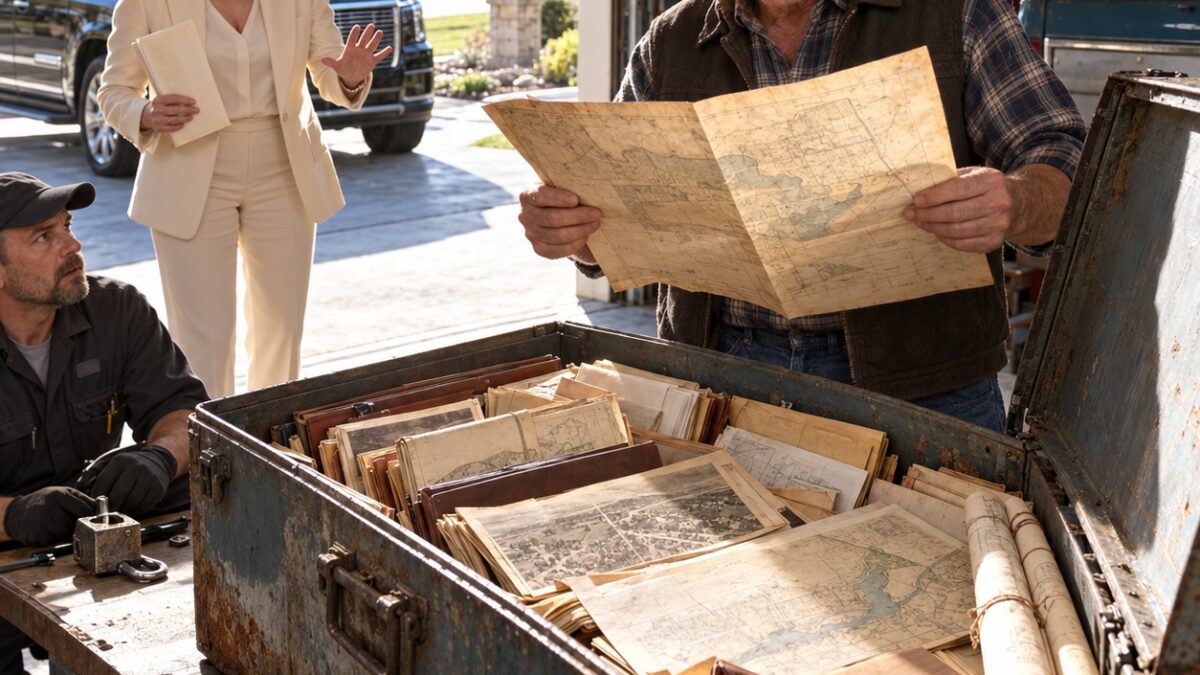
A metal case.
Rolled maps.
Three waterproof document tubes.
Brass key.
Small black notebook.
Nothing dramatic.
No cash.
No hidden gold.
No weapons.
Paper.
The kind of thing Patricia had originally said was worthless.
Daniel opened the notebook.
Maintenance records.
Valve pressures.
Inspection dates.
Water levels.
March 3, 1990.
A county engineer wrote:
Unit 17 remains functional. Do not connect to new development without landowner authorization.
Daniel tapped the page.
“That is important.”
Next page:
Commercial expansion must not use Mercer Corridor without new recorded agreement.
I sat down.
“That’s what North Ridge wants.”
“Yes.”
“And the HOA signed something with them?”
“I’m almost sure.”
The notebook continued through 1994.
Then a final 1996 notation.
HOA storage transfer approved. Unit 17 documents retained inside container pending final landowner acknowledgement.
Daniel stopped.
“There.”
“What?”
“The HOA knew this was not theirs.”
I picked up the brass key.
“What does that open?”
“Probably the underground vault.”
We turned to the maps.
Original MRC corridor.
Engineering diagram.
Control facility.
Then the third map.
Newer paper.
Much newer.
Someone had drawn a connection line from the existing corridor directly toward North Ridge’s newest expansion.
Written beside it:
Phase Four Capacity Connection.
My stomach tightened.
“Two years.”
Daniel nodded.
“They’ve been planning around this infrastructure for at least two years.”
Suddenly every offer made sense.
Patricia did not want her trash back.
Thomas did not care about a rusty steel box.
They wanted the documents because the documents proved the HOA’s representations about the corridor were probably false.
North Ridge needed water.
The old system might provide it.
The land belonged to me.
There was the problem.
We contacted the county engineer.
Harold Benson came two days later.
Thirty-plus years with the county.
Gray hair.
Practical face.
The moment he saw the container, recognition appeared.
“MRC 17.”
“You know it?”
“I inspected it once.”
“When?”
“1991.”
“What’s underground?”
“Control chamber. Roughly twenty by thirty feet.”
“Still there?”
“As far as county records indicate.”
“Connected?”
“To the regional line, yes.”
Daniel asked:
“Could it be activated for new development?”
Harold hesitated.
“With engineering work.”
“How much water?”
“Potentially enough reserve capacity to support several hundred homes under emergency conditions.”
Ethan looked at me.
“Phase Four.”
Exactly.
I asked:
“What would a new system cost?”
“Several million.”
Then we all understood.
North Ridge’s interest was not philosophical.
It was mathematical.
The MRC infrastructure already existed.
If North Ridge could legally connect into it, they might save millions in new water-system construction.
But the HOA had apparently granted something it did not own.
Daniel obtained the agreement.
It was worse than expected.
Permanent access.
Expansion rights.
Permission to connect new infrastructure.
All granted by Cedarbrook HOA to North Ridge Communities.
Across property the HOA did not own.
“Who signs away somebody else’s land?” Ethan asked.
“Someone who assumes nobody will check.”
Daniel wanted confrontation.
I did not.
“Not yet.”
“What else do you need?”
“The reason my father hid the note.”
We opened the third waterproof tube.
There it was.
September 1994.
Letter from my father to the county.
He agreed to preserve the emergency-water corridor.
He did not consent to converting private Mercer land into a permanent commercial utility route.
Then one sentence:
If surrounding subdivision development expands beyond the original plan, all future access and capacity rights must be renegotiated directly with the property owner.
I read it twice.
Daniel sat opposite me.
“This is the whole case.”
My father had not tried to sabotage development.
He had not refused emergency infrastructure.
He had simply established a basic rule.
If somebody wants to use private property commercially later—
Ask.
Negotiate.
Pay fairly.
Record it.
Hardly radical.
Unless your entire business plan depends on pretending the owner’s consent is unnecessary.
The following Monday Patricia sent me a formal HOA notice.
I opened it at the kitchen counter.
OBSTRUCTION OF COMMUNITY INFRASTRUCTURE
I laughed loud enough for Ethan to hear from the hallway.
“What?”
I handed him the notice.
The HOA demanded immediate access to the Mercer corridor.
Claimed historical contractual rights.
Stated my refusal was interfering with community infrastructure.
Daniel read it later.
Then smiled.
“They just helped us.”
“How?”
“They put the claim in writing.”
The difference between a threat made verbally and a claim printed on letterhead is often evidence.
Daniel prepared our response.
Attached:
1988 agreement.
1994 letter.
1996 transfer record.
County inventory.
2024 map.
HOA–North Ridge agreement.
Then he sent it to the county.
The next day, the county froze any new connection work involving MRC Unit 17.
Thomas Bell called.
His voice was controlled.
“Frank, this is becoming a major problem.”
“No. The major problem happened when North Ridge paid for access from an association that didn’t own the access.”
“We relied on their representations.”
“I understand.”
“We have significant engineering expenditures tied to this.”
“Talk to Patricia.”
“We need the corridor.”
“Then negotiate with the owner.”
Long silence.
Then:
“How much?”
That was the first honest question anyone had asked since the auction.
“I haven’t decided.”
The following week Cedarbrook called an emergency HOA meeting.
Patricia expected to control it.
She did not.
Margaret, the association treasurer, had requested an independent financial review of the North Ridge agreement.
That review created an entirely new problem.
North Ridge had paid Cedarbrook HOA $420,000.
For access rights.
Infrastructure coordination.
Expansion agreements.
Some portion might have been legitimate compensation for whatever rights the HOA actually possessed elsewhere.
Then Margaret found $96,000 transferred from HOA funds to Cedar Advisory Group.
A consulting company.
Owned by Patricia’s brother.
Another payment:
$42,000.
Another:
$31,500.
Over eighteen months:
$169,500.
No detailed service documentation.
No board vote authorizing the relationship.
Payment descriptions said:
Infrastructure rights coordination.
I looked at Daniel.
“This keeps getting worse.”
“For Patricia.”
“Good distinction.”
The evening before the emergency meeting, Patricia came to my gate.
Alone.
No developer.
No attorney.
No board.
I stayed on my side.
“What do you want?”
“Settle this.”
“How?”
“You return the container.”
“No.”
“I’ll pay.”
“No.”
“Two hundred thousand dollars.”
That gave me pause.
Not because I planned to accept.
Because Patricia had gone from four dollars to two hundred thousand dollars for the same supposedly obsolete documents.
“Frank, please.”
First time she had ever used that word with me.
“Why?”
She looked toward the workshop.
“If those documents become public, the entire project may collapse.”
Finally.
Truth.
Not all of it.
Enough.
“So that’s the problem.”
“The community needs water capacity.”
“Then negotiate honestly.”
“You don’t understand what happens if Phase Four stops.”
“You’re right.”
I leaned against the gate.
“I don’t fully understand North Ridge’s internal finances.”
Her eyes narrowed.
“But I do understand that you signed an agreement granting rights you didn’t own.”
“Hundreds of homeowners could suffer because of this.”
“No.”
My voice stayed calm.
“You do not get to transfer responsibility to me because your unauthorized agreement has consequences.”
“I was trying to protect Cedarbrook.”
“By hiding documents from the landowner?”
“I did not hide anything.”
“Then why did you tell me the container was scrap?”
She looked away.
That was answer enough.
“You’re making a mistake,” she said.
I looked back toward Unit 17.
“No.”
Then at her.
“The mistake was selling it to me for four dollars.”
I closed the workshop door.
The emergency meeting began Thursday at seven.
By 6:45 the parking lot was full.
Groups of homeowners stood outside.
Some had seen financial records.
Others had heard rumors about underground water infrastructure.
Some wanted Phase Four to continue.
Some wanted Patricia removed.
Most wanted one simple answer.
Why had their HOA president signed a multimillion-dollar developer agreement using property rights the HOA apparently did not own?
I arrived with Daniel and Ethan.
We did not bring the container.
No need.
Everything had been copied.
Photographed.
Certified.
The evidence no longer depended on one rusting steel box surviving the night.
Patricia sat at the front table.
For once, she did not look perfectly composed.
HOA attorney beside her.
Margaret with a financial binder.
Thomas Bell sat in the back.
The microphone clicked.
The board chair opened.
“This emergency meeting concerns Mercer Reserve Corridor Unit 17 and the infrastructure agreement with North Ridge Communities.”
Patricia interrupted.
“The board is acting on incomplete information.”
Margaret turned.
“No.”
Her voice was calm.
“We’re acting on documents.”
The room quieted.
Daniel stood.
He did not give a dramatic speech.
Lawyers who have good documents rarely need one.
“Let’s begin with the original agreement.”
Certified copy.
He explained:
Temporary construction and maintenance rights.
Underlying land ownership retained by Mercer family.
Future expansion requiring new agreement.
Document placed on table.
Next:
1994 letter from my father.
Future capacity rights renegotiated directly with owner.
Next:
1996 inventory.
Container transferred temporarily.
Return to landowner after closeout.
Next:
2024 North Ridge map.
Phase Four connection.
Then:
Current HOA–North Ridge agreement.
Permanent access.
Expansion rights.
Connection rights.
One by one.
Same conclusion.
Cedarbrook never acquired ownership of the Mercer corridor.
Never acquired permanent expansion rights.
Never received authority to sell those rights to North Ridge.
Patricia finally spoke.
“The original agreements are obsolete.”
Daniel turned.
“Then why does your 2024 agreement cite them as the source of your authority?”
No answer.
He continued.
“The North Ridge agreement states that Cedarbrook HOA possesses historical control over the Mercer Reserve Corridor.”
Thomas Bell stood.
“We relied on that representation.”
Patricia turned toward him.
“Thomas—”
He shook his head.
“We asked for proof of the corridor rights.”
“We provided records.”
“You provided records showing historical use.”
His voice sharpened.
“Not ownership.”
Whispers filled the room.
“Our company has spent months designing Phase Four around access we may not legally possess.”
Margaret opened her binder.
“And North Ridge paid Cedarbrook $420,000 for that access.”
Thomas nodded.
“Yes.”
Margaret looked at Patricia.
“Where did the money go?”
“Infrastructure planning.”
Margaret turned a page.
“Then explain Cedar Advisory Group.”
Patricia went still.
“One hundred sixty-nine thousand five hundred dollars over eighteen months.”
A homeowner near the front whispered:
“What?”
Margaret continued.
“Cedar Advisory Group is owned by Patricia Holloway’s brother.”
Now the room erupted.
Patricia raised her voice.
“Those were legitimate consulting services.”
“Then where is the work product?”
“We have invoices.”
Margaret held one up.
“No. We have payment requests.”
The HOA attorney took the document.
Read.
His face changed.
“Patricia, do we have supporting service documentation?”
Silence.
Margaret:
“And when did the board vote to approve hiring a company owned by your brother?”
Nothing.
Someone shouted:
“Who approved it?”
Margaret looked directly at Patricia.
“She did.”
Noise exploded.
Arguments.
Homeowners talking over one another.
Board chair striking the microphone.
Patricia trying to speak.
I remained seated.
People expected me to be furious.
I was.
But anger was no longer necessary.
Documents were stronger.
Eventually order returned.
Daniel took out one final page.
My father’s note.
Seven words.
Do not give this to the HOA.
The room became quieter than it had been all night.
Daniel explained where it had been found.
Then described what Unit 17 contained.
Emergency-water plans.
Maintenance logs.
1990 warning against connecting commercial development without authorization.
My father’s 1994 restriction.
1996 custody note.
Patricia stared at the paper.
“You should not have that.”
I finally spoke.
“You sold it to me.”
Her eyes moved to mine.
“For four dollars.”
“Yes.”
“That container was never supposed to be auctioned.”
“Then why was it?”
She looked toward the board chair.
No answer.
The HOA attorney leaned forward.
“Patricia, did you authorize the storage cleanup?”
“Yes.”
“Did you know Unit 17 was among the stored material?”
Pause.
“I knew the container was there.”
“Did you know it contained these records?”
Longer pause.
Every person in the room waited.
Finally:
“Yes.”
That was the moment.
Not the money.
Not the maps.
That admission.
The board chair stared.
“When did you know?”
“Years ago.”
The room erupted again.
Margaret raised her voice over the noise.
“If you knew those records existed, why did you represent the Mercer corridor to North Ridge as HOA-controlled property?”
Patricia answered so quietly I almost missed it.
“Because the development needed the capacity.”
Thomas Bell stood.
“You told us the rights were secured.”
“I believed they were.”
“You just admitted you knew these documents existed.”
Patricia did not respond.
Thomas sat.
He looked less angry than horrified.
There is a special kind of anger when somebody lies to you.
There is another kind when you realize you paid $420,000 to rely on that lie.
The board attorney requested a recess.
Thirty minutes.
Homeowners flooded the hallway.
Some approached me.
Questions.
How much is the water system worth?
Did I plan to shut off existing homes?
Could the county take the land?
Was Phase Four dead?
I answered carefully.
“I don’t know.”
“You own the corridor?”
“The underlying property, yes.”
“Can you block everything?”
“Rights still need legal review.”
“What do you want?”
That question stopped me.
I had not fully decided.
My father had not tried to block emergency water.
He protected consent.
That was different.
I repeated the same thought.
“If someone wants to use my property, they can negotiate with me.”
One homeowner nodded.
“That seems fair.”
Exactly.
It should never have required a hidden steel box to become obvious.
The board returned.
Three motions.
First:
Patricia’s signing authority immediately suspended.
Passed.
She voted no.
Nobody joined her.
Second:
All HOA agreements involving Mercer property frozen pending independent legal review.
Passed.
Patricia voted no.
Alone.
Third:
Full financial audit of North Ridge payments and Cedar Advisory contracts.
Passed.
Again.
Patricia alone.
For a woman accustomed to controlling board votes, three unanimous rejections felt louder than shouting.
She sat very straight.
Face unreadable.
The meeting ended.
I left without speaking to her.
The most important problem remained.
North Ridge still needed water capacity.
If MRC could support their expansion legally, they could save millions.
If not, Phase Four faced a major infrastructure redesign.
The next morning, Thomas Bell arrived at my workshop.
No attorney.
No SUV full of people.
Just him and a folder.
“We’d like to negotiate.”
“Directly?”
“Yes.”
“With the landowner?”
His mouth tightened slightly.
“Yes.”
“Progress.”
I opened the proposal.
Twenty-year infrastructure license.
$1.2 million.
Annual payments.
Defined corridor.
Environmental protections.
Restoration obligations.
Emergency-access provisions.
Insurance.
Maintenance responsibilities.
Explicit acknowledgment that I retained ownership of the underlying land.
I read slowly.
Thomas waited.
“This gives the HOA no independent right.”
“Correct.”
“They cannot modify it.”
“Correct.”
“North Ridge cannot transfer it without my written consent.”
“Correct.”
“Any future expansion outside this footprint requires another agreement.”
“Yes.”
I looked at him.
“You could have done this months ago.”
He sighed.
“I relied on what we were told.”
“That is your issue with Patricia.”
“I know.”
I thought about my father.
His note.
His 1994 letter.
People might interpret the situation as him opposing development.
He had not.
He opposed being treated as if his ownership disappeared when somebody else wanted something.
I understood that.
I signed.
But only after adding one condition.
Cedarbrook HOA had to formally acknowledge in writing that it possessed no ownership interest or permanent expansion right over the Mercer Reserve Corridor.
Thomas agreed.
The HOA agreed.
County recorded everything.
For the first time in decades, paper and reality matched.
My land.
Emergency infrastructure preserved.
North Ridge received limited negotiated access.
HOA received exactly what written agreements granted.
Nothing more.
That “nothing more” mattered.
People like Patricia often built power from assumptions between documents.
The new agreement removed assumptions.
The financial audit continued.
Months.
Independent accountants.
Bank records.
Payment approvals.
Cedar Advisory Group received $169,500 without proper board authorization.
The board demanded repayment.
Patricia’s brother’s company returned a portion.
The rest remained under legal review.
Again, I will not invent a dramatic criminal ending the source does not provide.
No fabricated arrest.
No prison sentence.
The real consequences were enough.
Patricia resigned as HOA president.
The board adopted new rules requiring independent title verification before representing property rights to developers or contractors.
A basic concept.
Verify ownership before selling somebody’s access.
Apparently civilization needed policy for that.
Unit 17 stayed with me.
I cleaned the container.
Removed rust.
Repaired one damaged hinge.
I considered repainting it.
Didn’t.
The faded letters remained.
MRC 17
History should look like history sometimes.
Ethan visited one afternoon and pointed at the container.
“Four dollars.”
“Yes.”
“One point two million.”
“That is not what happened.”
He smiled.
“That is exactly what happened.”
“No.”
I put down a wrench.
“I did not turn four dollars into $1.2 million.”
“You bought evidence for four dollars and negotiated a $1.2 million license because of it.”
“Different.”
“Not very.”
“It is to me.”
The money mattered.
Of course.
A twenty-year license with annual protections changed the economics of the land.
But it was never the point.
If North Ridge had offered two million dollars for ownership of the corridor, I might still have refused.
Because my father’s entire warning had been about ownership.
Do not give this to the HOA.
Not:
Never cooperate.
Not:
Stop all development.
Not:
Destroy the water system.
Do not give control away.
That was the lesson.
The difference between cooperation and surrender is consent.
Patricia never understood that.
Thomas eventually did.
Or at least his lawyers did.
A few months after everything settled, I was cleaning the workshop.
I found the original auction receipt beneath a stack of invoices.
Handwritten.
Cheap paper.
Lot 31. Steel storage container. $4.
I stared at it.
Then pinned it above my workbench.
Ethan saw it later.
“You’re keeping that?”
“Absolutely.”
“Why?”
I looked at Unit 17.
“Because it marks the moment they made the mistake.”
“What mistake?”
I held up the receipt.
“They gave me the evidence.”
That was the entire story in one sentence.
The HOA had not been defeated because I outsmarted them with some secret loophole.
They defeated themselves by treating old property records as something they could control indefinitely.
For decades, assumptions accumulated.
The HOA controls the corridor.
Nobody will check.
The old Mercer agreement is obsolete.
The developer can rely on us.
The container is forgotten.
The landowner does not remember.
The county will not care.
Each assumption depended on the previous one.
Then Patricia authorized a storage cleanup.
Four dollars.
Receipt.
Legal sale.
The chain broke.
I think often about how casually it happened.
No midnight raid.
No whistleblower.
No hacker.
No investigative reporter.
An HOA garage sale.
That almost makes it worse.
Thirty years of buried documents resurfaced because somebody wanted more space in a storage building.
Patricia knew Unit 17 existed.
That admission at the emergency meeting made one thing clear.
She had spent years hoping its existence would remain irrelevant.
Maybe she thought no one would ever open it.
Maybe she believed the agreements were too old to matter.
Maybe she assumed the HOA’s repeated use had become authority through habit.
Property law does not work that way.
Possession of documents is not ownership of land.
Longstanding assumption is not title.
A developer’s need does not become an easement because the project is expensive.
And selling somebody else’s rights does not make them yours.
Those distinctions feel obvious when written plainly.
They become less obvious when large projects grow around them.
North Ridge had spent months and money planning Phase Four.
Engineers created designs.
The HOA signed contracts.
Payments moved.
Board discussions occurred.
At some point, the size of the project began functioning psychologically like proof.
Surely all this planning cannot be based on rights we do not possess.
It was.
That happens more often than people think.
Big systems do not become accurate simply because many professionals participate.
If the first assumption is wrong, expensive work can grow on top of it.
That is why my father preserved the documents.
He knew memory fades.
Personnel changes.
HOA presidents change.
Developers change.
County employees retire.
Paper remains.
His 1994 letter was not emotional.
It was precise.
Future access.
Future capacity.
Renegotiate with owner.
He understood something I only appreciated after all this.
Never rely on somebody remembering what you agreed to.
Record it.
Then keep the record somewhere safer than an HOA storage shed if possible.
That part had not gone according to plan.
I wondered for months how the container ended up staying with Cedarbrook after the 1996 transfer.
Administrative laziness?
Convenience?
Intentional retention?
The source documents only establish that it was supposed to return to the landowner and did not.
I refuse to invent beyond that.
The truth is strong enough.
What mattered was what happened once it resurfaced.
The board changed.
Financial controls tightened.
Property verification became policy.
Patricia resigned.
North Ridge negotiated properly.
That was a healthier ending than destroying Phase Four out of spite.
Some homeowners expected me to block the project.
A man approached me at the clubhouse after the meeting.
“You could stop all of it.”
“Maybe.”
“Are you going to?”
“Why?”
He looked surprised.
“After what they did?”
“North Ridge needs access.”
“Exactly.”
“I own access.”
“So make them suffer.”
That sentence bothered me.
I had every right to demand fair terms.
Environmental protections.
Restoration.
Money.
Control.
But punishment for the sake of punishment would have turned ownership into revenge.
My father had not protected the corridor so his descendants could become Patricia from the other side.
He protected the right to choose.
I chose negotiation.
That choice produced $1.2 million over a defined twenty-year license because the infrastructure had genuine value.
Not because I wanted to extort people.
The figure reflected what North Ridge could save and what limited use of private property was worth.
Thomas’s proposal was serious.
The agreement contained limits.
That made it acceptable.
If they had approached me that way from the beginning, the entire scandal could have been avoided.
Imagine.
Thomas Bell knocks.
“Frank, we found an old water corridor under your land. We may need it for Phase Four. Here are the records. Here is what we propose. Here is what we will pay.”
I might have said yes.
No hidden container.
No emergency meeting.
No audit.
No resignation.
No $169,500 consulting problem exposed.
But honesty requires giving the other person the possibility of saying no.
That was what Patricia could not tolerate.
If she asked, I could refuse.
If she claimed authority, my refusal became irrelevant.
So she chose authority she did not have.
That decision infected everything after.
The North Ridge payment became especially ugly because homeowners eventually understood what had happened.
$420,000 entered the association.
Ordinary members assumed their leadership had negotiated something valuable.
In reality, the HOA had sold rights it could not legally convey.
Then nearly $170,000 flowed toward a company owned by the president’s brother without proper board approval.
That is the kind of fact that destroys trust faster than any legal memorandum.
At the emergency meeting, people were angry about Unit 17.
The payment records made it personal.
HOA dues are homeowner money.
Association assets belong collectively within the governing structure.
When a president treats that system like family business, everyone becomes financially implicated.
Margaret understood.
She became one of the quiet heroes of the story.
Treasurers rarely get dramatic scenes.
They get spreadsheets.
Spreadsheets can be devastating.
She saw $96,000.
Then $42,000.
Then $31,500.
Asked:
What work?
Where are the invoices?
Who approved this?
Simple questions.
Patricia had no simple answers.
That is how accountability usually works.
Not one giant accusation.
Small questions repeated until someone cannot hide behind general language.
“Infrastructure planning.”
Fine.
Which infrastructure?
What deliverables?
Which consultant?
Why related party?
Where board authorization?
Where service documentation?
Words collapse when details arrive.
Daniel did the same with property rights.
Historical authority?
Show the deed.
Permanent access?
Show the recorded easement.
Expansion rights?
Show the agreement.
Not there.
Then you do not have them.
People often overcomplicate disputes because complication benefits whoever is bluffing.
Reduce it.
Who owns the land?
What rights were granted?
To whom?
For what duration?
For what purpose?
Everything else follows.
The MRC history was fascinating technically.
Emergency water.
Control valves.
Pressure management.
Regional connection.
An underground chamber sitting beneath land I had walked over countless times.
That part humbled me.
You can own property and still not know everything beneath your boots.
Old infrastructure survives memory.
Pipes.
Cables.
Drainage structures.
Easements.
Abandoned roads.
Legal relationships.
Land has layers.
My father knew more than he told me.
Maybe he assumed I would find the documents eventually.
Maybe not.
The seven-word note felt intentional.
Do not give this to the HOA.
He did not write:
Frank, here is a detailed explanation of a future subdivision dispute.
Typical Dad.
Minimum language.
Maximum inconvenience.
Ethan found that funny.
“You inherited his communication style.”
“I talk more.”
“Unfortunately.”
Children become disrespectful after thirty-five.
No HOA can regulate that.
I kept the brass key.
We never needed a dramatic trip underground for the story to work.
County engineers confirmed the facility.
The records established the rights.
No hidden treasure chamber required.
That is another place I could embellish.
I won’t.
Reality was paperwork.
Valves.
Engineering drawings.
Legal agreements.
That sounds boring until somebody offers you $200,000 to hand it over.
Then boring becomes interesting.
Thomas Bell changed during the story too.
His first visit annoyed me.
He arrived with the confidence of somebody expecting a transaction.
Four dollars.
Expenses.
Fifty thousand.
One hundred thousand.
Then that warning:
Old property rights aren’t as simple as they look.
Technically true.
Just aimed in the wrong direction.
Later he became more practical.
Once his company saw Patricia’s representations could not survive review, Thomas stopped pretending the HOA’s authority was enough.
He negotiated.
That is why I never treated him as identical to Patricia.
North Ridge made mistakes.
They relied on bad representations.
They should have verified title independently before paying $420,000.
That was on them.
But when the truth surfaced, Thomas eventually dealt directly with the owner.
That mattered.
People should get credit for changing behavior when facts change.
Patricia instead tried to buy silence.
Fifty thousand.
Two hundred thousand.
Give the container back.
Stop digging.
Protect the community.
Those phrases tell you where someone’s priorities are.
If she genuinely believed the HOA owned the rights, she would have welcomed review.
Produce title.
Produce recorded easement.
Done.
Her fear of the documents revealed more than any accusation.
People who possess valid rights rarely offer six figures to make historical records disappear.
I remember standing at the gate during her final private visit.
She looked exhausted.
For the first time, not polished.
That almost made me feel sorry for her.
Then she said hundreds of homeowners could suffer because of me.
That ended the sympathy.
Responsibility shifting again.
I did not sign the North Ridge agreement.
I did not route money to my brother.
I did not hide Unit 17.
I did not sell nonexistent access rights.
The first step toward solving a problem is putting responsibility back where it belongs.
Her decisions caused the crisis.
My refusal to conceal those decisions did not.
That distinction is important beyond HOAs.
Organizations often label transparency disruptive when secrecy created the instability.
Do not ask questions.
Think of the community.
Think of jobs.
Think of property values.
Think of schedules.
All valid interests.
None justify pretending ownership belongs somewhere it does not.
In the end, transparency did not destroy Cedarbrook.
The community survived.
Phase Four found a legal route.
North Ridge got capacity.
The HOA got better policies.
Homeowners learned what happened.
The only person who truly lost authority was the one who had abused it.
That is a good outcome.
Not painless.
Better.
A few residents were angry about the $1.2 million license.
One asked why the HOA had to “pay me” for something underground.
“They aren’t.”
“What?”
“North Ridge is licensing access.”
“But it benefits the neighborhood.”
“Yes.”
“So why should one owner make money?”
I asked:
“Do you let the HOA use your backyard without permission because a project benefits other residents?”
“That’s different.”
“How?”
He did not answer.
Utility infrastructure creates strange entitlement.
If something serves many people, individuals sometimes assume private ownership becomes selfish.
But public benefit does not automatically erase compensation.
Easements exist for that reason.
Condemnation law exists for that reason.
Negotiated licenses exist for that reason.
Society needs infrastructure.
Property owners still possess rights.
Both can be true.
My father understood.
The final agreement proved cooperation and ownership were compatible.
That became the part I was proudest of.
Not the money.
Not Patricia’s resignation.
A legal status that matched reality.
The county retained legitimate emergency interests.
North Ridge received limited commercial access.
I retained title.
The HOA acknowledged its limits.
Everyone knew the rules.
That is peace in property law.
Not absence of shared use.
Clarity.
The old corridor had lacked clarity for decades.
Unit 17 restored it.
I sometimes wondered what would have happened if another buyer had gotten the container.
Someone uninterested.
Scrap dealer.
Maybe the box gets cut apart.
Documents thrown out.
Maps burned.
The 2024 project moves forward under false assumptions.
North Ridge connects.
Then years later, somebody discovers the title problem after millions more are invested.
Litigation would have been catastrophic.
In that sense, Patricia’s four-dollar mistake may have saved Cedarbrook from a much larger future disaster.
I doubt she sees it that way.
I do.
The best time to discover a bad assumption is before construction.
Second best is now.
The container arrived just in time.
North Ridge had spent engineering money but had not completed the connection.
The county hold froze things before the situation became physically harder to reverse.
That timing mattered.
A paper problem remained mostly a paper problem.
Those are cheaper.
Ask any engineer.
Ethan enjoyed reminding me that his environmental-construction background had spotted the double steel before I did.
“You thought it was a toolbox.”
“I knew it was suspicious.”
“You paid four dollars because you like junk.”
“I invested strategically.”
“You had no idea.”
“History will remember my version.”
He laughed.
I hope history remembers his.
He found the note.
Without that seven-word warning, we still would have uncovered the records.
But the note turned curiosity into urgency.
My father had known the HOA should not control the information.
He had understood future risk before Cedarbrook’s present leadership ever existed.
That gave us direction.
Daniel deserves equal blame for everything becoming complicated.
A normal attorney might have told me to return the container and avoid trouble.
Daniel saw 1988 stamped on metal and immediately started pulling county records.
He was exactly the lawyer the situation needed.
Property disputes reward stubborn researchers.
“What if Patricia sues over the container?” I once asked.
“For what?”
“Mistaken auction.”
“She sold it.”
“She says mistake.”
“That does not automatically unwind a completed sale, especially after you received a written receipt and relied on it.”
“Four dollars.”
“Best receipt you ever kept.”
True.
The receipt became a joke.
Also evidence.
Ownership of the container itself was not the same as ownership of every underlying public record, of course.
But the HOA’s attempt to reclaim it could not erase my legal access to copies, county archives, or my family’s property agreements once discovered.
That was another reason Daniel copied and certified everything before the emergency meeting.
Never let the whole case depend on one physical object.
If Unit 17 disappeared in a fire, the evidence remained.
Good practice.
Property people become paranoid for reasons.
Patricia’s resignation did not restore homeowner trust immediately.
That takes longer.
The board’s new title-verification policy was a start.
Independent review before claiming rights.
Related-party transactions subject to oversight.
Again, I will not invent specific reforms beyond the source.
But the central correction mattered.
No president could simply tell a developer:
We control that.
Show proof first.
That should have existed already.
Sometimes institutions write policies after discovering a human being was the loophole.
Patricia had treated informal historical custody as ownership.
That is dangerous.
The HOA stored the container.
Therefore the HOA controls the corridor.
Wrong.
The HOA referenced old agreements.
Therefore those agreements grant current expansion rights.
Wrong.
The subdivision surrounds portions of the route.
Therefore the association speaks for the route.
Wrong.
Proximity is not title.
Possession of paperwork is not title.
Administrative habit is not title.
I sound repetitive because property law often is repetitive.
People keep trying to replace documents with assumptions.
Documents keep winning.
Months after the settlement, I walked the length of the MRC corridor with Ethan and Harold Benson.
Not because we were planning work immediately.
I wanted to understand what lay beneath us.
Harold showed us approximate chamber locations.
Valve alignments.
Old access points.
The landscape gave almost nothing away.
Grass.
Trees.
A slight depression here.
Older utility marker there.
Underneath:
Infrastructure capable of supporting emergency water for hundreds of homes.
Hidden systems fascinated Ethan.
He asked Harold technical questions.
Pressure.
Condition.
Materials.
Possible rehabilitation.
I mostly listened.
Then I thought about the political layer sitting above the physical one.
A pipeline can survive thirty years.
So can an agreement.
People forget both.
Neither necessarily stops existing.
That became my favorite lesson from the entire mess.
Neglect is not deletion.
A forgotten right can still be a right.
A forgotten obligation can still be an obligation.
A forgotten document can still decide millions of dollars.
Sometimes the thing everyone ignores is exactly what still has power.
Unit 17 embodied that.
After I cleaned the steel casing, the letters became clearer.
MRC 17.
The number looked almost proud.
Ethan wanted to restore the original blue paint.
I said no.
“Why?”
“I like the rust.”
“You spent three hours removing rust.”
“I like some rust.”
“That makes no sense.”
“I’m sixty-eight.”
“That also doesn’t make sense.”
Children.
The container remained in my workshop.
Not because I needed the physical records anymore.
Those lived in secure files.
I kept it because objects hold context.
A digital scan cannot show the weight.
The industrial lock.
The hidden note.
The layers of paint.
The absurdity of Patricia standing beside it at an auction calling it scrap.
Sometimes I would look at the faded steel and hear:
“Don’t waste your money on that.”
Best financial advice she ever gave me.
I ignored it.
One afternoon Margaret stopped by.
She brought a copy of the final audit summary.
I already knew the essential numbers.
Still, seeing them formally compiled changed the feeling.
$169,500.
Related-party company.
Inadequate authorization.
Repayment demand.
“Did you ever suspect?” I asked.
She shook her head.
“I trusted her.”
“Most people did.”
“That’s not an excuse.”
“No.”
Margaret looked at the container.
“She knew what was in there.”
“Yes.”
“Why auction it?”
I smiled slightly.
“Probably because even controlling people make clerical mistakes.”
Margaret laughed.
“Four dollars.”
“Four.”
“She must wake up thinking about that.”
“Hopefully she has healthier hobbies now.”
Margaret became serious.
“Do you hate her?”
I thought about it.
“No.”
That answer surprised both of us.
“Angry?”
“Yes.”
“Still?”
“Some.”
“But hate?”
I shook my head.
Hate takes maintenance.
Medication schedule for resentment.
Daily feeding.
I had better uses for time.
Patricia lost the presidency.
The board investigated.
Her family consulting arrangement was exposed.
The property issue was fixed.
I had what I needed.
Closure becomes easier when the practical danger is gone.
I did not need her miserable forever.
I needed her unable to sign away my land.
Done.
Thomas and I eventually developed a functional relationship.
Not friendship.
Professional.
When engineers needed corridor access under the new license, North Ridge followed procedure.
Notice.
Schedule.
Insurance.
Defined work.
Restoration.
The first request felt strange.
Email.
Formal.
Respectful.
I replied yes.
Ethan laughed.
“Look at you cooperating with evil development.”
“They asked.”
“That’s all it took?”
“That was always all it took.”
Not literally all.
Fair compensation helped.
But yes.
Consent changed everything.
The workers entered.
Did their inspection.
Left.
Restored the area.
No drama.
That ordinary transaction proved how unnecessary the original deception had been.
Patricia had created a crisis because she viewed asking the property owner as weakness.
But negotiation is often faster than fraud once you count lawyers.
North Ridge learned that the expensive way.
Cedarbrook learned it through an audit.
I learned it through four dollars.
The first annual license payment arrived months later.
Ethan called.
“Did you frame that too?”
“No.”
“You should.”
“I framed the four-dollar receipt.”
“Which is objectively stranger.”
“Exactly.”
I kept living exactly as before.
That is another thing people misunderstand when they hear “$1.2 million agreement.”
They imagine transformation.
New house.
New cars.
I was sixty-eight.
I liked my workshop.
My property.
My routines.
Money gave options and compensated use.
It did not change what mattered.
My father’s warning did.
Not financially.
Emotionally.
I had spent years thinking he was overly suspicious of HOAs and developers.
He came from a different generation.
Private land.
County agreements.
Handwritten notes.
I assumed some of his caution was stubbornness.
After Unit 17, I understood.
He had watched temporary rights become assumptions in real time.
He knew once future people forgot the original limits, someone would eventually say:
We’ve always controlled this.
So he preserved the boundary.
It took thirty years for the warning to become necessary.
Still worked.
I wish I could have called him.
“You were right.”
He would probably answer:
“About what?”
Then pretend not to care.
Mercer men are exhausting.
Daniel once asked if I thought my father hid the note because he expected the container to remain with the HOA.
“I don’t know.”
“Could be.”
“Maybe.”
“Why not put the records somewhere else?”
“Maybe he thought they were safer in a locked industrial container.”
Daniel looked around the workshop.
“Apparently not.”
“They survived.”
“Fair.”
Again, source records do not tell us exactly what he expected.
I leave that uncertainty intact.
We know he wrote the warning.
We know the rights he preserved.
That is enough.
The most powerful evidence rarely needs a fictional backstory.
My father’s seven words worked because they were simple.
Do not give this to the HOA.
Patricia’s entire strategy proved why.
The HOA board eventually sent formal acknowledgment.
No ownership interest.
No permanent access rights beyond expressly recorded agreements.
I read it at the same workbench where Daniel first saw the 1988 plate.
That was satisfying.
Thirty years of ambiguity reduced to clear language.
I signed the North Ridge license.
County recorded it.
Everyone knew exactly who owned what.
No more historical fog.
That was the real seven-figure victory.
Clarity.
Money gets attention.
Clarity prevents the next war.
The Phase Four plans could proceed within the negotiated framework.
Existing emergency infrastructure remained protected.
Environmental conditions applied.
Future expansions required new consent.
Balance.
My father would have approved.
At least I think so.
He was not anti-development.
He was anti-being-taken-advantage-of.
There is a difference people conveniently ignore.
When somebody resists an unfair deal, powerful institutions often label them obstructionist.
It sounds more respectable than:
This owner will not give us what we want.
Patricia’s notice accused me of obstructing community infrastructure.
That phrasing almost worked emotionally.
Who wants to be the man blocking water?
But the water system was not hers.
The corridor was not hers.
And there was already a lawful solution.
Ask.
Negotiate.
The word “obstruction” was designed to make my consent look selfish.
It failed once the documents surfaced.
Language is part of property fights.
Watch it.
Necessary.
Urgent.
Community.
Historical.
Customary.
Everyone knows.
Always been this way.
Those phrases can describe legitimate rights.
They can also hide the absence of them.
Ask for the recorded document.
Daniel said that constantly.
“Show me paper.”
Not because paper is morally superior.
Because recorded rights survive personalities.
The one piece of paper Patricia probably wished had never existed was my auction receipt.
Four dollars.
I would sometimes tap it before starting work.
Good luck charm.
Ethan called it obnoxious.
He was correct.
A little obnoxiousness is healthy after an HOA scandal.
The story spread around Cedarbrook.
Naturally, details changed.
Someone said the container contained a deed giving me half the neighborhood.
False.
Someone said I discovered a secret reservoir worth ten million.
False.
Someone said Patricia knowingly sold me evidence as part of a whistleblower plan.
Absolutely false.
She wanted that box gone because she thought it did not matter or would remain closed.
Somebody even said my father had hidden cash inside.
I wish.
The real contents were more valuable than cash only because circumstances made them valuable.
Agreements.
Maps.
Engineering records.
Control key.
Notebook.
Evidence of rights.
That is less glamorous.
More consequential.
I corrected people when it mattered.
Not every rumor.
I was retired.
I had limits.
The clean version:
The HOA sold me a container.
Inside were historical records showing it lacked rights it had represented to a developer.
Financial review uncovered questionable related-party payments.
The parties corrected the property agreements.
Patricia resigned.
Simple.
Nobody believed the simple version because truth apparently needs explosions now.
Unit 17 had none.
Just a locksmith at 4:42 p.m.
Click.
Door.
Paper.
Sometimes history turns on a quiet mechanical sound.
The day I found the receipt again, I thought about throwing it away.
Everything was settled.
Why keep clutter?
Then I remembered Patricia’s face at the auction.
“Don’t waste your money.”
I pinned it above the bench.
Not to mock her.
Mostly.
To remind myself what assumptions look like.
The container was ugly.
Rusty.
Locked.
Cheap.
Everyone passed.
Value had nothing to do with appearance.
That applies to land records.
People.
Old agreements.
Too many things.
We discard what looks irrelevant and then wonder why history surprises us.
Ethan stood beside me.
“You know, if you’d listened to Patricia, none of this happens.”
“Exactly.”
“She told you not to waste four dollars.”
“Best four dollars I ever wasted.”
He smiled.
“What happens to Unit 17 after you?”
“Probably yours.”
His smile disappeared.
“No.”
“Absolutely.”
“I don’t want the cursed HOA box.”
“Family inheritance.”
“Sell it back.”
“Never.”
“Dad.”
I laughed.
He will keep it.
I know my son.
Probably repaint it despite my instructions.
That is his future crime.
No board investigation required.
Sometimes I stand at the property edge where the old MRC corridor runs and think about what is below.
Concrete chamber.
Valves.
Regional line.
Infrastructure built before Cedarbrook existed.
The neighborhood arrived later.
Then the HOA.
Then Patricia.
Then North Ridge.
Each new layer treated what came before as background.
But old rights do not always disappear beneath new construction.
Sometimes they remain.
Waiting.
That is the deeper reason Unit 17 mattered.
It connected physical infrastructure with legal memory.
The pipe remained.
The agreement remained.
Both had been ignored.
Neither was gone.
The lesson seems almost too obvious.
Still, Patricia’s entire plan depended on people forgetting it.
North Ridge’s seven-figure negotiation did not make me feel like I had won the lottery.
I felt like my father had finally gotten his original agreement respected.
That meant more.
He had allowed emergency use because communities need water.
He had resisted permanent commercial conversion without consent because ownership matters.
Thirty years later, we reached exactly the arrangement he envisioned.
Limited use.
Compensation.
Written consent.
Ownership retained.
The delay was unnecessary.
The principle survived.
That is why I never say:
I made $1.2 million from a four-dollar box.
That makes the story sound like treasure hunting.
I did not discover money.
I discovered proof.
Proof gave me negotiating power because other people had been planning around rights they did not have.
Different.
Important difference.
If the records had shown the HOA legitimately owned the corridor, I would have had nothing.
The box did not create rights.
It revealed them.
That is what evidence does.
It does not manufacture reality.
It allows reality to survive somebody else’s story.
Patricia had a story.
Historical HOA authority.
Community infrastructure.
Obstructionist landowner.
Outdated agreements.
North Ridge believed enough of it to pay $420,000.
Then the container opened.
Reality was less convenient.
My family retained land.
Emergency rights were limited.
Future commercial use needed consent.
The HOA knew documents existed.
Patricia had authorized related payments.
Stories collapse quickly when original documents return.
That is why she offered money.
Not because she wanted steel.
She wanted silence.
Silence was not for sale.
Access was.
Legally.
There is a difference.
I sometimes think Patricia could have kept her presidency if she had reacted differently after my purchase.
Imagine she calls.
“Frank, we made a serious mistake. That container contains Mercer property records. We need to review them with you and the county before North Ridge proceeds.”
Everything changes.
Audit still maybe happens.
Related-party payments remain a problem.
But property dispute becomes manageable.
Instead:
Bring it back.
You don’t want to know.
Stop digging.
That language told me not merely that something mattered.
It told me someone feared scrutiny.
Whenever a person with institutional authority tells you curiosity is dangerous, curiosity becomes a civic duty.
Within reason.
Do not open mysterious industrial containers containing explosives.
We had a locksmith.
And fortunately only paperwork.
A few years earlier, I might have returned it.
Before retirement.
Busy.
Less patience.
Four dollars.
HOA says mistake.
Fine.
Take it.
That possibility unsettles me.
How much of property history disappears because people are too busy to ask one more question?
Probably more than we know.
Old files get tossed.
Maps discarded.
Easements forgotten.
Corporate successors rely on summaries.
Then someone acts on a summary as if it were title.
Unit 17 survived because no one bothered to throw the container away.
Neglect preserved it accidentally.
Irony.
The same neglect that hid the truth also protected it.
Until me.
Four dollars.
I will never stop enjoying that number.
Patricia’s final resignation letter was brief.
The source does not reproduce it, so neither will I.
No fictional apology.
No dramatic admission.
She resigned.
That is enough.
People asked whether I thought she regretted everything.
I had no idea.
Regret is private.
Consequences are observable.
She lost signing authority.
Lost board support.
Faced financial scrutiny.
Resigned.
Her brother’s company faced repayment demands.
Those were facts.
I do not need access to her conscience.
Closure should not depend on villains developing one.
My relationship with Cedarbrook improved afterward.
Not perfect.
Normal.
Normal is underrated.
A homeowner might wave.
I wave.
Someone asks about the corridor.
I answer.
The HOA needs access under some legitimate right.
They use the recorded process.
No threats.
No mystery.
The new president once joked:
“We’re not auctioning anything without opening it first.”
I said:
“Cowards.”
He laughed.
Good.
An institution capable of laughing at its own disaster has some chance of learning.
Unit 17 became folklore.
I preferred it as steel.
Folklore exaggerates.
Steel just sits.
Ethan eventually fabricated a small stand so moisture would not collect beneath it.
Environmental construction.
Useful child.
He looked at the faded lettering.
“You sure you don’t want to repaint it?”
“No.”
“Seal it?”
“Maybe clear coat.”
“Progress.”
“Don’t push.”
We protected the rust.
There is probably a metaphor in that.
I will avoid it.
I am not my father, but I have inherited his resistance to unnecessary poetry.
The original receipt stays above the bench.
Every time someone sees it:
“What’s that?”
Story.
Sometimes long.
Sometimes:
“HOA sold me its worst mistake.”
That version works.
The final afternoon I want to remember came months after the agreements were recorded.
Nothing happened.
That is why I remember it.
I was in the workshop.
Door open.
Sunlight across concrete.
Unit 17 near the wall.
Ethan working on something at the far bench.
No phone calls.
No developer SUV.
No Patricia.
No attorney.
Just tools.
Radio.
Normal.
I looked at the container.
For decades, people had relied on assumptions around what it contained.
Now everybody relevant knew.
County.
HOA.
North Ridge.
My family.
No secret.
That reduced its practical power.
Good.
Evidence should become boring once the truth is settled.
The box did its job.
We no longer needed mystery.
Property ownership was recorded.
License was recorded.
Emergency system protected.
Future requirements clear.
The old container could finally become what Patricia originally claimed it was.
Just something sitting in storage.
Except now it sat in mine.
Legally.
For four dollars.
Ethan caught me looking.
“What?”
“Nothing.”
“You have the face.”
“What face?”
“The four-dollar face.”
“I do not have one.”
“You absolutely do.”
I looked at the receipt.
Then the box.
Then him.
“The HOA’s biggest mistake happened before they even knew there was a problem.”
He leaned against the bench.
“Selling it?”
“Yes.”
“Not hiding the documents?”
“That was worse.”
“Not signing rights they didn’t own?”
“Also worse.”
“The consulting money?”
“Technically much worse.”
“So the sale wasn’t the biggest mistake.”
I pointed at him.
“Do not ruin the ending.”
He laughed.
I did too.
Fine.
Patricia made many bigger mistakes morally and legally.
But selling Unit 17 was the mistake that exposed all the others.
That is why the receipt stays.
Four dollars opened thirty years of buried history.
It exposed the old corridor.
The preserved emergency system.
My father’s restrictions.
The 2024 plan.
The HOA’s false representation.
North Ridge’s dependence.
The $420,000 payment.
The $169,500 related-party transfers.
Everything.
Not because steel has magic.
Because evidence connects facts.
One record led to another.
Stamp led to map.
Map led to county archive.
Archive led to agreement.
Agreement led to expansion plan.
Expansion plan led to developer.
Developer led to money.
Money led to audit.
Audit led to accountability.
That chain is the real story.
No single heroic moment.
Curiosity plus records.
Again and again.
If I had accepted the first answer—
“It’s scrap”—
story ends.
If I accepted:
“We don’t know what MRC means”—
story ends.
If I accepted:
“Old agreements are obsolete”—
story ends.
If I accepted:
“Community infrastructure”—
maybe my property rights disappear quietly.
Ask one more question.
That is what I learned.
Not forever.
Not obsessively.
Just when an answer does not fit the evidence.
Why is scrap double-walled?
Why does it have an industrial lock?
Why does the HOA president care who bought it?
Why does a developer offer $100,000?
Why does a thirty-year-old county facility appear under a modern expansion?
Why did my father write a warning?
Why did the HOA receive $420,000?
Why did nearly $170,000 go to the president’s brother?
Questions are cheap.
Sometimes answers are worth seven figures.
But again—
The money was not the point.
The point was that somebody finally had to ask me.
At the end of everything, North Ridge needed access to land my family had always owned.
They came to the workshop.
They brought a contract.
They acknowledged title.
They offered terms.
I negotiated.
We signed.
Simple.
That is how the story should have begun.
Instead, it took a four-dollar auction to get us there.
My father had protected one principle.
If people want to use your land, they ask.
Patricia believed power meant never needing to ask.
The steel box proved otherwise.
And now, whenever I look at Unit 17, I do not think first about $1.2 million.
I think about seven handwritten words on yellow paper.
My father had been gone for decades.
Still, when it mattered, he was right there in the workshop with me.
Do not give this to the HOA.
I didn’t.
By the time Patricia understood why, ownership, evidence, and negotiation were no longer hers to control.
They were exactly where they should have been all along.
With the person who owned the ground beneath everyone’s plans.








