FULL STORY:HOA President Broke Into My Farm to Prove I Was Running an Illegal Airbnb—She Forgot About My Cameras and Two Guard Dogs
PART2
I put both hands on my hips.
“What shared zoning buffer?”
“The original planning map.”
“My farm isn’t in your HOA.”
“It may still be subject to community-impact review.”
“No.”
Her eyes narrowed slightly.
“Mr. Bennett, refusal to cooperate can lead to legal consequences.”
I looked at the gate between us.
Then at her clipboard.
Then back at her.
“You want to inspect my property?”
“Yes.”
“No.”
She blinked.
People like Sylvia are used to disagreement being the beginning of negotiation.
Mine was not.
“No?”
“No.”
“You haven’t seen the documentation.”
“You haven’t shown me anything giving your HOA authority to enter private farmland.”
“I’m the board president.”
“That answers a different question.”
Her lips tightened.
“I can arrange a formal inspection.”
“With who?”
“The board.”
“You and five more clipboards?”
She wrote something.
Actually wrote it down.
“Refusal to cooperate.”
“Spell my name right.”
She ignored me.
Then she took out her phone.
Started photographing my property from outside the gate.
Click.
The barn.
Click.
Equipment shed.
Click.
Cabin.
Click.
Chicken coop.
“Possible unpermitted structures,” she said.
“That woodshed is older than your subdivision.”
Click.
“Animal-control concerns.”
I looked toward my chickens.
“What animal-control concerns?”
She photographed the coop.
“Unsanitary conditions may fall within county review.”
“That’s a chicken coop.”
She kept taking pictures.
“The only dangerous thing here right now is how much you enjoy pretending you have jurisdiction.”
That got her attention.
She lowered the phone.
“I’m trying to protect community standards.”
“Then protect them inside your community.”
Her face hardened.
“We’ll be back.”
“We?”
“The board.”
I laughed.
“What is this, the HOA Avengers?”
She walked toward her SUV.
Before opening the door, she turned.
“Expect a full inspection.”
I leaned against the gate.
“Bring a warrant.”
She got in.
Drove away too fast.
I stood there for a while.
Then went inside.
Fed myself.
Fed the dogs.
Took a shower.
And tried not to think about Sylvia.
That lasted until the following morning.
Arthur texted me.
Sylvia is raising hell at the board meeting.
I answered:
About?
His reply came immediately.
You. Says you’re running a covert Airbnb and hiding unregistered dogs.
I stared at the screen.
Then at Brutus and Buster.
Both were lying on the porch.
“Congratulations.”
Brutus opened one eye.
“You’re covert.”
Buster yawned.
Arthur sent another message.
She claims the cabin is inside some community integrity buffer.
I typed:
That’s not a thing.
Three dots.
Then:
I know. Nancy asked where it appears in the CC&Rs. Sylvia changed the subject.
That interested me.
Nancy Delgado was another board member.
Quiet.
Practical.
Not the kind of person who enjoyed conflict.
I called Arthur.
He answered with:
“You finally pissed her off.”
“She came to my gate.”
“I heard.”
“She says she can inspect my farm.”
“She can’t.”
“You sure?”
“My property survey shows the HOA boundary ends at our eastern road.”
“So does mine.”
Arthur lowered his voice.
“She hates that cabin.”
“Why?”
“She thinks people are renting it.”
“My cousin stayed there.”
“I told her that.”
“She knows?”
“Everybody knows.”
“Then what is this?”
Arthur sighed.
“Control.”
I looked toward the fields.
That seemed likely.
Still, I did not want to rely on assumption.
I called the county clerk.
Then planning and zoning.
Then pulled my deed, survey, and parcel map.
Everything confirmed what I already believed.
My property was outside Shadow Creek.
No HOA declaration attached.
No annexation.
No shared buffer.
No architectural control.
The cabin was a legal preexisting structure.
My dogs were licensed with the county.
The farm had every agricultural exemption and permit it needed.
I printed everything.
Put it in a folder.
Then returned to work.
Sylvia sent me an email that afternoon.
FORMAL NOTICE OF INTENT TO INSPECT.
The language looked impressive.
“Community integrity.”
“Potential transient commercial occupancy.”
“Animal-registration verification.”
“Health and safety concerns.”
“Exterior structures affecting adjacent property values.”
No statutory citation.
No county case number.
No actual authority.
At the bottom:
Failure to cooperate may result in fines and legal referral.
I forwarded it to a local attorney named Rachel Kim.
Rachel had handled a fence-line dispute for my father years earlier.
Her response came forty minutes later.
She has no authority over your parcel. Do not grant access. Preserve everything.
Then another message.
Also, this “shared zoning buffer” phrase appears to be something she invented.
I smiled.
That was the first enjoyable part.
I replied:
Thought so.
Rachel answered:
Do not antagonize her anyway.
Less enjoyable.
For the next two days, nothing happened.
Then I had to drive north to pick up tractor parts.
Four-hour round trip if traffic behaved.
I left early.
Locked the farmhouse.
Locked the cabin.
Checked every gate.
Fresh NO TRESPASSING signs were already posted.
At the east entrance, I added another:
PRIVATE PROPERTY
NO ENTRY WITHOUT OWNER PERMISSION
DOGS ON PREMISES
At the inner gate near the cabin:
DO NOT ENTER
LIVE GUARD DOGS
Brutus and Buster were not attack dogs.
I want that clear.
They were farm dogs.
Large mixed breeds.
Both trained.
Both social with people I invited onto the land.
Kids from Shadow Creek had scratched their ears.
Arthur had fed them burgers.
The delivery driver knew them by name.
But they also understood territory.
Coyotes.
Stray dogs.
Unknown vehicles.
Unknown people crossing closed gates.
They barked.
They blocked.
They made strangers reconsider their plans.
That was part of why I had them.
I filled water.
Checked shade.
Left.
About two hours later, my phone buzzed.
MOTION DETECTED: EAST GATE.
I was at a farm-supply warehouse looking at hydraulic fittings.
I opened the camera app.
At first I saw nothing.
Then someone moved through the frame.
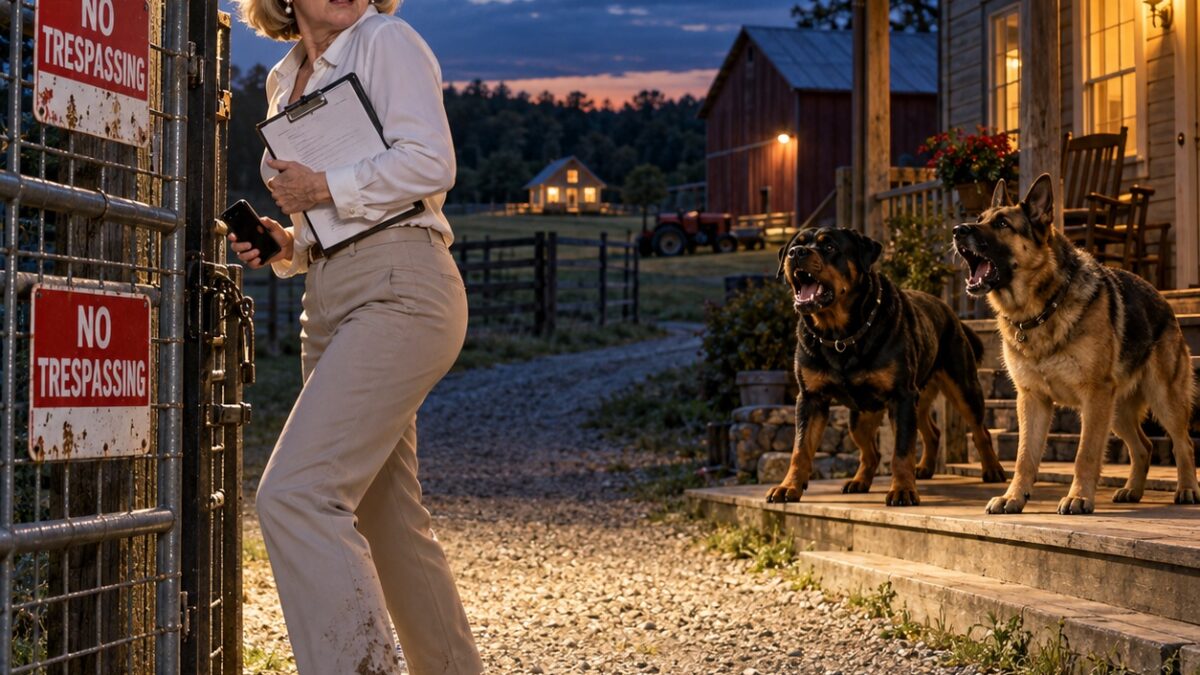
Purple blouse.
Khaki pants.
Clipboard.
I actually said aloud:
“You have got to be kidding me.”
A man beside me looked over.
“Problem?”
“Apparently.”
I enlarged the feed.
Sylvia stood at my east gate.
My truck was gone.
No other vehicle visible inside.
She looked left.
Right.
Then pushed at the gate.
Locked.
She walked along the fence.
Found the narrow maintenance opening near the old cattle panel.
And squeezed through.
I stopped breathing for a second.
Not because I was afraid.
Because I could not believe she actually did it.
There were signs.
Cameras.
A locked gate.
A written refusal.
An attorney-ready email trail.
And Sylvia climbed through anyway.
I hit record even though the system automatically archived everything.
Called Rachel.
She answered.
“I’m watching Sylvia trespass.”
Silence.
“What?”
“Live.”
“Call the sheriff.”
“She’s walking toward the cabin.”
“Jack, call now.”
I did.
Dispatcher answered.
I gave my name.
Address.
Explained I was away from the property.
“Do you see the person currently?”
“Yes.”
“Do you know her?”
“Yes. HOA president from the neighboring subdivision.”
Pause.
“Does she have permission to be there?”
“No.”
“Any weapons?”
“Not that I can see.”
“Animals on the property?”
“Yes. Two dogs.”
That changed the dispatcher’s tone.
“Are the dogs secured?”
“They’re free-roaming farm dogs.”
“Are they aggressive?”
“Protective. Trained. I’ve got warning signs on both gates.”
“Can you control them remotely?”
“No.”
“Sir, stay on the line.”
I switched cameras.
Sylvia reached the inner gate.
The red warning sign was visible directly beside her face.
DO NOT ENTER
LIVE GUARD DOGS
She read it.
I know she read it because the camera captured her turning her head toward the sign.
Then she opened the latch.
That moment later mattered more than almost anything else.
She had a chance to stop.
She did not.
She pushed through.
Closed the gate behind herself.
And started toward the cabin.
Under the porch, Brutus lifted his head.
Buster followed.
My chest tightened.
“Ma’am,” I told the dispatcher, “the dogs see her.”
“Officers are en route.”
Brutus stood.
Sylvia kept walking.
She was speaking to herself.
The camera microphone picked up pieces.
“Unapproved structure…”
“…occupancy evidence…”
“…board authority…”
She sounded like she was narrating an inspection.
Then Brutus stepped around the porch.
Stopped.
Sylvia froze.
He did not bark at first.
That was Brutus.
He watched.
Buster came behind him.
Bigger.
Louder.
One bark.
Deep.
Sylvia took one step backward.
“Easy.”
Buster barked again.
Brutus started forward.
Not sprinting immediately.
A fast controlled trot.
Sylvia turned.
That was the worst thing she could have done.
Running triggers dogs.
She moved quickly toward the gate.
Buster followed.
Then Brutus accelerated.
Sylvia screamed.
Dropped the clipboard.
Tried to turn.
Caught one shoe in loose gravel.
Went down hard.
Brutus reached her first.
The camera angle partially lost them behind a porch post.
I could hear barking.
Sylvia yelling.
Buster circling.
I shouted at my phone like the dogs could hear me.
“Brutus! Back!”
Nothing.
The dispatcher kept asking questions.
“What do you see?”
“I can’t see clearly.”
“Did the dogs bite?”
“I don’t know.”
Then Sylvia scrambled upright.
One pant leg torn.
Blood visible near the calf.
A scrape along her forearm.
Brutus was barking several feet away.
Buster closer.
Neither had latched on.
Neither continued once she retreated.
She stumbled toward the inner gate.
Got through.
Slammed it.
The dogs stopped at the fence.
Exactly what they were trained to do.
Territory ended.
Pursuit ended.
Sylvia leaned against the far side screaming:
“You vicious animals!”
Brutus barked.
Buster wagged once.
Farm dogs have a sense of irony.
The dispatcher said:
“Deputies and EMS are almost there.”
I gave permission for emergency personnel to enter through the main driveway.
Remotely opened the vehicle gate.
Then abandoned my tractor-parts purchase and drove home.
Rachel called while I was on the road.
“Do not speed.”
“I’m not.”
“Do not confront Sylvia when you arrive.”
“I’m not planning to.”
“Do not apologize.”
“What?”
“Do not say ‘I’m sorry this happened.’”
“Why?”
“Because people hear admissions where none exist.”
“Rachel.”
“I’m serious.”
“Fine.”
“Do not discuss liability.”
“Fine.”
“Let law enforcement document everything.”
“I said fine.”
“You sound angry.”
“She broke into my farm and got herself bitten.”
“Exactly why I’m talking.”
I took a breath.
“I’m calm.”
“No, you’re not.”
“No.”
“Become calm before you arrive.”
That was good advice.
By the time I reached the farm, an ambulance was parked on the shoulder.
Sheriff’s cruiser near my gate.
Arthur’s truck across the road.
Of course.
Half of Shadow Creek seemed aware.
Sylvia sat on the rear bumper of the ambulance.
Blanket over her shoulders.
Paramedic dressing her lower leg.
Another cleaning the scrape on her arm.
Her purple blouse had dirt across one side.
Hair loose.
Clipboard nowhere visible.
The moment she saw my truck, she pointed.
“That’s him!”
I parked.
Got out slowly.
Deputy Carson walked toward me.
I knew him casually.
County fairs.
Livestock calls.
Routine rural stuff.
“Jack.”
“Deputy.”
“You got the video?”
“Everything.”
“Already saw the live segment dispatch captured.”
He lowered his voice.
“Don’t argue with her.”
“My attorney said the same thing.”
“Good attorney.”
Sylvia yelled from behind him:
“Those animals attacked me!”
Carson looked back.
“Ms. Mercer, let the paramedics finish.”
“She needs to control those dogs!”
I almost answered.
Did not.
Carson noticed.
“Good.”
He walked me toward the gate.
“Tell me from the beginning.”
I did.
Previous visit.
Demand to inspect.
My refusal.
Email.
Signs.
Locked gates.
Travel.
Motion alert.
Dogs.
Everything.
Then I showed him the recorded footage.
First camera.
Sylvia approaching.
Testing locked gate.
Walking the fence.
Entering through the maintenance gap.
Carson paused.
“She went around a locked entrance.”
“Yes.”
Second camera.
Inner gate.
Warning sign.
Her head clearly turning toward it.
Carson paused again.
“Good view.”
“Very.”
Then she opened the gate.
Entered.
Walked toward the cabin.
Dogs appeared.
Fall.
Contact.
Retreat.
Carson watched twice.
“She crossed two boundaries.”
“Yes.”
“And you were four hours away.”
“About two when this happened.”
“No remote dog command?”
“No.”
“They stop at the gate?”
“Yes.”
The footage showed it clearly.
Carson nodded.
“We’ll document.”
Animal control arrived next.
That worried me more.
I knew what could happen after bites.
Even justified territorial incidents can trigger dangerous-dog procedures.
The officer, Maria Alvarez, examined Brutus and Buster.
Both were calm once I arrived.
Vaccinations current.
County registrations current.
No prior bite history.
No aggression toward responding personnel.
The bite itself appeared limited.
One puncture cluster to Sylvia’s calf.
One scratch likely from a paw or the fall.
Nothing life-threatening.
No “mauling.”
No ripped flesh.
No extended attack.
Still serious.
I treated it seriously.
Alvarez asked:
“Were warning signs visible?”
“Yes.”
“Show me.”
We photographed them.
Main gate.
East gate.
Inner gate.
She measured sight lines.
Documented fencing.
Asked whether delivery drivers entered.
“Only by permission.”
“Dogs secured then?”
“Usually on command or I meet the driver.”
“Any reason they would have expected Ms. Mercer?”
“No.”
“Had she been told not to enter?”
“Explicitly.”
I showed the email.
Alvarez nodded.
“I’ll include everything.”
Sylvia was transported to urgent care for cleaning, antibiotics, and evaluation.
Before leaving, she shouted at Deputy Carson:
“I’m pressing charges.”
He answered:
“You can make a statement.”
“They should arrest him.”
Jack—me—stood thirty feet away.
Carson said:
“He wasn’t here.”
“He trained them.”
“They’re dogs on private property.”
“She had a duty to inspect.”
Carson looked at her.
“That will be something you need to establish.”
She stared at him.
“He’s running an illegal rental.”
Carson asked:
“Do you have county documentation?”
“I’m the HOA president.”
“That’s not what I asked.”
For once, Sylvia had nothing useful.
The ambulance left.
Arthur approached.
“What the hell?”
I looked at him.
“You tell me.”
“She actually went in?”
I pointed at the cameras.
“All of it.”
He shook his head.
“Brenda-level crazy.”
“Who’s Brenda?”
“Long story.”
“Not today.”
He looked toward Brutus and Buster.
Both lying near the porch again.
“They okay?”
“So far.”
“Her?”
“Minor bite.”
Arthur exhaled.
“Could’ve been worse.”
That was true.
Much worse.
I did not enjoy that thought.
Despite my anger, I was relieved Sylvia was not seriously hurt.
I did not want blood.
I wanted boundaries respected.
The sheriff’s office took my formal statement.
Animal control completed its report.
Rachel requested copies immediately.
Then, as predicted, Sylvia escalated.
First came a lawyer letter.
Her attorney alleged negligence.
Failure to restrain dangerous animals.
Intentional maintenance of hazardous conditions.
Emotional distress.
Medical costs.
And, incredibly, “retaliatory canine deployment.”
Rachel read that phrase aloud over the phone.
Then silence.
I said:
“Are you laughing?”
“No.”
“You’re laughing.”
“Professionally.”
“What is retaliatory canine deployment?”
“Apparently your dogs are military assets.”
“Brutus is afraid of the vacuum.”
“That may be inadmissible.”
I appreciated Rachel.
She answered the letter.
Briefly.
My dogs were lawfully on my property.
Sylvia had no permission to enter.
She bypassed physical barriers.
Ignored conspicuous warning signs.
Entered despite prior written refusal.
I was absent.
I did not direct the dogs.
The incident ended once she retreated beyond the interior gate.
Video preserved everything.
Then the HOA sent its own notice.
Not to me.
To Sylvia.
Arthur forwarded the gossip version first.
Emergency board meeting.
Nancy apparently demanded a jurisdiction review.
Two other board members asked to see the original map Sylvia claimed created a “shared zoning buffer.”
There was no buffer.
I already knew that.
Now they did too.
Shadow Creek’s attorney reviewed the plats.
My farm was never part of the HOA.
Never annexed.
Never bound.
No inspection authority.
No dog-registration authority.
No commercial-use authority.
Nothing.
Sylvia had invented or badly misunderstood the whole thing.
Arthur called me that evening.
“She’s saying the county zoning overlay gave the HOA authority.”
“It doesn’t.”
“I know.”
“Why does she want the cabin so badly?”
Pause.
Then Arthur said:
“I think she saw people there.”
“My cousin.”
“Maybe she thought you were making money outside HOA control.”
“I’m outside HOA control.”
“Exactly.”
That was the problem.
Some people do not merely want order.
They want order that passes through them.
My farm offended Sylvia because it existed beside her authority without belonging to it.
The legal complaint moved forward anyway.
Sylvia filed.
Her lawyer argued that even if she technically trespassed, my dogs presented an unreasonable danger.
Rachel prepared everything.
Survey.
Deed.
Plat map.
County records.
Emails.
Camera footage.
911 call.
Animal-control report.
Veterinary records.
Dog licenses.
Warning-sign photographs.
Previous absence of aggression.
I asked:
“Do we really need this much?”
“Yes.”
“She’s on video.”
“Yes.”
“She reads the sign.”
“Yes.”
“She opens the gate.”
“Yes.”
“So?”
“So judges enjoy evidence more than confidence.”
Fair.
The hearing took place months later.
Not a dramatic television courtroom.
Wood benches.
Fluorescent lights.
People waiting for entirely unrelated cases.
Sylvia arrived with a crutch.
That was the first thing I noticed.
Rachel noticed too.
She whispered:
“Don’t react.”
“I didn’t.”
“You made a face.”
“I did not.”
“You absolutely did.”
Sylvia’s injury had healed enough that she walked from the parking lot without visible help.
Inside court, she leaned heavily on the crutch.
Her lawyer described the attack as “a foreseeable assault by inadequately controlled animals.”
Rachel did not interrupt.
When our turn came, she played the video.
Full sequence.
No edits.
Sylvia outside my locked gate.
Entering through the side.
Passing the PRIVATE PROPERTY sign.
Opening the second gate.
Standing beside the LIVE GUARD DOG warning.
Entering anyway.
Walking toward the cabin.
Dogs emerging.
Her fall.
Brief contact.
Retreat.
Dogs stopping at the gate.
Then Rachel played the earlier camera clip from three days before.
Sylvia at my front gate.
Me refusing access.
Audio clear.
“No.”
“You do not have permission to inspect my farm.”
She then showed the email.
Formal demand.
My written response:
Your HOA has no jurisdiction over this property. You do not have permission to enter. Any entry without my express consent will be treated as trespass.
The judge looked at Sylvia’s attorney.
“Your client received this?”
“Yes, Your Honor.”
“And entered anyway?”
“She believed she had lawful association authority.”
The judge looked at the plat map.
“She did not.”
“She acted based on her understanding—”
“Her understanding does not create property rights.”
Silence.
The attorney pivoted to the dogs.
“She had no reason to expect an attack of this severity.”
Rachel said:
“Your Honor, may we show exhibit fourteen?”
Photograph.
Red sign.
DO NOT ENTER
LIVE GUARD DOGS
The judge stared.
Then at Sylvia.
“You passed this sign?”
Her lawyer answered:
“She disputes whether it was—”
The video froze with Sylvia’s face beside the sign.
Rachel said nothing.
She did not need to.
The judge dismissed Sylvia’s claim.
Not because people may legally set dogs on trespassers.
That was never what happened.
Because the evidence showed I had not directed or released the animals.
They were on enclosed private agricultural property.
Warnings existed.
Sylvia knowingly entered.
The dogs stopped once she exited their contained area.
The court also noted that separate questions concerning animal-control requirements had already been evaluated by the appropriate county agency.
No dangerous-dog designation was issued.
No criminal case against me.
Sylvia looked stunned.
I felt mostly tired.
Outside court, Rachel said:
“You okay?”
“Yes.”
“Want to countersue?”
That stopped me.
“Should I?”
“That’s not what I asked.”
“What could we file?”
“Trespass.”
“Possibly defamation depending on what she said publicly.”
“Costs.”
“Interference.”
“Potential abuse-of-process issues depending on facts.”
“Would we win?”
Rachel gave me the lawyer answer.
“Nothing is guaranteed.”
I looked across the courthouse steps.
Sylvia was talking to her attorney.
Angry.
Pointing.
Still fighting.
I thought about another year of filings.
Depositions.
Money.
Time.
I thought about hay.
Fences.
Dogs.
Peace.
“No.”
Rachel nodded.
“You sure?”
“I want a restraining order.”
“That is cleaner.”
“Can we?”
“Given the repeated attempts to claim access and the actual trespass, yes, we have a good basis to seek one.”
That was what I wanted.
Not bankruptcy.
Not revenge.
Distance.
The court granted a protective no-contact order specific to the property.
Sylvia was prohibited from entering or approaching within the defined distance around my residence, farm gates, and operational areas except where public roads made incidental passage unavoidable.
She could not contact me directly.
No inspections.
No notices.
No photographers.
No walking up to my mailbox.
No appearing at the fence.
Rachel joked:
“Your scarecrow is probably protected too.”
I told Arthur.
He said:
“Good.”
Then:
“Can we name the scarecrow Sylvia?”
“No.”
“You’re no fun.”
The county handled the rest separately.
Sylvia received citations connected to trespass and the unnecessary emergency response created by entering despite warnings.
Nothing dramatic.
No prison.
No handcuffs.
Fines.
Official record.
Consequences.
That was enough.
Shadow Creek’s board had its own problem.
Their president had acted outside HOA authority while claiming to represent them.
Residents were furious.
Some because they liked me.
Others because they understood what Sylvia’s behavior could mean for them.
If she could invent jurisdiction over a neighboring farm, what prevented her from inventing rules inside the subdivision too?
Nancy pushed for a formal review.
Arthur attended every meeting.
He sent me updates despite my repeated requests that he stop enjoying the drama.
Sylvia was suspended from HOA duties first.
Then removed as president after a board vote.
She tried to frame it as a temporary political attack.
The residents apparently disagreed.
Nancy became interim president.
Her first action was to send me a letter.
Actual letter.
One page.
Mr. Bennett,
Shadow Creek Estates acknowledges that your property is not and has never been subject to the association’s governing declarations.
The association does not claim inspection, enforcement, animal-control, architectural, rental, or zoning authority over your land.
We regret the actions taken in the association’s name without proper authority.
Sincerely,
Nancy Delgado
Interim President
I read it twice.
Then put it in the filing cabinet.
Arthur asked:
“Frame it?”
“No.”
“You should.”
“No.”
“Put it by the gate.”
“Arthur.”
“Fine.”
The security footage spread anyway.
I did not post it.
Important distinction.
Someone at the HOA apparently obtained part of it through legal filings or local gossip.
Then somebody uploaded a clip.
Facebook first.
Then short-form video platforms.
The title changed depending on who posted it.
HOA President Learns What No Trespassing Means.
Clipboard Karen Meets Farm Security.
My least favorite:
HOA Sylvia Mauled by Country Justice.
That one angered me.
She was not mauled.
She got a minor bite after trespassing.
There was nothing funny about an animal bite.
Nothing heroic about dogs hurting someone.
Brutus and Buster had responded to an unauthorized entry.
That was different from celebrating injury.
I asked Rachel whether I should try getting the clips removed.
“Some, maybe.”
“Worth it?”
“Probably not all.”
“I don’t want people turning my dogs into some revenge fantasy.”
“That’s fair.”
We released a short factual statement through the county record when reporters called.
Property owner absent.
Unauthorized entry.
Warnings posted.
Animals contained on private property.
No serious injury.
No charges against owner.
End.
No interviews.
No viral victory speech.
Farm work does not pause because somebody on TikTok thinks your morning is content.
The goats still escaped.
Actually, one did two days after the hearing.
I spent forty minutes chasing him.
Arthur came over.
Watched from the fence.
“You defeated the HOA but lost to a goat.”
“Shut up.”
“Need the sheriff?”
“I hate you.”
Peace returned slowly.
Not instantly.
For a while, every vehicle near the gate made me look twice.
Every camera alert got my attention.
That irritated me.
Sylvia had turned my own land into something I monitored differently.
But habits settled.
Weeks passed without incident.
Then months.
Brutus and Buster returned to their normal concerns.
Squirrels.
Coyotes.
Delivery trucks.
Arthur arriving with beer.
Animal control checked once more.
Both dogs remained licensed, vaccinated, properly contained within the farm’s fencing system.
I added one additional secure latch to the inner gate.
Not because the old one had failed.
Because I wanted zero ambiguity.
I also moved one camera so the warning sign and entire approach were visible in one frame.
Rachel approved.
“Now you’re thinking like a lawyer.”
“That sounds insulting.”
“It should.”
Nancy visited eventually.
She called first.
That already made her my favorite HOA president.
I met her at the main gate.
She brought a pie.
“I’m apologizing with baked goods.”
“You didn’t trespass.”
“I’m apologizing institutionally.”
“Is that a thing?”
“It is today.”
I opened the gate.
Brutus approached.
Nancy froze.
“He’s friendly?”
“When invited.”
“That distinction suddenly feels important.”
I laughed.
She scratched his head.
Buster came over too.
We sat on the porch.
Nancy explained what had happened inside Shadow Creek.
Sylvia had spent years slowly expanding the board’s interpretation of its authority.
Most issues were minor.
Trash cans.
Parking.
Exterior decorations.
Rental restrictions.
But she had begun treating county concerns as HOA concerns.
Then neighboring concerns.
Then my farm.
“No one challenged her soon enough,” Nancy said.
“Why?”
“She did the work.”
That answer made sense.
The person willing to spend the most time on rules often becomes the person whose interpretation survives by default.
“We were lazy,” Nancy continued.
“Not lazy.”
“Yes.”
She sighed.
“We complained privately, then let her run everything because nobody wanted the job.”
“Arthur?”
“He mostly made jokes.”
“That sounds right.”
She looked toward the cabin.
“Was anyone ever renting that?”
“No.”
“Never?”
“My cousin stayed there.”
“That was it?”
“Also a hunting buddy one winter.”
Nancy covered her face.
“Oh my God.”
“What?”
“She had screenshots.”
“Of what?”
“Your cousin posted photos. Hashtag Texas getaway.”
I laughed.
“That’s why?”
“I think that started it.”
“My cousin calls staying anywhere outside his apartment a getaway.”
“She saw the cabin.”
“Then invented Airbnb.”
“Yes.”
We both laughed.
The whole conflict had begun because someone posted a photograph.
That felt modern.
Nancy said:
“For what it’s worth, the board adopted a new policy.”
“I’m afraid to ask.”
“No enforcement action outside recorded HOA parcels.”
I stared.
“That needed a policy?”
“Apparently.”
“Put it in bold.”
“We did.”
Good.
Over time, my relationship with Shadow Creek improved.
Most residents had never supported Sylvia’s farm campaign.
Some came over and apologized even though they had done nothing.
Arthur kept being Arthur.
Nancy ran meetings more quietly.
The HOA focused on actual HOA things.
Pond maintenance.
Road assessments.
Landscaping.
Pool rules.
Nothing involving my goats.
The division became healthy again.
They lived there.
I lived here.
We were neighbors.
Not subjects of the same government.
One evening about a year after everything ended, Arthur and I sat near the east fence.
Sunset.
Beer.
Brutus asleep nearby.
Arthur said:
“Do you regret not suing her?”
“No.”
“Not even a little?”
“No.”
“You could’ve gotten money.”
“Maybe.”
“You definitely could’ve made her miserable.”
I looked at him.
“That’s exactly why I didn’t.”
He took a drink.
“Explain.”
“I wanted her off my property.”
“She is.”
“I wanted the HOA to acknowledge it had no authority.”
“They did.”
“I wanted the dogs safe.”
“They are.”
“I wanted my life back.”
Arthur nodded.
“A lawsuit would’ve kept her in it.”
“Exactly.”
He looked toward Shadow Creek.
“You’re disappointingly mature.”
“Thank you.”
“That wasn’t praise.”
“I know.”
The restraining order remained in place.
Sylvia moved out of Shadow Creek eventually.
I heard about it from Arthur.
Her daughter lived two counties away.
She moved closer to family.
Part of me expected some final confrontation.
None happened.
No apology.
No angry letter.
No last drive past the farm.
She left.
That was fine.
Not every conflict requires reconciliation.
Some require distance.
I learned something else from the whole situation.
Signs matter.
Documentation matters.
But neither is permission to be reckless.
After the incident, several people joked:
“Good thing you had those dogs.”
True.
Then:
“She got what she deserved.”
That phrase bothered me.
Did Sylvia deserve consequences?
Yes.
Trespassing.
False authority claims.
Legal costs.
Removal from the board.
A protective order.
Those made sense.
Did I enjoy that she was physically hurt?
No.
If the same event happened again and I could magically make Brutus and Buster bark her back through the gate without touching her, I would choose that version.
Every time.
The goal of security is prevention.
Not punishment.
That distinction mattered to me because people online kept turning the dogs into weapons in their retelling.
They were not.
They were animals doing their job on land where a stranger had ignored every warning.
I worked with a trainer afterward anyway.
Not because they had behaved unusually.
Because responsibility does not end with being legally right.
We strengthened recall.
Boundary stop.
Place command.
Emergency disengagement.
Farm environments are unpredictable.
Meter readers.
Emergency workers.
Lost hikers.
Kids.
I wanted maximum control.
Brutus learned quickly.
Buster learned when snacks were involved.
Some things never change.
Two years later, a volunteer firefighter crossed the property during a brush-fire response after a neighboring field ignited.
Sirens.
Smoke.
Chaos.
I gave one command.
Both dogs went straight to the barn enclosure.
That moment meant more to me than any courtroom result.
Safe people.
Safe dogs.
That was the standard.
The cabin remained exactly what it had always been.
Family space.
Occasional guests.
No Airbnb.
No rental listing.
No secret commercial empire.
Arthur joked that I should put a sign on it:
NOT AN AIRBNB.
I threatened to ban him from the farm.
He ordered the sign anyway.
It arrived by mail.
I put it inside the barn where nobody could see it.
He considers that a victory.
One summer, my cousin—the one responsible for the “Texas getaway” photo—visited again.
I told him the whole story.
He stared.
“My post caused this?”
“Indirectly.”
“Dude.”
“You used a hashtag.”
“I use hashtags for everything.”
“That is apparently dangerous.”
He walked toward the cabin.
Took a photograph.
I said:
“Don’t.”
He grinned.
“No hashtags.”
“Good.”
He posted it later.
Caption:
Visiting family.
I approved.
Years passed.
Shadow Creek grew quieter.
New residents moved in who had never heard about Sylvia.
The ones who had turned the story into legend told it badly.
According to some versions, my dogs were Rottweilers.
They are not.
According to others, Sylvia broke into my house.
She did not.
Some say she was arrested.
She was not.
Others claim I won hundreds of thousands in a lawsuit.
I never sued.
The truth is enough.
A person claimed authority she did not have.
I said no.
She waited until I left.
Entered anyway.
My cameras recorded it.
My dogs reacted.
Law enforcement reviewed the facts.
Her lawsuit failed.
The HOA discovered she had no jurisdiction.
A court order created distance.
Then life continued.
That last part matters.
Conflict should end.
If you carry it forever, the other person still owns acreage inside your head.
Sylvia gets none of mine.
Not even metaphorically.
The farm stayed.
The dogs aged.
Brutus slowed first.
Gray around his muzzle.
More time sleeping.
Buster remained ridiculous longer.
Still chasing squirrels he never caught.
Still barking at the mail truck as though national security depended on it.
When Brutus eventually died years later, peacefully at home from old age, Arthur came over.
We buried him beneath an oak near the barn.
No connection to Sylvia.
No dramatic circle.
He was simply a good dog who had lived a good farm life.
That is how I wanted to remember him.
Buster lasted another year.
Then he too was gone.
Losing them hurt more than I expected.
For months, the farm sounded wrong.
Too quiet around the porch.
Eventually I adopted another pair of working dogs.
Not replacements.
Never.
New animals.
New personalities.
New rules.
And yes, the trainer came before they ever roamed freely.
Experience should make you wiser.
Otherwise it is just damage with a story attached.
The cameras stayed.
So did the signs.
Not because I lived in fear.
Because boundaries work best when visible.
My father used to say a good fence prevents arguments.
He was talking about cattle.
Still applies.
I also changed how I dealt with neighbors.
Before Sylvia, I assumed everybody understood the difference between my land and theirs.
After Sylvia, I stopped assuming.
I kept updated surveys.
Gate maps.
Emergency contacts.
County documentation.
If someone from Shadow Creek asked about something near the boundary, I answered early.
That prevented little suspicions from turning into stories.
When Nancy wanted to repair part of the subdivision drainage ditch near our fence, she called.
“Any issue?”
“No.”
“Can the contractor stage a truck near your east gate?”
“When?”
“Tuesday.”
“Fine.”
“Dogs?”
“I’ll secure them.”
Simple.
No clipboards used as weapons.
No covert inspections.
No court.
People say paperwork causes conflict.
Sometimes clarity prevents it.
Years after Sylvia moved away, Shadow Creek asked if I would let residents use a marked walking path along part of my outer field during their annual charity event.
My first instinct was no.
Then I thought.
They asked.
Properly.
Insurance certificate.
Waiver.
Exact route.
Date.
Time.
No access near livestock.
I said yes.
Arthur laughed.
“Sylvia would have a heart attack.”
“Good thing she doesn’t live here.”
Families walked the route.
Kids waved at me.
Nobody crossed a gate they were not supposed to cross.
Nobody inspected my cabin.
Nothing terrible happened.
That day helped remove the last bitterness.
The neighborhood had never been the enemy.
One person confused presidency with ownership.
That is all.
Every organization is vulnerable to that.
HOAs.
Companies.
Church committees.
School boards.
Families.
Give somebody a little authority and sometimes they forget authority is limited by purpose.
Sylvia was elected to help manage a subdivision.
Somewhere along the way, she decided that meant anything visible from the subdivision became her concern.
Then anything affecting the subdivision.
Then anything she suspected might affect it.
Then my cabin.
Then my dogs.
Then my gate.
Authority expanded in her mind until it reached wherever she wanted to go.
The physical gate stopped her.
So she climbed around it.
That is almost too perfect as a metaphor.
The court reduced everything back to the basic rule.
Your authority ends where someone else’s rights begin.
Simple.
Not always easy.
I thought about that when I inherited more responsibility on the farm.
Employees.
Seasonal workers.
Contractors.
People who depended on me.
Power looks different from the other side.
It is easy to mock somebody for overreaching until you gain the ability to do it yourself.
So I tried to remember Sylvia.
Not as a cartoon villain.
As a warning.
If a worker says:
“This doesn’t feel safe.”
Listen.
If a neighbor says:
“That’s my boundary.”
Check.
If someone says:
“No, you can’t enter.”
Do not convince yourself your good reason turns no into yes.
That lesson cost Sylvia a board position and a lot of money.
It cost me time and peace.
Worth remembering.
I still farm.
Older now.
Slower.
The tractor has changed.
Goats somehow remain criminal masterminds.
The cabin still stands.
Fresh roof.
Better Wi-Fi now, ironically.
Still not an Airbnb.
Sometimes friends stay.
Sometimes relatives.
Once Nancy’s brother used it for two nights after his truck broke down nearby.
I teased her.
“Unapproved transient occupancy.”
She looked at me.
“Don’t start.”
We laughed.
That is what peace sounds like.
Not silence.
Normal jokes.
Normal favors.
People knocking before entering.
If you stand at my east gate today, you will still see a sign.
PRIVATE PROPERTY.
Another below it:
PLEASE CALL BEFORE ENTERING.
Less aggressive than the old one.
More useful.
Near the inner field gate:
WORKING DOGS ON PROPERTY.
Clear.
No drama.
The old DO NOT ENTER sign hangs in my equipment shed.
Arthur says I should donate it to the county museum.
He is not funny.
The clipboard Sylvia dropped is gone.
Deputies took it as part of documentation that day.
I never asked what happened to it.
Probably thrown away.
That seems fitting.
Objects only become symbols if you let them.
I did keep one thing.
Nancy’s letter.
The one stating clearly that Shadow Creek had no jurisdiction over my farm.
It remains in my property file beside the survey and deed.
Not as a trophy.
As clarity.
If the board changes again.
If people forget.
If another president develops imagination.
Here.
Read.
Boundaries.
Sometimes people ask me what I would do differently.
Easy.
I would call the attorney the first evening instead of waiting.
I would send Sylvia written notice immediately.
I would review the dog setup sooner.
I might install the second camera before she ever returned.
What I would not do differently is open the gate.
That first no mattered.
If I had let her “inspect” simply to avoid conflict, I suspect Sylvia would have treated permission as precedent.
Cabin today.
Barn tomorrow.
Dogs next.
Farm equipment after that.
Boundaries become harder to rebuild once abandoned.
You do not need to yell to defend one.
You need to know where it is.
Then stand there.
That is what I did.
The irony is that I never hated Sylvia.
I hated what she did.
Important distinction.
Hating somebody is work.
Farming already gives me enough.
My land is legacy.
That sounds sentimental until you spend your life repairing something your father repaired before you.
The north fence has posts set by my grandfather.
One barn beam has my dad’s initials carved into it.
The creek crossing still has stones moved by people whose names I only know from photographs.
You do not own that kind of place casually.
You become temporary caretaker.
That is why Sylvia standing at my gate saying she had inspection rights bothered me more than an ordinary dispute.
She did not understand what she was asking me to surrender.
Not access.
Authority.
The idea that someone from a neighboring subdivision could cross my boundary because she had convinced herself my land fell under her paperwork.
No.
My father would have said no.
My grandfather would have said it louder.
I said it calmly.
That was enough.
Until Sylvia decided it was not.
Then cameras, law, and consequences took over.
I am glad I did not meet her trespass with my own.
I never went to her house.
Never threatened her.
Never followed her.
Never posted her address.
Never encouraged harassment.
When the videos spread, I stayed quiet.
That matters too.
Being wronged does not give you a blank check.
Once the legal problem was solved, I wanted it finished.
I have seen men lose years to feuds.
Fence lines.
Water.
Cattle.
Family land.
One insult becomes another.
Then children inherit anger like property.
No thanks.
Sylvia left.
Shadow Creek remained.
The farm remained.
I remained.
That is enough.
Arthur and I still sit by the fence sometimes.
He is older too.
One evening, he looked toward Shadow Creek and said:
“You know what the funniest part is?”
“What?”
“She really thought you were running an Airbnb.”
“I know.”
“Who would pay to stay next to your goats?”
I looked at him.
“People pay to stay on farms.”
“Not your farm.”
“Why?”
“Your rooster starts at four-thirty.”
“That’s authentic.”
“Your goats scream.”
“Rustic.”
“Your shower pressure is terrible.”
“Historical.”
He laughed.
“You could charge extra.”
I considered it.
Then pointed at him.
“Don’t even joke.”
He raised his beer.
“To community standards.”
I raised mine.
“To property lines.”
We drank.
Sunset over pasture.
Dogs from the newer generation asleep nearby.
Shadow Creek fountain visible in the distance.
No war.
Just neighbors on opposite sides of a line everybody finally understood.
That is the part people leave out when they tell the story.
The best ending is not Sylvia falling in the dirt.
Not the dogs barking.
Not the judge dismissing her claim.
Not her losing the HOA presidency.
The best part came later.
Nothing happened.
No notices.
No trespassing.
No cameras catching purple blouses at gates.
No deputies.
No lawyers.
Weeks became months.
Months became years.
The farm returned to being a farm.
That is victory.
Peace becoming boring again.
And if someone ever asks why I still keep cameras at every gate, I tell them the truth.
Most people respect fences.
Some respect signs.
A few only respect evidence.
Sylvia taught me that.
She also taught me something else.
Authority is not something you get to imagine into existence because you are used to people obeying you.
A title has boundaries.
A rulebook has boundaries.
An HOA has boundaries.
And a farmer’s gate has one job.
It marks where permission begins.
Sylvia ignored it.
The dogs did not.
The court did not.
And neither did I.








