FULL STORY:HOA Karen Called the County to Shut Down My Farm Stand—Then the Zoning Chairman Pulled Up and Bought Two Dozen Eggs
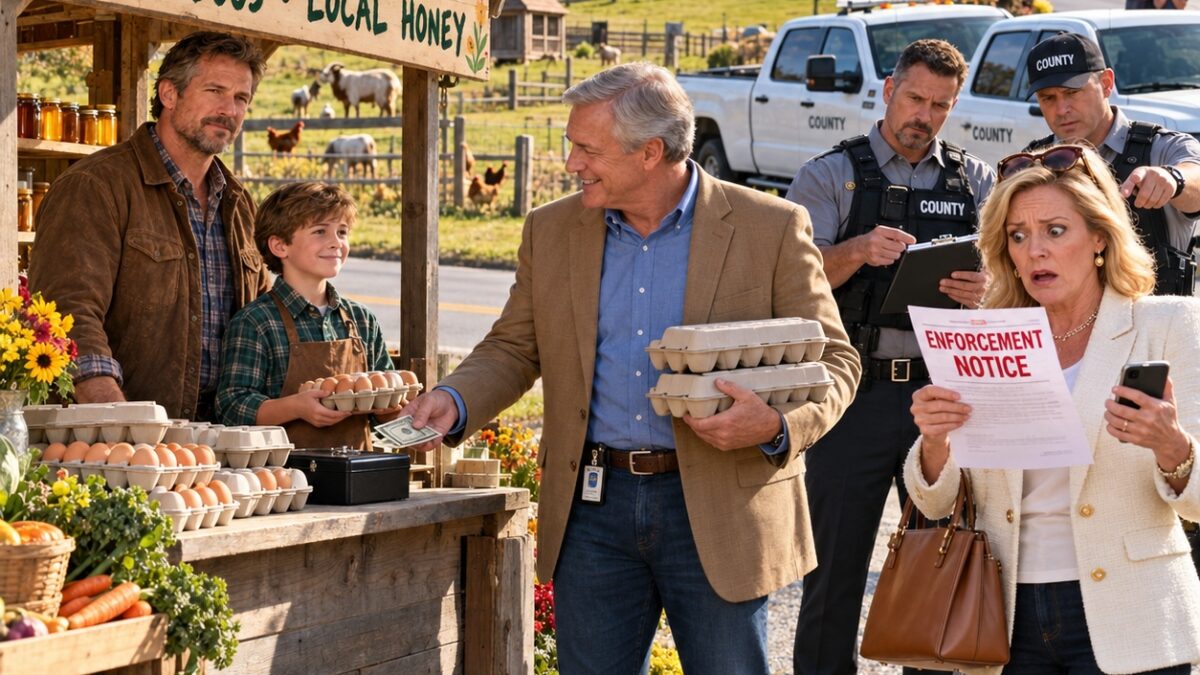
PART2
I was placing brown eggs into a carton.
I kept going.
“One.”
Brenda stared at me.
“Did you hear me?”
“Two.”
“Daniel.”
“Three.”
Leo was sitting behind the little counter with our cash box.
He looked at me.
Then Brenda.
Then me again.
I finished six eggs before I stood upright.
“Morning, Brenda.”
“This is not funny.”
“I didn’t laugh.”
“This is residential zoning.”
“Not this parcel.”
She lifted her phone.
“I’ve already reported you.”
A minivan driving past slowed.
Then a pickup.
A couple who had bought honey the previous weekend pulled onto the shoulder.
Lancaster County is full of people who can identify public conflict from half a mile away.
Within minutes, we had an audience.
Brenda noticed.
That seemed to energize her.
She raised her voice.
“You cannot operate a commercial business here.”
I wiped my hands against my jeans.
“It isn’t zoned the way you think.”
“Yes, it is.”
“No.”
“I checked.”
“With who?”
“The HOA.”
I almost smiled.
“That’s not the county.”
“The HOA has zoning maps.”
“I’m sure it does.”
Brenda stepped closer.
“You have people stopping on the road. You have signage. You’re conducting retail sales. You’re probably not licensed, probably not insured, and I highly doubt you’re reporting any of this properly.”
Leo’s face changed.
He was not old enough to understand zoning law.
He understood the phrase illegal.
“Dad?”
I looked at him.
“You’re okay.”
Brenda heard him.
She lowered her voice just enough to sound falsely sympathetic.
“I’m sorry your son has to see this, but adults have responsibilities.”
That did it.
Not enough to make me yell.
Enough to make me stop smiling.
“Leave my son out of it.”
“I’m simply saying—”
“No.”
She looked at me.
I pointed toward the stand.
“You have an issue with this, talk to me.”
Her mouth tightened.
Then came the sentence I remembered long after everything else.
“Rules changed, Daniel. People like you don’t get special treatment just because your family happened to own land here first.”
People like you.
Maybe she meant farmers.
Maybe people who did not live inside her controlled little subdivision.
Maybe people whose barns and work boots offended her sense of what the road was supposed to become.
Whatever she meant, she wanted me to hear it.
I did.
I said calmly:
“This land was growing food before your house existed.”
She laughed.
Actually laughed.
“And that gives you the right to do anything you want?”
“No.”
I turned toward the stand.
“The permit does.”
Her expression flickered.
Only for a second.
Then two white county vehicles appeared at the end of the road.
Brenda saw them.
Her smile returned instantly.
“There.”
She pointed.
“See?”
Leo stepped closer to me.
“Dad?”
“It’s fine.”
“Are they going to close us?”
“No.”
“You sure?”
“Yes.”
I was.
Mostly.
The trucks pulled onto the gravel shoulder.
Two county enforcement officers stepped out.
One was Officer Samuel Davis.
Mid-forties.
Serious face.
Clipboard.
The second, Miguel Ortega, looked about ten years younger and considerably less impressed by the crowd gathering along the roadside.
Davis walked toward me.
“Mr. Mercer?”
“Yes.”
“We received a complaint involving unpermitted commercial activity.”
Before I could answer, Brenda stepped between us.
“I filed it.”
Officer Davis glanced at her.
She continued.
“He’s been doing this for weeks. Selling products on residential land. People are parking along the road. There are signs. There are customers. I also have concerns about tax compliance.”
I stared at her.
Tax compliance?
Apparently Brenda had promoted herself from HOA compliance coordinator to IRS field agent.
Officer Ortega glanced toward the stand.
Eggs.
Honey.
Tomatoes.
A basket of zucchini.
Leo’s crooked sign.
His expression did not change, but something in his eyes suggested he had expected a meth lab from Brenda’s complaint.
Officer Davis looked at me.
“Do you have authorization for the roadside operation?”
“Yes.”
“Can we see it?”
“Absolutely.”
I wiped my hands again.
Then stopped before reaching for the folder beneath the counter.
“Can I ask who the complaint is officially attributed to?”
Davis looked at his clipboard.
“It’s already documented.”
“I did it.”
Brenda said it proudly.
“Because somebody has to respect the law around here.”
I nodded.
“Understood.”
Then I looked down the road.
Nothing yet.
Officer Davis noticed.
“Your permit, sir?”
“You can see it.”
I paused.
“But if you have five minutes, this will probably be easier.”
His forehead creased.
“Why?”
“Someone else is already coming.”
Brenda rolled her eyes.
“Oh, please.”
I ignored her.
“Your lawyer?” she asked.
“No.”
“Some family friend?”
I leaned against the counter.
“No.”
“This isn’t a movie, Daniel.”
“No.”
I checked the road again.
Then I saw the black SUV.
Slow.
Dark.
County plate.
It turned onto our stretch of road and pulled directly in front of the stand.
Brenda crossed her arms.
“This should be interesting.”
The SUV stopped.
Charles Harrison stepped out.
Late sixties.
Silver hair.
Khaki pants.
Blue button-down.
No dramatic suit.
No entourage.
Nothing about him screamed authority.
That was probably why Brenda did not recognize him.
Officer Davis did.
His posture changed immediately.
Not fear.
Professional recognition.
“Mr. Harrison.”
Harrison lifted one hand.
“Morning, Sam.”
Brenda was still smiling.
Harrison walked past her.
Past the officers.
Straight to the stand.
He picked up one of the cartons.
Opened it.
Inspected the eggs.
“These today?”
“Yes.”
“This morning?”
“About six-thirty.”
He nodded approvingly.
“I’ll take two dozen.”
Brenda made an incredulous sound.
“Are you serious?”
Harrison looked at her.
“I usually am.”
“This place is about to be shut down.”
He glanced at me.
Then at the officers.
“Is it?”
Brenda stepped forward.
“Yes.”
She pointed at me.
“He is operating an illegal business in a residential zone. I filed the complaint myself.”
There was a moment of silence.
Harrison turned toward Officer Davis.
“Sam?”
Davis shifted his clipboard.
“We received a complaint, sir. We’re verifying the parcel classification and permit status.”
“Good.”
Harrison reached into his pocket.
Not for money this time.
His identification.
He showed it to Davis.
Davis already knew him.
Ortega did too.
Brenda finally noticed the change.
“What is this?”
Harrison put the identification away.
“I’m Charles Harrison.”
Nothing registered.
He added:
“Chairman of the county zoning board.”
The expression on Brenda’s face changed so quickly it almost felt unfair to watch.
“No.”
Harrison raised one eyebrow.
“No?”
“I mean… that can’t…”
She looked at Officer Davis.
Then back at Harrison.
“I would know.”
“Would you?”
Ortega looked down.
His mouth moved slightly.
I strongly suspected he was suppressing a smile.
Brenda recovered quickly.
That was one of her talents.
“Well, good.”
She gestured toward my stand.
“Then you’re exactly who should be here.”
Harrison nodded.
“I agree.”
“This man is operating a commercial stand on residential property.”
“No.”
“He is.”
“No.”
Brenda’s face tightened.
Harrison placed the egg carton on the counter.
“This parcel is not regulated the way the surrounding subdivision parcels are.”
“But the zoning map—”
“Was updated.”
“When?”
“Last year.”
She looked at me.
Then Harrison.
“That makes no sense.”
Harrison continued.
“This property qualified under the county’s small-farm and roadside produce allowance.”
Brenda stared.
“He applied?”
“Yes.”
“When?”
“Last year.”
“And you approved this?”
“I signed it.”
Silence.
Leo looked up at me.
I winked.
His shoulders relaxed.
Brenda stepped toward Harrison.
“No one informed the neighborhood.”
Harrison shrugged.
“It’s his property.”
“The HOA should have been notified.”
“Why?”
“Because we maintain community standards.”
Harrison gave her a patient look.
“Is Mr. Mercer’s property part of your HOA?”
She hesitated.
“No, but—”
“Then your notification process has nothing to do with his agricultural zoning.”
Brenda’s mouth opened.
Harrison added:
“That sounds like an HOA concern, not a county one.”
Someone near the road laughed.
Then another.
Brenda heard it.
Her face reddened.
Officer Davis looked down at his clipboard.
“So the agricultural exemption is active?”
“Yes.”
“Roadside sales included?”
“Yes.”
“Signage?”
“Within approved limits.”
“Parking?”
Harrison looked toward the gravel area beside the stand.
Daniel—me—had widened the shoulder months earlier to keep customers off the travel lane.
“As long as customers use the designated pull-off and don’t obstruct the roadway.”
Davis nodded.
He closed his clipboard.
“Then there’s no violation.”
Leo smiled.
Wide.
Proud.
Brenda did not.
“But look at this.”
She gestured toward the cars.
“Traffic.”
Harrison looked.
Three vehicles.
All off the road.
No blocked lane.
No congestion.
“Looks manageable.”
“It creates disruption.”
“To what?”
“The neighborhood.”
Harrison picked up his eggs again.
“Funny.”
“What?”
“I drove here because someone at the county office told me this was the best place nearby to buy fresh eggs.”
People laughed again.
This time even Officer Ortega smiled.
Brenda’s hands tightened.
“This isn’t over.”
I looked at her.
“I never said it was.”
Harrison took out cash.
I reached for change.
He shook his head.
“Keep it.”
Then he lowered his voice.
“You handled this better than I would have.”
“I have a kid watching.”
He glanced at Leo.
“Good reason.”
He turned as if he were leaving.
Then stopped.
I saw him look toward the fence post near the entrance to our driveway.
Something was attached there.
A bright yellow paper inside a plastic sleeve.
Harrison walked toward it.
My stomach tightened.
I already knew what it was.
The notice.
It had appeared the previous afternoon.
OFFICIAL ZONING WARNING
UNAUTHORIZED COMMERCIAL USE
CEASE OPERATIONS PENDING COUNTY REVIEW
County seal printed at the top.
At least something resembling the county seal.
No case number.
No inspector name.
No valid department contact.
I had photographed it, removed it from the stand itself, then attached it to the fence because I wanted officers to see it.
I suspected Brenda made it.
I did not know how far she had gone.
Harrison pulled the plastic sleeve from the post.
Read the page.
His expression changed.
Not dramatically.
His face simply stopped being friendly.
“Daniel.”
“Yes?”
“When did you receive this?”
“Yesterday morning.”
“Mail?”
“No.”
“Taped to the stand.”
“Who placed it?”
I looked at Brenda.
So did everyone else.
Harrison turned.
“Ms…?”
“Whitmore.”
“Did you put this on his property?”
For the first time that morning, Brenda did not answer immediately.
Officer Davis stepped closer.
“Ma’am?”
She crossed her arms.
“I delivered it.”
Harrison held up the paper.
“From whom?”
“The HOA.”
“This says county zoning enforcement.”
“It relates to zoning.”
“That’s not what I asked.”
Brenda’s voice became defensive.
“I was trying to warn him.”
Harrison studied the paper.
“Our official seal is on this.”
Brenda looked toward the road.
Nobody was laughing now.
Harrison continued.
“There is no county case number.”
Silence.
“No inspector signature.”
Silence.
“No enforcement contact.”
He looked at Officer Davis.
“Did your office issue this?”
Davis took the page.
Read it.
“No, sir.”
“Did planning issue anything?”
“Not that I’m aware of.”
Harrison looked at me.
“Daniel?”
“Yes?”
“Did you receive any official county notice before today?”
“No.”
His eyes went back to Brenda.
“Where did this document come from?”
She finally snapped.
“I created a courtesy warning.”
“With our seal?”
“It’s public.”
“No.”
She swallowed.
“I found it online.”
“That’s not the issue.”
Brenda looked around and realized people were recording.
A man beside a pickup had his phone raised.
A woman near the road whispered something to her husband.
Brenda’s confidence began breaking around the edges.
“This is being blown completely out of proportion.”
Officer Davis held the notice.
“Ma’am, did you present this as an official county document?”
“No.”
I spoke for the first time in several minutes.
“It says ‘Official County Zoning Enforcement Warning’ in the first line.”
Brenda shot me a look.
“I was trying to make you take the issue seriously.”
“You told me the county ordered me to stop selling.”
“Because I knew they would.”
Officer Ortega finally spoke.
“That’s not the same thing.”
Brenda turned to him.
“I’m on the HOA board.”
Harrison sighed.
“The HOA cannot issue county enforcement notices.”
“I never said—”
He held up the paper.
“You printed the county seal.”
“I was trying to help the neighborhood.”
“No.”
Harrison’s voice remained calm.
“You were attempting to create authority you did not have.”
Brenda looked stunned by the directness.
Officer Davis asked:
“Did you file the complaint before or after posting this?”
She did not answer.
“Ma’am?”
“Before.”
“When?”
“Yesterday.”
Davis checked his clipboard.
The complaint had apparently been logged that morning.
He looked at her.
“This report came in at 7:42 today.”
Brenda hesitated.
“I submitted information yesterday.”
“Not through our system.”
“I called someone.”
“Who?”
“I don’t remember.”
That answer made everything worse.
Harrison’s eyes narrowed.
“Were you trying to convince Mr. Mercer the county had already taken enforcement action before an actual complaint had even been reviewed?”
Brenda looked at me.
Her voice softened suddenly.
“I was trying to avoid a bigger problem.”
I almost admired the pivot.
Victim to public servant in under three seconds.
She continued.
“Daniel has been antagonistic from the beginning. Every time the HOA tries to maintain standards, he uses the fact that his property predates the neighborhood as an excuse to ignore us.”
I shook my head.
“My property isn’t in your HOA.”
“It affects our property values.”
“My chickens?”
“Your entire operation.”
Leo was watching.
I reminded myself of that.
Stay calm.
Harrison did not need reminding.
He said:
“Whether you like Mr. Mercer’s agricultural use is irrelevant.”
“It isn’t irrelevant to the people who have to look at it.”
A murmur moved through the crowd.
That sentence hurt Brenda.
Most of the people watching were there to buy from us.
Harrison continued:
“The county has approved the use.”
“But—”
“The county has approved the use.”
He said it again, slowly.
Brenda finally went quiet.
Officer Davis pointed toward the truck.
“Ms. Whitmore, we need to get some additional information from you regarding this document and the complaint.”
Her eyes widened.
“You’re arresting me?”
“No.”
“Then I’m not going anywhere.”
“You’re not under arrest.”
“Good.”
“But we still need to establish what was represented, how this was created, and whether county insignia was improperly used.”
“That’s ridiculous.”
Harrison said:
“It’s serious.”
Brenda snapped toward him.
“Over a piece of paper?”
“Over an official-looking document falsely represented as county enforcement.”
“I never said it was real.”
I looked at her.
“You told me county enforcement had already ordered the stand closed.”
She pointed at me.
“You know what I meant.”
“Yes.”
I paused.
“That’s the problem.”
A few people murmured agreement.
Brenda lowered her hand.
Officer Davis gestured again.
“Ma’am.”
She looked around.
At the phones.
At Harrison.
At the officers.
At my stand.
Twenty minutes earlier, she had stood in almost the same spot promising to watch county employees shut us down.
Now everybody was waiting for her.
Her shoulders dropped slightly.
She walked toward the county truck.
No handcuffs.
No dramatic arrest.
Just a woman suddenly discovering that official authority worked very differently from HOA intimidation.
Before Harrison left, he picked up the two cartons of eggs.
He looked at me.
“You open every morning?”
“Sunrise to noon.”
“Every day?”
“Except Sunday.”
He nodded.
“I’ll be back.”
Then he looked at Leo.
“Good sign.”
Leo beamed.
“I painted it.”
“I can tell.”
My son’s face fell.
Harrison laughed.
“That was a compliment.”
He got into his SUV and left.
The county truck followed a few minutes later.
Brenda was in the passenger seat of one of them.
The road became quiet again.
For maybe ten seconds.
Then a man I had never met stepped toward the counter.
“You still selling eggs?”
I laughed.
“Plenty.”
“I’ll take two dozen.”
A woman behind him said:
“Better make that four.”
Someone else asked for honey.
Within thirty minutes, we sold everything.
Leo stood behind the cash box looking stunned.
Finally he said:
“Dad?”
“Yeah?”
“What just happened?”
I put one hand on his shoulder.
“Somebody made a complaint.”
“I know.”
“And the county checked.”
“And?”
“And we were following the rules.”
He thought.
“Then why did Brenda say we weren’t?”
I looked toward the subdivision across the road.
“Because she thought saying something loudly would make it true.”
Leo frowned.
“That’s stupid.”
“Sometimes.”
He looked at the empty egg shelves.
“Are they taking her to jail?”
“No.”
“Why not?”
“Because not every wrong thing ends with somebody going to jail.”
He seemed disappointed.
Eleven-year-old justice tends to prefer clear endings.
I continued.
“They’ll figure out what happened with the notice.”
“What if she gets in trouble?”
“That’s between her and the county.”
He nodded.
Then asked:
“Can I tell Mom?”
“Your mother will know before we get inside.”
He laughed.
He was right to.
My wife, Rachel, pulled into the driveway fifteen minutes later.
She stepped out.
Looked at the empty stand.
Looked at me.
Then Leo.
“What happened?”
Leo ran toward her.
“Brenda got taken away because she made a fake county paper and Mr. Harrison bought eggs and Dad knew the whole time and there were two officers and everybody was filming and—”
Rachel looked at me.
I shrugged.
“That’s the short version.”
She closed her eyes.
“I leave for three hours.”
“Very productive morning.”
“You couldn’t have called me?”
“It was handled.”
She stared.
Then laughed despite herself.
“Of course it was Brenda.”
The county called that afternoon.
Officer Davis explained that Brenda had been interviewed and released.
Again, not arrested.
No dramatic jail cell.
The notice had been taken as evidence for review.
The county legal department would determine whether any administrative or criminal issue existed regarding unauthorized use of insignia or misrepresentation.
Davis also apologized.
“For what?”
“The interruption.”
“You were doing your job.”
“We received a complaint.”
“You checked it.”
“Yes.”
“You found the answer.”
He paused.
“Not everyone sees it that way.”
“I do.”
That mattered to me.
The officers were not villains.
Neither was the zoning department.
They responded to what sounded like a legitimate complaint.
Brenda had tried to weaponize that process.
There is a difference.
Two days later, I received a formal county letter.
PROPERTY COMPLIANT.
AUTHORIZED AGRICULTURAL ROADSIDE SALES.
NO ENFORCEMENT ACTION WARRANTED.
I made three copies.
One for my files.
One under the farm stand counter.
One laminated.
Leo wanted to frame it.
I told him that might be excessive.
Then Brenda’s HOA sent me a certified letter.
I almost threw it away.
Rachel said:
“Open it.”
“You open it.”
“It’s addressed to you.”
“You married me.”
“That is not power of attorney.”
I opened it.
The letter was from HOA president Harold Meyers.
Not Brenda.
He made three things clear.
First, Mercer Farm was not and had never been subject to subdivision covenants.
Second, Brenda’s contact with me regarding county zoning had not been authorized by the HOA board.
Third, the board had begun a review of her conduct.
Rachel read it.
“Keep that.”
“I was planning to.”
She pointed toward the folder.
“You’re becoming one of those men with binders.”
“I’ve been attacked by people with binders.”
“That’s how it starts.”
The neighborhood reaction was stranger.
For years, most subdivision residents had tolerated Brenda rather than confront her.
Some liked her.
Some feared her.
Most simply preferred not to become her next project.
After the farm-stand scene circulated through local group chats, people started talking.
A lot.
A retired couple told me Brenda had threatened them with fines over a wheelchair ramp that had already been approved.
Another family said she sent repeated letters over their vegetable garden.
One homeowner claimed she had told him county code prohibited his work van from being visible, even though no such rule existed.
Apparently the fake zoning notice was not her first attempt to blur the line between HOA rules and government authority.
It was simply the most obvious.
The HOA called a special meeting.
I had no intention of going.
Harold called personally.
“Daniel, I’d appreciate it.”
“I’m not a member.”
“I know.”
“Then why?”
“Because your situation triggered the review.”
“I can provide documents.”
“People should hear what happened.”
I sighed.
“What time?”
“Seven.”
“Make it quick.”
He laughed.
“No promises.”
I went.
Rachel came.
Leo wanted to.
I said no.
“This is adult boredom.”
“But Brenda might yell.”
“Exactly.”
The meeting room was full.
Brenda sat near the front.
Perfect blouse.
Perfect hair.
Different posture.
No clipboard.
That alone felt significant.
Harold opened the meeting.
No speeches.
He reviewed the HOA’s limits.
Property boundaries.
Authority.
County versus private covenants.
Then he addressed the obvious.
“No HOA representative may present themselves as a county official, issue documents implying county enforcement, or file complaints as though speaking for the association without authorization.”
Brenda raised her hand.
“This is clearly directed at me.”
Harold looked at her.
“Yes.”
The room went silent.
I respected him instantly.
Brenda leaned forward.
“I was protecting the neighborhood.”
A woman behind me whispered:
“Here we go.”
Brenda continued.
“For years, I have been the only person willing to enforce standards while everyone else complains privately.”
Harold said:
“This matter concerns property outside our HOA.”
“It affects us.”
“So does the weather. We don’t govern that either.”
Several people laughed.
Brenda’s face tightened.
She looked toward me.
“You knew this would happen.”
I answered from my chair.
“Knew what?”
“That people would turn against me.”
“I knew my permit was legal.”
“That’s not what I mean.”
“Then I don’t know what you mean.”
“You let me look like a fool in front of everyone.”
That sentence explained more than all the others.
I leaned forward.
“Brenda.”
She stared.
“You called the county.”
No answer.
“You brought them to my property.”
No answer.
“You posted the fake warning.”
Her jaw tightened.
“I didn’t make you look like anything.”
I sat back.
The room stayed quiet.
Harold moved on.
The HOA board voted to remove Brenda from the compliance committee immediately.
Then, after more discussion, she resigned from the board entirely rather than face a membership removal process.
She stood.
Collected her purse.
Looked at me once.
Then left.
No applause.
No cheering.
I was glad.
This was not a movie.
Nobody needed to humiliate her further.
The important thing was that the behavior stopped.
For several weeks, it did.
Farm life continued.
Chickens did not care about zoning victories.
They still needed feeding at sunrise.
Bees still required checking.
Vegetables still needed harvesting.
Leo still forgot to close the feed-bin lid.
Ordinary responsibility is useful after conflict.
It reminds you that drama is temporary.
Work remains.
Our farm stand became busier.
Not because I wanted publicity.
Because the confrontation had spread.
People wanted to support us.
Some drove farther than made sense just to buy six eggs.
I told one man:
“You spent more on gas than these eggs cost.”
He smiled.
“Not the point.”
I understood.
A local bakery started buying honey.
A café took eggs twice a week.
We expanded the stand slightly.
Still small.
Still sunrise to noon.
Leo added a second sign.
YES, WE’RE LEGAL.
Rachel made him remove it.
I thought it was funny.
A month after the confrontation, Charles Harrison returned.
No black SUV drama this time.
He pulled up in an old pickup.
Leo saw him first.
“Dad! Egg guy!”
Harrison stepped out.
“I have a name.”
Leo looked embarrassed.
“Sorry.”
“I’ve been called worse.”
He bought eggs.
Honey.
A jar of Rachel’s peach preserves.
While I bagged everything, I asked:
“What happened with the notice?”
Harrison became serious.
“The county referred the matter for review.”
“Anything I need to do?”
“No.”
“Was she charged?”
“No criminal charge at this point.”
I nodded.
That was fine.
“Administrative warning?”
“Yes. Formal cease-and-desist regarding county insignia and representations.”
“Good.”
He looked at me.
“Disappointed?”
“No.”
“Most people want blood after something like that.”
“I want her to stop.”
He smiled.
“That’s healthier.”
He handed Leo cash.
My son calculated change carefully.
Harrison watched him.
“You learning the business?”
Leo nodded.
“I’m going to make the farm bigger.”
I raised one eyebrow.
“You are?”
“Yes.”
“When were you planning to tell me?”
“Now.”
Harrison laughed.
He took his bag.
Before leaving, he looked at the land.
“You know, your family did something smart.”
“What?”
“Keeping this parcel.”
“Wasn’t always smart.”
“No?”
“Developers offered a lot.”
“I’m sure.”
“My father refused.”
“Why?”
I looked toward the old barn.
“He said once land turns into pavement, nobody remembers what grew there.”
Harrison nodded.
“Your father sounds stubborn.”
“You met him?”
“Exactly.”
I laughed.
He had.
Apparently Dad had argued with the zoning board more than once.
Family tradition.
The farm stand slowly became part of the road.
Not controversy.
Just geography.
Morning commuters stopped.
Parents brought kids.
Neighbors walked over.
Even people from Brenda’s subdivision.
Especially them.
One woman named Karen—unfortunately for her—became a regular.
The first time she introduced herself, Leo’s eyes went wide.
I kicked his shoe lightly.
Do not.
He behaved.
Karen bought honey every two weeks.
She was lovely.
Names are innocent.
Months passed.
Then one autumn afternoon, Brenda appeared again.
Alone.
No phone.
No HOA folder.
No audience.
I was restocking eggs.
She stopped several feet away.
“Daniel.”
“Brenda.”
She looked at the stand.
Then the farm.
“How’s business?”
“Fine.”
Awkward silence.
I returned to the eggs.
She said:
“I owe you an apology.”
My hands stopped.
I looked up.
She seemed physically uncomfortable saying it.
Good apologies often are.
She continued.
“I overstepped.”
“Yes.”
Her mouth tightened at the lack of easy absolution.
“I thought…”
She stopped.
I waited.
“I thought if I didn’t control what was happening around the subdivision, everything would become…”
She searched for the word.
“Messy?”
“Yes.”
I looked around.
Chicken coop.
Mud near the fence.
Leo’s handwritten sign.
A tractor that needed washing.
“Life is messy.”
“I know.”
She glanced toward the stand.
“My husband always wanted to live somewhere rural.”
That surprised me.
“He did?”
“He grew up around farms.”
“What changed?”
“He died before we moved here.”
I did not know that.
“I’m sorry.”
She nodded.
“I think I hated this place because he would have loved it.”
That sentence landed differently.
Not an excuse.
An explanation.
Brenda continued.
“Every time I saw your barn or chickens or customers, it reminded me that the neighborhood wasn’t what I had imagined.”
“So you tried to make us disappear.”
She looked ashamed.
“Maybe.”
“No maybe.”
“You’re right.”
I leaned against the counter.
“Why the fake notice?”
She exhaled.
“I thought if it looked official, you would stop before the county got involved.”
“You understand that sentence makes it worse.”
“Yes.”
“And then you called the county.”
“I was certain they’d agree with me.”
“They didn’t.”
“No.”
She looked toward the ground.
“I was wrong.”
I let the silence stay.
Then I asked:
“Do you want eggs?”
Her head came up.
“What?”
“Eggs.”
A tiny laugh escaped her.
“I don’t know if that’s a joke.”
“It isn’t.”
She opened her purse.
“One dozen.”
I handed her a carton.
She offered money.
I took it.
No free symbolic peace offering.
Business is business.
She started walking away.
Then turned.
“Daniel?”
“Yeah?”
“I really am sorry.”
I nodded.
“I believe you.”
Not:
It’s okay.
Because it had not been okay.
Not:
Forget it.
Because I had not.
Just:
I believe you.
That was enough.
Brenda became a customer after that.
Not weekly.
Occasionally.
Mostly honey.
She never joined the HOA board again.
According to one neighbor, she volunteered with the subdivision landscaping committee but refused any position that involved enforcement.
Growth.
Leo was fascinated.
“Why do we sell her stuff?”
“Because she pays.”
“That’s it?”
“And because people get to do better.”
He thought.
“What if she does something bad again?”
“Then we deal with that.”
“So we forgive her?”
“Forgiveness doesn’t mean pretending.”
He looked confused.
I tried again.
“It means I don’t need to spend every morning angry about something that already ended.”
He nodded slowly.
“Can I still think the fake sign was stupid?”
“Yes.”
“Good.”
Children understand nuance when properly motivated.
The following spring, our county agricultural office asked if I would participate in a small roadside-farm workshop.
I said no.
They asked again.
I said no.
Harrison called.
I said:
“You’re abusing public office.”
He laughed.
“Two hours.”
“I hate public speaking.”
“You argued with Brenda in front of forty people.”
“That was different.”
“How?”
“I was mad.”
“Pretend you’re mad.”
I eventually agreed.
The workshop covered permits.
Food safety.
Signage.
Traffic.
Insurance.
Agricultural exemptions.
Not dramatic.
Useful.
During questions, a young farmer asked:
“What do you do when neighbors complain?”
I almost gave a joke answer.
Then thought about it.
“First, make sure you’re actually right.”
People laughed lightly.
I continued.
“Seriously. Don’t assume because your family has done something for fifty years that every regulation still allows it.”
Harrison nodded.
“Get permits. Get approvals in writing. Keep copies.”
I paused.
“And if someone still says you’re illegal?”
A few people smiled.
“Stay calm.”
That came from experience.
“People often expect anger because anger makes you easier to dismiss.”
I thought about Leo behind the cash box.
“Know your facts before you raise your voice.”
Afterward, Harrison said:
“That was almost wise.”
“Almost?”
“You’re still a farmer.”
“Get off my property.”
He bought eggs before leaving.
The fake county notice remained in my filing cabinet.
Not displayed.
Not framed.
Evidence.
Every few months I saw it while looking for something else.
It became less emotionally powerful each time.
Paper.
Ink.
A seal Brenda downloaded from the internet.
At first, seeing it made me angry.
Later, amused.
Eventually, nothing.
That is how you know a conflict has stopped owning space in your head.
Two years after the incident, Leo was thirteen.
Taller.
More confident.
The farm stand had expanded slightly.
He handled Saturday mornings almost by himself while I worked nearby.
One morning, I heard a customer arguing.
I came over.
A man was upset about the price of honey.
Leo stood behind the counter.
Calm.
The man said:
“That’s ridiculous.”
Leo answered:
“That’s the price.”
“I can get it cheaper at the grocery store.”
“Yes, sir.”
The man looked surprised.
“So?”
“So you can buy it there.”
I nearly laughed.
My son had learned boundaries.
No yelling.
No apology for something reasonable.
No need to win every interaction.
The customer eventually bought the honey.
After he left, I said:
“You handled that well.”
Leo shrugged.
“Learned from you.”
“That sounds dangerous.”
“And Brenda.”
I stopped.
“How?”
“She taught us what not to do.”
Fair.
Rachel laughed when I told her.
“Best teacher in Lancaster.”
“Do not tell Brenda.”
“I might.”
The agricultural designation eventually became more valuable than any of us expected.
Development kept expanding.
More subdivisions.
More traffic.
Less farmland.
People began appreciating small local producers more.
Our stand carried eggs, honey, seasonal vegetables, preserves, and occasionally goat-milk soap made by Rachel’s sister.
Still no giant business.
Still a farm stand.
Still our land.
One morning an older man stopped, bought tomatoes, and said:
“I remember when this whole road looked like this place.”
I looked toward the houses.
“So do I.”
“Don’t sell.”
“I’m trying not to.”
He nodded.
“That matters.”
My father had said the same thing in different words.
Land remembers through use.
Keep growing something.
Keep feeding somebody.
The first major developer offer arrived when Leo was fifteen.
Serious money.
Enough to change our finances permanently.
Rachel and I discussed it.
Late at night.
Mortgage.
College.
Retirement.
Repairs.
It was tempting.
Leo overheard.
“You’re selling?”
“We’re considering an offer.”
“No.”
I looked at him.
“You don’t get a veto.”
“It’s my farm too.”
“Legally, no.”
Emotionally, maybe.
He looked near tears.
“What happens to the stand?”
I did not answer.
He walked outside.
Sat beside the old sign.
The one he painted at eleven.
MERCER FAMILY FARM.
Crooked letters.
I joined him.
“You like this place?”
He glared.
“What do you think?”
“I think you complain about chores.”
“That doesn’t mean I want houses here.”
I smiled.
My father would have loved him.
We declined the offer.
Not because money did not matter.
Because the land mattered more to us.
That is a privilege.
I know.
Not every family can say no.
But we could.
So we did.
Brenda heard about it somehow.
She stopped one morning.
“You turned down Whitfield Development?”
“How do you know that?”
“Neighborhood gossip.”
“Apparently.”
She bought honey.
Then said:
“For what it’s worth, I think you made the right choice.”
I stared at her.
“Who are you?”
She laughed.
“I know.”
She looked toward the houses.
“I spent years trying to make everything match.”
Then toward my farm.
“Now I think it’s nice that something doesn’t.”
That was probably the most meaningful thing she ever said to me.
Not because I needed approval.
Because change is real when someone can name their old mistake.
Years later, Officer Davis stopped at the stand.
Off duty.
Baseball cap.
No clipboard.
I recognized him immediately.
He smiled.
“You remember me?”
“Unfortunately.”
He laughed.
“I deserve that.”
He bought eggs.
I asked:
“Do you remember that morning?”
“Oh yes.”
“Worst complaint of your career?”
“Not even close.”
“That’s worrying.”
“You don’t want to know.”
Officer Ortega eventually became a regular too.
He always asked if Brenda had posted any more county documents.
“No.”
“Disappointing.”
“Very.”
The story became neighborhood folklore.
Like all folklore, it became exaggerated.
According to one version, Harrison arrived with six officers.
False.
Another version said Brenda was arrested in front of fifty people.
False.
Another said the county chairman owned half my farm.
Definitely false.
The truth was more interesting because it was ordinary.
One woman assumed authority she did not possess.
One farmer kept paperwork.
County employees checked facts.
The system worked.
Not perfectly.
But well enough.
There is satisfaction in that.
You do not always need a dramatic secret identity.
You need documentation.
That is less cinematic.
More useful.
I still tell Leo that.
He is older now.
Nearly grown.
The little boy who asked whether officers were going to shut us down now handles most customer questions himself.
He wants to study agricultural business.
Maybe come back.
Maybe not.
I try not to pressure him.
Land should be inherited freely, not as a sentence.
But one thing remains.
The old sign.
We have repainted the stand three times.
Replaced the roof once.
Expanded the gravel pull-off.
Added refrigeration for certain products.
But Leo refuses to replace the original sign.
Paint faded.
Letters crooked.
One corner cracked.
“It stays.”
“Why?”
“Because that’s the one Brenda tried to shut down.”
I laughed.
“That’s not sentimental at all.”
“It’s history.”
Maybe.
Under the counter, next to the cash box, we still keep a laminated copy of the agricultural exemption.
Charles Harrison’s signature at the bottom.
We have needed to show it exactly twice since that morning.
Both times, county employees looked at it, nodded, and moved on.
No drama.
The best kind of paperwork.
I sometimes think about the first thing Brenda said.
“This is illegal.”
She said it with absolute certainty.
That is what I remember most.
Not anger.
Certainty.
People can be wrong loudly.
Wrong confidently.
Wrong with a phone in their hand and an audience behind them.
Confidence is not evidence.
A title is not jurisdiction.
A complaint is not a conviction.
And a piece of paper that looks official does not become legitimate because someone uses the right logo.
Those are lessons I wanted Leo to see.
That was why I stayed calm.
Not because I was fearless.
When the county trucks arrived, my stomach tightened too.
Even when you know you followed rules, government vehicles pulling onto your property create a reaction.
What mattered was what I did with it.
I could have shouted.
Called Brenda names.
Turned the whole thing into a roadside circus.
Instead, I kept filling egg cartons.
Because I knew what was in the folder beneath the counter.
Facts give calm somewhere to stand.
That is what I want my son to remember.
Not:
Dad humiliated Brenda.
I did not.
Not:
We beat the county.
We did not.
The county was never our enemy.
I want him to remember:
We had done the work.
We knew the rules.
We treated people professionally.
Then when somebody tried to use authority dishonestly, the truth survived the noise.
That matters.
Especially now.
Everybody wants the loudest moment.
The viral clip.
The perfect comeback.
The public defeat.
Real life often improves through quieter things.
Applications.
Signatures.
Boundaries.
Receipts.
Patience.
And occasionally a zoning chairman buying two dozen eggs at exactly the right time.
Harrison eventually retired.
On his last week, he stopped at Mercer Farm.
I gave him two cartons.
He reached for cash.
“No.”
He frowned.
“I always pay.”
“Retirement gift.”
“That sounds like bribery.”
“You’re retired Friday.”
“It’s Wednesday.”
“Fine.”
I took one dollar.
He laughed.
“Terrible businessman.”
“Get out.”
Before leaving, he looked at the exemption hanging inside the stand.
“You know I almost didn’t sign that.”
“What?”
He smiled.
“Traffic concern.”
“You’re telling me this now?”
“Your pull-off plan convinced us.”
I stared.
“All these years, I thought it was obvious.”
“Nothing in zoning is obvious.”
Fair.
He shook my hand.
“Keep farming.”
“We’re trying.”
Leo stepped forward.
Harrison shook his hand too.
“You keep him honest.”
Leo said:
“I do.”
Traitor.
Harrison left.
I watched the SUV disappear.
Different SUV now.
Private plates.
No authority needed.
Life moves.
Brenda eventually moved away.
Not dramatically.
Her daughter had children in Virginia.
She sold the house.
Before leaving, she stopped one last time.
Bought honey.
Of course.
“You know,” she said, “when I first saw this stand, I thought it would make the neighborhood look worse.”
“And?”
She looked around.
Cars pulling in.
A mother showing her daughter the chickens.
Leo stacking cartons.
Fields beyond the barn.
“I think the road would look worse without it.”
I did not make a joke.
“Thank you.”
She held the honey jar.
“I mean it.”
“I know.”
She started toward her car.
Then turned.
“And Daniel?”
“Yeah?”
“That fake notice was stupid.”
I laughed.
“Very.”
“Goodbye.”
“Take care, Brenda.”
That was the end.
No lifelong enemies.
No revenge.
No courtroom.
Just one chapter closed.
Mercer Farm remained.
Every morning, we opened at sunrise.
Still do.
Eggs on the left.
Honey on the middle shelf.
Vegetables in baskets.
Cash box behind the counter.
The road gets busier every year.
The fields around us get smaller.
But our little stand still sits there.
Crooked wooden sign.
Tin roof.
Twelve acres behind it.
And sometimes, when somebody new asks whether we are “allowed” to sell there, Leo laughs.
Then he points below the counter.
“Dad keeps the paperwork.”
He says it like I am paranoid.
Maybe I am.
I reach down.
Pull out the laminated exemption.
County seal.
Parcel number.
Approved use.
Charles Harrison’s signature.
Everything proper.
Everything boring.
Everything real.
I never tell customers the whole story unless they ask.
Most do not need it.
They just want eggs.
That is how I like it.
Because despite everything Brenda tried to turn it into, Mercer Family Farm was never meant to be a battleground.
It was a place where my son learned to count change.
Where neighbors bought breakfast.
Where bees turned clover into honey.
Where chickens somehow produced eggs faster than we could wash cartons.
Where old land kept doing the thing it had always done.
Feeding people.
Brenda once told me people like me did not deserve special treatment.
She was right about one part.
I never needed special treatment.
I needed the same thing everybody deserves.
The rules applied honestly.
The right to use my property within those rules.
And the ability to say no when someone tried to invent authority over me.
That was all.
Years after the day county trucks pulled into my driveway, Leo asked me:
“Dad, were you scared?”
We were closing the stand.
Sun setting.
He was old enough now to remember that morning clearly.
“A little.”
“You didn’t look scared.”
“That was intentional.”
“You knew Harrison was coming.”
“Yes.”
“So you knew we were safe.”
“I knew the permit was valid.”
“That’s not the same.”
I looked at him.
He had grown smarter than my easy answers.
“No.”
I admitted.
“It isn’t.”
“What if Harrison hadn’t come?”
“I would’ve shown Officer Davis the paperwork.”
“And if he didn’t believe you?”
“I would’ve appealed.”
“And if Brenda kept fighting?”
“I would’ve kept answering with documents instead of yelling.”
Leo thought.
“Sounds tiring.”
“It would have been.”
“Then why didn’t you just yell?”
I smiled.
“Because yelling feels good for thirty seconds.”
I closed the cash box.
“Being right on paper lasts longer.”
He laughed.
“That sounds like something Grandpa would say.”
Maybe it was.
We locked the stand.
Before going inside, I looked toward the road.
Years earlier, Brenda had stood right there.
Phone in hand.
Certain.
“This is illegal.”
“They’re coming to shut you down today.”
She wanted me afraid.
Wanted my son afraid.
Wanted the neighbors to watch authority remove something she disliked.
Instead, authority arrived.
Checked the facts.
And left us exactly where we belonged.
That was the victory.
Not Brenda getting exposed.
Not the fake notice.
Not the officers taking her aside.
The victory was simpler.
The next morning, the sun came up.
I opened the stand.
Placed eggs on the shelf.
Put honey beside them.
Leo opened the cash box.
A truck stopped.
Then another.
And business continued.
No shouting.
No revenge.
No dramatic declaration.
Just a wooden stand on family land outside Lancaster, Pennsylvania.
Still standing.
Still ours.
And still legal.








