FULL STORY:Her Mother Crushed Nearly Her Entire Skull at 29 Days Old—For a Week, the Tiny Puppy Lay There With No Treatment and Almost No Time Left
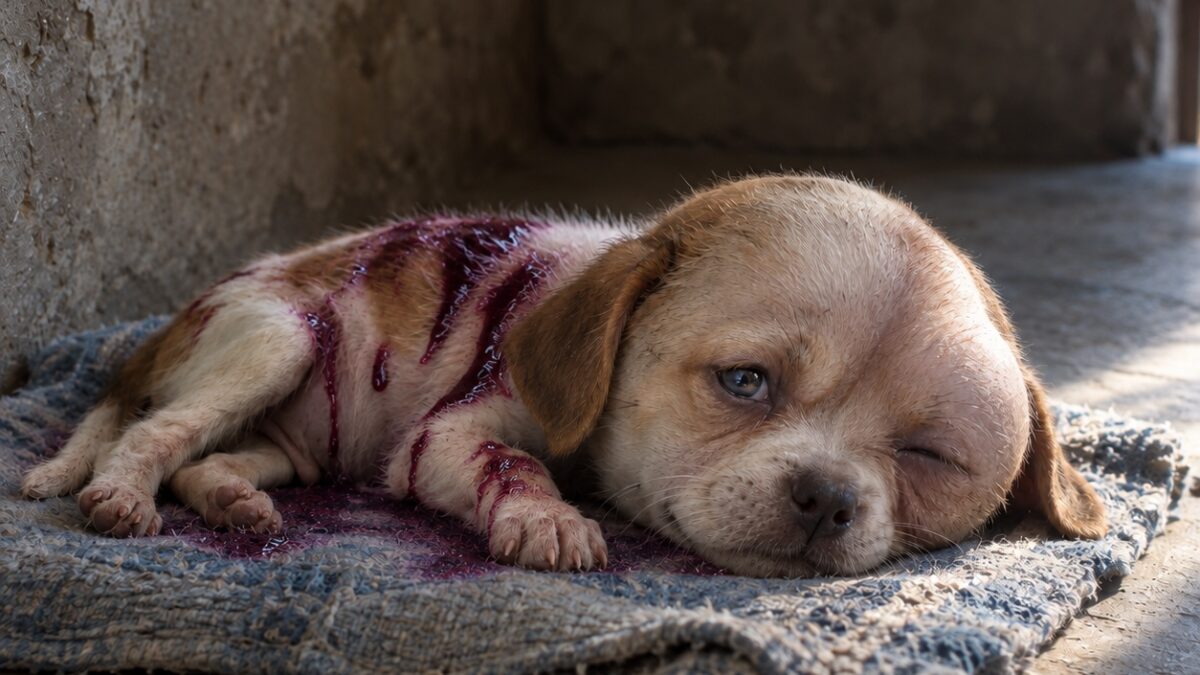
FULL STORY CONTINUATION
The clinic team was ready for her when we arrived.
There was no long introduction.
No waiting to see whether the swelling might settle on its own.
Valentina was far beyond that point.
The veterinarian began examining her almost immediately.
Even gentle handling showed how serious the situation had become.
The swelling around her head was not simply soft tissue irritation.
Fluid had accumulated.
Infection had developed around the bite wounds.
Abscesses had formed.
The wounds had been closed over and hidden by inflammation, trapping pus and inflammatory material inside.
Her little body had been trying to fight all of that while still growing.
Medication was started.
Pain control.
Treatment directed at the infection.
Then the veterinary team began draining her head.
Blood came out.
Then pus.
Then thick inflammatory fluid.
Watching it was difficult.
Not because the procedure was dramatic.
Because every bit of infected material being removed represented something Valentina had been carrying for days.
Pressure.
Pain.
Inflammation.
Her skull was tiny.
There was almost nowhere for swelling to go without causing more problems.
The drainage gave her some relief, but nobody in the room believed we had solved the underlying injury.
The neurological signs were too severe.
The circling.
Difficulty standing.
The strange movements.
The blood.
The extreme swelling.
The veterinarian told us what we were already afraid to hear.
“There may be fractures.”
“How many?”
“We won’t know until we image her.”
“Could it be one?”
“Yes.”
The veterinarian paused.
“But based on the trauma, there may be more.”
X-rays were taken.
I remember waiting for the images and trying not to create a future in my head.
That is one of the worst habits during rescue.
You begin imagining outcomes before you have facts.
Maybe it is one small fracture.
Maybe medication fixes the swelling.
Maybe the infection clears.
Maybe she goes home in two days.
Maybe.
Then the X-rays came back.
The veterinarian looked at them.
Then looked again.
His expression told us before his words did.
Valentina’s skull was fractured.
Not one small fracture.
Not one isolated crack.
The attack had damaged almost the entire skull.
I stared at the image.
A puppy that young should not even have been surviving what we were seeing.
Her bones were delicate.
Still developing.
And now so much of the structure protecting her brain had been broken.
I asked the question nobody wanted to ask.
“Can she survive this?”
The veterinarian did not offer reassurance he could not guarantee.
“She needs neurological evaluation.”
That was the honest answer.
Her condition was too complicated for guesses.
We needed someone who understood brain and spinal injuries at a specialized level.
A veterinary neurologist.
That consultation alone cost approximately $250.
Normally, that number would not sound enormous compared with major surgery.
At the time, every amount mattered.
Valentina also needed specialized recovery nutrition.
Each can cost around $25.
And she was not going to need one can.
She needed enough nutrition to support a body already trying to heal trauma, infection and severe inflammation.
Then there was the possibility nobody wanted to say too loudly.
Skull surgery.
If the broken bone was unstable or pressing into surrounding tissue, if infection could not be controlled, if the fractures threatened her brain, surgery might become unavoidable.
But Valentina was barely a month old.
That fact complicated everything.
A large dog with a mature body can be a serious surgical patient.
A tiny puppy with widespread skull fractures, active infection and neurological symptoms is another level of risk.
Anesthesia itself mattered.
Blood loss mattered.
Temperature control mattered.
Every decision had to account for how very little puppy there was to work with.
So the first goal was stabilization.
Not heroic surgery.
Not rushing because we were frightened.
Stabilize her.
Control infection.
Drain the fluid.
Support her body.
Feed her.
Observe her neurological status.
Run blood work.
Then gather better images.
The veterinary team kept draining the damaged areas as needed.
In the beginning, the material coming out was ugly.
Thick pus.
Blood.
Inflammatory fluid.
Exactly what you would expect when severe bite injuries had been allowed to sit for a week.
We cleaned.
Medicated.
Waited.
Repeated.
Valentina endured more than any puppy that age should ever have known.
But something about her surprised us.
She remained responsive.
People online began making conclusions based on photographs and short videos.
Some said she was brain-dead.
They saw the enormous swelling.
The circling.
The neurological abnormalities.
And decided they knew the diagnosis.
We did not argue much.
We were too busy treating the puppy in front of us.
Because Valentina was still there.
She responded.
She moved.
She ate when able.
She recognized handling.
She was not a diagnosis written by strangers behind screens.
Assumptions were not neurological examinations.
Comments were not CT scans.
The only people who could tell us what was happening inside Valentina’s head were the veterinarians actually examining her and the specialists interpreting her imaging.
So we kept going.
Day by day, something began to change.
The fluid draining from her head became different.
Less thick.
Less infected.
The pus decreased.
Eventually, what came out became clearer, with only some blood mixed through it.
That was not a guarantee.
But it was encouraging.
The infection might finally be losing ground.
Valentina’s general condition began improving too.
Not dramatically overnight.
Little signs.
She seemed slightly more present.
More interested.
Her body no longer looked like it was spending every available bit of energy simply enduring the swelling.
She began showing us pieces of the puppy hidden beneath the medical emergency.
A look.
A movement.
Interest in food.
The desire to move when she had enough strength.
You learn to protect yourself emotionally during difficult rescues.
You do not say:
She’s going to make it.
You say:
Today is better.
Because tomorrow can change everything.
Valentina’s case had already taught us that.
We collected blood for the testing she needed.
We checked whether her little body was stable enough for the next step.
The CT scan.
X-rays had shown the fractures.
A CT could show them in detail.
The exact pattern.
Bone fragments.
How the skull was healing.
Whether broken pieces threatened the brain.
Whether surgery was necessary.
It was the examination that could turn uncertainty into a surgical plan.
It was also another expense.
Then somebody stepped forward.
A sponsor offered to pay for Valentina’s CT scan.
There are moments in rescue when a donation does more than cover an invoice.
It removes a wall.
Before that offer, we were asking:
How do we afford the next answer?
Afterward:
Schedule it.
The sponsor later came to the clinic.
He wanted to meet the tiny puppy whose scan he had paid for.
By then, Valentina had already begun looking different from the first images.
Still recovering.
Still medically fragile.
Still carrying the evidence of enormous trauma.
But more alive in her expression.
The man looked at her for a long time.
It is one thing to see suffering online.
Another to stand a few feet from a puppy who fits into your arms and understand that most of her skull has been fractured.
Valentina moved.
Watched.
Interacted.
She was not the motionless creature people had written off.
She was a puppy in treatment.
A very sick puppy.
But still a puppy.
The scan was completed.
Then we waited for the neurosurgeon’s interpretation.
That wait was different.
By then, we knew enough to understand how serious the answer might be.
The specialist reviewed the images.
When he finally spoke about what he saw, even he sounded stunned.
Valentina should not have been doing as well as she was.
There were so many fractures.
So much damage.
Her survival itself seemed extraordinary.
The neurosurgeon called it a miracle that she was still alive.
But there she was.
Walking.
Eating.
Playing.
That last word mattered.
Playing.
A puppy whose skull had been shattered.
A puppy who had spent seven untreated days with swelling and infection so severe that her head became distorted.
A puppy strangers said was brain-dead.
Playing.
Not because the danger had passed.
It had not.
But because somewhere inside Valentina, life was still producing puppy behavior.
Curiosity.
Food.
Movement.
Small bursts of joy.
I remember watching her one day and thinking how unfair survival stories can become when humans tell them.
We like brave animals.
Fighters.
Warriors.
We say:
She refused to give up.
Valentina did survive astonishing things.
But she was not sitting there making inspirational decisions.
She was a baby.
Her body was doing what living bodies do.
Fighting infection.
Growing tissue.
Building bone.
Trying to protect the brain.
Her job was to be a puppy.
Our job was to give that body every possible chance.
The scan showed that chance would require surgery.
Neurosurgery.
The word landed heavily.
This was no longer:
Maybe.
Valentina needed an operation.
The fractured bone had created ongoing problems.
Loose pieces.
Sharp fragments.
Inflammation.
Infection.
Abscess formation.
The damaged skull could not simply be ignored.
Medication had helped stabilize her.
Drainage had controlled part of the infection.
Her strength had improved.
Now the surgeons needed to deal with the shattered bone itself.
The surgery was scheduled.
The night it happened, I watched the clock.
11:20 p.m.
That was when Valentina was carried into the operating room.
So much of rescue is movement.
You drive.
Carry.
Call.
Sign.
Pay.
Clean.
Feed.
Ask.
There are also moments when movement stops.
Surgery is one.
You hand the animal over.
The doors close.
Then there is nothing useful you can do.
Waiting is its own kind of pain.
I kept thinking about how small she was on the first night.
One paw.
That enormous swollen head.
The circling.
The blood.
Then:
Thirty-six days old.
Clinic.
Drainage.
X-rays.
Neurologist.
CT.
Now operating room.
All of it packed into such a short life.
A puppy should have memories of milk and sleeping against littermates.
Valentina’s first weeks had become anesthesia forms and scans.
The operation took longer and became more complicated than the team had expected.
When the surgeons opened the injured area, they discovered something remarkable.
Valentina’s body had not been waiting passively for medicine to save it.
Healing tissue was already forming.
New bone growth had begun.
Her body was trying to rebuild a protective structure around her brain.
Quietly.
Day after day.
Even while infection remained.
Even while pieces of the original skull were broken.
The surgeons found loose and sharp fragments of damaged bone.
Those pieces were contributing to inflammation.
Infection.
The abscesses.
They carefully removed them.
Precision mattered enormously.
Every fragment existed near delicate neurological tissue.
The surgery had to clear dangerous bone without creating new injury.
The team had originally considered placing an implant over part of the skull.
A protective artificial structure.
But once they saw the healing already taking place, the decision changed.
Valentina’s own tissue and developing bone were forming a natural barrier.
The surgeons chose to respect that process rather than replace it unnecessarily.
Remove what was dangerous.
Clean.
Allow the healthy healing tissue to continue its work.
Then came the words we had been waiting for.
She survived.
Valentina came out of surgery alive.
Alive.
I remember repeating that word because after everything, it still felt fragile.
Surgery completed did not equal recovery completed.
She had endured a major neurological operation at an age when most puppies were still learning basic coordination.
She still had to wake properly from anesthesia.
Avoid complications.
Keep infection controlled.
Heal the surgical site.
Eat.
Rest.
Keep moving forward.
But she had crossed another line.
The one that had frightened us most.
She was still here.
Her recovery after surgery began.
Again, not one dramatic transformation.
Monitoring.
Medication.
Feeding.
Checking the incision.
Watching her neurological signs.
Making sure the puppy who had surprised the neurosurgeon continued to surprise us.
Valentina did.
Slowly.
She regained energy.
The swollen, distorted face we remembered from the first day became less recognizable.
Not because we forgot it.
Because healing was changing what we saw.
She had more normal puppy moments.
Eating.
Looking for attention.
Moving around.
Playing when she felt well enough.
Little signs that her world was becoming larger than the inside of a veterinary clinic.
Eventually, she was strong enough to leave.
Home.
That word felt enormous.
After days of hospitalization, procedures, needles, imaging and surgery, Valentina was carried out.
The same puppy who once spent seven untreated days getting weaker now had survived specialized neurological care and an operation on her shattered skull.
We wanted to believe the hardest part was finished.
Everyone did.
Then the surgical flap reopened.
I remember the message.
Something had changed at the incision.
Part of the flap had come apart.
After everything her little body had already endured, the wound was no longer holding the way we needed it to.
There are moments when rescue work makes you angry at biology itself.
How much more?
How much should one puppy have to tolerate?
Valentina had already been bitten.
Already developed infection.
Already spent a week untreated.
Already endured drainage.
Imaging.
Medication.
A major operation.
Now she had to go back.
There was no alternative.
An open surgical site around a skull injury is not something you wait casually to see.
The risk of infection and complications mattered too much.
So the trip began again.
Back to the clinic.
Back to the doctors.
Back to preparation.
A second operation.
The emotional weight of the second surgery felt different from the first.
Before the first, we were terrified because we did not know whether her tiny body could handle neurosurgery.
Before the second, we knew exactly what she had already survived.
That knowledge cuts both ways.
You know she is strong.
You also know how much has already been asked of her.
One of us said:
“This poor baby.”
There was nothing more intelligent to add.
Valentina did not understand why she was going back.
She only knew familiar hands were carrying her again.
I hated that.
You want rescued animals to learn:
Hands mean home.
Food.
Comfort.
Instead, sometimes loving hands have to carry them into painful treatment.
That does not make the care less loving.
But it makes it emotionally complicated.
The second surgery began.
Again, we waited.
Again, the doors were closed.
Again, all the optimism in the world could not replace a surgeon’s skill and Valentina’s physical ability to tolerate another procedure.
Then:
She made it.
Again.
Valentina survived her second operation.
At that point, I stopped trying to predict what she could or could not overcome.
Not because she was invincible.
She was not.
She was a vulnerable young animal whose life had repeatedly depended on veterinary intervention.
But every time we reached a point that seemed almost impossible, her body found enough strength for the next day.
This time, the surgical site healed.
Properly.
The infection continued resolving.
The dangerous bone fragments were gone.
Her body continued producing protective tissue and new bone.
The pressure and swelling that had defined her earliest rescue photographs disappeared.
The neurological problems improved.
Then something happened that even those of us hoping for the best had been afraid to say aloud.
Valentina recovered.
Completely.
Not:
She survived but remained profoundly disabled.
Not:
She lived but required constant neurological support.
Not:
She improved enough to manage.
She healed.
The tiny puppy whose skull had been fractured almost everywhere became a healthy, strong dog.
Even the veterinary team who had seen the images could look at Valentina later and struggle to connect her with the patient they first treated.
The face changed.
The posture.
The energy.
The eyes.
Most of all:
The way she moved through the world.
No helpless circling.
No enormous swollen head.
No blood from her mouth.
No drains releasing infected fluid.
No surgical waiting room.
She ran.
Played.
Ate.
Slept.
Did all the boring things healthy dogs do.
Boring became beautiful.
I remember one of the first times I watched her playing after we could truly call her recovery successful.
She moved quickly.
Too quickly to photograph easily.
A normal problem.
Someone laughed.
“Slow down, Valentina.”
She did not.
Why would she?
For weeks, everything in her life had been about restrictions.
Be careful.
Stay still.
Medication.
Treatment.
Protect the head.
Watch the wound.
Now she had a body that could move.
So she used it.
I watched her little face.
The swelling gone.
The surgical trauma healed.
And I thought:
That is the same skull.
Not literally unchanged.
Of course not.
Bone had been removed.
New bone developed.
Tissue healed.
But the same head we once feared might never survive was now attached to a dog who wanted to play.
That is extraordinary enough without exaggeration.
Her story spread while she recovered.
People who had first seen images of a frighteningly injured puppy saw later updates.
Some could not believe it.
I understood.
If I had seen only the first and final pictures with nothing between, I might have wondered whether they were the same dog too.
The contrast was extreme.
But the middle mattered.
Recovery did not happen because of one miracle moment.
It happened through a chain.
People raised money.
Somebody went to get her.
Veterinarians examined her.
Medication started.
Fluid was drained.
Infection treated.
X-rays taken.
Blood tested.
Special food provided.
Neurological evaluation arranged.
Someone paid for the CT scan.
A neurosurgeon studied the images.
Surgeons operated late at night.
Loose bone was removed.
Healing tissue protected.
A wound reopened.
Another trip.
Another operation.
More recovery.
Then time.
You cannot remove the middle and honestly tell the story.
Hope is not an alternative to medical care.
Hope helped people keep funding the care.
Keep driving.
Keep waiting.
But antibiotics still had to work.
Surgeons still had to operate.
Imaging still had to show them where.
Nutrition still had to support growth.
Valentina’s own biology still had to heal.
Her recovery was a collaboration between persistence, medicine and a young body capable of extraordinary repair.
I liked that truth more than any magical version.
Eventually, the next question arrived.
Home.
Not temporary recovery.
Permanent home.
Valentina had spent the beginning of her life inside crisis.
Now she needed what healthy puppies need.
Consistency.
Safety.
Food.
Play.
Someone whose role was no longer rescuer or veterinary professional.
Family.
A kindhearted man opened his home to her.
I remember being careful with my emotions at first.
After a rescue this intense, people become protective.
Not because potential adopters are suspicious.
Because everyone who carried the animal through treatment begins subconsciously believing nobody else could possibly understand what she survived.
That is not fair.
A successful rescue has to let go.
The goal is never:
Keep her a patient forever.
The goal is:
Make her somebody’s dog.
The man wanted Valentina.
Not the tragedy.
Not the publicity.
Her.
The energetic dog.
The beautiful face.
The personality that had emerged after pain stopped controlling every minute.
He gave her a home.
A real one.
The kind where the most important questions become:
Did she eat?
Where is her toy?
Why is she running through the house?
What did she get into?
Has anyone seen the sock?
Ordinary dog questions.
No neurosurgeon needed.
No late-night surgery schedule.
No drainage.
That was the life we wanted for her.
At first, I still watched every update too carefully.
How is she moving?
Any swelling?
Eating normally?
Any neurological sign?
Trauma teaches rescuers hypervigilance too.
You see catastrophe once.
Then every small thing looks like a possible return.
Valentina did not care about our anxiety.
She played.
Ate.
Grew.
Became stronger.
Her body was finished proving itself to us.
We needed to believe it.
One update showed her smiling.
I know dogs do not smile exactly as humans do.
But anybody who loves dogs knows the expression people mean.
Relaxed mouth.
Bright eyes.
Face open.
Comfort.
There was none of the strain from the first photographs.
That face once distorted by swelling now looked joyful.
I stared longer than necessary.
Then went back to the first images.
Not because I enjoy suffering.
Because sometimes you need to remember distance.
Twenty-nine days old.
Mother’s bite.
Skull fractured.
Seven untreated days.
Thirty-six days old.
Rescue.
Clinic.
Drainage.
X-ray.
Neurology.
CT.
Surgery.
Second surgery.
Recovery.
Home.
Each word holds hours we cannot compress.
Her adopter did not receive the puppy from the first photograph.
He received everything she became because people refused to accept that photograph as her final form.
That matters.
Someone once commented that Valentina was lucky.
Yes.
She was lucky rescuers learned about her.
Lucky people donated.
Lucky specialized veterinary care became available.
Lucky a sponsor covered imaging.
Lucky surgery was possible.
Lucky infection responded.
Lucky her body healed.
But luck did not drive the car.
Luck did not clean wounds.
Luck did not hold her through procedures.
Luck did not read scans.
Luck did not perform neurosurgery at 11:20 at night.
People acted.
I think we sometimes call an animal lucky because naming the number of human decisions required feels overwhelming.
Valentina needed many people.
No one person could have created the outcome alone.
The family who could not afford her veterinary care could not solve it.
The rescuers could not perform surgery.
The clinic could not necessarily fund every specialist expense itself.
The sponsor could pay for the CT but could not remove bone fragments.
The neurosurgeon could operate, but recovery still depended on nursing care.
The adopter could give a home only because everybody before him got Valentina there alive.
Rescue is a chain.
Break one link at the wrong moment and the ending changes.
That is why I always return mentally to those first seven days.
They could have been the end.
By the seventh day, Valentina’s condition had worsened terribly.
If we had learned about her later—
I stop the thought there.
We did not.
We learned when we learned.
We acted when we could.
Regret about an alternate timeline does not help the animal who survived.
Still, the seven days teach something.
Pain does not become less urgent because poverty caused the delay.
The family’s lack of money was real.
So was Valentina’s suffering.
Both truths need to exist without turning the story into something simpler than it was.
It is easy to look at a severely injured animal and ask:
Why didn’t someone take her to a vet?
Sometimes the answer is:
They could not afford to.
That does not make the injury acceptable.
It does explain why rescue networks, donations and accessible veterinary care matter.
Without outside help, Valentina had no route to treatment.
Compassion without resources can become helplessness.
Resources turn compassion into action.
The first fundraising requests were not glamorous.
Help us pay.
We need money for a puppy.
People scroll past dozens of requests like that.
Somebody stopped.
Then somebody else.
A sponsor paid for the CT.
Each person saw only one part.
Together, they bought medical possibility.
That is the less cinematic side of hope.
Invoices.
The neurologist consultation was about $250.
Recovery food around $25 per can.
Imaging.
Operations.
Hospitalization.
Medication.
All of it costs money.
Valentina did not know.
Good.
Animals should not have to know economics.
She only experienced whether treatment happened.
Humans had to solve the rest.
The sponsor who paid for the scan eventually meeting her became one of my favorite moments because it connected an abstract donation to a living animal.
He had paid for images.
What he actually bought was information.
Information that allowed specialists to understand her skull.
Information that helped decide surgery.
He visited and saw Valentina in front of him.
Moving.
Responding.
Developing personality.
A donation became a puppy.
That is powerful.
The neurosurgeon’s reaction mattered too.
Professionals see terrible things.
You learn not to use the word miracle casually.
But when a specialist looks at extensive fractures and says survival itself is remarkable, you listen.
Valentina had no business being dismissed by strangers online as already gone.
Her scans showed massive injury.
Her behavior showed life.
Both were true.
That taught us to resist another dangerous tendency.
Images can shock people into certainty.
They see an injury and say:
There is no quality of life.
They see neurological movement and say:
Brain dead.
They see swelling and say:
Put her down.
Sometimes those conclusions may ultimately be correct in other cases.
But diagnosis belongs to veterinarians with the patient and the evidence.
Not comments.
Valentina needed assessment.
Not assumptions.
That difference gave her time.
Her case also taught me that improvement does not always look dramatic at first.
We celebrated fluid becoming clearer.
Think about that.
Not running.
Not playing.
Fluid.
Less pus.
A medical change most people would never want to see became hope.
Then blood work.
Then stability.
Then CT eligibility.
Recovery is built out of tiny thresholds.
Stable enough for scan.
Strong enough for anesthesia.
Infection controlled enough for surgery.
Wound healed enough to go home.
Flap repaired.
Incision closed.
Eat.
Move.
Grow.
None sound like a miracle by themselves.
Stack them together.
Dog survives.
That is how medicine creates outcomes people later call miraculous.
The first operation remained the moment I thought about most.
11:20 at night.
Why does an exact time stick in memory?
Because waiting forces you to attach fear to numbers.
11:20.
Door closes.
Midnight.
Still waiting.
Time moves.
Somewhere behind that door, surgeons are holding the future of something small enough to carry in two hands.
We had already done everything we could to get her there.
Then skill passed to someone else.
The surgery’s unexpected finding—that new tissue and bone were already forming—felt almost like discovering Valentina had been participating in her own rescue all along.
Again, biologically, of course she was.
Bodies heal.
That is what they do.
But emotionally, seeing new bone after so much destruction felt profound.
The attack had broken her skull.
Her body was building.
Destruction and repair happening in the same place.
The surgeons had considered an implant.
Then looked at what Valentina was already producing.
Natural protection.
Developing barrier.
They decided to trust it.
That decision required judgment.
More intervention is not automatically better.
Sometimes good surgery means knowing what to remove and what to leave.
They removed the dangerous pieces.
Loose.
Sharp.
Inflamed.
Infected.
Then let healthy healing continue.
That balance became part of Valentina’s recovery.
When the flap reopened later, it felt like betrayal.
Not by anyone.
By hope.
We had finally allowed ourselves to think:
The surgery worked.
She is home.
Then another problem.
Back.
Second operation.
That is where many rescue stories become dishonest in retelling.
They compress setbacks.
We like upward lines.
Rescue.
Treatment.
Better.
Adopted.
Real healing zigzags.
Valentina’s did.
Improvement.
Surgery.
Recovery.
Complication.
Second surgery.
Recovery again.
The setback did not erase progress.
It required more work.
That is an important distinction.
When the flap reopened, nobody said:
Everything failed.
They said:
We need to go back.
That mindset matters.
A complication is not automatically defeat.
It is new information.
New problem.
Solve what can be solved.
Valentina survived the second operation.
Then finally, healing held.
The first time someone used the phrase “complete recovery,” I almost did not trust it.
Complete?
After all of that?
But yes.
The puppy who had moved in circles because neurological injury was affecting her coordination grew into a dog who could run.
The puppy who struggled through pain ate normally.
The puppy whose head was grotesquely swollen developed a beautiful, proportionate face.
Scars became history rather than crisis.
Her adopter saw a dog.
Not a medical emergency.
That is the highest compliment recovery can receive.
People sometimes ask whether she remembered what happened.
We cannot know.
Dogs remember experiences in their own ways.
Maybe hands around her head remained sensitive for a while.
Maybe clinics frightened her.
Maybe none of it carried forward consciously.
I do not invent trauma where I cannot see it.
What I know is what she did later.
She played.
Ran.
Ate.
Engaged.
Enjoyed being alive.
Whatever remained from the beginning did not stop her from using the life in front of her.
That is enough.
Her name fit her strangely well.
Valentina.
A name we gave a tiny puppy when we had no guarantee she would survive the night.
Later it sounded almost inevitable.
Strong.
Loved.
But at the beginning, names do not know endings.
We could have named her Valentina and lost her.
That possibility was real.
Naming an animal does not protect them.
Treatment does not guarantee them.
Love does not control biology.
I think recognizing that made the final outcome more meaningful.
Nobody had certainty.
They acted anyway.
Hope is often misunderstood as believing everything will be fine.
That is optimism.
Hope can be much more practical.
We do not know if she will survive.
Treat her.
We do not know if she can tolerate surgery.
Stabilize her.
We do not know if the skull can heal.
Scan it.
We do not know if the second operation will work.
Try.
Hope is action without guarantee.
Valentina received that from people repeatedly.
The kindhearted man who eventually adopted her entered the story at the end, but his role mattered just as much.
Medical rescue creates survival.
Family creates life.
There is a difference.
A dog can be medically cleared and still need belonging.
Valentina went from being surrounded by people because she was sick to being surrounded by someone because she was loved.
That transition is easy to overlook.
At the clinic:
People watch you constantly because something is wrong.
At home:
Someone watches because you are theirs.
Both are care.
Different forms.
The latter is what rescue aims toward.
Her adopter gave her ordinary days.
The days of hospital rooms ended.
No drainage trays.
No scan appointments.
No surgeons.
No crisis fundraising.
Morning.
Food.
Play.
Rest.
Affection.
The luxury of becoming unremarkable.
I love unremarkable rescued dogs.
Nothing makes me happier than an update where the biggest problem is that a former medical emergency stole a shoe.
That means the center of the story moved.
Valentina’s center moved.
Eventually, the first photograph stopped defining her.
That is why I am careful when telling her story now.
The injuries were extreme.
We should not minimize them.
But if I spend nine paragraphs describing the shattered skull and one sentence describing the life afterward, I accidentally let the violence own her.
It does not.
Her mother’s bite was something that happened to Valentina.
It was not Valentina.
The seven untreated days were part of her history.
Not her identity.
The surgeries were chapters.
Not the whole book.
Today’s dog matters too.
Healthy.
Strong.
Beautiful.
Joyful.
Loved.
That balance is important in rescue storytelling.
Suffering attracts attention.
Recovery deserves equal space.
When I look at Valentina now, the word helpless no longer fits.
It fit the twenty-nine-day-old puppy.
Of course.
She could not rescue herself.
Could not pay for care.
Could not describe pain.
Could not drive to a clinic.
Adults had to act.
But the grown dog is not a frozen image of helplessness.
She moves under her own power.
Chooses toys.
Runs toward what interests her.
Responds to affection.
Has preferences.
Her life belongs to her in a way it could not when every hour depended on medical decisions.
That feels like justice.
Not punishment for whoever failed her.
Freedom from the condition that once defined her.
I do not know what happened to her mother after the attack.
The source does not tell us.
I will not invent a story about an evil mother dog.
Maternal aggression can happen for many reasons.
Stress.
Pain.
Instinct.
Illness.
Environmental pressure.
We do not know.
The injury was horrific.
That does not require turning an animal into a villain with human motives.
The mother bit her.
Valentina was severely injured.
Those facts are enough.
The human family’s poverty also deserves accuracy.
They could not afford care.
That does not mean they enjoyed watching her suffer.
The delay was dangerous.
The suffering was unacceptable as a medical condition.
But poverty is not cruelty by definition.
The rescuers’ role was not to build a moral trial.
It was to get the puppy treated.
That focus helped.
Who can take her?
Who can pay?
Which clinic?
What does she need?
Useful questions.
Outrage can motivate action, but it can also consume energy animals need directed elsewhere.
Valentina needed less commentary.
More medicine.
She got it.
Later, when people asked how we knew she still wanted to live, I never loved the phrasing.
Animals do not sign philosophical statements.
What we saw was behavior.
She responded.
She ate.
She moved.
She played.
Her body healed.
Those facts justified continued assessment.
The specialist’s role was to determine medical possibility.
Not ours to romanticize.
Still, watching her eat during recovery felt emotional.
Food is ordinary until someone has been close to death.
A bite.
Chew.
Swallow.
Another.
Nutrition entering a body trying to rebuild skull bone.
Twenty-five dollars a can sounded expensive.
Then you watched her eat it.
Price turned into tissue.
Energy.
Healing.
Worth it.
Every can.
The neurological evaluation cost money.
Worth it.
CT scan.
Worth it.
Surgery.
Worth it.
Not because every expensive intervention must always be pursued regardless of prognosis.
That would be irresponsible.
In Valentina’s case, specialists believed a meaningful recovery remained possible.
The outcome proved that possibility was real.
Good rescue is not:
Do everything because stopping feels like failure.
It is:
Get qualified assessment.
Understand prognosis.
Treat when treatment can reasonably relieve suffering and restore life.
Valentina had that pathway.
So we followed it.
The second surgery could have emotionally pushed people toward:
Enough.
How much can she take?
But the medical team saw a repairable complication.
That distinction mattered.
If the suffering had become hopeless or untreatable, compassion might have required a different decision.
It did not.
There was another operation.
She survived.
Then healed fully.
I say that because rescue stories should not accidentally teach that persistence is always medically correct.
Persistence needs professional guidance.
Valentina’s team had it.
That is part of why she is here.
Her sponsor visited after the CT.
I sometimes wonder what he thought when he later saw the final photographs.
He paid for one scan.
One moment in a much larger chain.
But without that image, surgical planning might have been delayed.
One person does not have to save the whole animal.
Sometimes you pay for one step.
Drive one trip.
Share one post.
Give one meal.
Hold one paw.
Medicine and rescue are full of partial contributions.
Humans like complete ownership of good outcomes.
Reality distributes credit.
That should encourage people.
You do not need enough money to fund every surgery to matter.
You can fund part.
You do not need space to adopt every dog to help.
You can foster one.
You do not need to be the surgeon.
You can help the puppy reach one.
Valentina was saved by accumulation.
Money.
Skill.
Time.
Transport.
Care.
Someone finally saying:
She can live with me.
Accumulation created a life.
The older Valentina got, the more physically impossible her baby photographs seemed.
Dogs grow quickly.
Soon the tiny thirty-six-day-old body existed only in memory and images.
Her head became normal.
Her legs stronger.
Her movements coordinated.
One day someone sent a video of her running.
I replayed it.
Once.
Twice.
Three times.
Not because the running itself was extraordinary for a dog.
Because circling had once been one of her most frightening symptoms.
She had tried to walk and could not travel straight.
Now she chose a direction.
Ran there.
Turned because she wanted to.
Not because neurological damage forced her body into a loop.
That difference made me cry.
Movement had become choice again.
Later, another video showed her eating.
Normal.
Fast.
Enthusiastic.
I remembered blood in her mouth.
Another contrast.
Then sleeping peacefully.
No clinic.
No monitor.
No one hovering.
Recovery hides its greatest achievements inside ordinary behavior.
A healthy dog sleeping is boring.
To people who watched Valentina fight through two skull surgeries, it was luxury.
Her adopter never needed to know every moment we experienced.
He knew the important medical history.
Of course.
But he did not need to carry our fear forever.
He could build his own relationship with her.
That is another part of letting go.
Rescuers sometimes tell adopters so many stories about an animal’s past that the new family becomes afraid to treat them normally.
Valentina deserved normal.
Careful where medically appropriate.
Normal where safe.
Let her play.
Let her run.
Let her become more than “the skull fracture dog.”
The adopter did.
Today, if somebody met her without knowing the story, they might never guess.
That is beautiful.
Not because scars are shameful.
Because pain is not currently controlling her.
A stranger sees a gorgeous, joyful dog.
Exactly.
That is who she is now.
The most beautiful smile, people say.
Maybe.
I see something else.
Relaxation.
The face no longer bracing against pain.
That is better than beauty.
At the beginning, Valentina’s face was distorted by swelling because the body was screaming:
Something is wrong.
Now the face says nothing urgent.
That silence is healing.
No emergency.
No desperate fundraising post.
No warning.
Just dog.
One evening, someone asked me:
“When did you know she was going to survive?”
I thought.
There was no one moment.
Not rescue night.
Too unstable.
Not after drainage.
Too early.
Not after X-rays.
If anything, worse.
Not after CT.
Surgery ahead.
Not after first operation.
Complication possible.
And indeed, complication came.
Not after the second surgery immediately either.
We still had to watch healing.
Maybe the first time I stopped asking the question.
That might have been when.
You monitor so long for danger that eventually one day you realize the danger is no longer the center.
You are discussing adoption.
Toys.
Food.
Personality.
Then survival quietly becomes assumed.
That is the threshold.
No bell announces it.
You simply start planning life instead of preventing death.
Valentina crossed that threshold.
The first week after rescue, every conversation began with medical condition.
Later:
“She likes this.”
“She plays with that.”
“She’s growing.”
“She’s ready.”
That language shift told us we had won something important.
Patient became puppy.
Puppy became family dog.
I think about the seven untreated days less now.
Not because they do not matter.
Because they no longer deserve the largest share of her life.
She has had many days since.
Better days.
Each one reduces the percentage of her life occupied by that first week.
That is one way time heals.
At thirty-six days old, seven days was enormous.
At one year, smaller.
At several years, smaller still.
The past does not disappear.
Its proportion changes.
I hope Valentina lives long enough that those seven days become a tiny fraction.
That is my favorite kind of revenge against suffering.
More life.
Not dramatic justice.
Arithmetic.
Add good days until the bad ones become outnumbered.
Her adopter is doing that.
Morning.
Afternoon.
Night.
Again.
Love through repetition.
I do not know whether he thinks of himself as part of some miracle.
Probably not.
He feeds his dog.
Cares for her.
Lives with her.
That is enough.
The greatest rescuers eventually become ordinary owners.
That is success.
Valentina does not wake each morning thinking:
I survived nearly complete skull fractures.
She probably thinks:
Breakfast.
Where is my person?
What can I play with?
Good.
Let humans hold the history.
Let her hold the toy.
I have one memory from the early days that returns when I see her now.
She was lying still during treatment.
Her head looked unbearably large.
A small paw extended from beneath her body.
That paw looked normal.
Tiny nails.
Soft pads.
Just a puppy paw attached to a medical case so severe that everything else felt overwhelming.
I remember touching it gently.
Not because touching a paw provided treatment.
Because I needed to remember:
This is a baby.
Not skull fractures.
Not neurological signs.
Not CT cost.
Valentina.
That distinction protects compassion in medicine.
Cases can become conditions.
Animals become diagnoses.
People do too.
Fractured skull in cage three.
Neurological puppy.
Abscess case.
Useful shorthand.
Dangerous if it replaces identity.
Valentina stayed herself through all of it.
Her name helped.
The sponsor saw Valentina.
The neurosurgeon operated on Valentina.
The adopter chose Valentina.
Not Case 147.
Not hopeless puppy.
Valentina.
Names carry personhood in the human mind.
Maybe that is why rescuers name so quickly.
We need something to protect against emotional abstraction.
She was named while we still feared losing her.
The name insisted on a future tense.
Valentina will need this.
Valentina may have surgery.
Valentina is eating.
Valentina is improving.
Then finally:
Valentina is going home.
Words helped us imagine continuity before we had proof.
I remain grateful we tried.
That sounds obvious now.
She lived.
Of course trying was right.
Hindsight makes successful decisions look easy.
At the beginning, the facts were brutal.
One-month-old puppy.
Severe swelling.
Neurological signs.
Seven-day delay.
Blood.
Infection.
Near-total skull fractures.
Possible surgery.
High costs.
Uncertain prognosis.
Some people saw that list and concluded treatment was pointless.
Imagine if their certainty had controlled the decision.
No CT.
No neurosurgeon.
No discovery that new bone was forming.
No removal of sharp fragments.
No second operation.
No recovery.
No joyful dog.
That does not mean every apparently hopeless case will end like Valentina.
They will not.
It means hopelessness should be diagnosed, not guessed.
That is the message I carry from her.
Get information.
Let qualified people assess.
Do not confuse frightening appearance with known outcome.
Valentina looked impossible.
Her body disagreed.
The surgeon found evidence of that disagreement inside her skull.
Healing tissue.
New bone.
Life had been building under the wounds before any of us could see it.
That image stays with me more than anything.
Beneath infection.
Beneath swelling.
Beneath shattered fragments.
Construction.
The body laying down new protection.
Quiet.
Invisible.
Maybe that is why people use Valentina as a symbol of hope now.
Not because hope magically fixed her.
Because healing began before anyone could see enough of it to believe.
The surgeon opened the injured area expecting devastation.
Devastation was there.
So was repair.
Both.
That feels true beyond medicine.
Damage and healing can occupy the same place at the same time.
We tend to wait for pain to disappear before calling something recovery.
Valentina’s skull was recovering while she still needed surgery.
Healing had already started inside an injury that still looked terrible.
That is a more honest image of recovery.
Messy.
Partial.
In progress.
Not pretty.
Real.
When her surgical flap reopened, healing did not vanish.
A complication occurred inside a larger recovery.
The second operation was not proof the first attempt was meaningless.
It was part of finishing the job.
That perspective helped us wait again.
Everything did not reset to zero.
She carried prior healing with her.
Then moved forward.
People who followed her story sometimes sent messages.
“She gives me hope.”
I understood.
Still, I resisted making Valentina responsible for human inspiration.
She did not survive for us.
She survived because she was treated.
If her story helps somebody endure something, beautiful.
But she is allowed to just be a dog.
I think rescuing animals sometimes turns them into symbols so quickly that we forget the best outcome is freedom from symbolic duty.
Valentina does not owe us bravery.
She does not have to perform resilience every day.
She can be lazy.
Naughty.
Hungry.
Playful.
Annoying.
Loved.
The whole range.
Her adopter gives her that.
That is better than a permanent pedestal.
One of the latest images I saw showed her relaxed, healthy and bright.
I tried to find the old swollen puppy inside that face.
Could not.
Then I looked at the ear position.
The eyes.
Something familiar.
Not injury.
Her.
The identity underneath.
Bodies change dramatically through growth.
But there is continuity.
Maybe that is what made the final photograph emotional.
Not “look how pretty she is.”
Look who made it.
Same life.
Same little soul we carried at thirty-six days.
Now occupying a strong body.
That is the miracle if you want to use the word.
Continuity.
She did not become another dog.
The dog everyone thought might die became this one.
The final outcome did not erase the beginning.
It answered it.
The first week asked:
Will pain be everything she knows?
No.
The X-rays asked:
Can a skull this damaged protect a brain long enough?
Somehow, yes—with help.
The CT asked:
Is surgery possible?
Yes.
The first operation asked:
Can her body recover?
Yes.
The reopened flap asked:
Can she survive another setback?
Yes.
Adoption asked:
Can her life finally be about something other than medicine?
Yes.
Today answers the rest.
She runs.
She plays.
She eats.
She is loved.
Clear enough.
Sometimes I imagine the first rescue drive again.
Night.
Valentina in our arms.
Nobody knowing whether we were already too late.
If I could speak to the person I was in that vehicle, I would not tell them the ending.
Maybe I would.
Tempting.
But there is value in remembering that care had to be given without certainty.
If we had known she would recover completely, courage would have been easier.
We did not.
That is why everyone’s choices mattered.
The rescuer who climbed into the vehicle did not know.
The donor did not know.
The sponsor paying for the CT did not know.
The neurosurgeon could not promise.
The surgical team could not guarantee.
The people waiting at 11:20 could not know.
They acted anyway.
That is hope in its most useful form.
Not:
Everything will be okay.
But:
She deserves the chance to find out.
Valentina got that chance.
She used every bit of it.
Today, when she runs through her home with the kindhearted man who adopted her, there is nothing about the movement that tells you how close she once came to losing everything before life had properly begun.
Her steps are straight.
Strong.
Chosen.
When she eats, there is no blood.
When she sleeps, no one is watching her head for dangerous swelling.
When someone touches her, it is not always because a wound needs cleaning.
Sometimes a hand is simply a hand.
Affection.
That detail may be my favorite.
For weeks, touch meant treatment.
Hold still.
Examine.
Drain.
Clean.
Inject.
Operate.
Bandage.
Then home changes touch back into something gentle.
Pet.
Scratch.
Hold.
Love.
The body learns a new pattern.
Valentina deserved that.
Every injured animal does.
Medicine is not the final destination.
Comfort is.
Her story began with a bite from the dog who should have been her safest companion.
It could have taught us to tell a story about betrayal.
I choose not to center that.
Because Valentina’s life became much bigger than the act that almost ended it.
Her story became about the people who reached her.
The veterinarians who did not dismiss her.
The sponsor who paid for information they desperately needed.
The surgeons who opened a shattered skull and found healing already underway.
The second team who repaired the complication.
The man who eventually said:
She can live with me.
That is the direction I want the story to face.
Forward.
The first photograph may be what makes people stop scrolling.
The last one is what matters.
Healthy dog.
Happy face.
Family.
Sometimes rescue endings are complicated.
Chronic medication.
Disability.
Ongoing pain management.
That can still be a good life.
Valentina’s ending happened to be extraordinary in another way.
Complete recovery.
We had barely allowed ourselves to imagine it.
Then it happened.
There is joy in being wrong about how limited the future might be.
I was wrong.
The people who feared permanent neurological damage were wrong.
The strangers who declared her already gone were very wrong.
The surgeons themselves were surprised.
Valentina got to prove all of us incomplete.
Not through determination in the human sense.
By healing.
By growing.
By staying alive long enough for medicine to work.
That is enough.
If I tell her story years from now, I will probably still start with the number.
Twenty-nine days old.
Because age makes the injury shocking.
But I want to end with a different number.
Not a medical bill.
Not surgery time.
Not fracture count.
Days.
All the days she has had afterward.
I hope they become too many to count.
That is what she deserved from the beginning.
Not extraordinary suffering.
Ordinary years.
A family.
Meals.
Play.
Rest.
Someone waiting for her.
A safe place to sleep.
She did not get the beginning she should have had.
We cannot rewrite that.
We helped change what came after.
And in the end, that tiny puppy who once lay for seven days with a shattered skull, untreated and growing weaker, did not merely survive long enough to become a rescue story.
She survived long enough to stop needing one.
She became Valentina.
Healthy.
Strong.
Joyful.
Loved.
And the skull everyone feared could never protect her again quietly rebuilt itself around the life she refused to lose.








