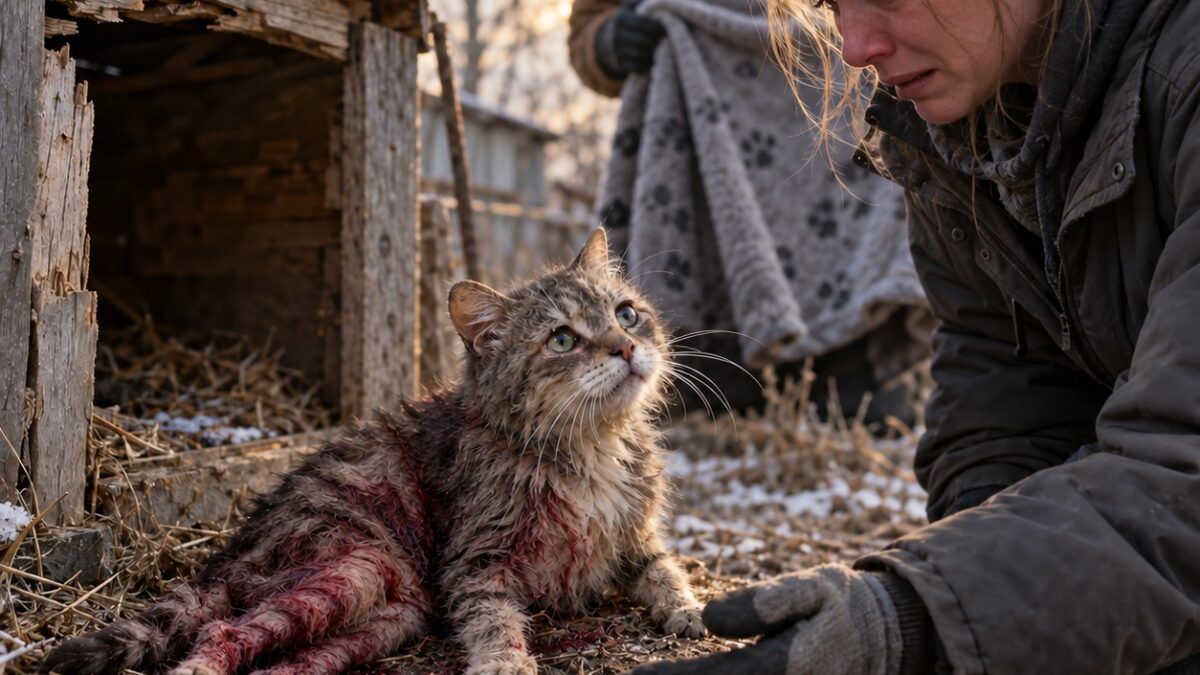
FULL STORY:He Lay Beside a Broken Doghouse Unable to Move His Back Legs—Then One Look Made Us Refuse to Leave Him There
FULL STORY CONTINUATION
The first veterinary examination stripped away any comforting explanations.
Koksik was not simply weak.
He was not an exhausted cat who needed food and a few days indoors.
His back legs were completely paralyzed.
There was no movement.
No attempt to bear weight.
No small reflexive push that made us think perhaps exhaustion had only made him look worse than he was.
The problem was real.
Serious.
And not limited to his legs.
His body was struggling with basic functions.
There were signs of deeper internal complications.
His appetite was nearly gone.
He had reached the kind of condition where one problem feeds another.
A cat that does not eat becomes weaker.
A weaker body tolerates illness and stress poorly.
Limited movement creates additional care needs.
Everything becomes harder at once.
He lay on the examination surface while people spoke quietly above him.
Veterinary conversations sound different when prognosis is good.
People move more quickly toward plans.
Medication.
Rest.
Nutrition.
Follow-up.
When prognosis is poor, silence appears between sentences.
Koksik’s room had that kind of silence.
Low chances.
Poor prognosis.
Quality of life.
The phrases arrived carefully.
Nobody wanted to say more than the medicine supported.
Nobody wanted to promise what could not be promised.
But nobody wanted to pretend the situation was mild either.
Someone eventually raised the question every rescuer dreads.
Would letting him go be kinder?
I understood why.
There are times when love is not the same as continuing treatment forever.
Sometimes the body is suffering without a realistic path toward comfort.
Sometimes refusing to let go serves the human more than the animal.
That question deserves honesty.
But Koksik complicated it.
Because he was still there.
Not merely alive in the technical sense.
Present.
Watching.
Responding in small ways.
His body had failed him terribly.
His spirit had not completely disappeared with it.
Whenever someone entered, his eyes tracked the movement.
When a hand approached gently, he noticed.
Sometimes he seemed too exhausted to do much more.
Other times there was a little more awareness.
A little more connection.
Nothing dramatic.
But enough to make everybody hesitate before deciding his future for him.
We asked the veterinary team the questions that mattered.
Was he in uncontrolled suffering that could not be managed?
Was there any reasonable chance of stabilizing his general condition?
Could he eat again?
Could he become comfortable even if the paralysis remained?
Could a paralyzed cat still have quality of life?
The answers were not simple.
That was the point.
The paralysis was severe.
Nobody was promising recovery of the back legs.
But paralysis alone does not erase every possibility of comfort, appetite, attachment, curiosity, rest, or affection.
The larger question was whether Koksik’s overall health could improve enough for those things to exist.
So we continued.
Not because success was guaranteed.
Because it was not yet clear that failure was inevitable.
The first days were exhausting.
Treatment.
Monitoring.
Medication.
Careful feeding.
Cleaning.
Repositioning.
Watching.
Waiting.
Every part of Koksik’s day required attention he could not provide for himself.
If he shifted awkwardly, someone helped.
If he seemed uncomfortable, someone checked.
If he refused food, we tried again later.
If he ate even a little, we remembered exactly how much.
Progress was measured in bites.
In expressions.
In whether his eyes seemed brighter that morning.
In whether he looked toward a familiar person entering the room.
I began to understand how difficult long-term rescue can be psychologically.
Emergencies are frightening, but they are clear.
Do this now.
Stop bleeding.
Start fluids.
Get to surgery.
Koksik’s fight was slower.
There was no single dramatic procedure that would suddenly decide everything.
We had to wake up every day and ask the same question.
Is there enough improvement to keep going?
At first, the answer did not feel obvious.
His back legs remained still.
His appetite remained poor.
Some days he barely reacted.
He looked exhausted by simply existing.
There were moments when I stood near him and wondered whether we were asking too much.
Then he would look up.
Not every time.
Enough.
Sometimes he followed a voice.
Sometimes a gentle touch made his expression soften.
Sometimes he stayed awake a little longer.
Tiny things.
Nothing a medical chart could transform into a miracle.
But enough to say:
I am still here.
Then we reached the limits of what the local clinic could offer.
That did not mean anyone had failed.
Sometimes a patient needs another team.
Different experience.
More specialized evaluation.
Another set of eyes.
The rescuers discussed options.
Transporting a fragile, paralyzed cat to another city was not a simple decision.
Travel itself creates stress.
There was no guarantee the next clinic would tell us anything better.
We might move him only to hear the same prognosis from different people.
But the alternative was to stop searching while Koksik remained stable enough to keep trying.
Nobody was ready to do that.
So we moved him.
Another city.
Another clinic.
Another examination room.
Another group of people studying a body that had already endured more than it should have.
I remember wondering how many new hands Koksik could tolerate before he shut down emotionally.
But he surprised us.
Still cautious.
Still tired.
Still watching.
The specialists evaluated him.
We listened.
Asked questions.
Tried to understand which problems might improve and which probably would not.
The paralysis remained the clearest permanent fact.
His back legs did not suddenly move.
No one offered us a dramatic cure.
There was no miracle surgery in the source of his story.
No moment where he stood and shocked everyone.
His recovery took a different direction.
First, his general condition began to stabilize.
Slowly.
So slowly that for a while I wondered whether we were imagining it.
One day he ate a few more bites.
The next day, maybe not.
Then another better day.
His eyes seemed less dull.
Then tired again.
Progress rarely travels in a straight line.
That was difficult emotionally.
You want improvement to behave like a staircase.
One step.
Then another.
Never backward.
Real healing looks more like weather.
Clear morning.
Clouds.
Rain.
Sun again.
Koksik taught us to stop demanding a dramatic pattern.
Celebrate what was real.
A few extra bites.
Good.
A little more interest.
Good.
Less withdrawn.
Good.
Then one afternoon something happened that no scan could measure.
I was near him with another caregiver.
Koksik had been resting.
Someone spoke softly.
He opened his eyes.
Looked toward us.
Then held eye contact.
Not the quick glance of an animal checking where the danger is.
He stayed.
A few seconds.
Maybe less than it felt.
But he did not immediately look away.
I froze.
Nobody wanted to interrupt the moment by reacting too loudly.
It might have meant trust.
Maybe curiosity.
Maybe simple recognition.
We did not need to label it.
What mattered was that Koksik was beginning to engage rather than merely endure.
That difference was enormous.
For so long, every part of his life had seemed passive.
Lifted.
Examined.
Fed.
Treated.
Moved.
Helped.
Now there was a small action coming from him.
Look.
Notice.
Stay.
We welcomed it.
Then showed up again the next day.
That is the unromantic part of rescue.
A beautiful moment does not finish anything.
You still return.
Clean.
Feed.
Monitor.
Repeat.
Trust grows through repetition more than speeches.
Koksik needed consistent evidence.
Gentle hands today.
Gentle hands tomorrow.
Food arrives.
Blanket stays.
Nobody hurts him.
Nobody leaves him outside beside broken wood.
Again.
Again.
Again.
Eventually his body began reflecting that stability.
His appetite improved.
Not suddenly ravenous.
Steadier.
Meals stopped being a daily argument with a body that wanted nothing.
He began eating regularly.
As food went in, weight returned slowly.
His outline changed.
Not dramatically at first.
But the frightening sharpness softened.
The body under the fur began to look less fragile.
His coat changed too.
When we found him, the fur had been tangled, dirty, dull.
That kind of coat can tell you something about the life an animal has been living.
Not always exactly what happened.
But that something is wrong.
As Koksik received food, care and regular grooming, the roughness began to disappear.
The fur softened.
The dullness gave way to shine.
One day somebody commented:
“He looks like a cat again.”
I understood what they meant.
Not that he had ever stopped being one.
But pain and neglect had swallowed his identity visually.
You looked and saw emergency first.
Now you could look and see Koksik.
His face.
His expressions.
His preferences.
That was another milestone.
The back legs still did not move.
That never changed.
It would be dishonest to turn this into a story where love healed paralysis.
It did not.
Koksik’s body remained permanently altered.
There were things he could never do the way an able-bodied cat would.
He would need care adapted to him.
He would always depend on humans for things other cats handled independently.
But quality of life is not measured solely by whether a body functions normally.
That was the question everyone had wrestled with in the beginning.
Could Koksik still have a life worth living?
As he started eating, watching, responding and relaxing, the answer became clearer.
Yes.
Different.
But yes.
Blankets replaced cold ground.
That sounds small until you have seen an animal curled beside a broken shelter.
Warm rooms replaced nights outside.
Food arrived consistently.
Water.
Clean bedding.
Gentle contact.
Rest.
No expectation that he perform recovery dramatically.
No demand that he stand.
Nobody tried to turn his disability into failure.
We adjusted around what his body could do.
And something beautiful happened when survival stopped consuming every bit of him.
His personality appeared.
At first, only fragments.
A tail flick when annoyed.
That made us laugh.
Not at him.
With relief.
Annoyed is a luxury.
A severely ill animal often does not have enough energy to care about small inconveniences.
Koksik began caring.
Interrupt his nap?
Tail.
Move something he preferred left alone?
Look.
Bring food he liked?
Interest.
Something unfamiliar moved across the room?
Curiosity.
Little signals.
Pieces of the cat he had always been, buried under exhaustion.
The first soft complaint surprised me.
A small vocal protest.
Someone had disturbed him.
Instead of worrying, everybody smiled.
“Okay, okay.”
Koksik looked offended.
Perfect.
Be offended.
Have opinions.
That is life.
For a long time, we had been asking whether he would survive.
Now we could ask:
What does Koksik like?
That is a completely different question.
Survival asks:
Can the body continue?
Living asks:
What kind of experience is the body having?
He liked warmth.
He liked soft places.
He liked predictable people.
He liked rest.
He liked being treated gently.
He did not need legs that worked to have preferences.
He did not need to run to be curious.
He did not need to stand to form relationships.
That became important when the time came to think beyond the clinic.
A rescue cannot become home simply because everyone there loves the animal.
Clinics and temporary care exist to stabilize.
Eventually Koksik needed something permanent.
That raised new fears.
Adoption can be difficult for healthy adult cats.
A paralyzed cat with additional care needs?
Harder.
Anyone taking him home would need to understand what his life required.
Not be frightened by the disability.
Not adopt out of pity alone.
Pity fades.
Routine remains.
He needed someone willing to make care part of ordinary life.
Meals.
Bedding.
Hygiene.
Monitoring.
Gentle handling.
Day after day.
The right home would not see him as a project.
It would see him as Koksik.
That distinction mattered.
We had spent so long looking beyond his paralysis ourselves that we needed adopters capable of doing the same.
People sometimes encounter disabled animals and see only the thing that does not work.
Legs.
Eyes.
Hearing.
Mobility.
But animals experience their lives from inside themselves.
Koksik did not sit around comparing himself with cats who could jump.
He knew comfort.
Discomfort.
Hunger.
Warmth.
Fear.
Safety.
Attention.
Rest.
If we could give him more of the good and protect him from the bad, his life could contain value without looking like another cat’s life.
Eventually, the home appeared.
There was no magical lightning strike.
No dramatic music.
People met him.
Learned about his condition.
Understood the paralysis was permanent.
Understood that loving Koksik would involve work.
They did not look at him and say:
Poor thing.
At least not as the whole response.
They looked longer.
At his face.
His personality.
The way he reacted.
The gentle cat underneath everything.
They wanted him.
Exactly as he was.
That was the phrase that mattered.
Not:
We’ll take him if he improves.
Not:
Maybe his legs will come back.
Not:
We can fix him.
Exactly as he was.
That is one of the greatest gifts anyone can give a disabled animal.
Love without requiring transformation first.
The adoption day felt almost impossible to me.
We had first lifted Koksik from beside old wood because he had no safe place.
Now we were preparing him to leave people who had become familiar.
Transitions worried me.
Even good ones.
Animals do not understand paperwork saying:
Forever home.
They experience change.
New room.
New smells.
New voices.
We had to trust that the same patience that brought him this far would continue on the other side.
His family was ready.
Soft bedding.
Warmth.
Food.
Care.
Time.
I stayed near him before he left.
Koksik looked at me.
Not the way he had beside the shelter.
That difference was everything.
At the beginning, his eyes had tracked every movement because strangers were potential threats.
Now he knew human presence could mean comfort.
He still had caution.
Why would he not?
But caution no longer looked like hopelessness.
There was curiosity in him.
Recognition.
Expectation.
I touched him gently.
“You’re going home.”
He did not understand the sentence.
That was fine.
He would understand the routine.
That evening, somebody would feed him.
The next morning, somebody would still be there.
Then the next evening.
Then another morning.
That is how animals learn home.
Not through words.
Through repetition.
Nobody disappears.
Food keeps coming.
Bedding remains.
Hands stay gentle.
The room stays warm.
Eventually:
This is mine.
This is safe.
These are my people.
Koksik reached that place.
Updates came.
He settled.
Rested.
Ate.
Accepted care.
The same cat who had once seemed trapped inside a failing body began living inside a stable routine.
His back legs remained paralyzed.
That fact did not shrink.
We did not pretend it away.
But it also stopped dominating every description.
At first:
Koksik, the paralyzed cat.
Later:
Koksik likes this blanket.
Koksik ate well.
Koksik complained when someone woke him.
Koksik is resting.
That shift meant more to me than any miracle cure could have.
He became a cat first again.
Disability present.
Identity larger.
His forever family learned his rhythms.
Warm meals.
Soft bedding.
Care.
Affection.
Quiet.
And Koksik learned them too.
The frightened vigilance in his eyes continued to soften.
He had spent too long waiting for bad things.
Now good things repeated often enough to become ordinary.
That may be the deepest kind of healing.
Not forgetting pain.
Learning that pain is no longer the only expectation.
The shelter where we found him still appears in my mind sometimes.
Old wood.
Cold ground.
His back legs behind him.
He could not stand to see who was coming.
He waited anyway.
I think about that often.
Waiting requires something.
Not optimism in the human sense.
Animals do not narrate hope the way we do.
But some part of Koksik kept responding to the world.
Kept looking.
Kept breathing.
Kept accepting another minute.
Then another.
When we approached, that tiny continuation gave us the chance to help.
If we had judged his worth only by what his legs could do, we might have missed everything else.
The way he learned to hold eye contact.
The appetite returning.
The coat softening.
The annoyance.
Curiosity.
Trust.
Peace.
Home.
Paralysis was real.
It was not the whole life.
That lesson stayed with everybody who knew him.
There were days in the clinic when we had questioned whether quality of life could ever be good enough.
That was a responsible question.
I do not regret asking it.
Hard rescue decisions require asking what life feels like for the animal, not merely whether the heart still beats.
But quality of life can change.
A frightened, starving, medically unstable cat lying motionless is not necessarily showing you what his future self will experience once pain, hunger, fear and loneliness are reduced.
Sometimes you need enough time to find out.
Koksik got that time.
And he answered in the only ways he could.
Eat.
Look.
Respond.
Rest.
Trust.
Those were his arguments for life.
Quiet ones.
He never stood up to prove anything.
Never ran across a room.
Never regained movement in the back legs.
He did not need a cinematic recovery to justify the care people gave him.
That is important.
We celebrate animals who learn to walk again because the visual transformation is powerful.
But recovery does not always mean restoration.
Sometimes recovery means adaptation.
Comfort.
Connection.
A body remains changed.
A life becomes better anyway.
Koksik’s story belongs in that category.
The ending is not:
He beat paralysis.
He did not.
The ending is:
Paralysis did not prevent him from belonging.
Those are very different stories.
I prefer the truthful one.
His family did too.
They did not spend every day waiting for him to become another cat.
They loved the one already there.
That acceptance created peace.
I imagine his mornings now very differently from the ones before rescue.
Not because I know every detail.
I do not.
But the source tells us enough.
Soft bedding.
Warm meals.
People around him.
Care.
He wakes somewhere safe.
That sentence is enormous.
Safe.
No broken shelter.
No cold ground.
No unanswered footsteps.
No question of whether anyone will return.
He does not need to stand to see who is coming.
The people coming are his family.
They come every day.
That is how trust becomes belonging.
One day, someone caring for him sent an update describing him stretched comfortably in blankets.
I stared at the image for a long time.
The body position was simple.
Relaxed.
That is all.
But relaxation is not small when fear once shaped every movement.
A cat who relaxes deeply assumes the environment will remain safe while he stops monitoring it.
Sleep is trust.
Rest is trust.
Looking away from the door is trust.
Koksik had earned none of those things through performance.
They had simply become possible because people finally behaved consistently around him.
I wish consistency were more dramatic in rescue stories.
It is what changes most animals.
Not one giant gesture.
Breakfast.
Dinner.
Medication.
Blanket.
Clean bedding.
Gentle touch.
Again.
Again.
Again.
Eventually nervous systems learn what the calendar has been saying.
You are safe now.
Koksik’s body still required help.
That did not make him less worthy.
Dependency makes some people uncomfortable because we live in a culture that treats independence as proof of value.
Animals expose how strange that belief is.
Every kitten is dependent.
Every old animal becomes more dependent eventually.
Illness changes bodies.
Injury changes bodies.
Value does not disappear each time autonomy decreases.
Koksik taught that without meaning to teach anything.
He simply needed help.
People gave it.
Then he gave them something back.
His presence.
His personality.
His trust.
Love is rarely one direction, even when the care demands are uneven.
There are caregivers who will tell you the smallest response from a medically fragile animal can carry enormous emotional weight.
Koksik looking at you.
Koksik eating.
Koksik flicking his tail because you annoyed him.
Those moments felt like communication.
Not gratitude.
Animals do not owe rescuers gratitude.
But relationship.
That was enough.
I also learned not to romanticize his suffering.
People sometimes call animals like Koksik inspirational in ways that accidentally make pain beautiful.
The pain was not beautiful.
Being abandoned or left outside in that state was not meaningful.
Paralysis is not a gift.
Hunger is not a lesson.
Whatever hardships brought him to that shelter should never have happened.
The beauty came later.
In the response.
People refusing to leave.
Veterinarians being honest.
Rescuers continuing to search when one clinic reached its limits.
A family choosing him with full knowledge of what care required.
That is where meaning belongs.
Not in the suffering itself.
Koksik did not need to suffer so we could learn compassion.
He deserved compassion before any of this.
The fact that he received it late does not justify the delay.
It simply makes the eventual care more urgent.
Sometimes I think about the people who may have passed that old shelter before us.
The source does not tell us who did.
Maybe nobody saw him.
Maybe the area was isolated.
Maybe he had not been there as long as it felt.
We do not know.
That uncertainty matters.
It is easy to build villains out of gaps.
I do not want to.
The visible facts are enough.
Koksik was in serious condition.
Rescuers found him.
He was taken for care.
That is the point where responsibility became ours.
From there, nobody looked away.
Another clinic when needed.
More expertise.
More time.
No guarantee.
Just refusal to abandon him again because the case was difficult.
That word—again—became important.
We could not control what happened before.
We could control repetition.
Koksik had known uncertainty.
Now consistency.
Cold.
Now warmth.
Hunger.
Now meals.
Isolation.
Now people.
No mobility.
Still no mobility.
But everything around that permanent fact changed.
That is how environment can transform a life even when medicine cannot repair every function.
The old version of his world demanded movement he did not have.
Outdoor ground.
Exposure.
Limited access to resources.
The new world was built around what he could do.
Soft places within reach.
Care brought to him.
People adjusting.
That difference can decide whether disability is unbearable or manageable.
Accessibility is not only a human idea.
Animals need environments shaped to their bodies too.
Koksik’s family understood that.
They did not ask him to adapt alone.
They adapted with him.
That is love in practical form.
No speeches.
Just changing routines.
One caregiver once said:
“He knows when it’s me.”
I asked how.
“He looks different.”
That made sense.
Animals become students of pattern.
Footsteps.
Voice.
Smell.
Timing.
Koksik had been cautious because pattern once meant uncertainty.
Now familiar people predicted good things.
The face softens before the meal arrives.
That is trust becoming anticipation.
He began showing that.
Little by little.
Eventually he no longer seemed like the cat we found.
Physically, some features remained.
Paralyzed legs.
Body shaped by injury.
But emotionally?
Different.
The forgotten look disappeared.
That description can sound sentimental, but anybody who has worked with frightened animals knows what it means.
Eyes change when a creature stops expecting abandonment.
Posture changes.
Attention changes.
Rest changes.
Koksik became less watchful in the painful way and more curious in the ordinary way.
That was one of the greatest transformations.
Curiosity is future-facing.
A frightened animal asks:
What will hurt me?
A curious animal asks:
What is that?
Koksik began asking the second question more often.
Not in words.
With his eyes.
A sound.
Movement.
Someone bringing something new.
That was life returning.
He also became opinionated.
I keep coming back to that because it delighted everyone.
A little complaint when nap interrupted.
Tail flick.
Expression.
Those ordinary behaviors meant he had enough security to object.
He expected his preferences might matter.
Imagine that transition.
Beside the old shelter, life happened to him.
At home, he could have preferences inside life.
That is dignity.
A paralyzed cat can have dignity.
He can dislike being moved a certain way.
Prefer one blanket.
Want food.
Want sleep.
Want affection.
Want less affection right now, thank you.
Care should preserve those choices whenever possible.
His family learned him.
That is what forever homes do.
They learn the animal.
Not only the care instructions.
The individual.
The word “forever” is used casually in rescue.
Forever home.
It sounds beautiful.
The reality is repetitive.
Monday.
Tuesday.
Wednesday.
Someone keeps choosing the same dependent animal.
When the care is inconvenient.
When the weather is bad.
When sleep gets interrupted.
When another appointment is needed.
Forever is not one adoption photograph.
It is ordinary responsibility continuing after everybody online stops paying attention.
Koksik got that.
That is why his ending feels complete.
Not because everything was repaired.
Because his place in the world stopped being temporary.
He belonged.
There is relief in that word.
Belonging means nobody is deciding tomorrow whether you are still worth the effort.
Nobody measures your value against normal legs.
You are part of the household.
Your needs become household needs.
Your blanket has a place.
Your meal has a time.
Your sounds mean something to people.
That is home.
Koksik went from lying beside something broken to living inside something stable.
Maybe that is the simplest way to say it.
Broken shelter.
Stable home.
Still the same paralyzed body.
Completely different life.
I wish every rescue could offer that.
Not all do.
Some bodies cannot be stabilized.
Some suffering cannot be controlled.
Some animals do not reach adoption.
That makes Koksik’s outcome precious without turning it into a rule.
His case worked because enough pieces aligned.
Rescuers found him in time.
Veterinary teams had something they could still treat.
His overall health responded.
He began eating.
A suitable family appeared.
Remove one of those pieces and the ending might change.
That is why I resist saying:
He survived because he never gave up.
Koksik did have remarkable persistence.
But animals should not have to earn rescue by fighting hard enough.
If his body had failed, that would not mean he was weaker morally.
Bodies have limits.
What happened here was a partnership.
His body held on.
People provided care.
Medicine created opportunity.
Food restored strength.
Safety allowed personality.
Family made it permanent.
All of it.
I often return in my mind to the veterinary conversation about letting go.
Not because I think it was wrong.
Because the later life makes it emotionally difficult to remember.
Knowing the ending, people want to say:
How could anyone consider euthanasia?
But they did not know the ending.
They saw a severely paralyzed, medically fragile cat with poor appetite and deeper complications.
Responsible care sometimes includes asking whether treatment is serving the animal.
The fact that Koksik later improved does not make the question cruel.
It makes the decision complex.
What mattered was that nobody rushed it while there were reasonable avenues left to explore.
They watched him.
Evaluated his comfort.
Searched for more expertise.
And gave his condition time to declare a direction.
It did.
Toward stability.
Then toward life.
That nuance matters.
Hope should not become denial.
Compassion should not become stubborn treatment at all costs.
Koksik was not saved because people refused reality.
He was saved because they looked closely enough to see that reality still contained possibility.
That is different.
His back legs never moved.
Reality.
His appetite could improve.
Possibility.
His weight could return.
Possibility.
He could experience comfort.
Possibility.
He could trust.
Possibility.
He could belong.
Possibility.
They pursued what was possible without pretending the impossible had happened.
That is one of the healthiest rescue stories I know.
No miracle legs.
No medical fantasy.
Just life expanding around permanent damage.
The more comfortable Koksik became, the more the word “fighter” felt inadequate.
Fighting suggests constant battle.
Eventually he did not need battle.
He needed peace.
Calling him a fighter forever risks trapping him emotionally in the worst chapter.
At home, he could stop fighting.
He could sleep.
Eat.
Complain.
Observe.
That was better.
A survivor should eventually be allowed to become simply a cat.
No heroic assignment.
No inspirational duty.
Koksik did.
His family probably still told his story to people who asked.
The paralysis made the past visible.
But within the house?
He was not a story.
He was Koksik.
That is freedom.
Someone new might see his legs first.
His family saw his habits.
That transformation from public identity to private familiarity is one of adoption’s gifts.
Rescue posts say:
Paralyzed cat needs home.
Family says:
Koksik is cranky because you moved his blanket.
Much better.
I hope every disabled animal gets to become ordinary to somebody.
Ordinary love is deeper than dramatic sympathy.
It survives after the first emotional reaction fades.
Koksik’s family made room not only for the beautiful parts.
For care needs too.
That is the test.
When inconvenience becomes routine rather than crisis, belonging is real.
Warm food.
Soft bedding.
Clean space.
Gentle hands.
His world became built from those things.
The outside shelter became memory.
I sometimes wonder whether he remembered it.
Probably in ways we cannot know.
Animals carry associations.
Sensory patterns.
But he did not need to consciously forget for his present to improve.
Safety can coexist with memory.
Maybe some sudden movement still made him tense.
Maybe unfamiliar people took longer.
That would be understandable.
Healing does not require erasing every response.
It creates enough new experiences that old fear stops controlling everything.
That seems to be what happened.
The moments of trust grew.
One look held longer.
One meal easier.
One nap deeper.
No single day declared:
He is healed emotionally now.
That is not how trust works.
One day, you notice you are no longer measuring.
The cat accepts the hand.
Looks toward the door with curiosity.
Complains.
Sleeps.
And you realize:
Somewhere along the way, survival stopped being the whole schedule.
That was Koksik.
I remember how he looked the first day.
Dirty fur.
Thin body.
Motionless legs.
Eyes following every step.
Then I think of the ending.
Warm blanket.
Soft coat.
Weight restored.
People nearby.
No need to wait.
The contrast is enough.
We do not need extra tragedy.
No invented owner.
No criminal case.
No miraculous medical procedure.
No wheelchair race.
The story already has everything important.
An animal with permanent disability was abandoned to a terrible condition.
People found him.
They faced an honest question about whether life could still be good.
They tried.
He responded.
And a family chose him.
That is powerful because it is believable.
Maybe the most important sentence is the simplest.
His back legs never regained movement.
I want that stated clearly because it makes the ending stronger, not weaker.
Love did not erase disability.
Safety did not erase paralysis.
A forever home did not turn his body back into what it might once have been.
They changed the conditions around the disability.
That was enough to create quality of life.
People often assume a good rescue ending requires medical normalization.
Walk again.
See again.
Hear again.
Run.
Jump.
Not always.
A good ending can be:
Comfortable.
Stable.
Loved.
Adapted.
Home.
Koksik’s story teaches that.
When he lay beside the shelter, inability to walk meant exposure and helplessness.
At home, inability to walk meant care routines.
Same condition.
Different environment.
That is profound.
Disability interacts with surroundings.
Neglect makes limitations dangerous.
Support makes them manageable.
His family supplied support.
That is why his life changed so much even though the paralysis did not.
His appetite returning was another turning point.
Food does more than restore weight.
It signals participation.
A body saying:
Yes, I want something.
Then the coat changed.
Physical care becomes visible through fur.
One day you realize the animal feels soft again.
That seems superficial.
It is not.
Healthy grooming and nutrition show that the body is no longer entirely overwhelmed.
The shine in Koksik’s coat did not mean all internal problems vanished.
It meant care had reached the surface.
Beautiful.
His new family probably experienced milestones we never saw.
First night sleeping calmly.
First time showing annoyance at home.
First meal finished without coaxing.
First moment looking like he had always belonged there.
Those specific scenes are not in the source, so I will not manufacture them as facts.
We do not need them.
The source gives us the final state.
Warm bedding.
Meals.
Kindness.
Care.
Rest.
Home.
That is enough to understand what changed.
I am careful about another phrase too:
“The life he always deserved.”
People use it often.
It is true morally.
But deserving is not the reason we help.
Animals do not have to prove they deserve safety.
Koksik deserved help before he looked grateful.
Before eye contact.
Before eating.
Before becoming affectionate.
His worth existed while he was dirty, frightened and unable to move.
That matters.
Sometimes rescue stories accidentally reward animals for being sweet.
He did not bite.
He did not hiss.
He leaned into care.
Beautiful.
But had he been defensive, he still would have deserved medical help.
Trauma changes behavior.
Compassion should survive that.
Koksik happened to reveal a gentle personality.
That became part of his charm.
Not the price of rescue.
I think rescuers fell in love with his quietness.
The way he watched.
The way trust appeared without drama.
No grand gesture.
A few seconds of eye contact.
Those tiny exchanges make difficult cases emotionally sustainable.
You are cleaning.
Feeding.
Monitoring.
Tired.
Then the animal gives you one look that says, perhaps not gratitude, but recognition.
You continue.
Caregivers need moments too.
Koksik gave them.
Then eventually the best possible thing happened.
He no longer needed those specific rescuers every day because family took over.
That is success.
Rescue should make itself unnecessary in an individual animal’s daily life.
Stabilize.
Prepare.
Transfer care.
Step back.
Let home become the center.
Koksik reached that.
The people who found him could release the fear.
Not completely.
You always remember.
But they no longer had to ask every morning:
Did he survive the night?
His family could ask different questions.
Did he eat?
Is he comfortable?
Which blanket?
Normal care questions.
That is progress.
Sometimes I picture the old shelter empty after he left.
Not because the source tells us what happened to it.
Only because I remember looking back at it while we carried him away.
At that moment, it felt like a symbol of abandonment.
Later, maybe just old wood.
Places lose power when the animal survives them.
Koksik’s life is not still beside that shelter.
That matters.
Trauma photographs can freeze animals permanently at their worst.
People share the “before” because it is shocking.
Years later, viewers still imagine the animal lying there.
But Koksik moved on.
Even without walking.
That is almost poetic.
His legs could not carry him forward.
People did.
Then care did.
Then trust.
Then home.
Movement does not always look like steps.
Koksik’s entire life moved.
From outside to inside.
From hunger to meals.
From fear to connection.
From temporary care to permanent family.
That is a journey even when the body remains in one place.
Maybe that is why his story affects me so much.
We associate progress with visible motion.
Koksik teaches another kind.
A cat can be completely paralyzed behind and still travel an enormous emotional distance.
He did.
By the end, he knew he mattered.
I cannot prove what a cat “knows” in human language.
But behavior shows expectation.
He could relax.
Accept care.
Show personality.
Rest surrounded by people.
That is as close to belonging as any animal can demonstrate.
Home is a pattern the nervous system learns.
Koksik learned it.
The forgotten cat beside the broken shelter did not disappear because his past was erased.
He disappeared because present conditions changed long enough that the old description stopped fitting.
Forgotten?
No.
Alone?
No.
Waiting?
No.
Starving?
No.
Unsafe?
No.
Paralyzed?
Yes.
Loved?
Also yes.
Both can be true.
That is the ending.
If someone met Koksik today and asked what happened, his family could explain.
Back legs do not work.
Found in terrible condition.
Recovered.
Adopted.
But the most important information would not be history.
It would be current instructions.
How he likes to be held.
What he eats.
Where he rests.
How to make him comfortable.
Who he trusts.
That is life.
Present tense.
I prefer present tense for rescue animals.
Was suffering.
Is safe.
Was alone.
Is home.
Was hungry.
Eats.
Was afraid.
Trusts.
The grammar itself shows recovery.
Not perfect.
But real.
Koksik’s story does not need a larger moral than that.
Still, there is one thing I carry from it.
Never assume a life has no room left because one function is gone.
Assess honestly.
Ask hard questions.
Listen to veterinary professionals.
But look at the whole animal.
Pain.
Comfort.
Appetite.
Awareness.
Connection.
Capacity for pleasure.
Adaptability.
Quality of life is broader than walking.
Koksik proved that simply by continuing to become more himself after his legs never returned.
The first person who reached toward him saw a cat who could not escape.
The family who adopted him saw a cat who no longer needed to.
That difference is everything.
He has people now.
People who return.
People who know his needs.
People who make room.
No more watching footsteps disappear into darkness.
No more guessing whether morning means another day alone.
He can rest.
That is what I want people to remember.
Not just the paralysis.
Rest.
A cat who had spent unknown nights beside cold, broken wood now stretching into warm blankets.
The back legs still quiet.
The rest of him alive.
Soft fur.
Food nearby.
Familiar voices.
Somebody coming into the room.
Koksik looks.
No panic.
No need to run.
He could not run anyway.
But now he does not need to.
He is already where he belongs.








