FULL STORY:He Couldn’t Walk, Run, or Even Stand When They Found Him Beside a Broken Shelter—But Koksik Was Still Waiting for Someone to Come Back
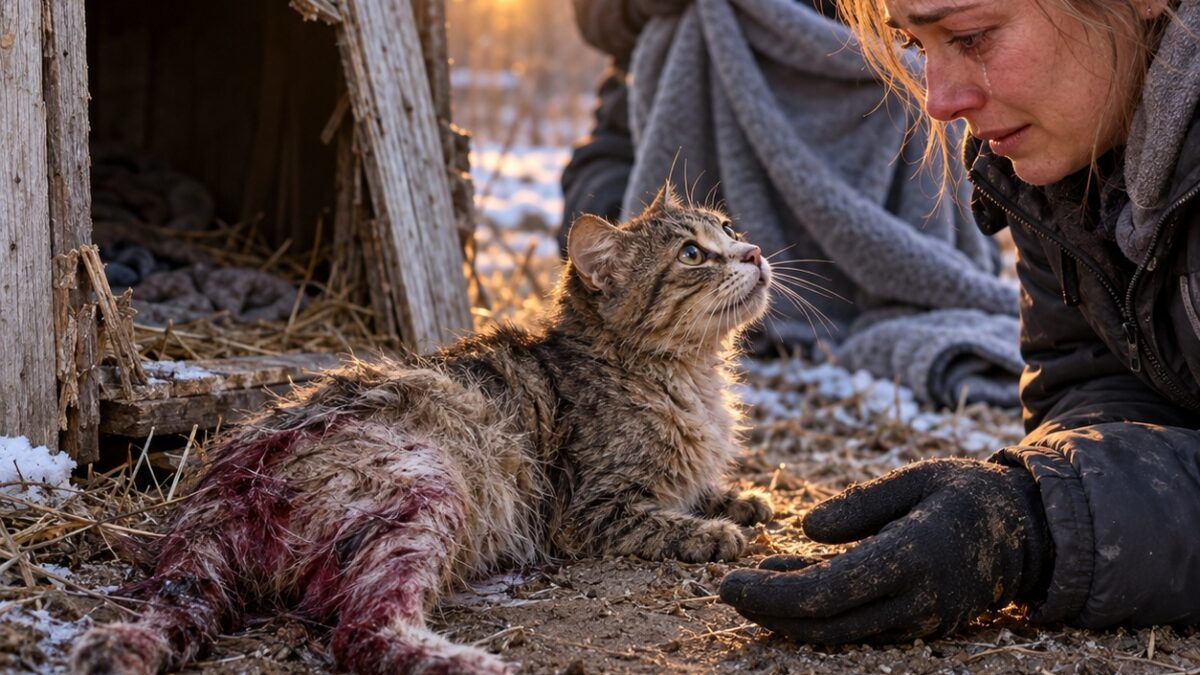
FULL STORY CONTINUATION
The veterinary examination gave rescuers the first clear picture of how serious his condition really was.
Koksik was not merely tired.
Not simply underweight.
Not temporarily weak from hunger.
His back legs were completely paralyzed.
No useful movement.
No ability to stand.
No way to support the rear half of his body.
The problem affected more than walking.
When paralysis is severe, the entire body becomes more complicated.
Basic bodily functions can become difficult.
Keeping clean becomes difficult.
Maintaining healthy skin becomes difficult.
Moving away from urine or waste becomes difficult.
Even shifting position to relieve pressure can require help.
And Koksik had already been living like that without consistent care.
His body carried the evidence.
He was painfully thin.
His appetite had almost disappeared.
There were signs that his condition involved deeper complications beyond what could be seen simply by looking at his legs.
He needed treatment.
Monitoring.
Support.
And perhaps most frightening of all, time.
Time was something nobody knew whether he had.
The first conversations among the veterinary team were careful.
Then quieter.
Rescuers could hear the words even when no one wanted to say them directly.
Poor prognosis.
Low chances.
Permanent damage.
Quality of life.
Those words do not mean cruelty.
They are not spoken because veterinarians want to give up.
Sometimes love requires asking whether treatment is helping an animal live or merely extending suffering.
That question matters.
Especially when the patient cannot explain what he feels.
Koksik could not tell anyone where the pain was.
Could not tell them how long he had been like this.
Could not answer whether he wanted another procedure.
So people had to look at the animal in front of them.
His breathing.
His response.
His appetite.
His awareness.
His discomfort.
His ability to engage.
And every time they looked at Koksik, they found the same difficult truth.
He was in terrible condition.
But he was still there.
Still watching.
Still responding.
Still breathing.
Still capable of noticing when someone entered the room.
Still capable of holding a gaze.
That did not guarantee recovery.
It simply meant the decision was not obvious yet.
So the rescuers asked for more time.
Not endless time.
Not treatment without purpose.
A chance.
The days that followed were exhausting.
Medication.
Careful feeding.
Cleaning.
Positioning.
Monitoring.
Helping his body with functions it struggled to handle on its own.
Watching his skin.
Watching his appetite.
Watching his eyes.
Then doing it again a few hours later.
The dramatic part of rescue is often one moment.
Finding the animal.
Opening the cage.
Lifting him from danger.
The work afterward is repetitive.
It does not photograph as well.
No triumphant music.
No instant transformation.
Just another morning.
Another treatment.
Another bowl of food Koksik might or might not touch.
Another check to see whether anything had improved.
At first, almost nothing did.
His legs remained completely motionless.
The paralysis did not soften.
He still could not stand.
Still could not walk.
Still depended on other people to move him safely.
Sometimes he barely reacted.
There were hours when he seemed withdrawn so deeply into himself that rescuers worried he had stopped caring what happened.
Food sat untouched.
A gentle hand might receive only a tired glance.
The body under the fur still felt too thin.
It was easy, on those days, to understand why the prognosis had frightened everyone.
Hope is much easier when the patient gives you something obvious.
A step.
A strong appetite.
A purr.
A playful movement.
Koksik gave them almost none of those things in the beginning.
But he gave them enough.
A look.
A few bites.
A response to touch.
A slightly brighter expression.
Small things.
Rescue teaches you to respect small things.
When an animal is healthy, finishing half a meal might mean nothing.
When that animal has barely eaten for days, a few extra bites can feel enormous.
The first time Koksik ate more willingly, nobody called it a miracle.
They simply noticed.
Good.
He ate.
Write it down.
Try again later.
The next feeding went a little better.
Then another did not.
Recovery is rarely a straight line.
One encouraging day can be followed by a frightening one.
Progress can disappear under exhaustion.
That is why people caring for fragile animals learn not to celebrate too early and not to panic too quickly.
Watch the pattern.
Koksik needed a pattern.
The local clinic gave him what it could.
But eventually the limits became clear.
His case required more.
More experience.
More resources.
Another team.
Maybe another opinion.
The rescuers faced a choice.
Accept what they had already been told and stop.
Or keep looking.
They chose to keep looking.
Koksik was transported to another city.
Another clinic.
Another set of hands.
That journey mattered.
Moving a healthy cat can be stressful.
Moving a severely disabled, medically fragile cat is something else.
His body needed support.
His paralysis had to be managed carefully.
The trip itself could exhaust him.
Yet there was no guarantee that the next clinic would say anything different.
No promise that new specialists would discover a treatment everyone else had missed.
The rescuers knew that.
They went anyway.
Not because they believed persistence magically defeats biology.
Because uncertainty remained.
And while uncertainty remained, they wanted Koksik evaluated by people who might know more.
Another examination.
More discussion.
More difficult language.
The fundamental reality did not change.
His back legs were paralyzed.
The damage was severe.
There was no sudden sign that one morning he would stand and walk normally.
That possibility grew less realistic the more his condition was understood.
Sometimes rescue stories build toward exactly that kind of moment.
The animal everyone thought would never walk suddenly takes a step.
People cry.
Music swells.
Perfect ending.
Koksik’s story was not going to become that story.
His back legs never regained movement.
That matters.
Because his life did not become valuable only if he could walk again.
The rescuers slowly had to understand that too.
At the beginning, so much attention centered on the paralysis.
Of course it did.
It was visually obvious.
Medically serious.
Life-changing.
But eventually another question began replacing the first one.
Not:
Can we make his legs work?
But:
Can Koksik have a life worth living even if they never do?
That question changed everything.
Because once the goal moved away from restoring some imagined version of a “normal” cat, they could look more clearly at the cat actually in front of them.
Was he eating?
Could he become comfortable?
Could his medical needs be managed?
Was he interested in people?
Did he respond to affection?
Could he rest without constant distress?
Did he show preferences?
Personality?
Curiosity?
Did he have moments that looked like something other than survival?
At first, the answer to many of those questions had been unclear.
Then, slowly, it changed.
Koksik began eating more regularly.
Not one dramatic meal.
A pattern.
A little more today.
Another decent meal tomorrow.
His body finally had something to rebuild with.
Weight began returning.
Slowly.
His bones looked less sharp beneath the skin.
His face began changing too.
Not in shape.
In expression.
The exhausted dullness receded.
His eyes followed people differently.
There was still caution.
But now there was also attention.
Interest.
The world around him was beginning to matter again.
His coat changed.
The old dirt and tangles came away.
Care replaced neglect.
As nutrition improved, the fur lost that dry, lifeless look.
It softened.
Then began to shine.
That may sound superficial beside paralysis.
It was not.
A coat reflects the condition of the body beneath it.
Healthy fur does not fix nerve damage.
But seeing Koksik’s coat improve told everyone that something else was happening.
His body was receiving enough.
Enough food.
Enough hydration.
Enough consistent care to invest energy in something beyond immediate survival.
The transformation was quiet.
No single day when everyone walked in and said:
There he is.
It accumulated.
A few more bites.
A longer period awake.
A face that looked more engaged.
Then the trust.
That part changed more than his appearance.
At first, Koksik watched hands.
Every touch was evaluated.
Every movement followed.
He had spent too much time with uncertainty.
Now people approached and the same things kept happening.
They fed him.
Cleaned him.
Helped him.
Adjusted his bedding.
Moved him gently.
Nothing unpredictable.
Nothing cruel.
Then they came back.
And came back again.
Trust is repetition.
Especially for animals.
A person cannot explain:
You are safe now.
The animal learns through proof.
One day.
Another day.
Another.
The same hand reaches.
Nothing bad happens.
The same voice speaks.
Food arrives.
Pain is treated.
Blankets remain warm.
The body begins to release some of its vigilance.
Koksik started looking directly at people more often.
Not always turning away.
Sometimes following someone with his eyes when they crossed the room.
That small change meant more to rescuers than any dramatic gesture.
It meant relationship was becoming possible.
Then personality began appearing.
That is one of the most beautiful phases in a rescue.
At the beginning, pain can hide the animal.
Everything gets flattened into symptoms.
Weak.
Thin.
Paralyzed.
Not eating.
Dirty coat.
You know almost nothing about who he is because survival occupies all available space.
As Koksik stabilized, that space opened.
He showed irritation.
A flick of the tail when somebody disturbed him at the wrong moment.
Good.
Annoyance requires enough energy to have an opinion.
He showed curiosity.
Something moved.
His eyes followed.
Someone brought a new blanket.
He noticed.
He developed preferences about where he rested.
Sometimes, if a caregiver interrupted a comfortable nap, he made a soft complaint.
That sound made people smile.
The cat who had once lain beside a broken shelter too exhausted to do anything was now objecting to being inconvenienced.
That is progress.
Not medical progress in the sense everyone first wished for.
His legs remained paralyzed.
But life was returning to the parts of him paralysis had not taken.
His appetite.
His awareness.
His comfort.
His ability to trust.
His personality.
Those things mattered.
Maybe more than people understood in the beginning.
There is a danger in looking at a disabled animal and seeing only what he cannot do.
Koksik could not use his back legs.
True.
He could not run.
Could not jump.
Could not walk like other cats.
True.
His care would always require accommodation.
Also true.
But disability is not the entire inventory of a life.
Koksik could eat.
Rest.
Notice.
Enjoy warmth.
Recognize people.
Respond to gentle touch.
Develop routines.
Show irritation.
Show curiosity.
Sleep comfortably.
Be loved.
Those things count.
The rescuers gradually stopped waiting for some miraculous step that might never come.
Instead, they started helping Koksik build a life around the body he actually had.
Soft bedding became essential.
Because he could not reposition himself normally, comfort mattered even more.
Cleanliness mattered.
Monitoring mattered.
Routine mattered.
The environment had to work for him.
That is what adaptation means.
Not pretending the disability disappears.
Changing the world around it enough that life becomes possible.
Koksik learned that the floor beneath him could be warm.
That food would arrive.
That somebody would notice if he needed help.
No more cold dirt beside a collapsing shelter.
No more waiting through darkness without knowing whether anyone would come.
People came.
Every day.
That repetition slowly rewrote his expectations.
I think one of the cruelest parts of abandonment is uncertainty.
Not simply being alone.
Not knowing whether alone is permanent.
An animal waits.
Listens.
Watches.
Maybe somebody appears.
Maybe not.
Koksik had spent enough time in that uncertainty.
Now he lived inside routine.
Routine does not sound romantic.
For traumatized animals, routine can be a form of mercy.
Morning.
Food.
Cleaning.
Medication if needed.
Rest.
Human voices.
Another meal.
Warmth.
Night.
Then morning again.
Same pattern.
Safe because it repeats.
Koksik began relaxing into it.
His body would never move like a healthy cat’s.
But his face began looking like a cat who expected tomorrow.
That is different.
When you first find an animal in severe condition, tomorrow can feel almost theoretical.
Can we get through tonight?
Can we get through this procedure?
Will he eat?
Will he crash?
Later, tomorrow becomes ordinary.
We need more food tomorrow.
Someone will wash his bedding tomorrow.
The veterinarian wants to recheck something next week.
The future grows longer.
That is a powerful shift.
Koksik reached it.
Eventually people stopped speaking only about prognosis.
They started speaking about home.
That word would have sounded almost irresponsible in the beginning.
Home?
For a cat who could not walk?
Who struggled with basic bodily functions?
Who required ongoing support?
Who had already been described in terms of low chances and poor quality of life?
Finding an adopter would not be easy.
A disabled cat is a commitment.
Love alone is not enough.
The person needs time.
Patience.
Practical willingness.
An understanding that ordinary cat care may require more effort.
That travel may be harder.
That cleaning is part of the routine.
That accommodations are not temporary.
Koksik was not going to graduate out of paralysis.
Whoever chose him had to choose that reality too.
That is why the eventual home mattered so much.
His new family did not adopt an inspirational story.
They adopted Koksik.
The actual cat.
Paralyzed back legs included.
Permanent care needs included.
Everything.
They looked past what he had lost because they could see what remained.
A gentle animal.
A survivor.
A cat capable of relationship.
A cat who had learned to trust after having every reason not to.
A cat who deserved comfort even if his body did not work the way people expected.
They said yes.
That moment is what I think rescue is supposed to lead toward.
Not applause.
Not online attention.
A place where the animal no longer belongs to a rescue case file.
He belongs to people.
Koksik went home.
A real home.
Not another temporary room.
Not another clinic where the next person entering might be wearing gloves.
Home.
Soft bedding prepared for him.
Warm meals.
People who knew his needs.
People who had chosen the responsibility.
For the first time, Koksik did not have to wait beside anything.
No broken shelter.
No clinic door.
No carrier wondering where he was going next.
The destination had arrived.
The first days in a permanent home can be confusing for any rescued animal.
New sounds.
New smells.
Different rooms.
Different hands.
For Koksik, everything had to be approached with extra care because mobility was limited.
He could not simply explore the way an able-bodied cat might.
He depended on the environment being brought within reach.
Comfort had to come to him.
And it did.
Blankets.
Warm spots.
Food placed where he could reach comfortably.
Gentle attention.
A place to rest without fear.
Nothing about those things sounds dramatic.
That was the point.
Koksik had experienced enough drama.
The good life he needed was ordinary.
Predictable.
Kind.
His family gave him that.
The cat beside the broken shelter had once looked at every approaching person with caution.
Now familiar people meant safety.
The shift did not happen because paralysis disappeared.
It happened because uncertainty did.
That distinction makes his story different from many rescue stories.
His body did not become “perfect.”
There was no final scene where he suddenly stood.
No first running steps.
No miracle cure.
Instead, there was something quieter.
Acceptance.
Not resignation.
Acceptance by the people around him.
This is Koksik.
This is his body.
This is what he needs.
Now how do we give him a good life?
That can be every bit as beautiful as recovery.
Sometimes more honest.
We have a habit of valuing disabled animals through how closely they can return to normal.
Can he walk again?
Can she see again?
Will the leg be saved?
Will the spine recover?
Those questions matter medically.
But life does not become worthless when the answer is no.
Koksik proved that.
His legs never moved again.
Yet the rest of him came back.
Appetite.
Weight.
Coat.
Expression.
Trust.
Personality.
Comfort.
Belonging.
That was not a partial victory.
That was his life.
There is a difference between curing a condition and healing an animal.
Koksik was not cured of paralysis.
But he healed in ways nobody could see during the first examination.
The tiredness in his eyes softened.
His body grew stronger.
The ragged coat changed.
The cat hidden underneath fear appeared.
The world stopped being only pain and waiting.
He learned comfort.
That matters.
I think back to the moment he first held someone’s gaze.
Only seconds.
No dramatic music.
No movement in his legs.
Nothing that would appear significant on a medical chart.
Yet emotionally, it may have been the first sign that Koksik was returning to relationship.
He was not shutting everything out.
He was looking.
Then later, he stayed looking.
Then he began responding.
That progression is impossible to capture with numbers.
Some forms of recovery live in behavior.
The first complaint when disturbed.
The first relaxed nap.
The first time appetite becomes expectation.
The first time a hand approaches and the body does not brace.
Those are measurable only if somebody cares enough to notice.
Koksik had people who noticed.
That was one of his greatest advantages after rescue.
Someone noticed that first tiny change.
Then another.
They did not dismiss it because the legs remained motionless.
They allowed progress to be broader than walking.
That gave Koksik room to succeed.
The word fighter is used constantly in rescue stories.
Koksik was called one too.
I understand why.
He survived.
But I am careful with the word.
Animals do not choose illness as a battlefield.
They do not owe us heroism.
Koksik did not have to earn treatment by appearing brave.
He deserved care even on the days he barely reacted.
Even when he did not eat well.
Even when progress seemed invisible.
Even when his eyes looked tired.
The people helping him did not require a performance.
That is what made their care meaningful.
They kept showing up when he had very little to give back.
Later, personality returned.
But compassion came first.
That is how it should be.
The same is true of adoption.
Koksik’s family did not choose him because he could promise some inspirational future.
They chose the cat he already was.
That may be one of the purest forms of rescue.
Not:
We love you because we think you will become normal.
But:
We love you here.
Now.
As you are.
The paralysis did not become invisible.
His family still had to deal with it every day.
They still had to provide practical help.
Love did not magically make care easy.
A warm photograph does not show the work behind it.
Bedding needs changing.
Hygiene matters.
Health needs monitoring.
Disabled animals can develop complications if care slips.
The forever home was not merely affection.
It was responsibility.
That makes it more meaningful, not less.
Anyone can feel sorry for Koksik after seeing him beside the broken shelter.
A permanent family has to transform sympathy into routine.
That is harder.
They did it.
Now Koksik rests on soft bedding.
He eats warm meals.
He spends his days with people who know him.
Not as “the paralyzed rescue cat.”
Not only that.
As Koksik.
The cat with preferences.
The cat who can be annoyed.
The cat who watches things.
The cat who has a favorite comfortable place.
The cat whose presence is expected.
That last part means everything to me.
Expected.
Somebody notices whether he is there.
Somebody checks him.
Someone prepares what he needs.
His existence is part of another person’s daily life.
Compare that with the shelter where rescuers found him.
Weathered wood.
Cold ground.
No reliable food.
No certainty that a person would appear.
He had been forgotten so completely that nobody even knew how long he had waited.
Now he could not disappear unnoticed if he tried.
That is belonging.
It is not only being loved.
It is being accounted for.
Your absence would matter.
Your hunger would be noticed.
Your discomfort would prompt action.
Koksik finally lived inside that kind of attention.
The old version of him—if you can call it old—had spent each day conserving energy.
The new Koksik could spend energy on opinions.
That tail flick.
That curious glance.
That soft complaint when somebody disturbed his nap.
I love those details more than any imagined miracle.
A complaint means he expects comfort.
Think about that.
Beside the broken shelter, comfort was not guaranteed.
Now if a person interrupted his nap, he had enough confidence to be annoyed.
That is an enormous psychological distance.
Secure animals complain.
They develop preferences because they trust the environment enough to expect something from it.
Koksik developed expectations.
Good.
Let him.
He had spent too long accepting whatever happened.
Now people adjusted blankets for him.
Brought food.
Made space.
That did not spoil him.
It restored something.
Dignity.
Not human dignity exactly.
Animal dignity.
The ability to live without constant suffering defining every moment.
That is what his family gave him.
I sometimes imagine someone seeing Koksik today without knowing the beginning.
They might notice the paralysis first.
Of course.
His back legs still do not work.
They might feel immediate pity.
But stay longer.
Watch his eyes.
Watch how he responds to familiar people.
Watch the relaxed body on soft bedding.
See the healthy coat.
See that he eats.
See that he rests.
See the personality.
Then paralysis becomes one fact among many.
Not the whole sentence.
That is how disability should be understood.
Koksik is paralyzed.
And he is loved.
Koksik cannot walk.
And he has a home.
Koksik needs help.
And he has preferences.
Both.
Not either-or.
His story would be weaker if we pretended the paralysis disappeared.
It did not.
Reality makes the ending more meaningful.
He found happiness without receiving the cure everyone originally wanted.
Sometimes that is life.
The body keeps scars.
Function does not fully return.
Then you build something good anyway.
That is not settling.
It is living.
Koksik learned that before any of us.
He had no other choice.
At first, his back legs may have seemed like the central tragedy.
Later, the greater tragedy would have been assuming paralysis meant he had no future.
Thankfully, the rescuers did not make that mistake.
They questioned.
They searched.
They transferred him.
They asked specialists.
Then when the answer became clear—that his legs might never move—their commitment shifted rather than disappeared.
If we cannot restore walking, restore comfort.
If we cannot change the damage, change the life around it.
That is compassionate adaptation.
I think it deserves as much celebration as any miracle recovery.
Perhaps more.
Because it reflects reality for many disabled animals.
Not every injury heals completely.
Not every spine recovers.
Not every leg can be saved.
But quality of life is bigger than one function.
Veterinarians know that.
Good rescuers learn it.
Families like Koksik’s live it.
His life today may look different from another cat’s.
He may not chase toys across a room.
May not leap onto furniture.
May not run to the window.
But difference is not emptiness.
He can experience warmth.
Taste.
Comfort.
Human companionship.
Rest.
Interest.
Security.
Love.
Those are not consolation prizes.
They are life.
Koksik did not need a perfect body to deserve them.
There is another image I cannot forget.
His fur when rescuers found him.
Matted.
Dirty.
Neglected.
That coat told a story before anyone knew the medical details.
An animal who cannot groom normally loses another piece of independence.
Cats are meticulous.
Cleanliness is part of how they live.
Paralysis can take that away too.
So when Koksik’s coat eventually softened and began to shine, human care had restored something deeply feline.
He could not fully maintain himself.
Someone helped.
That is what disability support means.
Not turning the animal into something else.
Helping him access the things his body can no longer provide alone.
Clean fur.
Dry bedding.
Comfort.
Health.
That shine was care made visible.
His weight gain was another.
At first, every rib seemed too close to the surface.
Later, his body looked fuller.
Stronger.
Again, no legs moving.
Still progress.
The body had stopped eating itself to survive.
Food was staying.
Nutrition was being used.
Strength returning to the muscles that still worked.
There was more Koksik in Koksik.
That sounds strange.
But starving animals almost seem to disappear physically.
They become outlines.
Recovery fills them back into themselves.
Koksik came back.
Not as the cat he might have been before paralysis.
As the cat he could still become afterward.
That distinction matters.
We do not know his life before the shelter.
No one knows exactly where he came from.
Whether he had a home.
Whether someone once stroked that fur.
Whether he had a name before Koksik.
Speculating will not help him.
The reliable story begins where rescuers found him.
Broken shelter.
Thin body.
Paralyzed legs.
Cautious eyes.
Anything before that remains unknown.
I like leaving unknown things unknown.
Rescue stories are powerful enough without invented villains or imagined histories.
We do not need to picture someone abandoning him deliberately.
Maybe that happened.
Maybe not.
We know neglect occurred because of the condition he was found in.
We know he was alone.
That is enough.
The point is what happened next.
People intervened.
He received care.
When one clinic reached its limits, they moved him.
When the prognosis stayed poor, they did not pretend otherwise.
When paralysis remained permanent, they changed the goal.
When Koksik began trusting, they recognized it.
When a home became possible, someone opened one.
Every step mattered.
No single hero.
No one dramatic rescue moment.
A chain.
That is how many lives are saved.
One person finds.
Another transports.
A veterinarian examines.
Another specialist advises.
Someone feeds.
Someone cleans.
Someone donates.
Someone fosters.
Someone adopts.
Koksik’s outcome belonged to all of them.
But ultimately, it belonged to him too.
Not because he owed anyone a fight.
Because he lived the life they helped make possible.
Today, his days are not organized around prognosis.
That is perhaps the greatest sign of success.
The question is no longer:
Will he survive?
It is:
Is he comfortable?
Has he eaten?
Does he need his bedding adjusted?
Is he sleeping?
Is he annoyed that somebody disturbed him?
Ordinary caregiving questions.
No one is discussing euthanasia in hushed voices every morning.
No one is wondering whether another clinic might be the last.
The crisis chapter ended.
That matters.
A disabled animal can be stable.
A life can be different without being constantly tragic.
Koksik’s family helped make paralysis ordinary.
Not invisible.
Ordinary.
Something accommodated.
Something known.
Not something that dominates every interaction.
That is belonging too.
The people around you stop staring at what is different because they know you.
Visitors may see paralysis.
Family sees Koksik.
That difference is huge.
It is the difference between case and relationship.
He stopped being an animal everyone was trying to save.
He became somebody’s cat.
I think those are the words every rescue hopes to reach.
Somebody’s cat.
Somebody’s dog.
Somebody’s responsibility.
Somebody’s morning routine.
Somebody’s worry when he refuses a meal.
Somebody’s relief when he eats.
Somebody’s place beside the chair.
The broken shelter could never give him that.
Neither could a clinic, no matter how loving.
A clinic treats.
A home belongs.
Koksik finally belonged.
There are nights when I imagine that first darkness beside the shelter.
Not because the story tells us exactly what happened.
It doesn’t.
I imagine only what we know is plausible from the condition rescuers found him in.
Cold.
Stillness.
No ability to walk away.
He could not search for food easily.
Could not relocate himself normally.
Could not defend himself the way a mobile cat might.
His options were almost nonexistent.
He had to wait.
That is what makes his rescue so haunting.
Waiting was not poetic.
It was forced on him.
His body had taken away movement.
He could not go find a better life.
The better life had to come find him.
Eventually, it did.
Someone walked toward the broken shelter.
Koksik watched.
Flinched.
Waited.
Then allowed a hand close.
That single interaction contained the entire possibility of what followed.
If fear had turned into aggression, would they still have helped?
Probably.
Good rescuers understand fear.
But the fact that he stayed still gave them access quickly.
They could lift him.
Carry him.
Begin.
From there, his life became movement performed by others.
Into a vehicle.
Into a clinic.
To another city.
To another team.
Eventually to a home.
Koksik could not walk his way toward safety.
People carried him there.
That is why the title of his story in my mind is not about paralysis.
It is about waiting.
He waited because he had no choice.
Then people finally stopped making him wait.
Food came.
Care came.
Specialists came.
Home came.
Love came.
That is the reversal.
Sometimes I think rescue is really the end of waiting.
The street dog waits for food.
The abandoned kitten waits for warmth.
The sick animal waits for pain relief.
The shelter animal waits for adoption.
The disabled cat waits for someone willing to see beyond the disability.
Koksik waited for all of those things.
Eventually, the waiting changed into having.
Warmth.
Food.
Care.
Family.
No longer theoretical.
His.
That is why his final life feels so peaceful to me.
Soft bedding sounds insignificant unless you remember cold ground.
Warm meals sound ordinary unless you remember an animal whose appetite was disappearing.
A family sounds expected unless you remember nobody knew how long he had been alone.
Context makes comfort powerful.
Koksik’s life today does not need to be spectacular.
It only needs to be his.
He does not need viral moments.
No miracle video.
No heroic race in a wheelchair.
No dramatic before-and-after where paralysis vanishes.
A warm blanket is enough.
A full stomach.
A familiar hand.
Sleep without fear.
Those things would have seemed impossible beside the old shelter.
Now they are normal.
I hope they remain normal for a very long time.
There is something else his story says about hope.
Hope does not always mean believing the exact outcome you want will happen.
At the beginning, hope may have meant:
Maybe his legs will recover.
They did not.
If hope depended only on that, the story would have become failure.
Instead, hope changed.
Maybe he can become comfortable.
Yes.
Maybe his appetite can return.
Yes.
Maybe his weight can improve.
Yes.
Maybe he can trust people.
Yes.
Maybe his quality of life can become good.
Yes.
Maybe someone will adopt him exactly as he is.
Yes.
Hope survived by becoming more accurate.
That is a mature kind of hope.
Not demanding reality obey a preferred ending.
Finding the good life still available inside reality.
Koksik had one.
The veterinarians who initially questioned quality of life were not wrong to ask.
That question protected him.
If his suffering had remained uncontrolled, if he could not eat, if complications made comfort impossible, then love might have required a different decision.
That is hard.
But responsible care includes that possibility.
What changed the answer was Koksik.
His condition stabilized.
He began eating.
Engaging.
Trusting.
Resting.
His body remained disabled, but his life began containing positive experiences.
That is what made continuation meaningful.
This is why rescue stories should not teach:
Never give up no matter what.
That can become cruelty too.
They should teach:
Assess honestly.
Treat when treatment can help.
Watch the animal.
Let quality of life guide you.
Koksik kept giving his caregivers reasons to continue.
Not a miraculous leg movement.
Something more relevant.
Life.
He wanted food again.
He noticed people.
He rested comfortably.
He showed personality.
He connected.
Those signs mattered.
His rescuers listened.
I respect that.
Their love did not turn medicine into fantasy.
They did not announce a cure that never happened.
They accepted the paralysis.
Then built the rest.
The home at the end becomes even more important because of that honesty.
Koksik’s adopters were not promised a normal cat.
They were not told:
He’ll probably walk someday.
They chose him knowing the truth.
Permanent damage.
Extra care.
Different life.
Yes anyway.
That yes carries weight.
There are easy adoption photos.
Healthy kittens.
Playful puppies.
Animals who can fit almost any home.
Then there are animals like Koksik.
The family has to decide with clear eyes.
Can we provide this?
Can we adapt?
Can we commit?
His family did.
That choice gave every sleepless rescue day meaning.
Not because adoption is the only measure of success.
But because Koksik needed permanence.
He had spent too much of life in temporary places.
The old shelter was temporary misery.
Clinics were temporary care.
He needed a place that did not end.
Forever home is an overused phrase.
In cases like his, I understand why people keep using it.
Because the promise matters.
You are not moving again because nobody wants you.
You are not waiting for somebody to decide whether you are worth the work.
This is it.
Your bed.
Your people.
Your routine.
Home.
Koksik finally stopped being transferable.
That is beautiful.
I picture him now stretched across soft bedding.
Back legs still quiet.
Front half relaxed.
Eyes no longer carrying the same exhaustion.
Maybe a person walks into the room.
He watches.
Not because he is afraid of what they will do.
Because he knows them.
Maybe food follows.
Maybe a blanket adjustment.
Maybe nothing at all.
Sometimes the most healing thing is a familiar person walking through the room without anything happening.
Normal presence.
No threat.
No procedure.
No abandonment.
Just life continuing.
Koksik earned that normality.
I think his story also says something about what we call “whole.”
People might have looked at him and said he would never be whole again.
I disagree with the premise.
His body was permanently injured.
But wholeness is not the same as anatomical perfection.
A cat can live fully inside limitations.
He can experience connection.
Safety.
Pleasure.
Preference.
Rest.
If those experiences are present and suffering is managed, then the life itself is not broken simply because the spine is.
Koksik’s family understood.
They did not repair him into worthiness.
They recognized worth that was already there.
That is perhaps the most important part.
He was worth rescuing before he trusted anyone.
Worth treating before he ate well.
Worth carrying before anybody knew the outcome.
Worth loving before a home was guaranteed.
Worth choosing even after the legs never came back.
His value did not rise with recovery.
Our ability to see him simply improved.
The cat was always there.
Pain had hidden him.
Care uncovered him.
First a look.
Then a tail flick.
Then curiosity.
Then complaint.
Then comfort.
Then home.
That sequence tells me more than any medical miracle could.
Koksik’s story does not end with him standing.
It ends with him resting.
I love that.
For an animal who may have spent countless nights unable to move away from cold ground, rest is not passive.
Rest means safety has finally become strong enough that vigilance can stop.
He can sleep.
Deeply.
On something soft.
Surrounded by people who will still be there when he wakes.
That is the ending.
Not recovery from paralysis.
Recovery from abandonment.
Recovery from hunger.
Recovery from fear.
Recovery from being unseen.
Those were wounds too.
Some of them healed completely.
The forgotten cat beside the wooden shelter is gone in that sense.
The paralysis remains.
The forgotten part does not.
He is known.
His needs are known.
His personality is known.
His presence matters.
Someone would notice immediately if he did not eat.
Someone would notice if he seemed uncomfortable.
Someone would notice if he looked frightened.
He no longer disappears into scenery.
That alone changes everything.
I keep returning to those first eyes.
Cautious.
Tired.
Following strangers because watching was the only control he had left.
Then the later gaze.
Direct.
Held.
Trust beginning.
And finally, I imagine those eyes today.
Relaxed enough to look away first.
That may sound strange.
But trust is not only looking.
Sometimes trust is no longer needing to watch.
An animal who believes you are safe can close his eyes.
Turn his head.
Sleep.
Koksik can do that now.
He does not have to monitor every approaching footstep.
He does not have to prepare for the worst.
A familiar hand can reach.
He knows what it means.
Care.
That is how far he traveled without ever taking a step.
From suspicion to trust.
From cold ground to blankets.
From nearly no appetite to warm meals.
From being unknown beside a broken shelter to being somebody’s beloved cat.
His legs never carried him there.
People did.
And now he does not have to wait anymore.
No more staring into the darkness wondering whether anyone is coming.
No more lying beside rotting wood with a body that will not obey.
No more measuring life in cold nights and unanswered hope.
Koksik has a home.
He has people.
He has comfort.
He has safety.
His life looks different from other cats.
That is true.
But different is not less.
He still cannot walk.
Still cannot run.
Still cannot stand the way he once might have.
Yet every day, he has something the abandoned cat beside that broken shelter did not have.
Certainty.
Someone is coming back.
Someone always comes back.
And after all the waiting Koksik had already done, that may be the greatest gift anyone could have given him.








