FULL STORY:For Two Years, Buddy Waited at the Gate Every Morning for the Man Everyone Else Had Stopped Expecting
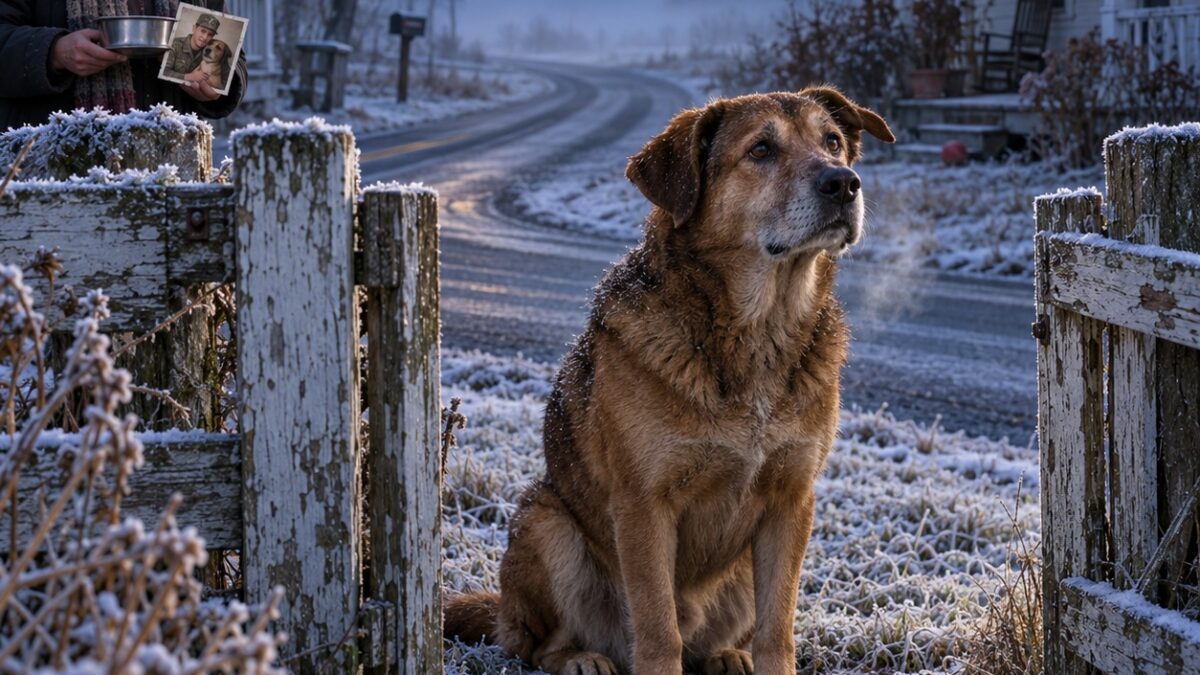
FULL STORY CONTINUATION
At the beginning, nothing felt frightening.
Delays happened.
Orders changed.
Schedules shifted.
Michael called when he could.
The first time the phone rang at my house because he couldn’t reach his own landline, he sounded exhausted but cheerful.
“How’s Buddy?”
Not hello.
Not how are you.
Buddy.
“He’s fine.”
“Eating?”
“Yes.”
“Sleeping?”
“Mostly.”
“Still digging by the fence?”
“Unfortunately.”
Michael laughed.
That laugh made the whole situation feel temporary.
“Can you put me near him?”
“What?”
“Put the phone near Buddy.”
I felt ridiculous, but I did it.
Buddy was stretched beside my kitchen table.
I lowered the receiver.
“Michael wants to talk to you.”
Buddy lifted his head when Michael’s voice came through.
“Hey, boy.”
His ears rose.
“Buddy.”
He stood.
His nose moved toward the phone.
Michael kept talking.
“I’m coming home. Just taking longer than I thought.”
Buddy whined.
It was a small sound.
Almost confused.
Then he licked the receiver.
I laughed.
Michael didn’t.
For several seconds, the only sound on the line was his breathing.
“Did he hear me?”
“He heard you.”
“Good.”
Before hanging up, Michael said, “Tell him I’m coming home.”
“I will.”
“And keep letting him stay at the house if he wants.”
Michael had left me a key.
During the day, Buddy spent most of his time with me.
At night, he preferred Michael’s house.
The first few nights I tried keeping him in mine.
He paced.
Stood at the front window.
Scratched once at the door.
Not frantically.
Just insistently.
So I started walking him across the road after dinner.
I would unlock Michael’s house, check the lights, fill Buddy’s water, and sit for a while.
Buddy always went straight to Michael’s bedroom.
He sniffed the bed.
Then the closet.
Then the shoes Michael had left beside the wall.
After that, he settled on the rug beside the bed.
At dawn, he came to my house.
Then he went to the gate.
Every morning.
I tried changing the routine.
“Come eat first.”
Buddy ignored me.
“Walk?”
He looked toward the road.
“Buddy.”
Nothing.
He sat beside the gate.
Sometimes twenty minutes.
Sometimes an hour.
Then he would come back and eat.
It became our rhythm.
Weeks became two months.
Then three.
Michael called less often.
Not because he wanted to.
Communication was difficult.
I could hear tension in his voice when he did reach me.
“I’m okay.”
That was always his second sentence.
The first was always:
“How’s Buddy?”
By the fourth month, Michael stopped predicting when he would return.
That scared me more than anything.
“What happened to a few weeks?”
Silence.
“Michael?”
“I don’t know.”
“What does that mean?”
“It means I don’t know.”
His tone sharpened, then softened immediately.
“Sorry.”
“You don’t owe me an apology.”
“I just…”
He exhaled.
“Things changed.”
“Are you safe?”
“For now.”
I hated that answer.
I didn’t ask for details.
Some things he could not tell me.
Some things, I suspect, he simply did not want to tell anyone at home.
“What should I tell Buddy?”
Michael gave a tired laugh.
“That I’m a liar.”
“No.”
“He waits?”
“Every morning.”
There was a pause.
“How long?”
“Until he decides you’re not showing up before breakfast.”
Michael made another sound, something between laughter and pain.
“Stupid dog.”
“He gets that from you.”
“Yeah.”
Then Michael went quiet.
“Read to him.”
I thought I had misunderstood.
“What?”
“I’m going to send letters.”
“To Buddy?”
“Yes.”
“You realize Buddy cannot read.”
“He has you.”
I laughed.
“You want me to read your letters to your dog.”
“Yes.”
“That’s insane.”
“Will you?”
I looked through my kitchen window.
Buddy was lying beside the front step, facing Michael’s house.
“Yeah.”
“I will.”
The first letter arrived nine days later.
The envelope was addressed to me.
Inside was another envelope.
On the front, in Michael’s handwriting:
BUDDY.
I took it across the road.
Buddy followed.
We sat on Michael’s porch.
“Apparently you have mail.”
Buddy looked at me.
I opened the envelope.
Michael’s letter was simple.
Hey, boy.
I hope you’re behaving yourself.
I know you’re probably bothering our neighbor and stealing his chair.
Don’t dig near the roses.
I’ll be home.
I miss you.
That was almost all of it.
I felt stupid reading it aloud.
Until I looked at Buddy.
He was listening.
Maybe not to the words.
Maybe to my tone.
Maybe because I kept saying Michael’s name.
Maybe because the paper smelled faintly like the person who had handled it.
When I finished, I folded the letter.
Buddy moved closer.
Then, without prompting, he placed one paw on the envelope.
I froze.
“Seriously?”
He left it there.
I laughed.
“You are the strangest dog I’ve ever met.”
After that, the letters became a ritual.
Michael wrote whenever he could.
Sometimes twice in a month.
Sometimes not for six weeks.
Every letter was addressed to Buddy.
Some were short.
Some filled several pages.
He wrote about weather.
About food.
About missing his house.
About the river.
About how badly he wanted coffee from the little place in town.
He never wrote much about what he was actually doing.
But between the lines, I could feel him changing.
Early letters were light.
You better not be sleeping on my bed.
Later ones said things like:
I thought about our walk by the river today.
I’d give anything to be bored with you again.
Still later:
I hope you remember me.
That sentence made me stop reading the first time I saw it.
Buddy was sitting beside me.
His paw touched my leg.
I swallowed.
“Of course he remembers you.”
The letter continued.
Sometimes I worry I’ll come home and he’ll look at me like a stranger.
Tell him I didn’t leave him because I wanted to.
I looked at Buddy.
He was staring toward the road.
“Michael thinks you’ll forget him.”
Buddy’s ears twitched at the name.
“No chance, right?”
His tail moved against the porch boards.
I folded the letter.
He put his paw on it.
Every time.
I never taught him.
Never asked.
I would finish reading, place the paper beside me, and Buddy would reach out.
Sometimes his paw landed directly on the envelope.
Sometimes beside it.
But always close.
I started writing Michael back.
Buddy ate today.
Buddy chased a rabbit and lost.
Buddy destroyed one of your old slippers, which I consider revenge for abandoning him with me.
Buddy still waits by the gate.
I almost stopped including that last sentence.
It felt cruel.
But Michael asked every time.
Does he still wait?
Yes.
Every morning?
Yes.
Even when it rains?
Yes.
That was the truth.
Rain changed nothing.
Neither did cold.
During the first winter, snow fell hard for three days.
I woke before sunrise, looked out my window, and saw Buddy crossing the road.
“Absolutely not.”
I pulled on boots and followed.
He sat beside Michael’s gate in six inches of snow.
“You’re going to freeze.”
Buddy ignored me.
“Michael is not walking home through a blizzard.”
His eyes stayed on the road.
I stood beside him.
Five minutes.
Ten.
Eventually I sat on the low stone wall near the gate.
“You know, if he returns today, I’m going to kill him for making me do this.”
Buddy leaned against my leg.
We waited together.
That became another part of the story nobody understood unless they saw it.
People in the village knew Buddy.
Everyone knew Michael had left.
At first, neighbors found Buddy’s waiting touching.
After six months, people stopped mentioning it.
After a year, some began saying things I hated.
“Maybe the dog should go live permanently somewhere else.”
“He needs to move on.”
“What if Michael doesn’t come back?”
I understood the logic.
I did.
But I refused to move Buddy.
Not because Michael’s house had magical powers.
Because Buddy chose it.
He slept there peacefully.
He ate.
He exercised.
He spent most afternoons with me.
He had a good life.
The waiting was simply part of him.
Trying to remove it felt less like helping and more like taking away the last thing he believed in.
Still, as the first anniversary approached, even I began worrying.
Michael had been gone a year.
One year.
Twelve months of letters.
Phone calls.
Silences.
Delays.
Rumors.
News reports I learned not to watch when Buddy was beside me, though of course that was irrational.
One night Michael called after nearly seven weeks of silence.
The moment I heard his voice, I knew something was different.
“Hey.”
“Michael?”
“Yeah.”
“Jesus Christ.”
“I know.”
“Seven weeks.”
“I know.”
“Don’t do that again.”
“I’ll put it on my schedule.”
His joke sounded empty.
“Are you hurt?”
“No.”
That answer came too fast.
“Michael.”
“I’m okay.”
I sat down.
Buddy was asleep near the stove.
At the sound of Michael’s voice through the receiver, his head lifted.
“What happened?”
“Nothing I can talk about.”
There it was.
The wall.
The military part of Michael’s life had become a locked room.
I could stand outside it.
That was all.
“How’s Buddy?”
I rubbed my forehead.
“You already know.”
“He still waits.”
“Yes.”
Michael went quiet.
Then I heard him breathing strangely.
“Michael?”
“I’m here.”
“You okay?”
“Read him my next letter.”
“I read all of them.”
“No.”
His voice cracked.
“Really read it.”
The letter arrived four days later.
I did not open it immediately.
Something about the weight of the envelope frightened me.
That evening, I sat on Michael’s porch with Buddy.
The sun had already gone down.
I opened the letter.
Buddy,
I’m sorry.
I thought I would be home long before now.
I know you don’t understand where I am.
Maybe you think I chose to leave.
Maybe dogs don’t think that way.
I don’t know.
I keep remembering the morning I left and the way you tried to follow the car.
I should have stayed another minute.
I should have hugged you longer.
I stopped.
Buddy looked at me.
I continued.
I don’t know when I’m coming home.
But I am trying.
If our neighbor reads this to you, that means you’re still there, and I need you to keep being there.
Not forever.
I would never ask that.
Just until I can find my way back.
I had to stop again.
My vision blurred.
Buddy moved closer.
I put one hand on his back.
“You hear that?”
He looked toward me.
“He’s trying.”
I finished.
I miss you more than I know how to explain.
Sometimes when things are bad, I close my eyes and picture our gate.
You’re there.
I’m coming up the road.
That picture keeps me going.
So if you’re still waiting, maybe we’re doing the same thing.
Michael.
I folded the letter carefully.
Buddy placed his paw on it.
That time, I cried.
Not dramatically.
No sobbing.
Just tears I couldn’t stop.
Buddy licked my wrist.
“You two are going to ruin me.”
The second year began.
By then, caring for Buddy no longer felt like a favor.
He had become part of my life.
I had never intended that.
I lived alone.
My wife had died several years earlier, and my children had grown and moved away.
Before Buddy, my days had been orderly.
Quiet.
Breakfast.
Work around the property.
Tea.
Radio.
Sleep.
Buddy disrupted the silence.
He scratched the back door when impatient.
He stole pieces of bread if I left them too close to the counter.
He disliked one particular delivery driver for reasons I never understood.
He snored.
He shed everywhere.
He stood in the kitchen while I cooked and behaved as though starvation was moments away.
He also waited for me each afternoon.
Followed me through the garden.
Sat nearby while I repaired fences.
And on evenings when Michael’s absence weighed heavily, Buddy seemed to understand silence better than most people.
That created another fear in me.
What would happen when Michael returned?
I wanted him to return.
Of course I did.
But if I was honest, part of me dreaded losing Buddy.
The thought made me ashamed.
I had never been his owner.
I was temporary.
A bridge.
The man holding the place until the real person came back.
But two years is a long time.
Long enough to build routines.
Long enough to love something.
I began imagining two impossible futures.
In one, Michael never returned.
Buddy kept waiting until old age taught him the road would remain empty.
In the other, Michael came home and Buddy left me immediately.
One future was unbearable.
The other hurt for reasons I had no right to resent.
So I stopped thinking too far ahead.
Day by day.
That was what Buddy seemed to understand.
Every morning he waited.
Then he lived the rest of the day.
He did not spend every second grieving.
He chased birds.
Slept in sunlight.
Demanded food.
Rolled in things that forced me to bathe him while cursing Michael’s name.
But every sunrise, the gate came first.
That consistency impressed me more than the dramatic waiting people imagined.
Loyalty wasn’t Buddy being sad all day.
Loyalty was remembering.
Again.
And again.
And again.
The letters continued.
One arrived stained along the corner.
Another had been folded so many times the paper was soft.
Michael’s handwriting became rougher.
Some letters were only a few lines.
Still here.
Still thinking about home.
Tell Buddy I saw a dog today and it wasn’t him, so naturally it was disappointing.
Another said:
I dreamed about the river.
Buddy ran ahead like always.
When I woke up, I could still hear his collar tags.
I read every word aloud.
One spring afternoon, almost twenty-two months after Michael left, I found Buddy at the gate unusually early.
The sun was barely visible.
He stood instead of sitting.
His whole body was alert.
“What is it?”
He stared down the road.
I followed his gaze.
Nothing.
“Rabbit?”
Nothing.
“Fox?”
His tail moved.
Then stopped.
I felt something strange in my chest.
“Michael?”
Buddy looked at me.
I laughed at myself.
“No.”
No call.
No message.
No warning.
That morning passed like the others.
Then another month.
And another.
We crossed the two-year mark quietly.
No celebration.
No announcement.
I read Michael’s latest letter.
Buddy put his paw on it.
The next morning, he returned to the gate.
I remember standing behind him and thinking:
How long can love wait before it becomes grief?
I still don’t know the answer.
Then came the morning everything changed.
It was early autumn.
Cold enough that my breath showed faintly.
I stepped outside carrying a mug of coffee.
Buddy was still asleep inside.
Usually he beat me to the door.
I walked toward the gate.
A man stood across the road.
At first, I thought he was a stranger.
He was thin.
Much thinner than Michael had been.
Gray showed near his temples even though he was still young.
He wore a dark jacket and carried one bag.
His shoulders looked different.
Lower.
Heavier.
His face had changed in ways I couldn’t name.
But the eyes were Michael’s.
I stopped.
My coffee slipped slightly in my hand.
Neither of us moved.
“Michael?”
He gave a small smile.
“Morning.”
That was all.
Two years.
Hundreds of letters.
Hundreds of mornings.
And he said morning.
I crossed the road.
Then stopped again.
I wanted to hug him.
Hit him.
Ask where he’d been.
Ask what happened.
Ask why nobody had told me he was coming.
Instead I said, “You look terrible.”
He laughed.
A real laugh.
“Good to see you too.”
Then his eyes moved past me.
Toward my house.
His face changed.
“Where is he?”
I turned.
The front door behind me was partly open.
Buddy appeared.
He stepped onto the porch.
For one second, he didn’t move.
Michael didn’t move either.
There were maybe forty yards between them.
Buddy stared.
His ears rose.
His body became completely still.
I held my breath.
This was the moment Michael had feared.
What if Buddy did not recognize him?
Two years changes scent.
Voice.
Movement.
Appearance.
Michael whispered, “Buddy.”
The dog exploded.
I had never seen him run like that.
Not after rabbits.
Not at the river.
Not for food.
He launched from the porch and tore across the yard.
Through the open gate.
Across the road.
Michael dropped his bag.
“Buddy!”
The dog ran harder.
Michael bent down.
I expected Buddy to jump.
Knock him backward.
Bark.
Cry.
Something wild.
Instead, when Buddy reached him, he stopped.
Just stopped.
He stood inches away.
Looked into Michael’s face.
Then sat.
Slowly.
And placed his head against Michael’s knees.
Michael collapsed.
He dropped to both knees and wrapped his arms around Buddy.
For several seconds, neither moved.
Then Michael began crying.
Not quietly.
The kind of crying that comes from somewhere deeper than embarrassment.
He buried his face in Buddy’s neck.
“I’m sorry.”
Buddy’s tail moved.
“I’m sorry, boy.”
The tail moved again.
“I came back.”
Buddy pressed harder into him.
“I came back.”
I stood several yards away and cried too.
I had imagined that reunion hundreds of times.
In some versions, Buddy barked.
In others, Michael shouted.
I never imagined the silence.
They simply held each other.
Michael’s hand moved behind Buddy’s ears.
Same movement I had watched him make the morning he left.
Buddy closed his eyes.
His body softened.
Two years collapsed into one moment.
Eventually Michael looked at me.
“Thank you.”
I shook my head.
There was too much in those words.
Too much for an answer.
Buddy remained glued to Michael.
When Michael stood, Buddy stood.
When Michael picked up his bag, Buddy followed.
When Michael crossed the road toward his old house, Buddy moved beside him.
But at the gate, Michael stopped.
The house looked abandoned.
Not ruined.
I had maintained it.
Cut the grass.
Checked pipes.
Opened windows occasionally.
But a house knows when nobody lives inside it.
Curtains remained still.
Dust lay behind the glass.
Michael stared.
“I thought about this place every day.”
Buddy leaned against his leg.
Michael swallowed.
“I don’t know if I can go in yet.”
“You don’t have to.”
He looked at me.
“Can we stay at your place?”
“Of course.”
So Michael came into my kitchen.
Buddy followed him everywhere.
If Michael moved three feet, Buddy moved three feet.
If Michael sat, Buddy pressed against his knees.
When Michael went to wash his hands, Buddy waited outside the door.
“He thinks you’re leaving again,” I said.
Michael looked down.
His expression broke.
“I know.”
We drank tea.
For a while Michael said very little.
I did not push.
I had learned enough from his letters to know homecoming was not the simple ending people imagined.
Yes, he was home.
But part of him had not arrived yet.
He stared at ordinary things.
My kettle.
The window.
The bread on the counter.
As though civilization itself felt unfamiliar.
Buddy rested across his feet.
After a while Michael said, “You read them?”
“All of them.”
“To him?”
“Yes.”
“Every letter?”
“Every one.”
Michael looked embarrassed.
“They were stupid.”
“No.”
“I wrote to a dog.”
“You wrote to home.”
His eyes met mine.
He said nothing.
I reached into a drawer.
I had saved the letters.
Every one.
Rubber bands around them.
Careful stacks.
I placed them on the table.
Michael stared.
“You kept them?”
“They weren’t mine to throw away.”
He picked up the top envelope.
Buddy immediately raised his head.
Michael noticed.
“What?”
“Put it down.”
“What?”
“Just put it on the floor.”
Michael did.
Buddy stood.
Walked over.
And placed his paw on the envelope.
Michael stopped breathing.
For a second, his face went blank.
Then tears filled his eyes.
“He did that?”
“Every time.”
Michael crouched.
“Every letter?”
“Every one.”
Buddy’s paw remained on the envelope.
Michael covered his mouth.
“I didn’t know.”
“I know.”
“He knew they were mine?”
“I don’t know exactly what he knew.”
Michael touched Buddy’s paw.
“But he knew they mattered.”
Michael sat on the floor.
Buddy immediately leaned against him.
That afternoon, Michael told me pieces of what the two years had been like.
Not everything.
Never everything.
He told me enough.
There had been places he expected to stay days and remained months.
Times communication was impossible.
Friends who did not return.
Nights when sleep would not come.
Moments when he believed the only safe future was the one he could picture.
His house.
The river.
Buddy running ahead.
“I used to close my eyes,” he said, “and imagine the gate.”
I nodded.
“He was usually there.”
I almost laughed.
“He actually was.”
Michael smiled.
“I know that now.”
The next morning, we walked to his house.
Buddy ran several steps ahead, then stopped at the gate.
He looked at Michael.
Waited.
For two years, Buddy had sat outside that gate expecting Michael to appear.
Now Michael was standing behind him.
Still, Buddy would not enter first.
Michael noticed.
“You waiting for me?”
Buddy’s tail moved.
Michael put his hand on the latch.
The metal was stiff.
He pushed the gate open.
Then he stood aside.
“Come on, Buddy.”
Buddy looked inside.
Then at Michael.
Michael’s voice shook.
“We’re home.”
Buddy entered.
Michael followed.
I stayed outside for a moment.
It didn’t feel like my place.
Then Michael looked back.
“You coming?”
I went in.
The house smelled closed.
Dust and wood and time.
Michael stood in the living room.
Everything was nearly where he left it.
His books.
An old jacket.
A framed photograph.
Buddy walked from room to room.
Sniffing.
Remembering.
He reached Michael’s bedroom.
Stopped.
Then rushed inside.
Michael followed.
I remained in the hall.
Buddy circled beside the bed.
Then jumped onto it.
Michael laughed.
“You were definitely sleeping there.”
I said, “I can neither confirm nor deny.”
Buddy rolled onto his side.
For the first time since Michael returned, he looked completely relaxed.
Michael sat beside him.
His hand moved across Buddy’s back.
“Everything is the same.”
“No.”
Michael looked at me.
“What?”
“It looks the same.”
He understood.
“You’re right.”
The next weeks were not easy.
That is the part reunion stories often leave out.
People imagine waiting ends when the person returns.
Sometimes another kind of waiting begins.
Michael had to learn home again.
He woke at strange hours.
Some nights he walked outside and sat alone.
Loud noises made him tense.
He disliked crowded places.
He stopped mid-sentence sometimes and disappeared somewhere behind his own eyes.
Buddy became his anchor.
If Michael woke before dawn, Buddy woke too.
If Michael walked to the river, Buddy followed.
If Michael sat silently on the porch, Buddy lay across his feet.
No questions.
No advice.
No expectation that Michael become the version of himself who had left two years earlier.
I think that mattered.
People kept saying things like, “You must be so happy to be back.”
Michael would smile.
Say yes.
But happiness wasn’t the whole truth.
Homecoming carried grief too.
He had returned.
Others had not.
His house waited exactly where he left it.
He had not.
Buddy seemed to accept that without confusion.
Dogs do not demand that you explain who you used to be.
They learn who you are today.
Michael started repairing the house.
First the shutters.
Then the porch.
Then the garden.
He planted flowers.
“Those won’t survive,” I told him.
“Why?”
“Buddy.”
Buddy was already digging nearby.
Michael shouted, “Hey!”
Buddy looked completely innocent.
I laughed so hard I nearly dropped the shovel.
Little by little, life returned.
Michael walked to the river every morning.
Buddy beside him.
At first, I accompanied them.
Eventually, I realized they needed those walks alone.
Still, I often saw them from my window.
Michael moving slowly.
Buddy trotting ahead.
Stopping.
Looking back.
Making sure Michael was still there.
The roles had reversed.
For two years Buddy had waited for Michael to come home.
Now he constantly checked that Michael wasn’t disappearing again.
Michael noticed too.
One evening he came to my porch.
Buddy lay between us.
“He doesn’t trust me.”
“That isn’t true.”
“He checks where I am every five seconds.”
“He spent two years losing you.”
Michael looked toward the road.
“I didn’t lose him.”
“No.”
“That somehow makes it worse.”
I understood.
“He couldn’t know why you were gone.”
“I know.”
Michael rubbed Buddy’s ear.
“How do I make him understand I’m staying?”
“You don’t.”
Michael looked at me.
“You stay.”
That was all.
No speech.
No reassurance.
No command.
You stay.
The same lesson Buddy had practiced for two years.
Michael nodded.
“Okay.”
And he did.
Weeks later, Buddy began sleeping deeply again.
Stopped following Michael to the bathroom every single time.
Stopped standing whenever Michael picked up car keys.
Small changes.
Trust returning slowly.
One afternoon Michael came to my house carrying an envelope.
“For you.”
“What is it?”
“A letter.”
“You live across the street.”
“I know.”
“You could just speak.”
“Read it.”
I opened the envelope.
His handwriting was familiar from two years of mail.
He had written:
When I left, I thought the hardest part would be leaving Buddy.
I was wrong.
The hardest part was not knowing what he thought my leaving meant.
I was afraid he believed I abandoned him.
I was afraid I would become a smell that faded from the house.
A voice he forgot.
A person who used to exist.
But you kept me alive in his world.
Every letter you read.
Every morning you let him wait.
Every night you opened my house.
You never asked him to stop loving me just because waiting was painful.
You protected something I couldn’t protect from where I was.
I stopped.
Michael stood silently.
I continued.
I know you think you only fed him.
Walked him.
Read letters.
Opened doors.
But that was everything.
You gave him somewhere to put his loyalty.
You gave me proof that home still existed.
I don’t know how to repay that.
Thank you for keeping my place until I could come back and stand in it myself.
I folded the letter.
For a minute, I could not speak.
Finally I said, “I didn’t do anything special.”
Michael shook his head.
“You were there.”
“That isn’t special.”
“Yes.”
His voice was firm.
“It is.”
He hugged me.
Michael had never hugged me before.
Buddy stood immediately, apparently concerned that something important was happening without him.
Michael laughed and pulled him between us.
It was ridiculous.
Three grown creatures tangled together on my porch.
One human who had gone away.
One human who had waited with a dog.
One dog who had refused to stop believing.
That night, my house felt different.
Quiet.
Too quiet.
Buddy had been spending more and more nights with Michael.
Of course he had.
That was the point.
But I missed him.
His corner beside the kitchen stove was empty.
No collar tags in the hallway.
No nose pushing at my hand while I ate.
I sat at the table with tea and stared toward the door.
For two years, I had complained constantly.
Dog hair.
Mud.
Food bills.
Destroyed slippers.
Now I would have given anything to hear him scratch once at the back door.
I felt ashamed of the sadness at first.
This was what I wanted.
Michael was home.
Buddy belonged with him.
Then I understood something.
Doing the right thing does not protect you from missing what you have to let go.
Love can be generous and painful at the same time.
I had not lost Buddy.
He lived across the road.
I saw him every day.
Still, the role I had occupied was ending.
Temporary had lasted long enough to feel permanent.
The next morning, habit woke me early.
I put on my coat.
Walked outside.
Then, without thinking, went toward the gate.
Buddy wasn’t there.
The road was empty.
For two years, that sight would have frightened me.
Where is he?
Why isn’t he waiting?
That morning, I smiled.
He wasn’t waiting because there was nobody left to wait for.
Across the road, Michael’s kitchen light turned on.
A moment later, the door opened.
Buddy ran into the yard.
Michael followed carrying a mug.
Buddy saw me.
His tail exploded.
He ran across.
Jumped against me.
“Hey.”
I scratched his neck.
“You forgot your morning appointment.”
Michael called from across the road.
“He has a new one.”
“What?”
“Dragging me to the river.”
Buddy barked.
I laughed.
“Go on.”
He hesitated.
Looked at me.
Then Michael.
“Go.”
Buddy ran back.
I watched them walk toward the river.
Man and dog.
Together.
That became my favorite view.
Not the reunion.
People would assume otherwise.
The reunion was unforgettable.
Buddy running across the road.
Michael on his knees.
Two years collapsing.
Yes.
But the mornings afterward mattered more.
Because reunion is a moment.
Love is what comes after.
Michael getting up even when he slept badly because Buddy needed walking.
Buddy waiting when Michael moved slowly.
Michael remembering medicine when Buddy developed a skin infection.
Buddy sitting beside Michael during nights when the past returned.
Ordinary loyalty.
Not dramatic.
Not visible to strangers.
That was the real ending.
Except life rarely ends neatly.
Months passed.
Michael became healthier.
Not the same.
I don’t think he ever wanted to be exactly the same.
He started helping at a local veterans’ organization.
At first only once a week.
Then more.
He discovered there were others who understood things he could not explain to me.
I was grateful for that.
Buddy remained central to everything.
Sometimes Michael brought him along.
The other men loved him.
Buddy seemed convinced every room existed primarily for him.
One day Michael joked, “He has more friends than I do.”
“Always has.”
Buddy lay beneath the table.
Michael looked at him.
“You know, I used to think home was that house.”
He nodded across the road.
“What changed?”
“Two years away.”
He rubbed his hands together.
“Home isn’t walls.”
“No.”
“It isn’t even a place.”
Buddy raised his head.
Michael smiled.
“It’s knowing something wants you back.”
That sentence stayed with me.
Years later, when people asked about Buddy, they always focused on his waiting.
Two years at the gate.
Every morning.
Yes.
That was remarkable.
But I sometimes worried the story became too simple in people’s mouths.
They turned Buddy into a symbol.
The faithful dog.
The soldier returning.
The perfect reunion.
Real life was messier.
Buddy got impatient.
Michael struggled.
I missed the dog I’d temporarily adopted into my own life.
There were hard nights.
Guilt.
Fear.
Adjustment.
Love did not erase any of it.
Love gave them something to move through it with.
That is different.
One evening, almost a year after Michael returned, the three of us sat near the river.
Buddy had slowed slightly.
He wasn’t old yet, but two years had passed for him too.
Dogs do not get our luxury of pretending time is abstract.
Michael threw a stick.
Buddy ran after it.
Halfway there, he seemed to reconsider whether the effort was worth it.
He slowed.
Picked it up.
Returned.
Dropped it three feet from Michael.
Michael laughed.
“You used to bring it all the way back.”
Buddy lay down.
“Union rules,” I said.
Michael sat in the grass.
Buddy rested beside him.
The sun dropped behind the trees.
For a while nobody spoke.
Then Michael said, “Were you ever angry with me?”
The question surprised me.
“About what?”
“Leaving him with you.”
“No.”
“Not once?”
“Ask me again about the winter he had diarrhea.”
Michael laughed.
“Seriously.”
I thought about it.
“I was angry at the situation.”
“At me?”
“No.”
“You should’ve been.”
“Why?”
“I told you a few weeks.”
“You believed that.”
“I should’ve known better.”
“You were twenty-four.”
“Still.”
I looked at him.
“You think guilt is loyalty?”
He frowned.
“What?”
“You keep punishing yourself because Buddy waited.”
Michael looked down.
“Maybe.”
“He doesn’t care.”
“How do you know?”
“Because you’re here.”
Buddy rolled slightly until his back pressed against Michael’s leg.
I pointed.
“See?”
Michael smiled.
“He’s forgiving.”
“No.”
I shook my head.
“I don’t think he sees it that way.”
“How?”
“He didn’t forgive you because he never judged you.”
Michael went quiet.
“He waited because you were his person. You came back. End of story.”
“I wish people worked like that.”
“Some do.”
“Do you?”
I smiled.
“Depends whether you destroy my slippers.”
Michael laughed.
The sun disappeared.
We walked home together.
Buddy in the middle.
Years continued.
The gate slowly changed meaning.
At first, it had been the place Michael left.
Then the place Buddy waited.
Then the place they reunited.
After that, it became ordinary again.
Michael repainted it.
Replaced one hinge.
Buddy sometimes slept in its shade.
Children walked past and knew nothing about what had happened there.
I liked that.
Not every meaningful place needs to remain sacred forever.
Sometimes healing means a monument becomes a gate again.
One morning, I saw Michael sitting beside it with Buddy.
They were watching the sunrise.
For a second, the image looked almost identical to all those mornings Buddy waited alone.
Except Michael was there.
That difference filled the entire scene.
I walked over.
“You two starting the waiting routine again?”
Michael smiled.
“No.”
Buddy’s head rested against his boot.
“We’re just watching.”
That may have been the final lesson Buddy gave me.
Waiting and watching can look exactly the same from a distance.
But they feel completely different.
Waiting is absence.
Watching is presence.
For two years Buddy had watched the road because someone was missing.
Now he watched the sunrise because someone was beside him.
Years after Michael’s return, I found one of the old letters while cleaning a drawer.
The paper had yellowed slightly.
The envelope said BUDDY in Michael’s handwriting.
I carried it across the road.
Michael was in the yard.
Buddy was asleep beneath the porch.
“Found something.”
Michael took the envelope.
He smiled.
“I remember this one.”
“You do?”
“Read it during one of the worst weeks.”
I handed it to him.
Buddy woke.
Saw the envelope.
And, impossibly, stood.
He walked over.
Michael laughed.
“No way.”
Buddy sniffed the paper.
Then placed one paw on it.
We both froze.
Years had passed.
Yet somewhere inside that dog’s mind, the ritual remained.
Michael knelt.
“You remember.”
Buddy’s tail moved.
Michael looked at me.
His eyes filled.
I had seen that look before.
The morning at the gate.
Some emotions do not become smaller with time.
They become deeper.
Michael held the letter.
“I thought these kept him connected to me.”
“They did.”
He looked at Buddy.
“Maybe they kept me connected to him more.”
“Probably both.”
Michael slid the envelope into his jacket.
“I’m keeping this one.”
“It’s yours.”
“No.”
He smiled.
“It’s ours.”
Later that evening, I went home alone.
My house was quiet again.
But no longer empty.
There is a difference.
Buddy had taught me that too.
Silence isn’t always loneliness.
Waiting isn’t always hopelessness.
Letting go isn’t always loss.
Sometimes caring for something means accepting that its happiest place may eventually be somewhere other than beside you.
For two years, I was Buddy’s temporary home.
I fed him.
Walked him.
Opened Michael’s house.
Read letters aloud.
Sat beside him at the gate.
And somewhere along the way, I loved him enough to fear the day he would no longer need me.
Then that day came.
And it was beautiful.
Painful.
But beautiful.
Because Buddy did not belong to my loneliness.
He belonged to Michael’s return.
Even now, when I think back to the morning Michael appeared at the gate, I remember small details more clearly than dramatic ones.
His shoes were muddy.
His jacket was too large because he had lost weight.
He had a thin scar near his jaw I was too polite to ask about.
His hands shook when Buddy approached.
Buddy’s collar made a tiny metal sound as he ran.
Michael said his name only once before Buddy recognized him.
And after two years of waiting, Buddy did not need proof.
No letter.
No explanation.
No apology.
He simply knew.
Michael was home.
Maybe that is why the story stayed with me.
People spend so much of life asking for certainty.
Proof that someone loves us.
Proof they will return.
Proof waiting means something.
Buddy had none.
All he had was memory.
A voice.
A smell.
A man who had knelt beside him one morning and promised, “I’ll be back.”
The promise took two years longer than either of them expected.
But Buddy held it anyway.
And Michael held his own version from thousands of miles away.
One imagined a man walking up the road.
The other imagined a dog sitting beside a gate.
Neither knew exactly when the picture would become real.
They believed in it long enough for it to happen.
I am older now.
Michael is older too.
Buddy, of course, grew older faster than both of us.
There came a time when the walks became shorter.
The runs beside the river became slow strolls.
Michael stopped throwing sticks far.
Then stopped throwing them at all.
Buddy preferred sitting beside the water.
Michael sat with him.
That was enough.
I watched the way Michael cared for him and understood there had always been symmetry in their story.
Buddy waited when Michael could not come home.
Years later, Michael slowed down when Buddy could no longer run.
Buddy had given him patience.
Michael returned it.
One evening I found them sitting beside the gate.
Buddy’s muzzle almost completely gray.
Michael scratching gently behind his ear.
“He had a good day?” I asked.
“Very good.”
Buddy raised his head.
His tail thumped once.
I crouched.
“You still remember me?”
He licked my hand.
Michael laughed.
“You’re the food man. He’ll remember you forever.”
I looked toward the road.
“Hard to believe he sat here every morning.”
Michael followed my gaze.
“I think about that sometimes.”
“Does it hurt?”
“Yes.”
He thought.
“And no.”
Buddy leaned against him.
“I used to think those two years were stolen from us.”
“They were.”
“In a way.”
Michael touched Buddy’s head.
“But maybe love isn’t measured by uninterrupted time.”
I looked at him.
“What is it measured by?”
Michael smiled faintly.
“Whether it survives interruption.”
Buddy sighed.
Neither of us said anything after that.
We didn’t need to.
When I tell their story now, people often ask what happened next.
Did Michael stay?
Did Buddy live a long life?
Did everything remain happy?
The truth is ordinary.
Michael stayed.
Buddy stayed with him.
They walked.
Ate.
Slept.
Argued over furniture, if one-sided arguments between a man and a dog count.
Michael occasionally traveled for short periods but never without making sure Buddy knew he would return.
The first time he left overnight, Buddy sat near the door.
I saw fear in Michael’s face when he came to collect him the next afternoon.
Buddy greeted him as though he had been gone two years.
Michael laughed and cried.
After that, departures became easier.
Because Buddy learned another lesson.
Sometimes people leave.
And then they come back.
That knowledge may have been Michael’s greatest gift to him after the reunion.
Not staying physically beside him every second.
Teaching him that absence did not always mean loss.
And Michael learned the same.
He could leave the house.
Visit friends.
Travel.
Sleep.
Live.
Without believing that movement itself betrayed what he had lost during his service.
They healed each other in small repetitions.
That is how most healing works.
Not one dramatic moment.
A thousand ordinary ones.
Doors opening.
Footsteps returning.
Meals shared.
Walks completed.
Mornings arriving.
Eventually, Buddy stopped sleeping facing the front door.
Michael told me this as if it were major news.
“He slept with his back to it.”
“Scandalous.”
“You don’t understand.”
I did.
A dog that had spent two years monitoring entrances finally trusted the house enough not to watch them.
That mattered.
The last letter I ever wrote about Buddy wasn’t to Michael.
It was for myself.
I had developed the habit during those two years.
Writing made things easier to understand.
I wrote:
Buddy taught me that loyalty isn’t refusing to change.
It isn’t freezing yourself in the moment someone leaves.
He changed.
He loved me too.
He learned new routines.
He aged.
He had good days without Michael.
None of that weakened his loyalty.
He could live and still wait.
He could care for me and still belong to Michael.
He could be happy without forgetting.
Maybe people need to learn that.
I kept the page.
I still have it.
Because for a long time, I had thought Buddy’s lesson was simply that love waits.
It was bigger than that.
Love waits when waiting is necessary.
Love returns when returning is possible.
Love stays when staying is needed.
And love lets go when holding on would be selfish.
I had to learn that last part myself.
The morning after Michael returned, I thought the gate had stopped being important.
I was wrong.
It remained important.
Just differently.
Every time I passed it, I remembered a dog facing an empty road.
Then I remembered that same dog running.
That is how I prefer to hold the story.
Not the waiting alone.
The running.
Because waiting without return would only be tragedy.
Buddy’s faith became beautiful because one morning the shape he had expected finally appeared.
Michael came home.
Not unchanged.
Not unhurt.
Not on schedule.
But home.
And Buddy did not ask where he had been.
He did not demand an explanation for the missing years.
He did not punish him for being late.
He ran.
Sometimes I think humans make love harder because we insist every return must answer every question.
Buddy only needed one answer.
Are you here?
Michael was.
That was enough.
Even now, when dawn comes over our little village and light touches the road in front of Michael’s old gate, I sometimes stop there.
I see the past layered over the present.
Buddy sitting.
Me beside him.
An empty road.
An envelope beneath his paw.
Snow.
Rain.
Summer dust.
Then Michael standing at the other end.
Thin.
Tired.
Alive.
And Buddy running as if every morning of waiting had been practice for that single moment.
I can still hear Michael say his name.
I can still see Buddy stop before him.
I can still see that old dog lower his head onto Michael’s knees.
Not because he doubted.
Because he knew.
I knew you would come.
I had always believed you would come.
Maybe that is what his silence said.
Maybe dogs don’t think in sentences at all.
It doesn’t matter.
What mattered was that Michael understood.
So did I.
Two years earlier, Michael had asked me for a favor.
Take care of Buddy for a few weeks.
I agreed without understanding what I was promising.
I thought I was agreeing to food.
Walks.
A place to sleep.
Instead, I became the keeper of something invisible.
A connection stretched across distance.
A promise neither man nor dog could enforce.
I could not bring Michael home.
I could not explain military orders to Buddy.
I could not shorten the months.
But I could open the house.
Read the letters.
Stand beside the gate.
I could keep one life steady while another life tried to find its way back.
At the time, those actions felt small.
Now I know better.
Michael was right.
Sometimes being there is everything.
And if anyone asks me what Buddy taught me, I don’t say that dogs are loyal.
Everyone already knows that.
I say he taught me that love survives in routines.
In the bowl filled every morning.
In the gate visited at sunrise.
In a letter read aloud even when the listener cannot understand every word.
In a paw placed carefully on an envelope.
In the decision to show up again tomorrow.
Buddy waited for Michael for two years.
But Michael was waiting too.
One at a gate.
One far from home.
Both held the same picture inside themselves.
And one cold morning, those two pictures finally became the same reality.
A man at the end of the road.
A dog running toward him.
Home, at last.








