FULL STORY:For Two Days, a Black Lab Refused to Leave a Rain-Soaked Bus Stop—and the Reason Broke Me
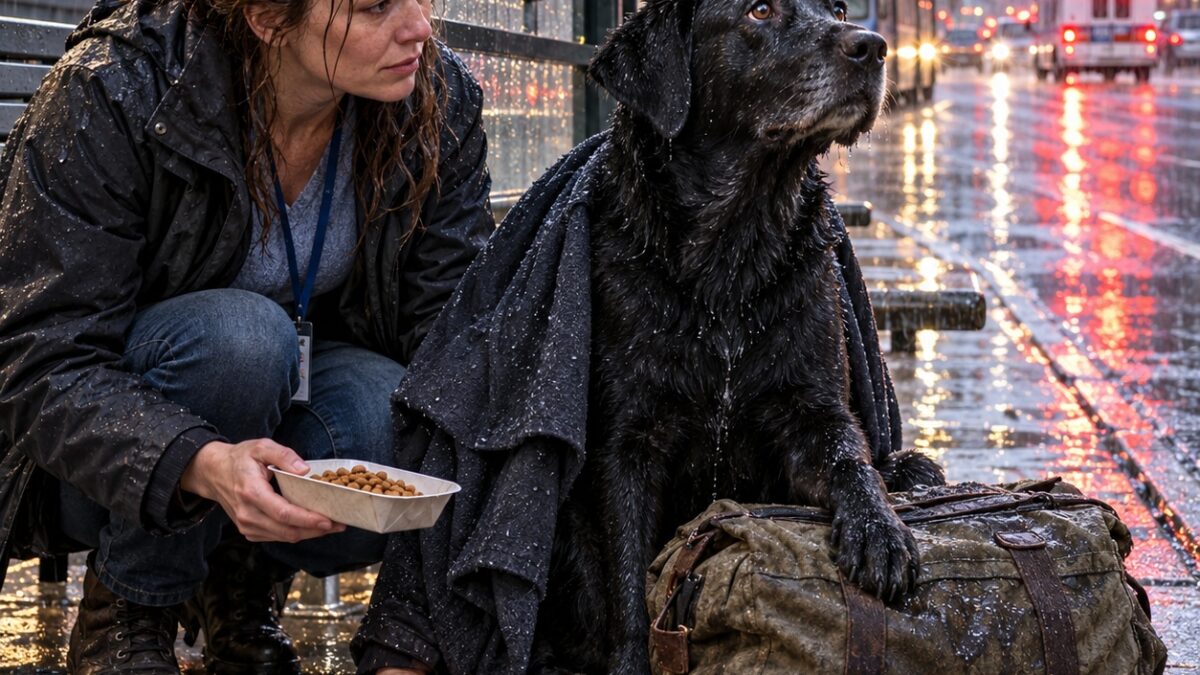
PART2
I called our office first.
Then animal control.
I explained what had happened and asked for something unusual.
No catch pole.
No forced removal.
No loud group of strangers approaching him.
I wanted a transport crate large enough for him and a blanket.
My coworker, Daniel, arrived around nine that night.
He stepped out of the van, looked at the Labrador, then at me sitting on the wet pavement.
“You’ve been here how long?”
“Most of the day.”
“You look terrible.”
“Thank you.”
“I mean wet.”
“That really improves it.”
He smiled.
Then looked at the dog.
“That him?”
“Yes.”
“What’s his name?”
“I don’t know.”
“Owner?”
“Hospital.”
“Condition?”
“Unknown.”
Daniel opened the van quietly.
When the metal crate came into view, the Labrador stood for the first time since I had met him.
Not aggressively.
He looked at the crate.
Then Daniel.
Then me.
And sat again.
More firmly.
Daniel whispered:
“He knows.”
“He thinks we’re taking him away.”
“Aren’t we?”
“Yes.”
“But?”
“But I don’t want him to think we’re making his owner disappear.”
Daniel nodded.
He stayed back.
I approached alone.
Slowly.
The dog watched.
I placed one hand near his shoulder.
Waited.
No flinch.
Then rested my palm gently against the top of his head.
He closed his eyes.
That nearly destroyed me.
People assume traumatized animals always fight.
Sometimes they do something worse.
They accept things without resisting because they have learned resistance does not matter.
But this was different.
His body did not feel defeated.
It felt exhausted.
“I know.”
His eyes opened.
“I know he told you he’d come back.”
The dog stared at me.
“You believe him.”
Nothing.
“I think you should.”
One ear moved.
“But you can’t stay here in the rain.”
He looked at the street again.
“I’m not asking you to stop waiting.”
That was the only promise I could make honestly.
“I’m asking you to wait somewhere warm.”
I slid my hand down the side of his face.
“And I’ll look for him.”
His eyes returned to mine.
“I promise.”
For another minute, neither of us moved.
Then he stood.
Daniel quietly opened the crate.
The Labrador looked inside.
Sniffed.
Took one step.
Stopped.
I touched his shoulder.
“It’s okay.”
Another step.
Then another.
He entered on his own.
No force.
No struggle.
Daniel closed the door carefully.
I sat beside the crate inside the van.
For the entire drive to the shelter, I kept one hand through the bars.
The dog lowered his head onto my fingers.
His body trembled.
Not cold.
The van was warm.
He was still waiting.
That is the only way I can describe it.
Even while moving away from the bus stop, something inside him remained there.
At the shelter, we placed him in the quietest room we had.
Food.
Water.
Dry blankets.
Low light.
No other dogs directly beside him.
He did not eat.
Did not drink.
Sat facing the door.
I stayed.
Every time someone opened it, his head lifted.
When he saw me, it lowered again.
Not disappointment exactly.
Patience.
He was not hoping I had come back.
He was checking whether I had brought the person he wanted.
Around midnight, I found the first useful clue.
The duffel bag.
I had brought it with us because the dog refused to leave without it.
Inside were clothes.
Socks.
A half-empty bottle of aspirin.
Several receipts.
A plastic bag containing dog food.
A cheap paperback.
Three photographs.
And papers.
Old shelter documents.
A medical bill.
An expired temporary-housing form.
The name repeated more than once.
Michael Grant.
I wrote it down.
There was also a handwritten note with what looked like a former address.
I searched our system.
No current housing placement.
I searched public assistance records available through my work.
Old entries.
Temporary shelter.
Short-term rental assistance.
No active case.
The following morning, I started calling.
The first shelter remembered him vaguely.
“He stayed here last winter.”
“With a dog?”
“Yes.”
“Black Lab?”
“I think so.”
“Where did he go?”
“Transitional motel placement.”
That motel had closed.
The second organization knew him better.
A woman named Carla answered.
“Michael Grant?”
“Yes.”
“Oh.”
That single syllable carried recognition.
“Do you know where he is?”
“Not now.”
“He was taken to the hospital yesterday.”
“God.”
“You knew him?”
“He came to our meal program.”
“Tell me about him.”
She hesitated.
“Why?”
“His dog is with me.”
Silence.
Then:
“Bear?”
I looked toward the kennel.
The Labrador was still facing the door.
“Is that his name?”
“Yes. Bear.”
I whispered:
“Bear.”
His head snapped toward me.
My heart stopped.
“Bear.”
He stood.
Walked to the gate.
That was the first real response I had gotten.
Carla heard me.
“That’s him.”
“Tell me everything.”
Michael had been homeless on and off for several years.
Construction work when his health allowed.
Warehouse jobs.
Day labor.
Odd repairs.
Nothing stable.
Medical debt.
Back problems.
Heart trouble.
He avoided hospitals whenever possible because he feared bills he could never pay.
Bear had been with him for almost nine years.
“Michael used to say the dog was the only thing he owned that nobody had taken away,” Carla said.
I looked at Bear.
“He fed that dog before himself.”
“I believe it.”
“We used to give Michael two meal boxes because we knew half of his would go to Bear.”
“Did he have family?”
“Not really.”
“Friends?”
“People knew him.”
“That’s different.”
“Yes.”
I made more calls.
A church pantry.
Former employer.
Street outreach team.
A man who had hired Michael to paint houses.
Everybody said versions of the same thing.
Good man.
Quiet.
Proud.
Poor.
Loved that dog.
One man said:
“I saw him sleeping outside in February. He had Bear inside his coat.”
Another told me:
“He’d spend his last five dollars on dog food.”
A woman from the outreach team said:
“He always refused motel rooms if they wouldn’t take Bear.”
That detail mattered.
Michael had chosen cold over separation.
More than once.
By noon, I found the hospital.
Getting information was harder.
Privacy rules.
No relation.
No release.
I explained who I was.
Social worker.
His dog in temporary care.
Need to determine discharge planning.
Still difficult.
Eventually a hospital social worker called me back.
Michael was there.
Alive.
Unconscious.
Cardiac event combined with severe exhaustion and untreated illness.
No clear timeline for recovery.
“Can I visit?”
“You’re not family.”
“I know.”
“He doesn’t have an authorized visitor listed.”
“I know.”
“So technically—”
“His dog hasn’t eaten.”
Pause.
“What?”
I told her.
Bus stop.
Two days.
Rain.
The command to stay.
Bear at the shelter staring at the door.
The hospital social worker went quiet.
“Give me twenty minutes.”
Thirty-five minutes later, she called back.
“Come at four.”
I arrived carrying nothing.
No flowers.
No card.
What do you bring a man who may not know you are there?
Michael looked smaller than I expected.
Thin.
Gray stubble.
Hollow cheeks.
Hospital gown hanging loosely from his shoulders.
Machines beside him.
I stood near the bed and suddenly felt ridiculous.
I did not know this man.
He had never asked me to become involved.
Yet his entire world was sitting in a shelter waiting for him.
I pulled a chair close.
“Mr. Grant?”
Nothing.
“My name is Emma Hartford.”
No response.
“I’m a social worker.”
Machines continued their quiet rhythm.
“This is going to sound strange.”
I put one hand gently around his.
“I’m taking care of Bear.”
His fingers did not move.
“He stayed at the bus stop.”
I swallowed.
“For two days.”
Nothing.
“He stayed beside your bag because you told him to.”
My eyes burned.
“You said you’d come back.”
Still nothing.
“I don’t know if you can hear me.”
I squeezed his hand.
“But he believes you.”
A tiny movement.
So small I thought I imagined it.
His index finger shifted against mine.
I froze.
“Michael?”
Nothing else.
Maybe reflex.
Maybe not.
I kept talking.
“He’s safe.”
My voice cracked.
“He’s warm.”
I lied slightly.
Emotionally, Bear was nowhere near warm.
“He hasn’t been eating much.”
I looked at Michael’s face.
“So I need you to do something for me.”
No response.
“Come back.”
I sat there twenty minutes.
Before leaving, I said:
“I promise you I will not let him disappear.”
That promise scared me.
Because social workers learn never to guarantee outcomes we cannot control.
Yet I had already made the same promise to Bear.
Now there were two of them depending on it.
I returned to the shelter after dark.
Bear stood when I entered.
I sat on the floor.
“I saw him.”
Bear froze.
I do not know whether he understood words.
Maybe tone.
Maybe the name embedded in everything I said.
“He’s alive.”
Bear stepped closer.
“He’s still here.”
Closer.
“And I think he’s trying to come back.”
Bear put his head on my knees.
For the first time.
I started crying.
Not quietly.
I wrapped one arm around his shoulders.
“You stubborn old thing.”
His weight settled against me.
“You really believed him, didn’t you?”
That night, Bear ate.
Only a little.
Half a bowl.
Then drank.
Then slept.
Actually slept.
He lay on his side instead of sitting toward the door.
I stayed.
Daniel came in around eleven.
“You’re going home?”
“No.”
“Emma.”
“Tomorrow.”
“You have a house.”
“So does he, apparently. It’s just in the hospital.”
Daniel sighed.
“Want coffee?”
“Yes.”
He brought two cups.
We sat outside Bear’s room.
I thought about Michael.
A man with almost nothing.
No permanent housing.
No savings.
No obvious family.
No stability.
Yet he had somehow created enough love that another living creature would sit in the rain for two days because of one sentence.
Stay.
I’ll come back.
People with houses break promises every day.
Michael had no house and apparently had built a home inside one dog.
I decided the story could not end with discharge paperwork and another shelter bed.
The next morning, I started working.
Not emotionally.
Practically.
That is what social workers do best when we are useful.
Michael would eventually need somewhere to go.
Bear needed continued care.
Veterinary expenses.
Food.
Temporary boarding.
Maybe permanent supportive housing.
Medical coverage.
Follow-up appointments.
Transportation.
I called everyone.
Church groups.
Homeless-outreach organizations.
Veterans’ groups, though Michael was not a veteran.
Animal-welfare nonprofits.
Housing advocates.
Local charitable foundations.
The first ten calls accomplished almost nothing.
The eleventh got me dog-food donations.
The twelfth led to a woman willing to cover Bear’s veterinary exam.
The fifteenth connected me with a landlord who sometimes worked with transitional-housing programs.
Then people started hearing the story.
I was careful.
No social media circus.
No exploitation.
I told only what was necessary.
A man was hospitalized.
His dog had waited two days.
They needed a way to stay together after discharge.
A restaurant owner donated meal cards.
A retired nurse offered transportation to appointments.
A small rescue fund agreed to cover Bear’s food and medications for six months.
Three college students volunteered to help move donated furniture if housing became available.
One woman called me crying.
“I don’t have money.”
“That’s okay.”
“I can sew.”
“What?”
“Does the dog need a blanket?”
I smiled.
“Yes.”
Bear received three blankets.
He preferred the old one.
Of course.
His condition improved slowly.
He began eating consistently after my hospital visits.
Every time I returned, I told him what I knew.
“He’s still sleeping.”
“He opened his eyes today.”
“The doctors are reducing sedation.”
“You need to keep eating.”
Bear would listen.
Sometimes his ears lifted at Michael’s name.
By the end of the first week, he recognized my routine.
I would enter.
He would approach.
I would sit.
He would place his head against my leg.
Then wait.
I became the messenger between two beings who could not reach each other.
It was one of the strangest roles I had ever had.
The hospital social worker, Jasmine, became my ally.
She called me after ten days.
“He’s conscious.”
I stood so fast my chair rolled backward.
“Fully?”
“Not fully oriented yet.”
“Can he talk?”
“A little.”
“Can I come?”
“Yes.”
I drove immediately.
Michael looked different awake.
Still sick.
Still exhausted.
But his eyes were kind.
That is the first thing I remember.
He watched me approach.
“Mr. Grant?”
He frowned.
Then recognition came from somewhere.
“Dog.”
His voice was barely sound.
I smiled.
“Yes.”
“Bear?”
“He’s okay.”
Michael closed his eyes.
A tear slid toward his ear.
“He waited.”
Michael opened his eyes.
“What?”
“At the bus stop.”
His mouth trembled.
“How long?”
“Two days.”
He turned his face away.
“I told him…”
“I know.”
“Stay.”
“I know.”
“I thought…”
He struggled for breath.
I waited.
“I thought I’d be back.”
“I know.”
“I didn’t mean…”
“I know.”
He cried silently.
I held his hand.
“He doesn’t blame you.”
Michael laughed weakly through tears.
“You know that?”
“Yes.”
“How?”
“He’s a Labrador.”
That made him smile.
Small.
But real.
“He’s eating?”
“Yes.”
“Sleeping?”
“Yes.”
“Scared?”
“Yes.”
Michael closed his eyes again.
“He hates shelters.”
“He tolerates ours.”
“He likes chicken.”
“We discovered that.”
“Don’t give him too much.”
“He would disagree.”
Another small smile.
Then he whispered:
“I can’t lose him.”
“You won’t.”
Again, the dangerous promise.
This time I meant it more.
“We’re working on housing.”
“Housing?”
“For both of you.”
He stared at me.
“I can’t pay.”
“We’ll figure that out.”
“I owe everybody.”
“No.”
“I do.”
“Michael.”
He stopped.
“You are sick.”
His jaw tightened.
“You have spent years surviving. Let other people carry something for a minute.”
“I don’t take charity.”
“Then call it community.”
“It’s charity.”
“Fine. Take charity.”
He almost laughed.
“You’re bossy.”
“I’ve been told.”
“I don’t deserve—”
“Bear sat in the rain for two days because he disagrees.”
That silenced him.
I leaned closer.
“You can argue with me later.”
Michael nodded weakly.
“When can I see him?”
That question broke my heart.
“As soon as the hospital allows it.”
The answer was not soon enough for either of us.
Infection precautions.
Recovery.
Physical therapy.
No animals on the unit.
We tried alternatives.
Video call.
Bear heard Michael’s voice through my phone.
His reaction was immediate.
I had never seen anything like it.
His head snapped up.
He moved toward the screen.
Michael said:
“Bear.”
The dog whined.
A long, aching sound.
He sniffed the phone.
Licked the screen.
Michael cried.
I nearly dropped the device because my own hands were shaking.
“Hey, buddy.”
Bear pushed his nose against the phone.
“I’m coming.”
That sentence mattered.
I’m coming.
Michael did not say soon.
Did not promise a day.
Just:
I’m coming.
Afterward, Bear stood by the shelter door for almost an hour.
But he ate dinner.
That was progress.
Meanwhile, housing moved.
A local nonprofit owned several small apartments used for transitional placements.
One unit was becoming available.
Ground floor.
Pets allowed.
Not fancy.
One bedroom.
Small kitchen.
Warm.
Safe.
The director knew Michael from previous outreach.
“He always refused our placements before.”
“Because?”
“They didn’t allow dogs.”
“This one does.”
“Then he might say yes.”
He did.
Immediately.
No pride.
No argument.
Not after I said Bear could live there.
“What do I need to do?”
“Sign paperwork.”
“I’ll sign.”
“Income review.”
“Fine.”
“Medical follow-up.”
“Fine.”
“Case management.”
He grimaced.
“Emma?”
“Yes?”
“Do you count as case management?”
I smiled.
“Unfortunately for you.”
“Fine.”
Furniture came from donations.
Small table.
Two chairs.
Bed.
Couch.
Dog bed.
Someone donated bowls.
Someone else a heavy winter coat for Michael.
Daniel found an old radio.
“Why?”
“Everybody needs a radio.”
“That sounds like something a seventy-year-old says.”
“My father gave it to me.”
“Your seventy-year-old father?”
“Shut up.”
We stocked the kitchen.
Not much.
Enough.
Three weeks after Michael collapsed, the hospital finally cleared him for discharge.
I barely slept the night before.
Bear had no idea.
I did not tell him because I did not want to create another promise until Michael was physically in my car.
I picked Michael up just before noon.
He wore donated jeans.
A gray sweatshirt.
The new coat.
He used a cane.
He looked fragile.
But standing.
Alive.
Jasmine wheeled him to the entrance.
He looked around.
“Where’s Bear?”
“At the shelter.”
“Why didn’t you bring him here?”
“Because I want you to survive the reunion.”
He smiled nervously.
“He’s going to knock me down.”
“Yes.”
“No, he won’t.”
“He’s a Lab.”
“He knows I’m sick.”
“We’re about to find out.”
The drive was quiet.
Michael held Bear’s old bag on his lap.
I had cleaned it, but not too much.
The dog’s bowl.
Old photographs.
Papers.
Everything remained.
Michael ran his fingers over the canvas.
“I had this before Bear.”
“How long?”
“Twelve years.”
“It looks twenty.”
“Thanks.”
He looked out the window.
“I slept with my head on it plenty.”
“Bear guarded it.”
“I know.”
“Why was it so important to him?”
Michael looked down.
“Because it smelled like me.”
Of course.
The shelter staff had been told not to crowd the corridor.
No applause.
No cameras.
No surprise party.
This was not content.
This was theirs.
I walked Michael inside.
Bear was sitting in his usual place.
Facing the door.
The moment the latch clicked, his head lifted.
He saw me first.
Then the man beside me.
Bear stood.
He did not run.
That surprised everyone.
He walked.
Slowly.
One careful step at a time.
Michael stopped breathing for a second.
“Bear.”
The dog stopped.
Five feet away.
Michael’s eyes filled.
“It’s me.”
Bear moved again.
Two feet.
One.
Then he sat directly in front of Michael.
Looked up.
Michael lowered himself as far as he safely could.
Bear placed his head on Michael’s knees.
That was it.
No dramatic jumping.
No barking.
No chaos.
Just contact.
Michael bent forward.
Wrapped his arms around the dog.
And sobbed.
“I came back.”
Bear did not move.
“I’m sorry.”
His hands shook against the dog’s wet eyes and ears.
“I came back.”
I stood by the door crying.
Daniel stood behind me pretending not to.
Bear pushed his head harder into Michael.
Then licked his chin.
Michael laughed and cried at the same time.
“You waited.”
I whispered:
“Yes.”
Michael looked at me.
“He really waited?”
“Every minute.”
He closed his eyes.
Bear remained pressed against him.
The reunion lasted longer than I can describe.
Because nobody wanted to interrupt it.
Eventually Bear climbed partly into Michael’s lap despite clearly being too large.
Michael let him.
Of course.
We left the shelter together.
Bear paused at the door.
Looked back at me.
I crouched.
“Go.”
He walked toward Michael.
No hesitation.
At the car, Bear climbed into the back seat beside him.
Michael did not sit in front.
He sat with the dog.
For the entire drive, Bear’s head rested against Michael’s thigh.
One hand stayed on his neck.
When we reached the apartment, Michael stood outside for a long moment.
Small building.
Nothing luxurious.
A few shrubs.
Parking lot.
Curtains somebody had donated.
He looked at me.
“This is ours?”
“For now.”
“Bear too?”
“Especially Bear.”
Michael’s eyes filled again.
He opened the door.
Bear entered first.
Sniffed every room.
Kitchen.
Bedroom.
Bathroom.
Then returned.
Michael sat on the couch.
Bear sat beside him.
Head on his knee.
Same position.
Always.
I left groceries.
Medication schedule.
Phone numbers.
A folder full of appointments.
Michael looked overwhelmed.
“Emma.”
“Yes?”
“Why did you do all this?”
I thought about the bus stop.
Rain.
Dog.
Bag.
“I don’t know.”
“That’s not true.”
“No.”
I sat across from him.
“Because he believed you.”
Michael looked down at Bear.
“And that was enough?”
“It made me want to.”
He nodded.
“I told him I’d come back.”
“You did.”
“Three weeks late.”
“He’s forgiving.”
Michael smiled.
“I know.”
The first month was not magically easy.
Real endings are rarely clean.
Michael was weak.
Physical therapy hurt.
He tired quickly.
The apartment subsidy required paperwork.
Benefits applications were delayed.
He missed one medical appointment.
Bear developed an ear infection.
Money remained tight.
But they were together.
That changed everything.
When Michael refused to go to a follow-up because he felt too tired, I said:
“Bear needs you.”
He went.
When Bear refused medication, Michael hid it in cheese.
When Michael forgot to eat, Bear stared at him until he shared toast.
They managed each other.
I visited once a week at first.
Then every two weeks.
The scene was always similar.
Michael in a chair.
Bear beside him.
Hand on dog.
Dog touching man.
One afternoon I asked:
“Why did you tell him to stay?”
Michael looked confused.
“At the bus stop.”
“Oh.”
“Why not have the paramedics take him?”
“They wouldn’t.”
“You asked?”
“I barely remember.”
He rubbed Bear’s ear.
“I knew he was scared of ambulances.”
“Why?”
“Sirens.”
“Still.”
“I thought I’d be gone an hour.”
His face tightened.
“I knew that stop.”
“What do you mean?”
“We slept near there sometimes.”
“The bus stop?”
“Behind the old church down the block.”
He looked toward the window.
“I told him to stay because it was the last place I knew how to find him.”
That hit me.
“I thought if they took me somewhere and released me…”
He swallowed.
“I could come back.”
“You were worried he’d be moved.”
“Yes.”
“And you’d lose him.”
Michael nodded.
“I’ve lost everything else.”
Bear lifted his head.
Michael smiled.
“Not you.”
The dog rested again.
“He’s my family.”
I had heard that from everyone who knew Michael.
Now I heard it from him.
“My parents are gone. No kids. Brother died young. People came and went.”
He scratched Bear’s neck.
“This one stayed.”
I looked around the little apartment.
“Now you have an address.”
“For the first time in years.”
“How does that feel?”
“Strange.”
“Good strange?”
He considered.
“Scary.”
“Why?”
“Something to lose.”
That answer stayed with me.
Housing professionals often talk about stability as if it is automatically comforting.
Sometimes stability creates fear.
If you own nothing, loss has less territory.
Once you begin rebuilding, anxiety follows.
Can I keep this?
Will it disappear?
Bear had the same fear.
For the first weeks, if Michael left the apartment without him, Bear panicked.
Paced.
Whined.
Waited at the door.
So we worked on it carefully.
Thirty seconds.
Michael stepped outside.
Returned.
One minute.
Returned.
Five.
Returned.
Bear learned a new version of the same promise.
I’ll come back.
This time, the waiting happened indoors.
Dry.
Warm.
With food.
But the lesson was still hard.
Eventually Michael could attend an appointment without Bear clawing at the door.
Eventually Bear slept while he was gone.
Trust rebuilt itself through repetition.
Leave.
Return.
Leave.
Return.
One evening, Michael called me laughing.
“What happened?”
“Bear stole my sandwich.”
“That sounds normal.”
“He hasn’t done that in years.”
“You sound proud.”
“I am.”
“Why?”
“He’s being a jerk again.”
We both laughed.
That became one of my favorite calls.
Recovery looks ridiculous sometimes.
A dog stealing lunch can mean safety.
A man complaining about rent can mean he finally has rent to complain about.
Normal problems are underrated.
People in the neighborhood slowly got to know them.
The woman downstairs brought soup.
A teenage boy offered to walk Bear when Michael’s knees hurt.
A retired mechanic fixed Michael’s old bicycle.
The restaurant owner continued sending meal vouchers.
Not forever.
Long enough.
Michael resisted less over time.
Not because he became comfortable receiving help.
Because he started giving back.
He repaired a neighbor’s cabinet.
Fixed a leaking sink.
Helped repaint the nonprofit office.
Walked another resident’s dog.
“I need to earn my keep,” he told me.
“You’re not a tenant from 1890.”
“Still.”
I let him help.
Dignity matters.
Then came a small turning point.
Michael got part-time maintenance work through the same housing organization.
Nothing heavy.
Ten hours a week at first.
Changing filters.
Minor repairs.
Checking smoke detectors.
He loved it.
“Real job?”
“Real pay.”
“How’s your heart?”
“Doctor approved it.”
“Bear?”
“Management.”
I laughed.
“Of course.”
Michael bought Bear a new collar with his first paycheck.
Blue.
Simple.
The old one had become frayed.
He showed it to me like jewelry.
“Thirty-two dollars.”
“That’s a lot for you.”
“Yeah.”
“You could’ve bought cheaper.”
“No.”
Bear wore it proudly.
Or indifferently.
We assigned pride anyway.
Six months passed.
Michael gained weight.
Not much.
Enough.
Color returned to his face.
He stopped using the cane inside.
Bear gained weight too.
Too much, according to the veterinarian.
I called Michael.
“You’re feeding him too much.”
“He was skinny.”
“He isn’t anymore.”
“He likes food.”
“All Labradors like food.”
“He suffered.”
“Michael.”
Pause.
“Fine.”
“Measure the portions.”
“Cruel.”
“I’m hanging up.”
He laughed.
The apartment became home.
Photographs appeared.
One showed Michael and Bear years earlier near a shelter outreach tent.
Another at a park.
Another under a bridge, surprisingly.
I asked about that one.
“Bad winter.”
“You kept the photo?”
“A volunteer took it.”
Bear was curled against Michael’s sleeping bag.
Michael looked almost embarrassed.
“I was ashamed of that picture for years.”
“Why?”
“I looked homeless.”
“You were homeless.”
“Exactly.”
“And now?”
He studied it.
“Now I see we made it through.”
That was growth.
Not pretending suffering never happened.
Owning the evidence that it did.
One year after the bus-stop incident, I drove past the same location.
The weather was clear.
No dog.
No bag.
People waiting for buses.
Ordinary.
I parked.
Stood where Bear had sat.
I could still picture him.
Wet.
Motionless.
Faithful beyond reason.
My phone buzzed.
Photo from Michael.
Bear asleep on the couch upside down.
Caption:
SOME GUARD DOG.
I laughed alone on the sidewalk.
That evening, I visited.
Michael made coffee.
Bear brought me a toy.
“You play now?”
He dropped it.
I threw it.
Bear retrieved.
Michael said:
“He thinks you’re family.”
“That’s dangerous.”
“He has questionable judgment.”
We sat.
I told Michael where I had been.
“The stop?”
“Yes.”
He became quiet.
“I haven’t gone back.”
“Why?”
“Don’t need to.”
Fair.
I asked:
“Do you regret telling him to stay?”
Michael took a long time answering.
“Yes.”
Then:
“No.”
I waited.
“I regret that he suffered.”
“Of course.”
“But if I told him to run after the ambulance…”
He shook his head.
“He might’ve been hit. Lost. Picked up somewhere I couldn’t find.”
“You did what made sense in the moment.”
“I thought I was dying.”
That was the first time he had said it that plainly.
“I couldn’t breathe. Chest felt crushed.”
He looked at Bear.
“I remember the paramedic saying I couldn’t bring him.”
“So?”
“I thought if I died…”
His voice lowered.
“At least somebody might find him at that stop.”
I swallowed.
He had not told Bear to stay because he was certain he would return.
He had said it because he wanted Bear to be findable if he did not.
That changed the whole memory.
Michael continued:
“But I couldn’t tell him that.”
“No.”
“So I said I’d come back.”
“Maybe you needed to believe it too.”
He looked at me.
“Maybe.”
Bear put his paw on Michael’s shoe.
The promise had worked both directions.
Dog waited.
Man survived.
I do not claim love cured Michael.
Doctors did medicine.
Nurses did medicine.
Physical therapy mattered.
Housing mattered.
Food mattered.
Rest mattered.
Luck mattered.
But I believe Bear gave Michael something worth returning to.
That matters too.
And Michael gave Bear the same.
Their story eventually became known locally, mostly because community groups who helped them talked about it.
People romanticized it.
Homeless man and loyal dog reunited.
Heartwarming.
Yes.
But I always felt uneasy when the story became too simple.
Michael had not been rescued because one dog loved him.
He was helped because housing existed.
Because medical care continued.
Because people donated.
Because organizations coordinated.
Because a landlord allowed pets.
Because someone answered a phone.
Love made people care.
Systems made care useful.
Both matter.
Without Bear, maybe nobody would have noticed Michael’s story.
Without practical help, caring would have produced nothing but tears.
That lesson stayed with me professionally.
Afterward, our office changed how we handled cases involving hospitalized unhoused people with pets.
We created a contact list.
Temporary foster options.
Pet-friendly housing resources.
Emergency veterinary funding.
Nothing revolutionary.
Just fewer chances for a person to lose the last relationship they had because bureaucracy could not accommodate an animal.
Bear’s two days at that stop changed policy in a small office.
Michael found that funny.
“My dog made government paperwork?”
“Yes.”
“Poor Bear.”
I laughed.
He became strangely proud of it later.
Every winter, Michael donated something to the shelter.
Never much.
Ten dollars.
Twenty.
Dog food.
Used blankets.
One year he brought a full case of canned food.
“Big spender.”
“Overtime.”
“Look at you.”
“Don’t get emotional.”
“I’m already emotional.”
“Emma.”
Bear aged.
That worried everyone.
Labs do.
Gray around the muzzle first.
Then slower hips.
Less enthusiasm for long walks.
Still excessive enthusiasm for food.
Michael adjusted everything around him.
Ramp by the bed.
Non-slip rugs.
Senior-dog food.
Pain medication.
Shorter routes.
One afternoon I found Michael sitting on the floor rubbing Bear’s back.
“You okay?”
“He’s getting old.”
“So are you.”
“Not helping.”
I sat.
Michael whispered:
“I don’t know how I’ll do this.”
“What?”
“If he goes first.”
There was no answer that would make it better.
So I used one of his.
“He’s here.”
Michael nodded.
“For now.”
“For now.”
We spend so much life trying to prepare for loss that sometimes preparation steals time from what is still present.
Michael knew that.
He struggled anyway.
Bear eventually developed arthritis.
Then kidney disease.
Manageable for a while.
Michael gave medications with military precision.
He kept a notebook.
Food.
Water.
Bathroom.
Energy.
Medication times.
The man who once could barely manage his own medical appointments became obsessive about Bear’s.
I teased him.
“You know more about his kidneys than yours.”
“His matter more.”
“Wrong.”
“He’s nicer.”
“Debatable.”
Bear still waited near the door whenever Michael left.
Not anxiously anymore.
Simply habit.
He knew.
Michael always came back.
That is one of the most beautiful things about repeated promises.
Eventually they stop feeling like promises.
They become reality.
At some point, Bear no longer needed proof.
The old bus stop belonged to the past.
Michael went out.
Bear slept.
Michael returned.
Normal.
Years after the reunion, Michael became seriously ill again.
Not sudden this time.
Planned hospitalization.
Three days.
Maybe four.
The first thing he told the hospital social worker was:
“My dog stays home.”
She called me.
I laughed.
“Progress.”
I arranged care.
Bear stayed in the apartment with the teenage neighbor, now in college but home for break, checking on him.
The first evening, Bear waited near the door.
Second evening, less.
Michael video-called.
“I’ll come back.”
Bear heard him.
Lay down.
And ate dinner.
That felt like a full circle I had not expected.
The same words.
Different outcome.
Because now Bear had years of evidence.
Promises mean something when history supports them.
Michael came home on day four.
Bear greeted him like he had returned from war.
No bus stop.
No rain.
No crisis.
Just reunion.
Michael called me.
“He waited.”
“Of course.”
“But he ate.”
“Growth.”
“He stole the neighbor’s chicken.”
“Excellent.”
“You’re a terrible social worker.”
“I’m a dog optimist.”
Eventually Bear reached twelve.
Then thirteen.
Michael had started calling him “old man.”
Bear ignored it.
One spring afternoon, I visited and found them sitting outside the apartment.
Michael in a folding chair.
Bear at his feet.
Sunlight.
Neighbors talking.
A child drawing chalk circles on the sidewalk.
Nothing remarkable.
I sat beside them.
Michael said:
“You know what I used to think rich meant?”
“What?”
“Having enough money that losing five dollars didn’t matter.”
“Reasonable.”
“Now?”
He looked around.
“This.”
I followed his eyes.
Apartment.
Dog.
Chair.
Coffee.
Neighbors.
“You’re easy to please.”
“No.”
He rubbed Bear’s head.
“I learned the difference between having a lot and having enough.”
I wrote that sentence down later.
Social work teaches you to measure need.
Income.
Housing status.
Food security.
Insurance.
Transportation.
All essential.
Michael taught me that people also need enough belonging.
Bear was his.
Not possession.
Belonging.
Years earlier, people had said Michael had nothing.
That was financially almost true.
But he had Bear.
And Bear had him.
Their loyalty did not pay bills.
It did not replace healthcare.
It did not solve homelessness.
But it kept both of them emotionally connected to life long enough for help to matter.
That is not nothing.
Bear’s final year was gentle.
I am grateful for that.
No dramatic emergency.
Just decline.
More sleep.
Less appetite.
More time pressed against Michael.
The veterinarian eventually told him:
“Start thinking about quality of life.”
Michael hated the phrase.
“What does that even mean?”
“It means love sometimes changes jobs.”
He stared at me.
“From what to what?”
“From keeping someone with you to keeping them from hurting.”
He did not speak for a long time.
A month later, Bear stopped eating breakfast.
Then dinner.
Medication helped briefly.
One evening Michael called.
“Emma.”
His voice told me.
“I’m coming.”
“You don’t have to.”
“I know.”
I went.
Bear lay on his bed.
Michael sat on the floor beside him.
That old duffel bag was nearby.
Still.
I had not seen it in years.
“You kept that?”
Michael smiled faintly.
“Of course.”
Bear lifted his head when I entered.
Tail moved.
Once.
“Hi, buddy.”
I sat.
He rested his chin against my hand the way he had in the transport crate years earlier.
I remembered rain.
Metal bars.
Trembling.
Waiting.
This time there was no waiting.
Only tiredness.
Michael whispered:
“I told him.”
“What?”
“That he doesn’t have to stay.”
I looked at him.
“He spent his whole life doing what I told him.”
Michael’s eyes filled.
“I don’t want the last command to be wait.”
I cried.
There is no professional training for a sentence like that.
The veterinarian came to the apartment.
Bear remained on his bed.
Michael held his head.
I sat nearby.
Before the medication, Michael leaned close.
“Remember the bus stop?”
Bear’s eyes moved toward him.
“I said I’d come back.”
Michael pressed his forehead against Bear’s.
“I did.”
His shoulders shook.
“And you waited.”
Bear breathed slowly.
“But you don’t have to wait anymore.”
Michael kissed his head.
“Go ahead.”
Bear died with Michael’s hand resting between his ears.
No rain.
No pavement.
No uncertainty.
Home.
I stayed after.
Michael sat beside the empty bed.
For almost an hour, neither of us spoke.
Then he reached for the duffel bag.
Opened it.
Inside were old papers.
Photographs.
The blue collar.
Receipts.
Pieces of their life.
He held the collar.
“I thought losing everything was the worst thing.”
I waited.
“It isn’t.”
“No.”
“Losing the thing you’d keep if everything else went.”
I moved closer.
“I know.”
Michael cried.
I let him.
There are moments when helping means arranging housing.
Filing benefits.
Calling hospitals.
There are moments when helping means sitting on the floor and not filling silence.
Bear taught me that.
So did Michael.
Months passed.
Michael kept working part-time.
Kept the apartment.
That mattered.
At first he said he would never get another dog.
I believed him.
Then one Saturday, almost a year later, he came to the shelter carrying Bear’s old leash.
I stared at it.
“No.”
“Relax.”
“What are you doing?”
“Looking.”
“That is how adoption starts.”
“I’m just looking.”
“Sure.”
He walked the kennels slowly.
Passed puppies.
Young dogs.
Energetic Labs.
Then stopped at an older mixed-breed dog.
Gray muzzle.
Quiet.
The dog sat near the back.
Michael crouched.
Did not call.
Did not reach.
He simply waited.
I watched from the doorway.
After five minutes, the dog moved forward.
One step.
Michael smiled.
Another.
Eventually the dog reached the gate.
Michael held out his fingers.
The dog sniffed.
I wiped my eyes.
Michael looked over.
“Don’t start.”
“I’m not doing anything.”
“You’re crying.”
“Dust.”
“In a shelter?”
“Very dusty.”
He adopted her three days later.
Her name was Rosie.
She was not Bear.
That was the point.
Nothing replaces what was real.
But love can continue without replacement.
Michael later told me:
“Bear would’ve liked her.”
“How do you know?”
“He liked everybody.”
“Fair.”
Rosie slept on Bear’s old bed.
Michael kept Bear’s collar hanging beside the door.
The duffel bag stayed in the closet.
And every time Michael left the apartment, he told Rosie:
“I’ll be back.”
The first time I heard him say it, I froze.
He noticed.
“What?”
“Nothing.”
He smiled.
“You remember.”
“Yes.”
“So do I.”
Rosie watched him.
Michael leaned down.
“But I don’t tell her to stay outside.”
We both laughed.
That is how grief changes eventually.
Not disappearance.
Integration.
The old pain remains, but laughter can stand beside it.
I am older now than I was when I found Bear.
Still doing social work.
Still seeing things I wish I did not.
Still meeting people whose lives have collapsed in ways outsiders reduce to bad choices.
I have become slower to assume.
Faster to ask.
Where is the dog?
Who are you trying not to lose?
What would make this placement impossible for you?
Sometimes the answer is an animal.
People who have never been poor often misunderstand why someone without a home would keep a dog.
They ask:
“If you can’t afford yourself, why have a pet?”
I understand the practical concern.
Food costs money.
Veterinary care costs money.
Housing becomes harder.
All true.
But I have sat with a man who owned almost nothing except one dog.
That dog was not an irresponsible luxury.
Bear was the relationship keeping him attached to the world.
Take away the dog, and you might make the spreadsheet cleaner while destroying the person.
Good help accounts for the whole life.
Not just the part that fits a form.
That lesson changed how I work.
It changed other people too.
Our community eventually created a small fund specifically for pets belonging to people in temporary housing or medical crisis.
Emergency boarding.
Vaccinations.
Food.
Short-term veterinary care.
Pet deposits.
Nothing enormous.
It began with Bear.
Nobody named it after him.
Michael refused.
“Bear didn’t care about plaques.”
True.
But I know.
Every time a hospitalized person keeps their animal because someone pays for three weeks of boarding, I know where the idea came from.
A black Labrador at a bus stop.
Rain.
One bag.
One promise.
Bear waited two days.
People often focus on that.
Two days.
As if duration is the miracle.
I think the real miracle is simpler.
He believed.
He had no phone.
No explanation.
No concept of intensive care.
No way to know why Michael vanished.
He only had a sentence.
Stay here.
I’ll come back.
So he stayed.
Humans break under uncertainty because our minds invent stories.
Bear had one story.
Michael comes back.
That certainty kept him in place.
Dangerously, yes.
But beautifully too.
Michael carried the same certainty from the other side.
When he woke in the hospital, he did not ask about money first.
Or housing.
Or his bag.
He asked:
Bear?
That was his entire world condensed into one word.
People ask me sometimes which moment I remember most.
The bus stop?
Hospital?
Video call?
Reunion?
Bear dying?
It is not what they expect.
I remember the shelter door opening on reunion day.
Bear looking up.
Seeing Michael.
Standing.
And not running.
He walked.
Slowly.
Carefully.
As if hope itself was fragile and sudden movement might break it.
Then he reached Michael.
Sat.
Placed his head on his knees.
That gesture said everything.
You came back.
Michael did not need forgiveness because Bear had never conducted a trial.
He had simply waited for reality to catch up with the promise.
It finally did.
That is why I still tell the story.
Not because loyalty is cute.
Loyalty can hurt.
Bear almost starved himself.
Love without support can become suffering.
The story matters because other people eventually entered it.
The cashier who remembered.
The shelter worker.
The hospital social worker.
The landlord.
The woman who sewed blankets.
The people who donated food.
The students who moved furniture.
The neighbor who walked Bear.
The veterinarian.
Every person became part of keeping one promise that Michael had made under flashing ambulance lights.
I’ll come back.
Michael could not keep it alone.
So strangers helped him.
There is something deeply human in that.
Sometimes we cannot fulfill our promises without one another.
That does not make the promise less real.
Years later, I once asked Michael whether he thought Bear understood what had happened.
He smiled.
“No.”
“Really?”
“He understood enough.”
“What?”
“I left.”
He touched Bear’s old collar hanging beside the door.
“And I came back.”
Maybe that is all any of us understand in the end.
Who left.
Who returned.
Who stayed.
Who waited.
Who showed up when staying alone became impossible.
My name is Emma Hartford.
I am a social worker.
I have seen people with houses who were completely alone.
I have seen people without houses who were deeply loved.
I have watched families fall apart over money.
And strangers become family because one person needed somewhere to sleep.
But I have never forgotten the black Labrador beside that bus stop.
Rain running from his coat.
One old duffel bag beneath the bench.
Eyes fixed on the road.
He was not waiting because he was confused.
He was waiting because someone he loved had told him:
Stay.
I’ll come back.
Michael did come back.
Late.
Weak.
Changed.
But alive.
And Bear, after everything, did exactly what he had promised too.
He stayed.
For years afterward, whenever Michael sat in his little apartment, Bear would settle beside him and place his head on his knees.
Michael’s hand would rest on the dog’s head.
Sometimes neither moved for an hour.
Two beings the world had nearly separated.
Together.
Warm.
Home.
People talk about love as though it always has to move toward something.
Chase.
Fight.
Cross distance.
Make noise.
Bear taught me something else.
Sometimes the greatest love does not run.
Sometimes it sits in the rain.
Beside one old bag.
Watching the road.
And believes.








