FULL STORY:For Seven Days, a Brown-and-White Dog Refused to Leave Our ER Doors—Then the Storm Forced Her to Make a Choice
PART2
Clara Desmarais ran a small animal-rescue organization outside the city.
I knew her through previous cases involving injured strays and pets belonging to hospitalized patients.
She was one of those people who never seemed hurried, even when everyone around her was.
I called shortly after noon.
“I have a dog.”
“You always have a dog when you call me.”
“This one’s been outside seven days.”
Silence.
“Seven?”
“Owner came in by ambulance.”
“Still admitted?”
I looked toward the nurses’ station.
“No.”
Clara understood from my voice.
“Oh.”
“He died two days ago.”
“And she’s still there?”
“Yes.”
“Has anyone tried trapping her?”
“No hard capture.”
“Good.”
“Storm hits tonight.”
“I saw.”
“She’s weak.”
“How close can you get?”
“Maybe six feet before she backs away.”
“Toward where?”
“The ambulance lane.”
“That’s bad.”
“Yes.”
“I’ll come.”
She arrived just before dusk.
By then the sky had turned a dark, unnatural gray.
Wind pushed leaves across the parking area.
The automatic doors opened and closed with every gust.
Élodie, one of our nurses, stood beside me at the window.
“She can’t stay.”
“I know.”
“What if Clara can’t get her?”
I had no answer.
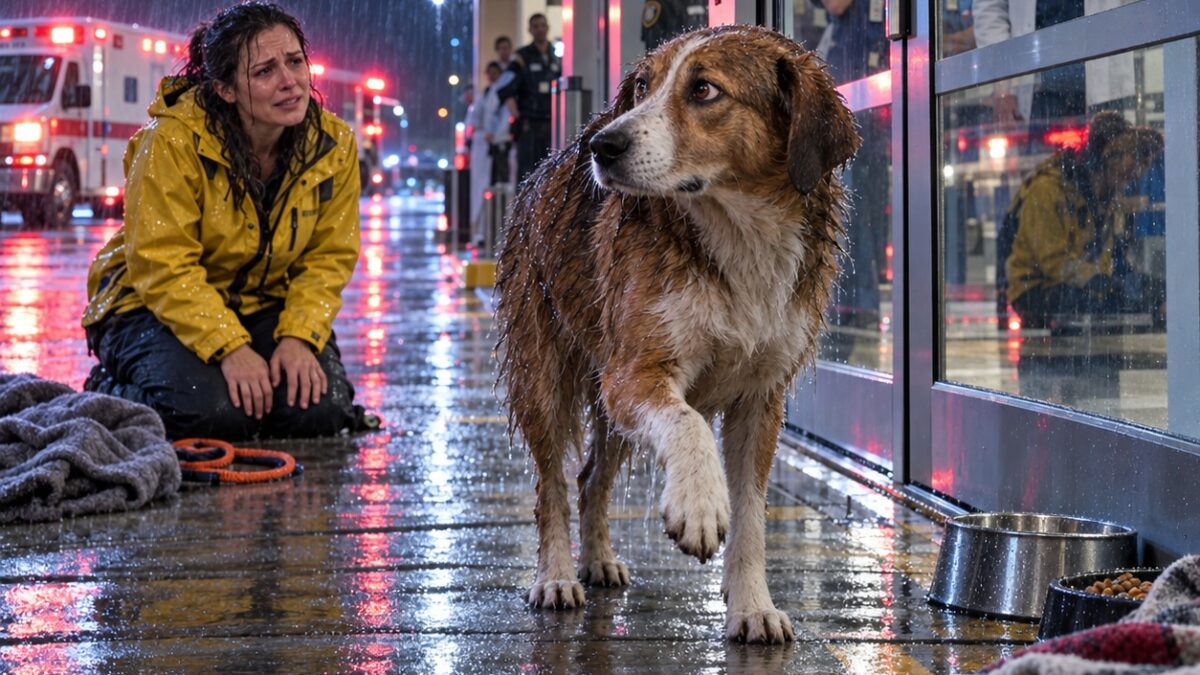
The dog was still seated almost exactly where she had been on Monday.
Only now her body looked smaller.
Hips sharper.
Head lower.
Her fur lifted in the wind.
Clara did not approach immediately.
That was the first thing I noticed.
Everyone else who had tried helping had begun with movement.
Clara began by standing still.
She watched from near the parking lot.
Five minutes.
Ten.
The dog glanced at her once.
Then returned her eyes to the doors.
Clara came inside.
“She’s not waiting for the building.”
“What do you mean?”
“She’s waiting for a person.”
“We know.”
“No.”
She shook her head.
“You know intellectually. She’s organized her entire behavior around it.”
I looked through the glass.
“She thinks he’ll come out.”
“Yes.”
“He won’t.”
“I know.”
“What do we do?”
Clara looked at me.
“Stop trying to make her leave.”
I frowned.
“That’s the whole problem.”
“No. The problem is that every person who approaches becomes something trying to separate her from him.”
I understood.
“So?”
“I have to become something else.”
The first heavy raindrops struck the glass.
Clara took a thick fleece blanket from her bag.
Then left it inside.
No leash.
No catch pole.
No net.
Nothing.
She walked outside empty-handed.
Slowly.
She stopped about twelve feet from the dog.
Then knelt.
The dog looked at her.
Clara lowered her gaze.
Hands flat on her thighs.
Wind blew her hair across her face.
She did not move to fix it.
The dog turned back toward us.
For several minutes, Clara said nothing.
Then she started talking.
Softly.
We could barely hear through the glass.
Not commands.
Not:
Come here.
Not:
Good girl.
Not:
Want a treat?
She simply spoke.
Later she told me some of what she said.
“You did your job.”
“You stayed.”
“Everybody saw you.”
“You didn’t leave him.”
“There’s nothing more you have to prove.”
Inside, people began gathering.
Not because we had announced anything.
They noticed.
A physician stood near triage.
Two paramedics paused beside the doors.
Security.
Nurses.
One custodian with a mop still in his hand.
We all watched.
Rain became heavier.
The dog’s ears shifted.
For seven days, those ears had pointed toward the doors.
Now one rotated toward Clara.
Clara kept talking.
“He knew you were there.”
That sentence hurt me.
She could not know that.
Maybe André had seen her through the ambulance doors.
Maybe he had been unconscious.
Maybe he had known nothing after arriving.
But if a comforting uncertainty exists, sometimes kindness does not require destroying it.
“You waited long enough.”
The dog looked at Clara.
Not a glance.
Really looked.
Thunder sounded somewhere beyond the hospital.
She flinched.
Then immediately looked back at the doors.
Clara remained kneeling.
“Nothing bad happens if you rest.”
Rain soaked her clothes.
Water ran down her sleeves.
Forty minutes passed.
I checked the clock twice.
Forty-five.
Then a gust hit so hard the trees near the entrance bent.
The dog stood.
Her legs shook.
Someone behind me whispered:
“Come on.”
I almost told them not to speak.
The dog took one step toward Clara.
Stopped.
Clara did not reach.
Second step.
Pause.
Third.
The dog looked once at the glass doors.
Then back at Clara.
Another gust.
She continued.
When she reached Clara, she stretched her neck.
Smelled one open palm.
Clara remained still.
The dog sniffed again.
Then something in her seemed to disappear.
Not life.
Resistance.
She folded.
Her front legs bent.
Her body dropped against Clara’s knees.
Her head landed across Clara’s lap.
And from her chest came one enormous sigh.
I heard it even through the doors.
Élodie started crying.
So did the custodian.
I did too.
Clara placed one hand against the dog’s neck.
No restraint.
Just contact.
The dog closed her eyes.
For seven days, she had watched the doors.
Now, finally, she let someone else watch them for her.
Clara waited another minute.
Then signaled us.
I brought the blanket.
We moved slowly.
Clara wrapped the dog.
The animal did not fight.
Did not look toward traffic.
Did not stand.
Clara lifted her.
The dog’s head remained against her shoulder.
At that exact moment, the rain became violent.
It hit the pavement so hard water bounced.
The automatic doors opened.
Clara carried her through.
For the first time in seven days, the dog crossed the threshold.
Not to search for André.
To be safe.
We took her into a heated staff room behind the emergency department.
No exam bay.
No metal table unless medically necessary.
Warm blankets.
Dim light.
A bowl of water.
Small amounts of food.
Clara sat on the floor.
The dog drank for almost a full minute.
Then ate several bites.
Then stopped.
Looked around.
Every face was watching.
“Give her space,” Clara said.
We did.
She lay down.
But she did not sleep.
Not yet.
Her eyes moved toward the door.
Clara rested nearby.
“You’re still waiting.”
The dog’s ears twitched.
Clara looked at me.
“She needs a name for tonight.”
“A name?”
“Something we can say softly.”
Élodie suggested Belle.
Someone else said Hope.
I said nothing.
Clara looked through the narrow window at the storm.
Then at the dog.
“Étoile.”
Star.
I smiled.
“Why?”
“Because everybody on night shift has been orienting themselves around her for a week.”
The name stayed.
Étoile.
We checked her medically as gently as possible.
Dehydrated.
Underweight.
Paw pads irritated from remaining on concrete.
Exhausted.
No major injury.
Heart and lungs sounded acceptable.
She was older than we first guessed.
Maybe seven.
Maybe eight.
No microchip information that immediately gave us another owner.
André’s niece confirmed what we suspected.
Étoile had been his dog for years.
The two lived alone.
No spouse.
No children.
The niece could not take her because of housing restrictions and another reactive dog.
She cried when Clara called.
“My uncle loved her.”
“I believe it.”
“He talked about that dog more than people.”
Clara looked at me.
“That sounds familiar.”
The niece told us Étoile slept beside André every night.
Walked with him every morning.
Went almost everywhere dogs were allowed.
André had once delayed moving into a cheaper apartment because it would not accept pets.
The niece said:
“She was his family.”
I looked at the dog sleeping nearby.
“Apparently he was hers too.”
We did not tell Étoile in words.
What could words do?
Instead, Clara gave her what she could understand.
Warmth.
Food.
Predictability.
Presence.
The storm lasted most of the night.
Rain hammered the building.
Lightning flashed.
Étoile startled at the first thunder.
Clara put one hand on the floor beside her.
Not touching.
Available.
Étoile watched.
Then lowered her head.
Around three in the morning, she finally slept.
Deeply.
Her entire body relaxed.
No ear pointed toward the door.
No head lifting when someone walked past.
Sleep after seven days of waiting looked almost sacred.
The next morning, the storm had moved east.
Branches littered the parking lot.
Parts of the lower road were flooded.
But sunlight appeared behind thinning clouds.
Étoile woke slowly.
Ate.
Drank.
Then walked outside on a leash with Clara.
She stopped near the glass doors.
Every one of us held our breath.
She stared.
For several seconds.
Then Clara said:
“Come on.”
Étoile looked at her.
And followed.
That mattered more than I can explain.
She looked back once.
Only once.
Then they walked toward Clara’s rescue vehicle.
The sanctuary was thirty minutes outside town.
Small.
Peaceful.
More like a farmhouse than a shelter.
Large fenced yards.
Quiet indoor rooms.
No long row of metal kennels.
Étoile spent the first forty-eight hours mostly sleeping.
Clara sent me photographs.
First:
Curled on a thick bed.
Second:
Sleeping on her side, paws loose.
Third:
Eyes open beside a food bowl.
The captions were short.
STILL EXHAUSTED.
ATE HALF BREAKFAST.
WENT OUTSIDE TEN MINUTES.
DRANK WELL.
I checked my phone between patients more than I should have.
Our entire emergency department did.
“How’s Étoile?”
“Any update?”
“Did she eat?”
“Did she sleep?”
She had somehow become our patient without technically being one.
On day three, Clara called.
“She wagged.”
“What?”
“Tail.”
“For you?”
“For breakfast.”
“That still counts.”
“I agree.”
By the end of the first week, Étoile was eating regular meals.
She walked through the sanctuary garden.
Slowly at first.
Always checking the gate.
Whenever a vehicle arrived, she became alert.
Clara never punished or redirected sharply.
She allowed her to look.
Then called softly.
Étoile eventually turned back.
That became part of healing.
See the door.
See the road.
Choose the present.
Again.
Again.
Again.
I visited after ten days.
I worried she would not remember me.
Why should she?
To her, I was one of dozens of people behind glass.
When I entered the garden, Étoile stared.
I crouched.
“Hey, star.”
One ear lifted.
Clara smiled.
“She remembers voices.”
Étoile approached.
Not running.
She sniffed my hands.
Then stood beside me.
That was enough.
I scratched her shoulder.
“You look better.”
She did.
Weight returning.
Coat cleaner.
Eyes less hollow.
But every now and then, she looked toward the building entrance.
Old habits.
I asked Clara:
“Do you think she’s still waiting for André?”
“Yes.”
The answer surprised me.
“Really?”
“She may always wait in some way.”
I watched Étoile.
“That sounds terrible.”
“It isn’t.”
“How?”
“Memory isn’t the problem.”
Clara nodded toward the dog.
“Being unable to live anywhere except inside the memory is the problem.”
That sentence stayed with me.
I had seen versions of it in humans.
Widows refusing to move a dead spouse’s shoes.
Parents preserving bedrooms.
People calling disconnected phone numbers just to hear old voicemail greetings.
Grief is not forgetting.
It is learning to carry something that no longer has a physical destination.
Étoile had spent seven days giving grief a destination.
The glass doors.
If she stared long enough, André might return.
Now she had to learn a much harder thing.
Love could remain even when waiting ended.
Clara worked slowly.
No forced socialization.
Étoile decided who touched her.
She preferred women at first.
Then accepted one male volunteer named Pierre who read books outside her enclosure.
He did not read to her intentionally.
He had bad eyesight and liked daylight.
Étoile started lying nearby.
Eventually she slept beside his chair.
Progress often looks accidental.
Two weeks after rescue, I brought one of André’s old blankets.
His niece had found it in the apartment.
We debated whether giving it to Étoile would help or hurt.
Clara said:
“Let her decide.”
We placed it in her room.
Étoile approached.
Sniffed.
Stopped.
Her entire body went still.
She inhaled again.
Then lay on top of it.
For almost an hour.
No crying.
No pacing.
Just stillness.
I sat outside the room.
Clara whispered:
“That’s goodbye.”
“You know that?”
“No.”
She smiled sadly.
“But I like believing it.”
Étoile slept on André’s blanket for several weeks.
Then gradually stopped.
One morning Clara found her on another bed.
The blanket remained untouched across the room.
No one moved it.
A week later, Clara folded it.
Étoile watched.
No distress.
The blanket eventually went into a storage box with André’s leash and collar.
Not erased.
Stored.
Another good metaphor for grief.
Three weeks after the storm, Julien and Sophie arrived.
They were not looking specifically for Étoile.
They had lost their own dog, Milo, six months earlier.
Fourteen-year-old spaniel.
Cancer.
Sophie told Clara they had spent months saying:
“Never again.”
Then the house became too quiet.
They were not ready for a puppy.
They wanted an adult.
Calm.
Maybe overlooked.
Clara told me later she thought of Étoile immediately but said nothing.
She let them walk through the garden.
Étoile was near an apple tree.
Sunlight on her back.
Sophie stopped.
“That one.”
Julien smiled.
“We haven’t even met her.”
“I know.”
Étoile saw them.
Usually she waited for strangers to approach.
That day, she stood.
Walked toward Sophie.
Stopped directly in front of her.
Sophie crouched.
No reaching.
Étoile sniffed.
Then rested her head across Sophie’s knees.
Exactly what she had done with Clara.
Sophie cried instantly.
“Oh.”
Julien looked at Clara.
“Does she do that with everyone?”
“No.”
That answer decided everything.
They visited three more times.
Clara insisted.
Étoile had experienced enough sudden transitions.
Visit one:
Garden walk.
Visit two:
Indoor time.
Visit three:
Short car ride.
Étoile remained cautious but increasingly comfortable.
Julien never pushed.
That helped.
He would sit on the ground and wait for her.
One afternoon Étoile walked over and leaned against his shoulder.
Julien closed his eyes.
Sophie whispered:
“Milo used to do that.”
Clara later told me:
“They all lost somebody.”
Maybe that was why it worked.
Not because grief magically recognizes grief.
Because people who know loss sometimes understand not to hurry another creature through it.
The adoption happened quietly.
No big event.
No balloons.
No crowd.
Clara signed paperwork.
Sophie attached a new tag to Étoile’s collar.
Julien loaded food and medication into the car.
Étoile stood near the sanctuary door.
Looked back toward Clara.
Clara knelt.
“Go.”
Étoile approached.
Pressed her head against Clara’s chest.
Then stepped away.
Walked toward Sophie.
Got into the car.
No panic.
No refusal.
Clara cried only after the vehicle disappeared.
I knew because she called me.
“She left.”
“You okay?”
“No.”
“Good adoption?”
“Perfect.”
“Then why are you crying?”
“Because that’s what we do.”
Fair.
Sophie sent the first photo that night.
Étoile asleep on a rug beside their couch.
Caption:
SHE ATE DINNER. CHECKED EVERY ROOM. NOW OUT COLD.
Second morning:
Étoile standing near the back door, sunlight across her face.
Third:
Running.
Actually running.
Not far.
But enough.
The country property suited her.
Wide yard.
Trees.
Quiet road.
No hospital sirens.
No automatic doors.
Julien worked from home several days a week.
Sophie taught music lessons.
Étoile was rarely alone.
At first, she followed Sophie obsessively.
Bathroom.
Kitchen.
Laundry.
Garden.
Sophie worried.
Clara said:
“Let her.”
“How long?”
“Until she learns you come back.”
So Sophie created predictable absences.
Walk to mailbox.
Return.
Ten minutes upstairs.
Return.
Short grocery trip.
Return.
Étoile gradually stopped shadowing every step.
Trust transformed from proximity into certainty.
She did not need to watch Sophie constantly because Sophie developed a history of returning.
That is one of the quiet miracles of consistent love.
The dog who once believed separation might be permanent learned that sometimes doors close temporarily.
One month after adoption, Sophie sent us a video.
Julien walked through the front door after being gone two hours.
Étoile ran toward him.
Tail high.
Full body wagging.
No hesitation.
I showed it to the emergency department during a break.
Élodie smiled.
“She looks different.”
“She is.”
“No.”
Élodie pointed at the screen.
“Her eyes.”
That was true.
The sadness had not vanished completely.
Maybe I imagined it because I knew her history.
But something had changed.
The eyes were engaged.
Looking toward life instead of through it.
Our staff kept following her updates.
She became a kind of unofficial mascot.
Someone printed one of Sophie’s photographs and taped it near the break room.
Étoile asleep beneath an apple tree.
Underneath, a nurse wrote:
DAY 7: WOULD NOT LEAVE THE ER
DAY 70: REFUSES TO LEAVE THE SUNBEAM
The joke became popular.
We needed it.
Emergency departments are heavy places.
Bad endings accumulate.
We rarely get to know what happens after discharge.
Patients leave.
We return to work.
Étoile gave us an after.
Months later, Sophie brought her back to visit.
We planned carefully.
No one knew how Étoile would react to the hospital.
Clara came too.
Sophie parked farther away.
They walked slowly.
Étoile seemed relaxed until she saw the glass doors.
Then she froze.
My stomach dropped.
Her ears forward.
Body still.
Sophie stopped.
No leash pressure.
Clara remained several feet away.
I stepped outside.
Étoile looked at me.
Then the doors.
Me.
Doors.
Sophie whispered:
“You don’t have to.”
Étoile took one step toward the entrance.
Then another.
She reached the place where she had spent seven days.
Sniffed the concrete.
Stood still.
I felt my throat tighten.
People inside noticed.
Élodie came to the glass.
So did a paramedic who had been there that week.
Étoile looked through the doors.
For maybe twenty seconds.
Then turned.
Walked to Sophie.
Sat against her leg.
That was it.
No waiting.
No collapse.
No desperate searching.
She had returned to the place where André disappeared and chosen the person beside her.
I crouched.
“Good girl.”
Étoile approached.
Let me scratch her neck.
Then she looked once more at the doors.
We walked away together.
That visit changed how I thought about grief more than anything else.
Healing is not avoiding the door forever.
Sometimes healing is standing before the same door and discovering you no longer need it to open.
Étoile returned home with Sophie and Julien.
Her life became ordinary.
That is my favorite part.
Not heroic.
Ordinary.
Morning walks.
Food.
Mud.
Naps.
She learned to chase a soft ball.
Discovered that squirrels existed apparently for personal insult.
Stole one entire loaf of bread from the kitchen counter.
Sophie called Clara horrified.
Clara laughed.
“Congratulations.”
“For what?”
“She feels safe enough to misbehave.”
Ordinary trouble can be a sign of recovery.
At the hospital, we still talked about her sometimes.
Especially during storms.
When wind hit the glass, I remembered that seventh night.
The dog bracing herself against the gust.
Clara kneeling.
All of us watching.
One evening, a new resident asked:
“Why is there a dog photo in the break room?”
Élodie answered:
“That’s Étoile.”
“Whose dog?”
“Long story.”
The resident read the caption.
“Waited outside seven days?”
“Yes.”
“For who?”
I answered:
“Her person.”
“What happened?”
“He died.”
The resident looked at the photo.
“That’s awful.”
“Yes.”
“Then why do you all smile when you talk about her?”
That question surprised me.
I looked at Étoile asleep beneath the apple tree.
“Because that wasn’t the end.”
Simple.
We see so many bad moments in emergency medicine that sometimes we confuse crisis with conclusion.
A person arrives bleeding.
A family screams.
A monitor alarms.
That is one chapter.
We rarely see recovery months later.
Étoile’s worst week was not her whole life.
That mattered.
André’s death did not define everything that came afterward.
His love had shaped her.
Then Clara’s patience.
Then Sophie and Julien’s consistency.
Lives are cumulative.
One loss can be enormous without being final.
About a year after Étoile’s adoption, André’s niece contacted Sophie.
She had seen one of the rescue organization’s updates.
She asked if she could visit.
Sophie said yes.
Her name was Marianne.
She arrived carrying a small cardboard box.
Étoile barked once when the car pulled in.
Then approached.
Marianne stepped out.
The moment Étoile smelled her, something changed.
She circled.
Sniffed her coat.
Hands.
Shoes.
Marianne knelt.
“Hello, sweetheart.”
Étoile became intensely focused.
Marianne smelled like family.
Maybe like André’s old apartment.
Maybe shared household scents.
We cannot know.
Étoile pressed close.
Marianne cried.
“I’m sorry.”
Sophie stood nearby.
Marianne opened the box.
Inside were photographs.
André with Étoile as a younger dog.
André sitting on a park bench.
Étoile beside him.
André at home reading while she slept against his feet.
A red bandana.
One old rubber toy.
Sophie took them carefully.
Marianne said:
“I thought she should have these.”
Sophie asked:
“Do you want the photographs?”
“I have copies.”
They sat together for hours.
Marianne told stories.
André found Étoile years earlier through a rescue group.
She had been timid.
He was patient.
They grew inseparable.
He cooked too much chicken for her.
Let her on furniture despite telling everyone he did not.
Took her to the same park every morning.
Talked to her constantly.
Sophie listened.
No jealousy.
No need to erase the previous life.
That is one of the most loving things an adopter can do.
Honor who came before.
That night, Sophie placed one photograph on a shelf.
André and Étoile.
Beside another photograph:
Julien, Sophie, and Étoile.
Past.
Present.
Same dog.
Both true.
Months later, Sophie told me Étoile sometimes looked at André’s photograph.
Again, maybe human projection.
It did not matter.
The picture belonged there.
His life did not have to disappear for hers to continue.
I sometimes think about André himself.
I never really knew him.
He was my patient only briefly.
But I knew enough to understand that a dog waited seven days for him.
That tells you something.
Not everything.
But something.
We often measure a person’s life through records.
Job.
Address.
Diagnosis.
Age.
Family contacts.
André’s chart contained medical facts.
None mentioned that an animal loved him enough to sit outside glass doors through cold nights.
Charts are useful.
Incomplete.
Étoile knew a version of him medicine never recorded.
That humbles me.
Two years after the storm, our hospital added a small protocol for pets connected to emergency patients.
Nothing dramatic.
If EMS identifies an animal left at a scene or outside the hospital, social services and local rescue contacts are notified sooner.
Microchip check.
Temporary placement.
Owner communication when possible.
Family contact.
A line on an intake checklist.
Étoile inspired it.
Not officially named after her.
But we knew.
Before, we treated animals around patients as someone else’s problem.
Animal control.
Family.
Neighbors.
That week taught us better.
For some patients, the animal is family.
Losing one during hospitalization can become another trauma.
Now we ask.
“Is there a pet at home?”
“Who is caring for them?”
Simple questions.
Important ones.
Clara said:
“Étoile is changing policy now.”
I laughed.
“She never entered medical school.”
“Better bedside manner than half your residents.”
Unfortunately true.
Sophie and Julien continued sending photographs.
Étoile in snow.
Étoile asleep beneath Christmas lights.
Étoile with mud up to her chest.
Étoile beside Sophie while she practiced piano.
She hated the high notes.
Apparently howled during one specific scale.
Julien filmed it.
We watched it repeatedly at work.
The dog who once sat silently outside our doors had discovered opinions.
Good.
One photograph stayed with me.
Étoile on the porch at sunset.
The front door behind her stood open.
She was looking outward.
Not back.
I saved it to my phone.
Sometimes after difficult shifts, I looked at it.
Not because I needed a dog story to fix human suffering.
Nothing fixes everything.
Because it reminded me that a terrible day can be real and still not be the final shape of a life.
The seventh day had looked like an ending.
André dead.
Storm approaching.
Étoile exhausted.
No plan.
Then Clara knelt.
One act of patience changed direction.
That is something emergency medicine understands.
Sometimes the difference between tragedy and another chapter is small.
A minute.
A decision.
Someone staying calm.
Someone refusing to give up.
Years later, Étoile began aging visibly.
Gray around her muzzle.
Slower mornings.
More naps.
Sophie updated us.
Arthritis.
Medication.
Still happy.
Still eating.
Still following Julien into the garden.
One day Sophie called me directly.
I had not spoken to her in months.
“Mathieu?”
“Yes?”
“I need to ask something strange.”
“Those are usually the interesting calls.”
“Do you think Étoile would remember Clara’s voice?”
I smiled.
“Yes.”
“Why?”
“Because I saw what it did once.”
Étoile had become ill.
Not dying.
But hospitalized overnight at a veterinary clinic after a gastrointestinal episode.
She was anxious.
Refused food.
Sophie wondered if familiar voices might help.
Clara called on speaker.
“Hey, star.”
Sophie later told me Étoile lifted her head instantly.
Tail moved.
The voice from the storm.
Years later.
Still somewhere inside.
That moved me almost as much as the original rescue.
Memory does not vanish because a new life begins.
It accumulates.
Étoile recovered.
Returned home.
More years followed.
Quiet ones.
Eventually, as every animal story does, hers approached an ending.
Sophie called Clara first.
Then me.
Étoile had been diagnosed with advanced cancer.
Comfort care remained possible.
Not much more.
I drove out to visit.
The house was exactly as photographs had shown.
Country road.
Wide green yard.
Apple tree.
Étoile lay beneath it on a large cushion.
Older now.
White around the face.
Body thinner.
But when she saw me, her tail moved.
I sat beside her.
“Still causing trouble?”
Her eyes closed as I touched her neck.
Sophie sat nearby.
“She stole bread last week.”
“Excellent.”
“She threw up afterward.”
“Less excellent.”
Julien brought coffee.
We sat together.
No one pretended.
Time was short.
Étoile rested.
After a while, Sophie said:
“I’m scared she’ll think we’re leaving her.”
I knew exactly what she meant.
Her whole life had revolved around departures.
André through hospital doors.
Sanctuary transitions.
New home.
Now this.
I said:
“She knows your history.”
“What do you mean?”
“You come back.”
Sophie looked at Étoile.
“Every time.”
“That matters.”
Clara arrived an hour later.
Étoile heard her before seeing her.
Ears lifted.
Clara walked into the garden.
“Hey, star.”
Tail.
Stronger.
Clara knelt.
Étoile pushed her head against Clara’s legs.
Same gesture.
Different day.
Clara cried immediately.
“You really like making me do this, huh?”
Étoile sighed.
We laughed through tears.
That afternoon, we talked about the storm.
Sophie had heard the story many times.
Julien too.
But there were details they never knew.
The custodian holding a mop.
Élodie crying behind the glass.
The exact way Étoile looked back at the doors before approaching Clara.
Sophie listened carefully.
“I’m glad she waited.”
That surprised me.
“What?”
“Not seven days.”
She stroked Étoile.
“I hate that part.”
“Then what?”
“I’m glad she loved someone enough to wait.”
She looked at me.
“And I’m glad someone helped her stop.”
That was exactly it.
We should not romanticize suffering.
Seven days outside a hospital was dangerous.
Painful.
Unnecessary if we had understood sooner.
But the devotion underneath was real.
Both truths.
Étoile’s final day came months later.
At home.
Under the apple tree.
Sophie and Julien beside her.
Clara drove out.
I could not attend.
I was on shift.
Sophie sent me a message afterward.
SHE WASN’T AFRAID.
Four words.
I sat in the staff room.
Looked at the old photograph still taped near the cabinet.
Day 7.
Would not leave.
I cried.
Then returned to work.
Emergency medicine does not pause for private grief.
That evening, Sophie called.
She told me Étoile’s last moments were peaceful.
No doors.
No strangers.
No storm.
Just familiar hands.
Clara whispered her name.
Julien stroked her chest.
Sophie held her head.
Étoile relaxed.
And for the final time, she stopped waiting.
They buried part of her ashes beneath the apple tree.
Kept part inside.
Marianne, André’s niece, came later.
She brought the old red bandana.
They tied it temporarily around the tree during a small remembrance.
No ceremony.
No speeches.
Just four people who had known different chapters of the same dog.
I visited weeks later.
The cushion was gone.
The yard looked strangely large without her.
Sophie said:
“The house is too quiet.”
I knew that sentence.
“Do you think you’ll adopt again?”
“Not now.”
“Good.”
She looked surprised.
“Good?”
“You don’t have to decide today.”
Sophie nodded.
“Clara said the same thing.”
“Clara is annoyingly wise.”
“Yes.”
Months later, Sophie and Julien adopted another dog.
Not a replacement.
Never.
A young mixed-breed named Lune.
Clara sent me a photograph.
Lune asleep beneath the apple tree.
I smiled.
Not because Étoile was gone.
Because life had expanded again.
That is the pattern she left us.
A door closes.
Not every door.
I still work at the same hospital.
The glass doors have been replaced since then.
Newer model.
Better seal.
Same location.
Every time a storm approaches, someone who was there mentions Étoile.
New staff hear the story.
Some think we exaggerate.
Seven days?
Yes.
Exactly seven.
Did she really never leave?
Only short distances.
Did she really collapse into Clara?
Yes.
Did everyone really gather behind the glass?
Almost everyone who could spare thirty seconds.
Memory polishes stories over time.
I try not to.
I remember the parts that were uncomfortable too.
How long it took us to understand.
How our first attempts scared her.
How easily helping can become forcing when we think our goal matters more than the frightened creature’s experience.
Clara taught me something that night.
You cannot always rescue by pulling.
Sometimes rescue means becoming safe enough that the other being chooses to move.
That changed how I dealt with human patients too.
Fearful elderly people.
Children.
People in psychiatric crisis.
Someone refusing care.
Of course medicine sometimes requires intervention.
But whenever there is time, dignity matters.
Slow down.
Explain.
Sit instead of standing.
Hands visible.
Voice low.
Do not confuse compliance with trust.
A dog outside an ER taught me that.
Or Clara did through the dog.
Either way, I kept it.
There is another lesson.
Waiting can look like loyalty and still become harm.
Étoile believed staying at those doors was the only way to remain faithful to André.
Leaving felt like betrayal.
I have seen humans do the same thing with grief.
Refusing joy because the person they lost cannot share it.
Refusing new love.
New places.
New traditions.
As if moving forward means the old bond was false.
Étoile eventually proved otherwise.
She loved André.
Completely.
Then she loved Sophie and Julien.
Completely.
One did not invalidate the other.
He was her first home.
They became her next.
That is not replacement.
That is continuation.
I think about that often.
Especially because in emergency medicine we are present when people lose someone.
Families ask impossible questions.
“How do I go home?”
“What do I do tomorrow?”
“How am I supposed to leave this room?”
I cannot answer fully.
But sometimes I remember a brown-and-white dog staring at glass doors.
And Clara saying:
“You did your job.”
“You stayed.”
“Now you can rest.”
Maybe all grief eventually asks for permission.
Not to forget.
To stop standing guard.
That is what Étoile received that stormy night.
Permission.
Her person was not coming back through those doors.
But love had already happened.
Nothing could undo it.
She did not have to prove it by freezing outside forever.
She could walk toward warmth.
Food.
Sleep.
A new hand.
A garden.
Years.
That is why her story never felt sad to me in the end.
It began with loss.
It did not end there.
Today, a small framed photograph sits near our staff lounge.
Not the one under the apple tree.
The first picture taken after the storm.
Étoile asleep on the hospital blanket.
Eyes closed.
Body completely relaxed.
Under it, someone eventually added a small plaque:
ÉTOILE
SHE WAITED SEVEN DAYS.
THEN SHE LEARNED SHE WAS ALLOWED TO GO HOME.
I used to think the last line was wrong.
Home?
She went to a rescue center first.
Then Sophie and Julien.
But I understand now.
Home did not begin at an address.
It began the moment she stopped believing that leaving the hospital meant abandoning André.
The moment she placed her head on Clara’s knees.
The moment she trusted that walking away from one door did not erase the person behind it.
That was the beginning of home.
Sometimes I stand beside those glass doors during night shifts.
Ambulances come.
People leave.
Rain hits the pavement.
Nothing unusual.
And I remember a dog bracing herself against the wind because loyalty told her to stay.
Then I remember her walking toward Clara.
One trembling step.
Then another.
Then another.
That is the image I keep.
Not waiting.
Movement.
Because devotion is beautiful.
But sometimes the most faithful thing you can do for a love that has ended is not remain frozen where it disappeared.
Sometimes you carry it with you.
And take the next step.








