FULL STORY:For Eighteen Days, My Golden Retriever Refused to Leave the Fence Where His Best Friend Disappeared
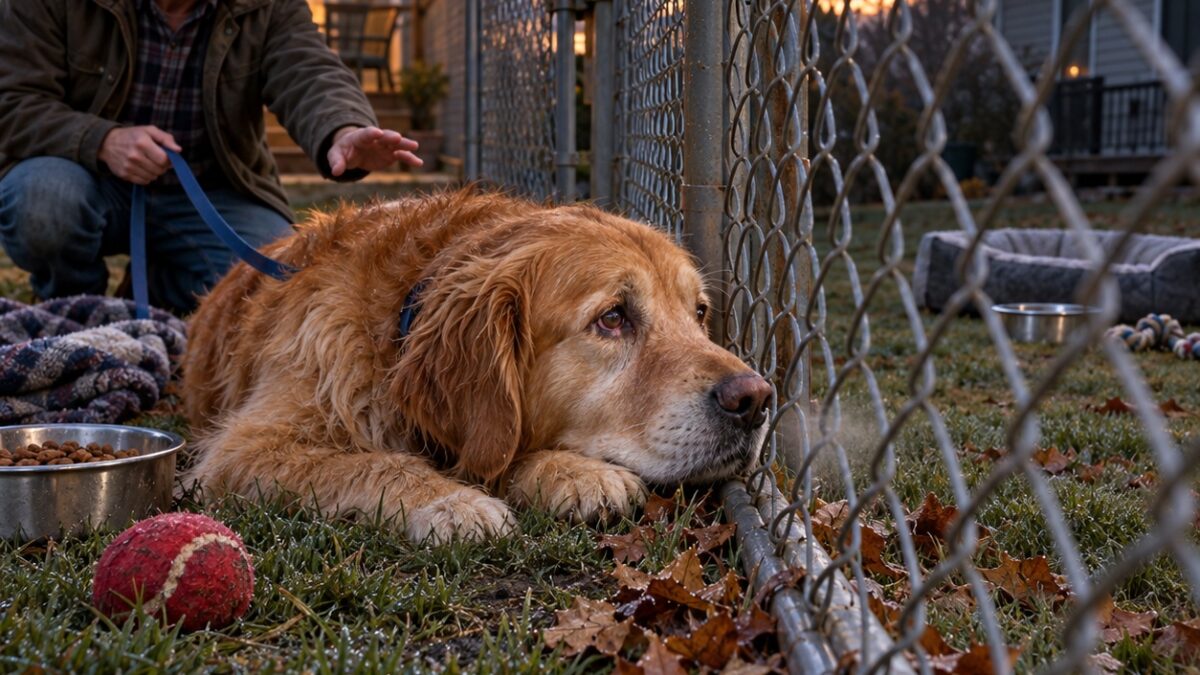
FULL STORY CONTINUATION
The first night, I let him stay outside longer than usual.
It wasn’t especially cold.
I thought exhaustion would eventually solve the problem.
Oscar had never voluntarily missed bedtime in his life.
Every evening around ten, he usually started his own routine.
Drink water.
Walk through the kitchen to check whether anyone had dropped food.
Circle his bed.
Collapse.
Sometimes snore loudly enough to annoy my wife, Laura.
That night, ten came and went.
Oscar didn’t move.
At eleven, I went outside again.
He was in the same spot.
The backyard light threw a pale circle across the grass.
Titan’s yard looked strange without him.
Empty bowl beside the porch.
One rope toy near the steps.
The gate between our yards was closed.
Michael was at the veterinary hospital.
I crouched beside Oscar.
“Titan isn’t coming home tonight.”
His ears moved at the name.
I immediately regretted saying it.
Oscar lifted his head.
Looked through the fence.
“I’m sorry.”
I touched his back.
“He’s at the hospital.”
Oscar stared.
Dogs understand words.
Not all of them.
Not in sentences the way we do.
But Titan’s name meant something.
Hospital did not.
I tried again.
“Michael is with him.”
Nothing.
“He’s getting help.”
Oscar lowered his chin.
I sat beside him.
For fifteen minutes.
Then thirty.
Around midnight, Laura opened the back door.
“You coming in?”
“I don’t think he is.”
She stepped outside in slippers and a robe.
“Oscar.”
His tail usually went wild when Laura spoke.
That night, nothing.
She crouched beside us.
“Oh, buddy.”
“He hasn’t eaten.”
“Anything?”
“No.”
“Should we call Sarah?”
Dr. Sarah Miller had been our family veterinarian since Oscar was a puppy.
“It’s been one day.”
Laura looked at me.
“You’re worried.”
“Yes.”
“So am I.”
We brought an old dog bed outside.
Oscar refused to lie on it.
Instead, he curled directly against the bottom of the fence.
I dragged the bed closer until half of it touched him.
Eventually, he shifted one shoulder onto it.
That was all.
I went inside around one in the morning.
I didn’t sleep.
Every hour, I checked the window.
Oscar remained there.
At five thirty, I looked again.
Same place.
Same direction.
The second day was worse.
My kids noticed immediately.
Emma was twelve.
Jack was nine.
They had grown up with Oscar.
To them, he wasn’t a pet.
He was simply one more member of the house who happened to have four legs and no respect for personal boundaries.
Emma carried his breakfast outside.
She sat beside him.
“Come on.”
Oscar smelled the bowl.
Turned his head.
She picked out one piece of chicken.
His favorite.
Nothing.
“Dad?”
Her voice frightened me.
“Yeah?”
“Why won’t he eat?”
“He’s upset.”
“Because Titan’s gone?”
“Yes.”
“When is Titan coming back?”
I didn’t know.
Michael had called at six that morning.
The news wasn’t good.
Titan had a severe infection.
His kidneys were under stress.
The veterinary hospital had started IV fluids, antibiotics, and supportive care.
They couldn’t promise anything.
I hadn’t told the children that.
“Hopefully soon.”
Emma frowned.
“You said hopefully.”
I hate how easily children hear fear.
“The doctors are trying.”
She looked toward Titan’s empty yard.
“Is he going to die?”
Jack froze.
“Emma.”
“What?”
“You can’t say that.”
“Why?”
“Because Oscar can hear you.”
The sentence nearly broke me.
I crouched between them.
“We don’t know what’s going to happen.”
Jack’s eyes filled.
“But Titan’s his best friend.”
“I know.”
“Then they have to fix him.”
I put my arms around both kids.
Adults create a lot of comforting lies around children.
Sometimes because children need them.
Sometimes because adults do.
I couldn’t say Titan would be fine.
So I said the only thing I could.
“Everyone is doing everything they can.”
That afternoon, Jack brought out Oscar’s red ball.
Oscar had owned that ball since he was a puppy.
It was faded.
Chewed.
Practically falling apart.
Normally, the sound of it bouncing once on concrete would send him into a frenzy.
Jack threw it gently.
The ball rolled three feet from Oscar’s nose.
Oscar looked at it.
Then looked back through the fence.
Jack stood still.
“Dad.”
“I know.”
“He doesn’t want it.”
“I know.”
Jack picked up the ball.
Then he sat next to Oscar and started crying.
Not loudly.
He buried his face against Oscar’s neck.
“Titan’s coming back.”
Oscar did not move.
“I promise.”
I wanted to stop him.
Don’t promise that.
But I couldn’t.
Oscar leaned slightly into Jack.
That tiny movement made my son cry harder.
The days began organizing themselves around waiting.
Every morning, I checked Oscar before coffee.
Every meal, I brought food outside.
Every afternoon, I tried something new.
Boiled chicken.
Beef.
Egg.
Wet food.
Treats.
Cheese.
Oscar ate almost nothing.
He would sometimes take a bite if I sat several feet away and pretended not to watch.
But not enough.
Water worried me even more.
I moved his bowl directly beside the fence.
If I held it too close, he turned away.
If I left it and went inside, he sometimes drank.
Barely.
By day three, I called Dr. Miller.
She came that afternoon.
Sarah was in her mid-forties, practical, calm, and almost impossible to alarm.
She had once removed half a sock from Oscar’s stomach while joking that Golden Retrievers were “beautiful animals born without common sense.”
When she walked into the backyard and saw him, she stopped smiling.
“How long has he been like this?”
“Since Titan left.”
“He stays here overnight?”
“Yes.”
“You can’t get him inside?”
“He’ll move if I physically force him.”
“Have you?”
“Once.”
“What happened?”
“He paced the back door for twenty minutes and scratched at it until I let him out.”
Sarah crouched.
Oscar knew her.
Usually he would greet her enthusiastically even though she was the woman responsible for vaccines.
This time, he barely lifted his head.
Sarah ran her hands over his body.
Checked gums.
Eyes.
Heart.
Temperature.
Skin.
Abdomen.
Oscar tolerated everything.
Too passively.
She frowned.
“He’s lost weight already.”
“How much?”
“We should weigh him, but visibly? Enough to concern me.”
“Is he sick?”
Sarah took her stethoscope away.
“Physically, I don’t hear anything alarming.”
“So what is this?”
She looked toward Titan’s yard.
“Grief.”
I stared at her.
“He knows?”
“He knows his friend disappeared under stressful circumstances.”
“That’s not the same as understanding death.”
“No.”
She sat back on her heels.
“But dogs don’t need our concept of death to experience separation distress.”
Laura had joined us outside.
“So what do we do?”
“First, prevent him from harming himself.”
“How?”
“Hydration matters most right now. Food next.”
Sarah looked at me.
“If he continues taking almost nothing, we’ll need more intervention.”
“You mean hospital?”
“Possibly.”
My stomach dropped.
“I don’t want to drag him away from here.”
“Neither do I. That could make his stress worse.”
She rubbed Oscar’s shoulder.
“We work with him where he is as long as we safely can.”
Sarah explained that animals can form intense social bonds.
Abrupt separation can create behavior resembling grief, depression, anxiety, even physical decline.
Oscar’s entire routine had included Titan.
Morning greeting.
Fence.
Shared yard time.
Evening.
Then one morning Titan had been carried away visibly ill.
Oscar had no context.
No explanation.
Only absence.
“For him,” Sarah said, “leaving this fence may feel like giving up the place where Titan could return.”
Laura’s eyes filled.
“You think he’s standing guard?”
“I think he’s waiting.”
I looked at Oscar.
His gaze had never left the neighboring yard.
“How long can he do that?”
Sarah’s answer was quiet.
“Longer than is good for him.”
That night, Michael called.
I stepped into the kitchen because I didn’t want the children hearing everything.
“How is he?”
“Still fighting.”
“What does that mean?”
“They stabilized his kidneys.”
“Good.”
“Some improvement.”
I exhaled.
“But?”
“They found pneumonia too.”
My stomach tightened.
“Jesus.”
“Yeah.”
“How are you?”
Michael laughed once.
A terrible little sound.
“I’m sleeping in a motel across from the hospital.”
“Have you eaten?”
“I think so.”
“That’s not an answer.”
“David.”
“Sorry.”
“No.”
His voice broke slightly.
“It’s okay.”
I looked through the kitchen window.
Oscar was visible near the fence.
“Michael.”
“What?”
“Oscar hasn’t left the fence.”
Silence.
“Since when?”
“Since Titan left.”
“What do you mean hasn’t left?”
“He goes a few feet for bathroom breaks if I make him. Otherwise he stays there.”
“Oh God.”
“He barely eats.”
Michael went quiet.
Then I heard him crying.
“Don’t tell me that.”
“I thought you should know.”
“I can’t lose both of them.”
“You’re not losing Oscar.”
“You don’t know.”
“No.”
I looked outside.
“But Sarah is watching him.”
Michael took a long breath.
“Can I talk to him?”
I almost said he wouldn’t understand.
Then remembered our kids.
Maybe understanding wasn’t the point.
I switched to speaker.
Walked outside.
Oscar’s ears moved when he heard Michael’s voice.
“Hey, Oscar.”
Oscar lifted his head.
Michael went silent on the phone.
I whispered, “Keep talking.”
“Hey, buddy.”
Oscar stood.
For the first time in hours.
He looked around.
Then toward Titan’s yard.
“Titan’s still here.”
Michael’s voice shook.
“He’s fighting.”
Oscar took one step toward the fence.
“He’s not home yet.”
Another step.
“But he’s trying.”
Oscar’s tail did not wag.
Still, something in his posture changed.
I held the phone near him.
“We’re bringing him back if we can.”
Michael started crying again.
“You hear me? I’m bringing him home.”
Oscar touched his nose to the fence.
That became our new routine.
Every evening, if Michael had enough strength, he called.
If he couldn’t, I sat beside Oscar and gave him the update myself.
“Titan ate a little today.”
Ears up.
“Doctors say his breathing is better.”
Head lifts.
“Still at the hospital.”
Eyes on me.
“I know.”
I don’t pretend Oscar understood the medical information.
But he recognized Titan.
Recognized my tone.
Maybe he understood one thing:
The story wasn’t over.
By day five, cold weather moved in.
Nothing severe.
But nighttime temperatures dropped sharply.
Oscar still refused the house.
I built a temporary shelter beside the fence.
A small canopy.
Windbreak.
Thick blankets.
Insulated dog bed.
My backyard began looking like a disaster relief site.
Carl from work came over and helped me secure a tarp.
He looked at Oscar.
“That’s dedication.”
I didn’t like the admiration in his voice.
“It isn’t cute anymore.”
He looked at me.
“I didn’t mean—”
“He’s hurting himself.”
Oscar’s ribs were beginning to show.
He slept lightly.
Every unfamiliar vehicle made his head rise.
Every sound from Michael’s driveway made him stand.
Then settle again.
Waiting.
Always waiting.
By day seven, I became angry.
Not at Oscar.
At the situation.
At Titan for being sick, which made no sense.
At Michael for being at the hospital, which made even less sense.
At myself because I couldn’t fix anything.
That evening, I carried Oscar inside.
He weighed less.
I could feel it.
He did not struggle in my arms.
I placed him in the living room.
Closed the back door.
“Enough.”
Oscar stood staring at the glass.
“You’re going to stay inside tonight.”
He whined.
“No.”
He walked to the door.
Scratched once.
“Oscar.”
Scratch.
“Oscar.”
He turned and looked at me.
I wish he hadn’t.
His face wasn’t defiant.
It was desperate.
I lasted twelve minutes.
I opened the door.
He walked straight back to the fence.
Laura stood behind me.
“You couldn’t do it.”
“No.”
“Good.”
I turned.
“What do you mean good?”
“He would have spent all night panicking.”
“He’s freezing outside.”
“So keep him warm outside.”
“This is insane.”
Laura’s eyes flashed.
“Do you think he cares?”
That silenced me.
“He doesn’t understand what we understand.”
“I know.”
“No, David.”
She pointed toward Oscar.
“He doesn’t understand that Titan is in a hospital being treated. He doesn’t understand why the yard is empty. He doesn’t understand schedules or infection or discharge dates.”
Her voice broke.
“All he knows is his friend disappeared.”
I looked away.
“What do you want me to do?”
“Stop trying to make him grieve in a way that makes you comfortable.”
That stung.
“I’m trying to keep him alive.”
“So is everyone.”
She softened.
“Sit with him.”
I did.
Night after night.
Sometimes Laura joined.
Sometimes Emma.
Sometimes Jack fell asleep with his head against my arm while Oscar lay beside us.
We took turns.
No one formally decided this.
It simply happened.
Our family moved toward the fence because Oscar would not move away from it.
On day nine, Dr. Miller returned.
She weighed Oscar.
He had lost nearly nine pounds.
Too much.
She gave subcutaneous fluids.
Oscar barely reacted.
I hated how still he was.
“We need calories.”
“I’ve tried everything.”
“Try hand-feeding tiny amounts.”
“He turns away.”
“Then flavor the water lightly with broth.”
We adjusted.
Boiled chicken puree.
High-calorie veterinary food.
Broth.
Small frequent amounts.
Oscar accepted enough to keep Sarah from hospitalizing him.
Barely.
She warned us every day could change that.
“If his blood work worsens, I’m taking him in.”
I nodded.
“What if he refuses?”
“He’s still your dog.”
That sentence reminded me of responsibility.
Love sometimes means respecting an animal’s emotional needs.
Sometimes it means overriding them to keep the animal alive.
I hoped we wouldn’t have to choose.
Day ten.
Titan developed another fever.
Day eleven.
The fever broke.
Day twelve.
His oxygen improved.
Day thirteen.
He stood with assistance.
Michael sent a photograph.
Titan in the hospital.
Thin.
IV line.
But standing.
I brought my phone outside.
“Oscar.”
He looked.
I placed the phone in front of him.
Dogs may or may not understand photographs on screens the way we do.
Oscar stared.
Then smelled the phone.
His ears rose.
“That’s Titan.”
Oscar licked the screen.
I laughed and cried at the same time.
“He’s ugly.”
Oscar looked at me.
“Don’t tell him I said that.”
Tail movement.
Tiny.
The first in almost two weeks.
I ran inside.
“Laura!”
She thought something was wrong.
“What?”
“He wagged.”
“What?”
“His tail.”
We rushed outside like idiots.
Oscar had stopped.
Laura crouched.
“Do it again.”
Nothing.
“Oscar.”
Nothing.
I laughed.
“He already used today’s wag.”
For the first time in almost two weeks, our children laughed too.
Not long.
But enough.
Day fourteen brought rain.
Cold rain.
Oscar’s shelter kept him mostly dry, but I hated it.
I sat beside him wearing a waterproof jacket.
“You know Titan would call you an idiot.”
Oscar sighed.
“He’d be inside.”
No response.
“He always was smarter.”
One ear moved.
I smiled.
“You’re offended.”
I kept talking.
At some point I realized I was no longer talking to Oscar because I believed words would change him.
I talked because waiting is unbearable in silence.
Maybe that’s why people pray.
Not because words guarantee outcomes.
Because silence leaves too much room for fear.
On day fifteen, Michael called.
“They’re talking about discharge.”
I stood so quickly my chair fell backward.
“What?”
“Not tomorrow.”
“When?”
“They need him eating independently. Breathing stable. But Sarah’s friend over here thinks maybe a few days.”
My heart pounded.
“Don’t tell the kids yet.”
“I wasn’t going to.”
“And don’t tell me unless you’re sure.”
“I know.”
I looked through the window.
Oscar lay against the fence.
“Can I tell him?”
Michael laughed softly.
“Tell him whatever you want.”
I walked outside.
Oscar lifted his head.
“Titan might be coming home.”
His ears shot up.
I froze.
“Did you understand that?”
Oscar stood.
Looked into Titan’s yard.
Then at me.
“Not today.”
He remained standing.
“Soon.”
He stepped toward me.
I hadn’t seen him voluntarily leave the fence more than several feet in fifteen days.
Oscar walked directly to me.
Stopped.
Then returned to his spot.
Maybe coincidence.
Maybe tone.
It didn’t matter.
Hope had entered the yard.
The next three days were the longest.
Day sixteen, Titan ate a full meal.
Day seventeen, he walked down a hospital corridor.
Michael sent video.
Oscar watched the sound more than the image.
When Titan barked weakly through my phone speaker, Oscar barked back.
One loud bark.
Jack came running.
“Was that Oscar?”
“Yes.”
Oscar barked again.
Then stared toward the neighboring yard.
Emma cried.
Everything made us cry by then.
Day eighteen.
No discharge.
I began losing patience.
“They said a few days.”
Laura reminded me, “It’s not a hotel.”
“I know.”
“You want him home healthy.”
“I know.”
Oscar looked exhausted.
His coat had lost shine.
Ribs visible.
Eyes still fixed.
Eighteen days.
Almost three weeks of his life spent waiting against metal wire.
I sat beside him after midnight.
The air was cold enough that my fingers hurt.
I tucked another blanket over his back.
“You’ve made your point.”
Oscar breathed slowly.
“He knows you love him.”
Nothing.
“You don’t have to prove anything.”
I rested my hand against his shoulder.
“He’s trying to come back.”
Oscar’s eyes opened.
“You did your part.”
I leaned against the fence.
“Now let him do his.”
For some reason, that was the night I broke.
I had stayed functional for the kids.
For Michael.
For Oscar.
But sitting there in the dark, I started crying.
Quietly.
“I can’t explain this to you.”
Oscar raised his head.
“I wish I could.”
He shifted.
His body moved closer to my leg.
“I wish I could tell you he’s coming back.”
Oscar rested his chin on my thigh.
I stroked his head.
“But I don’t know.”
There.
The truth.
“I don’t know.”
Saying it out loud terrified me.
Oscar closed his eyes.
We stayed there until nearly two.
At some point, I fell asleep sitting against the fence.
Laura woke me.
“David.”
I opened my eyes.
“Come inside.”
“What time?”
“Four.”
Oscar remained beside me.
I stood painfully.
“Two hours.”
I looked at him.
“Then breakfast.”
He watched me walk away.
At 6:12 the next morning, an explosion of barking ripped through the house.
Not distressed barking.
Not warning.
Joy.
Pure, uncontrolled, unbelievable joy.
I sat upright in bed.
Laura grabbed my arm.
“What is that?”
“Oscar.”
He barked again.
I ran.
Bare feet.
No robe.
Nearly fell on the stairs.
Emma’s bedroom door opened.
Jack came behind her.
I reached the living room window.
A dark SUV was pulling into Michael’s driveway.
My heart stopped.
“No way.”
The driver’s door opened.
Michael got out.
He looked exhausted.
Unshaven.
Thinner.
Smiling.
Then he walked around the vehicle and opened the passenger door.
He leaned inside.
When he straightened, Titan was in his arms.
Wrapped in a blue hospital blanket.
The pit bull looked half his former size.
His ribs showed.
One front leg had been shaved for an IV.
His head rested against Michael’s shoulder.
But he was alive.
“Titan!”
Jack screamed behind me.
Oscar was outside.
I don’t remember opening the back door.
Maybe Laura did.
Maybe it was already open.
We all ran into the yard.
Oscar was at the fence.
But he wasn’t lying down.
He was jumping.
Spinning.
Barking.
His entire body seemed incapable of containing what was happening.
“Oscar!”
He looked at us once.
Then back at Titan.
Michael lowered Titan carefully onto the grass.
“Easy.”
Titan stood.
Barely.
His legs trembled.
Oscar immediately stopped jumping.
That change was extraordinary.
One second, pure chaos.
The next, caution.
He saw Titan’s weakness.
Understood somehow.
Titan took one slow step.
Oscar approached the fence.
Titan took another.
Then another.
Their noses touched through the wire.
Everything became still.
No barking.
No jumping.
They smelled each other.
Oscar’s tail moved so hard his entire back end shook, but he did not push.
Titan closed his eyes.
Oscar pressed his nose harder through the fence.
Michael knelt beside Titan.
I stood on our side with my children.
Laura had both hands over her mouth.
Nobody spoke.
Titan licked Oscar’s muzzle once.
Oscar made a soft sound.
A whine.
The same sound he had made eighteen days earlier when Titan was carried away.
Except now it sounded different.
Not fear.
Relief.
Michael looked at me.
“Open the gate.”
I had forgotten the little gate existed.
For eighteen days it had remained locked because there was no reason to use it.
I ran to the latch.
My hands shook so badly it took two tries.
Then the gate opened.
Oscar did not rush through.
That surprised all of us.
He stepped slowly.
Titan remained standing.
Oscar circled him.
Smelled his neck.
Shoulders.
Side.
The shaved leg.
Hospital blanket.
Everything.
As though checking.
Verifying.
You are real.
You are whole enough.
You came back.
Then Oscar stood beside him.
Titan leaned.
His heavy head came down across Oscar’s shoulder.
Oscar froze.
Not from fear.
To hold him.
The stronger dog now supported the weaker one.
Eighteen days of waiting ended in that position.
Titan’s head on Oscar.
Oscar standing perfectly still.
My children crying.
Michael crying.
Laura crying.
Me not even pretending I wasn’t.
Michael whispered, “He waited?”
I nodded.
“Every day?”
“Every minute he could.”
Michael put his hand over his eyes.
“Jesus.”
“He barely ate.”
“What?”
“He’s okay.”
I didn’t want guilt touching this moment.
“Sarah treated him.”
Michael looked at Oscar.
“I’m sorry, buddy.”
Oscar ignored us.
His attention belonged entirely to Titan.
They remained together for almost twenty minutes.
Then Titan became tired.
Michael helped him toward the house.
Oscar followed through the gate.
I called him.
“Oscar.”
He stopped.
Looked at me.
For one irrational second, I wondered if he’d stay next door forever now.
Then Titan lay on a blanket near Michael’s porch.
Oscar settled beside him.
Of course.
We let him stay.
Around nine, I brought Oscar’s breakfast over.
Same bowl he’d refused every morning.
Chicken.
His regular food.
A little broth.
I placed it beside him.
He looked at Titan.
Titan was sleeping.
Oscar looked at me.
Then he ate.
Not cautiously.
Not reluctantly.
He devoured everything.
Jack laughed.
“He’s eating!”
Oscar finished.
Licked the bowl.
Looked for more.
I sat on the grass.
“Unbelievable.”
He drank an entire bowl of water.
Then picked up the red ball Jack had carried over.
For eighteen days, that ball might as well have been a rock.
Oscar held it.
Looked at me.
I threw it gently.
He trotted after it.
Not far.
He was weak.
But he went.
Picked it up.
Brought it back.
The yard erupted with laughter.
Titan opened one tired eye.
If dogs can look annoyed, he did.
I imagined him thinking:
Eighteen days of near starvation and somehow you’re still an idiot.
Oscar dropped the ball beside him.
Titan sniffed it.
Closed his eye.
Oscar lay down.
For the rest of the morning, they slept shoulder to shoulder.
That evening, something happened that felt almost as important as Titan coming home.
I stood at our back door.
“Oscar.”
He was next door.
Titan inside resting.
Oscar sat near the connecting gate.
“Come on.”
He looked toward Michael’s house.
Then at me.
“Bed.”
For eighteen nights, that word had meant nothing.
Oscar stood.
Walked through the gate.
Crossed our yard.
Entered the house.
Laura started crying again.
“I’m out of tears,” I told her.
“You’re crying.”
“I know.”
Oscar went directly to his old bed.
Circled once.
Collapsed.
Within minutes, he was asleep.
Deeply asleep.
No fence.
No vigilance.
No checking.
I sat on the floor beside him.
His body looked too thin.
We had recovery ahead.
But he was home.
The next weeks became a different kind of healing.
Titan needed medication.
Special food.
Short walks.
Follow-up appointments.
Oscar needed weight back.
Routine.
Rest.
Sarah monitored him closely.
When she returned three days after Titan’s homecoming, Oscar greeted her at the door.
Tail wagging.
She stopped.
“Well.”
“What?”
“I haven’t seen that dog in three weeks.”
Oscar shoved his nose toward her medical bag.
“He associates you with snacks.”
“Rude.”
She examined him.
“He’s gained a little already.”
“Three days.”
“Golden Retriever.”
Fair.
“Any concerns?”
“Keep meals gradual. His system has been under stress.”
I looked toward the fence.
Oscar had already started walking there every morning.
Sarah followed my gaze.
“He still checks?”
“Every dawn.”
“Does he stay?”
“No.”
That was the difference.
Oscar went to the fence.
Titan came.
They touched noses.
Then life continued.
Breakfast.
Kids.
Ball.
Walks.
The fence was no longer a place of despair.
It had become a meeting place again.
Titan recovered slowly.
There were setbacks.
Some days he had energy.
Others, none.
Oscar seemed to adjust his behavior.
Before the illness, he constantly challenged Titan to play.
Afterward, he became gentler.
He brought toys but didn’t insist.
Lay beside Titan during naps.
Walked at Titan’s speed.
That impressed me.
People sometimes describe Golden Retrievers as simple dogs.
Happy.
Friendly.
Food obsessed.
Oscar was all of those things.
But watching him with Titan made me realize how much we underestimate animals when we call them simple.
Oscar understood weakness.
Maybe not medically.
But socially.
His friend was different.
So Oscar changed.
A month after Titan came home, Michael and I sat near the fence while the dogs slept nearby.
He looked older.
Those eighteen days had aged both of us.
“I don’t know how to thank you.”
“For what?”
“Taking care of Oscar while I was gone.”
I laughed.
“Oscar is my dog.”
“You know what I mean.”
I did.
“You didn’t need another thing to worry about.”
“I worried anyway.”
Michael looked at Titan.
“I almost lost him twice.”
“You never told me that.”
“You had enough.”
I felt a brief flash of anger.
Then understood.
“When?”
“First week.”
Titan’s breathing had crashed one night.
Emergency oxygen.
Second time, infection markers spiked.
Michael had spent hours thinking he would leave the hospital alone.
I looked at Oscar.
“Maybe it’s good he didn’t know.”
Michael smiled sadly.
“Maybe he knew more than we think.”
I wasn’t sure I believed that.
I still don’t.
I don’t need to.
What I know is enough.
Oscar loved Titan.
Titan disappeared.
Oscar waited.
That’s extraordinary without adding anything supernatural.
Our children processed the experience differently.
Emma became protective of Oscar’s eating.
For months, every morning:
“Did Oscar finish breakfast?”
“Yes.”
“All of it?”
“Yes.”
“Did you see?”
“Yes.”
Jack turned Titan’s return into a family holiday.
“The Titan Day.”
I objected.
Apparently I had no authority.
The following year, on the anniversary, Jack made dog-safe cupcakes.
Michael came over.
Titan ate his in one bite.
Oscar attempted to steal a second.
Normal life.
Exactly what we’d wanted.
The story spread through our neighborhood.
Then online, after someone posted about it.
People called Oscar loyal.
Amazing.
Heroic.
I appreciated the kindness.
But sometimes the attention bothered me.
Oscar had not staged a grand demonstration of loyalty.
He had suffered.
There is a difference.
I never wanted people romanticizing the part where he refused food.
That was dangerous.
Pain should not become beautiful simply because love caused it.
The beautiful part came later.
The reunion.
Recovery.
Oscar learning he could leave the fence because Titan was safe.
Love isn’t proven by destroying yourself.
That lesson became important to me.
Even with animals.
Especially with people.
A few months later, I asked Sarah whether she thought Oscar would behave the same way if Titan went to the veterinarian again.
“I hope not.”
“So do I.”
She smiled.
“But probably not.”
“Why?”
“Because now he has another experience.”
She explained.
Before, departure meant uncertainty.
Now Titan had left and returned.
That memory mattered.
The next time Michael took Titan for a routine appointment, Oscar did notice.
He sat by the fence.
My stomach tightened.
Not again.
I walked outside.
“Oscar.”
He looked toward Titan’s driveway.
“Vet.”
Ears moved.
“Titan’s coming back.”
I had no idea whether the sentence helped.
Oscar waited about twenty minutes.
Then came inside for breakfast.
I nearly cheered.
Two hours later, Titan returned.
Oscar celebrated.
But there had been no vigil.
No refusal to eat.
He had learned something.
Absence did not always mean loss.
That may have been the greatest gift Titan’s return gave him.
Trust in return.
Humans need that too.
I certainly did.
Those eighteen days changed something in me.
Before them, I liked certainty.
Schedules.
Answers.
Plans.
Illness is brutal partly because it strips those away.
Every phone call from Michael had contained maybe.
Maybe Titan improves.
Maybe he eats.
Maybe discharge soon.
Maybe.
Meanwhile, Oscar behaved as though one thing was certain.
His friend mattered.
That was all.
He couldn’t control the hospital.
Couldn’t influence antibiotics.
Couldn’t understand blood tests.
He could remain at the place where their lives connected.
I think about that sometimes when someone I love is struggling.
Our instinct is to fix.
Offer advice.
Find solutions.
Do something.
Sometimes the most important thing is much smaller.
Stay close.
Be available.
Wait without leaving.
Oscar did that literally.
Against a fence.
For eighteen days.
I do not recommend his version.
Eat your meals.
Sleep inside.
Listen to your doctor.
But emotionally?
He understood something.
Presence has value even when it cannot fix the crisis.
Titan eventually returned to most of his old routines.
Not all.
Age and illness left marks.
He tired faster.
Needed medication.
Lost some muscle permanently.
But he was Titan.
Serious.
Patient.
Still willing to tolerate Oscar’s nonsense.
The first time Titan barked at a squirrel after recovering, Oscar looked delighted.
He ran to join him.
Neither came close to catching it.
Some things never change.
Years have passed since those eighteen days.
Oscar is older now too.
His golden face has white around the eyes.
His red ball has finally been retired.
Jack objected.
The ball was practically disintegrating.
We put it in a box with old collars and photographs.
Titan’s muzzle went gray faster.
Their mornings changed.
They didn’t race to the fence anymore.
They walked.
But always there.
Dawn.
Oscar leaves our porch.
Titan leaves Michael’s.
They meet.
Sometimes they sit on opposite sides of the wire.
Sometimes we open the gate.
Often they simply lie in the grass.
Together.
No waiting.
That’s what I love most.
During those eighteen days, Oscar sat at the fence because something was missing.
Now they sit there because nothing is.
The location is identical.
Meaning completely changed.
One summer morning, I carried coffee outside.
Oscar and Titan were asleep against the fence.
One on each side.
Their backs touching through the metal.
I sat on the porch.
Laura came out.
She followed my gaze.
“Remember?”
“How could I forget?”
She sat beside me.
“I thought Oscar was going to die.”
“So did I.”
“You didn’t say that.”
“Neither did you.”
We watched them.
Titan opened one eye.
Oscar slept.
“Do you think he would have waited forever?”
Laura thought about it.
“No.”
I looked at her.
“Why not?”
“Because we wouldn’t have let him.”
That answer mattered.
Love does not mean letting someone disappear into grief.
We honored Oscar’s need to wait.
We also brought water.
Food.
Medical care.
Shelter.
We would have hospitalized him if necessary.
Compassion is not passive.
Sometimes it sits beside suffering.
Sometimes it intervenes.
We had needed both.
Oscar’s loyalty alone would not have protected him.
Our care alone could not have made him stop waiting.
Healing required meeting in the middle.
Years later, when Sarah retired, she asked about Oscar and Titan at her farewell party.
“Still together?”
I showed her a photo.
Both dogs by the fence.
She smiled.
“I think I remember doing house calls for the world’s most stubborn Golden Retriever.”
“You charged me for them.”
“As I should.”
“You said he was emotionally stuck.”
“He was.”
“What made him unstuck?”
Sarah looked at the photograph.
“His friend came home.”
Simple.
That was the answer.
No therapy trick.
No training technique.
No better treat.
Titan came back.
Sometimes the thing causing pain really is absence.
And nothing except return can fully answer it.
I know not every story gets that ending.
That’s what makes ours difficult to remember without gratitude.
There are dogs who wait and the person never returns.
People too.
No miracle.
No car in the driveway on day nineteen.
I know that.
So does Michael.
We never turned Oscar’s story into proof that hope always gets rewarded.
That would be dishonest.
Hope is not a contract.
Oscar waited.
We got lucky.
Titan survived.
That is what happened.
The lesson wasn’t “wait forever and everything will work out.”
It was something quieter.
Love creates bonds powerful enough to change behavior, appetite, sleep, even health.
Those bonds deserve respect.
Grief deserves respect.
And when someone returns after you have feared losing them, don’t waste the ordinary days that follow.
Oscar certainly didn’t.
Neither did Titan.
After the reunion, the dogs stopped treating time as something to save.
Every morning mattered.
Every nap in sunlight.
Every walk.
Every stolen treat.
Every ridiculous chase through the yard.
Maybe they always lived that way.
Maybe humans were the ones who finally learned to notice.
Titan eventually became too old to play much.
Oscar adjusted.
He would bring his ball near Titan, then lie down instead of demanding a chase.
Sometimes Titan put one paw over the ball.
Oscar allowed it.
The first time I saw that, I laughed.
“Sharing now?”
Oscar looked at me.
Michael called from his porch.
“Titan outranks him.”
“Since when?”
“Always.”
Oscar barked.
Titan didn’t bother raising his head.
Old friends.
One autumn afternoon, my daughter Emma, now older, asked me something unexpected.
“Dad?”
“Yeah?”
“Do you think Oscar thought Titan died?”
I considered it.
“I don’t know.”
“Then why did he wait at the fence?”
“Because that’s where Titan disappeared.”
She nodded.
“Do you think he was afraid leaving meant Titan would come back and miss him?”
That thought hurt.
“Maybe.”
Emma scratched Oscar’s ear.
“That’s awful.”
“Yes.”
She looked at Titan next door.
“But he didn’t miss him.”
“No.”
Oscar had been exactly where Titan left him.
What that means scientifically, emotionally, symbolically—I don’t pretend to know.
It is simply true.
I sometimes imagine those eighteen days from Oscar’s perspective.
One morning, your friend is sick.
Strangers arrive.
They lift him.
He leaves.
His smell remains in the yard.
His bowl remains.
His toys remain.
But the living creature at the center of your routine is gone.
So you wait where you last saw him.
Sun rises.
Sun sets.
People offer food.
Children cry.
Cold comes.
Your body weakens.
Still, the yard next door remains empty.
Then one morning:
Sound.
Car.
Voice.
Scent.
There.
He exists again.
How could that not change an animal?
It changed all of us.
Michael became less casual about Titan’s presence.
He told me once that before the illness, he sometimes rushed walks.
Checked his phone.
Complained about vet bills.
Afterward, he tried to be present.
I did too.
I stopped treating Oscar’s endless requests for attention as interruptions.
Not always.
I’m human.
Sometimes a dog dropping a wet ball in your lap during a work call is genuinely irritating.
But more often, I noticed.
He’s here.
That’s enough.
When Oscar rests his head on my knee, I remember a time he wouldn’t leave the fence.
When Titan slowly crosses through the little gate, I remember him wrapped in a blue blanket.
Memory gives ordinary moments weight.
That can be painful.
It can also make life richer.
The gate between our yards still exists.
We replaced the fence years ago but insisted the contractor keep a connecting gate in the same place.
He asked why.
“Dogs.”
He looked at us as though that explained nothing.
It explained everything.
The original latch hangs in Michael’s garage.
Jack wanted to keep it.
Another relic.
Our children grew up around the story.
Not the online version.
The actual one.
The nights outside.
The bowls of untouched food.
Sarah with her stethoscope.
The phone calls.
The fear.
Then the bark at dawn.
They learned something important.
Animals grieve.
Animals attach.
Animals notice absence.
And responsibility means paying attention when behavior changes.
That’s a better lesson than simply saying dogs are loyal.
Oscar’s waiting nearly harmed him.
Recognizing why he waited allowed us to help without treating him as disobedient.
Imagine if I had punished him.
Dragged him inside.
Yelled.
Removed him from the fence entirely.
We might have made his fear worse.
Instead, we adapted while protecting his body.
I am proud of that.
Not perfect.
But proud.
One winter, years afterward, Titan had another medical procedure.
Nothing life-threatening.
Dental work under anesthesia.
Michael dropped him at the clinic in the morning.
Oscar watched the car leave.
Then went to the fence.
I watched through the window.
He sat.
My stomach tightened automatically, even after all that time.
Ten minutes.
Twenty.
I brought breakfast outside.
“Titan’s coming home this afternoon.”
Oscar smelled the food.
Then ate it.
Right there.
Beside the fence.
I nearly laughed with relief.
After eating, he carried his bowl toward the house.
He turned once toward Titan’s yard.
Then followed me inside.
That was healing.
Not forgetting the previous experience.
Responding differently because of what came afterward.
Titan returned at four.
Oscar greeted him like a celebrity.
Then both went to sleep.
No eighteen-day vigil.
No collapse.
The body remembered fear.
But it also remembered return.
I think humans underestimate how much healing depends on new endings to old patterns.
Someone leaves.
They come back.
You sleep.
Nothing terrible happens.
You eat.
The world continues.
Again.
Again.
Eventually, fear is no longer the only evidence you have.
Oscar had eighteen days of fear.
Then years of evidence that Titan existed on the other side of the fence.
That mattered more.
Today, when I look at them, I don’t think first about the hospital anymore.
I think about mornings.
Oscar stretching.
Titan appearing.
Two gray-faced old dogs meeting near the fence as though they haven’t seen each other in months instead of twelve hours.
Their tails move.
They smell each other.
Sometimes Oscar brings a toy Titan has no intention of touching.
Then they sit.
No urgency.
No fear.
Just company.
That may be the most beautiful transformation of all.
Oscar once believed he had to stay there in case Titan returned.
Now he knows Titan will.
There is a world of difference between those two kinds of waiting.
One is terror.
The other is trust.
A few mornings ago, I stood outside with coffee.
The air was cold.
Oscar sat on our side.
Titan on his.
Sunrise turned the grass gold.
I thought about day eighteen.
Oscar thin.
Exhausted.
Still watching.
Then day nineteen.
The bark.
The car.
Titan’s head on Oscar’s shoulder.
I would not choose those eighteen days again.
I would spare Oscar the fear if I could.
I would spare my children.
Michael.
Titan.
All of us.
But because I cannot change what happened, I can at least respect what it showed me.
Love is not merely affection.
It is expectation.
Routine.
Presence.
A place reserved for another life inside your own.
When that life disappears, even temporarily, the shape it occupied remains.
Oscar sat beside that shape for eighteen days.
He would not pretend it wasn’t there.
Then Titan returned and filled it again.
Maybe that is why the reunion felt so powerful.
It wasn’t just two dogs touching noses through wire.
It was the restoration of a world.
Oscar’s world had contained Titan.
For eighteen days, there had been a hole in it.
Then suddenly the hole had a heartbeat again.
I watched my dog eat that evening with more joy than I had ever watched an animal eat before.
He finished.
Drank.
Picked up his ball.
Came inside.
Slept.
Ordinary things.
Miraculous only because, for eighteen days, we feared ordinary life might not return.
That’s what I remember most now.
Not the suffering.
The return of ordinary life.
Oscar asleep in his own bed.
Titan resting next door.
Kids laughing.
Doors closing without fear.
Food disappearing from bowls.
Morning arriving without dread.
People use the word miracle too easily.
Titan’s survival came from veterinary medicine, intensive care, Michael’s persistence, and luck.
I respect all of that.
But I understand why my children called his return a miracle.
Sometimes miracle is simply the word we use when something we were afraid to lose is placed back in our hands.
Oscar would probably use no word at all.
He would simply lean against Titan.
Maybe that’s better.
Titan is alive.
Oscar is beside him.
Nothing else needs explaining.
And every morning when those two old friends meet at the fence, I remember the eighteen days when Oscar sat there waiting for a life he loved to reappear.
Now he still goes to the same place.
But he isn’t waiting for a miracle anymore.
He’s meeting his friend.








