FULL STORY:Every Time I Hammered My Old Fence, a Starving Dog Came Running in Panic—Then a Neighbor Told Me Who He Was Waiting For
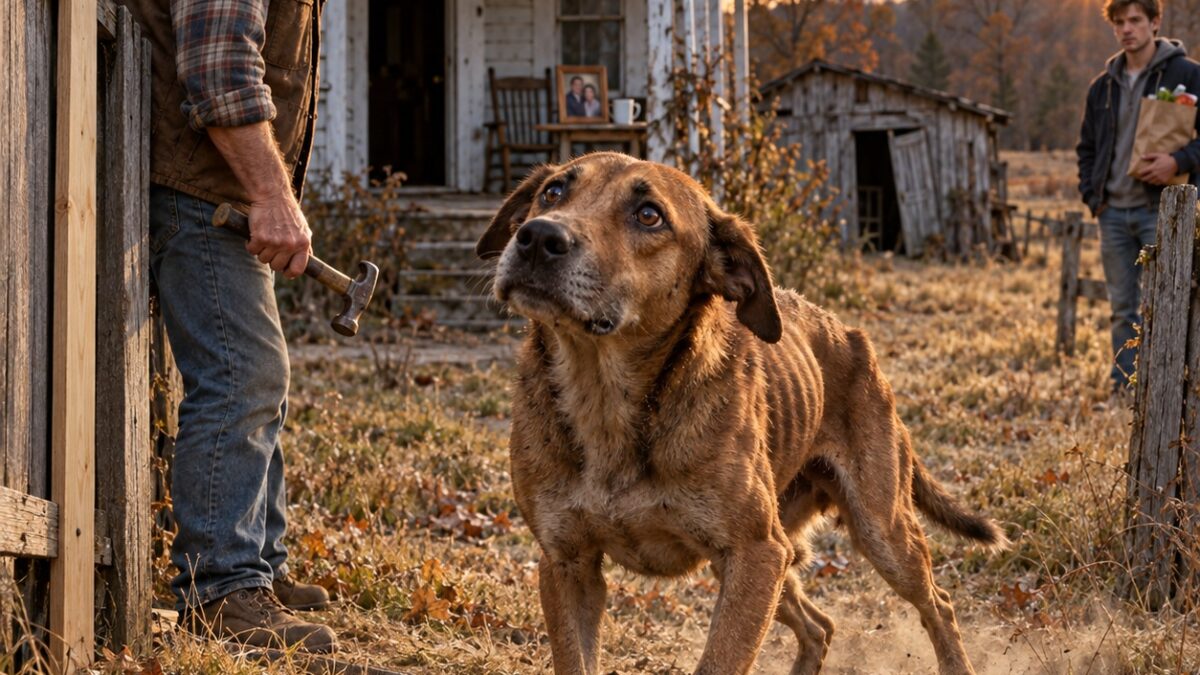
PART2
Same panic.
Same run.
Same sudden stop when he saw me.
This time I noticed how thin he really was.
His waist tucked sharply behind his ribs.
One hip looked almost too prominent.
There were scars near one ear.
No collar.
No tag.
No sign that anyone nearby was feeding him regularly.
I set the hammer down.
“Are you looking for somebody?”
His ears shifted.
That question felt ridiculous.
But something about his behavior did not feel like a stray searching for food.
Food was everywhere around old houses.
Garbage bins.
Rodents.
Compost.
He did not sniff.
He did not explore.
He came when the hammer struck.
Looked at me.
Then left.
That happened four times in the first week.
Hammer.
Run.
Stop.
Disappointment.
Disappear.
I began wondering whether somebody had trained him to come to that sound.
Maybe a contractor.
Maybe the previous owner.
Maybe someone who once lived on the property.
I asked the real-estate agent.
She knew nothing.
The property had passed through an estate sale.
Vacant almost two years.
Before that, an elderly woman owned it.
She had moved into assisted living.
No dog listed.
I asked the man at the hardware store.
He shrugged.
“Lots of strays out that way.”
“This one comes when I hammer.”
“Maybe thinks it’s a dinner bell.”
“He leaves when I stop.”
“Then he’s bad at dinner.”
Helpful.
I started leaving water.
At first he ignored it.
Then, after several hot days, the bowl was empty each morning.
I put food beside it.
Sometimes the food disappeared.
Sometimes not.
I could not tell whether the dog was eating or raccoons were getting there first.
Then a young man named Caleb knocked on my door.
He lived farther down the road.
Mid-twenties.
Work boots.
Baseball cap.
He pointed toward the yard.
“That dog been coming here?”
“You know him?”
Caleb looked toward the field.
The dog was sitting near the far edge.
Watching us.
“I know of him.”
“Whose is he?”
Caleb hesitated.
“Can I come in?”
That was not the answer I expected.
We sat at my kitchen table.
The room still smelled of sawdust because I had spent the morning repairing a cabinet.
Caleb rested his elbows on his knees.
For a while, he said nothing.
Then he began slowly.
“There was a man around here about a year ago.”
“What man?”
“Homeless guy.”
“Living on this property?”
“Not exactly.”
Caleb looked toward the window.
“He slept wherever he could.”
Behind the abandoned house.
Near the road.
Under the old bridge when it rained.
Sometimes in that shed before the door fell apart.
“Did he own the dog?”
Caleb nodded.
“They were always together.”
“What was his name?”
“I think people called him Sam.”
“You think?”
“He wasn’t the kind of guy who introduced himself much.”
“And the dog?”
Caleb shook his head.
“Never heard a name.”
I frowned.
“You’re telling me nobody knew the dog’s name?”
“The man didn’t really call him anything.”
“What do you mean?”
“He’d whistle.”
Caleb smiled faintly.
“Or tap his leg. Dog came.”
I looked through the window.
The brown dog remained at the edge of the yard.
Head lowered.
Caleb continued.
“Sam did odd jobs.”
“Like what?”
“Fence repair. Firewood. Cleaning up yards. Anything.”
My eyes moved to the hammer on the counter.
Caleb noticed.
“He fixed things around this house sometimes.”
“With a hammer.”
“Yeah.”
I said nothing.
Caleb’s face changed.
“There’s more.”
I already knew there was.
“What happened to him?”
“He died.”
The word entered the room quietly.
“When?”
“About a year ago.”
“How?”
“No one really knows. He had health problems. One morning he just… stopped.”
“Stopped?”
“Collapsed near the back of the property.”
Caleb looked down.
“Someone called an ambulance. They took him.”
“And the dog?”
“Stayed.”
I leaned back.
Caleb continued.
“The dog sat where they’d been.”
“For how long?”
“Days.”
My throat tightened.
“People tried feeding him. Tried catching him. He wouldn’t go with anybody.”
“What happened?”
“Eventually he started moving around.”
“Searching?”
Caleb nodded.
“Every time someone came here making noise, he ran over.”
I stared at him.
“Hammering?”
“Especially hammering.”
Something inside me dropped.
Caleb gestured toward the field.
“He hears it and thinks Sam is back.”
I looked outside again.
The dog was watching my house.
Waiting.
Still.
After a year.
Caleb said:
“Every time he gets here and sees someone else, he leaves.”
No one spoke for a while.
Then I asked:
“Why hasn’t anybody taken him?”
“Some tried.”
“What happened?”
“He wouldn’t stay.”
“Shelter?”
“They couldn’t catch him easily. Somebody finally did once, but he got out of a foster yard two days later and came back here.”
“To this property?”
“Yes.”
“Why?”
Caleb looked at me like the answer was obvious.
“Because this is where Sam was.”
I swallowed.
“What kind of man was he?”
Caleb thought.
“Quiet.”
“Drank?”
“Sometimes.”
“Dangerous?”
“No.”
“Mean to the dog?”
Caleb’s head came up immediately.
“No.”
The answer was firm.
“That dog was everything to him.”
I waited.
Caleb continued.
“I’d see them in the mornings. Sam sitting in the sun. Dog with his head on Sam’s boots.”
He smiled faintly.
“They shared food.”
“That explains why he’s so thin.”
“He was thinner right after Sam died.”
“How did he survive a year?”
“People leave things out.”
“Why doesn’t someone feed him properly?”
“Because he doesn’t stay anywhere long enough.”
I looked out again.
The dog had shifted.
Still watching.
Caleb lowered his voice.
“I think he still expects him.”
That sentence stayed with me long after Caleb left.
That night I could not sleep.
I lay in the bedroom staring at the ceiling.
The house creaked occasionally.
Old wood cooling.
Wind against branches.
Somewhere outside, a dog barked.
I thought about Sam.
A man with no house.
No permanent bed.
No place that belonged to him.
Yet he had one creature that followed him everywhere.
Then I thought about the dog.
Technically homeless too.
But maybe that had never mattered.
Home had been a person.
Then that person vanished.
And the dog remained near the last place where their lives had overlapped.
Waiting.
I understood more of that than I wanted to.
After Margaret died, I had spent months waiting.
Not for her.
I knew she was gone.
I had been there.
Held her hand.
Watched her take the last breath.
I was not waiting for resurrection.
I was waiting for pain to change.
Waiting to wake up and not feel cheated.
Waiting to make coffee without reaching automatically for two mugs.
Waiting for some invisible person to come tell me:
Okay, George.
That is enough.
You can live normally again.
No one came.
Of course.
Grief does not send officials.
It does not issue completion notices.
You simply keep waking.
Keep eating.
Keep existing.
Until one day you notice something hurts differently.
The dog did not understand death the way I did.
But maybe that made waiting even worse.
I knew Margaret would not return.
He might not.
That possibility broke something in me.
The next morning, I filled a metal bowl with clean water.
Then I cooked a small piece of beef.
Not seasoned.
Margaret had always scolded me for feeding dogs table food.
“We don’t own a dog,” I used to tell her.
“That is not permission to poison other people’s.”
I smiled at the memory.
First smile of the morning.
I placed the bowls near the edge of the yard where the dog often stopped.
Then I sat on the porch.
I did not hammer.
I waited.
Twenty minutes.
Nothing.
Forty.
Then movement near the field.
The dog appeared.
Slowly this time.
No panic.
He saw me.
Stopped.
I stayed seated.
He approached the water.
Looked at me.
I looked at the ground.
He drank.
Long.
Almost the entire bowl.
Then he sniffed the beef.
I expected him to devour it.
He did not.
He sat.
Beside the food.
Facing the road.
I watched him.
Five minutes.
Ten.
The meat remained untouched.
Caleb’s words returned.
They shared food.
The dog was waiting for Sam.
Maybe he had spent years never eating until the man ate too.
I felt something tighten in my throat.
I wanted to say:
He isn’t coming.
But what right did I have?
I barely knew this animal.
Instead, I stayed on the porch.
An hour later, the dog stood.
Ate half the meat.
Then walked away.
The next morning, I repeated the routine.
Water.
Food.
Porch.
No approach.
The dog came.
Drank.
Waited.
Watched the road.
Ate a little.
Left.
Day three.
Same.
Except after drinking, he looked directly at me.
Not a quick glance.
A long one.
I kept my hands on my knees.
He took one step toward the porch.
Stopped.
I did not speak.
Another step.
Ten feet away.
Then eight.
He sat.
Not beside the bowls.
Closer to me.
My heart started beating faster like I was the one being approached by a wild animal.
Technically, I suppose I was.
I remained still.
After twenty minutes, he left.
Day four, he sat six feet away.
Day five, three.
Day six, he came beside the porch step.
I could hear his breathing.
I wanted desperately to reach down.
I did not.
He had spent a year having humans try to take him somewhere he did not want to go.
Maybe the first kindness I could offer was letting him choose.
So I waited.
The dog shifted.
Then slowly lowered himself beside my feet.
His shoulder touched my boot.
My throat closed.
I stared straight ahead.
He lay down.
After another minute, he placed his head across my shoe.
That was when I cried.
Not dramatically.
No sobbing.
Just tears.
They came without warning.
I wiped my face once.
The dog lifted his head.
Looked at me.
Our eyes met.
Something passed between us.
Not magic.
Recognition.
He had lost someone.
So had I.
He lowered his head back onto my foot.
I whispered:
“Yeah.”
That was all.
“Yeah.”
We sat there until noon.
He did not leave.
Around one, I stood carefully.
The dog rose too.
I went inside.
He waited at the porch.
I came back with food.
He ate.
All of it.
That was the first day.
From then on, he began staying.
Not completely.
At first he disappeared at night.
Sometimes for hours.
Sometimes until morning.
But he returned.
I kept feeding him.
I gave him water.
I still did not touch him much.
A hand briefly over his head.
One scratch behind the ear.
Then more.
He tolerated it.
Eventually leaned into it.
I needed a name.
Caleb insisted Sam never used one.
“That seems impossible.”
“I’m telling you.”
“What did he call him?”
“He’d say things like ‘come on’ or ‘boy.’”
I studied the dog.
Light brown coat.
Dark eyes.
One white patch on his chest.
“Brownie.”
Caleb laughed.
“That’s terrible.”
“I didn’t ask.”
“You named a brown dog Brownie.”
“It’s not because he’s brown.”
“Sure.”
“It reminds me of autumn leaves.”
Caleb stared.
“What?”
“Brown leaves fall, but they still have color.”
“That is somehow worse.”
Brownie looked between us.
I pointed.
“He likes it.”
“He doesn’t know his name.”
“He will.”
I started using it.
“Brownie.”
Food.
“Brownie.”
Walk.
“Brownie.”
Come here.
After about a week, one ear moved when I said it.
Then both.
Two weeks later, he came.
That was enough.
The hammer problem took longer.
The first time I resumed fence repairs, I forgot.
One strike.
Bang.
Brownie was sleeping beneath a tree.
He exploded to his feet.
Ran toward me.
Not playful.
Panicked.
He skidded near the boards.
Looked around.
His eyes searched beyond me.
House.
Shed.
Road.
My heart sank.
“Brownie.”
He ignored me.
He ran toward the old shed.
Sniffed.
Came back.
For almost ten minutes, he searched the property.
Then slowly approached.
I knelt.
“I’m sorry.”
He stared at the hammer.
I set it down.
“That’s mine now.”
Brownie looked toward the road.
“No one’s coming.”
The words escaped before I could stop them.
He looked at me.
I almost apologized again.
Instead, I touched his neck.
“I’m here.”
That became our work.
Teaching Brownie the hammer no longer meant Sam.
Not by forcing.
By repetition.
I tapped softly.
One strike.
Then food.
Wait.
Another.
Talk.
Touch.
Eventually Brownie learned that when the hammer sounded, he did not need to run from the field because he was already in the yard.
Already home.
But even months later, sometimes the first sharp bang made his head snap toward the road.
Memory lives in the body.
So does hope.
Brownie began sleeping on the porch.
I bought a dog bed.
He ignored it.
Slept beside the steps.
I moved the bed there.
He slept beside it.
I gave up.
Then one rainy night, thunder started.
I opened the door.
“Come inside.”
Brownie stood outside.
Wet.
Uncertain.
“Come on.”
Nothing.
Maybe houses scared him.
Maybe Sam had never been allowed inside anywhere.
Maybe doors meant being trapped.
I sat just inside the threshold.
Did not pull.
Brownie looked at the rain.
Then me.
Then one paw crossed.
Stopped.
Second paw.
Eventually he entered the kitchen.
He stood frozen.
I did not close the door immediately.
That was important.
He needed to know leaving remained possible.
He sniffed the floor.
Chair.
Cabinet.
My boots.
Then walked back to the open doorway.
Looked outside.
Rain.
He turned around.
Came toward me.
I closed the door halfway.
Waited.
Then fully.
Brownie tensed.
I opened it again.
He relaxed.
We repeated that three times.
Close.
Open.
Close.
Open.
By the fourth, he understood.
Door did not mean prison.
That night he slept on a folded blanket near the entrance.
I slept badly because every sound woke me.
At 3:00 a.m., I walked into the kitchen.
Brownie raised his head.
I poured water.
Looked at him.
“You know, most dogs make people feel safer at night.”
His tail tapped once.
“You’re making me nervous.”
Another tap.
I smiled.
The next morning, I opened the back door.
Brownie went outside.
I thought he might disappear.
He did not.
He walked ten feet.
Turned.
Waited for me.
That was new.
So I followed.
We began walking every morning.
At first, Brownie led us toward the road.
Always the same direction.
Sometimes he stopped near the edge of the old property.
Looked down the road.
Waited.
I never pulled him.
Eventually he turned back on his own.
Week by week, the pauses shortened.
Then one morning, he did not stop at all.
He walked beside me.
I noticed but said nothing.
Some victories should not be interrupted.
As Brownie gained weight, his personality emerged.
He was not solemn by nature.
That surprised me.
Grief had hidden him.
Healthy Brownie was curious.
Stubborn.
Food-obsessed.
Suspicious of vacuum cleaners.
Completely offended by baths.
He chased leaves.
Stole work gloves.
Carried sticks far too large for him.
Once, he ran through wet paint and left brown-and-white paw prints across three porch boards.
I stared.
He stared.
“Margaret would have liked you.”
That sentence came out naturally.
I stopped.
Brownie wagged.
I sat down.
For months, speaking Margaret’s name had felt like touching a bruise.
Now I said it to a dog covered in paint.
I laughed.
Then cried.
Brownie came over.
Placed his head on my knee.
“You’re very confusing.”
He stayed.
I started talking to him about her.
Not all at once.
Pieces.
“She hated yellow kitchens.”
Brownie listened.
“She made terrible pancakes.”
Tail.
“She loved dogs even though she refused to admit it.”
Brownie shifted closer.
“She would’ve made you sleep outside for exactly one night.”
I thought.
“No. Half a night.”
I began telling stories I had not told anyone since she died.
How we met at a grocery store because I dropped a jar of pickles.
How she laughed during our wedding vows.
How she once drove twenty miles back home because she thought she had left a candle burning and discovered she had never lit it.
How she sang badly while gardening.
Brownie became my audience.
He did not tell me to move on.
Did not say Margaret would want me happy.
Did not recommend grief groups.
He listened.
Sometimes listening is the whole medicine.
The house improved too.
Fence straight.
Porch safe.
Gutters clean.
New paint.
Shed repaired.
I planted flowers.
That part was Margaret’s influence.
Marigolds.
Lavender.
Coneflowers.
I had no idea what I was doing.
My daughter visited and stared at them.
“Dad.”
“What?”
“You planted flowers?”
“Yes.”
“Voluntarily?”
“I’m still capable of growth.”
She looked at Brownie lying beneath the porch.
“And who is this?”
“Brownie.”
She stared at me.
“You named him Brownie?”
“Do not start.”
She crouched.
Brownie hesitated.
Then approached.
My daughter scratched his neck.
“You have a dog.”
“He has me.”
“Oh, that’s worse.”
“What?”
“You’re sentimental now.”
“Leave.”
She laughed.
Then she looked at me.
Really looked.
For a long time.
“You’re better.”
The sentence made me uncomfortable.
“I’m busy.”
“That’s not what I mean.”
I turned toward the yard.
She stood beside me.
“Mom would’ve liked this place.”
“I know.”
“And him.”
Brownie looked up.
“I know.”
My daughter put one arm around me.
I let her.
Before Brownie, she had worried about me constantly.
Calls.
Texts.
Unexpected visits.
Questions disguised as casual conversation.
Now she worried less.
Not because I was suddenly cured.
Because she knew someone was waiting at the house.
That mattered.
I began understanding Sam differently too.
At first, I pitied him.
Homeless man.
No money.
No house.
Dead alone.
Then I started asking more people about him.
Not because I needed information.
Because Brownie’s life before me deserved to exist.
The convenience-store owner remembered him.
“Sam used to sweep the sidewalk for coffee.”
“Did he ask?”
“No. Just did it.”
A woman at the diner said he sometimes washed dishes for meals.
“Always asked for scraps.”
“For himself?”
She smiled.
“For the dog.”
An older man near the church said Sam repaired bicycles.
“He could fix anything with almost nothing.”
That sounded familiar.
A volunteer from the food pantry remembered Brownie.
“That dog never left him.”
“What did Sam call him?”
She shook her head.
“Just boy.”
I smiled.
Of course.
“Did Sam ever talk about family?”
“No.”
“Past?”
“Not much.”
“Why was he homeless?”
“Does it matter?”
That question embarrassed me.
“No.”
She softened.
“He lost work. Then housing. Then health. After a while, getting back becomes harder than people think.”
I knew that.
Not from homelessness.
From grief.
Once momentum disappears, small tasks become enormous.
Mail.
Phone calls.
Appointments.
Applications.
Showering.
Eating.
Living.
Maybe Sam had fallen beyond a point where the system required more strength to escape than he had.
But he had Brownie.
Every story returned to that.
Sam and the dog.
Walking.
Sleeping.
Sharing food.
Sitting in sunlight.
One afternoon, Caleb brought an old photograph.
“Found this on my phone.”
Sam sat against the side of the shed.
Long gray beard.
Thin face.
Brownie beside him.
Except Brownie looked younger.
Healthier.
His head rested across Sam’s ankles.
Sam’s hand lay on his back.
Neither looked at the camera.
They were simply sitting.
I stared for a long time.
“That’s him?”
“Yeah.”
“What was happening?”
“Nothing.”
“That’s why you took it?”
Caleb shrugged.
“Light looked good.”
I looked at Sam.
Then Brownie.
I understood something.
Sam had given Brownie a home without owning one.
I framed the photograph.
Put it on a shelf.
Some people thought that was strange.
Why keep a picture of a dead stranger?
Because Brownie loved him.
That was enough.
The first time Brownie noticed the frame, he sniffed it.
Of course the photograph had no scent that mattered.
He looked at the image.
Did he recognize faces on paper?
I do not know.
But he stayed near the shelf for a while.
Then came to me.
I rubbed his head.
“He was a good man?”
Brownie leaned against my leg.
“I think so too.”
I never wanted to replace Sam.
That mattered to me.
Maybe because people had made similar mistakes after Margaret died.
“You’ll meet someone else.”
I hated that sentence.
Margaret was not a chair.
Not a job opening.
Not a slot.
No one else could become her.
If I ever loved another person, that love would not replace anything.
It would be new.
Brownie taught me the same rule.
I was not Sam.
He did not need me to be.
He could remember Sam and still sleep in my kitchen.
Love has room.
We underestimate its architecture.
A year after I bought the house, the yard looked completely different.
Grass cut.
Fence repaired.
Dead branches gone.
Porch painted.
Garden growing.
Brownie had gained enough weight that his ribs no longer showed.
His coat shone.
His eyes changed most.
That blank distance disappeared.
He looked at things.
Birds.
Cars.
Me.
The road became less important.
One evening, I sat on the porch.
Brownie beside me.
Sun low.
The yard finally looked like something Margaret would have called respectable.
I realized I had not thought:
When will this stop hurting?
Not all day.
Maybe not the day before either.
That startled me.
Grief was still there.
Always would be.
But I was no longer waiting for its permission.
Brownie put his head on my lap.
I looked down.
“You know something?”
Tail moved.
“We were both waiting.”
He closed his eyes.
“You for Sam.”
I rubbed his ear.
“Me for… I don’t even know.”
The breeze moved through the leaves.
“I think I was waiting for someone to tell me life still counted.”
Brownie sighed.
“But no one had to.”
I smiled.
“You showed up.”
That sounded overly sentimental.
I said it anyway.
“And now we’re done waiting.”
Brownie’s tail tapped the porch.
I laughed.
“Agreed.”
For the first time since Margaret died, I understood healing without hating the word.
People talk about healing as though damaged things return to their original state.
That is repair, maybe.
Healing is different.
A scar does not become untouched skin.
A repaired fence is not the original fence.
My life would never become what it had been.
Brownie’s would not either.
Sam remained dead.
Margaret remained dead.
Nothing changed those facts.
Healing meant building something that could exist beside them.
Not instead of them.
Beside.
Brownie helped me do that.
I hope I helped him.
Our morning walks became routine.
We took the road past the field.
Sometimes farther.
Brownie stayed close.
At one particular spot near the old shed, he still slowed.
I learned that was where Sam had collapsed.
Caleb confirmed it later.
At first I wanted to avoid the place.
Then I decided that felt wrong.
So whenever Brownie stopped, I stopped too.
No pulling.
No “come on.”
We stood.
He looked.
Sometimes sniffed.
Then eventually turned to me.
Tail moved.
We continued.
Memory did not have to become a trap.
It could become a place you visited.
Then left.
That helped me with Margaret’s grave.
I had avoided the cemetery for months.
The first visits shattered me.
Then I stopped going.
Felt guilty.
Brownie changed that.
One Sunday, I put him in the truck.
He hated vehicles at first.
Maybe too many failed attempts to catch him.
But he learned.
We drove to the cemetery.
I walked to Margaret’s grave.
Brownie followed.
I sat on the grass.
For a long time, I said nothing.
Then:
“This is Margaret.”
Brownie sniffed the stone.
I laughed.
“She’d be furious that I introduced you this way.”
He sat beside me.
I told her about the house.
The flowers.
The fence.
Brownie’s terrible name.
My daughter’s opinion of it.
I cried.
Then smiled.
Then cried again.
Brownie put his head on my knee.
I stayed an hour.
When I stood, something inside me felt lighter.
Not because I said goodbye.
I had already done that.
Because I said hello differently.
“Come on, Brownie.”
He followed.
Driving home, I realized I had spent months trying to choose between remembering and living.
Brownie had never made that choice.
He remembered Sam.
Then kept walking with me.
Simple.
Animals are useful teachers because they rarely turn lessons into speeches.
Brownie’s lesson was footsteps.
Stop.
Remember.
Continue.
Caleb became a regular visitor.
Mostly because Brownie liked him.
Partly because Caleb enjoyed mocking the name.
“You could rename him.”
“No.”
“Anything would be better.”
“No.”
“Max.”
“Boring.”
“Scout.”
“Pretentious.”
“Sam Junior.”
“Absolutely not.”
“Brownie.”
“Correct.”
“You’re impossible.”
Brownie wagged.
“He agrees with me.”
Caleb helped with heavier repairs.
In exchange, I fed him.
Eventually we became friends.
I asked once why he had not taken Brownie himself.
Caleb thought.
“I tried.”
“What happened?”
“He’d stay in my garage for a night. Then leave.”
“Toward here?”
“Always.”
“Why didn’t you force him?”
“Would that have helped?”
No.
It would not.
Caleb looked at Brownie.
“I think he needed to decide.”
That was exactly right.
Trust cannot be kidnapped.
Neither can home.
Brownie chose.
Slowly.
Food did not make him choose.
Shelter did not.
My need certainly did not.
He came closer by inches.
One day, his head on my foot.
That was the choice.
I sometimes wondered whether he recognized something in me.
Maybe that was romantic nonsense.
Probably.
He came because I was predictable.
Quiet.
Fed him.
Did not grab him.
That is enough explanation.
Still, grief recognizes grief in ways science may not bother measuring.
Two beings sitting on a porch.
Neither able to explain.
Both knowing absence.
Maybe that mattered too.
Winter arrived.
I worried about Brownie sleeping cold.
He now stayed inside most nights.
But sometimes he insisted on lying on the porch until late.
I bought him a thick bed.
This one he used.
Eventually.
I placed it near the fireplace.
On especially cold nights, Brownie curled there.
I sat in Margaret’s old reading chair.
I had brought it from our house despite claiming I wanted nothing that remembered too much.
Turns out there are some memories you still carry intentionally.
Brownie slept.
I read.
Sometimes I looked around the room.
Old house.
New paint.
Margaret’s chair.
Sam’s photograph.
My dog.
Not the life I expected.
Still a life.
That became enough.
Christmas was hardest.
First Christmas in the new house.
Second without Margaret.
My daughter insisted I come stay with her.
I refused.
She compromised by coming to me.
Family filled the house.
Grandchildren.
Food.
Noise.
Brownie disappeared into the bedroom for the first hour.
Too much.
Later he emerged.
My youngest granddaughter, six, sat on the floor.
Brownie approached.
She froze.
My daughter whispered:
“Don’t grab him.”
The child held out one hand.
Brownie sniffed.
Then sat beside her.
Within twenty minutes, she had him wearing a red ribbon.
I expected panic.
Brownie tolerated indignity with surprising grace.
At dinner, someone dropped turkey.
Brownie discovered holidays.
By evening, he was exhausted.
Everyone left.
Silence returned.
Not the old terrible silence.
Full silence.
The kind after a good day.
I sat on the porch.
Brownie joined me.
I looked at the dark yard.
“Merry Christmas.”
He leaned against me.
“I miss her.”
Brownie remained.
“But today was good.”
Tail tapped.
“Both can be true.”
That became another lesson.
I had treated grief like weather.
If sadness exists, happiness must be fake.
Wrong.
They coexist.
You can laugh and miss someone.
You can love a new dog and mourn the old life that made room for him.
You can rebuild without betraying what burned down.
Brownie did not erase Sam by choosing me.
I did not erase Margaret by choosing tomorrow.
Those thoughts sound obvious now.
They were not obvious then.
Spring came.
The flowers I planted badly survived anyway.
Brownie spent hours sleeping among them.
I built him a shaded corner near the porch.
Small platform.
Roof.
Bed.
My daughter saw it.
“You built the dog a house.”
“Yes.”
“You bought a house so you could build your homeless dog a house.”
“He was homeless.”
“So were you emotionally.”
I looked at her.
“Get off my property.”
She kissed my cheek.
“Love you too.”
The doghouse was almost never used.
Brownie preferred the porch.
Of course.
I complained to Margaret’s photograph.
She would have enjoyed that.
One afternoon, a man stopped by.
Mid-fifties.
Rough clothes.
Backpack.
He stood at the gate.
Brownie froze.
The man looked at him.
“Is that Sam’s dog?”
“Yes.”
The stranger smiled sadly.
“Thought so.”
“You knew Sam?”
“Worked with him sometimes.”
Brownie approached the fence.
The man crouched.
“Hey, boy.”
Brownie sniffed his hand.
Tail moved.
That surprised me.
“Name’s Leonard.”
I introduced myself.
Leonard looked around.
“Sam used to sleep back there.”
“I heard.”
“He liked this place.”
“Why?”
“Quiet.”
Leonard rubbed Brownie’s ear.
“Lady who owned it before didn’t chase him off.”
That was new.
“She knew?”
“Sure.”
“Why didn’t anyone tell me?”
“Who would?”
Fair.
“What was Sam like?”
Leonard stood.
“Proud.”
“Everybody says quiet.”
“That too.”
“Anything else?”
Leonard smiled.
“Funny when he trusted you.”
I had never imagined Sam funny.
That bothered me.
Not because it was strange.
Because how easily we flatten dead poor people into sadness.
Homeless.
Sick.
Dead.
As if those are personality traits.
Leonard told me Sam loved terrible jokes.
Hated onions.
Could repair radios.
Had once walked three miles back to return a wallet containing forty dollars because “forty dollars was not enough to become a thief over.”
I laughed.
Brownie wagged at Leonard’s voice.
For half an hour, Sam became a person.
Not a story.
I was grateful.
Before leaving, Leonard looked at Brownie.
“He looks good.”
“He is.”
“Sam would like that.”
I swallowed.
“I hope so.”
Leonard nodded.
“He would.”
That validation mattered more than I expected.
I had never met Sam.
Yet somehow I felt responsible to him.
Not for replacing him.
For taking care of what he loved.
Maybe Margaret’s memory made me understand that.
If I died tomorrow, would I care whether someone replaced me?
No.
I would care whether they loved the people I left.
Brownie was somebody’s loved one.
That was enough.
A few months later, Brownie became ill.
Nothing dramatic.
Vomiting.
No appetite.
For a dog who worshiped food now, that terrified me.
I took him to the veterinarian.
The receptionist asked:
“Owner’s name?”
I said:
“George Hartley.”
Then paused.
It was the first official document connecting us.
Owner.
The word felt wrong.
I did not own his history.
I did not own his loyalty.
But paperwork needs boxes.
The veterinarian diagnosed an infection.
Medication.
Fluids.
Nothing serious.
I nearly cried from relief in the parking lot.
Brownie looked at me.
“What?”
He wagged weakly.
“You scared me.”
I crouched.
“I’m not ready.”
The sentence surprised me.
Not ready to lose another.
Of course.
That fear had been beneath everything.
Love introduces risk.
That is why grief can make people avoid attachment.
If I never care again, nothing can hurt like that again.
Mathematically reasonable.
Humanly impossible.
Brownie got better in days.
My fear did not.
It simply became part of loving him.
I accepted it.
Sam had loved Brownie knowing one of them would eventually lose the other.
Margaret had loved me with the same risk.
We all sign that contract without reading the ending.
Love first.
Loss later.
If you are lucky.
I stopped treating loss as evidence love had failed.
It was evidence something had existed.
Brownie and I settled into years.
Not weeks anymore.
Years.
The old house became ours.
Not mine.
Ours.
His nails marked the kitchen floor.
His fur collected beneath furniture.
One porch board carried scratches where he always turned before lying down.
I stopped trying to keep the place perfect.
Margaret would have laughed.
She spent thirty-seven years trying to teach me that homes are for living, not preserving.
Brownie finished the lesson.
Every morning, he waited near the door.
That phrase once meant grief.
Now it meant breakfast walk.
Same behavior.
Different life.
Waiting changed meaning.
That fascinated me.
The dog who spent a year waiting for someone who could not return now waited for me because he knew I would.
When I went to the grocery store, Brownie lay near the front window.
I always came home.
Doctor appointment.
I came home.
Lunch with Caleb.
I came home.
Cemetery.
I came home.
Repetition rewrote the word absence.
Temporary.
That may have been the greatest gift I gave him.
And he gave it back.
Every morning I woke.
Brownie was there.
Someone expected me.
That changes depression in practical ways.
You cannot stay in bed until noon if a dog needs outside.
You cannot skip dinner forever if a dog stares at you while you cook.
You cannot disappear completely into memory when somebody drops a disgusting tennis ball in your lap.
Responsibility can become a rope.
Brownie pulled me back.
Not dramatically.
Daily.
One morning, years after we met, I used the hammer again.
Repairing the doghouse he still refused to use.
Bang.
Brownie lay in the grass.
His head lifted.
My arm stopped.
For an instant, I saw the old panic beginning.
Then he looked at me.
Really looked.
Tail thumped once.
His head lowered again.
He stayed.
I stood there with the hammer in my hand and tears in my eyes.
That sound had once meant:
Maybe Sam came back.
Now it meant:
George is fixing something.
Nothing more.
I put the hammer down.
Went over.
Brownie opened one eye.
“You did it.”
No reaction.
“You’re home.”
He sighed.
Dogs are terrible at ceremonial moments.
I sat beside him in the grass anyway.
That night, I dreamed of Margaret.
First time in months.
We were in the old house.
She stood near the kitchen sink.
Brownie sat beside her.
That was impossible.
They never met.
Dreams do not care.
Margaret scratched his head.
Then looked at me.
She said nothing.
Just smiled.
I woke before dawn.
Brownie slept beside the bed.
I whispered:
“She likes you.”
His tail moved without opening his eyes.
“Arrogant.”
I smiled.
I never told anyone about the dream.
Until now.
Years passed.
Brownie’s muzzle turned gray.
He slowed.
Long walks shortened.
Runs became trots.
Then walks.
He still stopped near Sam’s place occasionally.
Less often.
I stopped too.
One morning, he stayed there longer.
The old shed had been rebuilt.
Grass thick.
Nothing visible remained from a year of waiting.
Brownie sniffed the ground.
Then sat.
I sat beside him.
“Thinking about him?”
Brownie looked toward the road.
I imagined Sam sitting there.
Thin.
Tired.
Brownie at his feet.
Sun on both.
They did not know how little time remained.
None of us do.
I touched Brownie’s shoulder.
“He loved you.”
Brownie leaned against me.
“And I do too.”
His ears moved.
“You got lucky.”
He looked at me.
I laughed.
“Fine. I did.”
We stayed another ten minutes.
Then Brownie stood.
Turned toward home.
He made the decision.
I followed.
That detail mattered.
When we first met, Brownie left me and returned to the field.
Now I followed him home.
A reversal.
Complete.
Brownie developed arthritis around age eleven, as best we could estimate.
No one knew his exact age.
The veterinarian guessed.
Medication helped.
I built a ramp for the porch.
He refused it.
Used stairs.
Then one day he used the ramp when he thought I was not watching.
Prideful dog.
Like Sam, perhaps.
Like me definitely.
I understood.
My own knees hurt.
We aged together.
Morning walks slower.
More stopping.
More sitting.
Still worthwhile.
Caleb married.
Had a baby.
Brownie tolerated being photographed beside a newborn.
My daughter became a grandmother twice more.
House filled on holidays.
The dog who once ran from strangers learned to sleep through family chaos.
That might have been the greatest transformation.
Safety becomes boredom eventually.
Boredom is beautiful when you have known fear.
Sometimes younger dogs came by.
Brownie watched them race.
No interest.
Wisdom.
One summer evening, Caleb asked:
“Ever think you saved him?”
I looked at Brownie.
“No.”
“You fed him.”
“He came.”
“You gave him a house.”
“He chose it.”
“You kept him alive.”
“He kept me alive too.”
Caleb nodded.
“Fair.”
People like clean hero stories.
Man rescues stray dog.
Dog rescues grieving man.
Both are true and false.
We changed each other.
No need to decide who did more.
Relationships are not court cases.
Near the end, Brownie slept more.
He still ate.
Still wagged.
Still wanted porch time.
But age had settled into him.
One evening, I sat beside him under the old tree.
Autumn.
Leaves turning.
Brown.
Gold.
Red.
The name finally made sense, even to Caleb.
Brownie watched leaves fall.
I said:
“That’s why.”
He looked at me.
“Your name.”
Nothing.
“Autumn leaves.”
Tail.
“You thought it was about your fur.”
He sneezed.
“Caleb did too.”
Brownie closed his eyes.
I rested my hand on his head.
“Things fall and still have color.”
That line had sounded sentimental years ago.
Now it felt true.
Loss does not make the entire life colorless.
Margaret’s life remained beautiful because it ended.
Sam’s did too.
Brownie’s would.
Mine.
Eventually.
The knowledge no longer frightened me the same way.
Not because I wanted death.
Because I had stopped demanding permanence before allowing gratitude.
Brownie gave me that.
His health declined the following winter.
Kidneys.
Then appetite.
The veterinarian was gentle.
“We can manage symptoms.”
“For how long?”
“No one can tell you.”
I hated that answer.
But it was honest.
I brought him home.
Soft food.
Medication.
Warm blankets.
The doghouse still unused.
Of course.
He preferred the porch when weather allowed.
One afternoon, Brownie stopped at the edge of the yard.
Same place he had first watched me.
I stood beside him.
He looked toward the field.
For a strange moment, I wondered if he was waiting again.
Sam.
Maybe memory had become stronger with age.
I did not correct him.
If old dogs are allowed anything, it should be memory.
Then Brownie looked at me.
Tail moved.
Turned toward the house.
Still choosing now.
I cried.
He ignored that.
Old friend.
The final week was difficult.
He stopped eating enough.
Drank less.
Struggled standing.
I slept on the floor beside him.
My daughter came.
Caleb.
Leonard even visited after I found his number.
He sat beside Brownie.
“Hey, boy.”
Brownie’s tail moved.
Leonard cried.
“So this is it?”
“I think so.”
He looked at me.
“You did good.”
“So did Sam.”
Leonard nodded.
“Yeah.”
He touched Brownie’s head.
“You had two good men, huh?”
Brownie closed his eyes.
After Leonard left, I sat alone with him.
I took Sam’s photograph from the shelf.
Placed it near Brownie’s bed.
Stupid maybe.
Humans need rituals.
I told him:
“You don’t have to wait for anybody.”
Brownie breathed slowly.
“Not Sam.”
I swallowed.
“Not me.”
His eyes opened.
That hurt.
“I’ll be okay.”
I was not sure.
But promises do not always need certainty.
“Margaret taught me how.”
Brownie watched.
“You did too.”
I stroked his ear.
“So if you’re tired…”
My voice broke.
I stopped.
Tried again.
“You can rest.”
The veterinarian came to the house the next morning.
I wanted Brownie on the porch.
His place.
Sunlight.
Blanket.
Caleb stood by the fence.
My daughter beside me.
I held Brownie’s head.
Before the final medication, I whispered:
“You know, when you first came here, I thought you were waiting for me to become somebody else.”
His eyes stayed on mine.
“Turns out I was waiting too.”
I kissed his head.
“Thanks for stopping.”
Brownie’s tail moved once.
One small tap against the blanket.
Then he relaxed.
Completely.
Quietly.
Gone.
I cried harder than I expected.
Grief does not become easier because you have practiced.
It becomes familiar.
That is different.
I buried Brownie beneath the old tree near the porch.
Not near Sam’s spot.
That surprised Caleb.
“Why here?”
“Because this was his home.”
He nodded.
We placed a small stone.
No dramatic inscription.
Just:
BROWNIE
HE STAYED
That felt enough.
For weeks afterward, I looked for him.
Door.
Porch.
Kitchen.
Bed.
The same habits I had after Margaret.
That was painful.
But I knew the terrain now.
Grief could not convince me nothing good would follow because I had evidence.
Not that another Brownie would come.
Not that life replaces.
That is not the promise.
The promise is simpler.
Pain changes.
One evening, I sat on the porch alone.
First cool night of autumn.
Leaves moving across the yard.
I thought about Sam.
Margaret.
Brownie.
Three dead beings connected in my mind though two never met.
Maybe that is what a life becomes eventually.
Connections among people and animals who never knew they were building the same person.
Margaret taught me love.
Loss taught me emptiness.
Brownie taught me how to live inside it.
Sam taught Brownie trust.
Brownie carried that trust to me.
No one does anything alone.
Even grief is inherited.
So is healing.
I still live in the old house.
I am older now.
Fence needs work again.
Wood does that.
I still hate ladders.
My daughter still complains.
The garden is bigger.
Flowers better.
Not good, exactly.
Better.
Brownie’s stone sits beneath the tree.
Sam’s photograph remains inside.
Margaret’s chair still faces the window.
The house contains all of them.
Not ghosts.
History.
People sometimes ask why I never moved closer to family.
I say:
“I have family here.”
They misunderstand.
That is fine.
My daughter visits often.
Grandchildren fill the porch.
Caleb’s children run through the yard.
I am not alone.
But even when I am physically alone, the house no longer feels empty.
It holds evidence that I was loved.
And that I loved.
That is different from loneliness.
One spring morning, years after Brownie died, I went outside with a hammer.
A fence board had loosened.
I held it straight.
Raised the hammer.
Stopped.
For one second, I expected movement in the field.
Ridiculous.
Habit.
Memory.
I struck the nail.
Bang.
The sound traveled.
No dog came running.
I smiled.
Not because I was glad.
Because he no longer needed to.
I finished the board.
Sat on the porch.
Looked across the field.
For the first time, the sound of a hammer belonged only to the present.
I thought about that skinny dog racing toward me years earlier.
Panic in his eyes.
Hope outrunning reason.
Every strike meant:
Maybe.
Maybe he came back.
Maybe this time.
He had spent a year trapped inside maybe.
So had I.
Maybe grief will end.
Maybe tomorrow matters.
Maybe I can care again.
Then Brownie showed up enough times that maybe became something else.
Here.
Food here.
Water here.
Sleep here.
George here.
Home here.
Healing did not arrive as an answer.
It arrived as repetition.
One bowl.
One morning.
One walk.
One head on one foot.
One day after another.
That is why, when people ask how I survived losing Margaret, I do not have an inspiring answer.
I bought a broken house.
I repaired boards.
A starving dog kept running into my yard.
Eventually neither one of us left.
That is the truth.
Brownie did not cure grief.
He gave it somewhere to sit.
Beside me.
Quietly.
Until both of us were ready to stand.
I still think of Sam sometimes.
More than you might expect for a man I never met.
I wonder what he would think if he could have seen Brownie healthy.
Sleeping by the fire.
Stealing gloves.
Surrounded by children.
Gray muzzle.
Safe.
I hope he would not feel replaced.
I do not think he would.
I think he would sit on the porch.
Maybe laugh.
Maybe say:
“Good.”
Then whistle.
Brownie would probably turn toward him.
That thought used to make me jealous.
It does not anymore.
Love is not a contest between people who came before and people who came after.
If Brownie had somehow been given one more minute with Sam, I would have wanted him to run.
Full speed.
No hesitation.
Because that is what love does when it gets an impossible second chance.
Then, perhaps, Brownie would look back at me too.
I would wait.
I learned that much.
Margaret once told me something during her final months.
I had forgotten it until years later.
We were sitting in our bedroom.
She knew she was dying.
I did not want to discuss it.
She did.
“George.”
“What?”
“You are going to keep living.”
“Don’t.”
“I mean it.”
“Margaret.”
“Promise.”
I refused.
She became angry.
Sick, exhausted, dying, and still angry.
“Promise me.”
I finally said:
“I’ll try.”
She looked at me.
“Good enough.”
For more than a year after her death, I thought trying meant continuing to breathe.
Then Brownie came.
He showed me trying could mean more.
Open the door.
Put out water.
Sit on the step.
Wait.
Let someone closer.
Walk tomorrow.
Plant flowers badly.
Laugh when paint gets ruined.
Say the dead person’s name without collapsing.
Build something.
Care.
Lose again.
Survive again.
That was living.
Not forgetting.
Living.
So when I think of Brownie now, I do not begin with the end.
I think of day six.
Head on my foot.
That was the turning point.
Two grieving creatures.
One old man.
One nameless dog.
Both still facing roads that led backward.
For a few minutes, neither moved.
Then he stayed.
That tiny decision built everything after it.
Home.
Routine.
Healing.
Family.
Years.
I named him Brownie because autumn leaves fall and still carry color.
Caleb mocked me.
He was right to.
It was sentimental nonsense.
But I understand the name better now.
Falling is not the same as becoming worthless.
An ending does not erase beauty.
Things can be broken and still useful.
Old houses.
Old fences.
Old men.
Grieving dogs.
He taught me that too.
I am George Hartley.
I was sixty-three when a skinny brown dog started running into my yard every time I swung a hammer.
I thought he was frightened by the noise.
Then I thought he was confused.
Then I learned the truth.
He was listening for a dead man.
And without realizing it, I had been listening for a dead woman.
Neither of us got the person back.
That is not how life works.
Instead, we found each other.
It was not the thing either of us wanted.
It became the thing we needed.
For years afterward, every morning when I opened the door, Brownie was there.
Waiting.
But not the old kind of waiting.
Not desperate.
Not staring toward the road.
He waited because breakfast happened.
Because walks happened.
Because I happened.
And every evening, when I came home, someone looked up.
That was enough to make the house a home.
That is what I understand now.
Home is not boards.
Not a roof.
Not a fence you repaired yourself.
Not an address.
Home is the feeling that your absence would be noticed.
It is someone lifting their head when you enter.
Someone expecting your footsteps.
Someone saving a place beside them.
Sam had no house.
But for Brownie, Sam was home.
I had a house after Margaret died.
But for a long time, I had no home.
Then a starving dog put his head on my foot.
And stayed.
That was the beginning.
Not of replacing anyone.
Not of forgetting.
Of belonging again.
Sometimes I still sit beneath Brownie’s tree in the evening.
Wind through the branches.
The house behind me.
Fields ahead.
I think about how many times he crossed that field because he heard my hammer and hoped.
How many times he arrived disappointed.
Then how, eventually, he stopped running away afterward.
I think about the first bowl of water.
The untouched meat.
The first step toward me.
The first night inside.
The first time the hammer sounded and he stayed asleep.
All those tiny moments.
That was our story.
No miracle.
No sudden cure.
Just two creatures who had lost somebody irreplaceable learning, one day at a time, that loving what remains is not betrayal.
It is life.
And if there is one thing Brownie taught me that I wish I had understood sooner, it is this:
You do not have to stop missing someone before you start living again.
You do not have to erase the road behind you.
You only have to notice when someone is standing beside you, ready to walk forward.
Brownie finally did.
So did I.
And for a while, we walked together.








