FULL STORY:An Elderly Beagle Had 13 Minutes Left Before Euthanasia—Then a Woman Who’d Never Seen Him Asked Us to Open the Back Room
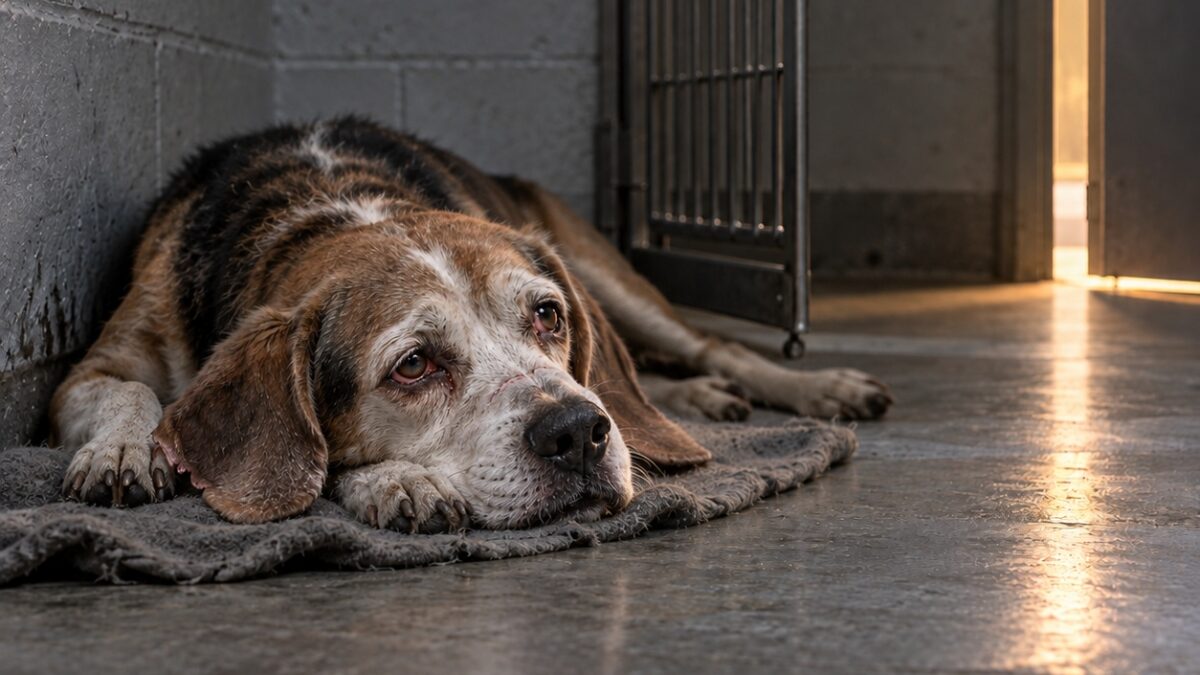
FULL STORY CONTINUATION
For several seconds, nobody moved.
That may sound strange.
We had spent the entire morning wishing somebody would choose 4-2281.
Then somebody did, and our brains seemed unable to catch up.
The manager said:
“I want to make sure you understand what you’re asking.”
The woman finally looked away from the cage.
“I understand enough.”
“He’s approximately eleven.”
“That’s fine.”
“He has a respiratory problem that will need attention.”
“That’s fine.”
“He may have other age-related needs we don’t know about yet.”
“That’s fine.”
“He hasn’t shown much engagement here.”
The woman looked back at him.
“That’s because he thinks nobody is coming.”
I remember that sentence.
Not because I knew she was right.
I didn’t.
We cannot know what a dog thinks with that kind of certainty.
But something about the way she said it made everyone in the room stop arguing.
The manager tried once more.
“You’ve driven a long way. You can look at the other dogs before deciding.”
“I already decided.”
“Ma’am—”
“Please.”
Her voice broke slightly for the first time.
“Please let me take him now.”
I looked at the clock.
5:48.
Twelve minutes.
The paperwork had to be completed correctly.
Emergency emotion did not remove legal procedure.
Adoption form.
Identification.
Agreement.
Fee.
Medical information.
Release.
The receptionist hurried back to the desk.
The woman followed.
I stayed with 4-2281.
He had not moved.
I crouched beside the cage.
“You have terrible timing.”
One wet eye looked toward me.
“You know that?”
Nothing.
I glanced at the clock again.
5:50.
I had worked through enough euthanasia mornings that time usually became something I tried not to watch.
You do the work.
Stay gentle.
Keep the room calm.
Looking repeatedly at a clock makes every minute heavier.
That morning, I could not stop.
5:51.
Paperwork outside.
5:52.
The woman answering questions.
5:53.
I could hear the receptionist asking whether the address on her identification was current.
5:54.
The manager came in.
“She’s doing it.”
I nodded.
“Everything okay?”
“So far.”
“Fee?”
“She has it.”
“How much cash?”
“Exactly enough, apparently.”
The adoption fee was forty dollars.
Later, our receptionist told me the woman pulled wrinkled bills from her pocket and counted them twice with trembling fingers.
She had left home at two in the morning.
No careful plan.
No folder.
No list of questions for the shelter.
She simply got in her car.
Drove three hours.
Arrived in clothes she had slept in.
And now she was buying thirteen minutes with forty crumpled dollars.
At 5:56, the paperwork was complete.
Nine minutes after she had entered the shelter.
The manager brought me the release.
I looked at the clock.
Four minutes before six.
Technically, once the adoption was approved, the appointment was canceled.
There was no longer a countdown.
My body did not seem to understand that yet.
I walked toward the cage.
4-2281 raised his head.
“Come on, old man.”
I opened the door.
He stood slowly.
No rush.
No frantic leap toward freedom.
He stepped out as though expecting another procedure.
The woman was waiting several feet away.
She knelt.
Did not call loudly.
Did not slap her legs.
Did not overwhelm him with baby talk.
She simply opened her arms a little.
The beagle looked at her.
Then walked forward.
One step.
Another.
He reached her.
And rested his head against her chest.
That was all.
No dramatic howl.
No jumping.
No instant transformation into a playful puppy.
He leaned into her.
She put both arms around him.
He stayed.
His entire body pressed against her as though he had been searching for somewhere to put its weight.
The woman closed her eyes.
I watched her mouth move.
I could not hear what she said.
Maybe his future name.
Maybe thank you.
Maybe nothing meaningful at all.
I realized I was crying.
That embarrassed me more than it should have.
Shelter employees cry.
We just learn to do it strategically.
Usually somewhere animals and adopters cannot see.
I turned away.
“I need to get his paperwork.”
The paperwork was already in my hand.
Nobody corrected me.
I left the room anyway.
In the hallway, another technician stood near the supply cabinet.
She looked at my face.
“He’s going?”
I nodded.
“Seriously?”
“Yes.”
“What time?”
I checked.
5:58.
She covered her mouth.
For the previous two weeks, plenty of us had passed that dog.
Fed him.
Cleaned the kennel.
Checked his symptoms.
Lifted him.
Moved him.
Added him to lists.
Removed him from lists.
Put him back.
We had done everything institutional care requires.
But none of us had been able to give him the one thing a shelter cannot manufacture indefinitely.
A person.
Now he had one.
At six o’clock, the minute when he was supposed to be at the beginning of the end, 4-2281 was walking through the front door.
The woman had wrapped part of a sweatshirt around him.
I followed them outside.
Dawn had barely started changing the sky.
Her car looked as exhausted as she did.
She opened the passenger door.
Placed him on the seat.
Adjusted the sweatshirt around him.
He turned once.
Then lay down.
She looked at me.
“Does he have a name?”
I hesitated.
“Not really.”
Only the number.
4-2281.
A shelter identity.
Inventory more than name.
She looked at him through the open door.
“I think Baker.”
“Baker?”
She smiled faintly.
“A baker’s dozen.”
I did the math.
Thirteen.
She had arrived at 5:47.
Thirteen minutes before six.
“Baker,” I said.
The dog did not react.
Why would he?
He had only been Baker for two seconds.
The woman touched his torn ear.
“He’ll learn.”
I handed her the medical information.
“Please have him checked. The respiratory issue has been persistent.”
“I will.”
“He may need time.”
“I have time.”
That sentence almost got me crying again.
She closed the passenger door.
Walked around.
Before getting in, she stopped.
“Thank you for opening the door.”
I did not know which door she meant.
The shelter.
The rear room.
The cage.
Maybe all of them.
I said:
“Thank you for asking.”
She got into the car.
I watched them drive away.
Baker slept before they reached the edge of the parking lot.
For the rest of that morning, the shelter felt strange.
Not happier exactly.
Public shelters do not get to become happy because one dog survives.
There were still animals waiting.
Still space problems.
Still medical cases.
Still impossible decisions.
The two dogs who had been ahead of Baker that morning remained part of the day.
I do not romanticize that.
Saving one animal did not erase the system around him.
But something changed in us.
The staff kept checking the empty cage.
Not intentionally.
Habit.
The cage where he had sat at 5:38 was open.
Clean.
Waiting for another dog.
One volunteer came in later and asked:
“Where’s 4-2281?”
“Adopted.”
She stopped.
“What?”
“Adopted.”
“By who?”
“Woman came before opening.”
She stared.
“That dog?”
“Yes.”
“The old beagle?”
“Yes.”
She looked toward the rear.
“I walked past him yesterday.”
“So did I.”
That became a quiet confession among us.
So did I.
One volunteer said:
“I kept thinking I’d sit with him after I finished the puppies.”
Another:
“I thought nobody wanted an old sick dog.”
Another:
“He never came to the front.”
Nobody had done anything cruel.
That was almost worse.
Neglect is easy to condemn when it is active.
A kick.
A chain.
A locked door.
What happened to Baker at the shelter was not cruelty.
It was invisibility.
He did nothing to compete.
And in an environment where dozens of animals are competing for limited human attention, quietness can become dangerous.
The loud dogs demanded to be noticed.
The puppies were automatically noticed.
The pretty dogs photographed well.
Baker remained at the rear.
He waited.
Or maybe he had stopped waiting.
That thought stayed with me.
Later, I described him to someone as resigned.
They asked:
“How can you know?”
I couldn’t.
Not really.
We should be careful about turning animal behavior into human narration.
But I know what fear usually looks like in a kennel.
Panting.
Pacing.
Avoidance.
Freezing.
Baker’s stillness felt different to me.
He reacted when handled.
He ate.
He moved where he needed to.
But he did not look toward every footstep as if it might belong to someone coming for him.
Some shelter dogs listen to every door.
Baker rarely did.
Then a stranger drove through the night and asked us to open the one he was behind.
The first day, we expected a call.
New adopters often have questions.
Sometimes panic.
The dog does not eat.
Dog hides.
Dog has an accident.
Dog will not sleep.
Baker’s adopter did not call.
Second day.
Nothing.
Third.
Nothing.
Someone from the shelter tried contacting her.
No answer.
We left a message.
Another staff member tried later.
Still nothing.
It was not that we believed she had done anything wrong.
Her paperwork was legitimate.
Address verified.
Release completed.
But everything about the adoption had been unusual.
No previous relationship with the shelter.
No appointment.
No online inquiry.
No rescue partner.
Nothing connecting her to us.
She simply appeared before dawn, chose a dog hidden from public view, paid cash, and disappeared down the highway.
People became nervous.
One coworker said:
“What if we rushed because of the time?”
The manager looked tired.
“The adoption was processed correctly.”
“I know.”
“We verified her identity.”
“I know.”
“She had the legal right to adopt.”
“I know.”
“Then what are you asking?”
“I just want to know he’s okay.”
So did all of us.
Another call.
No answer.
Days passed.
I found myself imagining Baker on the passenger seat.
Sweatshirt.
Head down.
Sleeping.
I hoped he was still doing that.
Sleeping somewhere.
Safe.
There is a strange emotional rule in shelter work.
You spend weeks wishing an animal would disappear from the building through the correct door.
Then once it does, part of you hates not knowing what happens next.
We are accustomed to control.
Food schedules.
Medication sheets.
Kennel assignments.
Cleaning logs.
Once an animal becomes somebody’s pet, that control ends.
That is the goal.
Still difficult.
We checked the adopter information again.
Small town near the Carolina border.
More than 150 miles away.
No adoption history with our shelter.
No obvious public social-media account.
Nothing we could casually use to reassure ourselves.
One technician searched her name.
Found almost nothing.
“Maybe she hates the internet.”
“Healthy.”
“Not helpful.”
I laughed.
Then one afternoon, the phone rang.
Reception called back toward us.
“It’s Baker’s person.”
Three of us moved at once.
The receptionist put it on speaker after getting permission.
The woman sounded confused by our concern.
“He’s fine.”
Everybody exhaled.
One staff member asked:
“He’s eating?”
“Yes.”
“Sleeping?”
“Beside me.”
That stopped us.
“Every night?”
“Every night.”
I pictured the dog in the rear cage.
Metal underneath him.
Concrete around him.
Then:
Beside me.
The woman continued.
“He gets me out of bed every morning.”
“What time?”
She laughed.
“Six.”
We looked at one another.
Exactly six.
The hour his euthanasia had been scheduled.
She said:
“Sometimes I wonder whether that hour stayed with him.”
No one answered immediately.
I do not know whether dogs understand clock time in the way that sentence suggests.
Dogs absolutely learn routines.
Morning light.
Human movement.
Meal schedules.
Biological rhythms.
The coincidence was still hard to ignore emotionally.
Six a.m.
The time we had written beside his number.
Now the time Baker apparently decided the day should begin.
Not end.
One of us asked about his health.
She said they were handling his needs and watching him closely.
That was enough.
We did not interrogate her.
He was no longer ours.
Then somebody finally asked what everyone had been wondering.
“The dream.”
Silence on the other end.
“What about it?”
“Why did you come here?”
She was quiet long enough that I wondered if we had offended her.
Then:
“I don’t know how to explain it without sounding crazy.”
Nobody laughed.
She continued.
“It happened three nights.”
“The same dream?”
“Yes.”
“What did you see?”
“A dog.”
“What kind?”
“I couldn’t tell.”
That detail mattered.
She had not dreamed clearly of an elderly beagle with a torn ear and a scar across his muzzle.
At least that was not what she told us.
She saw a dog alone.
A gray room.
Concrete walls.
The dog turned toward the wall.
“I tried to open the door.”
Her voice slowed as she remembered.
“It wouldn’t open.”
“What happened?”
“I woke up.”
“Three nights?”
“Three nights.”
The first morning, she dismissed it.
Dreams are dreams.
The second, it unsettled her.
The third night, she woke around two in the morning.
Could not go back to sleep.
She said she had the overwhelming feeling that if she waited until daylight, whatever she was supposed to do would be too late.
I asked:
“How did you choose our shelter?”
Another pause.
She explained that she began looking for shelters in the direction she felt she needed to drive.
The reasoning had not been clean enough for her to reconstruct.
Search.
Road.
Another search.
A feeling.
She kept going.
Eventually our shelter became the destination.
“I couldn’t explain what I was doing,” she said.
“I just knew I had to go.”
“Did you know we had Baker?”
“No.”
“Had you seen him online?”
“No.”
“We hadn’t promoted him much anyway.”
“I didn’t know his face.”
“Did you know about the euthanasia schedule?”
“No.”
“Six o’clock?”
“No.”
Nobody spoke.
The woman laughed softly.
“I know how it sounds.”
The manager said:
“You arrived at 5:47.”
“I know that now.”
“His appointment was six.”
“I know.”
“Thirteen minutes.”
“Yes.”
That was why she had chosen Baker.
A baker’s dozen.
Thirteen.
She said after leaving the shelter she had driven until the adrenaline disappeared.
Then exhaustion hit.
Baker slept beside her almost the entire way.
No pacing.
No whining.
No struggling with the seat.
He simply slept inside the sweatshirt she had wrapped around him.
She looked over repeatedly to make sure he was breathing.
Sometimes he sneezed.
Then settled again.
“He slept like he hadn’t slept in a long time,” she told us.
Maybe he had.
Shelters are rarely restful places.
Metal gates.
Barking.
Cleaning.
Strangers.
Lights.
Smells.
Dogs arrive already stressed, then spend nights surrounded by other stressed animals.
An old dog with a respiratory problem probably did not find much deep sleep there.
The image of him sleeping all the way home became one of my favorites.
Not because sleeping proves trust instantly.
It may simply prove exhaustion.
But for three hours, nobody needed anything from him.
No kennel.
No evaluation.
No adoption performance.
No trying to attract visitors.
He could simply lie there.
The woman said when they reached her house, Baker did not rush inside.
He stood near the car for a moment.
Looked around.
Then followed her.
I resisted asking for every detail.
I wanted them.
All of them.
Where did he sleep the first night?
Did he explore?
Did he understand the yard?
Did he recognize a couch?
What food did he like?
But we had already asked more than most shelters ask after adoption.
So I stayed quiet.
The woman volunteered one detail.
“He wants to be beside me.”
That was enough.
“He doesn’t have to be touching me every second. But he wants to know where I am.”
Again, I thought about the kennel.
Rear corner.
Turned away from noise.
Maybe being close to one person was easier than being exposed to dozens.
Maybe some dogs are never looking for “people.”
They are looking for a person.
I began thinking differently about the way Baker behaved during his shelter stay.
At intake, he seemed withdrawn.
Maybe he was.
But he was gentle when carried.
That was the clue we had overlooked.
Lift him, and he softened.
He remembered being somebody’s dog.
I wondered about that somebody more after he left.
Where had Baker spent the first decade of his life?
Had an elderly owner died?
Had he gotten loose?
Had somebody surrendered him indirectly?
Had he been abandoned?
We did not know.
His body carried history without explanation.
Torn ear.
Scar.
Missing tooth.
House manners.
Acceptance of touch.
No microchip information that reunited him with anyone.
No caller saying:
That’s my dog.
No person appearing at the shelter with a photograph.
His past stayed closed.
Maybe that was okay.
Baker did not need us to solve his entire history before giving him a future.
The woman did not ask:
Why is his ear damaged?
Who failed him?
Is he damaged emotionally?
She asked:
Can I take him?
Sometimes rescue becomes complicated because humans want the narrative before they commit.
What happened?
What breed exactly?
How healthy?
How trained?
How many years?
All reasonable questions.
But occasionally an animal needs somebody willing to say:
I don’t know everything.
I’ll go anyway.
Baker got that person.
The shelter manager later admitted something to me.
“When she first called, I was going to say no.”
“I know.”
“I almost didn’t let her in.”
“I know.”
“We don’t open until eight.”
“I know.”
She stared at the empty kennel area.
“What if I hadn’t changed my mind?”
Neither of us answered.
That is the kind of question that can become unhealthy if you let it.
What if.
What if the caller had waited?
What if she stopped for coffee?
What if traffic held her up fourteen minutes?
What if we followed the opening rule without exception?
What if 4-2281 had been first in line instead of behind two other dogs?
What if somebody had moved his file once fewer?
The entire story can be reduced to a pile of fragile timing.
But rescue work cannot be lived permanently in what-ifs.
You would never sleep.
I told the manager:
“You opened it.”
She looked at me.
“That’s what matters.”
She nodded.
I needed to believe that too.
People later asked whether I believed the woman’s dream was supernatural.
I never knew how to answer.
My job did not require an opinion about dreams.
I know what happened factually.
She reported the same dream three consecutive nights.
After the third, she woke around two in the morning.
She drove more than 150 miles.
She arrived at 5:47.
She had no prior contact with Baker that we knew of.
She asked whether there were more dogs beyond the public kennel area.
She entered the rear room.
She selected him immediately.
His euthanasia appointment was at six.
Those are the facts.
What caused the dream?
Coincidence?
Subconscious memory from something she had seen and forgotten?
An emotional impulse her sleeping brain turned into an image?
Something spiritual?
I do not know.
I am comfortable not knowing.
The result does not require me to explain the mechanism.
Baker went home.
That is enough.
The story spread quietly among shelter staff first.
Then volunteers.
People started calling him the thirteen-minute dog.
I disliked that at first.
It sounded like a slogan.
Baker was more than his countdown.
But I understood why people held onto the number.
Thirteen minutes made the closeness visible.
A day is abstract.
An hour still feels like time.
Thirteen minutes feels like a door almost closing.
It also became his name.
Baker.
A baker’s dozen.
The woman had taken a number associated with his planned death and turned it into an identity connected to survival.
I liked that.
Much better than 4-2281.
Shelter numbers are useful.
They keep records straight.
Prevent mistakes.
Track medicine.
Track intake.
Track outcomes.
They are necessary.
But nobody should have to live under one forever.
4-2281 had been a number in a system.
Baker was a dog beside someone’s bed.
Those are two different kinds of existence.
We began paying more attention to the quiet dogs after that.
I wish I could say everything changed permanently and no overlooked dog ever faced euthanasia again.
That would be dishonest.
Overcrowding did not disappear.
Budgets did not transform.
Animals kept arriving.
Some days we still had more dogs than options.
But Baker changed our habits in smaller ways.
A volunteer created a “back of kennel” rotation.
Spend five minutes with dogs who do not solicit attention.
Take photographs of the ones who stay hidden.
Write down the behaviors visitors might never see.
House-trained.
Soft when held.
Walks politely once outside.
Sleeps with head in lap.
Whatever was true.
Quiet animals needed translation.
Baker had never marketed himself.
We needed to do better on their behalf.
One afternoon, a family came looking for a small young dog.
They passed an older mixed breed twice.
The dog stayed curled near the back.
I heard myself say:
“Would you like to meet him?”
The father looked surprised.
“He seems scared.”
“He is quieter in the kennel.”
They met him outside.
Different dog entirely.
Tail.
Leaning.
Gentle.
They adopted him.
Was that because of Baker?
Partly.
Maybe.
At least Baker had changed what I noticed.
That mattered.
I also stopped treating a dog’s lack of performance as lack of desire.
Shelters are unnatural environments.
A visitor sees thirty seconds.
Maybe two minutes.
We ask animals under stress to audition for their lives.
Come forward.
Wag.
Kiss.
Play.
Be interesting.
Do not bark too much.
Do not hide.
Do not look sick.
Do not look old.
But individual animals cope differently.
Some shut down.
Some become frantic.
Some perform beautifully.
Some seem indifferent.
Behavior inside a kennel is information.
Not the whole animal.
Baker taught me that without trying.
The woman called again a few weeks later.
Not because we chased her.
This time she called us.
“I thought you’d like to hear him.”
“Hear him?”
In the background, I heard beagle noises.
Not a full howl.
Something between a whine and an argument.
I smiled.
“What is he doing?”
“Breakfast was apparently forty seconds late.”
I laughed.
“That quiet dog?”
“He is not quiet about food.”
The entire intake desk heard because the receptionist put the speaker on.
Baker vocalized again.
One volunteer actually clapped.
Ridiculous.
Wonderful.
The woman said:
“He has opinions now.”
That sentence stayed with me.
At the shelter, he had seemed like a dog whose expectations had collapsed.
At home, he had opinions.
Breakfast timing.
Where she sat.
When she woke.
Probably plenty more.
Safety gives personality room.
Sometimes we mistake shutdown for temperament.
Maybe Baker had always been stubborn.
Maybe he had spent his life arguing over food.
Maybe the noisy little old dog existed underneath the shelter silence the entire time.
He just needed somewhere he believed his voice mattered.
Every morning at six, he woke her.
She told us that again.
“Exactly six?”
“Close enough that it’s creepy.”
“What does he do?”
“Stands beside the bed.”
“Barks?”
“Sometimes.”
“Nose?”
“Yes. Cold nose.”
“Beagle alarm clock.”
“Very persistent.”
She laughed.
“If I ignore him, he gets louder.”
I liked that image much more than the one from 5:38.
Same hour.
Different room.
Same dog.
Different expectation.
At the shelter, six had been written as the end.
In her house, six became:
Wake up.
Feed me.
Go outside.
Start the day.
People can make too much symbolism out of animals.
I know.
Still.
Some symbolism earns its place.
The woman did not post Baker’s story online.
At least not anywhere we could find.
That surprised people.
In an era when every rescue can become content, she remained private.
Maybe that was why we initially struggled to contact her.
She had not driven through the night looking for a story.
She was not trying to become the woman who saved a dog thirteen minutes before death.
She wanted the dog.
That difference made me respect her more.
There were no staged photographs sent to us.
No captions about destiny.
No fundraising page.
No request for praise.
Just occasional phone calls.
“He’s fine.”
“He sleeps beside me.”
“He wakes me at six.”
Simple.
Maybe Baker had finally found somebody as uninterested in attention as he was.
The adoption fee remained forty dollars.
People later joked that she bought thirteen minutes for forty dollars.
I never liked that phrasing.
Life is not purchased from a shelter by the minute.
The fee covered a tiny fraction of shelter costs.
The important thing was the commitment attached to the forty dollars.
Anybody can hand over bills.
Taking an old dog with medical needs home is the real cost.
Time.
Vet visits.
Patience.
Cleaning.
Worry.
Adjusting life around an animal whose future may be shorter than a puppy’s.
The woman knew enough to understand that.
She chose him anyway.
Age is one of the hardest things for shelter animals to overcome.
Visitors say:
“I want more years.”
I understand.
Losing an animal hurts.
Choosing a young one can feel like protecting yourself from immediate grief.
But no one knows the exact number of years they are buying.
Young animals get sick.
Old animals surprise people.
Time is not guaranteed.
Baker’s adopter seemed to understand a different equation.
She was not asking:
How long will I get?
She was asking:
What happens to him if I leave?
That question changed his life.
I thought about it often.
There were younger dogs she passed.
Dogs with better odds.
Dogs whose health care might be simpler.
Animals that would photograph better.
She kept walking.
Not because those dogs mattered less.
Because whatever had brought her through the night had not ended when she entered the first kennel aisle.
She kept asking.
Are there more?
That question may have saved him as much as the dream.
Are there more dogs farther back?
Yes.
There are almost always more farther back.
Older.
Sicker.
Shy.
Recently surrendered.
Not ready for adoption floor.
Medical hold.
Behavior hold.
Dogs visitors never see unless somebody asks.
Baker was physically behind another door by the time she arrived.
He was no longer in the usual viewing area.
That detail still gets me.
Had she walked through public kennels and chosen from what was visible, she never would have met him.
Had she said:
I guess the dog from my dream isn’t here.
And left?
He would have remained in that room.
Instead she asked.
The manager opened another door.
Sometimes rescue is nothing more mystical than continuing one question farther than most people do.
Is there anyone else?
What about the dog in back?
What about the old one?
Can I meet the one nobody is asking for?
Those questions matter.
The woman’s dream may have started the drive.
Her persistence finished it.
Months later, I still remembered the way Baker leaned into her.
That was the moment staff members repeated most.
“He put his head right here.”
One technician would touch her chest.
“Immediately.”
“He didn’t even hesitate.”
Actually, he had hesitated a little.
One look.
A few steps.
Memory turns moments smoother over time.
I tried to keep mine accurate.
He did not sprint.
He did not magically recognize her.
He walked.
Reached her.
Leaning happened.
That was enough.
We did not need to turn it into prophecy.
A frightened old dog accepting comfort from someone who had just chosen him was already beautiful.
The technician who left the room because she was crying later admitted she had been the person who moved his file down the list one of the earlier times.
I had not known.
“You?”
She nodded.
“Third time.”
“Why?”
“I don’t know.”
“Come on.”
She looked embarrassed.
“He reminded me of my dad’s old dog.”
That was it.
Not some grand rescue decision.
Recognition.
She bought him days with one small administrative choice.
Another time, somebody else created space.
Another time, timing shifted.
Four delays.
Then the woman.
People often like stories with one hero.
Reality was messier.
Baker survived because multiple people gave him small pieces of time before one person gave him a home.
Nobody knew how the pieces connected.
The volunteer who passed his kennel but cleaned it carefully mattered.
The technician who shifted the file mattered.
The manager who broke opening protocol mattered.
The receptionist who listened long enough to repeat the dream mattered.
The woman driving mattered most at the end.
But survival had already been accumulating through quiet decisions.
That is shelter work.
Sometimes you never know which extra night becomes the one somebody needs.
Other times the extra night changes nothing.
That is the painful truth.
You cannot save every animal through delay alone.
Space is real.
Resources are real.
More animals arrive.
That is why Baker’s fourth reprieve felt so improbable.
We had already stretched his time.
By March 15, we could not stretch more.
Then somebody outside the system created an exit.
One of my coworkers said:
“It feels like he was supposed to go with her.”
I understood the feeling.
I said:
“Maybe.”
She looked at me.
“You don’t believe it?”
“I believe he did go with her.”
“That’s not what I asked.”
I smiled.
“I know.”
I did not need certainty.
I have seen enough suffering to be cautious around statements like everything happens for a reason.
Sometimes terrible things happen for no meaningful reason at all.
Animals are abandoned.
People fail them.
Shelters overflow.
Good staff make impossible choices.
I will not decorate all suffering with destiny.
But I can respect mystery.
Baker’s timing was mysterious.
The woman’s dream was mysterious.
The outcome was real.
That was enough wonder for me.
His story changed the receptionist too.
She was the one who had first told the caller:
Eight o’clock.
Rules.
Imagine being her.
She later said:
“I almost hung up.”
“Why didn’t you?”
“She sounded desperate.”
“For herself?”
“No.”
That was the odd part.
“She sounded like the dog was waiting for her.”
The receptionist had heard thousands of strange calls.
People asking whether we had purebred puppies for free.
People surrendering animals because furniture changed.
People arguing about fees.
Calls become noise.
This one did not.
Maybe because the woman did not ask:
What dogs do you have?
She said:
I need to come inside now.
Then:
I dreamed there was a dog alone in a concrete room.
Please let me see him.
The receptionist could have thought she was unstable.
Maybe she did.
She still carried the request to the manager.
That small decision mattered.
You do not have to believe someone’s explanation to take their urgency seriously.
We learned that too.
Over time, Baker became less of a shelter legend and more simply a memory.
New employees arrived.
Some had never met him.
Occasionally somebody would ask about an old kennel photograph.
“Who’s that beagle?”
“Baker.”
“Baker who?”
Then somebody told the story.
Five forty-seven.
Six o’clock.
Thirteen minutes.
Dream.
The story would become dramatic in retelling.
I corrected details when I heard them drift.
“No, she didn’t break into the shelter.”
“No, he wasn’t already sedated.”
“No, she did not know his breed from the dream.”
“No, there wasn’t one second left.”
Facts mattered.
The actual story did not need inflation.
Thirteen minutes is close enough.
A back room is hidden enough.
An old dog being overlooked for two weeks is painful enough.
A stranger driving more than 150 miles because of three dreams is unusual enough.
You do not need to manufacture lightning outside or claim Baker barked her name.
Truth is already strange.
That became another reason I valued the story.
There are rescue stories built around transformation.
Dog goes from skeletal to healthy.
Matted to beautiful.
Terrified to playful.
Baker’s transformation was quieter.
Number to name.
Back room to passenger seat.
Metal cage to sleeping beside someone.
Six o’clock as scheduled death to six o’clock as wake-up time.
Those contrasts did all the work.
No miracle cure required.
We did not know how long Baker would live.
The woman never promised years.
Neither did we.
The victory was not immortality.
It was that his final chapter changed.
At eleven, maybe he had one year.
Maybe three.
Maybe less.
Maybe more.
Nobody knew.
But whatever time remained would not begin inside that windowless room.
That matters.
People sometimes hesitate to adopt seniors because the ending feels too close.
But an animal does not calculate the ratio of grief to years.
Today matters.
Tonight matters.
A bed matters.
A person beside them matters.
Baker did not need ten promised years to benefit from leaving that shelter.
He needed that morning.
Then the next.
Then another.
His adopter gave him those.
I remember one call when the woman said:
“He snores.”
“A beagle?”
“Like a grown man.”
“That sounds healthy enough.”
“It isn’t cute at three in the morning.”
“You drove three hours to get him.”
“I know. Terrible decision.”
She was joking.
I heard Baker make a noise in the background.
She said:
“See? He heard me.”
There it was again.
Personality.
Opinion.
Home.
I smiled after hanging up.
The dog we thought had stopped anticipating anything now objected to criticism.
Good.
Let him.
One of the hardest parts of euthanasia work is wondering whether a dog would have been different somewhere else.
Not because euthanasia decisions are always wrong.
They are not.
Sometimes suffering is severe.
Sometimes safety risks are real.
Sometimes medical reality leaves no kind alternative.
Baker’s scheduled euthanasia was not based on terminal suffering.
It was space.
That category hurts differently.
A reasonably manageable old dog can die because too many animals exist and too few homes are available.
People outside shelter work often want a villain.
There may not be one person.
The system itself becomes the pressure.
The shelter was not eager to kill Baker.
We had already kept him far beyond the required three days.
Staff had delayed four times.
But goodwill cannot create infinite kennel capacity.
By March 15, there was nowhere else to move his file.
That is why adoption mattered.
It physically created space and saved a life.
The woman did not merely feel sorry for him.
She took responsibility.
Those are different.
Sympathy without action is common.
Action is rarer.
Plenty of people saw Baker.
Some may have felt bad.
No one chose him.
Until she did.
I include myself in that discomfort.
Could I have adopted him?
Maybe not practically.
My own circumstances were complicated.
Shelter staff cannot personally absorb every animal they love.
Still, after Baker left, I had to confront the ease with which I had emotionally categorized him.
Old.
Respiratory issue.
Low interest.
Poor adoption odds.
Those were accurate observations.
They had also started becoming identity.
He was more than his odds.
Shelters need categories to operate.
Humans need to remember categories are not destiny.
Baker’s adopter knew almost nothing about his odds.
Maybe that helped.
She did not have two weeks to watch nobody choose him.
She did not see four euthanasia lists.
She did not become accustomed to the idea that he was difficult to place.
She walked in fresh.
Saw him.
Chose.
Sometimes familiarity makes hopelessness feel objective.
A stranger can interrupt that.
Months later, a new older beagle came in.
Different dog.
Female.
Gray muzzle.
Quiet.
I noticed myself stopping.
I sat outside her kennel for five minutes.
She eventually came closer.
Nothing miraculous happened.
She was still old.
Still needed placement.
But I wrote more on her profile.
Calm when handled.
Interested in gentle attention after a few minutes.
Likely knows home routines.
I thought of Baker while writing.
That dog was adopted by a retired couple eight days later.
Coincidence?
Mostly.
But Baker had influenced the description.
That counted.
His legacy inside our shelter was not only a story.
It was changed attention.
Attention saves animals sometimes.
Not always.
Sometimes attention arrives and still cannot solve everything.
But invisibility almost never helps.
We became less willing to let quiet dogs disappear into kennel numbers.
I started saying their names, when they had names, during rounds.
When they did not, I used something more than the number when possible.
Not official records.
Just interaction.
“Hey, buddy.”
“Morning, old girl.”
Small.
Maybe pointless.
But numbers are for us.
Voice is for them.
Baker got his real name just before sunrise.
I wish every shelter animal could leave with one.
One year after March 15—I remember because someone found the old calendar entry—we talked about Baker again.
Nobody knew whether the woman would answer if we called.
The manager said:
“Leave them alone.”
She was right.
Adoption is not lifetime surveillance by the shelter.
Still, somebody sent a simple check-in message.
No pressure.
Hope you and Baker are well.
The response did not come that day.
Or the next.
I felt that old anxiety.
Then the woman replied.
Short.
He’s still beside me.
That was all.
No photo.
No long update.
He’s still beside me.
I read the sentence several times.
For Baker, that was the whole victory.
At intake:
Alone.
At euthanasia waiting:
Alone in a cage.
At home:
Beside me.
I did not need more.
I do not know exactly how long Baker ultimately had.
The source of his story ends before that answer.
I am glad.
Not because endings do not matter.
Because adding a death date would change what people focus on.
The point was never how many months or years he gained.
It was that the remaining time changed ownership.
It belonged to him and the woman who chose him.
No euthanasia list.
No kennel availability.
No file being moved by strangers.
No required hold period.
His life stopped being measured by shelter capacity.
That is what adoption gives.
Not guaranteed longevity.
Belonging.
I think about 5:38 sometimes.
My arms underneath him.
How he softened.
At the time, I interpreted it as submission.
Maybe resignation.
Later, I wondered whether I had missed something kinder.
Maybe Baker simply remembered how to be held.
That matters because memory does not have to disappear for hope to disappear.
A dog can stop expecting a home and still remember the feeling of one.
Then when the right arms return, the body recognizes the shape.
I do not know if that is what happened when he leaned into the woman.
But I like the possibility.
Somewhere before the shelter, somebody had carried him.
Maybe loved him.
Maybe lost him.
Whatever happened, the knowledge remained inside his body.
Human chest.
Arms.
Rest.
Then after two weeks of concrete, metal and barking, someone knelt and offered that shape again.
Baker stepped into it.
No miracle required.
Just memory.
A lot of people who hear his story focus on the woman.
Understandably.
Who drives three hours because of a dream?
Who arrives before opening?
Who asks to see dogs behind the public area?
Who chooses the oldest quiet beagle minutes before euthanasia?
She is extraordinary in the story.
But I also think about Baker’s role.
He did almost nothing.
That is important.
He did not earn rescue through performance.
He did not paw at her.
No dramatic howl.
No perfect eye contact from across the building.
No viral trick.
He existed.
Old.
Scarred.
Sick enough to need care.
Quiet.
And that was enough.
We often tell rescue stories in a way that makes the animal prove worthiness.
“He still wagged his tail.”
“She kissed her rescuer despite abuse.”
“He fought so hard.”
Beautiful details.
But animals do not owe us optimism to deserve life.
Baker did not have to demonstrate a heroic will to live.
He sat quietly.
The woman chose him anyway.
That is one of the things I love most about the story.
She did not need him to convince her.
She arrived convinced.
When the manager pointed out younger dogs, she did not compare.
When told his age, she did not calculate.
When told his health would need attention, she did not retreat.
Please let me take him.
Now.
Urgency without conditions.
That is rare.
I sometimes imagine the shelter from Baker’s perspective, though I know it is only imagination.
New smells.
Noise.
Unknown humans.
Kennel.
Days.
Dogs disappearing.
New dogs arriving.
Hands feeding.
Hands cleaning.
Hands lifting.
No familiar person.
Then the rear room.
Different smell.
Quieter.
Another cage.
Maybe he did not understand what it meant.
Probably not.
Then a woman appears.
Kneels.
He walks forward.
The door opens again.
Car.
Sleep.
House.
Beside a bed.
Six a.m.
Food.
Morning.
Again.
Dogs live beautifully in repetition once the repetition becomes safe.
Baker’s adopter gave him a new pattern.
Maybe that is what rescue ultimately is.
Not one giant moment.
A giant moment followed by ordinary repetitions.
Dinner.
Bed.
Morning.
Outside.
Back in.
Sleep.
Repeat.
The adoption at 5:56 saved Baker biologically.
The nights beside her made the rescue real.
People often want the dramatic moment.
I learned to value what follows.
We had seen animals returned after emotional adoptions.
Somebody falls in love with the idea of saving the saddest dog.
Then the daily work arrives.
Medication.
Accidents.
Anxiety.
Expense.
Schedule.
The story loses glamour.
The dog comes back.
That is why Baker’s woman staying mattered more than her dramatic arrival.
She drove at two a.m.
Impressive.
Then she kept him.
More impressive.
She made room beside her bed.
She woke at six.
She handled the respiratory issue and old-dog needs.
She listened to beagle complaints about breakfast.
That is commitment.
Rescue is not the drive.
It is the mornings after.
I wish I knew more about her.
Sometimes.
Why did she have the freedom to leave at two?
Had she owned dogs before?
Was she lonely too?
Did she have family?
Did Baker fill some empty space?
None of that belonged to us.
The story does not need her biography.
She wanted privacy.
We should respect it.
She gave Baker a home, not herself to an audience.
That distinction is refreshing.
When people contacted the shelter after hearing versions of the story, some wanted her name.
We did not provide it.
“Can we interview her?”
No.
“Can you give her my information?”
Sometimes we offered to pass along requests.
Mostly she declined.
Good.
Baker’s rescue did not create public ownership of her life.
Privacy is part of kindness too.
The shelter eventually replaced the metal cage in that rear room during renovations.
I watched workers remove it.
Probably not the exact cage Baker used—we rotated animals—but I still thought of him.
Concrete walls repainted.
Lighting improved.
Different layout.
The room no longer looked exactly like what the woman had described from her dream.
That felt appropriate.
Places change.
Maybe fewer animals would sit there waiting silently.
That was always the hope.
One new employee asked why I was standing in the doorway.
“Nothing.”
I almost left it there.
Then:
“There was an old beagle here once.”
She waited.
I told her.
Not dramatically.
Just the timeline.
5:38.
5:44.
5:47.
5:56.
6:00.
When I finished, she said:
“That can’t be real.”
“It was.”
“Thirteen minutes?”
“Thirteen.”
She looked around.
“Did the woman really dream about him?”
“She said she dreamed about a dog.”
“Do you believe her?”
“Yes.”
She looked surprised.
“I believe she had the dream.”
“That’s not what I meant.”
“I know.”
She laughed.
Then became thoughtful.
“I think I’d want it to mean something.”
I looked toward the kennels.
“It already meant something to Baker.”
That was enough.
I stopped trying to decide whether fate belonged in the story.
Meaning does not require proof of fate.
A woman’s dream motivated action.
Action saved a dog.
That is meaningful.
Even if the dream came from random firing neurons.
Even if it came from something neither of us can explain.
The value was in what she did when she woke.
She got up.
She drove.
That is where meaning enters.
Plenty of people feel something.
Fewer act.
The car left at two.
That was the choice.
Then every choice after.
Keep driving.
Call before opening.
Insist she could not wait.
Ask for more dogs.
Go into the back.
Choose the old one.
Ignore easier options.
Fill out forms.
Pay forty dollars.
Take him home.
Stay.
A chain.
Thirteen minutes was only the visible final link.
The rescue began hours earlier in darkness on a road leading south.
Maybe days earlier in sleep.
The shelter staff saw only the arrival.
That taught me another lesson.
You rarely know what effort stands behind someone walking through a door.
We saw an unprepared woman with untied shoes.
It would have been easy to dismiss her as impulsive.
She had already driven three hours.
Sometimes what looks chaotic at the finish is determination after a long night.
Our manager saw that eventually.
That is why she changed her mind.
The rules said eight.
Compassion asked:
Why is this person here at 5:47?
Good systems need rules.
Good humans need judgment.
Breaking every rule for every emotional request would create chaos.
But rigid systems can become cruel when no one is willing to see unusual circumstances.
The manager used judgment once.
That judgment mattered.
I am glad she did.
I am also glad the adoption paperwork remained proper.
Compassion and procedure do not have to be enemies.
We let her in.
Verified what needed verification.
Completed forms.
Collected the fee.
Canceled the euthanasia.
Released the dog.
Correctly.
Fast.
That balance protected everyone.
Especially Baker.
People sometimes romanticize rule-breaking.
The actual success was not:
We ignored all rules.
It was:
We recognized which rule could flex without compromising safety.
Opening time.
That was all.
Everything else stayed responsible.
Maybe that is another reason the story deserves to be told accurately.
Good rescue does not require chaos.
It requires discernment.
When to hurry.
When not to skip.
The paperwork took nine minutes.
Those nine minutes mattered.
We did not say:
There is no time, just take him.
We processed him.
Because a permanent home deserves the same care as any other placement.
At 5:56, he was legally hers.
At six, no ambiguity remained.
That fact gave me peace later.
The clock had not beaten us.
We had not beaten the clock recklessly either.
We finished correctly.
I remember looking at the digital clock at exactly six.
The room was empty where Baker had been.
I think that image will stay with me forever.
Nothing dramatic happened.
No alarm.
No bell.
Just numbers changing.
5:59.
6:00.
A time we had feared became another minute.
Somewhere down the highway, Baker was asleep.
That was all.
The date March 15 stopped feeling like his death date before it ever became one.
Instead it became the first day of Baker.
Not 4-2281.
Baker.
I hope his adopter celebrates it.
Maybe she does not.
Dogs do not need anniversaries.
Humans do.
We like markers.
The shelter certainly remembered.
The first anniversary, someone brought thirteen doughnuts.
Baker’s dozen.
I groaned.
“Too much?”
The volunteer grinned.
“Absolutely.”
We ate them anyway.
One was left.
Of course.
We joked it was Baker’s.
Then gave nothing to the dogs because doughnuts are not an appropriate shelter breakfast.
The humor felt good.
Not disrespectful.
Joy should be allowed around survival.
The story had enough sadness.
Eleven years of unknown history.
Two weeks overlooked.
Four euthanasia lists.
Thirteen minutes.
Let there be doughnuts too.
The new volunteers heard the story while eating.
One asked:
“Did he really wake her at six every morning?”
“That’s what she told us.”
“Creepy.”
“Sweet.”
“Both.”
Maybe.
Humans love patterns.
Dogs love schedules.
Between the two, Baker became a legend.
But when I strip away the legend, I return to one detail.
He softened when held.
Before the dream.
Before the stranger.
Before the new name.
That was our evidence he remembered tenderness.
Nobody came for him from the old life.
But the capacity to receive affection remained.
That is resilience in a quieter form.
Not fighting.
Not tail-wagging heroics.
Remaining capable of leaning into arms after abandonment.
If I ever describe Baker as strong, that is what I mean.
He did not become hard enough to survive.
He stayed soft enough to belong again.
Maybe dogs are better at that than humans.
We guard ourselves.
Build narratives.
If one person leaves, we expect the next one to leave.
Animals can do that too.
Fear exists.
Trauma exists.
But sometimes an old beagle who has every reason to withdraw walks toward a total stranger and puts his head on her chest.
No interrogation.
No guarantees.
Just:
Here.
Maybe that is courage.
Or exhaustion.
Or memory.
Or instinct.
Again, I am comfortable not knowing exactly.
I know what I saw.
He leaned.
She held him.
The technician left because she was crying.
Four minutes later, he was supposed to die.
Instead, he slept.
If I could return to that morning, I would change one thing.
I would sit with him longer before 5:38.
Not because it would alter the outcome.
Because I know now how close I came to making his final human contact merely procedural.
Lift.
Carry.
Cage.
Next task.
Shelter work can turn compassion into routine because routine is how you survive volume.
That is necessary.
But animals do not experience themselves as volume.
Each one is having the only life they have.
Baker reminded me.
Even when we believe the ending is already decided, gentleness matters.
Especially then.
We did handle him gently.
I am grateful for that.
Still, I wish I had whispered his not-yet-name.
Sat on the floor.
Something.
Maybe he would not care.
I would.
Regret can become useful if it changes the next interaction.
So after Baker, when I carried a dog toward that room, I tried to slow down.
Not irresponsibly.
One minute.
A hand on the shoulder.
Soft voice.
A name.
If there was one.
Because until the last second, the animal was alive.
That sounds obvious.
In difficult systems, obvious humanity needs deliberate protection.
Baker received his last-second reversal.
Not every dog did.
I refuse to use his story to pretend otherwise.
But maybe saving one teaches you to treat every one as though another door could still open.
Hope should not make you dishonest.
It can make you gentle.
That is enough.
Years later, I can still reconstruct the morning minute by minute.
5:38.
Metal cage.
Two dogs ahead.
4-2281 silent.
5:44.
Telephone.
Eight o’clock.
No, ma’am.
Hold please.
5:47.
Door.
Untied shoes.
More than 150 miles behind her.
Public kennels.
Young dogs.
Keep walking.
“Are there more?”
Rear hallway.
Concrete room.
Old beagle.
“Him.”
5:48 through 5:56.
Paperwork.
Forty dollars.
Wrinkled bills.
Signature.
Release.
Cage opens.
Old dog walks.
Head against chest.
Baker.
5:58.
Sweatshirt.
Passenger seat.
5:59.
Car leaving.
6:00.
Empty cage.
Those are the facts I trust.
Everything beyond them—the dream, timing, meaning—belongs partly to interpretation.
But facts can be miraculous enough.
Thirteen minutes.
That is not much time.
Most people spend thirteen minutes deciding what to watch.
Making coffee.
Waiting in traffic.
Scrolling through a phone.
For Baker, thirteen minutes separated two completely different futures.
In one, the rear-room door remained closed.
In the other, somebody asked us to open it.
I think that is why his story stayed with all of us.
Not because it proves destiny.
Because it proves how much can change when somebody refuses to assume the visible options are the only ones.
The woman could have waited until eight.
She did not.
The receptionist could have ended the call.
She did not.
The manager could have enforced the rule without exception.
She did not.
The woman could have chosen a young dog near the entrance.
She did not.
She could have turned around after seeing the rear room.
She did not.
She could have listened when we warned her about age and health.
She did listen.
Then chose him anyway.
Small refusals.
I won’t wait.
I won’t leave.
I won’t choose easier.
I won’t let the closed door be the end.
That is how Baker got home.
I have no idea whether Baker ever understood how close the timing had been.
I hope not.
Dogs should not have to understand the bureaucracy surrounding their lives.
He did not need to know that six o’clock had once meant euthanasia.
He only needed to know that at six now, if he put a cold nose against the woman sleeping beside him, she would wake up.
Maybe complain.
Maybe laugh.
Then get out of bed.
His day would begin.
Food.
Outside.
Company.
Whatever ordinary life looked like in that little town near the Carolina border.
That is the ending I choose to hold.
Not the syringe never used.
Not the euthanasia list.
Not the cage.
Morning.
Baker beside a bed.
Six o’clock.
A person opening her eyes because he decided it was time.
The hour did not disappear.
Its meaning changed.
And maybe that is what rescue does at its best.
It cannot erase age.
Cannot erase scars.
Cannot replace the missing tooth.
Cannot rewrite whatever happened before the shelter.
It changes what happens next.
4-2281 entered our rear room as an elderly dog nobody had chosen.
Baker left through the front door with a woman who had driven all night because she was afraid waiting would make her too late.
Thirteen minutes had separated those two lives.
She arrived while there was still time.
And for the old beagle sitting quietly behind a door almost nobody ever asked us to open—
that was enough.








