FULL STORY:A Navy SEAL Helped an Old Woman Save a Dying Dog — Then a Shocking Secret Was Revealed
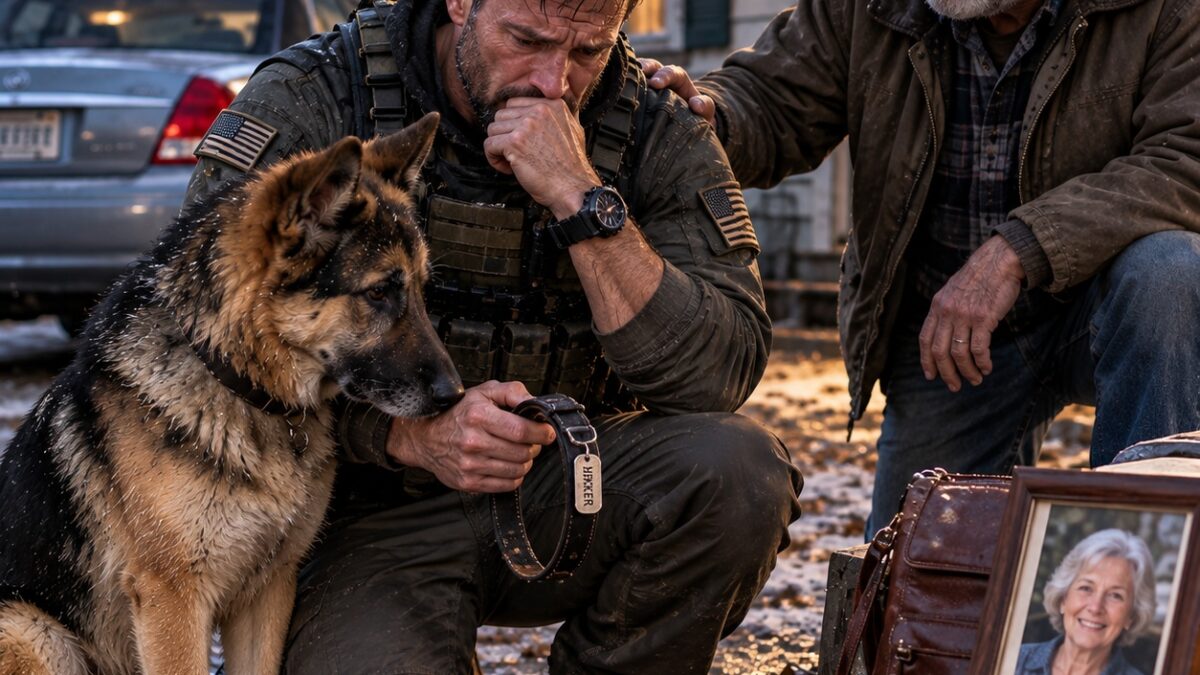
For several seconds, I thought I’d misunderstood him.
My mother had left seventeen days earlier?
Looking for me?
It made no sense.
I had been overseas.
Then back at base.
Then on leave.
There were military offices she could contact if she needed information.
There were neighbors.
Friends.
People who would help her.
Why would a seventy-two-year-old woman leave her home and travel across Wisconsin trying to find a grown man who should have been perfectly capable of answering his phone?
Then I remembered the calls.
The ones I’d ignored.
The ones I’d told myself I would return when I felt more like myself.
The ones I had seen appear on my screen before turning the phone over.
A sick feeling spread through me.
“Tell me exactly what happened.”
Otis stood beside his old dark-green pickup.
He was sixty-seven, broad through the shoulders, with a weathered face, gray mustache, and heavy hands that had spent more than forty years repairing boats around Juniper Lake.
He had known my family since I was a teenager.
When my father died, Otis repaired the dock without accepting payment.
When winter storms knocked out power, he checked on Mom.
He wasn’t a man who dramatized anything.
That made the look on his face unbearable.
“She heard something went wrong with your unit.”
I stood still.
“Who told her?”
“Somebody who knew somebody stationed near your base.”
He shook his head.
“You know how these things spread. A little truth, a little rumor.”
“What exactly did she hear?”
“That there had been casualties.”
My throat tightened.
“And that you’d lost your dog.”
I looked away.
Harker’s collar pressed against my hip inside its pouch.
Otis continued.
“She tried calling you.”
“I know.”
“Do you?”
The question came harder than he intended.
He looked away almost immediately.
But I deserved it.
“She called the family support number she had,” he said. “Then another office. Then she tried the base.”
I stared at him.
“Why didn’t anyone tell her I was alive?”
“From what she said, nobody she reached could confirm the things she wanted confirmed.”
Of course.
Different offices handled different questions. Privacy restrictions existed for reasons. And my mother didn’t know the system well enough to understand whom to contact.
She wasn’t angry.
She was frightened.
Otis rubbed the back of his neck.
“She said she was going to take a bus and find somebody who could tell her you were all right.”
“Why didn’t you stop her?”
He looked at me.
“Have you ever stopped Eleanor Rainer from doing something once she made up her mind?”
I opened my mouth.
Then closed it.
No.
I hadn’t.
Not once.
“She thought she’d be gone two or three days,” Otis continued. “Packed a small bag. Took some cash.”
He paused.
“When she didn’t call me as promised, I contacted the sheriff.”
“When?”
“Fifteen days ago.”
I felt my jaw tighten.
“And?”
“Deputy Mara Hensley took it seriously.”
He told me what investigators had established.
Mom had boarded a bus in Brightwater Falls.
She’d traveled east toward Lake Mercer Junction.
Later security footage placed her farther along the route.
Then in Harbor Glenn.
After that, her movements became uncertain.
Local hospitals had been checked.
Shelters.
Several motels.
Transit stations.
No confirmed current location.
I stared toward the road.
For a moment, the familiar maple trees seemed impossibly far away.
“Why didn’t anyone contact me?”
Otis didn’t answer.
He didn’t have to.
They’d tried.
I’d made myself unreachable.
At first because of deployment.
Then because I was grieving and couldn’t stand the sound of people asking whether I was okay.
I had thought silence would protect me.
Instead, it had sent my mother traveling through unfamiliar towns, frightened that her only son might be lying injured somewhere.
Otis’s voice softened.
“The morning she left, she came by my place.”
I looked at him.
“She was wearing that blue scarf you bought her years ago.”
I barely remembered buying it.
“She said something I haven’t forgotten.”
“What?”
Otis looked directly at me.
“She said, ‘If my boy is somewhere alone after losing that dog, I’m not sitting here watering flowers until he remembers he still has a mother.'”
Something broke inside my chest.
I turned away.
For weeks, I’d been acting as though grief belonged only to me.
I hadn’t considered what my silence was doing to the person who had spent my entire life worrying whether I’d come home.
Behind us, something scratched against wood.
Morrow.
The young shepherd had pushed his narrow body partly behind Mom’s favorite chair.
When he backed out, a strip of blue fabric came with him.
A scarf.
I froze.
Otis stepped inside.
“That’s hers.”
I crouched.
Picked it up.
The fabric smelled faintly of lavender.
Mom’s scent.
Morrow pressed his nose into it.
Inhaled.
Then moved toward the front door.
He stopped.
Looked back at me.
For the first time since arriving, I felt something smaller than hope but stronger than despair.
A possibility.
I took out my phone.
“Give me the deputy’s number.”
Deputy Mara Hensley answered on the third ring.
“Hensley.”
“My name is Gideon Rainer.”
Silence.
Then her tone changed.
“Eleanor Rainer’s son?”
“Yes.”
“Where are you?”
“At her house.”
She asked several questions.
Confirmed my identity.
Then explained that she was handling Mom’s missing-person case.
“I need to see everything you have,” I said.
“We can meet tomorrow.”
“I want every camera location, every witness, every search area—”
“Mr. Rainer.”
I stopped.
“We’ll talk tomorrow.”
I looked down at Morrow.
He was sitting beside the door, Mom’s scent still fresh in his nose.
I didn’t like waiting.
I’d spent most of my career acting decisively when time mattered.
But Mara’s voice made it clear she wasn’t interested in being bullied by my fear.
“Eight o’clock,” she said.
“I’ll be there.”
I barely slept.
Every sound inside Mom’s house seemed louder without her there.
The refrigerator cycling on.
Branches brushing the roof.
Morrow moving across the rug.
The wind chime outside the porch.
I’d made that wind chime in seventh-grade shop class.
The metal tubes were crooked.
The spacing was wrong.
My teacher had given it a generous passing grade because I’d obviously tried.
Mom hung it above the porch the day I brought it home.
Thirty-six years later, it was still there.
At some point after midnight, I stood beneath it with Harker’s collar in my hands.
I looked toward the lake.
The moon reflected across the water.
I remembered Mom teaching me to skip stones near the dock.
My father teaching me how to tie fishing knots.
Otis shouting from his boat that I was holding the rod backward.
Home had been full of ordinary sounds once.
I hadn’t realized how much I’d taken them for granted until I came back and found the house quiet.
Morrow approached.
Sniffed my hand.
Then sat beside me.
His left ear folded forward.
I looked down.
“I don’t know what I’m doing.”
He blinked.
That was the first honest sentence I’d spoken in weeks.
At 7:52 the next morning, I parked outside the Brightwater County Sheriff’s Office.
Morrow walked beside me on a brown leather leash.
Deputy Mara Hensley met us in a conference room.
She was thirty-eight, athletic, with dark brown hair pulled into a tight knot and hazel eyes that looked as though they were permanently evaluating whether someone was wasting her time.
She placed a folder on the table.
I sat.
Then immediately began asking questions.
“I want every camera location between here and Harbor Glenn.”
“No.”
I stared at her.
“No?”
“You can have every piece of legally releasable information that may help us locate your mother.”
She folded her hands.
“What you are not going to do is turn my office into a command post and start sending people in six directions because you’re frightened.”
“I’m not frightened.”
Mara looked at me.
Morrow looked at me.
The combined judgment was irritating.
“That’s exactly the kind of answer frightened men give me,” she said.
I leaned back.
“My mother is missing.”
“Exactly.”
Her voice remained steady.
“Which means your judgment is involved.”
I said nothing.
“You’re not commanding a military operation here.”
“That’s my mother.”
“And that makes you more likely to miss something, not less.”
For several seconds, we stared at each other.
Then I looked down.
Opened the folder.
And began reading.
It was the first useful thing I did that morning.
Mom’s route didn’t form a clean line.
It formed fragments.
A bus ticket from Brightwater Falls to Lake Mercer Junction, forty-three miles east.
A camera image showing her entering the station with a canvas shoulder bag.
Another showing her boarding a later bus.
A motel receipt.
Two small cash withdrawals.
Then Harbor Glenn.
After that, uncertainty.
Hospitals had been contacted.
Shelters checked.
Transportation records reviewed.
But there were gaps.
And the gaps frightened me.
Mara watched me studying the documents.
“You’ve already looked through all this?”
“Several times.”
“Then what are we missing?”
She didn’t answer immediately.
“People.”
I looked up.
“People remember details cameras don’t capture.”
I knew she was right.
That didn’t make it easier.
For years, I’d trusted mission reports, equipment, trained teams, and intelligence gathered through established methods.
Now my mother’s safety depended partly on whether a stranger remembered an elderly woman asking for directions two weeks earlier.
I hated how little control I had.
Mara apparently noticed.
“Mr. Rainer.”
“Gideon.”
“Gideon.”
She leaned forward.
“Your mother wasn’t helpless. She made decisions. She spoke to people. We need to understand those decisions.”
I looked toward Morrow.
He was sitting quietly beside my chair.
I nodded.
“All right.”
Our first stop was Lake Mercer Junction.
The bus station was a low brick building beside six bays.
It smelled of diesel, coffee, and wet concrete.
A ticket clerk named Janice Webb remembered Mom after Mara showed her the photograph.
“Oh, yes. The lady with the military picture.”
My attention sharpened.
“What picture?”
Janice described an old photograph of me in uniform.
Mom had carried it while asking how to contact an office that assisted military families.
“Was she confused?” I asked.
Janice shook her head.
“No.”
“Tired?”
“A little.”
“Did she know where she wanted to go?”
“Yes. She just didn’t know how to get there.”
That distinction mattered.
Mom hadn’t wandered away without understanding her surroundings.
She’d been trying to solve a problem using information she didn’t have.
Janice remembered her apologizing repeatedly for taking up time.
“She wasn’t bothering anybody,” Janice said. “I told her that.”
I swallowed.
My mother had traveled dozens of miles, frightened for me, and still worried about inconveniencing a ticket clerk.
That sounded exactly like her.
The county veterans’ service office was three blocks away.
A man named Daniel Reese remembered her.
He was fifty-four, an Army veteran who walked with a slight stiffness in one leg after an old injury.
He had a shaved head, rectangular glasses, and the patient expression of someone accustomed to explaining complicated systems to exhausted families.
Mom had asked whether he could confirm I was alive.
He couldn’t.
His office didn’t have access to the information she wanted.
He explained what help was available.
Told her where else she might try.
“She wasn’t angry,” Daniel said.
I looked at him.
“What was she?”
He paused.
Then answered.
“Scared.”
The word went straight through me.
He continued.
“She kept saying she didn’t need operational details. She just wanted somebody to tell her you weren’t lying alone somewhere.”
I turned toward the window.
Morrow pressed quietly against my boot.
For years, I’d believed I was protecting Mom by keeping the difficult parts of my life to myself.
But she understood me better than I’d realized.
She knew I tended to go silent when I was hurting.
She knew I could handle danger more easily than grief.
And she knew I’d rather say I was fine than admit I needed somebody.
The only problem was that I had forgotten she knew.
At the public library, we met Ruth Bellamy.
She was sixty-one, tall and narrow, with silver-blonde hair cut neatly at her chin.
She remembered helping Mom use a computer.
“She apologized to the mouse.”
I blinked.
“The computer mouse?”
Ruth smiled.
“She clicked the wrong thing and said, ‘I’m sorry.'”
For the first time that morning, I laughed.
It disappeared quickly.
Mom had searched for military family assistance.
Naval contact information.
Emergency notifications.
Transportation to Harbor Glenn.
Ruth remembered helping her spell several terms.
I stared at the desk where she’d sat.
A stranger now knew something about my mother that I hadn’t.
What she’d been thinking.
Where she’d been trying to go.
How frightened she was.
I’d spent years calling her whenever my schedule allowed.
Now strangers possessed more recent pieces of her life than I did.
As we prepared to leave, Ruth opened a drawer.
“I almost forgot.”
She removed a sheet of printer paper.
An old public photograph of me in uniform.
I looked younger by almost a decade.
At the bottom, in Mom’s handwriting, were nine words.
He always says he’s fine before anyone asks.
I stared at them.
Morrow rose beside me.
Pressed his shoulder against my leg.
I couldn’t speak.
We continued east.
At a roadside diner, a waitress remembered Mom ordering tomato soup and coffee.
She had asked which bus would take her closest to Harbor Glenn.
Then the waitress told us something I hadn’t expected.
An unhoused man had been sitting outside beneath the awning.
Mom left him half her sandwich.
“She didn’t have much herself,” the waitress said.
“I remember thinking that.”
I looked down.
That was Mom.
Even frightened.
Even short on money.
Even searching for her own son.
She could still look at another person and decide his hunger mattered.
We found the driver of her final bus into Harbor Glenn later that afternoon.
Harold Crowe.
Everyone called him Hal.
He was sixty-three, tall and thin, with thinning gray hair and wire-framed glasses.
He’d driven regional buses for thirty-one years.
He remembered Mom immediately.
“Third row. Right side.”
“You’re sure?” Mara asked.
Hal nodded.
“She carried a photograph.”
I already knew which one.
He’d spoken with her during a rest stop.
She asked whether Harbor Glenn had somewhere that helped military families.
“Did she say why?” I asked.
Hal looked at me carefully.
“She said she was looking for her son.”
I remained still.
His voice softened.
“She told me, ‘I just need to know my boy is all right.'”
Morrow shifted beside my boot.
Hal continued.
“When we reached Harbor Glenn, she was tired. Walking slower than when she boarded.”
“Was she confused?”
“No. She knew where she was.”
“Did anyone meet her?”
“No.”
“Which direction did she go?”
“Downtown.”
Useful.
But not enough.
By late afternoon, Mara had reconstructed more of the financial trail.
Mom had expected to travel for only a few days.
She carried limited cash.
Bus fares took some.
A motel charge took more.
Two taxi rides followed.
Then her debit card stopped working after purchases in unfamiliar places triggered a bank security restriction.
Her phone had also stopped functioning after getting soaked during heavy rain.
None of those events was catastrophic alone.
Together, they were dangerous.
A seventy-two-year-old woman far from home.
Limited cash.
No working phone.
A blocked bank card.
Medication left behind.
And no direct way to contact the person she was looking for.
“She could have asked for help,” I said.
Mara closed her laptop.
“She did.”
I looked at her.
She held my gaze.
“She’s been asking people for help everywhere we look.”
That silenced me.
I had imagined help as calling family.
Mom had done what she could.
She’d asked clerks.
Veterans’ service employees.
Librarians.
Bus drivers.
Waitresses.
People who happened to be standing nearby.
The problem wasn’t that she refused help.
The problem was that every bit of help she’d found had been too small to carry her all the way home.
We returned to several places with Morrow.
I carried Mom’s blue scarf in a clean paper bag.
Near the station, I crouched and let him smell it.
“Find.”
He lowered his nose.
Moved along the sidewalk.
Circled a bench.
Crossed toward a planter.
Then stopped.
There were too many footsteps.
Too much time had passed.
Too many overlapping scents.
I repeated the command.
Sharper.
“Find.”
He tried again.
Nothing.
At the next location, the result was worse.
I felt frustration building.
“Search.”
Morrow took several steps.
Stopped.
“Search.”
My voice hardened automatically.
The tone I’d once used when precision mattered immediately.
Morrow lowered his ears.
And stayed where he was.
For one terrible second, I was furious.
Then I realized who I was actually angry with.
Not Morrow.
Never Morrow.
I was demanding that an eleven-month-old shepherd solve a problem dozens of trained adults hadn’t solved.
Worse, I was asking him to behave like Harker.
The dog I’d lost.
The dog who had already spent seven years learning my commands, habits, and moods.
Morrow wasn’t Harker.
He couldn’t be.
And making him feel that he was failing because of it was unfair.
I loosened my grip on the leash.
Crouched beside him.
“I’m sorry, buddy.”
He looked at me.
His folded ear twitched.
I rested one hand against his neck.
“You didn’t do anything wrong.”
He leaned closer.
I swallowed.
“That was me.”
By nightfall, we had reached the limit of what we could accomplish.
Mara returned to Brightwater Falls to coordinate more calls.
I rented a room at a small motel overlooking a dark stretch of lake outside Harbor Glenn.
Morrow lay near the window.
I sat on the edge of the bed.
Removed Harker’s collar from its pouch.
Placed it on the table.
For a long time, I stared at the worn leather.
Then I looked toward Morrow.
“You’re not him.”
He raised his head.
The words felt cruel despite being true.
I rubbed both hands across my face.
“And I keep asking you to be.”
Silence.
“I won’t.”
Morrow watched.
“I’m done doing that.”
He stood.
Walked toward me.
Then placed his narrow head on my knee.
I rested my hand between his uneven ears.
For the first time, I didn’t compare the gesture to anything Harker would have done.
It belonged to Morrow.
And that mattered.
My phone rang shortly after sunrise.
Hal Crowe.
“I remembered something.”
I sat upright.
“What?”
“Your mother asked about the downtown market.”
“Which market?”
“Central Harbor Market.”
He explained that someone had told Mom about volunteers who helped stranded travelers near the market.
Food.
Temporary shelter.
Assistance.
She’d asked where to find them.
I was already standing.
Ten minutes later, Morrow and I were in the Bronco.
For the first time since the search began, we had more than a place Mom had already left.
We had somewhere she’d been trying to reach.
Harbor Glenn was celebrating its autumn market.
On another morning, I might have noticed how beautiful it was.
The sky was pale blue.
Maple trees had turned gold and crimson.
Wooden booths filled the central square.
Apples.
Pumpkins.
Honey.
Quilts.
Cinnamon pastries.
Children carried cider while a folk band played beneath the clock tower.
The whole town seemed determined to celebrate being alive.
I barely saw any of it.
I searched faces.
Gray hair.
Blue coat.
Small woman.
Wrong person.
Again.
And again.
Morrow walked beside me.
His nose moved constantly.
Unlike me, he wasn’t looking for a face.
He was reading the world in a language I couldn’t understand.
Mara had contacted Harbor Glenn police.
Officers were checking hospitals, shelters, and overnight intake records again.
I told myself to stay calm.
Then immediately began walking faster.
Our first stop was St. Matthew Community Hall.
It was an old brick church annex two streets north of the square.
Inside were folded cots, blankets, and boxes of canned food from the previous week’s outreach program.
A volunteer named Bernice Holloway recognized Mom’s photograph immediately.
“Yes,” she said.
“She stayed here.”
My heart jumped.
“When?”
Bernice gave us the date.
Three nights earlier than I’d hoped.
Mom had arrived shortly before dark.
Tired.
Damp from rain.
The hall had opened as temporary overnight shelter for stranded travelers.
“Did she eat?” I asked.
“Soup. Crackers. Half a banana.”
“Was she confused?”
Bernice shook her head.
“No.”
Then she smiled faintly.
“Stubborn, maybe.”
“That sounds right.”
Mom wanted to leave first thing the following morning.
Volunteers encouraged her to stay longer.
She refused.
“Why?” I asked.
“She thought she could get home.”
“How?”
“Bus, if she could afford it. Church van, if anyone happened to be traveling west.”
Bernice sighed.
“She was trying to solve it.”
That sounded like Mom.
Even frightened.
Even tired.
She was still making plans.
Still looking for a way forward.
Morrow sniffed near a wooden bench beneath the coat hooks.
Bernice noticed.
“She sat there.”
I didn’t order him to search.
I simply watched him investigate.
Then we moved on.
At Harbor Glenn Public Library, a man named Martin Keane remembered Mom.
He was fifty-nine, thin, with sandy-gray hair and a narrow mustache.
He wore a green sweater vest with a pen leaking faintly in one pocket.
Mom had asked him to help her use the computers.
Military contact numbers.
Veterans’ services.
Possibly my name.
“Did she find anything?” I asked.
Martin’s expression answered before he spoke.
“No.”
She’d found general websites.
Public directories.
Numbers that transferred her from one office to another.
Nothing that reached me.
“She was frustrated,” Martin said.
“With the system?”
“With herself.”
I looked at him.
“She kept saying she should know how these things worked.”
My jaw tightened.
My mother could repair a curtain, stretch grocery money, fix a leaking faucet, manage a house, and survive widowhood without asking anyone to applaud.
But a complicated contact system had defeated her.
And somehow she’d decided that made her foolish.
I wanted to tell her it didn’t.
I wanted to tell her she hadn’t failed.
I wanted the chance to say anything to her.
We returned to the market.
Near the south entrance stood a coffee-and-bread stall beneath a striped canvas roof.
The woman behind the counter was Marabel Ortiz.
Fifty-eight.
Sturdy.
Dark eyes.
Black hair heavily streaked with silver.
A beige apron dusted with flour.
She looked at Mom’s photograph.
Her expression changed immediately.
“You’re the son.”
I went still.
“You knew her?”
“Knew is too big a word.”
She removed her gloves.
“But I fed her.”
The sentence struck harder than I expected.
Mom had appeared at the stall several times during the past week.
The first time, she tried to buy bread with coins.
She counted them twice.
Then tried to tell Marabel she didn’t need soup.
“What did you do?” I asked.
“I gave her the soup.”
“Did she take it?”
Marabel gave me a dry look.
“She argued first.”
Despite everything, I smiled.
“That sounds right.”
“She tried giving me seventy-three cents.”
I laughed once.
A broken little sound.
Marabel smiled.
“Your mother is very serious about paying her debts.”
Then the humor faded.
Mom had been trying to save enough money for a ride back to Brightwater Falls.
Marabel suggested staying with volunteers.
Mom resisted.
Not angrily.
Fearfully.
“Why?” I asked.
Marabel hesitated.
“She thought you might come looking.”
I stared at her.
“She said if she kept moving, you might miss her.”
The market noise seemed to fade.
Marabel continued softly.
“She thought you’d look in places where people gathered. Stations. Churches. Markets.”
I swallowed.
“So she stayed around here?”
“Mostly.”
“Why?”
Marabel met my eyes.
“Because she trusted you to find her.”
I looked away.
I’d been hiding from my own life.
Mom had been searching for me through strangers and public places.
And somehow, even after everything, she still trusted I’d come.
Marabel reached beneath the counter.
Pulled out a folded paper napkin.
On it was a telephone number.
I recognized it immediately.
My old number.
One I hadn’t used in almost six years.
“She asked me to keep this,” Marabel said.
“In case a tall man with sad eyes came asking about her.”
I stared at the paper.
“Tall man with sad eyes?”
Marabel shrugged.
“Her description. Not mine.”
For several seconds, I couldn’t speak.
Mom had been searching for a version of me that no longer existed.
Using an old number.
An old photograph.
Memories from before deployments had rearranged our lives.
Yet she’d described my eyes perfectly.
Morrow pressed quietly against my leg.
Marabel hadn’t seen Mom that morning.
That changed everything.
“When was the last time?”
“Yesterday afternoon.”
“Where did she go?”
“Toward the old east market.”
I called Mara.
Gave her the information.
Within minutes, Harbor Glenn officers began checking nearby streets.
I crouched beside Morrow.
Removed Mom’s scarf from the paper bag.
Let him smell it.
This time, I didn’t rush.
Didn’t sharpen my voice.
Didn’t demand that he become Harker.
I simply waited.
“Take your time, buddy.”
Morrow lowered his nose.
Inhaled.
Then moved.
We began near St. Matthew’s.
Morrow investigated the bench where Mom had sat.
Then followed the sidewalk toward the library.
Twice he lost interest.
At one intersection, he moved toward a bakery.
Stopped.
Circled.
Returned.
I let him reset.
At the library, he lingered near a trash receptacle.
Martin later confirmed Mom had eaten a granola bar outside that entrance.
The scent work was imperfect.
Fragmented.
But it gave us possible direction.
By afternoon, clouds had moved over Harbor Glenn.
A fine drizzle began.
Rain changed scent conditions.
Pedestrian traffic complicated everything.
I felt urgency tightening in my chest.
Morrow followed a service lane behind the market.
Stopped.
Doubled back.
Then stood still with his nose raised.
I waited.
He turned east.
We crossed a lane between delivery vehicles.
Passed stacked vegetable crates.
Moved behind a shuttered storefront.
Then Morrow pulled toward a recessed doorway beneath a wide metal awning.
The space was dry.
Cardboard covered part of the concrete.
A paper cup stood against the wall.
Beside it lay a narrow strip of blue fabric.
I stopped breathing.
The material matched Mom’s scarf.
A frayed section.
Torn from one end.
Morrow gave a soft whine.
I crouched.
Touched the cardboard.
Someone had slept there.
I looked at the wall.
The cup.
The indentation where a body had rested.
My mother had been here.
Alone.
Perhaps hundreds of people had walked past within yards of her.
And now she was gone again.
For a moment, I couldn’t move.
I pictured her curled beneath the awning.
Cold.
Hungry.
Holding that old photograph of me.
Still trying to get home.
Then a voice sounded behind me.
“Sir?”
I turned.
An older produce seller stood several yards away.
His name was Warren Pike.
He was sixty-four, with bushy white eyebrows and hands darkened by decades of handling soil and vegetables.
He was staring at Mom’s photograph.
“I saw her.”
I stood so quickly Morrow startled.
“When?”
“This morning.”
“Where?”
Warren pointed east.
“Heading toward East Lantern Market.”
“How far?”
“Half a mile. Maybe less.”
“Was she alone?”
“Yes.”
“Are you sure?”
He nodded.
“She asked whether there was somewhere she could sit.”
That was enough.
Morrow moved toward the direction Warren indicated.
I shortened the leash just enough to keep control.
Then we ran.
East Lantern Market was smaller than the festival district.
But more crowded.
Produce stands leaned beneath striped awnings.
Crates overflowed with squash, apples, onions, and tomatoes.
Vendors shouted prices.
A coffee grinder whined somewhere nearby.
I barely heard any of it.
Morrow moved ahead with an urgency I hadn’t seen before.
His narrow body slipped between pedestrians.
His right ear stood upright.
The folded tip of his left bounced as he ran.
His nose worked constantly.
Sometimes near the pavement.
Sometimes lifted into the wind.
I stopped issuing commands.
I followed.
That was new.
Morrow cut toward the agricultural end of the market, where the polished stalls gave way to older brick buildings and loading alleys.
Then he stopped.
Completely.
His body went still beside a narrow alley between a vegetable warehouse and an old bakery.
I nearly passed him.
“Morrow?”
He stared down the alley.
I followed his gaze.
At first, I saw only stacked crates.
A rusted drainage pipe.
A faded green awning.
Then I noticed a chair.
Cheap white plastic.
Set beneath the awning.
An elderly woman sat in it.
A canvas shoulder bag rested against one ankle.
A paper cup stood on the pavement.
For one impossible second, I didn’t recognize her.
My mind had preserved Mom as she’d looked fourteen months earlier.
Small but energetic.
Silver-blonde hair brushed neatly back.
Cheeks full enough to make her look younger when she smiled.
The woman in the chair looked much smaller.
Her face was pale.
Her hair had escaped its pins.
Her blue cardigan showed beneath an oversized beige coat.
Her shoes were dusty.
Her hands rested folded in her lap.
My heart seemed to forget what it was supposed to do.
Morrow knew before I moved.
He pulled once.
The leash slipped from my fingers.
“Morrow!”
He ran.
I started after him, afraid he’d jump against her and knock her over.
But five yards away, he slowed.
Then three.
Then one.
He approached with his head lowered.
Tail moving softly.
No barking.
No jumping.
He stopped directly in front of her.
Mom stirred.
Her tired eyes lowered toward him.
“Well,” she murmured.
“Where did you come from?”
Morrow sat.
He looked up at her.
She slowly extended one hand.
He leaned forward.
And rested his head against her palm.
Then I spoke.
“Mom?”
She lifted her eyes.
For a moment, she simply stared.
Her expression changed.
Confusion.
Recognition.
Disbelief.
Then her mouth opened.
“Gideon?”
I couldn’t answer.
I crossed the alley.
Dropped to my knees beside her chair.
And wrapped my arms around my mother.
She felt impossibly light.
I held her carefully.
Afraid of hurting her.
Afraid of letting go.
Afraid that if I moved, the moment would disappear.
Her hands found my shoulders.
Then my face.
She touched my cheeks the way she had when I was a child.
“Gideon.”
“I’m here.”
Her eyes filled.
“You’re alive.”
I closed my eyes.
“I’m alive, Mom.”
She began crying.
Quietly at first.
Then harder.
“I didn’t know.”
“I know.”
“They said something happened.”
“I know.”
“I called—”
My voice broke.
“I know.”
She looked into my face.
“I thought you were hurt.”
I pressed my forehead against hers.
“I’m sorry.”
She shook her head.
“No.”
“Mom—”
“No.”
She held my cheeks.
“You’re here.”
I could barely speak.
Morrow sat beside us.
His tail moved against the pavement.
I looked toward him through blurred eyes.
The dog nobody wanted had found the woman I was terrified of losing.
But the strangest part wasn’t that he’d followed her scent.
It was that he’d approached her gently.
As if he understood she needed softness more than excitement.
I rested one hand against his head.
Then looked back at Mom.
“We’re getting you home.”
She tried to smile.
“I was trying to get home.”
I swallowed.
“I know.”
I called Mara immediately.
Then contacted local emergency services.
Mom was awake and speaking clearly, but she’d been traveling for more than two weeks with limited food, medication, and rest.
Her appearance worried me.
She’d become noticeably thinner.
Her hands were cold.
She stood unsteadily.
The medical evaluation couldn’t wait simply because we’d found her.
Mara coordinated with Harbor Glenn officers.
Mom protested at first.
“I’m just tired.”
I looked at her.
“You’re exhausted.”
“I’m seventy-two. It’s allowed.”
“Not like this.”
She gave me the familiar look.
“Don’t start ordering me around, Gideon.”
I almost laughed.
Almost.
“Then don’t scare me half to death.”
Her face softened.
For a moment, the humor disappeared.
“I didn’t know where you were.”
The words silenced me.
I took her hand.
“I’m here now.”
At the hospital, doctors examined Mom carefully.
She was dehydrated.
Exhausted.
Her blood pressure needed monitoring.
She’d missed daily medications.
The medical team checked for complications and treated what they found.
There was no hidden catastrophic diagnosis.
No dramatic collapse after the reunion.
Just the dangerous accumulation of too many days without proper rest, nutrition, reliable communication, or familiar support.
That should have been a relief.
It was.
But I also felt ashamed.
Because much of what had happened began with something simple.
My refusal to answer a phone.
I sat beside her hospital bed while fluids ran through a line.
Morrow wasn’t permitted in the treatment area.
He remained outside with an approved caretaker while I stayed with Mom.
For the first time since Harker died, I found myself wishing I could ask someone else what to do.
Not a commander.
Not a medic.
Just somebody who understood how a man could spend his whole adult life learning to protect strangers and still fail to notice that his mother needed him.
Mom watched me.
“You look terrible.”
I stared at her.
“That’s rich.”
She smiled faintly.
“Have you eaten?”
I almost laughed.
Even in a hospital bed, she was asking whether I’d eaten.
I leaned back.
“Mom.”
“What?”
“You were missing for seventeen days.”
“I noticed.”
I closed my eyes.
She reached for my hand.
“Gideon.”
I looked at her.
“I knew you were hurting.”
My throat tightened.
“I didn’t want you to worry.”
She nodded.
“I know.”
“That’s why I didn’t answer.”
“I know.”
I stared at her.
She continued quietly.
“But you don’t get to decide what I can bear simply because you love me.”
The words landed harder than any accusation.
I looked down.
She squeezed my fingers.
“I’m your mother.”
“I know.”
“And mothers worry.”
I nodded.
“But when you won’t tell me what’s happening, I don’t stop worrying.”
Her voice softened.
“I just have nothing real to hold on to.”
I couldn’t answer.
Because she was right.
Mom stayed under medical care until the clinicians were satisfied she could recover safely outside the hospital.
Mara remained involved long enough to close the missing-person search properly.
Otis was notified.
So were the people who had helped along the route.
Janice.
Daniel.
Ruth.
Hal.
Bernice.
Martin.
Marabel.
Warren.
People who had offered information, food, directions, shelter, or simply remembered a frightened woman asking for help.
I wanted to thank every one of them.
Mom thought that was a fine idea.
Then she insisted we do it after she got some decent sleep.
For once, I didn’t argue.
The evening before we returned to Brightwater Falls, Mom asked about Morrow.
We were sitting in her hospital room.
The late sunlight had turned the window gold.
I showed her a photograph of him sitting beside my Bronco.
One ear upright.
The other folded.
His expression looked suspiciously serious.
Mom smiled.
“He’s funny-looking.”
“He’s aware.”
“Did you buy him?”
“Adopted him from a training farm.”
“Why him?”
I hesitated.
Five larger shepherds had been waiting in the yard.
Strong.
Impressive.
Everything I should have wanted.
Then an awkward young dog knocked over a bucket and walked toward Harker’s collar.
I told Mom the story.
She listened quietly.
When I finished, she looked at the photograph again.
“So nobody wanted him?”
“Not for the jobs they had in mind.”
“But you did.”
“Apparently.”
She smiled.
“Good.”
I looked at her.
“Why good?”
“Because you both needed something the other wasn’t expected to give.”
I frowned.
“That sounds suspiciously like one of your sermons.”
“I’m seventy-two. I’ve earned the right.”
I smiled.
Then she looked toward the window.
“You thought you were finding a new dog.”
I nodded.
She looked back at me.
“Maybe you were finding a way to come home.”
I didn’t answer.
For once, I didn’t feel the need to.
The drive back to Brightwater Falls felt nothing like the journey that had brought me north.
Mom sat in the passenger seat beneath a folded blanket.
Her color had improved.
She was still tired, but the doctors had given us clear instructions.
Rest.
Hydration.
Medication timing.
Follow-up care.
Morrow occupied the rear seat.
For almost twenty miles, he behaved perfectly.
Then Mom opened a packet of crackers.
His head appeared between the seats.
I saw him in the mirror.
“No.”
Morrow withdrew.
Mom broke a cracker in half.
“Mom.”
“What?”
“You’re encouraging him.”
“He’s had a difficult week.”
“He stole half my sandwich.”
“That was before I met him.”
She looked at me.
“I have no jurisdiction.”
I stared at her.
She smiled innocently.
Morrow received half the cracker.
Somewhere outside Harbor Glenn, I realized I was smiling, too.
The sensation still surprised me.
It felt like discovering a room inside myself I’d boarded shut and forgotten.
Otis was waiting in Mom’s yard when we arrived.
He stood near the porch with his arms folded over his brown canvas jacket.
His mustache pointed downward in disapproval.
Mom saw him through the windshield.
“Oh, dear.”
I looked at her.
“You’re afraid of Otis?”
“Of course not.”
She lowered her voice.
“He can lecture for twenty minutes without breathing.”
I parked.
Before I could walk around the vehicle, Mom had opened her own door.
Otis pointed a thick finger at her.
“Next time you disappear seventy miles away, leave me an itinerary.”
She stepped down carefully.
“You would’ve stopped me.”
“That was exactly the plan.”
“You’re proving my point.”
“No. I’m proving mine.”
They stared at each other.
Then Morrow jumped down.
Otis looked at him.
Morrow looked at Otis.
Mom laughed.
The sound broke the tension.
Otis’s shoulders dropped.
He stepped forward and hugged her.
Gently.
“You scared the hell out of me, Ellie.”
“I know.”
For once, she didn’t make a joke.
I looked away.
It seemed only fair to let Otis pretend I hadn’t seen his eyes become wet.
Home changed quickly after that.
Not dramatically.
In small invasions.
Morrow discovered that Mom’s slippers could be carried into the backyard.
The first disappeared on his second morning.
I found it beside the bird feeder.
The next day, one of my work gloves appeared beneath the kitchen table.
On the third morning, Morrow lay directly across the doorway between the kitchen and the hallway.
Mom stopped in front of him.
“Morrow.”
He opened one eye.
“You’re in the way.”
He closed it again.
Mom stepped over him.
Five minutes later, I came around the corner and nearly tripped.
“Morrow!”
He looked genuinely surprised.
“You moved into the doorway.”
He yawned.
Mom called from the kitchen.
“He says that’s your interpretation.”
I looked toward the ceiling.
The house had once felt preserved.
Now it was becoming inhabited again.
Morrow followed Mom into the garden every morning.
He stretched out beside the chrysanthemums while she trimmed dead blossoms.
If she walked toward the lake, he went too.
If she sat on the porch, he chose a place where he could watch both her and the driveway.
I noticed without wanting to give it a grand meaning.
Attention.
That was all.
He paid attention.
I occupied myself with repairs.
The second porch step had loosened.
I replaced it.
A light above the front door flickered.
I changed the bulb.
The garage contained old paint cans, split extension cords, two broken chairs, and enough unidentified hardware to rebuild a small bridge.
I sorted everything.
Keep.
Repair.
Discard.
Otis walked in during the process.
Surveyed the piles.
Then said, “Your mother has been saving useless things since 1989.”
Mom shouted from the porch.
“I heard that!”
Otis raised his voice.
“I was counting on it!”
I laughed.
Then returned to work.
For several days, I pretended every repair was temporary.
Just handling practical matters before returning to duty.
Just making sure Mom was safe.
Just finishing things she’d been unable to manage alone.
But somewhere between fixing the porch and helping Otis replace a section of dock railing, I realized I hadn’t checked the date of my return flight in three days.
That frightened me.
Not because I wanted to leave.
Because I wasn’t sure I did.
Mom’s follow-up appointment went well.
Her blood pressure had stabilized.
The physician reviewed her medication schedule and reminded her to stay hydrated, eat regularly, and rest.
I wrote everything down.
Mom watched.
“You know, I’m sitting right here.”
“I know.”
“And I can hear the doctor.”
“I know.”
“Then why are you taking notes?”
I kept writing.
“Because you traveled across Wisconsin without your medication.”
“I took buses.”
“That doesn’t improve the sentence.”
The doctor hid a smile.
Mom folded her arms.
I loved her for it.
The woman who’d been sitting exhausted in an alley was beginning to sound like herself again.
But I had learned something.
People don’t become safe forever just because one crisis ends.
They still need food.
Water.
Rest.
Company.
Someone who notices when a routine changes.
Someone who answers the phone.
I could fix a porch.
I could replace a fence post.
I could build a better railing on the dock.
But I couldn’t build a system that guaranteed Mom would never need help again.
That realization made me uncomfortable.
It also made me more willing to listen.
Commander Holt called one evening.
I stepped onto the porch beneath the yellow light.
Morrow lay in the grass.
Mom was inside making tea.
“You don’t have to decide anything this week,” Holt said.
“I know.”
“There may be options.”
“What kind?”
“Training assignments. Shore-based roles. Evaluation work.”
I looked across Juniper Lake.
“Less deployment?”
“Potentially.”
He paused.
“Nothing guaranteed.”
“Welcome to the Navy.”
Holt gave a short laugh.
Then his voice became serious.
“I’m not telling you to leave operational work.”
“I know.”
“I’m also not telling you to go back because you’re afraid of what happens if you stop.”
That irritated me.
Which usually meant he’d found something true.
“I’m not afraid to stop.”
“Then taking time to think shouldn’t bother you.”
I said nothing.
“Figure out what you want, Rainer.”
The call ended.
When I turned around, Mom stood behind the screen door.
She held two mugs.
“How much did you hear?”
“Enough.”
She handed me one.
Then sat in her porch chair.
“Don’t stay because of me.”
I frowned.
“You want me to leave?”
“No.”
“Then what do you want?”
She looked toward the lake.
For a moment, the water reflected the last orange light of sunset.
Then she said, “I want you to stop living as though every choice is a debt you have to repay.”
I stared at her.
Duty had always made life simple.
Someone needed help.
You helped.
A task needed doing.
You did it.
A person needed protecting.
You stood between them and danger.
Wanting something for myself was harder.
It required admitting that my life belonged partly to the person living it.
I had never been comfortable with that.
Mom took a sip of tea.
Then glanced toward Morrow.
“He watches you when you’re thinking about leaving.”
I looked at the shepherd.
“He watches everything.”
“No.”
She shook her head.
“Not like that.”
Morrow’s amber eyes remained fixed on me.
For one uncomfortable second, I had the absurd feeling that he was waiting for an answer I hadn’t figured out how to give.
Then he sneezed.
Rolled onto his back.
And ruined the entire moment.
Mom smiled into her tea.
I shook my head.
Sometimes grace has terrible timing.
A few days later, I was repairing part of the garden fence.
One post had started leaning toward the lake.
The afternoon sun lay warm across the yard.
Mom walked toward the dock carrying a bottle of water.
Morrow followed.
I watched them go.
Normally, I would have finished tightening the wire before checking again.
Instead, I stood still until they reached the lake path.
Then returned to work.
Ten minutes later, Morrow barked.
One sharp bark.
I looked up.
He was running toward me.
He stopped several yards away.
Turned toward the lake.
Then looked back.
Another bark.
I dropped the pliers.
“What?”
Morrow ran toward the path.
I followed.
He didn’t sprint wildly.
He moved quickly enough to demand attention but kept checking behind him.
At the dock, Mom was sitting near the end.
One hand braced against the boards.
Her water bottle rested unopened beside her.
My stomach tightened.
“Mom?”
She looked over.
“I’m fine.”
The universal phrase of people who weren’t entirely fine.
I crouched beside her.
“What happened?”
“Got a little lightheaded.”
“Did you fall?”
“No.”
“Chest pain?”
“No.”
“Shortness of breath?”
“No, Captain.”
“I’m not a captain.”
“You’re interrogating me like one.”
Morrow sat beside her.
Leaned gently against her hip.
I opened the water bottle.
Handed it to her.
Checked that she was alert and speaking normally.
Her pulse felt a little fast.
She rested.
Drank.
After several minutes, she said she felt better.
I helped her stand.
I didn’t carry her.
She would’ve considered that an act of war.
Instead, I offered my arm.
She took it.
Morrow stayed on her other side.
That evening, I contacted her physician and followed the guidance given.
We monitored symptoms.
Hydration.
Medication timing.
Nothing concerning returned.
The episode was brief.
That was why it stayed with me.
Morrow hadn’t dragged Mom out of the lake.
He hadn’t performed some impossible rescue.
He’d simply noticed that she was sitting too still.
Then he’d come to get me.
Harker had taught me to trust warning signs in places where mistakes could cost lives.
Morrow was teaching me something quieter.
Important things don’t always announce themselves with explosions.
Sometimes they arrive as an elderly woman becoming slightly too still on a dock.
A dog rising from the grass.
A single bark.
That night, after Mom went to bed, I sat alone in the living room.
Morrow slept beside the couch.
I opened the canvas pouch I’d carried for weeks.
Removed Harker’s collar.
The black leather was worn smooth where years of fur had rubbed against it.
I turned it slowly in my hands.
I’d believed grief demanded loyalty.
As if moving forward meant leaving someone behind.
But perhaps I’d been measuring love incorrectly.
Harker had carried me through years defined by danger, discipline, and movement.
That life was real.
It mattered.
It always would.
I looked at Morrow.
He was asleep on his back.
One front paw bent ridiculously against his chest.
Nothing about him resembled Harker.
Now I was grateful.
I placed the collar on the table.
Not hidden inside the pouch.
Not packed away.
Just there.
Morrow opened one eye.
I rested a hand against his chest.
“Harker got me through one part.”
His tail tapped the floor without waking the rest of him.
I looked toward the hallway where Mom slept.
Then back at Morrow.
“Maybe you’re here for another.”
I left Harker’s collar on the table when I went to bed.
For the first time, I didn’t need to carry it with me.
October arrived quietly over Juniper Lake.
The forest deepened day by day.
Maples turned copper, red, and gold.
Birch trunks shone white between darker pines.
At dawn, mist rested above the water until sunlight broke it apart.
I had been home long enough to stop counting the days.
That surprised me.
For most of my adult life, leave had been measured backward.
Ten days remaining.
Seven.
Three.
Tomorrow.
Wheels up.
Home had always contained an expiration date.
Now my calendar sat closed on the counter.
I still woke before sunrise.
Still folded my clothes neatly.
Still checked doors before settling with coffee.
But some routines had softened.
I no longer drank my first cup standing.
Sometimes I sat on the porch.
Sometimes Mom joined me.
Almost every morning, Morrow appeared carrying something he had absolutely no right to possess.
A dish towel.
A slipper.
Once, inexplicably, a wooden spoon.
I stopped asking how.
The young shepherd remained exactly what he’d been when I chose him.
Narrow.
Long-legged.
Unevenly marked.
One ear upright.
One ear folded.
He hadn’t transformed into the magnificent dog people imagined when they heard the words German Shepherd.
He still misjudged corners when excited.
Still stole gloves.
Still sometimes barked at his own reflection in the porch window.
I loved every ridiculous part of him.
Not because his imperfections made him special in some grand philosophical way.
Because they made him Morrow.
Commander Holt called twice during the first week of October.
The second conversation lasted longer.
“There may be training and evaluation assignments opening later this year,” he said.
“More predictable schedule?”
“Possibly.”
“Less time overseas?”
“Potentially.”
“Nothing guaranteed?”
“Welcome to the Navy.”
I smiled.
Holt continued.
“You’d still have obligations.”
“I’m not asking to avoid them.”
“I know.”
He paused.
“What happens if none of those positions open?”
I looked through the kitchen window.
Mom was trimming chrysanthemums outside.
Morrow lay beside her chair, watching a squirrel with enough concentration to suggest national security implications.
For years, I’d wanted certainty before choosing.
The military often provided it.
Orders arrived.
Routes existed.
Objectives were defined.
Life outside that structure refused to provide briefings.
Perhaps it never would.
“I’ll finish my leave,” I said.
“Then we’ll talk.”
“Good.”
Holt paused.
“And Rainer?”
“Yes?”
“Taking time is also a decision.”
The call ended.
I remained beside the window.
I’d once assumed hesitation meant weakness.
Now I was beginning to understand that sometimes the bravest thing a disciplined man can do is refuse to make an enormous decision simply because uncertainty makes him uncomfortable.
Three days later, a familiar dark-blue SUV pulled into the driveway.
Morrow heard it before I did.
He rose from beneath the porch table.
His tail began swinging.
Dr. Laurel Pike stepped out.
She looked much as she had at Northwind Working Shepherd Farm.
Lean.
Athletic.
Light-brown hair pulled back.
Patient green eyes.
A woman who understood frightened animals and didn’t mistake loudness for confidence.
Morrow ran toward her.
Then stopped.
Sat.
Looked pleased with himself.
Laurel laughed.
“Well, look at you.”
She scratched behind his ear.
He leaned closer.
I walked down the steps.
“Didn’t know you were coming.”
“I was in the area.”
She looked toward the house.
“Thought I’d check on the dog nobody wanted.”
Morrow immediately tried to steal the strap of her bag.
Laurel sighed.
“Apparently, he has developed a criminal career.”
“Advanced training.”
She smiled.
Mom appeared on the porch.
Laurel introduced herself.
Within minutes, the two women were talking as though they’d known each other for years.
They discussed Morrow’s training.
His appetite.
His bad habits.
The way he’d found Mom.
Laurel listened carefully.
Then looked toward me.
“You know, scent work can be impressive without being infallible.”
“I know.”
“And his success doesn’t mean he suddenly became Harker.”
I looked down at Morrow.
He was lying beside Mom with his folded ear resting against her shoe.
“No.”
I smiled.
“It means he became Morrow.”
Laurel’s expression softened.
“Exactly.”
Later that afternoon, I took a walk with Morrow along the lake.
The water was calm.
Leaves drifted across its surface.
A cool breeze moved through the birches.
We stopped near the old dock.
I sat on the edge.
Morrow settled beside me.
For a while, I said nothing.
I thought about the flight home.
Harker’s collar.
Northwind.
The five impressive shepherds.
The awkward little dog who knocked over a bucket.
My mother’s empty house.
Otis taking off his cap.
The bus stations.
The old photograph.
Marabel’s napkin.
The alley.
Mom’s voice saying my name.
I looked at Morrow.
“You know, I thought I picked you because nobody else wanted you.”
He lifted his head.
“But maybe I needed somebody who didn’t care whether I had everything figured out.”
His tail moved.
I scratched beneath his chin.
“Don’t let that go to your head.”
He leaned closer.
I laughed.
For the first time, the laughter didn’t surprise me.
That evening, Mom came into the living room carrying an old wooden box.
“I found something.”
I looked up.
“What?”
She placed it on the table.
Inside were family photographs.
School pictures.
My first driver’s license.
A report card I would’ve preferred to remain buried forever.
A photograph of me wearing a ridiculous haircut at fifteen.
I stared at it.
“You kept this?”
“I’m your mother.”
“That isn’t an explanation.”
“It’s the only explanation.”
Near the bottom was a photograph I’d mailed her years earlier.
Harker sat beside me outside a training building.
I looked younger.
The dog looked alert.
Alive.
His ears stood high.
His eyes were fixed on me.
I touched the photograph.
Mom didn’t say anything.
That helped.
I’d bought a simple shadow box in town earlier that week.
I hadn’t been certain I would use it.
Now I brought it from the closet.
Opened the back.
Placed Harker’s black collar inside.
Then positioned the photograph beside it.
Nothing ceremonial.
No speech.
No attempt to turn grief into a neat ending.
Just a place.
Mom stood behind me.
Morrow sat beside my left boot.
I closed the glass.
For years, I’d misunderstood remembrance.
I thought love required carrying weight.
If the weight became lighter, perhaps the love had weakened.
But Harker had never asked me to remain wounded.
He’d simply stayed beside me while he was alive.
That had been enough.
I looked at the shadow box.
Then at Morrow.
Loving this strange, imperfect shepherd didn’t erase Harker.
Being home with Mom didn’t betray the teammates who were still serving.
Considering a different assignment didn’t erase the man I’d been.
Life didn’t require every new love to evict an old one.
There was room.
More than I’d believed.
I mounted the shadow box on the living-room wall.
Mom examined it.
Then adjusted it half an inch.
I frowned.
“It was level.”
“No.”
She stepped back.
“It absolutely was not.”
“It is now.”
I opened my mouth to argue.
Then a blur of yellow and black passed behind me.
I turned.
Morrow had my work glove in his mouth.
“Morrow.”
He froze.
I extended one hand.
“Give it.”
He considered the request.
Then ran.
“Morrow!”
He shot through the open screen door.
Mom burst out laughing.
I followed.
Morrow raced across the lawn.
Long, skinny legs carried him around the maple tree.
Past the flower beds.
Toward the lake path.
I could’ve stopped.
Waited for him to return.
Instead, I chased him.
“Morrow!”
He glanced backward.
That was his mistake.
He nearly ran into the bird feeder.
Corrected at the last second.
And continued with the glove clenched proudly between his teeth.
Mom laughed harder.
I tried to remain annoyed.
Failed.
A laugh escaped me.
Then another.
Soon I was running across the lawn, laughing like a man who had forgotten he still knew how.
Late sunlight poured over Juniper Lake.
The water shone gold between the trees.
The old wind chime rang unevenly above the porch.
For decades, I’d believed home was where a soldier went between departures.
A place to sleep.
Recover.
Refuel.
Say goodbye again.
Now I understood something different.
Home was where somebody recognized the sound of your vehicle before it reached the driveway.
Where an old childhood cup survived three decades because a mother refused to throw it away.
Where a neighbor checked the porch light without being asked.
Where a dog with one crooked ear stole your glove because apparently silence had become overrated.
Morrow finally dropped it.
I picked it up.
He stood in front of me, panting.
His amber eyes were bright.
I rested a hand against his narrow neck.
“You’re trouble.”
He wagged his tail.
Behind us, Mom called, “He gets that from you!”
I turned toward the porch.
My mother stood smiling beneath the wind chime.
Beyond her was the house.
The lake.
The trees.
The ordinary life I’d almost forgotten I was allowed to want.
Nothing about the scene was grand enough to resemble destiny.
Maybe that was why it felt real.
I had chosen Morrow because I thought I needed help surviving an old loss.
But he’d given me something else.
He’d reminded me that love isn’t replacement.
That staying isn’t surrender.
That continuing doesn’t mean forgetting.
Harker had helped me survive one season of my life.
Morrow had arrived for another.
Neither love diminished the other.
And my mother, who had traveled across unfamiliar towns because she couldn’t bear the thought of her son suffering alone, had shown me something I should’ve understood long before.
Sometimes the people who love us aren’t asking us to be strong.
They’re asking us to let them know we’re still there.
I looked down at Morrow.
He nudged my hand.
Then tried to take the glove again.
I pulled it away.
“Don’t even think about it.”
He wagged his tail harder.
Mom laughed.
I laughed, too.
And as the evening settled over Juniper Lake, I realized I no longer needed to carry Harker’s collar against my heart to prove how much I’d loved him.
His memory had a place in my home.
My mother had a place in my life.
And the young German Shepherd nobody wanted had a place beside me.
For the first time in a very long while, I wasn’t thinking about the next departure.
I was thinking about tomorrow morning.
Coffee on the porch.
Mom’s chrysanthemums.
Otis complaining about the dock.
Morrow stealing something he shouldn’t.
Another ordinary day.
Another chance to show up for the people who loved me.
And perhaps that was the greatest gift the little shepherd had brought into my life.
He hadn’t replaced the partner I’d lost.
He’d simply helped a grieving man find his way home.








