FULL STORY: “You Kissed Me Like You Meant It,” She Whispered—”I Did,” the Older Mafia Boss Said
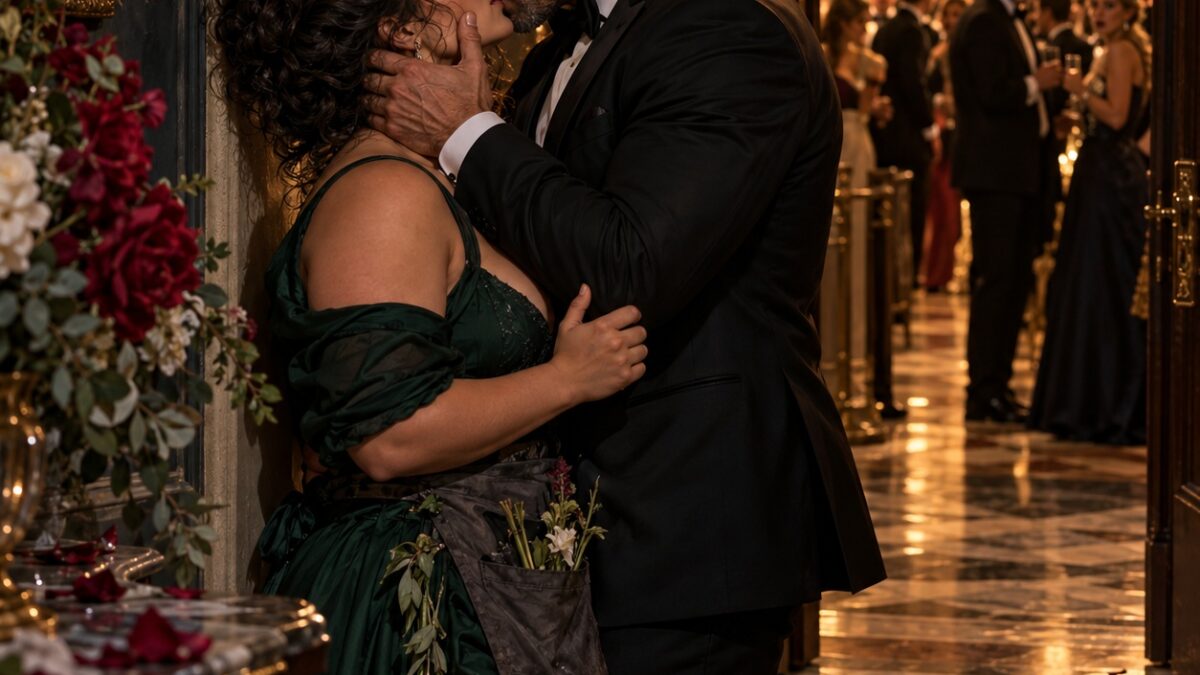
FULL STORY CONTINUATION
Westbridge Manor looked almost unreal at night.
Old Virginia stone.
Tall windows.
Formal gardens softened by wisteria.
Candles floating in low bowls.
Jasmine winding around the terrace doors.
The celebration was for Sophia Sterling, Roman’s twenty-six-year-old niece, and her fiancé, Ethan Caldwell, an architect with glasses and the calm expression of a man who had already learned that the Sterling family came with weather warnings.
I stayed at the edges.
That was where florists lived during events.
Close enough to rescue a collapsing arrangement.
Far enough that guests forgot you could hear them.
At eight-fifteen, I noticed everyone kept glancing toward the terrace.
Then I saw why.
Roman Sterling stood alone near the garden doors.
Sixty years old.
Broad shoulders.
Charcoal suit.
Silver hair brushed back from a weathered face.
One glass of whiskey in his hand.
Untouched.
Three men in dark suits positioned around the room as if casually existing near exits.
People approached him.
Shook his hand.
Left quickly.
Nobody lingered.
Even before I understood exactly what Roman was, I understood power.
The crowd curved around him.
I carried a small tray of floral pins toward the terrace.
He looked like a man planning an escape.
Apparently my mouth decided that was useful information.
“You look like you’re trying to figure out how to leave without anyone noticing.”
Roman turned.
Storm-gray eyes settled on me.
Not vaguely.
Completely.
He noticed my apron.
The flower petal stuck to my sleeve.
The pencil in my hair.
Everything.
“I am.”
I laughed.
I had expected intimidation.
Instead, he sounded tired.
“Give it five minutes.”
His eyebrow moved.
“Five minutes?”
“Stay through the toast.”
“And then?”
“You may escape.”
One of his security men looked as if he had just watched someone negotiate with a bear.
Roman set his whiskey on the railing.
“Five minutes.”
So we stood beside the garden.
I asked why he hated parties.
“Everyone is either afraid of me or trying to sell me something.”
“Which one am I?”
“I haven’t decided.”
“Fair.”
I looked at him.
“I haven’t decided about you either.”
His mouth shifted slightly.
“My current data says you are tall, gloomy, and holding whiskey you refuse to drink.”
“It is a prop.”
“A prop?”
“People stop trying to hand me things if I already have something.”
“That may be the saddest practical solution I have ever heard.”
“I understand you keep a sandwich in your apron.”
I stared.
“How do you know?”
“I noticed it.”
“That is considerably more alarming.”
Roman laughed.
Short.
Rusty.
One of the men at the door actually turned his head.
I looked toward the jasmine hanging above the terrace.
Roman followed my gaze.
“These are yours.”
“All of them.”
I tried not to sound proud.
“I wired the jasmine myself because it kept slipping.”
“It’s good.”
“You do not have to sound surprised.”
“I am not surprised.”
He looked at the flowers.
“My wife had a garden.”
Past tense.
I softened.
“What did she like?”
“Delphinium.”
His eyes moved toward the tall blue stems.
“She would have called that arrangement too blue.”
“Then spent the evening beside it?”
Roman looked at me sharply.
“Yes.”
I smiled.
“She sounds like my kind of woman.”
“Eleanor.”
The name carried weight.
“She died in 2019.”
“I’m sorry.”
He nodded.
Most people probably rushed to make grief comfortable.
Better place.
Everything happens for a reason.
Time heals.
I hated all of those sentences.
“My grandmother used to say you don’t get over a person.”
Roman waited.
“You grow a garden around where they were.”
He looked back toward the flowers.
“That is better than what people usually say.”
“She probably stole it from a greeting card.”
Another tiny smile.
Five minutes passed.
I knew because I had been counting.
Staying inside my welcome was another skill I learned young.
I straightened my apron.
“Your sentence is served, Mr. Sterling. You may escape.”
Roman looked toward the room.
Then back at me.
“I think I’ll stay for the toast.”
“Brave.”
“Careless, perhaps.”
“What is your name?”
“Clara Winslow.”
“Clara.”
He said it as if testing whether it belonged somewhere.
“Thank you for the five minutes.”
Roman stayed another forty.
He never spoke to me again that night.
He did not need to.
Every time I crossed the room, I felt his eyes find me.
At the door, he paused before leaving.
Turned.
Searched through the crowd until he found me.
Then inclined his head once.
I should have forgotten him.
I did not.
He came back four days later.
Rainy Tuesday.
I was kneeling in the carriage house with floral tape between my teeth when Josie appeared.
“There is an extremely large man in the lobby asking for you.”
“Client?”
“Crime lord.”
“Josie.”
“Allegedly.”
I wiped my hands.
Roman stood inside the manor entrance wearing a dark overcoat with rain on the shoulders.
Behind him was Luca, one of his security men.
Broad.
Quiet.
Patient expression.
Roman held a leather folder.
“My niece asked me to review arrangements for the wedding.”
That was nonsense.
Sophia had already approved everything.
Roman knew I knew.
I folded my arms.
“You came to inspect the garden?”
“Yes.”
“In the rain.”
“I was told rain reveals structure.”
“Who told you that?”
A pause.
“I read it.”
“Where?”
Roman looked almost annoyed with himself.
“The internet.”
“When?”
“Ten minutes ago.”
I laughed.
Behind him, Luca studied the ceiling.
We walked through the garden beneath one umbrella.
Forty minutes.
I showed him wisteria.
Roses.
An old magnolia Helen refused to prune correctly.
Roman listened as though each sentence mattered.
At the end:
“The garden is beautiful.”
“Thank you.”
“You’re the reason.”
That silenced me.
He returned Thursday.
Then Monday.
Then the following Friday.
Always an excuse.
Lighting.
Seating.
Acoustics.
The chapel.
The cooler temperature.
By the third week, I had started sending Luca away with plants.
Fern.
Jade.
Basil.
Josie started calling him Sir Basil.
Luca accepted the title.
Then Roman began bringing coffee.
He remembered my order after hearing it once.
Oat milk.
Too much cinnamon.
The first morning, he brought one for himself too.
I stared.
“You hate cinnamon.”
“I am attempting to understand.”
“You do not have to experience everything I like.”
“I disagree.”
He took a sip.
His eye twitched.
“Well?”
“It is…”
He swallowed.
“An experience.”
I laughed so hard I had to sit on a flower bucket.
Roman watched.
Something almost lost appeared in his face.
The next day he brought me my cinnamon latte.
He drank black coffee.
We never discussed what was happening.
The hospital bill forced us to.
Mom’s treatment had created a forty-thousand-dollar coverage dispute.
I drove to the billing office prepared to beg for ten years.
The woman behind the counter typed.
Frowned.
Then smiled.
“Your balance is zero.”
“That’s impossible.”
“It was paid eleven days ago.”
She turned the screen.
“Ongoing treatment has also been prepaid through December.”
“By who?”
“The Willow Street Foundation.”
I had never heard of it.
But eleven days earlier, Roman had casually asked the name of Mom’s clinic.
I found him beneath the wisteria that afternoon.
“You paid my mother’s bills.”
“Yes.”
Forty thousand dollars.
No flinch.
No apology.
At first.
“You did not ask.”
“No.”
“You did not tell me.”
“No.”
“You walked into my life and moved forty thousand dollars like you were sliding a chess piece.”
Roman’s jaw tightened.
“You are not a chess piece.”
“Then why did you decide for me?”
That hit him.
“I should have asked.”
I had not expected those words.
He looked almost ashamed.
“I haven’t asked permission for anything in a very long time.”
“I noticed.”
“I watched you count coins in a parking lot.”
My face burned.
“I saw your mother in dialysis.”
His voice roughened.
“There was something I could do.”
“So I did it.”
He held my gaze.
“I am not sorry she is safe.”
A pause.
“I am sorry I took your choice.”
My anger shifted.
Became something worse.
Relief.
It terrified me.
Nobody had ever lifted that kind of weight from me.
I hated how desperately I had needed it.
“I’m paying you back.”
“No.”
“Yes.”
“Clara.”
“One hundred dollars a month.”
“That would take—”
“My grandmother lived to ninety-six.”
A ghost of a smile.
“Then I will accept your terms.”
“Good.”
“On one condition.”
I narrowed my eyes.
“You accept my apology.”
“That depends on sincerity.”
“It is the most sincere thing I’ve said in twenty years.”
Rain dripped from the wisteria.
We stood too close.
Roman’s eyes dropped to my mouth.
Then he stepped back.
Deliberately.
“Clara.”
Something in his tone changed.
“You should stay away from me.”
I blinked.
“What?”
“Because of what I am.”
“You have not told me what you are.”
“You know enough.”
“Do I?”
“There are people who would hurt anyone I care about.”
His face closed.
“I have spent decades making certain I care about no one.”
A brutal statement.
“I will not make you the exception.”
I folded my arms.
“Roman Sterling.”
“Yes?”
“I am a florist.”
He waited.
“We are not known for wisdom.”
Roman closed his eyes.
Then walked away.
For three weeks, he did not come back.
I missed him so badly it made me furious.
Every month, I sent one hundred dollars through Luca.
Roman never told me he kept those envelopes unopened in his desk beside Eleanor’s photograph.
The next time I saw him was at a family remembrance dinner for Thomas Sterling.
Roman’s younger brother.
Sophia’s father.
He would have been fifty-five.
I arranged white lilies.
Blue hydrangeas.
One yellow rose at the head of the table.
Friendship.
Warm memory.
Not death.
Roman appeared in the doorway.
Black suit.
Black tie.
Grief making him look older.
He stared at the yellow rose.
Then at me.
“Thomas would have laughed at this.”
“He disliked flowers?”
“He said flowers were what people bought when they could not think of what to say.”
“What did you buy for his funeral?”
Roman looked down.
“I let the funeral home choose lilies.”
His throat moved.
“These are better.”
“They look like he is still here.”
I touched his sleeve.
Lightly.
Roman went motionless.
“I’m sorry I never knew him.”
“You would have liked him.”
“I think so.”
“He would have adored you.”
His eyes met mine.
Then he said:
“He would have told me I was an old fool for staying away.”
“Are you?”
“Yes.”
I smiled.
“Good.”
Guests began arriving.
Among them were Victor Kesler and his nephew Julian.
Victor was sixty-four.
Silver hair.
Cold eyes.
A smile too warm for his face.
Julian was younger.
Mid-thirties.
Drunk enough to believe everyone around him existed for entertainment.
Nobody had invited them.
Apparently nobody could refuse them without starting a war.
Julian cornered Sophia beside the head table.
“Condolences, sweetheart.”
He grabbed her wrist when she tried to move.
Ethan stepped forward.
Roman moved.
Then Julian stumbled backward.
Straight into me.
The hydrangea vase left my hands.
Glass hit marble.
Exploded.
Water.
Flowers.
Blue petals everywhere.
The entire room fell silent.
Julian looked at me.
His eyes moved over my apron.
My body.
My size.
His mouth curled.
“Watch where you stand, sweetheart.”
Then louder:
“There’s not much room left with you taking up all of it.”
Old humiliation is strange.
It does not care how healed you think you are.
Daniel’s voice returned.
Photos matter.
Schoolboys.
Bridesmaids.
Strangers.
Every little cruelty packaged as humor.
My face burned.
I saw Roman turn.
His expression frightened me.
I understood instantly that if I said nothing, someone else would.
And Roman Sterling’s version would probably involve significantly more paperwork.
So I planted my feet.
“That was one hundred eighty dollars of hydrangea.”
Julian blinked.
“And a hand-blown vase.”
The whole room stared.
“You will apologize for both.”
His mouth opened.
I continued.
“As for the space I take up?”
My hands shook.
My voice did not.
“I was invited.”
“I am here because I created the beauty in this room.”
I looked toward Sophia.
“You are here because people were too polite to turn your family away.”
Victor’s smile disappeared.
I stepped closer.
“If anybody is taking up space they have not earned, it is the man grabbing a grieving woman at her father’s memorial.”
Silence.
“Apologize to Sophia.”
Then:
“Pick up the glass.”
Julian looked ready to explode.
Victor spoke first.
“Julian.”
Cold.
“Apologize.”
He did.
Badly.
Victor nodded to me.
“My nephew has forgotten his manners.”
Roman still had not moved.
His eyes were flat.
Terrible.
He reached me in two strides.
One hand closed carefully around my elbow.
“Excuse us.”
It sounded like an order to the entire building.
He took me into the corridor.
Shut the door.
The noise disappeared.
Only marble.
Silk wallpaper.
Amber light.
My entire body started shaking.
“I think I may have made a mistake.”
Roman stared.
“I told a Kesler to pick up glass.”
“You did.”
“Was that stupid?”
His voice was rough.
“It was the bravest thing I have seen in thirty years.”
A watery laugh escaped me.
Then anger came.
Because he was here again.
Close.
Looking at me like I mattered.
After three weeks of deciding he knew what was best.
“Why do you keep doing this?”
His brow tightened.
“Doing what?”
“Acting like I’m something you have to protect.”
I stepped closer.
“You paid Mom’s bills.”
“Disappeared.”
“Came back.”
“Look at me like that.”
My throat tightened.
“What am I supposed to do with you, Roman?”
“Clara.”
“No.”
“Tell me.”
His jaw clenched.
“People near me get hurt.”
“Eleanor.”
“Thomas.”
“A hundred people whose names you do not know.”
“I have made peace with being alone.”
His eyes darkened.
“I have not made peace with watching someone like you pay for standing too close.”
“Then explain it.”
Roman went completely still.
I watched something give way behind his eyes.
His hand rose.
Slowly.
Giving me time to move.
I did not.
His palm settled against my jaw.
So gentle my breath caught.
Then Roman Sterling kissed me.
Not violently.
Not like some dramatic movie version of a dangerous man.
Slow.
Deliberate.
Tender enough to hurt.
The kiss of a man who had spent decades practicing restraint and had finally reached the limit of what restraint could survive.
His fingers slid into my hair.
They trembled.
That shocked me more than anything.
Roman was shaking.
I grabbed his lapels.
Kissed him back.
All my stubbornness.
All the hope I had spent years pretending I did not have.
All the fear.
When we finally separated, I touched my mouth.
“You kissed me like you meant it.”
Roman did not look away.
“I did.”
Twenty minutes later, after Sophia hugged me and Helen quietly cleared the broken vase, Roman walked me toward the carriage house.
His hand rested lightly at my back.
Inside, I sat on an overturned bucket because my legs had stopped functioning.
Roman stood by my worktable.
“I owe you the truth.”
I waited.
“All of it.”
His face was grim.
“When I finish, you may ask me to leave.”
Then he told me.
The Sterling family had controlled parts of Richmond’s shadows for three generations.
Port contracts.
Shipping.
Loans.
Favors.
Influence.
His father had built most of it.
Thomas had hated it.
Roman inherited it at twenty-nine.
“There are men dead because I gave orders.”
He did not soften it.
“I never touched anyone who did not understand the world he had entered.”
Roman looked bitter.
“That distinction feels thinner every year.”
The Keslers wanted what he controlled.
They had for a decade.
Thomas died three years earlier in a boating accident.
Roman never believed it was an accident.
Never proved otherwise.
“I am dangerous.”
His voice was plain.
“Not the way rumors make it sound.”
“Rumors are cartoons.”
He looked at his own hands.
“I am dangerous the way a river is dangerous.”
“I move.”
“Things move with me.”
“And sometimes people are in the way.”
Silence.
“I stayed away because I knew what would happen if I didn’t.”
He finally met my eyes.
“I have been trying for two months to stop thinking about a woman who talks to a ficus.”
Despite everything:
“Pierre is an excellent conversationalist.”
Roman almost smiled.
“You told me twice to stay away.”
“Yes.”
“You secretly paid Mom’s bills.”
“Yes.”
“You disappeared.”
“Yes.”
“So answer one question.”
I crossed the room.
“Do you want me to leave?”
“No.”
Immediate.
Small word.
Huge room.
I took his scarred hand.
“Then I’m staying.”
Roman’s jaw tightened.
“I’m scared.”
“I know.”
“I would be an idiot not to be.”
“Yes.”
“But I would rather be frightened beside you than comfortable without you.”
His fingers closed over mine.
“If you ever make this decision for me again, I will put a pot of geraniums on your head.”
Roman stared.
“Geraniums.”
“Very heavy.”
“That is unusually specific.”
“I am unusually specific.”
His face transformed.
Real smile.
Warm.
Almost young.
“I have noticed.”
Then Roman met my mother.
I tried to stop him.
He insisted.
On a Sunday afternoon, he arrived at our Church Hill house wearing a navy sweater and carrying a pound cake he had apparently researched for two days.
No visible bodyguards.
Margaret Winslow sat on the porch swing and looked him over like a school principal reviewing a suspicious transfer student.
“You’re the man who paid my bills.”
Roman did not lie.
“Yes, ma’am.”
“I thought so.”
Mom sipped tea.
“Funds called Willow Street do not suddenly appear around kidney patients by magic.”
I groaned.
“Mom.”
“Hush. I am interviewing him.”
Roman sat straighter.
Margaret pointed at him.
“I know what people say.”
“So do I.”
“I am sixty-one years old.”
“Yes, ma’am.”
“I have been studying men for a long time.”
Roman looked almost nervous.
“A man who brings pound cake and doesn’t know where to put his hands is not here to cause trouble.”
Mom leaned closer.
“But if you hurt my daughter, kidneys or no kidneys, I will make your life miserable.”
Roman’s eyes brightened.
“Mrs. Winslow.”
“Yes?”
“If I hurt Clara, I will personally bring you the broom.”
Mom studied him.
Then moved over.
“Sit.”
Roman obeyed.
“Do you play Scrabble?”
That was how the most feared man in Richmond ended up losing forty-three points to my mother over the word “qi.”
There were ugly moments too.
At a restaurant one night, a drunk man made a comment about my body.
I was already preparing my usual joke.
Roman set down his fork.
The room seemed to change temperature.
“Stand.”
The man laughed.
Roman looked at him.
“Apologize to the lady.”
No raised voice.
No threat.
Just certainty.
The man recognized him.
Went pale.
Apologized.
Left.
Roman turned back to me.
The cold disappeared immediately.
“I’m sorry.”
“For?”
“I should have let you handle that.”
I surprised myself.
“I didn’t want to.”
Roman waited.
“I’m tired of handling it.”
My voice shook.
“I’ve handled comments like that since I was twelve.”
Roman covered my hand.
“Then don’t.”
He leaned close.
“No one in this city gets to insult you and expect me to sit politely beside you.”
“Roman.”
“You are mine.”
My heart stopped.
The phrase should have bothered me.
From Daniel, it would have sounded like ownership.
From Roman, it sounded like a roof.
A locked door.
A fire burning inside.
I turned my hand beneath his.
Held on.
By September, Roman invited me to the Sterling Foundation gala.
Black tie.
Richmond society.
Exactly the kind of place Daniel’s old voice could come alive.
I stood in my bedroom staring at an emerald dress that suddenly seemed designed to humiliate me.
The zipper was half up.
My body looked too visible.
Too soft.
Too much.
Roman arrived early.
Mom sent him upstairs because apparently boundaries were no longer part of our household.
He stopped in the doorway.
I panicked.
“Don’t look.”
Roman’s expression changed.
“It doesn’t fit.”
“It does.”
“No.”
“I look ridiculous.”
“Clara.”
“I’ll stay home.”
He crossed the room slowly.
Did not touch me.
Stood behind me.
Looked at my reflection.
Dark curls.
Bare shoulders.
Emerald silk.
Every curve I had spent years learning not to apologize for.
“I have spent sixty years looking at things people wanted me to admire.”
His voice was steady.
“Paintings.”
“Cars.”
“Buildings.”
“Women trained to be admired.”
My breath caught.
“I know what something made for display looks like.”
His eyes met mine in the mirror.
“And I know what it looks like when I cannot look away.”
Tears burned.
“You are not too much.”
Roman moved closer.
“You have never been too much.”
His fingers fastened the final hook of the dress.
“The world has simply been too small.”
That night I walked into a ballroom on Roman Sterling’s arm.
I did not hide.
Not once.
Then October came.
And flowers told me somebody was betraying him.
It began with the order book.
Eleven white roses.
No real client.
Fourteen yellow carnations.
False name.
Nine foxglove stems in brown paper.
Different pickup points around Westbridge.
Strange orders entered by Brent Haskell from the manor office.
I remembered every stem.
Grandmother Odessa’s voice:
A florist who forgets what she planted gets robbed.
I studied the dates.
Roman’s visits.
His routes.
The numbers matched movements.
Eleven.
Fourteen.
Nine.
Hours.
Gate locations.
Someone was using fake floral orders to communicate Roman’s schedule.
I did not tell him immediately.
That sounds stupid.
It probably was.
But if Roman moved too soon, the person inside Westbridge would vanish.
I watched.
Brent Haskell.
Thirty.
Pale.
Office administrator.
He had lost weight.
Stopped joking with Josie.
His hand shook when he passed me order slips.
A courier in a gray cap appeared on specific days.
Then came the worse thought.
Only four people knew all Roman’s changed movements.
Luca trusted three.
The fourth was Gabriel Finch.
Roman’s oldest friend.
Head of security.
Thirty-five years beside him.
A man who asked after my mother every time he saw me.
One Tuesday night I stayed late inside the cold room photographing the order book.
The light clicked on.
Brent stood in the doorway.
Gun in both hands.
Shaking so badly the barrel moved.
“Clara.”
His voice cracked.
“Put the phone down.”
I did.
Slowly.
“I don’t want to do this.”
“I believe you.”
He stared.
“You do?”
“A man who wants to hurt somebody usually does not look like he is about to throw up.”
His face crumpled.
“My sister.”
“Maya?”
He nodded.
“She owes them money.”
“How much?”
“Enough.”
Tears fell.
“They said they would take the house.”
“Who?”
“The Keslers.”
He struggled to breathe.
“They said it was only a few orders.”
“Numbers.”
“Nothing dangerous.”
“Who gave you the dates?”
“A man named Gabriel.”
My stomach dropped.
“Last name?”
“I never knew it.”
“Where did you meet him?”
“Parking garage.”
“Twice.”
Gabriel.
I moved closer.
The gun touched my coat.
I put one hand over Brent’s.
Lowered it.
He let me.
“What you did was wrong.”
He cried harder.
“But it does not have to be the end of you.”
I took the phone.
“If you help us, we can help Maya.”
“I’ll stay with you.”
“I promise.”
I called Roman from the parking lot.
“Come to Westbridge.”
Silence.
“Now.”
“Are you hurt?”
“No.”
“Bring Luca.”
Another pause.
“Only Luca.”
Roman’s voice changed.
“Clara.”
“Do not come with anyone you have known a long time.”
He arrived in twelve minutes.
After Brent told him everything, Roman went white.
Not angry-white.
Grief.
“You could have been killed.”
He reached for me.
Stopped.
“A gun.”
His voice broke.
“Alone in a cold room.”
“If I had lost you—”
He could not finish.
“I spent months telling myself I was protecting you.”
He looked ashamed.
“You were doing what none of my men could.”
“You saw it.”
“I underestimated you.”
“I will never forgive myself for that.”
I touched his face.
“You could have trusted me sooner.”
Roman closed his eyes.
“Yes.”
When he opened them:
“I could have.”
His voice softened.
“I tried to build walls around you.”
He gave a bitter laugh.
“You are apparently the person who sees through walls.”
“No more secrets.”
“Not when they affect you.”
“No more decisions made over your head.”
He took my hands.
“We do this as equals.”
“As equals.”
Then Luca took Brent somewhere safe.
And Roman broke.
Gabriel had attended his wedding.
Carried Thomas’s coffin.
Sat beside Roman the night Eleanor died.
Held his shoulder while Roman cried.
Thirty-five years.
Roman lowered himself onto an overturned bucket.
Covered his face.
I sat on the floor beside him.
Eventually, his head rested against my shoulder.
The man half Richmond feared cried quietly in the dark for the friend who had betrayed him.
The argument about what came next happened at my kitchen table.
Roman wanted to handle Gabriel the old way.
Quiet.
No courts.
No witnesses.
Final.
“No.”
Roman looked at me.
“What?”
“You are not burying anyone because of me.”
“Clara.”
“No.”
“This man may have helped kill my brother.”
“I know.”
“You do not know what that means.”
“You’re right.”
I leaned toward him.
“But Thomas spent his life trying to stay away from this world.”
Roman went still.
“If you become exactly what killed him, Kesler wins anyway.”
He looked away.
“We know they are planning something around Sophia’s rehearsal dinner.”
I continued.
“We know they use the flower code.”
“Let me give them one more.”
Roman frowned.
Then I explained.
One fake order.
One fake route.
Only Gabriel receives the false information.
Kesler’s men show up.
State police get an anonymous tip about weapons.
Roman put his head in one hand.
“Forty years doing things the hard way.”
“Yes.”
“And a florist tells me to call 911.”
“It’s cleaner.”
Roman stared.
“And composts better.”
He laughed despite himself.
On Wednesday, I wrote a fake order in Brent’s handwriting.
Nine white roses.
River gate pickup.
Then I told Gabriel alone that Roman planned to leave Sophia’s rehearsal dinner at ten by the old River Road.
Alone.
It was a lie.
I practiced on Pierre until I could tell it without blinking.
Friday night, Westbridge glowed under strings of lights.
Rosemary sat at the head table.
Remembrance.
At 9:50, Roman kissed Sophia’s forehead.
Stepped toward the terrace.
Gabriel followed.
“Want me to drive?”
“No.”
“River Road gets dark.”
“I know.”
Roman looked toward the garden.
“Walk with me first.”
They went to the greenhouse.
I waited inside with Luca.
Order book on my lap.
Gabriel entered.
Saw me.
Saw the ledger.
His face changed.
The kind old friend disappeared.
Something tired took his place.
“Eleven roses.”
I said.
“Fourteen carnations.”
“Nine foxglove.”
Gabriel’s gaze hardened.
“My grandmother told me never to forget what I planted.”
I held up the book.
“You picked the wrong florist.”
His hand moved toward his coat.
Gun.
Luca shouted.
Roman stepped forward.
Unarmed.
“If you are going to do it, Gabriel.”
Roman’s voice was calm.
“Look at me.”
The gun shook.
“You held me the night Eleanor died.”
“Look at me.”
Gabriel’s face collapsed.
“They were going to kill us all.”
Roman said nothing.
“Kesler had the port.”
Gabriel’s words rushed out.
“I thought if I gave him one thing, he would stop.”
His breath hitched.
“I gave him Thomas.”
The greenhouse disappeared around us.
Roman stopped breathing.
“I told them where the boat would be.”
Gabriel was crying now.
“I did not think they would kill him.”
Roman moved.
One second, Gabriel stood holding the gun.
The next, Roman had him against the greenhouse glass.
The weapon hit the floor.
Roman drew back his fist.
I crossed the room.
Put my palm on his chest.
“Roman.”
Nothing.
“Look at me.”
His heart slammed beneath my hand.
“Not like this.”
“He killed Thomas.”
“I know.”
“He gave him to them.”
“I know.”
Roman’s fist trembled.
“Thomas spent his life refusing this world.”
I kept my eyes on his.
“Do not become the thing that took him.”
Sirens started far away.
“Let the law have him.”
For one terrible second, I thought Roman would not hear me.
Then his fist lowered.
His grip released.
Gabriel slid down the glass and wept.
Roman turned away.
His whole body shook.
I wrapped my arms around him from behind.
Held on.
State troopers reached River Road at 10:04.
Nine Kesler men were waiting in two sedans with illegal weapons.
Julian was among them.
The smirk disappeared when the cuffs went on.
Brent’s phone records and the courier’s cooperation led investigators toward Victor.
Within weeks, the Kesler empire in Richmond collapsed.
Gabriel was taken into custody quietly.
He did not resist.
He never looked back at Roman.
Sophia’s wedding happened five weeks later.
Cold November sunlight.
Westbridge garden.
Cream roses.
Tall blue delphinium Eleanor would have called too certain of themselves.
Mom wore lavender.
Roman insisted she sit in the front row.
She held his hand through the vows.
When Sophia and Ethan finally kissed, Margaret cried louder than anyone.
At the reception, Roman stood.
Tapped his glass.
The room quieted automatically.
Old habits.
“I have spent most of my life in rooms where nobody told me the truth.”
People smiled carefully.
“This year, a woman walked into one carrying ranunculus and told me I looked like I was planning an escape.”
Laughter.
I froze near the terrace doors.
Emerald silk.
Petal on my sleeve.
His eyes found me.
“She is the bravest person I know.”
My throat tightened.
“She stood in front of a Kesler with broken glass at her feet and told him to pick it up.”
More laughter.
“She saw what men I have trusted for decades could not see.”
Then Roman became serious.
“She taught me something I should have understood long ago.”
His gaze never left mine.
“Protection is not a wall.”
My eyes filled.
“She is my family.”
The room disappeared.
“And she is the first thing in my life I refuse to hide.”
Roman raised his glass.
“Clara Winslow.”
My hand covered my mouth.
“You are mine.”
Then:
“And I am yours.”
His voice softened.
“Let everyone here know it.”
Sophia started clapping while crying.
Ethan joined her.
Then Mom stood.
Let out a whoop loud enough to shock half the Sterling family.
That destroyed the remaining dignity of the moment.
I laughed through tears.
Roman smiled at me from across the room.
No hiding.
No running.
No walls.
Months later, life became surprisingly ordinary.
Which may have been the part I loved most.
I kept working.
Roman never asked me to stop.
Actually, he tried once.
Not maliciously.
“Why are you hauling buckets at six in the morning when you could hire three people?”
“Because I am a florist.”
“You own the business.”
“Yes.”
“Owners delegate.”
“Crime bosses delegate.”
Roman narrowed his eyes.
“That title is inaccurate.”
“Alleged crime bosses delegate.”
“Worse.”
I kissed his cheek.
“Go to work.”
“You are impossible.”
“So you keep saying.”
He did help me expand the carriage house.
Only after asking.
That mattered.
I drew the plans.
I chose the budget.
I took a loan for part of it because I wanted the business to remain mine.
Roman thought paying interest while he possessed money was irrational.
I explained independence was sometimes financially inefficient.
He said that was offensive to economics.
I told him love was not an acquisition strategy.
He stopped arguing.
Mostly.
Mom’s health remained complicated.
No miracle.
Dialysis continued.
Good weeks.
Bad weeks.
Roman stopped secretly paying anything.
He asked.
Sometimes I let him help.
Sometimes I paid.
Sometimes Mom told both of us to shut up and let her decide because apparently we had forgotten the patient possessed a voice.
She liked Roman more than was appropriate.
Especially after discovering he took Scrabble seriously.
“You cannot use foreign words.”
“Qi is accepted.”
“It is nonsense.”
“It is in the dictionary.”
“You bought the dictionary.”
“I did not.”
“You would.”
I sat between them eating pound cake while the most feared man in Virginia defended a two-letter word to a woman in slippers.
Those were the moments I wished my father could see.
Not the danger.
Not Westbridge.
Not wealth.
Roman sitting in Dad’s old chair listening while Mom told the same story for the fourth time.
That mattered.
Josie developed an enormous crush on Luca that she denied with the subtlety of fireworks.
Luca pretended not to notice.
Also badly.
After the Kesler arrests, she framed a photograph of him holding the basil plant I had given him months earlier.
It hung above her desk.
“Professional admiration.”
She explained.
“Of his horticultural commitment.”
“Of course.”
“Do not start.”
“I said nothing.”
“You are thinking loudly.”
Luca walked in at that exact moment.
Saw the framed photograph.
Looked at Josie.
Looked at me.
“I like that picture.”
Josie turned bright red.
I walked into the cooler before I ruined her life laughing.
Brent cooperated with investigators.
Maya kept the house.
I did not become his friend.
What happened was too serious for easy forgiveness.
But when everything ended, I sent him one card.
No flowers.
Just one line.
You were right to put the gun down. Keep choosing from there.
I never heard back.
That was fine.
Daniel reappeared once.
Of course he did.
Men like Daniel always seemed capable of sensing when a woman had stopped needing their approval.
He came into the carriage house while I was arranging centerpieces.
Expensive suit.
Same smile.
“Clara.”
My stomach tightened.
Not because I loved him.
Because the body remembers old rooms.
“Daniel.”
“I heard about you.”
“I’m standing right here.”
“You look good.”
There it was.
That particular tone.
As if he had once been owed improvement.
“Thank you.”
“I mean…”
He smiled.
“You really seem confident now.”
I stared.
I had spent three years imagining what I would say if I ever saw him.
Something devastating.
Elegant.
A sentence that would make him understand every wound.
Then I realized I did not want anything from him.
Not regret.
Not apology.
Not recognition.
“I was confident then.”
Daniel’s smile slipped.
“You just didn’t like the version that didn’t revolve around you.”
He looked toward the doorway.
Roman stood there.
He had apparently arrived halfway through.
Gray suit.
Coffee in one hand.
No expression.
Daniel recognized him.
The color left his face.
Roman looked at me.
Not Daniel.
“Do you need me?”
That question.
Not:
Do you want me to remove him?
Not:
Who is this?
Do you need me?
I smiled.
“No.”
Roman nodded.
Then walked away.
Daniel stared.
“You’re with him?”
“That is none of your business.”
“Clara, that man—”
“Goodbye, Daniel.”
He left.
My hands shook afterward.
Roman waited outside until I joined him.
“You heard?”
“Yes.”
“You did not come in.”
“You said you didn’t need me.”
My eyes stung.
“I wanted to.”
He added.
“I know.”
“You looked like you had it handled.”
“I did.”
Roman handed me coffee.
Black for him.
Cinnamon for me.
“You were never too much.”
I took the cup.
“I know that now.”
That was healing.
Not never feeling the old pain.
Knowing it was old.
Roman kept returning to the carriage house.
Sometimes with reasons.
Eventually without.
He stopped pretending Sophia required his opinion on wisteria.
I would look up and find him near Pierre.
“Meeting?”
“No.”
“Emergency?”
“No.”
“Criminal conspiracy?”
“Clara.”
“Just checking.”
“What are you doing here?”
Roman would set down coffee.
“I’m here for you.”
The first time he said it that plainly, I had to turn away.
Because once, being wanted had felt conditional.
Lose weight.
Try harder.
Photograph better.
Take up less space.
Now here was a man who had spent sixty years surrounded by polished things people told him to admire.
And he came to a cold carriage house because I was there.
One warm afternoon, wisteria covered the window.
Josie hummed at her desk beneath Luca’s basil photograph.
Pierre watched from the corner with his usual judgment.
I was wiring garden roses when the room changed.
Not dramatically.
I simply felt him.
Roman stood in the doorway.
Charcoal suit.
Silver hair.
One paper cup.
“Are you escaping another party?”
I asked.
“No.”
He crossed the room.
Set down the coffee.
Black.
Plain.
Exactly how I liked it on afternoons when sugar made my head ache.
“What are you doing here?”
Roman looked at me.
Not my flowers.
Not the room.
Me.
“I’m here for you.”
I put down my wire cutters.
For a moment I was back in that marble corridor.
His hand trembling against my jaw.
His mouth on mine.
My own shocked whisper.
You kissed me like you meant it.
I laced my fingers through his.
“And you still mean it?”
Roman lifted my hand.
Pressed his mouth to my knuckles.
“Every word.”
Another kiss.
“Every time.”
His gray eyes held mine.
“Every time I come back.”
Outside, the wisteria moved in the warm wind.
Somewhere beyond the garden, a bride laughed.
A band tuned.
Josie deliberately found a reason to disappear.
I stood in my own workshop beside my flowers, my books, my ridiculous ficus, and the man everybody else in Richmond knew how to fear.
For most of my life, I had believed I was simultaneously too much and somehow not enough.
Too large.
Too visible.
Too emotional.
Too soft.
Too loud when I laughed.
Not polished enough.
Not thin enough.
Not the woman a man would be proud to photograph.
Roman never cured those wounds.
That was not his job.
He simply refused to confirm them.
Again and again.
He looked.
He listened.
He returned.
He apologized when he crossed a line.
He learned that helping me required permission.
He learned protection was not a wall.
And I learned that softness had never been the opposite of strength.
My softness was what made me notice Brent’s terror instead of only his gun.
It was what made me remember my grandmother’s flowers.
It was what stopped Roman from destroying Gabriel in a greenhouse.
It was what let my mother frighten a man who frightened entire rooms.
Softness had not made me weak.
It had kept people alive.
Roman once thought loving me would give his enemies a weapon.
They thought so too.
They were wrong.
Love did not weaken him.
It forced him to choose the man he wanted to be when rage would have been easier.
And Roman’s power did not make me smaller.
At least not once he understood that I would leave before I allowed it to.
We met in the middle.
Not innocent.
Not perfect.
Not safe in the childish sense.
Honest.
That mattered more.
Sometimes people would ask me later when I knew.
I could say it was the first five minutes at Sophia’s engagement.
Maybe it was.
I could say it was the cinnamon latte.
Or the hospital bills.
Or the memorial dinner.
Or when he told me I was not too much.
But if I had to choose, I would still choose the corridor.
Cold marble.
Silk wallpaper.
One ballroom door between us and one hundred fifty witnesses.
Julian Kesler’s insult still echoing in my ears.
My hands shaking after years of pretending words never hurt.
Roman looking at me like my anger was not embarrassing.
Like my body did not need explaining.
Like the woman everyone else called too much was exactly enough to terrify a man who had spent his whole life fearing nothing.
He kissed me.
Slowly.
His hand trembled.
I touched my lips.
“You kissed me like you meant it.”
Roman looked straight at me.
“I did.”
He meant it then.
He meant it when he told me the truth about himself knowing I might walk away.
He meant it when he sat on my mother’s porch and accepted her threats.
He meant it when he stood behind me in the mirror and told me the world had been too small.
He meant it when he let Gabriel live.
He meant it when he told a room full of people I was his family.
And years later, every time Roman returned to the carriage house, put down coffee, and looked at me like he had finally found the one place in Richmond he did not want to escape from, I understood something simple.
The kiss had never been the promise.
Coming back was.








