FULL STORY: They Wanted to Take the Last Thing My Parents Left Me, and a Navy SEAL Was the Only Man Who Believed My Dog Was Innocent
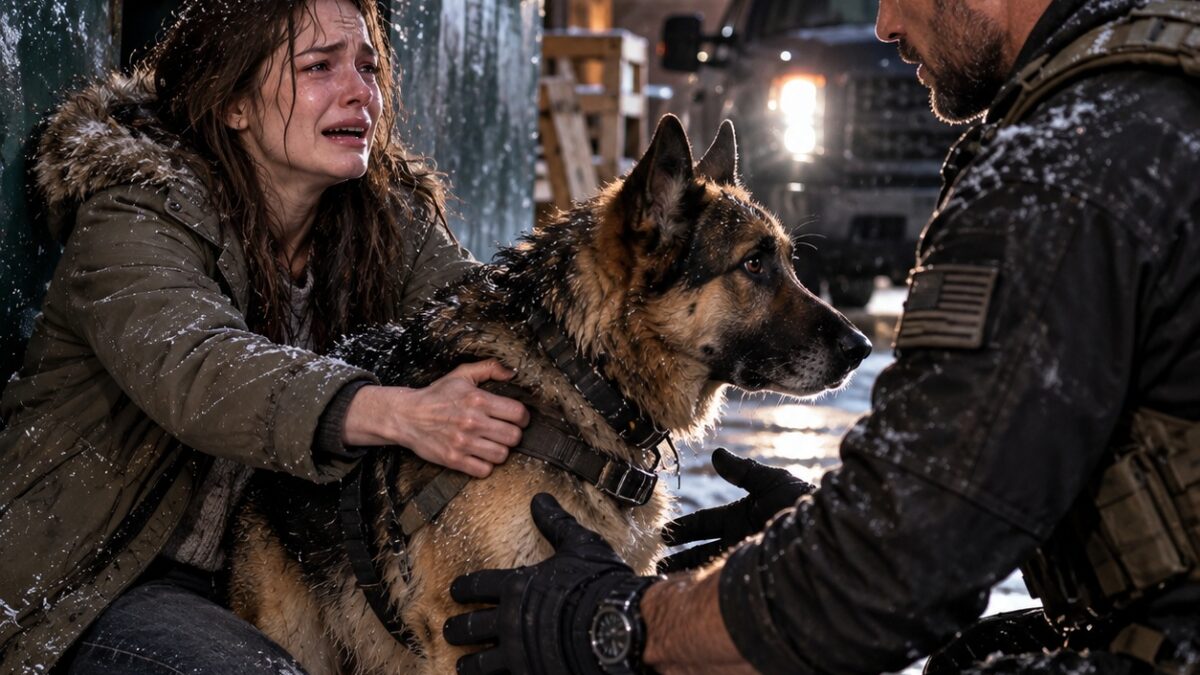
The heater in Cal Mercer’s pickup was the first real warmth I had felt in hours.
I held my hands against the vents, trying to stop them shaking.
My fingertips ached as sensation returned.
Behind me, Alder lay across the back seat, his head lifted just enough to watch the man driving us through the empty streets.
Cal didn’t ask where I wanted to go.
Not immediately.
He drove slowly, keeping both hands on the wheel, occasionally glancing at me as though he was checking whether I was still awake.
After several minutes, he said, “You been outside all night?”
“Most of it.”
“Have somewhere safe to stay?”
I hesitated.
“Yes.”
“Then why weren’t you there?”
I looked out the window.
Snow moved past the streetlights in pale ribbons.
“Because they’ll look there first.”
He said nothing.
I wished he would.
Silence made it easier to imagine he was reconsidering whether to help us.
Finally, he asked, “Where are your parents?”
The question landed like a stone in my stomach.
“Dead.”
His eyes shifted toward me.
“I’m sorry.”
“Three years ago.”
He waited.
I rubbed my thumb across a loose thread in my scarf.
“They were driving home on County Road Nine. There was black ice. Dad lost control, and their car slid into a truck.”
Cal’s expression remained steady, but something changed behind his eyes.
He didn’t offer one of those terrible phrases people use when they don’t know what to say.
He didn’t tell me everything happened for a reason.
He didn’t say my parents were in a better place.
He simply nodded.
“And Alder was theirs?”
“Dad’s, mostly.”
I turned toward the back seat.
“He brought him home when I was eighteen. Mom said one dog was enough trouble for a lifetime, but three days later she was sneaking him pieces of chicken under the dinner table.”
The memory hurt.
I smiled anyway.
“After the funeral, Alder started sleeping outside my bedroom. Every night. He wouldn’t leave until I got up.”
Cal looked in the rearview mirror.
Alder’s ears twitched.
“He sounds loyal.”
“He’s all I have.”
The words came out before I could stop them.
I felt embarrassed immediately.
Cal didn’t look embarrassed for me.
He just said, “Then we better make sure nothing happens to him.”
I wanted to believe that.
More than anything.
But by then I had learned that wanting something badly didn’t mean you would get to keep it.
Cal’s house stood outside town near a frozen inlet of Lake Superior.
White birch trees surrounded the driveway.
Pine branches hung low beneath heavy snow.
Warm light glowed from the porch.
When he opened the front door, I expected photographs, shoes, coats, the normal signs of somebody living in a house.
Instead, I found a living room so orderly it looked almost untouched.
One sofa.
One chair.
A small table.
No family pictures.
No scattered mail.
Even the boots beside the entrance stood perfectly aligned.
I looked around.
“Did you just move in?”
“Four months ago.”
“That explains some of it.”
“Some?”
I looked toward the empty walls.
“Your house doesn’t know you live here yet.”
He stared at me.
For one awkward second, I wondered whether I had offended him.
Then he laughed.
It was a short sound.
Almost surprised.
As though he hadn’t expected himself to do it.
Alder walked past us, circled the rug near the fireplace, and lay down with an enormous sigh.
Cal looked at him.
“Apparently he likes the place.”
“He considers making himself comfortable a professional responsibility.”
Cal shook his head.
Then he pointed toward the hallway.
“Bathroom’s on the left. There are clean towels in the cabinet. I’ll find you something dry to wear.”
I glanced at Alder.
Cal noticed.
“He can stay right here.”
I hesitated.
“You’re sure?”
“Ren, if I wanted your dog gone, I wouldn’t have invited him inside.”
I nodded.
But I still waited until Alder settled before leaving the room.
I didn’t know Cal Mercer.
I didn’t know what kind of man he was.
All I knew was that he had found me in the cold and hadn’t called me crazy.
At that moment, it felt like more kindness than I deserved.
An hour later, I sat at his kitchen table wearing an oversized sweatshirt and a pair of dry socks.
Cal placed a mug of hot tea in front of me.
Then he opened his refrigerator.
I watched him examine the contents.
Eggs.
Coffee creamer.
Mustard.
One apple.
A bottle of water.
He closed the door.
I stared.
“Do you ever eat?”
“Yes.”
“What?”
“Food.”
“That’s reassuring.”
He looked mildly offended.
“I was planning to go shopping tomorrow.”
“You’ve been planning that for four months?”
He laughed again.
Alder lifted his head from the living room.
For the first time since leaving my house, I felt the muscles in my shoulders begin to relax.
Not completely.
But enough to breathe.
Cal sat across from me.
“Tell me about the bakery.”
I looked down.
I had spent weeks trying to explain what happened.
Nobody had listened long enough to understand.
Now a stranger was asking.
And I was suddenly afraid to begin.
Golden Hearth Bakery had been the one place where I felt useful after my parents died.
The shop stood at the corner of Main Street and Cedar Avenue, inside an old two-story brick building with cream-colored trim.
Every morning, the windows glowed gold before the sun rose.
By seven, the smell of cinnamon, butter, fresh bread, and coffee drifted halfway down the block.
I loved that smell.
It reminded me of home.
My mother had been an excellent baker.
Not professionally.
She simply believed a kitchen was happier when something warm was coming out of the oven.
Every October, she made apple cake.
Every Christmas, she made cinnamon rolls.
And whenever someone in town was sick, she would carry over a loaf of bread wrapped in a clean dish towel.
After she died, I couldn’t bring myself to bake in our kitchen for almost six months.
The first time I tried, I made her apple cake.
I followed the recipe exactly.
When I took it out of the oven, it smelled so much like the house I remembered that I sat on the floor and cried.
Working at Golden Hearth was different.
There, baking became something I could do with my hands when my thoughts were too loud.
Measure.
Mix.
Knead.
Wait.
Bake.
A loaf of bread didn’t care whether you were grieving.
It needed attention.
And if you gave it what it needed, something good usually happened.
That predictability helped me survive.
My boss, Gideon Rusk, had always seemed kind.
He was fifty-four, solidly built, with neatly combed brown-gray hair and a carefully trimmed beard.
People loved him.
He sponsored school events.
Donated bread to local fundraisers.
Bought coffee for firefighters.
Remembered birthdays.
He had been generous to me after my parents died.
At least, that was what I believed.
He let me bring Alder to work, provided the dog stayed outside the food preparation area.
I built a sheltered spot beside the bakery, complete with a raised platform, insulated mat, and heavy water bowl.
On dangerously cold days, I moved him into an approved room away from food or arranged to take him home during breaks.
Alder understood the routine.
Every morning, I pointed toward his mat.
“Work.”
He walked over.
Turned once.
Lay down.
And watched the world go by.
Customers loved him.
Especially Evelyn Pike, a seventy-four-year-old woman who came by almost every Tuesday.
She brought dog biscuits.
Alder would look at the biscuit.
Then look through the bakery window toward me.
If I shook my head, he refused it.
Evelyn always laughed.
“That dog has better manners than my grandson.”
For years, nobody questioned whether Alder belonged there.
Then Gideon began asking about my house.
The Holloway home was an old pale-blue place near the eastern edge of town.
It needed repairs.
The roof leaked in two places.
The furnace occasionally clicked before starting.
The rear fence leaned farther than I liked.
But it was mine.
My father had repaired practically every inch of that house himself.
He was the kind of man who believed anything could be fixed with patience, a screwdriver, and enough stubbornness.
Mom complained that he saved things long after they should have been thrown away.
Dad always answered, “That’s because you married me.”
She would laugh.
Then throw a dish towel at him.
I missed them so much that sometimes I couldn’t breathe inside their kitchen.
But I wasn’t ready to leave.
Gideon began bringing up the property during ordinary conversations.
“You ever think about selling?”
“No.”
“Could get a decent price.”
“I’m not interested.”
“Ren, that place needs serious work.”
“I know.”
“You’re young. You could start over somewhere easier.”
“I don’t want to.”
He always smiled.
Always made it sound like friendly advice.
But the conversations kept happening.
By the fourth time, I felt irritated enough to tell him plainly.
“My house isn’t for sale.”
Gideon leaned against the bakery counter.
“Just trying to help.”
I went back to arranging rolls.
“Then help by dropping it.”
His smile remained.
But his eyes didn’t.
I remembered that expression later.
At the time, I told myself I was imagining things.
The first missing bakery items seemed ordinary.
Two pastry boxes disappeared from inventory.
A catering order was short by twelve pieces.
A metal transport tray couldn’t be found.
Gideon blamed bookkeeping.
“Busy season,” he told us.
Then more things vanished.
Cinnamon rolls.
Catering containers.
Several bags of bread.
Another metal tray.
Nothing expensive enough to create a crisis by itself.
But enough to make everyone suspicious.
Gideon called a staff meeting.
“Nobody’s accusing anybody,” he announced.
I appreciated that.
Until the following morning.
Two inches of snow had fallen overnight.
When I arrived at work, Bryce Kell, the delivery manager, stood near the rear loading entrance with another employee.
Both were staring at the ground.
“What happened?” I asked.
Bryce pointed.
Large paw prints crossed the fresh snow.
Beside them lay a torn Golden Hearth paper bag.
Crushed pastry pieces were scattered around it.
I stopped.
Alder stood beside my leg.
Someone behind me whispered, “Those look like his prints.”
I turned.
“Lots of dogs have paws that size.”
Nobody answered.
Bryce rubbed the back of his neck.
“I don’t know, Ren.”
“What don’t you know?”
He glanced toward the bakery door.
“Maybe Alder got into something.”
“He doesn’t leave his spot during my shifts.”
“He could’ve gotten out after you left.”
“He was home with me.”
Bryce looked away.
That should have been the end of it.
But by breakfast, the entire bakery knew.
By lunch, half the town seemed to know.
And by the following morning, the story had changed.
Now people were saying Alder had been stealing food for weeks.
Gideon laid photographs on the counter during another staff meeting.
Paw prints.
A damaged pastry bag.
Crushed food.
A metal tray near the loading area.
“We have to be realistic,” he said.
I stood beside the mixing table, still wearing my apron.
“Realistic about what?”
“Whether an animal might be taking food.”
“Alder doesn’t take food without permission.”
Gideon nodded sympathetically.
“I know you love him.”
That sentence made me angry.
Because he said it as though loving Alder made me incapable of telling the truth.
“You’ve known him for years,” I reminded him.
“Yes.”
“Have you ever seen him steal anything?”
“No.”
“Then why are we talking about him like he’s guilty?”
A few employees looked away.
Then Colin Marsh cleared his throat.
Colin worked afternoon preparation and occasional closing shifts.
He was thirty-four, mild-mannered, and usually avoided disagreements.
“There was one time,” he said.
I turned toward him.
“One time what?”
He shifted nervously.
“Alder growled at me.”
I stared.
“When?”
“A couple weeks ago.”
“Where?”
“Near the back door.”
“What were you doing?”
“Taking trash out.”
“Did he bite you?”
“No.”
“Snap at you?”
“No.”
“Lunge?”
Colin hesitated.
“He moved toward me.”
My stomach dropped.
Because I knew Alder.
He might growl if someone threatened me.
He might step between me and someone arguing with me.
But he had never attacked anyone.
Gideon raised a calming hand.
“Ren, nobody wants to make this worse.”
“Then stop making things up.”
His expression hardened.
“You need to calm down.”
I looked around.
Nobody defended me.
Not even Tessa Lane.
Tessa was twenty-seven and had been my closest friend at work.
We had shared lunches.
Covered each other’s shifts.
Talked about our families.
She knew what Alder meant to me.
But when I looked at her, she lowered her eyes.
That hurt more than Colin’s accusation.
Because I suddenly understood something terrifying.
People didn’t have to believe Alder was guilty.
They only had to be unwilling to say he wasn’t.
By the end of the day, Gideon called me into his office.
He asked me to sit.
I remained standing.
“Ren, I think you should take a few days off.”
“Paid?”
He hesitated.
“We can discuss that.”
“So unpaid.”
“This isn’t punishment.”
“Then what is it?”
“Customers are uncomfortable.”
“With me or Alder?”
He didn’t answer directly.
I felt my face grow hot.
“I’ve worked here for years.”
“I know.”
“I’ve never stolen anything.”
“Nobody said you did.”
“And my dog hasn’t either.”
Gideon sighed.
“There’s another option.”
I already knew what he was going to say.
“My house isn’t for sale.”
He spread his hands.
“I’m offering you an opportunity.”
“You’re suspending me and offering to buy my home in the same conversation.”
“I want you to have choices.”
I stared at him.
For the first time, the kindness I had trusted seemed strangely calculated.
“I’ve made my choice.”
I walked out.
Alder stood immediately when I reached him.
He waited while I clipped on his leash.
Then we went home together.
I didn’t cry.
I was too angry.
And anger was easier than admitting how frightened I had become.
The next three days were awful.
A county notice arrived about the leaning fence behind my property.
It wasn’t a fine.
Just a request for inspection.
Then a realtor called and said she had heard I might be interested in selling.
I told her she had heard wrong.
That night, I made the mistake of opening the Northstar Haven community page.
Someone had posted about Golden Hearth’s missing inventory.
The comments were worse than I expected.
Big dogs shouldn’t be allowed around food businesses.
If the owner can’t control him, maybe animal control should.
I heard he threatened an employee.
That girl shouldn’t be keeping a dangerous animal.
I read every word.
Then I read them again.
Alder lay beside the couch.
When I reached down, he moved his head beneath my hand.
“You don’t even know they’re talking about you,” I whispered.
He closed his eyes.
I wished I could be that innocent.
The following morning, Deputy Mara Voss knocked on my door.
Mara was thirty-eight, practical, calm, and not easily impressed by gossip.
She stood on the porch in her winter sheriff’s jacket.
Alder came to my side.
Mara kept a respectful distance.
“I’m not here to take your dog.”
I gripped the doorframe.
“Then why are you here?”
“A complaint was filed concerning possible property damage and aggressive behavior.”
“By Gideon?”
“I can’t discuss everything yet.”
“Colin?”
Her expression remained neutral.
I swallowed.
“Are you going to take Alder?”
“There is no current order to remove him.”
Relief rushed through me.
Then she added, “If credible evidence of dangerous behavior emerges, animal control could request a temporary behavioral evaluation.”
Temporary.
I hated that word.
After my parents died, everything had been temporary.
The offer to stay with an aunt.
The emergency financial arrangements.
The counseling.
The sympathy.
People promised to help until things settled.
Then everyone returned to their ordinary lives.
And I was left alone.
I knew Mara wasn’t threatening me.
She explained the procedure carefully.
But all I heard was that someone might come to my house and take Alder away.
That evening, a former coworker sent me a message.
Colin was preparing an additional statement.
This time, he apparently claimed Alder had lunged toward him.
I looked at the dog sleeping beside the fireplace.
Then at the photograph of my parents on the shelf.
Dad had one arm around Mom.
A younger Alder sat proudly at their feet.
I imagined an animal control officer leading him away.
I imagined the house without the jingle of his collar.
Without his paws crossing the kitchen floor.
Without the warm weight of his body pressed against my legs during sleepless nights.
And something inside me broke.
I packed a bag.
Clothes.
Medicine.
Cash.
Alder’s veterinary records.
His food.
The photograph.
Then I locked the door.
We walked into the night.
I knew running wasn’t rational.
But fear doesn’t always ask permission from reason.
By three in the morning, I was freezing behind the dumpsters.
And that was where Cal Mercer found us.
After I finished explaining everything, Cal sat silently across the kitchen table.
I couldn’t read his expression.
Finally, I asked, “You don’t believe me, do you?”
He looked up.
“I haven’t said that.”
“You keep asking questions.”
“That’s because I’m trying to understand.”
“I told you what happened.”
“You told me what you know.”
I folded my arms.
“What’s the difference?”
He leaned forward.
“The difference is whether we accept the first explanation or test it.”
I looked away.
He continued gently.
“Ren, I don’t know if your dog took a pastry. I wasn’t there.”
“He wouldn’t.”
“Maybe not.”
“Definitely not.”
Cal didn’t argue.
Instead, he took out a legal pad.
“Tell me everything that disappeared.”
I frowned.
“Why?”
“Just humor me.”
I listed the missing items.
Pastry boxes.
Cinnamon rolls.
Catering packages.
Metal trays.
Transport containers.
He wrote each one down.
Then slid the page toward me.
“Look at the last two.”
I did.
“What about them?”
“Does Alder have any reason to steal metal transport trays?”
I stared.
“No.”
“Could he drag one?”
“Maybe. They’re heavy.”
“What about several?”
I shook my head.
“Why would he?”
“Exactly.”
I looked at the list again.
For weeks, everyone had argued about whether my dog could steal food.
Nobody had asked how he could explain the missing equipment.
Cal tapped the page.
“Maybe we should stop asking whether Alder likes pastries.”
I looked up.
“And start asking what actually happened to the inventory.”
For the first time in weeks, I felt something other than fear.
It wasn’t hope yet.
But it was close.
Cal contacted Deputy Voss.
She wasn’t particularly happy to hear from him.
I could hear her through the speaker.
“Mercer, are you planning to investigate this yourself?”
“No.”
“You sound like a man planning to investigate something himself.”
“I’m asking you to look at the inventory.”
“That’s my job.”
“Good. We’re in agreement.”
She sighed.
I almost smiled.
Cal didn’t try to take over.
He didn’t claim his military experience made him more qualified than the police.
He simply pointed out inconsistencies and let Mara decide what could be examined properly.
That mattered to me.
I had spent weeks surrounded by people who spoke over me.
Cal listened.
Then asked questions that gave me room to think.
Mara arranged for Alder to be examined by Dr. Naomi Pel, the veterinarian who had cared for animals in Northstar Haven for almost twenty years.
Naomi had pale green eyes behind dark-framed glasses and the direct manner of someone who preferred uncomfortable truth to comforting nonsense.
She examined Alder’s teeth, weight, abdomen, paws, coat, and medical history.
I stood beside the examination table, twisting my fingers together.
Finally, she looked up.
“Could Alder steal a pastry?”
“No,” I answered immediately.
Naomi raised one finger.
“Ren. I’m asking whether he physically could.”
I swallowed.
“Yes.”
“Good. Now we’re being honest.”
She turned toward Mara.
“If this dog had been eating large quantities of rich pastries for weeks, especially products containing chocolate or significant amounts of fat and sugar, I would expect at least some indication in his clinical history.”
“Such as?” Mara asked.
“Digestive illness, weight changes, appetite changes, possibly pancreatic problems. It would depend on what he ate and how much.”
Naomi looked at Alder.
“I’m not seeing a history consistent with repeated large binges.”
My eyes filled.
“So he’s innocent?”
She softened.
“That isn’t what I said.”
My stomach sank.
“I said the physical story doesn’t fit particularly well. That’s useful information, but it isn’t proof by itself.”
I nodded.
I hated how often everyone told me the evidence wasn’t enough.
But I also began to understand why.
Because the people helping me refused to replace one unfair assumption with another.
That evening, Cal and I walked Alder along the public road behind Golden Hearth.
The bakery was closed.
Snowbanks lined the loading area.
A trash container stood near the rear wall, filled with old bread ends and damaged pastries.
The smell was strong enough that I noticed it from several yards away.
Alder walked past without stopping.
I looked down.
“Seriously?”
Cal glanced at me.
“What?”
“He’s walking past all that food.”
Alder didn’t even turn his head.
Instead, his nose lifted.
He looked toward the narrow service road leading east.
His ears moved forward.
I tightened the leash slightly.
“Alder?”
He stood still.
I followed his gaze.
Nothing moved.
But Cal was watching him carefully.
“What?” I asked.
He took a moment before answering.
“I wonder if we’ve been asking the wrong question.”
“Again?”
He looked at the loading area.
“Everybody keeps asking what Alder was doing near the bakery.”
“Yes.”
“Maybe we should ask what he was watching.”
I looked toward the service road.
Then remembered the white delivery van.
Bryce Kell.
And the strange way Alder had watched him during recent deliveries.
Bryce was thirty-one.
He had worked at Golden Hearth for several years and handled deliveries, transport equipment, and loading schedules.
He usually seemed exhausted.
His dark hair was untidy, and his jacket smelled faintly of diesel and machine grease.
He wasn’t especially friendly or unfriendly.
He was simply there.
Part of the background of the bakery.
But I remembered something.
Before the accusations began, Bryce had repeatedly offered Alder pieces of dried bread.
I had told him to stop.
“Why?” he asked.
“Because you’re training him to expect food near the loading area.”
“He hasn’t taken anything.”
“Because I haven’t given him permission.”
Bryce laughed.
“Smart dog.”
At the time, I thought he was being friendly.
Now I wasn’t sure.
Cal listened without interrupting.
Then he asked, “Did Alder ever eat what Bryce offered?”
“Not when I saw him.”
“Did Bryce still offer it?”
“Yes.”
Cal wrote that down.
He didn’t draw a conclusion.
Neither did I.
But the next time Alder stared toward the service road, I paid attention.
Mara reviewed the bakery records.
She found that confirmed inventory losses occurred after closing.
Not during ordinary business hours.
Three nights with missing merchandise also contained short gaps in the rear security camera feed.
Gideon said the system was old.
That was possible.
Old equipment failed.
But the repeated timing deserved examination.
Cal accompanied Mara to the bakery one morning.
I wasn’t allowed inside the employee interviews.
Neither was he.
Mara made that boundary clear.
He could observe the loading area with permission.
He couldn’t question workers as though he were law enforcement.
When he returned, he told me the metal trays were heavier and more awkward than the rumors implied.
“A large dog might drag one,” he said. “But repeatedly moving trays and organized catering containers after closing is a different story.”
I looked at Alder.
He was asleep near the fireplace.
“Somehow I doubt he’s running an organized catering theft business.”
Cal smiled.
“Terrible inventory management.”
I laughed.
It felt good.
Then I remembered the town still believed he was dangerous.
The laughter disappeared.
Cal noticed.
“We’re not finished.”
Two nights later, we walked the public road behind the bakery again.
The sky was clear.
Streetlights cast amber reflections across the hard snow.
Alder moved calmly until we reached the service road.
Then his posture changed.
His nose lowered.
He walked along the snowbank, following something I couldn’t detect.
About fifty yards farther, Cal’s flashlight caught a strip of transparent plastic near a ditch.
He crouched.
Packing tape.
A broken shipping seal.
Farther along were tire impressions partly covered by fresh snow.
Cal photographed them.
He didn’t touch anything.
I looked toward the eastern road.
“Bryce drives that way sometimes.”
Cal turned.
“With the bakery van?”
“Yes.”
He stood.
“Do you know where it goes?”
“No.”
He looked toward the dark trees.
Then asked something unexpected.
“When did Gideon first ask about your house?”
I frowned.
“Why?”
“Just answer.”
“Months ago. Before the missing inventory.”
“How many months?”
“Maybe six.”
Cal took out his phone.
He opened the county parcel viewer.
I watched him examine the surrounding lots.
Our property sat near the eastern edge of town.
Several neighboring parcels had changed ownership recently.
Cal zoomed in.
Then out.
His expression tightened.
“What?”
“I don’t know yet.”
“That’s becoming your favorite sentence.”
He gave me a sideways look.
“I know how to follow routes. Property law isn’t my specialty.”
I almost smiled.
“Something you don’t know?”
“Several things.”
“Name another.”
“Interior decorating.”
That time, I laughed.
But I stopped when I saw him send the parcel information to Mara.
Because the way he looked at the map told me the missing pastries might not be the real problem.
The following afternoon, Mara arrived at Cal’s house carrying printed property records.
She spread them across the kitchen table.
Three neighboring parcels had been purchased during the previous eighteen months.
All three belonged to Northlight Holdings LLC.
I stared at the name.
“Never heard of them.”
Mara placed another document beside the first.
“Companies can have multiple members and managers. Look here.”
I read down the page.
Then stopped.
Gideon Rusk.
I read it twice.
My stomach turned.
“The bakery owner?”
Mara nodded.
“His name appears in the company records.”
I looked at Cal.
“So the man trying to buy my house already has land around it?”
“Yes,” Mara said.
I sat back.
For months, I had believed Gideon simply thought my house was too expensive for me to maintain.
Now I looked at the map.
Three properties.
One house between them.
My house.
“Why?” I whispered.
Mara folded her hands.
“We need more information before assuming motive.”
“But why would he buy those lots?”
“We’re checking.”
I looked toward Alder.
He lay beside the kitchen table, his chin resting across my boot.
My father had spent years fixing that house.
My mother had planted flowers beneath the kitchen window.
I had celebrated every birthday there.
And somebody might have been looking at it as nothing more than a missing piece in a business plan.
The thought made me feel sick.
Mara arranged for us to speak with Dale Witcom, a local land survey consultant.
Dale was sixty-one, thin, skeptical-looking, and so accustomed to explaining boundaries that even his office seemed divided into carefully labeled sections.
Maps covered the walls.
He examined the Northlight documents.
Then nodded.
“I know the company.”
My throat tightened.
“How?”
“They’ve requested surveys east of town.”
“For what?”
“Preliminary development planning.”
“What kind?”
“Hospitality. A small lodge, restaurant space, seasonal services.”
I stared at him.
“Near the lake?”
“Close enough to market it that way.”
He pulled a large map from a drawer and spread it across his desk.
Colored lines showed roads, drainage areas, and property boundaries.
He pointed to the Northlight parcels.
Then traced a route from the county road toward the potential development site.
His finger stopped at the Holloway property.
My house.
I looked at him.
“Why does my lot matter? It’s not even that big.”
Dale adjusted his glasses.
“Sometimes the valuable property isn’t the largest.”
“Then what makes it valuable?”
He looked at the map.
“It’s the property sitting where someone wants to put an access road.”
The room went silent.
I stared at the blue outline of my home.
My parents’ kitchen.
My father’s workshop.
The backyard where Alder used to chase a red rubber ball.
To me, it was my family.
To Gideon, it might have been a road.
I felt cold despite the heated office.
“He wanted me gone.”
Mara answered immediately.
“We don’t know that.”
I looked at her.
“He kept asking me to sell.”
“Yes.”
“Then my job was threatened.”
“Yes.”
“Then Alder was accused.”
“Yes.”
“And now you’re telling me my house is in the way of his development?”
Mara’s expression softened.
“I’m telling you there is a possible financial motive. We still have to establish what happened.”
I looked down.
I understood.
I hated it.
But I understood.
Outside the survey office, snow melted slowly from the awning.
Alder stood beside me.
I stared toward the road.
Cal waited.
Finally, I said, “You know what’s strange?”
“What?”
“I’ve spent three years afraid that house would fall apart because I couldn’t afford to fix it.”
He said nothing.
“And apparently someone else was looking at it like it was a treasure chest.”
Cal nodded.
“People see value according to what they want.”
I glanced at him.
“That was almost wise.”
“Trying something new.”
I smiled weakly.
Then I looked down at Alder.
“What if Gideon’s been doing all this because I won’t sell?”
Cal waited before answering.
“Then we prove it.”
“Before he ruins everything?”
His expression hardened slightly.
“We’ll do what we can.”
I wanted a stronger promise.
I wanted him to say Gideon would never hurt us again.
That the accusations would disappear tomorrow.
That everybody in town would realize Alder was innocent.
But Cal didn’t make promises he couldn’t keep.
And strangely, that made me trust him more.
Two days later, Tessa Lane asked to speak with Mara.
She didn’t want to meet at the sheriff’s office.
We met at a small diner near the northern end of town.
Tessa sat in a rear booth, twisting the paper sleeve around her coffee cup.
She looked exhausted.
I sat across from her.
Cal took a seat farther down the counter.
Mara remained beside me.
For a long moment, nobody spoke.
Then I asked the question that had been hurting me for weeks.
“Why didn’t you call?”
Tessa looked down.
“Ren—”
“You knew me.”
“I know.”
“You knew Alder.”
“Yes.”
“Then why did you let everyone talk about us like that?”
Her eyes filled.
“Because I was scared.”
“Of what?”
“Gideon firing me.”
I stared at her.
“So you let him fire me instead.”
She flinched.
“I didn’t know it would go that far.”
I looked away.
She swallowed.
“I’m sorry.”
I wanted to forgive her.
I also wanted her to understand that an apology couldn’t erase the nights I had spent imagining someone taking Alder away.
Mara gently redirected the conversation.
“You said you witnessed something?”
Tessa nodded.
“I saw Bryce moving boxes after hours.”
My head snapped up.
“When?”
“More than once. I came in early to prepare sourdough. Around four-thirty or five.”
“What boxes?”
“Bakery cartons. Catering containers. Sometimes trays.”
“Where did he take them?”
“The white van.”
Mara leaned forward.
“Did you ask why?”
“Yes.”
“What did he say?”
“That Gideon approved transfers to another location.”
“Which location?”
“He didn’t say.”
I stared.
“And you believed him?”
“Bryce handled deliveries. I thought it was normal.”
“Then why are you here now?”
Tessa’s mouth trembled.
“Because after the theft accusations, Gideon said there had been no late-night transfers.”
Silence.
She looked at me.
“I knew something didn’t match.”
“And you stayed quiet.”
“Yes.”
Her eyes filled.
“I was afraid.”
I wanted to tell her that fear was no excuse.
But I remembered myself hiding behind the dumpsters.
Fear had made me run from a house I legally owned.
It had made me believe I had no choices.
I didn’t forgive Tessa that morning.
But when she agreed to make a formal statement, I felt the first small piece of trust begin to return.
That afternoon, Cal drove me back to my house to collect more clothing.
Alder came with us.
The pale-blue siding looked tired beneath the winter sky.
Snow covered the porch steps.
Inside, everything was exactly as I had left it.
My mother’s yellow bowl above the refrigerator.
Dad’s work gloves near the basement door.
The photograph on the shelf had been missing since I packed it into my emergency bag.
I set it back in its place.
For a moment, the house seemed to breathe again.
Cal checked the pipes while I gathered clothes.
Then Alder stopped at the basement door.
His ears lifted.
He went downstairs.
I followed.
Cal came behind us with a flashlight.
Alder crossed the concrete floor toward an old wooden cabinet.
It had belonged to Dad.
The hinges stuck.
The shelves were packed with paperwork and tools.
Alder sniffed near the bottom corner.
Then scratched lightly at the door.
“What is it?” I asked.
He scratched again.
I crouched and pulled.
The door wouldn’t budge.
Cal stepped beside me.
“May I?”
I nodded.
He carefully loosened the jammed hinge.
The cabinet opened.
A stack of folders shifted forward.
I caught them before they fell.
Dad’s handwriting covered the top envelope.
I sat back on my heels.
For three years, I had avoided opening most of his old files.
I wasn’t afraid of the papers.
I was afraid of the little things inside them.
His handwriting.
His notes.
The way he underlined dates.
The tiny ordinary details that could make missing him unbearable.
We carried the folders upstairs.
Most contained nothing surprising.
Insurance forms.
Tax records.
Repair invoices.
Old receipts.
Then I found an envelope dated two years before my parents died.
Inside was a formal property purchase offer.
Buyer:
Northlight Holdings LLC.
My hands went cold.
I unfolded the document.
Across the photocopy, Dad had written three words in dark blue ink.
No sale.
Beneath them was another sentence.
House stays with Ren.
I couldn’t breathe.
Cal stood quietly beside the table.
I traced the handwriting.
Dad had known someone wanted the property.
Maybe he hadn’t known why.
Maybe he had understood more than I realized.
But he had refused.
And he had written my name.
I started crying.
Not because the paper was valuable.
Because I could almost hear him.
This place is yours, sweetheart.
I had spent years worrying that I was failing to preserve what my parents left behind.
Yet Dad had been protecting my future before I even knew it needed protection.
Alder pressed his muzzle against my thigh.
I buried one hand in his fur.
“Dad knew.”
Cal crouched beside me.
“He knew enough to say no.”
I wiped my eyes.
“He always said this house was worth more than it looked.”
Cal glanced around the old kitchen.
“Maybe he wasn’t talking about money.”
I looked toward the hallway.
The floorboards Dad repaired.
The doorframe where Mom measured my height.
The windows overlooking the backyard.
For the first time, I wondered whether protecting the house meant more than refusing to sell it.
Perhaps it meant deciding for myself what it would become.
But I wasn’t ready to think about that.
Not yet.
Because Alder had moved toward another scent.
Near the mudroom, one of Dad’s old work jackets hung on a hook.
Alder sniffed the sleeve.
Then turned toward a canvas bakery tote I had brought home earlier.
His nose pressed against its lower corner.
He inhaled sharply.
I frowned.
“What’s wrong, buddy?”
Cal crouched.
A faint smell of machine grease clung to the bag.
I recognized it.
Bryce.
He always smelled like that after working on the bakery van.
I looked at Cal.
“He knows that smell.”
“Maybe.”
“Dad used similar grease in his workshop.”
Cal nodded.
“Alder may associate it with something familiar.”
I looked at my dog.
“Do you think that’s what he’s been following near the bakery?”
Cal stood.
“I think he remembers a smell.”
“That’s all?”
“That’s what we know.”
I sighed.
He had an infuriating habit of refusing to guess.
But he was teaching me something important.
There was a difference between trusting Alder and pretending I knew exactly what he was thinking.
The next piece of evidence came from traffic footage.
Mara reviewed images from a public intersection near the eastern service road.
On one of the nights inventory disappeared, a white commercial van passed through at 2:13 in the morning.
The license plate was visible.
The vehicle was registered to Northlight Holdings.
Golden Hearth used it for deliveries.
Gideon had previously claimed the van never left the bakery that night.
I stared at the photograph.
“So he lied.”
Mara chose her words carefully.
“His statement contradicts the footage.”
I looked at Cal.
He didn’t smile.
Neither did Mara.
I expected to feel victorious.
Instead, I felt frightened.
Because the contradiction suggested that the man who had spent months making me doubt myself might have been the one whose story couldn’t be trusted.
And Gideon still had influence.
He still owned the bakery.
He still knew people throughout town.
He still had money.
I had a dog, a damaged house, and a few friends who had finally started listening.
It didn’t feel like an even fight.
Cal began watching Alder differently after that.
Not as a dog who needed to prove he wasn’t dangerous.
As an animal who might have noticed something important.
One morning at my house, I remembered an incident from several weeks earlier.
“Alder got out once.”
Cal looked up.
“When?”
“Before all this started.”
“How long?”
“Maybe twenty minutes.”
“Which way?”
“East.”
He waited.
“When he came back, there was packing tape stuck near one of his paws.”
“What kind?”
“Clear shipping tape.”
“Still have it?”
I shook my head.
“I threw it away.”
I felt foolish.
Cal didn’t criticize me.
“You didn’t know it mattered.”
I looked toward Alder.
He stood near the back door, looking out at the winter sunlight.
“Do you think he found something?”
“Possibly.”
“Can we go?”
Cal considered.
Then called Mara.
She gave us very specific instructions.
We could walk public roads and open county trails.
We could not cross private fences, gates, or posted boundaries.
If Alder led us toward private property, we had to stop and call her.
Cal agreed.
I could tell Mara didn’t entirely trust his willingness to stop.
She made him repeat it.
He looked offended.
I laughed.
Then we drove east.
The morning was painfully bright.
Snow covered the roadside in deep white banks.
Lake Superior stretched beyond the pines like an endless sheet of cold steel.
Alder walked ahead on a long leash.
At first, he behaved normally.
He sniffed a tree.
Investigated rabbit tracks.
Paused near a frozen ditch.
Then, about a quarter mile east of town, he changed.
His head lowered.
His ears pointed forward.
The casual wandering disappeared.
He followed the edge of the road, stopped, tested the air, then continued.
Cal watched him.
“He does this often?”
“When he recognizes something.”
“How do you know?”
I smiled faintly.
“Dad used to hide his work gloves in the yard and make Alder find them.”
“Did he?”
“Every time.”
Cal glanced at me.
“Sounds like good training.”
“Mom said Alder trained Dad to hand out treats.”
We continued walking.
The road curved away from the lake toward a line of old pines.
Beyond them were several Northlight properties.
Alder stopped at a fork.
One side led toward a maintenance turnout.
The other followed the trees.
He chose the second.
A few hundred yards later, he stopped.
Ahead, beyond a wire fence, stood an abandoned greenhouse.
Broken glass covered parts of the old frame.
Cloudy plastic sheeting had replaced several panels.
Dead vines clung to the structure.
A weathered sign hung from the fence.
Private Property.
Northlight Holdings LLC.
Alder approached the boundary.
Then sat.
He didn’t bark.
Didn’t pull.
He simply stared.
I looked at Cal.
“What is it?”
Cal pointed through the fence.
Near the side of the greenhouse, something metallic caught the sunlight beneath a torn tarp.
I moved closer, staying outside the boundary.
My stomach dropped.
A metal bakery tray.
Red and gold lettering.
Golden Hearth.
I stared.
“That belongs to the bakery.”
Cal took out his phone and zoomed the camera.
More trays were stacked behind it.
I could see the faded logo.
I grabbed his sleeve.
“Cal.”
“I see it.”
“Those are the missing trays.”
“Maybe.”
“Cal!”
He turned toward me.
“Ren, we’re not going in.”
I hadn’t realized I was stepping toward the gate.
I stopped.
He called Mara.
While we waited, Alder moved toward a snowdrift beside the fence.
He pushed his nose into the powder.
Then began digging.
I crouched.
“What are you doing?”
A small paper bakery box emerged.
Its lid was crushed.
One corner remained sealed.
Inside was a dark, untouched pastry.
Alder sniffed it.
Then stepped back.
He didn’t try to eat it.
Didn’t lick the frosting.
Didn’t even seem interested.
He turned toward the greenhouse again.
I stared at him.
For weeks, people had pictured my dog stealing food because he couldn’t control himself.
Yet here he was, inches from an abandoned pastry, more interested in the place it came from.
I covered my mouth.
And for the first time since the accusations began, I felt the shape of the truth becoming visible.
Mara arrived with another deputy.
She photographed the visible trays from outside the fence.
The property belonged to Northlight, but that didn’t automatically permit officers to enter.
She contacted a company representative who claimed the greenhouse hadn’t been used in months.
The representative authorized an inspection.
Mara documented that consent before opening the gate.
Cal and I remained outside.
Alder sat beside me.
Ten minutes later, Mara called from inside.
“Ren?”
I stood.
“What did you find?”
Her voice sounded different.
“Your missing bakery inventory wasn’t eaten.”
My eyes filled.
An hour later, after the site had been documented, I was allowed to view part of it from the doorway.
Metal transport trays lined one wall.
Catering containers were stacked near a broken workbench.
Golden Hearth bags filled two trash bins.
Some pastries had spoiled.
Others were still wrapped.
There were discarded delivery sheets, tools, fuel containers, and equipment commonly used to maintain a commercial vehicle.
I stared at the untouched food.
I remembered every whisper.
Every person who had looked at Alder as though he were some greedy, dangerous animal.
Every comment about irresponsible owners.
Every morning I had gone to work afraid.
All that suffering.
And there was the food.
Abandoned in an old greenhouse.
I began to cry.
Cal stood beside me.
He didn’t touch me.
He didn’t tell me it was over.
Because it wasn’t.
Mara looked at the inventory.
“The items were transported here,” she said. “Now we determine by whom and why.”
I wiped my face.
I wanted someone arrested.
I wanted Gideon confronted.
I wanted every person who had whispered about Alder to walk into that greenhouse and see what I had seen.
But Mara was right.
Finding the missing property didn’t establish who had arranged everything.
Bryce handled deliveries.
Other employees had access to the storage area.
Keys could be copied.
Records could be altered.
The evidence had to lead us.
Not our anger.
Still, when I knelt beside Alder and wrapped my arms around his neck, I whispered something I hadn’t dared believe for weeks.
“We’re getting closer, buddy.”
His tail moved once.
I pressed my face into his fur.
“We’re getting closer.”
Gideon reacted quickly.
By that afternoon, he had an explanation.
Bryce Kell controlled the bakery delivery schedules.
Bryce had access to the van.
Bryce had access to storage.
If merchandise had been moved without authorization, Gideon claimed, then his delivery manager had betrayed his trust.
“I trusted him,” Gideon reportedly told investigators.
The sentence spread through town.
I heard about it from Tessa.
She called Cal’s house.
“He’s acting shocked.”
I looked toward Alder sleeping beside the fireplace.
A familiar pattern was forming.
Something went wrong.
Gideon pointed toward someone convenient.
First Alder.
Now Bryce.
I looked at Cal.
“He’s doing it again.”
Cal put down his coffee.
“What?”
“Giving everyone somebody to blame before anybody knows what really happened.”
His expression changed.
Not dramatically.
But I could tell he understood.
The next afternoon, Cal and I returned to my property to check the pipes and collect mail.
Gideon drove up while we were outside.
His dark SUV stopped near the road.
He stepped out wearing a navy wool coat.
He looked composed.
Friendly.
Almost concerned.
I felt my stomach tighten.
“Ren,” he said.
I remained on the porch.
“Gideon.”
“I heard some of the bakery inventory was recovered.”
“The police found it.”
He nodded.
“I’m relieved.”
I stared at him.
“For whom?”
His smile tightened.
“For everyone.”
He glanced toward my house.
“You’ve had a difficult few weeks.”
I felt heat rush into my face.
“You helped with that.”
He spread his hands.
“I suspended you while a serious issue was investigated.”
“And offered to buy my house.”
“I offered you options.”
I stepped down one stair.
“My house still isn’t for sale.”
Gideon sighed.
“Ren, you’re young. Northstar Haven has become a difficult place for you.”
“Because people made it difficult.”
He lowered his voice.
“I could make a fair cash offer. No complicated inspections. No waiting. You and Alder could start fresh.”
Alder had been near the porch rail.
He rose.
Walked between us.
Stopped.
He didn’t bark.
Didn’t bare his teeth.
He simply stood.
Gideon looked down.
“And people say this dog doesn’t have a problem.”
I placed one hand on Alder’s collar.
“Stay.”
He obeyed.
Cal stepped beside the porch post.
“Harmless and helpless aren’t the same thing.”
Gideon looked at him.
Something cold passed between them.
Then Gideon smiled.
“I’m only trying to help Ren.”
Cal said nothing.
The silence seemed to bother Gideon more than an argument.
He returned to his SUV.
We watched him drive away.
I looked down at Alder.
“You did good.”
He leaned against my leg.
For years, I had thought Gideon’s kindness meant he cared about me.
Now I wondered how long he had been waiting for me to become desperate enough to sell.
That evening, Mara called.
Bryce’s apartment was empty.
His phone went straight to voicemail.
The white delivery van was gone.
By morning, Gideon had told employees that Bryce might have abused his position.
I read the message twice.
Then set my phone down.
“He’s gone.”
Cal looked up.
“Bryce?”
“Yes.”
Alder lay between us.
I stared at the wall.
“What if they blame everything on him?”
“Maybe he’s responsible for some of it.”
“And Gideon just happens to be innocent?”
Cal didn’t answer.
I sighed.
“You always do that.”
“What?”
“Refuse to agree with me.”
He folded his arms.
“I agree when the facts support it.”
I looked at him.
“And when they don’t?”
“Then I keep looking.”
For some reason, that made me feel safer than a promise of revenge ever could.
Bryce was found two counties south.
He had been staying at a roadside motel with a broken neon sign.
The white delivery van was parked behind the building.
Mara didn’t tell us until investigators had located and interviewed him.
When Cal asked whether Bryce was cooperating, she said, “Not much.”
“Scared?”
“Yes.”
I heard that part.
It unsettled me.
Bryce had helped create evidence against my dog.
If he was responsible, I wanted him held accountable.
But fear sounded different when you recognized it.
I knew how it felt to believe every road led toward something terrible.
Bryce eventually admitted he had moved bakery items after hours.
He admitted using the van.
He admitted that some of the merchandise in the greenhouse had passed through his hands.
Then he stopped talking.
For hours, he insisted he had panicked because the evidence looked bad.
Mara didn’t threaten him.
She didn’t make promises she couldn’t keep.
She waited.
Then Tessa found old text messages.
She brought her phone to the sheriff’s office.
The messages were from Bryce.
One mentioned Gideon requesting another late transfer.
Another warned not to record the movement on the normal inventory sheet.
A third said Gideon had promised the numbers would balance later.
Mara documented them.
Then interviewed Bryce again.
This time, his story began to change.
Bryce had debts.
He had helped his younger sister through a custody dispute.
He’d borrowed money for moving expenses.
His truck had broken down.
Medical bills from an old shoulder injury had added to the pressure.
None of those problems excused what he did.
But they helped explain why Gideon had been able to control him.
At first, the requests sounded administrative.
Move a few items after closing.
Don’t record them on the usual sheet.
Use the secondary storage location.
Gideon allegedly told him the inventory records were messy and that the losses could be reconciled through other accounting.
Then the transfers continued.
Bryce knew the explanations were becoming less believable.
He kept accepting them.
Because he needed money.
And because admitting the first dishonest act would mean admitting everything that followed.
Eventually, the scheme became more deliberate.
The missing merchandise created questions.
The questions became accusations.
And Alder became the easiest explanation.
Bryce admitted he’d been encouraged to offer food near the loading area.
That was why he kept presenting Alder with bread despite my objections.
He wanted my dog associated with food and the rear entrance.
He also admitted discussing the fresh snow and whether tracks would remain visible.
When Mara told me that, I felt physically sick.
I remembered Bryce laughing.
Smart dog.
I remembered taking bread from his hand.
I remembered Alder refusing to eat.
And I finally understood why the paw prints had seemed so convenient.
They hadn’t necessarily been invented.
Alder really had walked near the loading area.
The cruel part was how ordinary behavior had been arranged and presented to make him look guilty.
They didn’t need a dangerous dog.
They needed a believable story about one.
Mara came to Cal’s house that afternoon.
I was sitting on the back steps.
Alder stood in the snow holding a stick.
Cal leaned against the railing while Mara explained what Bryce had said.
When she reached the part about the food and tracks, I stared at Alder.
He dropped the stick.
Looked at me.
Then picked it up again.
The same dog.
The same amber eyes.
The same pale gold patch above his right eye.
The same animal who had slept outside my bedroom after my parents died.
I felt tears begin to roll down my cheeks.
Mara stopped speaking.
I shook my head.
“They didn’t choose him because they thought he was dangerous.”
Neither Mara nor Cal answered.
I looked at my dog.
“They chose him because they knew I loved him.”
My voice broke.
“If they made me think I was going to lose him, I’d leave.”
I covered my mouth.
“And if I left, I’d probably sell the house.”
Cal’s jaw tightened.
I remembered Gideon offering me money during the suspension.
The way he had spoken about starting somewhere fresh.
The way he had always made surrender sound like an opportunity.
I looked at Mara.
“He wasn’t trying to get rid of Alder.”
She waited.
“He was trying to get rid of me.”
Alder walked toward me.
He placed the stick beside my boot.
Then pressed his head against my knee.
I began crying harder.
Because suddenly every frightening moment had a different meaning.
The rumors.
The suspension.
The property complaint.
The realtor’s phone call.
The animal-control warning.
None of them had required Gideon to threaten me openly.
He only needed to make my life unbearable enough that leaving seemed safer than staying.
And the cruelest part was that he had recognized the one thing I would sacrifice everything to protect.
My dog.
My father’s dog.
The creature who had kept me alive emotionally when everyone else was gone.
He had tried to turn my love into a weapon against me.
Cal crouched beside us.
For a long moment, he said nothing.
Then he looked at Alder.
“You didn’t do anything wrong, buddy.”
I pressed my face into the dog’s neck.
And cried for the girl I had been behind the dumpsters.
The girl who believed she was protecting her dog by giving him away.
The girl who almost surrendered her home because a powerful man had taught an entire town to look at her with suspicion.
Colin Marsh came forward two days later.
He admitted he had exaggerated Alder’s behavior.
The dog had growled once.
That part was true.
But the incident occurred when Gideon and I were arguing near the back of the bakery.
Colin had approached us.
Alder stepped between the men and me.
He growled.
He had not lunged.
He had not snapped.
He had not charged Colin.
When Mara asked why his statement changed, Colin looked down.
“Gideon kept asking whether I was sure I remembered it right.”
Mara waited.
“He said people needed the truth. That if somebody got hurt because I left something out, it would be my fault.”
Colin rubbed his hands together.
“After a while, I started remembering it the way he described it.”
When I learned what he had said, I sat quietly for a long time.
Part of me wanted to shout at him.
He had known Alder for years.
He had watched the dog lie calmly beside the bakery.
He knew the difference between a warning growl and an attack.
Yet he let someone else reshape the memory.
And that reshaped memory nearly cost me everything.
Tessa cried when she heard his confession.
“I’m sorry,” she told me.
I looked at her.
I believed she was.
But I also understood that being sorry after the damage was done didn’t automatically restore trust.
It had to be rebuilt.
If it could be rebuilt at all.
The case against Gideon grew stronger.
Investigators examined the greenhouse evidence, van movements, messages, statements, inventory records, property documents, and financial transactions.
Payments linked to Gideon and Bryce became part of the investigation.
The timing mattered.
The property offers had begun before the bakery losses.
The pressure on me increased after I repeatedly refused to sell.
The misleading accusations against Alder made my employment and life in Northstar Haven more difficult.
No single piece of evidence explained everything.
Together, the documents and testimony formed a troubling pattern.
Gideon knew my property mattered to the development.
He knew I wasn’t selling.
He knew I loved Alder.
And the pressure around my job, reputation, and dog had made my future feel impossible.
Three days after investigators assembled the necessary evidence and obtained legal authority, Gideon Rusk was taken into custody.
There were no sirens racing dramatically through town.
No public confrontation.
No moment when he fell to his knees and confessed everything.
The legal process continued, and the allegations had to be handled in court.
But the public accusation against Alder was finally addressed.
Mara issued a statement explaining that the investigation found no evidence supporting claims that he had stolen Golden Hearth property.
The allegations of dangerous behavior had been materially exaggerated.
I received the news while standing in Cal’s backyard.
Alder was carrying an enormous piece of firewood through the snow.
It was far too large to be a stick.
He looked absurdly proud of himself.
Cal stood beside me.
I listened to Mara’s statement over the phone.
When the call ended, I stared at Alder.
“So that’s it?”
Cal looked at me.
“For the accusation, yes.”
I swallowed.
“Everybody knows?”
“The facts are public.”
I nodded.
For weeks, I had imagined this moment.
I thought I would feel triumphant.
I thought I would scream.
Maybe laugh.
Maybe cry.
Instead, I felt exhausted.
Cal watched Alder struggling to turn around with the piece of wood.
“I don’t think lies disappear just because somebody corrects them,” he said.
I looked at him.
“No.”
I thought about the comments online.
The neighbors who crossed the street.
The coworkers who avoided my eyes.
The stranger who told me I shouldn’t own a large dog.
The fear that drove me from my own house.
All of it had happened.
Being proven right didn’t make it unhappen.
But then Alder dropped the piece of firewood at my feet.
Looked at me.
And wagged his tail.
I crouched.
Wrapped my arms around him.
And whispered, “You can come home now.”
He pressed his forehead against mine.
For the first time in weeks, I believed it.
The following morning, Golden Hearth called.
An interim manager had taken over operations while the legal and financial situation was reviewed.
He offered to reinstate me.
My position would be restored.
Back pay would be reviewed.
The bakery wanted to rebuild trust.
I listened politely.
Then declined.
Cal was repairing a loose porch board when I told him.
He looked up.
“You don’t want to bake anymore?”
“Of course I do.”
“Then why turn down the job?”
I sat on the steps.
Alder lay beside me.
For a moment, I struggled to explain.
Golden Hearth had once been my refuge.
The place where making bread felt like putting something good back into the world.
But now I couldn’t imagine walking into that kitchen without remembering the staff meeting.
Gideon’s photographs.
Colin’s accusation.
Tessa’s silence.
The way everyone looked at me as though loving Alder made me incapable of understanding reality.
“I still want to make bread,” I said.
Cal waited.
“I just don’t want to make it somewhere they used bread to ruin my life.”
He nodded.
Didn’t argue.
Didn’t suggest I was throwing away a good opportunity.
Didn’t tell me to forgive everyone and move on.
He simply asked, “What do you want instead?”
I looked toward the road.
Then toward Alder.
“I don’t know yet.”
Cal sat beside me.
“That’s allowed.”
I smiled faintly.
“You’ve become surprisingly good at saying reasonable things.”
“I practice.”
“On who?”
“The dog.”
Alder lifted one ear.
I laughed.
And for the first time, my laughter didn’t immediately turn into guilt.
Returning to Northstar Haven was harder than I expected.
People suddenly wanted to be friendly.
At the grocery store, a woman who had once moved her shopping cart away when Alder entered the aisle approached me.
“I’m glad everything worked out.”
I nodded.
“Thank you.”
She hesitated.
“I never really believed your dog did anything.”
I remembered her telling another customer that German Shepherds could become dangerous without warning.
I could have confronted her.
I didn’t.
I had spent enough weeks explaining myself to people who hadn’t wanted to listen.
At the post office, an older man stopped me.
“Rumors spread, you know.”
I looked at him.
He gave an awkward smile.
“They sort of take on a life of their own.”
I thought about the comments.
The repeated stories.
The people who passed accusations from one person to another.
Then I said quietly, “Rumors don’t have legs.”
The man frowned.
“What?”
“People carry them.”
He had no answer.
I walked outside with Alder beside me.
For the first time in weeks, I wasn’t afraid of being seen.
Tessa came to see me one afternoon.
She stood on my porch wearing her dusty-blue coat.
Her hands were buried in her pockets.
“Can we talk?”
I hesitated.
Then opened the door.
We sat at my kitchen table.
For a while, she stared at the yellow bowl my mother kept above the refrigerator.
“I should’ve defended you,” she said.
I didn’t answer.
“I knew Alder wasn’t dangerous.”
“Then why didn’t you say so?”
Her eyes filled.
“I was afraid Gideon would fire me.”
I looked down.
“That was my job, too, Tessa.”
“I know.”
“I needed that paycheck.”
“I know.”
“And when they started talking about taking Alder, I thought I was going to lose the only family I had left.”
Tessa began crying.
“I’m sorry.”
I stared at her.
I had imagined this conversation so many times.
In those imaginary versions, I was furious.
I said everything I’d been too frightened to say.
I made her understand exactly how much she hurt me.
But sitting across from her, all I felt was tired.
“I don’t know if things can go back to how they were.”
She nodded.
“I understand.”
“And I don’t want to pretend nothing happened.”
“I don’t either.”
I took a breath.
“But you came forward.”
“Yes.”
“You told Mara what you saw.”
“Yes.”
“That mattered.”
Tessa wiped her eyes.
“I wish I’d done it sooner.”
“So do I.”
We sat quietly.
Then she asked, “Can I make it up to you?”
I considered.
“Not all at once.”
She nodded.
“Okay.”
“But maybe you can start by being honest, even when it’s uncomfortable.”
“I can do that.”
I wanted to believe her.
This time, I decided to let her prove it.
A month after Gideon’s arrest, another offer arrived for the Holloway property.
This one came through attorneys representing the remaining development interests.
It was clean.
Professional.
No threats.
No pressure connected to my employment.
Just an offer.
And the amount made me sit down.
It was more money than I’d ever imagined possessing.
Enough to buy a newer house.
Enough to stop worrying about the roof.
Enough to replace the furnace.
Enough to leave Northstar Haven entirely.
I stared at the number for almost an hour.
When Cal arrived, I slid the paperwork toward him.
He read it.
Then placed it back on the table.
“Well?”
He looked at me.
“Well what?”
“What should I do?”
“What do you want?”
I sighed.
“That is becoming your favorite answer.”
“It’s a good question.”
“Cal.”
He smiled faintly.
I folded my arms.
“You have an opinion.”
“Probably.”
“Are you going to tell me?”
“Not unless you want it.”
I stared.
“That sounds suspiciously healthy.”
“I’m improving.”
I laughed.
But after he left, I walked through the house with the offer in my hand.
I went into Dad’s basement workshop.
His tools still hung along the wall.
The old workbench smelled faintly of pine and machine oil.
I remembered him repairing chairs.
Radios.
Lawn equipment.
Anything he thought deserved another chance.
Then I went into the kitchen.
Mom used to make apple cake there every October.
I could still picture her standing near the stove, flour on her cheek, laughing because Dad had stolen a piece before it cooled.
I walked into the hallway.
My childhood height marks remained along the doorframe.
Eight years old.
Ten.
Twelve.
Sixteen.
Dad had written the dates beside them.
I touched the faded pencil lines.
Then I went into my old bedroom.
The room where Alder slept outside the door after the funeral.
The room where I had spent three years believing the only way to honor my parents was to keep everything exactly as they left it.
I sat on the bed.
And understood something I hadn’t allowed myself to consider.
I had been afraid that changing the house meant losing Mom and Dad again.
But the house was not my parents.
It was something they had left me.
A place where I could choose what happened next.
I didn’t have to sell.
I didn’t have to stay.
For the first time, either decision could be mine.
That changed everything.
Three days later, I declined the offer.
Then I went downstairs and unlocked Dad’s workshop.
Cal found me standing in the middle of the dusty room.
The workbench ran beneath two windows.
Shelves covered one wall.
Old jars of screws stood in neat rows.
My father had labeled almost everything.
Some labels were useful.
Others were ridiculous.
One read:
Things I might need someday.
It contained a collection of bent nails.
I smiled.
Cal stepped beside me.
“What are you thinking?”
I looked toward the wide workshop doors.
“I think Dad would be furious if he knew I was moving his tools.”
Cal glanced around.
“What are you moving them for?”
I took a breath.
“A bakery.”
He blinked.
Then smiled.
“That is significantly better than my guess.”
“What was your guess?”
“Illegal dog casino.”
I burst out laughing.
Upstairs, Alder barked once.
Cal pointed toward the ceiling.
“See? He’s interested.”
I looked around again.
The more I imagined it, the more possible it became.
A small bakery.
Not a chain.
Not a massive operation.
Just a place where I could make good bread.
Sell cinnamon rolls.
Offer fresh coffee.
And build something that belonged to me.
The workshop would need serious changes.
Food-safe surfaces.
Proper ventilation.
Approved equipment.
Permits.
Inspections.
Plumbing.
A lot of work.
But for the first time in three years, I wasn’t imagining a future defined by what I had lost.
I was imagining something I wanted to create.
The bakery took months.
Not because people weren’t willing to help.
Because I insisted on doing it properly.
I didn’t want a charity project.
I didn’t want strangers handing me money because they felt guilty about the rumors.
I wanted a business.
Something I could operate.
Something I could be proud of.
Dale Witcom helped me understand zoning, permits, and the changes required to use the workshop commercially.
A local roofer repaired two leaking sections at cost.
Naomi helped design a safe outdoor water station for customers’ dogs, separate from the food preparation area.
Mara showed up one Saturday wearing jeans instead of her deputy uniform.
She spent four hours painting trim.
Then announced she hated painting and had agreed only because I promised cinnamon rolls.
Tessa left Golden Hearth two weeks later.
When she told me, she looked terrified.
“I don’t expect you to hire me.”
I folded my arms.
“Good.”
Her face fell.
I waited two seconds.
“Because I was going to make you fill out an application.”
She stared.
Then laughed so hard she nearly cried.
She became my first employee.
It wasn’t immediate forgiveness.
We still had difficult conversations.
There were days when I remembered her silence and felt hurt all over again.
But she worked hard.
She spoke honestly.
And little by little, we found a new friendship.
Not exactly the old one.
Something more careful.
And, eventually, stronger.
Cal helped with the repairs whenever he could.
He installed shelves.
Repaired doors.
Carried equipment.
Checked measurements.
Occasionally he tried to reorganize my tools.
I stopped him.
“Those are Dad’s.”
“They’re scattered everywhere.”
“He knew where everything was.”
“Even the bent nails?”
“Especially the bent nails.”
Cal looked at me.
Then slowly put the jar back.
I smiled.
He was learning.
And so was I.
I had begun visiting his house regularly.
Sometimes I brought bread.
Sometimes soup.
Once, I opened his refrigerator and found actual vegetables.
I stared.
He looked offended.
“What?”
“I’m proud of you.”
“They were on sale.”
“Even better.”
He rolled his eyes.
But there was more warmth in his house now.
A coat occasionally hung across a chair.
A coffee mug rested on the table.
A dog toy sat near the fireplace.
He didn’t rush to remove it.
Alder seemed delighted by that change.
Cal was changing in other ways, too.
He began volunteering with the county winter search-and-rescue team.
At first, only occasionally.
Then regularly.
He also started meeting with veterans who had struggled to adjust after leaving military service.
He never called it counseling.
He called it coffee with people who understood bad sleeping schedules.
But I could see how much those meetings mattered.
When I first met him, Cal had seemed like a man who didn’t know where to place himself without a mission.
He could organize anything.
Control his emotions.
Assess danger.
Make plans.
But his own house had looked as though he was only passing through.
Now he had friends.
Commitments.
Reasons to get up that weren’t connected to orders.
One evening, I asked him whether he missed the Navy.
He thought about it.
“Parts of it.”
“Which parts?”
“The people. The sense that what I was doing mattered.”
I looked at him.
“And now?”
He glanced toward Alder, who was asleep on his rug.
“I’m learning that you don’t need somebody to assign you a purpose.”
I smiled.
“That sounded wise again.”
“Dangerous habit.”
I laughed.
And he smiled at me in a way that made my chest feel unexpectedly warm.
One afternoon, while I was sanding an old workshop counter, I found something beneath a removable wooden shelf.
A pencil mark.
Almost hidden by dust.
I wiped it clean.
Three words appeared in Dad’s handwriting.
Ren’s corner. Someday.
I stared.
The room seemed to tilt.
Cal was repairing a sticking door.
He looked over.
“What’s wrong?”
I pointed.
He came closer.
Read the words.
Then looked at me.
I sat down.
I didn’t know exactly when Dad had written them.
Maybe years earlier.
Maybe when I was a teenager.
Maybe he had imagined giving me a place in his workshop when I grew older.
Perhaps it was nothing more than a joke.
But I touched the letters with trembling fingers.
For three years, I had believed the house was where my life had stopped.
Now I was turning part of it into a place where my life could begin again.
And there, beneath a shelf I had never thought to move, was my father’s handwriting.
Ren’s corner. Someday.
I began to cry.
Cal sat beside me.
He didn’t speak.
Alder lifted his head.
I looked at him through my tears.
“You knew this place was mine before I did, didn’t you?”
He yawned.
Cal nodded solemnly.
“Very moving response.”
I laughed through my tears.
Then cried harder.
Because suddenly I could almost hear Mom laughing beside us.
Dad complaining about the mess.
Alder’s collar jingling as he walked across the floor.
The memories hurt.
But they no longer felt like something I had to protect by standing perfectly still.
They felt like something I could carry forward.
The sign went up in early spring.
Alder & Hearth.
Beneath the lettering was a simple painted image of a German Shepherd lying beside a loaf of bread.
I stood across the road and stared at it for nearly five minutes.
Cal stood beside me.
“Well?”
I swallowed.
“I can’t believe it’s real.”
He looked at the sign.
“Looks real.”
I laughed nervously.
“What if nobody comes?”
“Then you’ll have a lot of bread.”
“Cal.”
“What?”
“I’m terrified.”
He turned toward me.
“I know.”
I looked down.
“What if I fail?”
He considered.
“Then you’ll know you tried something that was yours.”
I looked at the workshop.
The new windows.
The warm light inside.
The sign.
The dog resting beside the door.
I thought about Gideon.
How hard he had worked to make me believe I had no choice.
How close I had come to losing everything because I was frightened.
Now I had made a choice.
A real one.
And it was terrifying.
But it was mine.
Opening morning arrived beneath a pale-blue sky.
Snow still lingered in shaded corners of the yard.
Water dripped from the roofs.
Inside, the former workshop smelled of fresh sourdough, cinnamon, butter, and coffee.
I arrived before sunrise.
Tessa was already there.
She had tied her hair back and was arranging pastries on a display tray.
I stared.
“What time did you get here?”
“Early.”
“How early?”
“Don’t ask.”
I laughed.
We worked together until the first customers arrived.
Then the next.
And the next.
By nine, the cinnamon rolls were disappearing faster than I could glaze them.
By ten, the sourdough shelves needed restocking.
The little bakery was full of conversation.
Warmth.
The sound of cups being placed on tables.
The smell of fresh bread.
And for the first time in years, my parents’ property felt alive without making me feel guilty for being happy.
Alder had his own bed beside the front window, separated from the food preparation area.
Children watched him through the glass.
An older woman arrived holding a dog biscuit.
Evelyn Pike.
She smiled.
“Is the gentleman working today?”
I laughed.
“Very hard.”
She held out the biscuit.
Alder looked at it.
Then turned toward me.
I nodded.
“Okay.”
Only then did he take it.
Evelyn laughed.
“Still the most polite dog in Michigan.”
Soon the children learned the rule.
Ask Alder’s mom first.
It became a small tradition.
Mara arrived wearing her uniform.
She bought a cinnamon roll.
Took a bite.
Then examined it with exaggerated seriousness.
I raised an eyebrow.
“Well?”
She took another bite.
“Evidence collection.”
Cal stood nearby.
“You planning to bag the second one?”
Mara shook her head.
“Chain of custody requires immediate consumption.”
Even Naomi laughed.
I looked around the room.
At Tessa.
At Mara.
At Evelyn.
At the children watching Alder.
At Cal leaning against the counter with that quiet smile.
And I felt something shift inside me.
Three years earlier, I had believed the best part of my life was over.
For months, I had preserved my parents’ house like a museum.
Every object belonged to a memory.
Every room reminded me of someone missing.
Now there was flour on the counter.
Fresh bread cooling on racks.
Laughter in the hallway.
New friends.
New work.
New plans.
The past hadn’t disappeared.
It was simply making room for something else.
Not everyone in Northstar Haven changed overnight.
Some people apologized.
Some avoided me.
Others acted as though they had never believed the rumors.
I learned that being proven innocent didn’t mean everyone would admit they’d been wrong.
And healing wasn’t as simple as receiving an official statement.
There were still nights when I woke frightened.
Still moments when I panicked if Alder wasn’t immediately beside me.
Sometimes, when a vehicle slowed near the bakery, I felt the old fear return.
I would look through the window.
Expecting trouble.
Then Alder would lift his head.
Look at me.
And return to sleep.
He had survived the accusations without understanding them.
I was the one who needed time.
Cal understood that.
He never mocked my fear.
Never told me I was overreacting.
One evening, I apologized for checking the bakery locks three times.
He looked at me.
“Want me to check them with you?”
I shook my head.
“You don’t think that’s ridiculous?”
“No.”
“Why?”
He considered.
“Because feeling safe again can take longer than becoming safe.”
I stared at him.
Then nodded.
We checked the locks together.
The next evening, I checked them twice.
A week later, once.
It wasn’t dramatic.
But it was progress.
By April, the snowbanks had shrunk into dirty-white patches beneath the trees.
The roads were wet.
The lake had begun to change color.
One morning, I drove to Cal’s house and found him loading boxes into his pickup.
My stomach tightened.
For one terrifying second, I felt twenty-one again.
Standing in a hospital hallway.
Being told people I loved were gone.
I stepped out of the car.
“Are you leaving?”
Cal looked up.
“No.”
I tried not to show how relieved I felt.
“Then why are you packing?”
“Moving tools.”
“Where?”
“Workshop I rented in town.”
“Oh.”
He studied me.
“You thought I was going somewhere?”
I looked away.
“Maybe.”
He set down the box.
“Ren.”
I looked at him.
“I’m not disappearing.”
I swallowed.
“You can’t promise that.”
His expression softened.
“No. I can’t promise nothing will ever change.”
He walked closer.
“But I’m not planning to leave.”
I nodded.
I wanted to say something more.
Something about how much his friendship had come to mean to me.
How the cold night behind the dumpsters had changed both our lives.
How I had stopped feeling completely alone somewhere between the legal pad, the greenhouse, the bakery renovation, and all those quiet afternoons when he simply showed up.
But I wasn’t ready.
So I said, “Your house finally looks lived in.”
He smiled.
“Someone keeps bringing bread.”
“Sounds like a problem.”
“Terrible one.”
Alder appeared behind me carrying an old rubber ball.
He walked toward the pickup.
Dropped it into a box of tools.
Cal took it out.
Alder picked it up.
Dropped it back.
Cal stared at him.
“This dog is emotionally manipulative.”
I folded my arms.
“He spent months studying humans.”
Cal laughed.
Alder wagged his tail.
For a moment, the three of us stood beneath the pale spring sunlight.
And the world felt wonderfully ordinary.
Later that evening, I locked Alder & Hearth.
The last customers had gone.
Tessa had finished cleaning the display cases.
Fresh dough was resting in the refrigerator for tomorrow.
The floor smelled faintly of soap.
Outside, sunset spread gold across the wet streets.
Cal waited beside his pickup.
Alder stood between us.
I turned the key in the lock.
Then stepped back and looked at the sign.
Alder & Hearth.
Sometimes I still couldn’t believe it.
The business.
The house.
The fact that people came to my parents’ property because they wanted something I had made.
I remembered the first time Gideon asked me to sell.
The first missing pastry box.
The paw prints in the snow.
The comments calling Alder dangerous.
The night I packed a bag and left my home.
The dumpsters.
The freezing cold.
Cal’s headlights.
My desperate request.
Please take my dog before they catch him.
I turned toward Cal.
“Do you remember what I said the night we met?”
He looked at me.
“You said a lot.”
“I asked you to take Alder.”
His expression changed.
“Yes.”
“I thought giving him away was the only way to save him.”
Cal nodded.
“I remember.”
I looked down at the dog.
He was watching us.
“I was so scared.”
“I know.”
“I didn’t think anybody would help.”
Cal waited.
“And then you showed up.”
He looked toward the road.
“I was just driving past.”
“That’s not all you did.”
He turned back to me.
I took a breath.
“You listened.”
He didn’t speak.
“You didn’t treat me like I was crazy. You didn’t assume Alder was dangerous. You didn’t promise you knew everything.”
A small smile touched his face.
“I definitely didn’t.”
I laughed softly.
Then I looked toward the bakery.
“You gave me enough room to find out what was true.”
Cal was quiet for a long moment.
Then he said, “You did the hard part.”
I shook my head.
“We all did.”
Alder moved forward.
Stopped several steps away.
Turned.
His ears stood upright.
He looked from me to Cal.
Then back toward the road.
I smiled.
“He’s waiting.”
“For what?”
“For us.”
Cal looked at the dog.
Then at me.
Something warm passed between us.
Not a promise about forever.
Not a dramatic confession.
Just the quiet understanding that neither of us wanted to walk away.
We followed Alder down the road.
I used to think my father left me a house and a dog.
That was how I described my life after the accident.
A little money.
An old house.
A German Shepherd.
And too many memories.
But I understand it differently now.
Dad left me something he had spent years protecting.
A place where I could make choices.
Mom left me the ability to turn flour, water, and patience into something that made people feel welcome.
And Alder gave me something I didn’t know I would need.
Loyalty that didn’t disappear when life became ugly.
He had stayed through the funeral.
Through the nights when I cried into his fur.
Through the winters when the house seemed too quiet.
Through the days when neighbors whispered and strangers crossed the road.
He stayed when I was frightened enough to run.
And when I was ready to surrender him to save him, he stood between me and a man I didn’t know.
That man became one of the people I trusted most.
Cal had spent years serving in places where danger was obvious.
Where threats carried weapons.
Where courage meant moving toward something frightening.
But the danger in Northstar Haven had been different.
It came wrapped in polite offers.
Friendly smiles.
Professional language.
Small rumors.
And the careful exploitation of someone’s fear.
Cal didn’t save us by frightening everyone into silence.
He helped us by listening.
By asking questions.
By refusing to treat suspicion as proof.
And by standing beside us long enough for the truth to emerge.
I thought I was protecting Alder from a town that had turned against him.
In some ways, I was.
But he was protecting something in me, too.
The part that still believed I had a right to stay.
A right to be heard.
A right to decide what happened to the home my parents left behind.
I had nearly forgotten those things.
He hadn’t forgotten me.
By the time we reached the corner, Alder slowed.
He looked back at us again.
Cal shook his head.
“Bossy dog.”
I smiled.
“He learned from Dad.”
Alder continued walking.
The little metal tag on his collar made its familiar sound with every step.
For three years, that sound had been my reassurance that I wasn’t completely alone.
Now it was part of something larger.
Footsteps beside mine.
A warm bakery behind me.
A friend walking close enough that our shoulders occasionally touched.
And a future that no longer seemed like a place I had to enter by myself.
I looked toward the darkening lake.
Then at Alder.
Then at Cal.
For the first time since my parents died, going home didn’t mean returning to a house full of everything I’d lost.
It meant walking toward a life I was finally ready to live.
And the dog I once begged a stranger to take away was still right there beside me.
Exactly where he belonged.








