FULL STORY: “They Took My Only Meal,” the Old Woman Cried to a Navy SEAL — Then His Dog Found Her Secret
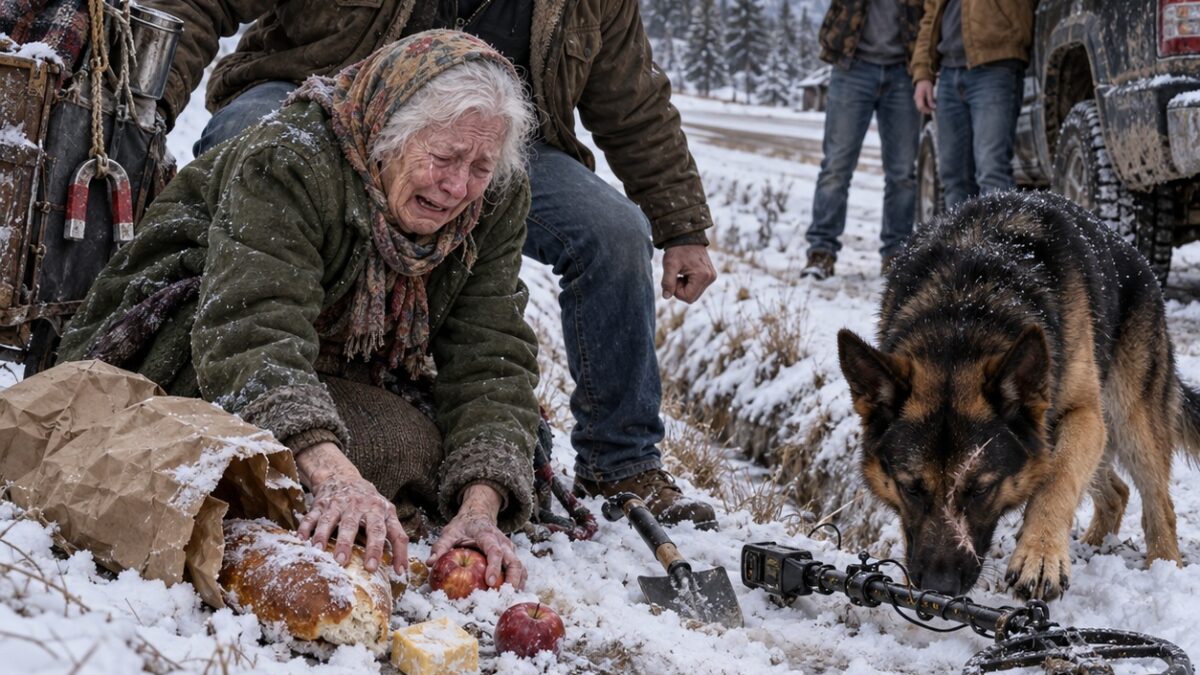
I had no immediate answer.
That bothered me.
For most of my adult life, I’d been trained to respond to problems quickly. Identify the threat. Establish priorities. Make decisions. Act.
But nothing in my training prepared me for the sight of a seventy-nine-year-old mother kneeling in dirty snow with half a loaf of ruined bread in one hand and her missing son’s military identification tag in the other.
Thirty years.
I looked toward the mountains.
Black Spruce Cut rose beyond the pines, its upper slopes disappearing into the gray winter sky.
I’d driven past that ridge hundreds of times.
I’d admired the scenery.
Complained about the weather.
Watched deer crossing the highway beneath it.
Never once had I looked at those mountains and imagined a mother searching them for three decades.
Agnes carefully returned the tag to her wallet.
Then she reached for the cheese.
“Let me help you.”
“I can manage.”
“I know.”
I picked up one apple and brushed away the snow.
She watched me warily.
“You’re not going to throw my food away?”
“Not without asking.”
Something in her expression softened.
I found the second apple beneath the bush.
The bread was wet and contaminated with road grit. The cheese wrapper had torn.
I didn’t pretend the food was still safe to eat.
I also didn’t embarrass her by explaining something she already knew.
Instead, I placed the salvageable items beside her bag.
“Where do you live?”
“Four miles outside town.”
“You walked here?”
“I usually do.”
I glanced at her boots.
The leather was cracked near the toes.
One sole had been repaired with adhesive that was beginning to separate.
“Would you let me drive you home?”
She looked at my pickup.
Then at Kota.
“Does your dog bite?”
“Only people with terrible manners.”
Her pale eyes narrowed.
“Then half this town ought to be nervous.”
Despite everything, I laughed.
It came out unexpectedly.
A short, rusty sound.
Agnes looked almost pleased with herself.
Then she bent toward the metal detector.
I picked it up before she could strain herself.
She immediately stiffened.
“Careful with that.”
“I’ve got it.”
“It’s older than you think.”
“Most things are.”
She gave me a look.
“Are you always this charming?”
“Only when I’m being supervised.”
Kota wagged his tail.
Agnes stared at him.
“At least one of you has manners.”
I loaded her cart and metal detector into the truck bed.
Then helped her climb into the passenger seat.
She allowed that much assistance, although she made it clear she didn’t particularly enjoy it.
Kota settled behind us.
As I started the engine, Agnes pressed her old canvas bag between her knees.
I noticed she kept one hand over the pocket containing the photograph.
Like someone protecting something breakable.
I knew that gesture.
I’d seen men carry photographs of their families into combat.
I’d seen wounded soldiers refuse to release letters from home.
But Agnes had been carrying hers for thirty years.
I couldn’t begin to understand what that meant.
The drive to her home took fifteen minutes.
We followed Old Quarry Road toward town, then turned onto a narrow gravel lane where the snowplow had cleared only the first half.
Her mobile home stood near a small stand of cottonwoods.
The siding was faded cream.
The wooden steps leaned slightly.
Clear plastic covered a crack in one window.
A narrow chimney released a weak trail of smoke.
I parked beside the steps.
Agnes looked at me.
“You can leave the detector by the door.”
I turned off the engine.
“How about I carry it inside?”
She sighed.
“You’re one of those men.”
“What kind?”
“The kind who asks questions when he’s already decided the answer.”
I glanced at Kota.
“She’s figured me out.”
The dog lifted one ear.
Agnes almost smiled.
Inside, her home was small but immaculate.
The floor had been swept.
Dishes were neatly stacked.
Three jars of dried beans stood above the sink.
A blue kettle sat on the stove.
The furniture was old, but everything had been cared for.
The room smelled faintly of coffee, soap, and wood smoke.
It was cold, though not as cold as I’d feared.
Agnes removed her coat.
Without it, she looked even smaller.
Her brown sweater hung loosely from narrow shoulders.
She kept the rust-red scarf around her neck.
“Coffee?”
I glanced at the clock.
“It’s almost six.”
“That wasn’t the question.”
I nodded.
“Coffee sounds good.”
She placed the kettle on the stove.
Kota settled near the kitchen table.
Then I noticed the walls.
Maps.
Dozens of them.
Some were county highway maps.
Others showed old mining roads, forestry boundaries, mountain elevations, and parcels of land.
Red-pencil circles covered several areas.
Handwritten dates appeared in the margins.
Newspaper clippings had been carefully taped beside them.
There were weather records.
Names.
Phone numbers.
Small index cards.
Letters.
Photocopies of official documents.
I stepped closer.
This wasn’t the collection of someone searching randomly.
It was an investigation.
A thirty-year investigation.
Agnes approached with two mugs.
“You look surprised.”
“I thought you were walking around with a metal detector hoping to get lucky.”
“Most people do.”
I studied a topographic map dated February 1996.
“You’re not.”
“No.”
Several circles marked the eastern slope of Black Spruce Cut.
A smaller cluster of handwritten notes appeared west of the ridge.
I pointed.
“What’s the difference between these areas?”
Agnes set down her mug.
“The east side is where they searched.”
“And the west?”
Her face changed.
“Where I think they should have.”
I looked at her.
“Tell me about your son.”
She stood quietly for several seconds.
Then walked toward a narrow shelf lined with photographs.
She picked up one frame.
The same young man I’d seen in her wallet stood beside a truck.
He wore a crooked smile.
Light brown hair.
Pale blue eyes.
Strong shoulders without the bulk of a much older man.
“My Micah,” she whispered.
She handed me the photograph.
“Micah Bell.”
I nodded.
“He was twenty-one.”
Agnes sat down.
And began telling me the story that had kept her standing beside Old Quarry Road for thirty winters.
Micah had been the kind of boy who couldn’t walk past something broken without trying to repair it.
A neighbor’s fence.
A leaking faucet.
An old truck that wouldn’t start.
If someone needed help, he volunteered before anyone asked.
“He drove me crazy,” Agnes said.
There was warmth in her voice now.
“When he was twelve, he brought home a half-frozen raccoon.”
I looked at her.
“A raccoon?”
“He told me it was injured.”
“Was it?”
“It bit him.”
I nearly laughed.
Agnes’s mouth twitched.
“I told him that was what came from rescuing animals with teeth.”
“What did he say?”
“That I was supposed to be proud of his compassion.”
“And were you?”
She looked at the photograph.
“Always.”
Micah had joined the Montana Army National Guard.
He’d recently completed a training period and returned home on leave.
He was excited about his future.
He talked about saving money.
Finding steady work.
Helping Agnes repair the roof.
He wanted to take additional training.
He wanted to buy a better truck.
He wanted the kind of ordinary future most young men assume they’ll have.
Then came a winter night in February 1996.
Micah went out with three other young men.
Warren Harrow.
Caleb Dorne.
Evan Pike.
Warren was twenty-five then, the son of a powerful local businessman.
Caleb was twenty-three, quieter, the son of a mechanic.
Evan was nineteen.
Restless.
Impulsive.
Young enough to believe danger was something that happened to other people.
A winter storm was approaching.
According to the official account, the four men had been traveling near the eastern side of Black Spruce Cut when something went wrong.
An avalanche followed.
Search teams went out before dawn.
Three young men were initially reported to have survived the incident or returned from the immediate danger, while Micah remained missing.
Agnes had later discovered that parts of those early reports were confused and incomplete.
She spoke carefully about that distinction.
“People kept repeating whatever was written first,” she said. “Even when later information didn’t fit.”
I listened.
The search continued for six days.
Rescue teams battled severe weather.
Snowfall made visibility terrible.
Helicopters struggled to operate.
Volunteers worked long shifts in dangerous conditions.
Micah wasn’t found.
Eventually, officials suspended the active search.
Agnes was told the mountain had taken him.
She looked toward the window.
“I remember everybody coming to the house.”
I waited.
“People brought food. They sat with me. They cried.”
Her fingers tightened around her mug.
“Some of those search volunteers nearly froze trying to find him.”
She looked directly at me.
“I’ve never forgotten that.”
I nodded.
“I believe you.”
“But after a while, people stopped coming.”
Her voice grew quieter.
“First the casseroles stopped. Then the calls. Then the questions.”
She stared at the wall.
“Everyone else had a life to return to.”
I felt a familiar ache behind my ribs.
“And you didn’t.”
Agnes shook her head.
“Not the same life.”
She stood and walked to an old filing cabinet.
From the bottom drawer, she removed a thick folder.
Inside were search reports, weather records, correspondence with public agencies, and letters to private search organizations.
Some had replied kindly.
Some had offered condolences.
Others required funding she couldn’t afford.
She’d sold her second car.
Then jewelry.
Then pieces of furniture.
All to continue looking.
I turned a page.
“How much have you spent?”
She gave a tired smile.
“Enough to learn that hope charges by the hour.”
I looked at the photographs.
The maps.
The dates.
The careful notes.
For years, people had called her crazy because she refused to stop searching.
But standing in that little kitchen, I saw no evidence that she had lost her mind.
I saw a mother who had refused to let a file become the final word about her son.
I returned to the map.
“Why do you believe the western location matters?”
Agnes hesitated.
Then she pointed toward the handwritten notes.
“An old snowplow driver told me something years after Micah disappeared.”
“What?”
“He saw a Harrow company truck traveling west of Black Spruce Cut the night of the storm.”
I looked at the official search circles.
All east.
“Did he report it?”
“He said he did.”
“Was it in the search file?”
“Not in anything they gave me.”
I studied the map.
“Who was the driver?”
“Walter Mercer.”
I looked up.
“Walt?”
“You know him?”
“By reputation.”
He’d spent decades working county roads.
Most people in town knew his name.
Agnes nodded.
“He told me the truck was on the old Black Spruce Service Road.”
I traced the area with one finger.
The road wasn’t on the modern map.
“Where did it go?”
“Through land owned by the Harrow family.”
I turned toward her.
My mind was already moving.
Location.
Timeline.
Witness.
Contradiction.
I had spent years building plans from incomplete information.
A familiar sense of purpose began pushing through the quiet life I’d constructed for myself.
“I’ll help you.”
Agnes watched me.
“No.”
I frowned.
“What?”
“No.”
“You’ve been doing this alone for thirty years.”
“That doesn’t mean every man with broad shoulders gets to arrive and take command.”
“I’m not taking command.”
“You sound disappointed.”
I looked at her.
She looked back.
Kota opened one eye beneath the table.
I sighed.
“All right. What are the rules?”
Agnes lifted one finger.
“You do not turn my son into a military mission.”
A second finger.
“You do not trespass.”
A third.
“You do not threaten anybody just because they’re irritating.”
I looked at her.
“That’s very restrictive.”
“I’m old. I enjoy making rules for younger people.”
I almost smiled.
Then I nodded.
“Agreed.”
She studied me.
“You mean it?”
“Yes.”
She looked toward Kota.
“Does he follow rules?”
“Better than I do.”
Kota lifted his head.
Agnes scratched behind his ears.
“Then perhaps there’s hope for both of you.”
The next morning, I brought Agnes groceries.
Bread.
Apples.
Eggs.
Milk.
Vegetables.
Soup.
Coffee.
And enough other food to make her stare at the bags in disbelief.
She stood in the doorway with her arms folded.
“What is all this?”
“Groceries.”
“I can see that.”
“Then we’re off to a good start.”
She gave me a severe look.
“I didn’t ask you to buy food.”
“I know.”
“I can pay you back.”
“I’m not asking.”
“That is precisely the problem.”
I set the bags on the kitchen counter.
“Agnes, three young men destroyed your food yesterday.”
“I remember.”
“Then let me replace it.”
She looked down.
For a moment, I thought she’d refuse.
Then she whispered, “I don’t want charity.”
I stood quietly.
I knew that word.
I’d heard it from wounded veterans.
From people who had lost their homes.
From elderly neighbors who would rather live without heat than admit they needed help.
I understood pride.
But pride didn’t put bread on the table.
“This isn’t charity,” I said.
She looked up.
“It’s restitution someone should have made yesterday.”
She stared at me.
Then nodded once.
“All right.”
I began putting groceries away.
Kota inspected the bags.
Agnes watched him.
“He eats better than I do.”
I glanced at the dog.
“He certainly complains more.”
She laughed.
A small laugh.
But real.
That afternoon, I took her metal detector to my cabin.
The battery contacts were corroded.
One cable had split near the search coil.
The handle was worn smooth from years of use.
I cleaned the contacts, repaired the damaged connection, and checked the machine carefully.
Kota stood beside my workbench, watching every movement.
“You smell solder once and think you’re an engineer?”
He sneezed.
I took that as criticism.
When I returned the detector, Agnes held it like an old friend.
“Does it work?”
I switched it on.
Swept the coil over a small piece of metal.
A clear tone sounded.
Agnes smiled.
Then her eyes filled.
“Thank you.”
I nodded.
“Let’s see what we can find.”
Our first searches were disappointing.
Old fence staples.
Bottle caps.
Wire.
Rusted hinges.
A spoon.
Agnes kept the spoon.
I looked at her.
“Do you think Micah dropped that?”
“No.”
“Then why are we keeping it?”
“It’s a good spoon.”
I stopped asking.
We searched only public areas where access was clearly permitted.
I marked our locations carefully.
Kota accompanied us.
I didn’t pretend he could magically locate a dog tag that had been buried for thirty years.
He wasn’t trained to detect metal.
What he could do was notice disturbed ground, unusual objects, changes in terrain, and occasionally scents that caught his attention.
Mostly, he was curious.
Very curious.
And that curiosity sometimes helped.
On the sixth afternoon, we reached a low embankment where the wind had stripped most of the snow away.
Kota walked past it.
Stopped.
Turned.
Sniffed near a patch of frozen grass.
Then moved away.
He returned a second time.
Then a third.
I watched him.
His ears were forward.
His body was relaxed.
But his attention stayed fixed on one small area.
“Show me.”
He lowered his muzzle toward the ground.
I swept the metal detector over the patch.
Nothing.
I adjusted the angle.
A weak tone sounded.
Agnes stopped breathing.
I checked our position.
We were on public land.
Then I carefully removed the shallow layer of frozen soil.
Something dark appeared.
Metal.
Small.
Corroded.
I lifted it enough to identify the shape.
A buckle.
Agnes crouched beside me.
Her fingers trembled.
“Micah had one like that.”
I looked at her.
“Could be.”
She studied it.
“Same type.”
“Same type doesn’t mean it’s his.”
“I know.”
She answered immediately.
That mattered.
Agnes wasn’t inventing certainty.
She knew the difference between hope and evidence.
I checked the location against the map.
Then checked again.
The buckle had been found nearly a mile west of the primary 1996 search zone.
I looked toward the ridge.
Agnes followed my gaze.
For thirty years, she’d searched for a reason someone might finally listen.
We hadn’t found proof.
Not yet.
But we’d found a reason to keep asking questions.
Two mornings later, I went to Bellweather Ridge Public Library.
Kota stayed home.
A large German Shepherd and fragile historical documents were not a combination I wanted to test.
The woman behind the reference desk was Mara Quinn.
Sixty-seven.
Short.
Round-faced.
Silver-brown hair cut neatly below her ears.
Reading glasses hanging from a chain.
She had retired as county librarian three years earlier but still volunteered several mornings each week.
According to the staff, retirement had failed to convince Mara that anyone else could organize the archives properly.
I showed her the map.
She studied it.
“Old road?”
“Maybe.”
“Those are usually the interesting ones.”
She led me downstairs.
The archive room smelled of paper, dust, and radiator heat.
I explained what I needed.
County maps from the mid-1990s.
Black Spruce Cut.
Old Quarry Road.
The western access routes.
Mara found several rolled documents.
A 1995 forestry map came first.
We spread it across a long table.
There it was.
A thin line west of the ridge.
Black Spruce Service Road.
I compared it with a later map.
The road was gone.
Not renamed.
Not rerouted.
Simply absent.
Mara leaned closer.
Her expression changed.
“Do you remember that road?” I asked.
She didn’t answer immediately.
Then she removed her glasses.
“Yes.”
I waited.
She looked toward the archive room door.
Then back at the map.
“That was where the search crews were supposed to start.”
I felt something cold move through me.
“What?”
“The west side.”
I pointed toward Agnes’s copied search report.
“The official search area was east.”
Mara stared at the circles.
“I know.”
“Then why?”
She shook her head.
“I remember equipment being prepared for the western access.”
“When?”
“The first morning.”
She swallowed.
“But the next morning, everyone was sent east.”
I looked down at the vanished road.
Mara continued.
“I never understood why.”
Neither did I.
But I intended to find out.
The following morning, Agnes joined us in the library basement.
Mara had prepared three boxes of newspapers from February 1996.
We sat around a steel table beneath fluorescent lights.
Agnes kept her coat on.
Even though the room was warm.
I noticed that.
She dressed as though she might need to go searching at any moment.
Mara opened the first box.
“February 1996.”
She carefully unfolded a newspaper.
The headline read:
Winter Search Continues Near Black Spruce Cut.
I leaned closer.
One paragraph mentioned search teams concentrating west of Old Quarry Road after a vehicle was reportedly located near Black Spruce Service Road.
Agnes stared at the page.
“I’ve never seen that.”
Mara looked at her.
“Then we need to know why.”
The following day’s newspaper carried another report.
Search operations had shifted east after updated information from survivors.
No detailed explanation.
No names.
No clarification of what had changed.
I felt anger building.
“Who gave the updated information?”
Mara considered it.
“Probably the surviving young men. Or whoever spoke for them.”
I looked at Agnes.
She was already watching me.
“No.”
I frowned.
“I haven’t said anything.”
“You’re thinking loudly.”
“What does that mean?”
“It means you’re already deciding where Warren Harrow lives.”
I folded my arms.
“He was there.”
“That makes him a witness.”
“He knows what happened.”
“Perhaps.”
“Agnes—”
She leaned forward.
“I lost thirty years because people treated assumptions like answers.”
Her eyes were sharp.
“I will not lose another day because you think anger is evidence.”
The words landed harder than I expected.
I stepped back.
She returned her attention to the newspaper.
Mara quietly closed one folder.
“There’s someone else you should talk to.”
I looked up.
“Who?”
“Walter Mercer.”
Agnes turned toward her.
“The snowplow driver?”
Mara nodded.
“He’s still outside town.”
I looked at Agnes.
She looked back.
This time, she didn’t say no.
Walt Mercer lived three miles north of town in a narrow yellow house beside a garage large enough to hold several farm vehicles.
He was eighty-three.
Tall once, though bent now.
White hair.
Thick white mustache.
Sharp brown eyes.
He wore faded overalls beneath an old work jacket.
When we arrived, he studied me.
“You’re the SEAL.”
“Former.”
He nodded.
“Nobody says former when they want help moving furniture.”
Agnes rolled her eyes.
“Don’t encourage him.”
Walt led us into his garage.
It smelled of engine oil, cold steel, and old wood.
Photographs of snowplows hung above a workbench.
A rusted blade leaned against the wall.
Walt stood beneath the photographs.
“I remember that night.”
His voice changed.
“Storm was coming hard. We were trying to keep the county roads open.”
I took out my notebook.
“What did you see?”
“A Harrow company truck.”
“Where?”
“Black Spruce Service Road.”
“The western road?”
“That’s the one.”
“What time?”
“Eight-thirty. Maybe nine.”
“Are you certain?”
Walt gave me an offended look.
“I plowed roads for thirty-six years. I knew company trucks the way bartenders know regular drunks.”
Agnes almost smiled.
Walt continued.
“Dark green truck. White Harrow logo.”
“Could you identify the driver?”
“No.”
“Passengers?”
“Not clearly.”
I nodded.
“What happened next?”
Walt looked toward the window.
“About an hour later, I heard a blast.”
Agnes went still.
“What kind of blast?”
“Deep.”
He considered his words.
“Not thunder. Not a truck backfiring.”
He gestured toward the mountains.
“One heavy boom. Then quiet.”
I felt my jaw tighten.
“Mining explosion?”
“Could’ve been.”
“Did you report it?”
“Next morning. To a deputy near the search staging area.”
“Who?”
Walt rubbed his mustache.
“Can’t remember the name.”
He looked frustrated.
“Young fellow. Brown hair. Sheriff’s office.”
“What did he say?”
“That they’d note it.”
Agnes spoke quietly.
“And did they?”
Walt looked at her.
“Not anywhere I’ve ever seen.”
Silence settled through the garage.
Then Walt said something that surprised me.
“I don’t think anybody planned to kill those boys.”
Agnes frowned.
“I didn’t say they did.”
“No. But stories get hungry after thirty years.”
He looked at me.
“Especially when somebody wants a villain with an address.”
I didn’t answer.
Walt continued.
“I think someone wanted attention away from that western road.”
“Why?”
“Don’t know.”
He shrugged.
“Could’ve been business. Could’ve been illegal storage. Could’ve been something completely different.”
He looked directly at Agnes.
“Here’s what I know. The truck went west. The road was closed. I heard a blast afterward.”
He raised one finger.
“Everything beyond that belongs to somebody who knows more than I do.”
I respected him for that.
He hadn’t given us a complete answer.
But he’d given us testimony that matched the old map.
And the old newspaper.
And the location of the buckle.
We were beginning to build something stronger than suspicion.
We returned to the public shoulder bordering old Harrow property two days later.
The sky was clear.
Cold enough that every breath hurt.
A rusted fence ran along the edge of the land.
Snow had drifted around the posts.
Kota moved slowly ahead of us.
Agnes followed with her metal detector.
Near a collapsed section of fence, Kota stopped.
Sniffed.
Moved several yards.
Returned.
I watched.
“Easy.”
He lowered his muzzle near a shallow depression.
I checked the property boundary.
We remained on public land.
Then I swept the detector over the snow.
A tone sounded.
Stronger than before.
Agnes stopped walking.
I removed the surface snow carefully.
Then a shallow layer of frozen soil.
Something dark appeared beneath the crust.
Metal.
I leaned closer.
A corroded military-style belt buckle.
Agnes made a sound I’d never heard from her.
Not a gasp.
Not a cry.
Recognition.
She dropped to one knee.
“Turn it over.”
I looked at her.
“Agnes—”
“Please.”
I carefully turned the buckle.
Two shallow scratches crossed the underside.
Parallel.
Uneven.
Agnes covered her mouth.
“Micah did that.”
I stared at the marks.
“You remember these scratches?”
She nodded.
Her eyes filled.
“He tried to fix the clasp with my kitchen knife.”
Her voice shook.
“I yelled at him because he ruined the blade.”
She laughed once.
A broken sound.
“He told me the buckle needed character.”
I looked at the two scratches.
A tiny domestic memory.
A mother scolding her son over a damaged kitchen knife.
Something no official search report would ever contain.
Agnes reached toward the buckle.
I gently stopped her.
“We need to document it.”
She looked at me.
“This one matters.”
“I know.”
I took out my phone.
Called the sheriff’s office.
And waited.
For once, Agnes didn’t argue.
Deputy Lena Crowe arrived twenty-eight minutes later.
She was forty-three, compact, athletic, with dark brown hair pulled into a low ponytail beneath her winter cap.
She studied the scene without rushing.
Photographed the buckle.
Measured the location.
Marked the position.
Collected the object with proper evidence handling.
Then listened while Agnes explained the scratches.
Lena didn’t dismiss her.
She also didn’t declare the mystery solved.
“One object can be coincidence,” she said.
I pointed toward the earlier discovery.
“And two?”
She studied the map.
“Two objects in the same western corridor are a reason to ask better questions.”
Agnes looked at the evidence bag.
“Enough to search the private property?”
“Not yet.”
I felt my jaw tighten.
Lena noticed.
“Don’t make me explain warrants to a Navy SEAL.”
“Former.”
“That makes it worse.”
Agnes almost smiled.
But her eyes remained fixed on the buckle.
For thirty years, she’d searched for one piece of metal.
Now we’d found something she recognized.
Something that suggested her son had been near the western road.
The problem was that suggestion wasn’t enough.
Not yet.
Sheriff Thomas Reic reviewed the evidence that evening.
He was sixty-one.
Broad-shouldered.
Short silver hair.
Gray mustache.
The kind of man whose expression looked stern even when he was merely thinking.
He studied the maps.
The photographs.
The witness notes.
The recovered objects.
Then leaned back.
“I can’t authorize a major search of private industrial property based on this.”
I stared at him.
“You have contradictory records.”
“I do.”
“A witness.”
“Yes.”
“Two objects nearly a mile west of the official search zone.”
“Correct.”
“One with identifying damage.”
“According to Mrs. Bell.”
Agnes straightened.
“According to me.”
The sheriff looked at her.
Not disrespectfully.
Carefully.
“I believe you remember it, Mrs. Bell.”
I leaned forward.
“Then what’s the problem?”
“The problem is that memory alone doesn’t establish the item’s origin to a legal standard.”
My hands tightened.
He continued.
“I need something I can put before a judge.”
I hated that answer.
Not because it was unreasonable.
Because it was reasonable when I desperately wanted a faster one.
Agnes touched my sleeve.
Just once.
Enough.
I sat back.
Lena watched the exchange.
I suspected she approved.
That irritated me even more.
We left after sunset.
Outside the sheriff’s office, Agnes stopped beside a public notice board.
I followed her gaze.
A county planning announcement had been posted beneath several zoning notices.
Harrow Aggregate and Timber — Western Site Clearing and Grading Authorization.
The permit had been approved months earlier.
The first work window was less than two weeks away.
Agnes read the notice.
Once.
Twice.
Then again.
I watched her face.
I’d expected anger.
Instead, I saw fear.
Not fear that she was wrong.
Fear that she might finally be right.
And still arrive too late.
Agnes called me shortly after seven the next morning.
“I’m going to see Warren Harrow.”
No greeting.
No explanation.
I sat at my kitchen table with coffee in one hand.
Kota lay beneath the window.
“You talked to Lena?”
“Yes.”
“She advised against a confrontation?”
“I’m not confronting him.”
“What are you doing?”
“Asking him a question.”
I closed my eyes.
Agnes had a talent for making me feel like the unreasonable person in conversations I’d entered with perfectly reasonable concerns.
“You want me there?”
A pause.
Then:
“Yes.”
That mattered.
She had spent thirty years refusing to let people take charge of her search.
Now she was asking me to come.
“I’ll pick you up.”
Harrow Aggregate and Timber occupied a large property on the northern edge of Bellweather Ridge.
The main office was a low building of stone and glass.
Beyond it stretched equipment yards, trucks, and snow-covered industrial structures.
Workers moved between buildings.
Steam rose from exhaust vents.
Nothing looked sinister.
That bothered me more than a locked gate would have.
Agnes sat beside me in the pickup.
Same moss-green coat.
Same rust-red scarf.
Same battered boots.
Kota watched from the back seat.
“You can still change your mind,” I said.
Agnes looked at the building.
“So can he.”
We went inside.
She gave her name to the receptionist.
“Tell Warren Harrow that Agnes Bell would like ten minutes.”
The receptionist disappeared down a hallway.
Less than a minute later, she returned.
“He’ll see you.”
I noticed that.
Warren hadn’t made Agnes wait.
He stood when we entered.
At fifty-five, he was still broad through the shoulders, with a controlled expression and brown hair heavily threaded with silver.
He wore a charcoal coat over a dark green sweater.
His desk was nearly empty.
Folders aligned.
Pens arranged.
Only one framed photograph sat near the edge.
It was turned slightly away from visitors.
Warren looked at Agnes.
Then at me.
Then Kota.
“You brought company.”
Agnes stepped forward.
“I brought witnesses.”
Warren swallowed.
“Agnes…”
She placed Lena’s photograph of the recovered buckle on his desk.
Two crude scratches showed beneath the corroded metal.
Warren stopped moving.
The color drained from his face.
Agnes watched him.
“My son,” she said quietly.
Warren sat down.
Not gracefully.
As though his knees had simply stopped working.
“Where is he?”
Warren stared at the photograph.
“I don’t know.”
Agnes remained standing.
“That answer has had thirty years.”
He closed his eyes.
“I don’t know exactly.”
The difference mattered.
I heard it.
So did she.
Agnes pulled out the chair opposite him.
Then sat down.
“Start with what you do know.”
Warren stared toward the window.
For several seconds, he seemed unable to speak.
Then he began.
The Harrow family had owned an old extraction site west of Black Spruce Cut.
By 1996, it had been mostly inactive.
But equipment remained there.
So did materials that should have been removed.
Explosive charges.
Detonators.
Old quarry supplies.
Some had been stored improperly.
Micah hadn’t known about them.
Neither had Evan Pike.
Caleb Dorne knew only that Warren sometimes used the service road.
Warren had told the others they were going to retrieve tools before the storm.
Instead, Micah saw the storage area.
Recognized what he was looking at.
And began asking questions.
“Of course he did,” Agnes whispered.
Warren looked at her.
“He wanted to report it.”
I watched his hands.
They were trembling.
“He said somebody could get hurt.”
Agnes sat very still.
“What did you tell him?”
Warren swallowed.
“That he didn’t understand what it would do.”
“To whom?”
“My family.”
The room became silent.
Warren’s father, Graham Harrow, had built the company into one of the region’s largest employers.
He was respected.
Generous.
A man who donated equipment to schools and helped neighbors after storms.
But Warren described another side of him.
A father who treated family reputation as something more important than truth.
If regulators discovered the illegal storage, the company might face serious consequences.
Lost permits.
Lost contracts.
Possibly much worse.
Warren had grown up believing protecting the company was his responsibility.
Even when protecting it meant hiding things that should have been reported.
Agnes looked at him.
“And that mattered more than four young men in a storm?”
“No.”
His answer came immediately.
Then he lowered his head.
“But that night, I acted like it did.”
I felt my jaw tighten.
Kota stood beside my chair.
I didn’t move.
Warren continued.
During the argument, a blast came from farther inside the old work area.
He didn’t know what caused it.
Deteriorating materials.
Improper storage.
Some other failure.
The ground shook.
Snow began moving on the slope.
The first slide wasn’t enormous.
But it was enough to knock Evan Pike down and carry him toward a shallow cut beside the service road.
Caleb ran toward open ground.
Warren followed.
Micah didn’t.
“He went back for Evan,” Warren whispered.
Agnes closed her eyes.
I watched her fingers tighten around the chair.
“Was Evan alive?”
“Yes.”
“Was Micah?”
Warren swallowed.
“Yes.”
Agnes opened her eyes.
Something changed in the room.
My heart began pounding.
Warren’s voice cracked.
“I saw Micah reach him.”
He looked at the desk.
“He got Evan partly out.”
I knew what was coming.
Before he said it.
A second release came from higher on the slope.
Much larger.
Snow.
Broken timber.
Rock.
Loose debris.
Warren and Caleb had already reached the outer road.
Micah was still trying to help Evan.
Then the mountainside disappeared behind a wall of white.
Warren stopped speaking.
Agnes didn’t.
“What did you do?”
“We tried to go back.”
“How?”
“We shouted. Caleb had a shovel.”
“How long?”
“I don’t know.”
His breathing changed.
“We couldn’t see the landmarks. Everything had moved.”
I had seen men remember disasters before.
Memory rarely returned in neat chronological order.
It came in fragments.
A sound.
A smell.
A shouted name.
The last glimpse of someone moving through darkness.
Warren looked like a man who had spent thirty years trapped inside those fragments.
Then he said:
“My father arrived.”
Agnes stiffened.
“How?”
“We made it down far enough to find a phone.”
Graham Harrow reached the area before the full search response was organized.
He saw the illegal storage site.
Saw what investigators might discover if rescue teams entered from the western road.
And made a decision.
Warren looked at Agnes.
“He told us the slope was unstable.”
“Was it?”
“Yes.”
“He said professionals would handle the search.”
I felt the anger rising again.
“And then?”
Warren looked toward me.
“He told us what location to give the authorities.”
I leaned forward.
“Where?”
“The eastern access.”
Agnes whispered, “But that wasn’t where you were.”
Warren shook his head.
“No.”
The word seemed to take every bit of strength he had left.
I stood.
Not quickly.
Not dramatically.
But something in my body changed.
My shoulders squared.
My weight shifted.
My hands tightened.
Kota moved immediately.
He stepped between me and Warren.
Not facing Warren.
Facing me.
His amber eyes lifted.
No growl.
No bark.
Just a silent warning.
I stopped.
For a moment, I could hear nothing except my own breathing.
Then I looked at Agnes.
She hadn’t moved.
This was her son.
Her grief.
Her right to ask what happened.
I had promised not to turn Micah into a mission.
Not to threaten anyone.
Not to let anger replace evidence.
I stepped back.
Kota remained in front of me for another second.
Then moved quietly beside Agnes.
Warren continued.
His father had provided incorrect location information.
One deputy accepted it.
That deputy knew Graham personally and had business connections involving Harrow contracts.
Whether he knowingly helped conceal anything, Warren couldn’t say.
The first reports used the false location.
Later reports copied those reports.
New investigators inherited the same coordinates.
Maps were prepared from those records.
Over time, one wrong location became official history.
No elaborate townwide conspiracy was necessary.
Just one lie.
Repeated until people stopped questioning it.
Agnes sat completely still.
Then she asked the question that hurt most.
“After the first slide, could Micah have gotten out?”
Warren lowered his eyes.
“Yes.”
“He could have run?”
“Yes.”
“But he went back.”
Warren nodded.
“For Evan.”
Agnes’s mouth trembled.
Thirty years.
Thirty years of imagining her son lost and frightened.
Thirty years of wondering whether he’d wandered into dangerous terrain.
Thirty years of searching for a piece of metal because it was the only thing she believed she might still recover.
Now she knew something else.
Her son had seen another young man in danger.
He could have kept running.
Instead, he turned back.
Agnes covered her face.
For a long time, nobody spoke.
Warren opened a drawer.
Inside was an old envelope.
He removed a photograph.
Four young men stood beside a dark green truck.
Micah.
Warren.
Caleb.
Evan Pike.
Evan looked younger than the others.
Thin.
Dark-haired.
Smiling with the reckless confidence of a nineteen-year-old who assumed he had plenty of time.
Agnes stared at him.
“No one ever told me his family was still looking.”
Warren closed his eyes.
“They left the area the next year.”
I thought of Mason Pike.
The reddish-brown curls.
The freckles.
The uncertain expression he’d worn when Dylan threw Agnes’s food into the snow.
Agnes looked up.
“Mason?”
Warren nodded.
“Evan was his great-uncle.”
I stared at the photograph.
Another family.
Another missing young man.
Another silence that had lasted decades.
Agnes touched Micah’s face.
Then Evan’s.
Warren stood slowly.
“What happens now?”
Agnes looked at him.
“You tell the sheriff.”
He nodded.
“Everything?”
“Everything.”
Warren looked toward me.
I said nothing.
Agnes continued.
“And don’t clean this story before you tell it.”
Warren lowered his eyes.
“I won’t.”
He mentioned that old company records might still exist.
Maps.
Equipment logs.
Files from the inactive western site.
Then he remembered something else.
A term his father had used.
A designation for the area where the second slide occurred.
“Slide Zone B.”
I looked toward Agnes.
She was staring at the photograph.
For thirty years, we’d had a mountain.
Now we had a road.
A witness.
A location.
A name.
Slide Zone B.
By Friday, most of Bellweather Ridge knew that Agnes Bell had visited Harrow Aggregate.
By noon, people knew Warren had spoken to the sheriff.
By evening, the story had grown three imaginary arrests, a buried truck, and a confession nobody had actually heard.
Small towns can turn facts into entertainment with frightening speed.
I ignored most of it.
Agnes ignored it better.
But Dylan Harrow couldn’t.
Warren’s son had spent his entire life hearing a carefully polished version of the past.
Agnes was unstable.
She couldn’t accept an accident.
The search had been thorough.
The western road didn’t matter.
Nothing suspicious had happened.
Now those familiar explanations were collapsing.
And the twenty-year-old who had laughed at Agnes while she picked bread from the snow began discovering that his family’s history wasn’t as clean as he’d believed.
He confronted Warren at home.
I wasn’t there.
But Warren later told me enough to understand.
Dylan demanded to know why his father had spoken.
Why he’d admitted the old search location was wrong.
Why people were suddenly looking at the Harrow name differently.
Warren didn’t defend himself.
He told Dylan what he’d told Agnes.
When Dylan protested that Agnes had spent years blaming their family, Warren said something his son hadn’t expected.
“She had reason to.”
Dylan stopped arguing.
Not because he understood everything.
Because for the first time, he realized his father had been living with a truth Dylan had never been allowed to hear.
Mason Pike learned about Evan from his grandmother.
Her name was Helen.
She was seventy-four, with short white-blonde hair and faded green eyes.
Mason visited after his mother told him to ask about the reopened case.
Helen brought out a narrow cardboard box tied with string.
Inside were photographs.
Old letters.
Funeral cards.
A newspaper clipping.
And a photograph of four young men beside a dark green truck.
Mason recognized Micah.
Then looked at the young man standing beside him.
“Who’s that?”
Helen touched the photograph.
“Evan.”
“Who was he?”
“My brother.”
Mason stared.
“You never told me you had a brother.”
Helen looked away.
“After he disappeared, our family stopped speaking about him.”
“Why?”
“Because it hurt.”
Mason studied the photograph.
Then asked who had continued searching.
Helen answered without hesitation.
“Agnes Bell.”
That was when the truth of his own behavior finally reached him.
He remembered the snowballs.
The laughter.
The bread falling from Dylan’s hand.
The old woman crouching in the snow while Trevor filmed.
He had spent months mocking someone who was trying to find the man who had gone back to save his own great-uncle.
The realization didn’t make him a different person overnight.
But it made him ashamed.
And for once, shame led him somewhere useful.
Trevor discovered an old video on his phone.
It had been recorded weeks earlier near the gas station.
Agnes appeared in the background.
Bent over her metal detector.
Searching.
Dylan’s voice could be heard clearly.
“Dad says she keeps searching the wrong side anyway.”
Trevor replayed it.
Then again.
At the time, the sentence had meant nothing.
Now it sounded different.
He showed Mason.
Mason watched the clip several times.
He wasn’t looking at Dylan.
He was looking at Agnes.
She stood twenty yards away, searching while three young men laughed.
He finally understood that cruelty doesn’t have to be dramatic to leave damage.
Sometimes it’s a joke repeated often enough that everybody forgets a human being is standing nearby.
The next morning, Mason found Agnes at the grocery store.
She was comparing prices on canned soup.
He stood several feet away.
For almost a minute, he said nothing.
Then Agnes looked up.
“You’re blocking the beans.”
He stepped aside.
“Sorry.”
She reached for a can.
“I mean about before.”
Agnes looked at him.
“The snowballs. The videos. The food.”
“Which part?”
Mason swallowed.
“All of it.”
She studied him.
“Good.”
He looked down.
“I didn’t know about Evan.”
“No.”
“My grandmother told me.”
Agnes’s expression softened slightly.
“I’m sorry,” Mason whispered.
She nodded.
“That’s a beginning.”
He hesitated.
“Are we okay?”
Agnes looked at him.
“An apology doesn’t put bread back on a dinner table.”
His face flushed.
“I know.”
“No,” she said gently. “You’re beginning to.”
She placed another can in her basket.
“But at least it tells me you still have time to grow up.”
Mason looked at her.
Then nodded.
Agnes pointed toward the shelf.
“Now move. You’re still blocking the beans.”
For the first time, he almost smiled.
While the town argued about the past, Deputy Lena Crowe worked on records.
Warren gave written permission for investigators to inspect historical company materials stored in an old family garage.
The sheriff’s office coordinated the documentation.
Nobody broke in.
Nobody stole files.
Nobody secretly searched private property.
They followed the procedures necessary to preserve evidence.
I found the waiting almost unbearable.
Agnes didn’t.
“Slow is better than wrong,” she told me.
The deputies found seven banker boxes.
Old invoices.
Equipment maintenance forms.
Insurance documents.
Payroll records.
Then maps.
One 1996 extraction map clearly showed Black Spruce Service Road.
Farther west, a shaded operational area carried the designation we’d been looking for.
Slide Zone B.
Warren had remembered correctly.
Another folder contained records of explosive materials used in quarry operations.
One entry from the week before Micah disappeared indicated that material remained stored at the inactive western site.
It didn’t prove what caused the slide.
But it established that the storage site existed.
Then Lena found an internal report dated two days after the incident.
The language was careful.
Possible slope disturbance near inactive western work area.
Access restricted.
Further review deferred due to weather.
I read the copy twice.
“They knew something happened west.”
Lena looked at me.
“They documented something happened west.”
“What’s the difference?”
“A courtroom-sized difference.”
Agnes nodded.
I sighed.
I was getting tired of everyone around me being correct.
But I knew they were right.
The sheriff’s office brought in an outside geologist.
Dr. Nolan Reyes had spent more than twenty years studying mountain hazards, unstable snowpack, and slope failures in the northern Rockies.
He was fifty-one.
Lean.
Dark-eyed.
Silver threaded through his hair.
He carried a waterproof notebook and had the irritating habit of refusing to provide certainty simply because someone wanted it.
I showed him the explosive records.
He studied them.
Then looked at me.
“You want me to say an explosion caused the avalanche.”
“I want you to say what happened.”
“Those aren’t necessarily the same request.”
Agnes liked him immediately.
Nolan spent the following day reviewing historic maps, weather reports, snow conditions, and photographs of the western slope.
He examined the old extraction records.
The reported blast.
The location of Slide Zone B.
The physical shape of the terrain.
Then gave his assessment.
The western slope was consistent with a substantial snow release.
Conditions that week had been unstable.
An external disturbance might have contributed.
A blast could have been involved.
Natural loading could also have caused failure.
He couldn’t definitively establish the trigger.
But the western area fit the reported large slide better than the official eastern location.
That mattered.
For the first time, we had more than a grieving mother’s memory.
We had old records.
A witness.
Recovered objects.
A specific industrial site.
And a professional assessment supporting the possibility that the original search location was wrong.
Lena began preparing a request to preserve the site.
There was one problem.
The clearing permit remained active.
Contractors were scheduled to begin work in two days.
Two days.
After thirty years.
Agnes stood outside the sheriff’s office when she heard.
I watched her face.
Expected panic.
Instead, she looked strangely calm.
“Thirty years,” she whispered.
“What?”
“I spent thirty years with nothing anyone would listen to.”
She looked toward the mountains.
“Now we have two days with something they have to.”
Kota sat beside her.
His amber eyes followed the distant ridge.
I looked at Agnes.
For the first time since meeting her, I believed we might reach an answer.
I was also terrified we might arrive too late.
The order came before sunrise.
Sheriff Reic called me personally.
A county judge had approved temporary preservation of the Slide Zone B area while the missing-person evidence was evaluated.
By seven-thirty, closure markers stood along the western access road.
The clearing crews did not enter.
There was no dramatic confrontation.
No bulldozers arriving at the last second.
No angry industrial executive shouting at deputies.
Work simply stopped.
Because after thirty years, a piece of paper finally carried enough authority to make Agnes Bell’s questions matter.
We stood beside the controlled area beneath a clear Montana sky.
Agnes wore her usual coat.
Her usual scarf.
Her old boots.
I noticed she’d dressed exactly as she always did.
I understood why.
She hadn’t come for a ceremony.
She had come for an answer.
Kota sat beside her.
For once, nobody asked him to search.
A professional team had that responsibility now.
Commander Renee Dalton arrived with a regional search-and-rescue unit.
She was forty-eight.
Powerfully built.
Wind-browned face.
Steel-blue eyes.
More than twenty years of mountain rescue experience.
She wore a red insulated jacket and carried a radio high on one shoulder.
Beside her jumped a black Labrador named Tess.
Seven years old.
Compact.
Strong.
Silver beginning around her muzzle.
Tess wore a working harness.
She was trained specifically in human-remains detection.
Kota watched her.
Tess looked back.
For several seconds, both dogs remained still.
Then Tess sneezed.
Kota tilted his head.
Agnes whispered, “Professional introduction.”
I almost smiled.
Renee approached.
“Mrs. Bell.”
Agnes nodded.
Renee removed one glove before shaking her hand.
“I need to explain something.”
Agnes stiffened.
“We may not find anything today.”
“I know.”
“We may find objects before we find people.”
“I know.”
“And if we find remains, this becomes a controlled recovery.”
Agnes stared at her.
Then nodded.
“I understand.”
Renee looked at me.
I nodded, too.
This wasn’t my operation.
It wasn’t Agnes’s personal search anymore.
It belonged to people trained to work safely and preserve whatever they found.
All we could do was wait.
The search began slowly.
Teams moved through sections of old debris.
Maps were checked.
Locations marked.
Snow conditions assessed.
The ground had changed over thirty years.
Trees had grown.
Others had fallen.
Snow and weather had shifted material.
The landscape didn’t preserve the past neatly.
It buried it.
Moved it.
Covered it with new seasons.
We waited near the staging area.
Agnes sat on a folding chair.
Kota lay beside her.
I stood until she finally looked up.
“You’re making me nervous.”
I sat.
“Better?”
“No.”
I almost smiled.
Hours passed.
Then a call came over the radio.
A team had located an object within old debris.
The recovery proceeded carefully.
A backpack emerged.
Collapsed nearly flat.
Its fabric faded by years underground.
One outer buckle was missing.
I looked toward Agnes.
Her hands tightened around her cane.
The backpack was taken to an evidence station.
Inside, a stitched label still showed two letters.
M.B.
Agnes sat down.
Not because anyone instructed her.
Her legs seemed to make the decision before she did.
I crouched beside her.
“Agnes…”
She lifted one hand.
“I know what it might mean.”
I nodded.
“Then let me know what it does mean.”
I stayed quiet.
The search team carefully examined the contents.
Small military-related items.
An old utility tool.
A narrow notebook damaged by moisture.
And a photograph preserved inside a plastic sleeve.
Renee brought the photograph over.
Agnes stared.
It showed her thirty years younger.
Her hair dark.
Her face fuller.
She stood in front of the same mobile home.
Holding a pie.
One corner was missing.
Agnes made a small sound.
“I burned that.”
I looked at her.
“The pie?”
“The crust.”
A laugh escaped her.
Then broke into a sob.
“I told him not to take that picture.”
She touched the plastic sleeve.
“He said someday I’d be glad he did.”
I looked away.
I had been prepared for evidence.
Maps.
Metal.
Documents.
I hadn’t prepared myself for a photograph of a mother holding a badly baked pie.
Because suddenly Micah wasn’t a missing-person case.
He was a son who teased his mother in her kitchen.
A young man who carried a photograph because he loved her.
A boy who expected to come home.
There was also a letter.
Unsent.
The paper had been damaged by moisture, but portions remained legible after careful handling.
Renee asked Agnes whether she wanted to read it.
She nodded.
The letter wasn’t profound.
That made it unbearable.
Micah complained about training food.
Mentioned a sergeant who snored loudly.
Asked whether Agnes was still pretending the roof didn’t leak above the back bedroom.
Then came a sentence about saving money for shingles.
He intended to repair her roof after his next training cycle.
No arguing.
Agnes stopped reading.
Her hand trembled.
For thirty years, she’d imagined her son’s final thoughts.
Fear.
Regret.
A prayer.
Perhaps her name.
But this letter showed something different.
Micah hadn’t believed he was about to die.
He expected spring.
A paycheck.
Another visit home.
He expected to climb onto his mother’s roof and repair something ordinary.
Agnes pressed the letter against her chest.
“He thought he had time.”
I looked toward the mountains.
I knew that feeling too well.
Kota rose.
Approached her slowly.
Waited.
Agnes lowered one hand.
Only then did he press his head beneath it.
She held onto him.
No one spoke.
Some moments don’t need explanations.
They need witnesses.
The search resumed.
By late afternoon, Tess began working a separate section below the main debris shelf.
Her handler kept her on a long line.
The Labrador moved methodically.
Crossed one narrow area.
Returned.
Crossed it again.
Then her behavior changed.
Renee stopped.
So did the team.
I watched from a distance.
I didn’t know Tess’s exact indication signal.
But I knew enough to understand that something important had happened.
Agnes looked at me.
I didn’t lie.
“This may be something.”
The controlled area expanded.
More personnel moved in.
Then Renee approached.
Her face was composed.
That frightened me more than alarm would have.
She removed her cap.
Held it in both hands.
“Mrs. Bell.”
Agnes stood.
Renee spoke carefully.
“We found an area that requires recovery.”
Nothing more.
No description.
No speculation.
Agnes nodded once.
The recovery continued out of public view.
Identification didn’t happen that afternoon.
Or the next.
There were records to compare.
Personal effects.
Forensic work.
Old dental information.
Procedures that couldn’t be rushed simply because a mother had already waited thirty years.
I drove Agnes home each evening.
She barely spoke.
Kota slept with his head against the back of her seat.
I didn’t ask her how she felt.
I already knew there were no words large enough.
Four days later, Lena came to Agnes’s mobile home.
I was already there.
Kota lay near the kitchen table.
Agnes stood beside the counter.
Lena didn’t sit immediately.
Something in my chest tightened.
Agnes noticed, too.
“Tell me.”
Lena took a breath.
“Two individuals were recovered.”
Agnes gripped the chair.
“One has been identified as Evan Pike.”
Her eyes closed briefly.
Then she whispered, “And the other?”
Lena looked directly at her.
“Micah Bell.”
The room became completely still.
Thirty years ended without thunder.
Without music.
Without a miracle that changed what had happened.
Just a name.
Spoken correctly.
In a small kitchen.
Agnes didn’t fall.
Didn’t scream.
Didn’t demand to see everything immediately.
She stood there holding the back of a chair.
Then slowly sat down.
I remained beside her.
Kota raised his head.
Agnes stared toward the window.
“Micah.”
She said it once.
Quietly.
As though she were calling him in from the yard.
My throat tightened.
I’d seen grief before.
I’d carried it myself.
But this was different.
For thirty years, Agnes had been waiting for someone to tell her what happened.
Now she finally knew where her son had been.
And no answer could give her back the life they’d lost.
The personal effects were released later, after documentation.
Among them was a corroded ball chain.
Attached to it was a military identification tag.
The second one.
Agnes held it between both hands.
I had imagined this moment ever since she showed me the first tag in the snow.
I expected relief.
Maybe collapse.
Maybe tears.
Instead, she looked almost confused.
She turned it once.
Then again.
“So small.”
I understood.
Thirty years had made the missing object enormous.
A symbol of everything unanswered.
Everything unfinished.
Now it was simply a small piece of metal.
She closed her fingers around it.
“I thought this was what I needed.”
I waited.
“It wasn’t.”
She looked toward the mountains.
“I needed to know he wasn’t wandering out there because he’d done something foolish.”
Her voice trembled.
I sat beside her.
“He went back.”
Agnes nodded.
“For Evan.”
I looked at the two tags in her hands.
“Yes.”
She began crying.
Quietly.
Not the tears of someone discovering loss for the first time.
Those had happened decades earlier.
These belonged to certainty.
“My boy wasn’t lost,” she whispered.
I swallowed.
“No.”
She pressed the tag into her palm.
“We were looking in the wrong place.”
The recovery reopened serious questions.
Investigators reviewed the inaccurate location information from 1996.
The western work-site records.
Improper explosive storage.
The roles of people who provided or accepted the original coordinates.
Some witnesses had died.
Some documents were missing.
Legal responsibility after three decades was complicated.
Warren continued cooperating.
Agnes didn’t ask me every day whether someone would be arrested.
She didn’t appear interested in a public spectacle.
One afternoon, Lena explained that the investigation could take months.
It might never produce the dramatic courtroom outcome people imagined.
Agnes listened.
Then placed the two recovered tags beside each other.
“I don’t need a performance.”
Lena waited.
“I want the record corrected.”
She pointed toward the map.
“The right road.”
Then the recovery location.
“The right place.”
Then Micah’s photograph.
“The right names.”
She looked at Lena.
“That’s what matters.”
I knew it wasn’t everything.
Nothing could give Agnes the years she’d lost.
Nothing could reverse what happened on that mountain.
But I understood what she meant.
For thirty years, an incorrect version of events had been treated as settled history.
Her son had been reduced to a young man who disappeared in bad weather.
Now there was evidence of where he had been.
What had happened.
And what he’d done for someone else.
Agnes wanted the truth to stop being hidden beneath paperwork.
She wanted her son remembered correctly.
Spring arrived slowly in Bellweather Ridge.
Snow retreated from the south-facing roofs.
Then the edges of Main Street.
Then the lower sections of Old Quarry Road.
By late April, brown grass appeared beside the shoulders.
Meltwater ran beneath the remaining ice.
One morning, I drove toward town with Kota beside me.
Near the familiar bend, he lifted his head.
I followed his gaze.
Agnes stood beside the road.
I slowed automatically.
For thirty years, people had associated that place with the same image.
An elderly woman bent toward the ground.
Searching.
A metal detector moving from side to side.
A magnet dragging through snow.
A canvas bag filled with scraps.
But that morning, something was missing.
No detector.
No shovel.
No cart.
Agnes simply stood beneath the pale spring sun with both hands resting on her cane.
I pulled over.
Kota jumped down first.
He trotted toward her.
She smiled.
“Good morning, handsome.”
He pressed against her leg.
I approached.
“You’re early.”
She looked at the road.
“So are you.”
I followed her gaze.
The snow had nearly melted from the ditch where Dylan had thrown her food.
For a moment, neither of us spoke.
Then Agnes said, “I used to come here because I thought every morning might be the day.”
I nodded.
“Sometimes I’d find a nail.”
She smiled faintly.
“Sometimes a bottle cap.”
I looked toward the mountains.
“And sometimes nothing.”
“Most days, nothing.”
She turned toward me.
“But I kept coming.”
I didn’t answer.
She looked at Kota.
“Your dog was the first one who didn’t act as though I was foolish for looking.”
I swallowed.
“He likes investigating things.”
“I noticed.”
Her smile softened.
Then she took a slow breath.
“I don’t have to look anymore.”
The words hung between us.
Thirty years.
Thousands of mornings.
Snow.
Rain.
Wind.
Hope.
Disappointment.
A mother’s stubborn refusal to stop asking.
Now she could stand beside the road without bending toward the earth.
Not because she’d forgotten Micah.
Because she finally knew where he was.
I offered my arm.
“Want a ride?”
She looked down the road.
“No.”
I nodded.
Then she added, “I’d like to walk.”
I smiled.
“Then we’ll walk.”
Kota moved ahead.
We followed slowly.
For the first time since I’d known her, Agnes walked along Old Quarry Road without searching.
The town changed in ways I hadn’t expected.
Not all at once.
Not perfectly.
But enough to notice.
People who once joked about Agnes began speaking to her with care.
Some apologized.
Others quietly stopped using the nickname they’d repeated for years.
The old label disappeared from conversations.
At least when I was around.
I hoped it disappeared everywhere.
But I knew better than to assume a town could become kind simply because it had been embarrassed.
Mason began helping Agnes with small repairs around her mobile home.
He never announced it.
He came on Saturdays.
Fixed a loose step.
Carried groceries.
Repaired the fence.
Agnes made him coffee.
Sometimes she complained about his work.
He listened.
I liked that.
An apology was important.
But showing up after the apology mattered more.
Trevor stopped posting videos of people who hadn’t agreed to become entertainment.
He volunteered during a community cleanup near Old Quarry Road.
Agnes didn’t praise him publicly.
She didn’t need to.
Dylan was slower.
Pride came naturally to him.
Humility did not.
But eventually he approached Agnes without his friends.
Without a phone.
Without anyone watching.
He apologized.
She listened.
Then asked whether he understood why what he’d done was cruel.
He tried to answer quickly.
She made him slow down.
By the time he finished, his face was red.
But he’d finally spoken to her like a person.
Not a joke.
Not a nickname.
A person.
The memorial was built near a safe public-access trail overlooking the western ridge.
Two markers stood side by side.
Micah Bell.
Evan Pike.
They were simple.
Stone.
Names.
Dates.
No enormous monument.
No theatrical display.
Just a place where families could come without being turned away by private property signs or dangerous terrain.
Helen Pike attended the small dedication.
She stood beside Agnes.
For a long time, neither woman spoke.
Then Helen reached for her hand.
Agnes took it.
Two families.
Two missing young men.
Two histories that had been separated by silence.
Now joined by the truth.
Mason stood behind his grandmother.
Trevor nearby.
Dylan farther back.
Warren attended but remained apart from the others.
I watched him.
He looked older than he had when I first met him.
Not because time had suddenly changed his face.
Because the effort of hiding the past was gone.
He no longer had the protection of silence.
I wasn’t sure what that would mean for him.
Agnes didn’t ask me to decide.
During the dedication, the official summary was read carefully.
The search had been directed toward an incorrect location.
The recovered evidence supported the western slide area.
Micah had returned to assist Evan during the avalanche.
The county’s records would reflect the corrected recovery location and updated account.
Agnes stood with both hands on her cane.
She didn’t smile.
But when Micah’s name was spoken, she lifted her head.
And for the first time, nobody in Bellweather Ridge had reason to call her crazy for asking where her son had gone.
Several weeks later, Agnes visited the memorial alone.
At least, she thought she was alone.
When she reached the clearing, Warren was standing beyond the markers.
He wore the same charcoal coat despite the warmer weather.
His head was lowered.
Agnes stopped.
Thirty years of anger stood between them.
She could have told him to leave.
Could have reminded him of everything he’d taken from her.
Could have demanded another apology.
Instead, she remained where she was.
Warren eventually looked up.
Their eyes met.
He didn’t approach.
Didn’t apologize again.
Perhaps he understood that repeating an apology can become selfish when the person being hurt is forced to receive it over and over.
Agnes gave him no smile.
No nod.
No forgiveness.
But she didn’t ask him to leave.
After several minutes, Warren turned and walked back toward the opposite trail.
Agnes waited until he was gone.
Then approached Micah’s marker.
She placed one hand against his name.
“That’s all I had today,” she whispered.
The wind moved gently through the pines.
Nothing answered.
Nothing needed to.
I learned about that visit later.
Agnes told me while we sat at her kitchen table drinking coffee.
She spoke without bitterness.
I found that difficult to understand.
For months, I’d watched evidence unfold.
I’d heard Warren admit what had happened.
I’d seen the consequences of a lie carried through three decades.
Part of me still wanted a clear punishment.
A simple ending.
Someone responsible standing before a judge.
Agnes seemed to understand my frustration.
“You’re still angry.”
I looked at her.
“Yes.”
“At Warren?”
“Among others.”
She nodded.
“That won’t bring Micah back.”
“I know.”
“Then what do you want?”
I stared at my coffee.
I had no good answer.
Agnes studied me.
“You keep trying to make every loss into something someone can fix.”
The words caught me off guard.
I looked up.
She continued.
“Sometimes you can’t.”
I felt an old memory move through me.
Afghanistan.
A narrow valley.
A failed extraction window.
An interpreter named Fared Ramani.
Twenty-nine years old.
Quiet.
Intelligent.
A man who smiled during moments when nobody else found anything funny.
Fared had worked with my team for months.
He knew the local routes.
The dangerous places.
The villages.
He’d warned us about roads that looked safe and weren’t.
Once, he’d helped drag an injured American to cover before anyone ordered him to.
He was brave.
Reliable.
And completely devoted to the people around him.
During my final mission with him, conditions collapsed faster than planned.
The extraction window narrowed.
Orders came to move.
Fared didn’t reach the vehicle.
I wanted to go back.
I was ordered not to.
I obeyed.
For years, I had reduced the entire event to one terrible equation.
Fared hadn’t been rescued.
Therefore, I had failed him.
I had carried that guilt into retirement.
Into my cabin.
Into every quiet morning.
I’d trained Kota because I needed something useful to do.
I’d kept my life orderly because disorder reminded me how quickly control could disappear.
Then Agnes came into my life.
And Micah’s story complicated the certainty I’d built around my own failure.
Micah turned back.
It was courageous.
It cost him his life.
I obeyed an extraction order.
It protected the people I was responsible for.
It also meant leaving someone behind.
Neither outcome alone explained the morality of the choice.
The truth was harder.
Sometimes people made the best decision they could with the information, time, and responsibility they had.
Sometimes the outcome still hurt.
That didn’t mean every painful result proved someone had acted without courage or love.
I looked at Agnes.
“I lost someone, too.”
She didn’t ask immediately.
She waited.
So I told her about Fared.
About the valley.
The extraction.
The order.
The decision I’d replayed for years.
When I finished, she sat quietly.
Then she asked:
“Did you love your men?”
I nodded.
“Yes.”
“Did you want to leave him?”
“No.”
“Did you have a good choice?”
I looked down.
“No.”
Agnes reached across the table.
Her hand was small.
Wrinkled.
Warm.
She placed it over mine.
“Then perhaps you can stop pretending the worst outcome proves you had no heart.”
I couldn’t speak.
For years, I’d blamed myself because guilt felt more useful than helplessness.
But sitting across from a mother who had spent thirty years searching for her son, I began to understand that grief didn’t always need another prisoner.
Sometimes it needed someone willing to keep living.
By late May, Agnes could walk Old Quarry Road without winter boots.
The mornings were warmer.
Birdsong returned to the pines.
The snow had disappeared from the lower slopes.
One morning, we walked together toward town.
Kota ranged ahead.
Agnes carried her cane but moved more confidently than she had in winter.
We talked about ordinary things.
The weather.
The library.
Mara Quinn’s ongoing battle with the archive filing system.
The new roof repairs Mason had promised to help with.
Agnes complained that the grocery store had raised the price of coffee.
I told her I’d bring some the next morning.
She accused me of trying to buy her affection with caffeine.
I admitted the strategy had worked on Kota.
She laughed.
Then Kota stopped.
His ears lifted.
His body changed.
I knew that posture.
He jumped into the roadside ditch.
And began digging.
Dirt flew backward between his hind legs.
I stopped.
“Seriously?”
Agnes froze.
For one terrible second, I felt everything return.
The metal detector.
The buckle.
The old maps.
The hidden road.
Thirty years of secrets beneath the ground.
“Kota.”
He ignored me.
Dug harder.
Agnes gripped her cane.
I stepped closer.
“Kota, leave it.”
Then he emerged.
A filthy green tennis ball filled his mouth.
I stared.
Agnes stared.
Kota wagged his tail.
I folded my arms.
“Thirty years of secrets, and that’s what you find?”
Agnes began laughing.
Not politely.
Not quietly.
She laughed so hard she had to lean against her cane.
I looked at her.
Then at Kota.
The dog stood proudly with the ball in his mouth.
I shook my head.
“You’re unbelievable.”
Agnes wiped her eyes.
“At least this one won’t make us call the sheriff.”
I laughed.
Kota dropped the ball at my boots.
I kicked it down the road.
He raced after it.
Agnes and I continued walking.
Ahead of us, Kota stopped with the tennis ball in his mouth.
He turned.
Looked back.
Waited.
For months, I’d watched him do the same thing.
At first, Agnes had been the little figure left behind beside the road.
Bent over snow.
Searching while everyone drove past.
Now she was walking beside me.
Slowly.
But forward.
Kota waited until we came closer.
Then ran ahead again.
Three shadows stretched across Old Quarry Road beneath the spring sun.
No metal detector.
No shovel.
No unanswered map.
Nobody was searching.
Nobody was being left behind.
I looked at Agnes.
She was smiling.
Not because her son was coming home alive.
Not because thirty years of suffering had somehow disappeared.
But because she finally knew the truth.
Micah hadn’t been careless.
He hadn’t simply wandered into danger.
He’d turned back because another young man needed him.
And his mother no longer had to spend every morning wondering where he had gone.
I looked toward Kota.
He was waiting ahead with his tennis ball.
For all I knew, he didn’t understand dog tags.
Missing-person files.
Quarry maps.
Or the terrible machinery human beings built around guilt and grief.
Maybe he’d never understood any of it.
Maybe he’d only noticed an old woman standing alone beside the road.
And decided she deserved someone’s attention.
I thought back to the afternoon we’d found her food scattered in the snow.
How close I’d come to driving past.
How easily I could have told myself it wasn’t my problem.
I remembered the three young men laughing.
The old woman’s shaking hands.
The photograph.
The single dog tag in her palm.
And the way Kota had refused to look away.
I had spent years believing courage meant running toward danger.
Sometimes it did.
But that winter taught me another kind.
The courage to stop.
To listen.
To believe that someone everybody else has dismissed might still have something important to say.
The courage to follow facts instead of anger.
To admit when we don’t know.
To keep asking questions when the easy answer leaves somebody behind.
And sometimes, the courage to accept that helping another person won’t erase our own pain, but might give that pain somewhere useful to go.
Agnes looked up at me.
“You’re thinking again.”
I smiled.
“Apparently.”
“Anything important?”
I glanced toward Kota.
Then toward the mountains.
“Just wondering how many times I drove past you.”
She considered that.
“Quite a few.”
“I should have stopped sooner.”
She nodded.
“Yes.”
I looked at her.
She gave me a small smile.
“But you stopped.”
The words settled quietly between us.
I offered my arm as we approached an uneven stretch of road.
She took it.
Kota trotted ahead, the muddy ball swinging from his mouth.
The mountains stood bright beneath the morning sun.
For the first time in years, they didn’t look like something I needed to conquer.
They looked like mountains.
Beautiful.
Indifferent.
Full of memories.
And sometimes, full of answers.
Agnes walked beside me.
I could feel the light pressure of her hand on my arm.
Her pace was slow, but steady.
There would still be difficult days.
Anniversaries.
Memories.
Questions without complete answers.
There would be mornings when she missed Micah so much that getting out of bed felt harder than climbing a mountain.
There would be nights when I remembered Fared and wished the past had been different.
Nothing we’d uncovered changed those things.
But neither of us had to face them the same way anymore.
Kota stopped once more and looked back.
I smiled.
“We’re coming, buddy.”
He waited.
And for some reason, that simple act moved me more than I expected.
He’d spent months looking back toward the old woman nobody wanted to notice.
Now she was walking with us.
When we reached the edge of town, Agnes stopped.
I turned toward her.
“You okay?”
She nodded.
Then looked back along Old Quarry Road.
For thirty years, that road had been the place where she searched for something missing.
Now it was simply the road leading home.
She squeezed my arm.
“Come on, Sawyer.”
I smiled.
“Where are we going?”
She looked at Kota.
“Your dog has earned breakfast.”
I laughed.
“He had breakfast.”
“Then he’ll have another.”
“And what about me?”
She raised an eyebrow.
“You can make the coffee.”
I shook my head.
“Some things never change.”
She smiled.
“Thank goodness.”
We continued toward town.
And as the morning sunlight stretched our shadows across the road, I understood that finding Agnes hadn’t given me a new mission.
It had given me something I hadn’t realized I needed.
A reason to stop looking at every loss as a personal failure.
A reason to believe that kindness mattered even when it couldn’t undo what had happened.
And a reason to be grateful for a stubborn German Shepherd who kept looking back until I finally learned to do the same.
That day, we weren’t searching for anything.
We were simply going home.








