FULL STORY: The Woman My Dog Found Beneath the Snow Was Hiding More Than a Dying Puppy
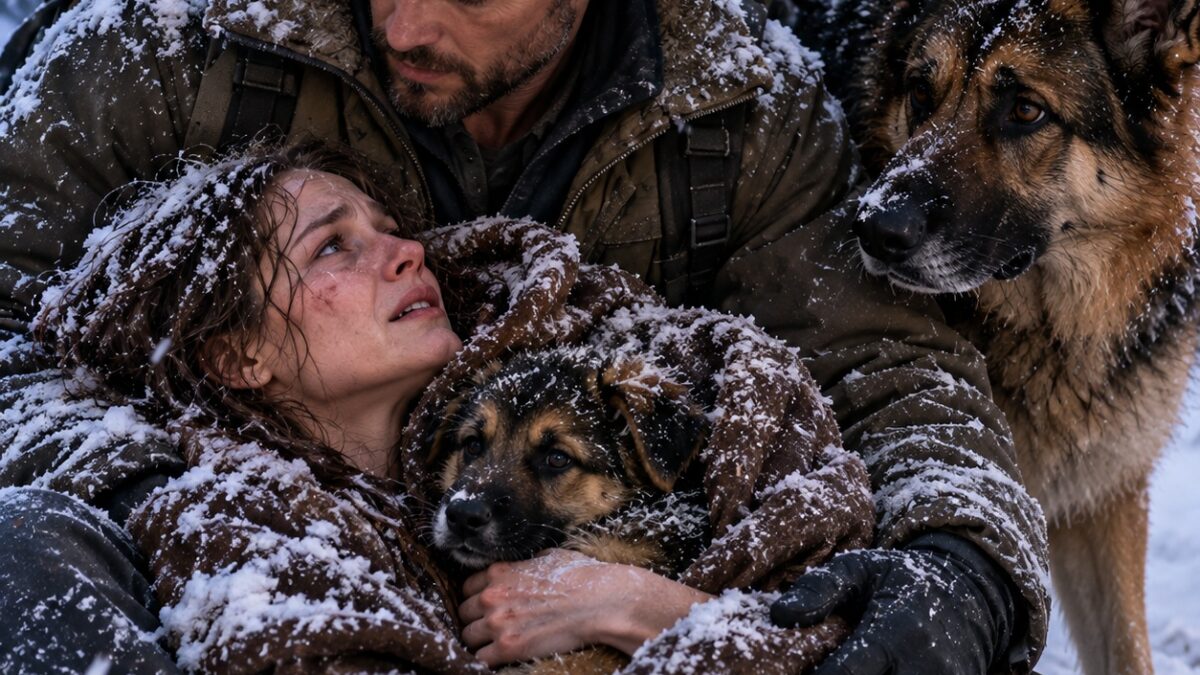
I didn’t know who Derek was.
I didn’t know why a woman who was barely conscious cared more about someone taking her puppy than about the fact that she might die in the snow.
And I didn’t have time to figure it out.
The temperature was dropping. The wind was getting stronger. The woman needed warmth and medical attention, and the little shepherd inside my jacket was shaking hard enough to make me worry he wouldn’t survive either.
I adjusted my hold on her.
“Atlas. Home.”
My dog turned immediately.
He led us uphill through the trees, pausing at every difficult section until I caught up.
The woman drifted in and out of consciousness.
Once, she whispered the puppy’s name.
“Pip.”
“He’s here,” I told her. “I’ve got him.”
Her fingers loosened slightly around my sleeve.
That was the only response I got.
By the time I reached the cabin, my arms were aching and the cold had worked through my gloves.
I kicked snow off my boots, got the door open, and carried her inside.
The stove was burning steadily.
Warm light filled the main room.
For three years, I’d kept that room almost unnaturally neat.
Firewood stacked by size.
Boots lined against the wall.
Dishes washed immediately.
Tools returned to their places.
Elena used to tease me that our house looked less like a home and more like a military inspection was scheduled every morning.
Now I was carrying a half-frozen stranger across the floor while a puppy whimpered inside my jacket.
I didn’t care about the mess.
I laid the woman carefully on the sofa.
Then I brought the puppy out and placed him in a wicker basket lined with dry towels.
He immediately tried to climb out.
“Easy, little guy.”
He ignored me.
Atlas came over and settled beside the basket.
The puppy stopped struggling.
I turned my attention back to the woman.
Elise had already told me what to do while emergency transport was being assessed: get her out of the wind, prevent further heat loss, avoid aggressive direct heating, and monitor her breathing and consciousness.
I covered her with dry blankets, kept her away from the stove, and stayed close enough to notice any change.
Her lips had begun regaining some color when my phone rang.
Elise.
“How is she?”
“Breathing. Pulse improving. Still barely responsive.”
“Emergency response knows your location. I’m coming up to assess her if the road holds.”
“Understood.”
“And Rowan?”
“Yeah?”
“Don’t try to fix this by putting her directly against the stove.”
I glanced toward the fire.
“I wasn’t going to.”
“You were thinking about it.”
I almost smiled.
Elise knew me too well.
She’d been one of the few people who kept checking on me after Elena died, even when I made it clear I wasn’t interested in being checked on.
“I’ll follow your instructions.”
“Good. That’s a refreshing change.”
She hung up.
I looked toward the basket.
Atlas was lying beside it, his black muzzle resting between his front paws.
Pip had managed to push his nose through the towels.
The puppy was watching the woman.
Every time she made a sound, his ears moved.
I crouched beside him.
“She’s still here, buddy.”
He looked at me.
Then at her.
I understood the feeling.
I’d spent years wishing there had been one more hour with Elena.
One more conversation.
One more chance to tell her something before she walked out the door.
This puppy had no idea how close he’d come to losing the only person he trusted.
I reached toward him.
He sniffed my fingers.
Then leaned forward enough to let me scratch the side of his face.
“You’re safe now,” I murmured.
I didn’t realize how much those words affected me until I heard myself say them.
Safe.
It had been a long time since I’d believed anyone in my house was truly safe.
Elise arrived just before evening.
She stepped inside carrying her medical bag, snow clinging to the shoulders of her heavy coat.
At fifty-two, she had the practical, no-nonsense manner of a woman who had spent years dealing with frightened people and stubborn men.
She looked at the sofa.
Then at me.
“Tell me what happened.”
I gave her the facts.
Where I found the woman.
How she’d been positioned.
What her breathing and pulse had been like.
What I’d done since bringing her inside.
Elise examined her carefully while I stayed out of the way.
After several minutes, she looked up.
“She’s improving. The immediate danger appears to be easing, but this was serious.”
“Hospital?”
“We’ve discussed transport with emergency services. We’ll continue monitoring her closely, and she’ll need prompt escalation if anything worsens.”
I nodded.
Elise checked her again, reviewed what needed watching, and made sure I understood the warning signs.
Then she glanced at the basket.
“That’s the puppy?”
“Yeah.”
She crouched.
Pip lifted his head.
“Poor little thing.”
“He’s warming up.”
“He’ll need a veterinary check, too.”
“I’ll arrange it.”
Elise stood.
Then looked around the cabin.
Her expression changed.
“Two new guests.”
“Temporary.”
“Of course.”
I folded my arms.
“Don’t start.”
She smiled.
“I haven’t said anything.”
“You were about to.”
“Rowan, you’re the only man I know who can sound defensive before anyone accuses him of anything.”
I didn’t answer.
She put away her equipment.
“What’s her name?”
“I don’t know.”
Elise looked toward the sofa.
“Then I suppose you’ll have to ask when she’s ready.”
I stared at her.
She smiled again.
“Most people do that when they meet someone.”
After she left, I checked the fire.
The woman was sleeping more peacefully.
Pip was curled in the basket.
Atlas lay beside him.
I stood in the middle of the room and listened.
For years, my cabin had been filled with silence.
Now there was the soft crackling of the stove.
Two dogs breathing.
A stranger sleeping on my sofa.
And the strange, unsettling feeling that the house was no longer empty.
The woman woke an hour later.
At first, she seemed confused.
Her eyes opened slowly.
She stared at the ceiling.
Then at me.
Fear crossed her face so suddenly that she tried to sit upright.
“Easy,” I said. “You’re safe.”
She looked around.
“Where am I?”
“My cabin. Outside Clearwater Ridge.”
Her breathing quickened.
“Where’s Pip?”
I pointed toward the basket.
“Right there.”
The puppy heard his name.
He scrambled upright, caught one oversized paw in a towel, stumbled out of the basket, and ran toward the sofa.
The woman reached for him.
“Pip!”
Her voice broke.
He climbed against her chest and began licking beneath her chin.
She wrapped both arms around him.
For several seconds, she didn’t look at me.
She buried her face in the puppy’s fur and cried.
I turned toward the kitchen.
Some moments deserved privacy.
I filled the kettle.
Behind me, she whispered, “I thought I’d lost you.”
The words were meant for the dog.
But they landed somewhere deep inside me.
I remembered Elena sitting cross-legged on the floor years earlier, laughing while a much younger Atlas tried to climb into her lap.
He had already been too big.
She had never cared.
I gripped the kettle handle.
The memory hurt.
Not because I wanted it gone.
Because for one brief moment, I could almost hear her laugh again.
“Thank you.”
I turned.
The woman was looking at me.
She had dark chestnut hair falling around a pale, exhausted face. Her eyes were a mixture of hazel and green, and there were shadows beneath them that hadn’t come from one cold afternoon.
“My name is Maris,” she said. “Maris Holloway.”
“Rowan Mercer.”
She glanced at Atlas.
“And that’s?”
“Atlas.”
Her eyes softened.
“He’s beautiful.”
“He knows.”
The corner of her mouth moved.
Not quite a smile.
But close.
I brought her warm tea once she was sufficiently alert.
She held the cup in both hands.
“How did you find us?”
“Atlas heard something.”
“He saved us?”
“He led me to you.”
She looked toward him.
Atlas raised his head.
Maris whispered, “Thank you.”
My dog watched her for a moment.
Then settled back down.
I sat opposite her.
“Do you remember what happened?”
She nodded slowly.
“I was trying to get to the bus stop.”
“Which one?”
“The stop outside town.”
“Why were you walking through the woods?”
Her fingers tightened around the cup.
“The bus was canceled. I didn’t know until I got there.”
She swallowed.
“My phone died. I thought there were houses near the lake. I saw a light through the trees.”
“My cabin.”
“Probably.”
She looked down at Pip.
“I kept thinking if I could get somewhere warm, we’d be okay.”
“Where were you going?”
“Helena first. Then Oregon.”
“What’s in Oregon?”
“My sister.”
I waited.
She didn’t offer anything more.
I had learned that forcing frightened people to answer questions rarely produced useful answers.
So I kept my voice even.
“Why didn’t you call the sheriff before your phone died?”
Everything changed.
Her shoulders stiffened.
Her breathing became shallow.
Pip lifted his head and pressed his nose against the inside of her wrist.
Maris looked down immediately.
The puppy held his muzzle there.
She closed her eyes.
I watched quietly.
Atlas lifted his head, too.
Something about the exchange made me uneasy.
Maris wasn’t simply reluctant to speak.
She was afraid.
I leaned back.
“Forget I asked.”
She looked at me.
Surprise crossed her face.
Then relief.
“Thank you,” she whispered.
I stood.
“You need rest.”
She glanced toward the front door.
“I can’t stay.”
“You can tonight.”
“I don’t want to cause problems.”
“You won’t.”
“You don’t know that.”
I looked at her.
“No,” I admitted. “I don’t.”
She seemed surprised by the honesty.
I continued.
“But I know you’re exhausted, and there’s another storm moving in.”
She looked down at Pip.
He had fallen asleep against her.
Finally, she nodded.
“One night.”
“One night,” I agreed.
Neither of us knew how much that agreement was about to change.
I woke at two in the morning.
Something felt wrong.
At first, I couldn’t identify it.
The fire had burned low.
The generator was running.
The cabin was quiet.
Then I realized Atlas wasn’t outside Elena’s bedroom door.
For three years, he had slept in the hallway every night.
Rain.
Snow.
Summer heat.
Christmas.
The anniversary of her death.
It didn’t matter.
He always returned to that door.
I sat up.
“Atlas?”
No answer.
I walked into the hallway.
His usual spot was empty.
My chest tightened.
I followed the faint light from the stove into the main room.
And stopped.
Atlas lay beneath the sofa.
Pip was curled between his front legs.
Above them, Maris slept under the blankets, one hand hanging loosely over the edge.
Atlas opened his amber eyes.
He looked at me.
Then lowered his head beside the puppy.
I stood there longer than I care to admit.
Behind me was the closed bedroom door of the woman I’d lost.
In front of me were two strangers my dog had found in the snow.
For the first time in three years, Atlas hadn’t chosen to guard the past.
He had chosen to stay with the living.
I looked at the puppy sleeping against his chest.
Then at Maris.
And something inside me began to move.
Not healing.
Not yet.
But perhaps the first small crack in the wall I’d built around my grief.
Maris woke before sunrise.
I found her sweeping the floor.
She had folded the blankets, washed her cup, wiped the kitchen table, and stacked the towels I’d used for Pip.
Now she was carefully collecting the melted snow we’d tracked inside.
I leaned against the doorway.
“You’re cleaning.”
She turned sharply.
“Sorry. Did I wake you?”
“No.”
“I didn’t want to leave a mess.”
“You nearly froze to death yesterday.”
“I know.”
“You should be resting.”
She looked down at the broom.
“I can still clean.”
I studied her.
There was something about the way she said it.
Not pride.
Fear.
As though she believed shelter came with conditions she hadn’t been told yet.
I noticed a piece of paper on the table.
A hardware-store receipt.
She had written a list on the back.
Two eggs.
Coffee.
Firewood.
Dog food.
One night of shelter.
I picked it up.
“What’s this?”
She looked embarrassed.
“I’m keeping track.”
“Of what?”
“What I’ve used.”
I stared at her.
“You’re making an invoice?”
“Not exactly.”
“Maris.”
“I ate two eggs.”
“Yes.”
“And drank your coffee.”
“That’s usually what coffee is for.”
“And used your firewood.”
I put the paper down.
“You don’t owe me for breakfast.”
“That doesn’t change how breakfast works.”
For a second, I just looked at her.
Then I felt the corner of my mouth move.
“Planning to pay rent for oxygen?”
“If you have a reasonable rate.”
I laughed.
A real laugh.
It surprised both of us.
Maris looked away.
I understood more than she realized.
She wasn’t trying to be difficult.
She was trying to make sure she didn’t owe anyone anything.
I had met people like that before.
People who had learned that kindness could become a bill someone presented later.
I sat down across from her.
“You don’t have to earn your way through every hour you’re here.”
She didn’t answer.
But her hands stopped shaking.
Outside, the wind had weakened.
Sunlight began creeping over the mountains.
And for the first time since Elena died, I found myself sitting at the kitchen table with another person, drinking coffee without wishing the conversation would end.
By late morning, I was outside clearing snow from the driveway.
Atlas walked ahead of me, testing the packed surface with the confidence of a dog who knew exactly where he was going.
Pip followed him.
The puppy watched every movement Atlas made.
When Atlas stepped carefully across a drift, Pip attempted the same route.
The crust broke beneath him.
He disappeared nose-first into the snow.
For one ridiculous second, only his back legs and tail were visible.
Then his head popped out.
Maris laughed.
The sound caught me so completely off guard that I stopped pushing the shovel.
She lifted Pip from the drift.
He shook himself violently.
Snow sprayed across Atlas’s face.
Atlas closed his eyes.
His expression was so deeply offended that Maris began laughing harder.
I looked away.
But I was smiling.
And Maris saw it.
Her laughter quieted.
For a moment, we looked at each other across the snow.
Then she smiled again.
It wasn’t the careful expression she’d worn the night before.
It was genuine.
Bright.
For one brief moment, she looked like a woman who hadn’t been afraid in a very long time.
I wanted to ask what had happened to her.
But I didn’t.
Whatever story had brought her to my road belonged to her.
She would tell it when she was ready.
I went back to shoveling.
Pip immediately tried to bury himself in another snowbank.
Atlas sighed.
At least, it sounded like a sigh.
And I laughed again.
The sheriff’s SUV arrived shortly before noon.
I recognized the vehicle.
Deputy Clare Weller climbed out wearing her dark brown winter uniform, snow boots, and the serious expression she reserved for situations that needed care rather than force.
Clare was forty-four.
She’d worked the county long enough to know that small towns could be kind, cruel, and spectacularly unwilling to mind their own business.
“Rowan.”
“Clare.”
Her eyes moved toward Maris.
“Maris Holloway?”
Maris went pale.
Pip moved against her leg.
I set down my shovel.
Clare noticed the change immediately.
She kept her hands visible and her voice calm.
“Your husband reported you missing last night.”
Maris stared at her.
“Did he tell you why I left?”
“He reported a domestic dispute. Said you left voluntarily.”
Maris laughed once.
There was no humor in it.
Clare continued.
“He also said you took a dog that belongs to jointly held property.”
Maris’s face changed.
“This dog is mine.”
“Can you prove that?”
“I paid for him.”
“Do you have the paperwork?”
Maris looked toward the road.
“It’s at the house.”
Clare nodded.
“That doesn’t mean I’m taking him.”
Maris looked up.
Clare continued.
“I’m not deciding ownership of a puppy on somebody’s porch. Without a court order requiring surrender, I’m not removing him today.”
The breath Maris released trembled.
“But Derek may raise the issue in the divorce,” Clare added.
At the name, Pip pressed his nose against Maris’s wrist.
She whispered, “You always know before I do.”
I looked down.
The puppy wasn’t reacting to Clare.
He was responding to Maris.
Whatever memories Derek’s name stirred in her, the dog had learned to notice them.
Clare asked Maris whether she was staying voluntarily.
Maris nodded.
“Yes.”
“Do you need help?”
Maris glanced at me.
Then at Pip.
“Not right now.”
Clare gave her information about contacting the department if she felt unsafe.
Then she returned to her vehicle.
Before getting inside, she looked at me.
“Rowan.”
“Yeah?”
“Be careful.”
I said nothing.
She lowered her voice.
“Don’t become part of their divorce.”
“I found her in the snow.”
“I know.”
Her expression softened.
“That’s why I’m telling you.”
She drove away.
I watched the SUV disappear down the lane.
Behind me, Maris was standing perfectly still.
The laughter I’d heard an hour earlier was gone.
And I understood that the real storm had finally reached my cabin.
Inside, Maris stood near the stove without removing her coat.
Pip sat close to her boots.
Atlas lay several feet away, watching quietly.
I gave her time.
Then I asked, “What actually happened?”
She stared into the fire.
For a long time, I thought she wouldn’t answer.
Then she said, “Derek and I built a business together.”
I sat across from her.
“Holloway Equipment Repair.”
She nodded.
“Fourteen years.”
Her voice was steady.
Too steady.
She began at the beginning.
Derek Holloway hadn’t always been the man she feared.
When they first married, he was hardworking, charming, and ambitious.
He could rebuild complicated equipment from parts most mechanics would have thrown away.
He remembered customers’ names.
He worked long hours.
And he made Maris believe they were building something together.
She handled the bookkeeping.
Invoices.
Payroll.
Vendor accounts.
Loan documents.
Tax records.
Every detail that kept the business running when Derek was too busy fixing machines to think about the office.
They worked side by side for years.
Then the company lost two major contracts.
Debt accumulated.
Derek began drinking.
At first, it was a drink after work.
Then several.
Then enough that Maris learned to tell what kind of night she’d have by the sound of his keys hitting the kitchen counter.
I watched her hands.
They were twisted together in her lap.
She continued.
“He started blaming me for everything.”
“What kind of things?”
“Late payments. Missing invoices. Customers who didn’t call back.”
She swallowed.
“Then I found out about Sloan.”
I waited.
“His affair.”
She looked away.
“At first, I thought that would be the worst part.”
“It wasn’t?”
“No.”
Her voice became smaller.
“When I told him I wanted a divorce, he accused me of stealing money from the business.”
My jaw tightened.
“He said I’d been moving funds. That I had hidden accounts. That I was trying to destroy the company before leaving.”
“Was any of it true?”
“No.”
She answered so quickly that I believed she was telling me what she knew.
But I also understood that belief wasn’t evidence.
“What did your lawyer say?”
She gave a bitter laugh.
“Gavin Rusk.”
The name meant nothing to me.
“He kept telling me not to escalate things.”
“Meaning?”
“Don’t challenge Derek too aggressively. Don’t argue about the house. Don’t fight over who controls the business.”
Her eyes filled.
“He said if I acted unreasonable, the judge would think I was unstable.”
I leaned forward.
“And you signed something.”
She nodded.
“A temporary agreement.”
Derek got use of their house.
Operational control of the business.
Access to systems she had spent fourteen years managing.
Maris was supposed to arrange a later collection of her personal belongings through counsel.
But another argument happened.
She wouldn’t describe it.
I didn’t make her.
“Then you left?”
“Yes.”
“With Pip?”
She looked down at the puppy.
“He was the only thing I could take without feeling like I’d left everything behind.”
I sat quietly.
She continued.
“Derek told people I was having an affair.”
I looked at her.
“With whom?”
“I don’t know.”
She laughed bitterly.
“He had printed emails. Messages supposedly from me.”
“Did you send them?”
“No.”
“Can you prove that?”
She looked away.
“I thought Gavin would.”
I thought about the legal documents.
The business.
The house.
The puppy.
Everything Derek had accused her of.
Then I asked, “Do you have copies of your financial records?”
“Not with me.”
“Bank statements?”
“No.”
“Emails?”
“My phone died, remember?”
“Backups?”
She pressed her lips together.
“I don’t know.”
I leaned back.
For fourteen years, she’d been the person who kept the records.
Now she was sitting in a stranger’s cabin without access to the information that might prove her innocence.
She looked at me.
“You probably think I’m stupid.”
“No.”
“I signed papers I barely understood.”
“You signed papers while exhausted and frightened.”
“That doesn’t make it less stupid.”
I shook my head.
“It makes it something we need to examine.”
She stared at me.
“We?”
I hesitated.
I hadn’t intended to say it that way.
But the word was already there.
I looked at Atlas.
Then Pip.
Then Maris.
“Let’s start by finding out what you can prove.”
The first useful piece of evidence appeared because Atlas wouldn’t leave Maris’s coat alone.
It was hanging beside the stove.
He walked over.
Sniffed the lower hem.
Then sat down.
I looked up from the table.
“Atlas.”
He didn’t move.
Pip trotted over to see what interested him.
The puppy grabbed the loose edge of the inner lining.
And pulled.
“Hey!” Maris cried.
She reached for him.
The fabric tore.
Something fluttered onto the floor.
A small paper receipt.
Maris picked it up.
Her expression changed.
I stepped closer.
“What is it?”
She smoothed the paper carefully.
It was a receipt from a pet supply and breeder cooperative outside Bozeman.
German Shepherd puppy.
Deposit.
Final payment.
The date was four months earlier.
At the bottom were the last four digits of the card used.
Maris stared at them.
“That’s my card.”
“Personal account?”
“Yes.”
She turned the receipt over.
Then back.
“I put it in my coat the day I picked him up.”
She looked at Pip.
“He threw up in the car twice.”
Pip wagged his tail.
I glanced at him.
“Strong legal defense.”
Maris laughed once.
Then she started crying.
She wiped her face quickly.
“It’s probably not enough.”
I shook my head.
“Maybe not by itself.”
Her shoulders sagged.
“But it’s something.”
She looked at the receipt again.
I continued.
“You have proof you paid for the puppy. We can start there.”
She carefully placed the paper on the table.
Then looked at Pip.
He was chewing the loose edge of her coat as though he hadn’t just made an important contribution.
I watched Maris straighten.
It was a small change.
But I saw it.
For the first time since I’d found her, she wasn’t only thinking about what Derek had taken.
She was beginning to see what she still had.
The next morning, the road into Clearwater Ridge reopened.
I drove Maris into town.
Atlas rode in the back seat.
Pip sat beside him, trying to imitate his posture.
Every time the truck turned, the puppy lost his balance and leaned into Atlas.
Atlas tolerated it with the expression of a retired general assigned to supervise kindergarten.
Maris watched them in the mirror.
She smiled.
Then she checked the receipt in her pocket.
For the third time.
I noticed.
Didn’t comment.
Our first stop was Clearwater Community Bank.
Maris seemed nervous as we walked inside.
She had spent years going into banks and financial offices without giving them much thought.
Now the counters looked like barriers.
She met with a representative who helped her access accounts still legally available to her.
I waited nearby.
Several minutes passed.
Then Maris leaned closer to the screen.
Her shoulders tightened.
The representative pointed toward something.
Maris shook her head.
I saw her mouth form the words, I didn’t authorize that.
When she returned, her face was pale.
“There were transfers.”
“How many?”
“Three that I didn’t recognize.”
“From where?”
She explained that money had moved between accounts in the weeks before she filed for divorce.
One transfer went toward an operating account connected to the business.
Another occurred two days before Derek told her the company was nearly broke.
“Can you prove he made them?” I asked.
“No.”
“Did the bank give you statements?”
“For the accounts I’m authorized to access.”
I nodded.
“That’s a start.”
She stared at the papers in her hands.
“I did the books for that company for fourteen years.”
I waited.
“I knew every vendor. Every account. Every payment.”
Her voice broke.
“Now I have to ask permission to look at records I used to prepare myself.”
I didn’t tell her everything would be fine.
I couldn’t promise that.
Instead, I said, “Then let’s find someone who knows how to get the rest.”
Our next stop was a legal aid office two blocks from the courthouse.
Deputy Clare had given Maris the address.
Naomi Vance met us upstairs in a small office lined with file boxes.
She was forty-six, with dark brown hair cut into a neat bob and intelligent brown eyes behind rectangular glasses.
She looked at the temporary orders.
The receipt.
The bank statements.
The printed emails Derek had used against Maris.
She didn’t interrupt.
Didn’t make dramatic promises.
Didn’t tell us Derek was going to prison.
She simply read.
Then she placed the documents into three neat stacks.
“What can we prove?” she asked.
Maris looked surprised.
“I just told you what happened.”
Naomi nodded.
“I understand. But the court needs evidence that supports the claims we’re asking it to accept.”
Maris stiffened.
Naomi continued calmly.
“That doesn’t mean I think you’re lying. It means we need to separate what happened, what you remember, and what we can independently establish.”
I liked her immediately.
She tapped the first stack.
“We can show you purchased Pip using a personal card.”
Then the second.
“We can show money moved before the divorce filing.”
Then the third.
“These are interesting.”
She held up the printed emails.
Maris leaned forward.
“What?”
“They don’t include complete headers.”
“So?”
“No verified source account information. No reliable routing history. Nothing that independently establishes who sent them.”
Maris stared at the pages.
“Then they’re fake.”
“Not necessarily.”
Naomi looked at her.
“We can’t jump from ‘unverified’ to ‘fabricated.’ But we can challenge anyone treating these printouts as established fact.”
Maris slowly nodded.
Naomi moved to another document.
Then stopped.
“Who is Gavin Rusk?”
“My attorney.”
“Former attorney?”
“Yes.”
Naomi studied the page.
“Did he disclose any previous professional connection to Clearwater Ridge Agricultural Development?”
Maris frowned.
“No.”
Naomi turned her monitor.
A public filing showed Gavin’s law office had represented a company connected to one of Derek’s commercial contracts.
I leaned forward.
“That’s a conflict?”
“Possibly,” Naomi said. “Not automatically.”
Maris looked at her.
“Then why does it matter?”
“Because if that relationship created a relevant conflict and wasn’t disclosed, we need to investigate.”
Maris sat back.
For several seconds, she said nothing.
Then she whispered, “He kept telling me not to fight.”
Naomi folded her hands.
“That may or may not be connected. We’ll examine the records.”
She looked at Maris.
“What do you want out of this?”
Maris stared at the table.
“My house.”
Naomi nodded.
“My money.”
Another nod.
“My dog.”
Her voice wavered.
Then she swallowed.
“No.”
Naomi waited.
Maris lifted her head.
“I want my name back.”
The room became quiet.
Naomi’s expression softened.
“That,” she said, “we can work toward.”
Driving back to the cabin, Maris barely spoke.
Pip fell asleep against Atlas.
Outside, the mountains stood bright against the winter sky.
I kept my eyes on the road.
After a while, she said, “You don’t have to keep doing this.”
“Doing what?”
“Driving me around. Helping with lawyers. Letting me stay.”
I glanced at her.
“Do you want me to stop?”
“No.”
“Then we’re okay.”
She looked down.
“I don’t want to owe you.”
“I know.”
She turned toward me.
“You don’t understand.”
“Then explain.”
She stared out the windshield.
“When Derek was good to me, there was always something he wanted later.”
I didn’t interrupt.
“If he bought me something, he’d remind me of it during an argument. If he helped with something, he’d decide that meant I should stop questioning him.”
She swallowed.
“Eventually, I stopped trusting kindness.”
I understood then why she’d made that list of eggs and firewood.
Why she kept trying to pay me.
Why she became uncomfortable whenever I did something without expecting a return.
It wasn’t gratitude she struggled with.
It was the fear of a debt someone could collect later.
I looked back at the road.
“Maris, I don’t need you to repay me for pulling you out of the snow.”
She didn’t answer.
“And if you decide to leave tomorrow, I’ll help you find a safe way to get where you’re going.”
Her head turned.
“You would?”
“Yes.”
“Even after everything?”
“Especially after everything.”
She looked at me for a long time.
Then she turned toward the window.
I saw her wipe one eye.
I pretended not to notice.
That evening, Pip discovered Elena’s bedroom door.
I was in the kitchen when I heard scratching.
I looked down the hallway.
The puppy was standing in front of the closed door.
He sniffed beneath it.
Then scratched again.
“Nothing in there for you,” I said.
Pip ignored me.
Atlas followed him down the hallway.
The puppy scratched harder.
Something inside me tightened.
“Pip, no!”
My voice cracked through the cabin.
The puppy jumped backward.
His ears flattened.
Maris turned sharply.
Atlas stepped between me and Pip.
Not threatening.
Protective.
I froze.
The silence that followed felt enormous.
I looked at the puppy.
He was trembling slightly.
Not from cold this time.
From me.
“Sorry,” I whispered.
Maris picked him up.
“It’s okay.”
But it wasn’t.
I knew it wasn’t.
The door had been closed for three years.
Nobody entered.
Nobody moved anything.
Nobody touched Elena’s books or clothes.
And I’d just frightened a puppy because he didn’t understand that rule.
Maris carried Pip back to the kitchen.
She didn’t ask what was behind the door.
Somehow, that made it worse.
Later, while she prepared tea, Atlas returned to the hallway.
He sat several feet from Elena’s door.
Then looked at me.
He didn’t bark.
Didn’t scratch.
Didn’t move.
He simply waited.
I stared at him.
For three years, people had tried to tell me it was time to move on.
Elise.
Old friends.
Neighbors.
I had resented every one of them.
I didn’t want anyone telling me when grief should end.
But Atlas wasn’t demanding that I forget Elena.
He was just sitting near a closed door.
And for the first time, I wondered whether the room had become less a place of memory and more a place where I’d imprisoned myself.
That night, Maris sat across from me at the kitchen table.
Pip slept beneath her chair.
Atlas lay near the stove.
I turned a coffee mug slowly between my hands.
Finally, I said, “Her name was Elena.”
Maris didn’t move.
“My wife.”
She waited.
“She died three years ago.”
“I’m sorry.”
I nodded.
“Car accident.”
My voice sounded strange to me.
Flat.
Controlled.
The way I sounded when giving a report.
“It happened on a mountain road south of town. Ice. A truck coming downhill lost control.”
Maris watched me carefully.
“She asked me to go with her that morning.”
I looked down.
“I told her I needed to fix the generator.”
A long silence followed.
Then Maris asked, “Did you cause the accident?”
“No.”
“Did you know it would happen?”
“No.”
“Could you have stopped the truck?”
I looked at her.
“No.”
She leaned forward slightly.
“Then why are you still putting yourself on trial?”
The question hit me harder than sympathy would have.
I looked away.
“If I’d gone with her—”
“You might have died, too.”
“Or I might have changed something.”
“Maybe.”
She let the word sit.
“Or maybe nothing would have changed.”
I tightened my grip on the mug.
Maris continued.
“We can invent an entire courtroom inside our heads, Rowan.”
I looked at her.
“We become the prosecutor. The witness. The judge.”
Her voice softened.
“And somehow, the verdict is always guilty.”
I couldn’t speak.
I had spent three years imagining the same morning.
If I’d gone with Elena.
If I’d fixed the generator later.
If I’d asked her to wait.
If I’d offered to drive.
Every possibility ended with me finding a way to blame myself.
Maris looked at the mug in my hands.
“You loved her.”
I nodded.
“She knew that?”
My throat tightened.
“Yes.”
“Then maybe that’s something you’re allowed to keep, too.”
I looked toward the hallway.
For the first time, the closed door seemed less like a duty and more like a choice.
And I wasn’t sure I wanted to keep making it.
Later that evening, I took the key from an old coffee tin above the refrigerator.
The brass felt cold in my palm.
Maris was washing her cup.
Atlas watched me from the hallway.
Pip trotted after him.
I stopped in front of Elena’s door.
For several seconds, I couldn’t move.
Then I inserted the key.
Turned it.
The lock clicked.
I opened the door.
The room smelled faintly of cedar and enclosed air.
Cream curtains framed the window.
Elena’s scarf still hung behind the door.
Her paperback rested facedown on the nightstand.
Nothing had changed.
I hadn’t allowed it to.
Atlas walked inside.
He stood in the middle of the room.
Pip followed him.
The puppy sniffed the rug.
Sneezed.
Then looked toward Atlas as though waiting for instructions.
I almost smiled.
Maris stood in the hallway.
I looked at her.
“You can come in.”
She shook her head gently.
“Not unless you want me to.”
“I just said you could.”
“That’s not the same thing.”
I stared at her.
She lowered her voice.
“Some rooms aren’t empty just because nobody lives in them.”
Something in my chest tightened.
I looked at Elena’s scarf.
The book.
The dresser.
The room I had kept frozen for three years.
Maris wasn’t trying to replace Elena.
She wasn’t asking me to throw anything away.
She wasn’t even asking me to change the room.
She was simply refusing to enter a space I hadn’t truly invited her into.
I stepped across the threshold.
One step.
Then another.
Atlas lay beside the bed.
Pip sat next to him, his crooked ear tilted sideways.
I looked around.
And for the first time since Elena died, I stood inside her room without feeling as though I’d betrayed her by surviving.
The following week, spring began announcing itself in small ways.
Snow still covered the hills, but water dripped from the roof each afternoon.
The days grew longer.
The road became easier to travel.
Inside the cabin, Maris had taken over one corner of my kitchen table.
She insisted the arrangement was temporary.
A calculator sat beside three folders.
A legal pad.
Sharpened pencils.
Stacks of receipts.
My receipts.
I hadn’t planned that.
It happened because she saw an invoice lying beside my toolbox and noticed something wrong.
“You charged Mr. Bellamy for six hours.”
“I worked six hours.”
“You bought a replacement belt.”
“Yes.”
“You didn’t bill him for it.”
“He’d already paid for the repair.”
Maris looked at me.
“Parts aren’t charity.”
“He’s seventy-eight.”
“Does being seventy-eight make fan belts free?”
I stared at her.
“No.”
“Good.”
She made a note.
“We’re making progress.”
Within three days, she had organized every receipt I’d misplaced, corrected two billing errors, and discovered I had been undercharging for work because I didn’t bother calculating the actual cost of materials.
I was impressed.
She was irritated.
“You have no system.”
“I have a system.”
“Rowan, one invoice was inside a boot.”
“I knew where it was.”
“That is not the same thing.”
Atlas lay beneath the table.
Pip slept with his head on Atlas’s tail.
I looked at the dogs.
“Neither of you is helping.”
Maris smiled.
Then I told her I wanted to pay her.
She immediately refused.
“You’re letting me stay here.”
“That doesn’t make your work free.”
“I’m using electricity. Food. Heat.”
“Maris.”
“Rowan.”
We stared at each other.
Atlas lifted his head.
Pip did the same.
Both dogs looked from one of us to the other.
Finally, Maris set down her pencil.
“I spent fourteen years helping build a business with someone else.”
Her voice changed.
“Then one day, he changed passwords, signed papers, and made me feel like I’d never belonged there.”
I stayed quiet.
“I’m not doing unpaid work anymore.”
I leaned back.
“Then name your rate.”
She blinked.
“What?”
“Your hourly rate.”
She hesitated.
Then gave me a number.
“Reasonable,” I said.
“I know.”
We shook hands.
And for the first time since I’d found her in the snow, Maris earned money by doing something she was good at.
She insisted on contributing toward groceries.
I argued.
She won.
That evening, she wrote her name at the top of a fresh sheet of paper beside a small payment she’d earned herself.
She stared at it for a long time.
I didn’t ask why.
I understood enough.
That money wasn’t just money.
It was something Derek couldn’t turn off with a password.
Naomi called two days later.
Maris put the phone on speaker.
I was repairing an old radio at the other end of the table.
“We received the first batch of financial records,” Naomi said.
Maris straightened.
“And?”
“Some of the numbers don’t support the allegations Derek made.”
I stopped working.
Naomi continued.
“Several transfers he attributed to your management activity originated from an administrator profile associated with credentials he controlled.”
Maris gripped her pencil.
“So he did it.”
“Not necessarily.”
Maris closed her eyes.
Naomi spoke calmly.
“We can establish which account credentials were used. That doesn’t automatically prove who physically initiated every transaction.”
Maris sighed.
“I know.”
“What do we do?”
Maris answered before Naomi could.
“We prove exactly what happened.”
Naomi almost sounded pleased.
“Correct.”
There were also missing invoice sequences.
Discrepancies between vendor records and reports Derek had submitted.
Expense categories that had changed.
Nothing yet gave them a complete picture.
But the story was beginning to look very different from the one Derek had told.
After the call, Maris stared at her notes.
“You okay?” I asked.
“I don’t know.”
“That’s allowed.”
She smiled tiredly.
“I spent weeks thinking maybe I really had made mistakes.”
“Everyone makes mistakes.”
“That’s not comforting.”
“It wasn’t meant to be.”
She laughed softly.
I went back to the radio.
She returned to the numbers.
And the cabin settled into a comfortable quiet.
The kind of quiet I hadn’t known existed anymore.
Then Pip decided he was bored.
And bored puppies, I was learning, were dangerous.
He stole one of my gloves first.
Atlas retrieved it.
Then he grabbed a dish towel.
Atlas retrieved that, too.
Then Pip discovered Maris’s old canvas bag.
It was beige, worn at the corners, with a loose interior seam.
She had carried it from Derek’s house when she left.
It was one of the few things she’d managed to keep.
“Pip, no.”
She crossed the room.
The puppy already had one corner between his teeth.
Maris reached for it.
He backed away.
“This is not a game.”
Pip disagreed.
He pulled.
The lining tore.
Something small fell onto the wooden floor.
A sharp plastic click.
Everyone stopped.
Even Atlas.
A black USB drive lay beside Pip’s paw.
Maris stared at it.
Her face lost color.
I stood slowly.
“Yours?”
She didn’t answer.
She picked it up.
Turned it over.
And whispered, “Oh, my God.”
I stepped closer.
“Maris?”
She stared at the drive as though she’d seen a ghost.
Then she sank into a chair.
“I forgot.”
“Forgot what?”
Her eyes filled.
“That I tried to protect myself before I even knew I needed protecting.”
I sat opposite her.
She held the USB in both hands.
Then she began telling me about a night three months earlier.
Derek had been drinking.
He was asleep on the living room couch.
Maris was in the office comparing bookkeeping records.
Something wasn’t right.
A payment she’d entered appeared under a different vendor.
An equipment purchase had been recategorized.
Several figures no longer matched the earlier reports she’d prepared.
She copied the bookkeeping database.
Vendor invoices.
Account exports.
Internal emails.
Anything she thought might explain the changes.
Then she heard Derek moving.
She panicked.
Slipped the USB into the torn lining of her canvas bag.
And planned to retrieve it the next morning.
But the next morning brought another argument.
Then meetings.
Legal papers.
Accusations.
The temporary agreement.
She forgot about the drive completely.
Now it sat in her palm.
I looked at Pip.
The puppy was chewing the torn bag again.
Completely unaware he’d just found something potentially important.
Maris laughed through tears.
“I’ve been sitting here thinking I had nothing.”
I leaned forward.
“Don’t plug it into my computer.”
She looked up.
“Why?”
“We need Naomi to tell us how to preserve it.”
Maris nodded.
She called immediately.
Naomi answered.
Maris explained.
There was a short silence.
Then Naomi said, “Don’t alter anything if we can avoid it. Bring it to me.”
Maris looked at the USB.
Her hands were trembling.
I covered one hand with mine.
“One step at a time.”
She nodded.
Pip climbed against her leg.
Atlas rested his head beside her chair.
And I had the strange feeling that both dogs understood more about loyalty than most people ever would.
Naomi arranged for the USB to be copied and preserved properly.
Maris sat beside her while they reviewed the contents.
I waited nearby.
Old ledgers appeared on the screen.
Vendor invoices.
Transaction exports.
Internal emails.
Then a loan agreement.
Maris leaned forward.
“I’ve never seen that.”
Naomi read it carefully.
The loan was tied to business assets.
It had been signed months before Maris filed for divorce.
Derek’s signature appeared on it.
Maris’s did not.
She stared at the page.
“He told me the company was struggling.”
Naomi nodded.
“That may be true.”
“But he didn’t tell me about this.”
“Then we need to understand why.”
They compared older accounting files from the USB with versions produced during formal disclosure.
Some entries had changed.
Expense categories.
Vendor designations.
Certain transaction records.
The differences were significant enough to require proper examination.
Naomi called in a qualified financial specialist to review the records and their history.
I watched Maris while she listened.
She had spent weeks being told she was irresponsible.
Dishonest.
Unstable.
Now the records she’d saved before everything collapsed were showing that at least some of the accusations against her didn’t match the available evidence.
She looked exhausted.
But something had changed.
She wasn’t just defending herself anymore.
She was participating in finding the truth.
Then Naomi opened another document.
Her expression tightened.
A payment record connected to a consulting company associated with Derek’s business showed money going to Gavin Rusk’s law office.
Maris went still.
“He was paid?”
“His office received a payment.”
“By people connected to Derek?”
“Possibly connected through a business relationship.”
Maris leaned forward.
“So Derek bribed him.”
Naomi shook her head.
“We don’t have evidence to say that.”
“But—”
“We need to determine what the payment was for.”
She looked directly at Maris.
“Suspicious isn’t the same thing as proven.”
Maris closed her eyes.
Then nodded.
Naomi continued.
“Because Mr. Rusk represented you while there may have been undisclosed professional connections relevant to the other side, I’ll raise the potential conflict through the proper professional channels.”
Maris looked at the screen.
For a long time, she said nothing.
Then she whispered, “He told me not to fight.”
Naomi’s expression softened.
“I know.”
“He told me I would make things worse.”
“We’re going to examine the circumstances.”
Maris wiped her eyes.
“And what happens now?”
Naomi closed the folder.
“Now we keep working.”
Three days later, Derek came to my cabin.
Atlas heard his vehicle before I did.
The shepherd stood near the front door.
Pip ran toward the window.
Maris looked outside.
Her face drained.
“Derek.”
I stood.
“Do you want him here?”
“No.”
That was enough.
I walked to the door.
Derek Holloway stepped from a dark SUV carrying flowers.
He was forty-two, broad through the chest, with neatly cut dark hair and a clean-shaven face that probably looked reassuring to customers.
He wore a charcoal coat over a navy shirt.
Polished shoes.
Expensive watch.
Everything about him looked controlled.
Respectable.
I understood immediately why people might have believed his version of events.
He approached the porch.
“Is Maris here?”
“She doesn’t want to see you.”
He gave me a tight smile.
“I’m her husband.”
“That doesn’t answer the question.”
His eyes moved past me.
He saw her inside.
“Maris.”
She didn’t approach.
“I brought these for you.”
He lifted the flowers.
“I don’t want them,” she said.
His mouth tightened.
“I just want five minutes alone.”
“No.”
“Maris—”
“No.”
Pip stood in front of her boots.
Atlas moved behind him.
Derek looked at the dogs.
Then at me.
“So this is what we’re doing now.”
I said nothing.
He laughed bitterly.
“You find a woman at her weakest, and suddenly you’re her protector?”
I kept my hands relaxed.
He continued.
“You lost your wife, right?”
Something cold moved through my chest.
Derek saw it.
His smile widened.
“Maybe this makes you feel useful again. Borrow somebody else’s broken family.”
My hands tightened.
Atlas looked toward me.
I forced them open.
I’d dealt with men who used anger as a weapon before.
Derek was trying to make me lose control.
Trying to turn the situation into a confrontation he could use later.
I wasn’t going to give him that.
Then Maris stepped forward.
“He didn’t save me from you.”
Derek looked at her.
She stood beside the doorway.
Her voice was calm.
“He gave me somewhere quiet enough to hear myself again.”
The flowers lowered in Derek’s hand.
For once, he didn’t have an answer.
Maris looked at him.
“Please leave.”
He stood there several seconds.
Then turned.
Walked back to his SUV.
And drove away.
I closed the door.
Maris leaned against the wall.
She was shaking.
Pip pressed his nose against her wrist.
I didn’t touch her.
Didn’t ask if she was okay.
I simply stood nearby.
After a while, she looked up.
“Thank you.”
I nodded.
“You told him to leave.”
“Yes.”
“And he left.”
She swallowed.
I understood why that mattered.
For years, Derek had decided when conversations started.
When they ended.
What counted as reasonable.
What she was allowed to say.
Now she’d told him no.
And the world hadn’t collapsed.
That evening, I sat on the porch overlooking the frozen lake.
Maris came outside carrying two mugs of coffee.
She handed one to me.
Then sat beside me.
For a long time, neither of us spoke.
Finally, she said, “He knew about Elena.”
I looked at the water.
“Small town.”
“He used her to hurt you.”
“He tried.”
Maris turned toward me.
“Did it work?”
I thought about the words.
About how quickly my fists had tightened.
About the anger I’d felt.
“A little.”
She nodded.
“I’m sorry.”
“You didn’t say it.”
“No.”
She looked down.
“But he came here because of me.”
I turned toward her.
“Maris.”
She looked up.
“You don’t have to take responsibility for everything another person chooses to do.”
She stared at me.
Then smiled sadly.
“You’re getting very good at giving advice you don’t follow yourself.”
I laughed.
She smiled.
Our hands rested on the wooden step.
Close.
Not touching.
Then Pip came outside.
He looked at the space between us.
Considered it.
And shoved his head directly into the gap.
Maris burst out laughing.
I looked down.
“Seriously?”
Pip wagged his tail.
Atlas stood in the doorway.
He watched us.
Then turned his head away with the expression of a dog embarrassed by everyone involved.
I laughed.
Not quietly.
Not carefully.
Really laughed.
Maris looked at me.
And something passed between us.
Something neither of us was ready to name.
But for the first time, the space between us didn’t feel like distance.
It felt like time.
And I wasn’t in a hurry.
Naomi called the following Tuesday.
Maris was sorting my invoices.
I was outside splitting firewood.
When I came inside, she was sitting perfectly still.
Her phone rested on the table.
I set down my gloves.
“What happened?”
She looked up.
“Someone contacted Naomi.”
“Who?”
Her voice barely moved.
“Sloan Avery.”
I stopped.
Derek’s mistress.
The woman whose name had become the center of Maris’s humiliation.
“What does she want?”
“To talk.”
“Do you want to?”
“No.”
I nodded.
“Then don’t.”
Maris looked away.
“Naomi thinks it might matter.”
I waited.
“She said I don’t have to forgive Sloan. I don’t have to like her.”
Maris swallowed.
“I just have to decide whether what she knows matters more than how I feel about her.”
I looked at her.
“That sounds like Naomi.”
Maris gave a tired laugh.
“Unfortunately.”
She sat quietly for several minutes.
Then she picked up her phone.
Called Naomi.
And agreed to the meeting.
I didn’t attend.
Maris wanted to go alone.
She needed that.
Not because she didn’t trust me.
Because she was beginning to trust herself again.
When she returned that afternoon, I was repairing a fence near the woodshed.
I saw her truck pull in.
She stayed behind the wheel for several seconds.
Then got out.
Her face looked different.
Not happy.
Not relieved.
Just changed.
I set down my hammer.
“How was it?”
She stared toward the lake.
“Complicated.”
We went inside.
She made tea.
I sat across from her.
Then she told me.
Sloan was a woman in her mid-thirties with honey-blonde hair and tired blue eyes.
She had arrived at the café looking nervous.
Maris hadn’t offered her hand.
Naomi sat nearby.
For several seconds, nobody spoke.
Then Sloan said something Maris hadn’t expected.
“Derek told me you’d already left him.”
Maris stared at her.
“He told me you knew he was married.”
Sloan looked down.
And Maris realized that the stories Derek had told them were completely different.
Sloan believed Derek’s marriage was already over except for paperwork.
She believed Maris stayed in the house because of business arrangements.
She believed the separation had happened months earlier.
Maris had still been sleeping beside Derek.
Still preparing his meals.
Still running the business.
Still believing there might be something left of their marriage to save.
When Sloan began noticing inconsistencies, Derek always had explanations.
He said holidays were complicated.
He said Maris was emotionally unstable.
He said she refused to move out.
He said the business required them to remain connected.
Every lie sounded temporary.
As though the truth was coming later.
It never did.
Then Sloan mentioned Gavin Rusk.
Naomi had immediately leaned forward.
Sloan had seen Derek meeting Gavin outside town.
Twice.
Once, she saw Derek hand him a thick envelope.
Maris’s first thought had been money.
Naomi stopped her.
They didn’t know what was inside.
Then Sloan showed them a message on her phone.
It was dated three weeks before Maris signed the temporary agreement.
Derek had written:
Once Rusk gets her to stop fighting, the business is clean.
Maris stared at the message.
Her stomach turned.
Naomi asked Sloan to preserve the original phone and conversation.
They discussed the context.
What Derek might have meant.
What Sloan understood at the time.
What could be verified.
No one declared that a bribe had occurred.
No one pretended the text proved everything.
But the message mattered.
It showed Derek had been thinking about Maris’s legal resistance in relation to control of the business.
And that was something Naomi could examine.
Maris sat across from Sloan, realizing that the woman she’d hated had also been manipulated.
That didn’t erase the affair.
It didn’t remove Sloan’s responsibility to question what she was told.
But it changed the shape of the betrayal.
Derek had given each woman a different story.
Then depended on their resentment to keep them apart.
When the meeting ended, Sloan stood.
“I should have checked,” she said.
Maris looked at her.
“Yes.”
Sloan nodded.
She accepted it.
Then Maris added, “He should have told the truth.”
Sloan’s eyes filled.
“Yes.”
They didn’t hug.
Didn’t become friends.
Didn’t pretend the pain was gone.
They simply left with a clearer understanding of what had happened.
I listened quietly while Maris told me everything.
When she finished, she stared into her tea.
“For months, I thought she was the woman who destroyed my marriage.”
I waited.
Maris shook her head.
“Now I think Derek was counting on me hating her.”
I looked at her.
“How do you feel?”
She thought for a long time.
“Angry.”
I nodded.
“Still hurt.”
“Of course.”
Then she looked up.
“But not confused anymore.”
I reached across the table.
She took my hand.
And for several minutes, we sat without speaking.
While Maris was in town meeting Sloan, a representative from a resort development company came to my cabin.
He had an offer to purchase several properties along the lake.
Mine was one of the most valuable.
Direct water access.
Forest frontage.
A view of the mountains.
The number on the offer was large.
Large enough to erase every financial worry I’d ever had.
Large enough to buy a house somewhere warmer.
Somewhere far from the road where Elena died.
Three years earlier, I might have signed without hesitation.
The cabin had become a place where I waited for time to pass.
I hadn’t particularly cared whether I lived there or somewhere else.
Now I looked around.
Maris’s coffee mug sat beside mine.
Her accounting folders occupied one corner of the table.
Pip’s food bowl rested beside Atlas’s.
There was a scratch on the lower cabinet where the puppy had chased his own reflection.
The house looked less perfect.
More crowded.
More alive.
I told the representative I’d consider it.
He left the paperwork.
That evening, I found an old rubber ball beneath the porch bench.
I tossed it toward Atlas.
He watched it roll.
For three years, he’d barely played.
I expected him to ignore it.
Instead, he ran.
Caught it.
Turned.
And brought it back.
He dropped it at my boots.
I stared at him.
Then picked it up.
Threw it again.
He ran.
Pip charged after him.
The puppy tripped over his own front paws, rolled once in the snow, then jumped up and continued as though nobody had seen.
Maris was standing in the doorway.
She laughed.
I laughed, too.
Atlas returned the ball.
I looked at him.
For three years, he’d slept outside Elena’s room and gone through the motions of living.
Now he was running through the snow because a puppy had reminded him how.
I threw the ball again.
That night, I declined the purchase offer.
Not because of Maris.
Not because I was making plans for someone who hadn’t agreed to them.
Because for the first time in three years, I wanted to see what spring looked like from my own porch.
Maris found the offer two days later.
She was organizing papers when she saw the unsigned contract.
She looked at the number.
Then at me.
“You turned this down?”
“Yes.”
“Why?”
“I didn’t want to sell.”
Her expression changed.
“Rowan.”
“What?”
“You didn’t do this because of me.”
It wasn’t a question.
I understood the fear immediately.
Derek had spent years making generosity into leverage.
She didn’t want another man making sacrifices he might later use against her.
I set down my tools.
“I didn’t keep the cabin for you.”
Her eyes dropped.
I continued.
“I kept it because for the first time in three years, I want to see spring here.”
She looked back at me.
Something softened in her face.
Then she took a breath.
“After the hearing, I’m finding my own place.”
I nodded.
“Okay.”
She blinked.
“Okay?”
“Yes.”
“I need to know I can pay my own rent.”
“Then you should.”
“Lock my own door.”
“Absolutely.”
“Buy my own groceries.”
I almost smiled.
“Preferably before we run out.”
She folded her arms.
“Rowan.”
“I’m listening.”
Her voice became quieter.
“I need to know I can make a bad decision without being afraid someone else will punish me for it.”
I looked at her.
“Then I think you should have your own place.”
She stared at me.
No argument.
No wounded pride.
No attempt to convince her that independence was rejection.
Just agreement.
She looked away.
“Not because I want to leave you.”
The words surprised both of us.
She corrected herself quickly.
“Leave here.”
I wisely didn’t smile.
“I know what you meant.”
She narrowed her eyes.
“No, you don’t.”
“Of course.”
Atlas watched us.
Pip wagged his tail.
And I realized something important.
If I cared about Maris, I couldn’t turn that care into another reason for her to feel trapped.
She needed to know she could leave.
Not because I wanted her gone.
Because I wanted her to be free.
The morning of the hearing, Maris was quiet.
I drove us into Clearwater Ridge beneath a pale sky.
Snow still clung to the shaded corners of buildings.
Meltwater ran along the curb.
The courthouse looked smaller than it had in Maris’s imagination.
She stood at the bottom of the steps holding her document folder.
I could see her trying to steady her breathing.
Atlas waited beside me.
Pip leaned against her leg.
The dogs couldn’t enter the courtroom, so Clare had arranged for them to be watched nearby.
Maris knelt and scratched Pip behind his crooked ear.
He pressed his nose against her wrist.
She smiled faintly.
“I’m okay, sweetheart.”
Then she stood.
I looked at her.
“Ready?”
“No.”
“Good.”
She stared at me.
“Good?”
“Means you’re not pretending.”
She took a breath.
Then nodded.
Naomi was waiting inside.
She looked as composed as ever.
Navy blazer.
Ivory blouse.
Dark trousers.
A thick file beneath one arm.
She glanced at Maris.
“Today isn’t about revenge.”
Maris nodded.
“It’s also not about proving every suspicion we’ve ever had.”
“I know.”
Naomi studied her.
“What are we trying to do?”
Maris took a breath.
“Correct what can be corrected.”
Naomi gave a small nod.
“Exactly.”
We entered the courtroom.
Judge Margaret Hensley was a compact woman in her early sixties with short silver hair and a quiet voice that made everyone listen.
Derek sat beside his new attorney.
He looked sober.
Controlled.
Respectable.
Gavin Rusk wasn’t representing either party at the hearing.
Questions about his prior representation and possible undisclosed conflicts were being addressed separately.
That mattered.
There would be no dramatic scene where someone pointed across the room and accused him of taking a bribe without proof.
Naomi wasn’t there to stage a spectacle.
She was there to establish facts.
The first evidence concerned the financial records.
Bank statements.
Account histories.
Administrative access information.
Transactions Derek had attributed to Maris.
Naomi walked through them carefully.
Some transfers originated from credentials associated with Derek’s operational control.
That didn’t automatically prove Derek personally initiated every transaction.
But it undermined the claim that the transfers could fairly be attributed to Maris.
Then came the files recovered from the USB.
Earlier bookkeeping records were compared with later versions produced during disclosure.
Expense categories had changed.
Vendor designations had shifted.
A loan agreement had been added to the business liabilities.
Derek’s signature appeared.
Maris’s did not.
His attorney argued that business records change routinely.
Naomi agreed.
Then asked why those changes had been used to support allegations that Maris had personally mishandled funds.
The room became quieter.
I watched the judge make notes.
Maris sat very still.
Next came the printed emails.
The ones Derek had used to suggest she was having an affair.
Naomi explained what the copies lacked.
Complete headers.
Verified originating accounts.
Reliable routing information.
Authenticated originals.
Derek’s attorney objected to any suggestion that the messages were fabricated.
Naomi didn’t argue.
“I’m not asking the court to conclude they were fabricated,” she said calmly.
“I’m asking that unauthenticated printouts not be treated as established fact.”
The judge studied the pages.
Then nodded.
I watched Maris.
For months, those papers had followed her like a label she couldn’t remove.
Now, in a courtroom, someone was finally saying the accusations hadn’t been proven.
She looked toward the back of the room.
Our eyes met.
I didn’t smile.
Didn’t nod.
Didn’t give her some dramatic signal.
I simply stayed where I was.
And something in her expression changed.
I think she understood then that I wasn’t waiting for her to become dependent on me.
I was sitting there hoping she’d become strong enough to stand without me.
Sloan testified briefly.
She wore a burgundy sweater beneath a camel-colored coat.
Her honey-blonde hair fell neatly around her shoulders.
She looked nervous.
She explained what Derek had told her about his marriage.
She acknowledged she’d believed him.
Then Naomi asked about the text message.
The original conversation had been preserved.
The message was presented with its context.
Once Rusk gets her to stop fighting, the business is clean.
Derek’s attorney argued that the statement was ambiguous.
Naomi agreed it didn’t prove bribery, fraud, or a criminal scheme.
The judge asked why she was offering it.
Naomi explained that it was relevant to Derek’s attitude toward Maris’s legal resistance and his efforts to control the business.
Nothing more.
There was no courtroom confession.
No dramatic arrest.
No moment where everyone suddenly stood and pointed at Derek.
Just evidence.
Carefully presented.
And that was enough to begin changing the record.
By early afternoon, Judge Hensley delivered an interim ruling.
The temporary arrangements would be modified.
Maris would regain access to certain personal funds and records.
Business accounts would receive additional oversight pending an independent valuation.
Neither party could make unusual transfers or dispose of major business assets without appropriate notice.
The allegations about Maris’s supposed affair would not be treated as established fact on the strength of the current email printouts.
The temporary use of the marital home remained unchanged for the moment.
Some debts were shared.
Others required review.
The business might need restructuring.
The house might eventually need to be sold.
Maris didn’t get everything.
Not even close.
But she got something she’d been fighting for since the day she left.
The right to have her own account of events taken seriously.
When the hearing ended, Naomi gathered her files.
Maris looked at her.
“Did we win?”
Naomi adjusted her glasses.
“We corrected part of the record.”
Maris smiled.
“You’re incapable of celebrating.”
“I’m a lawyer.”
“That wasn’t a denial.”
Naomi almost smiled.
I stood.
Maris turned toward me.
For a moment, she looked as though she might cry.
Instead, she took a breath.
“Let’s go get our dogs.”
Derek waited outside the courthouse.
He stood near the bottom of the steps with his hands in his coat pockets.
For the first time since I’d met him, he didn’t look prepared.
He looked tired.
Older.
Angry.
Maris stopped.
I remained several yards away.
Naomi stayed near the doors.
Derek approached.
“You destroyed everything.”
Maris looked at him.
A few months earlier, those words might have broken her.
Now she stood quietly.
“No.”
His jaw tightened.
“You dragged strangers into our business.”
She didn’t answer.
“You humiliated me.”
Maris looked directly at him.
“No, Derek.”
He opened his mouth.
She continued.
“You lost the right to decide everyone else’s version of the truth.”
He stared at her.
For once, nothing came quickly enough.
Maris walked past him.
No shouting.
No final insult.
No dramatic revenge.
She simply left.
I fell into step beside her.
We reached the parking lot.
Clare was waiting with Atlas and Pip.
The puppy nearly pulled the leash from her hand when he saw Maris.
He ran toward her.
She laughed and bent to catch him.
Atlas approached more slowly.
He pressed his shoulder against her leg.
Maris looked down at both dogs.
Then up at me.
Her eyes were full.
“Let’s go home.”
I nodded.
And although she still meant my cabin, I heard something different in the word.
Home.
On the drive back, the adrenaline finally left her.
At first, she sat quietly with Pip across her lap.
Then tears began slipping down her cheeks.
She wiped them away.
More came.
I kept driving.
Didn’t ask her to explain.
Didn’t try to stop her.
Pip rested his head on her thigh.
Atlas leaned forward between the seats.
Maris placed one hand on Pip.
Atlas stretched his muzzle toward it.
The two dogs touched noses above her fingers.
Something about the tenderness of that simple gesture broke through the last of her control.
She laughed once through the tears.
Then again.
I glanced at her.
She caught me smiling.
“You just smiled.”
“No.”
“I saw you.”
“Montana has unusual light.”
She laughed harder.
Atlas withdrew his head, apparently satisfied.
Pip wagged his tail against the seat.
I returned my eyes to the road.
The mountains stood bright in the late afternoon sun.
And somewhere during that drive, I understood something I hadn’t expected.
I loved her.
Not because she’d needed saving.
Not because she’d appeared in my life when I was lonely.
Not because she’d filled the silence Elena left behind.
Maris hadn’t replaced Elena.
No one could.
I loved Maris because she had shown me what courage looked like when it wasn’t loud.
When it meant walking into a bank where you no longer felt welcome.
Reading documents you’d been afraid to open.
Standing in a courtroom while someone tried to make you doubt your own memories.
Accepting help without surrendering your choices.
She was learning to stand again.
And I loved the woman she was becoming.
But I didn’t tell her that afternoon.
She had fought too hard to regain her independence.
I wasn’t going to turn love into another obligation.
If she wanted to stay in my life, I wanted it to be because she chose to.
Not because she thought she owed me.
Spring came slowly to Clearwater Ridge.
The snowbanks along Main Street began shrinking.
Dark earth appeared beside fence posts.
The lake remained cold and gray, but patches of open water spread near the shore.
And Maris found a cottage.
It stood on the eastern edge of town.
Small.
Pale wooden siding.
Narrow porch.
Two bedrooms.
A kitchen window overlooking young cottonwoods.
The cabinets were old.
The bathroom door stuck unless you lifted it slightly.
The refrigerator was loud enough to hear from nearly every room.
Maris loved it.
She found bookkeeping work at Clearwater Agricultural Cooperative.
The job involved feed orders, equipment accounts, grain deliveries, and seasonal payroll.
The salary wasn’t enormous.
But the desk was hers.
The login was hers.
The paycheck went into a bank account with only her name on it.
After months of negotiations, valuations, and legal proceedings, the marital property was divided.
The house she and Derek had shared was sold.
The business was restructured.
Some debts remained shared obligations.
Other disputed matters were resolved through the financial review and settlement process.
Maris didn’t walk away wealthy.
She had enough for a security deposit.
A used car.
Basic furniture.
A small savings account.
And a home where nobody else decided whether she could enter.
I helped her move.
Atlas came with me.
Pip supervised.
Mostly by stealing packing paper and carrying socks into the yard.
The first Saturday after she moved in, I noticed her front door didn’t close properly.
I arrived with my toolbox.
Maris stood behind me while I inspected the frame.
“How bad?”
“Catastrophic.”
She narrowed her eyes.
“It’s a door.”
“That’s how civilization begins to collapse.”
She laughed.
I replaced a hinge.
Adjusted the frame.
Installed new hardware.
When I finished, she tried to pay me.
I refused.
She put money in my coat pocket.
I found it.
Placed it on her kitchen counter.
The following week, she slipped the same bills into my toolbox.
I returned them.
Then she hid them beneath Atlas’s food bowl during dinner at my cabin.
I discovered them the next morning.
I called her.
“You involved my dog in financial fraud.”
She laughed.
“It isn’t fraud if he didn’t know.”
“He’s an accomplice.”
Atlas barked once behind me.
Maris smiled.
“Sounds like he wants a lawyer.”
I finally kept the money.
She considered it a victory.
I didn’t argue.
I was beginning to understand that sometimes accepting another person’s independence meant allowing them to pay for a repaired door.
Even when you would happily have done it for free.
A few weeks later, Maris called before breakfast.
“Can you come over?”
Something in her voice made me leave immediately.
I found her sitting on the cottage porch.
A white envelope lay beside her.
Pip sat near her feet.
Atlas followed me up the steps.
I sat down.
For a while, neither of us spoke.
Then she touched the envelope.
“The final decree came.”
I looked at her.
She wasn’t frightened.
She looked hollow.
As though she’d been holding herself upright for months and suddenly didn’t know what to do now that the fight was over.
“I thought I’d be happy,” she whispered.
I rested my forearms on my knees.
“You can be sad something ended even when ending it was right.”
She turned toward me.
“Where did you learn that?”
I looked at Atlas.
He was lying in a patch of sunlight.
“Later than I should have.”
Maris stared at the papers.
Then tears filled her eyes.
“I spent fourteen years with him.”
“I know.”
“I really believed we were building a life.”
“You were.”
She looked at me.
“Then how could he do that?”
I didn’t have an answer.
Not one that would help.
So I told her the truth.
“I don’t know.”
She nodded slowly.
For a while, we listened to the wind moving through the cottonwoods.
Then Pip stood.
He walked toward her.
For months, whenever tension entered her body, he’d pressed his nose against her wrist.
This time, before he reached her, Maris lowered her hand.
She rested it gently on his head.
The puppy stopped.
Looked up.
Then leaned into her palm.
I noticed.
I didn’t comment.
I didn’t need to.
Maris wasn’t waiting for another living thing to tell her she was safe.
She knew.
Later that afternoon, she stood alone in her kitchen.
For the first time in fourteen years, nobody else had a key.
She turned the lock.
Opened the door.
Closed it.
Locked it again.
Pip watched from the rug.
Maris laughed softly.
The sound of a lock had once meant someone else controlled whether she could enter her own home.
Now it meant privacy.
Choice.
Freedom.
She looked down at Pip.
“I think we made it.”
The puppy wagged his tail.
And the woman I’d found dying in the snow finally had a place where she didn’t have to ask permission to belong.
A few weeks later, Maris drove out to my cabin.
She found the front door open.
I was in Elena’s room.
There were boxes on the floor.
Not many.
Enough.
Maris stopped at the threshold.
I looked up.
“I started.”
She understood immediately.
Some of Elena’s clothes were folded for donation.
Her photographs were stacked carefully on the dresser.
Books had been sorted.
A small jewelry box remained untouched.
I held one of her sweaters in my hands.
“I kept thinking if I moved anything, I’d lose something.”
Maris leaned against the doorframe.
“And now?”
I looked around.
“Now I think remembering her doesn’t require keeping the room frozen.”
She nodded.
I looked at her.
“Will you help me?”
She stepped inside.
Only after I asked.
We worked slowly.
Nothing was thrown away carelessly.
Every object deserved consideration.
Keep.
Donate.
Remember.
Release.
Some things were easy.
Old magazines.
Unused household items.
Clothes Elena had intended to give away before the accident.
Other things were harder.
A scarf she wore every winter.
A book with notes in the margins.
A necklace I’d given her for our anniversary.
Maris never hurried me.
Never suggested what should stay or go unless I asked.
Near the bottom of one box, she found a photograph.
Elena sat on the porch years earlier.
Atlas was younger beside her, his black saddle darker and his muzzle free of gray.
She had one arm around his neck.
Her face was turned toward the camera.
She was laughing.
Maris handed it to me.
I stared at it.
Then turned it over.
On the back, Elena had written:
He’ll always know who needs you before you do.
I read the words twice.
Atlas wandered into the room.
Pip followed.
The older shepherd stopped beside me.
I looked down at him.
For three years, he had slept outside Elena’s door.
He had watched me move through life without really living.
Then one afternoon, he had heard something in the woods.
A sound I hadn’t noticed.
And he’d refused to ignore it.
He didn’t understand divorce papers.
Or false accusations.
Or the way grief can turn a house into a prison.
He didn’t know about hidden financial records, courtroom hearings, or the courage it takes to begin again.
He simply knew someone was in trouble.
That had been enough.
I crouched beside him.
“She was right about you, old boy.”
Atlas leaned against me.
Maris stood quietly nearby.
Pip sat between her boots.
I looked at Elena’s photograph.
For the first time in three years, I smiled without feeling guilty.
I didn’t have to forget her.
I didn’t have to stop loving her.
I could carry her memory forward while allowing the rest of my life to continue.
That was something I hadn’t believed possible.
Until now.
The months that followed were deliberately ordinary.
Maris remained in her cottage.
I stayed at the cabin.
We didn’t rush to combine our lives simply because we’d shared something difficult.
We had dinner together.
Sometimes at her place.
Sometimes at mine.
Sometimes the food was good.
Sometimes it wasn’t.
I once attempted homemade pasta and produced something Atlas refused to eat.
Maris considered that a professional evaluation.
We argued about money.
We laughed over small things.
We drove into the mountains with both dogs.
Pip grew until he no longer looked like a puppy from a distance.
But one ear still tilted sideways when he was confused.
He continued sleeping half on top of Atlas whenever possible.
Atlas tolerated it with the weary dignity of an older brother who had accepted that life was no longer going to be peaceful.
Maris learned that disagreement didn’t have to lead to punishment.
I learned that happiness didn’t erase grief.
There was room for both.
One evening, while we sat beside the lake watching the sunset, Maris asked me something that caught me off guard.
“Do you ever worry about losing someone again?”
I looked at her.
“Every day.”
She nodded.
“Me too.”
I watched the light move across the water.
“Sometimes I think it would be easier not to love anyone.”
She turned toward me.
“Would it?”
I considered the question.
“No.”
“Why?”
I looked at Atlas.
He was lying near the porch, Pip stretched across his back.
“Because then I’d still be losing something.”
Maris looked at me.
I continued.
“Just slowly.”
She reached for my hand.
I took it.
Neither of us spoke.
For a long time, we watched the mountains darken.
And I knew I wanted a future with her.
Not because I needed her to repair my past.
Not because she owed me anything.
Because I loved the person she was.
And I wanted to keep choosing her.
Almost a year after the winter we met, I asked Maris to marry me.
Not in the snow.
Not during an emergency.
Not after some dramatic speech.
We were standing in her kitchen.
Pip was attempting to steal a carrot from the counter.
Atlas was asleep near the door.
I looked at Maris.
“I don’t need you to live at the cabin.”
She raised an eyebrow.
“Excellent proposal.”
I smiled.
“I’m getting there.”
She folded her arms.
“I’m listening.”
I took her hand.
“I don’t need you to give up your cottage.”
Her expression softened.
“I don’t need you to stop working.”
“Good.”
“And I don’t need you to depend on me.”
She looked into my eyes.
I took a breath.
“I want to build a life with you where you always know you can leave.”
Her eyes filled.
“And you still choose to stay.”
For several seconds, she didn’t speak.
Then she whispered, “Rowan…”
I reached into my pocket.
Took out a small ring box.
Opened it.
“Maris Holloway, will you marry me?”
She began crying.
I felt my heart hammering.
For a moment, I was more nervous than I’d been during any mission I’d ever completed.
Then she laughed through her tears.
“Yes.”
I let out a breath.
“Yes?”
“Yes, you impossible man.”
I slipped the ring onto her finger.
She wrapped her arms around me.
Pip jumped against our legs.
Atlas opened one eye.
Then closed it again.
Apparently, he’d seen enough human foolishness for one evening.
I held Maris close.
And for the first time in years, I wasn’t thinking about what I’d lost.
I was thinking about what we were going to build.
We married beside the lake in early summer.
The mountains rose behind us.
Sunlight moved across the water.
The wind was gentle.
Clare attended in a blue dress instead of her deputy uniform.
Elise wore soft gray-green and spent most of the ceremony pretending she had something in her eye.
Naomi arrived in a navy dress, looking like she might object if our vows lacked proper documentation.
Sloan didn’t attend.
But that morning, a bouquet of pale wildflowers arrived with a small card.
For the life you chose for yourself.
Maris read it quietly.
Then placed the flowers among the others.
We didn’t discuss it.
Some chapters could be acknowledged without reopening them.
Atlas wore a dark blue neckerchief.
Pip carried the ring box.
That was our mistake.
For almost thirty seconds, everything went perfectly.
Then a squirrel ran across the edge of the clearing.
Pip saw it.
His ears went up.
Atlas looked at him.
Too late.
Pip launched himself toward the trees.
“Pip!”
He disappeared around a pine.
The ring box bounced against his collar.
Guests shouted.
Maris bent forward laughing.
I went after him.
For nearly two minutes, a former Navy SEAL who had survived years of demanding military training negotiated with a German Shepherd over a squirrel.
Atlas remained beside Maris.
He looked profoundly disappointed in the younger generation.
By the time I returned with the rings, Maris was wiping tears from her face.
I stopped in front of her.
“Still want to do this?”
She looked at Pip.
Then Atlas.
Then me.
“More now.”
Everyone laughed.
We finished our vows.
And when I kissed my wife, I understood that joy didn’t have to be perfect to be real.
Sometimes the interruptions were the best part.
That evening, the four of us returned to the cabin.
The lake reflected the last gold of sunset.
Atlas walked toward the porch.
For years, he’d stopped at the door and waited for me to open it.
This time, he stopped.
Turned.
And looked toward Maris.
She smiled.
Then reached for the handle.
The door opened.
Pip charged inside first.
Atlas followed.
Maris stepped into the warm light.
I remained outside for a moment.
I looked across the lake.
At the mountains.
At the cabin windows glowing against the evening.
There had been a time when I believed healing meant forgetting Elena.
That one morning I’d wake and her memory wouldn’t hurt anymore.
I understood now how wrong I’d been.
Healing didn’t mean erasing the dead.
It meant allowing life to grow around what they left behind.
Elena would always be part of me.
Maris wasn’t replacing her.
She was beginning something new with me.
And those two truths could exist together.
“Rowan?”
Maris called from inside.
I turned.
Atlas stood in the doorway.
Pip’s head appeared beneath his chest.
Warm light stretched across the porch.
I walked toward them.
I thought about that February afternoon.
The wind.
The snow.
The woman collapsed beside the road.
The tiny puppy hidden beneath her coat.
And Atlas barking three times because he knew something was wrong.
I had believed my cabin would never feel like home again.
I had believed grief was something I was supposed to carry alone.
Maris had believed trusting another person meant giving up her freedom.
Both of us had been wrong.
The greatest changes in our lives hadn’t arrived with grand promises.
They’d begun with something simple.
A dog refusing to ignore someone in trouble.
A woman refusing to abandon a puppy.
A door opened when two strangers needed shelter.
And the slow, difficult courage of allowing life to begin again.
I stepped inside.
Maris smiled at me from the kitchen.
Atlas settled beside the stove.
Pip immediately tried to steal one of my gloves.
I laughed.
Maris laughed, too.
And for the first time in years, when the door closed behind me, it wasn’t because I wanted to shut the world out.
It was because everything I wanted to come home to was already inside.








