FULL STORY: “The Older Boss Couldn’t Handle a Girl Like Me,” She Joked — He Smiled, “Are You Sure?”
FULL STORY CONTINUATION
The crowd parted for him.
That should have frightened me more than it did.
Men did not simply move out of Roman Devo’s way.
They anticipated him.
A shoulder shifted before he reached it.
A conversation lowered before he passed.
A waiter appeared with space nobody had asked him to create.
I had spent my professional life studying rooms.
The difference between a successful event and a disaster often came down to things guests never consciously noticed.
Traffic flow.
Sight lines.
Where people naturally gathered.
Who watched whom.
How close one table could be to another before privacy disappeared.
And now I was watching eighty sophisticated adults unconsciously reorganize themselves around one man.
Roman stopped in front of me beneath the lanterns.
The band had started something slow.
He held out his hand.
I looked at it.
Then at him.
“This feels suspiciously formal.”
“I don’t know what else to do with it.”
“That is almost charming.”
“Do not spread that rumor.”
I put my fingers into his.
His palm was warm.
His other hand settled at my waist with absurd care.
Not hesitant.
Careful.
Like I was a very expensive object and he had not been given the insurance policy.
I immediately became more nervous than I had been while insulting him from six feet away.
Roman looked down.
“You’re nervous.”
“I’m not.”
“Your hand is cold.”
“You might be making me nervous.”
His mouth moved.
Not much.
Enough.
“Then we’re even.”
We made it through one song.
Mostly.
The second song began.
Thirty seconds later, Roman stepped directly on my left foot.
Not brushed.
Not bumped.
Stepped.
I yelped.
His face changed completely.
For the first time all evening, the most intimidating man at the party looked horrified.
“Forgive me.”
“You told me you didn’t dance.”
“I don’t.”
“You neglected to mention you were a public-health threat.”
“I apologized.”
“You almost removed a toe.”
“I did not.”
“I may need a specialist.”
That did it.
A laugh escaped him.
Low.
Brief.
Startled.
Like the sound had surprised the man producing it.
I started laughing too.
Soon I had my forehead against his chest because I could not stand upright.
Somewhere around us, at least forty rich people were pretending not to stare.
I did not care.
Roman’s hand remained at my waist.
And something about his face while he watched me laugh became unexpectedly complicated.
Tender was too strong a word.
Not yet.
But something had opened.
He left at midnight.
Lucia found me afterward in the kitchen helping stack chairs.
“My brother stayed three hours and ten minutes.”
I looked up.
“Is that significant?”
“He stayed nineteen minutes at my wedding.”
“Maybe your band was bad.”
“He left because they played something he disliked.”
I stared.
Lucia examined a fallen rose petal.
“Come to lunch next week.”
“Business?”
“The foundation gala.”
I narrowed my eyes.
“Only the gala?”
She smiled.
“Of course.”
I had been dealing with wealthy clients long enough to recognize manipulation when it wore pearls.
Still, I agreed.
Two days later Roman walked into Heart and Honey Events himself.
Priya dropped a box of ribbon.
I was standing on a step ladder hanging eucalyptus.
The bell above the door rang.
I turned.
There he was.
Charcoal overcoat.
Silver at the temples.
Driver waiting outside.
Standing on my scratched wooden floor like a king who had accidentally wandered into a craft store.
“I need advice about flowers.”
Priya’s eyes widened.
I climbed down.
“For?”
Roman hesitated.
“My mother.”
That removed every joke from the room.
“The anniversary of her death is Sunday.”
His voice stayed even.
“I take flowers every year.”
I waited.
“Every year I buy whatever somebody hands me.”
A faint displeasure entered his face.
“And every year I think she would have hated them.”
Priya quietly collected her ribbon and vanished into the back.
“What did she like?”
“Ranunculus.”
His expression changed.
“She grew them in pots on the back steps.”
“Here?”
“In Sicily first.”
Then:
“Later here.”
“Colors?”
“Coral.”
“Cream.”
“She disliked purple.”
“Reasonable.”
Roman gave me a look.
“Ranunculus are dramatic enough without purple.”
That almost-smile again.
“She would have liked you.”
The sentence came so naturally he seemed to realize what he had said only after saying it.
Neither of us acknowledged it.
I made the bouquet myself.
Coral.
Cream.
A little pale yellow.
Undyed linen ribbon.
Nothing stiff.
Nothing funeral-looking.
He reached for his wallet.
I shook my head.
“No.”
“Sienna.”
“No.”
“You run a business.”
“This is not business.”
“I pay for what I take.”
“Not today.”
We argued across the oak worktable like hostile diplomats.
Finally he left.
Ten minutes later I found a folded bill underneath a jar of antique buttons.
It was far too much.
I called him.
“You cheated.”
“I do not cheat.”
“You hid money under my buttons.”
“You were being unreasonable.”
“I was being generous.”
“So was I.”
I stared at the bill.
Then at the refrigerator in my mother’s kitchen that had been making a grinding sound since March.
I used part of Roman’s overpayment to replace it.
That evening he texted.
Perfect punctuation.
No contractions.
He signed his full name like a nineteenth-century lawyer.
Miss Hart, the flowers were correct. My mother would have approved. Thank you. Roman Devo.
Priya and I stared at my phone.
“He signed the text.”
“I see that.”
“With his last name.”
“I see that too.”
“What are you going to say?”
I typed:
You’re welcome. P.S. You can use contractions in a text. The police won’t come.
Ten minutes passed.
Then:
I will take that under advisement. Roman.
I laughed until I had to sit down.
After that, his excuses became increasingly ridiculous.
He needed my professional opinion on the lobby of one of his Coronado hotels.
The lobby had been professionally designed ten years earlier and looked perfect.
He needed my opinion on a table setting Lucia had already approved.
He needed to know whether a shade of green was “too green.”
When I arrived, he showed me a silk swatch that was almost exactly the same color as the dress I had worn the night we met.
I held it beneath the light.
“Very complicated.”
Roman waited.
“Dangerously green.”
His eyebrow lifted.
“Really?”
“No.”
I handed it back.
“It’s a lovely green.”
Then:
“You have excellent taste in memories.”
He became very interested in the fabric.
His driver, Dom Ray, began treating these appointments like weather patterns.
Dom was broad, quiet, and gentle.
He had driven Roman for eleven years.
By the third week, I knew he took three sugars in his coffee and that his teenage daughter played clarinet.
I also learned that when Roman said:
“I have a quick question.”
Dom automatically canceled the next two hours.
The shoe incident was worse.
I broke a heel running across the Coronado ferry dock with a basket of candles.
It was funny.
So I texted Roman a picture.
Your city attacked me.
One hour later, a driver arrived at my studio carrying a large white box.
Inside were eleven pairs of shoes.
Eleven.
Heels.
Flats.
Boots.
Sandals.
Every pair my exact size.
I called Roman.
“I broke one heel.”
“Yes.”
“Not a leg.”
“I am aware.”
“You cannot buy a woman eleven pairs of shoes.”
“I can buy the store.”
“Please don’t.”
“It would not be difficult.”
“It would create enormous problems.”
“What problems?”
“I would have to write a thank-you note.”
“A note?”
“Yes.”
“Then you would write one back because apparently you correspond like a retired bank president.”
Silence.
“And then we would be trapped in an escalating cycle of formal gratitude until one of us died.”
Another silence.
Then I heard it.
A laugh.
Real.
Short.
Warm.
My heart did something unprofessional.
The dance lessons started in week four.
I had told him I could teach him.
Roman remembered promises.
Unfortunately.
One Thursday at nine, he came to my studio after closing.
I pushed the oak table against the wall.
Connected my phone to a speaker.
Roman removed his jacket.
Rolled his sleeves.
Stood in the middle of my floor looking as if I were about to audit him.
“First rule.”
He nodded.
“Do not count aloud.”
“I was not planning to.”
“You are counting right now.”
“No.”
“Your lips moved.”
“That is a normal facial expression.”
“It is a very frightening facial expression.”
He glared.
I laughed.
“Relax your shoulders.”
“I am relaxed.”
“You are standing like the national anthem is playing.”
His shoulders lowered by approximately one inch.
“Better.”
We started.
He stepped on me three times in fifteen minutes.
Each apology sounded like a diplomatic response to an international crisis.
“You hold me like I’m a Ming vase.”
“I do not know what a Ming vase feels like.”
“Expensive and frightened.”
“I’m attempting not to break you.”
That stopped me.
The music continued.
Roman’s hand rested lightly at my back.
I reached behind myself.
Took his wrist.
Moved his hand more firmly against me.
“I’m not that breakable.”
His eyes met mine.
“I am beginning to suspect that.”
Two weeks later, halfway through another lesson, he told me why he had stopped dancing.
We sat on the edge of the oak table drinking water.
He stared at his hands.
“My mother danced in the kitchen.”
I waited.
“Every Sunday.”
A small smile.
“She had a radio the size of a bread box.”
“She would cook with a wooden spoon and hold her arms out.”
His voice softened.
“Roman, come.”
I pictured him as a teenager.
Tall.
Awkward.
Too serious already.
“You said no.”
“For years.”
“Teenagers are idiots.”
“I remained one longer than most.”
“At a cousin’s wedding, she asked again.”
“I was grown.”
“People were watching.”
He looked toward the floor.
“I thought I would look foolish.”
My chest tightened.
“She became ill the following spring.”
He swallowed.
“She died four years ago.”
I said nothing.
Some grief does not need a sentence.
I learned that beside my father’s hospital bed.
Roman continued.
“I told myself I never danced because I disliked it.”
His mouth tightened.
“The truth is I did not want anybody else to ask.”
I put my hand over his.
Roman turned his palm upward beneath mine.
“You came to a stranger’s party.”
“Yes.”
“You asked a woman who insulted your face to dance.”
“I did not ask.”
“You strongly implied.”
He looked at me.
“I asked because you wanted nothing from me.”
I stayed still.
“Everyone I know wants something.”
“Money.”
“Access.”
“Approval.”
“Protection.”
He squeezed my fingers.
“I usually know what before they speak.”
His eyes became unguarded.
“You stood at a bar and were rude to me because it amused you.”
“That sounds terrible when you say it like that.”
“I found it refreshing.”
A smile touched me.
“I think my mother would have liked you.”
That almost broke me.
Instead, I slid off the table.
Held out both hands.
“Come on.”
Roman looked at them.
“She asked you for years.”
He stood.
“The least you can do is let somebody finally ask properly.”
We danced.
That night he did not step on me once.
When the song ended, his forehead rested against my hair.
My hands were against his chest.
And I knew.
I was in trouble.
Not funny trouble.
Not broken-shoe trouble.
Not rent-due trouble.
The kind that followed you home.
The next Sunday, he came to my apartment over the studio carrying a signed foundation contract.
I invited him to lunch.
He agreed far too quickly.
Meatball took one look at him and climbed directly into his lap.
Roman froze.
“He has chosen me.”
“He has chosen wool.”
“He is purring.”
“Your suit probably cost more than my couch.”
Roman sat absolutely motionless for nearly an hour rather than disturb him.
Dom eventually texted.
Roman showed me.
Boss, it has been an hour. Is everything all right?
Roman typed:
I am being held hostage by a cat.
That was the moment I realized the dangerous older boss might actually be ridiculous.
A few days later, we ate fish tacos on the roof of my building.
No suits.
No estate.
No employees.
Just canned lemonade and sunset.
I finally asked.
“Are you a gangster?”
Roman did not laugh.
Did not insult my intelligence.
Did not give me a polished denial.
“I own a shipping terminal.”
“I know.”
“Three hotels.”
“I know.”
“Buildings.”
“Yes.”
“A foundation.”
“Yes.”
“And some things I do not discuss.”
I stared.
“That is the most gangster sentence anyone has ever said.”
“Yes.”
“I thought you might say that.”
I put down my taco.
“I’m not asking you to pretend you’re innocent.”
His expression sharpened.
“I grew up in Chula Vista.”
“I know dangerous neighborhoods.”
“I know what men look like when everybody pretends not to notice what they do.”
The wind lifted my hair.
“I’m asking you not to lie.”
Roman listened.
“If you cannot tell me something, say you cannot tell me.”
“I’ll be annoyed.”
“I may be furious.”
“But I can handle a hard truth.”
I swallowed.
“What I cannot handle is living inside a nice story.”
“Because I did that once.”
Graeme.
Two years of believing love was solid until one sentence collapsed it.
Roman was quiet.
Then:
“I will never lie to you.”
Not:
I will tell you everything.
That would have been impossible.
“I may not always be able to answer.”
His voice remained steady.
“But I will never knowingly give you a lie.”
No flowers.
No jewelry.
No dramatic promise.
It was the most romantic thing anybody had ever said to me.
At the sixth week, the Devo Foundation Gala arrived.
Three hundred guests at the Hotel Alcazar in Coronado.
I transformed the ballroom into a lantern-lit garden.
Ranunculus.
Pale roses.
Green silk.
Candles.
I was standing with my clipboard watching guests enter when I found myself searching for Roman before I consciously decided to.
He stood across the room with Paulo and two city officials.
He looked up.
Found me instantly.
Small nod.
Almost invisible.
I felt it anyway.
Priya passed behind me.
“You’re blushing.”
“I’m hot.”
“Beautiful synonym.”
At 8:40 I saw the man with the cracked watch.
Same lean build.
Same pleasant face.
Dark suit.
Club soda.
Two limes.
At the birthday dinner, his card had said Adrian Hale.
At another event two weeks later, I had seen him under a different name.
Now his badge said Alan Hayes.
Same watch.
Same crack across the crystal.
Same habit.
He did not watch people.
He watched doors.
I stopped moving.
My entire job was noticing what did not belong.
A plate one inch off center.
A place card in the wrong script.
A candle flame leaning toward an open vent.
This man did not belong.
I found Roman behind the ballroom an hour later.
Caught his sleeve.
Pulled him into a service alcove.
“I need to tell you something.”
His expression changed immediately.
“And please do not laugh.”
“I do not laugh in the middle of sentences.”
“That is objectively false.”
“Tell me.”
I did.
The party.
The place card not on Lucia’s guest list.
The club soda.
The watch.
The false names.
The exits.
Everything.
When I finished, I realized I had been waiting for him to dismiss me.
People had been telling me I noticed too much since childhood.
Roman did not.
“You remember faces.”
“Yes.”
“And details.”
“I plan events.”
“It is my whole profession.”
I tried to smile.
“You would be amazed what people do in front of the woman holding flowers because they assume she is furniture.”
Roman’s face went cold.
Not at me.
At whatever he was thinking.
“Describe the watch again.”
I did.
He sent one text.
Then looked at me.
“Do not approach him.”
“I had no intention of introducing myself.”
“Do not even look at him.”
“Roman.”
“I mean it.”
His hand touched my arm.
“Finish tonight exactly as planned.”
“Dom will take you home.”
“What is happening?”
“I do not know yet.”
Then, because he had promised:
“But you may have found what I have spent six months looking for.”
I sat in Roman’s study the next morning with coffee I could not drink.
Marco Bellini stood near a bookcase.
Marco had managed Roman’s security for twenty years.
Gray hair.
Heavy shoulders.
Face suggesting suspicion was less a job than a religion.
Roman told me the truth.
Someone inside his organization had been selling information.
Shipment schedules.
Hotel contracts.
Financial weaknesses.
Waterfront relationships.
Two shipments had been stopped after inspectors somehow knew exactly where to look.
A city contract Roman expected had gone to Crane Pacific Holdings.
Small business owners along the harbor who had borrowed from the Devo family were discovering their debts had been purchased by Leonard Crane.
And Crane did not collect politely.
“He wants the terminal.”
Marco’s voice sounded like gravel.
“He has for years.”
“But he could not know what he knows without someone inside.”
Roman looked at me.
“The man you noticed works for Crane.”
“Adrian Hale?”
“Does not exist.”
“Alan Hayes?”
“Also does not exist.”
“A man like that is eyes.”
Marco added.
“We need whoever opened the door.”
I thought about the first party.
“Give me the place cards.”
Marco frowned.
“The what?”
“The place cards.”
Lucia brought them from storage.
Cream stock.
Blue-black calligraphy.
I spread them across Roman’s desk.
Found the one that had bothered me.
Mr. Adrian Hale.
At first glance, perfect.
Same style.
Same color.
Same weight.
But I had been buying stationery since I was twenty-two.
I lifted the card.
Turned it.
Ran a finger over the paper.
Then smelled the ink.
Marco stared as if I had started licking evidence.
“This was not done by your calligrapher.”
“How can you tell?”
“Flexible fountain nib.”
I pointed.
“See the downstroke?”
The ink pooled differently.
The paper was Italian cotton.
Expensive.
Rare.
The ink itself was an old-fashioned blue-black iron gall blend sold by one stationery store I knew.
Margarite’s on Fifth.
“I buy there.”
Roman said nothing.
“Margarite told me last month she sells maybe six bottles of this shade every year.”
Marco’s arms slowly unfolded.
“She said her best customer is an older gentleman.”
My stomach started hurting.
“He comes every spring.”
“Same day.”
“Peppermints in his pocket.”
Roman turned toward me very slowly.
“No.”
I hated the sound of that word.
“He writes her thank-you notes afterward.”
I did not say Paulo.
I did not have to.
“He taught me to ride a bicycle.”
Roman’s voice became almost conversational.
“He carried my father’s coffin.”
My chest hurt.
“He sat beside my mother’s bed.”
He looked toward the ocean.
“Held her hand while she died.”
“I’m not saying it was Paulo.”
Roman looked at me.
“I’m saying whoever wrote the card used ink he buys.”
“It might be coincidence.”
“Somebody might have borrowed the pen.”
“I only know paper.”
Marco spoke gently.
“It isn’t proof.”
Roman nodded once.
“No.”
Then:
“So we get proof.”
The idea came from mystery novels.
I read them on trains after events.
Tell different suspects different versions of the same secret.
Wait to see which version leaks.
Apparently intelligence services had been doing it for a century.
Marco looked mildly offended that my paperback education had arrived at one of his professional techniques.
Three people.
Three false shipment details.
Only one variation given to Paulo.
We waited.
Four days later, I styled a private dinner in Little Italy attended by several men inside Roman’s circle.
That afternoon, I found a waiter crouched beside a broken tray of crystal.
Young.
Maybe twenty.
Glasses cracked at one hinge.
Hands shaking.
His badge said Eli.
“I’m fired.”
“Probably not.”
“This is my third job.”
He looked sick.
“My mom is in the hospital.”
The sentence landed.
I crouched.
Gave him my last granola bar.
“Broken glass at a party is confetti with an attitude.”
He looked at me.
“That is not true.”
“No.”
“But it sounds better.”
He laughed weakly.
I wrote my number on his palm.
“If your manager makes trouble, tell him I said the tray was my fault.”
“Why?”
“Because I am more expensive to fire.”
I forgot him by dinner.
Paulo arrived carrying peppermints.
Kissed both my cheeks.
Told me the flowers looked like Sicily.
He was exactly the man I remembered.
Warm.
Kind.
Rumpled.
Grandfatherly.
I wanted desperately to have been wrong.
Two nights later someone broke into Heart and Honey.
I arrived at six in the morning.
The front door was unlocked.
Oak table overturned.
Glass everywhere.
My jars of buttons smashed across the floor.
Cash untouched.
Computers untouched.
The event binder was gone.
Every guest list from the previous year.
On the table sat a photograph.
Roman and me on the Coronado ferry dock.
I was laughing.
He was looking at me.
Beneath it:
ASK HIM WHAT SHE COSTS.
My hands shook so badly I sat down in broken glass.
I called Roman.
When he answered, I could say only his name.
He arrived in eleven minutes.
Marco.
Dom.
Four men.
Roman looked around my destroyed studio.
Then saw the photograph.
I finally understood everything Priya’s internet searches had failed to explain.
This was the man other dangerous men feared.
Something cold settled over him.
Total.
Controlled.
Then he saw me sitting among broken buttons.
The cold disappeared.
He knelt in the glass.
Ruined his suit without noticing.
Took both my hands.
“Are you hurt?”
“No.”
“Look at me.”
“I am.”
“Are you hurt?”
“I’m angry.”
His expression broke slightly.
“They broke my buttons.”
“What?”
“I have collected those since I was nineteen.”
Roman pulled me against him.
By evening, there was security outside Mom’s house.
Security outside Priya’s apartment.
A man in my building.
For once I did not fight it.
I was scared.
The next morning, a courier arrived.
Gray suit.
Envelope from Roman’s attorney.
My foundation contract had been terminated.
Payment in full for the remaining year.
Plus an amount so large I read the number three times.
Typed beneath it:
Mr. Devo will no longer require your services and requests that you not attempt further contact.
I stood absolutely still.
Then grabbed my keys.
It took forty minutes to reach La Jolla.
Four seconds to pass the gate because Dom saw my face and opened it.
Roman stood in his study.
He looked like he had not slept.
“I told you not to contact me.”
“You told me by lawyer.”
I threw the check onto his desk.
“Through a courier.”
His jaw tightened.
“That is the least brave breakup I have ever experienced.”
“We are not—”
“Oh, don’t you dare.”
Roman stopped.
“You do not get to flirt with me.”
“Dance with me.”
“Buy eleven pairs of shoes.”
“Let my cat imprison you.”
“Tell me about your mother.”
“Promise you won’t lie.”
“And then decide one morning I am too fragile for your world.”
“I do not think you are fragile.”
“Then what?”
His composure broke.
Not loudly.
Worse.
He turned away.
Then back.
“I saw that photograph.”
His voice had gone rough.
“And I thought about what they could do to you.”
“I thought for nine hours.”
His face looked pale.
“I have spent my entire life being the person other people fear.”
He pressed one hand against his desk.
“I have never been afraid for someone.”
“Because there was never anyone to lose.”
The ocean moved against the cliffs behind him.
“You walked into my life and told me I looked unfriendly.”
Despite everything, my mouth almost moved.
“And now I cannot breathe properly in this house.”
He looked at me.
No mask.
No authority.
No dangerous Roman Devo.
Just Roman.
“I think you are the first woman I have ever met who might actually be dangerous to me.”
“Because?”
I whispered.
His answer came like pain.
“Because I care what happens to you.”
I crossed the carpet.
Put my hand flat against his chest.
His heart was pounding.
“Then you don’t send me away.”
His eyes closed.
“You listen.”
I continued.
“You have spent your life deciding what everybody around you can survive.”
“You were wrong about me from the first night.”
“I do not need you to protect me by leaving me outside.”
My own voice shook now.
“I’m not fragile.”
“I’m frightened.”
“Those are not the same thing.”
Roman opened his eyes.
The argument went out of him.
“I’m sorry.”
He lowered his forehead to mine.
“I was wrong.”
We stood there breathing.
Then I said:
“Tell me what I need to know.”
He did.
The three lies had gone out.
Two disappeared.
The third returned within thirty hours.
False pier number.
Specific schedule.
Only one person had heard that version.
Paulo Marquetti.
Roman sat heavily in his chair.
Covered his eyes.
For the first time since I had known him, he cried.
Not elegantly.
Not silently.
His shoulders moved.
A man who had buried both parents without letting the world watch him break finally broke over a friend who was still alive.
I knelt beside him.
Held him.
Did not say it was all right.
It was not.
Three evenings later, I was kidnapped.
A delivery truck blocked the alley behind Heart and Honey.
Dom’s second security man was distracted by the driver.
A hand covered my mouth.
Van door.
Gasoline.
Fish.
Darkness.
I did not scream.
Panic wastes information.
I counted turns.
Listened.
Gulls.
Industrial traffic.
Road changing from smooth to broken pavement.
Then gravel.
When the hood came off, I was inside an abandoned cannery in National City.
Dark water at the loading dock.
Rusted machinery.
Concrete.
Leonard Crane waited in a cashmere cardigan like I had arrived for tea.
Silver hair.
Soft voice.
No urgency.
“Miss Hart.”
“Mr. Crane.”
“I’m sorry about the inconvenience.”
“I’ll mention it in the review.”
He smiled.
“I understand why he likes you.”
Then somebody stepped from the shadows.
Paulo.
Gray-faced.
Peppermints still in his pocket.
My anger disappeared.
In its place came grief.
“Why?”
He could barely look at me.
Roman intended to close the old business.
Not the hotels.
Not the legitimate shipping.
The darker things.
Paulo had spent thirty years in that world.
He saw Roman’s changes as abandonment.
Crane promised him retirement.
Security.
No blood.
“I never meant for them to touch you.”
Paulo whispered.
“You wrote the card.”
His eyes closed.
“I knew the ink.”
He flinched like I had struck him.
Then I saw the young man guarding the side door.
Broken glasses repaired with tape.
Thin shoulders.
Hands shaking around a cheap pistol.
Eli.
The waiter.
He went white when he recognized me.
“Please don’t say you know me.”
He whispered when Crane looked away.
“What happened?”
“Crane owns my mother’s hospital debt.”
His eyes filled.
“He said if I didn’t help, he’d call it in.”
There it was.
The entire ugly machine.
Men like Crane bought fear.
Then called the fear loyalty.
I looked at Eli.
“Do you still have my number?”
He hesitated.
“The one I wrote on your hand.”
“I put it in my phone.”
“Good.”
“You do not have to be brave.”
His mouth trembled.
“You only need to be smart.”
When Crane moved away, I whispered:
“Text it.”
“What?”
“My number.”
“Tell them where we are.”
“Tell them it’s me.”
Eli stood frozen.
Then slowly reached into his pocket.
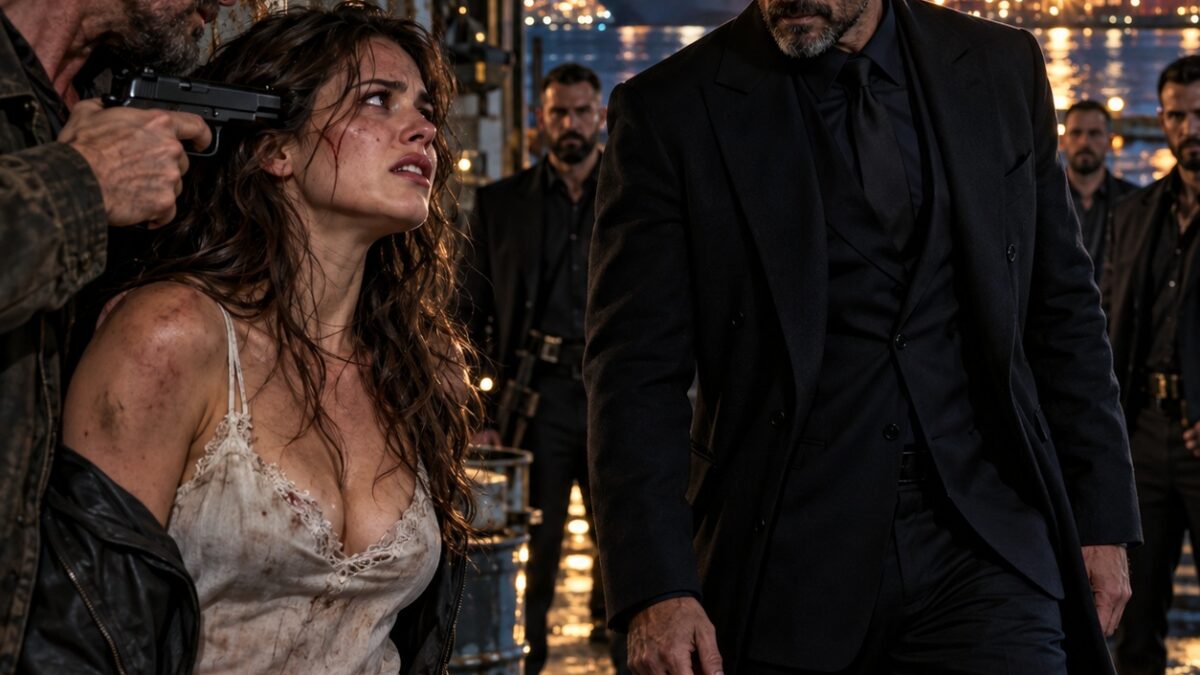
At 2:33 in the morning, the cannery doors opened.
Roman walked in alone.
Black overcoat.
Empty hands.
Visible.
Men raised weapons.
He did not slow.
His eyes found me.
Grease on my face.
Wrists bound.
Furious.
Something in him broke and rebuilt itself in a single breath.
“Are you hurt?”
“No.”
“My wrists hurt.”
I tried to smile.
“I am very annoyed.”
“You took your time.”
“I had to drive.”
That tiny flash of humor nearly made me cry.
Crane held up a transfer agreement.
Roman’s shipping terminal.
Every line signed except the last.
“A small thing.”
Crane said.
“One signature.”
“Miss Hart goes home to her cat.”
Roman did not look at the papers.
He looked at Crane.
“You made a mistake.”
His voice became so quiet the room seemed to lean toward it.
“You thought she was leverage.”
One step closer.
“Do you know what she is?”
Nobody answered.
“She is not under my protection.”
My heart stopped.
“Protection is what I give people.”
His eyes never left Crane.
“She is under my name.”
“Anyone who touches her answers to me.”
I tried to speak.
Crane told him to sign.
“Roman.”
I forced my voice steady.
“Don’t.”
“I’m not.”
“Then what are you doing?”
“Buying time.”
He said it almost gently.
“For a very large man who has been standing behind that crane for four minutes.”
The side door exploded inward.
Dom.
Marco.
Eight men.
Shouting.
Movement.
Crane lunged.
Grabbed the back of my chair.
Cold metal hit my temple.
Everything froze.
Roman’s face went white.
Then Paulo moved.
The old man who had spent the night avoiding my eyes threw himself against Crane’s arm.
The gun fired.
Paulo spun.
Blood appeared across the shoulder of his linen jacket.
Marco hit Crane like a wall.
The gun skidded across the concrete.
Roman did not go after the man who had threatened him.
Did not go after Crane.
Did not look toward the documents.
He ran to me.
Cut the bindings.
His hands shook so badly the blade almost slipped.
Then he pulled me against his chest.
Hard enough to hurt.
His whole body trembled.
“I’ve got you.”
Again.
“I’ve got you.”
Again.
“I’ve got you.”
Behind him, Eli was crying.
Dom had taken the gun away.
Now the enormous driver was asking the kid if he had eaten anything and digging a sandwich out of his coat.
That was the image I remembered later.
Not the gun.
Not Crane.
Not Roman walking in alone.
Dom offering a terrified boy half a sandwich.
The days afterward were quiet in the way houses become quiet after storms.
Crane was delivered to federal authorities along with ledgers from his own operation.
By the end of the week, newspapers reported the story of an investor who had been buying struggling waterfront businesses’ debts and using them to pressure owners.
Roman responded differently than people expected.
The foundation bought those debts.
Then forgave them.
He went into some of those shops himself.
Sat at kitchen tables.
Tore paperwork in half.
Eli’s mother’s medical bill was one of them.
The following spring, Eli joined the foundation as an apprentice.
Not charity.
Salary.
Training.
A future.
Paulo survived.
The bullet tore through his shoulder.
Four days later, I sat with Roman beside his hospital bed.
Paulo looked older.
Smaller.
The peppermint smell was gone.
Roman had barely spoken since we entered.
Finally he looked at me.
“What do you want me to do?”
Not:
What should I do?
Not:
What will people expect?
What do you want?
I looked at Paulo.
This man had betrayed Roman.
He had opened doors for Crane.
He had endangered me.
And when a gun touched my head, he had thrown himself between me and the bullet.
Human beings are inconvenient that way.
They rarely stay inside one moral category.
“He taught you to ride a bicycle.”
Roman’s face tightened.
“He carried your father’s coffin.”
“Yes.”
“He held your mother’s hand.”
“Yes.”
“He sold you.”
Silence.
“And he saved me.”
Paulo began crying.
I looked at Roman.
“I do not know how all those truths fit inside one person.”
“But they do.”
Roman said nothing.
“If you do what everybody expects Roman Devo to do.”
My voice lowered.
“You will carry it every Sunday for the rest of your life.”
I squeezed his sleeve.
“Be the man your mother raised.”
“Not the man your father was.”
“Not the man the city thinks you are.”
“Let him live.”
Roman was silent for a long time.
Then he bent toward Paulo.
Spoke in quiet Sicilian.
Paulo’s hand closed around his.
Three weeks later, Paulo left for Palermo.
A pension.
A ticket.
No reason to return.
Nobody on the docks stopped him.
The morning after the hospital, Roman and I stood on the cliff behind his house.
Gray sky.
Wind.
Pacific rolling below us.
He took both my hands.
For once, he did not look like he was searching for a safe version of what he wanted to say.
“I have been trying to say something for weeks.”
“That sounds dangerous.”
“I have no skill for it.”
“That has never stopped you.”
He looked at me.
“You said I could not handle you.”
“I said many stupid things that night.”
“You were correct.”
I blinked.
“What?”
“I cannot handle you.”
“That is not particularly romantic.”
“I do not want to.”
Now I was quiet.
“I do not want a woman who is easy to manage.”
His thumbs moved across my hands.
“I want the woman who walks into a room full of men everybody else fears and tells them they have sad faces.”
“That was one man.”
“You have done variations.”
I smiled through the tears beginning to form.
“You told me you were not fragile.”
He continued.
“I believed you.”
“And still I tried to send you away.”
“Yes.”
“I will not do it again.”
The wind caught my hair.
“You are mine, Sienna.”
He said it without ownership.
That was what mattered.
“Not because anybody gave you to me.”
“Not because I protected you.”
“Because you chose me.”
His voice roughened.
“And because I have never wanted anything so completely.”
My throat closed.
“You know.”
I laughed shakily.
“I always thought softness was what got me hurt.”
Roman waited.
“Graeme said I was too much.”
“I spent my whole life holding the umbrella for everybody.”
“Dad died.”
“I held Mom together.”
“Theo needed school.”
“I left mine.”
“Studio rent.”
“Employees.”
“Clients.”
“I was always the one telling everyone it was fine.”
My laugh broke.
“And then a scared waiter with broken glasses and a frightened old man carrying peppermints are the reason I’m alive.”
Roman looked at me with such openness it hurt.
“That is not weakness.”
“What?”
“Your softness.”
He lifted one of my hands.
“That is the strongest thing I have ever seen.”
My eyes closed.
“You can walk into any room I own.”
He kissed my fingers.
“And every man inside it will remember who stood beside him when he was afraid.”
Then he kissed me.
No audience.
No deal.
No performance.
The sun began turning the water gold.
When we separated, I whispered:
“Say it again.”
“Which part?”
“The part where I’m yours.”
Roman became very serious.
“I am yours.”
Then:
“And you are mine.”
He considered.
“I would like us to become extremely insufferable about it.”
I laughed.
“You already are.”
Months passed.
Not magically.
Not without fear.
Heart and Honey reopened after repairs.
I replaced the broken glass.
Bought new jars.
Priya found antique buttons online and began bringing them in one handful at a time without mentioning why.
Roman offered to replace everything.
I let him pay for the damage connected directly to Crane.
I refused every attempt to upgrade my entire studio.
“You do not need marble floors.”
“I did not say marble.”
“You thought marble.”
“It would be practical.”
“It would look ridiculous.”
“It is durable.”
“Roman.”
“All right.”
That became our pattern.
He offered.
I chose.
Sometimes I said yes.
Sometimes no.
He learned that love was not a purchase order.
I learned accepting help was not the same thing as surrendering independence.
Mom met him.
That went badly for Roman.
Not because Margaret Hart disliked him.
Because she liked him immediately and therefore treated him like family.
“You are too thin.”
He looked at me.
I shrugged.
“You’re on your own.”
Mom put more potatoes on his plate.
“Does nobody feed you?”
“I eat.”
“When?”
Roman stared at the potatoes.
“Theo says you own hotels.”
“Yes.”
“Then somebody in one of them should know how to make breakfast.”
Theo almost choked.
Roman looked at him.
Theo looked back.
They liked each other by the end of dinner.
Neither admitted it.
Theo asked Roman about shipping infrastructure for an engineering project.
Roman answered seriously.
No condescension.
No shortcut.
No offer to make a call.
Afterward Theo cornered me.
“He’s terrifying.”
“I know.”
“I kind of like him.”
“I know.”
“If he hurts you—”
“You are twenty-two.”
“I can still be threatening.”
“To Roman?”
Theo thought.
“Symbolically.”
“Very brave.”
Roman’s relationship with Meatball became humiliating.
The cat preferred him.
There was no reason.
I fed him.
Paid veterinary bills.
Cleaned his litter box.
Meatball still abandoned me every time Roman sat down.
One evening I found the two of them on my sofa.
Roman reading port documents.
Meatball asleep across his lap.
“You have stolen my son.”
“Your son snores.”
“He is emotionally secure.”
“He has one eye.”
“That is unrelated.”
Roman looked down.
“I think he understands me.”
“You both frighten strangers and dislike unnecessary movement.”
“That may be it.”
There were hard moments too.
Roman had promised never to lie.
He kept that.
But truth and intimacy are not automatically the same skill.
Sometimes he would say:
“I cannot discuss that.”
And I would have to decide whether I could live with it.
Sometimes yes.
Sometimes the answer was:
“Not if it affects me.”
Then he would tell me more.
There were arguments.
Actual arguments.
Not cute banter.
Once, security appeared outside my studio without warning after Roman received a vague threat.
I drove to his office furious.
“You did it again.”
His expression changed.
“I assigned two men.”
“Without asking.”
“There is a concern.”
“That is information you give me before you redesign my day.”
“Sienna—”
“No.”
I pointed at him.
“You do not get to use fear as permission.”
He went quiet.
Then nodded.
“You’re right.”
It still startled me sometimes.
“What?”
“I said you’re right.”
“I heard you.”
“You look suspicious.”
“I was preparing a second speech.”
“I saved us both time.”
He removed the men.
Then asked what level of security I would accept.
We agreed on one plainclothes guard during evening events until the threat passed.
That was growth.
Not transformation.
Growth.
The foundation changed too.
Roman began dismantling parts of the old business Paulo had feared losing.
Slowly.
Carefully.
He moved legitimate operations forward.
Cut ties with men who could not adapt.
Created legal assistance for waterfront families instead of informal debts that could become leverage later.
He would have done some of it anyway.
I did not flatter myself into believing I changed an entire man.
I simply gave him a reason to ask whether inherited rules were actually rules at all.
One afternoon, I found him holding his mother’s old ranunculus photograph.
“She would approve?”
I asked.
“Of what?”
“All this.”
Roman thought.
“She would ask why it took me so long.”
“That sounds like a mother.”
“She would also tell you I have terrible manners.”
“She’d be right.”
“I regret showing vulnerability.”
“No, you don’t.”
His smile answered.
Early spring arrived.
Lucia decided the family needed a party.
“Not a fundraiser.”
She told me.
“Not business.”
“Just family.”
“You have eighty people in your family.”
“Sicilians interpret the word generously.”
Heart and Honey styled it.
Of course.
Lanterns across the terrace.
String quartet beside the fountain.
White hydrangeas.
Ranunculus.
Green silk.
The house looked strangely like the night everything started.
Only warmer.
Mom sat at the head of the family table because Roman insisted.
She wore lavender.
She spent twenty minutes telling Lucia how Dad once built an entire dining set from one fallen oak.
Theo wore a new suit and pretended not to know half of what he had heard about the Devo family.
Priya arrived in sequins.
Dom brought his daughter, who played clarinet and immediately got trapped in a debate with Priya over whether the instrument had enough “dramatic authority.”
Meatball was upstairs asleep on a coat that probably cost more than my first car.
I wore green.
The same family of green Roman had pretended to need my professional opinion about months earlier.
When I came through the glass doors, he was standing beside the dance floor.
Waiting.
No crowd adjusted around him anymore.
Or maybe I simply no longer noticed when they did.
I walked toward him.
“Still think you can handle me?”
Roman held out his hand.
That familiar almost-smile appeared.
“I told you that first night.”
I placed my hand in his.
“Told me what?”
He drew me beneath the lanterns.
His hand settled at my waist.
Firm now.
No Ming vase.
No fear of breaking me.
The quartet began.
Roman leaned down.
His breath touched my ear.
“Are you sure?”
I laughed.
The same question.
Completely different woman.
Months earlier, I had thrown a joke at him because jokes were armor.
Because Graeme had convinced me being “a lot” was something a man eventually got tired of carrying.
Because I had spent seven years holding everybody else together and learned to keep my exhaustion hidden beneath brightness.
Roman had not asked me to be quieter.
He did not ask me to become easier.
He did not learn to handle me.
That was the secret.
People are not horses.
Problems.
Employees.
Things to handle.
He learned to stand beside me.
I learned to let him.
We moved across the terrace.
No missed steps.
No crushed toes.
“Look at you.”
I whispered.
“You have improved.”
“I had an excellent instructor.”
“She sounds expensive.”
“Extremely.”
“Difficult?”
“Exhausting.”
“Too much?”
Roman stopped.
Right there among the dancers.
I knew instantly he had heard more inside those two words than I meant to put there.
His face softened.
“No.”
His thumb moved against my back.
“Never too much.”
My throat tightened.
I looked away.
Roman tipped my chin back.
“Sienna.”
“Yes?”
“You spent years thinking strength meant carrying everyone.”
I stayed still.
“You were wrong.”
“What does strength mean?”
He glanced toward my mother.
Theo.
Priya.
Dom.
Lucia.
Paulo absent but alive somewhere across an ocean.
Then back to me.
“Knowing when to let somebody hold the umbrella for you.”
That almost made me cry.
I saved myself by smiling.
“You practiced that.”
“Possibly.”
“How long?”
“Dom said the original version was terrible.”
I laughed.
“Of course he did.”
Across the terrace Dom lifted his glass.
He had obviously heard.
Roman drew me back into the dance.
When the music ended, nobody applauded.
Nobody needed to.
Another song began.
We stayed.
The Pacific breathed black and silver beyond the cliff.
Lanterns moved in the wind.
Roman’s hand remained warm at my waist.
And I thought about the first night.
About the event stylist with overdue rent.
The girl who believed laughter was strongest when used first.
The woman who had spent years being the one who held everything up.
I thought about Roman as he had been.
A man everyone treated like weather.
Powerful enough to rearrange rooms.
Lonely enough that one honest joke could stop him.
He had been surrounded by people his whole life and spoken to like a human being by almost none of them.
Maybe that was why we collided.
I had spent years being told I filled too much space.
Roman had spent years watching everybody else shrink around him.
Neither of us knew what to do with someone who refused the pattern.
I did not make him good.
He did not rescue me.
The story was more complicated than that.
He had a past I did not romanticize.
Power I sometimes distrusted.
Decisions I challenged.
I had wounds he could not erase.
A father he could not bring back.
Years of school I had abandoned.
A business built out of exhaustion and stubbornness.
We did not fix each other.
We learned each other.
That was harder.
And better.
Sometimes love was Roman standing beside me while I argued with a florist about peony substitutions.
Sometimes it was me sitting quietly while the anniversary of his mother’s death passed through him.
Sometimes it was him asking before helping.
Sometimes it was me admitting I wanted the help.
Sometimes it was a dance.
Sometimes a terrible text message with a full signature.
Sometimes eleven ridiculous pairs of shoes.
Sometimes a photograph left by an enemy.
Sometimes the absolute terror in a man’s voice when he asks whether you are hurt.
And sometimes love looked like letting a person who betrayed you live because mercy was the only way to stop carrying him forever.
People later asked me what Roman said when he first knew he loved me.
He would claim it happened on the cliff.
I disagreed.
I think it happened in my destroyed studio.
Not because he said anything.
Because he entered with enough anger to freeze a room.
Then saw me.
And the anger broke around fear.
He knelt in glass.
That told me more than any declaration.
Roman argued it happened earlier.
At the dance lesson.
“When you moved my hand.”
“That is suspicious.”
“You said you weren’t breakable.”
“I’m still not.”
“I know.”
Sometimes Dom insisted the truth was obvious from the first party.
“The boss stayed three hours.”
Dom would say.
“He hates parties.”
“I do not hate parties.”
Roman would answer.
“You left your sister’s wedding after nineteen minutes.”
“The band was terrible.”
Lucia, if present, would shout from another room:
“The band won an award.”
Roman never had an answer for that.
My mother believed fate started when Roman came into my studio for flowers.
Priya believed she deserved credit because she looked him up on the internet.
Theo insisted Meatball made the final decision.
Meatball offered no comment.
I came to believe beginnings matter less than choices.
Roman chose honesty on the roof.
I chose not to run when honesty became frightening.
He chose fear after the break-in and tried to send me away.
I chose to call him on it.
He admitted he was wrong.
Paulo chose betrayal.
Then chose me when the gun came up.
Eli chose courage despite being terrified.
Roman chose me instead of revenge when the cannery erupted.
Later, he chose mercy.
Again and again, our lives shifted not because anybody became a different person overnight, but because somebody made one choice differently than they had before.
That was how people changed.
Not speeches.
Practice.
The older boss never learned how to “handle” a girl like me.
Thank God.
I would have hated him for trying.
Instead, Roman Devo learned what Graeme never had.
That my laughter was not a performance to tolerate.
My stubbornness was not disrespect.
My softness was not weakness.
My instinct to care for frightened people was not naïveté.
And I learned what I had spent years refusing to believe.
Being strong did not require me to be the only one holding everything.
The night of that spring party, we eventually escaped the guests.
Went back to the same balcony where I had first challenged him.
The air smelled like salt.
Lantern music softened behind us.
I leaned against the stone railing.
Roman stood beside me.
“You know.”
I said.
“What?”
“I was terrified when you asked if I was sure.”
“I know.”
I turned.
“You knew?”
“Your smile vanished for half a second.”
“That is horrifying.”
“I notice things.”
“So do I.”
“Yes.”
That was how we ended up here.
Two people who noticed too much.
I looked over the water.
“Were you bluffing?”
“That night?”
“Yes.”
Roman considered.
“A little.”
I gasped.
“The great Roman Devo was bluffing.”
“I was attempting confidence.”
“You said you usually had it.”
“I lied by implication.”
“Our rooftop agreement had not occurred yet.”
“Convenient.”
He smiled.
Real smile.
No rust.
No surprise now.
I had seen it enough times to know every version.
Then he came closer.
“I was nervous too.”
I stared.
“You?”
“Yes.”
“Why?”
“You made me laugh.”
“That sounds pleasant.”
“It was alarming.”
I laughed.
Roman’s hands settled at my waist.
“And you looked at me as if I were simply a man standing at a party.”
“You were.”
“No one else thought so.”
I understood that now.
Maybe I always had.
“You still are.”
He looked down at me.
“Simply?”
“No.”
I slid my arms around his neck.
“Complicatedly.”
“That is not a word.”
“I run an event company. I make words when necessary.”
His mouth curved.
“And are you sure now?”
I pretended to think.
Roman waited.
The ocean pushed against the rock below.
Behind us, our families laughed.
Somebody—probably Priya—dropped something and blamed Dom.
Music drifted through open doors.
My father’s absence still existed.
So did Roman’s mother’s.
The studio had scars from the break-in.
Roman carried betrayal.
Paulo lived somewhere far away with the knowledge of what he had done.
Nothing had been magically erased.
Life was not clean.
It was ours.
“Yes.”
I said.
“I’m sure.”
Roman kissed me.
And the most feared man on the San Diego waterfront never proved he could handle a girl like me.
He proved something better.
He could love one without asking her to become easier.








