FULL STORY: The Navy SEAL Found a Dying German Shepherd in the Blizzard, but the Secret Beneath the Frozen Lake Was Far Worse
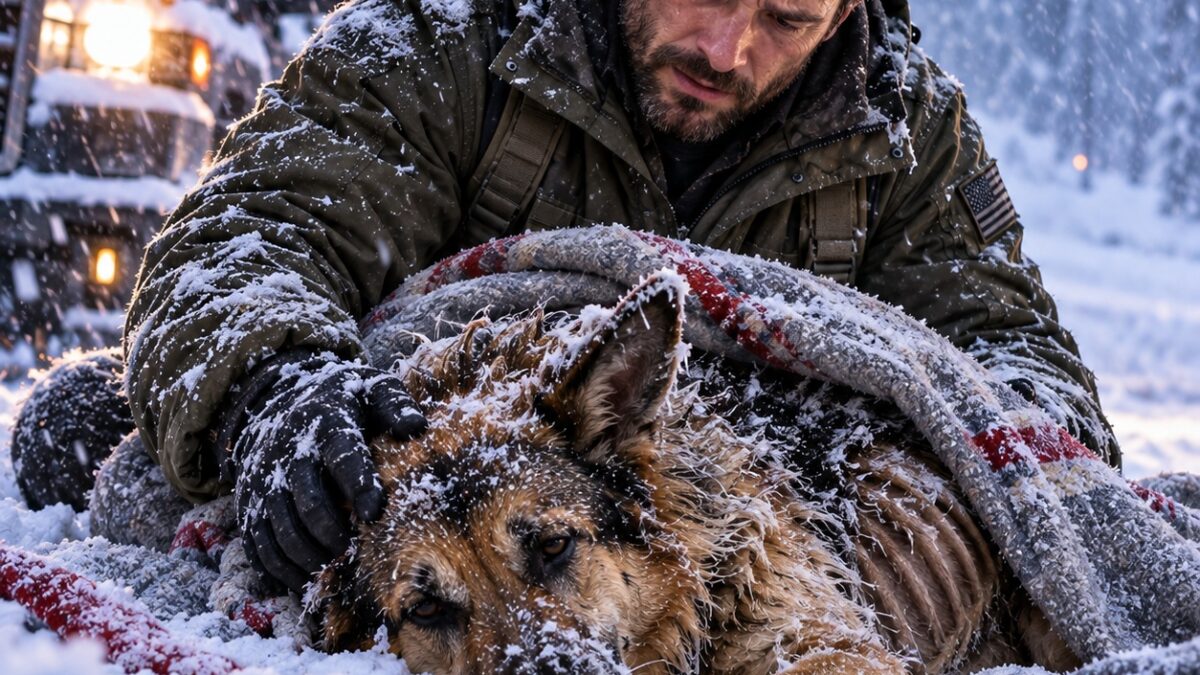
By the second morning, the blizzard had sealed the cabin inside a world no larger than its windows.
Snow pressed against the lower panes.
The porch railing had disappeared beneath drifts.
Even the reflective roadside posts I’d followed the day before were gone.
Outside, there was nothing but white.
Inside, I measured time by Vesper’s breathing.
Every thirty minutes, I checked his temperature.
Every hour, I updated Cecily over the emergency radio.
And every few minutes, whether I admitted it or not, I looked toward the makeshift bed beside the stove to make sure his chest was still moving.
His condition improved slowly.
The worst trembling eased.
His gums regained some color.
By late morning, he could lift his head without immediately dropping it again.
But he still refused food.
I placed a spoonful of softened meat in a shallow ceramic bowl and set it near him.
Vesper looked at the food.
Then at me.
“You realize this isn’t a negotiation.”
He lowered his head.
I waited.
Nothing.
I moved the bowl a little closer.
His ears flattened.
I stopped.
It was a small reaction, but clear enough.
He wasn’t necessarily rejecting the food.
He didn’t want to eat while I watched him.
I looked toward the kitchen table.
A four-month-old newspaper lay folded beside the stove.
Abigail had been reading it before the accident.
I picked it up.
Sat down with my back toward Vesper.
And pretended to be interested in soybean prices.
Ten minutes passed.
Then I heard ceramic scrape against wood.
I kept reading.
Another scrape.
Then the quiet sound of chewing.
My throat tightened.
When I finally looked back, half the food was gone.
Vesper had dragged the bowl behind Abigail’s armchair.
A small piece of meat was hidden beneath the edge of the rug.
I crouched several feet away.
“You’re saving that?”
He placed one paw across the rug.
I almost smiled.
“Fine. Apparently we both have things we don’t want anybody touching.”
I left it alone.
The cabin developed a rhythm around us.
I warmed water.
Changed towels.
Checked the generator.
Cleared snow from the chimney vent.
Prepared small meals under Cecily’s instructions.
And spoke to Vesper because the alternative was returning to the silence I’d spent months cultivating.
He began following me from room to room.
Not closely.
He usually kept four or five steps between us.
When I entered the utility room, he stopped at the threshold.
It had no window.
Only one exit.
The first time I noticed, I stepped farther inside.
Vesper froze.
His body angled backward.
I immediately returned.
He relaxed.
After that, I left the door open and stopped expecting him to follow.
Trust wasn’t obedience.
And a frightened animal couldn’t be ordered to feel safe simply because the person giving the order had good intentions.
That was something I understood intellectually.
Living it was harder.
On the third morning, the wind finally weakened.
Sunlight broke through the clouds.
I was preparing coffee when I saw Vesper standing beside the kitchen table with one of my wool socks hanging from his mouth.
I stopped.
He stopped.
We stared at each other.
“That,” I said, “is not food.”
Vesper backed under the table.
I crouched.
He placed the sock between his paws.
I reached forward.
He covered more of it.
“You have no income,” I told him. “You contribute nothing to the heating bill, and now you’re stealing winter clothing.”
His right ear lifted.
Something about the solemn expression and the damp sock beneath his enormous paw broke through me before I could stop it.
I laughed.
The sound came out rough.
Almost a cough.
Then it came again.
Louder.
Vesper tilted his head.
For one brief moment, the cabin felt like a home instead of a memorial.
Then guilt arrived.
I looked toward Abigail’s chair.
Empty.
Melody’s mug above the sink.
Untouched.
I felt the familiar accusation rise inside me.
You’re still here.
My laughter stopped.
I stood too quickly.
Vesper flinched.
Pressed himself farther beneath the table.
I saw it immediately.
And hated that I’d frightened him.
“Sorry.”
I lowered myself onto the floor.
The brass whistle beneath my shirt pressed against my chest.
Abigail had given it to me years earlier after our first summer paddling on Silver Wake Lake.
“You can command oceans,” she’d joked, “but you still need something to call you home for dinner.”
I held it in my palm.
For four months, I’d treated every unexpected laugh as a betrayal.
As though enjoying one second of life meant I loved my family less.
But Abigail had laughed constantly.
Melody even more.
Neither would have wanted me to turn our home into a punishment.
I placed the whistle beside me.
“You can keep the sock,” I told Vesper.
His ears moved.
“Apparently I’ve lost command authority.”
He remained under the table another minute.
Then slid one paw forward.
Still guarding the sock.
I smiled.
And this time, I let myself.
Cecily arrived that afternoon in a tracked utility vehicle operated by the volunteer rescue service.
She carried a medical bag and wore a long winter parka over her scrubs.
When she entered, she looked at Vesper.
Then the temperature log.
The water bottles.
The bedding.
The measured food portions.
“You followed instructions.”
I closed the door.
“You sound disappointed.”
“I’d prepared a speech.”
“Save it.”
“I may need it.”
She crouched several feet from Vesper.
Waited.
Allowed him to examine her before beginning the evaluation.
She checked his heart.
Lungs.
Gums.
Paws.
Abdomen.
Then she reached toward his right shoulder.
He stiffened.
She stopped.
“Old scar,” I said.
“I noticed.”
She didn’t force the examination.
Instead, she scanned for a microchip.
Nothing.
She examined his coat for signs of a collar or institutional handling.
No clear evidence of police or military service.
No obvious indication of a recent owner.
I watched her.
“So nobody’s looking for him.”
“That isn’t the same thing as nobody owning him.”
She photographed Vesper and arranged to circulate a found-dog notice through animal control and regional rescue contacts.
I nodded.
That was the right thing.
Even if I didn’t like imagining somebody coming to claim him.
Then she looked at the dog.
“He should come to the clinic for observation.”
Vesper raised his head.
He struggled upright.
Moved between me and the front door.
Not aggressively.
He didn’t growl or show his teeth.
He simply stood there trembling with effort, his body angled toward me.
Cecily stopped.
I looked at him.
“He thinks you’re taking him away.”
“I am considering it.”
Vesper looked back.
Then retreated toward the fireplace.
Cecily sighed.
“He can remain here if you follow the feeding plan exactly.”
I nodded.
“Small meals. No rich food. Daily updates. And if he worsens, you don’t argue.”
“I rarely argue.”
She stared at me.
“Fine,” I said. “I argue selectively.”
Two hours after Cecily left, the landline rang.
Warren Lyall, a retired marina manager, had seen Vesper’s photograph.
“I know that shepherd,” he said.
I straightened.
“Where?”
“Northshore fishing sheds. Been seeing him since September. Maybe earlier.”
“Did he belong to anyone?”
“Not anyone who admitted it.”
Warren explained that he’d occasionally left food behind an old bait house.
The dog always waited until he drove away.
He confirmed the tipped ear.
The ash-gray chest patch.
The sable coloring.
“That storm probably tore the roof off the shed he was using,” Warren said.
“Would’ve pushed him toward the road.”
I looked toward Vesper.
He was sleeping near the stove.
The explanation was ordinary.
A homeless dog had lost the shelter he’d been using.
A grieving man happened to drive past.
No supernatural arrangement.
No hidden destiny.
Just timing.
And a decision.
Sometimes that was enough.
That evening, I found an old camping mattress in the hall closet.
I covered it with two clean blankets and placed it where Vesper could see the kitchen, hallway, and front door.
Abigail’s armchair partly blocked the space.
I stood looking at it.
For months, I hadn’t moved a single thing.
Not her slippers.
Not her chair.
Not Melody’s mug.
The idea of shifting furniture seemed like another way of admitting they weren’t coming back.
But Vesper needed a safer place to rest.
So I gripped the chair.
Lifted one side.
Moved it toward the eastern window.
Six feet.
That was all.
Six feet.
Yet the change felt enormous.
A pale rectangle marked the floor where the chair had protected the wood from sunlight.
I stared at it.
Then placed Vesper’s mattress in the open space.
He approached slowly.
Sniffed it.
Circled once.
Lowered himself.
He didn’t sleep immediately.
But he stayed.
And that night, when I turned off the lamp, he didn’t return to the front door.
He chose his mattress.
The house hadn’t forgotten Abigail.
It had simply made room for another living creature.
Ten days after the storm, I woke to a sound that turned my stomach.
Vesper was vomiting beside the hearth.
I set down my coffee and crossed the room.
He staggered toward the door.
Hunched.
Vomited again.
Then stood trembling.
His gums looked pale.
His abdomen felt rigid.
When I placed my hand near his ribs, he gave a faint involuntary whine.
I had heard dogs whine before.
But something about that sound frightened me immediately.
“Vesper?”
He lowered his head.
I didn’t wait.
Within minutes, I had his medical folder, blankets, emergency kit, and radio ready.
I carried him to the truck.
The road to Silverpine Reach was clear enough to drive.
Thirty-five minutes later, I pulled into Cecily’s clinic.
She met us at the side entrance.
One look at Vesper erased her usual dry humor.
“Treatment room. Now.”
The clinic smelled of antiseptic, warm air, and wet fur.
Cecily examined him while an assistant prepared warmed fluids and monitoring equipment.
His temperature was abnormal.
He was dehydrated.
His abdomen was painful.
There were signs of severe gastrointestinal inflammation.
“What caused it?” I asked.
“Too early to know.”
She looked directly at me.
“Parasites, infection, something he ate, contaminated water from before you found him. Malnutrition makes everything harder.”
“Poison?”
“That’s a possibility, not a verdict.”
She started treatment.
IV fluids.
Medication for nausea.
Pain control.
Monitoring.
Blood tests.
I stood beside the table while Vesper turned his muzzle toward my sleeve.
He didn’t resist the catheter as long as my hand remained near his nose.
That nearly broke me.
Because he was trusting me.
And I couldn’t promise I would be able to save him.
The first laboratory results returned that afternoon.
Inflammation markers were elevated.
His electrolytes were significantly disturbed.
Liver enzymes were high.
Two kidney values were outside the normal range.
Cecily placed the report between us.
“His intestinal illness explains some of this.”
“Not all?”
“Not necessarily.”
I looked through the recovery-room window.
Vesper lay beneath a gray blanket.
An IV line ran into his leg.
“Tell me what happened to him.”
Cecily’s expression softened.
“Tristan, I don’t know yet.”
I stared.
She continued.
“If we decide the answer before the evidence arrives, we stop seeing everything that doesn’t fit.”
I hated how familiar that sounded.
Evidence before anger.
It was something I’d learned years earlier.
Something I had apparently forgotten.
Vesper stabilized through the afternoon.
Then worsened shortly after midnight.
His fever rose.
He developed bloody diarrhea.
His breathing became shallow.
Cecily adjusted his treatment.
I sat on a metal chair outside the recovery kennel.
I hadn’t eaten.
The assistant went home.
Snowplows moved past the frosted windows.
The fluid pump clicked.
Vesper kept his head angled toward my boots.
Every time I stood, his eyes opened.
So I stopped standing.
Near three in the morning, Cecily brought two paper cups of coffee.
She sat across from me.
“You should eat.”
“He should.”
“One of you has the medical excuse.”
I took the cup.
Didn’t drink.
For several minutes, we listened to the pump.
Then she asked a question I hadn’t expected.
“Did you go inside the hospital?”
I stared at her.
“What?”
“When Abigail and Melody were brought there.”
My chest tightened.
“They were already gone.”
“That wasn’t what I asked.”
I looked toward Vesper.
His body rose and fell beneath the blanket.
Finally, I answered.
“No.”
I’d driven to the hospital after the accident.
Parked outside the emergency entrance.
Watched nurses and families move through the doors.
A deputy came out.
Then returned.
Later, he brought forms.
Identification.
Personal effects.
Authorization for release.
I knew what those papers meant.
I knew my wife and daughter were gone.
But I couldn’t walk through the doors.
Because some irrational part of me believed that signing the documents would make the phone call real.
So I stayed in my truck.
Until sunrise.
Then I drove away.
Cecily listened without interrupting.
“I spent years going into dangerous places,” I said.
My voice sounded strange.
“Flooded compartments. Burning buildings. Rooms where people were shooting through walls.”
I swallowed.
“But I couldn’t walk through a hospital door.”
She folded her hands around her coffee.
“Courage doesn’t transfer automatically from one kind of terror to another.”
I looked at her.
“You were in shock.”
“I left them there.”
She didn’t soften her next words.
“You didn’t leave them alive and waiting.”
I stared toward the recovery kennel.
Vesper made a faint scraping sound.
He was trying to rise.
His hind leg slipped.
His front paw dragged against the blanket.
“Stay down,” I whispered.
He tried again.
Cecily opened the kennel so I could kneel beside him.
I placed my hand on the bedding.
Vesper reached forward until his nose touched my knuckles.
The effort exhausted him.
His head settled against my hand.
I stayed there.
For four months, I’d punished myself for not walking through those hospital doors.
That fact would never change.
But now another living creature was reaching toward me from a place of pain.
And I understood something.
Leaving this room wouldn’t protect me from losing him.
It would only decide whether he had to face his suffering alone.
“I’m here,” I whispered.
The words were for Vesper.
But they weren’t only for him.
Near dawn, his fever began to decline.
The fluids corrected the worst electrolyte imbalance.
His condition stabilized.
Cecily checked his abdomen.
Then allowed herself a small breath.
“He’s responding.”
I closed my eyes.
“When can he eat?”
“Not yet.”
“My dog hasn’t eaten since yesterday.”
Cecily looked at me.
Neither of us spoke.
I’d said it without thinking.
My dog.
She didn’t smile.
Didn’t point it out.
She simply made another note on the chart.
“Your dog can try a spoonful of bland food this afternoon if he continues improving.”
I nodded.
Somehow, that answer felt more official than any adoption document.
Later that morning, Laurel Madson arrived carrying a thick folder.
She coordinated regional wildlife recovery and had been helping circulate Vesper’s found-animal notice.
Now she had something else.
“Other animals are sick,” she said.
Cecily looked up.
Laurel unfolded a county map.
Three water birds.
Two beavers.
A fox.
All recovered during the previous month.
Their symptoms varied.
Weakness.
Diarrhea.
Liver abnormalities.
Tremors.
Disorientation.
Any single case might have been ordinary.
Together, they formed a disturbing pattern.
Laurel pointed to several blue circles on the map.
The northern marsh.
The old fishing access.
The shoreline near the abandoned bait sheds.
I leaned closer.
“That’s where Warren saw Vesper.”
Laurel nodded.
The approximate location fell within the cluster.
“Connected?” I asked.
She shook her head.
“Same geography. Connection comes later.”
Cecily arranged additional blood testing and toxicology analysis.
Laurel coordinated preserved wildlife samples.
Water samples from the recovery areas would be sent for analysis.
The work wouldn’t be quick.
A week.
Possibly two.
I hated that answer.
But it was the right one.
That afternoon, we spoke with Dr. Maeve Callahan.
Maeve was an environmental scientist who had spent years studying northern freshwater systems.
She reviewed the map by video.
Then looked at me.
“There’s enough here to justify investigating.”
I leaned forward.
“Industrial contamination?”
“Possible.”
“From where?”
“Could be industrial runoff. Agricultural sources. Failing septic systems. Illegal dumping. Historic sediment. More than one factor.”
I stared.
“So you’re saying we don’t know anything.”
“I’m saying we know something is worth examining.”
She tapped one of the marked locations.
“Patterns are invitations, Tristan. They aren’t conclusions.”
I nodded.
I understood.
Or thought I did.
Vesper returned to the cabin two days later.
He had medication.
A restricted diet.
A follow-up schedule long enough to fill half my refrigerator door.
I followed every instruction.
That evening, he stood near the eastern window.
His ears lifted.
I heard it too.
A low mechanical hum traveling across the frozen lake.
Warren explained over the phone that sound carried strangely in winter.
Pumps operating along the Ardan Shore industrial corridor could sometimes be heard from miles away.
I watched Vesper listening.
I didn’t call it a warning.
He was hearing machinery.
Nothing more.
Still, the sound stayed with me.
Several days later, I walked the public shoreline road near the northern marsh.
Vesper remained at the cabin.
He was recovering and didn’t need another adventure.
I carried a camera, notebook, measuring tape, and my phone.
Near a concrete drainage channel, I found something strange.
A strip of open water.
The air temperature was well below freezing.
But dark water continued moving through a narrow gap in the ice.
A faint mist hovered above it.
That alone didn’t establish anything.
Moving water could remain open for several reasons.
I photographed the channel.
The shoreline.
The public access marker.
Then I noticed the fish.
Dozens of small silver bodies lay beneath the ice.
Some caught among reeds.
Others suspended at different depths.
I crouched near the bank without stepping onto the ice.
For a long time, I stared.
Dead fish.
Sick wildlife.
Vesper’s illness.
A strangely warm current.
I could feel the pieces beginning to form a picture in my mind.
But I also knew that wanting a conclusion wasn’t the same as proving one.
I called Maeve.
“I found something that needs a second pair of eyes.”
She asked where.
I gave the coordinates.
Then waited beside the frozen marsh.
Three days later, Maeve organized the first formal water survey.
Elias Pembroke, the county water-quality inspector, joined us.
So did Lenora Pike, a local reporter known for refusing to print conclusions she couldn’t support.
I provided transportation, winter access information, and safety equipment.
Nothing more.
Elias labeled sampling bottles before we left.
“Every sample gets a number,” he said.
“Time. Location. Temperature. Chain of custody.”
He looked around.
“Nobody improvises containers.”
Lenora raised her recorder.
“Understood.”
We visited eight locations.
Three along the northern marsh and drainage channel.
Two near feeder streams.
Three comparison sites farther from the industrial corridor.
Maeve measured water temperature, conductivity, dissolved oxygen, and other field conditions.
Elias collected sealed samples.
Lenora documented the work.
I tested shoreline ice and helped keep everyone off dangerous surfaces.
At the northern drainage channel, the conductivity reading rose sharply.
Maeve checked the meter.
Then repeated the measurement.
The value remained elevated.
The water was several degrees warmer than samples from the southern comparison sites.
Lenora asked, “Does that prove contamination?”
“No,” Maeve answered.
“Does it prove Ardan Shore is responsible?”
“No.”
“Are you concerned?”
Maeve looked toward the dark current.
“Yes.”
Five days later, preliminary laboratory results arrived.
Several compounds associated with industrial surface treatment and synthetic-fiber processing were elevated in the northern samples.
The temperature and conductivity differences remained consistent.
Maeve spread the reports across my kitchen table.
Vesper slept near the stove.
“The northern marsh is receiving something unusual,” she said.
I studied the numbers.
“And Ardan Shore is upstream.”
“So are old maintenance yards, storm drains, septic systems, historic industrial sediment, and a closed landfill.”
I looked at her.
“You think the plant has nothing to do with it?”
“I think belief isn’t useful.”
I leaned back.
She continued.
“One round of sampling is a photograph. We need a sequence.”
I knew she was right.
But all I could see were the dead fish beneath the ice.
And Vesper lying in a veterinary clinic with an IV in his leg.
That afternoon, I made a mistake.
A serious one.
I opened the local community forum.
Selected the photograph of the dark drainage channel and dead fish.
Then typed:
How long has Ardan Shore been poisoning Silver Wake Lake while the town looks the other way?
I read it once.
My thumb hovered above the screen.
I thought about Vesper.
About Abigail loving this lake.
About Melody recording its sounds.
About men in offices saying more study was needed while animals died.
Then I posted it.
For twelve minutes, almost nothing happened.
Then the message spread.
Hundreds of shares.
Angry comments.
Demands for the factory to close immediately.
Other people accused me of inventing a crisis.
Then something uglier began.
Someone posted photographs of workers leaving the evening shift.
License plates.
Names.
Cars.
One comment appeared beneath a maintenance worker’s truck.
Ask him how many dead animals his paycheck is worth.
I stared at it.
The man who owned that truck wasn’t a corporate executive.
He was someone who had worked a shift, scraped ice from his windshield, and driven home.
And the anger I’d released no longer belonged to me.
Maeve called.
“What did you do?”
Her voice contained no greeting.
“I posted what I saw.”
“You posted a conclusion.”
“I asked a question.”
“You wrote a verdict with a question mark.”
I stood from the kitchen table.
Vesper lifted his head.
“The compounds match materials used at Ardan Shore.”
“They match materials used in more than one process.”
“The drainage comes from their side of the lake.”
“And we still haven’t established the exact source, timing, or mechanism.”
“Fish are dead.”
“Yes,” she said sharply.
“And now workers are being threatened because you were too angry to distinguish evidence from blame.”
I fell silent.
Lenora called next.
“I won’t use your post.”
“I didn’t ask you to.”
“You made yourself part of the story.”
“The photographs are real.”
“Yes.”
“The test results are real.”
“Yes.”
“Then what’s the problem?”
Her answer stopped me.
“True pieces can create a false picture when somebody arranges them carelessly.”
I looked toward Vesper.
He had risen.
He stood several steps away, watching me.
His body was slightly lowered.
I realized my voice had grown louder.
I sat.
The following morning, the sheriff’s office asked residents to remove photographs of employees’ vehicles.
Ardan Shore condemned harassment and said it was cooperating with regulators.
I posted a correction.
I wrote that the fish deaths, sick wildlife, and unusual water results justified further investigation.
But that available evidence did not yet establish Ardan Shore as the source.
I asked people to stop targeting employees.
Remove identifying photographs.
Let investigators finish their work.
The correction spread more slowly than the accusation.
Of course it did.
Anger traveled faster.
I had known that for years.
Somehow, I’d forgotten.
Two nights later, the town held a public meeting.
Every chair in the municipal hall was occupied.
Ardan Shore Materials employed more than three hundred people directly.
Hundreds of other livelihoods depended on it.
Contractors.
Truck drivers.
Restaurants.
Fuel suppliers.
Small shops.
The plant’s taxes helped support public services.
Those facts filled the room before anybody spoke.
I stood near the back wall.
Maeve and Elias sat with their reports.
Lenora occupied the press table.
Then Benton Ser stood during public comment.
Benton owned a tackle and marine-supply store near the highway.
His adult son worked at Ardan Shore.
He turned toward me.
“You came back four months after losing your family,” he said.
The room went quiet.
“Everyone here is sorry for what happened.”
My spine tightened.
“But grief doesn’t make you accurate.”
I stared at him.
Benton continued.
“You found dead fish, decided the factory must be the enemy you were owed, and posted something that brought strangers after working families.”
I felt heat climb my neck.
“I didn’t post anyone’s car.”
“No,” Benton replied.
“You lit the match.”
That was harder to deny.
I took one step forward.
Then a woman stood in the second row.
Her name was Nadine Frost.
She worked at the plant and represented many of the employees.
She was broad-shouldered, silver-haired, and wore a blue work coat with a union pin on her knit cap.
She turned toward Benton first.
“Sit down before you turn fear into theater.”
Benton hesitated.
Then sat.
Nadine looked at me.
“And you listen.”
I held her gaze.
“Nobody in this room wants poison in the lake,” she said.
“We drink that water. We fish there. We send our children onto that ice.”
She gestured toward the workers.
“But these aren’t pieces on your board. Three hundred jobs aren’t an acceptable casualty because outrage feels cleaner than patience.”
I swallowed.
“I know that now.”
“No,” she said.
“You know you made a mistake. That isn’t the same as understanding what the mistake costs.”
Nobody defended me.
Maeve didn’t rescue me.
Lenora didn’t look away.
And I realized something uncomfortable.
In the Navy, I’d learned to identify the threat and protect the vulnerable.
But here, the categories weren’t clean.
The factory that might be harming the lake also fed the town.
Protecting one without destroying the other would require something more difficult than anger.
It would require restraint.
I stepped forward.
“I was wrong to accuse before the evidence was complete.”
The room stayed quiet.
“And I was wrong not to consider who might get hurt because of what I said.”
I looked toward the workers.
“I can’t undo the post. But I can stop pretending that my anger gives me better judgment than the people doing the actual investigation.”
Nadine watched me.
Then nodded once.
Not forgiveness.
Not approval.
An acknowledgment that I’d finally said something worth hearing.
After the meeting, I went home.
Vesper waited near the stove.
He rose when I entered.
Walked toward me.
Then stopped.
I knelt.
He approached.
Pressed his nose against my hand.
I sat beside him.
For months, I’d searched for someone to blame for Abigail and Melody’s deaths.
The icy road had given me no enemy.
Now I’d found dead animals and suspicious water.
A problem I might actually be able to help solve.
And I’d nearly ruined the investigation because I wanted the answer to look like a villain.
I rested my hand on Vesper’s shoulder.
“I’m going to have to do better than that, buddy.”
He lowered his head onto my knee.
I sat there until the stove needed another log.
The next phase of the investigation required repeated sampling.
Not dramatic confrontations.
Not nighttime trespassing.
Not accusations.
Just careful work.
Maeve and Elias expanded their testing.
They collected samples after changes in weather and runoff.
Compared northern locations with unaffected sites.
Recorded temperature, conductivity, and chemical profiles.
Lenora reported what could be verified.
A technical specialist named Felix helped examine flow patterns and thermal differences using approved equipment.
I continued providing safety support where asked.
The results became more concerning.
But there were still unanswered questions.
The industrial corridor contained old infrastructure.
Some pollutants could have originated years earlier.
Some might have entered through recent runoff.
The challenge wasn’t merely finding chemicals.
It was proving when and how they entered the water.
Then the weather changed.
A sudden nighttime thaw brought rain to the frozen marsh.
The forecast warned of rapidly rising runoff and unstable ice.
Maeve wanted additional measurements during the flow event.
I agreed to assist with safety equipment.
The plan was limited.
Public access.
No entering restricted industrial property.
No unauthorized sampling.
And no taking needless risks.
Unfortunately, my original plan for Vesper’s care fell apart when Warren couldn’t reach the cabin.
I should have canceled my involvement.
Instead, I brought Vesper in the truck.
He remained secured inside.
I told myself he was safer with me than alone.
That wasn’t the whole truth.
The real reason was that I had begun dreading the idea of returning to an empty house.
And I wasn’t ready to admit it.
Rain struck the windshield as we approached the northern channel.
The snow had turned heavy and wet.
Dark water rushed beneath the old wooden bridge.
Maeve checked the instruments.
Temperature elevated.
Conductivity rising.
Flow increasing.
The mechanical hum from the industrial corridor carried through the rain.
Vesper stood inside the truck.
His ears pointed north.
I glanced toward him.
Then back at Maeve.
She raised a sample bottle beneath her headlamp.
The water looked gray-brown.
“Could be sediment,” she said.
Then the bridge railing failed.
It happened without warning.
One rotten support folded outward.
Maeve’s weight shifted.
She reached for the remaining rail.
Her glove slid across wet timber.
I lunged.
My fingers caught her coat for less than a second.
Then she fell.
The current took her immediately.
“MAVE!”
She surfaced beside the bridge.
Gasped.
Struck the underside of the platform.
Then disappeared into darkness.
I dropped to one knee.
Reached for the rescue rope attached to my belt.
The water beneath the bridge was black.
Foam and broken ice moved through the current.
I couldn’t see her.
Then Vesper began barking.
Not ordinary barking.
Sharp.
Urgent.
Repeated.
I looked toward the truck.
The dog was throwing his body against the safety tether.
But he wasn’t facing the bridge.
He was looking downstream.
I followed his gaze.
Then ran.
The channel curved behind a snowbank.
Vesper’s barking changed direction as I moved.
I heard him shift inside the truck.
Then another burst of barking.
I looked toward the water.
A pale hand broke the surface.
Maeve.
Nearly twenty yards downstream.
She was caught briefly against reeds and fractured ice.
“Hold on!”
She couldn’t have heard me.
I secured my rescue line to a steel bridge support.
Checked the anchor.
Clipped the working end to my harness.
Then moved down the bank, testing each step.
The snow collapsed beneath one boot.
Cold water rose to my knee.
I kept moving.
Maeve disappeared again.
Vesper barked farther downstream.
I followed the sound.
Then saw her.
Caught against a half-submerged branch.
Her face barely above the current.
Her movements were slowing.
I threw the rescue line.
Short.
Pulled it back.
Threw again.
The weighted loop struck her shoulder.
Her hand closed around it.
Slipped.
“Across your chest!”
I shouted until my throat hurt.
“Get it under your arm!”
She managed to hook one elbow through.
I leaned into the harness.
Pulled.
The current resisted with a steady force.
Not a dramatic impact.
Just relentless pressure.
I planted my boots.
Pulled again.
One foot.
Then another.
The anchor held.
Maeve moved toward the bank.
When she came close enough, I went flat on my stomach.
Caught the back of her field coat.
And dragged her upper body clear.
She coughed violently.
Water poured from her sleeves.
Blood ran from a cut near her hairline.
“Can you move your legs?”
She stared at me.
“I believe they’re filing a complaint.”
Her voice was weak.
But it was hers.
I pulled her fully onto the snow.
Wrapped her in my emergency blanket.
Only then did Vesper stop barking.
He stood inside the truck.
Panting.
Watching us through the rain-streaked glass.
Felix and Elias arrived minutes later.
Elias called emergency services.
Felix helped insulate Maeve from the frozen ground.
She was shivering violently.
Her lips had lost color.
But she remained conscious.
“The instruments,” she managed.
I stared.
“You nearly drowned.”
“I fell professionally.”
“You nearly died professionally.”
She closed her eyes.
“Data logger.”
Felix checked the tablet.
The instrument was still transmitting.
The conductivity graph had risen in a sharp curve.
Water temperature had increased rapidly.
Flow volume surged at the same time.
The measurements were real.
Recorded automatically.
Timestamped.
The weather had given the team a chance to observe what happened during a high-runoff event.
And the records were far more useful than anything I’d shouted on a community forum.
Once emergency responders had reached Maeve and stabilized her for transport, Felix received clearance to launch a drone over the public channel.
Its thermal camera recorded a warmer plume moving toward Silver Wake Lake.
The image didn’t identify chemicals.
It didn’t show who opened a valve.
But the timing aligned with the sensor spike and dark flow beneath the bridge.
Something warmer than ordinary runoff was entering the marsh during the thaw.
That mattered.
Maeve was transported to the hospital with hypothermia, bruised ribs, and a head injury.
I drove Vesper directly to Cecily’s clinic.
He hadn’t left the truck.
But he’d strained himself pulling against the tether.
His paws were cold.
His right shoulder was sore.
Cecily examined him while I stood in wet camouflage clothes beside the treatment table.
“No new serious injury,” she said.
“Rest. And no more field trips.”
I nodded.
She removed her gloves.
Then asked, “Why was he there?”
“Warren couldn’t reach the cabin.”
“That explains why your original plan failed.”
She looked directly at me.
“It doesn’t explain why bringing him became the replacement.”
I said nothing.
Cecily waited.
“I thought the truck was safe.”
“It was safe from the water.”
Her voice remained calm.
“That isn’t the only kind of danger.”
I looked at Vesper.
He was resting on a padded blanket, exhausted.
“He helped me find Maeve.”
“Yes.”
I waited.
“And he shouldn’t have needed to.”
That hurt.
Because she was right.
I’d brought a recovering dog into dangerous conditions because I didn’t want to be alone afterward.
I’d told myself it was loyalty.
But I had placed my need for comfort ahead of his recovery.
I sat on the floor beside him.
“I used him to make my fear easier.”
Cecily didn’t contradict me.
“Yes.”
I looked at Vesper.
“No more field sites.”
He shifted closer.
Winced slightly.
I placed my hand near his muzzle.
“This isn’t your job.”
I swallowed.
“You don’t owe me a mission.”
The next day, Lenora met privately with a maintenance employee from Ardan Shore.
His name was Omar Wexler.
He was thirty-nine and had worked around the plant’s valves, tanks, and steel access panels for years.
He was nervous.
Understandably.
He told Lenora that a major processing tank—Tank Three—had developed a fracture in October.
He filed a maintenance warning.
Then follow-up reports.
The damaged section was patched.
But the tank wasn’t replaced.
Under high inflow, excess volume could be diverted toward an overflow system intended for stormwater emergencies.
Omar had warned management that a rapid thaw could overwhelm the patched section.
“What happened to your warning?” Lenora asked.
“It was acknowledged.”
“That isn’t an answer.”
Omar looked toward the door.
“It became a meeting.”
He gave a tired laugh.
“Meetings are where warnings go when nobody wants them to remain warnings.”
Lenora understood the significance.
But she also understood the risk to him.
She connected Omar with Maris Ellington, an attorney experienced in representing people who reported possible workplace and regulatory misconduct.
Maris advised him on documenting what he knew and protecting his rights.
He didn’t go public immediately.
The decision could cost him his job.
His reputation.
His health insurance.
Everything his family depended on.
When his information eventually became part of the formal investigation, the consequences came quickly.
Ardan Shore placed Omar on administrative suspension.
He wasn’t fired.
His health coverage remained active pending review.
But some coworkers stopped answering his calls.
One man he’d trained for years returned a borrowed wrench by leaving it outside his garage.
Others sent messages from temporary email accounts.
You did the right thing.
Don’t use my name.
They knew about Tank Three last winter too.
Omar showed the messages to Maris.
“Anonymous support is still support,” he said.
She closed the folder in front of her.
“It’s also a measure of how frightened people are.”
He looked down.
“I keep expecting somebody else to step forward.”
“Someone may.”
“When?”
“When their fear changes shape.”
Omar sighed.
“That sounds like a polite way of saying not soon.”
“It is.”
She helped preserve his grievance rights and ensure the relevant employment documents were reviewed.
Because telling the truth wasn’t always the end of a courageous act.
Sometimes it was the beginning of a long, expensive period in which a person had to endure the consequences of having spoken.
State environmental investigators arrived three days later.
They conducted their own sampling under separate authority.
They selected sites without relying solely on Maeve’s recommendations.
Marsh water.
Drainage outlets.
Upstream locations.
Plant discharge points.
Sediment.
Control sites beyond the industrial corridor.
Company attorneys observed.
Elias observed the procedures.
The laboratory results returned the following week.
They aligned with the earlier pattern.
Industrial compounds were concentrated most heavily in the northern marsh.
Chemical profiles were consistent with recent industrial discharge rather than only historical contamination.
But the strongest evidence came from electronic records.
Under a preservation order, Ardan Shore retained maintenance logs, internal communications, automated flow data, and valve records.
Investigators compared them.
Repeated activations of an emergency overflow valve occurred during high runoff.
Those activations aligned with the spikes recorded by Maeve’s team.
Several maintenance warnings about Tank Three were missing from summaries previously sent to regulators.
Copies remained in the original maintenance database.
The warnings hadn’t vanished.
Someone had changed what appeared in the official summaries.
That raised questions far more serious than my first angry social-media post.
Russell Dandridge, Ardan Shore’s senior plant manager, requested a public hearing before the state issued an operational order.
The hearing took place on a gray afternoon.
Wet snow turned the sidewalks to slush.
The room was packed.
Workers.
Residents.
Reporters.
Regulators.
Scientists.
Company representatives.
Omar sat near his attorney.
Nadine Frost sat with other labor representatives.
Maeve and Elias had their reports.
Felix brought thermal images.
I sat behind them.
I had no official title there.
That was appropriate.
The hearing began with evidence.
Maeve explained the sampling sequence.
Elias described chain of custody.
Felix discussed the warmer plume captured by the drone.
He repeatedly clarified that thermal imagery demonstrated temperature differences, not chemical composition.
Then Omar testified.
He described the first warning about Tank Three.
The patch.
The follow-up reports.
The concerns about rapid runoff.
His voice was steady until he explained why he believed the repairs had been delayed.
“I was told replacement would be scheduled after the winter production cycle.”
Russell leaned toward his microphone.
“I never promised replacement on a specific date.”
Omar looked at him.
“No.”
He swallowed.
“You said we’d review it when shutting down wouldn’t put the town in danger.”
Russell’s expression changed.
Recognition.
Not outright denial.
Then Corwin Bale, a technical manager, testified.
He denied ordering anyone to falsify data.
He explained that certain overflow events could be classified as peripheral stormwater inflow under particular emergency conditions.
Maris presented an internal email.
Its wording appeared on the chamber screen.
The classification relied on whether direct process contamination could be independently confirmed at the time of release.
The hearing officer asked a question.
“How could contamination be independently confirmed during a severe storm if access was restricted and automatic samplers weren’t positioned at the outlet?”
Corwin adjusted his glasses.
“That would depend on site circumstances.”
“So the classification depended on evidence the system wasn’t equipped to collect?”
He didn’t answer immediately.
The silence lasted only a few seconds.
It changed the room.
Russell eventually asked to speak.
He stood without taking his notes.
“I knew Tank Three was deteriorating.”
A murmur moved through the workers.
He raised a hand.
“I didn’t understand the full extent of the releases. But I knew the system was vulnerable during high runoff.”
The hearing officer leaned forward.
“Why wasn’t the affected line shut down?”
Russell looked toward the workers.
“Because a December shutdown would have idled nearly half the plant.”
“That isn’t an environmental answer.”
Russell’s expression tightened.
“It’s the only answer I had.”
He spoke of wages.
Insurance.
Retirement contributions.
Suppliers.
Tax revenue.
A winter shutdown that might have become permanent.
Then he said, “I believed we could manage the risk until spring.”
Maeve looked at him.
“Manage it for whom?”
Russell fell silent.
For months, he’d described himself as the man protecting the town.
Now his argument sounded incomplete even to him.
During public comment, Benton Ser stood.
“My son works maintenance,” he said.
“If that line closes, he may lose his shift.”
Then he looked directly at me.
“You started this.”
The room tightened.
“Are you going to pay his mortgage?”
A month earlier, I might have answered with anger.
Or laboratory results.
Or the cold logic that no paycheck justified contaminated water.
But none of those would have answered the question he was really asking.
“No,” I said.
Benton frowned.
“I can’t pay your son’s mortgage.”
I looked toward the workers.
“I can’t guarantee every job survives.”
Then I took a breath.
“And I was wrong when I acted as though shutting down the plant would only hurt the people responsible.”
The admission unsettled the room.
I continued.
“I wanted one clear enemy.”
My voice became quieter.
“I wanted a door I could kick down and a problem I could end.”
I glanced toward Maeve.
“That was anger speaking before responsibility.”
Benton folded his arms.
“So now what?”
I looked toward Nadine, Maeve, and the labor-transition specialists.
“Now I stop pretending the solution belongs to me.”
Nadine stood.
She removed her cobalt knit cap.
Placed it on the table.
“The union is proposing an immediate shutdown of the contaminated production line,” she said.
“Not the entire plant.”
The room quieted.
“Operations with independent clearance continue. Workers from the affected section are reassigned first to containment, removal, and retrofit work.”
A labor specialist explained possible temporary wage support.
Rotating furlough arrangements.
State emergency assistance.
Environmental workforce grants.
Maeve described the necessary repairs and monitoring.
Maris discussed a protected restoration fund that the parent company would be required to finance.
Elias recommended independent oversight with regulators, scientists, residents, and workers able to access raw monitoring data.
Nadine looked toward the employees behind her.
“Nobody should have to choose between a paycheck and clean water.”
Her voice remained steady.
“That choice was created by people who waited until both were in danger.”
No one applauded.
The statement was too serious for applause.
Russell looked down at the fountain pen beside his notes.
Then said something I didn’t expect.
“My father worked at Ardan Shore when it had one building and forty employees.”
He looked toward the workers.
“He believed the plant and the town were the same thing.”
A pause.
“I believed protecting one meant protecting the other.”
He set down the pen.
“I delayed a cost.”
His eyes lowered.
“I didn’t prevent it.”
It wasn’t absolution.
It wasn’t a confession to every allegation.
But it was the first time he’d described his decision without calling it protection.
The state issued its emergency order that evening.
The affected production line was suspended.
The overflow system was sealed pending redesign.
Ardan Shore was required to fund independent monitoring, preserve records, and cooperate with further investigation.
A criminal inquiry opened into possible falsification of regulatory reporting.
The rest of the plant remained operational under enhanced inspection.
Nobody cheered outside the building.
Workers gathered beneath the parking lot lights.
Calling spouses.
Supervisors.
Parents.
Some had been reassigned.
Others faced reduced hours while wage-support plans were reviewed.
Omar stood near the steps.
One coworker walked past without acknowledging him.
Another stopped and handed him a folded note.
He opened it.
It read:
My kids swim in that lake. Thank you.
Then another sentence.
I’m still angry.
Omar showed it to Maris.
She read it.
Handed it back.
“Both things can be true,” she said.
I drove home after dark.
The snow had turned icy.
The road glittered beneath my headlights.
When the cabin appeared between the birches, its windows glowed warmly.
For the first time, the sight didn’t feel like an accusation.
Vesper was waiting on the porch.
Warren had checked on him during the hearing and left shortly before I arrived.
I climbed the steps.
“Hey, buddy.”
Vesper looked at me.
Then disappeared through the door.
I frowned.
A moment later, he returned carrying something.
A wool sock.
The same one he’d stolen during the blizzard.
He’d kept it hidden beneath his mattress for weeks.
He placed it beside my boots.
Then lifted one paw as though deciding whether to reclaim it.
I waited.
His paw lowered.
He stepped back.
I stared.
In the beginning, Vesper had hidden food and objects because possession was survival.
What was buried couldn’t be taken.
What was guarded might still exist tomorrow.
Now he was giving something away.
I bent and picked up the sock.
“This is an extremely poor restoration fund.”
His tail moved once.
I smiled.
Then carried it inside.
I placed the sock on the mantel.
Not because it was valuable.
Because it had been offered.
The lake wasn’t healed.
Not remotely.
Ardan Shore remained open.
The affected line was shut down.
Investigations continued.
Omar hadn’t become safe simply because he’d told the truth.
Russell hadn’t become innocent by admitting he’d made a terrible decision.
There would be appeals.
Repairs.
Lost shifts.
Angry neighbors.
Water samples.
Sediment removal.
Years of monitoring.
Truth hadn’t arrived like victory.
It had arrived like winter work.
Cold.
Costly.
Unfinished.
And requiring many hands.
That evening, I sat beside the stove.
Vesper settled on his mattress with his back toward the door.
I noticed.
For the first time, he wasn’t sleeping where he could escape fastest.
He was sleeping where he felt comfortable.
And I understood that recovery sometimes looked like such a small change that another person wouldn’t notice it at all.
Six weeks later, Silver Wake Lake still carried the color of winter.
The northern marsh remained under active restoration.
Containment booms curved across the outlet.
Crews worked from reinforced platforms.
Dark sediment was removed and transported for appropriate handling.
A temporary treatment system operated under state supervision.
Tank Three was being repaired and reinforced.
The overflow line remained sealed.
Independent monitors transmitted raw readings for public review.
Some plant workers were assigned to remediation.
Others worked shorter weeks while the union fought to secure financial support.
The parking lot was neither full nor empty.
The criminal investigation remained open.
No one pretended the problem had disappeared.
That mattered more than a dramatic announcement ever could.
Vesper gained nearly twelve pounds.
His coat thickened.
Black fur shone across his shoulders.
The reddish-brown coloring along his legs deepened.
His old scar still appeared when sunlight struck his right shoulder.
He ate regularly.
Slept comfortably.
Allowed Cecily to examine him without retreating.
But he still hid one small piece of food every evening.
Usually beneath the chair near the stove.
I asked Cecily about it during a follow-up.
“Will he ever stop?”
“Maybe.”
She watched him cover the food with the rug.
“Maybe not.”
“So he’s not fully recovered?”
She looked at me.
“Is he eating enough?”
“Yes.”
“Sleeping?”
“Yes.”
“Playing?”
“Mostly with stolen clothing.”
“Then perhaps this isn’t failure.”
I looked toward the hidden food.
“What is it?”
“Memory.”
I stood quietly.
Then nodded.
A wound could remain part of a life without controlling every hour of it.
That distinction was becoming important to me.
One evening, I was repairing a hinge in the mudroom.
An old metal pin slipped from my hand.
It struck the bottom of a steel tray.
A sharp crack.
Suddenly, the sound became something else.
Glass.
A phone vibrating.
The deputy’s voice saying Abigail’s name before Melody’s.
The room tilted.
My hands stopped feeling connected to my body.
I gripped the workbench.
Tried to breathe.
Couldn’t seem to get enough air.
I knew what was happening.
Knowing didn’t stop it.
I lowered myself against a cabinet before my legs failed.
Vesper appeared in the doorway.
He didn’t bark.
Didn’t paw at me.
He approached slowly.
Then sat close enough that his shoulder rested against my leg.
After a moment, he placed his head on my knee.
I focused on the weight.
Warm.
Real.
The coarse fur beneath my palm.
The movement of his ribs.
The pressure of his muzzle against my thigh.
I counted his breaths.
Until I could find my own.
Nothing miraculous happened.
Abigail and Melody remained dead.
The sound of metal would trouble me again.
But the mudroom returned.
The workbench was a workbench.
The tray was a tray.
The cold air smelled of pine shavings.
Not hospital antiseptic.
When the panic passed, I remained on the floor.
Vesper stayed with me.
Later, I called Everett Boon.
Everett was a former teammate who’d spent four months telling me grief wasn’t a solo operation.
He answered on the fourth ring.
“If this is about borrowing my snowblower, the answer is no.”
I looked toward Vesper.
“I had an episode.”
The humor disappeared from Everett’s voice.
“Are you safe?”
“Yes.”
“Dog there?”
“Yes.”
“Good.”
A pause.
“Tell me what happened.”
So I did.
Not every detail.
Enough.
The following week, I joined a remote counseling session for veterans who had lost spouses or adult family members.
I kept my camera off for the first ten minutes.
When I finally turned it on, Everett was visible in one corner of the screen.
He held his old dark-green thermos.
He didn’t smile at me.
Didn’t make it a big moment.
He simply nodded.
I spoke once.
“I think I used the lake because it gave me something I could fix.”
Nobody contradicted me.
And for the first time, I understood that working to protect Silver Wake Lake and learning how to live with my grief were not the same thing.
Both mattered.
But one couldn’t replace the other.
I continued volunteering with the monitoring effort.
I also continued attending the sessions.
I stopped pretending those two activities accomplished the same purpose.
In early March, I called the real estate agent.
“I want to withdraw the cabin listing.”
She hesitated.
“Are you sure?”
I looked toward the eastern window.
Vesper was lying in a square of sunlight.
Beyond him, the lake stretched beneath thinning ice.
“Yes.”
The mortgage was nearly paid.
My military pension and occasional consulting work would allow me to maintain the property if I lived carefully.
I didn’t need to leave.
I’d only believed I had to.
I converted the small back room into storage for volunteer-monitoring equipment.
Maps.
Insulated sample cases.
Field vests.
Replacement batteries.
Training materials.
The rest of the cabin remained a home.
Not an operations center.
Not a museum.
A home.
One Saturday, I opened the four boxes I’d brought during the blizzard.
I’d moved them into the mudroom months earlier but hadn’t touched them.
Now I carried them to the living room.
Vesper watched.
The first box held Abigail’s scarves.
They still carried a faint cedar scent.
I lifted a blue wool scarf and remembered her wearing it on the dock.
She’d always complained that the wind found her ears no matter how tightly she wrapped it.
The second box held Melody’s recording equipment.
Headphones.
Cables.
Microphones.
A small mixer.
Bright red tape marked one side of the headphones.
Melody had insisted that particular channel sounded better.
I’d told her electricity didn’t care which side she preferred.
She’d told me I understood underwater demolition better than modern audio equipment.
We’d both been right.
I laughed quietly.
Then swallowed.
But I didn’t put the headphones away.
I placed them on a shelf beside the eastern window.
The third box held kitchen belongings.
Small things.
Ordinary things.
A measuring cup.
A chipped serving dish.
A wooden spoon Abigail refused to replace.
The fourth held her green notebook.
I opened it.
Lavender along the porch.
Climbing beans near the shed.
Sunflowers facing the lake.
Between two sketches, she’d written:
Ask Tristan to stop pretending deer respect fences.
I laughed.
This time, I didn’t apologize.
That afternoon, I hung a photograph of Abigail and Melody in the living room.
They were standing together beside Silver Wake Lake.
Both squinting into the sunlight.
Melody held a coil of audio cable because she’d been recording water sounds for a theater project.
Abigail’s hair was being blown across her face.
She looked irritated.
Melody looked delighted.
I stood in front of the photograph for a long time.
Then Vesper approached.
He looked up.
I glanced at him.
“That’s Abigail.”
His ears moved.
“And Melody.”
He sniffed my hand.
I rested it against his shoulder.
“They would’ve liked you.”
He yawned.
I smiled.
“Melody would’ve recorded you snoring and turned it into experimental music.”
Vesper looked unimpressed.
“Trust me. You would’ve hated it.”
For the first time in months, speaking about my family didn’t feel like reopening a wound only to punish myself.
It felt like telling someone about people I loved.
People whose lives had contained more than the circumstances of their deaths.
Near the end of winter, Silverpine Reach held its annual lighting ceremony.
In previous years, residents placed lanterns along Main Street and the public dock.
This time, the path of light extended around Silver Wake Lake.
Small lanterns stood near the new community monitoring stations.
Nobody announced my name.
I was grateful.
Plant workers stood beside university students.
Nadine lit a lantern with Elias.
Laurel placed one near the wildlife recovery marker.
Omar arrived late.
He remained at the edge of the crowd until a former coworker handed him a match.
It didn’t repair everything.
But it was a beginning.
From the ridge, the lights looked like small golden points outlining the lake.
Not a monument to one person.
A watch kept by many.
Vesper stood beside me.
He looked toward the water.
Then toward the people.
Then back at me.
I rested a hand on his neck.
“We did all right, buddy.”
His tail moved.
I looked at the lights again.
“No.”
I smiled faintly.
“We’re still doing it.”
On the final morning of winter, Vesper and I walked along the western shore.
The snow had softened.
Water dripped from the birches.
The sky held the clear blue that appeared just before spring finally admitted it was coming.
Vesper ran a little ahead.
Stopped.
Turned.
Waited.
I joined him beside a wooden bench Abigail had chosen beneath a white birch.
I brushed snow from the seat.
Didn’t sit.
For a while, we watched the lake.
Restoration work continued farther north.
The water would recover slowly.
Slower than any of us wanted.
Some areas might require years of careful monitoring.
There was no honest way to promise a perfect ending.
I looked at Vesper.
His coat was thick now.
His posture relaxed.
The scar on his shoulder remained visible.
His tipped ear gave him a permanently skeptical expression.
“You ate breakfast twice,” I told him.
He looked toward me.
“Don’t act offended. We both know what happened.”
His tail moved.
I reached beneath my jacket.
The tarnished brass whistle rested against my chest.
Abigail’s gift.
For months, I hadn’t dared use it.
I’d treated it like a relic of a life I no longer deserved.
Now I held it in my hand.
Remembered her laughing on the lake.
Melody calling from the dock.
The three of us arguing about dinner.
Ordinary afternoons I’d once barely noticed.
I lifted the whistle.
For a moment, I hesitated.
Then blew it once.
A clear note traveled across the shoreline.
Vesper turned toward me.
His ears lifted.
I lowered the whistle.
Smiled.
“I’ll be home before dark,” I said.
I wasn’t saying goodbye to Abigail.
I wasn’t saying goodbye to Melody.
I was remembering the people who had taught me what home meant.
And for the first time, I understood that I could carry their love into the life I still had.
That evening, the cabin windows glowed between the trees.
I opened the front door and stepped inside.
Then waited.
Vesper remained on the porch.
He faced the northern forest.
Listening.
To branches.
Wind.
The distant hum of machinery beyond the ridge.
Somewhere out there were the abandoned fishing sheds where he’d survived before I found him.
The hunger.
Cold.
Long nights when the safest choice had been to stay awake.
I didn’t call him.
Didn’t order him inside.
I waited.
After a while, Vesper turned away from the trees.
Walked across the porch.
And entered the cabin.
By choice.
I closed the door most of the way, leaving a narrow opening long enough for the scent of pine and cold lake water to enter.
Firelight reached across the wooden floor.
Vesper walked to his mattress.
Circled once.
Lay down.
I took Abigail’s old chair beside the stove.
For a moment, I watched the flames.
Then looked at the photograph of my wife and daughter.
Nothing had erased what happened to them.
Nothing ever would.
The lake still needed years of work.
The town still had disagreements to resolve.
Omar still faced consequences for speaking up.
Workers still needed secure jobs.
And Vesper still sometimes hid food beneath the rug because a part of him remembered what hunger felt like.
But none of those wounds required us to remain trapped in the worst moment of our lives.
I had spent four months believing that surviving Abigail and Melody meant standing outside everything we’d loved.
Vesper had spent months surviving by avoiding any place where somebody might shut a door behind him.
And yet here we were.
A man.
A dog.
A warm cabin.
A lake still worth protecting.
We hadn’t forgotten what the world had taken.
We had simply stopped living outside the door of what remained.
Vesper lifted his head.
I looked toward him.
“You comfortable?”
His ears shifted.
I smiled.
“Good.”
He lowered his muzzle onto his paws.
Outside, the last cold wind of winter moved through the birches.
Inside, the fire burned steadily.
And for the first time since losing my family, I didn’t feel that continuing to live meant leaving them behind.
I felt that I was finally carrying them home.








