FULL STORY: The Navy SEAL Chose the Dying German Shepherd Nobody Wanted, Never Knowing What the Dog Would Find Beneath the Snow
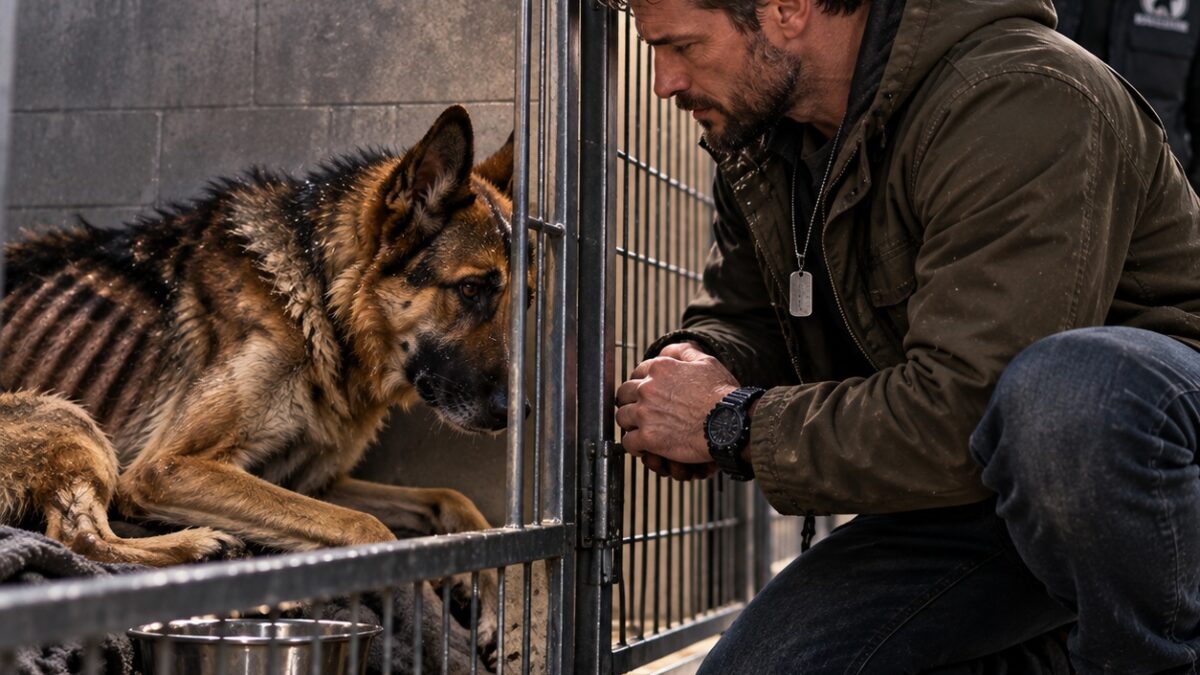
I drove home without adopting him.
That surprised Mason.
It surprised Callum even more.
When I returned to North Star Cabin that evening, the deputy called before I’d finished putting away my groceries.
“Well?”
“Well, what?”
“Did you get a dog?”
“No.”
There was a pause.
“You drove nearly two hours each way to look at dogs and came home without one?”
“That was always a possibility.”
“I know you, Calder. What happened?”
I stood beside the kitchen counter.
Outside, the last October sunlight caught the golden grass along the lower slopes of Crown Elk Range.
“There’s a shepherd named North.”
“Good name.”
“He’s not doing well.”
“What kind of not doing well?”
“His handler died.”
Callum became quiet.
I stared toward the mountains.
“He doesn’t eat much. Doesn’t respond to people.”
“Sounds familiar.”
“Callum.”
“What?”
“Don’t.”
He sighed.
“I’m not saying you’re a dog.”
“Good.”
“Although your table manners are worse.”
I ended the call.
But I didn’t forget North.
Two days later, I drove back to Pine Ridge.
I told myself I wanted to ask Mason a few questions about the dog’s medical history.
Instead, I found myself sitting outside the same kennel.
North was facing the front this time.
He lifted his head when I approached.
I sat down.
“Morning.”
He watched me.
“I haven’t brought anything.”
His ears shifted.
“I’m beginning to think you prefer that.”
We stayed there for almost half an hour.
On my third visit, North stood and walked toward the gate.
On the fourth, I rested my hand loosely beside the bars.
I didn’t reach through.
Didn’t call him closer.
Didn’t try to make him perform.
He studied my fingers.
Then approached.
His nose touched my knuckles.
Two seconds.
Maybe less.
Then he stepped back.
I looked at Mason.
“What would it take?”
The trainer didn’t smile.
That was one reason I trusted him.
“It would take knowing you’re the right home.”
“Fair.”
“Property assessment. Veterinary plan. Supervised interactions. Clear understanding of his needs.”
I nodded.
Mason continued.
“And you don’t get to turn every walk into training.”
I raised an eyebrow.
“I’m not looking for a search dog.”
“Good.”
He glanced toward North.
“Working dogs sometimes forget they’re allowed to just be dogs.”
I looked at the shepherd.
Then back at Mason.
“People too?”
His expression softened.
“Sometimes.”
A week later, the paperwork was complete.
Mason handed me a thick folder beside my old Ford Bronco.
North sat cautiously in the open rear compartment.
“Don’t try to turn him back into the dog he was,” Mason said.
I frowned.
“Why not?”
“Because he may not need to go backward.”
Mason looked at North.
“He might need the chance to become something different.”
I considered that.
Then closed the rear door gently.
The drive home took nearly two hours.
No radio.
No conversation.
North lay quietly behind me.
Whenever I checked the mirror, his ears were upright.
But his eyes were tired.
When we reached the cabin, I opened the rear door.
He climbed down slowly.
Smelled the ground.
Looked at the pines.
Then toward the front porch.
I opened the door.
“Not many rules.”
North stared.
“Don’t eat the furniture.”
Nothing.
“I’ll try not to either.”
He remained in the yard.
I sat on the porch step.
Waited.
After several minutes, North approached.
One paw touched the first step.
Then the second.
He stopped beside me.
I moved aside.
He entered.
And that was how the loneliest house above Silver Creek acquired its second occupant.
North didn’t become comfortable immediately.
For the first week, he behaved like a cautious guest who expected someone to ask him to leave.
He slept in the corner between the fireplace and hallway.
He never climbed onto the furniture.
Never begged for food.
Never barked without a reason.
When I crossed a room too quickly, his body tightened.
Then relaxed after he recognized me.
I placed his food bowl in the same location every day.
He usually waited until I walked away before eating.
On the third morning, I noticed he’d eaten perhaps a quarter of his food.
On the sixth, he remained in the room while I put it down.
I considered that progress.
The old version of me would’ve wanted measurable results.
A target weight.
A training schedule.
Daily milestones.
But North wasn’t a rehabilitation project I could complete.
He was a living creature trying to decide whether he could trust another person.
And the more I watched him, the less interested I became in rushing.
Dr. Elodie Mercer arrived that afternoon.
She was thirty-six, a veterinarian from Silver Creek, with chestnut-brown hair tied low, intelligent gray-green eyes, and the calm patience of someone who spent much of her working life convincing frightened animals not to bite her.
She knelt several feet from North.
Waited until he appeared comfortable.
Then examined him carefully.
Weight.
Hydration.
Gums.
Coat.
Movement.
Joint flexibility.
North tolerated the examination without seeking affection.
When Elodie finished, she looked at me.
“He’s underweight, not fragile.”
I nodded.
“That distinction matters.”
“What if I cook him steak?”
She stared.
“If you’re planning to feed him steak every night, I’m going to adopt you instead. Somebody clearly needs to supervise your spending.”
I almost laughed.
North’s ears shifted toward me.
Elodie noticed.
She pretended not to.
Then she explained the feeding plan.
Small measured portions.
Gradual increases.
Consistent routines.
Exercise appropriate to his condition.
No forcing attention.
No turning every improvement into a test.
“I don’t test him,” I said.
Elodie raised an eyebrow.
“You’re a former SEAL living alone on a mountain.”
“That isn’t an answer.”
“Exactly.”
I sighed.
“Callum talks too much.”
“Constantly.”
She smiled.
“And for once, I’m grateful.”
North’s recovery happened in inches.
He learned the sound of the stove door.
The cupboard holding his food.
The creak of the second stair.
The rhythm of my footsteps.
By the ninth day, he followed me to the front door.
I opened it.
He stopped.
I stepped outside.
He remained in the hallway.
I didn’t call him.
Two mornings later, I was stacking firewood when I heard claws touching the porch.
I turned slowly.
North stood half inside the doorway.
One front paw rested on the porch.
Then the second.
He looked toward the yard.
Smelled the air.
And stepped into the sunlight.
I kept stacking wood.
But something inside me loosened.
Four steps.
That was all.
Four ordinary steps.
Yet I knew how much courage they had taken.
That evening, I looked toward the empty chair across my table.
“We made four steps today, Jonah.”
The name startled me.
I hadn’t spoken it in weeks.
North lifted one ear.
I looked away.
“Yeah,” I whispered. “Four.”
Mason called every Sunday.
He never asked whether North was fixed.
Instead, he asked practical questions.
How much had he eaten?
Was he investigating new smells?
Where did he sleep?
Did he approach voluntarily?
Could he move away when uncomfortable?
Then he suggested simple scent games.
Nothing tactical.
Nothing demanding.
Just brief exercises to give North something familiar and enjoyable to do.
I hid an old glove beneath a bench outside the shed.
North smelled its mate.
Then investigated the yard.
He circled twice.
Stopped.
Changed direction.
And found it.
I rewarded him.
Then ended the exercise.
He looked surprised.
Maybe even disappointed.
I smiled.
“That’s enough for today.”
The old version of me would’ve increased the difficulty immediately.
But I remembered Mason’s warning.
I wasn’t trying to prove what North could do.
I was trying to show him he could enjoy doing it.
The first hard winter wind arrived near the end of November.
A pine branch scraped across the roof.
I woke before I understood where I was.
For several terrible seconds, my bedroom disappeared.
There was only white.
Snow across my goggles.
A rope cutting against my glove.
Radio static.
Someone shouting.
“Calder, pull back!”
Jonah’s voice somewhere beyond the wind.
Then my own voice.
“He’s still out there!”
I sat upright.
My breathing was too fast.
My hands were cold.
I stared around the room.
Wooden walls.
Window.
Bed.
Montana.
Not the mountain where Jonah died.
Not that night.
I pressed both hands against my face.
When I looked up, North was sitting in the hallway.
He didn’t approach.
Didn’t whine.
Didn’t act as though he understood every terrible memory inside me.
He simply remained there.
I lowered myself to the floor.
My back rested against the bed frame.
Several yards separated us.
Neither moved.
The wind scraped another branch against the roof.
I flinched.
Then breathed.
North slowly lowered himself onto his chest.
His head rested between his paws.
I stayed on the floor.
Sometime before morning, I fell asleep.
North did too.
At sunrise, I woke with a stiff neck.
The hallway was empty.
For one irrational second, panic struck me.
I stood too quickly.
Walked into the living room.
North was there.
But he’d moved something.
My old left combat boot lay beside his sleeping place.
One paw rested against the leather.
I stared.
That boot had been part of the field kit I wore during my final deployment.
I hadn’t used it in years.
North couldn’t know what it meant.
He probably liked the smell.
Leather.
Old fabric.
The traces of a person he was beginning to trust.
Still, I stood there longer than necessary.
North opened one amber eye.
I swallowed.
“You have terrible taste in souvenirs.”
He closed it again.
I left the boot where it was.
By early December, North’s body began changing.
The hollowness around his flanks softened.
His black saddle regained some shine.
The yellow-gold fur along his legs looked richer.
His appetite improved.
Elodie weighed him during another visit.
“Slowly,” she said. “Exactly how we want it.”
Our walks became longer.
One morning, we descended toward a creek below the cabin.
Thin ice glazed the rocks.
I stepped onto what looked like stable stone.
It shifted.
My injured left leg failed for half a second.
I dropped to one knee.
Caught myself with one hand.
North spun around immediately.
He didn’t bark.
He moved close to my left side and stood firm.
I placed one hand across his shoulders for balance while I rose.
Once I was upright, he stepped away.
I brushed snow from my knee.
“Do not tell Callum.”
North tilted his head.
“I recognize extortion when I see it.”
His mouth opened slightly.
Almost a pant.
I looked at him.
“Are you laughing at me?”
His tail moved.
I shook my head.
“Unbelievable.”
A week later, Mason visited.
He watched North move around the property.
Checked his condition.
Observed the way he stayed near me without appearing trapped.
Then he looked thoughtful.
“Want to try something?”
Callum happened to be delivering winter road notices that afternoon.
Mason recruited him for a scent exercise.
The deputy walked several hundred yards into the woods while North remained with us.
Fifteen minutes later, Mason handed me a glove Callum had left behind.
“Nothing complicated,” he said.
“Let North decide whether he wants to work.”
I offered the glove.
North smelled it.
His posture changed.
Head lowered.
Breathing deliberate.
Then he moved.
I followed on a long line.
He crossed the first clearing.
Lost the scent near frozen ground.
Circled downwind.
Then recovered it.
Less than ten minutes later, we found Callum sitting behind a fallen pine.
He raised both hands.
“I surrender!”
North ignored him.
He looked back at me.
Mason crouched beside the shepherd.
“He remembers more than I expected.”
I studied North.
For the first time, I didn’t see the thin dog facing a kennel wall.
I saw the animal who had existed before grief convinced him there was nothing left worth doing.
A few days later, North began watching the western mountains.
He would stand on the porch.
Lift his muzzle.
And stare toward Crown Elk Range.
I saw nothing unusual.
No elk.
No approaching vehicle.
No person moving through the timber.
Then Owen Mercer stopped by.
Owen was sixty-seven, a retired forest ranger who’d spent decades reading the mountains more carefully than most people read weather reports.
He noticed North immediately.
“What’s he watching?”
“Don’t know.”
Owen studied the sky.
Thin clouds were spreading across the distant ridges.
The wind had changed direction.
Owen frowned.
“Don’t like that.”
“Forecast says routine system.”
“Forecast doesn’t live here.”
The next morning, the advisory changed.
A low-pressure system had intensified faster than expected.
Snow totals increased.
Wind projections doubled.
Temperatures were expected to fall sharply.
Near noon, my phone vibrated.
A message from Harper Quinn, director of Silver Creek Search and Rescue.
Major winter weather possible within forty-eight hours. Crown Elk personnel review readiness.
I read it twice.
North stood beside the door.
He was staring west again.
This time, I didn’t dismiss it.
The morning before the storm was beautiful.
That was the danger of the mountains.
They rarely looked guilty before they hurt someone.
Silver Creek woke beneath a pale blue sky.
Families bought extra bread, batteries, propane, and salt.
Children dragged sleds toward the hill behind the elementary school.
Far above town, Crown Elk Range looked peaceful.
That morning, Grace Bellamy and her son Evan left Silver Creek to hike toward Mirror Lake.
Grace was sixty-two, a retired English teacher whose husband, Thomas, had died eight months earlier.
Evan was thirty-one, a nature photographer who had inherited his father’s love of mountains and his tendency to prepare carefully while pretending everything was easy.
They weren’t inexperienced.
They checked the weather.
Signed the trail register.
Listed their route.
Expected return time.
Emergency contact.
Vehicle information.
They carried appropriate clothing and supplies for a day hike.
The severe weather wasn’t expected until after they planned to return.
They had a reason for making the trip.
Thomas had proposed to Grace beside Mirror Lake.
After his death, she’d promised to return there with some of his ashes.
For months, she’d postponed it.
Finally, Evan convinced her they should go together.
By midmorning, they were above the lower tree line.
The air was cold.
The trail clear enough to follow.
But near noon, the wind shifted.
Clouds thickened over the ridges.
Evan looked upward.
“That moved fast.”
Grace followed his gaze.
“Should we turn?”
He checked his phone.
No signal.
He studied the sky.
“Let’s not push to the lake if this keeps getting worse.”
They continued only a short distance.
Then snow began falling.
They turned back.
But the storm accelerated faster than anyone expected.
Tracks disappeared beneath blowing snow almost as soon as they were made.
Visibility shortened.
The trail became difficult to recognize.
And by sunset, Grace and Evan hadn’t reached their vehicle.
The county ranger found their truck during a trail-closure sweep.
No one had signed them out.
Callum was notified.
Within twenty minutes, he reached the Silver Creek fire station.
Harper Quinn was converting the main room into a search command post.
Maps covered folding tables.
Radios charged along one wall.
Weather data filled a laptop screen.
Volunteers gathered with packs and rescue equipment.
Harper was forty-six, experienced, disciplined, and completely uninterested in people who confused bravery with recklessness.
She divided the mountain into search sectors.
Two teams went out before darkness fully settled.
But the storm kept worsening.
Higher terrain became dangerous.
Wind-loaded slopes developed.
Visibility collapsed.
Teams began returning when they reached the safety limits Harper had set.
Nobody had failed.
They’d simply reached conditions too dangerous to ignore.
At North Star Cabin, I heard the search traffic over my county scanner.
The names came through.
Grace Bellamy.
Evan Bellamy.
Missing.
I stood beside the stove.
North lay nearby.
Another transmission crackled.
Search teams repositioning.
Visibility poor.
High trails closed.
I turned down the volume.
“Not our job,” I told North.
He watched me.
I didn’t like how the words sounded.
They were true.
I wasn’t part of the county search team.
North wasn’t a certified search-and-rescue dog.
Nobody had asked us to do anything.
But the last time someone disappeared in snow, I’d spent the next three years wondering what would’ve happened if I’d done something differently.
And I knew that was the real reason I couldn’t stop listening.
Near ten that night, a convenience-store clerk called the search command post.
She remembered Grace and Evan buying coffee that morning.
Evan had mentioned an old ranger shelter near Mirror Creek.
He’d joked that if his mother complained about the cold, he’d rent her the luxury cabin.
Harper checked an older forestry map.
There it was.
A small shelter nearly erased from newer public maps.
The information changed the search plan.
Not proof.
Not a rescue.
But a reason to believe the Bellamys might have known where to seek cover.
Near midnight, another ground team returned.
Snow was too dense for effective visual tracking.
Unstable slopes blocked a second route.
Harper marked the areas that had been checked.
Then Callum drove up the mountain road toward my cabin.
I opened the door before he knocked.
He stood there with a waterproof map case and two sealed bags.
“You’re not here with groceries.”
“No.”
He entered.
Placed the bags on the table.
One contained a cream-colored scarf.
The other held a navy flannel shirt.
“The family brought these from home,” he said.
I stared at them.
Then at him.
“No.”
Callum unfolded the map.
“I haven’t asked yet.”
“You drove through a storm at one in the morning carrying scent articles.”
“Fair point.”
I turned away.
Callum studied the contours.
“Harper needs someone who knows cold-weather navigation.”
I said nothing.
“Someone who understands when terrain says no.”
I looked toward the fire.
“The last man I went looking for in snow didn’t come home.”
Callum didn’t soften his voice.
“That’s exactly why Harper wants somebody who knows what happens when things go wrong.”
My jaw tightened.
North rose.
He approached the table.
Smelled Grace’s scarf.
Then Evan’s flannel.
His entire posture changed.
The same quiet focus I’d seen during Mason’s training exercise.
He looked toward the door.
I stared at him.
Then reached for my phone.
Mason answered after four rings.
I explained the situation.
He listened.
Then said, “North isn’t certified for search and rescue.”
“I know.”
“He can track. That doesn’t make him operationally ready.”
“I know that too.”
“If Harper uses him, he’s support. Not a replacement for qualified personnel or safe search procedures.”
“Understood.”
“You follow her command structure.”
“Yes.”
“And if she calls you back?”
I closed my eyes.
For a second, I saw Jonah again.
White snow.
A rope.
The moment I obeyed the order to withdraw.
Then I looked at North.
“I come back.”
At two-thirty in the morning, my Bronco pulled into the Silver Creek fire-station lot.
Harper met us near the equipment bay.
She looked me over once.
“Leg?”
“Functional.”
“That wasn’t the question.”
“Cold makes it ache. No instability.”
She had a medic assess me and watched while I demonstrated that I could move safely under load.
Then she checked my equipment.
Insulation.
Spare gloves.
Headlamp.
Emergency bivouac.
Navigation gear.
Medical kit.
Avalanche transceiver.
Probe.
Shovel.
Only after that did she look at North.
“I don’t use miracles, Calder.”
“Good.”
I met her eyes.
“Neither do I.”
At the trailhead, North completed a brief scent-discrimination exercise.
Several rescuers had already crossed the area.
The ground was contaminated with multiple human scents.
North worked slowly, then identified a line that differed from the recent search traffic.
Harper watched carefully.
He wasn’t certified.
Nobody pretended otherwise.
But his response was useful enough to justify a limited supporting role.
She assigned me to Lucas Marr.
Lucas was thirty-eight, an experienced volunteer search-and-rescue medic with eleven years of backcountry work behind him.
He shook my hand.
“I’ve heard stories.”
“Most are lies.”
“Good. I prefer disappointing coworkers.”
Harper pointed to the map.
“North sector. Mirror Creek drainage.”
I nodded.
“You remain within the assigned boundaries unless redirected.”
“Understood.”
“If I order recall, you come back.”
“Yes.”
“Immediately.”
I held her gaze.
“That used to be the part I wasn’t good at.”
Her expression didn’t change.
“Then today you learn.”
Before dawn, three teams prepared to move.
Headlamps glowed through blowing snow.
Radios clicked.
Harness buckles snapped.
Nobody cheered.
Nobody made speeches.
The mountain ahead wasn’t waiting for courage.
It was waiting for mistakes.
I checked my final carabiner.
Lucas adjusted his pack.
North stood between us.
Yellow-gold fur beneath a black saddle.
Ears forward.
Body calm.
I crouched and offered Grace’s scarf one last time.
North breathed in.
Then turned toward the trail.
“Easy, buddy.”
He stepped forward.
I followed.
Lucas came behind us.
And together, we entered the storm.
Within minutes, the trailhead disappeared.
The world narrowed to wind, snow, and whatever North could still smell beneath both.
I followed the shepherd with one gloved hand controlling the tracking line.
Lucas remained several paces behind.
We didn’t talk much.
The mountain punished distraction.
Snow drove sideways through the pines.
At times I could see sixty yards.
Then the wind shifted and visibility dropped to a fraction of that.
I checked bearings.
Elevation.
Drainage direction.
Slope exposure.
The old topographic markings Owen had supplied.
North provided something different.
A nose.
A set of ears.
Years of scent experience.
But I didn’t let the dog replace the map.
We followed both.
For the first hour, North worked steadily.
He lowered his head in sheltered areas.
Raised it where wind carried scent.
Cut sideways when the trail weakened.
Then corrected himself.
Lucas watched him.
“Does he always move like he knows something we don’t?”
“No.”
“That was reassuring for nearly half a second.”
I almost smiled.
At a fork, faint boot prints crossed the snow toward the east.
Lucas crouched.
“Two people?”
“Possible.”
North approached.
Smelled them.
Then turned away.
Lucas frowned.
“He doesn’t like them?”
“Dogs don’t vote.”
I brushed snow from one print.
The tread had a broad triangular heel pattern.
I’d seen something similar on a rescuer’s boots earlier.
“Probably last night’s search team.”
Lucas examined it.
“You sure?”
“Mostly.”
“Excellent. My favorite kind of certainty.”
North was already working north.
We followed.
Twenty minutes later, he stopped beside a snow-covered shrub.
Something dark protruded beneath it.
I cleared loose powder.
A torn nylon strap.
Black with blue stitching.
Broken plastic buckle.
Lucas examined it.
“Trekking pole?”
“Looks like it.”
I photographed it.
Recorded the coordinates.
Called Harper.
“Command, North sector three. Possible personal equipment. Sending location.”
Static swallowed part of the reply.
Then Harper answered.
“Copy. Family description includes blue-black trekking poles carried by Evan Bellamy.”
Lucas looked at North.
“That’s more than we had an hour ago.”
I secured the strap.
“Then let’s not waste it.”
Farther up the mountain, the scent weakened.
North slowed.
Turned left.
Stopped.
Returned.
Moved right.
Stopped again.
Lucas watched.
“He lost it.”
“He lost the trail.”
“Difference?”
“A trail can come back.”
I shortened the line and guided North beneath dense fir trees where the wind was weaker.
I offered water.
Waited.
Then presented Grace’s scent article again.
North took a long breath.
His posture changed.
He moved back into the snow.
This time, he began working wide arcs.
Left.
Right.
Forward.
Back.
Searching for fragments.
I didn’t rush him.
Years earlier, I’d believed hesitation was weakness.
Now I understood that forcing speed onto uncertainty usually made things worse.
Nearly twenty minutes passed.
Then North stopped at the edge of a shallow depression.
He lifted his head.
Turned sharply downhill.
And moved.
A hundred yards farther down, North veered toward a lone pine twisted by years of wind.
There were no visible footprints beneath it.
Only untouched snow.
North circled once.
Then sat.
I frowned.
“He doesn’t usually sit on a trail.”
Lucas looked around.
“See anything?”
I approached.
A pale corner protruded from the snow beneath the tree.
Paper.
I knelt.
Carefully pulled it free.
A laminated photograph.
Grace Bellamy stood beside a gray-haired man near a mountain lake.
Thomas.
Her late husband.
On the back were six words.
One more sunrise at Mirror Lake.
Lucas exhaled.
“She carried it with the ashes.”
I stared at the smiling couple.
The photograph had probably slipped from Grace’s pack when she stopped beneath the tree.
North likely caught her scent on something she’d handled repeatedly.
Nothing supernatural.
Yet the sight of that man’s face beneath the snow stopped me.
Some people climbed mountains to say goodbye to the dead.
Others climbed because they still didn’t know how.
I placed the photograph inside a waterproof pouch.
Then looked at North.
“Let’s find her.”
He rose.
The trail led into a protected hollow.
The wind weakened.
But the snow deepened.
There, we found Grace’s backpack.
Only the upper edge remained visible beneath drifting powder.
Lucas pulled it free.
Inside were gloves.
Water.
First-aid supplies.
A sealed container holding Thomas’s ashes.
I studied the surrounding snow.
Several branches had been broken deliberately.
A shallow impression showed where someone had sat or fallen.
“They stopped here,” I said.
Lucas nodded.
“Then changed direction.”
“Toward shelter?”
“Looks possible.”
We continued.
My left leg began aching.
The cold pain settled around old scar tissue.
Lucas noticed my shorter stride.
“How bad?”
“Three.”
“Out of?”
“Depends who’s asking.”
“A medic.”
“Then four.”
He shook his head.
“At least you’re teachable.”
The hollow ended beneath a steep, wind-loaded slope.
The direct route crossed below it.
Lucas checked his watch.
“Going around adds thirty or forty minutes.”
I studied the snow above us.
A smooth pillow had accumulated along the lee side.
The shortcut was obvious.
So was the danger.
“We go around.”
Lucas nodded.
No argument.
After several minutes on the safer traverse, he asked quietly, “Three years ago, would you have taken the long way?”
I knew what he meant.
I kept walking.
“Three years ago, I thought faster always meant better.”
Lucas didn’t answer.
He didn’t need to.
By early afternoon, radio communication had deteriorated.
Messages arrived in fragments.
Harper confirmed our position.
Then static erased the rest.
North continued working.
The hollow narrowed beneath a rocky outcrop where snow had piled against the cliff.
Suddenly, he stopped.
His head tilted.
I nearly walked past him.
North stepped closer to the rock wall.
Paused.
Then barked.
Once.
Sharp.
Lucas turned.
“What?”
North barked again.
I listened.
Wind.
Nothing else.
The shepherd moved three feet left.
Barked a third time.
Lucas dropped to one knee.
Pressed the side of his hood toward the snowbank.
Several seconds passed.
Then his expression changed.
“Wait.”
I crouched.
He raised one finger.
“There.”
I held still.
A faint sound.
Tap.
Pause.
Tap.
Not a voice.
Something hard striking something else.
I dropped my pack.
“Here.”
We began digging.
North backed away when instructed.
Snow gave way beneath our shovels.
Then branches appeared.
Packed deliberately across a narrow opening beneath the rock.
A shelter.
Not the ranger cabin.
A natural recess reinforced against the wind.
Lucas pushed through first.
His headlamp swept the darkness.
“Grace?”
A weak sound answered.
She sat against the stone wall wrapped in an emergency blanket.
Her light-blue parka was visible beneath it.
Her face was pale.
Her lips had lost color.
Wet strands of silver-blonde hair clung to her cheeks.
One ankle had been braced crudely between pieces of wood.
She held a metal cup.
The source of the tapping.
Lucas moved immediately.
“Grace, I’m Lucas with search and rescue.”
She stared at him.
“Can you tell me your full name?”
“Grace Bellamy.”
“Good. Do you know where you are?”
She swallowed.
“Somewhere I intend never to visit again.”
Lucas glanced at me.
“Orientation intact.”
Even now, she could joke.
Then she saw North standing behind me.
Her expression changed.
“Oh.”
I crouched near the entrance.
“You’re safe for the moment.”
She looked beyond us.
Her eyes searched the opening.
“Where’s Evan?”
My stomach tightened.
“He isn’t here?”
Grace closed her eyes.
“My ankle gave out yesterday afternoon.”
She swallowed.
“We found this place. He tried to get a signal.”
Lucas paused while checking her pulse.
“How long ago did he leave?”
Grace looked directly at me.
Fear remained in her eyes.
“Yesterday.”
One word.
And suddenly the shelter felt smaller.
Until that moment, North had been searching for two people traveling together.
Now there was one more person.
Somewhere beyond the rock.
The wind.
The falling snow.
Evan Bellamy was alone.
Lucas worked quickly but carefully.
Grace was cold.
Exhausted.
Her ankle badly injured.
He stabilized what he could and assessed her condition without pretending the shelter allowed a complete diagnosis.
We contacted Harper after several attempts.
The radio crackled.
“Command, North sector. Grace located alive. Lower-leg injury. Cold exposure. Moving toward ranger shelter.”
Static swallowed the coordinates.
I repeated them.
Harper finally acknowledged.
“Copy. Extraction team redirecting. Several hours minimum.”
Lucas looked at me.
“That settles it.”
We couldn’t leave Grace in the rock recess.
We wrapped her in additional insulation.
Stabilized the ankle.
Used a compact emergency drag sheet to move her carefully.
I took the forward pull.
Lucas controlled the rear and monitored her.
North ranged only a few yards ahead.
There was no dramatic charge through the storm.
Every hundred feet required decisions.
Snow depth.
Wind exposure.
Tree cover.
Grace’s condition.
At one point she said, “I can walk.”
Lucas answered without looking up.
“No.”
“I taught teenagers for thirty-five years.”
“That explains your confidence. Not your ankle.”
Grace laughed weakly.
Twenty minutes later, the old ranger shelter appeared through the trees.
It was a low, weather-darkened cabin nearly buried beneath snow.
One shutter hung crooked.
The roof sagged slightly but remained intact.
Inside were two bunks, an iron stove, and dry emergency wood.
We moved Grace onto a bunk.
Lucas continued warming and monitoring her.
I cleared the stove vent and started a small fire.
North lay near the door.
He wasn’t relaxed.
He was waiting.
One Bellamy had been found.
The other hadn’t.
Grace watched the dog for a long time.
“Evan likes dogs,” she whispered.
I looked toward her.
“He always wanted one. Thomas thought we traveled too much.”
She paused.
“After Thomas died, Evan started coming over every Sunday.”
Lucas adjusted her blanket.
“Nice of him.”
“He pretended he needed my cooking.”
“Was he wrong?”
“Completely. I’m a terrible cook.”
She almost smiled.
Then looked at me.
“He left because of me.”
I didn’t rush to contradict her.
“Tell me what happened.”
She explained that they’d reached the rock recess after she twisted her ankle.
For a moment, Evan’s phone displayed one bar of signal.
Then it disappeared.
He believed a small ridge southwest of the shelter might give him enough elevation to call for help.
“He said fifteen minutes up. Fifteen back.”
“What time?”
“About three-thirty yesterday.”
I checked my map.
“And then?”
Her eyes filled.
“The snow got worse.”
She swallowed.
“I told him not to go. We argued.”
Her voice broke.
“That was the last thing I said to him.”
I knew what it felt like when the last words spoken to someone became more important than all the words that came before.
I looked at her.
“People don’t remember love by the last sentence.”
Grace stared.
“They remember everything before it.”
Lucas glanced at me.
I hadn’t intended to say that much.
But the words were true.
Harper came through the radio again.
“Calder, status?”
I answered.
Grace was stable.
The shelter was secure.
Lucas could remain with her.
Then I said what Harper had expected.
“I’d like authorization to continue searching for Evan.”
There was a long pause.
“You’ll be alone with North.”
“Yes.”
“Leg?”
“Stable.”
“Visibility?”
“Poor, but workable beneath the trees.”
Another pause.
Harper wasn’t deciding whether I was brave.
She was deciding whether sending me out increased the chances of rescue or created another emergency.
Finally, she answered.
“Approved under conditions. Ninety-minute hard turnaround. No extension without direct authorization.”
“Copy.”
“If communications fail, the turnaround still stands.”
“Understood.”
I checked my watch.
Ninety minutes.
I would not repeat the mistake of believing determination could substitute for judgment.
Before I left, Grace reached beneath her parka.
She pulled out a small brass compass hanging from a cord.
Its surface was scratched.
“Evan’s father gave him this when he was twelve.”
I frowned.
“Why do you have it?”
“He gave it to me before he left.”
She turned it over.
On the back, a short sentence was engraved.
Come back by the way you came.
Grace stared at the words.
“He said I was more likely to get lost sitting still.”
Her fingers closed around it.
I understood what she was telling me.
Evan had gone into the storm without the compass he’d carried on serious hikes since childhood.
Not because he forgot it.
Because he wanted his mother to have something dependable if he didn’t return.
She extended it toward me.
I shook my head.
“Keep it.”
“But he gave it—”
“We’ll bring back the part that matters.”
The promise frightened me the moment I said it.
I couldn’t guarantee Evan was alive.
Couldn’t guarantee North would find him.
Couldn’t guarantee I’d return before the weather worsened.
But Grace needed hope grounded in action.
And I still had time to act.
Outside, the storm sounded louder after the shelter’s warmth.
I offered Evan’s flannel shirt to North.
He inhaled deeply.
Then began working.
At first, the scent line was weak.
North followed it uphill.
Stopped near a fallen fir.
Doubled back.
Cut across the slope.
I watched carefully.
Movement wasn’t certainty.
Fifty yards later, I found a trekking-pole mark in crusted snow beneath an overhang.
Farther uphill, another.
Then nothing.
North began casting.
Left.
Right.
Back down.
Forward.
I checked my watch.
Sixty-eight minutes remained.
I resisted the urge to hurry him.
Rushing a confused tracker usually created two confused trackers.
North suddenly turned toward young spruce.
There, half-buried against a trunk, lay a dark-gray glove.
I photographed it.
Marked the coordinates.
Called Harper.
“Possible Evan glove. Continuing southwest.”
Her reply arrived broken but intelligible.
“Copy. Time limit remains.”
“Understood.”
I put the glove away.
North moved ahead.
The ridge became less distinct beneath drifting snow.
I began to suspect Evan had reached higher ground, lost his orientation in the whiteout, then descended in the wrong direction.
That wasn’t incompetence.
In a true whiteout, the world could erase the horizon, slope, and distance all at once.
North moved into a shallow basin.
Then stopped.
No bark.
No dramatic signal.
He lowered his head toward one patch of snow.
And began digging.
My pulse changed.
“North?”
He dug faster.
I called Evan’s name.
Nothing.
The surface looked ordinary.
Wind had smoothed it.
I removed my avalanche probe.
Assembled it.
Began checking around North’s position.
First push.
Nothing.
Second.
Nothing.
Third.
Resistance.
Soft.
Not rock.
I stopped breathing for half a second.
Then began digging downhill from the point.
Controlled strokes.
Snow thrown away from the probe.
North backed off when instructed but remained close.
I dug.
A dark shape appeared.
Fabric.
Then a shoulder.
“Evan!”
No response.
I cleared snow from his head and chest.
Protected his airway.
Checked for breathing.
There.
Shallow.
A pulse.
Slow, but present.
He was alive.
I tried the radio.
“Command, North sector. Subject located.”
Static.
I tried again.
No usable response.
Evan was severely cold.
Unresponsive.
Physically fragile.
I handled him carefully.
Insulated him from the snow.
Protected his airway.
Added thermal layers.
North lay on the windward side several feet away, reducing some of the snow blowing across the work area.
Not warming Evan.
Just helping create a calmer pocket.
I checked my watch.
The turnaround time had arrived.
The original instruction had been simple.
Turn back.
But the situation had changed.
Leaving Evan exposed was no longer the same as stopping an unsuccessful search.
I called again.
“Harper, Evan found alive. Unconscious. Need extraction instructions.”
Static.
I looked uphill.
The snowpack above us bothered me.
I needed to move Evan only far enough to reach mature trees where the slope flattened.
I prepared the compact drag system.
Then North stood.
His ears came forward.
For a moment, I heard nothing.
Then the mountain made a deep, muffled sound.
Whumph.
I froze.
The noise seemed to travel through my boots.
A settlement in the snowpack.
North stepped backward.
I looked uphill.
“Move.”
I secured Evan.
Dragged him toward the trees.
Not a sprint.
Controlled urgency.
Ten yards.
Fifteen.
Behind us, a small slab released.
Snow slid through the shallow basin where I’d been kneeling moments earlier.
Not an enormous avalanche.
Not a roaring wall swallowing the mountain.
But enough heavy snow to bury an unconscious man again.
I reached the trees.
Dropped beside Evan.
My breathing came hard.
For one terrible second, all I saw was another winter.
Another slope.
Jonah disappearing beyond reach.
My hands tightened.
Then North stepped beside me.
Snow clung to his muzzle.
I looked at him.
And the memory loosened.
This wasn’t then.
This was now.
Evan was alive.
I was alive.
And the right decision wasn’t to fight the mountain.
It was to get both of us home.
I raised the radio.
“Command, North sector. Do you copy?”
Static.
Again.
“Harper, do you copy?”
A faint voice broke through.
“Calder, go.”
I closed my eyes once.
“Found Evan.”
Static cracked.
I pressed the transmitter.
“Found Evan. Alive.”
A reply almost came through.
Then the radio went silent.
At the Silver Creek command post, only pieces of the message arrived.
Static.
My voice.
Three words.
Found Evan. Alive.
Harper straightened over the radio console.
“Calder, repeat condition.”
Nothing.
“Calder?”
Only static.
Nobody celebrated.
Finding a missing man and bringing him home were two separate victories.
Callum moved toward the search map.
Owen examined the western drainage.
Elodie stood near the medical staging table.
“Alive is a good beginning,” she said.
Harper nodded.
“Beginning. Not ending.”
Beneath the mature firs, Evan stirred.
I leaned closer.
“Evan?”
A faint groan.
“Open your eyes.”
It took effort.
Eventually, his eyelids lifted.
Confusion came first.
Then pain.
Then awareness.
He tried to sit.
I placed a steady hand against his shoulder.
“Don’t move too quickly.”
He stared at me.
“Who…?”
“Rhett Calder. Search and rescue.”
North stepped closer.
Evan focused on him.
“That yours?”
I looked at the shepherd.
“Apparently.”
For a moment, something close to a smile appeared on Evan’s face.
Then his expression changed.
“My mother.”
I felt my chest tighten.
“She’s alive.”
He stared.
“Mom?”
“She’s in a ranger shelter with a medic.”
His eyes filled.
“She made it?”
“Yes.”
He turned his face away.
And cried.
Quietly.
Exhausted.
I didn’t tell him everything was fine.
It wasn’t.
He was dangerously cold.
Injured.
Still miles from safety.
But he had the one piece of truth he needed most.
His mother was alive.
Radio contact improved several minutes later.
Harper directed us toward an alternate extraction route using an old forestry corridor Owen identified on his map.
A lower-gradient path.
Sheltered by thicker timber.
An extraction team was moving toward us from below.
We were to meet at a designated point.
I secured Evan on the compact rescue sled.
North stayed near his side.
Evan watched the dog.
“Was he the one who found me?”
“Yes.”
He swallowed.
“Then I owe him something.”
“He prefers food.”
“That seems manageable.”
We began moving.
Slowly.
Carefully.
I pulled where the snow allowed the sled to glide.
Paused frequently to assess Evan.
When the ground was firmer and he felt capable, I helped him stand for short controlled stretches.
North remained close.
He no longer moved far ahead searching.
He stayed beside the man he’d found.
As we descended, Evan became more responsive.
He spoke in fragments.
“Mom shouldn’t have come.”
I looked back.
“She didn’t make you bring her.”
“No. I wanted her there.”
He breathed carefully.
“After Dad died, she stopped doing things.”
I listened.
“She packed his clothes. Paid bills. Answered sympathy cards. Returned casseroles.”
Another pause.
“She did everything grief required except keep living.”
I felt my grip tighten around the sled line.
Evan continued.
“She thought she had to take his ashes to Mirror Lake because she promised him.”
I nodded.
“And you?”
“I thought if I got her up there, maybe she’d understand saying goodbye wasn’t betraying him.”
The words struck somewhere deep inside me.
For three years, Jonah’s absence had shaped every part of my life.
Where I lived.
Who I avoided.
The invitations I refused.
The work I wouldn’t do.
I had called it remembrance.
Because remembrance sounded noble.
Fear didn’t.
North suddenly stopped.
The forestry line crossed a flat white opening between the trees.
He moved toward the edge.
Lowered his muzzle.
Then backed away.
I halted.
“What is it?” Evan whispered.
I examined the ground.
Nothing obvious.
Then I heard something faint.
Running water.
Beneath ice.
The map showed a small tributary crossing the old service corridor.
Snow had concealed the banks so completely that the frozen stream looked like ordinary ground.
I tested the edge with a pole.
The crust broke almost immediately.
Black water moved below.
Evan stared.
“Good catch.”
I looked at North.
“Don’t encourage him. He’s already unbearable.”
We detoured upstream until I found a narrower, safer crossing.
It cost fifteen minutes.
It might have saved us from something much worse.
After we crossed, Evan asked to stop.
I initially thought he was exhausted.
Then he pointed toward North.
The shepherd stood quietly beside the sled.
Evan removed one insulated glove.
His hand trembled as he extended it.
North didn’t move closer.
Evan stopped several inches away.
“I remember something,” he whispered.
“From under the snow?”
He nodded.
“Not much.”
His eyes stayed on the dog.
“I couldn’t move. I thought I’d fallen asleep.”
He swallowed.
“Then I heard scratching.”
North’s ears shifted.
“Something hitting the snow.”
Evan laughed once through sudden tears.
“I thought it was Dad.”
I said nothing.
“I knew he was gone, but I thought maybe he came because Mom wasn’t there.”
He looked embarrassed.
“Stupid, right?”
“No.”
North stepped forward.
Touched his nose gently against Evan’s bare knuckles.
Just for a second.
Then stepped away.
I knew the simpler explanation.
Evan had probably heard North digging while drifting in and out of consciousness.
His frightened, cold-impaired mind had given the sound a familiar meaning.
But I didn’t need to take that meaning away from him.
“Maybe,” I said as I helped him pull his glove back on, “you heard somebody refusing to leave you there.”
North resumed walking.
So did we.
Half an hour later, I heard voices.
At first I thought it was the wind.
Then someone shouted.
“Calder!”
I stopped.
North lifted his head.
“Here!”
Three figures emerged between snow-heavy firs.
The extraction team.
Their lead medic hurried toward Evan.
Another rescuer secured the sled.
North remained beside the patient while they checked his condition.
Temperature.
Pulse.
Awareness.
Circulation.
Finally, the medic looked up.
“We have him.”
Only then did North step aside.
I noticed.
So did the medic.
Neither of us said anything.
Some things became smaller when explained.
Grace reached the lower staging area first.
Lucas told her that Evan had been transferred into the extraction team’s care.
She began crying.
This time, she smiled while doing it.
Evan arrived more than an hour later.
Mother and son were transported to the regional hospital.
Both were expected to recover.
North and I were among the last from our sector to return to Silver Creek.
The fire-station parking lot was crowded.
Not with cheering spectators.
Paramedics were moving equipment.
Families waited under blankets.
Volunteers drank terrible coffee.
People stood quietly near the doors.
I stepped down from the transport vehicle.
North jumped down beside me.
Conversation faded.
Then somebody clapped.
One person.
Then another.
The applause spread.
I looked around.
Deeply uncomfortable.
Callum approached grinning.
“You can smile. It’s not against Navy regulations.”
“I’m considering legal action against everyone present.”
North sneezed.
Callum pointed toward him.
“At least one of you has timing.”
Elodie came forward.
She checked North’s paws.
Eyes.
Hydration.
Then stood and looked at me.
“You?”
“Still operational.”
“That isn’t a medical term.”
“It should be.”
She shook her head.
But she smiled.
Harper approached Mason, who’d driven in after hearing that North had successfully contributed to locating both missing hikers.
She looked toward the shepherd.
“I’d like him formally evaluated.”
Mason folded his arms.
“For search work?”
“For whatever he actually wants to do.”
Mason smiled faintly.
“I think North finished evaluating us first.”
Harper almost smiled.
Almost.
It was late when we finally drove home.
North Star Cabin seemed smaller after the mountain.
Quieter, too.
I removed my boots.
Lit the stove.
Placed North’s food bowl on the floor.
Then made myself a simple meal.
For a while, neither of us moved.
I sat at the table.
North looked at his bowl.
Then lowered his head.
And ate.
Not a few cautious bites.
Not enough to keep going.
The entire bowl.
I stopped halfway through my dinner.
Watched him lick the bottom.
Then look up.
“Well,” I said.
North sat.
“Apparently saving people works up an appetite.”
His tail struck the floor once.
I looked around.
One man.
One dog.
The same cabin.
The same stove.
The same mountains outside.
But somehow the room no longer seemed built for loneliness.
I looked down at North.
“Looks like both of us made it home.”
He lay beside the fire.
And for the first time in years, the silence didn’t sound like something was missing.
By the end of winter, Silver Creek had stopped talking about the rescue every day.
That suited me.
North continued recovering.
His weight improved.
His coat thickened.
He became more curious.
More willing to approach people.
More interested in ordinary life.
Mason continued checking on him.
Elodie visited regularly.
Callum still arrived with groceries I hadn’t requested.
Some things never changed.
But other things did.
Harper asked whether I’d consider teaching navigation to new search-and-rescue volunteers.
I refused.
Then thought about it.
Then called her back.
“Twice a month,” I said.
“No full-time commitment.”
“Didn’t ask for one.”
“I’m not leading teams.”
“Didn’t ask that either.”
I frowned.
“You’re irritating.”
“I’ve been told it improves survival rates.”
I accepted.
The first class had six volunteers.
North lay beneath a table while I explained contour intervals, drainage systems, winter route planning, and why a compass was useless if your pride convinced you not to check it.
Teaching felt strange.
But not bad.
It wasn’t returning to the Navy.
It was using what remained of the man I’d been.
Grace and Evan recovered.
Months later, Evan visited with his mother.
He brought North a small bag of treats.
Grace brought a photograph.
One they’d taken during the first mild spring weekend after the rescue.
Mother and son standing beside the lower trailhead.
Both smiling.
Alive.
Grace handed it to me.
“We finally went back,” she said.
I looked at the photograph.
“To Mirror Lake?”
“No.”
She smiled.
“We didn’t need to.”
Evan glanced toward her.
“Dad would’ve liked the shorter hike.”
Grace laughed.
“He would’ve complained that we weren’t getting enough exercise.”
I smiled.
For years, I’d believed finishing something meant returning to the place where it went wrong.
Now I understood that sometimes recovery led somewhere else.
Not backward.
Forward.
I still thought about Jonah.
That didn’t change.
Some nights, the wind came down from Crown Elk and I woke with the same old memories.
But the memories no longer controlled every decision.
I began talking about him.
Not just how he died.
How he lived.
The ridiculous jokes.
The arguments.
The way he made terrible coffee and insisted it was a matter of personal taste.
The time he’d tried teaching a young recruit to fish with an improvised line and somehow managed to hook his own jacket.
I told Callum those stories.
Then Elodie.
One afternoon, I found myself telling Mason about Jonah’s dream of neighboring cabins in the mountains.
Mason listened.
Then asked, “Do you think he would’ve liked this place?”
I looked around.
The pines.
The porch.
North sleeping in the sunlight.
“Yeah,” I said.
“He would’ve complained about the road.”
Mason smiled.
“Sounds like a friend.”
“He was.”
That was the first time in years I said those words without immediately returning to the moment I lost him.
One evening, I opened the storage closet.
North followed me down the hallway.
He stopped outside the doorway.
I pulled out an old box.
Dog tags.
Unit patches.
A folded photograph.
A wooden plaque.
I took out the photograph.
Jonah stood beside me in winter gear.
Younger than I remembered.
Smiling with the confidence of a man who hadn’t yet become a ghost in someone else’s home.
I sat on the floor.
For years, I’d believed healing meant reaching a day when his death stopped hurting.
Now I understood that day might never come.
Maybe it wasn’t supposed to.
I didn’t have to erase the pain to make room for something else.
I carried the photograph into the living room.
Placed it on the mantel above the fireplace.
Then I took out the wooden plaque.
The next morning, the rusty nail beside the barn door was no longer empty.
Jonah’s name was there.
Not hidden in a box.
Not buried beneath guilt.
Part of my home.
Part of my life.
Exactly where he belonged.
Spring arrived quietly.
Snow retreated toward the highest ridges.
Meltwater ran through gullies.
New grass covered the lower slopes.
North began spending long afternoons on the porch.
Elodie appeared more often.
Sometimes to check on North.
Sometimes with veterinary supplies.
Sometimes with no particularly convincing reason at all.
One afternoon, she arrived carrying a bottle of joint supplement.
“North doesn’t need that,” I said.
“I know.”
She walked directly to the refrigerator.
Opened it.
Looked inside.
Coffee.
Mustard.
Eggs.
Half a loaf of bread.
Leftovers.
She closed the door.
“I’m not checking North.”
I stared.
Then realized the trap too late.
“I knew opening the door was a mistake.”
She smiled.
Our relationship remained undefined.
I preferred it that way.
For now, having someone arrive without it being an emergency was enough.
Mason eventually suggested something bigger.
Though he was careful not to call it a center.
Pine Ridge had older working dogs who no longer fit active programs but struggled in kennel environments.
I had land.
Elodie could provide veterinary oversight.
Mason could handle behavior assessments.
Harper knew families willing to foster.
“Start with one,” Mason said.
That one was Bishop.
A nine-year-old Belgian Malinois.
Dark fawn coat.
Black mask.
Narrow athletic frame.
Silver around the muzzle.
One slightly chipped canine tooth.
Bishop had spent years in detection work.
He wasn’t aggressive.
He was simply terrible at retirement.
On his first afternoon at North Star Cabin, he inspected the porch.
The shed.
The woodpile.
Two tires.
An empty bucket.
All with the grave suspicion of a dog convinced every object might conceal a professional obligation.
North watched from the steps.
I watched both dogs.
“I distinctly remember wanting one.”
Mason laughed.
“That’s how organizations begin.”
“No organizations.”
“Fine.”
But the paperwork needed a name.
Harper suggested Second Watch.
I hated how much I liked it.
One year later, Second Watch had helped several retired and career-change working dogs transition into foster or permanent homes.
It stayed small.
No enormous facility.
No publicity campaign.
Just a handful of people giving dogs time to become something other than what they’d once been trained to do.
By late spring, North was almost unrecognizable from the thin shepherd who had faced the back wall of a kennel.
His body was strong.
His coat shone.
His amber eyes were alert without appearing constantly burdened.
One afternoon, I repaired a section of fence while North rested nearby.
A small herd of elk appeared between distant pines.
He lifted his head.
Watched them.
Then rested his chin back on his paws.
No need to track.
No assignment.
No command.
Just a dog enjoying the afternoon.
I looked at him.
Months earlier, I’d believed I needed a dog because my cabin was too quiet.
I’d been wrong.
North hadn’t filled the silence.
He’d changed what the silence meant.
And I hadn’t rescued North in the way people liked to tell that story.
I hadn’t marched into Pine Ridge and saved a dying animal from an uncertain fate.
He was being cared for.
He was safe.
I had simply sat outside his kennel long enough for him to decide whether he wanted me nearby.
Then we’d spent months learning how to live with what we’d lost.
Not forgetting.
Not replacing anyone.
Just discovering that loss didn’t have to be the last important thing that happened to us.
That afternoon, North and I walked along the mountainside.
No tracking line.
No search assignment.
No command.
Sometimes he wandered several steps ahead.
Sometimes I did.
Neither of us needed the other to follow constantly.
Below us, Silver Creek gleamed green in the valley.
Above us stood Crown Elk Range.
The mountain still brought back memories.
Some painful.
Some surprisingly beautiful.
I thought about Jonah.
The last winter.
The order to pull back.
The years afterward.
Then I looked at North.
The dog who’d once refused to face the kennel door.
The dog who had waited for me during the worst nights.
The dog who’d found a mother beneath a rocky shelter and her son buried in snow.
The dog who’d helped lead me toward a life I’d convinced myself was over.
North moved ahead.
Then paused.
Looked over his shoulder.
I smiled.
“I’m coming, buddy.”
He turned forward again.
Together, we followed the ridge into the spring sunlight.
For three years, I’d believed that surviving Jonah’s death meant carrying my guilt forever.
I’d thought that if I stopped grieving so fiercely, I’d somehow prove our friendship hadn’t mattered as much as it should have.
But I’d been wrong.
Remembering him didn’t require me to remain frozen in the worst moment of his life.
It required remembering all the moments before it.
The laughter.
The loyalty.
The plans we’d made.
The things he’d hoped I’d experience after our service ended.
I finally understood that continuing to live wasn’t leaving Jonah behind.
It was taking what he’d meant to me into the life I still had.
North trotted through the tall grass.
A breeze moved across the ridge.
I felt the familiar ache in my left leg.
It didn’t frighten me anymore.
Some wounds remained.
But they no longer had to decide every direction I traveled.
I looked toward Silver Creek.
Toward North Star Cabin.
Toward the life that had slowly found its way back through my front door.
And I thought about how everything had begun.
A deputy who wouldn’t stop visiting.
A brochure I refused to throw away.
A recovery kennel at the far end of a hallway.
A German Shepherd who wouldn’t turn around.
And one tired man who sat on the concrete instead of walking past.
That had been enough to begin.
Not to erase what happened.
Not to make either of us the creatures we’d been before.
But to give us a reason to move forward.
North glanced back once more.
I kept walking.
And for the first time in years, the road ahead didn’t feel like something I had to survive.
It felt like somewhere I wanted to go.








