FULL STORY: The Faint Cry Beneath the Bridge Was the Last Sound a Starving Puppy Had Strength to Make
FULL STORY CONTINUATION
Everything moved quickly after that.
Not chaotically.
Professionally.
That difference mattered.
Someone took the puppy from my arms.
Another person asked where I found him.
How long I had had him.
Whether I knew anything about his history.
I kept answering the same way.
“No.”
“No.”
“I don’t know.”
I knew almost nothing.
That suddenly felt unbearable.
What was his name?
I didn’t know.
How old?
I didn’t know.
How long had he been there?
I didn’t know.
Who had done this?
I didn’t know.
Had he eaten?
No idea.
Had he drunk water?
No idea.
Every question had the same empty answer.
I stood there watching strangers care for an animal I had known less than an hour and felt as though I had failed an exam I had never been told to study for.
One of the veterinary staff noticed.
“Finding him was enough.”
I looked at her.
She repeated it.
“You got him here.”
I nodded.
It did not feel like enough.
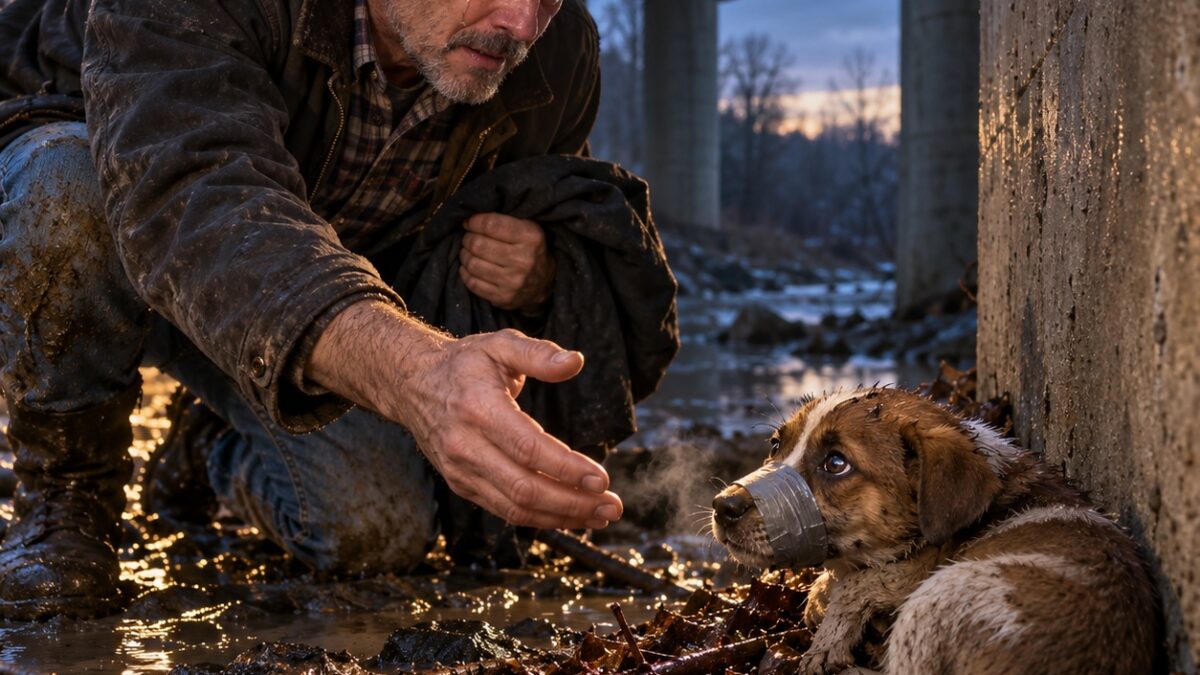
They worked on the tape first.
Slowly.
Carefully.
I watched from farther away because the room was small and I did not want to interfere.
The adhesive had pressed into skin that was already irritated.
The puppy’s face had been trapped inside it long enough that the area around his muzzle looked swollen and painfully sore.
Every time someone touched him, his body tensed.
Nobody rushed him.
That impressed me.
They spoke quietly.
Warned each other before repositioning him.
Let him pause.
It would have been easy to treat the tape as the enemy and removal as the victory.
Instead, they understood the puppy was the patient.
His fear mattered too.
Piece by piece, the tape came away.
Fur stuck to parts of it.
My stomach turned.
I looked away once.
Then forced myself to look back.
He had endured it.
The least I could do was witness what remained.
When the last piece came free, the puppy moved his jaw slightly.
Almost experimentally.
As if he had forgotten opening his mouth was possible.
One of the staff members whispered:
“There you go.”
The puppy licked his lips.
The movement was tiny.
It nearly destroyed me.
Such an ordinary thing.
A tongue across a mouth.
But a few hours earlier, even that had been impossible.
His skin underneath was badly damaged.
The team cleaned him.
Examined him.
Checked for additional injuries.
He was terribly underweight.
You could see every rib.
His hips.
The sharp structure of a body that should have been padded by puppy softness.
I asked:
“Is he going to make it?”
The veterinarian did not give me false certainty.
I respected that later.
At the time, I hated it.
“We need to see how he responds.”
“But can he recover?”
“There are encouraging signs.”
That phrase became my lifeline.
Encouraging signs.
Not safe.
Not healed.
Not guaranteed.
But not hopeless.
Then they offered food.
I will remember that for the rest of my life.
The puppy smelled it.
His entire expression changed.
For the first time since I found him, something stronger than fear moved through him.
Hunger.
He ate.
Fast.
Too fast.
The staff had to control the amount.
He kept looking for more.
A few minutes earlier, he had seemed barely capable of holding his head up.
Now he wanted the bowl.
Wanted the next bite.
Wanted life.
I laughed.
I did not mean to.
It came out half laugh, half sob.
One of the nurses smiled.
“Somebody has an appetite.”
The puppy kept eating.
“Good.”
I said it aloud.
“Good boy.”
His ears moved slightly.
Maybe toward my voice.
Maybe not.
I chose to believe toward me.
After he ate, exhaustion returned.
His body settled into the bedding they had prepared.
No bridge.
No mud.
No concrete.
No tape.
For the first time since I had seen him, there was nothing immediately hurting him.
He curled up.
I stood beside the enclosure.
He watched me.
I wanted to reach in.
Didn’t.
He needed rest more than reassurance from a stranger.
“Do you have a name for him?”
someone asked.
I shook my head.
“No.”
For some reason, that question hit me harder than the medical ones.
He had no name.
At least none we knew.
No collar.
No tag.
No person calling the hospital asking where he was.
He had arrived in my arms as simply a puppy somebody had left in pain.
That felt unfair.
Every creature should have a name someone says with affection.
The staff began using little nicknames.
Buddy.
Sweet boy.
Little man.
Anything that sounded gentler than patient.
I stayed longer than necessary.
Eventually, one of the staff said:
“You can go home.”
I looked at the puppy.
The sentence felt wrong.
Home.
I had one.
He didn’t.
“Will somebody be with him?”
“Yes.”
“Tonight?”
“Yes.”
“If anything changes—”
“We’ll handle it.”
I nodded.
Still did not move.
The staff member softened.
“You did your part.”
Again.
That phrase.
My part.
I hated how small it sounded.
But I left.
Outside, I looked down at my shirt.
Mud.
Hair.
A faint smear where the puppy’s body had rested.
I sat in my vehicle without starting it.
For several minutes, I simply stared at the steering wheel.
Then I cried.
I wish I could tell you it was only because I was relieved.
It wasn’t.
Some of it was anger.
Some fear.
Some guilt that made no logical sense.
I kept seeing the bridge.
Kept imagining arriving one hour later.
Two hours.
The next morning.
What if the whimper had stopped?
What if silence had won before I heard him?
Those questions are useless.
I know that.
They still came.
I went home.
Food tasted wrong.
My own bed felt too warm.
Every ordinary comfort suddenly had a comparison.
Water.
The puppy had been thirsty.
A meal.
The puppy had been starving.
A blanket.
He had been beneath concrete.
The ability to yawn.
His mouth had been taped.
I barely slept.
The next day, I checked for updates.
Then again later.
And the day after that.
The puppy was eating.
That became the best sentence in the world.
He was responding to treatment.
Another good sentence.
His condition remained serious enough to require attention, but he could recover.
Could.
There was that word again.
I clung to it.
As the days passed, his face began looking less like the animal beneath the bridge.
Swelling eased.
The damaged skin started its slow work.
His body received regular food.
He rested.
Something else started changing too.
His eyes.
The first time I saw him, those eyes had held only calculation.
How close are you?
Can I escape?
Will this hurt?
At the hospital, the fear did not disappear.
But small moments began breaking through.
Curiosity.
A little interest.
The beginning of trust.
People shared his story online.
I did not expect that part.
Someone posted about the puppy found beneath the bridge with tape around his muzzle.
Then others shared it.
Comments multiplied.
People were horrified.
Angry.
Heartbroken.
Some wanted to know who did it.
Some offered help.
Some simply wrote that they hoped he survived.
A photograph traveled farther than any sound beneath that bridge ever could.
The puppy who had barely managed a whimper was suddenly being talked about by thousands of people.
There was something poetic about that.
Someone had tried to silence him.
Now his story had become impossible to ignore.
I stayed out of most of it.
I did not want to become “the man who found the puppy.”
It was not my story to own.
He was the one healing.
The veterinary staff were doing the hard work.
Then, somewhere among those posts, Mary Witting saw his face.
Mary and her husband were grieving when Louie entered their lives.
I did not understand that part until much later.
They had recently lost their own dog.
Anyone who has never loved an animal deeply may not understand the silence that follows.
A dog does not simply occupy space.
A dog occupies time.
Morning.
The sound of nails against the floor.
A bowl needing to be filled.
A leash hanging by the door.
The automatic glance toward a favorite sleeping spot.
You structure days around them without realizing it.
Then they are gone.
The bowl stays dry.
The leash does not move.
You drop food in the kitchen and nobody appears.
You open the front door and there is no body vibrating with joy because you somehow survived leaving for twenty minutes.
Grief lives in those tiny absences.
Mary and her husband knew those absences.
Their home had recently learned quiet.
I imagine they told themselves they needed time.
Most people do.
We will wait.
We are not ready.
Maybe someday.
Then Mary saw the puppy’s photograph.
The taped muzzle was gone by then, but the damage remained visible.
So did the thinness.
So did those eyes.
Something in her changed.
Later, she would say she felt she could give him the love and security he needed.
That sentence sounds simple.
It isn’t.
Opening your home to an animal who has been badly mistreated means accepting that love may not be enough immediately.
You may offer a hand and watch him flinch.
You may buy a soft bed and see him choose the floor because softness is unfamiliar.
You may speak gently and still watch fear appear.
You are not only adopting an animal.
You are volunteering to repeat safety until his body begins believing it.
Mary and her husband went to meet him.
The connection happened quickly.
Not because the puppy suddenly forgot everything.
Because sometimes the right people arrive at the right point in recovery.
They looked at him and did not see a damaged animal requiring pity.
They saw a dog who needed a home.
They decided to adopt him.
And finally, he received the thing I had felt he was missing from the first night.
A name.
Louie.
I remember hearing it.
“Louie?”
I smiled.
That fit.
I could picture someone standing in a kitchen calling:
“Louie, get out of there.”
“Louie, come here.”
“Louie, dinner.”
Names belong inside homes.
Louie.
No longer the puppy beneath the bridge.
No longer the taped-muzzle case.
No longer a photograph people shared because they were horrified.
Louie.
Mary’s dog.
Her husband’s dog.
Their family.
I felt an enormous relief I cannot fully explain.
The night I carried him into Griffith Veterinary Hospital, my biggest fear was that the story would end there.
Not necessarily because he died.
There are other sad endings.
Animals can survive and still never find stability.
They can move between places.
Wait.
Become a case number.
Be loved by staff who cannot keep every animal.
Louie was not going to have that ending.
Somebody wanted him.
Specifically him.
Not a dog.
Louie.
The first nights in his new home must have been strange.
I can only imagine that part.
New rooms.
New smells.
Different footsteps.
A bowl in one place.
A bed in another.
Doors that closed but did not trap him.
Hands that touched gently.
Food that returned every day.
Fear does not own a calendar.
A dog does not know:
It has been three weeks. I should trust now.
Bodies learn through repetition.
Nothing bad happened today.
Nothing bad happened tonight.
The bowl came back.
The people came back.
Nobody abandoned me.
Nobody hurt me.
Again.
Again.
Again.
That is how a home becomes safe.
Not walls.
Repetition.
Louie gained weight.
His body began filling out.
His energy returned.
The puppy underneath the starvation began emerging.
Playfulness.
Interest.
The right to be troublesome.
I love troublesome dogs.
A mischievous dog has enough security to waste energy being ridiculous.
That is a luxury frightened animals do not have.
Mary gave him that luxury.
I thought my connection to Louie’s story was finished.
I was okay with that.
That was the goal, wasn’t it?
Find him.
Get him somewhere safe.
Let people better equipped carry him forward.
Then my niece saw the Facebook post.
She recognized the story.
Her uncle.
A puppy beneath a bridge.
The details matched.
She contacted people.
And suddenly, Louie’s new family learned exactly who had carried him out from underneath the concrete.
Someone suggested we meet.
I said yes too quickly.
Then immediately became nervous.
I did not tell many people that.
It felt silly.
What exactly was I afraid of?
That Louie would not remember me?
Probably.
That sounds selfish when written down.
He owed me nothing.
Absolutely nothing.
I knew that.
If Louie looked at me and felt nothing, that would not erase anything.
Dogs do not sign contracts with rescuers.
There is no clause saying:
You carried me once, therefore I must love you forever.
His affection belonged to him.
His family was Mary and her husband now.
That was right.
Still, some small part of me hoped.
Not for gratitude.
Recognition.
Because I had wondered whether those minutes beneath the bridge had meant anything to him besides fear.
I remembered holding him.
His body against my chest.
My voice saying:
Stay with me.
Stay with me.
Stay with me.
Had any part of that reached him?
Or had the entire night blended into one terrible cloud?
Maybe I was simply another strange human in the worst day he could remember.
The morning of the reunion, I nearly changed my mind.
What if seeing me frightened him?
What if my smell brought the bridge back?
What if he associated me not with rescue, but with pain?
That last fear mattered.
Animals cannot tell you which part of a memory you occupy.
I arrived anyway.
Mary greeted me.
We talked first.
She told me how Louie was doing.
How he ate.
How he settled.
The funny things.
The small quirks.
She spoke about him the way people speak about family.
Not rescue statistics.
Not recovery milestones.
Louie.
That alone was enough to make my throat tighten.
Then he appeared.
For a moment, my brain rejected what my eyes were seeing.
He looked too alive.
That sounds strange.
But the last Louie I had held seemed so close to disappearing.
This dog stood differently.
More weight.
More strength.
More confidence.
The same eyes, but not the same expression.
I crouched.
“Hey, buddy.”
He looked at me.
Nothing happened.
One second.
Maybe two.
Long enough for my hope to become embarrassment.
Of course he doesn’t remember.
That’s okay.
Then Louie froze.
His head shifted slightly.
His nose worked.
And everything changed.
Tail.
Ears.
Body.
He ran.
Not walked.
Ran.
Straight at me.
I barely had time to open my arms.
He hit my chest.
Licked my face.
My chin.
My hands.
Everywhere.
“Okay.”
I started laughing.
“Okay, buddy.”
Louie disagreed.
More licking.
His tail moved so hard his entire rear end swung with it.
Mary laughed.
I tried speaking.
Couldn’t.
I buried my face against his neck.
And that was when I cried.
Really cried.
Not the quiet tears in the vehicle after the hospital.
This was different.
Because underneath my hands was everything I had been afraid not to see.
Weight.
Warmth.
Life.
Louie pushed closer.
I kept remembering how light he had been.
That contrast broke me.
“You remember.”
I whispered it before I could stop myself.
“You remember me.”
Maybe scientifically that was too confident.
Maybe he remembered scent.
Voice.
Touch.
An emotional association.
I did not care.
Louie knew something.
Enough to run.
Enough to trust.
Enough to celebrate.
And suddenly I understood how much uncertainty I had been carrying since the bridge.
When you rescue an animal and then hand him into somebody else’s care, part of you always wonders.
What happened after I left?
Did he heal?
Did he feel safe?
Did he ever stop being afraid?
Mary had told me yes.
Louie answered differently.
With his whole body.
Yes.
I’m here.
I’m safe.
Look at me.
I made it.
I think that was what I heard in every lick.
I made it.
There are emotional moments people describe as happy.
This was not simply happy.
It hurt.
Because joy can hurt when it arrives carrying memory.
Every healthy part of Louie reminded me how unhealthy he had been.
Every ounce he gained reminded me how little he weighed in my arms.
Every confident movement reminded me of the puppy pressed against concrete.
Every lick reminded me of the mouth someone had taped shut.
That is why I cried.
Not because the ending was sad.
Because the ending made the beginning feel even more unbearable.
Louie did not stay with me.
He went back to Mary.
Exactly where he belonged.
Before leaving, he looked back once.
Maybe I invented significance.
Humans do that.
Still, I carried that look home.
Over the next few days, I thought about Mary and her husband often.
Their grief had been part of Louie’s rescue too.
They had lost a dog they loved.
Nothing about adopting Louie replaced that animal.
That language bothers me.
Replace.
Living creatures are not furniture.
A new dog does not fill the exact shape of an old one.
Mary’s first dog remained loved.
Louie became loved differently.
Grief did not disappear.
It changed the house’s capacity.
That is one of the stranger things about love.
A broken heart does not always become smaller.
Sometimes it becomes roomier.
Pain creates space you wish did not exist.
Then, someday, something else enters.
Not replacing.
Joining.
Louie entered a home that already understood how much a dog could matter.
That was lucky for him.
And maybe lucky for Mary too.
People sometimes rescue each other in directions we do not notice immediately.
Mary gave Louie safety.
Louie gave Mary a reason for the leash to move again.
A bowl to fill.
Footsteps in the house.
A reason to laugh at something stolen from a laundry basket.
I cannot prove he healed them.
That is too large a responsibility to place on a dog.
But companionship changes grief.
Sometimes having another heartbeat nearby makes an empty room less cruel.
Louie had a heartbeat to spare.
I still thought about the person who taped his muzzle.
Of course I did.
Anger did not vanish because Louie healed.
Some days it became worse.
I would see a photograph of him happy and think:
How could anyone have done that to this animal?
The happier he became, the less understandable the cruelty seemed.
But eventually, I stopped letting the unknown person occupy the center of the story.
Whoever did it had already taken enough.
Time.
Pain.
Fear.
They did not deserve Louie’s future too.
Cruelty often demands attention.
It shocks us.
It creates questions.
Who?
Why?
How?
Those questions are natural.
But if we stare only at cruelty, we accidentally let the cruelest person become the main character.
Louie deserved better than that.
His story belonged to him.
And to the people who chose differently afterward.
The veterinary team.
Mary.
Her husband.
My niece.
Everybody who helped.
What happened beneath the bridge was a chapter.
A terrible one.
Not the whole book.
I began telling people that when they called me a hero.
I never liked that word.
Hero.
It turns one ordinary decision into something unusual.
I heard a sound and stopped.
That should not be unusual.
Someone needed help.
I helped.
I was not courageous.
I was upset.
Scared.
Angry.
Confused.
If anything heroic happened, it was Louie deciding that humans were worth trying again.
Imagine what trust required from him.
The world had given him evidence.
Human hands had hurt him.
Left him hungry.
Left him unable to open his mouth.
Then more human hands arrived.
Mine.
Veterinary staff.
Mary’s.
Her husband’s.
Louie had to decide, over and over, whether the new hands belonged to the old pattern.
At first, his body probably answered automatically.
Flinch.
Hide.
Freeze.
Then safety repeated.
No pain.
Food.
Soft voices.
Again.
No pain.
A bed.
Again.
No pain.
A walk.
Again.
Love.
That is courage.
Not fear disappearing.
Fear receiving enough contradictory evidence that trust becomes possible.
Louie learned.
People do too, sometimes.
Years before Louie, I used to think kindness was mostly personality.
Some people are kind.
Others aren’t.
Now I think kindness is more often interruption.
You are busy.
Something interrupts.
You are tired.
Something interrupts.
You have plans.
Someone needs you.
You decide whether your life can tolerate the interruption.
That evening, Louie was an interruption.
I could have continued.
I could have said:
Someone else will handle it.
I could have rationalized.
Maybe it is a raccoon.
Maybe the sound is nothing.
Maybe I am imagining it.
The mind is incredibly creative when convenience needs defending.
I stopped.
That is all.
One small interruption accepted.
And somewhere after that:
A veterinary team said yes.
Mary said yes.
Her husband said yes.
My niece stopped scrolling long enough to recognize the story.
So many yeses.
Louie lived inside them.
I sometimes visit the bridge in my memory more than in real life.
I see the same shadows.
But memory has changed.
At first, I always saw Louie beneath it.
Now I see the empty space after I lifted him.
That matters.
Empty.
He is not there anymore.
The bridge no longer owns him.
Neither does the tape.
Neither does hunger.
He has a home.
That is the image I prefer.
An empty patch of mud beneath a bridge where a puppy once believed the world had ended.
And somewhere else, Louie sleeping in a house.
Maybe dreaming.
Maybe snoring.
Maybe taking up more of the bed than he was invited to.
Normal things.
Ordinary happiness is the most beautiful revenge against suffering.
Not dramatic happiness.
Ordinary.
A full bowl.
A ridiculous toy.
A hand scratching behind an ear.
Someone saying:
“Louie, come inside.”
Someone worried when he seems tired.
Someone celebrating his birthday even though dogs do not understand calendars.
That is what he deserved.
There is a photograph of our reunion I have seen many times.
Louie against me.
My face partly hidden.
His body full of motion.
People say:
“You can tell he knew.”
I usually smile.
I don’t argue.
Maybe because I believe them.
Maybe because I need to.
Sometimes memory is not about proving exact mechanisms.
It is about what the moment meant.
Louie saw me.
He came.
For me, that was enough.
The first time he saw me, he tried to disappear.
The next time, he ran toward me.
If you want the whole story in two images, there it is.
Fear.
Then trust.
Under a bridge.
Then in someone’s arms.
Silenced.
Then impossible to contain.
I have wondered whether Louie ever whimpers in his sleep.
Whether his body remembers things his waking mind cannot explain.
Dogs can carry fear in strange ways.
A sound.
Tape tearing.
A particular smell.
Certain movements near the face.
Maybe those things stayed.
Maybe not.
Healing is not forgetting.
I know that much from people.
We keep scars even when wounds close.
The goal is not necessarily to erase.
It is to make the present safe enough that the past stops deciding every reaction.
Mary gave him that.
Every morning she woke up and remained the same person.
Every evening he ate.
Every night he slept and woke to the same home.
Safety became boring.
That is one of the greatest gifts anyone can give a traumatized creature.
Boring safety.
Nothing terrible today.
Nothing terrible tomorrow.
Eventually, expectation changes.
I wish I could go back to the puppy beneath the bridge and tell him.
You have no idea what is coming.
You are going to eat.
A lot.
You are going to have a name.
Louie.
Someone will love saying it.
A woman you have not met yet will see your photograph and feel her heart move.
Her husband will agree.
You will have a house.
You will have people.
You will grow.
You will run.
And one day you will see me again.
I will be afraid you forgot.
You will answer by nearly knocking me over.
Obviously, I cannot tell the puppy.
Time only moves one way.
Maybe that is why rescue feels so painful afterward.
We know the ending while remembering someone who didn’t.
Louie beneath the bridge had no knowledge of Mary.
That ignorance breaks me.
When suffering is happening, the future is invisible.
Humans understand that too.
During grief, people tell you:
It gets better.
You cannot see how.
During fear:
You will be safe again.
You don’t believe them.
Louie did not know.
But the future existed anyway.
Mary existed.
A warm house existed.
The food waiting for him existed.
He simply had not reached it yet.
That thought has comforted me in other parts of life.
Sometimes the good thing has already begun somewhere you cannot see.
The person who will help you is living an ordinary day.
The place you will eventually feel safe exists miles away.
You are just not there yet.
Louie was not there yet.
Then I heard him.
People occasionally ask what they should do if they find an injured animal.
I tell them the lesson I learned that night.
Do not assume dramatic action is always best.
I wanted to rip the tape off.
Veterinary professionals were better equipped.
Compassion without care can accidentally cause more pain.
Get help.
Move carefully.
Let trained people handle what requires training.
Love is not diminished by knowing your limits.
Sometimes the kindest thing is transportation.
Sometimes a phone call.
Sometimes standing nearby.
Sometimes paying attention.
The veterinary team at Griffith did what I couldn’t.
That deserves as much attention as finding him.
Their work was not viral.
No dramatic bridge.
Just careful treatment.
Cleaning.
Monitoring.
Feeding.
Watching.
Professional patience.
The quiet work between rescue and recovery.
Without that, the reunion never happens.
Without Mary and her husband, recovery does not become a life.
Stories like Louie’s often compress the middle because the middle is slow.
But the middle is where healing lives.
Weight gained ounce by ounce.
Skin repairing.
Fear easing.
Meals.
Sleep.
A hand tolerated.
Then welcomed.
A home explored.
Then claimed.
Louie did not wake up one morning suddenly healed.
He became safe gradually.
That may be why our reunion meant so much.
I was seeing all the days I had missed reflected in his body.
Mary’s days.
The veterinary staff’s days.
Louie’s days.
Every meal between the bridge and me.
Every night he survived.
Every good touch.
All of it had accumulated into a dog strong enough to run.
I hugged the result of hundreds of small mercies.
That is a better way to describe it.
Hundreds of small mercies.
Not one heroic rescue.
I happened to provide the first.
There is another part of the story I rarely say aloud.
The night I found Louie, I was not having a particularly good day.
Nothing tragic.
Just one of those ordinary days where everything feels heavier than it should.
Bills.
Work.
Fatigue.
I had been thinking about my own problems.
Then that sound interrupted me.
Suddenly, my problems did not disappear.
But attention shifted.
There was a living thing in front of me whose need was immediate.
That perspective did something.
Not because other suffering makes yours invalid.
I hate that idea.
Someone always has it worse, so you cannot be sad?
Nonsense.
Pain is not canceled by comparison.
But caring for someone else sometimes gives your pain somewhere useful to move.
For an hour, I was not thinking about myself.
I was thinking:
Stay alive.
Maybe that is part of why Louie stayed with me emotionally.
Helping him reoriented something in me.
Again, I do not want to burden a puppy with saving a person.
He did not rescue me.
But he reminded me I could still matter in a moment.
That has value.
Mary might understand that too.
She lost her dog.
Then Louie appeared.
He did not erase grief.
He gave love somewhere to go.
Humans need somewhere for love to go.
Love with nowhere to go becomes grief.
Maybe adoption opened a door for Mary’s love to move again.
That is beautiful.
Not because the first dog mattered less.
Because the first dog taught her how deeply an animal could matter.
Louie benefited from love another dog had already expanded.
I hope that thought brings comfort to anyone who has adopted after loss.
You are not replacing.
You are continuing a capacity.
One animal taught your heart a language.
Another hears it later.
Louie heard Mary’s.
I heard his.
A faint whimper.
Then, later, joy.
The contrast remains the reason this story stays with people.
Someone tried to take away his voice.
But you cannot really measure a voice only by sound.
Louie’s voice became every person who shared the post.
Every person who cared.
Mary saying yes.
My niece recognizing the story.
The veterinary team’s work.
Even this story now.
He was silenced physically for a time.
Then compassion amplified him.
That is a hopeful thought.
Cruelty can be loud.
Kindness can travel farther.
Not always.
But sometimes.
Enough times to matter.
I do not know where Louie is at every moment.
That is another good thing.
His life should not be public property forever simply because his worst moment became public.
He deserves privacy.
Normalcy.
Days no stranger knows about.
The best ending for a viral rescue story is eventually becoming boring enough that nobody needs updates.
Louie ate breakfast.
Louie slept.
Louie went outside.
Louie came back in.
Nothing bad happened.
Perfect.
Still, whenever I do receive news, I smile.
Because for me there will always be two Louies.
The one beneath the bridge.
And the one who ran toward me.
They are the same dog.
That is the miracle.
Not that he became someone else.
He remained himself long enough to experience something better.
We often talk about second chances as though the first version must disappear.
No.
Louie’s second chance did not create a different puppy.
It allowed the original one to finally exist without fear controlling everything.
The playful dog was always in there.
Hunger hid him.
Pain hid him.
Fear hid him.
Safety revealed him.
That is perhaps the saddest and most beautiful truth of his story.
How many animals never get the safety needed to reveal who they actually are?
How many are labeled aggressive when they are terrified?
Difficult when they are hurting?
Withdrawn when they have learned attention brings pain?
Louie was lucky.
Terribly unlucky first.
Then profoundly lucky.
I wish luck had not been necessary.
I wish systems caught every animal.
I wish cruelty never happened.
But wishes do not rewrite the bridge.
They can shape what we do after.
Donate.
Adopt.
Report suffering.
Support veterinary teams.
Help shelters.
Stop when you hear something.
Small things.
Useful things.
People sometimes want dramatic instructions for becoming compassionate.
Most compassion is inconveniently ordinary.
Look.
Listen.
Do not assume somebody else will handle it.
That last one matters.
Bystanders are often good people waiting for another good person to move first.
I was lucky there was nobody else under that bridge to wait for.
The decision became mine.
There is freedom in that.
No committee.
No debate.
A puppy.
Me.
Move.
I moved.
If there is one moment I return to more than the reunion, it is the first time Louie ate at the veterinary hospital.
I know that surprises people.
The reunion sounds more emotional.
It was.
But the meal was the first proof.
The puppy had spent who knows how long unable to eat normally.
Tape around his mouth.
Weak.
Then suddenly:
Food.
His body remembered exactly what to do.
He wanted it.
That appetite was life speaking.
Louder than the whimper.
I stood there watching and thought:
You still want to be here.
That mattered.
There is something deeply painful about seeing an animal desperate to live after someone treated its life as disposable.
Louie did not understand cruelty philosophically.
He simply wanted food.
Warmth.
Safety.
His desires were modest.
That makes what happened to him harder to accept.
Animals ask so little from us compared with how much they give.
A bowl.
A safe place.
Attention.
Routine.
Kindness.
And somehow humans still fail them.
But humans also saved Louie.
That complexity matters.
When cruelty happens, people sometimes say humanity is terrible.
I understand the feeling.
But Louie’s story contains both sides.
A human harmed him.
A human heard him.
Humans treated him.
Humans adopted him.
Humans connected us again.
We contain both possibilities.
That means choices matter.
Mary once described how Louie looked at home.
Comfortable.
Safe.
That word again.
Safe.
I keep returning to it.
Because safety is invisible until it is gone.
Most of us wake up without thinking:
Nobody taped my mouth while I slept.
Nobody left me beneath a bridge.
We take bodily safety for granted because we should be able to.
Louie could not.
Then gradually he could.
What a gift.
There should be no heroism necessary for an animal to reach ordinary safety.
Yet when safety has been violated, rebuilding it becomes sacred work.
Mary did that.
Her husband did that.
The veterinary hospital did that.
I started it only by moving him from one place to another.
I am grateful I was allowed to be part of it.
Years from now, my memory may fail around details.
Exactly what the weather was.
What I wore.
How long the drive took.
Maybe I will forget names of staff members.
But I do not think I will ever forget Louie’s weight in my arms.
Too light.
Then later, his weight against my chest during the reunion.
Healthy enough to push.
Those two sensations are the entire story inside my body.
First:
Please don’t die.
Later:
Easy, buddy, you’re going to knock me over.
That is what hope should feel like.
Heavy.
One day, Louie will grow old.
I do not like thinking about it, but love makes the thought unavoidable.
Mary and her husband know this better than most.
They have already lost one dog.
Someday, perhaps years away, another goodbye will come.
That does not make adoption a tragedy waiting to happen.
It makes every ordinary day between beginning and goodbye more valuable.
Louie was almost denied those days.
That is why they matter so much.
Every birthday.
Every nap.
Every walk.
Every stupid thing he chews.
Every guest he greets too enthusiastically.
Every veterinary visit.
Every gray hair around his face one day.
All stolen back from the ending he almost had beneath that bridge.
That is how I think of his life now.
Stolen back.
Not by violence.
By care.
The person who left him may have decided his life was worth nothing.
Louie’s existence afterward became a quiet disagreement repeated daily.
Breakfast.
You matter.
Medicine.
You matter.
A bed.
You matter.
A name.
You matter.
A family.
You matter.
A reunion.
You mattered then too.
Maybe that is why he ran toward me.
Not because he owed me.
Because in the worst moment, I had behaved as though his life mattered before I knew anything about him.
No breed paperwork.
No cute adoption photo.
No guarantee he would survive.
No future story.
Just an injured puppy.
Enough.
That should always be enough.
Sometimes people ask whether I would do it again.
I find the question strange.
If I heard the same sound tomorrow?
Yes.
Of course.
Would I be less afraid?
Probably not.
Courage is often falsely described as fearlessness.
I was scared.
Scared he would die.
Scared I would hurt him removing the tape.
Scared he might bite because of pain.
Scared I was too late.
I acted while scared.
That is all.
Louie acted while scared too.
Maybe that was our first thing in common.
Two frightened creatures under a bridge.
One much more frightened than the other.
Trying the next step.
I reached.
He allowed me.
That was enough to begin.
If I could change one part of the story, obviously I would erase the suffering.
No tape.
No hunger.
No bridge.
Louie simply born somewhere safe and adopted normally.
No viral story.
No heroic reunion.
Nothing remarkable.
That would be better.
We should remember that when we romanticize rescue.
The best rescue is the one never needed.
Louie should never have required us.
But once he did, I am grateful people answered.
That is the meaning I take from it.
Not that suffering happens for a reason.
I reject that.
Cruelty does not become justified because kindness follows.
Louie was not hurt so Mary could find him.
He was not abandoned so I could feel useful.
Pain does not need to be ordained to produce meaning.
The meaning comes from what we choose afterward.
Somebody chose cruelty.
Others chose care.
Care won more of Louie’s life.
That is enough.
The last time I thought deeply about the bridge, I realized something.
The first sound I heard was almost nothing.
A tiny whimper.
Louie had so little strength.
Yet that sound traveled far enough.
Across mud.
Up concrete.
Through wind.
Into my ears.
Then his story traveled farther.
To the hospital.
Onto Facebook.
Into Mary’s home.
To my niece.
Back to me.
A tiny sound under a bridge became a chain connecting people who had never met.
That is astonishing.
Maybe no cry for help is truly small if someone answers.
Louie could not ask clearly.
Could not explain.
Could not say:
Please.
I’m scared.
I’m hungry.
My face hurts.
Don’t leave me here.
He made one sound.
Human beings had to do the interpreting.
That is responsibility.
The vulnerable often cannot advocate perfectly.
Animals.
Children.
People in pain.
Sometimes the absence of perfect communication becomes an excuse for inaction.
Louie reminds me to pay attention to weaker signals.
A flinch.
A silence.
A person who stops showing up.
A dog hiding.
A faint sound where there should not be one.
Not everything announces itself.
Some suffering whispers.
After everything, I think that is what breaks my heart most.
Louie nearly disappeared quietly.
No crowd.
No camera.
No one watching.
Just a puppy under a bridge.
If I had not heard him, the world might never have known he existed.
Now people know his name.
Louie.
They know Mary loved him.
They know he ran toward me.
They know he survived.
There is justice in being remembered.
Not legal justice.
Something smaller.
Someone tried to reduce his life to silence.
Instead, people told his story.
But I hope the story is told correctly.
Not as horror first.
As life.
Yes, mention the tape.
We have to.
Mention the starvation.
Mention the bridge.
But keep going.
Do not stop at suffering.
Tell them he ate.
Tell them the staff cared for him.
Tell them Mary saw him.
Tell them he got a name.
Tell them about the home.
Tell them about the reunion.
Tell them he ran.
Always tell them he ran.
Because that is the part that matters to me.
The puppy who could barely whimper became a dog strong enough to run toward love.
If that does not break your heart and mend a piece of it at the same time, I do not know what will.
When Louie ran into my arms, I did not become his owner.
I did not need to.
I became someone who had once carried him through the worst few minutes of his life.
Mary became the person who carried him through everything after.
There is beauty in roles ending.
Rescue should lead to no longer being needed.
Parents know this.
Veterinarians know it.
Foster families know it.
Anyone who helps another living thing toward independence eventually has to accept:
The goal was never to keep being essential.
The goal was safety without you.
Louie had that.
So when our reunion ended and he left with Mary, I was not sad.
Maybe a little.
Human.
But mostly grateful.
He walked away from me willingly.
That was proof.
He had somewhere else to go.
Someone else he trusted.
A home waiting.
The puppy under the bridge had nowhere.
Louie did.
I cannot ask for a better ending.
Even now, if I close my eyes, I can feel two versions of him.
The first against my arms.
Almost weightless.
The second against my chest.
Healthy.
Excited.
Trying to lick my entire face off.
Between those two moments stands a veterinary hospital, a social-media post, a grieving couple, a niece, hundreds of meals, nights of sleep, medication, patience, and love.
That distance is what compassion can do.
Not instantly.
Not magically.
Step by step.
Meal by meal.
Day by day.
That is Louie’s story.
Not a miracle that fell from the sky.
A series of people choosing not to look away.
The bridge was where I found him.
It was never where he belonged.
And sometimes, when that faint whimper returns to me late at night, I let myself hear what came after too.
The sound of him eating.
Mary saying his name.
My own laughter when he ran toward me.
A tail hitting everything in reach.
Life becoming loud again.
Then the memory does not hurt quite as much.
Because I know the silence did not win.








