FULL STORY: “Please Take Us With You—They’ll Take My Dog Away,” the Old Woman Begged the Navy SEAL
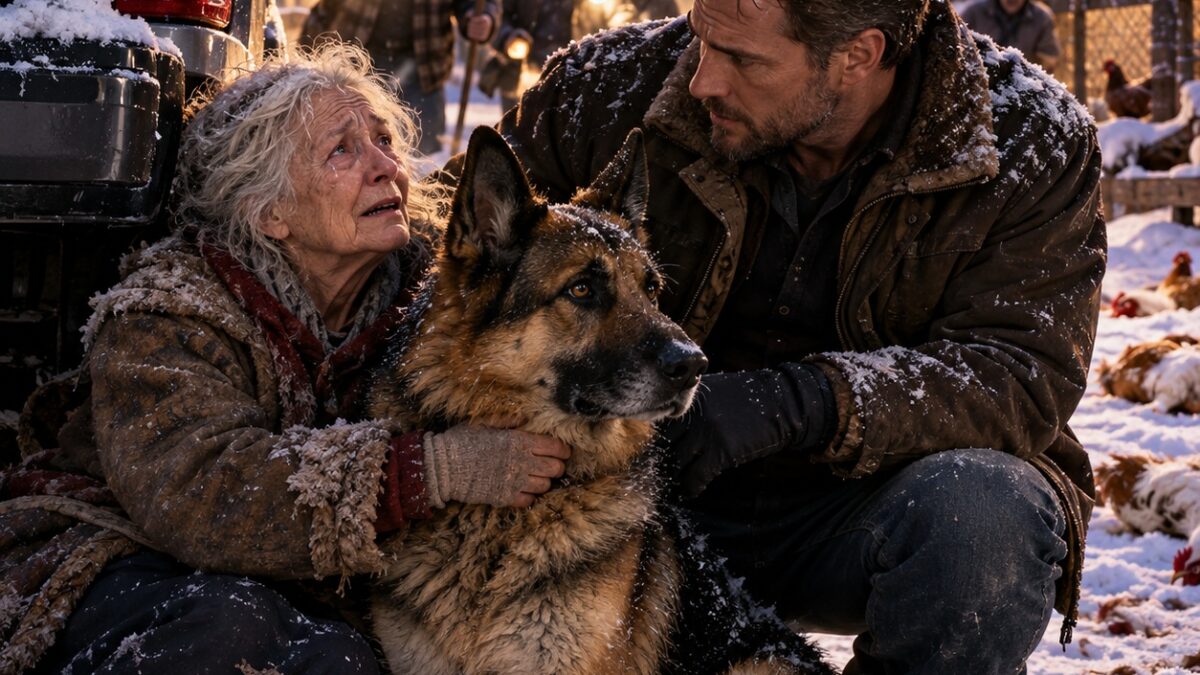
FULL STORY CONTINUATION
She lived on the far edge of Pinehaven in a weathered little cabin with faded green siding and one porch step that leaned slightly to the left.
She was seventy-two.
Widowed.
Her daughter was dead.
Her only grandchild was dead.
The way Miriam described it, grief had not arrived in one dramatic wave.
It had emptied her life gradually.
One chair.
One room.
One holiday.
One name she no longer had anyone to call.
Eventually she woke up and realized the only other breathing creature beneath her roof had four legs.
That was Brier.
Eight years old.
Broad-chested.
Quiet.
Watchful.
Miriam survived on a small pension and whatever she could earn collecting scrap.
Every morning, weather permitting, she pulled a dented two-wheel cart through Pinehaven.
Aluminum cans.
Copper wire.
Old pulleys.
Broken hinges.
Discarded machine parts.
Anything the recycling yard might turn into a few dollars.
Brier walked beside her.
He rarely barked.
When strangers came too close, he did not lunge or bare his teeth.
He simply moved between Miriam and whoever had entered her space.
Miriam had grown so used to it that sometimes she rested a gloved hand on his shoulder without looking.
He had stayed beside her after her husband died.
He had lain beneath a church pew after her daughter’s funeral.
When influenza left Miriam too weak to stand, Brier slept pressed against the side of her bed.
On weeks when the pension ran thin, they ate whatever she had.
Miriam joked that canned soup tasted better when nobody asked what kind it was.
Pinehaven knew them.
That did not mean Pinehaven knew who they were.
Some residents waved.
Others looked away.
Teenagers had started calling Miriam “the scrap lady.”
She pretended not to hear them.
Brier always did.
The trouble began at Creel Poultry Farm.
It was the largest chicken operation in the valley.
The owner, Harlon Creel, was fifty-eight, broad through the shoulders, with a salt-and-pepper beard and the permanently tired expression of a man who had spent most of his life fixing practical problems before sunrise.
He was not cruel.
That mattered later.
He donated to the school.
Plowed neighbors’ driveways after storms.
Helped when barns flooded.
But Harlon trusted numbers more easily than people.
If twenty things should be in a room and only eighteen were there, he wanted to know where the other two went.
Feelings could wait.
For more than ten years his day-to-day farm operations had been handled by Nolan Pike.
Nolan was thirty-six.
Lean.
Capable.
Short dark hair.
A face people found trustworthy.
He remembered birthdays.
Fixed machinery without being asked.
Could laugh with hired hands in the morning and speak respectfully to Harlon at dinner.
Around Pinehaven, ten years of reliability was almost kinship.
When Miriam and Brier passed the back fence, Nolan sometimes tossed meat scraps through the wire.
Miriam told him not to.
“He’ll start coming here looking for food.”
Nolan smiled.
“Dog likes me.”
“That’s the problem.”
“Better than him looking for trouble.”
At the time, she thought it was only a joke.
A few weeks later, Harlon discovered the poultry count was wrong.
First six birds seemed missing.
Then nine.
Then, after a full inventory and several arguments about whether someone had written down the wrong numbers, the count settled at thirty-two.
Thirty-two chickens gone over roughly two weeks.
No carcasses scattered behind the barns.
No obvious blood.
No large piles of feathers.
But there were canine tracks near the rear fence.
Big ones.
Yellow-and-black hair caught in disturbed wire.
And a seventeen-year-old farmhand named Evan Cole admitted he had seen Brier around that part of the property after dark.
That was enough.
Not for the sheriff’s department.
For Pinehaven.
By noon, the story had become simpler than the evidence.
The scrap lady’s German Shepherd was stealing chickens.
Somebody decided he was carrying them into the woods.
Somebody else suggested Miriam must know.
Then the ugliest version appeared.
Maybe she was eating them too.
Miriam heard that one in the general store.
She was standing at the counter holding a discounted loaf of bread.
The woman speaking behind her lowered her voice too late.
Miriam paid.
Walked outside.
Brier was sitting exactly where she had left him.
His amber eyes lifted.
She crouched.
“You’ve become famous.”
Brier tilted his head.
“For all the wrong reasons.”
He leaned his shoulder against her knee.
That evening Deputy Clare Beck arrived at Miriam’s cabin.
Clare was forty-four.
Fit.
Chestnut hair tied neatly behind her head.
The controlled posture of someone who disliked speaking before she knew enough.
She did not come like a deputy arriving to seize a dangerous animal.
That helped.
“Harlon filed a complaint.”
Clare sat at Miriam’s kitchen table.
“That does not mean Brier has been proven responsible.”
Brier lay beside Miriam’s chair with his head on his paws.
Miriam stroked his collar.
“And if they find more?”
Clare chose her words.
“If there is evidence tying him to livestock losses, the county could require temporary impoundment during the investigation.”
Temporary.
Miriam knew that word.
Hospitals had used it.
Doctors.
People who said her daughter would need help only temporarily.
Sometimes temporary was simply the last name something had before it disappeared from your life.
Clare noticed the change in Miriam’s face.
“No one is taking him tonight.”
Miriam nodded.
But fear rarely waits for permission.
Later, while she packed clothing into an old canvas bag, Brier rose beside the stove.
He went to the window.
Stared east.
Creel Farm.
His ears stayed forward.
Miriam crossed the room.
He moved to the door.
Not whining.
Not scratching.
Waiting.
She opened it a few inches.
Cold air entered.
Brier shoved his nose toward the gap and inhaled.
Then pulled toward the farm.
“Stop.”
He froze.
But he kept looking east.
For the first time since the accusations began, Miriam had a thought that frightened her more than the rumors.
Brier was not afraid of Creel Farm.
He wanted to go back.
And she had no idea why.
Before midnight she made her decision.
Two changes of clothes.
Medication.
Dog food.
Flashlight.
Cash from an envelope.
One old photograph.
At 4:30 in the morning, she locked the cabin.
Brier looked east twice before following her away from Pinehaven.
Several hours later, she found my truck.
When she finished telling me the story, I looked down at Brier.
The evidence was not nothing.
Tracks that might be his.
Hair that might be his.
Witness sightings.
A missing flock.
I was not going to comfort Miriam by pretending inconvenient facts did not exist.
“Tracks don’t tell the whole story.”
Her expression changed.
Not relief.
Almost.
I opened the passenger door.
“You can ride with me until I know what happened.”
“Where?”
“My father’s house.”
“You live there?”
“Not exactly.”
Brier climbed into the rear seat only after Miriam sat down.
I noticed.
He was not difficult.
He was deliberate.
As we drove through Pinehaven, Miriam lowered herself slightly.
Not enough to disappear.
Enough not to be recognized by every person staring from a window.
I kept my eyes on the road.
I had seen guilty men hide themselves because they feared consequences.
I had also seen innocent people shrink because the wrong person had already decided their future.
I did not yet know which kind of fear sat beside me.
That uncertainty bothered me less than it once would have.
Age had taught me that rushing toward certainty could be another form of fear.
The road left town.
Entered pine country.
Snow lay thick between the trunks.
Then Samuel’s house appeared.
Dark cedar siding.
Low porch.
Snow resting along the roof.
I stopped the truck.
The engine idled.
Miriam glanced at me.
I did not move.
For a few seconds the only sound was the heater and Brier breathing behind us.
“Are you all right?”
“No.”
The answer surprised both of us.
I shut off the engine.
Cold rushed in.
Every step toward the porch felt familiar.
The post Samuel had painted badly.
The gutter I promised to fix and never did.
The metal boot scraper.
I had spent years entering places where violence might wait behind walls.
None of that prepared me for a house where the danger was memory.
I unlocked the door.
The hinges gave a low complaint.
Inside smelled of old wood, dust, and winter air trapped too long.
My father’s coat still hung from a hook.
That coat struck me harder than the funeral.
I looked away.
Miriam noticed.
She said nothing.
Brier entered cautiously.
Living room.
Kitchen.
Hallway.
Halfway down the hall, he stopped.
His ears rose.
I turned.
He was staring at a framed photograph.
Samuel near the end of his life.
Tall but slightly stooped.
Silver hair.
Trim gray beard.
Dark plaid shirt beneath a canvas jacket.
The expression of a man faintly annoyed someone had made him pose.
Behind me, Miriam made a sound.
Small.
Her canvas bag fell.
I moved toward her.
“Miriam?”
She did not answer.
Her face had drained.
“Who is that?”
“My father.”
“What was his name?”
“Samuel Wyn.”
She reached for a chair.
Sat before I could catch her.
Brier returned immediately.
Pressed his shoulder against her knee.
Her trembling hand found his neck.
Then she looked at me.
“Samuel was my little brother.”
The room went very still.
My first instinct was suspicion.
Not because she looked dishonest.
Because the claim was too large.
“My father never said he had a sister.”
“I imagine he had his reasons.”
“What was her name?”
“Miriam.”
I stared.
“Your name is Miriam.”
“It is now too.”
She looked at the photograph.
“I was Miriam Wyn before I married.”
She had left Pinehaven at eighteen.
Her father disapproved of the young mechanic she loved.
The argument hardened.
She married him anyway.
At first she wrote home.
Some letters returned.
Some never did.
Her mother died.
Her father followed.
The family property was sold.
Samuel left Minnesota.
Miriam and her husband moved from state to state chasing work.
Addresses changed.
Telephone numbers changed.
Pride did what time could not finish.
“People think families break in one moment.”
She stared at Samuel’s photograph.
“They usually don’t.”
“One letter not answered.”
“One Christmas missed.”
“One year becomes five.”
“Then you realize you don’t know where your own brother lives.”
Her husband eventually died.
Then her daughter.
Then her grandson.
Loss stripped away excuses.
She began searching for Samuel.
Records brought her back to Pinehaven less than two years earlier.
By the time she confirmed Samuel had returned there in middle age, he was already dead.
“You knew the house was here.”
“Eventually.”
“And never came?”
“I came as far as the road.”
“Why stop?”
She took time before answering.
“Because I saw the roof.”
I frowned.
“And thought about what I looked like.”
She gestured at her patched coat.
“My cart.”
“My life.”
“I thought Samuel might have children.”
“People who knew him as a good man.”
Her voice dropped.
“I didn’t know if I had the right to walk into that life after fifty years and say I was the sister who disappeared.”
I wanted to argue.
Then I remembered I had owned a key to the same house for three years and had refused to walk inside.
Judgment died before it reached my mouth.
Then Brier did something strange.
He left Miriam’s side.
Walked beneath Samuel’s photograph.
Looked up.
Then sat between Miriam and me.
Not facing either of us.
Just there.
Like a dog placing himself into a family picture nobody had invited him to join.
It was absurd to assign meaning to that.
I did anyway.
“My father kept records.”
“What kind?”
“All kinds.”
Samuel believed throwing away paper was evidence of weak character.
Receipts.
Warranty cards.
Maps.
Letters from me during training.
Upstairs, I found his study.
Dust.
Old books.
County maps.
A dark wooden box.
Samuel kept it locked for years.
As a teenager, I once asked what was inside.
“Things that survived me being foolish.”
I assumed tax documents.
The key was still in the place where Samuel pretended keys were hidden.
Inside were photographs.
Letters tied with string.
Old envelopes.
Most never mailed.
The first photograph showed a teenage girl under a summer tree beside a younger boy.
The boy was unmistakably Samuel.
Between them sat a German Shepherd.
I turned the photograph over.
Miriam, Sam, and Duke. Summer 1968.
I sat for a second.
Then carried it downstairs.
Miriam took it.
Her thumb touched the edge.
“Oh.”
That was all.
Tears moved down her face quietly.
“Duke.”
Brier raised his head at the unfamiliar name.
“He stole shoes.”
“My father?”
She gave a broken laugh.
“The dog.”
Then:
“Samuel stole peaches.”
I laughed.
I had not expected to.
It surprised me so much I almost stopped.
Miriam smiled fully for the first time.
I went back upstairs.
There were letters addressed only to Miriam.
No street.
No city.
Others carried old addresses crossed out.
Samuel had searched.
County offices.
Directories.
Notes in his handwriting.
Possible Miriam Calder—Wisconsin.
Check hospital records.
Ask Paul in Duluth.
Every line was an attempt Miriam never knew he had made.
Near the bottom was one envelope different from the others.
My name.
Reed.
I reached toward the flap.
Stopped.
Three years of grief sat inside that small movement.
I put it back.
Not yet.
That night, I made the downstairs guest room for Miriam.
She protested the couch was enough.
I ignored her.
Brier settled near the doorway so he could see both her room and the hall.
“You can stay tonight.”
Miriam studied me.
“Only tonight?”
I almost gave the easy answer.
Then looked toward the stairs.
“I don’t know yet.”
She nodded.
“That makes two of us.”
Much later, I sat in Samuel’s chair.
The unopened letter remained upstairs.
Downstairs, floorboards creaked as Brier shifted.
For three years I believed that house contained only evidence of what I lost.
Now Samuel’s sister was sleeping under the same roof.
The dead had not returned.
Nothing impossible had happened.
But the house no longer felt empty.
Somehow that was harder to understand.
Morning came in gold bands through the kitchen windows.
I had been awake since before six.
Miriam came in after seven.
Brier followed.
He stretched beside the radiator.
A county SUV appeared at the end of the lane.
Miriam stiffened.
“You called someone?”
“No.”
“I did.”
Her eyes went to me.
Deputy Clare Beck stepped out.
“If Brier is going to be cleared, we cannot spend the week hiding him.”
“I wasn’t hiding.”
I looked at her.
She sighed.
“All right.”
“I was hiding.”
Clare removed snow from her boots before entering.
“I don’t have a warrant.”
She said it immediately.
“And I do not have an order to impound Brier.”
Miriam’s shoulders dropped.
“Then why are you here?”
“Because Reed asked to see what we actually have.”
Photographs came out first.
Rear fence.
Packed snow.
Wire.
Bootprints.
Large paw impressions.
Yellow-and-black hair.
I studied them.
Clare watched.
“You see something?”
“I’m looking for what isn’t there.”
I enlarged one image.
“If a large dog went into a chicken enclosure repeatedly, I’d expect more disturbance.”
I pointed.
“No concentrated feathers.”
“No blood.”
“No drag marks.”
“No real struggle at the fence.”
Clare nodded.
“That bothered me too.”
The inventory was worse for the official story.
There had never been a single night when thirty-two chickens vanished.
First six.
Then more.
Then the full count.
“So why does the entire town say Brier stole thirty-two?”
Clare gave a tired smile.
“Because ‘dog steals chickens’ fits in one sentence.”
She tapped the sheets.
“Accounting doesn’t.”
Miriam looked at Brier.
“People decided before anyone counted correctly.”
Clare did not defend them.
“Yes.”
I pointed to the tracks.
“These could still be his.”
Miriam looked sharply at me.
“I thought you were helping.”
“I am.”
I met her eyes.
“Helping is not pretending evidence I dislike does not exist.”
She folded her arms.
“If those are Brier’s tracks, we need to know why he made them.”
That calmed her more than false reassurance would have.
Twenty minutes later another vehicle arrived.
Dr. Elise Rowan.
Pinehaven’s veterinarian.
Fifty-one.
Practical.
Kind without becoming sentimental.
Brier recognized her.
His tail hit the floor once.
“Hello, trouble.”
Miriam frowned.
“He is not trouble.”
“I know.”
Elise crouched.
“That’s why I said hello.”
She examined his paws.
Between the toes.
Pads.
Muzzle.
Shoulders.
Chest.
Coat.
Brier tolerated everything with the exhausted dignity of an animal who knew veterinarians eventually stopped touching things.
Elise stood.
“Could Brier kill a chicken?”
Miriam looked offended.
Elise raised one hand.
“That is not the same question as whether he did.”
She turned toward Clare.
“A healthy German Shepherd could catch poultry.”
Then explained repeated predation usually left signs.
Scratches.
Cuts from wire.
Feathers in the coat.
Blood around mouth or paws.
Digestive changes if he was consuming birds.
Miriam brushed him every other day.
She would have noticed.
Elise found nothing suggesting repeated fence crossings or poultry attacks.
“That proves innocence?”
Miriam asked.
“No.”
Elise shook her head.
“It tells us the physical story is not especially convincing.”
That was when Miriam remembered Nolan.
“He feeds him.”
Clare looked up.
“What?”
“Nolan.”
“When we pass Creel Farm.”
“Scraps.”
“Leftovers.”
“I told him to stop because Brier started checking the fence every time.”
I felt my attention sharpen.
“How often?”
“Several times a week.”
Clare and I looked at each other.
I tapped the track photograph.
“Then his presence near that fence is not surprising.”
Miriam stared at the image differently.
The tracks had terrified her.
Now the tracks stayed exactly the same while their meaning changed.
Real tracks.
Wrong story.
That afternoon Clare and I went to Creel Farm.
Harlon’s patience was thinning.
“I’ve answered questions.”
“We’re asking different ones.”
He looked at me.
“You investigating now?”
“No.”
“Good.”
“I’d hate the promotion.”
Clare almost smiled.
Nolan appeared with a clipboard.
Easy expression.
Friendly.
Clare asked about Brier.
“You fed him?”
Nolan laughed.
“Sure.”
“Scraps.”
“Dog looked hungry.”
“His owner asked you to stop.”
“She worries too much.”
Then he said:
“Maybe the dog was just doing what dogs do.”
He glanced toward Clare.
“Doesn’t mean the old lady should get blamed.”
The statement sounded generous.
Almost.
But nobody had said Brier stole the birds.
Clare had not.
Elise had not.
Even Harlon was using words like suspected now.
Nolan spoke as if guilt were already settled and only Miriam’s responsibility remained open for debate.
I said nothing.
Sometimes people explain themselves best when they believe nobody noticed.
We reached the fence.
No blood.
No deep bending.
A big dog could stand near it without crossing.
Beyond the property, faint parallel grooves crossed older snow.
Too close together for a pickup.
ATV.
I stored the detail.
When we left, Nolan waved.
Relaxed.
I watched him in the mirror until the farm disappeared.
“You don’t like him.”
Clare said.
“I don’t know him.”
“That was not my question.”
“He decided what happened before you did.”
“That makes half the village suspicious.”
“I’m not arresting half the village.”
“You’re not arresting anybody.”
“Good.”
“Less paperwork.”
By late evening Miriam had gone to bed.
I stayed downstairs reading farm inventory Clare emailed.
Just after two in the morning, Brier started walking.
Across the living room.
Turn.
Back.
Then he stopped at the door.
“You need out?”
He stared at the handle.
I put on my boots.
Opened it.
Brier did not head toward the nearest tree.
He walked to the edge of the yard.
Stopped.
Looked east.
Then kept going.
“Brier.”
He stopped.
Turned his head toward me.
Waited.
Then faced forward again.
The old part of my mind woke up.
Pattern.
Choice.
Intention.
I took a flashlight.
Followed.
He never went far enough ahead to disappear.
At every bend he lowered his nose.
Checked.
Chose.
Moonlight was strong enough that I rarely used the beam.
Eventually we reached an old county service road.
Brier slowed beside a drainage ditch.
I swept the light downward.
Corn kernels.
Only a handful.
Farther ahead, orange plastic protruded from snow.
Tie-down cord.
I put it in my pocket.
Brier kept moving.
Then tire tracks.
Narrow.
ATV.
The tracks entered deeper timber.
Brier smelled them.
His ears lifted.
He walked into one groove.
Several yards.
Stopped.
Looked back.
I followed.
The ATV tracks did not turn toward Creel’s chicken buildings.
They led away.
Straight into the forest.
I stood there beneath moonlit pines.
Behind me was the farm everybody believed Brier kept visiting because of chickens.
Ahead were dark timber and tracks leaving it.
For the first time, another possibility formed.
Maybe Brier had not been going back because something there tempted him.
Maybe he had been following something that kept leaving.
By morning I stopped thinking of the tracks as an answer.
They were direction.
That distinction mattered.
At breakfast, I spread a county map across Samuel’s table.
Miriam made coffee.
Brier slept near the stove.
“You’ve walked here?”
I pointed east of Creel Farm.
“Not far.”
“Think.”
“At seventy-two I always enjoy being ordered to remember things.”
I ignored that.
Miriam studied the map.
Then changed.
“A month ago…”
I waited.
“Brier brought something home.”
“What?”
“Orange cord.”
I straightened.
“Like this?”
I showed her the piece.
She stared.
“I threw his away.”
“Thought he found it in trash.”
“Anything else?”
Miriam traced the map.
“Sometimes when we passed the logging road, he stopped and stared into the trees.”
“How often?”
“Three.”
“Maybe four.”
“And you never followed him?”
“I was collecting scrap, Reed.”
She frowned.
“I wasn’t conducting reconnaissance.”
That almost pulled a smile from me.
“One evening I saw an ATV come out.”
“What color?”
“Red.”
“Driver?”
“Helmet.”
“Heavy coat.”
“After dark.”
It had not seemed strange.
Hunters used those trails.
County crews did too.
Useful clues often looked ordinary before anyone knew they mattered.
I went to the land records office.
The old road was county land.
It curved north through timber and ended at a rectangular parcel once used for county maintenance storage.
Mostly abandoned for eight or nine years.
That changed what I could legally observe.
I called Clare.
She listened.
“You are not going inside any structure.”
“I wasn’t planning to.”
“You are not confronting anyone.”
“I understand.”
“Reed.”
“Yes?”
“I know you’re a former SEAL.”
“I am aware.”
“That is exactly why I’m saying it twice.”
I agreed.
And meant it.
Mostly.
That night Miriam went upstairs early.
After midnight, Brier became very still.
Then walked to the door.
I put on my boots.
No conversation.
Outside, the snow sounded dry beneath us.
We moved through timber toward the county road.
Brier slowed when we reached the maintenance track.
Tested the air.
Then went north.
The abandoned site appeared gradually.
Sagging fence.
Low wooden building partly hidden by pines.
One corner of the roof sunken.
No official vehicle.
Brier stopped about thirty yards out.
Lowered his body.
Chest nearly touching snow.
That was not curiosity.
The dog had become cautious.
Then I heard something from the building.
Scratch.
Movement.
A chicken clucked.
Once.
Then again.
I moved around the edge of the clearing.
Did not approach the door.
A gap between warped boards gave me a narrow view.
I raised my phone.
Wire cages.
Chickens.
Several with colored leg bands.
Numbers matching Creel’s system.
Then more.
Feed sacks.
Portable generator.
Coils of copper cable.
Fuel containers.
Boxes of machinery parts.
A chainsaw carrying what looked like an inventory sticker.
Items that had no reason to sit together unless they had come from different places.
I recorded everything visible from outside.
Brier did not move.
Then his head lifted.
Ears snapped forward.
I heard nothing at first.
Ten seconds later, light moved through the trees.
Engine.
Red ATV.
Cargo trailer.
It entered the clearing.
The rider stopped.
Removed his helmet.
Nolan Pike.
I was not surprised.
That bothered me more than surprise would have.
At the farm, Nolan had been relaxed.
Here, when he thought nobody watched, every movement became sharp.
He checked the road before unlocking the building.
I recorded through the same gap.
Nolan moved between cages and stolen goods.
Lifted one crate.
Carried it to the trailer.
Then another.
I shifted my weight.
My heel touched something metal beneath the snow.
Scrape.
Nolan stopped.
Set down the crate.
Killed the ATV.
The forest went silent.
He grabbed a flashlight.
Swept the beam across the building.
Clearing.
Tree line.
I could have stayed.
I had hidden in worse places from men more dangerous.
But staying was not the mission.
Proof mattered more than pride.
If Nolan found me, he could claim I had trespassed into the building.
Moved property.
Threatened him.
Staged the evidence.
I touched two fingers against Brier’s shoulder.
“Move.”
He turned immediately.
Not the route we came.
Deeper pines.
I followed.
Behind us:
“Who’s there?”
I did not answer.
Ground dropped into a shallow ravine.
Brier descended.
Turned left at the bottom.
A deer trail cut between spruce and pine.
Nolan’s beam remained uphill.
Searching the wrong route.
Brier moved with quiet certainty.
He had probably traveled the path before.
That stayed with me.
Every time people misunderstood him, Brier kept behaving according to information they did not possess.
Eventually we reached the county road half a mile south.
Nothing followed.
I called Clare.
“Tell me you’re at home.”
“No.”
Pause.
“I hate being right.”
“I have video.”
Her voice changed.
“What?”
“Creel-tagged chickens.”
“Farm equipment.”
“Fuel.”
“Cable.”
“Nolan moving crates.”
“Did you go inside?”
“No.”
“Did he see you?”
“Don’t think so.”
“Go home.”
“Already moving.”
“Send me the video when you’re there.”
I looked at Brier.
Moonlight on the snow dusting his black saddle.
“Understood.”
Clare arrived at the abandoned site shortly after sunrise with two deputies.
I stayed away as requested.
Miriam waited at Samuel’s house.
Before nine, Clare called.
The building had nearly been emptied.
Cages gone.
Generator.
Cable.
Fuel.
Boxes.
Fresh tire tracks crossed the clearing.
“He heard you.”
Clare said.
“So he knew someone was there.”
“Nolan?”
“We’re talking to him.”
By noon Nolan had an explanation.
He claimed he had recently discovered Creel property was missing.
Followed his own suspicion to the abandoned building.
Went inside only to recover Harlon’s property.
Denied knowing where the other goods came from.
Then he turned the accusation around.
Suggested I had become obsessed with clearing Brier because of Miriam.
Implied I might have arranged the evidence.
Miriam nearly came out of her chair.
“He’s saying you put chickens there?”
“He’s saying enough to make the story muddy.”
“You have video.”
“We have video of him handling property in a building.”
I sat at the kitchen table.
“It doesn’t prove who stole it.”
Miriam hated the answer.
Because it was true.
Later Harlon confirmed several items on my video belonged to Creel Farm.
Helpful.
Incomplete.
I watched the footage once more.
Nolan.
Cages.
Crates.
Then stopped.
Brier lay nearby.
For weeks Pinehaven treated every step he took toward Creel Farm as evidence of guilt.
But Brier had not led me to a predator’s feeding ground.
He led me to living chickens.
Stolen property.
A man arriving in darkness.
One fact no longer depended on rumor.
Brier had not returned because he was the thief.
He returned because the thief kept coming back.
By the end of the week Pinehaven divided itself.
People who watched Nolan’s story weaken began doubting Brier’s guilt.
Others refused to believe a man who had worked a farm for ten years suddenly became a thief because a former SEAL and a poor old woman thought something felt wrong.
Harlon struggled more than anyone.
Nolan once stayed through an entire January night when heat failed in a poultry building.
He repaired frozen pipes until his fingers went numb.
When Harlon’s wife had emergency surgery, Nolan managed the farm almost two weeks without asking for extra pay.
Those memories mattered.
They did not prove innocence.
But they made suspicion feel like betrayal.
Trust rarely disappears at the same speed evidence arrives.
While the investigation stalled, something quieter happened inside Samuel’s house.
Miriam began changing it by existing there.
A scarf appeared over a chair.
Medication near the sink.
A chipped blue mug became hers without any formal discussion.
Her reading glasses sat beside newspapers.
Brier left yellow-and-black hair on a rug I had vacuumed two days before.
And I started hearing laughter.
Most of it at my father’s expense.
“Samuel was not always serious.”
Miriam said one morning.
I was tightening a cabinet hinge.
“He was.”
“No.”
“He absolutely was.”
“When Samuel was eleven, he hid an injured dog in the woodshed for four days.”
“My father hated animals in the house.”
“That’s because the dog ate one of his shoes.”
“That sounds more like him.”
“He climbed onto the roof when he was twelve.”
“Why?”
“Wanted to see the lake.”
“And?”
“He saw the lake.”
I waited.
“He couldn’t get down.”
I breathed out something close to a laugh.
“You made that up.”
“I had to fetch your grandfather.”
For most of my life, Samuel existed in memory as controlled.
Quiet.
Responsible.
The kind of father who checked tire pressure before long drives and expressed emotion by fixing a broken hinge.
Miriam rebuilt him into a boy.
Foolish.
Funny.
Human.
Children often meet their parents too late in the story to know who they were before becoming fathers and mothers.
Then Miriam found a photograph.
Teenage Samuel beside a wooden hive.
His mouth open in pure panic.
Blurred bees around his head.
“What happened?”
“He thought he could steal honey with a kitchen spoon.”
I stared.
“My father?”
“Your very serious father.”
I laughed.
Not politely.
Not for Miriam.
The sound escaped before I could stop it.
For a moment, it hurt.
Then it didn’t.
Brier lifted his head.
Studied me as though laughter were a new household sound requiring inspection.
Miriam smiled.
“So he can do it.”
“Do not make this a habit.”
“Too late.”
That afternoon Miriam sorted through her old scrap cart.
Clare had retrieved it from her cabin.
The cart sat near Samuel’s garage beneath canvas.
Bent aluminum.
Copper.
Old pulley.
Rusty brackets.
Brier wandered around.
Then stopped.
His nose went into one corner.
He pushed something metal with his muzzle.
It rolled across the boards.
Miriam frowned.
“What is that?”
I picked it up.
A section of heavy padlock shackle.
Cut clean through.
Dark blue paint remained on one side.
“Where did you get this?”
“I don’t know.”
“Think.”
She frowned.
Then recognition.
“The dumping area behind Creel.”
“When?”
“Week before the chickens disappeared.”
“Maybe a little earlier.”
“I thought it was scrap.”
“It was.”
I turned it under the light.
“Just maybe not ordinary scrap.”
Clare took the broken metal to Creel Farm.
Harlon walked with her to a side building used for feed additives and tools.
The door was dark blue.
Paint near the old latch matched closely.
More importantly, Harlon remembered Nolan replacing the lock shortly before inventory trouble began.
Nolan told him the old mechanism froze.
Harlon stood staring at the door.
“You’re saying he cut my lock?”
Clare shook her head.
“I’m saying this may have come from your door.”
Harlon did not answer.
Ten years of loyalty had defended Nolan.
Now those same years made betrayal almost unbearable.
Later that day, Clare found gas-station security footage.
The camera covered part of the access road leading toward the abandoned county site.
Two nights.
Red ATV.
Small utility trailer.
Driver in helmet.
Face impossible to identify.
But the trailer had a distinctive bent left fender.
Nolan’s trailer had the same damage.
Harlon looked at the image.
“That could be anyone’s ATV.”
Clare agreed.
“It could.”
“You don’t sound like you believe that.”
“I sound like a deputy who isn’t arresting anyone because a trailer fender is bent.”
That answer frightened Harlon more than an accusation.
Clare did not need to persuade him.
The evidence was doing it slowly.
The final break came from Evan Cole.
Seventeen.
Freckles.
Messy light-brown curls.
Father gone since he was nine.
Mother working two jobs.
Nolan had been the man who convinced Harlon to hire Evan after school.
That kindness had purchased more silence than Nolan probably realized.
Evan entered the sheriff’s office just before closing.
Clare found him twisting his knit cap.
“You wanted to tell me something?”
“I don’t know if it matters.”
“Tell me.”
“Let me decide.”
Evan admitted he had seen Nolan loading feed sacks onto the trailer after normal work hours.
More than once.
He had also seen empty poultry crates stacked behind a shed one night when they should have been cleaned and stored.
“You asked him?”
“Yes.”
“What did he say?”
“That Harlon knew.”
“And you believed him?”
“I wanted to.”
“Why tell me now?”
Evan stared at his hands.
“Everybody’s saying that dog did it.”
He looked up.
“And I knew some things didn’t make sense.”
Then his voice dropped.
“Nolan got me the job.”
“My mom needs me working.”
There it was.
Not cowardice.
Fear with a price attached.
Clare softened.
“Telling the truth does not make you responsible for what Nolan did.”
Evan nodded.
I doubt he believed it yet.
His statement connected the broken lock.
ATV footage.
My video.
Inventory irregularities.
Nolan’s access.
A witness putting farm property in Nolan’s trailer outside normal procedures.
Clare got a search warrant.
The next afternoon deputies searched a storage unit Nolan rented seventeen miles south of Pinehaven.
What they found ended the argument.
Fuel cans marked from another farm.
Copper wiring matching material stolen from a dairy.
Portable generator with part of the serial plate scratched.
Power tools identified by local owners.
Veterinary supplies.
Creel feed sacks.
And dozens of colored poultry leg bands.
Harlon recognized his system immediately.
He stood inside the storage unit surrounded by proof.
“How long?”
Records eventually suggested more than a year.
Nolan began small.
Fuel.
Tools.
Feed.
Things easily blamed on bad counts, wear, careless workers.
Then the thefts grew.
He sold goods outside the county.
Moved others between temporary storage locations.
When Harlon announced a full inventory review, Nolan realized the losses were about to become visible.
The chickens were a desperate move for fast money.
Brier and Miriam offered him a convenient story.
A German Shepherd already visiting the fence.
A poor elderly woman nobody listened to closely.
Investigators reconstructed the rest.
For months, Nolan had encouraged Brier’s presence with meat scraps.
After moving the birds, he used loose yellow-and-black hair from an old blanket near the farm scrap area to strengthen the existing canine evidence.
He did not need to fake every paw print.
Brier made many himself looking for the food Nolan had trained him to expect.
Nolan only needed people to interpret those tracks the way he wanted.
When Clare explained it at Samuel’s kitchen table, Miriam looked at Brier sleeping near her boots.
“So he picked him because people would believe the worst.”
“Yes.”
Miriam looked at Clare.
“And me?”
Clare did not soften it.
“You made the story easier.”
Silence.
I felt anger rise.
Miriam spoke first.
“That’s clever.”
Clare frowned.
Miriam looked down at Brier.
“No.”
Her eyes hardened.
“Not clever.”
“Lazy.”
I understood.
Nolan had not outsmarted Brier.
He counted on everybody else refusing to look closely.
That evening I stood outside with the dog.
He sniffed the air toward the woods.
For more than a year Nolan carried stolen goods through routes Brier knew.
His scent had settled into trails.
Vehicles.
Fence lines.
Rope.
Feed.
Snow.
Nolan’s biggest mistake had not been underestimating a dog’s intelligence.
It was assuming memory belonged only to people.
He was arrested Thursday morning.
The sky was so clear Pinehaven looked innocent.
There was no chase.
No gunfight.
No dramatic final confrontation.
Clare and two deputies found him behind another rented storage building twenty miles south, loading stolen crates into a utility trailer.
By then, the case rested on too many pieces to explain away.
My video.
Evan’s statement.
Stolen tools.
Fuel cans.
Poultry bands.
Receipts.
Months of irregular inventory.
And a second set of invoices discovered in Nolan’s pickup showing handwritten sales to buyers outside the county.
The truth finally became too large for one man’s reputation to hide.
Clare called before noon.
“He’s in custody.”
I stood beside Samuel’s kitchen window.
Brier was outside with his nose buried under a crust of snow.
Miriam sat behind me repairing a glove.
“That’s it?”
“For the arrest?”
“Yes.”
“For Brier?”
Clare paused.
“I’m making an official statement this afternoon.”
I looked at Miriam.
“Tell her now.”
“He was not responsible.”
I ended the call.
Miriam looked at me.
“Well?”
“Nolan’s been arrested.”
She nodded.
“And Clare says Brier is officially cleared.”
Miriam looked through the window.
Brier had found something beneath the snow.
Probably a stick.
His tail moved once.
For weeks she had imagined that moment.
Relief.
Vindication.
Maybe satisfaction.
Instead, she looked tired.
“So now everyone knows.”
“Yes.”
She pushed the needle through her glove.
“That doesn’t make them unknow what they thought.”
She was right.
Proving Brier innocent had become easy.
Undoing how Pinehaven had looked at Miriam was harder.
By afternoon, the news spread through town at the same speed the accusation had.
Only now the energy was embarrassment.
At the grocery store, people who had whispered about Brier suddenly found canned vegetables fascinating.
At the post office, one woman approached Miriam.
“I never really believed it.”
Miriam remembered hearing that same woman call Brier dangerous three days earlier.
She nodded.
That was all.
Another man apologized.
Then made the mistake people often make when apologies get uncomfortable.
“You know how rumors are.”
Miriam looked at him.
“Rumors don’t walk by themselves.”
He had no answer.
Some said nothing.
Those were almost easier.
Public shame has many disguises.
Avoidance.
Explanations.
Sudden friendliness.
Very rarely, honesty.
Harlon arrived at Samuel’s house the next morning.
White envelope in hand.
Cap removed before Miriam opened the door.
“I owe you an apology.”
Miriam looked at the envelope.
“Is that the apology?”
“No.”
“Good.”
Behind her, I hid a smile.
Harlon exhaled.
“I should have waited.”
Miriam said nothing.
“I trusted Nolan because he earned trust before.”
“He earned yours.”
“Yes.”
“And Brier hadn’t.”
Harlon looked toward the stove.
Brier lay there with his eyes closed.
“No.”
“That was the problem.”
Harlon accepted it.
No excuses.
Then held out the envelope.
“Reward money.”
“For what?”
“Helping recover Creel property.”
“Uncovering the thefts.”
Miriam did not take it.
“I didn’t find anything.”
Harlon looked at Brier.
“Your dog did.”
“That sounds closer.”
“I’d still like you to have it.”
Miriam looked at me.
Not for permission.
To see if I was amused.
I was.
“Buy Brier food for a year.”
Harlon blinked.
“What?”
“Dog food.”
Brier opened one eye.
Miriam pointed at him.
“He eats like a small government program.”
I laughed.
Harlon tried not to.
Failed.
For the first time in weeks, he looked less like a farmer watching his judgment collapse and more like a tired man being given an opportunity to put one small thing right.
“All right.”
“A year.”
“Good.”
Harlon looked at Brier.
The dog closed his eye.
“That doesn’t feel like forgiveness.”
“It isn’t.”
Miriam remained calm.
“But it’s a start.”
Three days later Clare organized a community meeting in the recreation hall beside the library.
She wanted the investigation explained publicly before new rumors grew around the old ones.
Nearly sixty people came.
Miriam almost refused.
“If you don’t go, they will talk about you without you.”
She looked at me.
“That’s manipulative.”
“It’s true.”
“That makes it worse.”
She went.
Brier came too.
The hall smelled like coffee, winter coats, and floor wax.
Metal chairs.
People who once crossed the road to avoid Brier now watched him carefully from a distance.
Clare stood at the front.
No drama.
No victory speech.
“Nolan Pike has been charged in connection with multiple thefts involving properties across the county.”
She explained the pattern had extended more than a year.
Then said what Miriam came to hear.
“There is no evidence that Brier was responsible for the missing poultry at Creel Farm.”
The room became still.
“The canine tracks were real.”
Clare continued.
“Brier had previously been on the property.”
“That fact was misinterpreted and later manipulated.”
Elise stood next to her.
Explained Brier’s physical exam had never supported repeated predatory behavior.
No sentimentality.
Just facts.
Then Evan stood.
The kid looked like he would rather face a blizzard.
His narrow shoulders were tense inside a blue jacket.
He walked toward Miriam.
“I should have said something earlier.”
Miriam looked at him.
“I saw things.”
He swallowed.
“Not everything.”
“But enough that I knew something wasn’t right.”
His eyes went to the floor.
“I was afraid I’d lose my job.”
Miriam softened.
Fear she understood.
“Look at me.”
He did.
“Next time you see something wrong, don’t wait until you aren’t afraid.”
Evan frowned slightly.
Miriam continued.
“Do it while you’re afraid.”
“That’s usually when it matters.”
Evan nodded.
Went back to his seat.
Then a local church volunteer named Thomas suggested the town create a fund.
Miriam became suspicious immediately.
“What kind of fund?”
“So you won’t need to collect scrap anymore.”
Her face changed.
Not anger.
Something firmer.
“I like collecting scrap.”
Thomas blinked.
“You don’t have to.”
“I know.”
That silenced him.
“I don’t enjoy being cold.”
She said.
“I don’t like bad wheels.”
“And I certainly don’t enjoy people throwing broken glass into metal bins.”
A few people smiled.
“But finding something useful in what somebody else threw away?”
She looked around.
“I like that.”
Thomas tried again.
Miriam lifted one finger.
“You can fix my cart if you want.”
The mechanic in the room immediately nodded.
“Do not turn me into a charity project.”
Discussion over.
On the drive back to Samuel’s house, I was quiet.
Miriam noticed.
“You disagree?”
“No.”
“You’re thinking loudly.”
I glanced at her.
“I came here to sell the house.”
“I know.”
“I thought keeping it meant keeping the grief.”
Miriam looked out the window.
Snowbanks moved beneath afternoon sun.
“And now?”
I thought about Samuel’s kitchen.
Laughter.
Brier beside the stove.
Miriam’s gloves near my father’s coat.
“I don’t know.”
Miriam smiled faintly.
“That’s healthier than pretending you do.”
When we reached the house, Brier jumped down first.
I unloaded Miriam’s scrap cart.
The town mechanic had repaired it.
Metal frame old.
Paint mostly gone.
One wheel still squeaked.
But it rolled straight.
Miriam took the handles.
I looked at that cart.
Then Samuel’s house.
Once, both had seemed like remnants.
Old things.
Lives no longer useful.
Something people might reasonably discard.
Miriam pushed the cart toward the garage.
“Need help?”
“No.”
She made it several feet.
Then stopped.
“Actually…”
I waited.
“The door.”
I opened it.
She pushed the cart inside herself.
Brier followed.
I stood outside.
Her words from the meeting stayed with me.
People threw away useful things because they stopped looking closely.
Metal.
Animals.
People.
Maybe even houses full of memories a man had mistaken for nothing but pain.
The first real sign of spring in Pinehaven was water.
Thin streams moving beneath snowbanks.
Icicles shortening.
The frozen lake stayed white from a distance, but the edges darkened.
Afternoon sun lingered a little longer.
I noticed because for the first time in three years, I stayed somewhere long enough to watch a season change.
The decision about Samuel’s house remained.
Sell.
Keep.
Leave.
Those had once seemed like three different choices.
Now they didn’t.
One morning I stood in the kitchen holding a realtor’s business card.
The house no longer looked preserved.
Miriam’s blue mug by the sink.
Reading glasses beside yesterday’s paper.
Brier hair along the rug.
Her gloves hanging beside Samuel’s coat.
The place had become untidy in small living ways.
I looked at the business card.
Tore it in half.
Miriam entered.
“What was that?”
“Nothing.”
“You only tear things dramatically when there’s something.”
I dropped the pieces into the trash.
“I’m keeping the house.”
She stopped.
“Because of me?”
“No.”
“Good answer.”
I looked toward the window.
“Maybe because I finally figured out the difference between remembering someone and living inside their absence.”
Her expression softened.
She poured coffee.
“So now what?”
“Now I fix your cabin.”
She slowly lowered the pot.
“No.”
I frowned.
“No?”
“You just learned something important and lost it in less than thirty seconds.”
I understood.
I had made a decision for her.
Again.
I tried differently.
“Would you like me to fix your cabin?”
Miriam waited long enough to make the correction uncomfortable.
“Yes.”
I exhaled.
“Roof first.”
“Window.”
“The roof leaks.”
“The window whistles.”
“The roof leaks water.”
“The window whistles all night.”
I looked toward Brier.
He lay stretched across the floor.
Refused involvement.
“Roof.”
Miriam pointed at him.
“Window.”
We compromised.
Both.
The cabin needed more than Miriam admitted.
Several shingles had lifted.
The heater coughed every time it started.
A window frame had warped enough to show daylight.
I spent three days repairing what could be repaired.
Miriam refused to replace anything simply because it looked old.
“Old is not broken.”
“I know.”
“You look at things like they personally disappointed you.”
“This heater has.”
Brier followed us through the work.
Usually positioned himself where he created maximum inconvenience.
Second afternoon, I was kneeling beside the entrance when Miriam brought out paint samples.
I stared.
“What are those?”
“For the door.”
“The door is fine.”
“The door is gray.”
“Nothing wrong with gray.”
“It has been gray long enough.”
She handed me a sample.
Bright yellow.
“No.”
“You asked what I wanted.”
“I did not realize you would use that power irresponsibly.”
“Yellow.”
“People will see it from Minnesota.”
“We are in Minnesota.”
“Exactly.”
I closed my eyes.
“Why yellow?”
She stopped joking.
Looked at the old faded door.
“I’ve lived long enough in gray.”
I looked at her.
Then at the sample.
“Yellow it is.”
While searching Samuel’s garage for a smaller brush, I found the wooden box again.
I had moved it downstairs weeks earlier.
Then deliberately avoided it.
Inside, beneath photographs and returned correspondence, waited the envelope.
Samuel’s handwriting.
Reed.
Nothing else.
I sat on an overturned bucket.
For several minutes, I did not touch it.
I once believed courage meant moving despite danger.
Age had complicated that definition.
Sometimes courage was remaining still long enough to open an envelope.
I broke the seal.
The letter was shorter than expected.
Samuel had written it after learning he was sick.
Most concerned practical things.
Property.
Insurance.
Tools I should not let anyone throw away.
That was my father.
Even death required organization.
Then I reached the final paragraph.
I read it once.
Then again.
If Miriam ever comes home, don’t ask her why it took so long.
My vision blurred.
If she’s standing at the door, that means she carried whatever kept her away farther than either of us will ever understand.
And then:
Just tell her the door is still open.
I lowered the paper.
For a moment, the garage disappeared.
There was only Samuel’s handwriting.
Miriam had lived less than ten miles away for almost two years.
My father died before she found him.
She believed she returned too late.
But the door had stayed open anyway.
Not literally.
Something better.
In Samuel’s mind, she had never been erased.
I folded the letter carefully.
Found Miriam sitting on her cabin porch.
The newly painted yellow door stood behind her, absurdly bright against faded siding.
Brier lay across the boards with his paws stretched out.
I held out the letter.
Miriam recognized Samuel’s handwriting before reading one word.
Her fingers trembled.
She read slowly.
When she reached the last lines, she stopped.
No collapse.
No speech about wasted years.
She simply sat still.
I leaned against the porch post.
Miriam did not apologize for leaving.
Did not explain again why she had stayed away.
For the first time, she seemed to understand that neither thing was required.
Brier lifted his head.
Watched her.
Then stood.
Walked over.
Rested his broad head across her knee.
Miriam laid one hand on his fur.
Whether Brier understood sadness, I did not know.
Whether he noticed breathing, posture, scent, or simply wanted attention did not matter.
Meaning does not always require proof.
I thought about the chain of accidents that brought us there.
A dog accused of stealing chickens.
A frightened woman hiding behind a stranger’s pickup.
A scent Brier refused to forget.
A road through woods.
A house I returned to only because I planned to dispose of it.
None of those things felt miraculous on their own.
Together?
Dangerously close.
Maybe destiny is just ordinary decisions viewed from far enough away.
Spring arrived properly two weeks later.
Miriam returned to her scrap route.
The difference became obvious immediately.
“Morning, Miriam.”
The grocery clerk called.
A mechanic lifted one hand from beneath a hood.
No one called her scrap lady.
Not where she could hear.
Brier walked beside the repaired cart with his slow patient stride.
At Creel Poultry Farm, a new wooden sign stood beside the rear entrance.
Harlon had painted it himself.
The letters were slightly crooked.
BRIER IS WELCOME HERE.
Miriam stared.
Harlon emerged from the barn.
“You spelled his name correctly.”
“I had supervision.”
Brier sniffed the signpost.
Harlon pointed toward a sealed bag near the office.
“First month’s food.”
Miriam nodded.
“A deal is a deal.”
Among Pinehaven’s children, Brier developed a new reputation.
They called him Chicken Detective.
I objected immediately.
“He is a German Shepherd.”
“He has dignity.”
Miriam looked toward Brier.
The dog lay on his back in sunlight.
One rear leg pointed into the air.
“What dignity?”
I had no response.
One bright morning, I was driving along the north road when I found Miriam ahead.
She pulled the repaired cart.
Copper wire filled half of it.
Brier walked beside her.
I slowed.
Lowered the passenger window.
“Need a ride?”
Miriam looked at me.
Then the road.
“No.”
“Fine.”
I started to accelerate.
“One thing.”
She raised a finger.
“The copper does.”
I stopped.
“You said you didn’t need a ride.”
“I don’t.”
She pointed toward the cart.
“That does.”
I got out.
Brier immediately walked around my truck and stopped beside the passenger door.
I stared.
“No one invited you.”
He sat.
“You live with Miriam.”
Nothing.
I pointed toward the cart.
“Walk.”
Brier looked at Miriam.
Miriam was laughing now.
“He’s been right more often than you.”
“That is an outrageous statistical claim.”
Brier stayed seated.
I opened the door.
He climbed in.
Miriam and I lifted the scrap cart into the bed.
Sunlight stretched across the wet road.
Snow remained in shaded ditches.
Fields were starting to show through.
I looked toward Pinehaven.
Beyond the trees stood Samuel’s house.
My house now.
Not because Samuel died there.
Not because Miriam came back.
Not even because I had decided to keep it.
Home was not one decision.
I finally understood that.
It was accumulation.
A chair left occupied.
A dog allowed through the door.
A chipped blue coffee mug beside the sink.
A pair of gloves hanging next to my father’s coat.
A ridiculous yellow door.
A sister forgiven before she ever asked.
A son willing to return.
I closed the tailgate.
Brier watched me through the passenger window.
“Don’t look pleased with yourself.”
His ears lifted.
Miriam laughed.
I walked around to the driver’s side.
For years, every road back to Pinehaven had felt like a road toward someone I had lost.
That morning, with Miriam beside the scrap cart and Brier waiting impatiently inside my truck, it finally felt different.
I was not returning to a dead man’s house anymore.
I was going home.
And if you ask me now what saved any of us, I cannot give you a heroic answer.
It was not my Navy training.
Not one brilliant deduction.
Not some dramatic confrontation.
Mostly, people finally looked closely.
We looked at the tracks instead of the rumor attached to them.
We looked at the hair and asked how it got there.
We looked at Brier’s body and noticed what should have been present if he had actually killed dozens of chickens.
We looked at an ATV groove everybody else would have driven past.
We listened to a frightened seventeen-year-old boy even though he waited too long to speak.
We looked again at a trusted man because trust is not evidence of innocence.
We looked at an old woman everybody found easier to dismiss.
And I looked at a house I had reduced to grief because grief was easier to understand than possibility.
Brier understood none of that.
He did not know what prejudice was.
He did not understand poverty.
He did not know why people trusted Nolan’s clean reputation more than Miriam’s worn coat.
He did not know that thirty-two missing chickens could become thirty-two accusations before anyone had properly counted.
He did not understand why an old woman would rather flee into a Minnesota winter than risk losing him.
He knew scent.
Routes.
Memory.
He knew Nolan kept going where Nolan did not belong.
He followed him.
Again.
And again.
Until one person finally followed Brier.
That was enough.
I used to believe loyalty meant standing beside someone no matter what.
Nolan taught me that was incomplete.
Harlon trusted Nolan because Nolan had earned trust in years past.
That did not make Harlon foolish.
It made him human.
The mistake was letting old loyalty become stronger than new evidence.
Miriam understood that better than any of us.
When Harlon apologized, she did not humiliate him.
She also did not erase what happened just to make him comfortable.
“It isn’t forgiveness.”
She told him.
“But it’s a start.”
That may have been the most honest definition of forgiveness I had ever heard.
Not pretending no harm happened.
Not calling judgment understandable and therefore harmless.
Not demanding that the injured person make everybody else feel better.
A start.
Nothing more.
Evan taught me something else.
Courage rarely arrives without fear.
The kid had been afraid.
Nolan got him the job.
His mother needed the money.
Evan knew enough to know something was wrong and not enough to know how much speaking might cost.
Miriam did not tell him he should not have been afraid.
She told him next time to act while afraid.
That was a lesson I understood.
I had spent my adult life around people described as brave.
Most of them had been terrified at some point.
Courage was never the absence of fear.
It was deciding fear did not get the final vote.
Miriam had been afraid too.
She fled town.
Hid behind my truck.
I could have judged that as cowardice.
Instead, I eventually understood it as the action of a woman who had lost nearly everyone she loved and refused to let the last one be taken because other people preferred an easy story.
She did not need rescuing from being old.
Or poor.
Or alone.
That had been another thing I needed to learn.
When I first told her I would fix her cabin, she stopped me.
“No.”
I thought she was refusing help.
She was refusing the decision.
There is a difference.
I asked the second time.
She said yes.
That one correction followed me afterward.
Good intentions can still be another way of taking control if you never bother to ask what the other person wants.
Miriam did not need a new life designed by Pinehaven.
She liked her scrap route.
She liked finding value in things other people discarded.
She did not want Thomas’s community fund.
She wanted better wheels.
She wanted a roof that did not leak.
A window that did not whistle.
And a yellow door.
I thought the color was ridiculous.
I painted it anyway.
Because she wanted it.
Samuel’s letter taught me the last thing.
For three years, I believed I stayed away from his house because I was grieving.
That was true.
Not complete.
I also stayed away because returning meant admitting I could not change the ending.
In the teams, action mattered.
Movement.
Solution.
Extraction.
Objective.
Death offers no objective.
No fixing it.
No better plan.
No second entry.
You either learn to live around the empty place or spend the rest of your life standing outside it.
Samuel had searched for Miriam for years.
Never found her.
She returned too late.
On paper, that was a failed mission.
But the letter proved something I had not considered.
Love does not always require the other person to arrive in time to remain real.
Samuel had kept the door open.
Not the physical door.
The place.
Her place.
No punishment waiting.
No demand for explanation.
If she’s standing at the door, that means she carried whatever kept her away farther than either of us will ever understand.
I had read intelligence reports shorter than that paragraph.
None changed me more.
My father, the most stubborn man I knew, had somehow understood what I was only beginning to learn.
Sometimes the greatest mercy is not asking someone to defend the years that hurt them.
It is simply making room when they finally arrive.
Miriam never got to sit across from Samuel.
Never heard him tell her himself.
That loss remained.
The story did not erase it.
I would have distrusted any ending that tried.
But she got the letter.
I got her stories.
Samuel became more than the man I lost.
He became the boy who stole peaches.
The idiot with the kitchen spoon and the beehive.
The twelve-year-old stranded on a roof.
The younger brother who kept looking for a sister long after pride made both of them believe too much time had passed.
Grief changed shape.
That was enough.
Miriam still lived in her cabin.
I kept Samuel’s house.
Brier considered both properties his.
He spent mornings with Miriam.
Afternoons wherever he pleased.
Sometimes I would open Samuel’s back door and find him sleeping in sunlight like he had been paying the mortgage for years.
Other times he sat beside Miriam’s yellow door watching the road.
Harlon kept his word.
One year of dog food.
Not cheap food either.
Miriam checked.
The first time he delivered it, she read the label.
Looked at him.
“Better than what you eat?”
Harlon considered.
“Probably.”
“Good.”
Their relationship never became sentimental.
That would not have suited either of them.
But Harlon started waving when Miriam passed the farm.
Eventually she waved back.
The sign stayed.
BRIER IS WELCOME HERE.
Evan kept his job.
Harlon made that decision carefully.
The boy had waited too long to speak.
He had also spoken when speaking became hard.
Harlon decided one failure of nerve should not become a permanent identity.
Clare agreed.
So did Miriam.
Elise continued treating Brier like a patient rather than a hero.
Which I suspect he preferred.
At his next examination she said:
“You have become famous.”
Miriam groaned.
“Don’t encourage him.”
Elise checked his teeth.
“He seems unchanged.”
“Exactly.”
Brier sneezed directly on her coat.
Elise wiped her sleeve.
“Very dignified.”
I laughed.
Miriam pointed.
“See?”
“This town worships the wrong animal.”
I denied that.
Poorly.
Nolan’s case moved through the courts without much drama.
He had stolen from several farms.
Sold equipment.
Manipulated inventory.
Framed an animal because he expected people to believe the easiest version.
That detail became the part Pinehaven remembered most.
Not because it was legally the worst thing he did.
Because everyone understood their participation in it.
Nolan planted hair.
Yes.
But the town supplied the certainty.
He encouraged Brier to visit the fence.
But the town turned paw prints into a verdict.
He chose Miriam because he believed nobody would defend the scrap lady.
For a while, he was right.
That was the part nobody enjoyed saying out loud.
Clare eventually said it for them.
At the recreation hall she never lectured.
She did not have to.
She simply explained how the evidence actually developed.
Thirty-two birds disappearing over time.
No physical signs on Brier.
Known food conditioning at the fence.
Nolan’s access.
The trailer.
The lock.
Evan’s statement.
Storage unit.
Receipts.
The lesson was obvious.
Truth had required more words than rumor.
That is usually how it works.
A lie can fit into one sentence.
The truth often arrives carrying paperwork.
Spring deepened.
The lake finally loosened.
Pinehaven’s roads turned muddy.
Snow retreated into the forest shadows.
The first morning I heard water running freely in the ditch beside Samuel’s house, I stood on the porch longer than necessary.
Three years earlier, that porch felt like a boundary.
Now Miriam’s blue mug sat inside.
Brier’s hair had permanently defeated the living-room rug.
One of Samuel’s photographs had been moved from the hall to the kitchen because Miriam said the lighting was better there.
I objected.
She ignored me.
I had started fixing things again.
Not because they were his.
Because the house was ours to use.
One loose cabinet hinge.
A porch board.
The gutter I promised Samuel I would fix.
That one took me three years.
I stood on a ladder one afternoon when Miriam walked across the yard.
“You finally doing it?”
“Yes.”
“He complained about that gutter.”
“I know.”
“For years.”
“I know.”
“He probably complained about you not fixing it after he died.”
I looked down.
“That is not how death works.”
“You don’t know.”
“Neither do you.”
Miriam considered.
“Fair.”
Brier sat below the ladder looking up.
“If you knock me off this thing, I’m changing the dog-food arrangement.”
His ears rose.
Miriam smiled.
“He knows you’re bluffing.”
“Everybody in this family is disrespectful.”
The word left my mouth before I thought about it.
Family.
Miriam heard.
So did I.
Neither of us commented.
She went inside.
A few minutes later she brought coffee.
That was how most important things happened between us.
No speech.
No ceremony.
Just another mug.
Another chair.
Another person staying.
Sometimes I wondered what Samuel would have thought seeing us.
His sister in his kitchen after fifty years.
His son sleeping in the upstairs room again.
A German Shepherd beside the stove.
Knowing Samuel, he would have complained about dog hair.
Then secretly fed Brier something under the table.
Miriam insisted that was exactly what he would have done.
“You don’t know.”
“I knew him before you existed.”
“That is an unfair advantage.”
“Yes.”
She enjoyed that answer too much.
I had spent decades thinking my father was fully known to me.
He wasn’t.
Neither was Miriam.
Neither was Brier.
Maybe nobody ever is.
That became the deeper wound behind what happened in Pinehaven.
People believed familiarity was knowledge.
They knew Nolan for ten years, so they believed they knew what he could not be.
They saw Miriam’s old coat and scrap cart, so they believed they knew what kind of woman she was.
They saw Brier’s paw prints and decided they knew why he had been there.
All three assumptions were wrong.
The facts had been visible.
They were simply attached to the wrong stories.
Months later, I asked Clare what first bothered her.
“The missing birds?”
“No.”
“Tracks?”
“No.”
“What?”
“The certainty.”
She drank coffee at Samuel’s kitchen table.
“Too many people were certain before I had enough to be certain.”
“That usually means something.”
“Yes.”
“Sometimes it means they know more.”
“Sometimes it means they’re afraid not to know.”
That stayed with me.
People hate uncertainty.
They would rather have a bad answer than an incomplete one.
Brier never needed an answer.
He followed what he knew.
Scent.
Direction.
Repetition.
Maybe that was why he found the truth first.
He never needed it to fit a story.
Miriam eventually framed the old photograph of herself, Samuel, and Duke.
She put it beside one of Brier.
I found the two frames on Samuel’s mantel.
“You did this?”
“Yes.”
“Brier was not alive in 1968.”
“I’m aware.”
“It looks like some kind of dog succession chart.”
Miriam looked at the frames.
“Maybe it is.”
Duke.
Brier.
Two German Shepherds separated by more than fifty years.
One in the childhood photograph.
One sitting between the last two people carrying that childhood forward.
I stopped making fun of the arrangement.
Not immediately.
But eventually.
There were still mornings Miriam got angry.
Not dramatic.
A look at someone in town.
A silence after hearing Brier praised by people who had condemned him a month earlier.
Being proven right does not erase what being doubted cost.
I learned not to force gratitude out of justice.
She did not owe Pinehaven happiness because Pinehaven finally corrected itself.
She was allowed to remember.
One afternoon, a woman from the general store approached Miriam near the recycling yard.
“I’m sorry.”
No explanation.
No “rumors are rumors.”
No defense.
Just:
“I said something I shouldn’t have.”
Miriam looked at her.
For a long moment.
Then nodded.
“Thank you.”
Later I asked:
“That one different?”
“Yes.”
“Why?”
“She apologized for what she did.”
“Not what everyone did.”
Simple.
Specific responsibility.
Another lesson.
I was starting to collect them.
By late spring, the yellow door became one of the most visible things on Miriam’s road.
She had been right.
You could practically see it from another county.
I never admitted this.
Then one morning I drove past and realized I liked it.
Not the color.
The fact it existed.
Miriam spent most of her life trying not to attract attention she had not earned.
Old coat.
Quiet house.
Scrap cart.
People reducing her to whatever made them most comfortable.
The yellow door asked no permission.
It announced itself.
I understood why she wanted it.
“I’ve lived long enough in gray.”
She had said.
Maybe the door was not decoration.
Maybe it was evidence.
People could survive gray and still choose yellow.
I had come back to Pinehaven believing the only honest thing grief allowed was distance.
Samuel’s house proved otherwise.
Miriam proved otherwise.
Brier, in his own stubborn way, proved otherwise.
Loss remained.
But loss did not have to own the entire property.
Some mornings I still walked into Samuel’s study and felt the old pressure in my chest.
His chair.
Lamp.
Handwriting.
Nothing about Miriam’s arrival made me stop missing him.
But missing him no longer required avoiding every place he had touched.
That was the change.
I could miss my father and laugh at the photograph of him being attacked by bees.
I could keep his coat on the hook without treating the hallway like a museum.
I could repair his house without pretending I was repairing grief.
That was as close to healing as I trusted.
Not replacement.
Not forgetting.
Room.
Making room.
The same thing Samuel had done in the letter.
Keep the door open.
That summer, people still told the story wrong sometimes.
Stories become cleaner in retelling.
They said:
“The Navy SEAL proved the dog innocent.”
I corrected them when I heard it.
“No.”
“What?”
“Evidence proved the dog innocent.”
They would laugh.
I didn’t.
Brier found things.
Clare investigated.
Elise evaluated him.
Evan spoke.
Miriam remembered details.
Harlon faced what he did not want to believe.
I happened to follow.
Hero stories are dangerous when they erase everybody else.
Especially when the original problem began because people were too eager for one simple explanation.
So I refused the clean version.
I did not rescue Miriam.
I gave her a ride.
She gave me family.
I did not solve Samuel’s death.
His letter helped me stop treating grief like a locked room.
I did not train Brier.
He trained me to pay attention.
If anyone was responsible for the direction of events, it was probably the dog.
I told Miriam that once.
She nodded seriously.
“I’ve been saying that.”
“You have not.”
“I’ve been thinking it.”
“That does not count.”
“It does at my age.”
Brier sat between us.
I pointed.
“Do not encourage her.”
He yawned.
By then, the children of Pinehaven had fully embraced “Chicken Detective.”
Someone drew a picture of Brier wearing a little detective hat.
It appeared in the library window.
I threatened to remove it.
Miriam threatened me back.
“You leave it.”
“He looks ridiculous.”
“He looks handsome.”
“He looks like Sherlock Holmes lost a bet.”
A child standing nearby overheard.
“That’s Detective Brier.”
I looked down.
The girl could not have been older than seven.
“I apologize.”
“Good.”
Miriam laughed all the way home.
The strange thing was that Brier never changed.
Same quiet stride.
Same old collar.
Same habit of putting himself between Miriam and unfamiliar people.
Same tendency to follow scents no human could detect.
Fame belonged to humans.
Dogs apparently had better things to do.
Sometimes I thought that was the purest part of the story.
The town changed its opinion.
Brier did not need its approval.
He needed Miriam.
Food.
A warm place to sleep.
A road worth following.
Maybe dignity begins there.
Not in convincing everybody to see you correctly.
In knowing who you are while they figure it out.
Miriam had learned that long before me.
She collected scrap because it mattered to her, not because the town respected it.
She loved Brier before anyone called him a detective.
She returned to Pinehaven even though shame kept her outside Samuel’s house.
She was not remade by acceptance.
She was simply seen more accurately.
That difference matters.
Toward the end of summer, I found her sitting on Samuel’s porch one evening.
Not her own.
His.
Brier beside her.
Sun lowering behind the pines.
She held the old photograph.
Miriam and Samuel and Duke.
I sat.
For a while, neither of us spoke.
“Do you regret it?”
I eventually asked.
She knew what I meant.
“The years?”
“Yes.”
“All of them?”
A long pause.
“I regret some choices.”
She touched the edge of the picture.
“I don’t regret the life that came after.”
“My husband.”
“My daughter.”
“My grandson.”
“Brier.”
Then:
“If I say I wish I never left, I erase them.”
I had not thought of it that way.
“But I wish I had written one more letter.”
She looked toward the road.
“Maybe Samuel wished the same.”
“He probably did.”
“Your father was stubborn.”
“So are you.”
“Yes.”
“That may be the only family trait we can prove beyond doubt.”
I smiled.
Miriam leaned back.
“You know what I think the real tragedy was?”
“What?”
“Not that we fought.”
“Families fight.”
“Not that I left.”
“People leave.”
She turned the photograph over.
“The tragedy was that each of us decided silence meant the other did not care.”
I sat with that.
How many people had done exactly that?
How many relationships ended not from one unforgivable act, but from two people slowly turning uncertainty into a verdict?
Samuel had searched.
Miriam never knew.
Miriam returned.
Samuel was already gone.
The letter bridged the gap too late for them.
Not too late for us.
That was the mercy.
Years do not always come back.
Sometimes something else arrives in their place.
A nephew.
A house.
A dog.
A story.
Enough to begin differently.
When autumn approached again, I realized I had been in Pinehaven almost a year.
The idea startled me.
I had come expecting days.
Maybe weeks.
Instead I stayed through melting snow, mud, summer rain, mosquitoes, and the beginning of cool mornings.
Samuel’s house needed work.
I kept doing it.
Miriam’s cabin held together.
The yellow door faded slightly in the sun.
She said we would repaint it next year.
“We?”
I asked.
“You’re taller.”
“That is not consent.”
“You’ll do it.”
She was probably right.
Brier developed arthritis in one rear leg.
Nothing severe.
Elise recommended supplements.
Shorter walks on icy days.
Miriam listened carefully.
Then ignored the shorter-walk recommendation anytime Brier looked interested in the road.
“Elise said—”
“He knows his body.”
“He is a dog.”
“And somehow still the smartest investigator in the county.”
I could not win that argument.
We adjusted the cart route instead.
Less hill.
More stops.
I drove them when weather got bad.
Miriam usually refused a ride.
The scrap did not.
That loophole became routine.
One winter morning, almost a year after I found her behind my truck, I stopped in the same village lot.
Not deliberately.
I needed furnace filters.
When I came back outside, Brier stood behind my pickup.
For one second, memory hit me so hard I stopped walking.
Same dog.
Same truck shape.
Snow.
But Miriam was not crouching under a tarp.
She stood beside the hardware store talking to Clare.
Laughing.
No fear.
No hiding.
Brier saw me.
Walked over.
Sat by the passenger door.
“You are getting manipulative.”
His tail moved once.
Miriam approached.
“He learned from you.”
“That is slander.”
Clare smiled.
“I can write it in a report.”
“You do not have enough evidence.”
She looked toward Brier.
“I’ve made that mistake before.”
There was no bitterness.
Only recognition.
We loaded Miriam’s purchases.
Dog food.
Wire.
Paintbrush.
A replacement heater part she insisted she could install herself.
She could not.
We both knew it.
I would end up doing it.
But I waited until she asked.
Mostly.
That was growth.
Driving back, I passed Creel Farm.
The sign remained.
BRIER IS WELCOME HERE.
Snow had collected along the top.
Harlon was outside.
He raised one hand.
Miriam raised hers back.
A small thing.
Probably invisible to anyone who did not know.
I did.
I had learned home was made from those small permissions.
So was trust.
So was forgiveness.
Nothing happened all at once.
That may have been the lesson underneath all the others.
Families do not always break in one dramatic moment.
Neither do towns.
Neither do people.
But repair often happens the same way.
One apology.
One truthful statement.
One ride.
One repaired wheel.
One open door.
One person deciding to look again.
Brier looked through the windshield from the back seat.
His ears shifted at something I could not hear.
I smiled.
“What?”
Miriam asked.
“Nothing.”
“You only smile like that when there’s something.”
“That is not true.”
“It is.”
I glanced at the dog.
“He started all of this.”
Miriam looked back at Brier.
“No.”
I expected a joke.
She surprised me.
“People started it.”
“The accusation.”
“The rumor.”
“The way they looked at him.”
She rubbed one hand along Brier’s neck.
“He just refused to let us stay wrong.”
That might have been the best description.
Brier did not save us by becoming extraordinary.
He did what he always did.
Stayed beside Miriam.
Followed what he knew.
Refused to abandon a trail simply because humans misunderstood why he was on it.
Maybe that is why I never liked calling the story a miracle, even though sometimes it felt like one.
Miracles sound impossible.
What happened was made of ordinary things.
A smell.
A tire track.
A scrap of metal.
A boy finally telling the truth.
A deputy willing to wait for evidence.
An old photograph.
A letter.
A yellow door.
Ordinary things become powerful when somebody pays attention.
Before Pinehaven, I thought observation was a tactical skill.
Notice the exit.
Notice the hands.
Notice what changed.
Notice what is missing.
Brier taught me another use.
Notice who is being ignored.
Notice which story is too convenient.
Notice when poverty is being mistaken for character.
Notice when reputation has become armor.
Notice when grief has turned a house into something you are afraid to enter.
Notice when help becomes control.
Notice when a door you assumed was closed is still open.
My father understood that last one before I did.
Maybe Miriam did too.
Maybe that was why she never pressured me to read the letter.
She knew some doors had to be opened from your side.
And Samuel’s letter did not tell me to forgive Miriam.
That was never necessary.
She had done nothing to me.
It told me something harder.
Do not demand a confession before you offer belonging.
If she is standing at the door, that means she carried whatever kept her away farther than either of us will ever understand.
I used to think understanding came before compassion.
The work I had done in the Navy encouraged that.
Gather facts.
Identify.
Assess.
Decide.
Life turned out messier.
Sometimes you do not understand enough.
Sometimes another person cannot explain enough.
Sometimes fifty years fit badly into language.
Compassion can come first.
The door can stay open while questions remain.
That does not mean evidence stops mattering.
Brier’s case taught the opposite.
Facts mattered.
Clare refused to clear him simply because Miriam loved him.
Elise refused to declare him harmless just because she liked him.
I refused to dismiss paw prints because I wanted Miriam to be telling the truth.
Compassion without truth becomes another comforting lie.
Truth without compassion becomes cruelty.
We needed both.
Maybe that was why everything changed.
People finally stopped choosing between them.
We could say:
Brier’s tracks were real.
And:
He did not steal the chickens.
We could say:
Harlon trusted Nolan for understandable reasons.
And:
He judged Brier too quickly.
We could say:
Evan stayed silent because he was afraid.
And:
His silence mattered.
We could say:
Miriam left her family.
And:
She still loved them.
We could say:
Samuel was hurt.
And:
He kept the door open.
We could say:
I avoided my father’s house for three years.
And:
I loved him.
Two truths can exist without canceling each other.
That was a better world than the one Pinehaven had built around one simple accusation.
The following spring, almost exactly a year after Brier was cleared, I drove along the north road again.
Miriam was ahead.
Same repaired cart.
More rust now.
Copper wire.
A box of old brass fittings.
Brier beside her.
His pace slower.
Still steady.
I rolled down the window.
“Need a ride?”
“No.”
I nodded.
Started forward.
“The brass does.”
I stopped.
“You are exploiting precedent.”
“I’m seventy-three.”
“I have limited time.”
I got out.
Brier walked around the pickup.
Passenger door.
Sat.
“No.”
Nothing.
“Miriam rides in the passenger seat.”
Brier looked at her.
She laughed.
“He’s been right more often than you.”
“You need a new argument.”
“It keeps working.”
I opened the rear door.
Brier did not move.
“Seriously?”
He stared at the front.
I looked at Miriam.
“You have created a monster.”
“I did nothing.”
“Exactly what Harlon said about Nolan.”
“That is offensive.”
“Good.”
She was still laughing when Brier finally climbed into the back.
We loaded the cart.
I closed the tailgate.
The air smelled like wet earth.
Snow remained only beneath trees now.
Pinehaven stretched ahead.
Beyond it, Samuel’s house.
My house.
Miriam had her own cabin.
She preferred it that way.
The yellow door still bright.
But there was always a room for her at Samuel’s.
There was always space for Brier.
That was enough.
I got behind the wheel.
Miriam settled in.
Brier leaned his head between the front seats.
“Back.”
I told him.
He ignored me.
Miriam looked out the window.
“Samuel would have liked him.”
“The dog?”
“Yes.”
“He would have complained about the hair.”
“Absolutely.”
Then:
“He would have liked you being here too.”
My hands tightened once on the wheel.
“I know.”
I finally did.
There had been a time when every mile toward Pinehaven felt like movement toward death.
Toward an empty kitchen.
A coat on a hook.
Everything I had failed to say.
Now the road held different things.
Miriam’s laughter.
Brier breathing behind me.
A bad yellow paint job.
A blue mug.
Samuel’s letters.
A repaired gutter.
A photograph of a boy stealing honey badly.
Nothing that happened brought my father back.
I would not disrespect grief by pretending it did.
But the house stopped being only where his absence lived.
That was the miracle, if I had to use the word.
Not resurrection.
Room.
Room for grief and laughter.
Regret and forgiveness.
Old things and new use.
The dead and the living.
A dog beside the stove.
An aunt I did not know I had.
A man finally willing to call the place home.
Sometimes people tell me Brier solved a theft.
Technically, no.
Clare solved a case.
Evidence solved a case.
Brier followed a trail.
But that answer also feels incomplete.
Because without Brier, Miriam would have continued believing the entire town saw him more clearly than she did.
Without Brier, I would not have followed the county road.
Without Brier, the cut lock might have stayed forgotten in a scrap cart.
Without Brier, I might have sold Samuel’s house before opening the letter.
One animal did not fix everything.
He simply kept moving toward what the rest of us had stopped looking at.
Truth.
Family.
Home.
That was enough.
So if I ever tell the story now, I begin with an old woman hiding behind my truck.
Not Nolan.
Not thirty-two chickens.
Not the abandoned county shed.
Miriam.
Cold.
Afraid.
One hand around an old leather collar.
“Please take us with you.”
At the time, I thought she was asking for transportation.
She wasn’t.
Not really.
She was asking for one person not to decide before listening.
One person to look at Brier and see more than tracks.
One person to look at her and see more than a poor old scrap collector.
I wish I could say I immediately believed her.
I did not.
That would make a cleaner story.
I listened.
That turned out to be better.
Because believing someone without facts can be as dangerous as condemning them without facts.
Miriam did not need blind faith.
She needed a fair look.
Brier did too.
Maybe most people do.
We are all carrying evidence other people misread.
Old coats.
Bad reputations.
Past mistakes.
Silence.
Grief.
Money.
Lack of money.
The wrong friend.
The wrong family.
The wrong moment witnessed from the wrong angle.
It is easy to look once and decide.
Harder to stay.
Ask.
Check again.
Pinehaven eventually did.
Not perfectly.
But enough.
And one bright morning, when I looked through the windshield and saw Samuel’s roof beyond the trees, I realized I had finally done the same thing with my own life.
I had looked again.
The house was never only grief.
Miriam was never only the sister who left.
I was never only the son who stayed away.
Brier was never the thief.
Sometimes what looks lost is simply waiting for someone to follow the right trail home.
I pulled into the driveway.
Brier’s ears rose before the truck stopped.
Miriam reached for the door.
I looked at Samuel’s house.
Then at them.
For the first time in years, I did not see what was missing.
I saw who had arrived.
And that was enough.








