FULL STORY: “Please Adopt Them,” the Old Woman Begged the Navy SEAL — Then His Dog Saw the Bruises on Her Arm
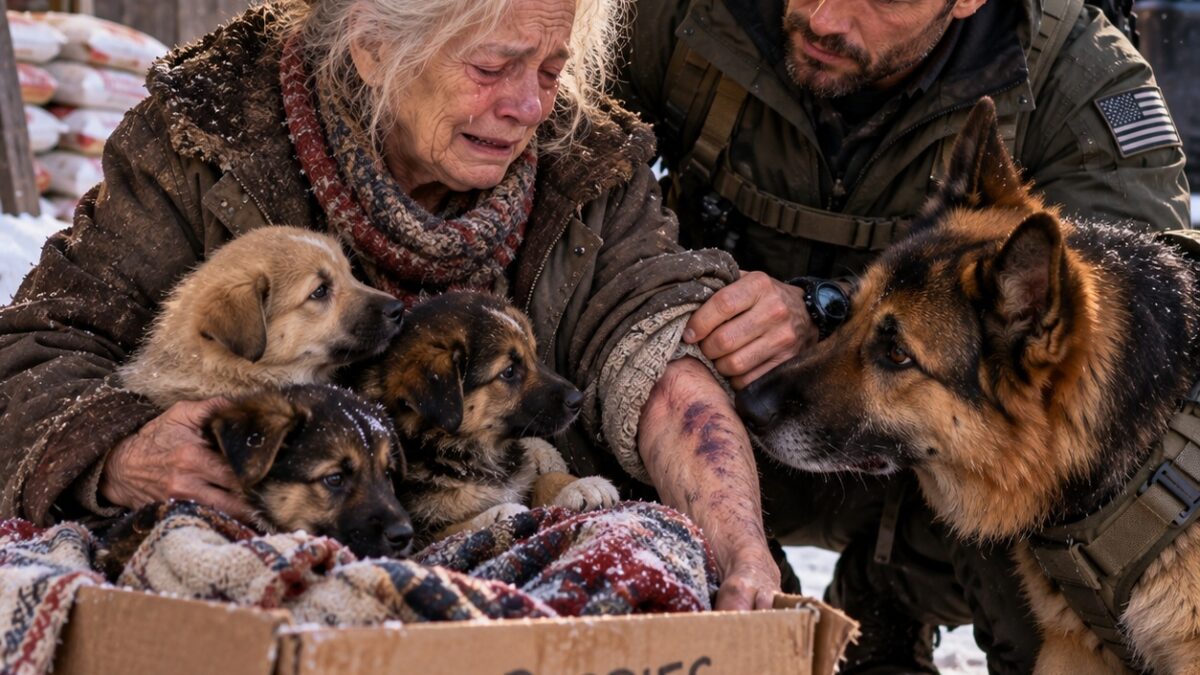
FULL STORY CONTINUATION
I didn’t ask about the mark.
Not then.
There are times when a direct question opens a door, and times when it slams one shut.
Something about Edith’s expression told me she was already frightened enough.
So I crouched beside the box and let Pippen attack the lace of my boot.
“You sure these are German Shepherd mixes?” I asked.
Edith blinked.
“Yes.”
“He looks like a professional criminal.”
Pippen pulled the lace free and backed away proudly.
Edith laughed.
It wasn’t a loud laugh, but it was genuine.
After several hours of being ignored or rejected by people walking past, I suspected she’d needed that sound more than she knew.
I looked at her hands.
The gloves were worn thin across the fingertips.
“Let’s get them inside somewhere warm.”
“You’re taking them now?”
“First, we’re going to the veterinarian.”
Her expression shifted.
“Oh, they’ve already been examined.”
“I believe you. I’d like the vet to check them again before I bring them home.”
She nodded quickly.
“Dr. Lena Harrow. Her clinic is on the next block.”
“Then let’s go.”
I lifted the cardboard box.
Maple immediately tried to climb over the edge.
Pippen seized the folded corner of the quilt.
Moss remained curled against Bramble, watching me with suspicious eyes.
I looked down at my dog.
“You understand this is your fault?”
Bramble blinked.
Edith smiled again.
I carried the box toward my pickup while she folded the chair and collected the handwritten sign.
She hesitated before putting the sign inside her bag.
I noticed the care she took with it.
The cardboard was damp at the corners, and the ink had begun to run.
She held it as though it were something important.
Maybe because it represented a decision she hated having to make.
Or maybe because she wanted proof that she’d tried to find the puppies good homes.
I didn’t know yet.
I only knew she looked relieved when all three were safely inside my truck.
Dr. Lena Harrow was still at the clinic when we arrived.
She opened the exam-room door, saw me carrying Pippen, Edith holding Maple and Moss, and Bramble waiting politely in the hallway.
Then she stopped.
“No.”
I frowned.
“I haven’t said anything.”
“Rowan, you brought three puppies.”
“Technically, Bramble brought three puppies.”
Lena looked toward the shepherd.
He sat perfectly still.
“Of course he did.”
I had known Lena for years.
She was forty-eight, tall, athletic, with ash-blonde hair tied behind her head and the calm confidence of someone who had handled everything from frightened kittens to injured livestock.
She’d also patched up Bramble after a mishap during a wilderness training exercise.
That history apparently gave her permission to criticize both of us.
“These are Edith’s rescues,” I explained.
Lena nodded.
“I remember.”
She looked toward Edith.
“You found somewhere for them?”
“For now.”
Edith glanced at me.
“Mr. Kesler has agreed to foster them.”
“Rowan,” I corrected.
She smiled.
“Rowan.”
Lena looked almost relieved.
“That’s good news.”
She examined the puppies one by one.
Maple was first.
A confident honey-gold female with a black muzzle and one ear standing straighter than the other.
She objected to being weighed, attempted to climb Lena’s sleeve, and greeted the examination table as an obstacle designed specifically for her entertainment.
Pippen was heavier, darker, and apparently convinced that every object he encountered was meant to be chewed.
He tried stealing Lena’s pen.
Then my sleeve.
Then the corner of the examination towel.
Moss was the smallest.
He had pale-gold fur beneath a dark mask, a small triangular marking on his chest, and two ears that folded slightly forward.
Unlike his siblings, he watched first.
Only after several minutes did he approach Lena’s hand.
She took her time with him.
“He’s still a little underweight,” she said.
Edith’s expression tightened.
“I’ve been feeding him.”
“I know you have.”
Lena’s voice remained gentle.
“He looks much better than he did when you first brought him in.”
Edith relaxed.
The examination continued.
The puppies were healthy enough for foster placement, although Moss would need extra attention to his weight.
We reviewed their vaccination records and general care.
Then I signed the temporary foster paperwork.
Edith watched my pen move across the page.
When I finished, she let out a breath so quietly I almost missed it.
For the first time that afternoon, the three puppies had somewhere safe to sleep.
I loaded them into the pickup.
Bramble climbed into the back seat and sat between them with the weary dignity of a man assigned to supervise three badly behaved children.
Edith stood beside the clinic door.
The sun was already dropping behind the western ridge.
“Need a ride home?” I asked.
Her face changed.
She glanced toward a clock visible inside the pharmacy across the street.
Four forty-one.
“No.”
“You sure?”
“Yes. I’m close enough.”
I didn’t believe her.
But she looked almost panicked at the idea of arriving home in a stranger’s truck.
“Edith—”
“Thank you, Rowan.”
She stepped back.
“I mean that.”
I watched her tighten her gray scarf.
Then she smiled at the puppies.
“Be good.”
Pippen immediately tried to climb over Moss.
Maple scratched at the window.
Moss pressed closer to Bramble.
Edith laughed softly.
I started the engine.
As I drove away, I checked the rearview mirror.
She stood outside the clinic, growing smaller behind us.
Bramble had turned to watch her.
He didn’t face forward again until she disappeared completely from view.
My cabin had been quiet for almost three years.
That ended before seven the following morning.
I woke to a scraping sound beneath my bed.
Then a low growl.
Then something soft dragged across the floor.
I opened my eyes.
One of my socks was missing.
I found Pippen under the dresser with the sock hanging from his mouth.
He looked delighted.
I didn’t.
“Seriously?”
He wagged his tail.
When I reached for the sock, he backed away.
I crouched.
“Pippen.”
He lowered his front legs in the universal invitation to chase him.
I sighed.
The puppy shot past my shoulder.
I followed him into the kitchen.
Maple joined the pursuit, although she had no idea what we were chasing.
Moss watched from beside Bramble.
My older shepherd sat near the woodstove with the expression of a dog who had already decided this was beneath him.
Pippen ran under the table.
Maple tried to follow and collided with a chair leg.
I stopped.
Looked around.
Then looked at Bramble.
“This was a mistake.”
He yawned.
Twenty minutes later, I found the sock behind the firewood box.
By noon, a dish towel had disappeared.
The following morning, one of my work gloves turned up in Bramble’s water bowl.
I had spent years keeping the cabin immaculate.
Every tool had a place.
Every pair of boots stood neatly beside the door.
Firewood was stacked according to size.
The kitchen counters were always clean.
Now there were chew toys under the table, blankets beside the stove, puppy food containers near the pantry, and paw prints in places I couldn’t explain.
Maple discovered the sofa.
She worked out how to climb onto it by stepping on a cushion.
Unfortunately, she did not understand that getting down required a completely different skill.
I found her sitting at the edge, front paws hanging over, making small offended noises at gravity.
I folded my arms.
“You got yourself up there.”
She whined.
“Not convincing.”
She whined louder.
I lifted her down.
Bramble watched from the rug.
“Don’t start.”
He blinked slowly.
If dogs could laugh at people, I was convinced mine was enjoying every minute.
Yet something else happened during those first days.
Bramble began teaching them.
Not with commands.
Not in the way a human trainer would.
He simply showed them what was safe.
When Maple wandered too close to the stove, he stepped sideways and blocked her path.
When Pippen discovered an electrical cord near my workbench, Bramble moved him away with a gentle nudge.
Moss followed him everywhere.
He sat when Bramble sat.
Waited when Bramble waited.
Slept near his hind legs.
One evening, I found Moss curled in the warmest spot beside the stove.
That had always been Bramble’s place.
Bramble had moved several feet away.
I stood in the doorway.
“You’re getting sentimental.”
He rested his muzzle on his paws.
I smiled.
Maybe I was getting sentimental, too.
A week later, Edith appeared at my cabin.
I heard a light knock just after noon.
Bramble stood immediately.
The puppies erupted.
By the time I opened the door, Maple was pressing between my boots, Pippen was trying to climb over her, and Moss was watching from a safer distance.
Edith stood on the porch.
Her cheeks were red from the cold.
Snow clung to the hem of her coat.
She still wore the same gray scarf and brown gloves.
But she looked more tired than I remembered.
I glanced past her toward the road.
“You walked?”
“Not all the way.”
“The bus?”
She nodded.
“It goes to the old mill stop now.”
“That’s still more than a mile.”
She smiled.
“I’ve had seventy-four years to practice walking.”
Before I could answer, Maple pushed past my boot.
Then Pippen.
Then Moss.
All three puppies rushed toward Edith.
She laughed.
A real laugh.
Not the polite kind people use when they’re trying to reassure strangers.
She sank carefully onto the floor just inside the doorway and opened her arms.
The puppies climbed over her.
Maple licked her chin.
Pippen grabbed the end of her scarf.
Moss crawled into her lap and settled against her chest.
Edith closed her eyes.
For a moment, I saw something painful beneath her happiness.
She hadn’t wanted to give them away.
Not really.
She had been trying to protect them from a decision she didn’t control.
That was different.
Very different.
I closed the door against the cold.
“Coffee?”
“Tea, if you have it.”
“I own tea.”
She looked surprised.
“Bramble likes chamomile?”
“No.”
“Then I’ve misjudged you.”
I laughed.
She stayed almost two hours.
She asked about each puppy as though requesting medical updates on grandchildren.
Was Moss gaining weight?
Did Maple still wake during the night?
Had Pippen destroyed anything expensive?
“Depends how much value you put on socks,” I said.
Edith looked at Pippen.
“Criminal behavior.”
He wagged his tail.
For a while, she seemed comfortable.
Happy.
Then I noticed her checking the clock.
Once.
Twice.
Three times.
When I offered to drive her home, she refused.
“Next week, I can bring the puppies to visit you,” I suggested.
Her answer came too quickly.
“No.”
The room went quiet.
Edith looked down.
“I mean… that isn’t necessary.”
I waited.
“I like coming here.”
I studied her face.
Fear often speaks before people have time to disguise it.
But I didn’t challenge her.
“All right.”
She looked relieved.
Too relieved.
That stayed with me.
The visits became a routine.
Every Thursday, Edith arrived around noon.
The bus carried her part of the way.
She walked the rest.
The puppies learned to recognize the sound of her steps on the porch before I did.
Maple usually reached the door first.
Pippen followed, barking as though Edith had been gone for years.
Moss waited behind Bramble until I opened the door, then ran toward her with his little tail moving so quickly it blurred.
Edith always laughed when she saw them.
Sometimes she brought small treats.
Sometimes she brought an old towel for their bedding.
Once, she arrived with a carefully wrapped dog toy she’d found at a discount store.
She apologized because it wasn’t new.
I told her the puppies had already destroyed expensive toys in less than twenty minutes.
She smiled.
“Then perhaps they won’t mind a little history.”
We talked over tea.
She told me about her years as an elementary school librarian.
Thirty years of children.
Books.
Reading lessons.
Lost library cards.
Late returns.
She described one second grader who hid inside the reading castle because he refused to leave before finishing a dinosaur book.
Another child had returned a picture book with peanut butter between the pages.
Edith had spent almost an hour cleaning it.
“The boy said he was feeding the dinosaurs,” she told me.
I laughed.
“What did you say?”
“That the library didn’t provide catering.”
She smiled at the memory.
For those moments, she sounded like a woman with a full life behind her.
Someone who had been respected.
Useful.
Loved.
Then the stories changed.
Not suddenly.
Gradually.
One Thursday, she talked less.
The next week, she checked the clock repeatedly.
Another time, my phone vibrated on the kitchen counter.
Edith flinched so sharply that Moss lifted his head.
She immediately smiled.
“Sorry.”
I said nothing.
The following visit, she wore a thicker sweater beneath her coat even though the cabin was warm.
Her hands remained hidden inside her sleeves.
And Bramble began watching her differently.
It happened while Edith was sitting on the rug with Maple.
Pippen was asleep beneath the table.
Moss had curled against Bramble’s chest.
I was repairing a loose cabinet hinge near the kitchen.
Bramble rose.
Walked toward Edith.
Stopped beside her left hand.
Then lowered his nose toward her wrist.
Edith froze.
Not dramatically.
Only for a second.
But I noticed.
Bramble sniffed again.
She pulled her hand back and tucked it beneath the opposite sleeve.
My dog didn’t follow her.
He simply looked up.
Then turned his head toward me.
I knew that look.
Bramble had spent years around injured people during search-and-rescue training.
He wasn’t detecting bruises by some supernatural ability.
He was responding to something unusual.
A scent.
A movement.
A person protecting a painful area.
I set down my screwdriver.
“Edith.”
She looked up.
“What?”
I nodded toward her arm.
“Can I see your wrist?”
She looked down.
“There’s nothing wrong.”
The answer came too quickly.
I crouched several feet away.
“Please?”
She hesitated.
Then slowly pushed back her sleeve.
A fading bruise wrapped partly around her wrist.
Yellow at the edges.
Dark purple nearer the bone.
The shape was difficult to ignore.
I felt something harden behind my ribs.
“What happened?”
Edith immediately pulled the sleeve down.
“I bumped into the table.”
I watched her face.
She wouldn’t quite meet my eyes.
“At my age,” she added lightly, “the furniture wins more arguments than I do.”
Normally, I appreciated dry humor.
This time, I didn’t smile.
Neither did Bramble.
“Are you sure?”
“Yes.”
Her voice was softer now.
I could have pressed.
Could have demanded an explanation.
Could have told her I didn’t believe her.
But years of dealing with frightened people had taught me that forcing a confession rarely made someone safer.
Sometimes the most useful thing you could offer was a place where silence wasn’t punished.
So I nodded.
“All right.”
Edith looked surprised.
Then relieved.
But there was shame in her expression, too.
And that bothered me more than the bruise.
She forgot her gray scarf that afternoon.
I discovered it draped over the back of a chair after the bus would already have passed the old mill stop.
I folded it carefully.
Set it beside the door.
Bramble approached.
Sniffed it.
Then stood facing the window.
I watched him.
“Don’t.”
He remained still.
“You’re becoming dramatic.”
No response.
Outside, snow moved through the pines.
I told myself Edith had simply forgotten a scarf.
People forgot things.
It didn’t mean anything.
But I couldn’t stop thinking about the way she’d hidden her wrist.
Or the way she’d checked the clock.
Or how quickly she’d refused my offer to visit her home.
The following Thursday, she didn’t come.
At twelve-fifteen, I noticed.
At one, Maple wandered toward the front door twice.
At two, Pippen fell asleep beneath the table.
At three, I put another log on the fire.
I told myself the bus was probably late.
Maybe the weather was bad.
Maybe she had a doctor’s appointment.
I didn’t call.
I didn’t have her number.
That fact irritated me more than it should have.
Friday passed.
No Edith.
Bramble began moving between the window and her scarf.
Moss followed him.
I tried sanding a cabinet door.
After thirty seconds, I realized I’d been working the same corner.
I put the sandpaper down.
Saturday morning arrived bright and cold.
Bramble stood beside the front door.
Edith’s scarf lay on the bench.
I looked at both.
“You think something’s wrong?”
His ears lifted.
I reached for my truck keys.
“Fine.”
I pulled on my boots.
“We’re going to look.”
Bramble was already waiting beside the passenger door before I reached the truck.
The Vale house stood on the northern side of Sunridge Falls.
It was a handsome two-story home painted pale gray with white trim.
A broad covered porch stretched across the front.
A huge leafless maple stood in the yard.
The driveway had been cleared almost perfectly.
A late-model SUV sat near the detached garage.
I parked along the curb.
Bramble sat upright beside me.
“This isn’t what I expected either,” I murmured.
The house didn’t look neglected.
There were no obvious signs of poverty.
No broken windows.
No sagging roof.
Nothing that explained why Edith seemed frightened to return home.
I crossed the shoveled walkway.
Bramble stayed beside me.
I rang the bell.
Footsteps approached.
The door opened.
A tall, slender woman stood inside.
Straight chestnut-brown hair brushed her shoulders.
Her pale green eyes were calm.
Her makeup was understated.
She wore a black turtleneck beneath a camel-colored coat.
Everything about her looked polished.
Prepared.
Controlled.
“Can I help you?”
“Rowan Kesler.”
Recognition flickered across her face.
“The man with the puppies.”
I noticed the wording.
Not the man helping Edith.
Not the man fostering the abandoned dogs.
The man with the puppies.
“That’s me.”
Her eyes dropped toward Bramble.
“And this must be the shepherd she keeps talking about.”
“Bramble.”
“Beautiful dog.”
Bramble remained still.
He had never been particularly impressed by compliments.
“I was hoping to see Edith.”
The woman’s expression changed by almost nothing.
“She’s resting.”
“Everything okay?”
“Oh, yes.”
She leaned lightly against the door.
“She’s had a little cold.”
I nodded.
“Sorry to hear that.”
“At her age, I prefer she doesn’t push herself.”
She said it like a concerned daughter.
But she kept speaking.
“She’s been overdoing things lately.”
“In what way?”
“Well…”
A small sigh.
“She’s becoming forgetful.”
I kept my face neutral.
“Forgetful?”
“Doors. Where she puts things. Going outside in bad weather.”
She glanced toward Bramble.
“Then there was the business with the stray dogs.”
“The puppies?”
“Yes.”
She smiled.
“She brought three animals home without thinking through what caring for them would involve.”
I listened.
Silence can be useful.
People often fill it because they become uncomfortable.
Clare did.
“Daniel and I have been discussing whether Mom might need somewhere more appropriate.”
“Appropriate?”
“Less responsibility. More support.”
The words sounded reasonable.
That was what bothered me.
Concern could be genuine.
It could also make an excellent disguise for control.
Behind me, Bramble shifted.
His ears had angled toward the second floor.
I followed his gaze without moving my head too quickly.
One upstairs curtain moved.
For a moment, only darkness showed.
Then a face appeared.
Edith.
She stood several feet back from the window.
Her white hair was loose around her temples.
One hand rested against the curtain.
Our eyes met.
Only for a second.
Then she stepped away.
Clare had just told me she was resting.
I looked back at her.
I didn’t challenge the contradiction.
Not yet.
Instead, I said, “Tell Edith Bramble misses her.”
Clare smiled.
“I will.”
I walked back toward the truck.
Bramble followed.
Neither of us looked back.
But I knew Edith had seen us.
And I suspected she understood why we’d come.
Two days later, someone knocked at my cabin.
Edith stood outside.
She looked exhausted.
Her coat was buttoned high.
Her white hair had been tied back again.
Her face carried the washed-out color of someone who hadn’t slept properly.
“I had a cold,” she said before I asked.
I stepped aside.
“Come in.”
The puppies recognized her immediately.
Maple reached her first.
Pippen followed.
Moss stayed close enough to brush against her boots.
Edith laughed weakly.
Then lowered herself into a chair.
I made tea.
For several minutes, we talked about ordinary things.
Moss had gained weight.
Maple had discovered snowbanks.
Pippen had stolen a screwdriver handle and hidden it beneath Bramble’s blanket.
Edith smiled.
But I noticed she never asked why I’d visited her house.
Eventually, I told her.
“I stopped by.”
Her cup froze halfway to her mouth.
“When?”
“Saturday.”
She lowered it carefully.
I didn’t mention the upstairs window.
Not yet.
“Clare said you were sick.”
Edith stared into her tea.
“I was.”
A pause.
“Maybe.”
I leaned back.
“I’m not asking you to explain anything you don’t want to.”
Her shoulders relaxed slightly.
“But I am going to ask you one question.”
She looked up.
The room became very still.
Even Pippen seemed to sense the change.
“Do you feel safe in your own house?”
Edith looked away.
For almost half a minute, she said nothing.
Maple had fallen asleep across her feet.
The puppy rolled onto her side.
Edith automatically lowered one hand and rested it against the small dog’s ribs.
Her fingers moved gently with each breath.
Then Edith whispered, “She trusts me enough to sleep like this.”
I waited.
Edith’s mouth trembled.
“I’m not sure when I stopped trusting myself.”
The words hit harder than any accusation could have.
I moved my chair a little closer.
“Tell me.”
And slowly, in pieces, Edith began explaining what had happened inside the beautiful gray house.
At first, Clare had been helpful.
That mattered.
Edith wanted me to understand it.
When Daniel left for his long maintenance contract in Alaska, Clare had offered to help manage the household.
She drove Edith to appointments.
Picked up prescriptions.
Handled complicated bills.
Made dinner on evenings when Edith’s arthritis bothered her.
Edith appreciated it.
She had been a widow for years.
Her son worked hard.
She didn’t want him worrying about her while he was away.
So she accepted Clare’s help.
Then small things changed.
The first was the car.
Edith drove to the grocery store during light snowfall.
Clare was angry when she returned.
She said the roads were dangerous.
She said Edith shouldn’t be driving in winter.
Then she took the keys.
“For your own safety,” she told Edith.
Edith tried to argue.
Clare reminded her that Daniel would be upset if anything happened.
After several conversations, Edith stopped asking for the keys.
Then Clare began organizing her medications.
At first, that seemed helpful.
But eventually, Edith noticed she had to ask where certain bottles were kept.
Then Clare started opening financial mail.
She said she was keeping everything organized.
One bank card stopped being stored in Edith’s wallet.
Clare said it was safer in the desk.
Sometimes the office door was locked.
Edith began asking permission to access money from an account that was partly hers.
I sat quietly.
My hands had tightened without my noticing.
“What happened to your phone?”
She looked down.
“Nothing.”
“Edith.”
She sighed.
“I wanted to call Daniel.”
“When?”
“A few weeks ago.”
“What happened?”
“Clare said he was working.”
“And?”
“I said I’d leave a message.”
Edith rubbed her thumb against the side of her mug.
“She reached for the phone.”
I waited.
“I held on.”
Her voice became smaller.
“She grabbed my wrist.”
I looked at her sleeve.
“The bruise?”
She nodded.
“She only wanted the phone.”
I felt anger rise.
“That doesn’t explain the injury away.”
“She didn’t hit me.”
I kept my voice level.
“I’m not asking what she calls it.”
Edith looked at me.
“I’m asking whether you’re afraid of her.”
Silence returned.
She didn’t say yes.
She didn’t say no.
Tears gathered in her eyes.
One slipped down her cheek.
She wiped it away almost angrily.
“I’m too old for this.”
“For crying?”
“For not knowing whether I’m making a problem bigger than it is.”
I leaned forward slightly.
“Being uncertain doesn’t make you wrong.”
She stared at me.
Then whispered, “I used to know what I was doing.”
I waited.
“I was a librarian for thirty years. I paid my bills. I raised Daniel. I managed this house after my husband died.”
Her voice cracked.
“Now I can’t even find my own bank card without asking.”
I wanted to tell her she wasn’t helpless.
That Clare had no right to control her.
That she should leave immediately.
But the more I listened, the more I understood something important.
Edith didn’t need another person making decisions for her.
Even decisions intended to protect her.
She needed the ability to make them herself.
So I asked, “What do you want to do?”
She looked surprised.
“I don’t know.”
“That’s okay.”
She stared at the puppies.
Maple slept peacefully across her feet.
Moss rested near Bramble.
Pippen was chewing a rag beneath the table.
Edith whispered, “I want to know what’s happening in my own house.”
I nodded.
“Then that’s where we start.”
The financial part of the story emerged slowly.
Daniel sent money home regularly from Alaska.
Some went toward taxes.
Some toward repairs.
Some toward groceries, medication, and Edith’s expenses.
He believed everything was being handled properly.
Edith had believed that, too.
Until the amounts Clare said were needed stopped making sense.
Heating costs were supposedly increasing.
Insurance had gone up.
Repairs became more expensive.
There was always an explanation.
But Edith rarely saw the statements herself anymore.
Then, several weeks before finding the puppies, she noticed an envelope in a stack of household mail.
It was a rental statement.
For an apartment in Silver Creek, roughly forty minutes from Sunridge Falls.
Clare’s name appeared as the payer.
Edith had never heard of the property.
I looked at her.
“Was your name on the lease?”
“No.”
“Daniel’s?”
“No.”
“Did you ask Clare?”
Edith shook her head.
“I started to.”
“What stopped you?”
She looked toward the window.
“I realized I was afraid of the answer.”
That was worse than I expected.
I sat quietly for several seconds.
Then I spoke.
“I’m not going to follow Clare.”
Edith looked back at me.
“I’m not going through her phone or breaking into anything.”
She nodded.
“And I’m not going to pretend we already know what that apartment means.”
“What can we do?”
“We start with what belongs to you.”
“My accounts?”
“Your accounts. Your mail. Your property records. Anything you legally have a right to examine.”
I looked directly at her.
“And if your suspicions are wrong, the facts will tell us that, too.”
Edith studied me for a long time.
Then nodded.
“No guessing.”
“No spying.”
“Just the truth.”
I nodded.
“Just the truth.”
She looked down at Maple.
The puppy had rolled onto her back, exposing her little stomach without a care in the world.
Edith smiled sadly.
“I thought Clare simply hated the puppies.”
I waited.
“The barking. The mess. The hair.”
She looked toward Moss.
“But they made me leave the house.”
Then Pippen.
“They gave me somewhere to go that wasn’t a room she controlled.”
Edith became quiet.
Finally, she whispered, “I don’t think the puppies were ever the real problem.”
I looked toward Bramble.
He sat beside the stove, perfectly still.
Watching Edith.
For weeks, my dog had noticed things I’d been trying to understand.
He didn’t know about bank accounts.
Or rental statements.
Or family arguments.
He knew when someone was frightened.
And fear had been sitting in front of us for a long time.
The county services building stood three blocks behind the courthouse.
The following morning, I drove Edith there.
She sat beside me with both hands folded over her canvas bag.
She had dressed carefully.
Chestnut coat.
Gray scarf.
Brown gloves.
But there was something different in her posture.
She looked like a woman preparing to enter a room where someone might tell her what kind of person she had become.
I parked near the side entrance.
Bramble had stayed home with the puppies.
This wasn’t work for a dog.
It was work for documents, signatures, memory, and courage.
“You ready?” I asked.
Edith looked at the building.
“No.”
I nodded.
“Good enough.”
She smiled faintly.
We went inside.
Naomi Pierce met us on the second floor.
She was fifty-one, with a sturdy build, dark brown eyes, and black hair heavily threaded with silver.
Her office was orderly without being cold.
A small plant leaned toward the window.
Two chairs faced her desk.
A ceramic mug beside her keyboard read:
Listen First.
I liked that.
Naomi shook Edith’s hand.
“Mrs. Vale, I’m Naomi Pierce.”
She explained that she worked with older adults dealing with financial pressure, housing questions, family conflict, and concerns affecting independence.
Her voice was steady.
No pity.
No assumptions.
Edith seemed relieved.
Naomi looked at me.
“And you are?”
“Rowan Kesler.”
“A friend?”
I glanced at Edith.
“That’s probably the simplest answer.”
Naomi nodded.
Then turned back to Edith.
“Before we begin, I want to make something clear.”
Edith straightened.
“I’m not here to decide whether your daughter-in-law has committed a crime.”
She paused.
“I’m here to understand what you can access, what you can decide, and what has changed.”
Edith nodded.
“All right.”
Naomi leaned forward.
“Can you currently access your own bank account whenever you want?”
Edith’s fingers tightened.
“No.”
Naomi picked up a pen.
“When was the last time you could?”
Edith thought.
“Months ago.”
The room changed.
Not dramatically.
But I felt it.
We were no longer discussing a difficult family relationship.
We were discussing control.
The morning became a slow process of recovering information.
Naomi helped Edith contact the bank.
There were identity checks.
Security questions.
Documents to verify.
At one point, Edith struggled to remember a particular account detail.
Her face reddened.
“I know this.”
Naomi waited.
Edith closed her eyes.
Then answered correctly.
No one rushed her.
No one suggested the hesitation proved she was confused.
Another security question asked about the street where she’d lived as a newlywed.
She remembered immediately.
Naomi scanned her identification.
We waited.
More questions.
More verification.
At one point, Edith looked toward me as though expecting me to answer for her.
I didn’t.
Not because I wanted to make things difficult.
Because these were her accounts.
Her identity.
Her decisions.
She needed to hear herself answer.
Finally, the bank provided access to several months of statements from an account Edith was legally named on.
Naomi printed them.
The stack was thicker than Edith expected.
She stared at the first page.
“Daniel really has been sending money.”
“Yes,” Naomi said.
Regular deposits.
Consistent amounts.
Enough to cover more than the basic expenses Edith had been told were consuming nearly everything.
But the withdrawals told another story.
A recurring rental payment connected to Silver Creek.
Restaurant charges.
Two weekend hotel bills.
Several transfers to the same name.
Grant Morrow.
Again.
And again.
Edith traced the name with one finger.
“I don’t know him.”
Naomi looked up.
“You’ve never met him?”
Edith hesitated.
“I don’t remember the name.”
Naomi nodded.
“Then that’s where we’ll leave it for now.”
I watched Edith.
Each transaction seemed to hurt her differently.
The large amounts frightened her.
The smaller charges seemed almost more insulting.
Someone had been making ordinary, repeated decisions involving money she thought was being used for her care.
Naomi tapped one page.
“One unusual transaction proves very little.”
Edith looked at her.
“But this…”
Naomi nodded.
“This is a pattern that deserves examination.”
She paused.
“Pattern still needs context.”
I respected her for that.
She wasn’t feeding Edith fear.
She was helping her build something that could survive questions.
Later that afternoon, Naomi introduced us to an elder-law attorney named Marcus Bell.
He was sixty-three, tall and narrow-shouldered, with close-cropped gray hair and a neatly trimmed white beard.
He wore a brown suit that looked as though it had survived many long days in court.
He carried a yellow legal pad covered in tight handwriting.
Marcus had handled estate disputes, guardianship matters, and financial-control cases for years.
He listened while Naomi summarized what we’d found.
Then he looked at Edith.
“The first thing we do is separate what feels wrong from what is legally relevant.”
She nodded.
“The second thing is make sure nobody speaks for you unless you want them to.”
Something changed in her expression.
Not confidence yet.
But recognition.
Marcus reviewed the statements.
Asked what documents she remembered signing.
Made a list of records that needed to be obtained.
Then he asked a simple question.
“Who owns the house?”
Edith blinked.
“My husband and I did.”
“And after he died?”
“I stayed.”
Marcus smiled gently.
“That’s not quite the same question.”
Edith looked uncertain.
Not frightened this time.
Curious.
He continued.
“We need to review the deed and any estate records.”
She nodded.
I watched her.
For weeks, Clare had made Edith feel incapable of answering ordinary questions.
Now she was discovering that not knowing something didn’t mean she had lost the right to know it.
It simply meant we needed the correct documents.
A few days later, I met Walter Ames.
Everyone called him Walt.
He lived across the street from Edith.
Sixty-seven.
Broad.
Gray-white hair.
Thick mustache.
The hands of a man who had spent thirty-five years running a hardware store.
When I approached him outside his house, he folded his arms.
“I’m not getting involved in family drama.”
I nodded.
“Good.”
He frowned.
“That wasn’t the answer I expected.”
“I’m not asking you to take sides.”
“What are you asking?”
“What was Edith like before Daniel went to Alaska?”
Walt leaned against his mailbox.
“That’s easy.”
He described a stubbornly independent woman.
Edith drove herself to the grocery store.
Paid property taxes.
Managed contractors.
Shoveled her own front steps even when Walt offered to help.
Once, she’d argued with a roofer for twenty minutes because he tried charging her for flashing he hadn’t replaced.
“She knew exactly what she was doing,” Walt said.
“When did that change?”
He looked toward the Vale house.
“After Clare started handling everything.”
I waited.
He shrugged.
“Maybe that means nothing.”
“Maybe.”
My answer seemed to satisfy him.
I didn’t need him to accuse anyone.
I needed to understand the difference between Edith’s normal independence and the restrictions that had developed later.
Walt had known her for years.
His memories mattered.
But memories alone weren’t the same as proof.
I was learning to be patient.
It wasn’t easy.
The strangest clue came from Pippen.
Edith was visiting my cabin when the puppy stole one of her gloves and sprinted behind the sofa.
“Oh, not again.”
She bent to chase him.
A folded piece of paper slipped from her coat pocket.
It fell near my boots.
I picked it up.
“Think you dropped this.”
It was an auto-repair invoice.
Nothing remarkable at first.
Then I noticed a name under the secondary contact information.
Grant Morrow.
Edith took the paper.
Her face changed.
“I know that name.”
I stayed quiet.
“He came to the house.”
“When?”
“Twice. Maybe three times.”
“Why?”
“Clare said he worked in real estate.”
She stared at the invoice.
“She called him an investment consultant.”
I looked at the address beside his name.
Silver Creek.
The same building connected to the rental payments.
Edith’s hands began trembling.
I felt the pieces moving toward one another.
But I stopped myself.
A name on an invoice wasn’t proof of an affair.
A rental payment wasn’t proof of theft.
A property contact wasn’t proof of a scheme.
We needed records.
Not conclusions.
Pippen emerged from behind the sofa with the stolen glove still in his mouth.
Nobody laughed this time.
Edith looked down at him.
“That dog keeps stealing things.”
I took the glove.
“Apparently, he also returns evidence.”
She almost smiled.
Then looked at Grant’s name again.
A scrap of paper that had seemed worthless was now a thread connecting two parts of her life that were never supposed to touch.
Naomi began checking only records Edith had legal access to.
Property correspondence.
Public filings.
Mail connected to the household.
Documents associated with the house.
A preliminary valuation request appeared.
The Vale residence had been scheduled for an estimate.
Edith had not requested it.
Daniel had never mentioned selling.
Grant Morrow’s company name appeared in the contact chain.
At the same time, public notices showed a possible resort expansion near the northern edge of Sunridge Falls.
Property values in the area were rising.
Someone had been thinking about the house.
Someone had also been describing Edith as less capable of managing her own decisions.
I didn’t like the combination.
But we still didn’t know what it meant.
Marcus returned with the ownership documents two days later.
He placed them on Naomi’s desk.
“Good news first.”
Edith sat straighter.
“You are still the primary owner.”
She stared at him.
“Daniel can’t sell the house?”
“Not on his own under the current ownership arrangement.”
“Clare?”
“No.”
Marcus folded his hands.
“Not unless you grant authority you do not currently appear to have given.”
Edith let out a long breath.
I hadn’t realized how much fear she was carrying until I saw some of it leave.
Marcus continued.
“That doesn’t mean nobody can pressure you.”
Her expression tightened.
“But legally, the house remains yours to make decisions about.”
Edith nodded slowly.
“Mine.”
“Yes.”
Naomi placed another folder on the desk.
“There’s something else.”
Inside were notes concerning Edith’s ability to live independently.
The language was clinical.
Forgetfulness.
Poor judgment.
Unsafe behavior.
Stray animals brought into the residence.
Winter wandering.
Difficulty managing finances.
Possible need for supervised living.
Edith read the pages slowly.
Her hands began to shake.
Not because she failed to understand.
Because she understood perfectly.
Someone had taken ordinary events from her life and arranged them into a portrait she didn’t recognize.
She looked up.
“This isn’t me.”
Naomi waited.
Edith touched one page.
“I forget things sometimes.”
“Most people do.”
“I’ve made mistakes.”
“So does everyone.”
She looked toward me.
For the first time, I saw anger replace fear.
Quiet anger.
Steady anger.
“This isn’t me,” she repeated.
I leaned back.
“Then don’t let someone else write the rest.”
The first thing Edith took back wasn’t money.
It was her mail.
Naomi helped her arrange for bank statements and financial notices to come directly to her.
Then came passwords.
New banking credentials.
A new phone passcode.
A separate folder for important documents.
Her cell phone stayed in her coat pocket instead of on the kitchen counter.
Her bank card returned to her wallet.
None of those changes looked dramatic.
That was why they mattered.
Control had slipped away one small convenience at a time.
Now Edith was reclaiming it the same way.
One decision.
One document.
One ordinary choice.
Clare noticed.
At first, she said nothing.
Then the questions began.
Why was the bank sending Edith statements?
Why was she meeting Naomi?
Why had she changed her password?
Why did she need an attorney?
Edith answered less than she once would have.
That changed the atmosphere in the Vale house.
Clare had been most comfortable when every explanation passed through her first.
Now some things no longer did.
The tension collected in small moments.
Clipped dinners.
Closed doors.
A coffee cup set down too hard.
A smile that disappeared the second Edith turned away.
She told me about some of it during her visits.
I didn’t tell her to leave immediately.
Didn’t tell her to stay.
I reminded her that if she felt unsafe, she didn’t have to wait for something terrible to happen before asking for help.
She listened.
Whether she fully believed that yet was harder to tell.
The phone call came on a snowy evening.
I was repairing an old oak chair near the stove.
Maple slept on the rug.
Pippen lay beneath the table with one paw resting on a stolen rag.
Moss was curled against Bramble.
My phone vibrated across the workbench.
Edith.
I answered immediately.
“Edith?”
Nothing.
Only breathing.
Faint.
Uneven.
I straightened.
“Edith?”
A woman’s voice sounded somewhere away from the phone.
Too muffled to understand.
Then Edith spoke.
Sharper than I’d ever heard her.
“No.”
A scrape.
Another muffled sentence.
Then a hard impact.
The line went silent.
I was already standing.
Bramble was at the door.
I called back.
No answer.
Again.
Nothing.
My old instincts arrived fast.
Drive.
Enter.
Control the situation.
But this wasn’t a battlefield.
Edith wasn’t a mission.
And rushing into a family home without understanding what had happened could make things worse.
I forced myself to stop.
Then called Naomi.
She answered on the third ring.
“Pierce.”
“It’s Rowan.”
My voice made her fully alert.
“What happened?”
I told her exactly what I’d heard.
No interpretation.
No accusation.
Just facts.
She paused.
“I’ll request a welfare check.”
I grabbed my keys.
“Don’t go inside unless there’s an immediate emergency,” she added. “I’m heading there.”
“I know.”
“Stay outside.”
“I will.”
Bramble followed me to the truck.
The puppies stayed behind.
By the time I reached the Vale house, a county vehicle and a patrol car were pulling into the driveway.
The porch light was on.
Clare stood near the doorway.
Even from the street, I could see that her composure had cracked.
Her hair had fallen loose around one side of her face.
Her camel coat was open.
Her jaw was tight.
I stayed beside my truck.
Exactly as Naomi had told me.
Bramble sat at my left side.
A deputy entered with a county response worker.
Several long minutes passed.
Then Edith appeared in the hallway.
Her white hair was partly undone.
Her face was pale.
Her phone lay broken near the wall behind her.
The screen had shattered across one corner.
One wrist was red.
Clare was speaking quickly.
“We argued. That’s all.”
The county worker asked Edith directly.
“What happened?”
Edith looked toward Clare.
Then toward the open door.
For one terrible moment, I thought she would do what she’d been doing for months.
Make it smaller.
Protect Clare.
Tell everyone there had been a misunderstanding.
Instead, Edith spoke.
“I tried to call my son.”
Clare’s face changed.
Edith continued.
“She took the phone from me.”
Clare interrupted.
“I was trying to stop her from upsetting Daniel over nothing.”
The county worker raised one hand.
“Let her finish.”
The sentence seemed to change the entire room.
Edith swallowed.
“She grabbed my wrist.”
Clare stared at her.
“Edith—”
“I pulled away.”
Her voice shook.
“The phone fell.”
Silence.
The deputy looked toward the broken screen.
The county worker examined Edith’s wrist.
There was no blood.
No dramatic injury.
No scene designed for public outrage.
Only redness.
Fear.
And an elderly woman finally describing what happened without protecting the person who had frightened her.
I stood beside the truck.
Bramble remained still.
When Edith stepped fully into view, he sat down.
His eyes stayed on her.
Then slowly, he lowered his head.
I understood the feeling.
For weeks, Edith had been whispering around the truth.
Now she’d said it aloud.
Sometimes justice doesn’t begin with punishment.
Sometimes it begins when a frightened person is finally allowed to finish a sentence.
Naomi arrived shortly afterward.
She spoke privately with Edith.
The immediate question wasn’t whether Clare had committed every wrong we suspected.
It was where Edith could safely stay that night.
I offered my cabin.
Immediately.
Naomi shook her head.
“Not tonight.”
I frowned.
“She’d be safe.”
“I know.”
“Then why not?”
Naomi lowered her voice.
“Because if Clare later claims you isolated Edith or influenced her decisions, we create an unnecessary complication.”
I looked toward the porch.
“So what do we do?”
“Edith chooses somewhere neutral.”
A friend from her library years was contacted.
Margaret Sloan.
Seventy-two.
A retired middle school English teacher who lived less than ten minutes away.
Margaret arrived wearing a purple winter coat.
She didn’t ask Edith for details.
Didn’t demand explanations.
She simply opened the passenger door of her car.
“I changed the guest sheets this morning.”
Edith looked at her.
Margaret smiled.
“Apparently, Providence likes clean linen.”
Edith laughed weakly.
That was enough.
She climbed into the car.
I watched it disappear down the street.
Clare remained inside the house.
For once, I felt no urge to confront her.
The situation had moved beyond confrontation.
It needed records.
It needed professionals.
It needed Edith’s choices to be respected.
Over the next several days, more information emerged.
Walt Ames came forward with footage from his front-door camera.
He’d installed it after someone stole a snowblower attachment the previous winter.
The camera covered his own driveway and part of the public street.
He volunteered the recordings after Naomi explained what kinds of records might be relevant.
Nobody hacked anything.
Nobody followed anyone.
The footage simply showed what had already passed in front of Walt’s home.
A dark crossover had appeared near the Vale house several times over the previous months.
The same man got out on multiple occasions.
Grant Morrow.
I looked at the images.
Then at Naomi.
She shook her head before I could speak.
“Being at the house proves he was at the house.”
I sighed.
“Nothing more.”
“Exactly.”
The stronger evidence came from Daniel.
After Edith finally spoke with him through Naomi, he began checking financial accounts he legally shared with Clare.
The conversation with me happened that evening.
He called from Alaska.
For the first time, I saw Edith’s son clearly.
Daniel Vale was forty-six.
Broad-shouldered.
Tired brown eyes.
Dark hair heavily silvered at the temples.
Several days of stubble along his jaw.
He wore a navy work jacket with a maintenance-company patch.
He didn’t look calm.
He looked furious.
“How long have you known my mother?”
“Not long.”
“Then why am I hearing this from you?”
“You shouldn’t be.”
His expression hardened.
“What does that mean?”
“It means you should hear it from her.”
Daniel stared at me.
“Why should I believe you?”
“You don’t have to.”
That stopped him.
I continued.
“Naomi has documents your mother authorized us to share.”
“What documents?”
“Account activity. Property records. Correspondence. Dates.”
“No accusations?”
“No.”
Daniel leaned back.
The anger had nowhere obvious to go.
I sent the files through the agreed channel.
Then waited.
Nearly twenty minutes later, he returned to the call.
He looked different.
Less angry.
More frightened.
He had checked his own joint accounts.
There were payments to Grant.
Silver Creek rent.
Hotel charges.
Transfers he didn’t recognize.
Expenses that had nothing to do with Edith or the house.
Daniel rubbed a hand across his face.
“She told me everything was going toward Mom and repairs.”
I said nothing.
He stared at the screen.
Then asked the question he’d been avoiding.
“The bruises?”
I remained still.
“What about them?”
“Did Clare do that?”
“That’s not mine to answer.”
His jaw tightened.
“You saw them?”
“Yes.”
“Then tell me.”
“No.”
My voice stayed level.
“Ask your mother.”
Daniel looked angry again.
But this time, I suspected the anger was directed inward.
A long silence followed.
Then he said, “I’m coming back.”
“When?”
“As soon as I can get coverage.”
I nodded.
“Good.”
He looked at me.
“Rowan?”
“Yeah?”
“Thank you for helping her.”
I didn’t know what to say.
So I simply nodded.
“She deserves to be heard.”
Daniel looked away.
Then ended the call.
That night, my cabin felt different.
The fire burned steadily.
Moss slept against Bramble’s chest.
Pippen was beneath the table.
Maple had dragged Edith’s gray scarf from the bench and curled beside it.
Her chin rested across the folded wool.
As though she believed Edith might come through the door if she waited long enough.
I stood watching her.
The puppies didn’t understand bank accounts.
They didn’t understand betrayal.
They didn’t know Daniel was coming home.
But they’d been part of Edith’s life at the exact moment she most needed a reason to leave the house.
They’d made her talk to people.
Made her travel.
Made her laugh.
Made her feel useful when someone else was telling her she could no longer make good decisions.
And Bramble had noticed the fear she was trying to hide.
Not because he understood every detail.
Because some dogs are simply better at watching people than we are.
I scratched behind his ears.
“Good boy.”
He opened one amber eye.
Then closed it again.
Daniel arrived two days later.
Naomi arranged for him to meet Edith at Margaret’s house.
I wasn’t there.
That mattered.
This was between a mother and her son.
Later, Daniel told me enough to understand what happened.
When he walked through the door, Edith stood.
For a moment, neither moved.
Then he whispered, “Mom.”
She tried to smile.
“Hello, Danny.”
He hadn’t heard her call him that in years.
Daniel crossed the room.
Stopped just short of embracing her.
As though suddenly unsure whether he’d earned the right.
Edith solved it.
She stepped forward.
He wrapped both arms around her.
And held on.
For a long time, neither spoke.
When they finally sat, Daniel kept looking at her.
“You look tired.”
Edith smiled faintly.
“So do you.”
“That’s not an answer.”
“Neither was yours.”
Their old rhythm appeared for half a second.
Then disappeared.
Daniel folded his hands.
“Why didn’t you tell me?”
Edith looked down.
There were a hundred possible answers.
Distance.
Pride.
Shame.
Fear.
She chose the simplest.
“I didn’t want you to have to choose between your mother and your wife.”
Daniel inhaled sharply.
“Mom…”
“I thought I could manage it.”
“You shouldn’t have had to.”
“I thought if I complained, I’d make your life harder.”
His voice broke.
“Then your job wasn’t to disappear so my life could stay easy.”
Edith looked at him.
He swallowed.
“You were never supposed to be the person who had to become smaller.”
That was when she cried.
Not because Daniel had failed her.
Because he’d finally come close enough to understand that he had.
Naomi didn’t begin with accusations.
She laid the records out in three groups.
Money.
Grant.
The house.
Daniel read the financial documents first.
The deposits he had sent home were clearly recorded.
So were expenses Edith had never been told about.
Silver Creek rent.
Restaurants.
Hotels.
Transfers to Grant Morrow.
Daniel stared at one payment for a long time.
“I was working sixteen-hour maintenance shutdowns.”
His voice was quiet.
“Clare told me Mom’s prescriptions had gone up.”
Edith’s face tightened.
Daniel continued.
“She told me the furnace repairs cost almost twice what we’d planned.”
Naomi explained that some household expenses were legitimate.
Some weren’t clearly connected to Edith’s care or the house.
The concern was the pattern.
Edith had less and less access to accounts in her own name.
Meanwhile, spending she didn’t recognize continued.
Daniel nodded.
He hated it.
But he understood why the distinction mattered.
The second group involved Grant.
By then, Daniel had reviewed enough records from accounts he legally shared with Clare to understand that their connection exceeded ordinary business.
Shared lodging expenses.
Restaurant charges.
Payments connected to the Silver Creek apartment.
Messages he could lawfully access made the personal nature of the relationship difficult to dismiss.
Naomi didn’t ask him to describe them.
Neither did Edith.
That part belonged to Daniel.
His marriage.
His betrayal.
His grief.
He closed the folder.
“I’ll deal with that separately.”
No one argued.
The third group concerned the house.
Property correspondence.
A preliminary valuation.
Grant’s real estate contacts.
Notes describing Edith as increasingly unable to manage daily decisions.
References to forgetfulness.
Winter walking.
Stray animals.
Possible assisted living.
Daniel read the pages twice.
Then a third time.
“There’s no document saying Clare planned to steal the house.”
“No,” Naomi replied.
“No signed sale agreement?”
“No.”
“No transfer?”
“No.”
Daniel leaned back.
Almost relieved.
Almost.
Naomi continued.
“What exists is a pattern.”
The word stayed in the room.
Each piece could be explained individually.
A rental could be called an investment.
A valuation could be called planning.
Medication management could be called care.
Concern about an elderly woman walking in winter could be reasonable.
But placed together, the money, restrictions, property interest, and descriptions of Edith as incapable became harder to ignore.
Daniel reached one page.
Stopped.
It wasn’t a bank statement.
It wasn’t a property record.
It was a copied handwritten note concerning Edith’s behavior.
One sentence was underlined.
Edith becomes emotionally attached to animals and makes impulsive decisions without considering household impact.
Daniel read it again.
Then looked at his mother.
“What did you do?”
Edith blinked.
“I rescued three puppies.”
He stared at the sentence.
Something changed in his face.
“They wrote saving three abandoned dogs like it was evidence against you.”
No one answered.
The documents stopped looking like ordinary paperwork.
They began looking like a story someone had been writing about his mother.
A story in which every act of kindness became poor judgment.
Every forgotten object became evidence of decline.
Every question became confusion.
Every attempt to act independently became a problem.
And Daniel finally understood how dangerous that story could become when only one person was allowed to tell it.
They met Clare at the Vale house that afternoon.
Edith agreed to the meeting after Naomi asked what she wanted.
Marcus had already explained what she did and didn’t have to discuss.
The meeting wasn’t intended to settle legal matters.
It was meant to establish what would happen inside Edith’s home next.
I waited outside on the porch with Bramble and the puppies.
Daniel had invited me inside.
I declined.
“This isn’t my table,” I told him.
Bramble sat beside the railing.
Maple wandered near the steps.
Pippen investigated every bootprint in the snow.
Moss stayed close to my older shepherd.
Inside, Clare entered the living room.
She stopped when she saw Daniel.
Her composure slipped for one second.
“Daniel.”
He stood.
“You weren’t supposed to be back until next week.”
“I know.”
She looked at Edith.
Then Naomi.
Then the documents spread across the table.
“What is this?”
Daniel didn’t raise his voice.
“Sit down.”
Clare remained standing.
He placed the Silver Creek records first.
She exhaled sharply.
“That apartment was an investment.”
Then the Grant payments.
“Grant is a business contact.”
The hotel charges.
Her answer came slower.
“You don’t understand the context.”
The property valuation.
“I wanted to know what the house was worth. That’s not a crime.”
Then the notes about Edith.
Clare’s restraint cracked.
“Someone had to deal with reality.”
Edith looked up.
Clare continued.
“Your mother has become difficult.”
Daniel’s face hardened.
“She brought three stray animals home. She goes outside in dangerous weather. She forgets things.”
Clare looked at him.
“I’ve spent months taking care of everything while you were gone.”
Daniel didn’t answer immediately.
There was some truth in the burden she’d described.
He had left his wife with much of the household work.
But that didn’t excuse what had happened.
Before he could speak, Edith did.
“You said the dogs made this house impossible.”
Clare turned.
Edith’s voice remained quiet.
“The puppies never took my bank card.”
Silence.
“They never told me I didn’t remember things I remembered perfectly.”
Clare opened her mouth.
Edith continued.
“They never made me ask permission to leave my own house.”
The room went still.
Clare’s face reddened.
“I was helping you.”
Edith nodded.
“There were days when you did.”
That answer surprised everyone.
Even Clare.
Edith continued.
“You drove me to appointments. You picked up medicine. You cooked when my arthritis was bad.”
Clare’s expression softened slightly.
“Exactly.”
“But helping me doesn’t give you ownership of me.”
The softness disappeared.
Edith’s hands trembled.
Her voice did not.
“You were my daughter-in-law.”
She paused.
“I began feeling like I was someone you were keeping under control.”
Clare looked toward Daniel.
“You left me here to handle everything.”
He flinched.
Because that part contained truth.
“I did.”
Clare stared at him.
He continued.
“And I have to live with that.”
Her breathing changed.
“But what happens to us?”
Daniel looked at the folders.
“Not here.”
“Daniel—”
“We’ll handle our marriage through attorneys.”
Her face went white.
“And the money will be reviewed separately.”
“You think I stole from you?”
“I think I don’t know enough yet.”
Clare laughed bitterly.
“So that’s it?”
She looked at Edith.
“Your mother cries and suddenly I’m the villain.”
Edith didn’t respond.
Daniel did.
“No one here needs to call you anything today.”
His voice remained low.
“But Mom decides what happens in her house.”
Clare looked around the room.
For perhaps the first time, she understood everyone was waiting for Edith.
Not Daniel.
Not Naomi.
Edith.
The elderly woman looked toward the staircase.
Then back at Clare.
“I want some space.”
Clare stared at her.
For several seconds, she said nothing.
Then nodded.
She went upstairs.
Twenty minutes later, she came down with a suitcase and an overnight bag.
There was no dramatic arrest.
No shouting.
No theatrical scene on the porch.
Clare put on her camel coat.
Took her keys.
And left.
The front door closed.
I heard the latch from outside.
I turned.
Edith stepped onto the porch.
Maple reacted first.
She slipped from my hand and launched herself through the snow.
Pippen followed.
Then Moss.
All three reached Edith at once.
Maple jumped against her knees.
Pippen circled her boots.
Moss pressed into her legs.
Edith lost her balance and sat down gently in the snow.
Then she began laughing.
Really laughing.
Daniel came through the doorway.
He looked at the puppies swarming his mother.
“I think you’ve been ambushed.”
Edith wrapped both arms around Maple and Moss.
Pippen tried climbing over her shoulder.
For once, she laughed through tears.
“I’m happy to be outnumbered.”
I smiled.
Then looked at Bramble.
He remained seated beside the porch steps.
Calm.
Still.
Watching Edith surrounded by the lives she’d once been forced to give away.
For weeks, he’d watched doors, faces, hands, and silences.
Now he simply lowered himself into the snow.
As if, for tonight at least, there was nothing left he needed to guard.
Clare leaving the Vale house didn’t make every problem disappear.
It only made the problems easier to name.
The weeks that followed were full of things that never appear in perfect happy endings.
Lawyers.
Bank statements.
Phone calls.
Documents.
Questions about money.
Some expenses could be traced.
Some couldn’t.
Some funds would probably never be recovered.
Daniel began separation proceedings.
Marcus continued reviewing the financial records.
Naomi remained involved long enough to make sure Edith understood every decision placed before her.
No one promised justice would arrive neatly.
It rarely does.
Some questionable expenses could be challenged.
Others were harder to untangle.
Some losses remained losses.
But Edith discovered something more important than recovering every dollar.
She could make decisions again.
Her bank card stayed in her wallet.
Her phone stayed in her coat pocket.
The front-door key hung from the little brass hook beside the kitchen entrance where she’d kept it for nearly twenty years.
Financial mail came directly to her.
If someone needed her signature, they waited until she’d read the page.
Those changes looked ordinary.
To Edith, they felt enormous.
The house itself began feeling different.
Not because the furniture changed.
Because silence no longer meant fear.
She could sit in the kitchen and hear the refrigerator hum without wondering whether footsteps would stop behind her.
She could leave a book on the table and know no one would move it.
She could decide at ten in the morning that she wanted coffee downtown.
And simply go.
That last freedom nearly made her laugh the first time she used it.
Daniel returned to Alaska to finish the remaining weeks of his contract.
He didn’t abandon Edith by doing so.
That distinction mattered to both of them.
For the first time, he understood that caring about his mother didn’t require rearranging his entire life around her.
And it didn’t require insisting she rearrange hers around him.
When the contract ended, he accepted maintenance work much closer to Montana.
Then rented a modest house a few miles from Edith.
The first night there, she called him.
“You know, you could have stayed here.”
“I know.”
“There are two empty bedrooms.”
“I know.”
“You’re paying rent for no reason.”
Daniel laughed.
“Mom.”
“What?”
“You taught me something.”
“That sounds dangerous.”
He smiled.
“Being close to someone and living on top of them aren’t the same thing.”
Edith was quiet.
Then she said, “That sounds suspiciously like something I would say.”
“You would.”
“I’m very wise.”
“You also called me yesterday because you couldn’t find your glasses.”
“They were in the refrigerator.”
“I remember.”
“You were distracted?”
“Obviously.”
For once, the laughter between them didn’t carry guilt.
They were learning how to be mother and son again.
Not caregiver and dependent.
Not protector and burden.
Just family.
Edith returned to the place where she’d spent most of her adult life.
The elementary school library.
Two mornings a week, she volunteered.
The building smelled almost exactly as she remembered it.
Paper.
Floor polish.
Crayons.
Winter coats drying too slowly on hooks.
Children still returned books late.
They still folded page corners despite being told not to.
They still asked questions adults had forgotten how to answer honestly.
Edith loved every minute.
One morning, a little boy asked why dogs couldn’t come into the library.
She told him some dogs could, with the right arrangements.
He thought about that.
Then asked whether puppies could learn to read.
Edith smiled.
“Not in the same way you do.”
He looked disappointed.
“But they can learn other remarkable things.”
She thought of Bramble.
Maple.
Pippen.
Moss.
And how three abandoned puppies had helped her remember something she’d almost forgotten.
That she was capable.
Useful.
Allowed to make choices.
Allowed to be herself.
The puppies eventually needed permanent homes.
We’d known that from the beginning.
They were growing quickly.
Maple was confident, curious, and determined to investigate everything.
Pippen had become stronger and more mischievous, with a particular interest in stealing socks, gloves, and anything small enough to carry.
Moss remained quieter.
He followed Bramble everywhere.
Slept beside him.
Waited for him before going outside.
Sat when Bramble sat.
Sometimes I caught the two of them standing in exactly the same posture, watching the trees beyond my cabin.
I suspected Moss believed Bramble was the finest creature who had ever lived.
Bramble tolerated the admiration with enormous patience.
Edith visited one afternoon while I was feeding them.
She watched Maple investigate the food bowls.
Then looked at Pippen.
Then Moss.
Her expression changed.
“Saving them doesn’t mean keeping them,” she said quietly.
I looked at her.
“No.”
She nodded slowly.
For months, she’d thought love meant holding tightly enough that nothing could be taken away.
Clare had shown her what happened when that idea became control.
The puppies were teaching her something different.
Love could mean helping someone reach the place where they belonged.
Even when that place wasn’t right beside you.
Maple went home with Edith.
The choice surprised neither of us.
She’d been the first puppy to climb into Edith’s lap.
The first to recognize her footsteps.
The first to rush toward her on the porch.
And Edith had finally reclaimed the right to decide whether a dog could live in her house.
Pippen went with Daniel.
I warned him about the socks.
He laughed.
Two days later, he called to tell me Pippen had stolen a work glove and hidden it in the laundry basket.
I told him he hadn’t been adequately warned.
Moss stayed with me.
Or perhaps I should say, Bramble chose him.
The smaller shepherd had grown into a strong young dog, but he still followed Bramble’s lead.
He slept beside him.
Waited for him before going outside.
And watched him with the same quiet devotion he’d shown from the first day.
I looked at them one morning.
Moss was copying Bramble’s posture almost exactly.
“I guess I lost voting rights sometime last month.”
Edith smiled.
“I think you lost them the first day.”
I considered that.
“Probably.”
The three puppies went to three different homes.
But they were hardly separated.
Every Sunday became an unofficial gathering at my cabin.
Edith arrived with Maple walking proudly beside her.
Daniel drove over with Pippen, who usually had his head halfway out the truck window before the vehicle fully stopped.
Moss recognized the engine.
He raced from the porch.
Maple met him halfway.
Pippen barked until Daniel opened the door.
Then chaos followed.
Bramble never joined the first rush.
He stood beside me, watching all three puppies circle through the snow.
He looked less like their friend and more like an exhausted instructor inspecting a class that had ignored the curriculum.
I scratched behind his ears.
“They learned nothing.”
Bramble stared ahead.
“Exactly.”
One Sunday, Edith arrived carrying something flat beneath her arm.
Not Maple’s leash.
Something weather-stained.
She placed it on my workbench.
I looked down.
The old cardboard sign.
FREE PUPPIES — GOOD HOMES ONLY.
The black marker had faded.
One corner had softened from snow and moisture.
I stared at it.
“I thought you threw that away.”
“I almost did.”
Edith ran her fingertips over the cardboard.
“Should I?”
I looked toward the dogs.
Maple slept beneath the table.
Pippen was trying to steal a rag.
Moss had wedged himself against Bramble.
“No.”
I carried the sign into my workshop.
Edith followed.
I selected a piece of pine from the rack.
Measured it.
Cut four narrow strips.
Built a simple frame.
Nothing decorative.
Nothing elaborate.
When I finished, I placed the cardboard inside.
Then I took a wood-burning tool.
Beneath the sign, I added three words.
THEY FOUND THEIRS.
Edith read them.
Her eyes filled.
She touched the frame once.
“They did.”
I looked at her.
“So did you.”
She shook her head gently.
“So did all of us.”
By the end of February, winter began loosening its grip on Sunridge Falls.
Snow still covered the fields.
But dark earth appeared along the road shoulders.
Water dripped from the cabin roof in the afternoon sun.
The days grew longer.
One bright morning, I stepped onto the porch with Bramble and Moss.
Bramble’s black-and-gold coat shone beneath the pale sunlight.
Moss stood beside him.
Taller now.
His once-folded ears beginning to hold themselves upright.
Far down the road, someone appeared.
Edith.
Maple walked beside her.
Behind them came a pickup moving slowly over the packed snow.
Daniel was driving.
Pippen had his head outside the passenger window.
His ears flapped wildly in the wind.
Maple spotted Moss.
She ran.
Moss raced down the path.
Pippen barked from the truck.
I smiled.
Bramble stayed beside me.
The older shepherd didn’t run.
He simply watched.
And I remembered a winter afternoon in town.
A seventy-four-year-old woman sitting in the cold.
A cardboard box at her feet.
A handwritten sign.
Three frightened puppies.
I had thought Bramble noticed the dogs.
Now I understood something different.
He had noticed Edith first.
A woman sitting in freezing weather, desperately trying to find homes for three small lives while slowly losing control of her own.
Three puppies had needed somewhere to belong.
Edith had needed her voice.
Daniel had needed to come home in more ways than one.
And I had needed something to pull me beyond the careful boundaries of my solitary life.
Bramble couldn’t understand property law.
He couldn’t read bank statements.
He knew nothing about betrayal, separation, or legal documents.
But he understood people in the simple ways humans often make complicated.
Who was afraid.
Who was lonely.
Who needed space.
Who needed someone to stay.
Edith reached the cabin.
Maple and Moss circled each other in the snow.
Daniel parked.
Pippen jumped down and ran toward the others.
Bramble finally stepped off the porch.
Slowly.
Calmly.
Toward all of them.
Edith had once rescued three puppies from a cardboard box beside a winter road.
In the end, those three puppies and one old German Shepherd had done something just as important.
They had helped four people find the places where they could finally choose to belong.
Edith looked at me.
“Do you remember what I said the first day?”
I smiled.
“Which part?”
“That I wasn’t allowed to bring them home.”
I nodded.
She looked down at Maple.
The young shepherd stood proudly beside her.
Then Edith looked back at me.
“I’m allowed now.”
Her voice was quiet.
But steady.
I felt something tighten in my chest.
She continued.
“Funny, isn’t it? At seventy-four, I had to learn that again.”
I shook my head.
“Maybe you didn’t learn it.”
She looked at me.
“Maybe you remembered.”
For several seconds, she said nothing.
Then she smiled.
“I like that better.”
Daniel walked up carrying a bag of groceries.
Pippen followed with one of his gloves in his mouth.
I looked at the puppy.
“Still stealing?”
Daniel sighed.
“Every day.”
Edith laughed.
Moss raced toward his brother.
Maple joined them.
Within seconds, the yard was full of barking, running, slipping, and tumbling dogs.
Bramble stood beside us like a patient grandfather.
I scratched behind his ears.
“All your fault, buddy.”
He looked up.
His amber eyes were calm.
I thought about how close I’d come to driving past Edith that first afternoon.
How easily I could have told myself three puppies weren’t my problem.
How many people had probably seen her sitting outside the feed store and never wondered why she looked so afraid.
She’d been asking strangers to save three dogs.
But she hadn’t known how to ask anyone to save her.
And the truth was, she didn’t need someone to take over her life.
She needed someone to help her see that it still belonged to her.
I watched Edith laughing with Daniel while Maple leaned against her legs.
The bruises had faded.
The paperwork had been corrected where it could.
The financial questions were being handled.
Her son was close enough to visit.
Her front door opened with her own key.
And when she wanted to bring a dog home, she no longer had to ask permission.
I looked down at Bramble.
He leaned against my leg.
For a moment, I remembered the way he’d stared at Edith’s wrist.
How he’d remained patient.
How he hadn’t needed to understand every detail to know something wasn’t right.
I rested my hand against his head.
“Good boy.”
His tail moved once.
Inside the cabin, the framed cardboard sign hung on the workshop wall.
FREE PUPPIES — GOOD HOMES ONLY.
Beneath it were the three words I’d burned into the wood.
THEY FOUND THEIRS.
And as Edith walked toward my porch, smiling while Maple trotted proudly beside her, I knew those words had never belonged only to the puppies.
They belonged to the elderly woman who had finally reclaimed her home.
To the son who had learned that sending money wasn’t the same as being present.
To the man who had learned that helping didn’t mean taking control.
And to the dog who had refused to look away when someone was quietly asking for help.
That morning, nobody was frightened.
Nobody was being watched for mistakes.
Nobody had to prove they deserved a place at the table.
We simply opened the door.
And everyone came inside.








