FULL STORY: Old Woman Begged a Navy SEAL to Shelter Her Dogs — Then He Uncovered a Heartbreaking Secret
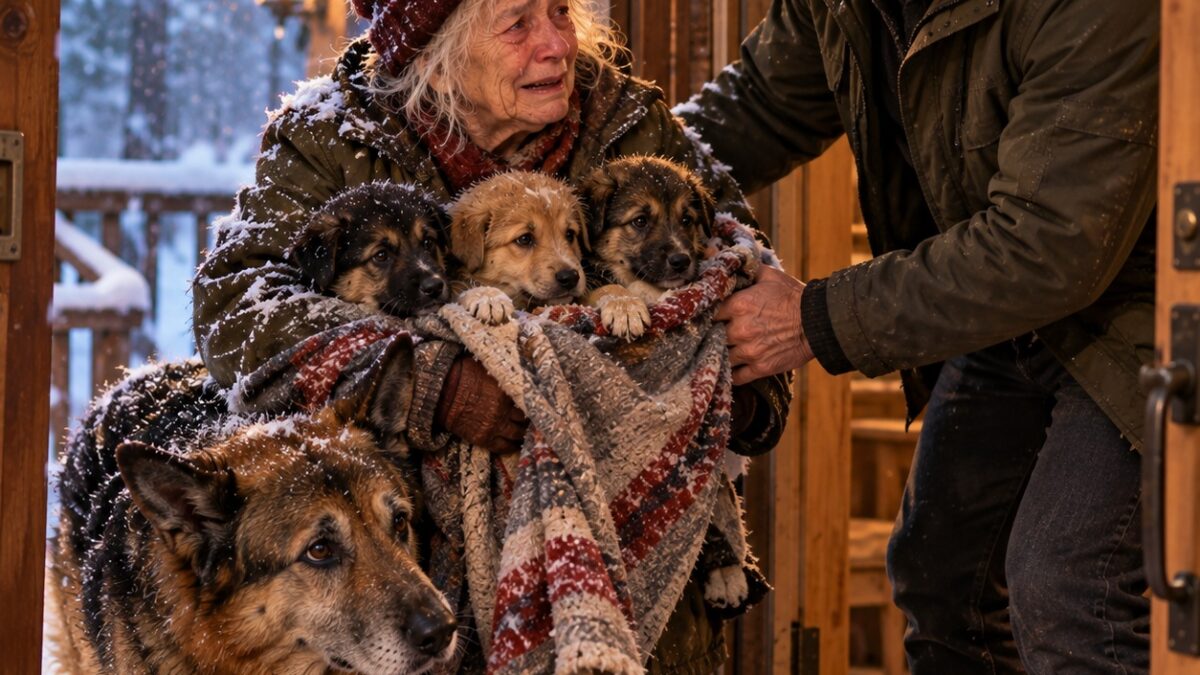
Her name was Eleanor Witmore.
Everyone in Evernorth called her Nell.
She was seventy-four years old, five feet two inches tall, and possessed the kind of stubbornness that could make a full-grown man feel foolish for offering to carry her groceries.
I learned that within the first ten minutes.
“Sit down,” I told her.
“I can stand.”
“Your hands are shaking.”
“It’s winter.”
“You’re soaked.”
“Snow does that.”
I pulled a chair near the wood stove.
“Mrs. Witmore.”
She looked at me.
Something in my voice made her stop arguing.
She sat.
I brought a dry blanket from the hallway closet and placed it beside her, then gave her privacy to remove her wet outer layers.
Her boots had soaked through.
Snow had melted into the seams.
Her fingers were red and numb.
I knew enough about cold exposure to take it seriously.
I also knew I wasn’t a physician.
I called Dr. Naomi Pierce, the local veterinarian, because Nell said Naomi had been helping care for her animals for years.
I explained the woman’s condition first.
Naomi asked whether Nell was confused.
Whether she was breathing normally.
Whether she could answer questions.
Then she told me she was nearby and would come over.
While we waited, I gave Nell warm water with honey.
She looked at the mug.
“Do you always serve guests like they’re recovering from a shipwreck?”
“I don’t usually have guests.”
“That explains the atmosphere.”
I almost smiled.
Almost.
Then something pulled against my boot.
I looked down.
The smallest puppy had my shoelace between his teeth.
“Hey.”
He pulled harder.
“Let go.”
He backed away.
I bent toward him.
He moved faster.
Nell watched the exchange over her mug.
“That’s Pip.”
“Pip is committing theft.”
“He’s very ambitious.”
Pip shot beneath the coffee table with the lace still in his mouth.
I followed.
He changed direction.
Nell raised an eyebrow.
“You’re losing.”
“I’m not competing.”
“You’re definitely losing.”
I finally freed the lace.
Pip sat in front of me and wagged his tail as though we’d enjoyed a mutually beneficial exercise.
The round-bellied puppy had settled near the stove.
“That one’s Moss,” Nell said.
I looked at him.
He had thick honey-gold fur, an oversized black muzzle, and enormous paws.
His eyes were closed.
“He’s unusually calm.”
“Don’t confuse laziness with good behavior.”
Across the room, the female puppy sat close beside Bishop.
“And that’s Juniper.”
Juniper had a narrow muzzle and dark, watchful eyes. Her ears were almost fully upright, and she watched Bishop with absolute concentration.
When the old shepherd sat, she sat.
When he shifted, she shifted.
When he glanced toward the window, she turned her head too.
I looked at Nell.
“She copies him.”
“Everything.”
“That’s going to become a problem.”
“It already is.”
For one brief moment, we were simply two strangers discussing dogs.
Then Nell tried to lift her mug.
Her hand trembled so badly that water spilled over the rim.
The humor left the room.
Naomi arrived twenty minutes later.
She wore a dark green field jacket and carried a black veterinary bag.
She checked Nell before examining the dogs.
Temperature.
Pulse.
Breathing.
Hand color.
Awareness.
She took her time, asking questions without frightening her.
Finally, she looked at me.
“She had significant cold exposure. She got inside before it became more serious.”
Nell folded her arms.
“I told you I was fine.”
Naomi ignored that.
“If she becomes confused, her breathing changes, or her condition worsens, get medical help immediately.”
I nodded.
“I know.”
Naomi raised one eyebrow.
“That sentence worries doctors.”
“I’m not a doctor.”
“Good. Remember that.”
Then she examined the puppies.
Pip objected to having his mouth opened.
Juniper tolerated everything while watching Bishop.
Moss fell asleep halfway through his examination.
Naomi looked down at him.
“This one would sleep through the end of civilization if somebody put a warm rug nearby.”
Nell laughed.
Finally, Naomi examined Bishop.
The old German Shepherd stood patiently while she checked his joints, back, and hind legs.
His movement was stiff.
His coat was thick but not as full around the hips as it had probably been years earlier.
“Arthritis is bothering him,” Naomi said.
Nell nodded.
“It’s worse in cold weather.”
“We’ll need to keep an eye on that.”
“I know.”
Bishop turned his head toward Nell.
Naomi smiled.
“And maybe stop calling him old where he can hear you.”
His tail moved once.
I wasn’t sure whether that was agreement or irritation.
After Naomi left, I made soup.
Not particularly good soup.
I had spent years treating cooking as a process of making food safe enough to consume with minimal effort.
Nell took one spoonful.
Paused.
Then looked at me.
“What?”
“Nothing.”
“That means something.”
She took another spoonful.
“Were you ever trained to cook?”
“No.”
“I can tell.”
I stared.
She smiled.
“It needs salt.”
I pushed the shaker toward her.
She added some.
Tasted again.
Then nodded.
“Better.”
I sat across from her.
For the first time in three years, someone was sitting at my kitchen table criticizing my dinner.
I had forgotten how ordinary that felt.
How warm.
How dangerous.
Because ordinary moments were exactly the things I missed most about Emily and Sophie.
Later that evening, Nell explained what had happened.
Her husband, Walter, had purchased their lakeside property more than thirty years earlier.
Back then, the eastern shore of Lake Evernorth had been beautiful but inconvenient.
The roads were rough.
Winter access was difficult.
Tourists preferred the western shoreline.
Walter had built their cedar cabin himself.
He worked as a mechanic, repairing trucks, fishing equipment, generators, and whatever else people brought him.
He wasn’t wealthy.
But he was patient.
Nell smiled when she talked about him.
“Walter believed almost anything could be fixed.”
“Was he usually right?”
“No.”
She laughed.
“But he was wonderfully confident.”
He’d planted apple trees.
Built the dock.
Repaired the porch.
Added shelves throughout the cabin.
Every board carried some memory.
Walter had been dead eight years.
Nell still lived there.
She survived on Social Security, small savings, and whatever she could earn collecting recyclable materials.
She wasn’t wealthy in any ordinary sense.
But the land had become valuable.
Very valuable.
A development company called Northrest had been purchasing property around Lake Evernorth.
Its proposed resort, Evernorth Shores, included vacation cabins, a marina, restaurants, shops, and recreational facilities.
The project promised jobs.
New business.
Tax revenue.
A future for a town where young people often moved away because they couldn’t find enough work.
Nell understood that.
She wasn’t opposed to development.
She simply didn’t want to sell her home.
“Northrest made three offers,” she told me.
“Large ones?”
She nodded.
“The last was large enough that I briefly questioned my moral character.”
I almost smiled.
“Then?”
“I recovered.”
I waited.
She looked toward the dark window.
“Walter planted the apple tree beside our porch. I don’t want a service road running through it.”
That was when she told me the detail that changed everything.
Northrest owned property on both sides of her land.
The company wanted a strip along the shoreline to connect its planned service route to the marina.
Then surveyors appeared.
New stakes were placed farther inside the area Nell had always considered hers.
A structural assessment connected to the development raised concerns about the foundation beneath the lakeside portion of her cabin.
The county issued a temporary no-occupancy order.
Seventy-two hours.
Nell was allowed to request an independent inspection.
But she wasn’t allowed to sleep in the house while the order remained in effect.
“Did anyone explain why?” I asked.
“A county officer named Thomas Reed.”
“What did he say?”
“That the foundation might be unsafe.”
“Was he threatening you?”
“No.”
She shook her head.
“He was polite.”
That mattered.
I had expected anger in her voice.
Instead, there was something more unsettling.
Confusion.
“He was doing his job,” she continued. “I know that.”
She looked at the dogs.
“But he was standing in my kitchen telling me I couldn’t sleep there anymore.”
I didn’t answer.
She continued.
“The church offered me a cot. But not the dogs.”
“Naomi?”
“She offered to take the puppies.”
“And Bishop?”
Nell looked down.
The old shepherd was resting beside her chair.
“When I spent two nights in the hospital, he stopped eating.”
Her voice softened.
“He’d already been abandoned once before I found him. I couldn’t do that to him again.”
I looked at Bishop.
He opened one eye.
Nell reached down and touched his silver muzzle.
“He’s family.”
She explained how Bishop had found my house.
A month earlier, I had stopped to repair her cart beside County Road Eight.
I’d barely remembered the encounter until I opened my door.
But Bishop had remembered.
During the storm, he’d turned toward the wooded trail leading to my property.
Nell initially refused to follow.
She was trying to reach a bus stop.
But as the snow intensified, her fingers became numb.
The cart slipped into a rut.
Her legs weakened.
And Bishop left the main road.
He walked toward the trail.
Stopped.
Looked back.
Waited.
Then continued.
Nell eventually followed him.
“He knew where you lived,” she told me.
I glanced at the dog.
Bishop remained beside her chair.
“I suppose he did.”
“I think he remembered you.”
“Probably the water.”
“And Pip attacking your boot.”
“That was memorable.”
She smiled.
Then her expression softened.
“If he hadn’t remembered…”
She stopped.
I looked toward the window.
Snow pressed against the glass.
The forest was almost invisible.
I didn’t finish the sentence for her.
Neither of us needed to.
That night, I carried an extra blanket into the guest room.
Nell was already sitting on the edge of the bed.
Juniper lay near the doorway.
Moss had curled into a furry ball beneath the chair.
Pip was investigating the bedspread.
Bishop stood beside Nell.
“You need anything?” I asked.
She shook her head.
“I’m all right.”
“Bathroom’s down the hall.”
“I saw it.”
“Water on the table.”
“Thank you.”
“Call if you need something.”
She studied me.
“You don’t do this much, do you?”
“What?”
“Take care of people.”
I almost laughed.
“That depends on your definition.”
Her eyes moved over my face.
I knew what she saw.
A man who looked strong enough to handle almost anything.
But there was an emptiness in my house that strength had never solved.
She didn’t ask.
That earned my respect.
“Good night, Mrs. Witmore.”
“Good night, Gar.”
I stopped in the doorway.
It had been a long time since someone called me that without sounding as though they were asking for something.
I turned off the light.
At two in the morning, I woke to a soft thumping sound.
Once.
Then again.
I went downstairs expecting to find Pip destroying a shoe.
Instead, Bishop sat in the dark hallway.
He was facing a closed bedroom door.
My daughter’s room.
I stopped.
For three years, that door had remained shut.
Behind it were Sophie’s books.
Her little pink winter coat.
A wooden puzzle missing one piece.
A shelf filled with stuffed animals.
A room I’d preserved because I couldn’t imagine changing anything without losing another part of her.
Bishop didn’t scratch.
Didn’t whine.
He simply looked at the door.
Then looked at me.
For one irrational second, I felt as though he knew what was behind it.
Of course he didn’t.
He was a dog.
He knew smells.
Sounds.
Patterns.
But he had positioned himself in front of the one door in the house I couldn’t bring myself to open.
“Come on,” I whispered.
He didn’t move.
I swallowed.
“Bishop.”
The old shepherd rose slowly.
Walked past me.
And brushed his shoulder against my leg.
Then he disappeared toward Nell’s room.
I remained there.
Staring at the door.
For the first time in years, I wondered whether keeping it closed was helping me survive.
Or simply keeping me from living.
The next morning, Nell was warm enough to argue about everything.
I made coffee.
Toast.
Scrambled eggs.
Moss had claimed my armchair.
I lifted him down.
He climbed back.
I lifted him down again.
He returned for a third attempt.
Nell watched.
“I think you’ve lost.”
“I haven’t.”
Moss curled into the cushion.
“You’ve definitely lost.”
I looked at the puppy.
He closed his eyes.
For reasons I couldn’t explain, I laughed.
Not much.
Just enough.
Nell noticed.
Her expression softened.
Then she pretended she hadn’t seen anything.
I appreciated that.
After breakfast, I offered to drive her to the temporary lodging her friend Lena Ortiz had arranged.
Pip climbed into my pickup immediately.
Juniper followed.
Moss looked at the distance between the ground and the seat and decided the effort wasn’t justified.
I lifted him.
Then I noticed Bishop.
He hadn’t moved.
He stood facing the opposite direction.
Toward the lake.
Toward Nell’s cabin.
“Bishop?”
His ears shifted.
Nell looked at him.
“He wants to go home.”
I followed the old dog’s gaze.
Then looked at her.
“What happened out there?”
She hesitated.
“Not everything. Just enough.”
She told me about the survey stakes.
The old property line.
The county report.
The difference between the maps.
And how she’d begun to suspect that the development paperwork didn’t match the land she remembered.
She didn’t accuse anyone of theft.
She didn’t claim a conspiracy.
She simply said, “I don’t understand these documents well enough to know what I’m supposed to believe.”
That caught my attention.
Not because I understood property law.
I didn’t.
But because I’d spent years learning to recognize when different pieces of information didn’t fit together.
“Show me the maps,” I said.
We returned to my dining table.
Nell spread her papers across it.
An older tax map.
The county notice.
A more recent boundary drawing.
Copies of letters from Northrest.
I placed the two maps beside each other.
The shoreline was recognizable.
The access road was recognizable.
The cabin stood in the same place.
But the boundary wasn’t identical.
I studied the measurements.
“Does this prove anything?” Nell asked.
“No.”
She frowned.
“That isn’t encouraging.”
“It’s not supposed to be.”
I tapped the newer map.
“It means we need somebody qualified to tell us which description is controlling.”
She looked at the papers.
“Walter planted a row of pines inside the boundary.”
“Inside?”
“Yes.”
“Not on it?”
She shook her head.
“He said people might forget where the property line was someday.”
I looked up.
“Do you remember how far inside?”
“No.”
I nodded.
“That could matter.”
She studied me.
“Are you going to help?”
I looked toward Bishop.
Then back at Nell.
“Yes.”
I paused.
“But we’re going to do it properly.”
The county allowed Nell to retrieve more belongings under supervision.
I drove her to the property.
Bishop came with us.
The puppies stayed with Naomi for the afternoon.
The cabin looked smaller than I expected.
Cedar walls.
A leaning porch.
A narrow chimney.
Snow piled beneath the apple tree.
Temporary fencing marked part of the nearby development area.
I stayed on permitted ground.
Didn’t move stakes.
Didn’t cross the construction boundary.
Didn’t confront the workers.
I photographed landmarks.
The old pines.
The access road.
The cabin.
The new stakes.
Nell pointed toward the shoreline.
“Walter planted those trees when we bought the place.”
I walked along the accessible portion of the path.
Bishop followed.
Then the dog stopped near a shallow depression.
His nose lowered.
He sniffed.
Scratched once.
I crouched.
Snow had settled differently there.
The soil beneath the crust looked disturbed.
I took a photograph.
“What is it?” Nell asked.
“No idea.”
She looked at my phone.
“You photograph an awful lot of things you don’t understand.”
“Usually the ones worth remembering.”
She smiled faintly.
Then continued toward the cabin.
That evening, I called Miles Keen.
Miles had served with me years earlier.
After leaving the Navy, he’d become an insurance fraud investigator in Duluth.
He was one of the few men I trusted to tell me I was wrong without worrying about whether I’d like it.
When I explained the situation, he was silent.
Then he said, “You used to get paid to solve problems other people couldn’t handle.”
“This isn’t that.”
“Good.”
I looked at the papers on my table.
“I want to know which map is right.”
“Then hire a surveyor.”
“I know.”
“Don’t become the story, Gar.”
I glanced toward the living room.
Nell sat beside the stove.
Bishop rested at her feet.
Pip had stolen one of my socks.
“I don’t plan to.”
Miles laughed.
“That was never the problem with you.”
The next few days changed my house in ways I hadn’t expected.
Pip began stealing gloves.
Juniper slept outside Nell’s door every night.
Moss permanently occupied the armchair.
Eventually, I stopped removing him.
Bishop moved through the house with quiet confidence, as though he understood its rhythms better than I did.
The kitchen became noisy.
Food bowls appeared beside the cabinets.
Blankets accumulated near the stove.
Someone was always looking for a missing shoe.
For the first time in three years, I had to think about people and animals other than myself before going to bed.
I didn’t know how to feel about that.
One night, I woke to laughter.
A woman’s laughter.
Warm.
Unexpected.
Alive.
For one impossible second, my half-asleep mind supplied a name.
Emily.
I sat upright.
My heart began pounding.
Then I heard the laughter again.
Downstairs.
Nell.
I stepped into the hallway.
My chest hurt before I reached the kitchen.
Nell stood beside the table.
Pip had gotten his head stuck inside a brown paper grocery bag.
The puppy staggered backward, thoroughly offended by the experience.
Nell laughed so hard she had one hand braced against the counter.
I stopped in the doorway.
And suddenly I wasn’t looking at Nell.
I was remembering Emily.
My wife laughing during an argument because I’d used the wrong word.
Sophie collapsing into giggles on the living room floor.
The way our home had once been filled with the sounds of people who didn’t have to be careful about being happy.
I turned away.
Bishop followed.
I stopped in the hallway.
The old shepherd sat beside me.
He didn’t touch me.
Didn’t demand attention.
He simply stayed.
I lowered one hand onto his neck.
“She liked dogs, too,” I whispered.
Bishop remained still.
I swallowed.
“Sophie.”
It was the first time I’d spoken my daughter’s name aloud in almost a year.
Nell began noticing more than she admitted.
She never demanded explanations.
Never asked me to describe what happened.
Never told me I needed to move on.
But she saw the photograph that had slipped from a box.
Emily wearing a red winter hat.
Sophie sitting on her shoulders.
Both laughing.
She saw the small toys tucked beneath furniture.
The room I kept closed.
The way I sometimes stopped speaking when one of the puppies made an unexpected sound.
And she understood something I didn’t want to explain.
We were both living beside memories we were afraid to disturb.
Three mornings later, Lena Ortiz arrived carrying a cardboard document tube.
She was a librarian in Evernorth.
Thoughtful.
Precise.
Stubborn about records.
She’d known Nell for years and had been helping her understand the development documents.
She spread several maps across my dining table.
The oldest dated back decades.
Another had been recorded when Walter and Nell purchased the property.
A county tax map followed.
Then the newer development drawing.
The shoreline remained recognizable.
The road was the same.
But the eastern boundary seemed to shift between versions.
Not dramatically.
Quietly.
A few feet in one place.
More in another.
Lena looked at me.
“I can find paper.”
I waited.
“I can’t tell you which paper wins.”
“Who can?”
She gave me a name.
Caleb Finch.
Caleb was sixty-one and had spent thirty-seven years surveying northern Minnesota properties.
He lived twelve miles north of town in a modest house surrounded by surveying poles, an old fishing boat, and enough rusted equipment to make his yard look like an outdoor museum.
He was skeptical from the moment we arrived.
I appreciated that.
When I mentioned Walter Witmore, his expression softened.
“Walter rebuilt the lower unit on my outboard in ninety-eight.”
Nell smiled.
“He charged you eventually.”
Caleb laughed.
“He accepted twelve dollars and a blackberry pie.”
“That sounds like Walter.”
Caleb reviewed the documents for almost forty minutes.
He barely spoke.
Then he placed two maps side by side.
“I don’t know which one is legally controlling yet.”
Nell sighed.
Caleb raised one finger.
“But I know these two cannot both describe the same boundary.”
He measured the discrepancy.
At the widest point, it approached twenty-seven feet.
Nell frowned.
“Twenty-seven feet doesn’t sound like enough land to ruin anybody’s life.”
“For a bedroom?” Caleb said. “No.”
He drew a line along the shoreline.
“For a marina access road, it could change an entire development plan.”
I leaned closer.
The company owned parcels on either side of Nell’s land.
The narrow shoreline section affected setbacks, access, and the practical connection between parts of the proposed resort.
If the newer boundary stood, the development fit neatly.
If the older boundary proved correct, the company might have to redesign a significant portion.
I looked at Caleb.
“So they don’t necessarily need her cabin.”
He nodded.
“They may need the ground beside it.”
Nell stared at the map.
For the first time, the company’s persistence made sense.
It wasn’t about the value of her old cedar walls.
It was about where those walls stood.
Caleb agreed to examine the publicly accessible area beside the property.
I took Bishop.
Nell remained with Naomi and the puppies.
We moved slowly along the public right-of-way.
Fresh snow had smoothed most signs of activity.
But in several places, the frozen crust looked different.
Compressed.
Disturbed.
Refrozen.
Bishop stopped.
His nose lowered.
He scratched at the snow.
I crouched.
Dark soil lay beneath the crust.
Something had disturbed the ground before the last freeze.
Caleb examined the location.
Then carefully cleared loose snow from a spot within the publicly accessible margin.
Metal appeared.
Not a bright modern stake.
A rusted survey monument.
He stopped immediately.
“Don’t touch it.”
I raised my hands.
“I wasn’t going to.”
He gave me a skeptical look.
I smiled faintly.
Caleb exposed enough of the cap to read a sequence of letters and numbers without shifting the marker.
He photographed it.
Recorded the location.
Then stepped back.
“What does it mean?” I asked.
“There’s an old monument here.”
“And?”
“That’s all we know.”
I stared.
He shrugged.
“A monument can be moved. Records can be superseded. Field notes can contain mistakes.”
Bishop sniffed the hole.
Caleb looked at him.
“But your friend found something worth checking.”
Then Bishop moved again.
Twenty feet farther along the snowbank, he stopped near a dead fern.
Scratched once.
Looked back.
We examined the location.
Another patch of disturbed soil.
A piece of old orange survey ribbon trapped beneath frozen leaves.
Farther toward the lake, Bishop stopped a third time.
There was only a shallow depression and a rust stain.
Caleb stood and looked along the rough alignment.
“One point is interesting.”
He gestured toward the second.
“Two are curious.”
Then the third.
“Three make me want an independent survey before anybody pours concrete.”
I looked at Bishop.
The old shepherd sat quietly.
He didn’t understand property rights.
Survey monuments.
Legal descriptions.
He understood the ground.
Scent.
Disturbance.
Places where something had changed.
He was simply reacting to what his senses told him.
The rest was our responsibility.
The discoveries didn’t prove a conspiracy.
Caleb insisted on that.
So did Miles.
So did I.
But there was enough to request a professional review.
Then another problem appeared.
I took Bishop walking along a public trail south of the resort site.
The path crossed a narrow creek feeding Lake Evernorth.
Bishop approached the water.
Lowered his head.
Stopped.
His nose moved.
Then he pulled back without drinking.
I watched him.
“What?”
He approached again.
Sneezed.
Stepped away.
I crouched near the creek.
A faint rainbow sheen moved across a slow eddy.
There was a weak petroleum smell.
I didn’t touch the water.
I photographed the location.
Recorded the coordinates.
Then called the state environmental reporting line.
Two technicians arrived the following day.
They collected official samples.
One explained that unusual sheen could result from several sources.
Road runoff.
Old machinery.
Natural material.
Construction activity.
Testing would determine whether there was contamination.
That answer was fine with me.
I didn’t need Northrest to be guilty.
I needed someone qualified to establish what was true.
Miles called that evening.
He had been reviewing public corporate records.
“Found something mildly ugly.”
I leaned back.
“Mildly?”
“Don’t get excited.”
“I’m not.”
“That’s your excited voice.”
He explained that a surveying subcontractor used on portions of the Northrest development had once employed a regional manager named Douglas Vain.
That manager later became an operations executive with another subcontractor currently involved in site preparation.
I considered it.
“Illegal?”
“No.”
“Evidence anybody falsified records?”
“No.”
“Then what do we have?”
“A relationship worth disclosing to the people reviewing procurement and possible conflicts.”
I looked toward the dining table.
“Could mean nothing.”
“Exactly.”
That was Miles.
He refused to turn coincidence into certainty.
I respected him for it.
The following day, Lena found an old planning record from 1986.
It concerned a shoreline conservation corridor established after erosion and habitat concerns around parts of Lake Evernorth.
Certain changes in land use near the corridor could require additional review or public consultation.
The documents were complicated.
Lena had highlighted the relevant sections.
“Does Nell’s property fall within it?” I asked.
“Part of the shoreline appears to.”
“Is the rule still active?”
“I don’t know.”
“Was the additional review completed?”
“I can’t find it.”
Nell raised one hand.
“I feel better knowing ignorance is becoming a group activity.”
Even I smiled.
We had unanswered questions.
Not proof.
The survey needed independent confirmation.
The creek needed laboratory results.
The shoreline procedure needed legal review.
And none of us had the right to pretend otherwise.
Still, I noticed something changing.
The case no longer looked like an elderly woman arguing against a powerful company.
It looked like a collection of small inconsistencies that deserved professional examination.
That was progress.
Northrest sent someone to speak with us.
His name was Adrien Vale.
He was forty-eight, tall, controlled, and dressed in a charcoal overcoat.
He arrived alone.
No security.
No theatrical confrontation.
Just a man carrying a folder.
I opened the door.
“Mr. Thorne?”
“Gar.”
“Adrien Vale.”
“I know.”
He looked past me.
Nell sat near the stove.
Bishop rested at her feet.
Pip was under the coffee table.
Moss occupied the armchair.
Juniper watched the old shepherd.
Adrien waited until Nell invited him to sit.
That surprised me.
Men accustomed to power often behaved as though every room belonged to them.
Adrien didn’t.
He placed a document on the table.
A new offer.
It was substantially higher than the previous proposals.
Northrest would purchase a smaller home for Nell within Evernorth.
Cover relocation costs.
Establish a fund for veterinary care and food for her dogs.
The amount was large enough to change the rest of her life.
I watched her face.
She didn’t touch the paper.
Adrien leaned forward.
“Mrs. Witmore, I don’t want a seventy-four-year-old woman facing another winter like this.”
Nell looked at him.
“Then why did I spend part of one without my house?”
His expression tightened.
“The no-occupancy order came from the county.”
“After a report connected to your development.”
“Yes.”
He didn’t deny it.
That mattered.
Adrien began explaining the project.
Jobs.
Tax revenue.
Tourism.
Restaurants.
Marina services.
Year-round maintenance positions.
A reason for young families to remain in Evernorth.
Some of it sounded like salesmanship.
Some of it was difficult to dismiss.
The town needed work.
People needed opportunities.
That was real.
Adrien looked at Nell.
“A town can’t stop changing because everyone has memories attached to a piece of ground.”
Nell’s expression didn’t change.
I understood his argument.
I also understood its weakness.
“If the project is good for Evernorth,” I said, “it shouldn’t need her rights to disappear for it to succeed.”
Adrien turned toward me.
“And if every procedure turns out to be correct?”
“Then we accept the verified outcome.”
Nell glanced at me.
I continued.
“But first we find out whether those procedures were correct.”
Adrien studied me for a long moment.
Then nodded.
“I can respect that.”
He stood.
Before leaving, he looked at Nell.
“The offer remains open.”
She folded the paper.
“So does my door.”
Adrien almost smiled.
“That sounded like an invitation.”
“It wasn’t.”
After he left, Nell stared at the number on the offer.
For several seconds, she said nothing.
“Enough to make you think?” I asked.
She looked embarrassed.
“Enough to make me ashamed that I thought.”
“Why?”
“Because Walter built that house.”
I took a breath.
“That isn’t the whole answer.”
She looked at me sharply.
I continued.
“You can refuse because you want to keep the land. But considering the offer isn’t betraying Walter.”
The words landed harder than I intended.
Nell stared at me.
Then said softly, “That advice sounds expensive.”
I looked away.
She knew exactly what I’d been avoiding.
For years, I’d believed changing anything about my home meant abandoning Emily and Sophie.
Now I was telling her not to confuse memories with obligations.
The irony wasn’t lost on either of us.
The town began choosing sides.
At the diner, some people called Nell brave.
Others called her selfish.
A marina mechanic told Lena that Northrest might create enough work to keep his son from moving to Minneapolis.
A retired teacher argued that the lake had already endured too much development.
Neither argument was ridiculous.
That made the conflict harder.
One afternoon, Nell stopped at a grocery store she’d used for nearly twenty years.
The owner had previously allowed her a little credit when money was tight.
This time, he refused.
He looked embarrassed.
“I’m sorry, Nell.”
“You know I’ll pay Friday.”
“I know.”
“Then what changed?”
He rubbed his forehead.
“People are saying the resort could move its investment if the delays continue.”
Nell looked at him.
“And you think that’s because of me?”
He didn’t answer.
She placed the bread back on the shelf.
Then left.
When she returned to my house, she said nothing about it.
But Bishop stayed unusually close to her that evening.
I saw how the argument was affecting her.
She wasn’t simply defending property.
She was defending herself against the idea that her right to live in her home made her an enemy of the town.
The next morning, a school bus stopped at the end of my driveway.
Seven children climbed out carrying bags.
Dog food.
Blankets.
Tennis balls.
A handmade card.
Their teacher stayed nearby while they approached.
Nell stepped onto the porch.
One little girl handed her the card.
“My mom says we’re not supposed to pick sides.”
Nell nodded.
“That sounds wise.”
The girl lifted a bag of dog treats.
“But dogs still have to eat.”
For several seconds, Nell couldn’t speak.
Then she knelt carefully and thanked the child.
I stood in the doorway watching.
I had spent years avoiding people because I feared what caring might cost.
Now seven children were teaching me that kindness didn’t always require choosing a political or financial position.
Sometimes it simply meant feeding a hungry dog.
That evening, Bishop did something strange.
He carried the children’s card from the coffee table to Nell’s canvas bag.
Placed it beside her belongings.
Then walked across the room.
A moment later, he returned with a photograph.
Mine.
Emily in a red winter hat.
Sophie sitting on her shoulders.
Both laughing.
I’d left it partly exposed inside a box while searching for property records.
Bishop placed it between Nell and me.
Then sat.
I stared.
The room became very quiet.
Nell looked from the children’s card to the photograph.
Then at the old dog.
“I think he’s tired of both of us keeping our memories in boxes.”
I almost told her dogs didn’t think that way.
Instead, I picked up the photograph.
Looked at Emily.
At Sophie.
And placed it on the shelf above the fireplace.
Not hidden.
Not face down.
Visible.
For the first time in three years.
Two days later, Pip found Sophie’s scarf.
It was pale blue.
Small.
Soft.
One end carried a crooked patch Emily had sewn after Sophie caught it on a fence.
I was sorting papers when Nell called from the hallway.
“Gar, your criminal has something.”
I turned.
Pip emerged carrying the scarf.
My entire body went rigid.
“Drop it.”
He wagged his tail.
“Pip.”
He kept walking.
I crossed the room too quickly.
Snatched the scarf from his mouth.
“Damn it!”
The word cracked through the house.
Pip flattened.
His tail tucked beneath him.
Juniper backed away.
Moss lifted his head.
Nell stopped moving.
I stood there breathing hard.
One fist closed around the scarf.
Then I looked at Pip.
The little dog had crawled beneath the table.
He was frightened of me.
A three-month-old puppy.
Frightened because I’d shouted over a piece of fabric.
I lowered myself into a chair.
“I’m sorry,” I whispered.
Nell didn’t answer for me.
She sat across from me.
For a long time, neither of us spoke.
Then I said, “My wife’s name was Emily.”
Nell waited.
“She laughed at terrible times.”
My mouth twitched.
“At funerals. During arguments. Once when our basement flooded.”
Nell smiled faintly.
“Sophie got that from her.”
My throat tightened.
“Everything loud came from her mother.”
I stared at the scarf.
“She was eight.”
The words came slowly.
I told Nell about the accident.
Not the graphic details.
Not the hospital room.
Just the phone call.
The impossible drive afterward.
The terrible knowledge that I had been somewhere else when the two people I loved most needed nothing more than to keep living.
For years, I’d known logically that my presence probably wouldn’t have changed the accident.
Emotionally, I had never accepted it.
Nell listened.
Then I admitted something I’d never said aloud.
“I’m not afraid I’ll forget them.”
She waited.
“I’m afraid I’ll forget exactly.”
My fingers tightened around the scarf.
“The way Emily said my name when she was annoyed.”
I swallowed.
“The sound Sophie made when she laughed too hard.”
My voice broke.
“One day I’ll remember that she laughed. But I won’t remember what it sounded like.”
Nell’s eyes filled.
She didn’t tell me I was wrong.
Didn’t tell me grief would disappear.
She simply said, “Laughing again doesn’t mean you loved them less.”
I looked down.
She glanced toward the hallway.
“The dead don’t need us to turn the rest of our lives into locked rooms.”
I stared at her.
She smiled sadly.
“Believe me. I tried.”
That night, I opened Sophie’s bedroom door.
Not all the way.
Just enough to let the hallway light fall across the floor.
I stood there holding the scarf.
And for once, I didn’t close the door immediately afterward.
Lena called late that evening.
She had found the original planning minutes for the shoreline conservation corridor.
The language wasn’t merely general guidance.
In the original documents, certain changes near that section required additional public review.
Whether the requirement remained active still needed confirmation.
But the discrepancy justified asking.
She’d also contacted Mara Ellis.
Mara was a legal aid attorney in Duluth who handled housing and land-access disputes.
She had agreed to examine the case.
The following Monday, Mara arrived at my house carrying a battered leather briefcase.
She was forty-five, tall, composed, and possessed the kind of expression that suggested she disliked wasted time more than unpleasant arguments.
She spread the documents across my dining table.
Maps.
County records.
Caleb’s notes.
Lena’s archival copies.
Miles’s corporate-record summary.
Then she looked at me.
“Before we do anything else, everyone stops investigating independently.”
Caleb frowned.
“We’ve been careful.”
“I’m sure you have.”
“That sounded insulting.”
“It was preventative.”
Nell almost smiled.
Mara raised one finger.
“No entering construction sites.”
A second.
“No touching survey monuments.”
A third.
“No taking documents you aren’t authorized to have.”
Then she looked directly at me.
“And nobody threatens anyone.”
I folded my arms.
“Why are you looking at me?”
“Because you look like the person witnesses would later describe as intimidating even if you were ordering coffee.”
Nell laughed.
I didn’t.
Mara continued.
“We do this cleanly or we don’t do it.”
That was when I decided I trusted her.
The work became organized.
Caleb prepared a professional memorandum explaining the survey discrepancies.
Lena arranged the historical records chronologically.
Miles limited his corporate findings to what public documents actually established.
Mara assembled a formal request for county review.
I did something much harder.
I waited.
Then the environmental office called.
The creek samples showed elevated traces of petroleum products and solvents.
Not enough to prove deliberate dumping.
Not enough to identify a responsible company from the samples alone.
But enough to justify an upstream inspection.
State inspectors examined an equipment staging area used by one of Northrest’s subcontractors.
They found improper waste-oil storage and inadequate secondary containment.
No secret pipeline.
No elaborate conspiracy.
Just carelessness.
The subcontractor was required to correct the problems.
Northrest acknowledged that corrective action was needed.
Mara read the statement twice.
“Useful,” she said.
Nell looked up.
“Because they admitted wrongdoing?”
“Because they acknowledged something needed fixing.”
That distinction mattered.
I had spent years learning how dangerous carelessness could be.
People rushed.
People assumed someone else had checked.
People treated small mistakes as unimportant.
Sometimes that was all disaster required.
The Evernorth Ledger became interested.
Its reporter, Rachel Boon, was thirty-three and had a reputation for asking questions that irritated nearly everyone.
Mara considered that a good sign.
Rachel interviewed Adrien first.
He explained the resort’s potential economic benefits.
Jobs.
Tax revenue.
Opportunities for younger residents.
She reported those arguments.
Then she interviewed Nell.
They sat at my kitchen table.
Bishop rested at Nell’s feet.
Rachel opened her notebook.
“What do you want Northrest to do?”
Nell looked at her.
“Build what they’re legally allowed to build.”
Rachel paused.
“You don’t want the project stopped?”
“I never said that.”
“But people in town believe you’re trying to stop it.”
“People in town believe many interesting things.”
Rachel almost smiled.
“What do you want them to understand?”
Nell looked down at Bishop.
The old dog’s silver muzzle rested across her boot.
Then she looked up.
“Don’t stop them from building.”
Rachel waited.
“Make them build it right.”
The next morning, that sentence appeared in the newspaper.
By noon, half the town had repeated it.
The argument changed.
It became harder to call Nell an enemy of progress when she was asking development to follow the rules that were supposed to govern everyone.
The night before the county hearing, I found Nell sitting alone on my porch.
Bishop lay beside her.
The snow had stopped.
The lake reflected the last pale light of evening.
I stepped outside.
“You should be resting.”
“I’ve rested enough for one lifetime.”
I sat beside her.
For several minutes, neither of us spoke.
Then she said, “I’m scared.”
I turned.
It was the first time I’d heard her admit it.
“Of losing?”
“No.”
She rubbed Bishop’s ear.
“Of winning for the wrong reason.”
I frowned.
“What do you mean?”
“What if they pity me?”
I waited.
“Old woman. Dead husband. Four dogs.”
Her voice trembled.
“What if they forget the papers and decide they feel sorry for me?”
Bishop lifted his head.
“I don’t want mercy,” she whispered.
The old shepherd placed one paw over the toe of her boot.
I watched him.
Then I looked at Nell.
“Then don’t ask for it.”
She turned toward me.
“Ask them to look.”
Something steadied in her expression.
Not sudden fearlessness.
Something quieter.
The permission to stop pretending she wasn’t afraid.
I sat beside her until the porch light came on.
Then we went inside.
The county hearing room was full.
Residents occupied every chair.
Others stood along the walls.
Northrest representatives sat near the front.
Adrien Vale was among them.
Rachel Boon waited near the aisle with her notebook open.
Mara arranged the files.
Caleb reviewed the survey diagrams.
Lena carried historical records.
Nell stood beside me.
Bishop remained at her side.
I looked at her.
“You don’t have to do this alone.”
She touched my forearm.
“You opened your door when I had nowhere to go.”
I nodded.
“This part,” she said, “I need to stand for myself.”
Then she walked forward.
Bishop went with her.
Nobody objected.
By then, half the room seemed to know him.
When Nell’s turn came, she didn’t deliver a dramatic speech.
She spoke plainly.
Walter had built the cabin.
They had lived there for decades.
She knew the town needed jobs.
She understood why families wanted more opportunities.
“I’m not against tourists,” she said.
A few people shifted.
“Most of them are perfectly nice if you point them toward the lake and away from your tomatoes.”
Soft laughter moved through the room.
Then she continued.
“If somebody proves the land isn’t mine, I’ll accept the law.”
The room grew still.
“But if the law only gets checked after an old woman ends up outside in winter, then something failed before I ever walked out my door.”
Nobody applauded.
Mara had discouraged theatrics.
The silence was better.
Caleb explained the survey discrepancy.
Nearly twenty-seven feet in places.
He explained why a professional independent survey was necessary.
Mara discussed the procedural questions surrounding the shoreline corridor and occupancy order.
A state representative confirmed that the environmental inspection remained open and corrective action had been required at the subcontractor’s storage area.
Northrest responded through counsel.
They denied intentional wrongdoing.
They argued that different survey records could produce legitimate discrepancies and that the company had relied on professional contractors.
Adrien didn’t interrupt.
When he spoke, he was careful.
“If mistakes occurred, they should be corrected. But the project should be judged on verified facts, not suspicion.”
I found myself agreeing.
So did Mara.
That was exactly the point.
The county didn’t hand Nell a dramatic victory.
Instead, it ordered a temporary pause on construction within the disputed area.
An independent survey would reestablish the property boundary.
The cabin would receive a separate structural inspection.
Planning officials would review whether additional shoreline procedures had been required.
Environmental corrective action would continue.
Nell listened.
Then looked at me.
I nodded.
It wasn’t triumph.
It was time.
And time was what she needed.
Three weeks later, the results arrived.
The independent survey placed the controlling boundary substantially closer to the older Witmore records than to the line used in the development plan.
The structural inspection found necessary repairs.
Foundation stabilization.
Drainage improvements.
Replacement of rotted supports.
But once temporary safety work was completed, the cabin’s condition did not justify continuing the broad no-occupancy restriction.
The administrative review found no grand conspiracy.
Instead, it found something more ordinary.
Incomplete survey information.
Poor coordination.
A rushed approval sequence.
Contractors treating assumptions as verified facts.
A development team moving forward before every important question had been resolved.
Adrien wasn’t arrested.
Northrest wasn’t destroyed.
The company faced added oversight, internal review, environmental remediation costs, and a significant redesign of part of the resort.
Its reputation suffered.
But after satisfying revised requirements, it would still be allowed to develop property it lawfully owned.
Mara called that accountability.
I thought it sounded better than revenge.
Nell didn’t ask whether the company had suffered enough.
She asked when she could go home.
The afternoon she returned, sunlight broke through the clouds.
I drove her along the old lakeside road.
Bishop sat upright in the back of the truck.
The puppies wriggled beneath a blanket.
When we reached the cabin, Bishop was the first to recognize it.
His ears lifted.
His tail moved.
I opened the door.
He stepped down carefully.
His hind legs were stiff, but he climbed the porch steps without hesitation.
Then he stopped at the door.
Pip exploded from the truck.
Juniper followed.
Moss attempted to follow at the same speed, landed in a snowdrift, and decided enthusiasm was overrated.
Nell stood at the foot of the porch.
She didn’t move.
I waited behind her.
“You all right?”
She looked at the cabin.
Walter’s cabin.
Her cabin.
The place she had spent weeks trying to regain.
“I fought all winter to get this back.”
I nodded.
Then she looked toward the dogs.
Bishop waiting by the door.
Pip buried in snow.
Juniper racing in circles.
Moss reconsidering whether snow was worth investigating.
Something changed in Nell’s expression.
Not sadness.
Possibility.
She looked back at the cabin.
“And now,” she said slowly, “I’m beginning to think it’s too much house for just me.”
I stared.
“Mrs. Witmore?”
She smiled faintly.
“Don’t look so worried, Gar.”
I had learned that when Nell told me not to worry, I should usually prepare for work.
Spring came slowly to Lake Evernorth.
The first dark water appeared beneath the old bridge.
Snow slipped from roofs in heavy sheets.
The lake ice broke into floating plates.
And the soil beneath the pines smelled wet and alive.
Nell returned to her cabin.
But home no longer meant exactly what it had before.
Walter’s marks remained everywhere.
The crooked shelf.
The uneven porch rail.
The old cap hook beside the door.
For years, she’d treated those details like sacred objects.
Proof that her husband had lived there.
Proof that their marriage had been real.
Now she began to understand something neither of us had wanted to admit.
A house could remember the dead without becoming a museum for them.
I started with the necessary repairs.
Roof.
Porch supports.
Drainage.
Damaged insulation.
Sections of the foundation identified in the inspection.
A faulty water line.
I worked carefully.
Nell supervised.
Aggressively.
“You’re not replacing that whole porch.”
“Only the boards that bend when I breathe near them.”
“They’ve been bending for years.”
“That’s not a defense.”
“It’s history.”
“It’s rot.”
She folded her arms.
Bishop sat beside her.
The old shepherd looked from one of us to the other.
Finally, I sighed.
“I’ll save the good boards.”
Nell nodded.
“Walter would approve.”
“I’m sure that was his lifelong dream.”
She smiled.
Then handed me another nail.
The dogs supervised the repairs.
Pip stole my measuring tape.
Juniper chased sawdust.
Moss fell asleep on a drop cloth.
Bishop watched from the shade.
His muzzle had grown more silver.
His hind legs took longer to loosen after cold mornings.
But he still followed Nell everywhere.
By early April, she said what she’d been thinking for weeks.
“What if we made room for more?”
I looked across the yard.
“More what?”
She stared at me.
I sighed.
“Dogs.”
“Animals nobody has anywhere to put.”
“Nell, you’re seventy-four.”
“I remain aware.”
“This is work.”
“So was surviving.”
That ended the argument.
Mostly.
We didn’t simply start taking in animals.
Mara made that clear.
She helped Nell establish a small nonprofit rescue organization and navigate the required approvals.
Naomi inspected the property.
She walked through the cabin with a clipboard.
She identified a safe isolation space for new arrivals.
Proper food storage.
Cleaning facilities.
Reliable plumbing.
A room where basic examinations could be performed.
Then she set strict limits on the number of animals Nell could care for.
Nell looked offended.
Naomi didn’t care.
“Too many dogs means stress, disease, fights, poor sanitation, and eventually nobody gets proper care.”
“I know how to care for dogs.”
“I know. That’s why I’m saying it to somebody who might actually listen.”
Nell sighed.
I smiled.
Naomi pointed her pen at me.
“And you don’t get to ignore the limits either.”
I raised both hands.
“Understood.”
The town helped.
A regional animal-welfare fund contributed toward the isolation enclosure and medical supplies.
Neighbors donated lumber.
Blankets.
Food.
Time.
A retired carpenter offered two Saturdays and stayed for six.
Someone left twenty neatly folded blankets outside the porch.
A hardware store donated fencing materials.
Even people who had disagreed with Nell during the resort dispute offered help.
She accepted.
Because she didn’t want the rescue built only by people who had chosen her side.
She wanted it built by people who cared about animals.
Northrest paid environmental remediation expenses and part of Nell’s documented losses under the settlement following the county review.
Later, a company representative asked whether she’d acknowledge that contribution on the rescue’s sign.
Nell shook her head.
“No.”
The representative looked surprised.
“It could demonstrate community cooperation.”
She looked at me.
Then back at him.
“Doing the right thing doesn’t need a billboard.”
The representative didn’t argue.
Two weeks later, we raised the sign.
EVERNORTH HAVEN
For animals with nowhere else to go.
Bishop sat beneath it while I tightened the final bolt.
Nell stood beside me.
For a long moment, neither spoke.
Then she whispered, “Walter would’ve liked this.”
I looked toward the cabin.
The roof was repaired.
The porch was safe.
The yard was fenced.
And inside were warm beds waiting for frightened animals.
“I think he would,” I said.
Our first rescue dog wasn’t dramatic.
No frozen lake.
No violent injury.
No impossible emergency.
Just an old brown hound named Chester.
He was twelve.
Gray around the eyes.
Overweight.
Terrified.
His owner had died.
And Chester had spent days refusing to settle into unfamiliar places.
Naomi brought him to Evernorth Haven.
He wouldn’t eat.
Wouldn’t approach anyone.
Wouldn’t leave the corner of the isolation room.
Nell sat on the floor several feet away.
Waited.
An hour passed.
Then Bishop entered.
He looked at Chester.
Didn’t approach.
Didn’t bark.
He simply lay down between the frightened hound and the open door.
Five minutes.
Ten.
Nothing happened.
Then Chester slowly lowered his head onto his paws.
His breathing changed.
Nell looked at Bishop.
The old shepherd hadn’t done anything dramatic.
He’d simply stayed.
By evening, Chester ate from Nell’s hand.
That night, she wrote a sentence on a piece of paper and pinned it inside the little office.
Sometimes rescue begins by staying.
I read it twice.
Then looked toward Bishop sleeping beside her chair.
For the first time, I understood why his loyalty had affected me so deeply.
He didn’t know how to fix everything.
He simply refused to abandon someone who was afraid.
The puppies grew.
Their paws finally began matching the rest of their bodies.
Pip remained a criminal.
He stole gloves, socks, towels, and anything else he could carry.
A retired schoolteacher named Margaret Cole eventually adopted him.
Margaret was sixty-seven, energetic, and claimed she wanted a calm companion.
Everyone looked at Pip.
She reconsidered.
“A companion.”
On adoption day, Pip stole my glove one final time.
Margaret chased him halfway across the yard.
I watched them leave.
“I give her four days.”
Nell shook her head.
“She taught seventh grade for forty years.”
I considered that.
“Pip may be outmatched.”
Juniper found a family with two young daughters and a fenced acre.
They visited three times before Naomi approved the adoption.
Juniper chose them before anyone signed a paper.
She spent the final visit carrying a tennis ball from one girl to the other until both were exhausted.
When they left, Bishop stood beside the gate until the car disappeared.
Nell scratched behind his torn ear.
“You did well.”
He looked up at her.
Then followed her inside.
Moss was different.
Families loved him.
He loved families.
He accepted treats.
Allowed children to scratch his chest.
Sat politely during introductions.
Then, when the visit ended, he returned to my house and climbed into my armchair.
It happened four times.
On the fifth, Nell stood in my living room watching him snore upside down, paws in the air.
“I think we’ve misunderstood something.”
I looked up from a repair invoice.
“What?”
“You didn’t rescue Moss.”
I followed her gaze.
The dog opened one eye.
Then closed it.
“He adopted you.”
I sighed.
“That’s unfortunate.”
“He seems devastated.”
Moss continued snoring.
And that was how I acquired a dog.
Not through careful planning.
Not because I had decided I was ready.
A round-bellied puppy simply claimed my armchair and refused to leave.
Bishop stayed with Nell.
Every morning, he walked the wooded road between Evernorth Haven and my house.
His pace slowed as spring deepened.
The stiffness in his hind legs lasted longer after cold nights.
I noticed.
I stopped walking ahead of him.
If he needed ten minutes, I took ten minutes.
Neither of us seemed to consider it kindness.
It was simply our pace now.
One morning, we walked onto Nell’s dock.
The last ice had disappeared.
Lake Evernorth stretched blue beneath a high spring sky.
I carried a photograph in my jacket pocket.
Emily.
Sophie.
My wife wearing her red winter hat.
My daughter sitting on her shoulders, laughing so hard her eyes were closed.
For three years, that photograph had hurt too much to look at.
Now it stood on my bookshelf.
Every morning, sunlight reached it.
I took it out.
Bishop sat beside me.
I studied their faces.
Then spoke quietly.
“I thought remembering them meant it had to hurt.”
The old dog looked toward the lake.
I smiled faintly.
“Maybe remembering just means they were here.”
Bishop leaned against my leg.
I didn’t need anything else.
A year passed.
Evernorth Haven remained small.
That was always the plan.
It didn’t become a warehouse filled with kennels.
It became a place where frightened dogs stayed until somebody knew their names well enough to take them home.
Dozens eventually did.
Nell continued using her old metal cart.
One afternoon, I found her beside the grocery store collecting aluminum cans.
I stopped.
“You know you don’t have to do this anymore.”
She added another can.
“I know.”
“You have volunteers.”
“I know.”
“Then why?”
She examined a dented soda can.
“The can didn’t do anything wrong.”
I stared.
Then laughed.
Not a restrained smile.
Not a sound that disappeared before it fully formed.
A real laugh.
Warm.
Unprotected.
Nell stopped moving.
For a second, she simply listened.
Then she smiled and returned to her cart.
I understood what she was doing.
She wasn’t collecting cans because she’d been forced into poverty.
She was doing something familiar.
Something useful.
Something that reminded her who she was before anyone began treating her life as an obstacle to be moved.
I let her finish.
Then helped load the cart.
Late that winter, sunlight fell gold across Evernorth Haven.
Nell sat on the porch.
Bishop rested beside her, silver muzzle shining in the light.
I was repairing a section of fence near the yard.
Moss appeared behind me carrying a glove.
I turned.
“Moss.”
He froze.
“Moss.”
His tail moved.
“Don’t.”
He ran.
I dropped my hammer and chased him.
Nell burst out laughing.
Bishop lifted his head.
Watched for a moment.
Then settled back against the porch boards.
Inside the shelter, dogs barked.
A brass bell rang above the door.
Someone arrived carrying donated blankets.
Water moved quietly beneath the ice along the shoreline.
The cabin that had once been treated as an obstacle on a development map was now full of names, footsteps, food bowls, muddy paws, and people who came because they knew they could help.
I stopped chasing Moss long enough to look around.
At the repaired porch.
The warm windows.
Nell laughing beneath the winter sun.
Bishop resting faithfully beside her.
The little sign beside the gate.
For animals with nowhere else to go.
And I thought about the afternoon she’d arrived at my house.
An elderly woman with frozen hands.
Three puppies beneath a blanket.
An old German Shepherd who refused to abandon her.
She’d asked for shelter for the dogs.
She hadn’t asked me to save her life.
She hadn’t asked me to protect her land.
And she certainly hadn’t asked me to reopen the parts of my heart I’d spent three years trying to bury.
But somehow, all those things had happened.
The investigation hadn’t uncovered one grand villain waiting to be defeated.
It had revealed something more ordinary and, in some ways, more frightening.
A large project had moved too quickly.
Records had been treated as facts before they were verified.
People had assumed someone else was responsible for checking.
And an elderly woman nearly lost her home because the system had stopped seeing the person standing in its way.
Bishop hadn’t understood those things.
He hadn’t known why the boundary markers mattered.
He hadn’t known what the strange creek water meant.
He hadn’t known that the old survey records might protect the cabin.
He’d simply noticed unfamiliar smells, disturbed ground, and the road leading toward someone who had once helped his owner.
Then he’d done what he always did.
Stayed close.
Waited.
Refused to leave.
And I had finally learned to do the same.
For three years, I believed the safest way to survive losing Emily and Sophie was to stop allowing anything else to become precious.
I thought that if I kept every door closed, nothing else could be taken from me.
But grief didn’t become smaller because I made my life empty.
It just had more room to echo.
Nell taught me that a house could hold memories without becoming a prison.
Bishop taught me that loyalty wasn’t always dramatic.
Sometimes it was simply adjusting your pace so someone older could keep walking beside you.
Pip, Juniper, and Moss taught me that laughter could return without betraying the people I’d lost.
And Evernorth Haven taught me something I’d never learned during all my years of military service.
Not every rescue begins with a plan.
Sometimes it begins with opening a door.
I looked toward the porch.
Nell had stopped laughing.
She was sitting quietly beside Bishop, one hand resting in his thick fur.
The old shepherd looked back at her.
Then settled his muzzle across her boot.
I picked up my hammer.
Moss dropped the glove.
For once, he didn’t run.
I retrieved it.
Then walked toward the porch.
“Need anything, Nell?”
She looked up.
Thought for a moment.
Then smiled.
“Sit with us.”
I glanced toward the unfinished fence.
It could wait.
I set down the hammer.
Pulled over a chair.
And sat.
The lake glittered beyond the pines.
The house was warm.
The dogs were safe.
And for the first time in years, I wasn’t afraid of how much I had come to love the life around me.
Bishop closed his eyes.
Nell rested her hand on his head.
Moss curled up beside my boots.
And somewhere inside the house, among photographs of Emily and Sophie, old tennis balls, muddy paw prints, and the ordinary mess of being alive, I finally understood something I wish I’d known three years earlier.
Losing the people we love changes us.
But it doesn’t mean the rest of our lives have to remain empty.
Sometimes the greatest thing we can do for someone who’s frightened isn’t to promise that nothing bad will ever happen again.
It’s to make sure they don’t have to face what happens next alone.
That was what Bishop had done for Nell.
That was what Nell had done for me.
And now, together, we were doing it for every frightened animal that came through the doors of Evernorth Haven.
The old German Shepherd hadn’t saved us by understanding the world.
He’d saved us by refusing to stop caring about the creatures in it.
And on that quiet winter afternoon, with Nell beside me and the lake shining beyond the trees, I realized that was more than enough.








