FULL STORY: Navy SEAL Sees His Elderly Mother Give Her Last Meal to Her Dog—The Truth Is Heartbreaking
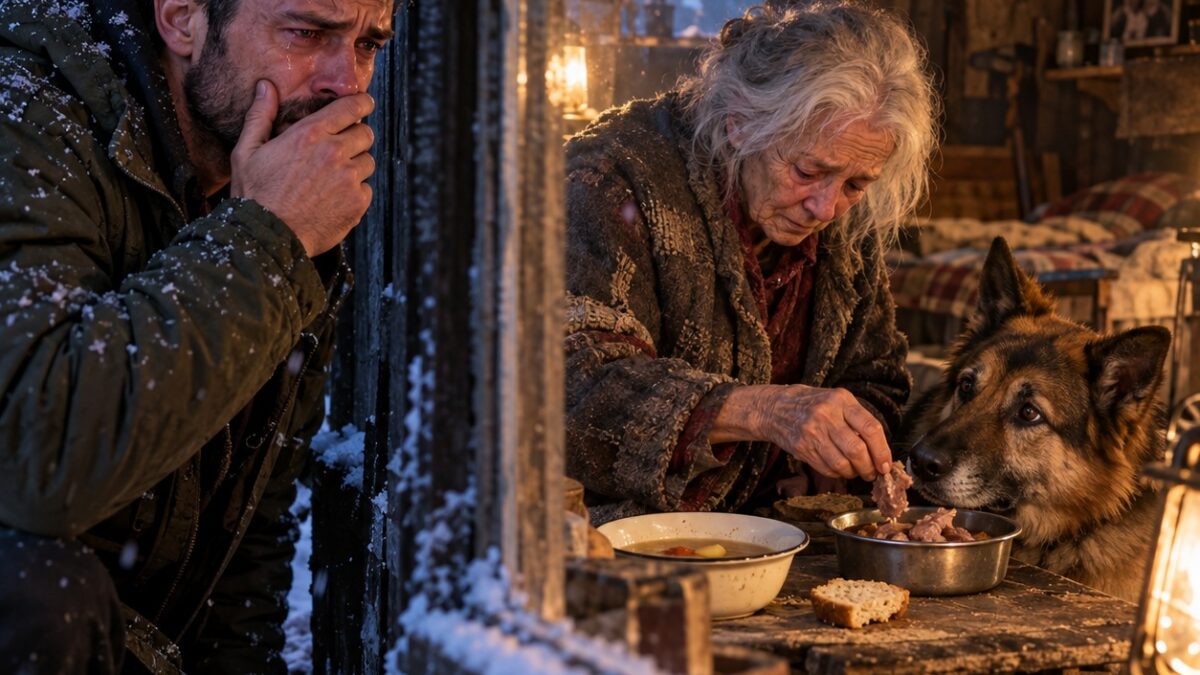
For several seconds, my mother didn’t answer.
She stood in the doorway with one hand gripping the frame, the other resting against the patched sleeve of her coat.
Behind her, Brier watched me without making a sound.
I had faced men who wanted to kill me. I’d operated in places where hesitation could cost lives. I’d learned to make decisions under pressure, to keep my voice steady when everything around me was falling apart.
But standing in front of my mother, I had no idea what to say next.
Finally, she stepped aside.
“You’d better come in. You’re letting the heat out.”
I walked inside.
There wasn’t much heat to lose.
The room was so cold I could see the faintest trace of my breath near the back wall.
A small electric heater stood beside a wooden chair. It hummed unevenly, clicked off, then started again with a metallic rattle.
The floorboards were worn.
A bucket sat beneath a dark water stain on the ceiling.
One window was covered with plastic sheeting that fluttered whenever the wind hit the building.
There was a narrow bed behind a curtain, a tiny kitchen counter, and a two-burner stove with one burner that looked older than I was.
On the shelves, I counted three cans of soup, a container of oatmeal, half a loaf of bread, and a nearly empty bag of dog food.
I didn’t mean to count.
My training made me notice things.
Structural weaknesses.
Available resources.
Threats.
The problem was that every threat in that room was aimed at my mother.
She closed the door.
“You have that look again.”
“What look?”
“Your inspection face.”
I turned toward her.
“My what?”
She gave a tired little smile.
“You had it when you were twelve. Your father used to say you could find something wrong with a brand-new bicycle.”
Normally, I might have laughed.
Instead, I looked at the stew.
“How much have you eaten today?”
“Enough.”
“Mom.”
“I’m not a child, Cade.”
“I know you’re not.”
“Then don’t question me like one.”
I drew a slow breath.
“Why did you give Brier almost all the meat?”
Her expression changed.
She looked toward the dog, who had settled beside her chair.
“He’s been losing weight.”
“So have you.”
“He didn’t eat much yesterday.”
“That’s not what I asked.”
She folded a dish towel that was already folded.
“He never chose any of this,” she said quietly.
I looked at her.
“What?”
She stroked Brier’s graying muzzle.
“He didn’t choose to get old. He didn’t choose to lose Daniel. He didn’t choose to live out here with me.”
Her voice wavered.
“He’s a good dog. He deserves to eat.”
Something inside me twisted.
I wanted to tell her she deserved to eat, too.
That she deserved warm walls, decent food, proper medical care, a bed that didn’t sit beneath a leaking roof.
I wanted to demand why she’d allowed herself to reach this point.
But I had no right to make that demand without first answering a question of my own.
Where had I been?
I crouched beside the rear door.
Cold air pushed through a gap large enough to show daylight.
“How long has this been like that?”
“A while.”
“How long?”
“Since last winter, maybe.”
I stood and tested the faucet.
Nothing came out.
I turned it again.
A thin stream of water appeared.
“The pipes freeze sometimes,” she explained.
“Sometimes?”
“Only when it’s very cold.”
I looked around.
We were in northern Michigan in January.
The ceiling insulation had sagged above the kitchenette.
The heater was struggling.
The roof was leaking.
My mother had been living inside a building that barely qualified as shelter.
“Mom, you can’t stay here.”
Her shoulders stiffened.
“Don’t start.”
“This isn’t safe.”
“It’s what I have.”
“Then we’ll find something else.”
“We?”
I stopped.
She looked directly at me.
“You haven’t spoken to me in ten years, Cade. You don’t get to walk through my door and start giving orders.”
I felt the words hit exactly where she intended.
She was right.
And I hated that she was right.
“I’m not trying to give orders.”
“You’re using the same voice you used when you told me not to leave.”
I looked away.
For a moment, we were back in that old kitchen.
She was fifty-nine again.
I was thirty.
There were boxes beside the door and too many things neither of us knew how to say.
My mother lowered her eyes.
“I’m sorry. I shouldn’t have said that.”
“No.”
My voice came out rough.
“You should have.”
I sat down across from her.
Brier raised his head, studied me, then rested his muzzle on his paws again.
“I don’t know how to do this,” I admitted.
Mom looked surprised.
“Do what?”
“Come back.”
Her expression softened so quickly that I almost couldn’t stand it.
“You already did.”
I stared at the table.
“That doesn’t fix anything.”
“No,” she agreed. “It doesn’t.”
We sat quietly.
Outside, wind pushed snow against the window.
Inside, the heater rattled like it was preparing to surrender.
Then I stood.
“I’m going to get groceries.”
“Cade—”
“And a proper heater.”
“I don’t need—”
“And something to seal that door.”
She gave me the same look she used to give me when I was a teenager.
“Are you listening to me?”
“Unfortunately, yes.”
That earned the smallest smile.
I walked toward the door.
“Tomorrow morning,” I said, “I’m coming back.”
She didn’t answer.
I turned.
“Mom?”
Her eyes were shining.
“I heard you.”
I hesitated.
“I mean it.”
She nodded.
And for the first time in ten years, I left my mother with a promise I intended to keep.
The next morning, I returned before nine.
My truck was loaded with groceries, lumber, weather stripping, insulation, tools, a safer portable heater, and enough dog food to feed Brier for weeks.
Mom was standing outside when I pulled in.
She saw the supplies.
Then she saw me.
Her expression went from surprise to disbelief to outright irritation.
“No.”
I climbed out.
“Good morning to you, too.”
“Cade Whitmore, what have you done?”
“Shopping.”
“For whom?”
“Apparently, a woman who believes oatmeal is a balanced meal.”
She folded her arms.
“You are taking all of that back.”
“No.”
“I mean it.”
“So do I.”
“I can pay you.”
“I didn’t ask you to.”
“That’s precisely the problem.”
I stopped unloading.
Mom had always hated feeling indebted to anyone.
When I was little, she would rather repair a torn coat than ask for help buying a new one.
When Dad got sick, she kept the household running without telling anyone how exhausted she was.
I used to admire that stubborn independence.
Now I was staring at what happened when pride became a survival strategy.
“Mom,” I said more gently, “these are groceries, not a debt.”
She looked away.
“I don’t want you thinking you have to take care of me.”
“I don’t think that.”
“Then why are you doing this?”
I picked up a bag of groceries.
“Because the kitchen has nothing in it.”
She opened her mouth.
I continued.
“And because I want to.”
That silenced her.
Brier appeared in the doorway.
He walked straight to the bags of dog food, sniffed one, and sat down beside it.
I pointed at him.
“See? At least somebody appreciates me.”
Mom glanced at the dog.
“He has questionable judgment.”
I stared at her.
She smiled.
And without warning, I laughed.
It sounded strange coming out of me.
Rusty.
Unfamiliar.
Mom laughed, too.
For a few seconds, the little shed felt less like a disaster and more like a place where a family might live.
I began working on the rear door.
The first thing I learned was that the building had been repaired so many times with mismatched materials that fixing one problem usually revealed two more.
The second thing I learned was that Brier considered himself the supervisor.
He followed me from one end of the room to the other, sniffing tools, watching screws fall, and occasionally placing himself directly where I needed to kneel.
“You’re going to have to move, buddy.”
His ears twitched.
He didn’t move.
“I’ve worked with highly trained military dogs. You know that?”
Brier blinked.
“Every one of them followed instructions better than you.”
Mom called from the kitchen.
“Maybe they had better leadership.”
I looked up.
She was smiling into her coffee.
Something warm and painful moved through my chest.
I hadn’t heard her tease me like that since before Dad died.
A truck pulled into the lane while I was fitting a new strip along the doorframe.
The driver was an older man, maybe seventy, wearing a brown canvas jacket over a faded red flannel shirt.
He moved slowly, favoring one shoulder.
When he reached the porch, he looked me over.
“You must be Cade.”
“Depends who’s asking.”
“Caleb Dunn.”
He extended one broad, scarred hand.
“I own the land under this architectural masterpiece.”
From inside, Mom shouted, “I heard that, Caleb!”
“Good,” he called back.
I shook his hand.
Caleb explained that the building had once been his workshop.
He’d converted part of it for seasonal use years ago.
When Mom needed somewhere to stay, he’d offered it to her.
“For free,” he added.
Mom appeared in the doorway.
“For rent.”
Caleb sighed.
“Twenty dollars a month.”
“And I pay every month.”
“Like the IRS is standing in the driveway,” Caleb muttered.
I almost smiled.
Then I looked at the building.
“How long has she been here?”
Caleb hesitated.
Mom disappeared inside.
His face changed.
“Coming up on three years.”
Three years.
Three winters.
I looked at the roof.
The patched window.
The narrow chimney.
“Why hasn’t anyone fixed this?”
Caleb rubbed his right shoulder.
“I meant to. Got some work done. Then this shoulder started giving me trouble.”
He looked uncomfortable.
“Your mother doesn’t make it easy to help her.”
“I’ve noticed.”
“She’s proud.”
“That’s one word for it.”
Caleb looked through the doorway.
“She’s a good woman, Cade.”
I said nothing.
He continued.
“And that dog probably saved her more times than either of us knows.”
Brier walked over and pressed against his leg.
Caleb scratched behind his ear.
“Daniel loved this old fellow. Your mother loves him even more.”
At the mention of Daniel’s name, I felt the familiar tightening in my chest.
I had spent ten years refusing to hear anything good about the man.
But there I stood, looking at a dog whose loyalty was the only thing keeping my mother from complete isolation.
And for the first time, I wondered what kind of man Daniel had actually been.
I met Norah Bell that afternoon.
She owned a small grocery store on North Haven’s main street, a narrow place called Belle’s Market that smelled of fresh coffee, warm bread, and oranges.
Norah was in her early sixties, with brown eyes behind thin glasses and a practical manner that reminded me of Mom.
She recognized me immediately.
“You’re Evelyn’s boy.”
I stopped.
“That obvious?”
“You have her eyes when you’re worried.”
“I’m not worried.”
She smiled.
“You have her lying voice, too.”
I filled my basket with groceries while she watched me without hovering.
At checkout, she placed two bags of apples beside my purchases.
“I didn’t buy those.”
“They’re going soft.”
I picked one up.
It was firm, bright red, and perfectly good.
Norah kept scanning my groceries.
“Your mother is very good at making five dollars behave like ten.”
My stomach tightened.
“How long has she been shopping here?”
“Years.”
“Does she owe you money?”
“No.”
“Has she ever asked you for food?”
Norah stopped scanning.
“Your mother never asks for anything.”
“Then how do you know when she needs help?”
She looked at me over her glasses.
“You don’t have to ask someone to notice.”
I stood there holding the apple.
Those words were simple.
They were also an accusation I couldn’t argue with.
Norah sighed.
“She used to buy fresh vegetables, meat, things for proper meals. After Daniel passed, her purchases got smaller.”
I looked down.
“Sometimes she’d put something back at the register because the total was too high. Always the things she needed most.”
I swallowed.
“Why didn’t she contact me?”
Norah’s expression softened.
“I think she believed she had lost you.”
I left with my groceries and two bags of apples I knew Norah had no intention of charging me for.
During the drive back, I kept hearing her words.
You don’t have to ask someone to notice.
For ten years, I had taken my mother’s silence as proof she didn’t care.
I had never asked whether she was safe.
Whether she was sick.
Whether she could pay her bills.
Whether she was alone.
My anger had allowed me to imagine her living happily somewhere else.
That imagined happiness had justified my absence.
Now I knew better.
And knowing better was beginning to hurt.
I found out about her medical situation when I noticed a prescription bottle beside the sink.
It was nearly empty.
“Do you have a refill?”
Mom looked up from folding laundry.
“Next week.”
“How many pills are left?”
“Enough.”
I picked up the bottle.
She gave me a warning look.
“Cade.”
“Three.”
“That’s not necessarily a problem.”
“When is your appointment?”
She hesitated.
I set the bottle down.
“Mom.”
The following afternoon, we drove to a small clinic where I met Dr. Hannah Voss.
She was forty-eight, with short ash-blonde hair and the kind of calm, direct manner I trusted immediately.
Mom went to the front desk after her appointment to arrange a follow-up.
Hannah spoke quietly to me.
“Your mother receives Social Security. She isn’t completely without income.”
“Then why is she living like this?”
“Because the money doesn’t stretch far enough.”
Hannah explained that electricity, heating fuel, transportation, groceries, medication, and basic living costs consumed almost everything.
Mom could qualify for additional assistance.
She had refused to complete the applications.
“Why?”
Hannah gave me a patient look.
“You’ve met your mother.”
I sighed.
“Fair point.”
“I gave her the forms twice. Norah gave her another set. Caleb offered to help.”
“And?”
“She said other people needed the assistance more.”
I closed my eyes.
Of course she had.
She was the kind of woman who would share the last meal in her house with a dog because she believed he deserved it.
She was also the kind of woman who would rather suffer than admit she deserved help herself.
“Is she medically okay?”
Hannah’s expression became more serious.
“She needs better nutrition, a safer home, and consistent care. Her hip pain also needs proper attention.”
I looked toward the front desk.
Mom was smiling politely at the receptionist.
From a distance, she looked like any other elderly woman making an appointment.
Up close, I could see the fatigue she was trying to hide.
“She shouldn’t be living there,” I said.
“No,” Hannah agreed.
“What do I do?”
“Start by helping her believe accepting help isn’t the same as surrendering independence.”
I almost laughed.
“That sounds harder than anything the Navy ever trained me for.”
Hannah smiled faintly.
“It probably is.”
That evening, I discovered the little wooden chest.
I had noticed Brier watching it earlier.
He would sit near Mom’s bedroom doorway and stare at the chest beneath her bedside table.
Sometimes he approached it.
Sometimes he gently pushed his nose against the lid.
I assumed it held something that smelled familiar.
Perhaps Daniel’s belongings.
While searching for screws in a nearby cabinet, I accidentally bumped the chest.
The lid shifted open.
I reached to close it.
Then I saw a photograph.
It was me.
Twenty-three years old.
Wearing my Navy uniform.
Smiling at the camera with the awkward confidence of a man who thought he already understood the world.
I froze.
Inside the chest were newspaper clippings.
A faded Navy patch.
Old photographs.
A few printed articles mentioning my unit.
And envelopes.
Dozens of them.
Some were addressed to me.
Others had never been sealed.
I lifted one.
It was a birthday card from six years earlier.
Another was from four years earlier.
Another from the previous Christmas.
Mom’s handwriting appeared on every envelope.
Some had postmarks.
Others were untouched.
I opened the oldest card.
Inside, she had written about how proud she was of me.
She wondered whether I was eating enough.
She hoped I had friends around me.
She said she missed hearing my voice.
I sat on the edge of her bed.
For ten years, I had told myself she had forgotten me.
Yet here was a box filled with evidence that she had remembered every birthday.
Every Christmas.
Every milestone she could find in the news.
I heard a floorboard creak.
Mom stood in the doorway.
Her face went pale.
“I didn’t mean to open it,” I said.
She looked at the chest.
“I know.”
I held up the card.
“Why didn’t you send these?”
She sat carefully beside me.
“I sent some.”
“I never got them.”
“At first, I kept trying.”
Her fingers twisted together.
“Sometimes they came back. Sometimes I didn’t know whether you received them.”
I looked at the envelopes.
“Then why did you stop?”
Her eyes filled.
“Because after enough silence, you start believing silence is the answer.”
I couldn’t speak.
She touched the photograph of me at twenty-three.
“I didn’t want to force myself into your life.”
“Mom…”
“You were angry. I understood that.”
“I was hurt.”
“I know.”
“No, you don’t understand. I thought you chose him instead of me.”
She looked at me for a long time.
Then she whispered, “I know you did.”
I stood and walked toward the window.
Outside, snow drifted slowly past the trees.
I could feel her watching me.
“You should have called,” I said.
“I did.”
I turned.
She continued quietly.
“After a while, I stopped getting answers. And every year that passed made it harder to try again.”
I remembered all the calls I’d ignored.
The messages I’d deleted.
The addresses I’d never bothered to update.
I had called it protecting myself.
Now I was beginning to see what it had cost.
Brier came into the room.
He approached Mom and rested his muzzle against her knee.
She scratched behind his ears.
I looked at the chest.
“Did Daniel know about all this?”
She nodded.
“He helped me find some of those newspaper articles.”
That surprised me.
“He did?”
“He was proud of you, Cade.”
I almost laughed bitterly.
“He didn’t even know me.”
“He knew you mattered to me.”
I looked away.
For ten years, I’d imagined Daniel as the man who had encouraged my mother to forget her first family.
Now I was learning he’d spent time helping her preserve pieces of my life.
I wasn’t ready to forgive him.
I wasn’t even ready to admit I might have been wrong.
But I could no longer pretend the man I hated existed only in the story I’d invented.
I asked about Daniel that night.
The heater I’d installed had warmed the room enough that Mom finally removed her coat.
We sat at the kitchen table with cups of coffee.
Brier lay between us.
I had been avoiding the question since arriving.
Finally, I said, “Where is Daniel?”
Mom stopped moving.
Her fingers tightened around the mug.
Brier lifted his head.
Then he got up and rested his muzzle across her knee.
Mom looked down at him.
For several seconds, she said nothing.
“Daniel died three winters ago.”
I sat very still.
The room seemed quieter.
I looked at the leaking ceiling.
The cracked walls.
The old furniture.
Then back at her.
“If Daniel died three years ago,” I asked, “why are you living here?”
Mom lowered her eyes.
“Because after he died, this was the only place left for me.”
I felt anger rise in my chest.
“Tell me everything.”
She took a breath.
And finally, after ten years of silence, my mother began telling me the truth about the life she’d chosen.
Daniel had taken her to a house near Lake Superior.
It sat on a wooded rise overlooking the water, surrounded by spruce trees and tall pines.
She described it slowly, almost carefully, as though speaking too freely about something beautiful might make its loss hurt all over again.
The house had wide windows.
A fireplace.
A kitchen with enough room for two people to cook together.
In winter, the lake sometimes looked like a sheet of silver beneath the morning sun.
Daniel loved fishing.
He loved walking through the woods.
He loved repairing old things even though, according to Mom, he wasn’t particularly good at carpentry.
She smiled faintly while remembering him.
“He built me a bookshelf once. The whole thing leaned to the left.”
“What happened to it?”
“We put heavy books on the other side.”
I almost smiled.
“Did that work?”
“Not at all.”
For a moment, her expression softened.
Then the memory faded.
She explained that Daniel’s family had owned property around the lake for decades.
The house belonged to a family trust connected to the Puit estate.
Daniel had lived there for years.
Mom believed it was his home.
In every practical sense, it was.
But he didn’t personally own it in the way she had assumed.
And after he died, that distinction became everything.
“Who controlled it?” I asked.
“His son.”
“Wesley?”
She nodded.
I’d never met Wesley Puit.
All I knew was that he was Daniel’s eldest child, forty-four years old, and apparently comfortable allowing an elderly widow to spend three winters in a shed.
I already hated him.
Mom saw it on my face.
“Cade, don’t.”
“Don’t what?”
“Decide what kind of man he is before you understand what happened.”
I stared at her.
“You’re defending him?”
“I’m explaining him.”
“There’s a difference?”
“Yes.”
She looked toward the window.
“Wesley never trusted me.”
“Why?”
“Because he thought I had taken his father away from his family.”
I sat back.
Daniel’s first marriage had ended badly.
His children had been old enough to remember the arguments, the separation, and the years afterward.
Wesley had carried a deep resentment toward his father.
When Daniel eventually fell in love with Mom, Wesley saw it as another betrayal.
He convinced himself she had married Daniel for security.
For the house.
For whatever he believed she might inherit.
“Did Daniel know?”
“Of course.”
“Did he correct him?”
“Many times.”
“Did Wesley listen?”
Mom gave me a long, sad look.
“How well do angry sons listen, Cade?”
I looked down.
That one landed.
After Daniel’s funeral, Wesley had taken over much of the estate’s administration.
Two weeks later, he arrived with paperwork.
He explained that the lake house belonged to the family trust.
There were maintenance expenses.
Taxes.
Trust obligations.
Decisions Mom had no authority to make.
Then he told her she needed to leave.
“He gave me several months,” she said.
“How generous.”
“Cade.”
“Mom, you had just buried your husband.”
“I know.”
“And he told you to move?”
“Yes.”
“Was there somewhere arranged for you to go?”
She shook her head.
I felt my hands tightening into fists beneath the table.
Mom continued.
“Wesley didn’t scream at me. He didn’t threaten me. He was very formal.”
“That doesn’t make it better.”
“I didn’t say it did.”
She looked exhausted.
“He spoke about legal ownership as though the years I had lived there were nothing more than a long visit.”
I could picture it.
My mother standing in a home where she’d shared meals, celebrated birthdays, and watched her husband grow old.
A man with folders telling her she no longer belonged there.
She told me about one afternoon when she’d found Wesley sorting Daniel’s belongings into boxes.
She asked what would happen to his fishing equipment.
Wesley replied, without looking at her, “Family things stay with family.”
I stared at the table.
“He actually said that?”
Mom nodded.
“He was grieving.”
“So were you.”
“Yes.”
“Then why do you keep making excuses for him?”
She looked directly at me.
“I’m not making excuses. I’m telling you what happened.”
I stood and walked across the room.
“Did he give you any money?”
“No.”
“Did you ask about the estate?”
“No.”
“Did you speak to an attorney?”
“A neighbor suggested it.”
“And?”
She looked away.
“I couldn’t.”
“Why?”
Her voice broke slightly.
“Because I was tired, Cade.”
I turned.
She was crying now.
Not dramatically.
Not loudly.
Just tears slipping down the face of a woman who had spent too many years pretending she was strong enough to endure anything.
“I had already buried your father. I had already lost you. Then Daniel died.”
She pressed a hand against her chest.
“I couldn’t sit across from his children and argue about which pieces of his life belonged to me.”
My anger had nowhere to go.
She continued.
“I packed my clothes, some photographs, kitchen things, and a few letters.”
“And Brier.”
She smiled through her tears.
“And Brier.”
“What happened to the house?”
“Wesley took care of it.”
“And where did you go?”
She gestured around us.
“Caleb found this place for me.”
I looked at the walls.
Three years.
Three winters.
My mother had been cold, hungry, and alone while I continued telling myself she had chosen a better life without me.
I wanted to find someone to blame.
Wesley.
Daniel.
The estate.
The trust.
Anyone.
But Mom watched me with an expression I knew too well.
“Cade.”
“What?”
“Don’t let anger make all your decisions again.”
I looked at her.
She spoke carefully.
“I already lost one son to pride. Don’t turn yourself into another man who thinks being angry means he’s right.”
I sat back down.
Brier came over and settled between us.
And for the first time, I saw something I didn’t like.
Wesley believed my mother had stolen his father.
I believed Daniel had stolen my mother.
We were two grown men carrying the same wound from opposite sides.
And somewhere between those two stories, an elderly woman had ended up starving in a shed.
I wanted to confront Wesley immediately.
Mom refused.
“Not like this,” she said.
“Like what?”
“With your jaw locked and your hands clenched.”
I opened my hands.
She raised an eyebrow.
“Very convincing.”
I looked toward the door.
“What do you expect me to do?”
“Something useful.”
So I did.
The next two days turned the shed into a construction site.
Caleb arrived with tools and a thermos of coffee.
He also brought Owen Beckett, a fifty-five-year-old electrician with thick forearms, close-cropped salt-and-pepper hair, and a habit of staring at bad wiring as though personally offended by it.
Owen opened the electrical panel.
Looked inside.
Closed it.
I raised an eyebrow.
“That bad?”
He opened it again.
“I wanted to see whether it had improved.”
Caleb nearly choked on his coffee.
It hadn’t improved.
Owen found overloaded circuits, outdated connections, and several improvised repairs that could have become dangerous.
He explained what needed to be replaced.
I listened.
One thing the military had taught me was the danger of pretending to understand something outside my expertise.
I knew how to work under pressure.
I knew how to follow procedures.
I knew how to keep people alive in difficult circumstances.
But I wasn’t an electrician.
And I wasn’t going to experiment with my mother’s safety.
Owen handled the wiring.
I handled hauling materials, clearing damaged boards, and preparing the doorframe.
Later that morning, Noah Mercer arrived to inspect the heating system.
He was a broad-shouldered man in his forties with hazel eyes and an easy sense of humor.
He took one look at the old heater.
“How attached are you to this thing?”
Mom looked concerned.
“Emotionally?”
“Preferably not.”
I folded my arms.
“Can it be saved?”
“Absolutely.”
I waited.
Noah pointed at the heater.
“If your goal is to display it in a museum.”
Even Mom laughed.
We arranged a replacement heating system.
Over the following days, I worked alongside Caleb, sealing gaps, replacing damaged sections near the back wall, strengthening the lower steps, and preparing the building for proper insulation.
The more we repaired, the more I realized how long my mother had spent tolerating conditions no one should have had to tolerate.
She would describe a leak as “a little inconvenience.”
A frozen pipe was “just something that happens in Michigan.”
A broken heater was “still mostly working.”
Everything was mostly fine.
Nothing was truly fine.
And every time I discovered another problem, I had to fight the urge to make my guilt someone else’s burden.
Mom didn’t need a son who shouted about what had gone wrong.
She needed one who would help make things right.
Caleb seemed to understand that.
One afternoon, he watched me replace a warped board for the third time.
“You’re measuring that thing like the fate of the free world depends on it.”
“It isn’t level.”
“Neither is most of Michigan.”
I kept working.
Caleb studied me.
“Your mother doesn’t need perfection, Cade.”
I looked up.
“She needs a safe house.”
“She does.”
He paused.
“But she also needs a son who’ll sit down and have a cup of coffee with her.”
I tightened the final screw.
“After this.”
Caleb smiled sadly.
“There’s always one more thing to fix.”
I didn’t answer.
Because I knew he was right.
Brier became my shadow during those days.
At first, he watched me from the porch.
Then he started following me through the yard.
By the third morning, he was sleeping beside my toolbox.
He had a habit of picking up work gloves and carrying them away.
I discovered this when one of my new green gloves disappeared.
I searched the shed.
The porch.
The truck.
Then I noticed Brier standing near a snowbank with the suspiciously satisfied expression of a dog who believed he had accomplished something important.
“Brier.”
His ears lifted.
“Where’s my glove?”
He looked away.
I approached the snowbank.
One green finger protruded from the snow.
I pulled it out.
It was soaked.
I stared at him.
“Your dog is a criminal,” I told Mom.
She folded her arms.
“Technically, he was Daniel’s.”
“Then he inherited criminal tendencies.”
She laughed.
A real laugh.
Not the polite kind she used when trying to reassure people.
A sound that came from somewhere deep and happy.
I looked at her.
For a moment, I saw the woman who used to make pancakes on Saturday mornings while Dad read the newspaper.
Then the moment passed.
But something stayed with me.
She was still in there.
Beneath the grief.
Beneath the exhaustion.
Beneath ten years of silence.
My mother was still there.
And I wanted to know her again.
The first strange thing Brier did happened while Caleb and Mom were talking about Daniel.
I was carrying damaged boards toward the truck when I heard Caleb say something about an old fishing trail.
Brier’s ears lifted.
He had been lying beside the porch.
Suddenly, he stood.
Walked into the shed.
And returned carrying an old brown leather glove.
The fingers were permanently curved, the leather darkened with age.
It was too large to belong to Mom.
“Daniel’s?” I asked.
She nodded.
“He used to wear those when he went fishing.”
Brier carried the glove to the edge of the porch.
Then he looked toward the forest.
He stood perfectly still.
Not barking.
Not whining.
Just staring between the snow-covered trees.
Caleb followed his gaze.
“Daniel used to take him down that old trail.”
“What’s out there?” I asked.
“Mostly woods.”
Caleb thought for a moment.
“There was an old fishing cabin farther in.”
Mom looked toward the trees.
“I haven’t been there in years.”
“Daniel owned it?”
“He used it. It was part of the family’s old property.”
I watched Brier.
He lowered the glove onto the porch.
Then he lay beside it.
I didn’t think much of it at first.
Dogs remembered routines.
They associated objects with people.
They followed familiar scents and paths.
I’d worked around trained animals long enough to know loyalty could look almost like understanding.
But over the next several days, Brier kept returning to the same spot.
Sometimes he carried the glove.
Sometimes he stood facing the trees.
Always toward the same narrow opening between the pines.
One afternoon, after fresh snow had covered the yard, I finished fastening a piece of trim and began packing my tools.
Brier stood at the porch.
“Inside,” I called.
He didn’t move.
“Brier.”
He looked at me.
Then stepped into the snow.
He walked ten yards toward the forest.
Stopped.
Looked back.
I frowned.
He walked farther.
Stopped again.
Waited.
Mom came outside.
The moment she saw where he was going, her face changed.
“What?” I asked.
She stared toward the trees.
“Daniel used to take him that way.”
Brier stood beneath the pines.
Watching us.
Waiting.
I set down my tools.
“Well,” I said, reaching for my coat, “I guess we’d better find out what he’s doing.”
Mom looked at me.
“Cade…”
“What?”
She hesitated.
Then surprised me.
“I’m coming.”
The trail was almost invisible beneath the snow.
Brier moved ahead at a steady pace, pausing often to sniff the ground and study the trees.
He wasn’t running blindly.
He seemed to be following a route he knew.
I understood that.
Memory, terrain, habit.
A dog who had walked the same path with someone he loved enough times to remember its shape.
Mom followed several yards behind me.
Her limp worried me almost immediately.
The snow made every step harder.
She kept reaching for branches to steady herself.
After several minutes, I stopped.
“That’s enough.”
She caught up.
“What?”
“You’re limping.”
“I have been limping for years. It’s not exactly breaking news.”
“Mom.”
“I’m fine.”
I gave her a look.
She sighed.
“You are your father’s son.”
“That’s not an answer.”
“It’s the only one you’re getting.”
I looked toward Brier.
The dog had stopped farther ahead and was watching us.
“We don’t even know where he’s going,” I said.
Mom followed my gaze.
“No.”
“Then why are we doing this?”
She looked at the snowy path.
“Because Daniel walked this way.”
Her voice was barely above a whisper.
“And because I want to see where it leads.”
I didn’t argue.
Instead, I offered my arm.
She looked at it.
For one second, I thought she would refuse.
Then she slipped her hand through my elbow.
We continued together.
Neither of us mentioned it.
The woods gradually opened into a clearing.
Beyond a line of bare birch trees, a frozen inlet stretched toward the lake.
A small fishing cabin stood near the shore.
Its roof sagged.
One window was boarded over.
Snow had drifted halfway up the front door.
Mom stopped.
“Oh,” she whispered.
“You know this place?”
She nodded.
“Daniel brought me here twice.”
Brier circled the cabin.
His nose stayed close to the ground.
He passed the front door and moved toward a smaller side entrance nearly hidden by snow.
He sniffed it.
Scratched once.
Then looked back at me.
I approached.
“That seems specific.”
Mom came closer.
“Daniel used that entrance when he brought fishing equipment.”
I brushed snow away from the latch.
It was rusted but intact.
After several minutes of careful work, I managed to open the door.
Cold, stale air drifted from inside.
The room smelled of old wood, dust, and metal.
There was a small stove.
A table.
Two chairs.
A narrow cot.
Fishing rods leaned against one wall beneath a canvas tarp.
Nothing appeared to have been touched for years.
A green mug hung from a hook.
An old wool cap rested on a shelf.
Mom stared at them.
I watched her face.
I had seen people react to grief in different ways.
Some cried.
Some became angry.
Some went completely still.
Mom stood so motionless that I almost reached for her.
Then she whispered, “That’s his mug.”
I looked toward the hook.
“He always drank coffee out of that one.”
She smiled faintly.
“It had a chip in the handle. I tried to throw it away once.”
“What happened?”
“He rescued it from the trash.”
I looked at the mug.
It was ordinary.
Worthless to anyone who hadn’t known Daniel.
But to my mother, it might as well have been the last piece of him left in the world.
Brier walked through the room.
He sniffed the stove.
The cot.
The table.
Then he stopped near one leg of the table.
He lowered his muzzle toward the floor.
Sniffed again.
And scratched at one board.
I crouched.
“Brier, if this is a mouse, you’re buying dinner.”
He ignored me.
The board looked slightly different from those around it.
Two shallow marks showed near one edge.
I ran my thumb across them.
Tool marks.
Intentional.
I moved the table aside.
The plank lifted more easily than I expected.
Beneath it was a narrow compartment between the floor joists.
And inside sat a cedar box wrapped in old waterproof canvas.
For a moment, none of us spoke.
Brier stepped away from the opening.
He sat beside Mom.
She looked down at him.
Then slowly placed one hand against his graying muzzle.
“He remembers,” she whispered.
I looked at her.
“Remembers what?”
“Daniel.”
Her eyes filled.
“He remembers being here with him.”
I looked around the cabin.
The mug.
The fishing rods.
The old cap.
The worn floor.
A place that had held a man’s ordinary habits.
I understood then that Brier hadn’t necessarily known what was beneath the boards.
He had followed a route associated with the person he’d loved.
He had brought us back to a place the humans had forgotten.
I wrapped the box again.
“We’ll open it at home.”
Mom nodded.
She was tired.
Her face had gone pale from the cold.
I took her arm for the walk back.
Brier led the way through the snow.
This time, he didn’t stop to search.
He simply walked.
As though whatever had been waiting in those woods was finally going home.
We placed the cedar box on Mom’s kitchen table.
The room was warm enough now that she could sit without wearing her coat.
Brier lay beside her chair.
I carefully worked the old latch loose.
The lid opened.
Inside were several ordinary objects.
A thick envelope.
Some emergency cash.
A folded bank statement.
A certificate for a long-term investment account.
Several financial forms.
And a letter.
Mom’s name was written across the front in Daniel’s handwriting.
She stopped breathing for a moment.
I pushed the letter toward her.
“You should open it.”
Her fingers trembled.
“I don’t know if I can.”
I looked at her.
“You don’t have to do it alone.”
Her eyes met mine.
Something shifted in her expression.
She picked up the envelope.
Opened it.
And began reading.
I watched her face rather than the page.
At first, she seemed confused.
Then sad.
Then frightened.
Daniel had written the letter shortly before his death.
He had been experiencing chest pain.
Doctors wanted additional testing.
He didn’t believe he was dying, but he had begun to understand that age made promises about tomorrow less reliable.
He had been worried about Mom.
Especially about what might happen if Wesley continued refusing to accept her.
He regretted that he hadn’t repaired the relationship between his wife and his children.
He knew Mom would never demand anything from them.
So he’d made a separate financial arrangement.
An investment account.
Money intended for her security.
It remained in his name while he was alive.
She was listed as the beneficiary upon his death.
He had planned to explain everything after the bank completed the paperwork.
But he had hidden copies in the fishing cabin because he didn’t want them misplaced among the estate records at the lake house.
He’d intended to retrieve them.
He never had the chance.
Mom stopped reading.
Tears slipped onto the paper.
I reached toward her, then hesitated.
She kept reading.
Then she pressed a hand over her mouth.
“What does it say?” I asked gently.
She shook her head.
She couldn’t speak.
Finally, she turned the page toward me.
Daniel had written:
You have spent too much of your life believing love must be paid for with sacrifice.
I stared at the sentence.
Mom began crying harder.
Brier rose and pushed his head beneath her hand.
She held onto him.
I looked away for a moment, giving her the privacy grief sometimes required.
Then she whispered, “There’s more.”
I waited.
She read the next section aloud.
Daniel had written that money could help with practical things.
A safe home.
Food.
Medical care.
But it couldn’t solve the one problem he feared most.
The distance between her and me.
He had mentioned my name.
Not with resentment.
Not with bitterness.
With concern.
He had encouraged her to find her son.
To speak to me.
To stop letting years disappear.
Then came the sentence I will remember for the rest of my life.
Pride has already taken enough years from both of you.
I stared at the table.
For ten years, I had blamed Daniel for stealing my mother.
And in the final days of his life, he’d been trying to persuade her to come back to me.
The room blurred.
I pressed my palms against my eyes.
I didn’t want to cry.
I had spent so many years training myself to control everything I could.
But grief doesn’t respect discipline.
Neither does regret.
Mom reached across the table.
“Cade?”
I couldn’t answer.
She touched my hand.
“He wanted us to find each other.”
I nodded.
My throat felt too tight.
For ten years, I had carried a version of Daniel that made my anger easier to justify.
A selfish man.
A replacement for my father.
Someone who had taken something from me.
Now I was holding evidence that he’d cared about the very relationship I believed he had destroyed.
It didn’t mean everything he’d done had been perfect.
He should have explained the property situation more clearly.
He should have made sure Mom understood what would happen after his death.
He should have told her about the financial account.
But the man I had hated wasn’t the man my mother had loved.
And I had to face that.
Mom continued reading until the end.
Then she folded the pages carefully.
“He said I’d be all right,” she whispered.
I looked at the bank documents.
There were account numbers.
Dates.
A beneficiary designation.
But three years had passed.
The financial institution might have merged.
The account might have changed.
The designation might never have been completed.
I wasn’t going to promise her money based on documents I didn’t fully understand.
I gathered the paperwork into one stack.
“Tomorrow,” I said, “we find out whether he was able to keep that promise.”
Maryanne Cole’s law office was above an insurance agency in downtown North Haven.
She was fifty-two, composed, with auburn hair streaked lightly with silver and dark green eyes behind reading glasses.
Her office was orderly without being fancy.
Dark shelves.
Probate law books.
Filing cabinets.
A broad wooden desk with one edge worn smooth.
She listened while Mom explained Daniel’s death and the discovery in the cabin.
Then she examined the documents.
I watched her expression carefully.
She didn’t smile.
Didn’t frown.
Didn’t offer encouragement she couldn’t support.
Finally, she removed her glasses.
“What we know,” she said, “is that Daniel appears to have created an investment account and named Evelyn as the beneficiary.”
“Then it’s hers,” I said.
“No.”
I frowned.
Maryanne continued calmly.
“It may be hers. We need to verify the account existed, whether the designation was accepted, and whether any later documents changed it.”
Mom lowered her eyes.
I saw disappointment cross her face.
Maryanne noticed.
“Mrs. Puit, I’m not telling you this is bad news.”
“You’re not telling me it’s good news either.”
“Not yet.”
I looked at her.
I respected that.
There was no room for wishful thinking when my mother’s security was involved.
Verification took two days.
Two days of phone calls, records requests, archived account numbers, identity documentation, and questions that seemed to create more questions.
The original financial institution had merged with a regional bank after Daniel’s death.
The investment records had moved.
Some documents were archived.
Maryanne had to confirm that the beneficiary designation survived the transfer.
I hated waiting.
On the second afternoon, she looked up from her desk.
“Mr. Whitmore.”
“Yes?”
“You’re pacing.”
“I’m standing.”
“You’ve crossed the same section of carpet eleven times.”
I stopped.
Mom hid a smile.
I sat down.
Five minutes later, I stood again.
Maryanne didn’t bother commenting.
Finally, on the second afternoon, she called us back to her office.
This time, a single printed statement sat on the desk.
I noticed it immediately.
Maryanne waited until we were seated.
Then she turned the paper toward Mom.
“The account still exists.”
Mom stared at her.
I leaned forward.
“You’re sure?”
“Yes.”
Maryanne explained that Daniel’s investment had remained active after his death because the beneficiary had never submitted a claim.
The money had transferred internally during the bank merger.
The underlying account information had been preserved.
Most importantly, the beneficiary designation remained valid.
Mom’s name was on it.
Evelyn Whitmore Puit.
I stared at the statement.
“How much?”
Maryanne gave us the current value.
Mom covered her mouth.
It wasn’t the kind of money that made people rich.
There would be no mansion.
No luxury car.
No sudden fantasy life.
But it was enough.
Enough to move into decent housing.
Enough to cover medical care.
Enough to stop choosing between groceries and heating bills.
Enough for my mother to sleep without worrying about how she would survive the next winter.
I turned toward her.
Tears had filled her eyes.
At first, I thought she was crying because she was finally safe.
Then she whispered, “He remembered.”
I understood.
The money mattered.
Of course it mattered.
But the deeper gift was knowing Daniel had thought about her future.
He had wanted her protected.
He had tried to make sure she wouldn’t have to beg anyone for a place to live.
Even though he hadn’t managed to tell her before he died, he’d made the effort.
She touched the paper with trembling fingers.
“He told me I would be all right.”
Maryanne nodded.
“He made a meaningful arrangement to help make that possible.”
Mom cried quietly.
I sat beside her.
And for the first time since reaching Michigan, I felt something other than guilt and anger.
Relief.
Not complete relief.
There was still too much damage behind us.
But the future no longer looked like a narrow road ending at a frozen shed.
Before we left, Maryanne stopped us.
“There’s something else you should understand.”
I looked at her.
“Wesley didn’t touch this money.”
I frowned.
“What?”
“The account records show no withdrawals after Daniel’s death. No transfer attempts by the estate. No requests from Wesley.”
Mom lifted her head.
Maryanne tapped the statement.
“From what we can verify, he never knew this account existed.”
I sat back.
Part of me had wanted Wesley to be guilty of something.
Something clear.
Something I could point to.
Fraud.
Theft.
A deliberate attempt to take money that belonged to Mom.
But he hadn’t stolen this money.
He had simply allowed her to leave her home.
And then allowed himself not to think about what happened to her.
Maryanne folded her hands.
“Families can cause terrible harm without committing crimes, Mr. Whitmore.”
I looked at Mom.
She was still holding Daniel’s letter.
“Yeah,” I said quietly. “I’m beginning to understand that.”
I met Wesley that afternoon.
Not at Mom’s shed.
Not at the lake house.
I asked him to meet me at a small coffee shop near the marina.
Neutral ground seemed wise.
I had learned enough about myself to know I wasn’t always reasonable when family was involved.
Wesley arrived exactly on time.
He was tall, lean, clean-shaven, with dark brown hair beginning to gray near his temples.
He wore a charcoal coat over a navy sweater.
Everything about him looked controlled.
Careful.
He sat across from me.
For several seconds, neither of us spoke.
Finally, he said, “You found the account.”
I nodded.
“Yes.”
He looked toward the window.
“My father liked contingency plans.”
“Apparently, he didn’t like telling anyone about them.”
Wesley’s jaw tightened.
“He was probably waiting until everything was finalized.”
I leaned forward.
“He told my mother she’d be taken care of.”
“I know.”
“Then why did you make her leave?”
Wesley looked at me.
“The property belonged to the family trust.”
“She lived there with your father.”
“That doesn’t change the legal structure.”
“No,” I said. “It doesn’t.”
I let the silence sit for a moment.
“But it should have changed how you treated her.”
His eyes hardened.
“I gave her time.”
“You treated her like a guest in the house where she buried her husband.”
He looked away.
I could see the tension in his jaw.
Finally, he said, “Your mother represented something I wasn’t ready to accept.”
“What?”
“My father starting over.”
I stared at him.
He continued.
“My parents were married thirty-one years. Their marriage ended badly.”
“I know.”
“You don’t know what it was like.”
“Then tell me.”
He seemed surprised by that.
For a moment, I thought he would refuse.
Instead, he looked down at his coffee.
“When they separated, I was old enough to understand what was happening. Old enough to see how much it hurt my mother.”
He swallowed.
“But not old enough to understand that relationships can fail without there being one person to blame.”
I said nothing.
“My father tried to stay involved. He didn’t disappear. I know that now.”
“Didn’t stop you from blaming him.”
“No.”
The honesty caught me off guard.
Wesley continued.
“Then he met Evelyn. He moved on. He married again. And I couldn’t stand that he seemed happy when the rest of us were still trying to figure out what happened.”
I watched him carefully.
“My sister adjusted better than I did.”
“Rachel?”
He nodded.
“She understood something I didn’t.”
“What?”
“That my father was allowed to have another life.”
I leaned back.
For a moment, I heard my own thoughts in another man’s voice.
My father had died.
Mom had eventually met Daniel.
I decided that meant she was replacing Dad.
Wesley’s parents divorced.
Daniel eventually met Mom.
Wesley decided that meant Daniel had abandoned his first family.
Different histories.
Different grief.
The same refusal to accept that someone we loved could continue living.
I looked across the table.
“You didn’t hate my mother because of anything she did.”
Wesley stared at his hands.
“No.”
“You hated what she represented.”
“Yes.”
“And you made her pay for it.”
He didn’t answer.
He didn’t need to.
After a while, Wesley reached into his coat.
He placed a photograph on the table.
Daniel stood near the lake beside my mother.
They looked happy.
Older.
Content.
Mom was laughing at something outside the frame.
Daniel had one arm around her shoulders.
I stared at the picture.
“Where did you get this?”
“Dad’s desk.”
“Why didn’t you give it to her?”
Wesley swallowed.
“Because I was angry.”
There it was.
No dramatic confession.
No hidden crime.
No villainous scheme.
Just an ordinary act of cruelty committed by a grieving man who had convinced himself he was entitled to it.
And I understood it too well.
I had punished my mother with ten years of silence.
Wesley had punished her by treating her as though she didn’t belong.
Neither of us had considered the actual woman standing between our stories.
I pushed the photograph back toward him.
“Keep it.”
He looked surprised.
“Why?”
“So you remember what anger made you hide.”
His face tightened.
I stood.
Then stopped.
“You and I spent years punishing the same woman for different stories we never bothered to question.”
Wesley looked at me.
I waited.
For an apology.
An argument.
Anything.
He said nothing.
I walked away.
I didn’t feel victorious.
That surprised me.
I’d imagined confronting the person responsible for Mom’s suffering would give me some kind of satisfaction.
Instead, I felt exhausted.
Because I had seen too much of myself sitting across that table.
When I returned to the shed, Mom was preparing supper.
A real supper.
Chicken.
Potatoes.
Vegetables.
The refrigerator was full.
The room was warmer.
Brier was lying near the heater.
She looked up.
“How did it go?”
I hung my coat.
“We talked.”
“Did you argue?”
“Some.”
“Did you hit him?”
I looked at her.
“Mom.”
She raised an eyebrow.
“That’s not an answer.”
“No.”
“Good.”
I sat down.
She placed a plate in front of me.
For a while, we ate quietly.
Then she asked, “Do you understand him any better?”
I looked at my food.
“Unfortunately.”
Mom nodded.
“That’s usually how it works.”
I watched her cut a piece of chicken.
“Why didn’t you tell me sooner how bad things had gotten?”
She set down her fork.
“Would you have answered?”
I couldn’t speak.
She wasn’t being cruel.
She was asking a fair question.
I had spent years making myself unreachable.
“I don’t know,” I admitted.
“Neither did I.”
I looked at her.
“I’m sorry.”
She went still.
I had said those words many times in my life.
To teammates.
To friends.
To people I’d disappointed.
But I’d never said them to her about this.
Not once.
“I’m sorry I let ten years pass,” I continued.
Her eyes filled.
“Cade…”
“I’m sorry I made you believe you didn’t matter to me.”
She pressed her lips together.
I looked down at my hands.
“I was angry because I missed Dad. And I didn’t know how to tell you that seeing you with someone else made me feel like I was losing him all over again.”
Mom began crying.
“I never wanted you to feel that way.”
“I know.”
“No,” she whispered. “I should have understood how much you were hurting.”
I shook my head.
“You were hurting, too.”
She reached across the table.
I took her hand.
It was smaller than I remembered.
The skin was thinner.
The fingers were slightly crooked with age.
But it was the same hand that had checked my forehead when I was sick, buttoned my coat when I was little, and held mine across crowded parking lots.
I looked at it.
And realized how close I had come to losing the chance to hold it again.
With Daniel’s account verified and the beneficiary process moving forward, Mom could finally make decisions about her future without calculating every dollar against the next heating bill.
I suggested moving.
A proper house.
Somewhere in town.
Near the clinic.
Near the grocery store.
Somewhere she wouldn’t have to worry about another winter in the woods.
She listened.
Then shook her head.
“I want to stay.”
I stared at her.
“Here?”
“Yes.”
“Mom, this is a shed.”
“It used to be.”
“That’s not reassuring.”
She smiled.
“I like the trees.”
“There are trees all over Michigan.”
“I like these trees.”
I looked toward the window.
Brier was outside, sniffing the snow near the porch.
Mom continued.
“Daniel walked those woods. Brier knows every trail. Caleb is close. Norah comes by. Dr. Hannah is only a drive away.”
She paused.
“This place was lonely because I was lonely, Cade. It doesn’t have to stay that way.”
I looked around.
The roof still needed repair.
The bathroom needed work.
The windows were inadequate.
The steps were unsafe.
But the basic structure could be improved.
Caleb had already said so.
I thought for a moment.
“You want to turn this place into a real home?”
She nodded.
“Yes.”
I sighed.
“Then we do it properly.”
Her eyes narrowed.
“We?”
I smiled.
“You’re going to have to get used to that word.”
We began planning the renovations that week.
Caleb knew the structure better than anyone.
Owen handled the electrical work.
Noah planned the heating improvements.
I helped with framing, flooring, insulation, and the endless details that came with turning a former workshop into a warm, safe place to live.
Mom insisted on helping.
We negotiated.
She could choose paint colors.
Organize the kitchen.
Tell us where she wanted furniture.
She could not climb ladders.
Carry lumber.
Or stand on frozen ground lifting anything heavier than she should.
She argued about every restriction.
One morning, I found her trying to move a box of supplies.
“Mom.”
She looked up.
“What?”
“Put it down.”
“It’s not heavy.”
“Put it down.”
She sighed.
“You sound like your father.”
“Thank you.”
“That wasn’t a compliment.”
I took the box.
She followed me into the main room.
“You’re becoming very bossy.”
“I’m a Navy SEAL.”
“And I’m your mother.”
I stopped.
She raised her chin.
“Rank means nothing in this house.”
Caleb laughed so hard he had to set down his coffee.
I looked at him.
“You’re enjoying this.”
“More than you know.”
Despite the arguments, things changed.
The roof was repaired.
Damaged insulation was replaced.
Proper windows went in.
The heating system was upgraded.
Owen completed the electrical work.
We made the bathroom safer and installed a grab bar near the shower.
I rebuilt the steps with a lower rise and a sturdy railing.
Mom insisted she didn’t need the railing.
She used it the first morning.
I didn’t say a word.
Some victories didn’t need announcements.
Dr. Hannah helped Mom review her medications and develop a better plan for her hip pain.
She also brought the assistance applications Mom had previously refused.
This time, Mom signed them.
Not happily.
Not without complaining.
But she signed.
I knew what that meant.
She was beginning to understand that accepting help wasn’t the same as losing her independence.
It was simply allowing herself to have what she needed.
Norah appeared every few days with food.
Always food she claimed she had made too much of.
One afternoon, she arrived carrying a casserole large enough to feed everyone working on the house.
“I accidentally made too much,” she announced.
I looked at the dish.
“For a wedding?”
She adjusted her glasses.
“Do you want lunch or an investigation?”
I took the casserole.
“Yes, ma’am.”
She gave me a satisfied nod.
Mom laughed from the kitchen.
I stood there with a hot dish in my hands, surrounded by people who had noticed my mother’s suffering long before I arrived.
And I understood something important.
She hadn’t been completely abandoned.
Caleb had given her shelter.
Norah had made sure she had food.
Hannah had watched her health.
None of them could force her to accept everything she needed.
But they had kept showing up.
I was grateful.
More grateful than I knew how to say.
Near the end of the first week, I built Brier a sleeping area beside the kitchen wall.
It had an insulated base.
A washable surface.
Enough room for him to stretch out comfortably near the warmth.
I spent nearly six hours making it.
Mom stood behind me when I finished.
“That looks nicer than my first apartment.”
I brushed sawdust from my sleeve.
“He has connections.”
Brier approached.
Sniffed the new bed.
Stepped inside.
Turned around twice.
Then walked away.
He lay directly across my boots.
I stared at him.
“I spent six hours on that.”
Brier closed his eyes.
Caleb appeared in the doorway.
“Customer feedback seems negative.”
Mom covered her mouth.
I pointed at the dog.
“He’s not getting a refund.”
Brier wagged his tail once.
Everyone laughed.
The sound filled the warm room.
I stopped for a moment and listened.
That was what I’d wanted.
Not just walls that held the heat.
Not just food in the kitchen.
A place where my mother could laugh.
Where people could visit.
Where she could grow older without being afraid.
A home.
Rachel Puit arrived three days later.
I didn’t recognize the car when it pulled into the lane.
A woman in her late thirties stepped out carrying a cardboard box.
She had chestnut hair, hazel-green eyes, and the hesitant posture of someone who had rehearsed a conversation without knowing how to begin it.
Mom appeared in the doorway.
She froze.
“Rachel?”
Rachel nodded.
“I should have come sooner.”
Nobody moved.
Then Brier stepped off the porch.
He approached Rachel slowly.
Sniffed her hand.
And pressed his muzzle into her palm.
Her face crumpled.
“Oh, Brier.”
She knelt in the snow and wrapped her arms around him.
He stood quietly while she cried.
I watched from beside the porch.
Whatever had kept the humans apart, the dog hadn’t forgotten her.
When Rachel finally stood, her cheeks were wet.
Mom stepped aside.
“Come in.”
Rachel carried the box to the kitchen table.
Inside were Daniel’s belongings.
Not anything valuable.
A fishing knife.
A worn thermos.
Several photographs.
An old watch that no longer worked.
A small notebook filled with grocery lists, fishing dates, and reminders in his handwriting.
Mom touched the notebook as though it were something fragile.
“He used to write everything down,” she whispered.
Rachel smiled sadly.
“He was afraid he’d forget.”
“He never forgot where he’d put his coffee.”
Rachel laughed through her tears.
“Only because it was always in the same mug.”
Mom smiled.
I moved to the other side of the room, pretending to work on some trim.
I wanted to give them space.
But I could still hear.
Rachel sat across from Mom.
“I let Wesley handle everything,” she said.
Mom looked up.
“I know.”
“I told myself I was grieving.”
“You were.”
Rachel shook her head.
“That became an excuse.”
Mom remained quiet.
Rachel looked down.
“I should have checked on you.”
“You lost your father.”
“So did Wesley.”
“Yes.”
Rachel swallowed.
“And you lost your husband.”
Mom’s eyes filled.
Rachel continued.
“I never thought you were using him.”
Mom pressed a hand against the notebook.
“Thank you.”
“I should have said that when it mattered.”
For a while, neither spoke.
Then Mom asked, “Why didn’t you?”
Rachel gave a small, ashamed smile.
“Because silence was easier.”
I stopped working.
Those words had become painfully familiar.
Silence was easier.
Silence had allowed me to avoid the discomfort of calling.
It had allowed Wesley to avoid admitting he had treated Mom unfairly.
It had allowed Rachel to stay out of a conflict she knew was hurting someone.
Silence had protected everyone from awkward conversations.
Except the woman sitting at the table.
She had paid the price.
Rachel stayed nearly two hours.
They talked about Daniel.
About the lake house.
About old holidays and ordinary mornings.
They cried a little.
Laughed a little.
Nothing was magically repaired.
But when Rachel finally left, Mom stood on the porch watching her car disappear.
I approached.
“You okay?”
She nodded.
Then she looked at me.
“She came back.”
I followed her gaze down the lane.
“Yeah,” I said.
“She did.”
Mom smiled.
And I realized she wasn’t just watching someone leave.
She was beginning to believe that leaving didn’t always mean forever.
Wesley came four days later.
He didn’t call first.
His dark vehicle pulled into the lane just before sunset.
I stepped outside automatically.
Old instincts.
Old resentment.
He climbed out wearing the same charcoal coat and navy sweater.
For a moment, we looked at each other across the snow.
Neither spoke.
Then he opened the rear door.
And lifted out an old wooden chair.
I recognized it immediately.
I’d seen it in a photograph from Daniel’s house.
It was simple.
Worn.
The arms smooth from years of use.
Wesley carried it toward the porch.
Mom appeared behind me.
She stopped when she saw him.
“Wesley.”
He nodded.
“Evelyn.”
He set the chair down carefully.
For several seconds, he stared at it.
Then he looked at her.
“Dad would have wanted you to have this.”
Mom touched the doorframe.
“Thank you.”
Wesley nodded once.
He didn’t apologize.
He didn’t explain.
He didn’t ask to come inside.
He simply turned and walked back toward his car.
I watched him leave.
Then I looked at Mom.
She approached the chair.
Placed one hand on the worn back.
And stood there quietly.
I wanted to say something about Wesley.
About how little he’d done.
About how a chair couldn’t erase three years of suffering.
But Mom’s expression stopped me.
She wasn’t pretending everything was fixed.
She wasn’t excusing what had happened.
She was simply accepting a small gesture from a man who had spent years refusing to make one.
I understood.
Healing doesn’t always arrive with speeches.
Sometimes it begins with someone returning a chair.
By the second week, Brier followed me almost everywhere.
When I carried lumber, he walked beside me.
When I sat to eat, he lay beneath the table.
When I climbed a ladder, he positioned himself below as though supervising my safety.
One morning, I woke on the sofa with a heavy pressure across my legs.
Brier was stretched over them.
His head rested near my knee.
Mom stood in the doorway, smiling.
“He usually takes months to trust someone.”
I opened one eye.
“Maybe age lowered his standards.”
Brier’s tail thumped against the floor.
I looked down.
“Traitor.”
The tail thumped again.
Mom laughed.
I scratched behind his ears.
I had worked with dogs before.
I knew how much they noticed.
Changes in voice.
Body language.
Routine.
But Brier had a way of positioning himself beside whoever seemed to need him most.
When Mom was tired, he stayed near her chair.
When Caleb was working slowly because of his shoulder, Brier watched him.
When I sat alone on the porch at night, he came out and settled beside me.
No demands.
No questions.
Just company.
I began to understand why Mom had given him the last meat in her stew.
He wasn’t merely a pet.
He was part of the life she had built with Daniel.
He had been there when Daniel died.
He had moved with her into the shed.
He had spent three winters beside her bed.
When I was absent, Brier had stayed.
And even though it hurt to recognize that, I was grateful to him.
More than I could explain.
Near the end of the third week, the renovation was nearly complete.
The building was still modest.
It wasn’t luxurious.
It wasn’t large.
But it was warm.
Dry.
Safe.
Sunlight came through proper windows.
The roof no longer leaked.
The heating system worked quietly.
The kitchen had real food.
The steps were sturdy.
A small porch faced the trees.
And beside the front window sat Daniel’s old wooden chair.
I placed another chair next to it.
Mom noticed.
She didn’t ask why.
I didn’t explain.
One afternoon, I sat beside her on the porch.
Snow covered the yard.
Brier wandered slowly near the tree line.
I was tightening a screw on the railing.
It was already secure.
Mom watched me.
“You always fix things when you’re afraid to talk.”
I stopped turning the screwdriver.
“That’s specific.”
“You’ve done it since you were twelve.”
I set the tool down.
For a while, we sat quietly.
The winter sun was bright enough to make the snow sparkle.
Mom pulled her coat a little tighter.
Then I spoke.
“I thought you chose Daniel instead of me.”
She turned toward me.
“I know.”
“I spent ten years believing that.”
She nodded.
“I know.”
I stared at the trees.
“I thought if you could move away and be happy with someone else, then maybe Dad hadn’t mattered as much to you as he did to me.”
Mom’s face crumpled.
“Oh, Cade.”
I looked down.
“I know how unfair that sounds now.”
She reached for my hand.
“Your father mattered to me every day.”
I swallowed.
“I know.”
“Loving Daniel didn’t mean I stopped loving Thomas.”
I nodded.
“And moving to Michigan didn’t mean I stopped loving you.”
I looked at her.
She continued.
“I chose a new life badly. I should have listened more carefully to how much you were hurting.”
“And I should have understood you were hurting, too.”
She nodded.
We sat quietly.
Then she said, “I didn’t know how to be a widow.”
I turned toward her.
She smiled sadly.
“I knew how to be your father’s wife. I knew how to be your mother. But after he died, I didn’t know who I was supposed to become.”
I listened.
“Daniel didn’t ask me to forget Thomas. He never wanted that.”
She looked toward the trees.
“He just made the days feel less empty.”
I thought about the letter.
The financial account.
The old fishing cabin.
The man I’d blamed for ten years.
“He seems like he was a good man,” I said quietly.
Mom’s eyes filled.
“He was.”
I took a breath.
“I’m sorry I never gave him a chance.”
She squeezed my hand.
“Thank you.”
We didn’t use the word forgiveness.
There was no need.
Some things become clear without being announced.
I looked at my mother.
Really looked at her.
The silver hair.
The wrinkles.
The familiar eyes.
The way she held herself carefully because her hip still hurt.
I couldn’t recover the ten years I’d lost.
I couldn’t make her fifty-nine again.
I couldn’t undo the winters she’d spent cold and hungry.
But I could stop wasting the time that remained.
I put my arm around her shoulders.
For the first time in ten years, she leaned against me without hesitation.
And I held her.
I had to leave the next morning.
My assignment wasn’t going to disappear because I wanted more time in Michigan.
For years, leaving had been easy.
I packed.
I traveled.
I did my job.
I didn’t spend much time thinking about what I was leaving behind.
But that evening, as I folded clothes into my duffel, I heard Mom call my name.
I walked into the main room.
She was sitting near the stove.
Brier sat beside her.
Her hand rested on his head.
“There’s something I want to ask you.”
“Okay.”
She looked down at the dog.
“I want Brier to stay with you for a while.”
I answered immediately.
“No.”
Mom didn’t look surprised.
“I didn’t say forever.”
“That doesn’t make it better.”
She smiled faintly.
“Cade.”
“Mom, he stayed with you through everything.”
“I know.”
“He shouldn’t have to leave you.”
She scratched behind his ears.
“He’s not being abandoned.”
I looked at her.
“Then why?”
She took a slow breath.
“Because you’ve been alone for a long time, too.”
I said nothing.
She continued.
“Brier knows how to keep someone company without asking questions.”
I looked at the dog.
He looked back.
Mom smiled.
“And I think you could use that.”
I shook my head.
“I’m fine.”
She raised an eyebrow.
“There it is.”
“What?”
“The sentence people use when they don’t want to admit the truth.”
I looked away.
She was right.
Again.
Mom continued.
“I’ll be all right here.”
I started to argue.
She lifted one hand.
“Caleb lives nearby. Norah comes by every other day carrying food nobody ordered. Hannah calls if I miss an appointment.”
She smiled.
“Rachel visited yesterday.”
I looked at her.
“She did?”
Mom nodded.
“We had tea.”
I felt something loosen in my chest.
“That’s good.”
“It is.”
She looked down at Brier.
“And he trusts you.”
I crouched beside the dog.
He rested his chin on my knee.
I scratched behind his ears.
“You’re asking me to take your best friend.”
“I’m asking you to borrow him.”
I looked at Mom.
“For how long?”
“Until you come back.”
The words hit harder than I expected.
Until I came back.
Not if.
Not someday.
Until.
She was making a simple assumption.
That her son would return.
And the fact that she trusted me enough to say it made my eyes sting.
I nodded slowly.
“Okay.”
Mom smiled.
“Okay.”
Brier wagged his tail.
I looked down at him.
“You have no idea what you’ve just agreed to.”
He yawned.
I almost laughed.
That night, after Mom went to bed, I sat alone in the main room.
Brier settled beside me.
Daniel’s old leather glove rested near his sleeping area.
I picked it up.
The leather was worn.
Soft.
Familiar to the dog.
Brier raised his head.
I held it out.
He sniffed it carefully.
Then rested his muzzle on my knee.
I looked toward Mom’s bedroom.
A strange understanding came over me.
Brier wasn’t choosing between people.
He wasn’t replacing Daniel with me.
He wasn’t leaving Mom behind.
He was simply carrying the connections he’d been given.
Daniel.
Evelyn.
Me.
A family tied together by grief, love, regret, and a dog who remembered the paths between us.
I scratched his ear.
“You make people look foolish, buddy.”
He closed his eyes.
I took that as agreement.
The morning I left, the sky was clear.
Snow lay thick across the yard.
Smoke rose steadily from the repaired chimney.
The porch looked solid and warm beneath the pale winter sun.
Daniel’s chair sat beside the window.
The second chair stood next to it.
Mom came outside wearing her cream-gray coat.
It was still old.
Still patched.
But she looked healthier.
Her face had more color.
Her eyes no longer carried the same exhausted look I’d seen on my first day.
I loaded my duffel into the truck.
Then opened the rear door.
Brier climbed inside and settled on the blanket I’d placed across the seat.
Mom watched with a faint smile.
I looked at her.
“Call if you need anything.”
“I will.”
“I mean it.”
“I know.”
“Don’t climb on anything.”
She sighed.
“Cade.”
“And don’t skip meals.”
“I’m sixty-nine, not six.”
“That hasn’t stopped you from making terrible decisions.”
She laughed.
I smiled.
Then I reached for the truck door.
Brier suddenly stood.
Before I could react, he jumped out.
“Brier!”
He ran toward the porch.
Mom barely had time to bend before he pressed his broad head against her chest.
She wrapped both arms around his neck.
The dog didn’t bark.
Didn’t whine.
He simply stayed there.
Mom closed her eyes.
I watched from beside the truck.
For a moment, I considered looking away.
It felt too private.
Too important.
Then Brier stepped back.
Mom cupped his face.
“All right, old man.”
He looked at her.
She kissed his forehead.
Then he turned and walked back toward me.
Without being called, he climbed into the truck.
Mom approached.
In her hand was Daniel’s old leather glove.
She offered it to me.
“He looks for this when he misses home.”
I took it.
The leather was warm from her hand.
I looked at her.
“So will I.”
Her eyes filled.
Neither of us cried.
We had done enough crying.
I hugged her carefully.
She held on longer than I expected.
Then I climbed into the truck.
As I drove down the lane, I looked in the mirror.
Mom was standing on the porch.
Watching us go.
But she wasn’t standing there like someone being left behind forever.
She stood like a mother who expected her son to come home.
For the first time in ten years, leaving didn’t feel like abandoning her.
It felt temporary.
And that distinction changed everything.
The weeks that followed were ordinary.
That became my favorite part.
I called Mom because it was Tuesday.
Not because there was a crisis.
Not because something had gone wrong.
Just because I wanted to hear her voice.
Sometimes we talked about the weather.
Sometimes about food.
Sometimes about nothing.
She video-called me once because Brier had gained two pounds.
“You’re feeding that dog like he’s a retired admiral.”
I turned the phone toward him.
“Defend yourself.”
Brier was asleep.
Mom laughed.
“Of course he is.”
Another time, I noticed something alarming behind her during a video call.
She was standing on a kitchen chair.
“What are you doing?”
She looked over her shoulder.
“Getting flour.”
“Get down.”
“I’m sixty-nine, not six.”
“You have a hip problem.”
“I also have flour.”
“Mom.”
She sighed and climbed down.
“I swear the Navy trained you specifically to harass elderly women.”
I told her Caleb could move the flour to a lower shelf.
She said Caleb had better things to do.
An hour later, Rachel sent me a photograph.
The flour was on the lower shelf.
I saved the picture.
Ordinary things.
Ridiculous things.
Precious things.
My mother was building relationships again.
Rachel came by.
Caleb checked the house.
Norah kept arriving with food nobody believed was accidental.
Hannah monitored Mom’s health.
And I called.
Again.
And again.
Not because I was trying to make up ten years with enough phone calls.
Because I finally understood that love needed to be present in ordinary moments, not only during emergencies.
Brier adapted quickly to life with me.
He liked long walks.
He liked sleeping near my boots.
He liked carrying gloves away whenever I wasn’t looking.
He had an uncanny ability to occupy the exact spot I needed to stand.
One evening, I came home exhausted.
I sat on the sofa without turning on the television.
Brier walked over.
Rested his head on my knee.
And stayed.
I looked down at him.
“You miss her?”
His ears shifted.
“Yeah,” I whispered. “Me too.”
I scratched his head.
For the first time in years, missing my mother didn’t feel like a wound I needed to hide.
It felt like a reason to call her.
So I did.
A few months later, winter began loosening its grip on North Haven.
I finished my assignment and drove back to Michigan.
I didn’t tell Mom I was coming.
Partly because I wanted to surprise her.
Mostly because I wanted to know what it felt like to return home without ten years of anger waiting at the end of the road.
As we got closer, Brier began paying attention.
At first, he lifted his head.
Then his ears rose.
Two miles from the lane, he sat upright.
I glanced at him.
“You know where we are?”
He moved closer to the window.
The snowbanks had shrunk.
Dark earth showed beneath the trees.
Meltwater ran along the roadside.
Sunlight glittered across the wet pavement.
Then we turned into the familiar lane.
The old shed appeared through the trees.
Except it no longer looked like a shed.
Warm yellow light filled the windows.
Smoke rose from the chimney.
The porch stood clean and solid.
Two wooden chairs sat beside each other.
One had belonged to Daniel.
The other was waiting for me.
Mom stepped outside.
She looked healthier.
Not younger.
Time hadn’t reversed itself.
Her hair was still silver-white.
Her body was still slight.
She still rested one hand near her hip when she stood too long.
But the exhaustion I’d seen that first day was gone.
She smiled when she saw the truck.
Brier couldn’t wait.
The moment I opened the door, he jumped down and ran toward her.
She laughed as he crossed the yard.
He reached her first.
She bent carefully, wrapped her arms around his neck, and buried her face in his fur.
I stood beside the truck watching them.
Then I walked toward the porch.
Mom looked up.
For a moment, neither of us spoke.
Three months earlier, I had found her dragging firewood toward a broken shed.
Three months earlier, I had watched her give the last meat in her dinner to a dog because she couldn’t bear the thought of him going hungry.
Three months earlier, I had arrived carrying ten years of resentment.
Now she stood in front of a warm home, smiling at her son as if she had always known he’d find his way back.
She straightened.
“How long are you staying?”
I looked at the house.
At the two chairs.
At Brier standing between us.
Then I looked at my mother.
“Long enough this time.”
She smiled.
And for the first time in ten years, I believed we both understood what that meant.
I wasn’t promising to recover the years we’d lost.
Nobody could do that.
I wasn’t pretending everything that happened no longer mattered.
It did matter.
It always would.
Daniel was still gone.
My father was still gone.
Mom had suffered through winters I could never erase.
Wesley had caused pain he couldn’t simply take back.
And I had allowed pride to keep me away from someone I loved until I nearly lost the chance to see her again.
But the past no longer had to control every day that followed.
Daniel’s money had given Mom security.
His letter had shown her that she hadn’t been forgotten.
Caleb, Norah, Hannah, and Rachel had helped her rebuild a life she could enjoy.
But Brier had given us something different.
A direction.
He had remembered the trail to Daniel’s cabin.
He had remembered the scent of a man who loved him.
He had stayed beside my mother when the rest of us were trapped inside our own grief.
And somehow, that loyal old dog had helped guide two people who had forgotten how to reach each other.
Mom slipped her hand through my arm.
“Come inside,” she said. “I’ve made supper.”
I smiled.
“Enough for everyone?”
She laughed.
“Even for Brier.”
I looked down at him.
He wagged his tail.
I opened the door and followed my mother into the warm kitchen.
There was food on the table.
There were photographs on the walls.
Daniel’s old mug sat on a shelf.
My Navy picture stood beside a photograph of Mom and Dad.
Nothing had been erased.
Nobody had been replaced.
For once, there was room for every part of the life we’d lived.
Mom filled three bowls.
Two for us.
One for Brier.
She placed the dog’s food on the floor and sat beside me.
Brier looked at his bowl.
Then at Mom.
Then at me.
I smiled.
“Go ahead, buddy.”
He settled down and began eating.
Mom reached across the table and squeezed my hand.
I squeezed back.
And as I sat in that warm little home, listening to the soft sounds of supper and the wind moving through the trees outside, I finally understood something I’d spent ten years refusing to learn.
Love isn’t proved by how long you can stay angry.
It isn’t measured by how much pain you can carry.
And it doesn’t disappear simply because someone you love chooses a life you don’t understand.
Sometimes love is a letter written by a dying man who wants his wife to be safe.
Sometimes it’s an old neighbor charging twenty dollars for a place to sleep.
Sometimes it’s a grocery store owner slipping two extra bags of apples into someone’s shopping.
Sometimes it’s an elderly woman giving the last meat in her bowl to a dog who has never left her side.
And sometimes it’s a forty-year-old son finally opening a door he should have opened ten years earlier.
I looked at my mother.
She was laughing at something Brier had done.
Her eyes were bright.
Her hands were warm.
And she was here.
I couldn’t change yesterday.
But I could stop letting yesterday steal tomorrow.
That night, when I went to bed in the small guest room, Brier followed me.
He circled the rug twice and lay beside the door.
I reached down and scratched behind his ears.
“Good boy,” I whispered.
His tail moved once against the floor.
Outside, the woods were quiet.
The house was warm.
My mother was safe.
And after ten years of believing I no longer had a home to return to, I finally knew exactly where I belonged.








