FULL STORY: My Mother Hid Bruises From Me for Weeks, but My Navy SEAL Dog Exposed the Man Who Had an Entire Town Afraid
I shook Silas Harrow’s hand.
His grip was firm without being aggressive.
His smile was warm, practiced, and perfectly appropriate for a man welcoming a hometown soldier back from years of military service.
He was tall, fit, and impeccably dressed, with salt-and-pepper hair combed neatly away from his forehead. Nothing about him suggested the sort of man people would fear.
That was the first thing that bothered me.
I’d met dangerous men who looked dangerous.
I’d also met men who could make cruelty sound like concern.
Silas studied me with intelligent dark eyes.
“Margaret talks about you all the time.”
“Hopefully, only the good parts.”
He laughed.
“She says you were always determined to do things the hard way.”
“That sounds accurate.”
My mother smiled.
For a moment, I almost relaxed.
Then Silas looked toward the cart she’d been pushing.
“Margaret, you should have told me your son was coming.”
“I didn’t know myself.”
“Well, that’s no way to welcome family.”
He turned toward me.
“Take her for a drive. Have dinner. Enjoy the lake.”
Mom opened her mouth.
Silas continued.
“In fact, Margaret, take the month off.”
She blinked.
“A month?”
“Paid.”
He smiled.
“You’ve earned it.”
That should have reassured me.
A generous employer giving an older worker time with her son.
Nothing suspicious.
Nothing threatening.
But my mother didn’t look relieved.
She looked like someone who had just been given something she wasn’t sure she was permitted to accept.
“That’s very generous,” I said.
Silas shrugged.
“Your mother deserves it.”
His attention shifted toward Rook.
The shepherd remained beside Mom.
His amber eyes stayed fixed on Silas.
“Fine-looking dog.”
“He’s a good partner.”
“Military trained?”
“We’ve worked together a long time.”
Silas nodded appreciatively.
“I’ve always respected discipline.”
He glanced toward my mother.
“Especially loyalty.”
The word sounded ordinary.
But Mom’s fingers moved nervously against Rook’s collar.
I noticed.
I noticed everything.
Before leaving, Silas gave me his card.
“If you need anything while you’re home, let me know.”
I thanked him.
He climbed back into the utility vehicle.
As it drove away, Mom released a long breath.
I looked at her.
“You okay?”
“Of course.”
She smiled.
“I just wasn’t expecting you.”
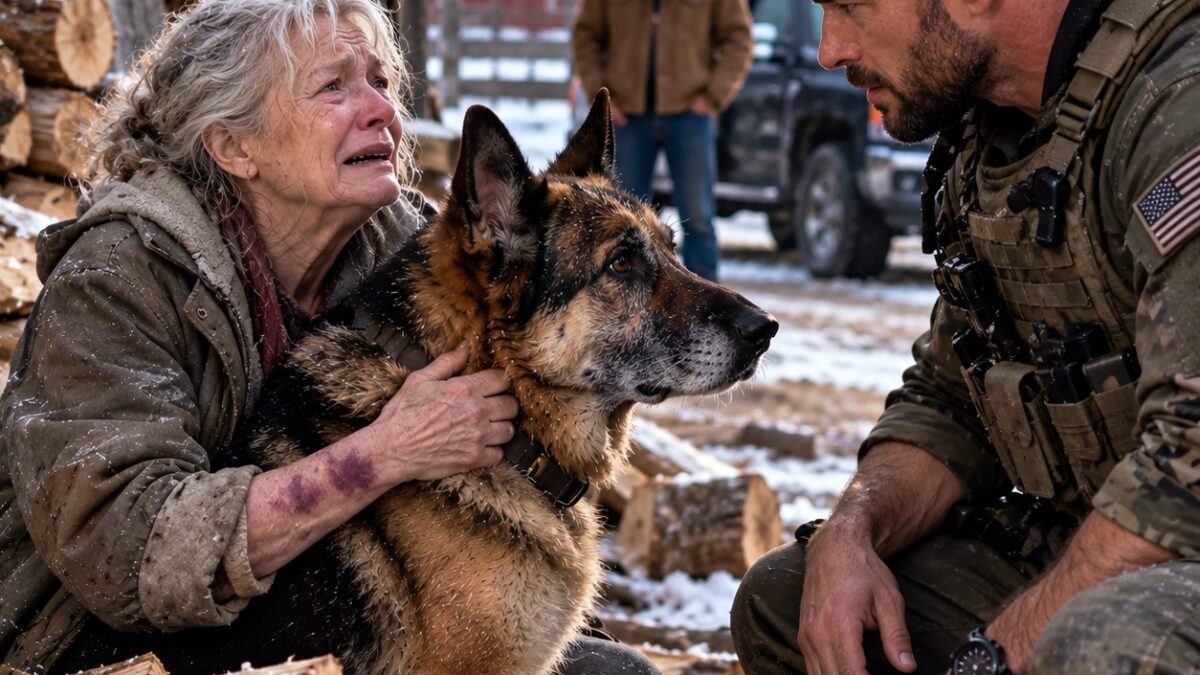
I wanted to ask about the bruises.
The cart.
The way she’d reacted to the engine.
But there were workers nearby.
And I’d spent enough years learning to recognize fear to know that questioning someone in front of the person they feared could make things worse.
So I picked up one of the buckets.
“Show me where you’re living.”
She started protesting.
“I can carry that.”
“I know.”
“Then why are you taking it?”
“Because I’m your son.”
She gave me the familiar look that used to stop me from tracking mud into the house.
“That excuse didn’t work when you were twelve.”
“It works better at forty.”
She laughed.
I held onto that sound.
Because I had a feeling I wasn’t going to hear much of it during the days ahead.
Mom lived in one of six small employee cottages near the northern edge of Silver Crown property.
The cottages were clean.
White siding.
Dark roofs.
Small porches.
Identical gravel driveways.
They looked respectable from the outside.
But they also looked temporary.
As though the people living inside them were permitted to stay only as long as someone else wanted them there.
Mom’s cottage had a narrow kitchen, a small living room, one bedroom, and a bathroom.
She’d arranged everything carefully.
A blue kettle sat on the stove.
A photograph of my father rested beside the window.
A quilt she’d made years earlier covered the sofa.
There were flowers in a glass jar on the table.
I recognized her in those details.
But I also noticed what wasn’t there.
The oak dining table my father built.
Her collection of books.
The cedar chest that had belonged to my grandmother.
The framed photographs that once filled the hallway of our family home.
“Where’s all your furniture?”
“Some of it went with the house.”
“Why?”
“Because I didn’t need everything.”
I set down my bag.
“Mom.”
She turned toward the kettle.
“Tea?”
“Why did you sell the house?”
“The roof needed replacing. Property taxes kept rising. Heating an old house is expensive.”
“Why didn’t you tell me?”
“I did.”
“You told me you were thinking about repairs.”
“I was.”
“That’s not the same thing.”
She stopped moving.
I regretted my tone immediately.
For thirteen years, I’d been coming home in fragments.
A week between assignments.
A holiday when schedules permitted.
A quick stop before leaving again.
During the last eighteen months, our calls had become especially brief.
She always said she was fine.
I always believed her.
Now I was standing in a cottage owned by her employer, asking questions I should have asked long ago.
Mom poured water into the kettle.
“I didn’t want you worrying.”
“That’s what sons do.”
“You have enough to worry about.”
“You’re my mother.”
She turned.
There was affection in her face.
And a boundary.
“I know who I am, Eli.”
I nodded slowly.
“Okay.”
She looked relieved.
For the moment, I let the subject rest.
But something inside me had already begun assembling a list of questions.
Where had the money from the house gone?
Why was she working so hard?
Why was she living on her employer’s property?
And who had grabbed her wrist?
That night, I slept on the sofa.
Rook settled on a rug near the front door.
Mom went to bed shortly after ten.
She looked exhausted.
I pretended not to notice.
At 3:17 in the morning, Rook stood.
I woke immediately.
He was facing the window.
Ears raised.
Body still.
Outside, an engine moved along the employee road.
I rose quietly and looked through the curtains.
A dark Silver Crown pickup rolled past the cottage at barely more than walking speed.
No emergency lights.
No headlights sweeping wildly.
Just a truck moving slowly through the darkness.
I might have dismissed it as an employee checking equipment.
Then I heard a sound behind me.
Mom stood in the kitchen doorway.
She wore her cardigan over her nightclothes.
A teacup rested in her hands.
The saucer rattled faintly.
She was staring at the truck.
Not surprised.
Afraid.
The vehicle continued past our window and disappeared between the trees.
Mom remained still.
“Mom?”
She flinched.
“It’s just one of the night crews.”
“At three in the morning?”
“They work odd hours.”
I looked at her.
She lowered her eyes.
“I couldn’t sleep.”
I could have pressed.
Could have demanded to know why she looked terrified.
Instead, I stepped away from the window.
“Want company?”
She shook her head.
“I’m fine.”
There it was again.
The sentence that had brought us to this point.
I’m fine.
She returned to her bedroom.
Rook followed.
He lay across the hallway outside her door.
His head rested between his paws.
He didn’t sleep immediately.
Neither did I.
I sat in the dark kitchen long after the truck disappeared.
An accident could explain bruises.
Age could explain exhaustion.
Financial pressure could explain selling a house.
But none of those things explained why my mother was afraid of headlights passing her window.
And Rook had noticed it before I did.
The next four days, I listened.
That wasn’t my natural instinct.
I wanted answers.
I wanted to find the man who’d hurt Mom and make sure he never touched her again.
But I’d spent enough time in difficult situations to know that acting too quickly could destroy the very thing you were trying to protect.
So I didn’t confront Silas.
I didn’t accuse his employees.
I didn’t wander around private farm buildings pretending my military background gave me permission to investigate whatever I wanted.
Instead, I walked through Alderwick with Rook.
I listened to people talk.
And I noticed what they stopped talking about.
The town looked prosperous.
The school had new aluminum bleachers.
The volunteer fire station displayed a polished rescue truck.
The public boat landing had been renovated.
A children’s playground stood near the community center.
Almost every new improvement carried the same name.
Harrow Family Foundation.
I saw it on plaques.
On signs.
On banners.
On donation boards.
Silas Harrow’s name was everywhere.
That didn’t prove he was doing anything wrong.
Plenty of wealthy people support the towns where they live.
But it raised a question.
How much of Alderwick depended on one man?
I found part of the answer at Finch’s Diner.
Carol Finch stood behind the counter when I walked in.
She was fifty-six, broad-shouldered, warm-faced, with auburn hair streaked gray and tied into a loose bun.
She’d been serving coffee in Alderwick for thirty years.
She recognized me immediately.
“Well, look what the wind dragged home.”
“Good morning, Carol.”
She set a mug in front of me.
“Still drink it like punishment?”
“Black.”
“That’s what I said.”
Rook settled beneath the stool.
Carol put down a bowl of water.
“Your partner looks smarter than you.”
“He encourages that rumor.”
She laughed.
We talked about the old days.
The lake.
The high school.
People I’d known who had moved away.
Then I asked how Alderwick had managed to stay prosperous when so many rural towns struggled.
Carol’s expression changed.
“Silas Harrow.”
I waited.
“Twelve years ago, Northern Valley Dairy shut down. Nearly two hundred jobs vanished.”
She wiped the counter.
“My brother lost his job. So did my husband.”
I nodded.
“I remember hearing about it.”
“It was worse than the newspapers said.”
She looked toward Main Street.
“Families started leaving. The hardware store nearly closed. Two farms went into foreclosure.”
Then Silas expanded Silver Crown.
He purchased struggling properties.
Added cattle operations.
Built distribution contracts.
Hired workers.
Provided housing.
Helped local businesses survive.
Carol’s gratitude was genuine.
“He kept this town from becoming another exit sign people drove past.”
I believed her.
“What does Silver Crown provide employees besides wages?”
“Housing for some. Transportation. Loans when people need help.”
“Loans?”
She stopped wiping the counter.
“Advances.”
“What kind?”
She gave me a careful smile.
“You’ve been home four days, and you’re already asking accountant questions.”
“Bad habit.”
“No, honey. Your bad habit used to be climbing Mr. Walker’s water tower.”
“That was once.”
“Three times.”
She moved toward another customer.
I let her go.
But I kept thinking about her answer.
Housing.
Transportation.
Loans.
If the same company supplied a worker’s paycheck, home, vehicle access, and emergency money, losing that job could mean losing everything at once.
That kind of dependence didn’t require locked gates.
It built its own fences.
Over the next few days, I noticed the pattern everywhere.
A Silver Crown van dropped six workers near the county market.
Several purchased work supplies through payroll deductions.
At the gas station, an older laborer joked that most of his paycheck took the scenic route back to Harrow before it reached his bank.
Then a Silver Crown truck entered the lot.
His smile disappeared.
He stopped talking.
Near the grocery store, Rook paused beside an elderly worker sitting on a bench.
The man held a folded pay envelope.
He was staring at a receipt.
His thumb moved over the same line repeatedly.
Rook approached quietly.
The man looked up.
Then scratched him beneath the chin.
“Good dog.”
His shoulders relaxed.
I stopped several feet away.
“Beautiful shepherd,” the man said.
“Thank you.”
He noticed me.
Immediately folded the receipt.
Stood too quickly.
Several coins fell from his pocket.
I crouched to help.
“No.”
The word came sharply.
I stopped.
He gathered the coins himself.
His face was red.
Then he tucked the pay envelope deep inside his coat and walked away.
I watched him disappear.
Rook looked up at me.
Nobody had made an accusation.
Nobody had confessed anything.
Yet I couldn’t forget how quickly the man had hidden a simple piece of paper.
Sometimes fear announced itself with a scream.
Sometimes it folded a receipt.
My first conversation with Nolan Pike happened outside a Silver Crown equipment shed.
I was returning Mom’s reading glasses.
He stepped from the loading area as I headed toward my truck.
Forty-six.
Thick chest.
Powerful forearms.
Dark hair graying near the ears.
A square face marked by years of outdoor work.
He wore a dark denim shirt with the sleeves rolled to his elbows.
His boots were covered in farm dust.
“You’re Margaret’s boy.”
“Eli Calder.”
“Nolan Pike.”
We shook hands.
His grip was firm.
Not aggressive.
But there was something guarded in his expression.
“Your mother talks about you.”
“Hopefully, selectively.”
A humorless smile touched his mouth.
“She works hard.”
“I’ve noticed.”
Something in my tone made him study me.
“Margaret likes keeping busy.”
“So she says.”
He shifted his weight.
“She gets curious, too.”
I remained still.
Nolan glanced toward the administration building.
“Good woman. But sometimes Margaret doesn’t know what’s her business and what isn’t.”
There it was.
Not quite a threat.
Almost advice.
“Does that cause trouble?” I asked.
“Only if people decide they want it to.”
His smile returned.
This time, I understood why it bothered me.
It looked like something he’d learned to wear for other people.
A worker called his name.
Nolan turned away.
I watched him go.
Rook didn’t growl.
Didn’t move forward.
But his eyes followed Nolan until he disappeared behind the barn.
I rested one hand on the dog’s collar.
“Yeah,” I murmured.
“I noticed him, too.”
That afternoon, I drove along a permitted farm access route near the cattle operation.
Rook walked beside me through an area open to visitors.
The air smelled of hay, dust, livestock, and freshly cut grass.
Beyond the main barns, a smaller storage building stood near an auxiliary feeding area.
Corrugated siding.
Padlocked doors.
Ventilation panels near the roof.
Nothing unusual.
Rook slowed.
Then stopped.
His nose lifted.
He sampled the air twice.
Walked several yards closer.
Then backed away.
I stopped beside him.
“What is it?”
He looked toward the building.
Not frightened.
Uncertain.
I followed his gaze.
A torn feed sack lay near a pallet.
A small amount of pale meal had spilled beside it.
Beyond the adjoining fence, several cattle stood near a water trough.
One animal shifted its weight repeatedly.
Its hind legs seemed briefly unstable.
Another remained lying down while the others moved toward fresh feed.
I knew enough about animals to recognize something might be wrong.
I didn’t know enough about cattle to decide what.
So I went to someone who did.
Dr. Rowan Bell operated a veterinary clinic near the eastern road out of Alderwick.
He was forty-four, lean, with sandy-brown hair, thoughtful eyes, and the patient manner of someone accustomed to patients who couldn’t tell him where they hurt.
When I mentioned Silver Crown, his expression became cautious.
“Cattle lie down, Eli.”
“I assumed that.”
“And sometimes they stumble.”
“I assumed that, too.”
He studied me.
“What exactly did you see?”
I described it.
The feed sack.
Rook’s reaction.
The animals.
No theories.
No accusations.
Just what I had observed.
Rowan listened.
Then asked, “Did you see what was inside the feed?”
“No.”
He removed his glasses.
Cleaned them slowly.
I watched him.
“You’ve seen something before.”
He didn’t answer immediately.
Then he opened the bottom drawer of a filing cabinet.
Removed a thick stack of veterinary records.
And placed them on the desk.
Different dates.
Different animals.
Similar symptoms.
Sudden fatigue.
Muscular tremors.
Irregular heartbeats.
Reduced appetite.
Across page after page, the same farm appeared.
Silver Crown.
Rowan rested both hands on his desk.
“Individually, none of this proves anything.”
I kept reading.
“Together?”
“Together, it bothers me.”
He explained that sick cattle could have countless causes.
Nutritional deficiencies.
Infections.
Contaminated feed.
Stress.
Genetic problems.
He’d recommended additional testing more than once.
But follow-up examinations had been difficult.
Some animals were moved.
Others sold.
Groups reportedly improved before he returned.
Nothing necessarily illegal.
Nothing conclusive.
“Could feed be responsible?” I asked.
“It could be fifty things.”
“That’s not an answer.”
“It’s the only responsible answer.”
I looked at him.
He didn’t flinch.
I respected that.
Rowan continued.
“If you’re asking whether this deserves investigation, yes.”
He paused.
“If you’re asking whether I can accuse Silver Crown of wrongdoing, no.”
I nodded.
“Fair enough.”
Then he gave me a warning.
“Don’t try to prove this yourself.”
I almost smiled.
“You’ve been talking to my mother?”
“No. I’ve just met enough capable men who assume being good at one difficult job makes them experts in every other difficult job.”
I laughed.
But the warning stayed with me.
Sheriff Mara Vance had been seventeen the last time I raced her across Alder Lake on borrowed skates.
She’d beaten me.
I still disputed that.
At thirty-eight, she ran the Alderwick Sheriff’s Office with the same stubborn confidence.
She was lean, athletic, with chestnut hair tied into a low ponytail and hazel eyes that missed very little.
When I entered, she looked up from a printer that appeared to be losing an argument with her.
“Well, Eli Calder.”
“Mara.”
“You look irritatingly healthy.”
“You still insult people before saying hello.”
“It saves time.”
Her eyes moved toward Rook.
He sat.
Mara crouched.
“You, I missed.”
Rook offered one paw.
I stared at him.
“Traitor.”
She scratched beneath his jaw.
“He remembers quality.”
Then she saw my expression.
“You didn’t come here to discuss my personality.”
“No.”
She led me into her office.
I told her what I’d observed.
Then explained what Rowan had shown me.
Mara listened without interrupting.
When I finished, she folded her hands.
“You have suspicions.”
“Yes.”
“You don’t have evidence that Silver Crown committed a crime.”
“I know.”
“Do you?”
I leaned back.
“Mara.”
“You’ve been gone a long time, Eli.”
She looked directly at me.
“You know how to gather intelligence. That doesn’t make you law enforcement here.”
“I understand.”
“No trespassing.”
“I know.”
“No intimidation.”
“Agreed.”
“No following people where you have no right to be.”
“Understood.”
She studied me.
Then nodded.
Only then did she open a drawer.
Inside was a thin folder.
Over several years, her office had received scattered complaints connected to Silver Crown.
Payroll deductions workers didn’t understand.
Disputes over employee housing.
Private advances that became difficult to repay.
Workers claiming they were threatened with eviction after employment disagreements.
Some complaints were withdrawn.
One man left town.
“Walter Keane,” Mara said.
I recognized the name.
He’d worked around Alderwick for years.
Repaired fences.
Helped neighbors with equipment.
A blunt man who didn’t waste words.
“He complained about payroll deductions,” Mara continued.
“Then about feed deliveries.”
“What happened?”
“He wouldn’t give enough detail for us to pursue it.”
She closed the folder.
“A month later, he moved west.”
I looked at her.
“Where?”
“I don’t know.”
Mara leaned forward.
“That’s why you need to be careful.”
I nodded.
She continued.
“People here are afraid of losing more than their paychecks.”
I thought about the old man hiding his receipt.
This time, I said nothing.
That evening, Mom made chicken soup.
Rain tapped softly against the cottage windows.
Rook slept near the table.
I helped cut bread.
On the refrigerator, a large paper calendar hung beside a grocery list.
At first, it looked ordinary.
Then I noticed several numbers written beside dates in small blue ink.
They didn’t correspond to appointments.
Some repeated.
Others appeared only once.
“What’s that?”
Mom glanced toward the calendar.
“Notes.”
“For what?”
“Things I need to remember.”
She kept slicing carrots.
I looked at her.
She didn’t look back.
Then headlights swept across the kitchen wall.
A vehicle parked outside one of the neighboring cottages.
A door slammed.
Mom flinched.
The pen she’d been holding slipped from her fingers and hit the floor.
Rook stood immediately.
He moved between her and the front door.
No barking.
No aggression.
Just his large body positioned protectively beside her.
I picked up the pen.
Set it on the table.
Then sat down.
I didn’t ask another question.
Minutes passed.
Rain whispered against the glass.
Mom remained standing at the counter.
Then she turned.
“Those numbers are feed lots.”
I looked up.
She reached toward the calendar.
Her finger stopped over the number nineteen.
“For weeks, I thought I was imagining things.”
Rook crossed the room.
Rested his chin against her thigh.
Mom stroked his head.
“I wish people were more like dogs.”
I almost smiled.
“How?”
“They notice when something is wrong before deciding whether noticing it will be inconvenient.”
I looked at her.
She took a breath.
And for the first time since I’d come home, my mother stopped trying to protect me from the truth.
Months earlier, Mom had been cleaning the Silver Crown administrative office.
A receiving ledger lay open on a desk.
She noticed one number beside a feed-lot entry.
It didn’t match an invoice she’d carried into the office earlier that morning.
At first, she assumed she remembered incorrectly.
She’d been tired.
The office was busy.
Numbers could be easy to confuse.
But then she noticed another discrepancy.
And another.
So she began writing lot numbers on her calendar.
Not because she thought she’d uncovered a crime.
Because she wanted to prove to herself she wasn’t becoming forgetful.
“Why didn’t you photograph the records?” I asked.
Mom gave me a tired look.
“Because I’m sixty-nine, Eli. I was cleaning an office, not conducting an operation.”
I lowered my eyes.
“Right.”
She continued.
One afternoon, Nolan Pike saw her looking at a receiving ledger.
She had written a number on a small grocery list.
He asked what she was doing.
She tried to explain.
He reached for the paper.
She instinctively held on.
Then he grabbed her wrist.
Hard.
Pulled the paper free.
And left the bruises I’d seen.
I stared at her.
“He did that?”
She nodded.
“He didn’t hit me.”
I felt my jaw tighten.
“That doesn’t make it acceptable.”
“I know.”
“What did he say?”
Mom looked away.
“He said I had a son serving far from home.”
Something cold moved through me.
Then she quoted him.
“Don’t turn a small thing into a big thing.”
For one brief second, I wanted nothing complicated.
No records.
No investigation.
No legal process.
Just Nolan Pike standing in front of me.
And the chance to make him understand exactly how wrong it was to threaten my mother.
Rook looked up.
His amber eyes held mine.
I exhaled.
Mom noticed.
“Don’t.”
“I haven’t moved.”
“I know that look.”
I stared at her.
“So did your father.”
“That’s not reassuring.”
“He had the same look when the lawn mower broke.”
I blinked.
“That seems disrespectful to my training.”
She almost laughed.
Then her face softened.
“Why didn’t you call me?” I asked.
She lowered herself into a chair.
Her eyes filled.
“You’ve spent your adult life going into dangerous places to bring people out.”
“That’s my job.”
“Yes.”
She looked down at her hands.
“And I didn’t want to become another dangerous place you had to come rescue.”
I couldn’t speak.
For years, I had believed calling home reassured my mother.
I’d never considered how carefully she might have constructed those conversations to reassure me.
“I told you I was fine,” she whispered.
“I know.”
“I wanted it to be true.”
I reached across the table.
Took her hand.
She squeezed mine.
“Come with me,” I said.
“Tomorrow. We’ll leave Alderwick for a while.”
She shook her head.
“No.”
“Mom—”
“There are people here who can’t leave.”
She began naming them.
Luis Ortega.
Edith Crane.
June Merritt.
Thomas Merritt.
Ben and Rachel Holloway.
People whose wages, housing, debts, and families depended on Silver Crown.
Then she mentioned Walter Keane.
“He tried to say something once.”
I looked up.
“You knew Walter?”
“Everyone knew Walter.”
“What did he say?”
“Not enough.”
Her voice broke.
“Then he left.”
I sat back.
Mom looked at me.
“If I leave because my son came home wearing combat boots, what happens to everyone whose son doesn’t?”
I had no answer.
For most of my life, protecting someone meant placing myself between them and danger.
My mother was asking for something harder.
Not rescue.
Respect.
I looked at her for a long time.
Then nodded.
“All right.”
Her shoulders relaxed.
“I won’t drag you away.”
“Thank you.”
“But I’m not ignoring this.”
“I didn’t ask you to.”
Rook settled between our chairs.
Mom rested her hand against his head.
Outside, the rain continued.
Nothing about our situation had become safer.
The farm was still there.
Nolan was still there.
Silas still controlled much of the town’s economy.
But something important had changed.
Fear had been spoken aloud.
And once fear had a name, it no longer owned the entire room.
Three mornings later, I met Mara and Dr. Rowan Bell near the public boat launch.
Fog lifted slowly from Alder Lake.
The air carried the first real chill of autumn.
We weren’t meeting because the lake mattered.
We were meeting because none of us wanted the conversation held inside Silver Crown, the sheriff’s office, or Rowan’s clinic.
Mara established the rules.
No trespassing.
No taking records that didn’t belong to us.
No hidden recording devices.
No treating suspicion as proof.
If a worker chose to speak, Mara could document the statement.
If Rowan was lawfully called to examine an animal, he could collect appropriate samples.
I could observe what any member of the public could legally observe.
Nothing more.
I understood why they both looked at me when Mara finished.
“I said I understand.”
She folded her arms.
“You also said that when we were seventeen and I told you not to jump off Miller’s Quarry.”
“Unrelated.”
“You jumped.”
“The water was deeper than expected.”
Rowan looked between us.
“I’m beginning to understand why Margaret worries.”
Rook sat beside me.
His expression suggested disappointment in everyone present.
I scratched behind his ears.
“Apparently, I’m outnumbered.”
Mara smiled.
“Good. Now we can begin.”
The following days were quieter than I’d expected.
There was no dramatic surveillance operation.
No breaking into buildings.
No secret cameras.
Just observation.
Dates.
Times.
Public roads.
Work patterns.
Truck movements.
Things seen from places where I had every right to stand.
Most observations meant nothing.
That was important.
You couldn’t identify something unusual unless you understood what normal looked like.
Mom continued working.
She carried lunches to workers who forgot to stop.
Remembered who liked sugar in their coffee.
Helped older employees with heavy boxes.
She knew which workers had sore backs.
Which ones were raising grandchildren.
Which families were struggling with medical bills.
And which people had learned to smile whenever a supervisor approached.
One afternoon, she asked me to help carry two insulated food containers toward the eastern cattle barn.
Rook accompanied us.
The sky was clear.
A north wind moved through tall grass along the fence.
A tractor hummed in the distance.
Nothing suggested danger.
We entered a covered passage beside an auxiliary feeding area.
Rook stopped.
I noticed immediately.
His head lowered toward a torn feed sack near a wooden pallet.
A small amount of pale meal had spilled through the damaged seam.
He sniffed once.
Twice.
Then pulled his head back and stepped away.
Mom frowned.
“He eats things I’ve dropped that I wouldn’t feed a raccoon.”
“That’s an exaggeration.”
Rook looked at me.
I reconsidered.
“Mostly.”
I didn’t let him approach the spilled feed again.
Instead, I looked through the rail toward the adjoining pen.
One steer stood apart from the others.
Its head hung lower than normal.
Another shifted unsteadily near the trough.
Mom followed my gaze.
“Something’s wrong.”
“Maybe.”
She identified the animals as part of a small contract herd temporarily boarded at Silver Crown.
The owner was Graham Tully, a local farmer recovering from hip surgery.
Mom called him.
Graham contacted Dr. Rowan Bell.
Forty minutes later, Rowan arrived with his veterinary bag.
He examined the sick animal.
Checked temperature.
Hydration.
Heart rate.
Observed its movement.
Then inspected the feed.
Only after receiving permission from the animal’s owner did he collect samples for testing.
I remained several yards away.
“What do you think?” I asked.
Rowan sealed the sample container.
“I think an animal is unwell.”
“That’s it?”
“For now.”
Then he looked toward the torn sack.
“But we finally have something useful.”
“What?”
“Something we can actually test.”
That evening, Mom brought me to a narrow office attached to the payroll building.
June Merritt was waiting.
She was twenty-seven, slender, with dark-blonde hair tucked behind one ear and pale blue eyes that kept moving toward the door.
She wore a cream sweater beneath a gray cardigan.
Her hands remained folded tightly in her lap.
“This is my son,” Mom said.
June gave her a look.
“I know who he is.”
I sat opposite her.
“You don’t have to tell me anything you don’t want to.”
She almost laughed.
“That sounds like what people say right before asking questions.”
“Then I won’t ask.”
I waited.
Silence did the work.
Eventually, June spoke.
“People think Silver Crown pays well.”
I remained quiet.
“On paper, sometimes it does.”
She explained the deductions.
Housing.
Utilities.
Transportation.
Tools.
Repayment on advances.
Service charges.
Interest.
Some were expected.
Others didn’t make sense.
“What service?” I asked.
She shook her head.
“That’s the problem.”
I leaned back.
She glanced toward the door again.
“My father still works here.”
Thomas Merritt was sixty-one, a maintenance mechanic with thinning gray-brown hair and permanently grease-stained fingertips.
He’d spent most of his life repairing pumps, tractors, and engines.
After June’s mother died from cancer six years earlier, Thomas had become quieter.
Silver Crown wasn’t just his employer.
It was the place that had paid his wages during the worst year of his life.
“If I lose my job,” June whispered, “he could lose his, too.”
I looked at her.
“You don’t owe me evidence.”
She narrowed her eyes.
“I thought that’s why you came.”
“No.”
“Then why?”
“Because my mother trusts you.”
June looked toward Mom.
I continued.
“No one gets to ask you to destroy your life just to prove they’re right.”
For the first time, her shoulders lowered.
Not completely.
But enough.
She didn’t hand me records.
Didn’t confess to anything.
Didn’t accuse Silas.
She simply whispered, “Some deductions don’t make sense.”
It wasn’t evidence yet.
But it was trust beginning.
As we left, June called after me.
“Mr. Calder.”
I turned.
“Does your dog ever decide someone is safe before you do?”
I looked down at Rook.
“Sometimes.”
June glanced through the glass partition.
Her father had just entered the hallway carrying a toolbox.
Rook approached him.
Thomas stopped.
Then slowly lowered his hand.
Rook sniffed it.
After a moment, the shepherd leaned his shoulder against Thomas’s leg.
The older man’s expression softened.
“My wife had a shepherd like you.”
He scratched behind Rook’s ear.
“Long time ago.”
June watched.
Her eyes filled.
Then she quickly looked away.
I understood then that her fear had a face.
It was walking down the hallway with a toolbox.
And sometimes courage didn’t begin when people stopped being afraid.
It began when they realized exactly what they were afraid of losing.
Two days passed without news from Rowan.
During that time, Mom and Rook developed a quiet routine.
He followed her around the cottage.
Rested where he could see both doors.
Walked beside her when she carried laundry.
One afternoon, a metal tray slipped from a shelf in the barn.
It struck the concrete floor with a violent clang.
Rook jerked upright.
For half a second, his entire body changed.
Muscles rigid.
Breathing shallow.
Eyes fixed on something nobody else could see.
I recognized it immediately.
A reaction to a sound associated with a bad memory.
Mom noticed, too.
She started toward him.
Then stopped.
Instead of grabbing his collar or forcing him to calm down, she sat on an overturned wooden crate several feet away.
She said nothing.
She waited.
A full minute passed.
Then another.
Slowly, Rook’s ears relaxed.
He looked toward her.
Mom didn’t call him.
Didn’t reach.
Didn’t command.
He crossed the distance himself.
Rested his head against her knee.
Only then did she touch him.
Her fingers moved gently through the fur below his ear.
I stood in the doorway watching.
Something tightened in my chest.
Maybe Rook had noticed my mother’s fear so quickly because fear wasn’t unfamiliar to him.
Maybe he’d recognized the way she flinched.
The way her breathing changed.
The way she tried to pretend nothing was wrong.
People often imagine courage means never being afraid.
I knew better.
Sometimes courage is recognizing that the loud sound behind you belongs to the present.
Not the past.
Mom bent her forehead toward Rook’s head.
For several seconds, neither moved.
They didn’t need words.
Rowan called just before sunset the following day.
I answered from the cottage porch.
“I have preliminary laboratory results.”
His voice held no triumph.
That told me enough.
“What did they find?”
“A compound associated with livestock weight gain.”
I looked toward the distant barns.
“Legal?”
“The compound has regulated uses in some contexts.”
He paused.
“What matters is the concentration and how it appears to have been used.”
“Meaning?”
“The preliminary result doesn’t match what should be present under the feeding program documented for that herd.”
I forced myself to remain calm.
“Does that prove Silver Crown deliberately did something?”
“No.”
His answer came immediately.
“It proves the sample deserves regulatory review.”
That distinction mattered.
Rowan had already contacted the appropriate state agricultural authority.
He’d submitted the laboratory findings through professional channels.
The matter was no longer only a veterinarian’s concern.
It had entered an official process.
Mom came onto the porch.
Rook followed.
I ended the call and looked toward Silver Crown’s red roofs glowing beneath the sunset.
For weeks, every answer had created another question.
Now one question had become unavoidable.
Not whether something unusual had happened.
But who knew.
And how long they’d known.
The first rumors spread before any official notice.
Someone saw a state vehicle near Rowan’s clinic.
Someone else heard samples had been sent to an outside laboratory.
By the end of the week, people whispered about Silver Crown in grocery aisles.
Then lowered their voices whenever the door opened.
Silas responded perfectly.
He behaved as though nothing was wrong.
At the town square, he stood beneath a banner for Alderwick Harvest Day.
He announced another donation to the volunteer fire department.
Promised funding for new youth baseball uniforms.
Smiled for photographs.
Remembered children’s names.
Asked old farmers about their health.
When someone mentioned a possible state review, Silas smiled.
“Silver Crown has always cooperated with regulators.”
He gave a small shrug.
“Good farms have nothing to fear from good oversight.”
It was a perfect answer.
No anger.
No defensiveness.
No threat.
I watched from across the street with Rook beside me.
That was what made Silas effective.
He didn’t ask Alderwick to choose between him and the truth.
He made people feel that questioning him meant questioning the hospital bill he’d once paid.
The fire truck he’d helped buy.
The job that kept someone’s family in town.
Gratitude had become insulation.
And Silas wore it well.
That evening, Mom stood at the kitchen sink long after the dishes were clean.
I sat at the table.
Rook slept beneath the window.
After several minutes, she spoke.
“I knew more than I admitted.”
I looked up.
She kept staring outside.
“Not everything.”
I waited.
“Not the feed. Not the testing.”
Her fingers tightened against the edge of the sink.
“But enough to know something wasn’t right.”
She remembered workers comparing paychecks and suddenly changing the subject when supervisors approached.
A man complaining about deductions who was transferred to harder work farther from town.
Animals being moved before scheduled veterinary follow-ups.
Questions left unanswered.
She’d noticed the pieces.
But she’d found reasons not to connect them.
“At least people still had jobs,” she whispered.
I recognized the sentence.
It sounded like something she’d repeated to herself for years.
I leaned forward.
“Because you were afraid?”
“Partly.”
She turned.
“And partly because it was convenient.”
The admission cost her.
“If I admitted the system was wrong, then I had to admit I was helping it stay quiet.”
I could have told her she wasn’t responsible.
Could have rushed to reassure her.
But some forgiveness becomes insulting when offered before the person has finished telling the truth.
So I simply said, “Then today you can do something different.”
Mom looked at me.
No speech followed.
No dramatic promise.
Just a decision.
The first person Mom invited to dinner was Luis Ortega.
He was fifty-seven, broad-shouldered, with warm brown skin and black hair silvering near the ears.
He was gentle by nature.
Apologized when chairs scraped.
Thanked Mom three times for stew.
He’d spent most of his life avoiding arguments.
After his daughter died in a highway accident, he became responsible for his twelve-year-old granddaughter, Sophia.
Every decision he made began with her.
“I can’t gamble with her roof,” he said quietly.
His Silver Crown wages looked respectable before deductions.
Then came rent.
Transportation.
A loan advance used for funeral expenses.
Interest.
Equipment charges.
He’d worked extra shifts for nearly three years.
His debt had barely changed.
“I thought I was bad with money.”
Mom looked at him.
“Why?”
“Because I couldn’t get ahead.”
His voice broke slightly.
“So I stopped asking questions.”
I felt something cold settle inside me.
That was how the system worked.
Each person believed the problem was personal failure.
Then Edith Crane came.
Sixty-three.
Thin.
Gray hair cropped short.
Sharp blue eyes.
A widow who had learned to repair faucets, negotiate bills, and tell men twice her size when they were wasting her time.
“I don’t scare easy,” she said.
Then she stared into her coffee.
“But I do calculate.”
Edith lived in a Silver Crown cottage.
If she lost her job, she believed she had thirty days to leave.
Her savings were limited.
The nearest affordable apartment she knew of was nearly an hour away.
“That isn’t fear,” she said.
“It’s arithmetic.”
Mom nodded.
Perhaps that was worse.
Soon the kitchen changed.
Not physically.
The same pale cabinets.
The same scarred wooden table.
The same curtains Mom had sewn.
But every few nights another chair appeared.
Then another.
Ben and Rachel Holloway came next.
Both thirty-one.
Seasonal workers.
Parents of a two-year-old boy who’d needed emergency surgery.
They’d taken a Silver Crown advance to cover expenses.
Neither understood why their repayment balance seemed to decrease so slowly.
Then Luis showed them his statements.
Edith brought her rental paperwork.
They began comparing terms.
Amounts.
Charges.
For the first time, they realized their problems weren’t necessarily isolated.
Halfway through the evening, Rook stood.
He walked slowly around the table.
Stopped beside Luis.
Then Edith.
Then Rachel.
Finally, he settled in the center of the room.
Six people sat around him.
Nobody spoke.
Then Mom looked down.
“Look at us.”
I followed her gaze.
“What?”
“We all thought we were alone.”
Luis gave a tired laugh.
“So did I.”
Edith looked across the table.
“That may have been the point.”
The words changed the room.
Not because they proved a criminal scheme.
Because everyone understood them.
A system didn’t have to silence an entire town at once.
It only needed each frightened person to believe nobody else was frightened.
Rook rested his head on his paws.
The conversation resumed.
Louder this time.
June Merritt arrived nearly a week later.
She waited until after dark.
Her father didn’t come.
She carried a thin manila folder.
“I’m not stealing company records.”
Mara, who’d joined us that evening, nodded.
“Good. I don’t want stolen records.”
June opened the folder.
Inside were copies of her own pay statements.
Documents she was legally entitled to retain.
She also had handwritten notes she’d made while trying to understand certain deductions.
No secret database.
No dramatic confession.
Just inconsistencies.
Service charges that changed without explanation.
Repayment amounts that didn’t match what she expected.
Different employees receiving differently labeled deductions for what appeared to be the same category.
Individually, the figures proved little.
Beside Luis’s statements, Edith’s paperwork, and the Holloways’ loan documents, they formed a pattern.
Mara began arranging separate interviews.
She made one rule clear.
“Nobody rehearses a story together.”
June nodded.
“Each person describes what happened to them.”
“Facts first,” Mara said.
“Interpretation later.”
For the first time in weeks, I felt something solid forming beneath our feet.
Not revenge.
Not a confrontation.
A record.
Around the same time, Dr. Rowan Bell’s veterinary findings reached the state.
An investigator named Clare Holloway arrived from the Minnesota Department of Agriculture.
She was forty-one, with dark eyes, straight black hair cut above her shoulders, and the steady manner of someone who had spent years examining complicated records.
She didn’t use dramatic language.
She never called an irregularity fraud before proving it.
Never called a violation intentional before establishing who knew what.
I respected her immediately.
Her first instruction was simple.
“Don’t give me conclusions.”
She looked around the room.
“Give me records, dates, and firsthand statements.”
That was exactly what Alderwick was beginning to provide.
Walter Keane was harder.
Mara eventually found him through his older sister in Montana.
I spoke with him by phone from Mom’s kitchen.
His voice was rougher than I remembered.
“So now people care.”
“They’re starting to.”
“That’s not the same thing.”
“No.”
My honesty seemed to surprise him.
Walter had worked at Silver Crown for years.
Before leaving, he’d photographed several feed deliveries because quantities recorded at arrival didn’t match figures later appearing in internal notes.
He’d kept copies of certain delivery documents provided to him through his work.
“Why didn’t you give them to the sheriff?”
“I tried talking first.”
His voice hardened.
“Then my hours changed.”
I waited.
“My rent changed.”
Another pause.
“People stopped sitting next to me at breakfast.”
I looked around Mom’s kitchen.
Walter continued.
“You ever watch an entire town decide you’re trouble because being your friend might cost them something?”
I swallowed.
“Yeah.”
He gave a bitter laugh.
“Didn’t think so.”
“I’m starting to understand.”
Silence followed.
Walter didn’t want to return.
He’d rebuilt his life elsewhere.
He didn’t owe Alderwick anything.
But when I told him Mom had spoken, then Luis, Edith, June, and others, his breathing changed.
“Margaret?”
“Yes.”
“That woman used to bring pie to every funeral in Alderwick.”
“She still probably would.”
Another long silence.
Then:
“I’ll send what I have directly to the investigator.”
“And an interview?”
“I’ll do one.”
It was enough.
Nolan Pike felt the ground shifting before anyone said it aloud.
Silas summoned him to the main office one afternoon.
Sunlight came through the windows.
Dust hung above an immaculate oak desk.
Silas stood looking toward the pasture.
“State people may ask questions.”
Nolan folded his arms.
“I know.”
“If they ask about barn operations, answer truthfully.”
Nolan frowned.
“What does that mean?”
Silas turned.
“You managed the barns.”
A cold weight settled behind Nolan’s ribs.
“And what happens there is your responsibility.”
The words were calm.
Administrative.
Almost reasonable.
That made them worse.
Nolan remembered the year his farm failed.
Two terrible seasons.
Foreclosure.
A business lost.
A life he could no longer afford.
Silas had offered him work when everyone else saw a man who’d lost everything.
For years, Nolan called that loyalty.
Now he wondered whether Silas had ever seen him as anything except someone who couldn’t afford to say no.
He left without answering.
In the maintenance shed, he stopped beneath a hanging work light.
His hands were stained with grease.
Strong hands.
Useful hands.
Hands that had repaired tractors and built fences.
Hands that had once held his daughter when she was small.
And hands that had grabbed Margaret Calder’s wrist because he’d been afraid of disappointing another man.
For the first time, Nolan didn’t ask whether Silas had gone too far.
He asked when he had.
And why it had taken him so long to notice.
Alderwick Harvest Day arrived beneath a clear September sky.
Maple trees along Main Street had turned copper and scarlet.
Small flags fluttered between lamp posts.
Pumpkins were stacked beside hay bales.
Children carried cups of cider.
Country music drifted from a temporary stage.
Smoke from grilled corn and sausages mixed with cinnamon.
For generations, Harvest Day had been Alderwick’s way of celebrating another year survived.
This year, the celebration carried something else.
Silver Crown banners hung above several booths.
Silas’s name appeared beneath the stage schedule.
On the fire department raffle sign.
Near the children’s pumpkin contest.
Nothing had been removed.
Nothing canceled.
To visitors, the town looked exactly as it always had.
Mom stood behind a folding table near the church lawn.
She was slicing blueberry pie.
Her silver-threaded hair was tied back.
She wore her familiar beige cardigan over a pale blue shirt.
She still looked thinner than I liked.
But something in her posture had changed.
She no longer seemed to be trying to take up less space.
Rook lay beneath the table.
His golden coat shone in the sunlight.
He watched Mom’s pie knife with intense concentration.
“You’re not getting any,” she told him.
He lifted his head.
“That expression won’t work.”
I stood beside her.
“Give him ten seconds.”
Mom sighed.
Then offered a tiny piece of crust.
I shook my head.
“You lasted twelve.”
“I’m a grandmother. We’re constitutionally weak against hungry faces.”
“He’s a German Shepherd.”
“He has a face.”
I laughed.
For a few seconds, everything felt ordinary.
I treasured that more than I expected.
Several miles away, state inspectors arrived at Silver Crown.
They carried signed administrative inspection authority and related legal paperwork permitting access to specified feed-storage areas and records.
No sirens.
No dramatic raid.
Workers weren’t ordered to the ground.
Operations didn’t stop all at once.
Investigators identified feed lots connected to the test results.
Collected additional samples.
Requested inventory records.
Isolated certain feed materials pending review.
A limited section of operations paused.
The rest of Silver Crown continued functioning.
That mattered.
Real investigations rarely resembled movies.
Sometimes a system began unraveling while tractors were still running.
Silas arrived at Harvest Day before noon.
He wore the same polished smile.
Ivory shirt.
Dark ranch jacket.
Hair perfectly arranged.
He shook hands.
Bought cider.
Congratulated a little girl whose pumpkin had been painted to resemble a cow.
If the state inspection concerned him, he didn’t show it.
Then he saw me.
He crossed the grass.
“Elias.”
“Silas.”
Rook raised his head but remained beneath Mom’s table.
Silas looked around.
“You know, when you were a boy, half these storefronts were empty by winter.”
I said nothing.
“Twelve years ago, they nearly became empty again.”
“I know.”
“I kept people here.”
“You did.”
That answer surprised him.
His shoulders relaxed slightly.
“Then perhaps you understand why I find all this difficult to appreciate.”
“All what?”
“You came home after years away.”
His expression cooled.
“Within weeks, people who’ve known me half their lives are suddenly treating Silver Crown like an enemy.”
I looked toward the school field.
Children were running between rows of carved pumpkins.
“I don’t think they needed me to tell them what happened to them.”
Silas’s smile disappeared.
“You think you understand this town?”
“No.”
He stopped.
I continued.
“You understand it better than I do.”
Silas folded his arms.
“Then perhaps leave its future to people who stayed.”
I met his eyes.
“You did help save Alderwick once.”
He remained silent.
“But saving a place once doesn’t mean you own it forever.”
His expression hardened.
Not dramatically.
Just enough.
Then he turned toward Mom.
“Margaret.”
She placed the pie knife down.
“Silas.”
“I’m disappointed.”
“In me?”
“In what this has become.”
His voice lowered.
“When you needed work, Silver Crown gave you work.”
Mom looked at him.
For a long moment, she said nothing.
Then she stepped around the table.
Rook stood.
I remained where I was.
This wasn’t my moment to occupy.
Mom faced Silas.
“You gave me a job.”
He nodded.
“And I gave you my time.”
He opened his mouth.
She continued.
“My mornings.”
Her voice was quiet.
“My hands. My back. My years.”
People nearby began slowing.
Listening.
“That exchange was settled every week I worked.”
Silas’s jaw tightened.
“You know this town would have suffered without Silver Crown.”
“I know.”
She looked directly at him.
“That doesn’t mean people should be afraid to ask where their wages went.”
A silence spread.
Mom continued.
“It doesn’t mean someone should worry that disagreeing with an employer will cost them the house they sleep in.”
Luis stopped near the cider stand.
Edith Crane turned from a craft booth.
June stood near the church steps beside her father.
Mom’s voice remained steady.
“And it doesn’t mean warning someone to stay quiet becomes acceptable simply because the warning sounds polite.”
For one strange second, nobody moved.
Then a little boy chasing a red paper windmill ran between us.
He stumbled.
The windmill fell.
Rook stepped forward.
Picked it gently from the grass.
And carried it back by the wooden stick.
The boy stared.
“Thank you, dog.”
A few adults laughed.
The tension eased just enough for everyone to breathe.
Rook sat beside Mom again.
She rested one hand against his neck.
The same wrist she’d hidden beneath her sleeve.
Now visible.
Steady.
Luis crossed the grass first.
He stood several feet behind Mom.
No speech.
No accusation.
Just presence.
Edith joined him.
Then June.
Thomas came beside his daughter, grease still dark beneath his fingernails despite his clean clothes.
Ben and Rachel Holloway appeared next.
Other Silver Crown workers followed.
Nobody shouted.
Nobody threatened Silas.
They simply stayed.
Silas looked at them.
For perhaps the first time in years, he was facing workers who no longer believed their fears belonged only to them.
Then Nolan Pike arrived.
He’d come directly from Silver Crown.
Dust covered his boots.
His face looked exhausted.
Silas saw him.
“Good.”
Nolan stopped.
Silas spoke carefully.
“I assume you’ve explained to the inspectors that barn operations fall under your management.”
I understood the meaning immediately.
So did Nolan.
A silence opened around them.
Nolan looked toward Mom.
She didn’t soften.
Didn’t rescue him from the consequences of what he’d done.
Then he looked toward Luis.
June.
Thomas.
Finally, Silas.
“You want me to say it was mine?”
Silas’s eyes narrowed.
“I want you to answer questions accurately.”
Nolan swallowed.
“I did what you told me to do.”
“Nolan.”
“No.”
The word surprised even him.
He took a breath.
Then another.
“I’m done.”
Silas stared.
Nolan turned toward Mara, who’d just approached after receiving an update from the state team.
“I need to give a statement.”
Mara didn’t react emotionally.
“Then we’ll arrange that properly.”
Nolan looked at Mom.
“I threatened you.”
She said nothing.
“I grabbed your wrist because I was scared you’d written down something I’d have to explain.”
His voice roughened.
“I’m not asking you to forgive me.”
Mom looked at him.
“Good.”
Nolan nodded.
The answer hurt.
It was supposed to.
Then he turned back toward Mara.
“I’ll tell them what I was instructed to do.”
He paused.
“And what I did myself.”
By late afternoon, state inspectors had expanded their work within the authority already granted.
Relevant feed lots remained isolated.
Additional samples were documented.
Records were secured for review.
Employees were scheduled for interviews.
A limited portion of operations remained suspended.
Silver Crown didn’t collapse.
Silas wasn’t arrested in front of the festival.
There were no handcuffs.
No crowd cheering.
No dramatic public humiliation.
There was only a process.
Slow.
Careful.
Difficult to reverse once enough people decided to tell the truth.
Silas left before sunset.
As he crossed toward his truck, he looked back at me.
For a moment, we held each other’s gaze.
I didn’t smile.
I hadn’t defeated him.
That wasn’t what had happened.
Behind me stood Mom.
Luis.
Edith.
June.
Thomas.
Workers who had spent years believing their fear belonged only to them.
That was what Silas was actually looking at.
A community discovering its own strength.
Rook turned away from him.
Walked to Mom.
Sat beside her leg.
She lowered one hand onto his thick fur.
The same hand that had trembled over a teacup.
The same wrist she’d hidden beneath a sleeve.
Now it rested in full view beneath the warm September sun.
And when a Silver Crown truck passed somewhere beyond the festival grounds, Mom didn’t look toward the road.
Winter arrived early that year.
By December, snow lined the county roads.
Alder Lake began freezing near the reeds.
Silver Crown’s red barns stood against the white fields.
The investigation hadn’t ended with Harvest Day.
In some ways, that afternoon had only begun it.
Over the following months, investigators compared payroll records, employee statements, rental agreements, repayment schedules, veterinary findings, shipping documents, and the materials Walter had preserved before leaving Minnesota.
No single page proved everything.
The story existed in accumulation.
A deduction here.
An altered figure there.
A shipment recorded one way at delivery and another later.
A worker transferred after complaining.
A feed lot whose documented program didn’t match laboratory findings.
A manager finally admitting which instructions he’d followed and which choices were his own.
The evidence didn’t become dramatic when laid beside itself.
It became difficult to deny.
Eventually, Silas Harrow faced charges connected to financial misconduct, livestock regulatory violations, and actions intended to pressure workers who questioned company practices.
The legal process moved slowly.
Hearings.
Attorneys.
Motions.
Arguments over responsibility.
Alderwick discovered that justice rarely arrives with the satisfying sound of a door slamming shut.
Mostly, it arrives in envelopes.
Certified mail.
Court dates.
Documents requiring signatures.
Strangely, I found that comforting.
A system built quietly over years deserved to be dismantled carefully enough that it couldn’t simply be rebuilt.
Nolan cooperated with investigators.
That didn’t erase what he’d done.
One cold morning, he came to Mom’s cottage before she moved out.
He stood on the porch wearing a heavy canvas coat.
His face looked tired.
Gray stubble covered his jaw.
Mom opened the door.
She didn’t invite him inside.
He understood.
“I gave them everything I know.”
“I heard.”
“They said it may matter.”
“It probably will.”
Nolan looked toward the snow.
“I don’t expect you to forgive me.”
Mom studied him.
Then said, “Doing the right thing today doesn’t erase what you did yesterday.”
He nodded.
“But,” she continued, “it’s still worth doing.”
He looked up.
There was no absolution in her face.
Only fairness.
For Nolan, that seemed harder to receive.
“Thank you.”
Mom closed the door gently after he left.
She didn’t watch him walk away.
Silver Crown began losing contracts.
Some buyers suspended purchases.
Others demanded independent reviews.
Credit tightened.
Business partners became cautious.
But the farm didn’t disappear.
Too many families depended on the land.
Too many animals needed care.
Too much of Alderwick’s economy had been built around those barns.
Closing everything would have punished many of the same people the investigation was supposed to protect.
So the transition became complicated.
Painfully complicated.
Months of negotiations.
Financial restructuring.
Sales.
Loans.
Settlements.
Some acreage went to neighboring farms.
The main livestock facilities attracted local producers and community investors interested in creating a cooperative.
Nothing was handed to workers for free.
There was no magical moment when everybody woke up owning a farm because justice had rearranged the paperwork overnight.
Investors had to be convinced.
Loans had to be approved.
Budgets had to work.
Some proposals failed.
Then one finally held together.
By spring, the sign at the front gate changed.
The polished crown emblem disappeared.
In its place stood a simpler wooden sign.
ALDERWICK FARM COOPERATIVE.
Luis Ortega became supervisor of the cattle barns.
The responsibility frightened him more than he admitted.
On his first morning, he walked the entire facility before sunrise and checked the feed storage twice.
I teased him about becoming management.
He shook his head.
“I spent too many years complaining about supervisors.”
He looked toward the barns.
“God has a sense of humor.”
June Merritt took charge of payroll.
She insisted every deduction be explained in plain language.
Every worker received written documentation before agreeing to advances or repayment terms.
Her father complained she used too much paper.
June told him that was rich coming from a man who saved old bolts in coffee cans because they might become useful in the year 2047.
Thomas didn’t deny it.
Edith Crane began helping with bookkeeping several afternoons a week.
She claimed younger people had forgotten how to add without a machine.
Nobody believed that was her only reason.
Dr. Rowan Bell helped establish new animal-health protocols and independent feed testing.
For the first time, workers could call a veterinarian without worrying that asking questions might cost them a shift.
The changes weren’t perfect.
There were arguments.
Expenses ran higher than expected.
A waterline burst during the first hard freeze.
Luis discovered that owning problems collectively didn’t make them smaller.
But the gate stayed open.
And workers no longer lowered their voices when discussing the people in charge.
Walter Keane returned in April.
His old silver pickup still had Montana plates.
He sat behind the wheel outside the cooperative for nearly five minutes before getting out.
Time away had sharpened him.
He was sixty now.
Lean.
Weathered.
Gray hair.
Short beard.
The same guarded expression of a man who’d learned how quickly a familiar place could decide he no longer belonged.
I met him near the gate.
He looked at the new sign.
“So that’s real.”
“Mostly.”
Walter snorted.
“Reassuring.”
He hadn’t come looking for work.
He didn’t want an apology from Alderwick.
He simply wanted to see what had happened to the place he’d once believed he had to flee.
Luis came from the barn.
Edith followed.
For a second, Walter looked ready to leave.
Then Mom appeared carrying a pie.
Walter stared at it.
“You still bribing people with blueberries?”
Mom smiled.
“Only difficult men.”
“Then you should have brought two.”
The old tension broke.
Not completely.
Healing rarely works that neatly.
But Walter stayed for coffee.
That was enough.
Later, he walked toward the cooperative gate.
Rook followed him.
Walter noticed after several steps.
“You checking whether I steal something?”
Rook kept walking.
Walter stopped beside the fence.
Beyond it, workers moved cattle between pens under a bright spring sky.
For years, Walter had remembered this place through one final image.
Himself driving away.
Nobody coming after him.
Now Rook sat beside his boot.
Walter looked down.
“I suppose you’re the one everybody talks about.”
Rook lifted his head.
Walter hesitated.
Then rested one hand between the shepherd’s ears.
His expression tightened.
“I wasn’t wrong,” he whispered.
I heard him from several yards away.
Walter swallowed.
“I just thought being alone meant I must be.”
Nobody answered.
There was nothing to correct.
Rook stayed beside him until he was ready to walk back.
Sometimes vindication doesn’t feel like victory.
Sometimes it simply means discovering that the loneliness lied.
Mom never returned to work at the farm.
Instead, she rented a narrow storefront beside Alderwick’s weekend market.
It had once been a florist shop.
The room still smelled faintly of wood and dried lavender.
I helped renovate it during the final weeks of my leave.
We installed a commercial oven.
Repaired shelves.
Painted walls.
Built a long wooden table.
Mom stood in the doorway watching me carry it inside.
“That table is too big.”
“There’s room.”
“Not for anything else.”
I set it down.
“Then we’ll find a use for it.”
She folded her arms.
“You inherited your father’s stubbornness.”
“Thank you.”
“That wasn’t a compliment.”
I smiled.
The following week, she invited enough people to prove I’d been right.
Wildflowers appeared in glass jars along the windows.
Blueberry pies cooled beside cinnamon bread.
Coffee seemed to be brewing at every hour.
Mom named the place The Open Table.
There was one rule.
Anyone could sit.
Nobody had to buy something first.
Children came after school.
Farm workers stopped for breakfast.
Widows sat beside young parents.
Walter occupied the same corner on Saturdays whenever he was in Minnesota.
Mom never reopened the bakery she’d once dreamed of owning.
The Open Table wasn’t really a bakery.
It was something different.
A place built around a belief she’d learned too late and intended to practice for the rest of her life.
Nobody should have to earn the right to belong at the table.
On my final morning before returning to my unit, I walked with Mom along Alder Lake.
Spring sunlight glittered across the water.
Birch leaves had returned in bright green.
Small purple flowers grew between the stones along the shore.
Rook ran ahead.
A flock of Canada geese grazed near the reeds.
My dog lowered himself into a stalking position.
I saw the intention immediately.
“Don’t.”
He ignored me.
Mom smiled.
“He’s thinking.”
“He’s never thinking when geese are involved.”
Rook crept closer.
One enormous goose raised its head.
Then charged.
Rook abandoned the mission with astonishing professionalism and sprinted back toward us.
Mom burst out laughing.
I looked at my dog.
“That’s your special operations partner?” she asked.
Rook stopped several yards away and pretended to inspect a tree.
I folded my arms.
“He’s courageous under very specific conditions.”
Mom laughed harder.
I found myself memorizing the sound.
For years, I’d heard her laugh through phone calls.
Short calls.
Scheduled calls.
Calls where she told me she was fine.
Now I was hearing it beside the lake where I’d grown up.
Real.
Unhurried.
Free.
We continued walking.
After a while, Mom spoke.
“You don’t have to protect me forever.”
I looked at her.
Her silver-streaked hair moved gently in the lake breeze.
There were still lines around her eyes.
Still memories she would carry.
Healing hadn’t returned her to the woman she’d been before everything happened.
It had created someone who knew what she could survive.
“I know how to stand on my own again,” she said.
I nodded.
“I know.”
That was all.
No promise I’d never leave.
No promise nothing bad would ever happen again.
Love isn’t the ability to guarantee another person’s safety.
Sometimes it’s trusting them with their own strength.
Later, I loaded my bag into the pickup.
Rook jumped into the passenger seat.
Across the valley, vehicles belonging to different farmers moved through the cooperative gate.
No single name ruled the entrance anymore.
At The Open Table, Mom stood beneath the wooden sign.
June carried coffee between tables.
Luis had somehow acquired flour across the front of his jacket.
Edith appeared to be explaining something to three children who clearly weren’t listening.
Walter sat in his usual corner with a cup of coffee.
I watched them.
Then I remembered my first day back.
The empty family house.
The employee cottage.
Mom pushing a cart that was too heavy for her.
Rook stopping beside her.
The bruises hidden beneath a sleeve.
At the time, I believed my dog had found someone who needed rescuing.
Now I understood it differently.
He had simply been the first living creature in a long while willing to stop and notice that my mother was afraid.
Dogs don’t understand contracts.
They don’t understand payroll systems.
Court hearings.
Regulatory authority.
They don’t know what it means when an entire town depends on one wealthy man.
But they understand trembling hands.
Changed breathing.
The way someone stops smiling when a vehicle approaches.
And sometimes, one creature refusing to ignore another creature’s fear is enough to make a human stop, too.
Then another.
And another.
Until silence is no longer the price of belonging.
I started the engine.
Rook looked once toward Mom.
Then faced forward.
Alderwick hadn’t become perfect.
It still had problems.
People still argued.
Bills still needed paying.
Winter still came whether anyone was ready or not.
But it had become a place where people could ask questions without first checking who was listening.
For me, that was enough.
I came home believing strength meant protecting the people I loved.
Mom taught me something harder.
Sometimes real strength isn’t standing in front of someone.
It’s standing beside them while they find the courage to stand for themselves.
I looked at The Open Table one last time.
Mom stood in the doorway.
She raised one hand.
The same wrist she’d once hidden beneath her cardigan.
Now uncovered.
Steady.
I waved back.
Rook settled beside me.
And as we drove away from Alderwick, I realized the greatest thing we’d accomplished wasn’t bringing down Silas Harrow’s control over the town.
It was helping people remember they had never been as powerless as fear had taught them to believe.
My mother no longer needed someone to rescue her from her life.
She had taken it back.
And this time, when I left home, I didn’t feel as though I was abandoning her.
I felt proud.
Proud of her.
Proud of the people who had spoken.
Proud of the neighbors who had stopped looking away.
And proud of the old German Shepherd who noticed the fear in my mother’s hands before I understood what it meant.
I reached across the seat and rested my hand against Rook’s shoulder.
“Good boy.”
His tail moved once.
Then he closed his eyes.
Outside, the lake disappeared behind the trees.
The road curved toward the mountains.
And for the first time in thirteen years, I wasn’t leaving Alderwick because duty had pulled me away from everything that mattered.
I was leaving knowing that the people I loved had found the strength to keep building something good without me standing guard.
That was a kind of peace I hadn’t known I was looking for.








