FULL STORY: “I Didn’t Invite You In,” She Whispered—“You Didn’t Lock the Door,” the Mafia Boss Replied
FULL STORY CONTINUATION
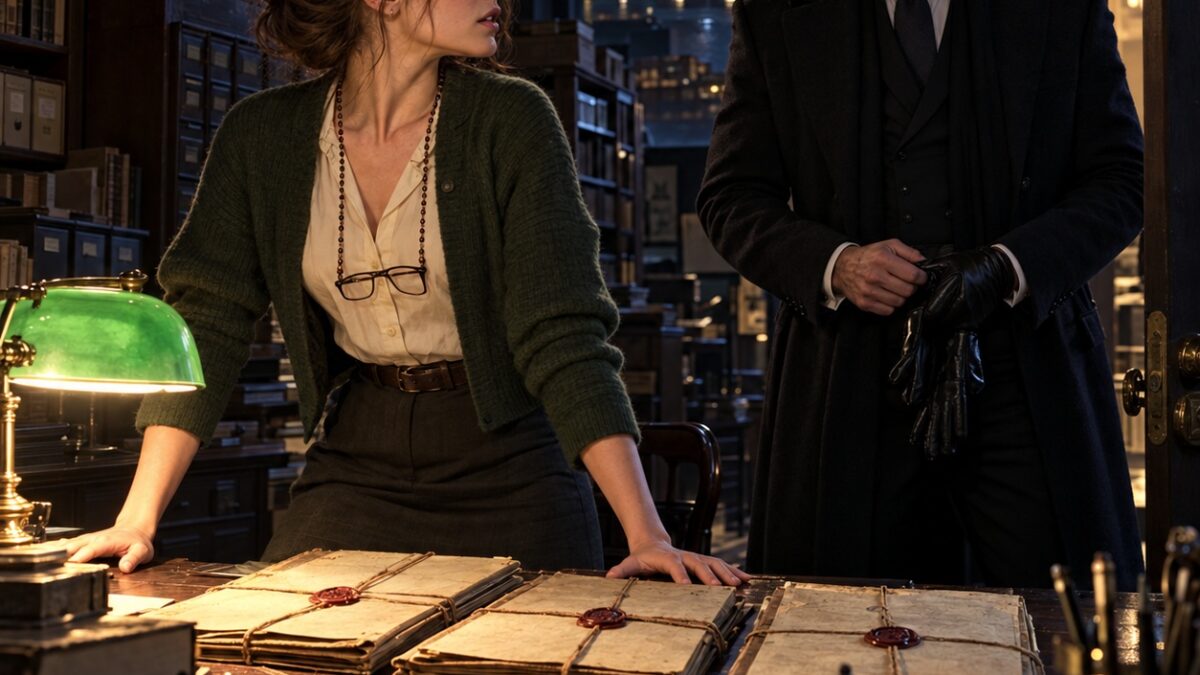
The next night, at exactly eleven-fifty, three perfectly spaced knocks sounded against the oak door.
I nearly dropped my pencil.
I knew who it was before I opened it.
Raphael stood in the hallway with both hands clasped politely in front of him like a man arriving for a formal interview.
Beside him stood a broad man in a leather jacket whose neck appeared approximately the same width as his head.
Raphael said gravely, “Miss Monroe. I knocked.”
“I heard.”
I stepped aside.
“You practiced.”
The big man’s eyes moved between us.
Raphael ignored him.
“This is Enzo Sartori.”
“He works with me.”
“I work for him,” Enzo corrected.
His voice sounded like gravel being poured into a steel bucket.
He examined my cardigan.
My glasses.
Thermos.
Acid-free folders.
Then Raphael.
“Boss.”
“Yes?”
“With respect.”
A pause.
“She is a librarian.”
“Archivist,” I corrected.
Enzo frowned.
“Difference?”
“About twenty thousand dollars a year and a master’s degree.”
Raphael turned his face toward the bookshelf.
His shoulders moved.
The most feared man in Pittsburgh was trying not to laugh at his own bodyguard.
That was the second unexpected thing I learned about him.
The first had been that he could back away when he frightened someone.
The second was that somewhere beneath all that discipline, Raphael Moretti possessed a sense of humor.
We opened the files properly.
Cotton gloves.
Bone spatula.
Documentation photographs.
Conservation mat.
Raphael touched nothing until I gave permission.
The first folder contained ledgers.
The second more ledgers.
The third held onion-skin correspondence covered in narrow handwriting.
Enzo lasted ten minutes.
Then he lifted a page.
“Forty cases artichokes. Sixty strawberries. Twelve blood oranges.”
He stared at me.
“Twelve hundred dollars a case.”
He dropped the page.
“Your banker liked fruit.”
I went still.
Raphael noticed.
“What?”
“Nobody pays twelve hundred dollars for artichokes.”
“Rich people are strange,” Enzo said.
“Not that strange.”
I pulled the ledger closer.
“And strawberries in January in Pittsburgh?”
Enzo shrugged.
“People eat strawberries in January.”
“Not wholesale shipments like this in 1998.”
I looked at dates.
Totals.
Quantities.
The old feeling came back.
Sitting on a stool in Nana Odessa’s grocery store.
Pencil behind my ear.
Watching her reconcile invoices.
My grandmother had run Monroe’s Market in Bloomfield for forty-one years.
She could tell when a distributor had shorted her by six slices of ham without opening the box.
She taught me bookkeeping before long division.
“Numbers don’t lie,” she used to say. “People do. But people who lie with numbers leave fingerprints.”
I began turning pages faster.
Raphael came closer.
I barely noticed.
“These aren’t grocery orders.”
Enzo leaned over.
“They say groceries.”
“They’re supposed to.”
My finger moved down a column.
“Look.”
Quantity.
Price.
Month.
Total.
Again.
Same pattern.
“The product names are people or companies.”
Raphael’s entire focus settled on me.
“The amounts are thousands with zeros removed.”
I turned another page.
“The quantities indicate months.”
Enzo pulled over a chair.
For the first time, he looked impressed.
I kept working.
Artichokes.
Strawberries.
Blood oranges.
Harbor Timber.
Shell accounts.
Transfers.
Then one repeated recipient.
J.
Nine thousand.
Twelve thousand.
Fifteen.
Month after month.
Year after year.
Until two weeks before Salvatore Moretti died.
One payment.
Fifty thousand dollars.
Beside it, Harold Ashworth had written four words in pencil.
ROADS NOT ROOTS. PAID IN FULL.
The room became silent.
Raphael pulled out the chair beside me.
Sat.
For a long time, he said nothing.
“My accountants had versions of these records.”
His voice was distant.
“Forensic specialists.”
I waited.
“Nobody found this.”
“They were reading what it said.”
He looked at me.
“Not what it meant.”
Something changed in his face.
Not attraction.
Not yet.
Recognition.
No man had ever looked at my mind that way.
My ex-fiancé Trevor once told me I had a pretty face if I tried harder with the rest of myself.
Three weeks before our wedding.
He had said it gently.
That was what hurt.
Like he was prescribing improvement.
He suggested postponing the wedding until I “found my best self.”
I handed him his ring.
Went upstairs.
Cried into a pillow.
Nana Odessa came in without knocking, sat beside me, and said:
“Delilah Jane, that boy wanted a wife the way some people want a sofa. You are too good a person to be furniture.”
Then she made grilled cheese at one in the morning.
I had stopped apologizing for my body after that.
Mostly.
Old damage doesn’t disappear simply because you understand it.
So when Raphael looked at me across that old ledger and asked:
“How did you see it?”
I didn’t know how to answer at first.
“Nana.”
“Your grandmother?”
“She ran a grocery store.”
I smiled awkwardly.
“She could find three missing cents in a month’s books.”
Raphael continued watching me.
“She said numbers show fingerprints.”
“That’s not boring.”
“I didn’t say it was exciting.”
“You called it boring.”
“It’s bookkeeping.”
“It found something my organization missed for eleven years.”
Behind him, Enzo pulled out another chair.
“All right.”
He sat heavily.
“Teach me ledger.”
I laughed.
That was how our nights began.
Not romantically.
With dead bankers.
Coded vegetables.
And Enzo developing a personal grudge against double-entry accounting.
Raphael came almost every night.
Sometimes Enzo came.
Sometimes Mateo Rossi drove him and waited downstairs.
Mateo was twenty-two.
Thin.
Restless.
Trying very hard to look older than he was.
One night I saw a GED prep book hidden beneath his driver’s seat.
The next evening, I handed him a newer one wrapped in brown paper.
He stared.
“What is this?”
“A weapon.”
“Against what?”
“Being embarrassed.”
His face reddened.
“I didn’t ask—”
“I know.”
I lowered my voice.
“People who worry this much about being stupid usually aren’t.”
He said nothing.
Raphael overheard.
Later, while we worked, he looked through the window at Mateo studying in the car.
“My father used to say things like that.”
I pretended not to notice his eyes shine.
I began bringing lemon shortbread.
Nana’s recipe.
Enzo ate one and made such a dramatic sound I nearly called Leonard for medical assistance.
Raphael stared suspiciously at the tin.
“It’s not poisoned.”
“You cannot know that.”
“I baked it.”
“That does not answer the question.”
Enzo took a second.
“Boss.”
“Yes?”
“If she poisons you with these, die happy.”
Raphael eventually tried one.
The next night, the tin was empty.
On my desk sat a jar of dark Sicilian honey.
Beside it:
For the next batch.
I kept that note in my cardigan pocket longer than any emotionally stable adult woman should admit.
Then I gave Raphael a library card.
He resisted.
“You’ve been here fourteen nights.”
“I am not a borrower.”
“You used our books.”
“For research.”
“Patron.”
“I am a guest.”
“Guests leave.”
His eyes stayed on mine.
Something shifted between us.
I looked down too quickly.
“Name.”
“You know it.”
“Occupation.”
“Businessman.”
I wrote consultant.
Raphael looked offended.
“Address.”
“No.”
“You cannot have a library card without an address.”
“I absolutely can.”
“Not in this building.”
He stared at me.
I stared back.
Finally I wrote:
No fixed address provided.
Then handed him the blue card.
He turned it over as if I had issued him diplomatic credentials.
For some reason, watching that dangerous man carefully slide a library card into the inner pocket of his coat near his heart nearly destroyed me.
I loaned him a battered book about Pittsburgh bridges.
He returned it four days later.
Two days early.
“Overdue fines are serious.”
“You investigated?”
“I prepare.”
“Terrifying.”
His mouth almost smiled.
The first time I realized Raphael was jealous, Professor Arthur Whitlock was asking me for coffee.
Arthur had been researching steel labor unions.
Tweed jacket.
Leather elbow patches.
Kind eyes.
He hovered beside my cart.
“I wondered whether you’d want coffee sometime.”
I felt myself blush.
“That might be—”
The temperature in the hallway seemed to drop.
Raphael stood at the far end.
Hands inside his coat pockets.
Expression perfectly blank.
Professor Whitlock noticed him.
Then remembered, quite suddenly, that he had an early lecture.
He left.
Without his hat.
I picked it up.
Looked at Raphael.
“What?”
“Nothing.”
“Were you glaring at him?”
“No.”
“He forgot his hat.”
“That sounds careless.”
“He asked me for coffee.”
“I heard.”
“Were you listening?”
“I was standing twenty feet away.”
“Were you jealous?”
Raphael considered that question as seriously as if I had asked him about a contract.
“I do not get jealous.”
“No?”
“I get informed.”
I laughed so hard the sound rang down the marble corridor.
Raphael stood there watching me.
Slowly, his mouth curved.
“Do not mock me, Miss Monroe.”
“I’m trying.”
“This is a serious condition.”
That morning, he walked me to the bus stop.
He claimed it was on his way.
It was not.
The street lamp had been broken for months.
We waited beneath darkness.
Four days later, the lamp worked.
A new bench appeared.
Then a rain shelter.
I never asked.
I knew.
A few nights later, I left the research room door open deliberately.
Raphael stopped at the threshold.
“No lock?”
I kept my eyes on the page.
“Thought I’d simplify your evening.”
He stared.
Then Raphael Moretti threw back his head and laughed.
Not the small almost-smile.
A real laugh.
Low.
Startled.
Warm.
Enzo stopped halfway down the hall.
Leonard looked up from his crossword.
And I sat beneath my green lamp thinking the most frightening thought I had experienced since meeting him.
I would do almost anything to hear that sound again.
The third week changed everything.
At the bottom of the second ledger, Harold Ashworth left another note:
For the key to J — C14F.
“C14F?”
Raphael repeated.
I already knew.
“Collection fourteen. Folder F.”
We went downstairs.
Ashworth boxes filled an entire shelving bay.
I pulled box fourteen.
Opened it.
A.
B.
C.
D.
E.
Then G.
My stomach dropped.
“F is missing.”
“You’re certain?”
“I cataloged this myself.”
I could picture the folder.
Brown leather journal.
Ribbon.
Thick.
“I remember it.”
Back upstairs, I checked the retrieval system.
One request.
Saturday morning.
One-fifteen.
Walter Hines’s staff account.
My deputy director.
I stared.
“That doesn’t make sense.”
Raphael stood behind me.
“Why?”
“Walter was in Tampa.”
“You know?”
“His niece’s wedding.”
I remembered photographs.
Cake.
Stone crab.
The groom’s mother crying underneath a gigantic hat.
“He was on a plane when this record says he removed the box.”
Raphael’s face sharpened.
“Someone used his credentials.”
“Yes.”
“And removed only F.”
“Yes.”
“Cameras?”
“Loading dock.”
Leonard pulled security video.
Ten-oh-eight that morning.
A man in a gray maintenance vest entered using a key card.
Fourteen minutes later, he emerged with something beneath his jacket.
The camera caught his face.
Raphael went completely still.
“Carmine Lupo.”
“Who?”
“Dominic’s driver.”
My skin went cold.
“Dominic Ferraro?”
Raphael did not answer.
I remembered a donor visit three days earlier.
Walter had summoned me in daylight.
A rare donor wanted to meet the archivist working the Ashworth collection.
White hair.
Tweed overcoat.
Kind voice.
Silver St. Jude medal.
He had asked about old notebooks.
Sentimental material.
Had seemed fascinated by my work.
I had liked him.
“Raphael.”
It was the first time I used his first name.
His head turned.
“I met Dominic.”
I told him.
Every question.
Every smile.
The notebook.
The medal.
Each detail landed like another blow.
When I finished, Raphael buttoned his coat.
Very carefully.
“Excuse me.”
Then walked out.
He didn’t return that night.
Or the next.
On the second night, Enzo came alone.
He looked ten years older.
“Boss is home.”
“Is he all right?”
“No.”
Enzo sat heavily.
“Dominic held him at baptism.”
I said nothing.
“Taught him to drive.”
Enzo looked at his hands.
“When Salvatore died, Raphael fell in the road.”
His voice roughened.
“Dominic held him up.”
I understood that kind of loss.
Not exactly.
But enough.
When Nana died eighteen months earlier, I spent three days unable to eat in her kitchen because making breakfast felt like agreeing she wasn’t coming back.
I warmed Leonard’s chicken-and-dumpling soup.
Wrapped it in a towel.
Put on my coat.
Enzo frowned.
“What are you doing?”
“Where does Raphael live?”
“Terrible idea.”
“Probably.”
“Delilah.”
“Where?”
Squirrel Hill.
Tall brick house.
Quiet street.
Mateo opened the door.
Saw the soup.
Let me in.
Raphael sat alone at a long table.
Tie undone.
Untouched whiskey.
Old photograph beside him.
Salvatore and Dominic laughing on a boat.
“You shouldn’t be here.”
“I know.”
I set down the soup.
“Eat.”
His eyes lifted.
“Delilah.”
“Chicken and dumplings.”
“I am not hungry.”
“Nana’s recipe cures grief, influenza, weather-related sadness, and most male stupidity.”
His mouth twitched.
“Stubbornness?”
“Second bowl.”
I sat beside him.
He eventually picked up the spoon.
Three bites later, he stopped.
Pressed his wrist against his eyes.
“I was twenty-five.”
I waited.
“My father called me.”
His voice dropped.
“Said to meet him at the chapel.”
A pause.
“We had argued.”
“What about?”
“I don’t remember.”
That hurt more.
“I took my time.”
His hands trembled.
“When I arrived, he was already in the car.”
I reached across the table.
“He had his rosary.”
Raphael swallowed.
“Dominic reached him before the ambulance.”
His face broke.
“He held me in the road.”
I covered his hand.
“And he said, ‘I’m here.’”
Raphael’s eyes closed.
“Again and again.”
Silence.
“For eleven years, I believed him.”
I held on.
“My parents died when I was nine.”
Raphael opened his eyes.
“Icy road.”
I looked down.
“Nana raised me.”
My throat tightened.
“When she died, I sat in her kitchen and couldn’t eat because it felt like eating meant accepting it.”
He turned his hand beneath mine.
“I don’t mean it’s the same.”
“No.”
“I mean grief makes the whole world feel dishonest for a while.”
His fingers closed around mine.
“It makes you feel alone.”
I squeezed.
“You’re not.”
We sat like that.
Eventually Raphael whispered:
“I don’t know what you’ve done to me, Delilah Monroe.”
“I brought soup.”
“That is not what I meant.”
“I know.”
Near two in the morning, he told me the plan.
No accusation yet.
They needed proof.
The notebook.
Carmine.
Something no old capo could dismiss as Raphael acting out of grief.
Then his face hardened.
“You can’t go home.”
I blinked.
“Excuse me?”
“Dominic knows you.”
“So?”
“He knows you decoded the records.”
“I noticed.”
“I have a property in Fox Chapel.”
“No.”
“Gate. Staff.”
“No.”
“I’ll put men—”
“No.”
Raphael became very still.
I stood.
“I’ve lived in Nana’s house twenty years.”
“Delilah—”
“I know every stairboard that creaks.”
“This isn’t about sentiment.”
“I know which stove burner sticks.”
“You could die there.”
“And I could die crossing Penn Avenue.”
His jaw tightened.
“You don’t decide where I live because you’re afraid.”
The sentence landed hard.
I kept going.
“I will accept precautions.”
“Good.”
“I will not be moved like a chess piece.”
“Delilah.”
“If I let someone move me once because fear tells them they know better, I’ll spend my whole life being moved.”
Silence.
I braced.
Trevor had always treated disagreement as proof I needed guidance.
I knew men who hated being told no.
Raphael had built his life around not hearing it.
He sat still.
Then breathed out.
“You’re right.”
I stared.
He looked up.
“I don’t want to own your choices.”
His voice softened.
“I want you alive.”
A pause.
“I may need practice understanding where those things differ.”
I felt something inside me release.
“I’ll help you practice.”
At seven the next morning, somebody knocked on Nana’s front door.
I opened it in a bathrobe.
Raphael stood outside with a toolbox.
Behind him, a locksmith.
“I am not moving you.”
I looked at the toolbox.
“I am not assigning guards to follow you.”
The locksmith stared at his shoes.
“I am putting better locks on your door.”
Raphael held out three brass keys.
“You keep all of them.”
I began laughing.
He looked offended.
“You’re installing them?”
“Yes.”
“Personally?”
“One.”
The locksmith cleared his throat.
Raphael spent forty minutes trying to install one deadbolt.
Dropped a screw.
Swore in Italian.
Apologized to Nana Odessa’s portrait.
He studied her stern face.
“She looks like she would’ve thrown me out.”
“She would’ve fed you first.”
He nodded.
“Then thrown me out.”
“Yes.”
“That seems fair.”
The deadbolt ended slightly crooked.
I loved it.
Matteo volunteered to drive me.
Not guard.
Drive.
He wanted help studying geometry.
I allowed it.
Monday morning, I waited in Walter Hines’s office.
Seven o’clock.
Retrieval log on his desk.
“How was Tampa?”
His ironed smile disappeared.
He confessed in under two minutes.
Casino debt.
Carmine Lupo.
First they wanted his username and password.
Then another favor.
Then another.
Eventually somebody appeared outside his daughter’s school.
Walter cried.
I wanted to hate him.
He had handed criminals access.
He had smiled while giving me the Ashworth boxes.
But fear has a recognizable face.
I’d seen it in donors.
In brides.
In myself.
“You go to the board today.”
He nodded.
“You tell everything.”
“Yes.”
“I’ll tell them you were coerced.”
“Delilah—”
“But you repay whatever they decide you owe.”
He covered his face.
“Yes.”
That night, an envelope waited on my research table.
Cream paper.
My name handwritten.
Inside:
My dear Miss Monroe,
I have always had a weakness for clever young people. Perhaps we might discuss Harold’s notebook quietly between friends. There is no need to trouble Raphael.
Yours sincerely,
D. F.
I read it twice.
Then sat beneath the green lamp.
The door was closed.
I didn’t lock it.
Raphael read the note the next night.
“No.”
“I haven’t proposed anything.”
“No.”
“He wants to meet.”
“Absolutely not.”
“If I refuse, Carmine comes.”
“I don’t care.”
“I do.”
“Delilah.”
“We need his confession.”
“We need you breathing.”
“You said your people need proof.”
His jaw tightened.
“I am the only person Dominic thinks is harmless.”
“You are the least harmless person I have ever met.”
That made me smile despite everything.
“Then let him keep making that mistake.”
Raphael argued until nearly dawn.
Eventually, he did something more difficult than giving an order.
He trusted me.
Friday.
Midnight.
Research room.
Enzo and three older men who had served Salvatore would listen from the adjoining room.
Matteo outside.
Leonard downstairs.
The ledgers hidden elsewhere.
Me at the table.
Tea waiting.
It would’ve been a good plan if Dominic had respected appointment times.
He arrived at nine-forty.
More than two hours early.
By the time Raphael received Matteo’s warning and raced toward the library, Dominic was already inside.
I was in the basement.
I heard the iron stairs.
Looked up.
Dominic stood below them.
Tweed coat.
White hair.
St. Jude medal.
Behind him stood Carmine Lupo.
One hand inside his jacket.
The other gripping Leonard’s collar.
Leonard’s lip was bleeding.
His glasses were gone.
He looked furious.
“Miss Monroe.”
Dominic smiled.
“So sorry for the theatrics.”
“Let Leonard go.”
“Soon.”
“He has a bad knee.”
Leonard muttered something unprintable.
Dominic walked between shelves.
“I want the ledgers.”
“No.”
“Your notes.”
“No.”
“You will take me to them.”
The warm-uncle voice disappeared.
“Or Carmine will ask Mr. Boyce.”
I looked at Dominic.
And suddenly I wasn’t frightened.
I pitied him.
“You loved Salvatore.”
His fingers stopped against a box.
“What?”
“You loved him.”
Dominic turned slowly.
“You held his son in the road after he died.”
His face changed.
“I don’t understand how you did that.”
“Delilah,” Leonard warned.
But I kept speaking.
“How do you betray someone and then carry his child through the grief you caused?”
Dominic’s face crumpled.
Only slightly.
“He was going to ruin me.”
There it was.
“He discovered the union money.”
His voice went thin.
“I took small amounts.”
“How much?”
“It grew.”
“Salvatore knew.”
“He told me to confess.”
Dominic laughed once.
Broken.
“In front of everyone.”
“He was giving you a chance.”
“He was humiliating me.”
“The Branigans?”
Dominic looked away.
“They promised only to frighten him.”
I closed my eyes.
“They needed his route.”
“Yes.”
“And you gave it.”
“I never meant him to die.”
“I believe you.”
Dominic stared.
I stepped closer.
“You’ve been carrying it eleven years.”
Tears filled his eyes.
“You can stop.”
I held out my hand.
“Put it down.”
Carmine shifted behind him.
Dominic nearly reached toward me.
Then fear hardened his face.
He pulled a pistol.
Pressed it against my temple.
Cold metal.
“I’m sorry.”
Leonard swore.
Dominic’s hand shook.
“I’m so sorry, my dear.”
Then a voice came from the staircase.
“It isn’t too late.”
Raphael.
He stood below us.
Gun pointed at Dominic.
Behind him:
Enzo.
Matteo.
Three gray-haired men from Salvatore’s old circle.
They had heard enough.
Raphael’s face was ice.
“Let her go.”
Dominic pressed the weapon harder against my skin.
“Put yours down.”
“Dominic.”
“I will do it.”
Three seconds.
I remember all three.
Raphael looked at me.
Eleven years.
His father.
The truth.
The man responsible.
The clean shot.
Everything he had wanted since he was twenty-five.
Then he lowered his gun.
Bent.
Placed it on the stone floor.
Raised his empty hands.
“Take the ledgers.”
Nobody moved.
“Take the money.”
His voice did not shake.
“Take every street I’ve ever controlled.”
One of the old men inhaled sharply.
“I don’t care.”
Raphael looked at me.
“But you will not touch her.”
Dominic’s body jerked.
That was when he understood.
Raphael Moretti had thrown away eleven years of revenge without hesitating.
For me.
The gun trembled against my temple.
I reached up.
Very slowly.
Put my hand around Dominic’s wrist.
“Look at me.”
His breath came ragged.
“Dominic.”
He looked.
“Now look at Raphael.”
He did.
“That is Salvatore’s son.”
Dominic began crying.
“He just did what his father would’ve done.”
His hand weakened.
“Don’t make him watch another person die.”
A broken sound escaped Dominic.
The pistol fell.
Enzo caught it before it hit the floor.
Matteo went for Carmine.
Carmine raised both hands and dropped to his knees.
Like a man relieved someone finally told him he could stop.
Raphael crossed the room.
Pulled me against him.
Hard.
His heart hammered against my ear.
“You are never doing that again.”
His voice shook.
“Do you understand?”
“Raphael.”
“Never.”
“I’m okay.”
“Do you understand me?”
I held him.
“I understand.”
His face pressed into my hair.
He was crying.
Silently.
So was I.
Behind us, Bruno Gallo—one of Salvatore’s oldest capos—looked at Dominic.
“We heard everything.”
Dominic stood alone.
“Salvatore’s chair is waiting.”
Raphael never released me.
“No one touches him tonight.”
Every man looked toward him.
“The family judges him in front of my father’s chair.”
His voice steadied.
“He answers to everyone he betrayed.”
That was the end of it.
Not the emotional end.
But the violent one.
Leonard sat on an overturned archive box with a handkerchief pressed to his lip.
I ran to him.
He opened his arms.
I cried into his shoulder.
“I’m fine.”
He patted me.
“I’ve been hit harder at Edgar Thomson.”
Then he looked over my head.
“And tell your boyfriend he knocks next time.”
“He is not—”
Raphael said from behind me:
“I will.”
Leonard grunted.
Dominic lost everything.
The stolen money went to families of men who had died because of his choices.
Carmine cooperated.
The Branigan operation collapsed under its own secrets once enough people started talking.
Walter resigned.
Repaid what he could.
Dominic disappeared from Pittsburgh permanently.
I never asked where.
Some answers do not improve a life by being known.
Dawn found Raphael and me on the library steps.
Police cars rolled away.
Pittsburgh’s hills turned pink.
The river below us became silver.
I wore a blanket.
And Raphael’s coat over it.
My body had finally started shaking.
“You touched his wrist.”
Raphael sounded furious again.
“He had a gun against your head and you touched him.”
“He was frightened.”
“He was about to shoot you.”
“Frightened people do terrible things.”
I looked at him.
“Sometimes kindness is the only thing they don’t expect.”
My lips trembled.
“It’s a boring superpower.”
“It is the opposite of boring.”
His voice broke.
Then his fingers touched my cheek.
Carefully.
“I put down my weapon for you.”
I leaned into his hand.
“In front of men who served my father.”
“I know.”
“I surrendered eleven years.”
He swallowed.
“Do you know why?”
I couldn’t answer.
“Because I looked into that room and realized there was exactly one thing in it I could not live without.”
Tears filled my eyes.
“And it was not revenge.”
Nobody had ever chosen me first.
Not like that.
Not Trevor.
Not my mother, who left.
Life had loved me through Nana, through friends, through routines and soup containers.
But being someone’s first choice?
I had never known it.
Raphael kissed me.
Slowly.
Like he was afraid I might vanish.
I rose onto my toes and kissed him back with every quiet night that had led us there.
The shortbread.
The library card.
The unlocked door.
When we separated, he rested his forehead against mine.
“You asked me not to control your choices.”
“Yes.”
“I won’t.”
I waited.
“You will work where you want.”
“Yes.”
“Live where you want.”
“Yes.”
“Tell me no whenever necessary.”
“Often.”
His mouth almost smiled.
“But understand something.”
“What?”
“Anyone trying to reach you goes through me.”
“Raphael.”
“I am not moving you.”
“Good.”
“I am simply pointing out that I am a much longer hallway than most men expect.”
I laughed into his coat.
Two weeks later, Raphael invited me to Sunday dinner.
“With my family.”
I nearly dropped the phone.
“Your actual family?”
“Yes.”
“The people who know what you do?”
“Yes.”
“Why?”
Silence.
“Because I’m tired of entering your life through unlocked doors.”
That sounded suspiciously meaningful.
“What does that mean?”
“Dinner.”
“Coward.”
“I’ll pick you up at six.”
On the ride, Raphael seemed nervous.
Raphael.
The man who had faced a gun without blinking.
He kept adjusting his cuff.
“What are you doing?”
“Nothing.”
“Your cuff has been adjusted six times.”
“I prefer symmetry.”
“You’re nervous.”
“No.”
“Jealous men get informed and nervous men get symmetrical?”
“Something like that.”
We reached Julia Moretti’s house.
Stone.
Warm windows.
Smell of garlic reaching the driveway.
Before Raphael could knock, the front door opened.
A small round woman with iron-gray hair and a flowered apron stared at me.
Her hands flew to her chest.
“Finally.”
Raphael closed his eyes.
“Ma.”
“You said she was nice.”
Julia grabbed my hands.
“You did not say beautiful.”
My throat closed unexpectedly.
“Come.”
She kissed both my cheeks.
“You are too thin.”
“Ma.”
“I am not thin.”
Julia waved him away.
“She will eat anyway.”
She smelled like flour.
Garlic.
A warm kitchen.
Nana.
I almost cried before reaching the dining room.
There were twenty-two people.
Enzo.
Matteo.
Leonard, somehow.
Tessa, who had been invited without my knowledge and looked delighted.
Older men.
Children.
Cousins.
People who had feared Salvatore, loved him, followed Raphael, and survived the fracture Dominic caused.
I sat beside Raphael.
Under the table, his hand found mine.
After dinner, he stood.
The room went silent.
“I wrote something.”
I whispered, “You wrote a speech?”
“Yes.”
“How many?”
“Several.”
I stared.
“This is the shortest.”
“You are unbelievable.”
Raphael faced the table.
“Eleven years ago, my father sat here.”
No one moved.
“When he died, I believed we lost a man.”
His voice was steady.
“We lost more.”
He looked around.
“We lost our trust.”
Then his eyes found me.
“A woman entered my life through an unlocked door.”
Enzo began smiling.
“She told me I was rude.”
A child giggled.
“She read handwriting everyone else ignored.”
Raphael held out his hand.
“She gave me back the truth about my father.”
I placed my hand in his.
“She stood in front of a gun and stopped a murder without firing one.”
My face grew hot.
“She did none of it because I paid her.”
He squeezed my fingers.
“Or because I ordered her.”
His eyes softened.
“She did it because she believed it was right.”
Raphael drew a breath.
“This is Delilah Monroe.”
The room seemed to tilt.
“She is under my protection.”
I opened my mouth.
“And before she objects—”
Enzo laughed.
“—that protection does not mean ownership.”
He looked at me.
“She taught me that distinction.”
I shut my mouth.
Barely.
“She is family.”
My eyes burned.
“Anyone who does not treat her as such will answer to me.”
Then:
“And if she tells any of you no, listen to her.”
His mouth curved.
“She generally has better judgment than I do.”
Julia burst into tears.
Enzo blew his nose like a trumpet.
Matteo cheered.
Tessa slapped both hands over her mouth.
People stood.
Glasses rose.
I could not breathe.
My whole life, I had been the woman people looked past.
The heavy girl in the cardigan.
The person holding coats.
The archivist in the basement.
The fiancée someone wanted redesigned before marriage.
Now twenty-two people looked directly at me.
Not through me.
At me.
Raphael bent toward my ear.
“You can still say no.”
I laughed through tears.
“To what?”
“Any of this.”
“You have to stop reminding me.”
“I mean it.”
“I know.”
“That is the point.”
I took his face in both hands.
Kissed him in front of everyone.
Julia cried harder.
When we separated, I whispered:
“Sit down.”
“Why?”
“Your mother is crying into the gravy.”
Life after that became strangely ordinary.
Which was exactly what I wanted.
I kept my job.
Nobody asked me to stop.
Raphael never suggested I should.
Leonard got a raise.
Tessa eventually started dating a quiet cellist who came to Friday coffee and somehow survived her opinions.
Matteo passed his GED in March.
He cried.
Denied it.
Then cried again when I baked him a graduation cake shaped like a diploma.
Enzo became dangerously enthusiastic about lemon shortbread.
Raphael continued borrowing books.
Always returned them early.
Overdue fines remained, according to him, “a matter of honor.”
Most nights, around eleven-fifty, a black car appeared by the loading entrance.
Footsteps climbed the marble stairs.
A dark coat entered my hallway.
Sometimes carrying Sicilian honey.
Sometimes a finished book.
Sometimes nothing.
He still knocked.
Always.
Even when the door was open.
Especially when the door was open.
On the final night of the Ashworth project, snow fell over Pittsburgh.
The last folder had been cataloged.
Last box shelved.
Every discovery documented.
The old oak table was empty except for my tea.
I had hung a little brass bell above the research-room door.
The same kind Nana Odessa once kept above Monroe’s Market.
I heard Raphael’s footsteps before he reached me.
Steady.
Measured.
Familiar.
They stopped outside.
I didn’t turn immediately.
I wanted to enjoy the moment.
The way you sit with the final sentence of a book you aren’t ready to close.
Then I looked up.
Raphael stood on the threshold.
Snow melting across his coat.
His face no longer looked like a locked door to me.
Not because the lock was gone.
Because somewhere along the way, he had given me a key without either of us noticing.
I smiled.
“Did you lock the door?”
His eyes warmed.
“No.”
The brass bell above him stayed silent.
He had learned how to open my door gently enough not to disturb it.
I looked at the chair across from mine.
The same chair beside the same old table.
“Good.”
Raphael waited.
He always waited now.
Not because he needed permission from the world.
Because he understood that he needed mine.
I gestured toward the chair.
“Come in.”
He crossed the threshold.
No hesitation.
And I thought about that first midnight when I had stood between him and three forgotten files, convinced the greatest danger in the room was the man in the dark coat.
I had been wrong.
The real danger was everything those papers uncovered.
Grief.
Betrayal.
Fear.
The terrible things people do because shame convinces them there is no way home.
Raphael had spent eleven years believing strength meant never yielding.
I had spent most of my life believing safety meant taking up as little emotional space as possible.
We had both learned differently.
Strength could mean lowering a gun.
Love could mean hearing no.
Protection could mean adding a deadbolt instead of moving the person behind the door.
And an unlocked door did not have to mean vulnerability.
Sometimes it meant trust.
Raphael sat across from me.
I pushed my tea toward him.
He looked suspicious.
“What is it?”
“Chamomile.”
“I don’t drink chamomile.”
“You do tonight.”
“Why?”
“You look tired.”
“I am not tired.”
“You have circles under your eyes.”
“They’re hereditary.”
I stared.
He took the cup.
“Thank you.”
His sign-language thank-you had improved considerably.
I smiled.
Then slid a blue library book toward him.
“What’s this?”
“Your next loan.”
He examined the cover.
“Four hundred pages.”
“You read quickly.”
“I work.”
“So do I.”
Raphael placed one hand over mine.
“Delilah.”
“Yes?”
“I love you.”
The words were quiet.
No audience.
No gun.
No family table.
No danger forcing honesty out of either of us.
Just an old research room.
Green light.
Snow.
Paper.
I turned my hand beneath his.
“I love you too.”
Outside, the river moved through darkness.
Inside, the bell hung over an unlocked door.
The first night Raphael Moretti entered my life, I had whispered:
“I didn’t invite you in.”
He had answered:
“You didn’t lock the door.”
Months later, I finally understood why those words stayed with me.
He could have taken the files.
He didn’t.
He could have taken my choices.
He learned not to.
He could have demanded a place in my life.
Instead, he knocked.
And I opened the door.
That made all the difference.








