FULL STORY: “He Probably Kisses Terribly,” She Whispered—Then The Older Mafia Boss Heard
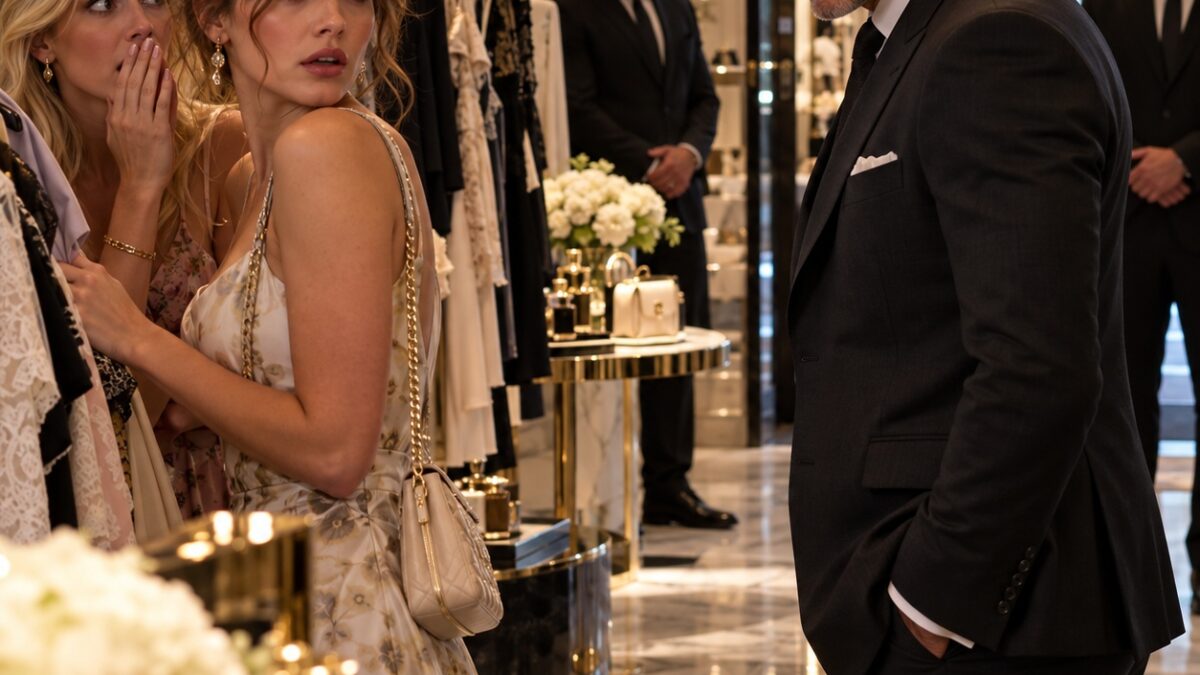
FULL STORY CONTINUATION
This time he claimed he needed a tie.
He did not need a tie.
I knew that because Silas Romano was wearing a tie that probably cost more than my monthly electric bill.
Dark navy silk.
Hand-finished.
Perfect width.
Perfect knot.
Perfect length.
I stared at it.
Then at him.
“What is wrong with that one?”
He looked down.
“I don’t like it.”
“You’re wearing it.”
“That does not mean I like it.”
“What exactly don’t you like?”
A pause.
“The color.”
“It is navy.”
“Yes.”
“What color would you prefer?”
“Another navy.”
I folded my arms.
Silas looked completely serious.
Behind him, Dalia disappeared into the stockroom because she had no loyalty whatsoever.
“All right,” I said. “Let’s find you a different identical tie.”
“That would be helpful.”
I showed him seven.
He rejected six.
The seventh was almost indistinguishable from the one he wore.
“This one.”
He nodded.
“Better.”
“You are impossible.”
“I’ve been called worse.”
“I imagine frequently.”
That almost-smile appeared again.
He bought the tie.
Then stayed forty minutes.
Asked about fabric.
Asked why I preferred certain cuts.
Asked why some men could wear wide lapels and others looked like they’d been swallowed by their own jacket.
He listened.
That was the first thing that unsettled me.
Men with money often asked questions because they enjoyed hearing themselves begin conversations.
Silas asked because he wanted the answer.
When I told him a particular jacket made him look like he was attending his own funeral, he changed it.
When I explained that tailoring was less about hiding bodies and more about honoring their shape, he went quiet.
“That’s your philosophy?”
“Yes.”
“You don’t make people look thinner?”
“I make people look like themselves on a very good day.”
He considered that.
“I like that.”
“So do I.”
He came back the next week.
And the next.
Sometimes he bought things.
Sometimes he clearly invented reasons to be there.
He needed cuff links.
Pocket squares.
A belt.
Advice about whether a coat looked “too aggressive.”
I told him the coat was fine.
His face was the aggressive part.
He bought it anyway.
Slowly, Bellator adjusted to his visits.
The junior associates stopped freezing.
Dalia started hiding less obviously nearby so she could listen.
I learned Silas drank coffee black unless he had already had three cups, at which point he added a small amount of cream.
He learned I used too much cream and not enough sugar.
One morning, a coffee appeared on the counter when I opened.
No note.
Exactly right.
I knew.
He denied responsibility.
“You have security men following coffee orders now?”
“I have no idea what you’re talking about.”
“Silas.”
“I came to discuss trousers.”
“You don’t need trousers.”
“I always need trousers.”
Dalia turned around before he saw her laughing.
Then there was the emerald dress.
I had mentioned it once.
A designer piece we sold the previous month.
Deep green silk.
Beautiful neckline.
The kind of dress that made a woman stand differently before she ever looked in a mirror.
It had been too expensive for me.
I told Silas that only because he asked what my favorite piece had ever been.
Two days later, a box arrived.
Inside:
The dress.
My size.
I found him that afternoon.
He was standing near the tailoring counter discussing cuff buttons with such obvious innocence I wanted to throw one at his head.
“You bought me the dress.”
“I ordered a dress.”
“For me.”
“You liked it.”
“That isn’t the point.”
“What is?”
“You can’t just buy women expensive things.”
“I am aware.”
“Are you?”
“Yes.”
I lowered my voice.
“I’m not something you can purchase.”
His expression changed immediately.
Not anger.
Something sharper.
Serious.
“I know.”
He stepped closer, but not enough to crowd me.
“I am not buying you.”
“Then what are you doing?”
“Listening.”
I stared.
“There’s a difference.”
He held my eyes.
“And I would like you to notice it.”
That shut me up.
I hated when he did that.
Not with power.
With precision.
I kept the dress.
Eventually.
I made him promise he would not start sending jewelry, cars, property, or exotic livestock.
“Livestock?”
“You seem capable of escalation.”
“I’ll avoid livestock.”
“Thank you.”
“What about jewelry?”
“No.”
“For now?”
“Silas.”
“For now.”
He walked away before I could argue.
There were quieter moments too.
The ones that mattered more.
He waited forty minutes after closing one night because I mentioned I hated walking through the parking garage alone.
He sat in a fitting-room chair reading an old paperback.
Didn’t announce why he was there.
Didn’t make me feel helpless.
Just waited.
Another night, I caught him humming along to the terrible pop song playing overhead.
“You were humming.”
“No.”
“I heard you.”
“You were mistaken.”
“You knew the chorus.”
“I know many things.”
“You were humming.”
“Camila.”
“You like terrible pop music.”
“I will deny this under oath.”
I laughed until I had tears in my eyes.
Once I twisted my ankle carrying a delivery box.
Silas drove me home himself.
Not his driver.
Him.
He sat on my porch steps while I iced it.
Twenty minutes.
Almost no talking.
Jasmine somewhere down the street.
Charleston evening thick and warm.
He watched until I could stand without wincing.
Then left.
He never tried to impress me with money.
That was what made the money stop frightening me.
I had grown up in houses wealthier than mine.
My mother cleaned them.
My father fixed their cars.
I had watched rich people treat my parents like extensions of appliances.
Useful.
Invisible.
Replaceable.
I promised myself I would never mistake wealth for character.
So one afternoon, I asked Silas:
“Are you interested in me because I’m the only woman in Charleston who doesn’t seem impressed by you?”
He went quiet.
Long enough that I regretted asking.
Finally:
“I have been surrounded by impressed people my entire life.”
His gaze dropped to his hands.
“It is a lonely way to be seen.”
I didn’t move.
“You look at me like I may disappoint you if I’m not careful.”
“That is because you may.”
“I know.”
His eyes returned to mine.
“And somehow that makes me feel more like a person than I have in years.”
I had no clever response.
So I reached up and straightened his already perfectly straight tie.
Mostly because I needed something to do with my hands.
That was the problem.
I was falling for him.
A sixty-year-old man with silver at his temples and a reputation that made grown men reconsider eye contact.
I told myself not to.
Every morning.
Sometimes in the mirror.
Do not fall for Silas Romano.
He is twice your age.
Do not fall for Silas Romano.
He comes with men in dark suits.
Do not fall for Silas Romano.
You literally made fun of his kissing before meeting him.
None of it helped.
He kept coming back.
He kept listening.
And somewhere between the coffee, the badly disguised shopping excuses, and the way he always stepped aside to let elderly women through doorways first, I stopped seeing a name.
I started seeing him.
Then three men walked into Bellator after closing and showed me exactly what the name meant.
They did not look like customers.
No shopping bags.
No curiosity.
Dark coats.
Hard eyes.
Stillness that felt practiced.
They asked for Silas.
Not Mr. Romano.
Silas.
One man said:
“The harbor issue needs an answer tonight.”
Another:
“Marquetti is done waiting.”
I stood behind the counter.
My skin went cold.
Silas emerged from the back fitting room.
And the entire dynamic changed.
The men stepped aside.
Not politely.
Instinctively.
Silas didn’t raise his voice.
He didn’t need to.
“You came into her place of work.”
His tone was almost conversational.
The oldest man swallowed.
“We needed—”
“You came here.”
Silence.
Silas looked at him.
“That was a mistake.”
Nothing dramatic happened.
No gun appeared.
No threats I could quote later.
The men left.
Immediately.
That scared me more than shouting would have.
I waited until the door closed.
Then turned.
“You could have told me.”
Silas looked at me.
“I know.”
“What exactly are you?”
He didn’t answer quickly.
That told me enough.
“Silas.”
“My family has businesses.”
“Everybody has businesses.”
“Some of ours are less public.”
“Oh.”
I laughed once.
Not because anything was funny.
“You’re actually—”
“Yes.”
“The thing everybody says?”
“Some of it.”
“Which part?”
“I am not discussing crimes with a woman standing under three security cameras.”
That was such a Silas answer that I almost laughed again.
Instead, I crossed my arms.
“You let me get involved without telling me.”
“I wanted you to know me first.”
The anger stalled.
He continued.
“Before the name.”
His voice softened.
“Before what everyone else believes about it.”
“That isn’t entirely your decision.”
“No.”
He looked down.
“It shouldn’t have been.”
I went home furious.
Then afraid.
Then furious again.
I lay awake under my wobbling ceiling fan and listed every reason to walk away.
Danger.
Age.
Power.
Secrets.
The fact that his enemies apparently knew which boutique he visited.
My mother would’ve locked me in her house if she knew.
My father would’ve asked six questions about Silas’s transmission before judging him as a person, which was not useful.
By morning, I knew one thing.
I wasn’t ready to leave.
I stayed carefully.
No illusions.
No dramatic declaration.
Just honesty.
Or what I thought was honesty.
Unknown to me, Dominic Marquetti had already seen photographs of Silas outside Bellator.
One showed him laughing.
That was enough.
Marquetti had spent eleven years searching for something Silas cared about enough to protect.
According to Enzo later, Marquetti had once said Silas had no soft places left.
No wife.
No young children.
No public lover.
Nothing useful.
Then I appeared.
A boutique stylist.
Predictable schedule.
Small apartment.
Parents across town.
Friend named Dalia.
Parking garage.
Morning coffee.
Everything ordinary about my life became information.
Silas learned about the surveillance before I did.
Enzo told him late one night.
Two sets of photographs.
Questions asked among suppliers.
People watching deliveries.
Silas spent the night considering every bad option.
Disappear from my life.
Move me without asking.
Hide me.
End whatever had begun before it could become leverage.
By morning, he chose something that scared him more.
He chose to tell me.
He came into Bellator the next afternoon.
His tie was crooked.
That was how I knew something was wrong.
Silas did not own crooked things.
“You look like somebody told you your tailor retired.”
No smile.
“We need to talk.”
The back fitting room felt suddenly too small.
He told me about the photographs.
Marquetti.
The questions.
My schedule.
My building.
My family.
By the time he finished, my hands were cold.
“I want you moved somewhere secure.”
There it was.
The sentence I had expected.
“Somewhere I control.”
“No.”
“Camila.”
“No.”
“Until this ends.”
“I said no.”
His jaw tightened.
Fear came first.
Then anger.
“I am not furniture.”
He blinked.
“What?”
“I’m not something you relocate because it makes you feel safer.”
“This isn’t about making me feel safe.”
“Isn’t it?”
His eyes darkened.
“He is gathering information on you because of me.”
“Then tell me the information.”
“I just did.”
“All of it?”
A pause.
That pause mattered later.
At the time, I missed it.
I stepped closer.
“If I’m going to be around you, you trust me enough to make my own decisions.”
“I am trying to keep you alive.”
“Then help me stay alive.”
My voice shook.
“Don’t lock me in a beautiful apartment and call that love.”
The word slipped out before either of us was ready for it.
Silas stared at me.
I wanted to take it back.
Instead, he breathed out.
“You’re right.”
That was not what I expected.
He looked almost annoyed with himself.
“I am sorry.”
I stopped.
“I will tell you what we know.”
He nodded once.
“You choose.”
Something shifted between us.
That afternoon he explained everything.
Routes.
Security.
Signals.
Cars.
Which men I could trust.
Where to go if I thought I was followed.
How to recognize whether someone was watching a door or merely waiting.
He did not simplify it.
That mattered.
I chose to keep working.
I chose to stay in my apartment.
I chose to accept discreet security outside.
Not because Silas ordered it.
Because now I understood the threat.
Once you know the reason for a precaution, accepting it feels different from being managed.
I began noticing things.
A man asking strange questions about the delivery entrance.
A vehicle parked across from my apartment too long.
A customer more interested in cameras than clothes.
I told Enzo.
He never laughed.
“Probably nothing,” I said once.
“Probably not nothing.”
He was already making a call.
The week of Bellator’s annual spring gala, the threat became specific.
The gala was the biggest event of our year.
Invitation only.
Designers.
Old Charleston families.
Politicians.
Social pages.
Champagne.
Silk.
Diamonds.
Three hundred people pretending not to evaluate one another.
I had worked toward it for months.
Silas insisted on attending.
Partly for me.
Partly because if Marquetti planned to move, a crowded public event gave him chaos.
The afternoon before the gala, Enzo came into the back office.
His face told me enough before he spoke.
“We have an inside man.”
“Who?”
“Catering.”
My stomach dropped.
“Which one?”
“Not confirmed.”
Silas asked:
“What is Marquetti’s timetable?”
“Twelve hours.”
That number changed the air.
“Twelve?”
“Whatever he plans, the window closes after tomorrow night.”
Silas found me twenty minutes later steaming dresses.
“Something is coming.”
I shut off the steamer.
“Tell me everything.”
“Camila—”
“No edited version.”
He met my eyes.
“All twelve hours.”
He did.
That night, I could not sleep.
I sat on my porch steps.
Thought about calling Mom.
Did not.
Instead, I called Silas.
He answered immediately.
“Tell me something that isn’t about tomorrow.”
Silence.
Then:
“I bought my first suit at seventeen.”
I smiled despite myself.
“Really?”
“Worked a job my father did not know about.”
“What kind?”
“Warehouse.”
“Illegal?”
“No.”
“Disappointing.”
“Very.”
He continued.
“The salesman gave me a jacket two sizes too large.”
“Why?”
“Said I would grow into it.”
“Did you?”
“I don’t know.”
“You kept it?”
“Yes.”
“Why?”
Long pause.
“It’s the last thing I own from the boy I was before everything became what it became.”
My throat tightened.
“Why tell me now?”
“Because if tomorrow goes badly…”
“Don’t.”
“I wanted you to know something small.”
His voice softened.
“Not the business.”
A breath.
“Not Romano.”
“Just Silas?”
“Yes.”
I pressed the phone against my ear.
“Tomorrow is not going badly.”
“Confident?”
“No.”
I smiled into the dark.
“Terrified.”
“Same.”
That surprised me.
“And after tomorrow,” I said, “you are showing me that terrible jacket.”
“Deal.”
The gala began beautifully.
Disasters often do.
I wore the emerald dress.
Yes.
That dress.
Silas saw me before guests arrived.
He went silent.
I tried not to enjoy it.
“You have something to say?”
“No.”
“That is disappointing.”
“I am attempting to remain respectful.”
“Try harder.”
“You look…”
He stopped.
I waited.
“Dangerous.”
I laughed.
“That was the wrong adjective.”
“No.”
His gaze held mine.
“It wasn’t.”
Nine hours.
That was Enzo’s first update I heard.
The countdown lived under the music.
I moved through the room doing my job.
Adjusting straps.
Solving seating problems.
Helping a nervous teenager stop hunching in her first formal gown.
Seven hours.
I saw him.
Catering jacket.
Standing near the service corridor.
Too still.
Servers watch trays.
Guests.
Empty glasses.
He watched security.
I walked calmly to Enzo.
“Man by service corridor.”
“Blue tie?”
“Yes.”
“You’re sure?”
“He hasn’t looked at a guest in five minutes.”
Enzo didn’t turn.
“Good eyes.”
Then moved.
Six hours.
I found Silas beside the champagne fountain speaking to a councilman.
I slipped my hand into his.
To everybody else, affection.
To us, information.
“I found the catering man.”
Silas continued smiling at the councilman.
“Where?”
“Enzo has him.”
His fingers tightened around mine once.
“You did exactly right.”
Three hours.
Security shifted.
Two hours.
Enzo’s voice sharpened.
“We lost him.”
My blood turned cold.
“He’s moving.”
Final hour.
I did what I knew.
Work.
Pinned a torn strap.
Reassured a client.
Fixed a hem.
Smiled.
Underneath all of it, I watched doors.
Silas found me behind a column.
“However this goes…”
“Don’t.”
“I need to say it.”
His voice was close to my ear.
“Tonight was never worth losing you.”
My chest hurt.
“If I had known the cost could become this…”
He looked at me.
“I would have stayed away that first day.”
“No, you wouldn’t.”
“I might have.”
“And let me spend my whole life believing you kiss terribly?”
That got the smallest smile.
“Yes.”
I leaned closer.
“Too late.”
His eyes changed.
“For the record, your theory has already suffered serious credibility problems.”
“Almost.”
“One day, Romano.”
“One day.”
One hour.
Then nobody said the number again.
I was near the front display helping a guest with a torn hem when the world exploded.
The glass wall came apart.
For one suspended second, my brain called it snow.
A bright white storm.
Then the black SUV reversed through the front display.
Mannequins fell.
Metal screamed.
People screamed louder.
Silas caught my arm.
Pulled me down.
Glass bit my knees.
My ears rang.
Someone climbed from the SUV.
Catering jacket.
Gun.
He shouted something about a shipment.
A debt.
Marquetti.
Ninety minutes.
That was the real countdown.
Not twelve hours.
Twelve hours had been camouflage.
The trap had always narrowed toward these ninety minutes.
Silas crouched beside me.
One arm across my back.
“Stay down.”
His voice was impossibly calm.
“Camila.”
I looked at him.
“Stay exactly here.”
Then:
“I need you safe more than I need anything else in this room.”
I should have listened.
I almost did.
Then I saw movement near the service corridor.
Second man.
The one Enzo had lost.
Moving fast toward the kitchen-side electrical panel.
Something metallic in his hand.
Not a gun.
Remote.
Trigger.
Phone.
I didn’t know.
But I knew he should not reach that panel.
A brass garment rod lay beside the collapsed display.
I grabbed it.
As he passed, I swung at the backs of his knees with everything I had.
He went down.
Hard.
The sound he made was deeply satisfying.
Enzo appeared almost instantly.
Pinned him.
Took the device.
Silas turned.
Saw me standing over a man with a brass rod.
Emerald dress covered in dust.
Glass in my hair.
Hands shaking.
For one second, he just stared.
Enzo glanced at me.
“Remind me never to criticize your swing.”
Then returned to his prisoner.
The gunman from the SUV surrendered minutes later.
Guests slowly emerged from behind counters and clothing racks.
Someone cried.
Someone filmed until Silas’s people suggested otherwise.
The whole room smelled like dust and perfume.
And Silas would not let go of me.
Even after it was over.
An hour later, I sat in the back office with a bandage on my forearm and somebody else’s jacket around my shoulders.
Silas sat across from me.
He looked composed from a distance.
I knew better now.
His knuckles were white.
“There is more you don’t know.”
I closed my eyes.
Of course there was.
“What?”
“Marquetti did not want you hurt tonight.”
“That is a strange comfort.”
“He wanted you taken.”
I opened my eyes.
“Alive.”
My stomach dropped.
“Why?”
“Leverage.”
“Against what?”
Silas looked away.
That frightened me more than the answer.
“Years ago, Marquetti falsified shipping records.”
He spoke slowly.
“An associate died because of decisions connected to those records.”
“His associate?”
“Ours.”
“And?”
“He tried to shift responsibility.”
Silas’s jaw hardened.
“My family kept proof.”
“You have it.”
“Yes.”
“He wants it.”
“Yes.”
“And I was the exchange.”
Silence.
“When did you know?”
His eyes returned to mine.
“Not everything.”
“Silas.”
“When did you know I could specifically be used like this?”
“The photographs.”
Something inside me cracked.
“That was weeks ago.”
“I know.”
“You told me Marquetti was watching me.”
“Yes.”
“You did not tell me why.”
“No.”
“You knew.”
“I knew it was possible.”
“And you decided I didn’t need that part.”
His face tightened.
“I thought I could protect you from carrying it.”
I laughed once.
Angry.
Exhausted.
“You keep doing this.”
“I know.”
“No. Listen.”
I stood.
Pain shot through my knees.
“You decide what I can handle.”
He said nothing.
“You did it when I didn’t know what you were.”
“Yes.”
“You did it again when the photographs appeared.”
“Yes.”
“You give me ninety percent of the truth and convince yourself the missing ten percent is mercy.”
He looked down.
“I know.”
That stopped me.
No defense.
No excuse.
Just acknowledgment.
“I spent thirty years keeping people alive by deciding for them.”
His voice was quiet.
“It is the only method I know.”
He looked at me.
“But I know now it is not the same as trust.”
I waited.
“I don’t know how to do it differently yet.”
Then:
“I want to learn.”
A pause.
“If you let me.”
The word he had used earlier came back.
Love.
I wasn’t ready to answer it.
Not yet.
So I took his hand.
Glass cuts.
Tension.
Warm fingers.
We sat there.
Eventually I asked:
“Can I still be angry?”
“Yes.”
“Even if I understand?”
“Yes.”
“As angry as I want?”
“As angry as you need.”
I looked at him.
“You make that very difficult.”
“How?”
“Being furious with someone while still wanting to sit beside them is deeply inconvenient.”
His mouth moved.
“Welcome to loving someone complicated.”
I stared.
He stared back.
Then I laughed.
I hated him slightly for being right.
Two days later, Enzo and I reviewed Bellator’s staffing.
That was how we found the betrayal.
Temporary catering coordinator.
Agency hire.
Friendly.
Helpful.
Always saved Dalia and me the good cheese cubes during events.
He had been feeding Marquetti information for weeks.
Delivery schedules.
Floor plans.
Employee patterns.
A year’s rent in exchange for access.
Learning that hurt differently.
The attackers were strangers.
He wasn’t.
I had joked with him.
Trusted small details to him.
Dalia listened to the entire explanation.
Silent.
For almost one full minute.
An achievement of historic importance.
Finally:
“So the sweet catering guy who saved us the good cheese was working for the mafia?”
“Yes.”
She stared ahead.
“I liked that cheese.”
I laughed so hard my ribs hurt.
That was Dalia’s gift.
Knowing exactly when the only acceptable response to horror was something stupid enough to remind you life still contained stupid things.
After the gala, Silas changed.
Not completely.
People don’t transform because somebody gives them one emotional speech.
He practiced.
That mattered more.
When security decisions involved me, he asked.
When his lawyer suggested increasing my protection, Silas said:
“Ask her.”
Not me.
Her.
I heard about it later.
That two-word correction meant more to me than the emerald dress ever had.
I started attending some briefings.
At first I felt ridiculous.
A fashion stylist surrounded by men who knew how to identify weapons from the shape beneath a jacket.
Then I spotted a blind area near Bellator’s loading entrance nobody else had noticed because they were looking at it as security.
I was looking at it as someone who moved garment shipments.
Different eyes.
Different answer.
Enzo studied the revised map.
“You have good instincts.”
“Thank you.”
“You would’ve made a decent handler.”
“I prefer dresses.”
“They involve fewer firearms.”
“Usually.”
He almost laughed.
Silas began asking my opinion.
Actually asking.
Not asking and waiting until I agreed.
There is a difference.
One evening we sat on his terrace overlooking Charleston Harbor.
Dark water.
Warm air.
His shoulder against mine.
“I spent sixty years believing strength meant control.”
I looked up.
“That sounds exhausting.”
“It was.”
“And?”
“You spent three months teaching me sometimes strength looks like trust.”
I leaned my head on his shoulder.
“Careful.”
“Why?”
“People might think you have gone soft.”
“They already do.”
“Oh?”
“My tailor asked if I wanted the funeral jacket back.”
I burst out laughing.
Then he showed me the old jacket.
The one from seventeen.
It had been packed away for decades.
Too large for the boy who bought it.
It fit the man almost perfectly now.
I held it against him.
Looked at the shoulders.
Sleeves.
Chest.
“Well?”
“You grew into it.”
“Took long enough.”
“Most good things do.”
He went very still.
I pretended not to notice.
Then folded the jacket carefully.
Three weeks after the gala, the final part began.
A charity auction.
One of Charleston’s oldest families.
Everybody who mattered in certain circles attending.
Marquetti would be there.
Or so we believed.
I insisted on going.
Silas looked at me as if I had announced a plan to jump from a bridge.
“You want to enter a room with the man who tried to kidnap you.”
“Yes.”
“No.”
I raised an eyebrow.
His expression changed.
He caught himself.
“What I mean is…”
I waited.
“I strongly dislike this idea.”
“Better.”
He exhaled.
“I want to finish it.”
“Enzo and I can.”
“I am tired of being a piece in everyone else’s plans.”
“Camila.”
“I notice things.”
“Yes.”
“I helped at the gala.”
“Yes.”
“Then let me be useful again.”
He argued.
I didn’t move.
Finally:
“If you go, you remain within arm’s reach of Enzo.”
“Agreed.”
“You do not confront anyone.”
“Agreed.”
“You see something, you tell us.”
“Agreed.”
“You let us handle the dangerous part.”
“I’ll do my best.”
“That answer is not reassuring.”
“It is the best available.”
He glared.
I smiled.
“A promise made during crisis only matters if you honor it when you’re calm.”
He knew exactly what I meant.
He nodded.
Auction night.
I wore the emerald dress again.
Armor.
Dalia helped fasten it.
Then hugged me.
“Don’t die in that dress.”
“Comforting.”
“It is excellent tailoring.”
“Thank you.”
“It would be wasteful.”
I kissed her cheek.
The ballroom glittered.
Crystal.
Candles.
Old Charleston smiling over old grudges.
I spotted something within twenty minutes.
New catering employee.
Near the records room.
Too interested.
Too still.
I did not approach.
I found Enzo.
“New guy near accounting.”
“Describe.”
I did.
Enzo moved.
What I did not know was that Silas and Enzo had spent three weeks setting their own trap.
The temporary coordinator who betrayed us had become an unwitting channel.
They fed him false information.
A shipment.
Documents.
Proof supposedly damaging enough to destroy Silas.
Marquetti took the bait.
At nine o’clock, his lieutenant Castellano arrived near the records room expecting evidence.
Instead, he found Enzo.
Two security men.
And two organized-crime officers who had spent more than a year building a case against Marquetti.
I watched from across the room with my hand in Silas’s.
Castellano’s face changed.
Confusion.
Recognition.
Panic.
He tried calling it a misunderstanding.
The documents inside his jacket made that difficult.
They were falsified shipping records.
Records meant to be planted against Silas.
Records that also linked back to Marquetti’s old schemes.
The very thing he had spent years hiding.
Marquetti himself wasn’t there.
But now the evidence was.
And within a week, so was he.
In custody.
For the first time in months, Silas breathed like a man who wasn’t listening for the next door to open.
The ballroom slowly returned to normal.
Music.
Conversation.
Champagne.
“You did that.”
I looked at him.
“We did.”
“You saw Castellano’s man.”
“We did.”
“Camila.”
“No.”
I squeezed his hand.
“You are still practicing.”
His eyes narrowed.
“Practicing what?”
“Understanding that everything doesn’t happen because you personally make it happen.”
He looked almost offended.
“Enzo planned.”
“Yes.”
“The police worked the case.”
“Yes.”
“I noticed the man.”
“Yes.”
“You helped.”
“Yes.”
“So?”
I smiled.
“We.”
Silas stared at me.
Then nodded.
“We.”
Enzo joined us.
“For what it’s worth, I have trained men who couldn’t read a room as well as you did tonight.”
“That is the nicest thing you have ever said to me.”
“I regret it already.”
“If I quit fashion, do I get a job?”
“Yes.”
“No, thank you.”
He frowned.
“Why ask?”
“Just checking.”
“Why no?”
“Worse lighting.”
Enzo smiled.
Actually smiled.
Later, after the crowd thinned, I stepped onto a quiet balcony.
Harbor lights shimmered below.
Silas found me there.
For a while, neither of us spoke.
Then:
“You have become important to me.”
I turned.
No careful distance in his face now.
No evasive humor.
“More important than I know how to explain properly.”
“Dangerous admission.”
“I am not good at words that do not involve negotiation.”
“I noticed.”
He stepped closer.
“Camila.”
“Yes?”
“I love you.”
There it was.
Simple.
Heavy.
True.
My heart hurt.
I smiled.
“Careful.”
His brow furrowed.
“People might think you like me.”
“They already know.”
He came closer.
Cedar.
Rain.
That warm clean scent I had stopped identifying separately because by then it simply smelled like Silas.
And suddenly I remembered.
The first Tuesday.
Dalia.
The whisper.
The humiliation.
My face warmed.
Silas noticed.
Of course.
“Still curious?”
I lifted my chin.
“That depends.”
“On?”
“Whether you intend to prove me wrong.”
His rare smile appeared.
The one I had first seen beside a funeral-looking suit.
Then he closed the distance.
The kiss was slow.
Unhurried.
Not practiced in the careless way I had joked about.
Careful.
Almost uncertain.
As though a man who had spent decades controlling every movement in every room had finally encountered one thing he refused to rush.
His hand touched my cheek.
Mine rested against his chest.
For one long moment, the entire dangerous, glittering city disappeared.
When we separated, I breathed:
“Well.”
Silas’s eyes opened.
“Well?”
I considered.
“You’re adequate.”
He stared.
I burst out laughing.
His arm tightened around my waist.
“Adequate?”
“Potential.”
“Camila.”
“Further testing may be required.”
“That can be arranged.”
Six months later, Bellator’s front window had been replaced twice.
The first time because a vehicle had destroyed it.
The second because Silas claimed the replacement glass was “inferior.”
I suspected sentiment.
He denied it.
Dalia still worked beside me.
Still gossiped.
Still occasionally whispered:
“Your terrifying boyfriend is here.”
I stopped blushing.
Mostly.
The new catering coordinator was exactly what his résumé claimed.
I learned to trust my instincts about people again.
Marquetti’s trial made the kind of quiet headlines Charleston preferred.
Then disappeared from conversation.
Silas’s world grew calmer.
Not safe.
I never lied to myself about that.
He was still who he was.
Men still lowered their voices around him.
Cars still occasionally followed us.
Enzo still checked exits.
Silas still carried decades of habits built in a world where mistakes could become funerals.
But the secrecy changed.
If something touched my life, I knew.
If a threat existed, he told me.
Sometimes too bluntly.
I preferred that.
I never stopped working.
Silas never asked me to.
I began sketching more seriously.
He encouraged me.
Not by buying a company.
I threatened him in advance.
By asking questions.
By looking at designs.
By remembering which fabric I hated.
My mother eventually met him.
That was more terrifying than Marquetti.
She stared at Silas over arroz con pollo and asked:
“How old are you?”
“Sixty.”
“And my daughter?”
“Old enough to make her own decisions.”
Wrong answer.
My mother narrowed her eyes.
“That was not what I asked.”
Silas looked at me.
I laughed into my water.
Dad liked him faster.
Mostly because Silas knew enough about old engines to argue about carburetors.
Men are strange.
Ten months after our first conversation, I was working an ordinary afternoon at Bellator.
Dalia was rearranging dresses.
A customer was debating between cream and ivory.
Music played.
The door opened.
Silas entered.
Same unhurried walk.
Silver at his temples.
That hush still followed him even though the staff no longer panicked.
Something was different.
He carried a small velvet box.
I noticed immediately.
Of course I did.
Noticing was what I did best.
My heart climbed into my throat.
Dalia saw the box.
Dropped a hanger.
Silas crossed the floor.
Stopped in front of me.
“I believe I still owe you proof.”
My voice caught.
“Proof of what?”
He opened the box.
Inside was a ring.
Elegant.
Not ridiculous.
Not enormous.
Exactly the kind I would have chosen.
Because he had listened.
“That you were wrong about me.”
My eyes filled.
“Specifically?”
“That I kiss terribly.”
I laughed through tears.
“And?”
“And that I have absolutely no intention of giving you the opportunity to test the theory with anybody else.”
Dalia made a noise behind us that sounded like a person being emotionally injured.
Silas looked at me.
Not commanding.
Not assuming.
Waiting.
That mattered most.
“Camila Hartwell.”
My hands shook.
“Will you marry me?”
“Yes.”
I said it before he could finish breathing.
Dalia started crying.
So did I.
Silas stood.
For once, the man everybody else waited on had been the one waiting.
I held out my hand.
He slid the ring onto my finger.
Perfect fit.
I looked at it.
Then at him.
“You knew my ring size.”
Silas looked extremely pleased with himself.
“I notice things.”
I laughed.
Then pulled him down and kissed him in the middle of Bellator.
Ten months earlier, I had whispered that Silas Romano probably kissed terribly because it was easier to joke about a dangerous man than imagine that a man like him might ever truly see a woman like me.
I was wrong about that too.
He had seen me from the beginning.
Not a body he wanted changed.
Not an employee.
Not a liability.
Not leverage.
Not something to move behind locked doors for safekeeping.
Me.
Softness and steel.
Fear and stubbornness.
Good instincts.
Bad jokes.
A woman who sold dresses and swung brass clothing rods at kidnappers when necessary.
And I had learned to see him too.
Not the name Charleston whispered.
Not the power.
Not the money.
The seventeen-year-old boy who bought a jacket too large and hoped he would eventually grow into it.
The sixty-year-old man still learning that protection without trust becomes another kind of cage.
The man who could command rooms but had to practice asking me what I wanted.
The man who learned to say we.
Dalia wiped her eyes.
“I would like the record to show that I was present for the original statement.”
“No one asked you.”
“I witnessed history.”
Silas glanced at her.
“You encouraged her.”
“I absolutely did not.”
“You laughed.”
“That is not encouragement.”
“It sounded supportive.”
Dalia pointed at me.
“She started it.”
I put my hand against Silas’s chest.
“Don’t intimidate my maid of honor.”
Dalia froze.
Then screamed.
I winced.
Silas actually laughed.
That same rare sound that had first made one of his assistants turn around in disbelief months earlier.
Only now it wasn’t rare.
Not with me.
And standing there beneath the warm boutique lights, a ring on my hand, Dalia crying beside a rack of evening dresses, I thought about all the ways a life can change without warning.
Sometimes it begins with danger.
Sometimes betrayal.
Sometimes a black SUV crashing through a glass wall.
And sometimes it begins on an ordinary Tuesday afternoon when you lean toward your best friend, look at the most dangerous man in the room, and whisper something you absolutely should have kept to yourself.
“He probably kisses terribly.”
For the record?
He doesn’t.








