FULL STORY: A Navy SEAL and His Dog Saw an Old Woman Sell Her Last Keepsake — The Truth Hurt Him
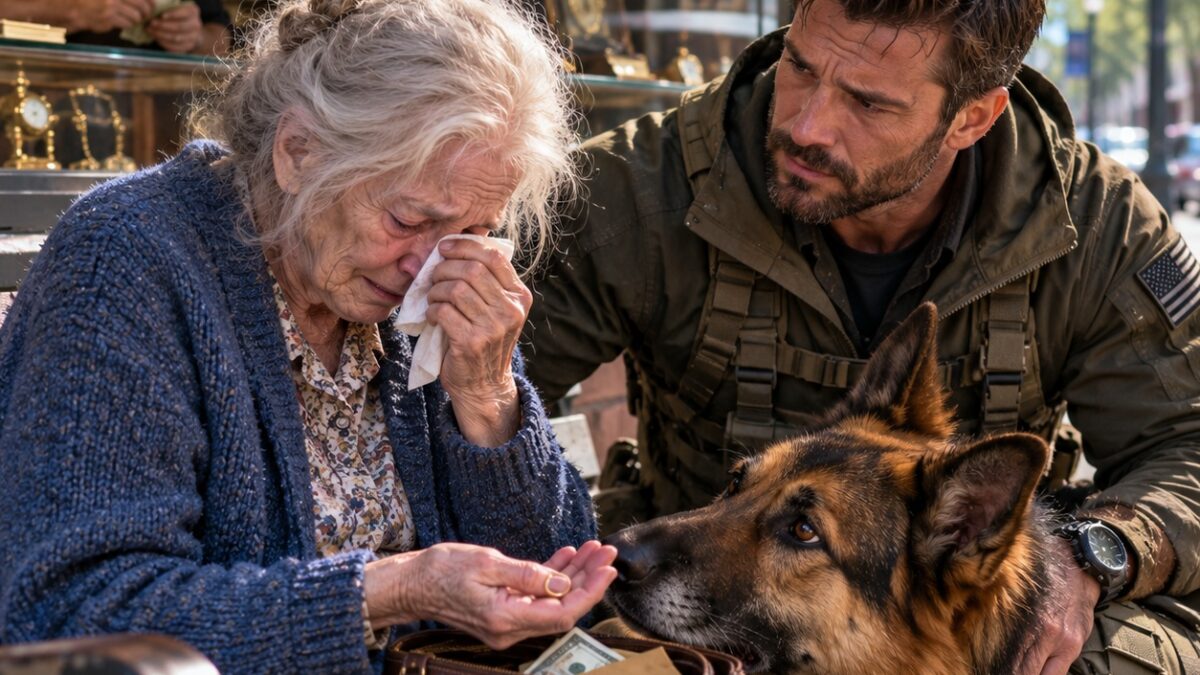
Clara Bennett kept staring at the message as though the words might change if she looked long enough.
Her name was Clara. She told me that after several seconds of silence, almost apologetically, as though I had caught her doing something embarrassing.
“Clara Bennett,” she whispered. “My husband’s name was Samuel.”
I looked at the phone in her trembling hand.
The message demanded twenty-four hundred dollars by the following day. It also instructed her not to call.
That second part bothered me more than the amount.
In the Navy, I had learned to pay attention to the things people tried to prevent you from doing. Sometimes a warning was genuinely protective. Other times, it was designed to keep you from discovering something.
But I wasn’t investigating an enemy position.
I was sitting beside a frightened elderly woman who believed her son was suffering.
“Clara,” I said, “you don’t have to decide anything right this minute.”
She gave a bitter little laugh.
“That’s easy for you to say.”
“I know.”
“He might be in pain right now.”
“He might.”
“He might need medication. Or another operation. He might be sitting somewhere wondering why his mother won’t help him.”
I looked at her.
“Then let’s find out what he needs.”
She shook her head.
“You don’t understand. He’s never been the kind of man who asks for help.”
Her fingers tightened around the phone.
“His father was the same way. Samuel would rather spend three hours fixing something himself than admit he needed to call a repairman.”
A faint smile crossed her face.
“Michael inherited every stubborn bone in that man’s body.”
Finn moved closer and rested his muzzle on her shoe.
Clara looked down at him.
“He’s a lovely dog.”
“Don’t tell him. He already thinks he owns everything.”
Her smile lasted only a second.
Then she looked toward the pawnshop receipt.
I watched her fold it carefully along the original crease, smoothing the paper with her thumb.
The action struck me as painfully familiar.
When people had almost nothing left under their control, they sometimes became intensely careful with the few things they could still manage.
A folded receipt.
A neatly buttoned cardigan.
An envelope placed squarely inside a handbag.
I had seen that behavior in places where people had lost far more than possessions.
“Do you live nearby?” I asked.
She nodded.
“Up on Bennett Road. The little gray house overlooking the water.”
“I know the one.”
“Most people do. Samuel built half the porch himself and spent the next twenty years insisting it was perfectly level.”
“Was it?”
“Absolutely not.”
I smiled.
For a moment, she looked less frightened.
Then her eyes filled again.
“He would know what to do.”
I waited.
“Samuel,” she whispered. “He always knew when something didn’t sound right.”
I didn’t tell her that wasn’t necessarily true.
Good people could be deceived.
Careful people could make mistakes.
And when someone you loved was hurting, intelligence didn’t always protect you from desperation.
Instead, I asked whether she would let me take her home.
She looked at Finn.
“Will your dog come?”
“Apparently I don’t have a choice.”
That earned another small smile.
It was enough.
Clara’s house stood on a gentle slope overlooking Lake Superior.
Pale-gray cedar siding. White trim. A narrow front porch. Lilac bushes blooming beside the steps.
A rusted wind chime moved lazily in the breeze.
Everything outside suggested a woman who still took pride in her home.
The grass had been cut recently.
Flowerpots stood in careful rows.
The windows were clean.
But the moment I stepped inside, I noticed the empty places.
A pale square above the fireplace where something had hung for years.
Two empty shelves inside a glass cabinet.
Four shallow scratches on a wooden table beside the window.
I didn’t comment.
Clara noticed me looking anyway.
“You can say it.”
“Say what?”
“That the place looks as though somebody’s been stealing the furniture.”
“I was going to say you have a very minimalist decorating style.”
She gave me a skeptical look.
“You’re a terrible liar.”
“I’ve heard worse.”
Finn began inspecting the living room.
He moved from the rug to the fireplace, sniffed near the cabinet, and eventually settled beside a chair.
Clara removed her cardigan.
Without it, she looked even smaller.
“The clock was Samuel’s,” she said.
I looked at the empty square above the fireplace.
“Anniversary present?”
“Twentieth.”
She nodded toward the glass cabinet.
“The silver knife set was from our fortieth.”
Then she glanced at the low table.
“My mother’s sewing machine stood there.”
I looked at her.
She immediately lifted her chin.
“Don’t.”
“I haven’t said anything.”
“You were about to feel sorry for me.”
I considered that.
“Maybe a little.”
“Well, don’t.”
I nodded.
“Understood.”
She turned toward the kitchen.
“I sold the clock. Pawned the silver. Sold the sewing machine.”
Her voice weakened on the final sentence.
For forty-three years, Clara had worked as a seamstress.
The sewing machine wasn’t merely another appliance.
It had been part of her livelihood.
Part of her mother’s life before hers.
And now it was gone.
She filled a kettle and placed it on the stove.
“Some people sell things because they don’t need them anymore,” she said.
I remained near the doorway.
“I know.”
“I needed all of those things.”
She didn’t turn around.
“But Michael needed me more.”
I watched her thin shoulders.
There was nothing useful I could say to that.
Not yet.
Over tea, Clara told me how the requests had started.
Four months earlier, she received word that Michael had been seriously injured in a traffic accident.
He was a maintenance engineer in Wisconsin, working long hours around industrial equipment.
His truck had been struck during heavy rain.
The injuries were severe.
Several operations followed.
Then rehabilitation.
Clara had been told that Michael’s head and throat had been injured, leaving him unable to speak normally.
Shortly afterward, a message arrived from an unfamiliar number.
The sender claimed to be Michael.
His phone had been destroyed, the message explained.
Talking hurt too much.
Texting was easier.
At first, the requests were small.
Three hundred dollars for medication.
Another payment for an insurance deductible.
Money toward temporary lodging near a rehabilitation center.
Then a therapy device.
Then transportation.
Each request sounded possible.
Each arrived with an apology.
And each carried enough familiar information to convince Clara that her son was writing.
“He knew about the maple tree,” she told me.
“What maple tree?”
“The one Michael fell out of when he was eleven. Broke his arm. Samuel nearly had a heart attack.”
She smiled at the memory.
“He knew the name of our old fishing boat. He knew I hated highways. He knew how Samuel drank his coffee.”
I nodded.
“And none of that seemed strange?”
“Why would it?”
“Because somebody else might know those things.”
She stiffened.
“Who?”
“I don’t know.”
“Exactly.”
I accepted that.
She wasn’t being unreasonable.
She was presenting the evidence she believed she had.
Facts about a family.
Personal memories.
Private details.
But facts could travel farther than people realized.
Photographs could be shared.
Old conversations repeated.
Addresses stored.
Messages forwarded.
And sometimes the person who knew a family best wasn’t a member of it.
“What happened after the first payment?” I asked.
“Michael thanked me.”
“Then?”
“He said he hated asking.”
Her eyes lowered.
“He always hated asking.”
“How much have you sent altogether?”
She hesitated.
Then shook her head.
“I don’t know anymore.”
That was the first time I saw shame enter her expression.
Not grief.
Not fear.
Shame.
She had been keeping track until the numbers became frightening.
Then she stopped adding them.
I remembered the little envelope she had carried from the pawnshop.
Seven hundred dollars.
For a wedding ring worn for more than fifty years.
And now someone wanted twenty-four hundred more.
“Clara, could we review your records tomorrow?”
She frowned.
“Why?”
“Not to prove you’re wrong. To see where the money went.”
“What if Michael really needs it?”
“Then making sure he’s the person receiving it protects him, too.”
She considered that.
For a long moment, the only sound was the kettle settling on the stove.
Finally, she nodded.
“All right.”
I didn’t push further.
It had taken enough courage for her to agree.
I stayed longer than I intended.
One porch board had come loose near the front steps.
I noticed it when Clara almost caught her shoe beneath the raised edge.
She protested when I retrieved a screwdriver from my truck.
“I’ve lived with that board for three years.”
“Then it’s overdue.”
“Samuel would’ve fixed it eventually.”
“He and I have that in common.”
While I worked, Finn wandered through the living room.
I heard something scrape against the floor.
Then another sound.
“Finn.”
No response.
That usually meant trouble.
I stepped inside.
My German Shepherd was backing out from beneath a low cabinet with something in his mouth.
A faded yellow tennis ball.
One side was split.
Most of the felt had worn away.
Clara stopped.
Then she began laughing.
Not a polite little laugh.
A real one.
“Oh, you thief.”
Finn approached proudly.
She reached for the ball.
“That belonged to Michael.”
I looked at Finn.
“I’m hearing concerning parallels.”
Clara smiled.
“Michael used to steal tennis balls from every dog in the neighborhood.”
“An organized operation?”
“He thought he was a professional trainer when he was twelve.”
“What were his qualifications?”
“Half a library book.”
I nodded solemnly.
“Elite preparation.”
She laughed again.
Then sat slowly in the chair.
“Samuel brought home our first dog when Michael was twelve. Black Labrador named Murphy.”
Finn placed his head on her knee.
Clara turned the tennis ball between her fingers.
“Michael was so serious about training him. He made little schedules. Reward charts. He even tried teaching Murphy to fetch our slippers.”
“Successful?”
“Murphy learned to hide Samuel’s slippers beneath the couch.”
I laughed.
Clara studied the ball.
“He was a good father, Samuel.”
Her smile softened.
“And Michael was a good son.”
“Still is, I imagine.”
She looked at me.
“I don’t know.”
The honesty surprised us both.
She stared toward the window.
“After Samuel died, Michael wanted me to move closer to him.”
“Wisconsin?”
She nodded.
“He worried about me living alone.”
“Seems understandable.”
“I know.”
She sighed.
“But after a certain age, people begin asking whether you’ve eaten breakfast as though you’re incapable of remembering what breakfast is.”
I smiled.
“Sounds annoying.”
“Extremely.”
She imitated Michael’s voice.
“Ma, did you check the furnace? Ma, don’t climb ladders. Ma, you can’t shovel the driveway at seventy-two.”
She stopped smiling.
“I know he meant well.”
I nodded.
“But being loved isn’t always the same as feeling useful.”
Clara looked at me sharply.
I hadn’t intended the words to sound so personal.
But they did.
She lowered her eyes.
“For most of my life, I was the person everybody needed.”
I waited.
“Samuel needed me. Michael needed me. Customers needed their clothes repaired.”
She looked around the empty room.
“Then Samuel died. Michael moved away. My hands got slower. Everybody started worrying about me.”
A tear slipped down her cheek.
“And then my son needed money.”
I leaned forward.
She swallowed.
“For the first time in years, I felt like his mother again.”
I didn’t answer.
There are confessions that become smaller if you rush to comfort the person making them.
Clara didn’t need me to tell her she was useful.
She needed someone to understand why the feeling mattered.
Finn found something else before we left.
A stack of old envelopes stood on the lower shelf of a console table near the hallway.
He brushed them with his nose while investigating the room.
One fell.
Clara bent to retrieve it.
It was an old birthday card from Michael.
When she opened it, a photograph slipped out.
A younger Michael stood beside Samuel on a dock, both holding a fish that looked suspiciously too large for either man to have caught without assistance.
Clara smiled.
Then turned it over.
On the back, in Michael’s handwriting, was a sentence.
Ma, call me before you decide I’m wrong. I might surprise you.
She read it twice.
I watched her expression change.
“What’s wrong?”
“Nothing.”
Then, after a moment, she said, “Perhaps I should’ve called him more often.”
I didn’t tell her that hindsight was cruel.
She already knew.
I clipped Finn’s leash back onto his collar.
Clara placed the photograph beside her telephone.
As I walked toward the door, she called after me.
“Luke?”
I turned.
“Thank you for not treating me like an old fool.”
I looked at her.
“Clara, you didn’t ask me for help because you were foolish.”
“Then why?”
“Because something happened that frightened you.”
Her eyes filled.
I paused.
“And frightened people deserve answers, not lectures.”
She nodded.
I left before she could see how much saying that reminded me of things I had learned too late in my own life.
The next morning, I drove Clara to Brightwater Community Bank.
Finn came with us.
Clara said she didn’t particularly need a dog in the car.
Finn disagreed by climbing into the back seat before she finished speaking.
The bank stood near the town square in a low red-brick building.
Inside, Clara asked for Naomi Vale.
Naomi was thirty-five, precise, patient, and unusually good at separating what she knew from what she suspected.
She had known the Bennett family for years.
She remembered Michael as the tall kid who repaired classmates’ cars in the high school parking lot.
When Clara explained why we were there, Naomi’s expression became serious.
She led us into a private office.
Clara signed the necessary authorization to review her own accounts.
I stayed quiet.
The records belonged to Clara.
The decisions belonged to Clara.
I was only there because she had asked me to be.
Naomi worked through the transactions.
One payment service.
Then another.
Different merchant names.
Different processing methods.
The longer she examined the records, the more carefully she chose her words.
Finally, she turned toward Clara.
“I can’t identify the ultimate recipient of every payment from what I can access here.”
Clara’s hands tightened.
“But?”
“Several transaction descriptions don’t appear to match hospitals or rehabilitation facilities.”
Clara stared at her.
“What does that mean?”
“Some legitimate medical payments use third-party processors. That alone doesn’t prove anything.”
Naomi pointed toward the screen.
“But the pattern is concerning enough that I strongly recommend you send no more money until Michael’s identity is independently confirmed.”
Clara looked toward the window.
“What if he’s waiting for it?”
Naomi softened.
“Then confirming where the money goes helps him, too.”
That was the sentence Clara needed.
She nodded.
“All right.”
Naomi helped her contact the bank’s fraud department.
A report was opened.
The existing transfers were documented.
Nobody promised a refund.
Nobody pretended the bank could instantly reverse payments made over several months.
But Clara had taken the first formal step toward finding out what happened.
Outside, she seemed exhausted.
I held the truck door while she climbed inside.
“What now?” she asked.
“Where did Michael work?”
She gave me the company’s name.
“Do you still have contact information for anyone there?”
She thought for a moment.
“An old Christmas card. One of his supervisors sent it years ago.”
“Let’s start there.”
She stared at me.
“You make everything sound simple.”
“No. I make the next step sound simple.”
“Is there a difference?”
“Usually a big one.”
She considered that.
Then smiled faintly.
We returned to her house and found the Christmas card in a kitchen drawer.
The first number was disconnected.
The second transferred us to a receptionist.
The third reached someone who remembered Michael but hadn’t spoken with him since the accident.
By the fifth call, Clara was gripping her tea mug so hard that I worried she’d break it.
Then a former colleague mentioned someone neither of us had considered.
“Have you tried his daughter?”
Clara went still.
“Rachel?”
“Yes. Rachel Bennett. I think she’s in Minnesota.”
I looked at Clara.
“Your granddaughter?”
She nodded slowly.
“Twenty-five now.”
“Do you have her number?”
“Not her current one.”
The colleague provided a contact number.
Clara wrote it down.
Then stared at the paper.
I waited.
Finally, she said, “We haven’t spoken much.”
“Why?”
She gave a sad smile.
“After Michael’s divorce, Rachel mostly grew up with her mother. Then she moved away.”
“Did something happen between you?”
“No.”
That answer came too quickly.
Clara noticed my expression.
“We simply stopped calling.”
I nodded.
Distance could become its own kind of argument.
Nobody said the relationship was over.
Nobody formally ended anything.
People just grew accustomed to silence.
Clara dialed.
The call rang several times.
No answer.
She ended it without leaving a message.
An hour passed.
I repaired another porch board while she folded and unfolded a dish towel at the kitchen table.
Finn slept beneath her chair.
Then her phone rang.
Minnesota area code.
Clara stared at it.
I nodded toward the screen.
“Answer.”
She did.
“Hello?”
A young woman’s voice came through.
“Grandma?”
Clara stopped moving.
“Rachel?”
“Grandma, where have you been?”
The question seemed to confuse her.
“Here.”
Rachel exhaled sharply.
“Dad’s been trying to find you for weeks.”
Clara looked at me.
“He’s been texting me every day.”
Silence.
Then Rachel said something that made the entire room seem to change temperature.
“Grandma, Dad doesn’t have a phone.”
Clara didn’t sit down immediately.
She stood beside the kitchen table, one hand gripping the back of a chair.
Finn lifted his head.
I stayed near the window.
“That’s impossible,” Clara whispered.
Rachel’s voice became softer.
“Grandma, listen to me.”
Clara shook her head even though Rachel couldn’t see her.
“No. Michael’s been asking for help.”
“He hasn’t.”
“He’s been sending messages.”
“He can’t, Grandma.”
Clara pressed the phone harder against her ear.
Rachel began explaining.
Michael’s accident had been far worse than Clara understood.
Another driver had lost control during heavy rain.
The collision sent Michael’s truck into a barrier.
He survived the initial impact, but the injuries were serious.
Two surgeries.
Intensive care.
Complications.
Another procedure.
For weeks, the doctors had been uncertain how much function he would recover.
His head and neck injuries had affected his ability to speak.
His right hand had become unreliable.
Some days, even holding a pen was difficult.
During the first two months, Michael had been focused almost entirely on surviving and beginning rehabilitation.
Clara stared at the floor.
“Why didn’t anyone tell me?”
Rachel’s voice broke.
“I tried.”
Clara closed her eyes.
Rachel explained that she hadn’t been especially close to her father before the accident.
Their relationship had suffered after the divorce.
Work, distance, and old arguments had made communication irregular.
But when the hospital contacted her, she went.
She learned medication schedules.
Insurance forms.
Therapy appointments.
Medical terminology she’d never expected to understand.
And she tried to contact Clara.
She mailed a letter to the post office box Michael had listed in his old records.
The box had been closed nearly two years earlier.
She called Clara’s old mobile number.
Disconnected.
She tried an old landline.
That number no longer worked.
Then she began calling unfamiliar numbers listed in outdated records.
Clara sat down slowly.
“I don’t answer calls I don’t recognize.”
Rachel became quiet.
Then she asked, “You saw the Minnesota numbers?”
Clara covered her mouth.
“I might have.”
Neither woman spoke.
No villain was required for that part of the story.
Outdated numbers.
A closed post office box.
Missed calls.
Years of assuming the other person didn’t particularly want contact.
Ordinary misunderstandings had left a mother and son separated at the worst possible moment.
Then Rachel said, “Dad’s been asking for you.”
Clara began trembling.
“What?”
“Every day he can manage it.”
“He’s asking for money?”
“No.”
Rachel sounded confused.
“Grandma, why would he ask you for money?”
Clara couldn’t answer.
Rachel continued.
“About six weeks ago, he started improving enough to communicate more consistently. He can read. He can write a little with his left hand.”
She swallowed.
“And almost every day, he writes the same thing.”
Clara’s voice was barely audible.
“What?”
Rachel began crying.
“Find Ma.”
Clara bent forward.
The phone slipped slightly in her hand.
I moved a chair closer.
Finn stood and pressed against her leg.
For months, Clara had believed her son was asking her to rescue him financially.
The real Michael had been desperately trying to get someone to find his mother.
I had seen people receive terrible news before.
But watching Clara absorb that truth was different.
Because the news was both wonderful and devastating.
Her son was alive.
He loved her.
He hadn’t forgotten her.
But the money, the ring, the clock, and the messages were suddenly surrounded by questions neither of us could ignore.
Rachel sent a video ten minutes later.
Clara stared at the attachment.
Her thumb hovered over the screen.
“I don’t think I can.”
I sat across from her.
“You don’t have to do it immediately.”
“What if I don’t recognize him?”
I looked at her.
“I think you will.”
“You can’t know that.”
“No.”
I paused.
“But I think you’re more afraid of seeing what happened to him.”
She looked at me.
Then nodded.
With trembling fingers, she opened the video.
Michael Bennett sat at a rehabilitation table beneath bright ceiling lights.
He was thinner than the photographs around Clara’s house.
His shoulders had narrowed.
A faint scar marked one temple.
His dark hair showed more gray than before.
His right hand rested awkwardly on the tabletop.
Beside him stood Dr. Elise Warren, a rehabilitation therapist with calm eyes and the patient manner of someone who understood how humiliating recovery could feel to a person accustomed to independence.
Michael tried to speak.
His lips moved.
A rough sound escaped.
Then stopped.
He tried again.
“Ma—”
The second syllable wouldn’t come.
His face tightened with frustration.
I glanced at Clara.
Tears were streaming down her cheeks.
Not because she was frightened of him.
Because she recognized that expression.
The stubborn determination.
The anger at his own limitations.
The same expression she’d seen when he was a teenager struggling to repair a fishing reel.
Dr. Warren slid a whiteboard toward him.
“Take your time.”
Michael picked up the marker with his left hand.
His writing was slow.
Uneven.
He stopped twice.
Started again.
Then lifted the board.
Please find Ma.
Clara made a sound I hope never to hear from another person.
It wasn’t quite a sob.
It was the sound of four months of fear collapsing into relief and grief at the same time.
She covered her face.
Finn moved closer and pressed his shoulder against her shin.
I turned toward the lake.
Some moments deserve privacy even when you’re sitting in the same room.
When Clara finally lowered her hands, the video was still playing.
Michael leaned back, exhausted.
Dr. Warren guided him through a breathing exercise.
He inhaled.
Exhaled.
Then made two short whistling notes, the second slightly lower.
Finn’s ears shot upright.
He stepped toward the phone.
Clara froze.
“Play that again.”
I replayed it.
The whistle came through the speaker.
Two short notes.
Clara stared.
“Michael used to do that.”
“What?”
“Call Murphy.”
“The Labrador?”
She nodded.
“When Michael was a boy, he trained Murphy to come with that whistle.”
She listened again.
Finn tilted his head.
There was nothing supernatural happening.
My dog heard an unusual sound and reacted.
But the sound meant something entirely different to Clara.
It was a piece of Michael that his injuries hadn’t taken away.
She touched the screen.
“That’s my boy.”
And for the first time since meeting her, I heard certainty in her voice without fear beneath it.
Rachel stayed on the phone while Clara recovered herself.
Then she mentioned another person.
“Grandma, I tried contacting people who might know where you were.”
“Who?”
“Some of Dad’s old contacts. Friends of Grandpa Samuel.”
She hesitated.
“One was Gavin Mercer.”
Clara looked up.
I felt a brief surprise at the surname.
Mercer.
Not a relative of mine, as far as I knew.
Gavin was fifty-four and had once run a small bookkeeping and tax service in Brightwater Cove.
He had known Samuel Bennett for decades.
He helped the family with tax forms, financial records, computer problems, and paperwork.
After Samuel died, Gavin continued assisting Clara.
She trusted him.
That was obvious from her expression.
“Gavin?” she repeated.
Rachel nodded, though we could only hear her.
“I called him shortly after Dad became stable.”
“What did he say?”
“He said he knew how to reach you.”
Clara’s face tightened.
“And?”
“A few days later, he told me you already knew about the accident.”
Silence.
Rachel continued carefully.
“He said you were upset and needed time.”
Clara stared at me.
“I never spoke to Gavin about Michael’s accident.”
I leaned forward.
“Rachel, did Gavin tell you exactly how he contacted your grandmother?”
“No.”
“Did he ever say he was sending messages on Michael’s behalf?”
“Not to me.”
That mattered.
It was suspicious.
But suspicion wasn’t proof.
I had spent enough years learning how dangerous assumptions could be when people began treating them like facts.
Clara looked at me.
“You think Gavin did this?”
“I think he had information that could be relevant.”
“That’s not what I asked.”
“I know.”
I held her gaze.
“But I don’t know who sent those messages.”
She looked away.
For a moment, I thought she might become angry.
Instead, she nodded.
“I don’t want to accuse someone just because I’m hurt.”
“That makes two of us.”
She took a breath.
“Then we find the truth.”
Rachel explained that Michael was recovering at a rehabilitation center outside Green Bay.
He was walking short distances with a cane.
Speech remained difficult.
Some days he could produce several words.
Other days he depended on writing.
He wanted to see Clara.
Rachel offered to arrange a video call immediately.
Clara looked toward the window.
Then at Finn.
Her face filled with fear again.
“What if he thinks I abandoned him?”
Rachel’s voice softened.
“Grandma, he’s been asking people to find you.”
“I know.”
“He wants you.”
“I know.”
But knowing didn’t erase the guilt she felt.
She had missed months of his recovery.
Someone had convinced her that sending money was the same as helping.
Now she didn’t know how to face the son she hadn’t actually spoken to.
“Not today,” she whispered.
Rachel didn’t argue.
Neither did I.
She promised to call again.
After the conversation ended, Clara went into the kitchen for water.
Her phone vibrated.
Another message.
She read it.
Then walked back and placed the screen in front of me.
Mom, please don’t tell anyone about the money. People will misunderstand.
I read it twice.
Then looked at Clara.
She was trembling, but her expression had changed.
The frightened woman from the bus stop had begun to disappear.
In her place stood someone who was starting to understand that silence had been protecting the wrong person.
“Tomorrow,” she said.
“What?”
“We report everything.”
I nodded.
“Tomorrow.”
The next morning, I arrived at eight-thirty.
Clara had already covered her kitchen table with papers.
Receipts.
Bank statements.
Handwritten notes.
Screenshots of text messages.
Old account information.
Her records were far more organized than I expected.
She noticed me looking.
“I was a seamstress for forty-three years, Luke. You can’t repair a complicated dress if you don’t know which seam has torn.”
I smiled.
“Fair point.”
Finn settled beneath the table.
Clara had arranged the payments in chronological order.
The earliest transfers were small.
Then the amounts increased.
Several hundred dollars at a time.
Different payment services.
Different descriptions.
The latest demand was still unanswered.
Twenty-four hundred dollars.
The message sat at the bottom of the list like a threat.
We returned to the bank.
Naomi helped Clara speak with the fraud department again.
The transactions were documented.
Supporting records were preserved.
Clara provided the telephone number that had contacted her.
The payment descriptions.
The dates.
The messages.
And the information Rachel had supplied about Michael’s actual condition.
Naomi was careful not to promise anything she couldn’t deliver.
Some payments might be recoverable.
Others might not.
The bank would cooperate with law enforcement.
But private financial records couldn’t simply be opened because someone had a suspicion.
Clara listened.
And this time she seemed to understand that careful investigation wasn’t the same as indifference.
Later that afternoon, we met Dana Row.
Dana was forty-three and worked on financial exploitation complaints.
She had a compact, athletic build, dark hair tied low, and the steady manner of someone who had heard too many heartbreaking stories to make promises quickly.
She met us at Clara’s kitchen table.
I stood near the window.
Finn slept beside Clara’s chair.
Dana worked through the timeline.
When did the first message arrive?
What information did the sender know?
Who had access to Clara’s telephone?
Who knew Michael couldn’t speak?
Which payment services were used?
When Clara mentioned Gavin, Dana looked up.
“Tell me why his name matters.”
Clara explained the family relationship.
The old bookkeeping service.
His help with her phone.
Rachel’s call.
His claim that Clara already knew about Michael.
Dana listened without interrupting.
Then she said, “That makes him relevant.”
Clara waited.
“It doesn’t make him guilty.”
I nodded.
Clara folded her hands.
“Should I call him?”
“No,” Dana said immediately.
“What if I ask him what he knows?”
“If he’s innocent, you risk damaging a relationship based on suspicion. If he’s involved, you may alert him before records can be preserved.”
Clara looked toward me.
I shook my head.
“No confrontation.”
She sighed.
“You two are very difficult.”
Dana almost smiled.
“That’s part of the job.”
After Dana left, Clara stood at the kitchen sink washing the same teacup for the second time.
I watched for a while.
Finally, I said, “You’re going to polish the flowers right off that thing.”
She stopped.
“I should have known.”
I leaned against the counter.
“Known what?”
“That something was wrong.”
“Why?”
She turned sharply.
“Because I’m not stupid, Luke.”
“I didn’t say you were.”
“I sent money to someone I’d never spoken to.”
She pressed the cup into the drying rack.
“I sold my mother’s sewing machine.”
Her voice broke.
“I pawned Samuel’s ring.”
I waited.
“I spent months believing my son was in pain, and all that time he was asking people to find me.”
Her eyes filled.
“How could I have been so blind?”
I took a breath.
“The accident was real.”
She looked at me.
“Michael’s injuries were real. The loss of his phone was real. Whoever wrote those messages used things that were true.”
Clara wiped her face.
“That’s why I believed them.”
“Yes.”
I gestured toward the papers.
“A bad lie is made up of lies. A convincing one often borrows as much truth as possible.”
She looked toward the empty wall above the fireplace.
“Someone knew about Samuel.”
“Yes.”
“About Michael’s childhood.”
“Yes.”
“About our family.”
I nodded.
She whispered, “Someone used my own memories against me.”
Finn rose.
He crossed the kitchen and pressed his head beneath her hand.
Clara sat slowly.
She rested her palm between his ears.
Then she said something I hadn’t expected.
“I think I know the worst part.”
I waited.
“I liked being needed.”
Her voice was barely audible.
“After Samuel died, everyone wanted to help me. Neighbors carried groceries. Michael asked me to move closer. Rachel called to make sure I was managing.”
She stared down at Finn.
“Everybody worried about me.”
I sat across from her.
“And then the messages started.”
She nodded.
“My son needed medication. Transportation. A place to sleep.”
Her mouth trembled.
“And I could help.”
I understood before she said the next words.
“I wasn’t just trying to save him.”
She began crying.
“I was trying to feel like his mother again.”
That confession hurt more than the numbers on the receipts.
Because the person behind the messages hadn’t created Clara’s loneliness.
He had simply found it.
He had taken the grief of a widow, the pride of a mother, the fear of becoming dependent, and the memories of a family.
Then he had used them to make her pay.
I told Clara something about myself that afternoon.
Something I rarely discussed.
“When I was in the teams, I thought helping meant fixing.”
She looked up.
“If someone had a problem, you solved it. If something was dangerous, you removed it. If a plan failed, you built another.”
“That sounds efficient.”
“It was.”
I glanced toward the lake.
“It also made me terrible at being around problems I couldn’t solve.”
Clara studied me.
“Such as?”
“Other people’s grief. Relationships. People who needed time rather than instructions.”
She smiled sadly.
“Sounds like you learned the hard way.”
“I did.”
I thought about the years after leaving the military.
How I had filled silence with work.
Boat repairs.
Dock repairs.
Cabin renovations.
Anything with a beginning, a list of materials, and a clear ending.
Wood was easier than people.
A warped board could be replaced.
A leaking hull could be sealed.
But you couldn’t fix loneliness by tightening screws.
And you couldn’t repair someone else’s grief by giving them orders.
“I spent a long time believing that if I couldn’t solve something, I wasn’t helping,” I told her.
“What changed?”
I looked at Finn.
“He’s been teaching me.”
Clara laughed softly.
“Your dog?”
“He’s better at staying quiet than I am.”
Finn yawned.
Clara smiled.
“That’s probably true.”
Dana called that evening with another question.
Who had handled Clara’s phone during the previous year?
Clara initially said nobody.
Then stopped.
“Gavin.”
She remembered that her old phone had failed.
Gavin helped transfer her contacts, photographs, and messages to a replacement device.
He had sat at the same kitchen table where we were now.
He could have seen family names.
Messages.
Photographs.
Email addresses.
Private information.
Nothing sophisticated was required.
No hacking.
No extraordinary technical ability.
Just access and familiarity.
Dana recorded the information.
Then Clara remembered something else.
Several weeks earlier, when the financial requests became more difficult to meet, she had sent the person claiming to be Michael a photograph.
Her left hand.
The wedding ring.
Beneath it she had written that it was almost the last thing she owned worth selling.
She opened the message history.
Scrolled.
Stopped.
Her face changed.
“What?” I asked.
She read the reply aloud.
“Sell it. I’ll buy you another someday.”
I felt a chill.
Clara stared at those words.
Then something remarkable happened.
Her expression cleared.
Not completely.
But enough that she seemed to see the message differently.
“Michael would never say that.”
I waited.
“Never.”
She looked at me.
“When he was a teenager, he joked about selling my ring to repair his first truck.”
Despite everything, a small smile appeared.
“Samuel chased him around the kitchen with a dish towel.”
She wiped her eyes.
“Michael laughed so hard he could barely stand.”
“What happened afterward?”
“He told me Dad would haunt him if he ever touched that ring.”
She looked at the screen again.
“Michael would never ask me to sell it.”
Her fingers tightened.
“Not that ring.”
I nodded slowly.
The impersonator knew the date of Samuel’s death.
The names.
The boat.
The childhood injury.
But he hadn’t understood the emotional meaning of the objects he was asking Clara to sacrifice.
Clara looked toward the bare fireplace wall.
“He knew facts about my family.”
Her voice became steady.
“But he didn’t understand my family.”
For the first time, she seemed less interested in defending the messages.
She wanted to understand how she had been deceived.
And that difference mattered.
Rachel called the following evening.
She had spoken with Michael.
He wanted to see Clara on a video call the next morning.
Clara immediately said yes.
Then looked terrified.
“What if I can’t do it?”
Rachel didn’t answer for her.
Neither did I.
Finn rested his head on Clara’s knee.
She placed one hand between his ears.
For a long moment, she stared toward the water.
Then she whispered, “Tomorrow.”
I arrived before eight the following morning.
Clara had changed her blouse three times.
She was standing in the bedroom doorway when I came inside.
“Is ivory too formal?”
“For a video call?”
“Luke.”
“Looks fine.”
“What about pale blue?”
“Also fine.”
She glared at me.
“You’re no help.”
“I’ve been told.”
Finn lay in the hallway.
Clara looked down at him.
“What do you think?”
He blinked.
“Useless,” she muttered.
I called from the kitchen.
“He heard that.”
“He was supposed to.”
There was something comforting about the exchange.
An ordinary argument over clothing.
A woman worrying whether she looked presentable to her son.
A dog occupying the doorway.
For a few minutes, the fraud and missing money seemed far away.
Then the tablet chimed.
Eight o’clock.
Clara went still.
I moved my chair toward the window, giving her space.
Finn sat beside her.
Rachel appeared first.
“Morning, Grandma.”
Clara swallowed.
“Morning, sweetheart.”
Rachel looked nervous.
“He’s here.”
The image shifted.
Michael appeared.
I watched Clara’s face.
For one second, she looked as though she didn’t recognize him.
Then her expression broke.
Michael was thinner than the photographs.
His face had hollowed.
A faint scar marked his temple.
His right hand rested awkwardly on the table.
His left was near a whiteboard and marker.
He wore a navy knit sweater.
He looked exhausted.
But his eyes remained fixed on his mother.
Clara leaned toward the screen.
“Michael?”
He tried to speak.
His mouth moved.
Nothing came.
He swallowed.
Tried again.
“Ma.”
One rough syllable.
Barely more than breath.
Clara began crying immediately.
Michael’s expression crumpled, too.
He tried another word.
Failed.
Rachel leaned closer but didn’t interrupt.
Michael reached for the marker.
His left hand moved slowly.
He wrote.
Stopped.
Erased part of the sentence.
Started again.
Clara whispered, “Take your time, sweetheart.”
Nearly a minute passed.
Then Michael lifted the board.
The letters were uneven.
But clear.
Mom, I never asked you for money.
Clara closed her eyes.
Her shoulders shook.
Michael lowered the board.
Began writing again.
This time, more slowly.
I watched Clara lean toward the screen.
When he lifted it, the message was simple.
He wanted her to know he had been trying to find her.
That he hadn’t forgotten her.
That the silence had frightened him, too.
Clara pressed both hands against her mouth.
“I’m sorry,” she whispered.
Michael shook his head.
She began speaking through tears.
“I thought you needed help.”
He listened.
“I thought you were alone. I thought you were hurting and didn’t want me to hear your voice because it would frighten me.”
Michael’s eyes filled.
“I sold things, sweetheart.”
He looked confused.
“My clock. Your father’s silver. My sewing machine.”
His expression changed.
“And my wedding ring.”
Michael stared at her bare left hand.
Then reached for the marker.
I looked away.
Clara had spent months believing she was helping him.
Now she was confessing sacrifices he had never asked her to make.
Michael wrote another message.
Slowly.
Painfully.
When he lifted it, Clara began crying harder.
He didn’t want her money.
He wanted her.
Clara leaned closer.
“You don’t owe me anything, Michael.”
He stared at her.
“You don’t have to pay me back.”
His mouth trembled.
“You don’t have to make everything right.”
She took a breath.
“You just come home.”
Michael lowered his head.
His shoulders moved.
Rachel turned away briefly.
And I realized that the conversation Clara had feared for days was becoming the one thing she had needed most.
Not proof that she had been a good mother.
Not forgiveness for missing his recovery.
Just permission for both of them to stop pretending they were fine.
The call lasted longer than Rachel expected.
Michael tired quickly.
Sometimes he tried to speak.
Other times, he wrote.
Clara asked about his therapy.
His meals.
Whether he was sleeping.
He answered as patiently as he could.
Then he noticed Finn.
The dog had lifted his head and was watching the screen.
Michael pointed.
Rachel looked down.
“Who’s that?”
Clara smiled through her tears.
“Finn. He’s Luke’s dog.”
I leaned toward the camera.
“Hello, Michael.”
Michael studied me.
I raised one hand.
“Your mother’s been keeping us busy.”
Clara looked offended.
“I have not.”
Finn moved closer to the tablet.
Michael smiled.
The expression changed his entire face.
Rachel explained how Finn had stopped outside the pawnshop and later refused to walk past Clara at the bus stop.
Michael listened.
Then looked at the dog again.
He reached for the whiteboard.
Wrote something.
Turned it toward the camera.
Can Finn come when you visit?
Clara laughed.
I looked down at my dog.
“Apparently you’ve been invited.”
Finn wagged his tail.
Michael smiled wider.
For the first time that morning, the tension seemed to leave Clara’s shoulders.
Not because everything had been fixed.
The money was still gone.
The fraud investigation was ongoing.
Michael still had months of recovery ahead.
The wedding ring was still at Harbor and Pine Exchange.
But the most important question had been answered.
Her son still wanted her.
And she knew where he was.
The following weeks were quieter than Clara expected.
She had imagined that discovering the truth would lead to dramatic events.
An arrest.
A confession.
Someone pounding on her door.
Instead, the investigation moved through paperwork.
Bank records.
Formal requests.
Interviews.
Telephone logs.
Financial documents.
Dana called regularly.
Sometimes she had useful news.
Other times, she simply explained that more records were being reviewed.
Clara became frustrated.
I understood.
When someone had harmed a person you cared about, waiting felt intolerable.
But I had learned that acting too quickly could destroy the very evidence you needed.
I never approached Gavin.
Never drove past his house.
Never tried to frighten him.
Clara asked me once whether I was holding back because of military discipline.
“No,” I told her.
“Then why?”
“Age.”
She stared.
“And lawyers.”
That made her laugh.
Finn remained completely uninterested in procedural integrity.
He spent most of those afternoons stretched across Clara’s kitchen floor, occasionally lifting one ear when the conversations became tense.
I began visiting more often.
Sometimes to help with repairs.
Sometimes to bring groceries.
Sometimes simply because Clara asked whether Finn wanted to come over.
She always phrased it that way.
As though the dog had a busy social calendar and I was merely his driver.
I didn’t mind.
Clara’s house was beginning to feel less lonely.
Not because the empty shelves had been filled.
Because people were returning to it.
The financial records eventually began pointing toward Gavin Mercer.
Several of the payment services Clara had used were connected directly or indirectly to accounts associated with his former bookkeeping business.
Dana was careful when she explained it.
A financial connection didn’t automatically mean a conviction.
But it gave investigators something specific to examine.
Gavin’s business had been struggling.
Clients had left.
Debts accumulated.
An equipment lease went unpaid.
Then tax obligations.
Personal loans.
The picture that emerged wasn’t of a brilliant criminal who had planned everything years in advance.
It was of a man who had begun treating other people’s trust as money he could spend.
Rachel’s call after Michael’s accident had given him information.
Michael couldn’t speak.
His phone had been destroyed.
Clara lived alone.
The family wasn’t communicating directly.
Gavin had known Samuel for decades.
He had helped Clara with paperwork.
He knew the family history.
The old fishing boat.
The maple tree.
The childhood accident.
The things that would make a text message sound authentic.
And he knew Clara’s emotional vulnerabilities.
He knew she missed Samuel.
He knew Michael lived far away.
He knew she hated feeling helpless.
The first request had been small enough to seem temporary.
Then another.
Then another.
Each time Clara paid, the deception became easier to continue.
By the time he was asking for larger amounts, the dishonesty had become a pattern.
I thought about the messages.
The apologies.
The invented medical expenses.
The demands not to call.
And the sentence that had finally convinced Clara something was terribly wrong.
Sell it. I’ll buy you another someday.
It was difficult for me to understand how a man Samuel had trusted could take something so intimate and turn it into a way to steal from his widow.
But the reason didn’t make the act less cruel.
Gavin had known exactly what that ring meant.
Or at least, he had known enough to understand how much pain Clara would endure before she refused to help someone claiming to be Michael.
That was what made the betrayal so personal.
Dana called one rainy Tuesday morning.
Gavin had been interviewed.
Clara drove to my workshop shortly afterward.
I was sanding the hull of a seventeen-foot wooden fishing boat when she appeared in the doorway.
Finn lay beneath the workbench.
The building smelled of cedar, varnish, and machine oil.
Clara stood for a moment without speaking.
I put down the sanding block.
“What happened?”
“They interviewed Gavin.”
I nodded.
“And?”
“Dana wouldn’t tell me everything.”
“Sounds like Dana.”
Clara came closer.
“She said they’ve preserved records. Some payments may be traceable.”
“Good.”
“Some might be recoverable.”
“Also good.”
“She said not all of it.”
I looked at her.
“I know.”
She folded her arms.
“Aren’t you angry?”
“Yes.”
“Then why do you look so calm?”
I considered.
“Because being angry doesn’t change what the bank records say.”
She shook her head.
“You’re a strange man.”
“I’ve been told.”
“You used to be a Navy SEAL.”
“Still true.”
“Doesn’t some part of you want to do something?”
I gestured toward the boat.
“I am doing something.”
She looked at the unfinished hull.
“That?”
“It’s emotionally more stable than the fraud investigation.”
She laughed despite herself.
Then grew serious.
“You really don’t want to see Gavin face consequences?”
“Of course I do.”
“Then why aren’t you doing anything?”
“Because Dana has people whose job is Gavin.”
I looked at the boat again.
“And my job is not to make their work harder.”
Clara was quiet.
I continued.
“I spent enough years in situations where the right action was to move quickly.”
I set the sanding block on the bench.
“This isn’t one of them.”
She looked at Finn.
He had not bothered opening his eyes.
“You’ve learned to let other people do their jobs.”
“Mostly.”
She smiled.
“I suspect that was difficult.”
“Still is.”
A few days later, Clara found an envelope beneath a stack of sewing patterns.
Inside were five twenty-dollar bills.
She told me about it when I visited that afternoon.
“Samuel used to hide money in ridiculous places.”
She held up the envelope.
“Once I found eighty dollars in a coffee tin labeled nails.”
“What did he say?”
“Seasonal prosperity.”
I laughed.
She smiled.
Then looked toward the empty place where her mother’s sewing machine had stood.
For weeks, she had been thinking about everything she lost.
The money.
The clock.
The silver.
The machine.
The ring.
But now she was beginning to think differently.
She folded the five bills into a fresh envelope.
Wrote two words across the front.
Ring fund.
I looked at her.
“Clara.”
“What?”
“You don’t have to do everything yourself.”
“I know.”
She held up one hand before I could continue.
“And that doesn’t mean I want somebody else to do it.”
I stopped.
She smiled.
“I think I’m learning something.”
“So am I.”
The pawn agreement was approaching its deadline.
Elias Boon called Clara personally.
He explained that an extension might be possible within the agreement.
Clara went to see him.
I drove her.
Finn waited in the truck with me.
When she returned, she was quiet.
“Everything all right?” I asked.
She nodded.
“He explained the options.”
“What did you decide?”
She looked at the receipt.
“I don’t want to use money that might still be part of the disputed transactions.”
I waited.
“And I don’t want you paying for it.”
I had not offered yet.
She knew I was considering it.
She looked at me.
“Luke, if you buy my ring back, I’ll be grateful.”
I said nothing.
“But I’ll still feel as though somebody had to rescue me.”
She folded the receipt.
“I don’t want that.”
I nodded.
“What do you want?”
She looked toward the town square.
“I want to earn it.”
Clara returned to sewing.
Not just occasional hems for neighbors.
She began taking small orders again.
Curtains.
Alterations.
Fabric bags.
Repairs.
She bought an inexpensive secondhand sewing machine that didn’t carry the memories of her mother’s old one.
At first, she complained about everything.
The needle tension.
The motor.
The pedal.
The way modern machines seemed designed by people who had never sewn a straight seam in their lives.
But gradually, she adjusted.
I helped build a small wooden display stand for the weekend market.
When I finished, she examined it.
“One side is crooked.”
I checked the level.
“It isn’t.”
“Then the ground is.”
I stared at her.
“That is an impressive commitment to being right.”
She smiled.
Finn slept beneath the table while customers examined fabric bags and handmade household items.
Several people stopped because of him.
One woman bought two bags after spending ten minutes petting the dog.
Clara watched her leave.
“That animal has an unfair commercial advantage.”
Finn accepted the accusation without comment.
Every sale mattered.
Five dollars.
Twenty.
Forty.
The ring fund grew slowly.
But this time, the money represented something different.
Not panic.
Not obligation.
Not proof that she was still useful as a mother.
Choice.
And Clara began to take pride in making those choices for herself.
Rachel became part of Clara’s life again.
At first, the calls were awkward.
They talked about Michael.
The weather.
Work.
Ordinary things.
Then one evening, Rachel told Clara something she’d been carrying for years.
“I used to think you didn’t like me.”
Clara was hemming a curtain when the call came.
She stopped sewing.
“What?”
“After Mom and Dad divorced, I thought you blamed Mom.”
Clara said nothing.
“Then I thought maybe you blamed me, too.”
Clara’s voice broke.
“Rachel, I never blamed you.”
“I know that now.”
“But why didn’t you say something?”
Rachel laughed sadly.
“Because I thought you didn’t want to hear from me.”
Clara closed her eyes.
“I thought you didn’t need me.”
Silence.
Then Rachel said, “Our family is really good at deciding what other people think without asking them.”
Clara laughed through her tears.
“That may be hereditary.”
The distance between them didn’t vanish.
But it finally had a name.
And once they began speaking honestly, there was something they could rebuild.
Three weeks later, Rachel called with the news Clara had been waiting for.
Michael’s rehabilitation team had approved him to leave the center and continue treatment on an outpatient basis.
He could come home.
Clara called me immediately.
I was working on a dock when the phone rang.
“Luke?”
“Yes?”
“Michael can leave.”
I stopped.
“When?”
“Next week.”
I looked toward Finn.
He was asleep near a pile of boards.
Clara was crying.
“He’s coming home.”
I smiled.
“Then we’d better get ready.”
We drove toward Green Bay before sunrise.
Clara sat in the passenger seat.
Finn occupied the back.
The road passed through forests, small towns, and stretches of farmland beneath a clear summer sky.
At first, Clara talked constantly.
She told me about Michael’s childhood.
How he hated spinach.
How he loved fishing.
How he once tried fixing a lawn mower without disconnecting the spark plug and frightened Samuel nearly to death.
She laughed.
Then became quiet.
By the final hour, she was staring at the road.
I glanced at her.
“Scared?”
“Terrified.”
I nodded.
“Good.”
She turned sharply.
“What is good about being terrified?”
“It means you’ve got something worth being afraid to lose.”
She looked at me for a long moment.
Then turned toward the window.
Finn pushed his head between the seats.
Clara reached back and scratched beneath his chin.
“You’re coming too, aren’t you?”
His tail moved.
The rehabilitation center stood behind a row of maples.
I parked near the entrance.
For several seconds, none of us moved.
Then the glass doors opened.
Rachel appeared first.
She wore a cream sweater and dark jeans.
She looked toward our truck.
Then smiled.
Behind her came Michael.
He was wearing the same navy knit sweater we’d seen in the video.
His hair was grayer.
His face thinner.
A cane supported him.
He walked slowly.
Carefully.
Rachel stayed several paces behind him, close enough to help but far enough to respect his determination.
Clara opened the passenger door.
Her feet touched the pavement.
Michael saw her.
Stopped.
The distance between them was less than ten yards.
Four months of separation.
Weeks of fear.
Money lost.
Trust damaged.
A stranger’s messages placed between a mother and her son.
Neither moved.
Then Finn jumped from the truck.
He looked at Michael.
Then back at Clara.
He didn’t bark.
Didn’t run.
He simply stood in the space between them.
Clara took one step.
Michael answered with one of his own.
Then another.
They met near the entrance.
Clara raised one hand.
For a moment, she seemed unsure where to touch him.
His shoulder?
His injured hand?
Then instinct settled the question.
She placed her palm against his cheek.
Michael closed his eyes.
She brushed his hair back the way mothers do when they still remember the little boy beneath the grown man’s face.
“Michael.”
His mouth moved.
He struggled for breath.
Then one word came.
“Home.”
Rough.
Soft.
Enough.
Clara began crying.
“Yes, sweetheart.”
She wrapped both arms around him.
He embraced her with his left arm first.
Then carefully brought his right arm around her.
Neither spoke.
Rachel covered her mouth.
I looked away.
Finn sat beside them.
I had spent years believing I understood what courage looked like.
Sometimes it meant stepping into danger.
Sometimes it meant remaining calm while everything around you fell apart.
But watching Michael struggle across those final yards, and Clara find the strength to face him after months of fear and humiliation, I realized courage could look much quieter.
It could look like taking one more step toward someone you loved.
Even when you were afraid of what they’d see.
Michael tired quickly.
Rachel helped him toward a bench near the entrance.
He insisted on doing most of the walking himself.
Clara hovered.
“Careful.”
He nodded.
“Watch your leg.”
He gave her a look.
“Maybe sit here.”
He sat.
She adjusted the back of his sweater.
Michael closed his eyes briefly.
I almost laughed.
Finn approached.
Michael extended his left hand.
The shepherd stepped forward and rested his head beneath his palm.
Michael smiled.
Then laughed.
The sound was rough.
But warm.
Clara looked at me.
“Your dog has changed owners again.”
I folded my arms.
“I’m losing operational control at an alarming rate.”
Michael pointed toward Finn.
Then toward himself.
I shook my head.
“No.”
His grin widened.
Finn stayed exactly where he was.
“Traitor,” I muttered.
Rachel laughed.
Clara laughed.
Michael laughed.
For a few seconds, the hospital entrance became an ordinary family gathering.
Not a place defined by injury.
Just people teasing one another.
And a dog who had apparently decided his social obligations were more important than mine.
The drive back to Brightwater Cove took several hours.
Michael slept through part of it.
Finn positioned himself so his head rested near Michael’s leg without interfering with the cane.
Clara checked on her son constantly.
I counted sixteen times.
On the seventeenth, Michael opened one eye.
“Ma.”
Clara turned completely around.
“Yes, sweetheart?”
He pointed toward the windshield.
She frowned.
“What?”
I smiled.
“I think he’s asking you to face forward.”
“I am facing forward.”
Michael raised one eyebrow.
Rachel had inherited that same expression.
Clara turned back.
Four minutes later, she checked again.
Michael closed his eyes in exaggerated defeat.
I laughed.
It was the first genuinely peaceful drive I’d had in months.
Life in the Bennett house changed immediately.
Not dramatically.
Practically.
I installed a rail beside the rear steps.
A shower chair appeared in the bathroom.
Michael’s outpatient therapy schedule went onto the refrigerator.
Some days he walked with a cane.
On better mornings, he could manage short distances without it.
Speech remained difficult.
Certain words came more easily than others.
When fatigue set in, he returned to the whiteboard.
Clara struggled with the change.
She had spent her entire life solving problems for the people she loved.
If Michael stood up, she offered an arm.
If he carried a glass, she reached for it.
If he moved toward the stairs, she followed.
One afternoon, I saw him attempt to carry a laundry basket toward his room.
Clara immediately stood.
“Let me.”
Michael shook his head.
“Sweetheart, you’re tired.”
He kept walking.
The basket wobbled.
Clara reached out.
Michael stopped.
He looked at her.
There was no anger in his face.
Only a quiet request.
Let me try.
Clara lowered her hands.
I watched her step back.
Michael adjusted the basket.
Took another careful step.
Then another.
He reached his room.
When he returned, he was sweating lightly.
Clara handed him a glass of water.
Nothing more.
I could tell how difficult that restraint had been for her.
But I also saw Michael’s expression.
He was proud.
And for the first time, Clara seemed to understand that loving him didn’t always mean removing every burden from his hands.
Sometimes it meant trusting him to carry what he still could.
That evening, Michael stood before the empty space above the fireplace.
The pale square where Samuel’s anniversary clock had hung remained visible.
Finn sat beside him.
Clara entered the room.
She stopped when she saw where her son was looking.
Michael reached for his whiteboard.
He wrote slowly.
Then turned it toward her.
You don’t have to sell things to keep me here.
Clara’s eyes filled.
Michael erased the sentence.
Wrote another.
And you don’t have to save me every day.
She looked at the empty wall.
Then at her son.
For months, she had thought the lesson of everything that happened was that she’d trusted the wrong person.
Now she was beginning to understand something harder.
Even true love could become heavy when it refused to let someone struggle.
Clara approached him.
“I’m learning.”
Michael nodded.
Then added two words.
Me too.
I stood near the kitchen doorway.
I didn’t interrupt.
They weren’t asking for advice.
They were figuring out how to love each other again.
Not as the mother of a little boy.
Not as a son responsible for an aging parent.
But as two adults who were frightened, stubborn, imperfect, and grateful to have another chance.
Rachel visited two weeks later.
Clara opened the door before she knocked.
For a second, both women looked uncertain.
Then Clara reached forward and hugged her granddaughter.
Rachel stiffened in surprise.
Then hugged back.
That evening, three generations of Bennetts sat around the same table for the first time in years.
Michael spoke when he could.
Wrote when he couldn’t.
Rachel teased him for chewing too loudly.
Clara told embarrassing stories about his teenage years.
At one point, Michael wrote a single word on his board.
Betrayal.
Rachel laughed so hard she nearly spilled her drink.
Finn lay beneath the table, strategically positioned where food was most likely to fall.
I arrived after finishing work on a lakeside cabin.
When I stepped into the kitchen, the room was full of overlapping voices.
Laughter.
Arguments.
Questions.
The sound of a family learning how to be together again.
Clara looked up.
“What?”
I shook my head.
“Nothing.”
But it wasn’t nothing.
Months earlier, I’d walked into that house and noticed all the empty spaces.
The clock.
The silver.
The sewing machine.
The missing ring.
Now those spaces remained.
But the room no longer felt empty.
It was full of people.
And that mattered more than anything I could have carried through the front door.
Summer deepened.
Clara kept sewing.
The ring fund grew.
Five dollars.
Twenty.
Forty.
Money from curtains.
Alterations.
Fabric bags at the weekend market.
Some of the disputed payments were still being reviewed.
A portion had been recovered.
Others remained unresolved.
Clara didn’t use the uncertainty as an excuse to stop living.
She continued working.
Not frantically.
Not because someone was demanding more money.
Because she enjoyed having something useful to do.
Sometimes Michael helped fold fabric.
Rachel designed labels for the market bags.
I repaired the display stand when Clara finally convinced me the ground wasn’t entirely responsible for its uneven appearance.
Finn continued attracting customers without ever contributing financially.
Clara accused him of operating an unauthorized marketing department.
He accepted the criticism with dignity.
Then fell asleep beneath the table.
Months after the day I first saw her at Harbor and Pine Exchange, Clara returned to the shop.
Michael went with her.
I waited outside with Finn.
Elias Boon retrieved a small box from his safe.
He opened it.
Inside lay the simple gold wedding band.
Worn smooth by decades.
Two tiny initials engraved inside.
Samuel Bennett.
Clara Morgan.
The ring Samuel had saved six months to buy.
The ring Clara wore through more than fifty years of marriage.
The ring she believed she had lost because her son needed her.
She lifted it carefully.
Michael watched.
His speech was stronger now, though still rough.
“Worth it?”
Clara looked at him.
Then shook her head.
“No.”
Michael frowned.
She smiled through her tears.
“The ring was never worth what I thought it was.”
She slid it onto her finger.
“But the man who bought it was.”
Michael laughed softly.
Clara looked down at the gold band.
Samuel wasn’t inside it.
He never had been.
The ring was precious because of what it reminded her of.
But the marriage had existed in thousands of ordinary moments no thief could take away.
The mornings.
The arguments.
The meals.
The laughter.
The shared work.
The years of loving someone through things that couldn’t be fixed.
And now the ring had come home.
Not because she sacrificed another part of herself.
Because she chose to earn it back.
News about Gavin arrived in pieces.
Dana explained that the legal process was continuing.
Some money had been recovered.
Some transactions remained unresolved.
Further proceedings would follow.
Clara was given the option of attending certain parts.
She declined.
Dana asked whether she was sure.
Clara looked toward the lake.
“Yes.”
I was sitting nearby when she received that call.
Afterward, she placed the telephone on the table.
I asked whether she was all right.
She nodded.
“He took money from me.”
“I know.”
She touched her wedding ring.
“He nearly took months of my life, too.”
I waited.
Her eyes moved toward Michael, who was practicing a speech exercise near the window.
Then toward Rachel’s photograph on the mantel.
Then toward Finn, asleep in a patch of sunlight.
“I’m not giving him another day.”
I nodded.
That was Clara’s choice.
Not forgiveness.
Not pretending the harm hadn’t happened.
Not abandoning the legal process.
Just refusing to spend the rest of her life letting Gavin occupy every peaceful moment.
I understood.
Perhaps better than I would have years earlier.
By late summer, Lake Superior had turned blue-gray beneath the afternoon sun.
I was replacing several boards on Clara’s lakeside dock.
Michael sat nearby practicing speech exercises.
Clara occupied a folding chair with her sewing box beside her.
She was repairing a tear in the sleeve of my camouflage shirt.
Finn lay directly in the center of the dock.
I stepped over him.
Once.
Twice.
Three times.
On the fourth pass, I stopped.
“Finn.”
One amber eye opened.
He didn’t move.
“Buddy, you’re in the way.”
He closed the eye.
Michael laughed.
Clara looked up from her sewing.
“He’s comfortable.”
“He’s obstructing a work site.”
“He’s supervising.”
I stared at her.
“You’ve both become impossible.”
Michael laughed harder.
The sound was still uneven.
But it was stronger than it had been when we first met him.
He looked toward his mother.
“Ma.”
Clara stopped sewing.
“Yes, sweetheart?”
Michael took a breath.
His face tightened with concentration.
“I…”
He paused.
I stopped working.
Another breath.
“Came…”
Clara’s hands began to tremble.
Michael swallowed.
Then finished.
“Home.”
Two words.
The simplest possible sentence.
And somehow it contained everything the family had endured.
Clara looked down at the wedding ring on her hand.
Then back at her son.
“You always had one.”
Michael smiled.
Finn lifted his head.
Clara reached down and stroked his ears.
For a moment, none of us spoke.
The wind moved softly across the lake.
The repaired dock boards were warm beneath my boots.
And I thought about the morning this had begun.
A pawnshop.
An elderly woman holding a ring.
A dog who refused to walk past her.
At the time, I’d believed I was witnessing someone losing the last thing she loved.
I hadn’t known about Michael.
Rachel.
Gavin.
The accident.
The messages.
The years of misunderstandings.
Or the way one cruel deception had entered a family through the very memories that should have made them feel safe.
But I knew something now that I hadn’t understood when I was younger.
People didn’t always need a hero to solve their problems.
Sometimes they needed someone to notice they were hurting.
Someone willing to listen.
Someone patient enough to help them find the truth without taking away their choices.
Finn had noticed Clara crying.
That was all.
He didn’t understand bank records.
Didn’t know who Gavin was.
Didn’t predict what would happen.
He saw a woman sitting alone at a bus stop, trembling over a piece of paper.
And he wanted to sit beside her.
Everything else began there.
I looked toward Clara.
She had returned to sewing.
Michael watched the lake.
Finn settled back onto the dock with the absolute confidence of a dog who had never questioned whether he belonged.
For months, Clara had believed being a good mother meant giving until she had nothing left.
Money.
Memories.
Her wedding ring.
Even the last possessions connecting her to the people she’d lost.
But Michael hadn’t needed those sacrifices.
He hadn’t needed her money.
He hadn’t needed her to fix his injuries.
He needed her to know he still wanted her.
He needed a place where he could return weak, frightened, and uncertain without having to prove he was the strong man he’d always been.
And Clara needed to know that growing older hadn’t made her less important.
She didn’t have to buy her place in her son’s life.
She already had one.
I picked up another dock board.
Finn opened one eye.
“Move,” I told him.
He didn’t.
Michael smiled.
Clara laughed.
And I found myself laughing with them.
Because the ring was back where it belonged.
Michael was home.
Rachel had returned to her grandmother’s life.
The house was full again.
Not everything had been recovered.
Not every wrong had been repaired.
But for Clara Bennett, the most important things had survived.
And as the evening sunlight spread across Lake Superior, I finally understood why that first morning had hurt me so deeply.
I had watched a mother surrender the last keepsake of her marriage because she believed love meant never refusing her child.
What I witnessed months later was something far greater.
A mother learning that she could stop sacrificing herself and still be loved.
A son discovering he could come home without being strong.
And a family realizing that love had remained there all along, even when silence, pride, fear, and another man’s lies had almost convinced them otherwise.
I looked down at Finn.
He was asleep again.
Right in the middle of the dock.
I shook my head.
“Good job, buddy.”
His tail moved once against the boards.
Then he settled back into the sunshine.
And for the first time since the day I saw Clara take off her wedding ring, there was nothing left for me to rescue.
Only a family together.
A warm house waiting behind us.
And an open door that would remain open for as long as they needed it.








