FULL ENDING:The HOA President Thought My Farm Was Hers to Control Until Her Own Lies Cornered Her
PART 2 and FULL ENDING  Thank you

For half a second, I honestly wondered whether I had heard her correctly.
Not because Martha was incapable of blaming somebody else.
By then, I knew better.
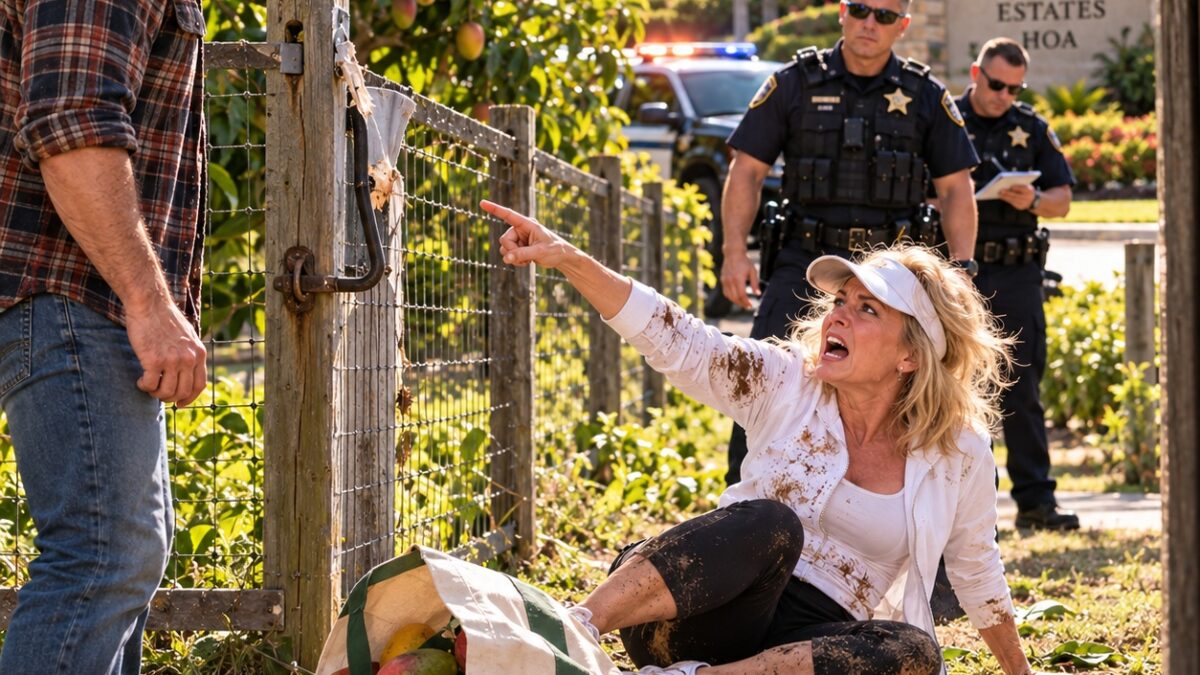
But there she was, sitting underneath a fence she had voluntarily climbed, surrounded by mangoes she had just removed from my trees, pointing toward my house as if I had somehow thrown her to the ground from fifty yards away.
I kept the phone to my ear.
The dispatcher asked, “Is the injured person conscious?”
“Yes.”
“Is she breathing?”
“Yes.”
“Is there severe bleeding?”
“Not that I can see.”
Martha yelled again.
“He trapped me!”
The dispatcher must have heard her through the phone.
“Sir, tell me exactly what happened.”
“She entered my property without permission,” I said. “She picked produce from my trees, attempted to climb back over the fence, caught her clothing on part of the fence, and fell.”
“That is not what happened!” Martha screamed.
I closed my eyes for a moment.
Of course it wasn’t.
Not in Martha’s version.
In Martha’s version, reality was something that happened to other people.
I gave the dispatcher my address and directions to the orchard.
She told me not to move Martha unless there was an immediate danger.
That suited me perfectly.
I wanted as little physical contact with her as possible.
I walked toward the fence but stopped several yards away.
Martha had managed to sit up.
One hand was pressed against her ribs.
The other gripped the grass.
Her tote bag lay open beside her.
Mangoes had rolled everywhere.
Some were bruised.
Two had split.
One had landed in a shallow irrigation channel.
She looked at me as though I had personally pushed her from a roof.
“You knew that was there.”
I looked at the metal hook.
It was an old piece of farm hardware protruding near one of the posts.
I had noticed it before.
I had even marked the section for eventual repair.
But it wasn’t hidden.
It wasn’t sharpened.
It wasn’t attached to a spring.
It wasn’t some trap waiting to catch a trespasser.
It was an old piece of metal on an old agricultural fence.
“You weren’t supposed to be climbing my fence,” I said.
“You knew somebody could get hurt.”
“Somebody using the gate wouldn’t.”
“I was inspecting the boundary.”
I looked down at the fruit.
“With a grocery bag?”
Her face hardened.
“I was collecting samples.”
“Samples.”
“For the community.”
“My mangoes don’t belong to the community.”
“You don’t understand HOA responsibility.”
I almost smiled.
I had spent months hearing variations of that sentence.
According to Martha, every fact she disliked was evidence that the other person simply didn’t understand.
I didn’t understand community standards.
I didn’t understand aesthetics.
I didn’t understand common property.
I didn’t understand liability.
The possibility that she might be wrong never seemed to occur to her.
“Martha,” I said, “you climbed a clearly marked private fence.”
“You should be helping me instead of interrogating me.”
“I called the ambulance.”
“Then stop talking.”
“Fine.”
I walked away.
The first police cruiser arrived before the ambulance had fully stopped.
That was when Martha performed one of the fastest personality changes I had ever witnessed.
The woman who had been swearing at me five minutes earlier suddenly became weak and soft-spoken.
“Thank God,” she whispered when the officer approached.
The officer looked at her, then me.
“What happened here?”
Martha pointed at me.
“I was conducting an HOA boundary inspection when I encountered an unsafe condition he knowingly left on his property.”
I actually stared at her.
Boundary inspection.
Not mango theft.
Not trespassing.
Boundary inspection.
The officer asked, “You’re with the HOA?”
“I’m the president.”
“And this property belongs to the HOA?”
“It adjoins our development.”
“That wasn’t the question.”
Martha paused.
“This parcel affects our community.”
I almost admired the way she could answer without answering.
The second officer had walked toward the mangoes.
He picked up the tote bag and looked inside.
“Were you harvesting fruit?”
“I was removing a nuisance condition.”
The officer looked around the orchard.
Rows of healthy trees stretched behind us.
“What nuisance?”
“Falling produce attracts animals and insects.”
I said, “She wasn’t taking fallen fruit.”
Martha snapped, “Nobody asked you.”
The officer turned toward her.
“I’m asking him now.”
He looked at me.
“You own the farm?”
“Yes.”
“You belong to this HOA?”
“No.”
“Ever belong to it?”
“No.”
“Is any portion of this orchard common property?”
“No.”
“Do you have documentation of the property line?”
“Yes.”
Martha interrupted.
“There have been ongoing boundary concerns.”
I looked at her.
That was new.
She had complained about noise.
She had complained about equipment.
She had complained about workers parking near the road.
She had complained about a shed.
But not once had she sent me a legitimate notice claiming the property line itself was disputed.
The first officer asked me about cameras.
I told him I had several.
“You captured what happened?”
“Everything.”
Martha’s head turned.
“Those cameras are illegal.”
The officer looked at her.
“How?”
“He’s been using them to monitor residents.”
“They’re pointed at my fence and orchard,” I said.
“You’ve been spying on me.”
“I’ve been recording my property.”
“You can’t just record people.”
The officer held up his hand.
“Ma’am, let us handle this.”
Martha looked personally offended that anyone would ask her to stop talking.
I went to the house for my tablet.
On the way, my stomach tightened.
I had dozens of recordings.
Until that moment, I had thought I was simply building evidence in case Martha eventually forced my hand.
Now I realized those videos might be the only thing standing between me and an accusation that I had intentionally hurt her.
That realization changed how the morning felt.
This was no longer an annoying property dispute.
Martha was injured.
She was furious.
And she had already begun constructing a story.
I opened the folder.
Dates.
Times.
Clips.
Weeks of them.
When I returned, emergency medical workers were examining her.
One officer stepped toward me.
“Show me today first.”
I opened the video.
There was Martha outside the fence.
She looked one direction.
Then another.
Placed the tote bag down.
Grabbed the top rail.
Climbed over.
The officer watched without saying anything.
Martha began immediately.
“That doesn’t show why I was there.”
No one responded.
On screen, she walked through the trees.
She didn’t inspect the fence.
She didn’t measure anything.
She didn’t photograph the boundary.
She went straight for the fruit.
She reached into the branches and twisted one mango free.
Then another.
And another.
She selected them carefully.
Ripe.
Undamaged.
Marketable.
The second officer leaned toward the screen.
“She’s picking them.”
“Yes.”
Martha said, “I was gathering them for community use.”
That was the first time she admitted it in front of the police.
The officer looked over.
“I thought you said you were conducting a boundary inspection.”
“I was.”
“With the bag?”
“The fruit was a secondary issue.”
“So you were taking it?”
“I was removing it.”
“Did he give you permission?”
“It was going to waste.”
“That isn’t what I asked.”
Martha’s jaw tightened.
“No.”
We continued.
The bag filled.
She carried it toward the fence.
She climbed.
Her shirt caught.
Her body rotated.
She fell.
That was it.
No one approached her.
No hidden mechanism moved.
No wire tightened.
Nothing happened except Martha attempting to climb a fence with a heavy bag and getting caught on a piece of metal.
The video continued.
Her first words after sitting up were audible.
Call the police. He did this to me.
The officer stopped the video.
He looked at Martha.
“You said he caused the fall.”
“He did.”
“How?”
“He left that dangerous metal there.”
“You said he did this to you.”
“He created the condition.”
“That’s different.”
“He knew I was coming.”
I laughed before I could stop myself.
Martha turned on me.
“You think this is funny?”
“No. I think that sentence is interesting.”
The officer looked at me.
“Why?”
“Because I specifically told her not to come back.”
His expression sharpened.
“When?”
“Several weeks ago.”
“Where?”
“At the HOA office.”
Martha said, “He threatened me.”
“I told you if you trespassed again, I would call the police.”
“That was threatening.”
The officer wrote something down.
Then he asked, “You said there were previous incidents?”
“Yes.”
“How many?”
I opened the folder.
Martha saw it.
Her expression changed.
“This is harassment.”
The officer said, “Ma’am, please stop interrupting.”
“He has been collecting footage of me.”
“Were you on his property in that footage?”
“That’s not the point.”
The officer looked at her.
“It may be.”
I played the first clip.
Different morning.
Different clothing.
Same fence.
Martha climbed over.
Picked mangoes.
Climbed back.
Next clip.
Same.
Next.
Same.
Another.
Same.
One recording showed another HOA board member standing outside the fence.
He kept watch while Martha entered the orchard.
Martha immediately said, “He had nothing to do with this.”
The officer looked at her.
“Do you know what day this was?”
She stopped talking.
Another clip showed her dropping one mango while climbing back out.
She got completely over the fence.
Then noticed the mango lying inside.
She actually climbed partially back to retrieve it.
For some reason, that small moment angered me more than everything else.
She could not even leave one.
The officers watched several clips in silence.
Martha became more agitated with every one.
Finally she said, “You deliberately allowed this to continue.”
I looked at her.
“I came to your office and told you to stop.”
“No. You were setting me up.”
“I warned you.”
“You wanted this.”
“I wanted you off my land.”
“You’re obsessed with me.”
The accusation was so absurd that I nearly laughed again.
My entire life revolved around the orchard.
Harvest schedules.
Workers.
Irrigation.
Storm forecasts.
Market prices.
Shipping.
Equipment.
Martha was not an obsession.
She was an interruption.
A loud one.
I had gone to the HOA office precisely because I wanted the problem to end quietly.
I could have gone directly to the police.
I hadn’t.
I gave her a chance to stop.
She took that chance and turned it into a challenge.
The officer asked whether anyone heard our office conversation.
“The receptionist may have heard part of it.”
Martha said, “He came into my office aggressively.”
“I didn’t raise my voice.”
“You accused me of theft.”
“You were stealing.”
“I was preventing food waste.”
The officer glanced at me.
I said, “That is almost exactly what she told me the first time.”
Martha realized what she had done.
“I didn’t say I took anything.”
“You just said you were preventing food waste.”
“Generally.”
The officer wrote again.
She watched his pen moving.
Her face reddened.
“Are you actually investigating me?”
“We are investigating what happened.”
“I am president of that HOA.”
He looked toward the subdivision.
“And?”
“I represent hundreds of homeowners.”
“Does that give you permission to enter this property?”
Martha opened her mouth.
Closed it.
The emergency workers wanted to transport her for evaluation.
She resisted.
She wanted to keep arguing.
The police eventually told her the medical issue could be handled separately from the trespassing complaint.
One officer then asked me whether I wanted to formally pursue the theft and unauthorized entries.
“Yes.”
Martha stared at me.
“You cannot be serious.”
“I am.”
“Over mangoes?”
That question finally made me angry.
Not loud.
Not wild.
Just tired enough that I stopped protecting her from the truth.
“No, Martha. Not over mangoes.”
She folded her arms.
“Then what?”
“Over you deciding that my permission doesn’t matter.”
She laughed bitterly.
“You’re going to ruin your relationship with an entire community because of fruit.”
“If you had asked me for ten mangoes for an HOA picnic, I probably would have handed you twenty.”
Her face shifted slightly.
“I donate fruit. I give neighbors fruit. I send boxes to people who help me. This was never about whether I could spare a few mangoes.”
“Then why are you making such a big issue?”
“Because you didn’t ask.”
She stared at me.
I continued.
“You climbed my fence. I told you to stop. You kept doing it. That is the issue.”
For a second, neither of us spoke.
Then I said the part I had finally understood.
“You didn’t steal fruit because you needed it. You stole it because you thought you had the right to ignore me.”
Her eyes became cold.
The officer stepped between us before she could respond.
He took the rest of my statement.
Then Martha changed her explanation again.
She told him the orchard might partially extend onto HOA-controlled land.
The officer asked for a survey.
She didn’t have one.
A plat.
No.
An easement.
No.
Written authority from the property owner.
No.
Any official legal dispute over the boundary.
No.
Prior notice to me that she intended to enter.
No.
The officer looked at the tote bag.
“What were you planning to do with the fruit?”
Martha hesitated.
“They were samples.”
“For what?”
“Community review.”
“What does that mean?”
“I don’t know.”
“How many samples did you need?”
Silence.
It was the first silence Martha had offered all morning.
Eventually, the officers told her the evidence supported allegations of trespassing and theft.
That was when the calm victim disappeared.
“You are not arresting me.”
One officer told her to turn around.
She looked at me.
“This is his fault.”
I said nothing.
“He should be arrested!”
The officer repeated his instruction.
“He created the hazard!”
“Martha,” I said quietly.
She pointed at my house.
“He has illegal cameras!”
“Ma’am.”
“He set this whole thing up!”
“Martha.”
Her eyes locked on mine.
“You’re going to regret this.”
The officer heard her.
“That’s enough.”
They took her toward the cruiser.
I stayed inside my property.
The sight was strange.
Martha had spent months behaving as if my fence were meaningless.
Now a police officer was escorting her past it.
The moment should have felt satisfying.
It didn’t.
After the vehicles left, I stood alone beside the scattered fruit.
The adrenaline drained out of me.
My hands started shaking.
I picked up the mangoes one by one.
The salvageable ones went into a crate.
The split ones went to compost.
I recovered the tote and turned it over to the officer before he left as part of the incident documentation.
Then I returned to my kitchen.
My coffee was cold.
Again.
I warmed it.
Sat down.
And replayed the fall.
I watched Martha’s shirt catch.
Watched her twist.
Watched her land.
Then I backed up and watched it again.
Maybe that sounds strange.
But an accusation repeated loudly enough can start doing something to your mind.
I knew I had not touched the fence.
I knew I had not set a trap.
I knew the hook had been there for years.
Still, when a person stands in front of uniformed officers and insists that you deliberately hurt them, part of your brain begins checking itself.
Had I moved anything?
No.
Had I changed the fence?
No.
Had I sharpened the hook?
No.
The old footage proved it.
Same hook.
Same position.
Weeks earlier.
Months earlier.
I backed everything up.
The original camera system.
An external drive.
Cloud storage.
I made a separate folder containing the exact clips shown to police.
At the time, it felt excessive.
A few days later, a process server arrived.
He handed me a thick envelope.
Martha was suing me.
I remember standing by the gate and staring at the first page.
Her name.
My name.
A legal complaint.
I read the claims.
Negligence.
Dangerous condition.
Failure to maintain the fence.
Harassment.
Invasion of privacy.
Emotional distress.
Physical injury.
Damage to her professional reputation.
I read the pages twice.
The language was clean and formal.
No shouting.
No insults.
No talk about rotting mangoes.
But underneath the legal vocabulary sat the same story Martha had been building from the moment she hit the ground.
She had entered my property.
She had taken my fruit.
She had injured herself while trying to leave.
And somehow the responsibility belonged to me.
One section described her as having entered the area “in furtherance of association-related boundary oversight.”
Boundary oversight.
I said the words aloud at my kitchen table.
They sounded ridiculous.
Another section alleged that my cameras had created an intimidating and hostile surveillance environment.
I looked toward the monitor mounted near the pantry.
The system had been installed because farms have theft.
Vandalism.
Equipment problems.
Wildlife.
Trespassers.
Apparently Martha believed that once she became the person repeatedly caught on the cameras, the cameras became an attack against her.
I called an attorney.
Her name was Rebecca Hayes.
I had used her firm years earlier for a property-contract issue, though nothing remotely like this.
Rebecca listened while I explained.
She didn’t interrupt much.
Then I placed a drive containing the videos on her desk.
“Start with that.”
She watched the first clip.
Then the second.
Then the third.
She paused.
“How many times did she enter?”
“I have more than what you’re seeing.”
“And you spoke to her before some of these?”
“Yes.”
“You explicitly told her to stop?”
“Yes.”
“She returned anyway?”
“Yes.”
Rebecca watched another recording.
“Did you ever give her permission?”
“No.”
“Did you ever tell the HOA they had access rights?”
“No.”
“Any easement?”
“No.”
“Any shared boundary maintenance agreement?”
“No.”
I gave her the deed.
Survey.
Correspondence from Martha.
Photographs.
Maintenance notes.
Everything.
Rebecca read one of Martha’s old letters about my tractor.
“She actually sent this?”
“Certified mail.”
She smiled slightly.
“She likes paperwork.”
“She likes authority.”
Rebecca looked up.
“Those are not always the same thing.”
That sentence stayed with me.
We reviewed the fence.
The hook.
The location.
The warning signs.
Rebecca asked whether the hook had been installed recently.
“No.”
“Did you modify it?”
“No.”
“Move it?”
“No.”
“Sharpen it?”
“No.”
“Was it concealed?”
“No.”
“Would somebody entering through the gate come into contact with it?”
“No.”
She nodded.
Then I asked what I really needed to know.
“Can she win?”
Rebecca took a breath.
“I’m not going to tell you no just to make you feel better.”
My stomach tightened.
“She has injuries. She has a lawsuit. That means we respond seriously. But filing something is not the same as proving it.”
“She was trespassing.”
“Yes.”
“She was stealing.”
“Yes.”
“It’s on video.”
“Yes.”
“So why am I worried?”
“Because you’re a normal person who has never been sued over somebody else climbing your fence.”
That was probably the most reassuring thing she said.
Not because it promised victory.
Because it accurately described what the lawsuit felt like.
For the next several weeks, every envelope made my stomach drop.
Every unknown number on my phone made me stop whatever I was doing.
Legal disputes consume attention.
Even when your position is strong.
Even when the allegations seem absurd.
Time gets pulled away.
Money gets pulled away.
Sleep gets pulled away.
And suddenly I understood exactly what Martha meant when she had told me people like me backed down once things became expensive.
She had not been predicting the law.
She had been predicting exhaustion.
She believed if she created enough pressure, the truth would become less important than the cost of defending it.
That idea bothered me more than the lawsuit itself.
I began seeing her strategy everywhere.
The old HOA letters.
The repeated complaints.
The office confrontation.
Her certainty with the police.
The immediate lawsuit.
Martha didn’t always need authority.
She needed other people to believe she had it.
And when belief failed, she used inconvenience.
A person who wanted peace might simply give in.
I wanted peace.
Badly.
But not that kind.
The neighborhood next door became strangely quiet after the arrest.
At first, nobody approached me.
Then one Saturday morning, a woman named Claire stopped at my small roadside farm stand.
I recognized her as somebody from the subdivision.
She bought a box of mangoes.
While I counted change, she said, “Can I ask you something?”
“You can.”
“Was Martha really taking these from your orchard?”
I looked at her.
“You’d have to ask Martha.”
Claire gave me a tired smile.
“That means yes.”
I didn’t respond.
She looked at the fruit.
“We were wondering.”
“About what?”
“The mangoes at the HOA meetings.”
My hand stopped.
“What mangoes?”
“Martha started bringing trays. Sliced mangoes. She said she had a supplier.”
I stared at the orchard.
“How often?”
“A few times this summer.”
I thought about the dates.
The thefts.
The larger bags before community events.
The pattern made sense.
I didn’t need Claire’s story for my case.
The camera footage was enough.
But something about the image angered me.
Martha standing in the clubhouse.
Accepting compliments.
Serving fruit she had climbed a fence to steal.
Claire must have seen my face.
“I’m sorry.”
“You didn’t do it.”
“No. But people let her get away with things.”
I looked at her.
“What things?”
Claire hesitated.
“Nothing like this, as far as I know. She just… makes everything sound like the board decided it.”
“Even when it didn’t?”
“Sometimes.”
She lowered her voice.
“If Martha wanted something, she was very good at making people believe resisting would create a bigger problem.”
That sounded familiar.
Claire took her box and left.
I wrote down the conversation afterward.
By then, documentation had become a habit.
The lawsuit moved forward.
Martha continued claiming she had entered because of boundary concerns.
Then sanitation concerns.
Then community concerns.
Her attorneys were more disciplined than she was, but they had to work with the facts she had given them.
And facts were not kind to Martha.
The videos showed her crossing a posted fence.
The videos showed her harvesting fruit.
The videos showed repeated visits.
The videos showed visits after I warned her.
The videos showed the hook unchanged.
And the videos showed her fall happening without any action from me.
People can fight over memories.
They can argue about tone.
They can reinterpret conversations.
Video is harder.
The camera had no opinion.
It didn’t care that Martha was HOA president.
It didn’t care that I was a farmer.
It recorded what happened.
That became my anchor.
Whenever the lawsuit made me feel as if reality itself were becoming negotiable, Rebecca would remind me.
“Go back to the evidence.”
So I did.
A few weeks before the hearing, Martha’s side suggested a settlement.
Rebecca called me into her office.
“They’re proposing mutual releases.”
“What does that mean in this case?”
“You pay an amount. They dismiss the civil claims. You both agree not to pursue certain additional matters against the other.”
“How much?”
She told me.
It wasn’t life-changing money.
But it was enough to hurt.
I stared at her.
“They want me to pay Martha.”
“That is what they’re proposing.”
“For getting injured while climbing my fence with stolen fruit.”
“I’m not arguing the logic.”
I stood and walked to the window.
For the first time, I considered it.
Really considered it.
Pay.
Make it disappear.
Stop thinking about attorneys.
Stop saving every letter.
Stop wondering whether some new accusation would arrive.
Stop seeing Martha every time I checked the fence.
Rebecca let me think.
Then she said, “You need to decide based on what you can live with. Settlement is not always an admission. Sometimes people settle because litigation is expensive.”
There it was.
Expensive.
Martha’s voice returned immediately.
People like you always back down once this gets expensive.
I turned around.
“No.”
Rebecca nodded slowly.
“You’re sure?”
“If I pay her, she’ll believe this worked.”
Rebecca studied me.
“That’s not a legal reason.”
“I know.”
“It’s a personal one.”
“Yes.”
She closed the folder.
“Then we prepare for court.”
Court arrived on a gray morning.
I wore a suit I had not worn in years.
The collar felt wrong.
The shoes felt worse.
I was accustomed to boots and work clothes.
The courthouse smelled like old paper, polished floors, and air-conditioning.
Martha arrived with her attorney.
Her arm was still supported.
I did not question whether she had been hurt.
She had.
The video showed a painful fall.
My position had never been that Martha deserved injury.
I didn’t want her injured.
I wanted her to stop stealing.
Those were different things.
She looked at me across the room.
For a moment, we held eye contact.
Then she looked away.
The hearing began quietly.
No television-style speeches.
No shouting.
Documents.
Procedures.
Questions.
Martha’s attorney presented her as an HOA president attempting to resolve concerns near a disputed boundary.
He emphasized the metal hook.
The condition of the fence.
Her injuries.
He described my camera coverage as excessive.
He suggested I knew she was likely to return and failed to correct a dangerous condition.
If you heard only his version, you might have thought Martha had been walking along a sidewalk when a rusty blade jumped out at her.
Then Martha testified.
She spoke softly.
Nothing like the woman who had shouted at police.
She described herself as concerned about the safety and appearance of the community.
She said the farm’s proximity had created ongoing issues.
She said she had been examining the boundary.
Rebecca stood.
“Did you remove mangoes from Mr. Mercer’s trees?”
Martha paused.
“I collected some fruit.”
“Did you pay for it?”
“No.”
“Did he give you permission?”
“No.”
“Did you ask permission?”
“I did not believe it was necessary.”
“Why?”
“Because the fruit was related to the concerns we were evaluating.”
Rebecca looked at her.
“What concern requires putting ripe mangoes in a tote bag?”
Martha’s attorney objected.
The judge allowed Rebecca to rephrase.
“What did you do with the mangoes after you removed them?”
“Some may have been brought to community events.”
Rebecca stopped.
She did not immediately ask another question.
The silence grew.
Martha shifted slightly.
Rebecca finally said, “So they were consumed.”
“Some may have been.”
“They were not tested.”
“No.”
“Not photographed as evidence of a nuisance.”
“Not that I recall.”
“Not submitted to an expert.”
“No.”
“Not preserved for an HOA report.”
“No.”
“Instead, they were served at events.”
“I said some may have been.”
Rebecca nodded.
Then she played the footage.
The first clip.
Martha climbed the fence.
Picked mangoes.
Left.
Second clip.
Same.
Third.
Same.
Fourth.
Again.
The judge eventually asked, “How many incidents were documented?”
Rebecca answered.
“Multiple entries over several weeks.”
The judge looked toward Martha.
“And these were all related to boundary inspection?”
Martha said, “The broader issue involved several concerns.”
The judge watched another clip.
This one showed Martha walking past a private-property sign before climbing.
Another showed the HOA board member waiting outside.
Another showed Martha returning after my office warning.
Rebecca asked me to testify about the confrontation.
I told the court exactly what I remembered.
I had shown up calmly.
I told Martha I had footage.
I told her she was trespassing.
She argued that the mangoes would rot.
I told her they belonged to me.
I warned her not to return.
Then I repeated her final line.
“People like you always back down once this gets expensive.”
Martha’s attorney objected to the characterization and context.
The judge handled it.
I did not need that sentence to win anything.
But saying it out loud in the courtroom felt strangely important.
Because now the lawsuit made sense inside that sentence.
Rebecca produced my deed.
The survey.
Boundary records.
The judge reviewed them.
Then he looked at Martha.
“Do you have documentation showing HOA ownership of any portion of Mr. Mercer’s orchard?”
“No.”
“An easement?”
“No.”
“Inspection rights?”
“No.”
“Written permission to enter?”
“No.”
“Any pending boundary action?”
“No.”
“Then explain to me what legal authority you believed allowed you to enter his property.”
Martha started discussing association responsibility.
The judge stopped her.
“I am asking about his property.”
“I believed the boundary was not clearly resolved.”
“According to what document?”
She hesitated.
“There had been discussion.”
“Where?”
“Within the association.”
“Do you have minutes?”
“I don’t know.”
“A written complaint?”
“I don’t know.”
“A survey contradicting his?”
“No.”
The judge leaned back.
For the first time, Martha looked uncertain.
Her attorney shifted toward the fence.
That brought us to the fall.
The video played.
Martha approaching the fence with the heavy tote.
Martha climbing.
The shirt catching.
The sudden rotation.
The impact.
I hated the sound.
Even in court.
Even after everything she had done.
Pain is pain.
I would have preferred none of it happened.
But the recording also showed the truth with brutal simplicity.
I was nowhere near her.
Nobody touched the fence.
Nobody activated anything.
The hook was already there.
Rebecca played older footage showing the same post.
Same hook.
Same position.
Weeks earlier.
Nothing altered.
Nothing hidden.
Nothing installed in anticipation of Martha.
The judge asked me directly, “Were you aware of this metal piece?”
“Yes.”
“When?”
“Before the fall.”
“Why was it still there?”
“It was on my repair list. We were in the middle of harvest work and other repairs had priority.”
“Did you leave it because you expected Ms. Ellison to return?”
“No.”
“Did you want her to get hurt?”
“No.”
“Did you expect anyone to climb that section?”
“No.”
He looked at me.
“But you knew she had climbed it before.”
“Yes.”
That was the question Rebecca had warned me about.
I answered honestly.
The judge continued.
“Why did you not call the police immediately after the first incident?”
“I hoped the direct warning would stop it.”
“You continued recording?”
“Yes.”
“Were you trying to catch her?”
“I was trying to document what she was doing.”
“That isn’t exactly the same answer.”
“No, sir.”
The room became very quiet.
I thought about it.
Then I said, “I wanted to wake up and never see her on the footage again. That was what I wanted.”
The judge watched me.
“I didn’t want an arrest. I didn’t want a lawsuit. I didn’t want her hurt. I wanted her to stop entering my property.”
That was the truth.
Maybe not dramatic.
But true.
Rebecca pointed out the private-property signs.
The locked gate.
The fact that legitimate access existed.
Martha had not been injured using the gate.
She had been injured choosing to climb the fence.
Then the police statements came up.
That was when Martha’s story began collapsing under its own weight.
The officer’s report documented her claim that she was inspecting the boundary.
Then her claim that she was removing nuisance fruit.
Then her statement about community use.
Then her claim about samples.
Then her accusation that I had intentionally caused the fall.
Each explanation had shifted depending on the question.
Martha said she had been in pain.
Confused.
Upset.
Her words had been misunderstood.
Her attorney argued that trauma can make immediate statements imprecise.
That was fair enough.
But the problem was not one confused sentence.
It was the entire pattern.
She had one explanation in her office.
Another at the fence.
Another for police.
Another in the lawsuit.
Another under oath.
Eventually, the judge interrupted.
“A private association does not acquire authority over neighboring property because it dislikes conditions on that property.”
Martha sat very still.
The judge continued.
“A title within an HOA does not create a right of entry onto land outside that HOA.”
Her attorney began to speak.
The judge raised his hand.
“And repeatedly removing produce without permission is not transformed into an inspection merely by describing it that way after the fact.”
I looked down.
For months, I had felt as if I were fighting to prove the obvious.
My land was mine.
The fence was mine.
The trees were mine.
The mangoes were mine.
I had begun to resent the fact that I had to defend statements so basic.
Hearing the judge say it did something to me.
Not triumph.
Relief.
The court rejected Martha’s claims against me.
The final orders were less cinematic than people imagine.
Legal conclusions.
Findings.
Costs.
Restitution.
The court addressed the stolen produce.
Damage.
Certain legal expenses.
Other fees connected to the incident.
The exact numbers mattered less to me than Martha’s reaction.
She looked stunned.
Not angry at first.
Stunned.
As if she had spent so long believing her version would eventually become true that she had not prepared herself for someone with authority to reject it.
Outside the courthouse, Rebecca and I stopped on the steps.
I breathed in deeply.
“Is it over?”
“The civil case is.”
I nodded.
People walked around us.
I heard whispers.
Then Martha came through the doors.
She saw me.
I expected anger.
She did not say anything.
She simply stared.
Then looked away.
That silence bothered me.
Rebecca noticed.
“She threatened you after the arrest?”
“Yes.”
“More than once?”
“Yes.”
“Consider a protective order.”
I did.
That same week, I filed.
I provided the police report.
The footage.
The repeated unauthorized entries.
The threats.
The court findings.
The order was granted.
Martha was not permitted to enter my farm.
Not permitted to approach my business.
Not permitted to contact me.
I understood what a piece of paper could and could not do.
It could not physically stop a person determined to behave badly.
But it removed the last possible excuse.
No confusion.
No misunderstanding.
No boundary inspection.
No community responsibility.
Stay away.
The HOA replaced Martha soon afterward.
I learned about it from a resident named George who came to buy fruit.
“They held a meeting,” he told me.
“And?”
“She’s out.”
“As president?”
“As far as I know, completely off the board.”
I nodded and went back to packing his box.
George waited.
“That’s all?”
“What else should I do?”
“I expected you to celebrate.”
“I have three pallets leaving tomorrow.”
He laughed.
“You really don’t care?”
“I cared when she was climbing my fence.”
George shook his head and paid for six mangoes.
Before leaving, he held the bag up.
“Look at this. I bought them.”
I laughed.
“Very advanced system.”
“I heard it might catch on.”
That was the first time the entire situation made me genuinely laugh.
After Martha left the board, the HOA letters stopped.
No more concerns about my tractor.
No more complaints about the shed.
No more comments about workers’ vehicles.
No more suggestions that my farm should somehow conform visually to a subdivision built beside it.
Nothing.
The silence felt suspicious at first.
I would check the mailbox and expect another certified envelope.
Nothing.
A week.
Two weeks.
A month.
Nothing.
The camera alerts became boring.
I loved it.
A deer walking the perimeter.
A raccoon disappearing beneath a tree.
Wind.
Rain.
A delivery driver taking the wrong turn.
Normal life.
Beautiful, uneventful, ordinary life.
I repaired the fence.
The hook came out.
I kept it in a storage shed until Rebecca confirmed there was no reason to preserve it anymore.
Then one afternoon, I tossed it into the scrap bin.
It hit the bottom with a dull metallic clang.
I stood there staring at it.
For months, that little piece of rusted metal had been described in court documents as a dangerous condition.
A trap.
A central piece of evidence.
To me, it was suddenly just junk.
The orchard continued growing.
That was perhaps the best lesson of the entire mess.
Trees do not care about human drama.
They care about water.
Soil.
Pruning.
Weather.
Disease.
Timing.
You can spend all night worrying about lawyers and still have irrigation lines to check at sunrise.
The work kept me sane.
That season, the mango crop came in heavy.
Branches sagged.
Some needed supports.
Crates filled faster than expected.
Workers moved through the rows laughing and calling to each other.
The farm slowly stopped feeling like the place where Martha had fallen.
It became my farm again.
One morning, I walked along the fence line.
The spot where she used to climb looked completely ordinary.
New hardware.
Repaired wire.
Private-property sign.
Beyond it were the roofs of the subdivision.
For months, every time I looked in that direction, I had felt tension.
Now I felt almost nothing.
That was freedom.
Not revenge.
Not watching Martha lose her position.
Not the court ruling.
The real victory was reaching a morning when she did not occupy space in my head.
Still, I thought about something she had said.
People like you always back down once this gets expensive.
I finally understood what had bothered me about those words.
It wasn’t that she thought farmers were weak.
It was that she understood something ugly about conflict.
Most decent people do not enjoy fighting.
They have jobs.
Families.
Bills.
Responsibilities.
They want peace.
And somebody who enjoys confrontation can use that desire for peace against them.
Martha created friction.
Letters.
Complaints.
Threats.
Legal costs.
Public embarrassment.
She expected me to eventually ask myself whether the mangoes were worth all of it.
And if the question had really been about mangoes, the answer might have been no.
The fruit was not worth months of stress.
But the boundary was.
Permission was.
The principle that another person does not get to take your property simply because resisting them is inconvenient was.
I did not need Martha punished.
I needed her stopped.
Those were different things.
One afternoon later that summer, I drove past the subdivision clubhouse after making a delivery.
There was an outdoor community event happening.
Tables.
Paper cups.
Children running around.
Food trays.
I would have driven past without another thought.
Then I noticed mangoes.
For one brief second, my chest tightened.
Old reflex.
Then I saw the boxes underneath the table.
My farm name was printed on them.
They had bought the fruit.
I slowed slightly.
Then laughed.
That was it.
That was the entire solution.
You want something that belongs to somebody else?
Ask.
Pay.
Respect the answer.
A concept simple enough that it should never have required police, attorneys, and a courtroom.
I kept driving.
The next morning, I woke before sunrise.
Coffee.
Weather.
Camera footage.
One raccoon.
A deer.
Branches moving in the wind.
No Martha.
I closed the app.
Outside, the sky was beginning to lighten over the orchard.
I walked toward the western rows where several trees were carrying too much fruit.
One branch was bending badly, so I braced it.
Sap stuck to my fingers.
The air smelled warm and green.
I could hear irrigation water running somewhere behind me.
For the first time in a long time, the subdivision beyond the fence felt like exactly what it should have been.
Somebody else’s neighborhood.
Not my problem.
I stood beneath one of the mango trees and looked at the fruit hanging untouched.
For months, I had thought I was in a battle with Martha.
I wasn’t.
Mostly, I had been trying to keep reality from being talked out of existence.
Martha climbed the fence.
Martha took the mangoes.
Martha ignored the warning.
Martha came back.
Martha fell.
Martha blamed me.
Martha changed her story.
Martha sued me.
And every attempt to escape responsibility gave everyone another reason to look more closely at what she had done.
I never needed to invent revenge.
I never needed to sabotage her.
Never needed to threaten her.
Never needed to trap her.
All I had to do was keep records and refuse to accept her version of my own property.
That was enough.
Eventually, the HOA got a new president.
The court gave me clarity.
The protective order gave me distance.
The repaired fence gave me back a boundary that no longer felt like a battlefield.
And the orchard gave me something better than vindication.
It gave me my ordinary life again.
Late one evening near the end of harvest, I stayed after everyone went home.
The sun was low.
The rows were quiet.
No police lights.
No lawyers.
No certified letters waiting at the gate.
No woman in a visor climbing where she did not belong.
Just warm air moving through leaves.
I reached up and picked one ripe mango.
Perfect skin.
Good weight.
Ready.
I turned it once in my hand.
For a second, I thought about Martha.
Then I realized something.
I wasn’t angry anymore.
I didn’t care where she lived.
I didn’t care what she told people.
I didn’t care whether she still believed she had been right.
She was no longer on my property.
No longer in my business.
No longer controlling my mornings.
And that was more satisfying than any punishment could have been.
I put the mango into a crate and walked back toward the house.
Behind me, the repaired fence stood quietly in the fading light.
It was only a fence again.
Exactly as it should be.








