FULL ENDING:The HOA President Sold My Private Shoreline to Strangers and Told 86 Families I Was the One Stealing From Them
PART 2 and FULL ENDING  Thank you

At first, they came one family at a time.
That was part of what made the situation so difficult to understand.
Nobody arrived looking like a trespasser.
There were no teenagers cutting fences, no drunks leaving beer cans by the dock, no people acting as though they knew they were somewhere they did not belong.
I would come home from a twelve-hour outage at the plant and see a couple carrying folding chairs down through the trees.
A yellow kayak appeared one afternoon, pulled high enough above the waterline that whoever left it clearly intended to come back.
One Sunday, four people were fishing from the flat grass on my east shore.
I walked down.
A man in a faded ball cap lifted his hand.
“Morning.”
“Morning.”
I looked at the rods, the cooler, the tackle boxes.
“You folks live around here?”
He nodded toward Fox Hollow.
“Yeah. Association members.”
I hesitated.
“Did somebody tell you this shoreline belongs to the association?”
The confusion on his face was immediate.
Not guilt.
Confusion.
“They told us the HOA has the lake.”
He gave a little shrug.
“We’re current on our dues.”
I remember looking at him and realizing he believed every word he had just said.
That mattered to me.
People later asked why I did not immediately start calling deputies and posting cameras and running everyone off.
Because he was not my enemy.
He was a guy holding a fishing rod and a soda who had been told by people he trusted that he had every right to stand there.
So I explained that the south shoreline was private property.
He apologized.
He packed up.
The others followed.
No argument.
I thought maybe that would be the pattern.
Then the language started changing.
Fox Hollow’s website referred to “our private community lake.”
Their monthly newsletter, which someone kept putting in my mailbox even though I was not a member, ran a sunset photograph of Brierwood beneath the words LAKESIDE LIVING.
A carved cedar sign appeared near their clubhouse.
FOX HOLLOW ESTATES.
LAKESIDE LIVING.
ESTABLISHED 1998.
None of that transferred property.
None of it created an easement.
But repetition has power.
If people hear “our lake” often enough, eventually asking who actually owns what begins to sound rude.
The geography made their interest obvious once I started paying attention.
Fox Hollow occupied most of the north and northwest side of Brierwood.
It was attractive land, but the shoreline was steep.
Rocky.
Full of stumps.
Launching a boat from their side would have required excavation, retaining work, and real money.
My side was different.
The Denholm parcel wrapped around the south shore and southeast cove.
Near the dam was a low gravel shelf where Roy’s father had once backed an old flatbed down to launch a johnboat.
It was nothing fancy.
Just a gentle slope of gravel and clay.
But it was the only easy trailer access anywhere around the lake.
In May, I ran into Sloan in the parking lot of the hardware store.
She had a rolled-up plan in the back of her SUV.
I decided to ask her directly.
“Sloan, does Fox Hollow have a recorded easement across my shoreline?”
She gave me that patient expression.
“The association has had lake access for years.”
“That isn’t what I asked.”
Her eyes sharpened slightly.
I repeated myself.
“Is there a recorded right?”
She opened the back of the SUV and pulled out the plan.
She spread it across the hood.
It was a beautiful subdivision exhibit.
Green common areas.
Blue water.
Neat lot numbers.
At the south end, somebody had shaded a pale-blue shape and labeled it LAKE ACCESS AREA.
Sloan tapped it with one fingernail.
“There.”
I looked at the map.
Then at her.
“What’s the book and page?”
“The what?”
“The deed book and page number for the easement.”
Her mouth tightened.
“The association’s attorney reviewed this years ago.”
“That may be true. What’s the recording reference?”
She rolled the plan halfway closed.
“Maybe maps make more sense to you than legal language.”
I had spent nineteen years reading hydraulic diagrams, electrical schematics, equipment drawings, tolerances, failure reports, and manuals written by engineers who apparently believed punctuation was a weakness.
I knew exactly what she was doing.
But there is a point in an argument where satisfying yourself and helping yourself become two different things.
I chose the second one.
“A map used to sell houses isn’t a deed,” I said. “If the right exists, give me the book and page.”
She rolled the rest of it up.
“I appreciate your diligence.”
The way she said diligence made it sound like a hobby I had picked up because I had too much free time.
Then she drove away.
On the road home, I kept thinking about what she had not given me.
At work, when a maintenance supervisor brings you a photograph of a pump instead of the nameplate information you asked for, there is usually a reason.
The photograph is not the thing you need.
It is the thing he has.
A few weeks later, my coworker Terry Loudermilk walked into the break room holding his phone.
“You live on Brierwood, don’t you?”
“Yeah.”
He turned the screen toward me.
“You seen this?”
It was an advertisement from a county classifieds page.
At the top was a photograph of Lake Brierwood at golden hour.
I recognized the angle immediately.
It had been taken from my dock.
Across the photograph were the words:
BRIERWOOD SUMMER LAKE PASS.
Underneath was a list.
Kayaking.
Fishing.
Paddleboarding.
Boat launching.
Weekend access.
Dawn to dusk.
Season pass: $195.
Trailer launch: $35.
Available to Fox Hollow residents and the surrounding community.
Proceeds benefiting clubhouse improvements.
At the bottom was a simplified map.
An anchor icon had been placed directly over the old Denholm launch slope.
I read the ad three times.
Terry watched my face.
“That yours?”
“The ground is.”
“You know they’re charging people?”
“I do now.”
That was the moment the problem changed for me.
A neighbor cutting across your field because somebody gave him bad information is one thing.
A corporation selling tickets to your field is another.
One is misunderstanding.
The other has invoices.
I printed the advertisement the next morning.
I dated the margin.
I slid it into a manila folder.
I did not know it yet, but that folder was going to become the most valuable object in my house.
Two mornings later, at seven o’clock, I heard heavy equipment.
I walked outside and saw a dump truck turning onto the old ramp cut.
By the time I reached the slope, a skid steer was spreading crushed stone toward the water.
There was already one load down.
Another truck was waiting.
The operator shut the machine off when he saw me.
He climbed down.
“Morning.”
“Morning. Who hired you?”
He was a decent man named Dale.
No attitude.
No games.
He reached into the cab and handed me a clipboard.
The work order called for eighty-five tons of crusher run.
PLACE AND GRADE BOAT RAMP APPROACH.
LAKE BRIERWOOD SOUTH ACCESS.
At the bottom, in blue ink:
Sloan Whitaker, HOA President.
My heart started beating harder.
Not because I was afraid of Dale.
Because concrete actions have a way of making abstract disrespect feel physical.
They had ordered trucks.
They had spent money.
They had sent machinery onto my land.
They had begun altering the ground as if my ownership were a clerical inconvenience.
“Dale, I need you to stop.”
He nodded immediately.
“No problem.”
“I’m not blaming you. But this is private property.”
“I can call the office.”
“I’ll make the call.”
I photographed everything first.
The work order.
The fresh gravel.
The skid-steer tracks.
The disturbed grass.
The old iron boundary pin in the weeds.
Then I called Sloan.
She answered on the second ring.
“Good morning, Wade.”
“Your contractor is grading a boat ramp on my parcel.”
A pause.
Not surprise.
Just silence.
“I’ve asked him to stop.”
Her voice stayed calm.
“The board approved improvements to a long-standing access area under Article Seven.”
“Your bylaws don’t give you authority over land outside your association.”
“This access predates your ownership.”
“Then send me the recorded easement.”
She exhaled.
“Wade, you are holding an entire community hostage over a patch of mud beside a lake.”
I looked at the fresh rock extending down my slope.
“You sent eighty-five tons of stone onto property you don’t own.”
“And you’re a mechanic with a tractor pretending to be a land-use attorney.”
There it was.
She probably thought that sentence would make me angry.
It did.
Just not in the way she expected.
I had been talked down to before.
Men who work industrial maintenance get used to it.
You can save a facility six figures in downtime and still have somebody in loafers call you “the maintenance guy” while explaining your own equipment back to you.
Usually you let it go.
You fix the machine.
You go home.
But I was standing on my own land.
I had bought every foot of it legally.
And this woman had sent a skid steer onto it because she was convinced the man answering her phone call did not possess the kind of intelligence that mattered.
I let four seconds pass before speaking.
“I’ll send my request in writing.”
Then I hung up.
That afternoon I wrote one page.
No anger.
No accusations.
No threats.
I wrote it the same way I write an equipment failure report.
Condition.
Evidence.
Requested corrective action.
I asked Fox Hollow Estates to provide any recorded instrument granting it recreational or commercial access across my parcel, including the book and page number.
I sent it certified mail.
Return receipt requested.
When the green card came back, I saved it.
Eight days later, an envelope arrived on association letterhead.
Inside was a single sheet.
Four words.
Our attorney disagrees.
That was it.
No lawyer’s name.
No deed.
No easement.
No book.
No page.
Behind the letter was another copy of the same colorful subdivision map.
I stood at my kitchen counter staring at it.
Then I laughed once.
Not because anything was funny.
Because people who have the paper send you the paper.
If somebody accused me of failing to rebuild a gearbox properly and I had photographs, measurements, inspection sheets, and torque records proving otherwise, I would not mail them a brochure showing what the gearbox looked like.
I would send the records.
The following Friday was my day off.
I drove to the county courthouse annex.
The register of deeds occupied the back half of the second floor.
That was where I met Miriam Pike.
Miriam had worked there thirty-one years.
She wore reading glasses on a beaded chain and possessed the calm authority of somebody who knew where three decades of public records were buried and had no need to impress anybody with it.
I explained the problem.
She became interested almost immediately.
“Let’s start with your deed.”
For the next two hours, we worked backward through the chain of title.
Denholm to Callahan.
A family partition.
An estate transfer.
A boundary agreement.
A utility easement.
A county road right-of-way.
Page after page.
Index after index.
Nothing mentioned Fox Hollow.
I began feeling foolish.
Maybe Sloan was right.
Maybe there was some instrument I did not understand.
Maybe I had taken a property dispute much further than a mechanic with a tractor had any business taking one.
Then Miriam stopped.
Her finger rested halfway down a 1987 deed.
“Huh.”
That is not a word you want to hear from a woman who has spent thirty-one years looking at property records.
“What?”
She moved closer to the page.
Under the legal description was a reference clause.
Subject to the rights and obligations contained in that certain Dam Parcel Instrument of record in Deed Book 412, Page 87.
Miriam read it again.
Then she looked over her glasses.
“Well. That’s interesting.”
“Can we pull it?”
She checked the computer.
“No.”
My stomach dropped.
Then she added, “Because Book 412 hasn’t been scanned.”
The county had digitized newer volumes first and worked backward as budgets allowed.
Book 412 was in climate-controlled basement storage.
Miriam filled out the retrieval form herself.
She disappeared for eleven minutes.
I sat alone listening to an old copier warm up down the hall.
When she returned, she was carrying a bound volume almost as large as a car battery.
She lowered it onto the table.
Page 87 began with a title in capital letters:
DAM PARCEL CONVEYANCE, IMPOUNDMENT AGREEMENT AND GRANT OF LIMITED EASEMENT.
My pulse kicked.
Attached were four exhibits.
A through D.
One contained a hand-drawn survey.
Miriam saw me reach toward the first page.
“Don’t stop at the first page,” she said.
“Why?”
“Because the front is where they tell you what they’re doing. The exhibits are where old lawyers tell you what they’re afraid somebody will try later.”
That sentence turned out to be prophetic.
I ordered certified copies of everything.
Every page.
Every exhibit.
Every stamp.
I drove home with the packet on the passenger seat and one thought repeating in my head.
There was an easement.
Sloan had not invented that part.
I just did not yet know what it meant.
Miriam referred me to Lauren Beckett, a real-estate attorney whose office occupied a converted bungalow near the square.
Lauren took the packet from me, picked up a mechanical pencil, and started reading.
Twenty minutes later, she stopped.
She looked at me.
“Your neighbors have an easement.”
I felt the floor go loose beneath me.
“They’re right?”
“About an easement existing? Yes.”
I leaned back.
For weeks I had been telling myself Sloan could not produce a recorded right because no recorded right existed.
Now a lawyer was telling me the opposite.
Lauren watched me process it.
Then she said, “Don’t confuse existence with scope.”
She turned the document around.
The instrument dated back to the 1960s.
The Denholm family and the timber company that had owned the north tract had cooperated to build the dam and impound the creek.
The Denholms took title to the dam parcel.
The timber company received something in return.
A twelve-foot-wide easement.
It ran from the north property toward the spillway.
“What’s it for?” I asked.
Lauren tapped Exhibit C.
“Read that.”
I did.
Ingress and egress for inspection of drainage structures.
Emergency access to impoundment infrastructure.
Coordination of embankment maintenance.
Then came five words that changed everything.
And for no other purpose.
I looked up.
Lauren was already turning the page.
“There’s more.”
The original lawyers had listed exclusions.
No right to construct a boat ramp or landing.
No recreational use, including fishing, swimming, or mooring watercraft.
No right to grant, assign, license, or sell use of the easement area to third parties.
No widening, paving, or improvement beyond what was reasonably required for inspection access.
No expansion of purpose without the prior written and recorded consent of the dam-parcel owner.
Lauren put down her pencil.
I stared at the document.
“Say it to me like I’m not paying you by the hour.”
She almost smiled.
“The association can walk down a twelve-foot corridor to inspect your spillway and deal with dam infrastructure.”
“That’s it?”
“That’s it.”
“No boats?”
“No.”
“Fishing?”
“No.”
“Paid passes?”
“Absolutely not.”
The humiliation I had been carrying for weeks changed shape.
Sloan had not misunderstood a nonexistent right.
She had taken a real, narrow right and stretched it until it became something its own document specifically prohibited.
The subdivision map had been created decades later as a marketing exhibit.
Some designer shaded an area blue and typed LAKE ACCESS.
Years of newsletters turned that shading into folklore.
Folklore became expectation.
Expectation became policy.
And now policy had become a $195 season pass.
“I should take this straight to Sloan.”
Lauren shook her head.
“No.”
“Why?”
“Because right now you have a document.”
“I have a certified recorded document.”
“Yes. And she’ll say you’re interpreting it wrong.”
I hated that Lauren was right.
“So what do I need?”
“A survey.”
She leaned forward.
“A document can become an argument. A survey puts the argument on the ground.”
She wanted the historic courses run.
The original monuments located.
The twelve-foot easement staked.
The new gravel ramp plotted.
The property line mapped.
Then she wanted a sealed survey plat.
“So what do I do until then?”
“Nothing.”
That may have been the hardest instruction anybody gave me that summer.
For eighteen days, I said nothing.
Dean Avery arrived on a Thursday morning with a helper, a total station, and a bundle of wooden stakes.
Dean was a licensed surveyor in his forties who used words the way misers use money.
He spoke only when necessary.
The first afternoon he found an original iron pin buried beneath six inches of leaf litter.
He looked at it.
Then at his instrument.
Then he nodded once.
That was Dean celebrating.
The following day he located another pin and an old stone monument referenced in the original exhibit.
By late afternoon, he walked up to my shop holding a tablet.
He turned it toward me.
“Ramp’s yours.”
“How much of it?”
“All.”
The entire graded ramp lay inside my parcel.
Not barely.
Not on a disputed boundary.
Not half and half.
The closest edge of their new stone was more than a hundred feet south of the property line.
The true twelve-foot maintenance easement ran down the east side of the draw and ended at the spillway apron.
It missed the boat ramp by roughly ninety feet.
I stared at the screen.
“So every load they placed…”
“Your land.”
Dean charged me $2,100.
I wrote the check without flinching.
Lauren mailed the demand letter the following Monday.
Attached was Dean’s sealed plat.
The letter cited Deed Book 412, Page 87.
It demanded that Fox Hollow stop advertising recreational access.
Stop selling passes.
Stop entering outside the maintenance corridor.
Stop improving my property.
It warned that any continued recreational or commercial use after written notice would be treated as trespass.
Every board member received a copy.
So did the association’s registered agent.
I honestly believed that would end it.
These were not criminals.
They were accountants, dentists, teachers, retirees, business owners.
Surely somebody would look at a recorded instrument and a stamped survey and say, We made a mistake.
Instead, Sloan called a special membership meeting.
The subject was me.
I was not invited.
Pearl Downey, a Fox Hollow resident I had met at the hardware store, called me the afternoon before.
“You ought to come.”
“I’m guessing Sloan doesn’t agree.”
“If anybody tries to keep you out,” Pearl said, “I’ll make enough noise that they’ll wish they hadn’t.”
So I went.
I sat in the back of the clubhouse on a metal folding chair.
There was a coffee urn on a plastic table.
A projector hummed.
Sloan stood in front wearing a cream blazer.
For forty minutes, she explained me to people who had never spoken to me.
She never called me greedy.
She never called me a liar.
That was the skill of it.
Instead she talked about “one property owner attempting to strip lake enjoyment from eighty-six families.”
She described a “historical use pattern.”
She talked about the board’s fiduciary obligation to protect community assets.
She displayed the blue marketing map.
She showed photographs of families near the lake.
She discussed clubhouse repairs and a reserve-fund shortage.
She said “our attorney” twice.
She never said Deed Book 412, Page 87.
Then she looked directly toward the back.
“Mr. Callahan seems to believe that owning the dirt beneath his boots gives him authority over everyone around him.”
Several people turned.
I could feel their eyes.
That was the part that hurt more than I expected.
I was not angry at those people.
They had been told for years that the lake belonged to their community.
Some had probably bought homes because of it.
They were not looking at a property dispute.
They were looking at the man they had been told was taking something away from their children.
During open comments, I was given three minutes.
Lauren had told me not to litigate in a clubhouse.
So I did not bring the deed.
I did not bring Dean’s survey.
I stood.
“My question is for Ms. Whitaker.”
Sloan folded her hands.
I said, “Please read one sentence from any recorded instrument in this county that gives Fox Hollow Estates the right to sell boat access across my parcel.”
Silence.
“If you can read that sentence, I’ll sit down.”
Nobody moved.
A chair creaked.
Sloan looked at me for several seconds.
Then she said, “The board does not conduct legal review in open session.”
And moved to the next item.
A man in the second row turned around.
Graham Talbot.
I did not know him then.
But I saw something change in his expression.
Four days later, Fox Hollow sent me a cease-and-desist letter.
They ordered me not to interfere with “authorized lake users.”
They cited Article Seven of the HOA bylaws.
They warned that I could be pursued for damages caused by interference with summer-program revenue.
I read the letter twice in my driveway.
That was the first moment real fear entered the situation.
Until then, every new piece of evidence had pushed in my direction.
Recorded document.
Survey.
Chain of title.
Now Sloan had all of that in front of her and was accelerating.
Confidence can be persuasive even when you know better.
I began wondering whether she had found something Lauren had missed.
A later easement.
A consent agreement.
Some obscure doctrine.
Something.
At the end of the month, Fox Hollow advertised its official Brierwood Summer Opening Weekend.
Food truck.
Kayak rentals.
Paddleboard rentals.
Paid parking.
Boat launching.
Pearl called me.
“They’ve sold fifty-three season passes.”
“How many to residents?”
“Less than half.”
I closed my eyes.
She continued.
“A bass club bought eight.”
I did the math on the back of a work order at the plant.
The HOA had collected more than ten thousand dollars in season-pass revenue alone against access through my property.
I sent one final certified letter.
It could not have been clearer.
No recreational access without a recorded instrument.
The maintenance easement remained open for dam inspection and emergency use.
I would not obstruct it.
But any organized recreational event on the graded area would occur without my permission and after explicit written notice.
I copied every board member.
Every return receipt came back signed.
Sloan’s had her own signature.
Nobody responded.
That Friday night, I sat on my porch listening to the spillway.
I kept asking myself the same question.
What if I’m wrong?
It is easy to be brave in retrospect.
At midnight before that opening event, I did not know how the next morning would end.
I knew eighty-six families had been told I was unreasonable.
I knew people had bought passes and made plans.
I pictured the man in the ball cap.
I pictured kids with fishing poles.
None of them had created this.
I did not want some father who had paid $195 in good faith to become collateral damage in a fight he did not understand.
So I made a rule for myself.
I would not touch anybody.
I would not block a vehicle with my body.
I would not move equipment.
I would not yell.
I would record.
I would ask.
And if Sloan wanted law enforcement there, I would welcome them.
At 7:40 the next morning, I heard the bad wheel bearing of the first boat trailer coming down the county road.
By the time I reached the clearing, the event was already taking shape.
That was the morning I described at the beginning.
The tables.
The wristbands.
The food truck.
The paddleboards.
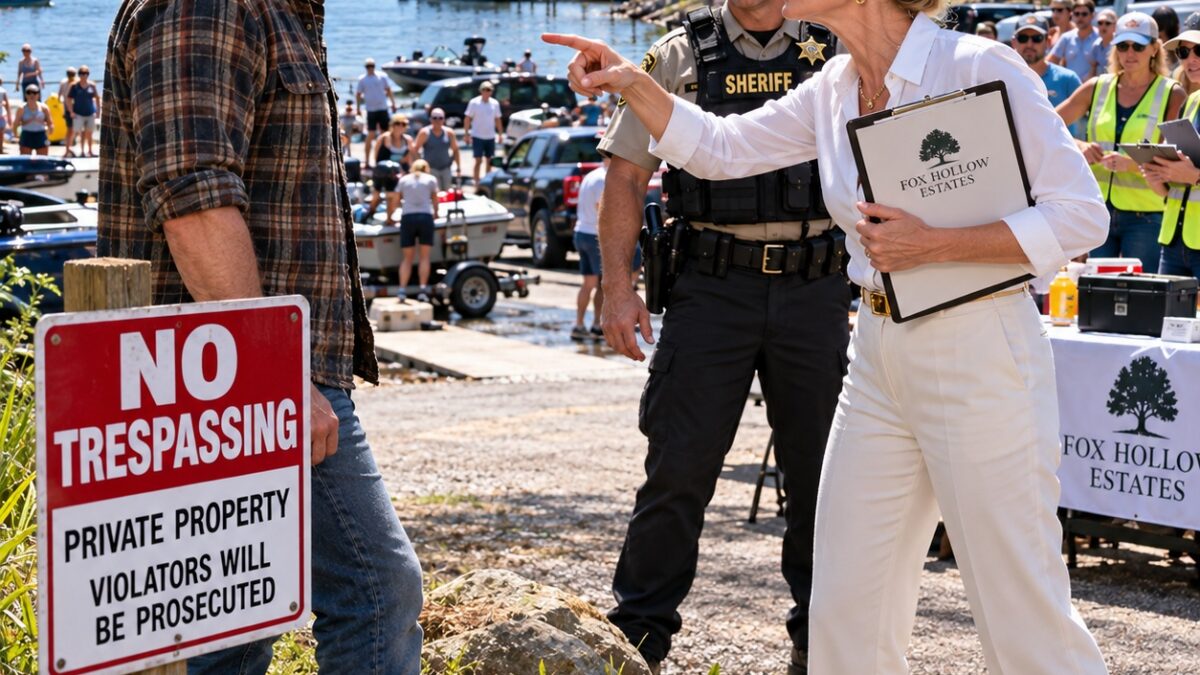
The sign sunk into my ground on treated posts.
PRIVATE LAKE ACCESS.
MEMBERS AND PASSHOLDERS ONLY.
And beneath it:
NO TRESPASSING.
Facing my house.
I stood looking at that sign longer than I should have.
There was something almost perfect about it.
After ten months of being told I was confused about my own property, Fox Hollow had finally erected a sign ordering me not to trespass on it.
I asked the bass-boat driver to stop.
Sloan turned it into a public confrontation.
Then she called the sheriff.
While we waited, I walked back to the cabin.
I opened the gun safe.
Not for a gun.
For the manila folder.
I took out my warranty deed.
Dean’s sealed survey.
The certified copy of Book 412, Page 87.
The photographs.
Dale’s work order.
The advertisements.
The certified letters.
The signed receipts.
I carried everything back down.
Twenty-two minutes later, Sheriff Bo Kesler arrived with a deputy.
Bo was in his mid-fifties, heavyset, slow-moving, and had the expression of a man who had already settled at least one argument over a fence line before breakfast.
Sloan reached him first.
“Sheriff, thank you for coming. We have a neighboring property owner who has been repeatedly—”
Bo raised two fingers.
She stopped.
“I’m going to ask three questions,” he said. “One at a time.”
Sloan straightened.
“Who holds record title to the ground we’re standing on?”
She started explaining the community access area.
He interrupted.
“Who holds record title?”
She looked toward me.
“Mr. Callahan owns an adjoining parcel.”
Bo turned to me.
I handed him my warranty deed.
He read the legal description.
Then he looked around.
“Second question. Where is the easement?”
Sloan produced the colorful subdivision exhibit.
Bo looked at it for about four seconds.
Then handed it back.
“Third question. What’s the recorded instrument number?”
“The access is shown here.”
“That isn’t what I asked.”
The sentence landed harder than anything I could have said.
For ten months, Sloan had been allowed to answer the question she preferred instead of the question she had been asked.
Now she was standing in front of a man who had no interest in helping her do that.
I handed Bo the rest of my packet.
Dean’s survey.
Book 412, Page 87.
All four exhibits.
He put the certified copy on the hood of his cruiser.
“Ma’am,” he said to Sloan, “where is your recreational easement?”
She pointed again at the blue area.
“This has been recognized by the community for decades.”
“Do you have a recorded recreational easement?”
“Our attorney has advised—”
“Do you have the instrument?”
She did not answer.
Bo looked down.
Then, in a slow flat voice, he began reading.
He read the description of the dam parcel.
He read the twelve-foot easement.
He read its purposes.
Inspection.
Emergency access.
Maintenance coordination.
No other purpose.
Then he turned to Exhibit C.
No boat ramp.
No recreational use.
No assignment or sale to third parties.
No expansion without written recorded consent from the owner.
The crowd became so quiet that the loudest thing on the property was the generator behind the barbecue truck.
Then somebody shut that off.
Sloan’s cheeks had gone pale.
“That document is decades old.”
Bo looked at the recording stamp.
“Old doesn’t mean unrecorded, ma’am.”
He did not announce that I had won.
That matters.
A sheriff does not decide title disputes on the side of a lake.
He said exactly that.
“If somebody has competing paperwork, a judge can sort it out. I’m not holding court out here.”
Then he looked toward the crowd.
“But right now, the record owner is standing here with a deed and a sealed survey. He has given written notice. I have not been shown a recorded instrument authorizing paid recreational access.”
He turned to me.
“Are you directing people to leave your property?”
“Yes, sir.”
Bo nodded.
Then he told Fox Hollow to stop launching boats.
He told the women in reflective vests to stop collecting money.
The bass-boat driver pulled his trailer back up the slope.
The deputy stood near the entrance while passholders gathered coolers, children, folding chairs, and rental equipment.
Nobody screamed.
Nobody was arrested.
That almost made it harder.
These were ordinary people realizing in real time that the access they had purchased might never have been the association’s to sell.
A man walked past me carrying a kayak.
He looked embarrassed.
“Man, I’m sorry. They told us this was theirs.”
“I know.”
And I meant it.
Within an hour, the shoreline was quiet again.
For three days, I believed the fight was over.
I pulled the HOA’s treated signposts out with a chain and bumper jack.
I hauled the sign to a scrap recycler.
They gave me $2.40 for it.
That felt about right.
On Tuesday evening, Graham Talbot walked down my driveway.
Nobody from Fox Hollow ever walked down my driveway.
They drove.
Graham came on foot.
He had a folder under his arm.
He looked tired.
“Mr. Callahan?”
“Wade.”
He nodded.
“Wade. I owe you an apology.”
I waited.
“I was on that board.”
“I know.”
“For six years.”
He looked back toward the road.
“I kept telling myself we had lawyers. That Sloan knew what she was doing. That this was some complicated title disagreement.”
I did not say anything.
Graham held out the folder.
“After Saturday, I went through our records.”
He was board secretary.
That gave him full access to the association’s cloud storage.
He had searched correspondence from the previous year.
Inside a folder labeled CLUBHOUSE PROJECT LEGAL, he found an email sent five months before Fox Hollow began selling lake passes.
The sender was Priscilla Vanderveer, a Knoxville real-estate attorney.
The recipients were the entire board.
Attached was a three-page memorandum.
Graham had printed it.
I leaned against the shop door and read.
The first paragraph referenced a title review of the south-shore parcel.
Then I saw the number.
Deed Book 412, Page 87.
My hands stopped moving.
The association’s own attorney had found the exact document Miriam and I spent an afternoon digging out of basement storage.
The memorandum described Fox Hollow’s interest as a twelve-foot maintenance and inspection easement.
It said no recorded recreational grant had been located.
Then came the advice.
The association should not advertise or sell recreational access, including boat launching, without obtaining a written and recorded agreement from the owner of the dam parcel.
The lawyer warned that doing otherwise could expose the association—and potentially directors individually—to trespass claims and demands for restitution of money collected from passholders.
I read that paragraph twice.
Then a third time.
“When did they get this?”
“Five months before the first ad.”
I looked at Graham.
“All of you?”
He swallowed.
“Yes.”
I turned the page.
There was an email reply from Sloan sent forty minutes after the memorandum.
Two sentences.
The first thanked the attorney for her thorough review.
The second said:
We will address title objections if Callahan raises them.
I read it again.
If Callahan raises them.
Not if the title is unclear.
Not if there is another instrument.
Not if counsel is wrong.
If Callahan raises them.
Something cold settled into me.
For ten months, I had interpreted Sloan’s behavior as arrogance.
She believed her map.
She believed tradition.
She believed the HOA had stronger rights than it did.
That would have been bad enough.
But this was different.
She already knew.
Before the first pass was sold.
Before the skid steer.
Before eighty-five tons of stone.
Before she mailed “Our attorney disagrees.”
Before the clubhouse meeting.
Before the cease-and-desist letter.
Before she stood on my property and called the sheriff.
She knew.
And she had made a calculation about me personally.
Graham leaned against the opposite side of the doorway.
“She never thought you’d go look.”
I stared at Sloan’s email.
“No.”
I folded the page back.
“She never thought I could.”
That difference mattered more to me than the land.
She had looked at my occupation.
My shop.
My tractor.
My work boots.
Maybe the old cabin.
And she had decided exactly how much resistance a man like me was capable of.
She bet I would be intimidated by letterhead.
She bet I would assume a blazer understood legal documents better than grease-stained hands did.
She bet I would not know that a recorded instrument had a book and page.
She bet $2,100 for a survey would be enough friction to stop me.
She bet that if paperwork did not work, social pressure would.
Put me in a room with eighty-six families and call me selfish.
Make me feel like the villain.
Make defending my own deed emotionally expensive.
And if all else failed, call the sheriff in front of a crowd and let authority finish the performance.
I looked up.
“Why?”
Graham rubbed his face.
“The clubhouse.”
He showed me another document.
Fox Hollow needed major roof repairs.
The pool decking needed work.
The projects were about $41,000 beyond available reserves.
A special assessment would require membership approval.
Sloan was facing an election year.
The projected lake-pass income had already been inserted into the draft budget under community programs before the passes were advertised.
She needed revenue.
My shoreline had become a line item.
Once she put a number in the spreadsheet, my deed stopped being something to respect and became a problem to manage.
I sat down on the shop steps.
For several minutes neither of us spoke.
I thought about that first morning on my porch.
The folder.
The community-standards booklet.
The way Sloan smiled when I showed her my closing papers.
“Men who buy acreage always think acreage means autonomy.”
At the time, I thought she was dismissing me.
Now I understood she had been measuring me.
Lauren had the memorandum by nine the next morning.
She read it once.
Then again.
Lauren talked fast about almost everything.
When she became completely still, I knew something mattered.
“This changes the case.”
“How?”
“Before, they could say they misunderstood the easement.”
“They didn’t.”
“No.”
She tapped Sloan’s email.
“This is notice.”
Eleven days later, Lauren sent a demand package.
Everything went in.
My deed.
Dean’s sealed plat.
The certified 1960s instrument.
Photographs of the grading.
The contractor work order signed by Sloan.
The lake-pass advertisement.
My certified letters.
Their signed return receipts.
And finally, the attorney memorandum showing the board had known the legal limits before the program began.
Lauren asked for an injunction against future unauthorized access.
Refunds to every person who had paid for passes, launches, or parking.
Removal of the unauthorized stone.
Restoration of my slope.
Reimbursement of a portion of my survey and legal costs.
She asked me one more question.
“Do you want to pursue individuals?”
“No.”
“Wade, some of the exposure here may not be limited to the association.”
“I understand.”
“You’re sure?”
“I’m not suing eighty-six households because seven or nine people on a board made a bad decision.”
“What about Sloan?”
I looked out her office window.
“I want my land back the way it was. I want the people who paid money refunded. I want them to stop claiming the lake is an HOA amenity.”
“That’s all?”
“That’s all.”
I did not want revenge.
I wanted the argument to stop.
There was no dramatic trial.
Most disputes like this do not end with somebody giving a speech to a jury.
The association’s insurance carrier became involved.
The title company became involved.
Board members became much more interested in settlement after reading the phrase “individual liability” in a memorandum they had all received months earlier.
An emergency board meeting was called.
Graham moved to suspend the lake-pass program pending legal review.
The vote was seven to two.
Two weeks later, the board requested Sloan Whitaker’s resignation as president.
She submitted it in writing.
One paragraph.
She called the dispute “a difference of interpretation regarding historical community use.”
I remember reading that line at my kitchen table.
For a few seconds, I wanted to be angry all over again.
Then I put the paper down.
There was no reason.
The facts no longer needed my anger.
Under the settlement, Fox Hollow permanently ended the Brierwood Summer Lake Pass program.
Every one of the fifty-three season passes was refunded.
So were launch fees.
So was parking money.
The total came to just under $13,000.
Ironically, the money came out of the same reserve fund the program had been created to protect.
Fox Hollow removed the signs.
A contractor came back with equipment almost identical to what Dale had used.
For two days, workers pulled crusher run off my slope.
They regraded the disturbed ground.
They seeded it.
The association paid part of my survey and legal costs.
Most important to me, every household in Fox Hollow received a written correction.
Lake Brierwood was not owned or controlled by Fox Hollow Estates.
The association’s recorded interest on the south shore was limited to a twelve-foot easement for inspection and maintenance of dam infrastructure.
Previous communications describing the lake as a community amenity were inaccurate.
One page.
That was all.
I read it twice.
Then I put it in the same manila folder.
Not because I expected another fight.
Because after that summer I had developed a respect for keeping paper.
I saw Sloan one final time while the contractor was removing the last of the stone.
She parked on the shoulder.
She walked down the lane.
No navy blazer.
No leather folder.
No board members.
She wore jeans and a plain gray sweater.
For the first time since I had known her, she looked like another person standing beside a lake instead of somebody representing an institution.
We watched the machine load stone into a truck.
After a while, she spoke.
“Do you really want to control an entire lake by yourself that badly?”
There was no audience.
So her voice was quiet.
I considered the question.
“No.”
She looked at me.
“I never wanted to control Fox Hollow. I never told your residents what color their mailboxes should be. I never told anybody what to park in their driveway. I never cared what your clubhouse did.”
“You stopped eighty-six families from using something they’d used for years.”
“I stopped the association from selling something it didn’t own.”
She looked across the water.
I continued.
“If you had come to my door that first week and said, ‘Wade, people here have been fishing this lake for years; can we work something out?’ I probably would’ve said yes.”
She did not answer.
“But you didn’t ask.”
Her jaw moved slightly.
“You decided.”
Still nothing.
“You sold passes first and planned to deal with me only if I objected.”
That got her attention.
She turned.
I could tell immediately that Graham had not told her what he had shown me.
For one second, her face changed.
Not panic exactly.
Recognition.
Then the expression disappeared.
I did not press.
I had no need to.
A worker shouted to another worker.
A loader bucket scraped against stone.
Sloan looked back at the lake.
“I thought I was protecting the community.”
“Maybe you did.”
She looked at me again.
“That doesn’t make every decision you made theirs to live with.”
For a moment, I thought she might apologize.
She did not.
I also did not demand one.
Some apologies mean something because a person chooses them freely.
The ones you have to extract are just another form of paperwork.
Sloan walked back up the lane.
That was the last conversation we ever had.
She still lives in Fox Hollow.
Sometimes I see her SUV at the hardware store.
We do not speak.
I am fine with that.
People assumed I wanted her destroyed.
I did not.
She lost the position she had introduced herself with before she had introduced herself as a neighbor.
That was consequence enough for me.
What happened afterward surprised almost everyone.
That fall, I called Lauren.
“I want to give Fox Hollow access.”
There was a long silence.
“To what?”
“Not the ramp.”
“Good.”
“Foot access to the east cove. Residents only. Fishing. Carry-in kayaks and canoes.”
Another pause.
“You understand you just spent months proving they didn’t have that right.”
“I know.”
“So why give it to them?”
“Because I never cared about keeping neighbors away from the water.”
That was the part some people never understood.
My fight was not about isolation.
It was about consent.
There is an enormous difference between saying yes and being informed that you already said yes.
Lauren drafted a limited neighbor-use license.
This time, every sentence mattered.
Fox Hollow residents—and only residents—could use a marked footpath to the east cove between dawn and dusk.
Bank fishing was allowed.
Kayaks and canoes could be carried in by hand.
No trailers.
No motors through the ramp.
No commercial use.
No third-party assignments.
No fees.
Not from the HOA.
Not from me.
Nobody could turn access into a business.
The license was revocable on thirty days’ written notice.
And it terminated automatically if Fox Hollow ever again advertised the water as property it owned or controlled.
Then we did the thing Sloan should have cared about from the beginning.
We recorded it.
Book.
Page.
Public record.
No blue shading on a sales brochure.
No oral tradition.
No “everybody knows.”
Paper.
Pearl Downey brought me a pecan pie the week the license was signed.
She set it on my porch.
“You know,” she said, “you have confused the hell out of half the subdivision.”
“How?”
“They thought you hated everybody.”
“I barely know everybody.”
“That’s kind of the problem with HOA politics.”
She pointed toward the pie.
“Don’t give the plate back. I hate that plate.”
The man in the faded ball cap came back too.
The same one I had found fishing early that spring.
He stopped at the edge of the marked path the first Sunday and called toward the cabin.
“Wade?”
I stepped onto the porch.
“Yeah?”
He held up his fishing rod.
“We good?”
“We’re good.”
Over time, I learned his name was Carl.
He had spent twenty-two years supervising maintenance at a paper mill.
The first time he mentioned pump seals, we talked for almost an hour.
Now he fishes the east grass most Sunday afternoons.
Sometimes we barely say anything.
Sometimes he complains about management decisions from twenty years ago as if they happened yesterday.
The yellow kayak disappeared for a while.
Then I saw it again the next spring.
This time somebody carried it down the legal path.
That made me smile.
Not because I had won.
Because the situation had finally become what it could have been all along.
Neighbors using a neighbor’s land with permission.
No cash box.
No wristbands.
No false sign.
No president standing between us converting basic decency into institutional ownership.
I made one sign for the old ramp.
I cut it from scrap aluminum in my shop.
Nothing decorative.
No routed cedar.
No gold lettering.
I painted the words myself.
PRIVATE PROPERTY.
ACCESS BY PERMISSION, NOT BY ASSOCIATION PASS.
That sign is still there.
Sometimes people ask whether the whole thing was worth it.
The lawyer.
The survey.
The sleepless nights.
The humiliation of sitting in a clubhouse while somebody described me as an enemy to people who had never met me.
The morning I stood in front of families who thought I had ruined their summer.
The money.
The anger.
The months of wondering whether some document existed that would make me look like the ignorant man Sloan had already decided I was.
I do not know whether “worth it” is the right question.
I know what would have happened if I had done nothing.
The gravel would have stayed.
The boat ramp would have become permanent.
The passes would have continued.
Years would have passed.
Children would have grown up believing Fox Hollow owned the access.
Future buyers would have been shown the blue map.
Future boards would have said the same thing Sloan said.
Historical use.
Community amenity.
Everybody knows.
And eventually, defending my deed would have looked less like defending property and more like taking something away.
That is how assumptions harden.
Not always through one dramatic theft.
Sometimes through a sign.
A brochure.
A newsletter.
A sentence nobody challenges.
A map somebody shades blue.
A stranger walking across your grass because another stranger told him he could.
Then another.
Then another.
Until the question is no longer, “Who gave us permission?”
It becomes, “Who are you to stop us?”
That was the real fight.
Not water.
Not boats.
Not even eighty-five tons of gravel.
It was about the point where repeated assumption tries to become ownership.
In the evenings, when Brierwood is flat, I walk down to the dam.
I check the toe drain after heavy rain, exactly the way Roy Denholm told me to.
I keep saplings off the embankment.
I listen to water moving through the spillway.
The sound is low and steady.
Almost like a truck running somewhere far away.
The cabin roof is fixed now.
Most of the plumbing is new.
My equipment trailer is still beside the workshop.
And yes, the mailbox post is painted black satin.
Not because Fox Hollow told me to.
Because the old paint looked terrible and I already had the paint.
Sloan once told me that men who buy acreage mistake acreage for autonomy.
She also said I confused owning dirt with governing a community.
I have thought about those words more than I expected to.
Maybe there was half a truth buried in them.
No deed makes you completely autonomous.
Land comes with laws.
Easements.
Responsibilities.
Neighbors.
Water does not care about parcel lines.
A dam failure would not stop at my survey stakes simply because the deed says Callahan.
That was why the maintenance easement existed in the first place.
The original families understood something important.
Shared responsibilities can be written down.
Rights can be narrow.
Permission can be specific.
Neighbors can cooperate without pretending everybody owns everything.
I never wanted to govern Sloan’s community.
I never wanted to tell eighty-six families what they could do behind their property lines.
I never wanted Lake Brierwood empty.
The trouble was that Sloan wanted authority over something that belonged to me.
And five months before she ever sold the first pass, she wrote down exactly how she intended to handle that problem.
Not by asking.
Not by negotiating.
Not by buying an easement.
By waiting to see whether I was smart enough, stubborn enough, or confident enough to object.
She thought a mechanic with a tractor would never go looking for Deed Book 412, Page 87.
She was wrong about that.
But the lesson I kept was not that I had beaten an HOA president.
It was much simpler.
If you want something from your neighbor, ask.
If your neighbor says yes, put the agreement in writing.
If the agreement matters, record it.
And never confuse somebody’s willingness to share with your right to take.
Most evenings now, Carl is gone before dark.
The kayaks are carried back up the marked path.
Fox Hollow’s houses light up one by one across the water.
I stand beside the spillway for another minute.
Then I walk home.
The lake is quiet again.
Not because nobody else is allowed to enjoy it.
Because everybody finally understands the difference between access that was sold without permission and access that was given freely.
And after everything that happened, that difference is all I ever wanted respected.








