FULL ENDING:For Eleven Months, I Was Just the Quiet Night Nurse—Then a Military K9 Heard Five Words I Was Never Supposed to Know
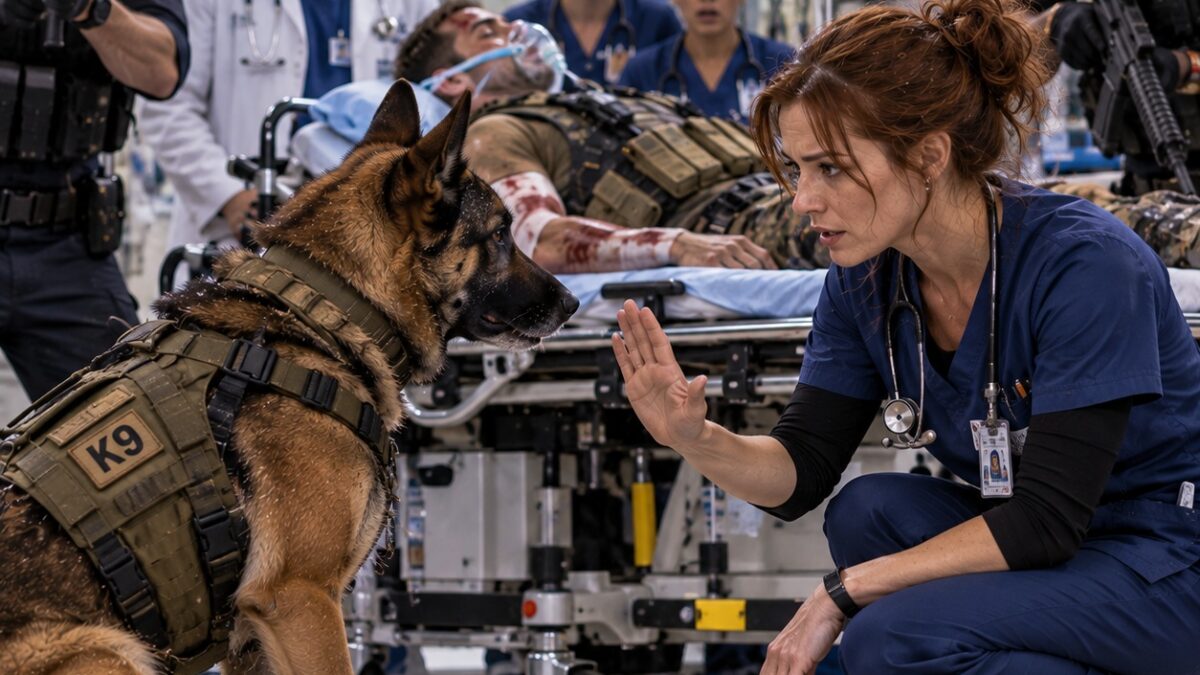
PART 2 and FULL ENDING  Thank you

The man on the gurney was still alive.
That was the only thing that mattered at first.
Later, everyone wanted to discuss the dog.
The command.
My background.
Why a civilian nurse at a regional hospital in Arizona knew how to release an eighty-five-pound Belgian Malinois from a protective hold.
In the first ninety seconds, none of that mattered.
Blood mattered.
Breathing mattered.
Color mattered.
The patient was in his early forties.
Tactical vest.
Unit patch I recognized but had no intention of discussing.
One wound on the left flank.
Another near the back of the right shoulder.
Blood along the side of his neck.
His breathing was shallow enough to make my own chest tighten.
“Trauma panel,” I said.
Someone moved.
“Full.”
Another nurse reached the cart.
“Get Dr. Claudia Merritt.”
“She’s upstairs.”
“Then tell her she has a critical trauma patient downstairs.”
The bay came back to life.
That was how rooms worked.
Sometimes all panic needed was one person moving as though there were still a sequence.
Assessment.
Airway.
Circulation.
Access.
Imaging.
Pressure.
Do the next correct thing.
The Malinois repositioned himself at the foot of the gurney.
He watched us.
Still.
Focused.
I learned later that his name was Cipher.
At that moment, I simply knew he had accepted the release but not surrendered responsibility.
Good dog.
Dr. Merritt arrived four minutes later.
She was one of the few surgeons I genuinely liked working with because she did not perform calm.
She possessed it.
There was a difference.
She entered.
Looked at the blood.
Looked at Cipher.
Looked at me.
“Brief me.”
I gave her the sequence.
She never asked why the dog was sitting.
Not then.
That was another reason I liked her.
Urgency has priorities.
We worked for more than an hour.
Pressure support.
Imaging.
Surgical consult.
One moment blurred into another with the clean sharpness trauma sometimes gave me.
That was the part of myself I had been trying hardest to make less visible.
Inside ordinary life, I overthought everything.
Did I speak too quickly?
Notice too much?
Stand wrong?
React too fast?
Inside trauma, there was no spare space for self-editing.
The body either told you something or it didn’t.
You either listened or you missed it.
Halfway through the stabilization, I became aware of a man standing near the trauma-bay entrance.
Civilian clothes.
Mid-forties.
Compact build.
No hospital badge.
He carried himself like someone who had spent a long time wearing gear and had only recently learned to look ordinary without it.
Phone in one hand.
No unnecessary movement.
Watching.
Not me exclusively.
Everything.
He became more interesting when he deliberately stayed out of our way.
People with weak authority move into rooms to prove they belong.
People with real authority often understand when their presence would make the work worse.
When we finally transferred the patient toward the ICU, I stepped into the corridor.
The man was waiting.
“You spoke the release command.”
Not hello.
Not Are you Nurse Elwood?
Straight to it.
“Yes.”
“Where did you learn it?”
He looked at me in a way I recognized.
Not curiosity.
Verification.
He had part of an answer already.
“I was embedded with a unit that used a related handler protocol.”
“When?”
“Second deployment.”
His eyes sharpened.
“Eastern theater?”
I held his gaze.
“Yes.”
He did not ask the country.
Smart.
Instead he said:
“The man you just treated is a federal protection witness.”
I looked toward the ICU corridor.
“He was not supposed to come here.”
“Then why did he?”
“His planned route was compromised.”
“Meaning?”
“Meaning what was supposed to happen changed quickly.”
I waited.
“He was rerouted to the nearest facility capable of taking him.”
“Which was us.”
“Yes.”
He paused.
“His survival over the next twelve hours matters to a case that has people much higher than me losing sleep.”
I picked up my chart.
“Then he’s in good hands.”
His expression changed almost imperceptibly.
Maybe surprise.
Maybe amusement.
“You’re not going to ask what case?”
“No.”
“Why?”
“Because if I need to know, someone will tell me.”
That was an old rule.
Useful then.
Useful now.
I started walking.
“What’s your name?” I asked.
“Terrell Wyn.”
“Agency?”
He smiled without warmth.
“Terrell Wyn is enough.”
“Thought so.”
I went back to the floor.
Bernadette was waiting.
She had the posture of a woman trying very hard to appear occupied while actually wanting to interrogate me.
“You want to ask.”
“No.”
“You’ve been staring for twelve minutes.”
“Eleven.”
“That doesn’t help.”
She folded her arms.
“You speak military dog?”
“No.”
“Sorsy.”
“I knew one protocol.”
“Why?”
“Previous work.”
“What previous work?”
“Before nursing.”
She looked toward the ICU.
“You’ve been here almost a year.”
“Yes.”
“You have never once mentioned military service.”
“I don’t mention high school either.”
“You went to high school.”
“Yes.”
“You see my point.”
“I see your frustration.”
Bernadette shook her head.
“Someday I’m going to understand you.”
“That sounds exhausting.”
“It already is.”
She walked away.
I watched her go and felt the first quiet pressure begin beneath my ribs.
Not fear.
Not yet.
Recognition.
This had happened before in other forms.
A skill surfaced.
Someone asked how.
The category around me became unstable.
Institutions liked categories.
Nurse.
Physician.
Security.
Administrator.
Civilian.
Veteran.
Once you belonged cleanly to one, people knew which rules to apply.
I had spent years living inside overlaps.
Medic and service member.
Medical personnel and someone expected to function under fire.
Healer and person trained to read threats.
Civilian nurse carrying instincts that had never become civilian.
I came to Kelbridge because I wanted one category.
Nurse.
Simple.
Honest.
Enough.
The next week proved simplicity was not something I could order from a supply cabinet.
The first question came from Dr. Rajan.
Then Merritt.
Then Bernadette.
Then two nurses who had apparently heard an exaggerated version in which I had hypnotized an attack dog with a secret language.
By the ninth day, Nursing Director Carol Dempsey summoned me upstairs.
Corner office.
Glass.
Controlled lighting.
Credentials arranged behind the desk.
Folder in front of her.
People sometimes joke about administrative offices being designed to establish hierarchy.
It is not a joke.
Furniture can communicate perfectly well.
“Thank you for coming.”
“You scheduled me.”
Dempsey ignored that.
“We’ve had some conversations about your performance.”
That sentence can mean almost anything in a hospital.
Usually nothing pleasant.
“Okay.”
“Your clinical outcomes are excellent.”
There it was.
The compliment before the problem.
She opened the folder.
“The concern is the pattern.”
“What pattern?”
“Interventions outside your assigned coverage.”
“The Bay Three patient was deteriorating.”
“And you were right.”
“The veteran patient needed de-escalation.”
“And your intervention was effective.”
“The dog prevented access to a critically injured man.”
“Yes.”
I waited.
Dempsey folded her hands.
“You see the issue?”
“No.”
She almost sighed.
“The issue is that your methods are not explained by your documented training.”
“My nursing license is current.”
“We verified it.”
“My credentials are current.”
“Yes.”
“Then what are you asking?”
“Why does a regional trauma nurse know restricted military working-dog language?”
I said nothing.
“Why did you recognize a developing pneumothorax before the attending physician?”
“Experience.”
“What experience?”
I looked at the folder.
There were probably eleven months of reports inside.
Shift notes.
Incident summaries.
Credential copies.
Maybe questions from coworkers.
A person flattened into paper.
“Your employment history before nursing school has gaps,” Dempsey said.
Not lies.
Gaps.
That mattered.
I had never falsified my service.
I had simply provided exactly what verification required and nothing more.
There are histories that do not fit normal employment forms because normal employment forms assume previous jobs existed in the ordinary way.
Supervisor name.
Address.
Telephone.
Responsibilities.
There had been periods of my life where none of those fields had honest answers I was permitted to provide.
“We need a supplemental history.”
“How much?”
“All relevant clinical or emergency training.”
“Some isn’t releasable.”
“Then document that.”
“That may not satisfy your verification process.”
“That is why we’re asking.”
I understood.
Dempsey was not trying to destroy me.
Not yet.
She was doing what administrators do when facts stop matching forms.
She was trying to make the form larger.
What frightened me was that sometimes institutions instead make the person smaller.
“Five business days.”
“I’ll provide what I can.”
I stood.
“Sorsy.”
I stopped.
“This is not disciplinary.”
“I understand.”
I did.
That did not mean it was harmless.
The elevator doors closed around me.
For five floors, I stood very still.
Breathed through my nose.
Counted.
Four in.
Six out.
Old regulation pattern.
By the second floor, my pulse was normal.
That irritated me.
I had spent eleven months trying to forget how many old habits I still used.
Now they seemed to be stepping forward one by one like witnesses.
Five years.
Two months.
Eleven days of service.
Enlisted at twenty-two.
Field medical training.
Three years moving through assignments that became less ordinary with each rotation.
Forward embedment beside special operations elements.
Two theaters.
Long nights in temporary treatment spaces.
Blood under red lights.
Dust inside everything.
Learning how to treat injuries while simultaneously knowing where cover was.
Learning that a wounded person may still be holding a weapon.
Learning that frightened dogs often needed clearer communication than frightened humans.
Learning that a medic could not always wait for the environment to become safe before entering it.
My final year ended differently.
Training accident.
The official language made it sound almost mild.
It had not been.
Medical evacuation.
Months of recovery.
Honorable discharge.
A commendation connected to an engagement that was itself classified tightly enough that the award existed mostly as an administrative shadow.
Then nursing school.
Then Kelbridge.
Then eleven months of trying to stand three steps behind the person I had actually become.
Terrell Wyn was waiting in the parking garage after my shift.
I spotted him before he spoke.
“You should work on looking less suspicious.”
“I’m standing beside a stairwell.”
“Exactly.”
He gave me a look.
“You knew Cipher’s protocol.”
“We covered that.”
“I checked rotation records.”
That stopped me.
“My name won’t appear in the ones you have.”
“I noticed.”
“Then your search was productive.”
He leaned against the concrete wall.
“Darien Ashford.”
So the patient had a name now.
“He has been a federal protection witness for fourteen months.”
I glanced toward the parking entrance.
“Does he usually travel with a military K9?”
“Cipher is more complicated than that.”
“Everything seems to be.”
Terrell almost smiled.
“The incident that put Ashford on your gurney was not a random vehicle event.”
“What was it?”
“Attempted removal.”
“Assassination?”
“We’re not using that word yet.”
“You just used removal.”
“Different paperwork.”
I hated federal language.
“They know he survived?”
“Yes.”
“They know where he is?”
“Not officially.”
“This is a public hospital.”
“Yes.”
“That means you have a time problem.”
“We know.”
I looked at him.
“What are you asking me?”
“Nothing.”
“Then why are you waiting in parking garages?”
“To give you information.”
“That sounds operational.”
“It partly is.”
He straightened.
“The other part isn’t.”
I waited.
He took a breath.
“Whatever is in your history—the part the hospital can’t categorize—it is not the liability they are starting to treat it as.”
I said nothing.
“It kept Ashford alive.”
“The team kept Ashford alive.”
“You opened access to the patient.”
“Cipher responded to training.”
“Training you had.”
“That does not make it exceptional.”
“No.”
He looked at me carefully.
“What makes it exceptional is that you walked toward the dog when everyone else moved away.”
I felt my jaw tighten.
“That was necessary.”
“Exactly.”
He pushed away from the wall.
“I have seen institutions confuse unusual capability with risk because the capability did not come through the pathway they recognize.”
“That sounds personal.”
“Everything worth saying usually is.”
He began walking.
Then stopped.
“Cipher is being fed.”
I looked at him.
“And walked twice a day.”
I had not asked.
Apparently he knew I had been wondering anyway.
“Thank you.”
He nodded.
That night, something inside me relaxed by half an inch.
Not because Wyn had defended me.
I did not need his permission to believe my service had value.
What mattered was that somebody had seen the tension clearly.
What had hurt me could also have trained me.
Both could be true.
For almost a year, I had acted as if acknowledging the second truth betrayed the first.
Monday morning, I submitted my supplemental history.
Sealed envelope.
Enlistment.
Medical training.
Deployment windows.
What I could legally disclose.
What I could not.
Medical evacuation.
Discharge.
The classified notation attached to the commendation.
The official citation was almost offensively vague.
Language about maintaining medical continuity under adverse conditions.
Words that made a night I still dreamed about sound like competent paperwork.
I handed the envelope to Dempsey’s assistant.
Then went to work.
By Thursday, the hospital had changed around me.
Nobody announced it.
Institutions rarely announce discomfort.
They alter temperature.
Rajan became almost excessively careful in how he spoke to me.
One resident who usually asked for my opinion stopped asking at all.
Bernadette watched me with an expression I could not decipher.
Dr. Merritt did the opposite.
She asked exactly the same questions she always had.
That helped more than she knew.
On Friday afternoon, a message arrived.
Please report to my office Monday at 0800.
I stared at it.
I knew what it meant.
Or believed I did.
Complicated employee.
Unverifiable history.
Liability.
Maybe reassignment.
Maybe formal restrictions.
Maybe a polite invitation to seek employment somewhere whose risk department was less nervous.
I went home.
Made dinner.
Ate half.
Sat on the steps outside my apartment early Saturday morning after a run.
The desert was turning orange.
Kelbridge looked almost gentle from a distance.
My phone rang.
Unknown number.
“Nurse Elwood?”
“Yes.”
“Colonel Rice.”
The voice carried the flat economy of command.
“I’m calling regarding Darien Ashford.”
“How is he?”
“Stable enough to be unhappy.”
“That is usually a good sign.”
“He has been asking for you.”
“I’m not working until tonight.”
“This isn’t about rounds.”
I waited.
“He understands there are questions regarding your status at Calverton.”
“Who told him?”
“People speak.”
“Too often.”
“He wants continuity of care established before any administrative decision affects your access.”
“I am a nurse, Colonel.”
“Yes.”
“My employment issue is separate from his federal case.”
“He disagrees.”
“That doesn’t surprise me.”
Rice’s tone changed slightly.
“Ashford’s testimony has documentation requirements for the next six weeks. His medical status affects federal scheduling, protective placement, and evidentiary continuity.”
“That sounds terrible.”
“It is.”
“I still don’t control hospital HR.”
“No.”
He paused.
“His office is making calls above Dempsey’s level.”
I looked at the desert.
“I didn’t ask for that.”
“I know.”
“That could make this worse.”
“It could also prevent incomplete information from becoming a decision.”
I did not like being protected by forces I could not see.
That feeling was old.
“Why tell me?”
“Because walking into Monday’s meeting without knowing the room has already changed would be unfair.”
I understood that.
“Thank you.”
“You don’t sound thankful.”
“I’m working on it.”
He hung up.
Sunday, I went into the ICU even though I was technically off.
Not to intervene.
To review handoff notes and reassure myself that Ashford was still improving.
Room Seven.
Darien asleep.
Cipher at the foot of the bed.
Someone had put a water bowl beside him.
Good.
Ashford looked younger unconscious.
Or maybe simply less guarded.
Fourteen months as a federal witness.
Fourteen months knowing the wrong person finding you could end your life.
I knew something about living inside prolonged threat.
Not his version.
Enough.
Cipher raised his head when I entered.
No growl.
He watched.
I spoke softly.
“You’re creating a remarkable amount of administrative trouble.”
His tail moved once.
“Not apologizing?”
Nothing.
“Typical.”
I left.
Monday at 8:00, I walked into Dempsey’s office.
Two extra people.
Man and woman.
Professional clothes.
Neutral expressions.
State nursing oversight.
My stomach dropped only once.
Then stopped.
Hospital counsel was there too.
Stafford.
Young enough to still believe expensive pens created authority.
Dempsey opened.
“We’ve reviewed your supplemental history.”
“Okay.”
“The portions available for verification have been verified.”
“And the classified portions?”
“Remain classified.”
“That is usually what happens.”
Stafford looked irritated.
Dempsey continued.
“The challenge is documenting the basis for interventions that appear connected to training we cannot independently review.”
“Such as?”
“Military working-dog release protocol.”
“The alternative was leaving a hemorrhaging patient inaccessible.”
The female state representative spoke.
“That’s understood. The scope issue is different.”
“No.”
She blinked.
I leaned forward slightly.
“The problem was a dog holding a trauma bay because his handler was dying. Security could not safely approach. Waiting for a specialist would have taken hours.”
“Nurse Elwood—”
“The relevant question in that room was not whether a nursing license contains an animal-handling provision. It was whether somebody was going to die while we discussed which box applied.”
Silence.
Stafford cleared his throat.
“The hospital’s concern—”
The door opened.
Dempsey’s phone lit at the same moment.
She looked at the display.
Something in her face changed.
A woman entered.
Mid-fifties.
Silver streaks through her hair.
She carried no visible anxiety about interrupting a hospital administrative meeting.
Terrell Wyn came behind her.
He stayed near the door.
The woman introduced herself as Deputy Administrator Hollis Farren with the Department of Health and Human Services.
That title was probably true.
It also clearly explained less than half of her relevance.
She sat.
Looked at Dempsey.
Then the state representatives.
Then Stafford.
“I understand there is a concern involving Nurse Elwood’s credentials and conduct.”
Stafford straightened.
“We’re discussing verification and potential liability.”
“Good.”
Farren placed both hands on the table.
“Then you should have the federal context before you make any determination.”
Nobody moved.
“The patient currently in your ICU is a material federal witness in a matter involving significant national-security interests.”
Dempsey glanced at me.
Farren continued.
“His survival last Thursday is directly attributable in part to clinical actions taken by Nurse Elwood.”
Stafford began:
“We’re not disputing the outcome.”
“I know.”
She stopped him without raising her voice.
“I am not here because I believe anyone in this room is acting maliciously.”
She looked at Dempsey.
“I am here because the policy review itself has been influenced by information your hospital did not know was being fed into it.”
The room changed.
Dempsey’s posture straightened.
“Explain.”
Farren turned toward me.
“The incident that brought Darien Ashford to this hospital was intentional.”
I said nothing.
“Federal investigators confirmed that forty-eight hours ago.”
I heard the air-conditioning.
Nothing else.
“The individuals involved had been tracking possible medical facilities connected to Ashford.”
Her eyes stayed on mine.
“They were aware he had selected Calverton Regional for a scheduled procedure.”
A cold line moved down my spine.
“They were aware you worked here.”
The sentence landed harder than it should have.
For eleven months, I had worked so hard to become unremarkable.
Somebody I had never met had found me anyway.
Dempsey spoke.
“How?”
“Through parties connected to the broader investigation.”
“And what does Nurse Elwood have to do with Ashford?”
Farren answered carefully.
“Capability.”
That word.
Not friendship.
Not conspiracy.
Capability.
“They understood that if Ashford arrived here in crisis, Nurse Elwood possessed experience that might materially improve his survival.”
Dempsey went pale.
“The complaints about her background.”
“Some originated naturally.”
Farren’s expression remained controlled.
“Others were encouraged.”
“By whom?”
“Still under investigation.”
Stafford had stopped taking notes.
Farren continued.
“The objective was to create a policy basis for moving Nurse Elwood away from high-acuity care or out of this facility before Ashford’s planned arrival.”
Nobody spoke.
“When his arrival occurred early and under emergency conditions, that plan failed.”
The dog.
The trauma bay.
My command.
Ashford surviving.
The sudden acceleration of administrative pressure.
Pieces slid together.
I looked at Dempsey.
“Someone pushed this review.”
Her voice was quiet.
Farren answered:
“Yes.”
“Using me.”
“Yes.”
“To get to him.”
“In part.”
Dempsey’s professional mask slipped.
Not much.
Enough.
She looked genuinely sick.
“I thought I was doing my job.”
“You were.”
Farren was unexpectedly kind.
“That is why influence operations work.”
The words hung there.
“They do not require everyone involved to be corrupt.”
She glanced around the table.
“They require enough legitimate people acting on incomplete information.”
I had lived inside operational planning long enough to know exactly how true that was.
One selective fact.
One anonymous concern.
One policy question.
One person in compliance asking another person in risk management whether there could be a problem.
No villain inside the room.
Just a direction introduced from outside.
“What happens now?” I asked.
“Two arrests were made this morning.”
The tension in my shoulders shifted.
“Individuals connected to Ashford’s attack.”
“Yes.”
“Immediate threat?”
“Neutralized to our current assessment.”
“And the broader case?”
“Ongoing.”
Farren stood.
Then looked at Dempsey.
“Nurse Elwood’s employment should not be treated as a federal uncertainty anymore.”
Dempsey nodded.
Farren turned to me.
“You’ll receive additional context as the case permits.”
“I’m thrilled.”
Something close to humor entered her eyes.
“I can tell.”
She left.
Terrell followed.
Before the door closed, he looked at me once.
Not victory.
Recognition.
The kind that said:
Now you know.
For almost thirty seconds, nobody spoke.
Then Stafford closed his folder.
The state representatives looked at each other.
The case they had thought they were evaluating had become something else entirely.
Dempsey stared at the table.
Finally she looked at me.
“I owe you an apology.”
I waited.
“I was building a file around what I couldn’t explain.”
Her voice sounded stripped down now.
Less administrator.
More person.
“I thought the right question was whether your history fit our framework.”
I said nothing.
“It wasn’t.”
“No.”
“The right question was what that history meant for your work.”
“Yes.”
She took a breath.
“I’m sorry.”
There were many things I could have said.
That she should have trusted outcomes.
That administrators too often fear what they cannot name.
That I had expected this.
That her review had hurt.
All true.
None necessary.
“I know.”
For some reason, that seemed to affect her more than forgiveness would have.
I left the office.
Went downstairs.
Worked.
At 11:00, I visited Ashford.
He was sitting up.
Pale.
Still weak.
But fully present now.
Cipher lay at the foot of the bed.
His tail moved when I entered.
Ashford noticed.
“He likes you.”
“He has questionable judgment.”
“Cipher has excellent judgment.”
“Then he is making an exception.”
I checked the monitor.
“Pain?”
“Manageable.”
“That means six?”
“Four.”
“That means six.”
He gave me a tired smile.
“They told me about the meeting.”
“Everyone tells you everything.”
“Occupational hazard.”
“You need sleep.”
“I’ve slept for four days.”
“You nearly died.”
“That sounds dramatic.”
“It was.”
Ashford watched me update the chart.
“Why did you go toward Cipher?”
I looked at him.
“Because you were bleeding.”
“Security was trying to find a handler.”
“Four hours away.”
“You could have waited for someone else to make the call.”
There it was.
Not curiosity.
A real question.
The same one Terrell had circled.
Why move toward something when stepping back would have been easier?
I stopped writing.
“I tried leaving once.”
Ashford waited.
“Leaving what?”
“Rooms I could help in.”
That was not the exact truth.
It was the larger one.
“I spent almost a year here trying to be smaller than my instincts.”
“Why?”
“Because I was tired of being the person institutions noticed when things became dangerous.”
He understood that more quickly than most people would have.
“So you became a nurse.”
“I was already medical.”
“That isn’t what I meant.”
I looked at him.
“No.”
He was right.
“I became a civilian nurse because it was the part I wanted to keep.”
“And the rest?”
“I thought I could leave it behind.”
“Did you?”
Cipher shifted.
His head rested against the bed rail.
“No.”
Ashford nodded.
“They’re going to debrief you.”
“I know.”
“Colonel Rice’s people.”
“Of course.”
“There’s also talk about consulting.”
I almost laughed.
“On what?”
“Cases involving military histories. Protected witnesses. People moving through civilian hospitals whose medical context doesn’t fit standard forms.”
“I’m a nurse.”
“Yes.”
He looked directly at me.
“You keep saying that like someone else hears it as a limitation.”
That stopped me.
Because he was right.
When I said I’m a nurse, I did not mean I am only a nurse.
I meant:
This is the name I chose.
This is where all the other training finally made sense to me.
A nurse is the person who stays beside the bed when everyone else has their own specialty to return to.
The person who notices the small change.
Who hears the word the patient does not emphasize.
Who knows that pain scores lie sometimes because people lie to survive.
Who remains.
“I’ll talk to Rice,” I said.
Ashford nodded.
“Good.”
I checked Cipher’s bowl.
Full.
Somebody had remembered.
That tiny fact mattered.
Six weeks later, Ashford was transferred to a secure recovery facility.
Cipher went with him.
I knew it would happen.
Still, when I entered Room Seven after transport and saw the empty space at the foot of the bed, I felt an unexpected absence.
Bernadette caught me looking.
“You miss the dog.”
“No.”
“You absolutely miss the dog.”
“He caused significant administrative inconvenience.”
“He sat down.”
“Exactly.”
She grinned.
“You miss him.”
I went back to work.
The federal case lasted eight months.
I was deposed twice.
Long rooms.
Long tables.
People with careful questions.
I gave careful answers.
No embellishment.
No speculation.
Sequence.
Time.
Observation.
Intervention.
That was how I survived depositions.
It was also how I survived trauma.
Eventually, Terrell returned to the hospital.
He stood at the nurses’ station with his hands inside his jacket pockets.
Bernadette looked at him.
“Parking garage full?”
He blinked.
I tried not to smile.
“You’ve developed a reputation.”
“I’m devastated.”
He waited until she left.
“The two men arrested after Ashford’s attack gave statements.”
I stopped typing.
“Useful?”
“Very.”
“The outside pressure on my job?”
“Documented.”
“How much?”
“Emails. Intermediaries. Calls. Enough to establish intent.”
He paused.
“You were specifically named as a target.”
I looked at him.
“Not the hospital?”
“You.”
Something inside me went quiet.
“Why?”
“Because they had a profile.”
“From where?”
“Still being litigated.”
“Convenient.”
“They understood your military medical background better than Calverton did.”
That sentence felt obscene.
Strangers trying to kill a witness had understood my usefulness more clearly than the institution where I worked.
Terrell seemed to read my reaction.
“Don’t give them that.”
“What?”
“The meaning.”
I frowned.
“They knew a capability existed.”
He leaned closer.
“That does not mean they knew you.”
Fair.
“When does the indictment become public?”
“Two or three weeks.”
“My name?”
“Briefly.”
I did not like that.
“You’ll be described as a target of the disruption effort.”
“Wonderful.”
“I wanted you to hear it from a person first.”
That softened my response.
“Thank you.”
He started away.
Then stopped.
“For what it’s worth…”
I looked at him.
“I’ve seen people with better training than you freeze.”
“That sounds insulting.”
“It’s not.”
He smiled slightly.
“The unusual thing you did that night wasn’t knowing Cipher’s release.”
“What was?”
“You stayed.”
Silence.
“When trained people around you were moving backward, you moved forward.”
“That was because I understood the dog.”
“No.”
He shook his head.
“That was because the patient needed you.”
He left.
I stared at my chart for almost a minute.
Then went back to work.
A month later, Dempsey asked me to come upstairs again.
This time there was no threatening folder.
There was a proposal.
I knew because it said PROPOSAL in unnecessarily large letters.
I sat.
“This looks expensive.”
“Good afternoon to you too.”
“What is it?”
Dempsey pushed the document toward me.
Veterans and Complex History Care Initiative.
I read the first page.
Then the second.
Military-service intake.
Blast exposure.
Prior field injuries.
Classified-service accommodation within credentialing.
Protected witness medical continuity.
Behavioral-health consultation designed for service-related hypervigilance.
Service-animal protocols.
I looked up.
“Who wrote this?”
“Several people.”
“Rice.”
“His office contributed.”
“Merritt.”
“Yes.”
“Farren.”
“Language review.”
“Terrell?”
“I suspect he argued with security.”
“That sounds right.”
Dempsey folded her hands.
“We want you to lead it.”
“No.”
I continued reading.
She blinked.
“That was quick.”
“This will take at least a year to build properly.”
“I know.”
“You need dedicated staffing.”
“Budgeted.”
“Credentialing is a nightmare if somebody has classified service.”
“Which is why we need a framework.”
“Traditional intake forms are useless for half the people you are describing.”
“Yes.”
I looked up.
Dempsey was smiling.
I stopped.
“You did that intentionally.”
“What?”
“You knew I’d start fixing it.”
“I hoped.”
“That is manipulative.”
“I learned from recent events.”
I almost laughed.
Then I looked back at the page.
A year earlier, I would have refused.
Too visible.
Too close to the life I had left.
Too much chance of people knowing what I knew and asking where I learned it.
But something had changed.
The woman from Balad.
Ashford.
Cipher.
The pneumothorax.
My own exhaustion.
All the moments I had slowed myself intentionally because being fully capable felt dangerous.
Maybe hiding had begun costing other people.
That truth was harder than any administrative review.
“You really want me?”
“Yes.”
“Why?”
Dempsey did not hesitate.
“Because you understand the problem from inside it.”
I thought about Ashford’s sentence.
You keep saying I’m a nurse.
I don’t think you mean it as a limitation.
No.
I did not.
“Yes.”
Dempsey’s shoulders relaxed.
“I’m going to regret this.”
“Probably.”
The initiative enrolled four patients in its second week.
Too quickly, in my opinion.
Administration had apparently discovered enthusiasm.
I spent the first month saying no to things.
No banners.
No military-themed décor.
No giant flag graphics in the waiting room.
No posters calling veterans heroes.
One communications consultant looked genuinely wounded.
“We’re trying to make them feel honored.”
“They’re trying to receive medical care.”
“But identity matters.”
“Exactly.”
I pointed toward the proposed poster.
“Do you want every patient who walks through the door to feel like they’re being recruited for a parade?”
She stared.
“No.”
“Then make it look like a clinic.”
Plain walls.
Good chairs.
Low noise.
Clear exits.
Staff trained to announce before touching.
Questions that asked about service without assuming trauma.
Questions that asked about blast exposure.
Long-term load-bearing injuries.
Sleep.
Pain medication history.
Environmental triggers.
Old surgeries performed in facilities that no longer existed.
A patient’s service history was not decoration.
It was clinical data.
Our second patient had been misdiagnosed for almost two years.
Headaches.
Dizziness.
Concentration problems.
Neck pain.
Every provider had treated each symptom separately.
Nobody had asked how many blast events he had experienced on deployment.
I asked.
He laughed.
“Which deployment?”
That answer changed everything.
Our fourth patient was a former Air Force flight nurse.
Thirty-six.
Eight urgent-care visits in six months.
Chest tightness.
Insomnia.
Intermittent tachycardia.
Nothing catastrophic on testing.
Every discharge note said anxiety.
Maybe part of it was.
But when she sat across from me, I recognized the posture.
Perfectly controlled.
Hands still.
Eyes constantly reading the environment.
The same exhausting performance I had lived inside.
“How long are you sleeping?”
“Four hours.”
“Average?”
“Good nights.”
“How long has that been happening?”
“Years.”
“Why do you keep going to urgent care?”
She looked embarrassed.
“Because sometimes I think something is wrong.”
“Something is wrong.”
Her eyes lifted.
“We just need to figure out which parts are medical, which are nervous-system overload, and which are both.”
For the first time since entering, her shoulders lowered.
That was when I understood what the initiative could become.
Not a place where people were told everything came from service.
A place where service was not ignored simply because the civilian chart lacked the right fields.
Three months after we opened, a package arrived.
Official channel.
Heavy envelope.
My name.
I carried it into my office.
Closed the door.
Did not open it for fifteen minutes.
I knew what it was before I touched the seal.
Service record.
Updated.
Corrected.
Someone in Colonel Rice’s world had pushed the records process through whatever walls had kept pieces buried.
The forward engagement was documented accurately.
Not publicly.
Not declassified.
Accurately.
That distinction meant everything.
The commendation was restored with the classification notation it should have carried from the beginning.
I read the citation.
Dry language.
Precise.
Still inadequate.
Then I saw one line in the notes field.
Not official citation language.
No regulation number.
No bureaucratic syntax.
Just:
She held. Every one of them came back. The record should have said so from the beginning.
I stopped breathing.
Not because I had forgotten.
Because I had spent years teaching myself that recognition did not matter.
Maybe it should not have mattered.
But there is a difference between needing praise and needing the truth not to be erased.
I sat at my desk.
Read the sentence again.
I remembered a night I did not talk about.
Weight against my shoulders.
Hands slick inside gloves.
Someone yelling coordinates.
Saber barking somewhere beyond canvas.
The certainty that there were still people out there.
The refusal to leave until the last one was moved.
I had told myself for years that the record being wrong changed nothing.
We knew what happened.
The people who survived knew.
Wasn’t that enough?
Maybe.
But when the accurate document sat in my hands, something I had kept braced inside me loosened.
I did not frame it.
I did not hide it either.
I placed it in the front folder of my desk.
Front.
Not bottom.
That mattered.
The federal indictment became public on a Tuesday.
By Wednesday, regional news had the story.
Names.
Network.
Attempted interference.
Ashford.
The attack.
Federal witness.
Hospital.
Me.
My name appeared only briefly.
I read exactly one article.
Four words stopped me.
The nurse who stayed.
Not hero.
Not warrior nurse.
Not secret operative.
Stayed.
I put the phone down.
That evening, I called my mother.
I had not called enough during those eleven months.
Hiding from the past had somehow included distancing myself from people who already knew it.
We talked about ridiculous things.
Her neighbor’s tree.
My cousin’s engagement.
A recipe I would never cook.
Whether Arizona heat had permanently ruined my judgment.
Forty minutes.
At the end, her voice softened.
“Sorsy?”
“Yes?”
“Are you okay?”
“I’m fine.”
“No.”
She knew that answer.
“Actually okay?”
I looked around my apartment.
For once, there was no bag packed.
No plan forming.
No administrative meeting waiting.
Work tomorrow.
Patients.
The initiative.
A life that had somehow grown large again without becoming dangerous.
I answered honestly.
“Yes.”
Silence.
“I think I actually am.”
“You sound surprised.”
“I am.”
She laughed softly.
“Maybe that’s okay too.”
After we hung up, I stood at the window.
Kelbridge lights.
Desert beyond them.
For eleven months, I had believed I could recover by reducing myself to the least complicated truthful version.
Nurse.
Nothing else.
No military history unless required.
No stories.
No explanations.
No visible scars.
No old language.
No patterns somebody might recognize.
But I had never been smaller.
I had only been less present.
There is a difference.
A person can survive something and then spend years paying another price by pretending the survival did not shape them.
I had been paying that price.
I could feel the edges now that I had stopped.
Winter came slowly in Arizona.
Not snow.
Cooler mornings.
Longer shadows.
One Thursday, I walked into our initiative’s first exam room.
A sixty-seven-year-old former infantryman sat on the edge of the table.
Hands on his knees.
Back straight.
Eyes moving constantly.
Door.
Window.
Me.
Equipment.
He was not aggressive.
Not even particularly anxious by outward measures.
His body simply remained ready.
Habit.
Decades old.
His primary physician had referred him with an unusually honest note:
I don’t know what I’m looking at. I think you need someone who does.
I liked that doctor immediately.
Not knowing is not failure.
Pretending to know is.
“Good morning.”
The man looked at me.
“My name is Sorsy.”
He nodded once.
“Tell me what’s been happening.”
He did not answer immediately.
He studied my face.
People who have spent enough time inside systems learn to evaluate whether the person in front of them is actually listening or simply waiting for enough keywords to send them elsewhere.
I knew that look because I had given it.
I sat.
Not too close.
No clipboard between us.
Waited.
Something in him settled.
Then he began.
Pain first.
Then sleep.
Then headaches.
Then the thing he had not told his primary physician because it sounded ridiculous when he said it aloud.
Certain mechanical smells made him nauseated.
Certain noises made his hands shake.
Sometimes he woke convinced he had forgotten someone.
Not a specific person.
Just the certainty that somebody had been left behind.
I listened.
Fully.
No part of my attention standing outside myself asking whether I looked too knowledgeable.
No slowing down my thoughts so I would appear ordinary.
No editing.
Just listening.
“That smell,” I said when he finished. “Diesel?”
His eyes sharpened.
“Sometimes.”
“Burned hydraulic fluid?”
His face changed.
“How did you know that?”
“Because you said mechanical.”
He watched me.
“And because I’ve met people whose bodies remember places before their minds catch up.”
He swallowed.
“You military?”
There it was.
A year earlier, I might have deflected.
“Former Navy.”
His shoulders dropped almost invisibly.
“Medical.”
“Yes.”
“You get it.”
“Parts of it.”
I would not steal his experience by pretending ours were identical.
“I know what it’s like when your body keeps responding to a place you left years ago.”
He nodded.
That was enough.
We built a plan.
Medical workup.
Neurology.
Sleep evaluation.
Trauma-informed therapy if he agreed.
No assumption that every symptom was psychological.
No assumption that none were.
He left with three appointments and, more importantly, the belief that somebody had heard the entire problem.
After he walked out, I remained in the room.
Quiet.
No dramatic revelation.
No military dog.
No federal official.
No investigation.
Just an empty exam room.
I realized something.
This was the ending I had wanted without knowing how to name it.
Not escape.
Integration.
The ability to sit with someone in pain and bring every useful part of myself into the room.
Not the commendation.
Not the classified file.
Not what Terrell thought was unusual.
Not what Dempsey once feared she could not explain.
This.
A patient.
A room.
Attention.
Stay long enough to understand what hurts.
That was the job.
It had always been the job.
Months later, Darien Ashford sent a letter.
No return address I recognized.
The envelope had passed through enough official hands that three separate routing labels covered one corner.
Inside were two pages.
He was alive.
Living under a new protection arrangement.
The federal case was moving.
He could not tell me where.
He wrote mostly about nothing important.
Weather.
Rehabilitation.
Food at the secure recovery center.
Then:
Cipher still checks every nurse who walks into a room. None of them meet his standards.
I laughed out loud.
Bernadette looked through my office door.
“What?”
“Nothing.”
“That sounded like something.”
“Go away.”
She did.
I kept reading.
Ashford’s final paragraph was short.
You told me once that you don’t leave people in rooms where you can help them. I’ve thought about that. For fourteen months I believed staying alive meant leaving every place before it became familiar. I’m trying something different now. Wherever I land when this is over, I’m going to stay long enough to know my neighbors. Cipher approves this plan as long as the neighbors do not own cats.
I read it twice.
Then placed the letter inside the same front folder as my service record.
Not hidden.
Part of my life.
Terrell came through once more almost a year after the first trauma call.
This time he entered through the main doors like a normal human being.
I regarded that as progress.
“You found the entrance.”
“I always knew where it was.”
“I’m proud of you.”
He looked around our small program.
Four exam rooms now.
One consultation space.
Two additional nurses.
One physician half-time.
Behavioral health access.
Service-animal policy posted discreetly near intake.
“You built this.”
“A lot of people built it.”
“You led it.”
“That is different.”
“Still allergic to credit.”
“I prefer accurate nouns.”
He smiled.
“The Ashford case closed its final major phase.”
“Good.”
“Sentences.”
“Good.”
“Some people higher up retired suddenly.”
“I’m devastated.”
“Farren said you’d say that.”
I liked Hollis Farren more every time she appeared indirectly.
Terrell became serious.
“I wanted you to know your name has been removed from active protective concern.”
I studied him.
“Meaning?”
“The network that targeted Ashford is dismantled.”
“And anyone interested in me?”
“No credible threat.”
For a long second, I did not know what to do with that.
Threat had been abstract but present since Ashford arrived.
Before that, the threat was my own history being discovered.
Before that, it was memories.
There was always something.
“What does that feel like?” Terrell asked.
“What?”
“Being told nobody is coming.”
I looked at him.
“You really need hobbies.”
He laughed.
Then I answered anyway.
“I don’t know yet.”
“That seems fair.”
He started toward the hall.
“Terrell.”
He turned.
“Thank you.”
“For parking garages?”
“For telling me the truth before institutions did.”
His expression softened.
“You did the useful part.”
“What was that?”
“You stayed.”
Then he left.
That word again.
Stay.
I thought about it often after that.
In the service, staying could mean holding position.
Protecting a casualty.
Refusing to abandon someone.
At Calverton, staying had meant something quieter.
Not quitting when my file became complicated.
Not retreating into a smaller self after Dempsey started asking questions.
Not treating my past as contaminated material.
Staying inside a room when somebody needed care.
Staying inside my own life.
Those meanings began fitting together.
Dempsey changed too.
Not dramatically.
People rarely do.
She remained precise.
Administrative.
Annoyingly fond of scheduled meetings.
But the initiative forced her to learn a new type of humility.
One afternoon, she came into my office carrying a credentialing form.
“We have a problem.”
“That is how every good conversation starts.”
“A nurse applicant.”
“Military?”
“Former Air Force.”
“Classified work?”
“Partially restricted.”
“And HR wants documentation she cannot provide.”
“Yes.”
I held out my hand.
Dempsey gave me the file.
“What did they ask for?”
“Supervisor contact.”
I almost laughed.
“Of course.”
“How do we verify legitimate restricted service without requiring disclosure?”
“You use the framework we built.”
“It doesn’t cover this classification category.”
“Then we expand it.”
Dempsey nodded.
No panic.
No suspicion.
Just a system recognizing it needed to grow.
That mattered to me more than an apology.
Six months later, that applicant became one of our best nurses.
She never told me details of her old work.
I never asked.
Her current credentials were valid.
Authorized federal verification confirmed relevant experience.
Enough.
Sometimes respect is knowing which questions you have no right to demand answers to.
Dr. Merritt became clinical sponsor for the initiative.
She complained that this meant more meetings.
Then attended every one.
One night after a difficult case, she stood beside me at the station.
“You know what irritates me about you?”
“That list is probably long.”
“You still act surprised when people trust your judgment.”
“I don’t.”
“You do.”
I looked at her.
She continued.
“You did it the first night.”
“With Ashford?”
“When I told you to brief me.”
“That was a normal request.”
“You hesitated half a second.”
“I was checking the chart.”
“No.”
She shook her head.
“You were surprised I asked you instead of the resident.”
I remembered.
She was right.
“You spent those eleven months teaching everybody to underestimate you.”
“I was trying not to attract attention.”
“Same result.”
She folded her arms.
“You don’t need to perform competence.”
“I don’t.”
“You also don’t need to perform ordinariness.”
That one stayed with me.
Later, at home, I stood in the kitchen making tea.
My service record remained in the desk.
Ashford’s letter.
A photograph of my mother I had finally put on a shelf.
Nothing dramatic.
But my apartment no longer looked temporary.
Plants.
Books.
A blanket I bought because I liked it, not because it could fit inside a duffel bag.
I realized I had signed another year on the lease without considering whether I might need to flee.
That felt like a milestone nobody would understand.
I understood.
The veteran from Balad came back once.
Not as an inpatient.
Follow-up.
She recognized me.
“You’re the nurse who didn’t tell me to calm down.”
I smiled.
“Still part of my practice.”
Her son laughed.
She looked healthier.
Not magically fixed.
Better.
She had resumed medication.
Found a therapist who had served in a military hospital.
Started sleeping five hours instead of none.
She sat in the same style of chair across from me.
“You military?”
“Yes.”
“I knew it.”
“You did not.”
“I did.”
“How?”
She smiled.
“You didn’t look scared of me.”
That hurt in a strange way.
Not because she had been frightening.
Because she had noticed the difference between being seen as dangerous and being seen as hurt.
“How are you doing?” I asked.
“Actually?”
“Preferably.”
She thought.
“Better.”
That word could carry an entire life.
Better.
Not healed.
Not erased.
Better.
I began using it more honestly myself.
When my mother asked:
Better.
When Bernadette asked after a long shift:
Tired, but better.
When Dempsey asked whether leading the initiative was what I wanted:
Yes.
Better.
The regional article calling me “the nurse who stayed” disappeared from public attention quickly.
Good.
News cycles move.
Another scandal.
Another election.
Another storm.
My name became ordinary again.
But not invisible.
There was a difference now.
People at Calverton knew I was a veteran.
Some knew broad details.
Most did not.
Nobody needed all of it.
I stopped treating knowledge of my past as an emergency.
One morning, a new resident asked:
“I heard you worked with special operations.”
“Sometimes.”
“What was that like?”
“Complicated.”
“Can you tell me?”
“No.”
He waited.
I kept charting.
Eventually he nodded.
“Okay.”
That was all.
No lie.
No deflection.
Boundary.
I could live with that.
Two years after the night Cipher entered our trauma bay, our initiative became a permanent department.
Small.
Intentionally.
We never wanted volume to become more important than attention.
Dempsey put together an opening event.
I objected.
She ignored me.
There were speeches.
I hated them.
Colonel Rice came.
So did Hollis Farren.
Terrell stood near a wall because apparently doorways remained irresistible.
Merritt spoke for three minutes.
Dempsey for seven.
Bernadette threatened to speak for forty and was prevented.
Then they asked me.
I walked to the podium.
Looked at the room.
Veterans.
Nurses.
Doctors.
Administrators.
Families.
Somebody had brought a service dog who slept through the entire event.
I had prepared remarks.
I ignored them.
“This program exists because normal medical systems are built around normal histories.”
People listened.
“There is nothing wrong with that.”
Pause.
“But people do not always have normal histories.”
I looked toward the front row.
“Sometimes the person sitting in an exam room has spent years sleeping lightly because that kept them alive.”
“Sometimes chronic pain began with an injury nobody documented properly.”
“Sometimes somebody reacts to a hallway, a smell, a hand on their shoulder, or a dog in a doorway because their nervous system learned a language before their medical chart did.”
I swallowed.
“Our job is not to romanticize that.”
“Or pathologize all of it.”
“Our job is to ask better questions.”
Then I said the sentence I had come to believe more than any other:
“History is not background information if it is still living in the body.”
Merritt nodded.
Dempsey looked down.
I continued.
“I spent almost a year here trying to make parts of my own history irrelevant.”
“They weren’t.”
“Not because my history makes me special.”
“It doesn’t.”
“But because it taught me how to recognize certain kinds of hurt.”
I looked around.
“That is what we are building here.”
“Recognition.”
“Then care.”
I stepped away.
Bernadette whispered:
“You hate speeches?”
“Yes.”
“You’re annoyingly good at them.”
“Never tell anyone.”
The service dog woke and sneezed.
Everyone laughed.
That helped.
Years later, I would still remember Cipher more clearly than almost anyone else from Ashford’s case.
Not the federal meetings.
Not the deposition rooms.
The dog.
The moment he looked at me.
The way the whole trauma bay saw danger and I saw duty.
Cipher had been doing exactly what he had been taught.
Protect the wounded person.
Hold ground.
Wait for a recognized release.
People wanted him to behave like a pet because we were inside a hospital.
He was not a pet in that moment.
He was a professional inside an unfamiliar environment without anyone speaking his language.
That became a metaphor people later tried to use about veterans.
I resisted it.
Human beings are not dogs.
But one part remained true.
Sometimes a person looks difficult only because nobody in the room understands what their nervous system has been trained by experience to do.
The answer is not always force.
Sometimes it is translation.
Darien Ashford wrote again four years after the case.
The protection restrictions had eased enough that his letter came through ordinary mail.
That alone made me smile.
Cipher had retired.
They lived somewhere he did not name.
Apparently the dog had become obsessed with sleeping in direct sunlight.
A warrior reduced to arguing with furniture for the warmest patch of floor.
Good.
Ashford wrote:
You once told me you were a nurse as if that explained everything. I think I understand now.
Then:
Cipher is old. He still watches doors. So do I. Maybe neither of us needs to stop. We just finally know which doors are ours.
I placed that letter beside the first.
Months later, Colonel Rice told me Cipher died peacefully.
At home.
Darien beside him.
I went into my office after the call.
Closed the door.
Cried.
There was no embarrassment in it.
Not anymore.
Saber had died years earlier.
I had never let myself grieve him properly because there had always been another movement, another task, another expectation.
Cipher had brought some of that grief back.
Now losing him reopened it.
I sat there until I could breathe normally.
Then I took my service record from the folder.
Read the line again.
Every one of them came back.
Not all of them stayed forever.
That was never what coming back meant.
It meant they had a chance to belong somewhere after the worst was over.
Cipher had.
So had Ashford.
So, eventually, had I.
I called my mother that evening.
We talked about nothing and everything.
Before hanging up, she asked:
“Still okay?”
I smiled.
“Yes.”
“Actually?”
“Yes.”
“I’m sad today.”
“That can be okay too.”
She was right.
Beautiful endings are not endings without grief.
They are endings where grief no longer proves the story failed.
Another winter came.
I was thirty-four by then.
My hair longer.
Still auburn.
Still practical.
Bernadette had become assistant director and complained about administration with the passion of a woman who had willingly entered it.
Dempsey remained director.
Merritt remained Merritt.
Our program had twelve dedicated staff.
Still small.
Still careful.
The first exam room remained the same.
One morning, I entered and found a young woman sitting beside the window.
Former combat medic.
Thirty-one.
Recently separated.
She would not make eye contact.
Her referral note said:
Persistent insomnia, panic episodes, difficulty adjusting to civilian medical role.
I almost laughed.
Not because it was funny.
Because sometimes life has no subtlety.
I sat.
“My name is Sorsy.”
She nodded.
“I read your chart.”
No response.
“But I’d rather hear it from you.”
Her eyes lifted.
“How much?”
“As much as you want to tell me.”
“What do you need to know?”
“Today?”
I thought.
“What hurts most?”
Her expression cracked.
Not tears.
Something underneath.
“I don’t know who I am if I’m not useful there.”
There.
Not the military.
Not deployment.
There.
I knew that word.
I had lived inside it.
“What do you do now?”
“ER nurse.”
“Good at it?”
She shrugged.
“People say so.”
“But?”
“I keep wanting things to go wrong.”
She looked ashamed.
“Because when something is bad, I know exactly who I am.”
I understood so completely that for a second it hurt.
“And when it’s quiet?”
“I feel wrong.”
I nodded.
She looked at me.
“You think that’s terrible.”
“No.”
“Then what?”
“I think your nervous system learned that crisis is clarity.”
She went still.
“That doesn’t mean you want people hurt.”
A tear finally appeared.
“It means part of you feels more organized when the environment matches what you were trained for.”
She whispered:
“Yes.”
I leaned back.
“You can build clarity without waiting for disaster.”
“How?”
“Slowly.”
“That’s not a real answer.”
“It’s the only honest one.”
She almost smiled.
“Were you military?”
“Yes.”
“Did you figure it out?”
“I’m still figuring it out.”
That answer helped her more than any perfect story could have.
We talked for an hour.
When she left, I stood alone in the room.
Again.
The same quiet.
But now I understood what my whole life had been teaching me.
Healing was not becoming the person you were before.
Sometimes that person no longer existed.
Sometimes they never should again.
Healing was becoming somebody who could carry the whole history without letting the worst chapter claim ownership of every page after it.
I had not returned to who I was before service.
I had not erased the person service made me.
I had built someone larger than both.
Nurse.
Veteran.
Daughter.
Coworker.
Leader.
Woman who still checked exits.
Woman who could sit with her back to a window now if the room felt safe enough.
Woman who once made herself late to her own instincts because she was afraid of being seen.
Woman who no longer did.
That evening, I left Calverton after sunset.
The desert had gone purple at the edges.
Air cooler than usual.
I stopped beside my car.
For years, parking lots had been transitional spaces.
Move quickly.
Check surroundings.
Get inside.
Leave.
That night, I stood there.
No reason.
Just because I could.
My phone rang.
Mom.
I answered.
“You working?”
“Finished.”
“Eat dinner.”
“Yes, ma’am.”
“You say that and then you eat cereal.”
“That is dinner.”
“It is defeat.”
I laughed.
We talked while I drove.
Home.
That word no longer frightened me.
My apartment had become a small house eventually.
Nothing dramatic.
Two bedrooms.
A porch.
A desert willow I nearly killed the first summer.
Bernadette claimed plants were evidence I was developing emotional stability.
I threatened to revoke her friendship.
She ignored me.
Inside the house, on a shelf in my study, was the service record.
Not framed.
Not hidden.
Beside it, Ashford’s letters.
A photograph of Mom.
A small old collar tag Colonel Rice had arranged to send after Cipher died.
Just his name.
CIPHER.
I had protested when the package arrived.
Then held the tag for almost an hour.
Now it sat there.
Not as a trophy.
As memory.
The dog who entered first.
The dog who made an entire trauma bay look at me.
The dog who had done nothing except behave according to what he had been taught—and somehow forced me to stop pretending I had never been taught anything either.
On difficult nights, I sometimes touched the tag.
Not because I needed courage.
Because it reminded me of clarity.
Cipher had known exactly who he was.
Protect.
Hold.
Release when the right signal arrives.
Humans complicate things.
We hold long after the danger ends.
Hold identities.
Hold guilt.
Hold distance.
Hold breath.
Sometimes we need our own release command.
Mine had not been five words.
It had taken years.
Maybe it was not a command at all.
Maybe it was a series of choices.
Walk toward the patient.
Submit the history.
Stay for the meeting.
Accept the apology.
Take the job.
Lead the initiative.
Call Mom.
Put the record in the front folder.
Tell the truth when a frightened former medic asks whether you understand.
Stay.
That was the word.
The newspaper had gotten it right accidentally.
The nurse who stayed.
At first I thought it meant the night Cipher came through the doors.
Later I understood it meant everything after.
I stayed inside a life large enough to include the past.
Stayed at Calverton when leaving would have been easier.
Stayed emotionally present when old habits told me distance was safer.
Stayed in rooms where pain looked strange until I understood its language.
Stayed long enough for people to know me without needing every detail.
Stayed long enough for myself to know me again.
On the fifth anniversary of the initiative, Dempsey organized another event.
I complained.
Nobody cared.
There were more patients now.
More staff.
Better systems.
We had helped other regional hospitals build similar credentialing pathways for clinicians with restricted military backgrounds.
No one should have to choose between violating a classification agreement and being treated as suspicious for obeying it.
That problem had seemed enormous once.
Now there was a procedure.
Paperwork can hurt people.
Paperwork can also learn.
That felt oddly satisfying.
After the event, I walked alone through the initiative.
Lights low.
Empty chairs.
Clean exam rooms.
I entered Room One.
The first room.
Sat where patients usually sat.
Looked toward the clinician’s chair.
For a moment, I imagined myself at twenty-nine.
Close-cropped hair.
Eleven months of tension beneath my ribs.
Exhausted from constant self-editing.
Believing peace meant being less visible.
I wanted to tell her something.
Not Everything will be fine.
That would have been a lie.
There would be fear.
Federal investigators.
Administrative pressure.
Public attention.
Old memories.
Loss.
Cipher dying.
Patients she could not save.
Days when leading a program felt impossible.
Better truth:
You will stop mistaking hiding for healing.
You will learn that being complicated does not make you a problem.
You will discover that the parts of yourself you fear most are not the same thing as the people who once misused them.
You will be seen.
And you will survive being seen.
More than survive.
You will finally be present.
I stood.
Turned off the light.
At the hallway window, the desert stretched toward darkness.
I watched for a moment.
Then Bernadette shouted from the station:
“Sorsy, are you coming or planning to haunt the building?”
“I’m coming.”
“Dinner. Real food.”
“You sound like my mother.”
“Your mother has excellent judgment.”
I walked toward her.
No emergency.
No patient.
No dog.
No tactical vest.
Just dinner with people who knew enough of me to tease me.
That may have been the most ordinary thing in the world.
For me, it was extraordinary.
Years earlier, when Cipher entered Calverton first, everybody thought the dangerous thing in the room was the dog.
It wasn’t.
The dangerous thing was how quickly people decide that what they do not understand must be controlled, removed, or reduced.
The hospital nearly did that to me.
I had been doing it to myself for eleven months.
Trying to fit into a smaller frame.
Trying to separate the nurse from the veteran.
The healer from the person trained in violence-adjacent places.
The present from the past.
They were never separate.
The whole self was not cleaner.
But it was honest.
And honesty, I learned, was far less exhausting than invisibility.
If you asked me now what happened that night, I would tell you this:
At 12:23 in the morning, a Belgian Malinois came through the emergency doors protecting a dying man.
The room saw teeth.
I saw training.
I spoke five words.
He sat.
That was all.
Everything that followed came because that simple act made people ask where I had learned the language.
For a long time, I thought the question was the threat.
It wasn’t.
The threat was believing I needed to erase the answer.
I do not erase it anymore.
My name is Sorsy Elwood.
I served five years, two months, and eleven days.
I was trained as a field medic.
I worked beside people whose names will never appear in stories.
I learned things in places I do not discuss.
I was injured.
I came home.
I became a nurse.
I tried to make those sentences contradict one another.
They never did.
They were all one life.
And on most mornings now, I enter the first exam room of the Veterans and Complex History Care Initiative, sit across from someone carrying a history the normal forms failed to understand, and say the simplest thing I know.
“Tell me what’s been happening.”
Then I listen.
Not halfway.
Not while editing myself.
Not while wishing I were somewhere else.
With my whole attention.
My whole history.
My whole self.
Because that was the lesson hidden inside every complicated thing that happened after Cipher walked through those doors.
I had spent eleven months trying to become small enough to feel safe.
But safety did not come when nobody knew who I was.
It came when I finally understood that I could be fully known, fully useful, fully myself—
and still have somewhere to stay.
That was my beautiful ending.
Not forgetting the past.
Not becoming the woman I had been before it.
Becoming a woman who no longer needed to run from any part of herself.
And staying.








