FULL ENDING: The HOA Thought Space 17 Was Just Paint on Asphalt—So Why Was My Family Name Buried in a 27-Year-Old Agreement?
PART 2 and FULL ENDING  Thank you

Susan sent the HOA a formal letter the next afternoon.
Not angry.
Not theatrical.
That was not her style.
It contained certified copies of the original recorded easement, the early development agreement, the twelve-year-old board note, and a demand that the towing threat stop until the legal status of Space 17 was properly reviewed.
Then we waited.
Two days.
Nothing.
Friday evening, I came home after one of those shifts that makes climbing out of the car feel like a medical procedure.
A conveyor system had failed before lunch.
By five, my shoulders hurt.
My right knee was stiff.
All I wanted was a shower and whatever Emily had put in the slow cooker.
Instead, I saw a black sedan near our townhouse.
Margaret stood beside it with a man in a navy suit.
I knew what he was before she introduced him.
Lawyer.
“Mr. Carter.”
Margaret called.
“This is Mr. Lawson, counsel for the association.”
He offered his hand.
“Good evening.”
I shook it.
“What can I do for you?”
“We wanted to speak regarding the parking issue.”
Emily came outside before he finished.
Margaret immediately said:
“We believe the matter can be resolved without unnecessary escalation.”
I almost smiled.
The person threatening to tow our car now wanted to discuss escalation.
Mr. Lawson opened his folder.
“The association has reviewed some of the material submitted by Ms. Bennett.”
Susan Bennett.
Our attorney.
“We acknowledge that there is a recorded easement associated with 214 Maplewood Lane.”
Emily exhaled.
“So Space 17 is ours.”
Mr. Lawson raised one hand.
“I did not say that.”
Her relief disappeared.
“The legal effect of the easement remains under review.”
I felt my jaw tighten.
“You sent us a violation.”
“Yes.”
“You threatened towing.”
“The notice included standard enforcement language.”
“Standard language can still tow a car.”
Margaret cut in.
“We’re trying to find a practical solution.”
I looked at her.
“Then withdraw the notice.”
Mr. Lawson answered instead.
“The board is prepared to suspend enforcement temporarily.”
“Temporarily?”
Emily asked.
“Yes.”
“For how long?”
“That would need to be discussed.”
I shook my head.
“We want it in writing.”
Margaret sighed.
“Mr. Carter—”
“In writing.”
I repeated.
Mr. Lawson nodded.
“That is reasonable.”
Margaret stepped toward us.
“But you need to understand the association has responsibilities to the entire neighborhood.”
“So do I.”
I said.
“My responsibility is to my family.”
“We cannot permit one property to interfere with long-term community planning.”
I stared at her.
“We aren’t interfering.”
“We’re asking you to respect your own records.”
For a second, her expression hardened.
Then Lawson closed his folder.
“We’ll send written confirmation.”
He started walking toward the car.
Margaret followed, then stopped.
“Mr. Carter.”
I waited.
“This neighborhood has changed considerably over the years.”
Maybe she meant parking demand.
Maybe she meant the clubhouse.
Maybe she meant something else.
I did not know.
I was not going to accuse her of anything without proof.
But her words irritated me.
“So have we.”
I answered.
She left.
That night, Susan called.
The towing threat was paused.
The reassignment proposal remained.
The dispute was alive.
Then she told us about the second document.
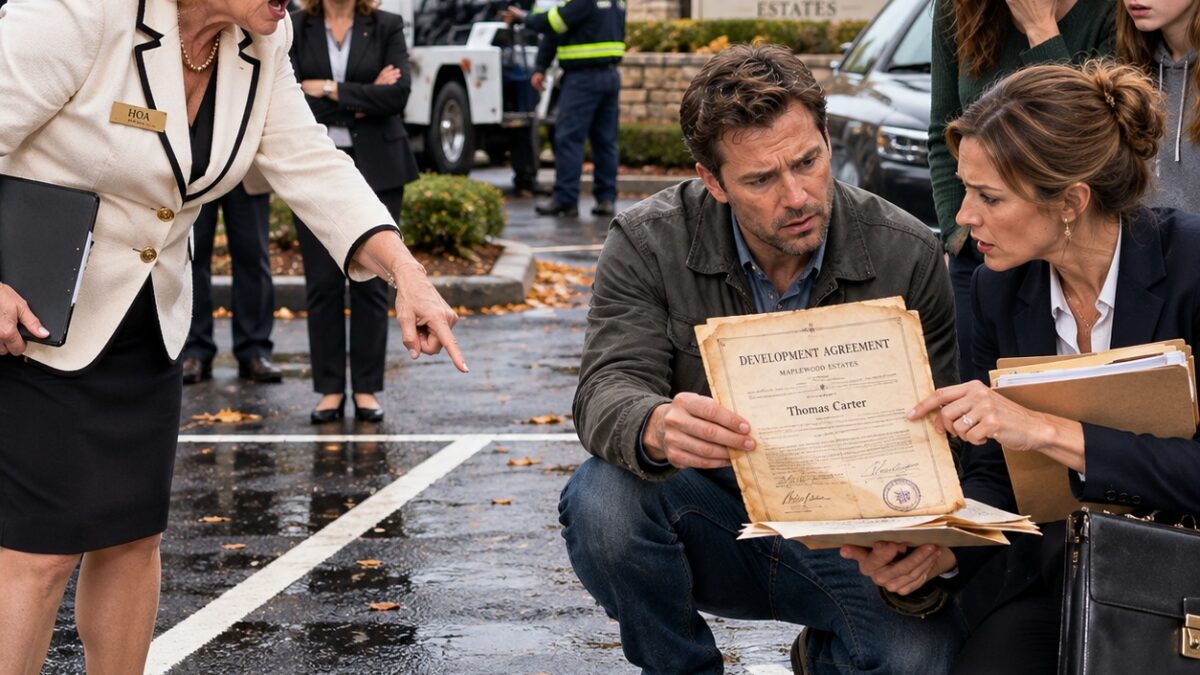
A private agreement between Thomas Carter and the original developer.
“Can you read it to us?”
Emily asked.
“No.”
Susan replied.
“Not because I’m trying to be dramatic.”
“I need to verify the recording references and compare it against the later declarations.”
“Is our family mentioned?”
I asked.
“Yes.”
“Thomas?”
“Thomas and language describing the Carter family.”
My hand tightened around the phone.
“In what way?”
“That is what I want to discuss Monday.”
After the call, Lily appeared.
“Dad.”
“Yes?”
“Are they taking our parking spot?”
“I don’t know.”
She frowned.
“At least you finally stopped saying everything is fine.”
Emily hid a smile.
Teenagers are ruthless.
“We’re doing everything we can.”
I told her.
“That’s all I can promise.”
She nodded.
Then:
“Okay.”
Sunday night, I called my mother.
“Do we have a Thomas Carter in the family?”
Silence.
“Why?”
“Just answer.”
“Your grandfather had an older brother named Thomas.”
My whole body went still.
“Construction worker?”
“Yes.”
I sat down.
Emily watched my face.
“Mom, did he live around Maplewood?”
“I don’t know.”
“He disappeared from most family gatherings before you were old enough to remember.”
“Why?”
“He and your grandfather had some disagreement.”
“About what?”
“Property, maybe.”
“Money.”
“Your grandmother never liked discussing it.”
“When did he die?”
“Early 2000s, I think.”
“Did he have children?”
“No.”
“Not that I know of.”
I stared at Emily.
Thomas Carter was not some random person with the same last name.
He was my great-uncle.
A man nobody in my immediate family had spoken about in decades.
Monday morning, Susan had six folders spread across her conference table.
I knew immediately the meeting was not going to be simple.
She pointed toward the oldest document.
“I confirmed the private agreement was recorded as a supplemental development covenant in September 1998.”
“What exactly does it say?”
I asked.
Susan slid a typed transcription toward us.
The original document was faded.
The transcription was not.
I began reading.
The first paragraphs described the financial problems affecting Maplewood Estates during construction.
Several subcontractors had filed claims.
Work on drainage and internal roads had nearly stopped.
Thomas Carter was identified as a foreman and skilled construction worker.
Then came the exchange.
In consideration of continued labor, completion of drainage corrective work, road-access improvements, and waiver of certain unpaid wage claims, the developer granted Thomas several benefits.
The first concerned his townhouse.
214 Maplewood Lane.
The developer reduced the purchase price.
That part did not surprise me.
The second did.
Susan pointed.
“Read paragraph seven.”
I did.
Space 17 shall remain reserved for the exclusive use and benefit of the occupants of 214 Maplewood Lane and shall not be redesignated, converted to visitor use, transferred to another dwelling, or incorporated into common-facility parking without written consent of the owner of 214 Maplewood Lane.
Emily looked at me.
“So that’s it.”
Susan held up her hand.
“It gets stronger.”
I kept reading.
The right was described as:
Perpetual and appurtenant to the property.
I looked at Susan.
“English?”
“It runs with the property.”
She said.
“If legally valid and unreleased, selling the townhouse does not automatically eliminate it.”
“Our landlord owns the benefit.”
“Yes.”
“And our lease assigns us the property’s parking.”
“Yes.”
“So we use the space.”
“That is my interpretation.”
My pulse quickened.
Then I reached the next paragraph.
The rights established herein are intended to benefit Thomas Carter, members of the Carter household, their successors, tenants, lawful occupants, heirs, and assigns in connection with occupancy or ownership of 214 Maplewood Lane.
I read it twice.
Emily whispered:
“They actually wrote Carter household.”
“Yes.”
Susan said.
“Why?”
I asked.
“There is an explanatory section.”
She pointed lower.
It described how Thomas had refused full cash settlement when the developer could not meet wage obligations.
Instead, he negotiated property rights.
The developer specifically acknowledged his continued labor as essential to completing portions of Maplewood Estates before municipal inspection deadlines.
Then there was a handwritten note initialed by both parties.
T. Carter requests rights remain with property so no future board can remove what labor paid for.
My throat tightened.
That was the sentence.
Not the legal language.
Not perpetual.
Not appurtenant.
That handwritten line.
So no future board can remove what labor paid for.
I knew exactly what that meant.
Thomas Carter had not received Space 17 as a favor.
He had earned it.
With work.
With unpaid wages.
With the leverage he had at a moment when a developer desperately needed people to stay.
I imagined him negotiating.
Maybe tired.
Maybe angry.
Maybe knowing promises disappear faster than paychecks.
He made them put it in writing.
Emily touched my arm.
“You okay?”
“Yes.”
I was not.
Susan waited.
Finally, I asked:
“Can the HOA override it?”
“That is the question I spent the weekend researching.”
“And?”
“Not through the documents they’ve shown us.”
I leaned forward.
She continued.
“The association declarations adopted later include general authority over common parking.”
“But recorded property-specific easements are expressly preserved unless released, terminated, or lawfully amended.”
“Was this one released?”
“I found no release.”
“Amended?”
“No.”
“Terminated?”
“No.”
Emily exhaled.
“So Margaret had no right to send the notice.”
Susan remained cautious.
“The association can make a legal argument.”
“That doesn’t mean it is a strong one.”
“What argument?”
“That later parking plans changed the physical configuration.”
“That Space 17 became common-area parking.”
“That the original reservation was superseded.”
“Did that happen?”
“The recorded plats still identify the area.”
“And more importantly, the twelve-year-old HOA note tells us someone in the association still believed the reservation mattered.”
I looked at the handwritten note again.
Verify before reassignment.
“They were warned.”
I said.
“Yes.”
“Years ago.”
“Yes.”
“And six months ago, they started planning to take the spot anyway.”
Susan looked at me.
“That is what the timeline appears to show.”
Emily asked:
“Why?”
Susan pulled out the confidential board review.
“Clubhouse expansion.”
“Private events.”
“They want to rent the clubhouse commercially on weekends.”
“For weddings?”
“Corporate events.”
“Private parties.”
“Things like that.”
The proposal projected additional annual revenue for the association.
“How much?”
I asked.
“Potentially between eighty and one hundred twenty thousand dollars.”
I laughed once.
Bitterly.
“So our parking space is blocking them from making money.”
“Not exactly.”
Susan said.
“The whole parking layout needs modification.”
“But Space 17 sits near the access lane they want to widen.”
“They need it.”
“It would make their plan significantly easier.”
I looked at Emily.
That explained the urgency.
Not everything.
But enough.
Then Susan gave us another surprise.
“I spoke with your landlord.”
I straightened.
“You contacted Mr. Patel?”
“Yes.”
Arun Patel had owned our townhouse for eight years.
He lived in Chicago.
We mostly communicated through a property manager.
“What did he say?”
“He had no idea about the original easement.”
“That’s bad.”
I said.
“Actually, it helps us.”
Susan replied.
“Why?”
“Because he has no interest in releasing it.”
Emily blinked.
“Really?”
“He considers a permanently reserved parking space an asset to his property.”
Of course he did.
For once, landlord economics worked in our favor.
“He is sending written authorization confirming that your lease includes the assigned parking right and that he objects to any HOA reassignment.”
I leaned back.
“So what do we do now?”
“Send the complete agreement.”
“Demand withdrawal.”
“And if they refuse?”
Susan looked at me.
“Then we decide whether to seek declaratory relief.”
“Court.”
“Yes.”
The word settled over the table.
Court.
Legal fees.
Time.
Stress.
I felt the old instinct rising.
Maybe we could negotiate another spot.
Maybe this was becoming too much.
Emily saw it.
“No.”
She said.
I looked at her.
“No what?”
“You’re doing the thing.”
“What thing?”
“The thing where you calculate how much surrender costs and call it practicality.”
Susan looked politely interested.
I stared at my wife.
“That is unfair.”
“Is it?”
I looked at Thomas Carter’s note.
What labor paid for.
For twenty-seven years, that sentence had survived.
I thought about some board simply painting over it because a wedding venue needed better access.
“No.”
I said.
“We don’t surrender it.”
Susan nodded once.
“Then we proceed.”
Her letter went out that afternoon.
This one was different.
The first letter had asked the HOA to pause.
The second demanded action.
Withdraw the violation.
Recognize the easement.
Stop all towing threats.
Stop reallocation.
Preserve records connected to the clubhouse plan.
Confirm no alteration to Space 17 without consent of the property owner.
The HOA had ten business days.
They answered in four.
Mr. Lawson called Susan first.
Then the board scheduled an emergency meeting.
Margaret sent an email to residents.
COMMUNITY PARKING REVIEW.
No mention of our name.
No mention of Thomas Carter.
No mention of the twenty-seven-year-old agreement.
But people knew.
Neighborhoods are efficient rumor systems.
By Wednesday, a man walking his golden retriever stopped me.
“You’re the parking guy.”
I stared.
“Apparently.”
He lowered his voice.
“Margaret says you’re blocking the clubhouse renovation.”
“I’m asking them to respect an easement.”
His eyebrows rose.
“There’s really an easement?”
“Yes.”
“Interesting.”
Then he walked away.
That night, Emily found a discussion in the neighborhood Facebook group.
Some residents supported us.
Some did not.
One comment:
Why should one renter get permanent preferential parking because of an ancient agreement?
Another:
Property rights don’t disappear because the resident rents.
Another:
They’re stopping improvements everybody will benefit from.
Then:
How much money are we spending on lawyers because one family won’t move their car?
That one made my stomach burn.
Lily saw it too.
She came downstairs furious.
“They’re calling us selfish.”
“Do not reply.”
“Dad.”
“Do not reply.”
“They’re lying.”
“People are discussing something they don’t fully understand.”
“So explain it.”
“No.”
“Why?”
“Because Susan is handling it.”
Lily folded her arms.
“You always tell me not to let people define me.”
“Yes.”
“Then why are you letting them define us?”
That question stayed with me.
The next morning, I asked Susan whether we could release the historical agreement publicly.
“Eventually.”
She said.
“But not yet.”
“Why?”
“Because the HOA’s attorney asked for a settlement conference.”
“What are they offering?”
“We’ll find out Friday.”
The conference happened at Mr. Lawson’s office.
Margaret attended with two board members.
One was Robert Chen, the treasurer.
The other, Denise Miller, had served on the board only eight months.
Susan sat beside me.
Mr. Patel joined by video.
Lawson began.
“Everyone understands litigation would be expensive.”
Susan said nothing.
He continued.
“The association is willing to offer the Carters an alternative reserved space.”
“No.”
I said.
Susan touched my arm lightly.
Not because she disagreed.
Because attorneys prefer clients not interrupt opening offers.
Lawson continued.
“Space 24.”
“Comparable distance.”
“Fresh designation.”
“Written guarantee for the duration of their tenancy.”
I shook my head.
Margaret looked annoyed.
“This is more than reasonable.”
Susan finally spoke.
“It is not responsive to the recorded easement.”
Margaret leaned forward.
“We need Space 17 for access.”
“There it is.”
Emily said.
Margaret looked at her.
“There what is?”
“The real reason.”
“This was never about us violating parking rules.”
“It’s about the event plan.”
Margaret’s eyes hardened.
“The clubhouse has been underutilized for years.”
“Rental income could reduce dues.”
“Improve reserves.”
“Fund landscaping.”
I understood the argument.
Actually, I respected part of it.
HOAs need money.
Roofs age.
Roads crack.
Pools break.
If the clubhouse could generate revenue, that could help people.
But good intentions do not create ownership.
I said:
“Then redesign the plan.”
Margaret laughed.
“You have no idea what engineering changes cost.”
“I know what agreements mean.”
“You’re a renter.”
The room went still.
Susan slowly turned toward her.
Mr. Lawson closed his eyes for half a second.
Margaret realized the mistake.
She tried to recover.
“I simply mean you are not the property owner.”
“Mr. Patel is.”
Susan said.
His voice came through the speaker.
“And I do not consent.”
Margaret’s face tightened.
Lawson stepped in.
“Let’s remain constructive.”
He offered another option.
Five thousand dollars to Mr. Patel for release of the easement.
Patel laughed.
“No.”
Ten thousand.
“No.”
Fifteen.
“No.”
Margaret looked at the screen.
“What amount would you accept?”
“None.”
She blinked.
Patel continued.
“I bought 214 Maplewood because assigned parking was represented as part of the property.”
“I have tenants whose lease includes it.”
“I am not releasing an asset because your board designed a project without checking title records.”
That was the first moment I genuinely liked my landlord.
Margaret turned to Lawson.
“This is absurd.”
Susan opened a folder.
“No.”
She said.
“This is title.”
Then she laid out the twelve-year-old board note.
Verify before reassignment.
Margaret stared.
Robert Chen leaned forward.
“I’ve never seen that.”
Denise looked at him.
“Neither have I.”
Margaret said nothing.
Susan placed the six-month-old confidential review beside it.
“You had this one.”
She said.
Robert looked at Margaret.
“Who prepared that?”
Margaret answered carefully.
“The planning committee.”
“You chaired that committee.”
Robert said.
“Yes.”
“Did you know there was an old reservation?”
“I knew there were historical references.”
Emily looked at me.
Historical references.
Not exactly ignorance.
Susan remained calm.
“Did you direct anyone to verify the easement before the violation notice was issued?”
“That was management’s responsibility.”
Lawson stepped in quickly.
“We are not conducting testimony here.”
Susan smiled faintly.
“Agreed.”
“But if litigation becomes necessary, those questions will be asked under oath.”
Nobody spoke for several seconds.
The conference ended without agreement.
On the drive home, Emily said:
“She knew.”
“We don’t know exactly what she knew.”
“She literally admitted she knew there were historical references.”
“That isn’t the same as understanding the legal right.”
Emily sighed.
“You and Susan are exhausting.”
“Records.”
I said.
“Not assumptions.”
She smiled despite herself.
“You’re turning into her.”
The emergency HOA meeting was scheduled for Tuesday night.
Before it happened, something unexpected occurred.
Robert Chen called me.
Not officially.
“I probably shouldn’t be calling.”
He said.
“Then maybe don’t.”
He laughed nervously.
“Fair.”
“What do you need?”
“I wanted to apologize.”
“For what?”
“I voted to authorize the parking review.”
My stomach tightened.
“You knew about Space 17?”
“No.”
“That’s the problem.”
He said.
“We were shown a map.”
“Margaret said management had identified several spaces with inconsistent assignments.”
“We were told the legal review would happen before enforcement.”
“It didn’t?”
“Not that I can find.”
“Why tell me?”
“Because I reviewed old board archives last night.”
“And?”
“There was an email from eleven years ago.”
“About the easement?”
“Yes.”
“What did it say?”
“That counsel at the time advised the board not to reassign Space 17 without obtaining a release from the property owner.”
I stopped walking.
I had been pacing outside work during lunch.
“Send that to Susan.”
“I already did.”
My pulse jumped.
“Robert.”
“Yes?”
“Why are you helping us?”
He was quiet.
“Because I joined the board to keep the pool budget under control.”
“Not to erase recorded property rights.”
Then:
“And because this is going too far.”
Susan called an hour later.
The email was real.
Old HOA counsel.
Clear language.
The parking reservation likely constituted an appurtenant easement.
Do not reassign without recorded release.
Now we had more than a handwritten note.
We had legal advice.
From the HOA’s own former attorney.
Susan’s voice was controlled, but I could hear the change.
“This significantly strengthens our position.”
“Does it prove Margaret knew?”
“No.”
“The email predates her time as president.”
“Could she have seen it?”
“Maybe.”
“We don’t need that yet.”
“What do we need?”
“The association had notice.”
That mattered more legally.
Tuesday night, the clubhouse was packed.
I had never seen so many residents attend an HOA meeting.
Normally, people avoid them like dental surgery.
Now every chair was taken.
People stood along the walls.
Margaret sat in the center behind a long table.
Robert to her left.
Denise beside him.
Two other board members.
Mr. Lawson sat near the end.
Susan sat with Emily and me in the first row.
Lily wanted to attend.
We said no.
She said we were violating her constitutional rights.
We said she had algebra homework.
The meeting began with regular business.
Landscaping.
Pool maintenance.
Trash pickup.
It was surreal.
Everybody knew why they were really there.
Finally:
“Next item.”
Margaret said.
“Parking and clubhouse-access review.”
Murmurs moved through the room.
Lawson stood.
He explained that a dispute had arisen concerning Space 17.
He acknowledged a historical recorded easement.
He acknowledged the association was reviewing its enforceability.
He did not mention the old legal warning until Susan stood during the resident-comment period.
“My name is Susan Bennett.”
She said.
“I represent the owner and lawful occupants of 214 Maplewood Lane.”
She held up a packet.
“For transparency, we have provided the board copies of the recorded 1998 supplemental agreement.”
“The easement provision.”
“The twelve-year-old board note.”
“And prior legal correspondence advising this association not to reassign Space 17 without a recorded release.”
The room changed.
People leaned toward each other.
Margaret’s mouth tightened.
Susan continued.
“This is not a request for special treatment.”
“It is a request that the association follow property rights already recorded before many current residents purchased homes here.”
A man in the back raised his hand.
“Can residents see the documents?”
Margaret answered:
“Not tonight.”
Robert interrupted.
“I think they should.”
Every face turned toward him.
Margaret looked stunned.
Robert continued.
“If we’re considering spending association money litigating this, residents should understand what we’re defending.”
Applause.
Not huge.
But enough.
Margaret struck the gavel.
“This is not a political rally.”
The applause stopped.
Then Denise spoke.
“I also support releasing the documents.”
Another board member nodded.
Suddenly, Margaret was no longer controlling the room.
Mr. Lawson leaned toward her and whispered.
She whispered back sharply.
Then:
“We will take a brief recess.”
The board disappeared into a side room.
Residents surrounded us.
Some friendly.
Some not.
One older woman said:
“I’ve lived here twenty years.”
“I never knew any of this.”
Neither did I.
A man wearing a golf shirt asked:
“Are you really related to the construction worker?”
“He was my great-uncle.”
“That’s wild.”
Another resident looked irritated.
“So one guy worked on drainage twenty-seven years ago and now we can’t improve the clubhouse?”
Emily responded before I could.
“One guy gave up unpaid wages in exchange for a recorded property right.”
The man opened his mouth.
Then closed it.
Good answer.
When the board returned, Lawson spoke.
“The association proposes postponing any vote on parking reconfiguration for thirty days while counsel conducts further title review.”
Susan rose.
“The towing notice should be withdrawn immediately.”
Lawson nodded.
“The association agrees to withdraw the notice.”
I looked at Emily.
For the first time since this began, something official had moved in our favor.
“Space 17?”
Susan asked.
“Existing use will continue during review.”
“No.”
She said.
“Not during review.”
“The association has had years to review.”
“The owner has refused release.”
“The original agreement prohibits reassignment.”
“Recognition should be permanent.”
Lawson looked toward Margaret.
Margaret shook her head.
Susan sat.
The war was not finished.
But our car was not getting towed.
That night, Lily met us at the door.
“Well?”
“We keep the spot for now.”
“For now?”
Emily sighed.
“Your father married a lawyer in spirit.”
I laughed.
The next thirty days changed Maplewood Estates.
The documents were released.
Residents read them.
Local history groups became interested in Thomas Carter.
Not because he was famous.
Because he was ordinary.
That made his story compelling.
A construction worker who accepted property rights because wages were delayed.
He helped complete drainage infrastructure.
He negotiated written protection.
Then disappeared from neighborhood history.
A reporter from a small local paper called.
I almost refused.
Susan said:
“Talk about your family.”
“Not the litigation.”
So I did.
I told the reporter I never remembered meeting Thomas.
That my family barely talked about him.
That discovering his name in property records felt like finding a relative in the foundation of a building.
The article headline read:
OLD EASEMENT REVEALS WORKER’S ROLE IN MAPLEWOOD ESTATES HISTORY.
Suddenly, the story was no longer:
Renter blocks HOA parking improvements.
It was:
HOA wants to remove right earned by worker who helped build neighborhood.
That shift mattered.
Margaret hated it.
At the next board meeting, she accused “outside publicity” of distorting the issue.
Robert responded:
“The documents were public records.”
Denise asked:
“Why were they not reviewed before enforcement?”
Margaret blamed management.
Management produced an email.
Six months earlier.
Sent to Margaret.
Subject:
SPACE 17 – POSSIBLE HISTORICAL RESTRICTION.
My hands went cold when Susan showed it to us.
The property manager had specifically written:
Before issuing a violation or reassignment notice, I recommend legal review due to references in archived records.
Margaret replied:
Proceed with preliminary notice. We cannot let one legacy parking claim derail the clubhouse plan.
Emily read the sentence twice.
“There.”
She said.
“There it is.”
Even Susan could not soften that one.
Margaret had known enough to be warned.
She chose to proceed anyway.
Not because she hated us personally.
There was no evidence of that.
Not because of our income.
Not because we rented.
The truth was both simpler and more frustrating.
She believed the clubhouse project was more important than one old property right.
She had decided practicality justified pushing first and sorting legality later.
That mindset is dangerous when you control enforcement.
She had not needed to be corrupt.
Only certain that her goal mattered more.
Susan sent the email to Lawson.
Two days later, he requested another settlement conference.
This time Margaret did not attend.
Robert and Denise came.
Mr. Patel joined.
Lawson looked tired.
“We believe a settlement is possible.”
Susan said:
“We’ve believed that from the beginning.”
He almost smiled.
Then he presented terms.
The HOA would permanently recognize the 1998 easement.
Space 17 would remain reserved for 214 Maplewood Lane.
No towing.
No reassignment.
No redesignation without a recorded written release from the property owner.
The association would update maps and governing records.
It would reimburse Mr. Patel and us for documented reasonable legal expenses up to $12,500.
My mouth opened.
I looked at Susan.
She remained completely neutral.
Professional poker face.
Lawson continued.
The violation notice would be formally rescinded.
Any internal violation history removed.
The clubhouse plan would be redesigned around Space 17.
And the HOA would commission a title review of other historical property-specific easements before future parking changes.
Emily whispered:
“That sounds like winning.”
Susan whispered back:
“Wait.”
There was one more condition.
Confidentiality concerning settlement negotiations.
Not the historical documents.
Not the easement.
Not public records.
Just settlement discussions.
Fine.
Then Lawson added:
“The board would like mutual non-disparagement.”
Susan shook her head immediately.
“No.”
“Why?”
“Because my clients should not be restricted from accurately discussing public HOA actions.”
Lawson sighed.
“Limited to knowingly false statements?”
Susan considered.
“That is already law.”
I almost laughed.
They removed it.
Then Robert spoke.
“There’s another issue.”
Margaret.
He looked uncomfortable.
“She resigned as president this morning.”
Emily stared.
“Because of this?”
“She said she no longer had the board’s confidence.”
That was diplomatic.
Later, Robert told me three board members had asked her to step down.
Margaret remained a homeowner.
She was not exiled.
Not sued personally.
Not arrested.
Nothing dramatic.
She simply lost the authority she had used too aggressively.
I was surprised by my reaction.
I did not feel triumphant.
I felt tired.
“What happens to the event facility?”
I asked.
Robert smiled faintly.
“We redesign.”
“Can you?”
“Probably.”
“It will cost more.”
“Maybe generate less revenue.”
“But yes.”
“Then why didn’t we start there?”
Nobody answered.
We signed the settlement three days later.
The permanent recognition was recorded.
That mattered most to Susan.
“A board resolution can change.”
She explained.
“A recorded acknowledgment tied to the property is harder to conveniently forget.”
The first thing I did after signing was drive home and park in Space 17.
Same cracked asphalt.
Same faded number.
Same Honda.
Nothing looked different.
Lily came outside.
“Seriously?”
“What?”
“You’re taking a picture of a parking spot.”
“I’m documenting history.”
“You’re embarrassing.”
“Also history.”
She rolled her eyes.
Emily came out laughing.
We took a photograph anyway.
The three of us standing in front of Space 17.
It remains one of my favorite family pictures.
Not because of the asphalt.
Because of what it represented.
Two months later, Maplewood Estates held another community meeting.
Robert had become temporary president.
One agenda item surprised me.
Historical recognition.
The local newspaper article had caused residents to start asking who else had helped build Maplewood.
Turns out Thomas Carter was not the only worker whose labor disappeared from the official story.
Several subcontractors.
Laborers.
A drainage crew.
A mason.
People whose names appeared in records but nowhere else.
Robert proposed a plaque near the clubhouse recognizing the original workers.
I almost objected.
Thomas did not need a plaque to validate him.
Then my mother came to the dedication.
She was seventy-eight.
Walking slowly.
She stood in front of Thomas’s name for a long time.
“I remember him now.”
She said.
“What?”
“He came to Christmas once when you were little.”
“I don’t.”
“You were maybe three.”
She smiled.
“He brought you a toy truck.”
That hit me harder than any legal victory.
This man had been close enough to hold something out to me.
And I had no memory of him.
“What happened between him and Grandpa?”
I asked.
My mother sighed.
“Pride.”
“Your grandfather thought Thomas was foolish for taking property instead of fighting for full wages.”
“Thomas thought your grandfather cared too much about money.”
“They stopped speaking.”
I laughed softly.
“So our family lost him over money.”
“Partly.”
“And twenty-seven years later we found him because of a parking easement.”
“Families are strange.”
She said.
That might be the most accurate legal conclusion in the entire story.
Mr. Patel came to the plaque ceremony too.
He surprised me again.
“I’ve been thinking.”
He said.
“That’s dangerous.”
He smiled.
“My wife and I are simplifying our portfolio.”
My stomach tightened.
“You’re selling the townhouse?”
“Possibly.”
I immediately thought of rent.
Moving.
Lily’s school.
Everything stable becoming unstable again.
Then he said:
“I wanted to offer it to you first.”
I laughed.
“Mr. Patel, we cannot afford Maplewood prices.”
“I know what you pay.”
“I know your history here.”
“And I know what similar units sell for.”
He quoted a number.
Still high.
But lower than I expected.
“I’m not giving it away.”
He said.
“I’m offering you first refusal and time to arrange financing.”
I looked at Emily.
Her eyes widened.
That night, we ran numbers.
Mortgage.
Taxes.
Insurance.
HOA dues.
Repairs.
It would be tight.
Very tight.
Old Daniel would have immediately said no.
Too risky.
Too expensive.
Stay flexible.
Do not create trouble.
But something had changed in me.
Not recklessness.
A different understanding of security.
For years, I thought security meant never challenging anything that could destabilize us.
Now I understood sometimes security requires claiming a place.
We applied.
Our credit was good.
Down payment was the problem.
We had savings, but not enough comfortably.
My mother called.
“I have something.”
“No.”
“You don’t even know what.”
“If it’s money, no.”
“It’s from your grandfather.”
I became quiet.
After his death, she had kept a small inheritance account.
Not huge.
Enough to help.
“Mom.”
“Listen.”
She said.
“Thomas and your grandfather stopped speaking because both were too proud.”
“I don’t intend to watch another Carter refuse family help because of pride.”
Emily mouthed:
She got you.
She had.
We accepted part.
Not all.
Three months later, we closed on 214 Maplewood Lane.
The house we had rented became ours.
I stood in the kitchen holding the keys.
Lily looked around.
“So nothing changes?”
“Everything changes.”
I said.
“The refrigerator still blocks the cabinet.”
“Unfortunately.”
“My room is still tiny?”
“Yes.”
“This is a terrible victory.”
She smiled when she said it.
Emily leaned against the counter.
“We own it.”
That sentence felt almost impossible.
We owned the townhouse.
And with it, Space 17.
Not because of Thomas Carter.
The bank did not care about family history.
We made payments.
Signed documents.
Took responsibility.
But his agreement had become part of the chain that kept us connected to this place long enough to claim it for ourselves.
The clubhouse project eventually opened eight months later.
Smaller than Margaret proposed.
Fewer events.
Different traffic flow.
Space 17 remained untouched.
Ironically, residents liked the revised design better.
More landscaping.
Less congestion.
A man who had criticized us online stopped me one Saturday.
“Looks like everybody got what they needed.”
I looked at him.
“Almost like checking the documents first would’ve saved everyone money.”
He laughed awkwardly.
“Yeah.”
The HOA spent nearly thirty thousand dollars on attorneys.
More than the engineering cost of adjusting the plan early.
That might have been the most fitting consequence.
Not destruction.
A lesson with an invoice.
Margaret and I barely spoke for months.
Then one morning, I was taking out trash when she walked past.
She stopped.
“Daniel.”
“Margaret.”
We stood there.
Two people who had once communicated mostly through legal letters.
“I owe you an apology.”
I did not say anything.
She continued.
“I believed the clubhouse project was necessary.”
“I still think it was valuable.”
“But I treated the easement as an obstacle before I understood what it was.”
“You were warned.”
“I know.”
That mattered.
No excuses.
No:
The manager misunderstood.
No:
You were difficult.
She said:
“I know.”
Then:
“I thought if we moved quickly, everyone would eventually accept the result.”
I looked at her.
“That’s easier when you aren’t the person losing something.”
“Yes.”
She swallowed.
“I understand that now.”
I nodded.
“Thank you.”
She seemed surprised.
“That’s it?”
“What do you want me to do?”
“I don’t know.”
“Neither do I.”
For a second, we both laughed.
Not friends.
Never likely to become friends.
But the story no longer needed another fight.
Before she left, Margaret said:
“I read the article about Thomas.”
“So did half the county.”
“He sounds stubborn.”
“He was a Carter.”
She smiled.
Then walked away.
I realized something afterward.
For months, I had wanted a moment when Margaret understood exactly what she had done.
I imagined speeches.
Embarrassment.
Maybe residents confronting her.
By the time the apology came, I no longer needed any of it.
That is one of the strange things about conflict.
At the beginning, you want the other person to admit you are right.
Near the end, sometimes all you want is peace that does not require surrender.
We got that.
Space 17 remained ours.
The HOA acknowledged the easement permanently.
Our violation record disappeared.
Legal fees were substantially reimbursed.
The clubhouse plan changed.
Margaret stepped down.
Records were corrected.
Other historical easements were reviewed.
No courtroom.
No dramatic judge pounding a gavel.
No police.
No millions.
Just documents doing what documents are supposed to do when people finally respect them.
But the deepest ending had nothing to do with the HOA.
It happened in my garage.
Six months after we bought the townhouse, I was cleaning boxes my mother had given me.
Old family things.
Photographs.
Tax papers.
Christmas cards.
Then I found an envelope.
THOMAS C.
Inside was a photograph.
A man standing beside a drainage trench.
Hard hat.
Work boots.
Thin mustache.
Three other workers beside him.
Behind them, partially framed houses.
On the back:
Maplewood job.
I sat on the garage floor.
That was him.
My great-uncle.
Not a name on an easement anymore.
A man.
I studied his face.
There was something familiar around the eyes.
Maybe imagination.
Maybe family.
Emily found me there.
“What did you find?”
I handed her the photo.
She sat beside me.
For several minutes, neither of us spoke.
Then:
“He really was here.”
“Yeah.”
“What are you going to do with it?”
I thought.
“Frame it.”
“Where?”
I smiled.
“Garage.”
She laughed.
“Very respectful.”
“He was a construction worker.”
“He’d hate the living room.”
“Fair.”
We put the photograph above my workbench.
Under it, I eventually framed a copy of the handwritten sentence:
So no future board can remove what labor paid for.
I see it almost every morning.
Some days I think about property rights.
Most days I think about work.
Thomas Carter never became wealthy.
At least, nothing we found suggested he did.
He worked.
Helped finish a struggling development.
Negotiated something lasting when the company could not fully pay him.
Then his family argument swallowed most of his memory.
That happens.
People disappear from family stories for stupid reasons.
Pride.
Divorce.
Money.
Distance.
Then twenty-seven years later, one legal paragraph can bring them back.
I also think about how close we came to losing Space 17 without ever knowing why it mattered.
If Emily had not pushed me.
If Susan had not dug deeper.
If the historical note had been missed.
If Mr. Patel had simply agreed to the HOA’s request.
If we had moved the car and said:
It isn’t worth the trouble.
Nothing dramatic would have happened.
That is what bothers me most.
Our lives would have continued.
We would have parked somewhere else.
The clubhouse would have expanded.
Thomas Carter’s agreement would remain buried in county records.
Everyone would assume the HOA had always been right.
Sometimes injustice does not look like a courtroom scandal.
Sometimes it looks like inconvenience accepted by someone too tired to argue.
That realization changed me.
Not into a person who fights everything.
I still believe in choosing battles.
You should.
Life is too short to turn every irritation into war.
But now I ask different questions.
Who benefits if I stay quiet?
What exactly does the document say?
Who decided this?
Do they have the right?
Is this truly a rule, or simply someone’s preference wearing official language?
Those questions are not disrespect.
They are citizenship.
Ownership.
Adulthood.
Lily learned something too.
A year after the dispute ended, her civics teacher assigned an essay about local government.
She titled hers:
WHY SMALL RULES STILL NEED DUE PROCESS.
I found it on the printer.
She was furious.
“You read my essay?”
“It was face up.”
“That is not consent.”
“I raised a future attorney.”
She rolled her eyes.
But I read it.
She did not use our names.
She described a fictional neighborhood where an association tried to reassign a property right without checking historical documents.
Her conclusion said:
Authority is easiest to misuse when the thing being taken seems too small to fight over.
I read that line twice.
Then I showed Emily.
She cried.
“Why are you crying?”
Lily demanded.
“Because you’re smart.”
“I’ve been telling you that for years.”
Teenagers.
Thomas Carter’s plaque still stands near the clubhouse.
It does not mention Space 17.
I am glad.
His life was bigger than a parking space.
It says:
THOMAS CARTER
Construction foreman and early Maplewood worker.
His labor contributed to the roads, drainage, and infrastructure that helped complete this community in 1998.
Below his name are others.
People I never knew.
Names that had lived only on payroll records.
I pass that plaque occasionally.
Most residents probably never read it.
That is okay.
Recognition is strange.
We think being remembered means everybody must know our story.
Maybe not.
Maybe it is enough that the truth exists somewhere people can find it.
Our townhouse still has problems.
Ownership did not magically make it beautiful.
The water heater failed six months after closing.
The dishwasher leaks if you load it wrong.
There is a crack near Lily’s bedroom window that keeps returning no matter how many times I patch it.
Homeownership is mostly paying money to discover new places water can enter a building.
Carlos—my coworker, not the hotel manager from someone else’s dramatic life—came over to help with the water heater.
He looked at Space 17.
“This is the famous parking spot?”
“Unfortunately.”
He stood in it.
“Feels normal.”
“I know.”
“You fought lawyers over this?”
“Yes.”
He shook his head.
“Man.”
Then:
“Good for you.”
That is usually how people react.
Because after all the documents, meetings, history, and stress, Space 17 still looks ridiculous.
A painted rectangle.
That is why the story matters.
Rights do not become less real because they involve ordinary things.
A driveway.
An access road.
A fence.
A parking space.
A strip of land.
A promise.
Most people do not fight over castles.
They fight over the practical pieces of life that let them get home, raise families, work, and feel secure.
One evening, almost two years after the first violation notice, Emily and I sat outside.
Lily had gone to a friend’s house.
The neighborhood was quiet.
The clubhouse lights were on.
Some kind of anniversary party.
Cars filled the redesigned event spaces.
Space 17 remained empty because our Honda was at the mechanic.
Emily pointed.
“Look.”
“At what?”
“Our spot.”
“What about it?”
“It survived.”
I laughed.
“You’re sentimental about asphalt now.”
“You started it.”
“I wanted to move the car.”
“Exactly.”
She leaned her head against my shoulder.
“Do you remember what you said when the first notice came?”
“No.”
“You said maybe fighting would cost more than losing.”
I did remember.
“Was I wrong?”
“Yes.”
She said immediately.
Then:
“And no.”
I looked at her.
She continued.
“The fight did cost money.”
“Time.”
“Stress.”
“But losing would’ve cost something we couldn’t measure because we didn’t even know what we were giving up.”
That was exactly it.
We would have lost more than Space 17.
We would have lost Thomas again.
A piece of our family history.
A recorded promise.
Maybe even the chance to eventually buy the property, because a permanent reserved spot helped make the townhouse worth keeping.
Most of all, we would have taught Lily something I did not want her learning.
That official people are automatically right.
That ordinary families should move when powerful organizations say move.
That history only matters if someone wealthy wrote it.
Thomas Carter was not wealthy.
Neither am I.
He still managed to put something into writing that lasted longer than most people’s titles.
Margaret was HOA president.
Now she is not.
Board members changed.
Management companies changed.
Attorneys changed.
Parking plans changed.
Thomas’s agreement remained.
There is humility in that.
Institutions often feel permanent when you are standing beneath them.
They are not.
Documents survive leadership.
Rights survive personalities.
History survives people who prefer convenience.
And sometimes a man with dirty work boots has more influence twenty-seven years later than the board president sitting beneath polished clubhouse lights.
I never met Thomas in any meaningful way.
Maybe my mother is right and he handed me a toy truck when I was three.
I wish I remembered.
I wish I knew what he sounded like.
Whether he laughed loudly.
Whether he was impatient.
Whether he liked coffee black.
Whether he was difficult.
He probably was.
Carter men have a tradition.
But I know one thing.
When somebody owed him money and asked him to keep working, he did not simply trust a handshake.
He asked:
What will you put in writing?
That question reached across twenty-seven years and protected my family.
So now I tell Lily something whenever she signs anything.
Lease someday.
Job offer.
Car loan.
Anything.
“Read it.”
“I know, Dad.”
“Every page.”
“I know.”
“Especially anything they say is standard.”
“Dad.”
“What?”
“You’re traumatized.”
“Correct.”
She laughs.
But she reads.
That may be Thomas’s most useful inheritance.
Not Space 17.
Skepticism with paperwork.
Our final HOA settlement sits in a fireproof box now.
Susan told me digital backups were enough.
I ignored her.
I have three copies.
Emily says this is unhealthy.
I say history has spoken.
Occasionally, new residents move in.
One couple recently rented the townhouse across from us.
The husband asked:
“Why does your parking space have a tiny metal plaque under the number?”
After settlement, the HOA installed one.
RESERVED — 214 MAPLEWOOD LANE
RECORDED EASEMENT
I smiled.
“Long story.”
He looked interested.
I shook my head.
“You don’t have time.”
I usually leave it there.
Not every story needs retelling every day.
But sometimes, when I pull into Space 17 after work, I think about the first notice.
The threat.
Margaret saying the neighborhood had changed.
Susan turning the old paper toward me.
Thomas Carter.
Construction worker.
Drainage.
Roads.
Unpaid wages.
Property rights.
Then I think about his handwritten note.
No future board can remove what labor paid for.
He was wrong about one thing.
A future board tried.
They simply failed.
Not because we were powerful.
Not because we had better connections.
Because he had put the truth where it could be found.
And once we found it, we refused to pretend it did not matter.
That is how the dispute ended.
No one went to jail.
No one lost millions.
Margaret did not become homeless.
The HOA did not collapse.
The clubhouse still hosts events.
The neighborhood moved on.
But Space 17 remained exactly where it had been.
The violation notice was erased.
The easement was recognized.
The records were corrected.
My family bought the home.
And the name Thomas Carter returned to Maplewood Estates after nearly three decades of silence.
The first day after we officially became owners, I came home late.
It was raining.
Almost the same kind of rain that had fallen the night the HOA notice appeared.
I pulled into Space 17.
Turned off the engine.
Sat there for a minute.
Our townhouse windows glowed.
Emily was inside.
Lily’s bedroom light was on upstairs.
My knee hurt.
My shirt smelled like machine oil.
A completely ordinary evening.
I looked toward the little plaque beneath the painted number.
Then at our front door.
And I understood why Thomas Carter had negotiated so hard for something that probably seemed minor even in 1998.
He was not really negotiating for parking.
He was negotiating for permanence.
One small promise that said:
You worked here.
You earned something here.
You have a place here.
And twenty-seven years later, his family came home to it.








