FULL ENDING: My HOA President Called My Service Dog a “Loophole,” and Her Obsession With Controlling Him Turned My Quiet Neighborhood Into a Fight Over the One Thing Keeping Me Steady
PART 2 and FULL ENDING  Thank you

For a second, everything around me disappeared.
The newspaper.
The lawn.
Karen.
The neighborhood.
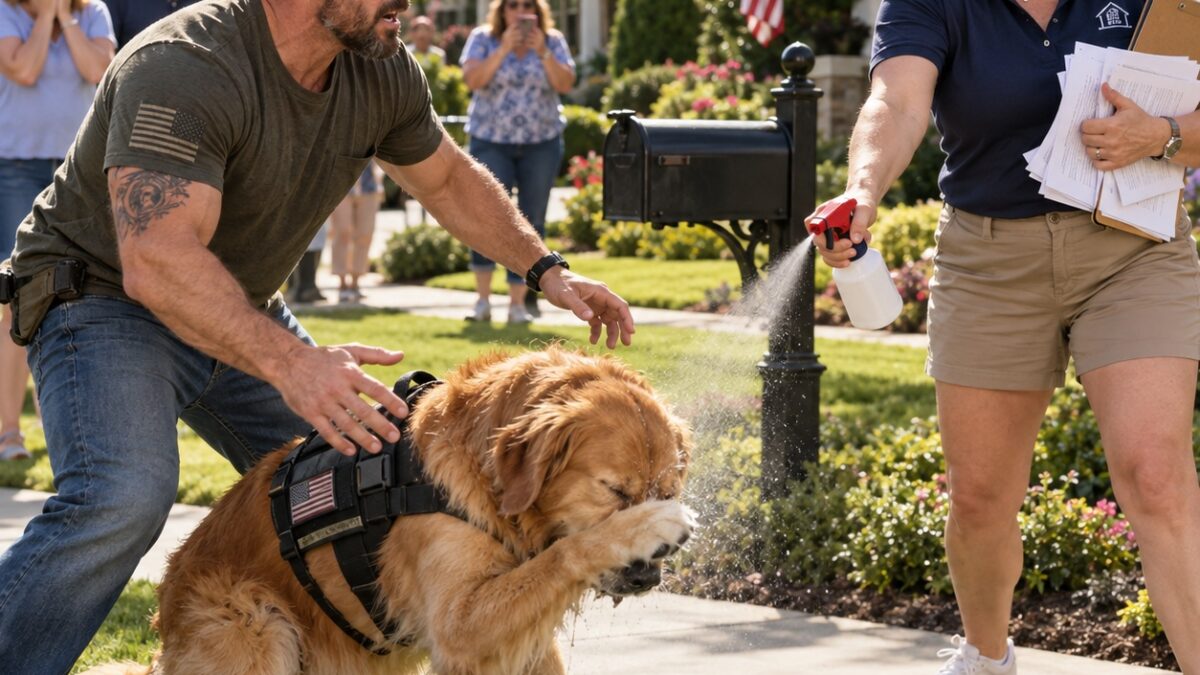
All I could see was Maverick jerking his head from side to side, blinking hard and trying to rub his face against his paws.
“Maverick.”
I dropped beside him.
His training was so deeply ingrained that even frightened and hurting, he tried to stay close to me.
That somehow made it worse.
He trusted me.
Completely.
I stood again and stepped between him and Karen.
“What is in that bottle?”
My voice did not sound like mine.
Years earlier, I might have exploded.
That was one of the things military training had given me that never entirely left.
When fear or anger hit hard enough, part of me became calmer instead of louder.
Karen held the bottle beside her hip.
For the first time, she seemed slightly uncertain.
Then the smugness returned.
“Vinegar and water.”
“You sprayed it into his eyes.”
“It won’t hurt him.”
“He is in pain.”
“Maybe now he’ll learn to respect authority.”
I stared at her.
She had actually said it.
Not:
I’m sorry.
Not:
I didn’t mean to hit his face.
Not even:
I was trying to scare him.
She wanted my service dog to learn to respect authority.
Her authority.
I looked down.
Maverick was still blinking frantically.
Every instinct in me wanted to stay and argue.
Instead, I chose him.
“Go home.”
I said.
Karen laughed.
“You don’t tell me—”
“Leave my property.”
Something in my voice stopped her.
She backed toward the sidewalk.
“This isn’t over.”
“No.”
I said.
“It isn’t.”
I guided Maverick inside.
He knew the house.
He knew the bathroom.
He followed me despite the irritation in his eyes.
I knelt beside the sink and began carefully flushing them with clean water.
“Easy.”
I whispered.
“You’re okay.”
He whined.
That sound went through me.
Maverick almost never complained.
Even when something frightened him, his training kept him focused.
Hearing that small, hurt sound made my hands tremble.
“Easy, buddy.”
I kept rinsing.
“Stay.”
He stayed.
“Good.”
More water.
He blinked.
Again.
Again.
Slowly the frantic pawing stopped.
The redness began easing.
His breathing settled.
Eventually, he sat beside me and leaned his weight against my knee.
That was Maverick.
Even after someone attacked him, he was trying to stabilize me.
I rested one hand on his head.
“I’m sorry.”
He looked up.
I knew apologizing to a dog sounded ridiculous.
I did it anyway.
“I should have stopped her sooner.”
That was not entirely rational.
I know that now.
At the time, it felt true.
I had tolerated the letters.
The comments.
The meeting.
The threat.
I kept trying to be reasonable because I was afraid any anger from me would confirm whatever stereotype Karen already carried about veterans.
That line she threw at me—
You military types think you’re above the rules.
It had not come from nowhere.
Karen had already decided what kind of man I was.
Aggressive.
Entitled.
Probably dangerous.
I had spent weeks making myself smaller so she could not point at my reaction and say:
See?
I was done doing that.
Once Maverick was resting comfortably, I picked up my phone.
Dialed 911.
“911, what’s your emergency?”
“I need to report an assault involving my service dog.”
The dispatcher became more focused immediately.
“Is the animal injured?”
“He was sprayed directly in the eyes with a vinegar-and-water mixture.”
“Is the person still there?”
“No.”
“She lives across the street.”
“Do you know her?”
“Yes.”
“Karen Whitfield.”
“HOA president.”
The title sounded absurd in that context.
“What led up to the incident?”
“She has been targeting my service dog over HOA pet rules.”
I explained.
The first confrontation.
The violation notices.
The meeting.
The proposed identification rule.
The threat.
Then this morning.
I kept my voice controlled.
The dispatcher asked whether I felt personally threatened.
“Yes.”
That answer surprised me.
Not because I thought Karen would attack me physically.
Because she had demonstrated that she believed her perceived authority justified harming the animal I relied on.
That made her unpredictable.
“Officers are on the way.”
I thanked her.
Then I sat on the floor beside Maverick.
My pulse had started climbing.
Delayed reaction.
That happened sometimes.
During a crisis, I could function.
Afterward, the body collected its debt.
Maverick noticed.
Of course he did.
He shifted closer.
Placed his head against my leg.
Pressure.
Grounding.
I closed my eyes.
“Not today.”
I whispered.
“You’re the one who got attacked.”
His tail moved once against the tile.
Twenty minutes later, someone knocked.
Two uniformed officers.
Maverick stood automatically.
I clipped his leash to his vest.
His eyes were still slightly irritated, but he had stopped squinting.
One officer stayed near me while the other looked at Maverick.
“That the service animal?”
“Yes.”
“Maverick.”
The officer nodded.
“Beautiful dog.”
Maverick ignored the compliment.
Working.
The officer smiled faintly.
“Definitely trained.”
I walked them through everything.
I showed the notices.
The proposed rule.
The written HOA restrictions.
Maverick’s training documents and the documentation I kept organized because arguments about service animals had happened before in restaurants, stores, and public places.
Nothing like this.
But enough that I had learned to carry information.
One officer took notes.
The other asked:
“Did she enter your property?”
“Yes.”
“Did you give permission?”
“No.”
“Did she say what was in the bottle?”
“Vinegar and water.”
“Did you see her spray the dog directly?”
“Yes.”
“Any witnesses?”
I looked toward the front windows.
Several curtains moved across the street.
“Probably.”
Karen had made sure to speak loudly.
She wanted an audience.
Now that audience mattered.
One officer remained with me.
The other walked across the street.
Karen opened her door.
Even from my window, I could see the performance begin.
Hands thrown upward.
Pointing toward my house.
Clipboard mentality translated into body language.
She spoke for several minutes.
The officer barely moved.
Then he asked something.
Karen pointed to the spray bottle sitting on a little outdoor table beside her door.
My stomach tightened.
She had not even hidden it.
That told me everything about how righteous she believed she was.
The officer picked it up.
Karen reached for it.
He pulled it away.
Her face changed.
She started talking faster.
Eventually, both officers returned.
The older one sighed.
“She admitted spraying Maverick.”
I was almost disappointed by how unsurprising that was.
“What exactly did she say?”
“That she was enforcing community standards.”
I stared.
“She still thinks she did nothing wrong?”
“Apparently.”
The second officer looked at Maverick.
“We explained that an HOA does not get to create its own rules that override disability protections.”
He paused.
“And spraying a working service animal in the face is not an HOA enforcement method.”
I almost laughed.
Not because it was funny.
Because hearing a police officer say it out loud exposed how insane the situation had become.
They explained that Karen’s conduct could support criminal charges under state law involving interference with a service animal, animal cruelty, and harassment.
The exact legal classification would be determined after review.
Then one officer asked me:
“Do you want to pursue charges?”
I looked at Maverick.
He sat beside my leg.
Calm again.
Trusting.
“Yes.”
No hesitation.
“I do.”
Karen was arrested in front of her house.
The moment the handcuffs clicked around her wrists, her face transformed.
Not humbled.
Not yet.
Enraged.
“You cannot do this.”
She shouted.
The officer guided her toward the patrol car.
“I’m HOA president.”
The absurdity of that sentence hung in the air.
The officer did not respond.
Karen saw me standing near my driveway.
“You.”
She twisted enough to look directly at me.
“I will have you evicted.”
I said nothing.
“You hear me?”
She shouted.
“You will be gone before the end of the month.”
Neighbors had started coming outside.
Garage doors open.
People pretending to collect mail.
One man stood with his arms crossed.
A woman from a few houses down whispered to her husband.
The patrol-car door opened.
Karen shouted one last time:
“This neighborhood will side with me.”
Then somebody behind me said quietly:
“No, we won’t.”
Karen heard.
Her face changed.
The officer placed her in the car.
The door shut.
Only then did I turn.
A woman from two houses down approached carefully.
She had attended the HOA meeting.
Sat three rows behind me.
“I’m sorry.”
She said.
“For what?”
“For saying nothing.”
I looked at her.
“At the meeting.”
Her eyes dropped toward Maverick.
“We all knew she was going too far.”
“But nobody wanted to be next.”
I understood.
More than she realized.
Fear does not always look like trembling.
Sometimes fear looks like silence.
She continued.
“Karen has been doing this for years.”
“Not this.”
I said.
“No.”
“Not hurting animals.”
“But the fines.”
“The threats.”
“Selective enforcement.”
“If she doesn’t like someone, suddenly their fence is an inch too tall.”
“Or their porch furniture is wrong.”
“Or their car is parked improperly.”
Another neighbor joined us.
Then another.
Stories began spilling out.
Karen had forced one elderly couple to remove a flower bed because she claimed it violated landscaping uniformity.
She fined a single mother repeatedly over a basketball hoop while ignoring the same hoop two streets over.
She threatened liens.
Publicly embarrassed people during meetings.
Called out homeowners by name.
I listened.
Something bothered me.
Not that Karen was worse than I knew.
That everyone already knew.
“Why didn’t anyone vote her out?”
I asked.
Silence.
Finally someone said:
“She knows the bylaws better than most of us.”
Another neighbor added:
“And she intimidates the board.”
The first woman looked ashamed.
“Honestly?”
“Yes.”
“We got used to it.”
That sentence stayed with me.
People get used to incredible things.
A rude comment becomes normal.
Then a threat.
Then retaliation.
Then everyone reorganizes their behavior around one person’s temper.
Until the person finally crosses a line obvious enough that nobody can pretend anymore.
For Sunnyside Estates, that line was Maverick.
The next HOA email arrived that evening.
Not from Karen.
From the vice president.
EMERGENCY BOARD MEETING.
No agenda details.
Everyone knew the agenda.
The meeting was scheduled for three nights later.
In the meantime, I tried to return to normal.
That proved harder than expected.
Maverick recovered quickly.
Physically.
His eyes cleared.
He went back to work as if nothing had happened.
I did not.
The first morning we walked our usual trail, I kept scanning ahead.
Every person carrying a bottle caught my attention.
A lawn-treatment sprayer across the street made my pulse jump.
Maverick noticed.
He bumped my hand lightly with his nose.
“I’m fine.”
I said automatically.
He bumped me again.
“No.”
I corrected myself.
“I’m not.”
Something about saying it out loud helped.
PTSD had taught me that the nervous system does not care whether embarrassment tells you the threat is over.
It remembers.
I had spent years learning that lesson about myself.
Now Karen’s attack had tangled my fear with Maverick.
The one living creature who usually made the world feel safer.
That enraged me in a different way.
She had not only hurt him.
She had contaminated the place where I felt secure.
For two nights, I woke from dreams in which Maverick was missing.
In one, I could hear him barking but could not find him.
In another, someone from the HOA was leading him away while neighbors watched.
Each time I woke, he was beside the bed.
I would put my hand on his shoulder.
Real.
Warm.
Here.
At the emergency meeting, nearly every folding chair was occupied.
I had never seen so many Sunnyside residents in one room.
Maverick wore his vest.
He sat beneath my chair.
Calm.
The board vice president opened the meeting.
Her voice shook slightly.
“We are here to address events involving President Whitfield.”
Someone shouted:
“Former president.”
Applause broke out.
The vice president raised both hands.
“Please.”
The room settled.
She explained that Karen had been arrested and that the board’s insurance carrier had already contacted them requesting information.
That got everyone’s attention.
Legal jeopardy.
Insurance.
Liability.
Suddenly the people who had treated Karen’s behavior as personality conflict understood it as organizational risk.
The vice president continued.
“Regardless of the outcome of criminal proceedings, the board must address whether Ms. Whitfield’s conduct represents this association.”
“No.”
Someone said loudly.
Another voice:
“Absolutely not.”
Then the floor opened.
One by one, neighbors spoke.
The elderly couple with the flower bed.
The single mother with the basketball hoop.
A man fined over a work truck he was legally permitted to park in his driveway.
A woman Karen had accused of running an illegal daycare because her grandchildren visited often.
The stories were not criminal.
Most were not even dramatic.
That was what made them powerful.
Petty power exercised repeatedly.
Karen had made dozens of people feel small in their own neighborhood.
Then the vice president looked at me.
“Would you like to speak?”
I had not planned to.
My hands tightened around the arms of the chair.
Maverick shifted against my leg.
I stood.
“I don’t want this to become about me.”
A few people looked surprised.
“Karen targeted Maverick.”
I continued.
“And that is why the police became involved.”
“But this meeting is bigger.”
I looked around.
“For weeks, I thought Karen was focused on me because she disliked service animals.”
“Or veterans.”
“Or maybe just being challenged.”
“Now I understand that the pattern existed long before I moved here.”
Several heads nodded.
“I knew the law protected Maverick.”
“I said so.”
“I showed her.”
“She told me community standards mattered more.”
A murmur moved across the room.
“That is the part the board needs to think about.”
“An HOA has authority.”
“Yes.”
“Rules matter.”
“Yes.”
“But authority without limits becomes something else.”
I paused.
“None of us bought homes here so one neighbor could decide which laws count.”
The room was silent.
“I’m pressing charges because Karen deliberately hurt the service animal I depend on.”
“But removing her from office is not punishment for what happened to me.”
“It is protection for everyone who lives here.”
I sat.
Maverick rested his chin on my knee.
The vote was called.
No confidence in Karen Whitfield.
Every hand went up.
Unanimous.
For the first time since I moved into Sunnyside Estates, Karen’s nameplate was removed from the front table.
Someone had already unscrewed it.
A stupid little piece of plastic.
Still, seeing the empty space did something to me.
Symbols matter when people invest them with power.
Karen had loved that nameplate.
President.
A word she seemed to believe converted opinion into law.
Now the space was blank.
The next step was court.
I had never been comfortable in courtrooms.
Not because of anything that happened to me personally.
Because authority-heavy spaces brought back a particular kind of tension.
Uniforms.
Commands.
Waiting.
Being observed.
Maverick helped.
On the morning of Karen’s first appearance, he walked beside me through security.
Vest on.
Focused.
Karen arrived in designer clothes.
Expensive attorney.
Hair perfect.
She looked more like someone attending a board fundraiser than someone facing criminal charges.
When she saw me, her mouth tightened.
Then she noticed Maverick.
Something flashed in her eyes.
Disgust?
Embarrassment?
Anger?
I could not tell.
Her attorney spoke first.
He framed the situation as a misunderstanding.
A neighborhood dispute that had “unfortunately escalated.”
My stomach tightened at that phrase.
Misunderstanding.
No.
Karen had understood exactly what she was doing.
She simply believed she was entitled to do it.
The prosecutor laid out the basic facts.
Service animal.
Repeated HOA conflict.
Threat.
Spray bottle.
Direct contact with Maverick’s face.
Karen’s admission to police.
State statutes involving animal cruelty and interference with a service animal.
The judge looked toward Karen.
“Did you spray the animal?”
Her lawyer stood.
“We are not entering a plea today.”
The judge nodded.
“I asked whether the factual allegation is disputed.”
The attorney hesitated.
“My client acknowledges using a vinegar-water solution in an effort to enforce what she believed were valid community animal-control requirements.”
The judge removed his glasses.
“Counsel.”
“Yes, Your Honor?”
“Your client believed an HOA pet-identification rule authorized her to spray a service animal?”
The attorney’s confidence changed.
Slightly.
“We are not suggesting the action was advisable.”
“That was not my question.”
Karen leaned toward him.
Whispered something.
The judge saw.
“So the answer is yes?”
The attorney exhaled.
“Yes, Your Honor.”
The judge’s expression hardened.
“Community rules do not permit residents to assault animals.”
Karen shifted.
“And private association rules do not nullify disability protections.”
That sentence was the first time I saw uncertainty enter Karen’s face.
Not fear yet.
Uncertainty.
Her world had always been simple.
Karen says rule.
People comply.
Karen sends notice.
People fix whatever she dislikes.
Karen threatens fine.
People apologize.
Now she was standing somewhere her clipboard meant nothing.
The criminal case did not end that day.
There were filings.
Negotiations.
Evidence review.
Statements.
I learned quickly that justice moves slower than anger.
That was probably a good thing.
Still, patience was difficult.
Karen’s attorney tried to reduce the case.
He argued there had been no permanent physical injury.
True.
Maverick recovered.
He argued the solution was mild.
Maybe.
He argued Karen had not intended serious harm.
I could not know what she intended.
I only knew what she said:
Maybe now he’ll learn to respect authority.
The prosecutor asked whether I would consider a plea.
I said I would listen.
I did not need Karen destroyed.
That surprised me.
In the first twenty-four hours after the attack, part of me wanted the harshest possible outcome.
Jail.
Fines.
Public humiliation.
Then that feeling changed.
Not because I forgave her.
Because I wanted proportion.
Accountability.
A clear consequence.
And most of all, I wanted her removed from any position where she could use authority like that again.
The HOA had already handled that.
The criminal case was different.
Karen eventually agreed to plead guilty to a lesser charge rather than risk a harsher outcome at trial.
At sentencing, the courtroom was fuller than I expected.
Several Sunnyside residents attended.
Not because I asked.
They wanted to see the end.
Karen stood beside her attorney.
No clipboard.
No polo.
No smiley-face notices.
The prosecutor summarized the incident.
The pattern of warnings mattered.
Karen had not acted impulsively after one encounter.
She had repeatedly been told Maverick was a service animal.
She had proposed a rule aimed directly at forcing additional HOA control.
She threatened me after the meeting.
Then she came onto my property with the spray bottle.
Her attorney emphasized her lack of prior criminal history.
Her years of community involvement.
The fact Maverick suffered no permanent injury.
Then Karen was permitted to speak.
She turned toward the judge.
“I was enforcing the rules.”
My jaw tightened.
Even then.
Not:
I was wrong.
Not:
I am sorry.
“I had residents complaining about dogs.”
She continued.
“Our community has standards.”
The judge leaned forward.
“Ms. Whitfield.”
Karen stopped.
“Your community standards are not the highest authority in the state.”
Her face flushed.
“The most important rule for any association is that it operates within the law.”
She looked toward her attorney.
He stared straight ahead.
The judge continued.
“And when an individual relies on a trained service animal because of a disability, your personal opinion about whether that animal should be registered with your HOA does not authorize harassment.”
Karen’s shoulders dropped slightly.
“Your actions were not enforcement.”
He said.
“They were retaliation.”
The sentence was thirty days in county jail.
A $5,000 fine.
Two hundred hours of community service at an animal shelter.
And mandatory disability-rights education.
Karen stared at the judge.
Thirty days.
For someone who had spent years threatening other people with consequences, the reality of receiving one seemed almost impossible for her to process.
“But I was just enforcing the rules.”
She said again.
Her lawyer touched her arm.
“Karen.”
The judge’s voice remained firm.
“No.”
One word.
No.
Maybe nobody had said it to her often enough.
Bailiffs approached.
Karen turned.
Our eyes met.
For a moment I expected rage.
Instead, she looked tired.
Small.
Defeated.
Her lips moved.
I could not hear clearly.
Maybe:
This isn’t over.
Maybe nothing.
It did not matter.
Because for me, it was over.
Not every consequence.
Not every memory.
But Karen’s power over my life.
Gone.
Maverick sat beside me.
Perfect posture.
Golden head high.
I reached down.
Scratched behind his ears.
He leaned gently into my hand.
That small movement grounded me more than the sentence.
I had come into the courtroom believing closure might sound like a judge announcing punishment.
Instead, closure felt like Maverick’s warm weight against my leg.
Proof.
He was okay.
We were okay.
The neighborhood changed after Karen.
Not instantly.
People who had spent years avoiding one another did not suddenly become friends.
HOA meetings still involved arguments.
Someone was always angry about parking.
Somebody else cared far too much about fence stain.
That may be unavoidable anywhere adults share rules.
But the tone changed.
People spoke.
That was the biggest difference.
At the next meeting, a board member proposed tightening a landscaping restriction.
A neighbor raised his hand.
“Show us the authority.”
Nobody gasped.
Nobody acted offended.
The board explained.
Discussion followed.
The rule was modified.
Normal governance.
I had never appreciated normal governance so much.
A few residents wanted me to run for the board.
Absolutely not.
I told them I had already survived one chain of command in my life and did not need another.
They laughed.
I was serious.
Maverick and I returned to our routines.
Morning walks.
Coffee on the porch.
Grocery runs.
Appointments.
Occasional bad nights.
The usual rhythms of a life that is not perfect and does not need to be.
Something had changed in me, though.
Before Karen, I often approached conflicts involving Maverick apologetically.
Not literally.
But emotionally.
I would explain too much.
Smile too much.
Try to make other people comfortable with my disability.
“He’s very well trained.”
“He won’t bother anyone.”
“I promise.”
As though Maverick’s right to work depended on strangers liking him.
As though my need required their approval.
Karen burned that habit out of me.
Now, when someone asked a legitimate question, I answered.
When someone crossed a line, I did not perform gratitude while defending myself.
There is a difference between courtesy and submission.
I had confused them.
One morning several months after sentencing, I saw a new family moving into the house across from mine.
Karen’s house had eventually been sold.
I had mixed feelings seeing the moving truck.
Her porch empty.
No clipboard visible through the window.
A man about my age carried boxes.
His wife directed movers.
A little girl followed them holding a stuffed rabbit.
Then she saw Maverick.
“Dog!”
She shouted.
Maverick remained seated.
Her father immediately said:
“Ask first.”
She came to the edge of the lawn.
“Can I pet him?”
I smiled.
“Not while he’s working.”
She looked disappointed.
“But if you see us sometime when his vest is off, you can ask again.”
She nodded solemnly.
“Okay.”
Her father looked at Maverick’s vest.
“Service dog?”
“Yes.”
“Got it.”
That was it.
No argument.
No loophole.
No demand for paperwork.
One normal human exchange.
I stood on the porch after they went inside and realized how much energy I had spent preparing for another Karen.
That is what bad encounters can do.
They teach you to expect repetition.
Maverick looked up at me.
“Yeah.”
I said.
“I know.”
We went inside.
I still attended HOA meetings occasionally.
Mostly when something directly affected my property.
The board adopted clearer guidance on disability accommodations.
Not because I demanded it.
Their attorney insisted after Karen’s arrest.
There was some embarrassment attached to that.
Good.
Institutions learn faster when liability becomes expensive.
The board also reviewed older violation practices.
Several fines were rescinded.
A few policies were rewritten.
People joked that Karen had accidentally created the most legally cautious HOA in the county.
Maybe.
I stopped caring about her legacy.
Mine mattered more.
Not in a grand sense.
I did not become an activist.
Did not start a foundation.
Did not turn the story into a career.
I simply became harder to intimidate.
That was enough.
One afternoon, the neighbor who apologized after Karen’s arrest came over with lemonade.
Maverick was off duty in the backyard.
No vest.
He trotted toward her.
She laughed.
“Now can I pet him?”
“Ask him.”
She crouched.
Maverick leaned into her hand.
We sat outside.
After a while she said:
“I still feel guilty.”
“About what?”
“The meeting.”
“You apologized.”
“I know.”
“I should have said something when she threatened you.”
“Probably.”
She looked surprised by my honesty.
I smiled.
“You want me to tell you it didn’t matter?”
“Maybe.”
“It mattered.”
She looked down.
“But you were afraid.”
I continued.
“And then you spoke when it mattered next.”
She nodded.
“That is what you can control.”
She thought about it.
“Were you scared?”
“Of Karen?”
“Any of it.”
I laughed softly.
“Constantly.”
“You didn’t look scared.”
“That doesn’t mean much.”
Military service had taught me how often courage is misdescribed.
People imagine courage feels strong.
It often feels nauseating.
Your hands sweat.
Your brain imagines ten bad outcomes.
You want someone else to go first.
Then you move anyway.
Calling police was not easy for me.
Pressing charges was not easy.
Court was not easy.
Standing before the HOA meeting was not easy.
But none of those things required me to feel fearless.
Only to decide fear was not making the final decision.
She looked at Maverick.
“He seems fearless.”
“No.”
I said.
“He’s trained.”
That distinction mattered too.
Discipline can look like fearlessness from the outside.
Maverick is still an animal.
He can be startled.
He can hurt.
He can feel stress.
His training gives him a response.
So did mine.
In a strange way, Karen’s attack reminded me why Maverick and I work so well together.
Neither of us needs the other to be invincible.
We need each other to stay present.
There are still days when PTSD gets ahead of me.
A backfire.
Fireworks.
A crowded store.
A nightmare.
A smell I cannot immediately place.
Maverick intervenes.
Not dramatically.
A nudge.
Pressure.
Blocking.
Redirecting.
Sometimes that is all the difference between a bad moment and losing the next hour.
People who have never needed a service animal sometimes look at him and see a well-behaved golden retriever.
Karen saw a pet she could regulate.
Both views missed the truth.
Maverick gives me freedom.
Not metaphorically.
Practically.
I go places because he is there.
I stay longer because he is there.
I sleep better because he is there.
I recover faster because he is there.
Someone once asked after the case:
“Couldn’t you just get another service dog if Karen had hurt him badly?”
I knew they did not mean cruelty.
They simply did not understand.
Maverick is not interchangeable equipment.
Training matters.
Bond matters.
Trust matters.
He knows my patterns.
I know his.
We built that partnership over time.
The idea of someone intentionally harming him because she disliked being told no still makes something hard settle in my chest.
But anger no longer runs the story.
That is another difference.
At first, I imagined Karen every time I walked outside.
Now I barely do.
Sometimes I remember her when the HOA sends an email.
Sometimes when I smell vinegar.
Sometimes when someone uses the phrase “community standards.”
Then the memory passes.
Not every wound needs a dramatic ending.
Some just need enough ordinary days afterward.
One year after the incident, Maverick and I took our usual morning route.
Sunlight through the trees.
Kids waiting for school buses.
Sprinklers running.
Someone mowing too early.
Sunnyside Estates looked exactly as it had before Karen.
That surprised me.
When conflict fills your life, you imagine the landscape itself is changing.
Then one morning you realize the houses are still there.
Trees.
Sidewalks.
Mailboxes.
The world kept moving.
We passed the lawn where Karen once stood with the spray bottle.
The new family had planted flowers.
Yellow ones.
The little girl was drawing with sidewalk chalk.
She saw Maverick.
“Is he working?”
She called.
“Yes.”
She nodded seriously.
“Okay!”
Then returned to the chalk.
I smiled.
Maverick kept walking.
No hesitation.
Neither did I.
At the trailhead, I sat on a bench.
Maverick positioned himself beside me.
A breeze moved through the trees.
I rested my hand on his back.
There was a time I thought healing from military service meant someday becoming the person I was before I went overseas.
I stopped believing that.
There is no going backward.
You build forward.
Different routines.
Different strengths.
Different relationships.
Maverick became part of that forward life.
Karen’s mistake was assuming dependence made me weak.
Maybe I once believed some version of that too.
I hated needing help.
Hated the vest at first.
Hated the questions.
Hated the idea that strangers could look at Maverick and know something about me was not entirely okay.
Then I learned independence is not the absence of support.
Real independence is having the support that lets you live your own life.
That lesson took me years.
Karen never understood it.
She saw accommodation as special treatment.
Protection as loophole.
A service animal as a pet getting privileges.
That ignorance would have been merely annoying if she had stopped there.
She turned ignorance into authority.
That was the danger.
People are allowed to misunderstand.
They are allowed to ask questions.
They are allowed to be wrong.
What they are not allowed to do is use power to punish someone because they refuse to learn.
The board learned that.
The neighborhood learned it.
Maybe Karen eventually did too.
I don’t know.
After her sentence, I made a deliberate choice not to follow her life.
Some neighbors did.
They told me she completed her community service.
Complained about the animal shelter.
Argued during her disability-rights classes.
Maybe those stories were true.
Maybe exaggerated.
I stopped listening.
“She isn’t my problem anymore.”
I finally told one neighbor.
That felt good.
Because for months, Karen occupied too much mental space.
I did not want her punishment to become another relationship between us.
Anger can keep someone connected to you almost as efficiently as affection.
I wanted neither.
Maverick deserved my attention more.
Life deserved it more.
Two years after Karen’s arrest, Maverick began slowing slightly.
Nothing dramatic.
A little gray around his muzzle.
Longer naps.
He still worked beautifully.
Still responded.
Still seemed to know what I needed before I did.
One evening, we sat on the porch.
The same porch where I had been reading when Karen crossed the lawn.
I looked at him.
“You’re getting old.”
His tail moved once.
“So am I.”
Another tail thump.
“Don’t be rude.”
He rested his head on my foot.
Across the street, the little girl from the new family rode a bicycle in circles while her father jogged behind her.
Normal life.
That phrase means more to me now.
Normal life.
Nobody shouting.
Nobody proving authority.
Nobody threatening fines.
Just people trying to get through the evening.
I used to think winning meant Karen in handcuffs.
Then I thought winning meant the unanimous HOA vote.
Then the sentence.
Thirty days.
Fine.
Community service.
Classes.
Those things mattered.
But sitting on that porch years later, I finally understood the real victory.
Karen became irrelevant.
The neighborhood stopped organizing itself around her moods.
I stopped organizing myself around her threats.
Maverick could lie in the sun.
I could read the paper.
The world did not require a confrontation.
Peace returned.
Not the fragile peace I tried to preserve when Karen first began targeting me.
That peace depended on silence.
This peace was different.
It had boundaries.
The first kind said:
Just comply so nobody gets angry.
The second said:
We know where the line is now.
I prefer the second.
I still keep the first three violation notices in a folder.
Grass.
Mailbox.
Garbage can.
They look ridiculous now.
Maybe they always were.
I also kept the HOA meeting notice with Karen’s proposal requiring service animals to wear HOA tags.
Not because I enjoy remembering.
Because sometimes paperwork shows escalation more clearly than memory.
Petty control.
More control.
Threat.
Retaliation.
Attack.
People often ask why victims of harassment do not react earlier.
Sometimes because each individual incident looks too small.
A letter about grass does not feel worth a war.
A mailbox color?
Absurd.
Garbage can?
Just move it.
A rude comment?
Ignore it.
A bad rule proposal?
Challenge it at the meeting.
A whispered threat?
Maybe she was just angry.
Then someone sprays your service dog in the face.
Looking backward, the line seems obvious.
Living forward, it appears one inch at a time.
That is why I no longer dismiss patterns simply because each piece looks minor.
Patterns matter.
Maverick taught me that too.
His work depends on patterns.
Breathing.
Hands.
Movement.
Posture.
He notices the small signs before the crisis.
Humans could learn from that.
A few years after Karen, a new board member asked whether I would speak at an HOA orientation meeting about disability accommodations.
My first answer was no.
Then I reconsidered.
Not because I wanted to become the service-dog spokesman of Sunnyside Estates.
I absolutely did not.
But one hour might prevent another stupid conflict.
So I went.
Maverick beside me.
I did not give a lecture.
I said:
“You don’t have to understand every disability.”
“You do have to know when to stop pretending HOA rules outrank actual law.”
A few people laughed.
I continued.
“If you have questions, ask your attorney.”
“If a resident requests accommodation, handle it professionally.”
“And if you ever find yourself standing on someone’s lawn with a spray bottle thinking you are about to teach a service dog respect…”
The room laughed harder.
“Go home.”
Even I laughed.
Humor took years.
That felt like progress too.
Afterward, a man approached.
“My wife has anxiety.”
He said quietly.
“She doesn’t have a service dog.”
“Okay.”
“I used to think people with animals for psychiatric conditions were exaggerating.”
I waited.
“I don’t anymore.”
He looked embarrassed.
“That’s all.”
He walked away.
Small change.
Maybe that is how communities actually improve.
Not dramatic conversion.
One person questioning one assumption.
I did not need Karen to become enlightened for the experience to matter.
I only needed the next person to do better.
Maverick eventually retired.
That day hurt more than I expected.
His trainer and I had discussed the signs.
Age.
Energy.
Joint stiffness.
He had given me years of flawless work.
The responsible thing was to let him become a dog.
Just a dog.
Funny.
Karen once used that category to diminish him.
When retirement came, being “just a dog” felt like an honor he had earned.
No vest.
No duty.
No watching me every second.
Sleeping wherever he wanted.
Begging shamelessly for pieces of chicken.
Ignoring commands occasionally because he knew I was not going to enforce them with the same seriousness.
The first time I walked outside with my successor service dog while Maverick stayed home, I nearly turned around.
He stood behind the window.
Watching.
My throat closed.
I went anyway.
That was what he trained me to do.
Live.
When I came home, he greeted me with the ridiculous enthusiasm of a dog who had not seen me in approximately forty minutes.
I sat on the floor.
Wrapped my arms around him.
“Still my guy.”
Always.
Sunnyside Estates remained imperfect.
People argued.
Boards changed.
Rules came and went.
But no HOA president ever again claimed federal disability law did not apply because of “community standards.”
That phrase had become almost a joke.
Whenever someone proposed something questionable, inevitably somebody asked:
“Is this another community-standards situation?”
People would groan.
That was Karen’s real legacy.
A warning.
Maverick’s legacy was different.
Neighbors learned his name.
Kids learned not to distract working dogs.
Adults who once stayed silent became more willing to challenge the board.
Not because Maverick was symbolic.
Because they watched what happened when silence lasted too long.
When I think back to that Saturday morning, the moment I remember most clearly is not Karen being arrested.
It is Maverick pawing at his eyes.
That image still hurts.
I also remember what happened next.
Water running.
His breathing slowing.
His head against my knee.
My hand on the phone.
The decision.
For years after coming home from overseas, I believed strength meant controlling every reaction.
Never letting people see panic.
Never needing help.
Never admitting fear.
That definition almost broke me.
Maverick helped teach me another.
Strength can mean asking for help early.
Using support.
Knowing the law.
Calling police instead of handling something yourself.
Pressing charges even when part of you worries people will call you dramatic.
Walking into a meeting where everyone once stayed silent.
Standing in court.
Then going home and living your life.
Karen wanted authority.
What she never understood was that authority and power are not the same.
She had a title.
Clipboard.
Board seat.
Fine schedule.
She could send notices.
Threaten.
Intimidate.
For a while, everyone obeyed.
But her power depended entirely on other people accepting that she could do whatever she wanted.
The moment people stopped accepting it, the illusion collapsed.
Law mattered.
Evidence mattered.
Neighbors speaking mattered.
Boundaries mattered.
And Maverick mattered.
Not because a judge said so.
Not because the police said so.
Because before Karen ever entered the story, he had already given me pieces of my life back.
The freedom to walk those trails.
Sit in restaurants.
Sleep a little easier.
Stand in crowded rooms.
Live somewhere like Sunnyside Estates and imagine maybe quiet could actually mean safety.
No HOA vote created that.
No HOA president could take it away.
On Maverick’s last working day, I took him along our original trail.
Slow pace.
No rush.
Sun warm through the trees.
We passed Karen’s old house.
Passed the meeting hall.
Passed the lawn where everything changed.
He did not know any of those places were important.
Dogs are better that way.
They do not turn geography into grudges.
At the end of the trail, I sat on the bench.
Maverick lowered himself beside me.
I removed his vest.
Folded it carefully.
For the first time in years, we sat together in public with no job between us.
A man walked past.
“Beautiful golden.”
“Thank you.”
Maverick wagged.
The man kept walking.
No explanation.
No law.
No argument.
I scratched behind Maverick’s ears.
He leaned into my hand.
Exactly as he had in court when Karen received her sentence.
“Good boy.”
I whispered.
His eyes closed.
And I realized the story had never really been about an HOA.
It was about what happens when someone mistakes another person’s accommodation for weakness.
When someone sees patience and assumes surrender.
When everyone else stays quiet because speaking feels inconvenient.
And what can happen when one line finally becomes too clear to ignore.
Karen sprayed my service dog because she believed she was teaching us both a lesson about authority.
She did teach me something.
Just not what she intended.
I learned that peace without boundaries is only delayed conflict.
I learned that laws matter most when ordinary people are willing to insist they apply.
I learned silence can protect a bully longer than anyone realizes.
And I learned that the strongest response to intimidation does not always involve shouting.
Sometimes it is simply this:
Take care of the one who was hurt.
Document what happened.
Make the call.
Tell the truth.
And refuse to move when somebody else insists their title matters more than your rights.
Maverick never needed an HOA tag to prove what he was.
And I never needed Karen Whitfield’s permission to live in my own neighborhood with the service animal who helped me live my own life.
That was true before she arrived on my lawn.
It was true when the handcuffs closed.
And it remained true long after her nameplate disappeared from the board table.








