FULL ENDING: At Officer Daniels’s Funeral, His K9 Climbed Into the Casket—and Refused to Let Us Close It
PART 2 and FULL ENDING  Thank you

“Rex.”
Dr. Meyers said his name softly.
The dog did not even look at her.
His eyes stayed locked on Collins.
I had worked around police dogs for most of my career.
I knew excitement.
Prey drive.
Defensive aggression.
Confusion.
Fear.
This did not look like any of them.
Recognition has its own posture.
Rex’s nose was working.
His ears were forward.
His entire body seemed to narrow toward one person.
Collins.
“What the hell is wrong with that dog?” Collins asked.
His voice was too loud.
Too fast.
He lifted both hands.
Nobody had accused him of anything.
Not yet.
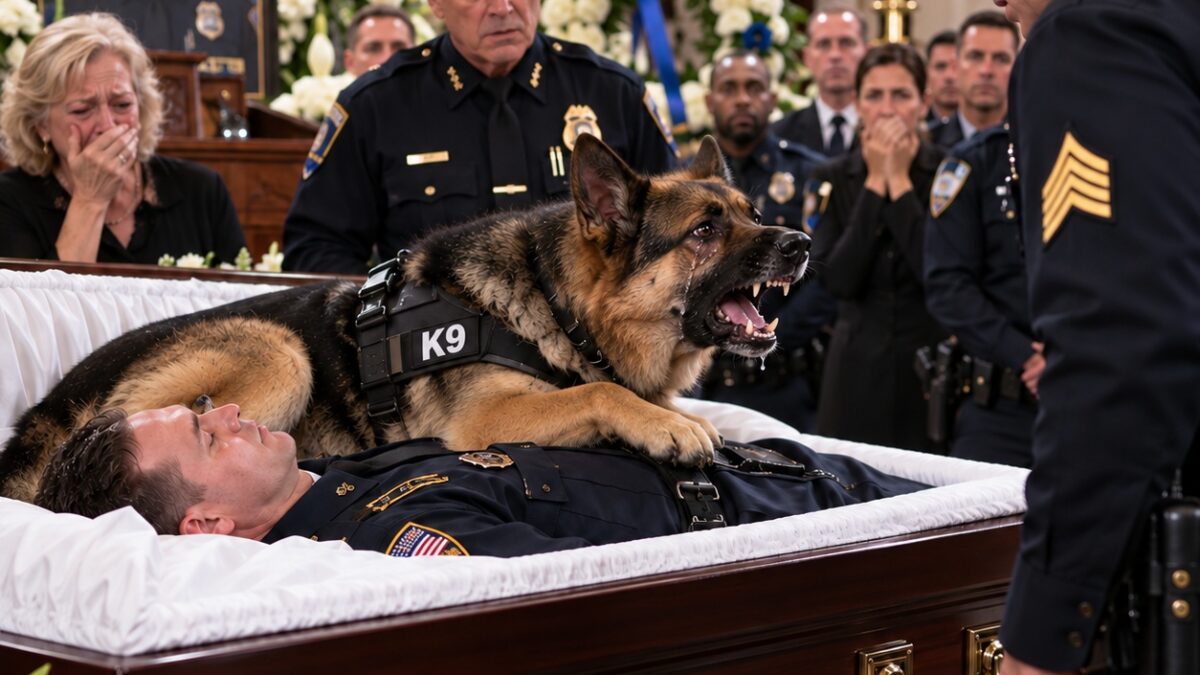
Rex stood halfway inside Michael’s casket.
His front paws pressed against the edge.
Then he barked.
Once.
The sound struck the walls.
People flinched.
Michael’s mother looked up through tears.
I stepped into the aisle.
“Collins.”
He looked at me.
“Chief?”
“Come forward.”
His face changed.
“What?”
“Come here.”
“No.”
That answer changed everything.
Not because refusing to approach a distressed K9 made someone guilty.
Any sensible person might have refused.
But Collins had spent twelve years in law enforcement.
He knew how to answer an order.
He also knew how to hide fear.
At that moment, he was doing neither.
“That dog is unstable,” he said.
Dr. Meyers looked at Rex.
“No.”
Collins pointed toward him.
“You just watched him climb into a coffin.”
“He is distressed.”
“Exactly.”
She shook her head.
“But right now he is not responding randomly.”
Rex growled again.
Dr. Meyers watched his nose.
“He’s responding to scent.”
The room went quiet.
Collins stared at her.
“What does that even mean?”
“It means something about you is familiar to him.”
“Of course I’m familiar. I work with him.”
“Not like this.”
Rex barked again.
I stepped closer to Collins.
“Were you at Ashford warehouse the night Daniels died?”
“No.”
Too quick.
“You weren’t on the response?”
“I was off duty.”
Lieutenant Harris was standing near the front row.
He pulled out his phone and opened the preliminary duty logs.
Then looked at me.
“Chief.”
Something in his voice made my stomach tighten.
“What?”
He stared at Collins.
“His patrol vehicle pinged near Ashford that night.”
Collins froze.
Harris continued.
“Three minutes before Daniels arrived.”
Every officer near us turned.
Collins’s face lost color.
“That’s wrong.”
Harris looked down.
“No.”
“It has to be.”
“No.”
Collins backed into a pew.
Rex growled.
I lowered my voice.
“You said you weren’t there.”
“I wasn’t on duty.”
“That isn’t what I asked.”
Silence.
“Were you at Ashford?”
Collins looked toward the exit.
That answered before he did.
“I was there.”
Several people gasped.
“But I had nothing to do with what happened.”
Rex exploded into barking.
A handler moved toward him.
I raised my hand.
“No.”
Everyone stopped.
My own pulse was hammering.
This was Michael’s funeral.
His mother was ten feet away.
His body was lying in an open casket.
And suddenly one of my sergeants was admitting he had lied about being at the scene of Michael’s death.
I looked at Harris.
“Take Collins outside.”
Collins stiffened.
“For what?”
“Conversation.”
“You’re detaining me because a dog barked?”
“No.”
I stared at him.
“I’m removing you from a funeral because you lied to my face about being at a homicide scene.”
Two detectives approached.
Collins left with them.
Rex stayed standing.
Even after the doors closed, he stared at the spot where Collins had disappeared.
Dr. Meyers crouched beside him.
“He remembers something.”
“How certain are you?”
“I’m certain that whatever association he has with Collins is powerful.”
“That isn’t evidence.”
“No.”
I appreciated that answer.
Police dogs are extraordinary.
They are not magic.
Rex could point us toward something.
He could not replace an investigation.
So we investigated.
Immediately.
I ordered Harris to pull everything from Michael’s final call.
Dispatch records.
Vehicle locations.
Radio logs.
Body-camera files.
The original report said Michael’s body camera had been destroyed in the explosion.
I wanted what remained.
An hour later, we were crowded around a laptop in a side room of the funeral hall.
The footage looked terrible.
Static.
Smoke.
Flickering images.
The first minutes showed almost nothing useful.
Michael entering Ashford.
Rex beside him.
Michael’s flashlight crossing old crates and rusted equipment.
Then Rex becoming increasingly agitated.
Michael’s voice:
“Easy, buddy.”
A growl.
Footsteps.
Then Michael transmitting:
“Unit Seven. Suspicious movement inside.”
Static.
“Request backup.”
More static.
Then something strange.
A shadow.
Human.
Moving behind stacked crates.
Harris paused the frame.
“Back it up.”
The technician reversed.
Again.
A figure appeared for less than one second.
Broad shoulders.
Police-type stance.
Not enough for identification.
But enough to matter.
Then Michael’s camera shifted.
We heard him say:
“Collins?”
Nobody in that room moved.
I felt cold all the way down my back.
“Play it again.”
The audio repeated.
“Collins?”
Then gunfire.
Rex barking.
A flash.
Explosion.
The image died.
Harris stared at me.
“He knew Collins was there.”
“Yes.”
“And Collins lied.”
“Yes.”
A detective entered carrying printed dispatch records.
“Chief, there’s more.”
He handed them over.
Collins had marked himself off duty at 8:00 p.m.
But his department vehicle crossed an automated plate reader two blocks from Ashford at 10:39.
Michael arrived at 10:42.
Three minutes.
That did not prove murder.
But the funeral had changed.
I walked back into the hall.
Michael’s service had technically ended.
Most civilians had left.
Family remained.
Officers remained.
Rex was still in the casket.
I looked at him.
“What did you see?”
His ears twitched.
For the first time, he lifted his head away from Michael.
Then his nose went into the air.
He inhaled.
Once.
Twice.
His body changed.
“Rex?”
He jumped from the casket.
Dr. Meyers barely moved before he was running.
“Rex!”
He crossed the hall.
Burst through the doors.
Harris took off after him.
I followed.
So did half the people still standing nearby.
Rex did not run like a grieving animal escaping chaos.
He ran like a working dog.
Head low.
Nose active.
Purpose in every stride.
Across the parking lot.
Behind the funeral building.
Toward the tree line.
“Do not lose him!”
We climbed fences.
Cut through an alley.
Crossed an old industrial road.
I had no idea what he was tracking.
Collins?
Michael?
Something from the warehouse?
Dr. Meyers ran near me.
“He has a scent.”
“Whose?”
“I don’t know.”
Rex kept moving.
Fifteen minutes later, we reached an aging storage facility.
Long rows of metal doors.
Rex turned immediately down one aisle.
Stopped at Unit 47.
Barked.
Scratched furiously at the bottom of the door.
The manager ran toward us.
“What is going on?”
I showed my badge.
“Who rents Forty-Seven?”
He checked his records.
The name meant nothing to me.
Probably false.
“Open it.”
“Chief, I can’t just—”
Harris looked at him.
“A police officer was murdered three days ago.”
The man went pale.
He retrieved a master key.
The lock opened.
The metal door rolled upward.
Nobody spoke.
Inside was a table.
Maps.
Photographs.
Police reports.
Surveillance images.
Ashford warehouse diagrams.
Pictures of Collins.
Pictures of vehicles.
Pictures of people I recognized from old criminal investigations.
Strings connected notes across one wall.
This was not a criminal hideout.
It was an investigation.
Michael’s investigation.
Harris picked up a handwritten page.
“I know this handwriting.”
So did I.
Michael Daniels.
Rex walked directly to the rear of the unit.
He stopped beneath a tarp.
Scratched.
Officers moved it.
Underneath sat a metal case.
Locked.
Harris found a key taped beneath the table.
Inside the case were flash drives.
Audio recorders.
Copies of financial records.
Photographs.
A sealed envelope.
My name was not on it.
No one’s was.
Across the front, Michael had written:
IF ANYTHING HAPPENS TO ME, FOLLOW REX.
I read it twice.
My throat tightened.
Dr. Meyers covered her mouth.
Harris whispered:
“He knew.”
I opened the envelope.
One sheet of paper.
Michael’s handwriting.
There is corruption inside the department.
I don’t know who I can trust.
Rex does.
If I don’t make it, he will lead you to them.
I looked at the German Shepherd.
He stood perfectly still beside the table.
Waiting.
Michael had not merely trusted Rex as protection.
He had built his contingency around him.
I felt ashamed.
Three days of reports.
Three days of officers asking what happened.
All that time, the witness we needed had been sitting in a station corner refusing food.
We simply did not understand his language.
Harris inserted one of the flash drives into a clean laptop.
Folders appeared.
Dates.
Names.
Payments.
Vehicle logs.
Photographs.
One name repeated more than any other.
Sergeant Aaron Collins.
We opened an audio file.
Michael’s voice filled the storage unit.
“Collins, I know you’re meeting them again tonight.”
A second voice.
Collins.
“Back off, Daniels.”
“I know what you’ve been doing.”
“You don’t know anything.”
“I know enough.”
A pause.
Michael again:
“I’m not letting you bury this.”
Then Collins:
“You keep pushing and you won’t live long enough to expose anything.”
The recording ended.
No one spoke.
I felt anger rising.
Not hot.
Cold.
The dangerous kind.
One of my own sergeants had threatened an officer investigating corruption.
Michael had known.
He had not reported it through normal channels because he believed normal channels were compromised.
That hurt almost as badly as learning Collins was involved.
Michael did not trust his own department.
My department.
I looked around the storage unit.
“How deep?”
Harris opened another file.
His face changed.
“Deep.”
The evidence suggested a network using legitimate police access to protect illegal shipments.
Weapons.
Dirty money.
Manipulated evidence.
Advance warnings of enforcement operations.
People outside the department paid people inside.
Michael had been mapping the connections.
Collins was one piece.
Not the only one.
A torn notebook page contained three lines circled in red.
COLLINS COORDINATING DROPOFFS.
ASHFORD MEETING POINT.
REX REACTED TO COLLINS—CONFIRM CONNECTION.
I closed my eyes.
Michael had noticed Rex’s behavior before he died.
He was starting to understand.
That was why Rex had stared at Collins during briefing.
Why he had grown anxious.
Rex had been smelling something.
Warehouse residue.
People.
Materials.
Whatever connection his trained senses recognized.
Michael had written it down.
Then he went to Ashford.
Maybe he believed he could confirm the last piece.
Maybe he did not trust backup.
Maybe the call itself had been arranged to draw him there.
We still did not know.
But we knew enough to move.
“Where is Collins?”
Harris grabbed his radio.
The answer came within seconds.
Gone.
He had slipped away during the confusion.
I swore.
Rex’s head lifted.
He moved toward the open storage door.
“Rex.”
He ignored me.
Sniffed.
Then ran.
Again.
“Follow him!”
By the time we returned to the funeral property, officers were locking exits.
Rex entered the hall.
Paused.
Then turned toward the administrative corridor.
He ran.
We followed.
A closed conference room stood at the far end.
Rex stopped outside.
Growled.
We heard movement inside.
Then Collins’s voice.
“I just need time.”
Harris raised his voice.
“Collins!”
Silence.
“Open the door.”
“No.”
“You are surrounded.”
“You don’t understand!”
I stood beside Harris.
“What don’t we understand?”
Collins shouted from inside:
“What happens if this gets out!”
That sentence was almost a confession by itself.
I looked at the tactical officers.
“Breach.”
The door opened hard.
Collins was inside.
His uniform shirt was half removed.
A duffel bag sat on the table.
He looked like he had been preparing to change clothes.
Then I noticed his forearms.
Scratches.
Several.
Deep.
Healing.
Rex saw them too.
He lunged.
Stopped inches before Collins.
Barking.
Not biting.
Not attacking.
Identifying.
Collins backed into the wall.
“Get that dog away from me!”
“No.”
My voice surprised even me.
Rex sniffed.
Growled.
Dr. Meyers arrived behind us.
She watched him.
Then looked at me.
“He’s matching.”
Collins laughed nervously.
“That means nothing.”
Harris stepped forward.
“We found Michael’s storage unit.”
Collins stopped laughing.
“We found the recordings.”
His face emptied.
“Your threat.”
Silence.
“Your location data.”
Nothing.
“Your voice on Michael’s files.”
Collins sagged.
Rex growled.
Finally Collins whispered:
“You have no idea what they made me do.”
“Who?”
His eyes closed.
“They’ll kill me.”
“Michael is already dead.”
I stepped closer.
“So talk.”
Rex barked.
Collins flinched.
Then something inside him collapsed.
“I was there.”
Nobody moved.
“At Ashford?”
“Yes.”
“Why?”
“Meeting.”
“What kind?”
He looked at the floor.
“A transfer.”
“Illegal weapons?”
His silence confirmed it.
“Who arranged the warehouse call?”
“I don’t know.”
“Do not lie again.”
“I swear.”
“What happened when Michael arrived?”
“He wasn’t supposed to come inside.”
I felt sick.
“Then why was he dispatched?”
“To scare him.”
“To scare him?”
“Someone wanted him to understand he was being watched.”
“And instead?”
“He came in.”
Collins swallowed.
“He saw too much.”
“Who shot him?”
“I didn’t.”
“Who?”
“I don’t know the shooter’s real name.”
“You were standing there.”
“It was dark.”
“Who planted the explosive?”
“Someone else.”
“Convenient.”
“It’s true!”
Rex snarled.
Collins pressed against the wall.
“I was supposed to clean up afterward.”
Harris’s voice went low.
“You were going to tamper with a murdered officer’s crime scene.”
Collins looked at him.
“Yes.”
The word made several officers curse.
“But Rex attacked you.”
Collins looked toward the dog.
“That animal came through the smoke.”
His voice shook.
“I tried to pull him away from Daniels.”
The scratches.
Now I understood.
“Rex did that.”
“Yes.”
“He recognized you.”
“Yes.”
“Because you were there while Michael died.”
Collins started crying.
Not loudly.
No dignity left to protect.
“He wouldn’t let me touch anything.”
I looked at Rex.
Three days earlier, officers thought he had been uncontrollable at the scene.
Now I understood.
He had not simply been guarding Michael.
He had been protecting evidence from a corrupt officer trying to destroy it.
I looked at Collins.
“You are under arrest for conspiracy, corruption, obstruction of justice, evidence tampering, and your role in Michael Daniels’s death.”
Officers cuffed him.
Collins did not resist.
As they walked him out, he looked at Rex.
“That dog was the only thing Daniels trusted.”
I answered:
“And he was right.”
The investigation exploded after that.
But before warrants.
Before arrests.
Before prosecutors filled my operations room.
There was something we had to do.
Rex returned to Michael’s casket.
This time, he climbed inside slowly.
Not frantic.
Not protective.
He curled against Michael again.
But his body felt different.
Dr. Meyers saw it too.
“He’s waiting.”
“For what?”
“I don’t know.”
Harris brought the metal case from the storage unit.
“There are recordings we haven’t played.”
Michael’s mother nodded.
“Play them.”
He connected one.
Static.
Then Michael’s voice.
“If you’re hearing this, something happened to me.”
Several officers bowed their heads.
Rex lifted his.
His ears twitched.
Michael continued.
“I didn’t tell anyone what I found because every trail kept pointing inside the department.”
I felt that sentence personally.
As chief, I should have created a department where Michael believed truth could safely move upward.
Instead, he had created a secret storage unit.
That failure belonged partly to me.
“Someone knows our schedules,” Michael said.
“Our procedures.”
“Our vulnerabilities.”
A pause.
Then:
“Rex knew before I did.”
The German Shepherd stared at the speaker.
“He reacts when something is wrong. He reacted to Collins before I understood why.”
Somebody behind me cried quietly.
“If something happens to me, I got too close.”
Michael’s voice became softer.
“Rex will lead you to the evidence.”
He already had.
“And he’ll lead you to the truth.”
Rex lowered his head toward Michael’s chest.
Then came the line that destroyed almost everyone in the room.
“Take care of him.”
Michael breathed.
“He’s more than my partner.”
Pause.
“He’s the only one I trust completely.”
His mother covered her mouth.
Harris turned away.
Michael continued.
“And if Rex refuses to leave me…”
His voice cracked slightly.
“…it’s because he doesn’t want my story buried with me.”
The recording ended.
No one spoke.
Rex gave one quiet whimper.
Dr. Meyers whispered:
“He wasn’t guarding the body.”
I looked at her.
“No.”
“He was guarding the message.”
That was exactly what he had been doing.
The next twenty-four hours changed our department forever.
We traced Collins’s contacts.
Four major conspirators emerged almost immediately.
Two outside traffickers.
Two people inside law enforcement.
Then more names.
Federal partners became involved.
Search warrants were executed.
Phones seized.
Bank records reviewed.
Evidence lockers audited.
Cases reopened.
The network Michael uncovered had been moving illegal weapons, laundering money, leaking operational information, and manipulating certain evidence to protect people who paid them.
Michael had noticed inconsistencies months earlier.
A weapon disappearing from one report.
A patrol unit repeatedly near locations where surveillance targets suddenly vanished.
Collins communicating with people who had no legitimate reason to know him.
One irregularity.
Then another.
Then another.
He followed them.
Quietly.
Alone.
Except for Rex.
Within forty-eight hours, multiple people were in custody.
Several officers were suspended.
The district attorney announced an independent review of every case touched by the corrupt members.
People asked how long it had been happening.
We did not know yet.
That answer embarrassed me.
As it should have.
A chief who claims betrayal was impossible has learned nothing from betrayal.
The public reaction was immediate.
What had begun as:
OFFICER KILLED IN WAREHOUSE AMBUSH
became something else.
OFFICER DIED WHILE EXPOSING POLICE CORRUPTION.
Crowds gathered outside the station.
Flowers.
Candles.
Photographs of Michael.
And Rex.
Children drew pictures of the German Shepherd sitting beside a badge.
Someone left a sign:
HE COULDN’T SPEAK, SO HE SHOWED THEM.
I kept that one.
The funeral resumed after the first wave of arrests.
Not because grief was finished.
Because Michael deserved burial.
The hall filled again.
This time there was sorrow.
But something else too.
Truth.
I stood at the podium.
For years, I had spoken at ceremonies.
Promotions.
Retirements.
Memorials.
Nothing prepared me for that room.
Michael’s mother sat near Rex.
Rex sat at the front of the casket.
Calm.
I looked at the officers.
“Michael Daniels did not die because he was careless.”
The room went still.
“He did not walk blindly into danger.”
I swallowed.
“He died because he discovered something corrupt people were willing to kill to protect.”
Several officers lowered their heads.
“He followed evidence even when it led somewhere painful.”
I looked toward the rows of badges.
“Inside his own department.”
That sentence needed to hurt.
“He kept going.”
I looked at Rex.
“And when Michael could no longer finish the work himself, his partner did.”
Rex lifted his head.
“Without Rex, Collins’s lie might have survived.”
I paused.
“Without Rex, the storage unit might have remained hidden.”
Another pause.
“Without Rex, Michael’s final message might have stayed buried beside him.”
I took a breath.
“Rex is not just a K9.”
My voice tightened.
“He is a witness.”
“A partner.”
“And a hero.”
The room rose.
Applause began.
Not celebration.
Recognition.
Rex watched us.
Then stood.
Walked toward the casket.
Placed one paw against its edge.
I will remember that image until I die.
Michael’s mother whispered:
“He understands.”
Maybe.
I do not pretend to know everything dogs understand.
But I know what Rex did.
He never left.
When Michael became worried, Rex warned him.
When danger came, Rex fought.
When Michael died, Rex protected him.
When we misunderstood, Rex waited.
When Collins entered the funeral, Rex identified the threat.
When we finally paid attention, Rex led us exactly where Michael needed us to go.
That was enough understanding for me.
I stepped down from the podium.
Walked to the casket.
Placed one hand gently on Rex’s head.
“Michael Daniels.”
My voice almost failed.
“Mission accomplished.”
Rex released one long breath.
The tension seemed to leave his body.
For the first time since Michael died, he looked tired instead of vigilant.
The sun had started setting outside.
Colored light came through the funeral hall windows.
It was time to close the casket.
Nobody wanted to be the person who asked Rex to move.
Harris finally approached.
He held the recorder.
“Chief?”
I knew what he wanted.
I nodded.
He pressed play.
Michael’s voice filled the hall again.
Not the corruption recording.
Something older.
Probably from training.
A simple voice memo.
“Good boy, Rex.”
Rex froze.
“I’m right here.”
His ears rose.
His eyes changed.
He looked around.
Searching.
Michael’s mother began crying.
Rex stepped toward the casket.
Slowly.
He placed his head inside near Michael’s uniform sleeve.
Exactly where Michael’s arm might have rested beside him in a patrol car.
He stayed there.
A soft whimper escaped him.
Not the warning from earlier.
Not fear.
Release.
Michael’s mother approached.
She placed one hand on Rex.
“Thank you.”
Her voice shook.
“You stayed with him.”
Rex closed his eyes.
For nearly a minute, no one moved.
Then the recording ended.
Harris whispered:
“It’s time, buddy.”
Rex lifted his head.
Nobody pulled him.
Nobody commanded him.
He stepped away on his own.
That mattered.
He sat beside the casket.
Calm.
The honor guard closed the lid.
The click echoed through the hall.
Rex watched.
But he did not panic.
He did not jump forward.
He had done what Michael asked.
The story was not being buried anymore.
The casket was carried toward the doors.
Rex walked beside it.
Not inside.
Not clinging.
Beside.
Partner position.
Outside, thousands of people lined the road.
Candles.
Flags.
Hands over hearts.
Michael’s mother walked behind the casket.
I walked near her.
Rex walked near Michael.
Exactly where he belonged.
As the procession began moving, Rex stopped once.
Lifted his head.
And barked.
One long, powerful sound.
People went completely silent.
The bark carried farther than I expected.
Across the parking lot.
Across the street.
Through the evening air.
It sounded nothing like grief anymore.
It sounded like a final call.
Then Rex continued walking.
Michael Daniels was buried that evening with full honors.
The investigation continued for months.
Collins eventually entered a plea and cooperated against others.
More arrests followed.
Evidence was recovered.
Money was traced.
Officers who had betrayed their badges lost them.
Some went to prison.
Some cases they touched were reopened.
Families received explanations they should have received years earlier.
Our department changed too.
It had to.
New evidence procedures.
Outside auditing.
Protected reporting channels.
Internal affairs oversight independent from the normal command structure.
Those reforms could not bring Michael back.
They could only make his death mean something beyond the tragedy itself.
I resisted that phrase for a long time.
Make it mean something.
Deaths do not owe us lessons.
Michael should have lived.
Rex should have grown old beside him.
His mother should not have had to touch a casket.
But once the loss existed, we had a responsibility.
Not to waste what Michael exposed.
Rex retired from active police service.
That decision was mine.
People asked whether it was because he was traumatized.
Partly.
Mostly because he had already done enough.
Michael’s mother took him.
The first evening she brought Rex home, she sent me a photograph.
He was lying beside Michael’s old chair.
Head on his paws.
Peaceful.
A month later, another photo arrived.
Rex sleeping on Michael’s bed.
Six months later, he visited the department.
Every officer stopped what they were doing.
Some knelt to greet him.
Rex accepted attention for a minute.
Then walked straight to Michael’s old locker.
He sat.
That hurt.
But differently than before.
Michael’s nameplate remained there.
We never reassigned the locker.
Eventually the department installed a small plaque.
OFFICER MICHAEL DANIELS
17 YEARS OF SERVICE
END OF WATCH
Underneath it:
K9 REX
PARTNER
WITNESS
MISSION COMPLETED
Michael’s mother visited the day we installed it.
She touched the plaque.
Then looked at me.
“Michael always said Rex understood people better than people did.”
I smiled sadly.
“He may have been right.”
She looked toward Rex.
“He knew Collins.”
“Yes.”
“He knew Michael was in danger.”
“Yes.”
“Do you ever wonder what would have happened if we listened earlier?”
That question stayed with me.
“Yes.”
Every day.
Regret is easy after the truth is visible.
Three days before Michael died, Rex had been restless.
He reacted to Collins.
Refused his patrol car.
Tried to stop Michael from entering Ashford.
All of it looked different afterward.
But leadership cannot function by treating every unexplained dog reaction as proof of conspiracy.
That is not the lesson.
The lesson is simpler.
Pay attention when facts stop fitting.
Michael did.
Rex did.
We did not.
Not soon enough.
There is a difference between skepticism and dismissal.
A good investigator lives inside that difference.
Months later, I spoke to a class of new police recruits.
I told them Michael’s story.
Not the polished version.
The uncomfortable one.
A respected sergeant betrayed the department.
Other people missed warning signs.
A good officer became afraid to report what he knew because he did not know whom to trust.
Our systems failed him before Rex helped expose the people who killed him.
One recruit asked:
“Chief, what’s the biggest lesson?”
I thought about Collins.
Michael.
The storage unit.
That envelope.
Rex lying across the casket.
“Your badge does not make you trustworthy.”
The room became very quiet.
“Your actions do.”
I continued.
“Never confuse loyalty to your coworkers with loyalty to wrongdoing.”
I looked around.
“If the truth threatens someone wearing the same uniform as you, your responsibility is still to the truth.”
Nobody spoke.
“And if something does not make sense, do not force it to fit because the comfortable explanation came first.”
I thought of Rex growling at Collins days before the murder.
“Look again.”
That became Michael’s legacy inside our department.
Look again.
We printed it nowhere.
Put it on no poster.
But people said it.
Evidence does not match?
Look again.
Witness statement inconsistent?
Look again.
Officer report too perfect?
Look again.
It was not suspicion.
It was discipline.
The same discipline Rex had shown.
The world had interpreted Rex’s behavior at the funeral as grief.
They were not wrong.
They were incomplete.
That distinction became important to me.
Rex was grieving.
He was also protecting.
Warning.
Waiting.
Tracking.
Love and duty existed in him at the same time.
Maybe they always had.
Years passed.
Rex grew gray around his muzzle.
Michael’s mother called me occasionally.
She said he still reacted when a police cruiser passed.
Still perked his ears when radios crackled.
Still slept near the front door at night.
Working dogs do not simply forget their work because humans declare them retired.
One winter morning, she called.
Her voice told me before the words did.
Rex was sick.
Age.
Nothing dramatic.
Nothing anyone could investigate or arrest.
I drove to her house.
Rex was lying near Michael’s old chair.
He recognized me.
His tail moved once.
I sat on the floor.
The chief of police in full uniform.
Right there on an old living-room rug beside a retired German Shepherd.
“You gave me a lot of trouble.”
Tail again.
Michael’s mother laughed through tears.
“He likes you.”
“I know.”
I touched the white fur around Rex’s muzzle.
“You did good.”
His breathing was slow.
“Michael knew that.”
I swallowed.
“We know it now too.”
Rex closed his eyes.
Michael’s mother sat beside us.
“He’ll see him again.”
I was not going to argue theology with a grieving mother.
“I hope so.”
She touched Rex.
“Do you think Michael knew Rex would actually understand the message?”
I thought about the envelope.
If anything happens to me, follow Rex.
“Yes.”
“Why?”
“Because Michael spent seven years trusting him.”
I looked at the dog.
“And trust like that usually comes from evidence.”
Rex died peacefully later that week.
We gave him a small department memorial.
Nothing like Michael’s funeral.
He would not have wanted spectacle.
At least that was what I told myself.
Michael’s mother brought his collar.
Harris brought the old recorder.
Dr. Meyers came.
So did officers who had followed Rex from the funeral hall to Unit 47.
I spoke briefly.
“Some police partnerships end at retirement.”
I paused.
“Some end with reassignment.”
I looked at Rex’s photograph.
“Theirs never ended.”
Michael had trusted Rex with his life.
Then, in the end, with his truth.
Rex carried both responsibilities until he no longer had to.
I thought back to that terrible funeral day.
Everyone believed Rex was refusing goodbye.
Maybe he was.
But it was more.
He refused to leave because leaving meant allowing us to close Michael’s casket while the truth was still hidden.
He refused to move while the man connected to Michael’s death still walked freely among us.
He refused to accept silence when Michael had left him a job to finish.
Once that job was done, Rex changed.
He allowed the casket to close.
Walked beside the procession.
Went home.
That was what convinced me most.
Not the growling.
Not the tracking.
Not even the storage unit.
The peace afterward.
For days, Rex had carried something.
Responsibility.
Urgency.
A promise.
Then the burden lifted.
Years later, people still told the story as:
THE POLICE DOG WHO SOLVED HIS HANDLER’S MURDER.
I understood why.
It made a good headline.
But Rex did not solve everything alone.
Michael gathered evidence.
Investigators verified it.
Forensics mattered.
Recordings mattered.
Vehicle logs mattered.
Confessions mattered.
Rex did something both simpler and more extraordinary.
He refused to let us stop looking.
That may have saved Michael’s name.
It may have saved future victims.
It changed our department.
It changed me.
Before Michael died, I thought leadership meant having answers.
Afterward, I understood something else.
Sometimes leadership means recognizing when the answer you accepted is wrong.
Sometimes it means listening to the person nobody else believes.
Sometimes it means being humble enough to admit that the truth may be standing directly in front of you in a form you do not understand.
In our case, it had four paws.
A black-and-tan coat.
And absolute loyalty to one dead officer.
I still keep Michael’s final note in a secure department archive.
The original.
Not a copy.
One line matters most.
Rex does.
Three days before Michael died, those two words would have sounded strange.
After everything that followed, they became one of the truest statements I had ever read.
Michael did not know which officer would find the envelope.
He did not know whether I would be the one reading it.
He did not know how long the investigation would take.
But he knew his partner.
He knew Rex would remember.
Recognize.
Track.
Wait.
And refuse to quit.
At Michael’s funeral, I thought I was watching a dog who could not let go.
I was wrong.
Rex was waiting for us to catch up.
Waiting for us to understand that Michael had not died in a random ambush.
Waiting for Collins to show himself.
Waiting until the evidence was found.
Waiting until the truth was safe.
Only then did he finally step away from that casket on his own.
Only then could we bury Michael.
Not with unanswered questions.
Not beneath a lie.
But as the man he really was.
A good officer who followed corruption even when it wore a familiar uniform.
A man who trusted his partner when he was no longer sure he could trust anyone else.
And a man whose final investigation survived him because one German Shepherd refused to let the department close the lid too soon.
Michael Daniels completed his duty.
Rex completed his.
And when I think about them now, I no longer picture that first heartbreaking moment with Rex lying across the casket.
I picture the end.
The casket moving toward the doors.
The evening light outside.
Rex walking beside it with his head held high.
No one pulling him.
No one commanding him.
Partner position.
One final escort.
Then that long bark across the silent street.
Not a cry.
Not anymore.
A salute.
A promise kept.
Mission accomplished.








