Everyone Had Come to Say Goodbye to a Paralyzed, Dying Dog—Then Sarita Lifted Her Head
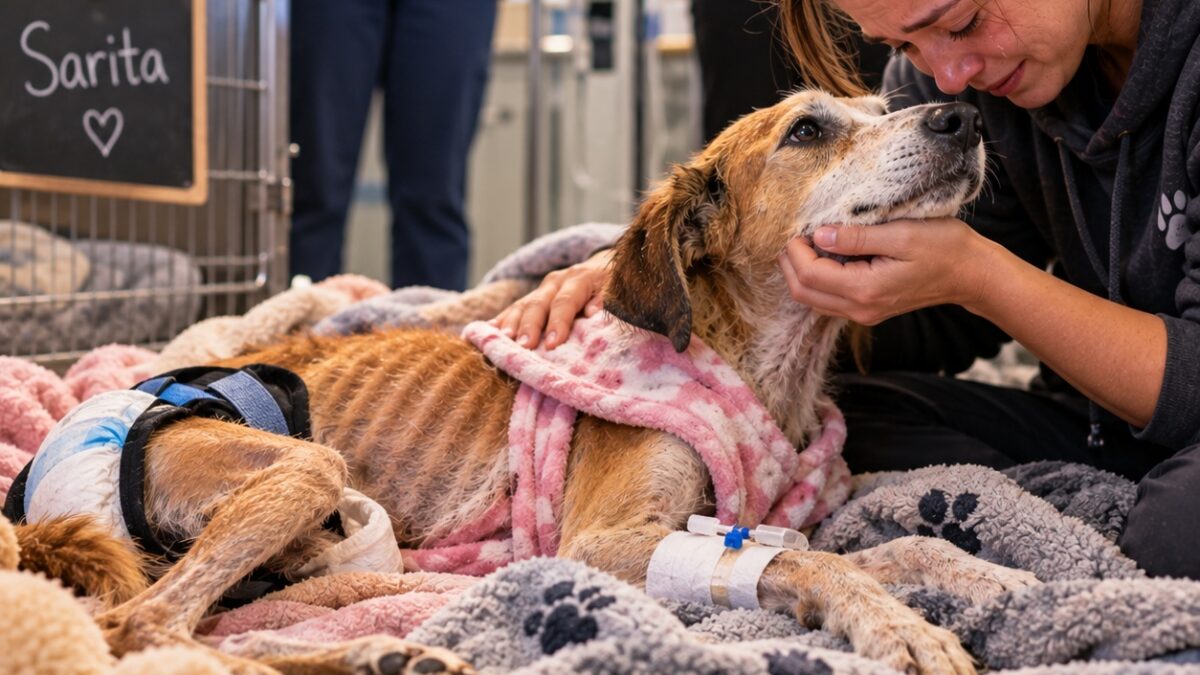
Everyone Had Come to Say Goodbye to a Paralyzed, Dying Dog—Then Sarita Lifted Her Head
By the time we heard about Sarita, people were no longer asking how to save her—they were quietly asking whether keeping her alive was only prolonging the inevitable.
Everything below her neck was paralyzed, her body was dangerously thin, several bones had already fractured, and every new examination seemed to reveal another serious problem fighting for what little strength she had left.
But while everyone around her was preparing to say goodbye, Sarita kept doing one stubborn, heartbreaking thing: she kept trying to live.
I remember the room being unusually quiet.
Not peaceful.
There is a difference.
Peaceful quiet feels soft.
That room felt heavy.
The kind of quiet that settles over people who believe they already know how a story is going to end but do not want to be the first person to say it out loud.
Sarita lay on a folded blanket in front of us.
She was tiny.
That was the first thing that struck me.
The second was how little of her seemed to move.
Her eyes.
A little movement around her nose when she breathed.
Occasionally the smallest effort to lift her head.
Everything below her neck seemed disconnected from whatever determination remained inside her.
Her front legs did not support her.
Her back legs did not support her.
If her body shifted, someone had moved it.
If she changed position, a person had helped her.
She was severely malnourished.
Her bones showed beneath her skin.
Her coat looked dull.
Her muscles had wasted away until there was almost nothing left to protect a body already struggling with several serious illnesses at once.
And there were fractures.
More than one.
Bones so fragile that even ordinary movement had become dangerous.
Standing was not merely difficult.
It seemed absurd.
Walking felt impossible.
Running did not belong in the conversation at all.
The call that brought Sarita to us had not sounded like a rescue request.
It sounded like a final consultation.
People were talking about suffering.
Quality of life.
Whether another attempt at treatment would be kind or selfish.
Whether we were trying to save a dog or simply postponing the moment everyone already feared.
Those are some of the hardest conversations in rescue.
Not because people do not care.
Usually because they care enough to be terrified of making the wrong choice.
There are moments when fighting can become cruelty.
There are also moments when giving up too early can take away the one chance an animal still has.
The problem is that nobody hands you a sign telling you which moment you are standing in.
You look at the animal.
You look at the test results.
You listen to the doctors.
And then, somewhere between medicine and instinct, you make a decision you hope you will be able to live with.
I moved closer to Sarita.
She was too weak to turn toward me properly.
I knelt beside the blanket.
“Hey, little girl.”
Her eyes shifted.
That was all.
I reached out carefully.
Touched the side of her face.
She tried to lift her head.
Not much.
A fraction of an inch.
Then it dropped again.
I pulled my hand back.
A few seconds later, she tried again.
That was the first thing that bothered me.
Not the paralysis.
Not the fractures.
Not even how thin she was.
It was that second attempt.
Sarita’s body was failing in almost every visible way.
But nobody had explained that to Sarita.
She did not understand prognosis.
She did not know what paralysis meant.
She did not know that people around her were considering whether this might be goodbye.
She only knew that someone was beside her.
And she wanted to lift her head toward that person.
One of the team members whispered:
“She keeps doing that.”
“Doing what?”
“Trying.”
I looked down at Sarita again.
Her breathing was shallow.
Her body remained almost completely still.
But her eyes followed us.
Alert.
Present.
Still asking something from the world.
Maybe not rescue.
Maybe not a miracle.
Maybe simply:
What happens next?
That was enough to stop us.
No one in that room believed love could replace medicine.
No one thought determination alone could heal broken bones or reverse paralysis.
We were not going to turn Sarita’s suffering into a sentimental experiment.
But before we said goodbye, we needed to know something.
Was her body truly finished?
Or was there still a medically responsible path forward?
We called specialists.
We reviewed everything again.
We discussed what treatment would involve.
It would not be simple.
It would not be quick.
It might fail.
There could be setbacks.
Relapses.
More discoveries.
More nights when we would wonder whether we had made the wrong decision.
No one promised she would walk.
No one promised she would survive.
We were given one thing.
A chance.
A narrow one.
But real.
I looked at Sarita.
At that tiny body lying motionless on the blanket.
Then at the people around me.
“Okay,” I said.
Nobody moved.
“We give her the chance.”
That was how Sarita’s second life began.
Not with a miracle.
Not with her suddenly standing.
With a room full of people who had almost said goodbye deciding to wait one more day.
PART2
The first days were not dramatic.
That is something people rarely understand about recovery.
The most important days often look almost identical to failure.
Sarita did not wake the next morning stronger.
She did not suddenly move a paw.
She did not surprise anyone by sitting up.
She remained paralyzed below the neck.
Still frighteningly thin.
Still medically fragile.
Still dependent on us for almost everything.
Food.
Positioning.
Cleaning.
Comfort.
Medication.
Monitoring.
Every part of her day had to be considered.
Could we move her without stressing a fracture?
Was she eating enough?
Could her body tolerate treatment?
Was this symptom part of something we already knew about, or the beginning of another problem?
Her condition was complicated enough that no single plan stayed simple for long.
New tests revealed new concerns.
One specialist would recommend something.
Then another result would change the priorities.
We adjusted.
Then adjusted again.
There were days when the medical chart seemed to be growing faster than Sarita.
I hated that feeling.
You would look at this tiny dog and wonder how one body could be carrying so much.
Severe malnutrition alone can change everything.
Muscles weaken.
Healing slows.
Energy disappears.
Then add multiple serious diseases.
Then fractures.
Then paralysis.
Sarita did not have one mountain to climb.
She had a whole range.
And she was starting from the valley floor.
We fed her carefully.
Not too much too quickly.
Her body had been deprived long enough that even nourishment required thought.
She needed calories.
Protein.
Hydration.
But she also needed her system to tolerate receiving them.
Every little improvement mattered.
Eating a little more.
Keeping food down.
Looking brighter.
Remaining comfortable.
Sleeping without distress.
Those became victories.
A normal dog finishing a meal is not news.
Sarita finishing even part of hers could change the mood of an entire room.
I began measuring progress in things I would once have ignored.
An eye opening faster when she heard a voice.
A stronger swallow.
A little more tension in her neck when she tried to lift her head.
A moment of annoyance when someone repositioned her.
That last one made me smile.
“I’ll take attitude.”
One of the technicians laughed.
“So will I.”
Because attitude requires energy.
And energy meant Sarita still had something to spend.
The hard part was never knowing whether the small signs would lead anywhere.
One good morning could be followed by an awful afternoon.
She would seem brighter.
Then a new symptom appeared.
Her body would stabilize.
Then another problem forced the medical team to reconsider treatment.
Hope rose.
Then got cut down.
Again.
And again.
Weeks passed.
Then more weeks.
The first month did not feel like a victory.
It felt like we had simply managed not to lose.
Sometimes that is the first stage of surviving.
You stop falling.
That is all.
The road does not move forward.
It simply stops sliding backward for a moment.
Sarita spent long stretches resting.
She had to.
Her body was trying to repair itself while carrying almost no reserve.
We repositioned her.
Supported her joints.
Protected fragile areas.
Watched her closely.
There are particular practical realities to caring for an animal who cannot move normally.
Pressure.
Comfort.
Cleanliness.
circulation.
Muscle wasting.
Every small neglect can create another problem.
Sarita had no room for another problem.
So someone was always watching.
Not hovering anxiously every second.
But paying attention.
That became our job.
Her job was much simpler.
Eat.
Rest.
Breathe.
Try again tomorrow.
Animals are often better at that than people.
We live in the future.
We look at Sarita and think:
Will she walk?
Will she recover?
What if the treatment fails?
How long can we continue?
Sarita had no relationship with those questions.
She had today.
A bowl placed in front of her.
A hand touching her face.
A treatment she did not understand.
Sleep.
Wake up.
Another day.
There was something almost unbearable about watching that.
She had no idea people once believed she had no chance.
Nobody had explained that she was supposed to die.
So she did not behave like a dog waiting for death.
Even when she could barely move, she remained present.
Some mornings she would hear footsteps and her eyes would brighten.
A tiny change.
But unmistakable.
“Good morning, Sarita.”
Her head might move half an inch.
We celebrated it.
Not loudly.
You become superstitious around fragile hope.
You do not want to frighten it away.
Then came the first real setback.
I will not invent a specific diagnosis that the source never gave us.
What mattered was that Sarita had multiple serious diseases fighting her at the same time, and treatment for a medically complicated dog does not move in a straight line.
One of those problems worsened.
Her energy dropped.
She stopped showing the small improvements we had been clinging to.
For two days, she looked almost like the dog from the beginning.
Flat.
Weak.
Eyes duller.
Someone asked the question nobody wanted.
“Are we doing too much?”
It was not cruel.
It was responsible.
You have to ask.
Every time.
Is treatment still helping?
Is the animal participating in life?
Are we preserving comfort?
Are we asking the body to endure something for our emotional benefit rather than theirs?
I sat beside Sarita.
She barely reacted.
That scared me more than anything.
For weeks, even on bad days, she tried to lift her head.
Now she did not.
I put my fingers beneath her chin.
“Come on.”
Nothing.
A few minutes later:
“Sarita.”
Her eyes moved toward me.
Then her neck tightened.
The smallest effort.
Her head rose.
Maybe an inch.
Held there.
Dropped.
I looked toward the medical team.
One of them closed her eyes for a second.
That ridiculous little head lift bought us another day.
That is what I mean when I say Sarita kept fighting.
Not some dramatic inspirational performance.
She did not understand she was fighting a symbolic battle.
Her body simply kept making tiny choices in the direction of life.
We listened.
The treatment plan changed again.
Different priorities.
More support.
More monitoring.
The setback passed.
Slowly.
Not cleanly.
But it passed.
A month became two.
By then, everyone who cared for Sarita had learned not to ask how long recovery would take.
There was no useful answer.
Weeks turned into months.
The calendar became almost insulting.
One date.
Another.
Another.
People want recovery to match schedules.
Four weeks.
Six weeks.
Twelve weeks.
Sarita did not.
She had her own timetable.
Her body had been starved.
Damaged.
Diseased.
Immobilized.
Healing was going to take however long healing took.
One morning, I realized her face had changed.
Not literally.
Her eyes looked different.
Brighter.
She was still thin, but no longer looked like she might disappear into the blanket.
Her neck was stronger.
She could hold her head up.
That may sound like nothing compared with running.
It was enormous to us.
At the beginning, lifting her head had looked like a full-body effort.
Now she could watch people move around the room.
Follow a sound.
Turn slightly toward food.
The world had become larger because Sarita could see more of it.
That was the first time I allowed myself to imagine something beyond survival.
Not walking.
I was not that brave yet.
I imagined sitting.
Maybe.
Supporting herself.
Maybe.
A body that could participate more actively.
The team began carefully increasing rehabilitation as her condition allowed.
Gentle work.
Controlled movement.
Nothing reckless.
Sarita’s bones had been fractured.
Her muscles had wasted.
You cannot take a paralyzed, malnourished dog and simply “make her exercise.”
Rehabilitation has to respect what is healing.
Support what is weak.
Protect what is fragile.
The early sessions hardly looked like exercise.
Positioning.
Assisted movement.
Encouraging muscles to engage.
Helping joints move through safe ranges.
Sarita sometimes looked deeply offended.
That was wonderful.
A dying dog does not waste energy being irritated.
“You hate us?”
Her eyes would narrow.
“Excellent.”
One technician joked that Sarita’s personality was coming back before her legs.
I said:
“Then we’re in trouble.”
We were.
She became stubborn.
Food she liked.
Food she did not.
Positions she tolerated.
Positions she clearly considered beneath her dignity.
There is a strange joy in seeing a critically ill animal become difficult.
At the beginning, you would have accepted anything.
One blink.
One swallow.
Now she had preferences.
That meant there was more dog inside the body again.
But below the neck, movement remained limited.
That haunted us.
Her overall health improved slowly.
Weight returned in small amounts.
Her body gained enough strength to endure more rehabilitation.
Yet the paralysis remained.
People began asking:
“What if this is as far as she gets?”
That was possible.
We had known that from the start.
There is a point in long recovery when the emotional goal has to change.
At first:
Save her.
Then:
Stabilize her.
Then:
Help her recover.
Eventually:
Give her the best life possible with whatever body she has.
We were reaching that point.
If Sarita never walked, could she still live well?
Could equipment help?
Could she be comfortable?
Could she enjoy people?
Food?
Sunlight?
Attention?
Yes.
Those questions mattered.
Because an animal should never be treated as a failed rescue simply because disability remains.
But Sarita still had another surprise waiting for us.
The first movement was so small I almost missed it.
We had been working with her through another rehabilitation session.
Her body supported.
The therapist repositioned one limb.
Then stopped.
“Did you do that?”
“What?”
“That movement.”
“I thought you did.”
We both looked at Sarita.
Nothing.
Maybe reflex.
Maybe positioning.
We continued.
Then it happened again.
A tiny contraction.
Not enough to call purposeful with confidence.
But enough to make everyone pay attention.
We did not celebrate.
Not yet.
One thing long rescue teaches you is to distrust your own hope until it survives repetition.
We watched.
Next day.
Again.
Different session.
Again.
Movement.
Not normal.
Not strong.
But present.
The communication between Sarita’s nervous system and muscles did not appear completely silent.
Hope returned.
Carefully.
Like someone entering a room where something fragile is sleeping.
No one said:
“She’s going to walk.”
We said:
“She moved.”
That was enough.
Over the following days, movement became more obvious.
Her body began participating in ways it had not before.
Muscles that had seemed absent started firing.
Weakly.
Irregularly.
Sometimes after encouragement.
Sometimes apparently on their own.
The rehabilitation sessions changed.
We could ask a little more.
Then wait.
Sarita tired quickly.
Of course she did.
Her muscles had spent months barely functioning.
Imagine trying to use a limb after keeping it motionless for that long.
Now multiply that across most of the body.
There is no shortcut.
Strength has to return fiber by fiber.
Balance has to be relearned.
Coordination has to be rebuilt.
And underlying illness still mattered.
Sarita was not suddenly healthy because one muscle moved.
We reminded ourselves constantly.
Then another setback came.
Progress slowed.
Something in her medical condition worsened again.
Treatment changed.
Rehabilitation had to be reduced temporarily.
That may have been the hardest stretch emotionally.
Because losing hope before you ever see progress is one thing.
Seeing progress, then watching it recede, is worse.
You know what might be possible.
And suddenly it seems to be slipping away.
Sarita looked tired.
We backed off.
Supported her.
Waited.
Someone said:
“She was doing so well.”
I hated that sentence.
Not because it was wrong.
Because it sounded too much like past tense.
She was doing well.
As though that chapter had ended.
I corrected them without meaning to.
“She is doing well.”
They looked at me.
“She’s having a bad week.”
I do not know whether I believed myself.
Sometimes hope is partly grammar.
Present tense.
Keep the animal in the present.
Sarita did.
She rested.
Recovered from that setback.
Then returned to rehabilitation.
Not where she had been.
A little weaker.
But the movement had not vanished completely.
We started again.
That phrase became Sarita’s entire recovery.
Start again.
Body gets stronger.
Start again.
Illness interrupts.
Start again.
Good week.
Start again.
Relapse.
Start again.
She never knew she was beginning over.
That may have saved her from our kind of despair.
Humans measure lost progress.
Dogs seem more willing to take the next available step.
Eventually, we started working toward supported weight-bearing.
That phrase sounds clinical.
Emotionally, it was terrifying.
Could Sarita’s body hold itself?
Even partly?
Her fractures had healed enough to allow cautious progression.
Muscle strength was better.
Her overall condition had improved.
Still, the first time we positioned her for standing practice, I felt sick.
One person supported her chest.
Another supported her hips.
Feet placed carefully.
Sarita’s paws touched the surface.
Her body sagged into our hands.
No surprise.
We adjusted.
Tried again.
For perhaps half a second, I felt resistance beneath my palm.
Her body pushed.
Then collapsed back into support.
“Again.”
We tried.
Nothing.
Rest.
The next session:
A little more.
No one counted seconds yet.
That would come later.
At night, I found myself imagining what standing must feel like to her.
Months spent horizontal.
The world always above you.
People bending down.
Ceilings.
Hands.
Then suddenly your head is higher.
Your feet are beneath you.
Gravity changes.
The room looks like a room instead of something seen from a blanket.
I wanted that for her so badly that I had to remind myself not to force it.
Wanting cannot become pressure.
Sarita’s body would decide.
We could only provide opportunity.
One morning, after months of treatment, she was positioned again.
Supported.
Feet beneath her.
Hands at chest and hips.
“Ready?”
Ridiculous question.
Sarita had never answered verbally.
But we always asked.
We eased support.
Her legs trembled.
Her body sank.
Then—
Stopped.
Not upright.
Not fully.
But she held part of herself.
The therapist froze.
“Don’t move.”
Nobody moved.
Sarita’s legs shook.
Her shoulders tightened.
Her head lifted.
For two seconds, maybe three, she supported more of her own weight than she ever had since arriving.
Then we caught her.
I laughed.
Someone else cried.
Sarita looked annoyed.
That was the first moment standing stopped being fantasy.
We worked carefully after that.
Never too much.
Strength before spectacle.
Day after day.
A little support.
A little less.
Trembling.
Rest.
Again.
And then came the morning none of us will ever forget.
Nothing about the room looked special.
No camera crew.
No music.
No dramatic announcement.
Morning light.
Regular rehabilitation session.
Sarita had already eaten.
She seemed alert.
One therapist placed her feet.
Another held her torso.
I stood a few feet away.
We had done this dozens of times.
“Okay, Sarita.”
Support eased.
Her legs trembled.
Her body swayed.
But this time she stayed up.
Not leaning entirely into us.
Standing.
Actually standing.
Someone whispered:
“Oh my God.”
I did not breathe.
Sarita adjusted one front paw.
It moved forward.
Her body wobbled.
The therapist reached instinctively.
“Wait.”
Sarita shifted the other paw.
Then one hind leg followed.
One step.
Tiny.
Awkward.
Careful.
Then another.
I heard someone sob.
Not loud.
Just one broken sound.
Sarita took a third step.
Her balance failed.
Hands caught her before she hit the floor.
The entire thing lasted seconds.
Maybe less than what memory has turned it into.
But time does strange things when you are watching something you spent months believing might never happen.
Sarita had walked.
A few steps.
That was all.
A few steps.
For most dogs, distance from one end of a kitchen mat to the other.
For Sarita, it felt like crossing a continent.
The dog who had arrived paralyzed below the neck had moved herself forward.
No one spoke for several seconds.
Then someone laughed through tears.
“Do that again.”
Of course she could not immediately.
Sarita was tired.
Her body had spent everything.
We let her rest.
She looked completely unimpressed by the historical significance of what she had just done.
That helped.
She was not a symbol.
She was Sarita.
And Sarita wanted a nap.
The video of those first steps spread among the people who had cared for her.
Not publicly at first.
Just phones passed from hand to hand.
“Look.”
People who had met her on day one watched.
Some covered their mouths.
One person who had been present during the earliest goodbye conversation sat down and cried.
“I thought we were going to lose her.”
“So did I.”
“I thought we were keeping her alive for us.”
“I know.”
“She was still in there.”
Yes.
That was the part nobody could stop thinking about.
Sarita had been there the whole time.
Inside the motionless body.
Inside the malnutrition.
Inside the illnesses.
Inside the fractures.
We had not created her will to live.
We had simply given it time to meet a body capable of answering.
Walking changed the emotional landscape.
But we were careful.
A few steps did not mean recovery was complete.
She remained weak.
Balance poor.
Endurance limited.
Her muscles needed substantial rebuilding.
A fall could hurt her.
We did not let excitement become recklessness.
The next milestone was repetition.
Could she stand again?
Yes.
Could she step again?
Yes.
Not every attempt.
But enough.
Then a few more steps.
Rest.
More.
Days.
Weeks.
Sarita’s body changed.
Muscle slowly returned.
You could see it in her posture.
Her limbs no longer looked like passive pieces carried with her.
They participated.
Balance improved.
She learned where her feet were.
That sounds obvious until you watch neurological recovery.
Knowing where a limb exists in space is a complex conversation between nerves and brain.
Sarita had to rebuild that conversation.
Some steps were messy.
Paws placed badly.
Body tilted.
She corrected.
Sometimes we corrected for her.
Then one day she crossed a room.
Not elegantly.
Who cared?
She crossed it.
After months when lifting her head had been a major event, Sarita moved from one side of a room to another.
I walked beside her.
Hands ready.
She did not need them until the end.
I went home that night and sat in my car longer than necessary.
I thought about the first room.
The silence.
People discussing goodbye.
Then Sarita’s tiny attempt to lift her head.
If she had not done that?
I do not know.
That is the truth.
Maybe the medical team would still have found a reason to continue.
Maybe not.
Rescue often depends on moments we cannot quantify.
But I know that movement stayed with us.
She kept trying.
So we did too.
Now she was walking.
The next transformation was less dramatic because it happened gradually.
Walking became more normal.
Less like a medical event.
At first, everyone stopped when Sarita moved.
Watched.
Celebrated.
Then eventually somebody noticed her walking while continuing another conversation.
That sounds like we stopped caring.
No.
It meant the impossible had become ordinary.
There is no better outcome.
She wandered several steps.
Nobody gasped.
She turned.
Nobody cried.
She was simply moving.
Like a dog.
That is healing.
The first time Sarita moved fast enough that I thought:
Was that almost a trot?
I refused to say it.
The therapist saw my face.
“No.”
“I didn’t say anything.”
“You were about to.”
“I was thinking.”
“Don’t jinx her.”
We laughed.
Sarita kept going.
Her gait was still imperfect.
But speed came naturally as strength improved.
Then playfulness arrived.
That may have been the biggest surprise.
There is a point in recovery where an animal stops conserving every ounce of energy.
Suddenly there is extra.
Enough to waste.
Play is beautiful waste.
A dog does not need to chase something.
Does not need to bounce.
Does not need to investigate nonsense.
Play exists because there is energy left after survival.
Sarita started showing that energy.
A toy caught her attention.
She moved toward it.
Someone dragged it a few feet.
Sarita followed.
Too quickly.
Nearly fell.
We all panicked.
She recovered.
Looked delighted.
That was the beginning.
Soon she wanted to explore.
Not just move where therapy directed her.
Choose direction.
Sniff.
Investigate.
The world was no longer something brought to Sarita.
Sarita was going to the world.
Outside changed everything.
The first yard sessions were careful.
Uneven ground is harder than flat flooring.
Grass pushes back.
Dirt shifts.
Small slopes challenge balance.
We stayed close.
Sarita lowered her head.
Smelled the ground.
Something changed in her expression.
Dogs understand the outdoors in a way humans never will.
Thousands of messages inside one patch of grass.
Who walked there.
What grew there.
Rain.
Soil.
Another animal.
Sarita took a few steps.
Stopped.
Sniffed again.
Then kept going.
Sunlight on her back.
Her gait awkward but determined.
I found myself walking behind her holding my hands uselessly in front of me as if I could catch every part of her at once.
Someone said:
“Let her.”
“I am.”
“You’re hovering.”
“She breaks.”
“She used to.”
That sentence stopped me.
Used to.
Her bones had healed.
Her body was stronger.
She was not the Sarita from the blanket anymore.
We had to let our fear update too.
That can be difficult in long recovery.
Caretakers become attached to fragility.
You spend months protecting an animal.
Then the animal becomes stronger before your nervous system does.
Sarita wanted freedom faster than we were emotionally ready to give it.
So we learned.
A little farther.
A little less support.
Then came running.
Not movie running.
Not a greyhound sprint.
The first time was probably only several fast, uneven strides.
But there was no mistaking intention.
Sarita accelerated.
Her body leaned.
Legs moved beneath her.
She crossed the yard before anyone could stop laughing.
“Did she just—”
“Yes.”
“She ran.”
“Yes!”
Sarita turned.
Then came back.
Not because she understood she had performed a miracle.
Because someone had something interesting in their hand.
That made it better.
Running was no longer a medical milestone to her.
It was useful.
There was somewhere she wanted to go.
The dog who had once been unable to move anything below her neck now had enough strength to waste energy by getting somewhere faster than necessary.
I cried.
Again.
By then, I had cried over Sarita enough that nobody commented.
Her progress continued.
More muscle.
Better balance.
Longer periods of activity.
She played.
Explored.
And then discovered digging.
Of all things.
After everything we had gone through keeping her bones safe, strengthening muscles, monitoring balance, Sarita decided her calling was excavation.
First hole:
Small.
Someone caught her pawing at a patch of dirt.
“Hey.”
Sarita stopped.
Looked innocent.
Then resumed.
By the third hole, nobody could pretend this was accidental.
She dug like she was trying to reach another country.
Front paws throwing dirt backward.
Nose immediately going into the hole.
Then she would emerge with soil across her muzzle.
Completely satisfied.
I watched one afternoon and thought:
Months ago, we celebrated this dog lifting her head.
Now I am yelling at her to stop destroying the yard.
Perfect.
Absolutely perfect.
That was the life we wanted.
Not endless gratitude.
Not a dog forever behaving like a delicate rescue.
We wanted problems.
Normal problems.
Dirty nose.
Holes.
Too much enthusiasm.
Running when she should probably slow down.
A dog acting like nobody had ever told her she was impossible.
People who met Sarita later struggled to connect her with the early photographs.
They saw a dog moving.
Playing.
Digging.
Maybe a little awkwardness remained at times.
But alive.
Fully present.
They would look at the pictures from the beginning.
“That’s her?”
“Yes.”
“No.”
“Yes.”
“She was paralyzed?”
“Below the neck.”
“And those bones…”
“Yes.”
“And she was that thin?”
“Yes.”
“What did you do?”
That question always made me uncomfortable.
Because it suggests one thing.
One treatment.
One hero.
There was no one thing.
Specialized veterinary care.
Repeated testing.
Changing treatment plans.
Nutrition.
Management of multiple diseases.
Time.
Rehabilitation.
People showing up every day.
Medical judgment.
Setbacks.
Restarts.
Patience.
Sarita.
All of it.
No one saved her alone.
And Sarita did not save herself alone either.
I dislike stories that put every burden on the animal.
“She fought.”
Yes.
But fighting without care would not have healed her.
Sarita’s determination mattered because people responded to it with medicine.
The team mattered because Sarita’s body responded.
Recovery was collaboration.
That is the honest version.
One afternoon, I sat in the yard watching her play.
No special event.
That is important.
She had dirt on her nose.
Again.
Someone had tried filling one of her holes.
Sarita had reopened it with professional dedication.
She ran several yards.
Stopped.
Turned.
Trotted back.
Sun on her coat.
A completely ordinary happy dog.
And suddenly I remembered the first room.
It hit me hard enough that I had to sit down.
The blanket.
Her motionless body.
The conversation.
Is it time?
Are we helping?
Are we hurting?
Can she survive treatment?
Should we let her go?
I looked across the yard.
Sarita had moved on to another patch of dirt.
She had no memory of our debate as far as I could know.
No resentment.
No awareness that her entire future once hung inside a conversation she could not participate in.
That humbled me.
Sometimes people ask:
“How did you know?”
We did not.
That is the truth.
We did not know Sarita would run.
We did not know she would walk.
We barely knew whether she would survive.
The decision to continue was not made because we could see this ending.
It was made because specialists believed there was still a responsible medical option and because Sarita herself remained engaged with life.
That combination mattered.
If her suffering had become uncontrollable?
Different decision.
If her body had reached a point where treatment offered no reasonable benefit?
Different decision.
Love does not require continuing forever.
But in that room, on that day, Sarita still had a chance.
Small.
Complicated.
Expensive in time and emotion.
But real.
We took it.
The chance almost disappeared more than once.
That is what people do not see in the final videos.
They see Sarita running.
They do not see the weeks when progress vanished.
They see dirt on her nose.
Not the nights when we wondered whether another disease had pulled her backward too far.
They see muscles.
Not the body so thin bones pressed against skin.
They see paws moving.
Not legs that once lay completely useless.
I think both images matter.
Not because suffering makes joy more valuable.
Joy does not need suffering to justify it.
But because the distance tells the truth.
Sarita did not wake up miraculous.
She rebuilt.
Slowly.
Painfully.
With help.
There is dignity in that kind of recovery.
It does not erase what happened.
It incorporates it.
The first time she ran past me without needing anyone close enough to catch her, I felt a strange grief.
Not sadness for Sarita.
Grief for the version of her we had known.
The tiny paralyzed dog on the blanket.
She was gone.
Not dead.
Transformed.
We had spent months organizing our lives around her fragility.
Then suddenly she no longer needed us in the same way.
That is the goal.
Still, letting go of being needed can hurt.
I watched her disappear behind a shrub.
Then reappear covered in dirt.
“Unbelievable.”
Someone laughed.
“What?”
“We saved her so she could ruin landscaping.”
Sarita barked.
The sound surprised me.
Not because she had never barked.
Because it sounded strong.
Everything about her once came quietly.
Breathing.
Tiny movements.
Now she had volume.
I loved it.
Months earlier, people had stood around her preparing for goodbye.
Now she had the audacity to demand attention because somebody was not throwing a toy quickly enough.
What a beautiful problem.
Her body filled out.
Coat improved.
Strength became visible.
Movement became smoother.
We still watched.
Once you have seen an animal nearly die, part of you always watches.
Is she tired?
Did that step look different?
Is she eating?
Too quiet?
But slowly, worry stopped being the center of every interaction.
We began seeing Sarita instead of her medical history.
That was another kind of recovery.
For us.
The yard became her favorite place.
Especially loose soil.
She would lower her nose.
Sniff.
Choose a location based on criteria known only to Sarita.
Then dig.
The first few times we corrected her.
Later, I started laughing before I even reached her.
“Sarita.”
She would look up.
Brown dirt coating the bridge of her nose.
Paws muddy.
Expression completely innocent.
“You know exactly what you’re doing.”
Tail movement.
Then back into the hole.
There are photographs of her like that.
If you knew only those pictures, you would think she had always been healthy.
Maybe that is what I love most about them.
Not because the past should be forgotten.
Because the past had finally stopped being visible every second.
Sarita was no longer carrying her suffering on the surface for strangers to see.
She looked happy.
That is enough.
I often wondered what she understood about her own transformation.
Probably nothing like what we did.
Animals do not create before-and-after slides.
Sarita did not stand in the yard thinking:
I used to be paralyzed.
She smelled dirt.
Heard voices.
Saw movement.
Wanted to go there.
Her body could.
So she did.
Maybe that simplicity is part of why animals survive things that emotionally overwhelm humans.
We narrate suffering while we are still inside it.
We predict endings.
Sarita did not.
Today hurt.
Then today ended.
Tomorrow came.
That day had food.
Treatment.
Another day.
Then one muscle moved.
Then another.
Eventually feet.
Eventually running.
No statistics.
No prophecy.
Just days.
I am careful when people say:
“She proved everyone wrong.”
It is a powerful phrase.
And in one sense, true.
People believed she had no future.
She had one.
But I do not think the people considering goodbye were wrong to be concerned.
They saw suffering.
Real suffering.
They were trying to protect her.
The mistake would have been refusing to reconsider when Sarita showed us there was still something left to work with.
Medicine is not certainty.
Neither is compassion.
Sometimes compassionate people reach different conclusions with the same information.
Sarita was fortunate that her medical team found a path worth attempting.
And fortunate that people could support her long enough to see whether that path led anywhere.
It did.
Farther than anyone expected.
That is why her story stays with me.
Not because it teaches:
Never give up.
That lesson can be dangerous.
Sometimes letting go is the loving thing.
Sarita’s story teaches something subtler.
Do not confuse terrible odds with no chance.
Look again.
Ask the specialists.
Watch the animal.
Understand the suffering.
Understand the options.
Then make the kindest decision you can with what you actually know.
For Sarita, kindness meant one more chance.
Then another.
Then another.
Until the chances became steps.
And the steps became running.
There was a day near the end of her long rehabilitation when I walked into the yard and could not immediately find her.
My heart jumped.
Old reflex.
“Sarita?”
Nothing.
I walked farther.
“Sarita!”
Rustling behind a bush.
Then she appeared.
Running.
Straight toward me.
Dirt flying behind her.
There was soil on her nose.
Of course.
She came fast enough that I bent instinctively to catch her.
Sarita changed direction at the last second and ran past.
I almost fell.
Someone nearby laughed.
“She doesn’t need you to catch her.”
I stood there.
That sentence hit somewhere deep.
She doesn’t need you to catch her.
For months, catching Sarita had been the whole point.
Catch her body when it sagged.
Catch her during standing practice.
Catch her when balance failed.
Catch her when weakness returned.
Catch her before a setback became a crisis.
Catch.
Support.
Protect.
Now she had run past me because she could.
I turned.
Sarita was circling back.
I opened my arms anyway.
This time she came close enough for me to touch her.
I scratched her neck.
“Show-off.”
She looked delighted.
There are moments when an ending announces itself.
That was ours.
Not because Sarita’s life stopped there.
It did not.
But because the question that began the story had finally been answered.
At the beginning, people asked:
Does she have any chance to live?
Now I was trying to keep her from digging another hole.
Yes.
She had a chance.
And she took everything we gave her.
Treatment.
Food.
Time.
Rehabilitation.
Patience.
Then turned it into a life so ordinary that sometimes we forgot to be amazed.
That is the ending every rescue animal deserves.
Not eternal status as an inspiration.
Ordinary life.
Mud.
Grass.
Running.
Napping.
Being mildly annoying.
Having preferences.
Being safe enough to waste time.
Sarita had spent months with every minute devoted to survival.
Now she could waste an afternoon digging.
What luxury.
One evening, the yard was warm.
Sun low.
Sarita had been playing longer than usual.
She finally tired and lay down in the grass.
Not collapsed.
Resting.
Important difference.
I sat several feet away.
She lifted her head.
Easy now.
No monumental effort.
Just a dog looking at someone.
That tiny action had once been the entire reason we hesitated to say goodbye.
Now it was nothing.
Routine.
I remembered kneeling beside her on the first day.
“Hey, little girl.”
Her head trying to rise.
Failing.
Trying again.
If I could go back to that room and show everyone one image, I would not choose her running.
I would choose this.
Sarita lying comfortably in grass after playing too hard.
Because running is dramatic.
Resting safely is the life.
No machines.
No urgent conversation.
No one wondering whether she will survive the night.
Just evening.
A tired dog.
Her body finally hers again.
She closed her eyes.
I watched her breathe.
Steady.
Deep.
Nothing like that first day.
Someone walked past.
“Ready to go in?”
“In a minute.”
I stayed.
The sky changed color.
Sarita slept.
I thought about all the times we almost lost hope.
The first diagnosis.
The paralysis.
The fractures.
The severe malnutrition.
The multiple diseases.
The first setback.
The second.
The weeks without visible progress.
The moments when walking felt ridiculous to imagine.
Then:
Movement.
Standing.
One step.
Another.
A room.
A yard.
Running.
Dirt.
The sequence sounds smooth when condensed.
It was not.
It was messy.
Painful.
Uncertain.
That is why I do not call Sarita’s recovery a miracle.
A miracle sounds instant.
Sarita’s recovery was thousands of ordinary acts stacked on top of one another.
Feed her.
Turn her.
Treat her.
Check her.
Support her.
Rest.
Try.
Fail.
Adjust.
Try again.
Week after week.
Month after month.
Then one day the stack became tall enough that she stood.
Later, it became tall enough that she walked.
Then ran.
There is something more beautiful to me about that than magic.
Work can be repeated.
Care can be repeated.
Patience can be repeated.
And sometimes repetition changes what seemed impossible.
The people who first said goodbye never meant Sarita harm.
I want that remembered.
They looked at a tiny paralyzed dog who was starving and sick and broken.
They did not want her to suffer.
Their grief came from compassion.
Then Sarita complicated the decision by continuing to participate.
That is why rescue is hard.
Animals do not hand us written wishes.
We interpret.
We make mistakes.
We hope.
Sarita was lucky enough that someone said:
Wait.
Just one more look.
Maybe that is the smallest possible definition of hope.
Wait.
Not forever.
Not blindly.
Just long enough to be certain the door is actually closed.
Sarita’s door was not.
It was barely open.
She pushed through.
I imagine people hearing her story years later and asking:
“What was wrong with her?”
Several serious diseases.
Severe malnutrition.
Paralysis.
Fractures.
That is what the source tells us.
And that is enough.
We do not need to invent medical labels to make her suffering sound worse.
It was already terrible.
Nor do we need to invent a dramatic rescuer or a perfect adoption to give the story a conclusion.
Her transformation is the conclusion.
She went from a dog who could barely move to a dog who stood.
From standing to walking.
From walking to running.
From being handled like glass to digging holes with reckless enthusiasm.
The body everyone thought was finished became strong enough to misbehave.
That is the kind of ending I trust.
One afternoon, someone tried filling the largest hole in the yard.
They packed the soil down.
Smoothed it.
Twenty minutes later, Sarita found it.
She stared at the repaired patch.
Then at us.
Then immediately started digging it up again.
“No!”
She dug faster.
“Sarita!”
Dirt flew.
Everyone laughed.
She stopped.
Nose brown.
Tail going.
Completely alive.
I thought:
There you are.
Not the patient.
Not the prognosis.
Not the impossible case.
Sarita.
That is who we had been fighting for all along.
We just could not see all of her on the first day because pain covered almost everything.
By the end, there was no hiding her.
She was everywhere.
Across the yard.
Under bushes.
Inside holes.
At people’s feet.
Running toward sounds.
Exploring.
Playing.
Taking up space.
The dog who had seemed to be disappearing had become impossible to ignore.
That is where I choose to leave her.
Not on the blanket.
Not inside the room where people whispered about goodbye.
Not at the moment she first stood.
Those things belong to the story.
But they are not the final picture.
The final picture is Sarita running across a yard under her own power.
Stopping because something in the dirt smells interesting.
Digging until her paws are brown.
Lifting her head with soil across her nose.
Looking toward the people who once carried her because she could not carry herself.
Then turning and running again.
No one chasing her because she might collapse.
No one holding her upright.
No one discussing whether she has a future.
The future is right there.
Moving.
Playing.
Making a mess.
Alive.
When the call first came, everyone thought Sarita had reached the end.
She had almost no strength.
Almost no movement.
Almost no reasonable reason for anyone to expect what came later.
And perhaps that is why her story hurts before it heals.
Because we came close to saying goodbye to a dog who still had whole mornings ahead of her.
Whole afternoons.
Grass she had not smelled.
People she had not met.
Holes she had not dug.
A body she had not yet learned to trust again.
There is no way to know how many days Sarita ultimately received.
That is true for every living thing.
But she received days she almost lost.
And then she filled them.
That is what matters.
At the beginning, we gave Sarita one chance to prove everyone wrong.
By the end, I realized that was never really what happened.
She did not owe us proof.
She did not survive to make us look wise.
She did not walk so we could say our decision had been correct.
We gave her a chance because she was still here.
Then Sarita used that chance however she wanted.
To stand.
To walk.
To run.
To play.
To dig.
To live.
That was enough.
More than enough.
So when I think about that first room now, I do not remember the silence first.
I remember her eyes.
I remember touching her face.
I remember the tiny effort to lift her head.
Then the second attempt.
That was the beginning.
A movement so small most people would have missed it.
The entire future hidden inside one inch.
She tried.
We noticed.
And instead of saying goodbye, we said:
“One more day.”
One more day became weeks.
Weeks became months.
Months became steps.
And those steps became a little dog racing across a yard with dirt on her nose while the people who once thought she had no chance stood there laughing because they could no longer keep up.
Sarita was not supposed to get that ending.
She got it anyway.








