𝗣𝗔𝗥𝗧𝟮:Karen kept stealing my mails so I put a mouse-trap inside my mailbox and she fell victim
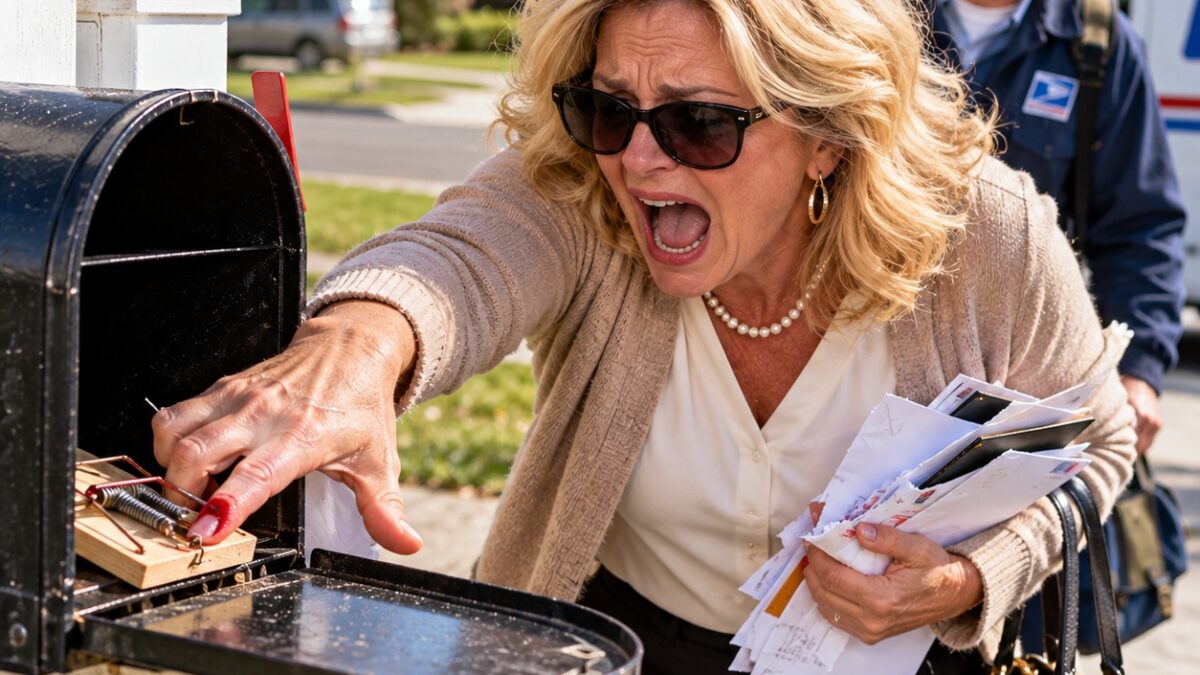
PART 2 and FULL ENDING  Thank you

I wish I could tell you I went home, called the Postal Inspection Service, installed a camera, and behaved like the calm, responsible adult I claimed to be.
That would have been smarter.
It also would not be true.
I was angry.
Not the loud kind.
The worse kind.
The kind where everything becomes very clear and a terrible idea begins sounding elegant.
For years, Sharon had operated on one assumption.
Nobody would challenge her hard enough to make the inconvenience worth it.
She sent letters.
People complied.
She threatened fines.
People paid.
She cited bylaws most homeowners had never read because reading forty-seven pages of HOA regulations on a Tuesday night sounded worse than giving Sharon whatever she wanted.
The system reinforced her.
Not because she was always right.
Because resisting her required more energy than obeying her.
Mail was different.
My mortgage statement was not an HOA matter.
My bank correspondence was not her business.
Prescription information was not her business.
Tax forms were not her business.
Nothing inside that mailbox became community property because Sharon owned a blazer and knew how to print an official-looking header.
So I started documenting.
That part was smart.
I ordered a camera for the front window.
Wide enough angle to show my driveway, mailbox, sidewalk, and the section of street where Sharon usually appeared during her self-appointed neighborhood inspections.
I saved every damaged envelope.
Photographed torn seams.
Tape.
Resealed edges.
Dates.
I asked Mike to text me if he noticed anything unusual on delivery.
He agreed, although he made one thing very clear.
“I am not participating in whatever revenge fantasy you’re cooking.”
“I don’t have a revenge fantasy.”
“You have the face.”
“What face?”
“The one homeowners get right before I hear a story later.”
Fair.
For four days, nothing happened.
Perfect mail.
No damage.
No Sharon near the box.
I began wondering whether confronting her had worked.
Then Friday came.
At 10:14 that morning, the camera recorded Sharon walking past my house.
She slowed.
Looked toward the front windows.
Kept going.
Two minutes later, she came back.
Stopped at the mailbox.
Opened it.
Looked inside.
Closed it.
Nothing had been delivered yet.
She walked away.
That clip changed everything.
Until then, I had evidence that my mail was being damaged.
Now I had evidence Sharon was accessing my mailbox when she had no reason to.
Still not proof she had opened anything.
But enough to remove coincidence.
I saved the file.
Backed it up.
Then waited.
Monday, Mike arrived around noon.
Dropped three envelopes.
One small padded package.
I watched from inside.
Thirty-seven minutes later, Sharon appeared.
She wore a cream cardigan.
Black pants.
Shoes entirely unsuitable for walking anywhere except between a luxury SUV and a restaurant.
She looked toward my house.
Opened the mailbox.
Pulled one envelope out.
Held it.
Turned it over.
Then slid it back.
She left.
That was the point where I should have called federal authorities immediately.
Instead, I wanted something she could not explain away.
Something so undeniable that the board, the neighbors, and Sharon herself would have to stop pretending she was simply “checking community compliance.”
The next morning, I made a decoy envelope.
Nothing valuable.
Nothing private.
Just paper.
And then I did the part I am not going to pretend was wise.
I put an ordinary mousetrap in the mailbox with it.
No modification.
No nails.
No blades.
No homemade mechanism.
Nothing designed to cause serious injury.
But still—
a spring trap inside a place where I expected an unauthorized person to put her hand.
That was reckless.
At the time, I called it clever.
There is a difference between those words that becomes much easier to understand after police officers arrive.
My goal was humiliation.
A sharp snap.
A scare.
Maybe a pinched finger.
Something theatrical enough to make Sharon finally understand that reaching into someone else’s mailbox could produce consequences she did not control.
I turned the camera on.
Then waited.
Nothing happened Monday.
Tuesday.
Nothing.
Wednesday morning, 9:56.
Sharon appeared.
I was sitting in my living room pretending to read an email while watching the camera feed.
Cardigan.
Dark green this time.
Large sunglasses.
A folder beneath one arm.
She walked past once.
Returned.
Looked toward my driveway.
Then toward both neighboring houses.
Nobody outside.
She opened the mailbox.
My heart started pounding.
This is the part people later imagined I enjoyed.
I did.
For approximately two seconds.
Then reality became less funny.
Sharon reached inside.
There was a sharp snap.
She screamed.
Not the dramatic yelp I had imagined.
A real scream.
Her hand jerked backward.
The trap came partway out with her before dropping onto the grass.
Sharon stumbled off the curb.
For half a second, I thought she was going to fall into the street.
I was out the front door immediately.
Not laughing.
Not filming.
The camera was doing that already.
Sharon clutched her right hand.
Two knuckles bleeding.
Nothing crushed.
No broken finger that I could see.
Still worse than the harmless prank version I had pictured.
“You trapped me!”
She screamed.
I looked at the mailbox.
Then her hand.
Then the neighbors beginning to emerge.
“You were inside my mailbox.”
“You set a weapon!”
“It’s a mousetrap.”
“You booby-trapped federal property!”
That phrase came fast enough that I suspected Sharon had spent time thinking about how the law might apply if she ever got caught.
Mrs. Donnelly from across the street walked out in slippers.
“What happened?”
Sharon held up her hand like a battlefield casualty.
“He attacked me!”
“I was inside my house.”
“You built a trap!”
“You reached into my mailbox.”
More doors opened.
Phones appeared.
Of course.
There is no emergency in an American subdivision that cannot attract four amateur videographers within ninety seconds.
Sharon began shouting.
Lawsuit.
Police.
Assault.
Intentional injury.
Domestic terrorism.
That last one actually happened.
“Domestic terrorism?”
I repeated.
“You put a weapon inside a mailbox!”
“You put your hand inside my mailbox.”
“It’s HOA jurisdiction!”
“No.”
I said.
“It absolutely is not.”
Then Mike’s postal truck appeared at the corner.
He slowed.
Saw the crowd.
Stopped.
His face went through three stages.
Confusion.
Recognition.
Regret.
He stepped out.
“What happened?”
Sharon pointed at me.
“He set a trap!”
Mike looked at her bleeding hand.
Then the mousetrap in the grass.
Then my mailbox.
Then me.
“You did not.”
His disappointment hit harder than I expected.
“I did.”
Mike closed his eyes.
“Man.”
Sharon straightened.
“There!”
“Even the federal employee admits it!”
Mike opened his eyes.
“I deliver mail.”
“I don’t prosecute people.”
Then he looked at Sharon.
“But why was your hand inside his mailbox?”
Sharon froze.
One second.
Two.
Then:
“I was conducting a neighborhood safety inspection.”
Mike actually laughed.
Not because the situation was funny.
Because the alternative may have been shouting.
“You are not a postal inspector.”
“I am HOA president.”
“Congratulations.”
Mike said.
“That does not make you a postal employee.”
Sharon pointed toward him.
“You knew!”
“Knew what?”
“That he was targeting me!”
Mike looked at me again.
“I absolutely did not.”
True.
He had specifically refused involvement.
Sharon’s phone was already in her left hand.
Calling 911.
By the time the first patrol car arrived, twenty-three people were standing outside.
I know because Mrs. Donnelly counted later.
Officer Grant stepped out looking as though he had been assigned what he expected to be a neighborhood argument.
Then he saw the hand.
Mailbox.
Trap.
Phones.
Postal vehicle.
His expression changed.
“All right.”
He said.
“Everybody stop talking.”
Nobody did.
He said it again.
Louder.
That worked.
He separated us.
Sharon first.
Me second.
Mike third.
The neighbors became witnesses.
I told the truth.
All of it.
Mike warning me.
Damaged mail.
Confrontation.
Video.
My decision to put the mousetrap inside.
I did not call it self-defense.
It wasn’t.
I did not claim I accidentally left it there.
That would have been ridiculous.
Officer Grant stared at me.
“You deliberately placed a spring trap in the box because you expected her to reach in?”
“Yes.”
“You understand that was a bad idea.”
“Yes.”
“Did you understand it before today?”
I considered lying.
“No.”
He almost smiled.
Almost.
“Show me the video.”
I pulled it up.
First clip.
Sharon checking the empty box.
Second.
Removing my delivered envelope.
Examining it.
Replacing it.
Third.
Today.
Approach.
Look around.
Open.
Reach.
Snap.
Officer Grant watched twice.
Then asked:
“Do you have the damaged envelopes?”
“Yes.”
“Keep them.”
“Do not alter anything else.”
“And do not post this video online.”
That disappointed several neighbors immediately.
Sharon heard him.
“Arrest him!”
Grant turned toward her.
“We’re still investigating.”
“He assaulted me!”
Grant looked at her.
“Ma’am, did you have permission to access his mailbox?”
“I had HOA authority.”
“That wasn’t my question.”
“The association has an obligation to protect property values.”
“That also wasn’t my question.”
Her expression changed.
He continued.
“Did he give you permission?”
“No.”
“Did the Postal Service?”
Her chin lifted.
“The Postal Service does not control our covenants.”
Mike made a sound behind us.
Grant looked at him.
“Sir?”
Mike rubbed his mouth.
“Sorry.”
Officer Grant turned back.
“Ma’am, I’m going to strongly recommend you stop discussing federal mail law until the people who enforce federal mail law are involved.”
Sharon’s confidence slipped.
There it was.
For years, HOA rules had been her universe.
Now another system had entered the room.
One she did not chair.
The ambulance came because Sharon insisted her hand was severely damaged.
That part annoyed people later.
It should not have.
If someone says they need medical care after being injured by something you deliberately placed, they should get evaluated.
Her knuckles were cut.
One finger badly bruised.
No fracture.
No tendon damage.
A few stitches.
Painful.
Embarrassing.
Not catastrophic.
I was relieved.
That feeling surprised me.
I had wanted to scare her.
The second I saw blood, I understood how stupid revenge can become when physics gets involved.
A trap does not know your moral intention.
It does what it does.
Sharon left in the ambulance.
Officer Grant stayed.
Then a second vehicle arrived.
Not police.
Postal Inspection Service.
Mike had called his supervisor.
His supervisor called the inspectors.
The first inspector who spoke with me was a woman named Dana Keene.
Forties.
Dark suit.
Hair tied back.
Expression that made me want to confess to parking violations from college.
She watched the videos.
Photographed the mailbox.
Collected copies of the damaged envelopes.
Then interviewed Mike.
Longer than she interviewed me.
That worried me.
Eventually she came back.
“You said Mrs. Whitmore attempted to persuade your carrier to let her inspect your mail?”
“That’s what Mike told me.”
“Did you witness that?”
“No.”
“So that comes from him.”
“Yes.”
“Good distinction.”
She wrote something.
“What did you personally observe?”
I told her.
Opened envelopes.
Damaged packages.
Sharon accessing the box.
Footage.
Confrontation.
Nothing more.
Keene looked at me.
“Do you have evidence she opened the damaged letters?”
“No.”
“Then don’t say you do.”
“I believe she did.”
“Belief is not evidence.”
I liked her immediately.
Not because she was helping me.
Because she was disciplined.
Then she pointed toward the mailbox.
“Your mousetrap was also a problem.”
“I know.”
“Do you?”
“More than I did this morning.”
“That’s progress.”
No smile.
“You cannot intentionally create a hidden mechanical hazard for people who may lawfully access your mailbox.”
“Carrier.”
“Substitute carrier.”
“Postal inspector.”
“Emergency personnel.”
“Even if you believe your intended target has no right to be there.”
That landed.
I had been so focused on Sharon that I had not really considered anyone else.
Mike.
A substitute.
Somebody reaching in after a delivery problem.
My face changed.
Keene noticed.
“That’s why we don’t improvise enforcement.”
She said.
“We document.”
“We investigate.”
“We charge people if evidence supports it.”
“You don’t get to build your own penalty system.”
That sentence hurt because it sounded exactly like something I had accused Sharon of doing.
I nodded.
“You’re right.”
Keene studied me.
“People rarely say that this fast.”
“Today has been educational.”
She almost smiled.
The HOA emergency meeting happened that night.
I did not attend.
Not because I had suddenly developed restraint.
Because my attorney told me not to.
Yes.
Attorney.
By four in the afternoon, Sharon had posted on the community Facebook group that I had “attempted to maim a senior citizen through a weaponized postal device.”
Someone sent me a screenshot.
My brother called.
My boss called.
Two neighbors texted:
DO NOT RESPOND.
For once, I listened.
I hired David Mercer, a local attorney recommended by a coworker.
He watched the video.
Read the HOA posts.
Looked at the mousetrap photo.
Then leaned back.
“You managed to be both the victim and the person who created a separate legal issue.”
“That sounds efficient.”
“It isn’t.”
“Am I getting arrested?”
“Probably not based on what I’m seeing.”
“But you may be cited.”
“And if she sues, you absolutely have exposure.”
“She was stealing my mail.”
“That helps explain why you were angry.”
“It does not automatically authorize you to injure her.”
“I wasn’t trying to seriously injure her.”
“Good.”
“Keep saying seriously.”
I stared.
He continued.
“Because you were trying to cause something.”
That was uncomfortable.
Also true.
David’s advice:
Say nothing publicly.
Preserve everything.
Do not contact Sharon.
Do not modify mailbox.
Do not delete social media messages.
Do not discuss motive beyond counsel and investigators.
And, most important:
“If anybody asks whether the trap was smart, the correct answer is no.”
“I already know.”
“Good.”
“It will save us time.”
The next morning, Cedar Ridge looked different.
Nothing physically changed.
Lawns still trimmed.
Garbage trucks came.
Children waited for school buses.
But Sharon’s authority had developed a crack.
People were talking.
Not only about my mailbox.
The previous evening’s board meeting apparently turned into a disaster.
Mike had told investigators Sharon called her request an “official board security initiative.”
Board members denied authorizing anything.
One of them, Linda Chen, reportedly asked Sharon to produce the policy.
Sharon could not.
Another board member discovered she had used HOA letterhead in emails to several delivery services demanding notification about “unusual parcels.”
That was new.
I had not known.
Then neighbors started comparing experiences.
Mrs. Donnelly’s medication package had once gone missing for six hours before reappearing on her porch.
Mr. Patel had received a letter opened along the side.
The Reynolds family reported two packages showing signs of being resealed.
None proved Sharon.
But the pattern widened.
By Friday, Dana Keene interviewed half the street.
The thing that hurt Sharon most was not my trap video.
It was Mike.
Postal carriers document more than people realize.
He had made a note to his supervisor after Sharon approached him.
Date.
Time.
Nature of request.
Offer of money.
He had also kept the small envelope she tried to give him.
Cash inside.
That was evidence.
Sharon claimed it was a holiday gratuity.
In September.
Mike’s supervisor did not find that convincing.
Then Keene obtained HOA emails.
I learned about them later through discovery.
Sharon had written:
If carriers won’t cooperate, we’ll have to check after delivery.
Another:
Certain residents are receiving material inconsistent with residential use.
And one mentioning me by address.
No evidence.
No explanation.
Just suspicion.
Sharon had convinced herself curiosity was governance.
That was the part I had not fully understood.
I thought she knew she was violating boundaries.
Eventually, I realized she believed the boundary should not apply to her.
Power is most dangerous when the person using it stops recognizing it as power.
They begin calling it responsibility.
My attorney found the relevant HOA documents.
Nothing.
No mail inspection authority.
No package-review rule.
No right to search deliveries.
Of course not.
Any board attorney with half a functioning brain would have rejected the idea.
The association’s insurer contacted Sharon separately.
That mattered.
If she had acted outside board authority, legal coverage became complicated.
Suddenly the woman who had always hidden behind “the HOA” was discovering the HOA might step away from her.
She sued me two weeks later.
I expected it.
Personal injury.
Negligence.
Intentional harm.
Emotional distress.
Legal fees.
She also requested an injunction requiring me to remove “dangerous devices” from association property.
That was funny for one reason.
My mailbox sat on property the HOA did not own.
David crossed that section out with a red pen.
“She’s reaching.”
“Does that help?”
“It helps me enjoy my morning.”
The lawsuit was not funny otherwise.
Legal process has a way of removing entertainment from neighborhood revenge.
Depositions.
Bills.
Insurance calls.
Photographs of Sharon’s hand.
Medical reports.
Questions about my intent.
I had to sit in a conference room while her attorney asked:
“Did you want Mrs. Whitmore to put her hand into the mailbox?”
“Yes.”
“Did you want the trap to activate?”
“Yes.”
“Did you anticipate physical contact?”
“Yes.”
“Did you want her to experience pain?”
I paused.
My lawyer did not rescue me.
Because the answer mattered.
“I wanted the snap to scare her and stop her.”
“That wasn’t my question.”
“No.”
The attorney waited.
I corrected myself.
“I understood it could hurt.”
“Did you want that?”
“At the time, I wanted her to feel a consequence.”
There.
Ugly.
True.
That answer probably cost me money.
It also stopped me from pretending I had been morally perfect because Sharon had done something worse first.
I wasn’t.
The internet version later made me a folk hero.
The actual version included me writing a check.
The federal investigation moved separately.
That was the part Sharon underestimated.
Civil court allowed her to argue about the trap.
Federal investigators cared about mail.
Chain of custody.
Dates.
Carrier testimony.
Video.
Digital communications.
Whether she had taken mail before delivery or after.
Whether contents were opened.
Whether she obstructed correspondence.
Whether she induced or attempted to induce a carrier to violate procedure.
The details were more complicated than neighbors wanted them to be.
People wanted one dramatic charge:
MAIL TAMPERING.
Reality involved specific conduct.
Specific evidence.
Specific counts.
The investigation eventually established enough for prosecutors to proceed on conduct involving mail taken from boxes after delivery and correspondence intentionally interfered with.
Sharon’s attorney negotiated.
There was no giant televised federal trial.
No judge banging a gavel while the gallery laughed.
That is the version storytellers prefer.
The real outcome was quieter.
And more serious.
Sharon entered a plea on federal mail-related charges.
She received probation.
A substantial fine.
Restitution and costs.
Community service.
And, far more damaging to her than any of those—
a federal criminal record.
The offer she made Mike became part of the evidentiary picture.
So did the emails.
My mousetrap case ended differently.
No prison.
No dramatic acquittal.
I accepted responsibility for creating a foreseeable mechanical hazard.
Paid a fine.
Covered a portion of Sharon’s documented medical expense through settlement.
No admission that she had any right to be inside the box.
No waiver of my claims about her conduct.
David called it:
“The legally expensive version of everybody learning something.”
My bank account agreed.
Was it fair?
Yes.
That answer surprises people.
They expect me to say:
She deserved it.
Maybe she deserved consequences.
That does not mean I had the right to manufacture whatever consequence entertained me.
Those are two separate questions.
Dana Keene had been right.
I had become irritated with Sharon for acting like her own police department.
Then I acted like mine.
Smaller scale.
Different motive.
Same underlying arrogance.
I decided my certainty gave me authority.
That realization was unpleasant.
Useful things often are.
The HOA consequences arrived before the criminal case finished.
Petition.
Recall meeting.
I attended that one.
Community clubhouse packed.
People standing along the walls.
Sharon sat at the board table.
No neck brace.
No giant cast.
Her hand had healed.
She wore a beige jacket and the expression of someone determined to remain president through force of posture.
Linda Chen opened the meeting.
She had become acting vice president after two board members demanded Sharon temporarily step aside.
Sharon refused.
Hence the recall.
Residents spoke.
Not about the trap.
About years of conduct.
Selective enforcement.
Threats.
Private information.
Unauthorized letters.
Treating contractors as if they worked for her personally.
Mr. Patel walked to the microphone.
He was seventy-two.
Soft-spoken.
Retired history teacher.
The man whose garden bench Sharon had once treated like an architectural crisis.
“I have lived here twenty-one years.”
He said.
“Longer than any person currently on the board.”
“This association was created to maintain shared property.”
“It was not created to govern our private lives.”
Applause.
Linda asked people not to.
They did anyway.
Mr. Patel continued.
“Mrs. Whitmore forgot something basic.”
“If your position requires everyone else to have less privacy than you do, the position is not the problem.”
“You are.”
Sharon interrupted.
“This is personal harassment.”
Mr. Patel looked toward her.
“You opened people’s mail.”
“I inspected potential violations.”
Someone behind me said:
“Oh, my God.”
Linda closed her eyes.
Sharon realized too late what she had just admitted.
Her attorney, seated in the first row, physically lowered his head.
Mr. Patel stepped away.
Then Mike spoke.
He was not an HOA resident.
He had been asked to provide factual information.
He stood behind the microphone in his Postal Service jacket.
“I deliver to this neighborhood.”
“I don’t work for your board.”
“I don’t report to your president.”
“I’m not here to decide who should run your association.”
“But I want one thing in the record.”
“Your mail belongs to the people it is addressed to.”
“It does not become neighborhood property because the box is visible from the street.”
Simple.
Probably the strongest statement of the night.
Then Sharon demanded to speak.
Linda tried to limit her time.
Sharon ignored the limit.
She blamed me.
The media.
Mike.
Hostile board members.
Federal overreach.
Residents who had “never understood the burden of leadership.”
That phrase ended her.
You could feel it.
People did not hear leadership.
They heard exactly what the previous years had taught them to hear.
Control.
The recall passed.
Eighty-two percent.
Sharon was removed as president.
Two board members resigned afterward because they had supported her too long.
Linda became interim president.
Her first motion was almost comically basic.
“No officer of this association has authority to inspect, seize, open, redirect, delay, or interfere with personal mail or private deliveries.”
Unanimous.
I looked at David.
He whispered:
“I would’ve assumed civilization already covered that.”
Apparently Cedar Ridge needed it in writing.
The new board did something else.
They hired an outside management company for enforcement.
Board members could report violations.
They could not personally investigate homeowners.
No president wandering around photographing windows.
No private confrontations.
No “security inspections.”
Document.
Submit.
Independent review.
The atmosphere changed.
Not overnight.
People who had spent years watching for Sharon became slow to believe she was really gone.
A trash bin left out one extra hour.
Nobody received a letter.
Mr. Patel repainted his bench.
Blue.
Technically not approved.
Linda saw it.
Sat down on it.
That became neighborhood legend.
Mike continued delivering mail.
The first time he came after the federal plea, he stopped at my driveway.
“You.”
He pointed.
“No more hardware-store justice.”
I raised both hands.
“Retired.”
“I’m serious.”
“I know.”
He looked at the mailbox.
I had replaced it.
Normal.
Locking model approved for residential delivery.
No surprises.
Mike nodded.
“Look at that.”
“Growth.”
“Expensive growth.”
“Best kind.”
He handed me three envelopes.
All sealed.
I checked them.
He noticed.
“Still inspecting?”
“My own mail.”
“That one you’re allowed to do.”
Then he saluted dramatically.
Not because I was a hero.
Because Mike enjoyed annoying me.
“Mail Defender.”
“Go away.”
He laughed and drove on.
Sharon stayed in Cedar Ridge.
That surprised everyone.
I think people expected her to sell the house and disappear.
She did not.
Maybe pride.
Maybe money.
Maybe leaving would have felt like admitting defeat.
For the first few months, she avoided the entire block.
Then life forced normality.
She walked.
Collected her own mail.
Went to grocery stores.
Attended no HOA meetings.
The first time we passed on the sidewalk, she looked straight ahead.
I did the same.
I did not need another confrontation.
The story had already become larger than either of us.
News sites briefly picked it up.
Then social media.
The headline versions got ridiculous.
HOMEOWNER BOOBY-TRAPS HOA KAREN.
MAIL THIEF MEETS MOUSETRAP JUSTICE.
Some posts claimed Sharon lost a finger.
She did not.
Others claimed I had wired the mailbox to electricity.
I absolutely did not.
One video edit added an explosion sound.
There was no explosion.
The actual snap was almost unimpressive.
People wanted a satisfying revenge fantasy.
Reality was more complicated.
Sharon broke the law.
I did something reckless.
Evidence exposed her.
Law handled the rest.
That is not as emotionally clean as:
Karen got what she deserved.
But I think it is more useful.
Because the real victory was not the trap.
The trap almost weakened my position.
David told me that repeatedly.
“You had excellent evidence before the stunt.”
He said.
“You know what we call adding unnecessary danger to an excellent case?”
“Drama?”
“Bad lawyering.”
“I’m not a lawyer.”
“Obviously.”
The video that mattered most was not the snap.
It was the day before.
Sharon calmly opening the box.
Removing my letter.
Examining it.
Putting it back.
No provocation.
No trap.
No injury.
Just conduct.
The boring video was stronger.
That taught me something.
We are drawn to dramatic proof.
The scream.
The blood.
The fall.
But quiet evidence usually survives better.
Dates.
Emails.
Camera footage.
Witnesses.
A carrier documenting an improper request.
The law prefers boring.
Boring is good.
Boring is how you build something another person cannot explain away.
Months later, Dana Keene stopped by.
Official reason:
returning copies of material no longer needed.
She stood on the porch.
Looked toward the new mailbox.
“Anything inside?”
“Letters.”
“Excellent.”
I smiled.
“Did you come here just to check?”
“No.”
Then she smiled slightly.
“Partly.”
She handed me an envelope.
“Your case is closed on our side.”
I took it.
“Thank you.”
“Thank Mike.”
“I did.”
She looked toward Sharon’s end of the street.
“People misunderstand federal mail enforcement.”
“They think the important part is the value of what was taken.”
“Often it isn’t.”
“Privacy and trust are part of the system.”
“People need to know that what is sent to them is not being filtered by whoever feels entitled to look.”
I nodded.
“That’s what made me angry.”
“I know.”
She looked back at me.
“Anger identified the problem.”
“It did not authorize your solution.”
There it was again.
“You really enjoy reminding me.”
“I enjoy when a lesson sticks.”
“It stuck.”
“Good.”
She left.
I kept that line.
Anger can identify a boundary.
It does not automatically tell you what to do next.
That may have been the difference between me and Sharon by the end.
At the beginning, both of us believed certainty was enough.
Sharon was certain she needed to inspect people.
I was certain she deserved to be taught a lesson.
Neither certainty created authority.
The board election happened in spring.
Linda ran.
Mr. Patel refused.
He said:
“I already survived public education.”
Nobody could convince him.
Linda won.
The new board published a short code of conduct.
It was only two pages.
Transparency.
No unilateral enforcement.
Resident privacy.
Conflict-of-interest disclosures.
Meeting minutes.
Complaint process.
It should not have felt revolutionary.
In Cedar Ridge, it did.
People started attending meetings for the first time.
Not because they expected drama.
Because the meetings had become boring enough to be useful.
Budget.
Roof repairs at clubhouse.
Landscaping.
Insurance.
Exactly what an HOA should spend most of its time doing.
The neighborhood improved.
Not the lawns.
Those had always been fine.
The people.
We stopped treating the association like something Sharon owned.
That was our mistake too.
We had complained privately for years.
Rolled our eyes.
Paid fines.
Let her accumulate authority because confronting her sounded exhausting.
Power does not always get seized.
Sometimes it gets abandoned by everyone else.
That lesson stung almost as much as my fine.
I joined one committee.
Not the board.
Never the board.
Landscape committee.
Why?
Mr. Patel recruited me.
Which was revenge for every time I mocked HOA meetings.
We spent three hours discussing drought-resistant shrubs.
I considered prison.
Then remembered I had a record clean enough that prison was unlikely.
Stayed.
That summer, Cedar Ridge held a block party.
For the first time in years, Sharon did not organize it.
Mrs. Donnelly did.
Children ran through sprinklers.
Mike stopped by after his route.
Mr. Patel brought food.
Linda tried not to talk about board business.
Failed.
Someone made a mailbox-shaped cake.
That was directed at me.
I refused to cut it.
Mike did.
A neighbor had placed a tiny plastic mousetrap decoration on top.
I stared.
“Too soon.”
“It has been eleven months.”
“Still too soon.”
Everybody laughed.
Even me.
Across the street, Sharon’s house remained quiet.
For one second, I felt something unexpected.
Not guilt exactly.
Sadness.
Sharon had built her whole identity around being the person who controlled Cedar Ridge.
When that authority disappeared, I wondered what remained.
Then I remembered something.
Understanding consequence does not require rescuing someone from it.
I did not go knock on her door.
Did not invite her over.
Did not write a forgiveness letter.
Boundaries could exist without cruelty.
That was enough.
About a year after the mousetrap, I saw Sharon at the mailbox cluster near the clubhouse.
She was collecting something from a parcel locker.
I almost turned around.
She saw me.
No point.
We stood maybe ten feet apart.
Her hand had healed completely.
Small scar across one knuckle.
She noticed me looking.
“You cost me a lot.”
She said.
No hello.
I nodded.
“You cost me quite a bit too.”
“You humiliated me.”
“You opened my mail.”
“I was protecting the neighborhood.”
There was less confidence in the sentence now.
It sounded memorized.
I did not argue.
“What did you think you were going to find?”
That question caught her.
She looked toward the parking lot.
“You were receiving business correspondence.”
“I work remotely two days a week.”
“The covenants—”
“Allow home offices.”
She knew.
Of course she did.
“So what were you looking for?”
Sharon’s face changed.
Not much.
Enough.
“I thought you were organizing residents against me.”
There it was.
I stared.
“My mail?”
“You had meetings.”
“I had people over for football.”
“You were always questioning assessments.”
“I disagreed with your fines.”
“You encouraged others.”
“I told Mr. Patel not to pay a fine that wasn’t authorized.”
“Exactly.”
For the first time, I understood the real reason.
Not security.
Not prohibited businesses.
She wanted to know who was challenging her.
The mail was intelligence.
Proof.
Control.
“You were afraid.”
I said.
Sharon’s jaw tightened.
“No.”
“Yes.”
“You thought if people talked without you knowing, you would lose control.”
She stepped closer.
“You have no idea what it takes to manage people who complain about everything.”
I almost laughed.
Instead:
“You weren’t managing us.”
“You were monitoring us.”
She looked away.
I could have pushed harder.
Made her admit it.
There was no need.
Her own life had already answered the argument.
I said:
“The trap was wrong.”
That made her look back.
“I shouldn’t have done it.”
Surprise.
Real.
“But you still had no right to touch my mail.”
Her mouth opened.
Closed.
Two truths.
At the same time.
People hate that.
They want one person clean.
One person dirty.
Life rarely cooperates.
Sharon looked at the scar.
“You wanted to hurt me.”
“I wanted to teach you a lesson.”
“That’s the same thing.”
I thought about it.
“Closer than I understood.”
She nodded once.
Maybe the first honest agreement we ever had.
Then she picked up her package.
Walked away.
No apology.
I did not expect one.
I did not chase her.
That conversation changed the story for me.
Until then, I had told it inside my own head like a contest.
Sharon versus me.
She invaded privacy.
I outsmarted her.
Video exposed her.
She lost.
I won.
That is emotionally satisfying.
Also incomplete.
The real story was about boundaries.
Sharon crossed mine because she believed her position made ordinary limits optional.
I responded by crossing another because I believed being wronged made retaliation acceptable.
The system corrected both.
Her consequences were far more serious because what she did was broader, repeated, and criminal.
Mine were smaller.
They still mattered.
That was justice.
Not because everybody received the same punishment.
Because each action was evaluated separately.
I wish more neighborhood disputes worked that way.
Instead, people choose teams.
If someone on your side does something stupid, you defend it because admitting stupidity feels like helping the other side.
I could have done that.
People offered me the script.
“She deserved the trap.”
“Don’t apologize.”
“You’re a legend.”
“No jury would convict you.”
“Mail thieves should lose a hand.”
That last one disturbed me.
I stopped reading comments.
You can become a symbol for people who want permission to behave worse than you did.
That is not fun.
I began answering one question whenever local reporters asked.
“Would you do it again?”
“No.”
They always looked disappointed.
One asked:
“Even knowing it exposed her?”
“The camera exposed her.”
“The trap injured her.”
“Those were separate things.”
That quote never became the headline.
Of course.
Years passed.
Mike eventually transferred routes.
His final day, he knocked on my door.
This time holding a package.
“Fragile.”
He said.
“Should I inspect it first?”
“Get off my property.”
He laughed.
Then held out his hand.
I shook it.
“You did me a favor.”
I said.
“When you told me.”
“I mostly wanted to watch your face.”
“Still counts.”
Mike looked toward Sharon’s house.
“She ever apologize?”
“No.”
“You?”
“I told her the trap was wrong.”
He whistled.
“Growth.”
“Apparently everyone is invested in my development.”
“Because it was funny.”
“I paid thousands of dollars.”
“Expensive comedy.”
He climbed back into the truck.
Then leaned out.
“One more thing.”
“What?”
“If your next mail carrier tells you something weird…”
“I call inspectors.”
“Beautiful.”
He saluted.
Drove away.
I still live in Cedar Ridge.
The mailbox is different.
The neighborhood too.
My letters arrive sealed.
Packages remain on the porch.
Nobody inspects them except me.
Linda served two terms and stepped down voluntarily.
That alone made her a local icon.
Mr. Patel’s bench is still blue.
Technically, the color was eventually approved retroactively.
He framed the approval letter.
Mrs. Donnelly still knows everything that happens within four houses.
Unlike Sharon, she uses gossip rather than subpoenas.
Socially legal.
Usually.
As for Sharon—
she became simply Sharon.
Not President Whitmore.
Not Madam Chair.
Not the woman with the clipboard who could threaten fines before breakfast.
Just a homeowner.
That may have been the consequence she hated most.
Authority had been the costume.
Without it, nobody was required to perform fear.
Sometimes I still think about the moment the trap snapped.
Sound smaller than memory makes it.
Sharp click.
Scream.
Then everything after.
Police.
Inspectors.
Lawyers.
Federal case.
Recall.
Settlement.
Money.
Anger.
Humiliation.
All because I wanted reality to “smack her upside the head.”
That phrase seems stupid now.
Reality did not need my help.
I already had the video.
Mike’s testimony.
The damaged mail.
Sharon’s own emails.
I had evidence.
What I lacked was patience.
That distinction cost me.
Still, I do not regret stopping her.
I regret how I tried to do it.
Important difference.
Because there is another bad lesson people could take from this story.
Keep quiet.
Do not fight back.
Let authorities handle everything while somebody continues violating you.
No.
Document.
Report.
Push.
Demand action.
Attend the meeting.
Hire the lawyer.
Save the email.
Install the camera.
Know the rule better than the person abusing it.
That is not passivity.
It is leverage.
The difference is that leverage survives scrutiny.
A mousetrap does not.
I learned that the embarrassing way.
The funniest part?
Years afterward, whenever somebody in Cedar Ridge gets overly enthusiastic about enforcement, one phrase ends the discussion.
“Do we need another mailbox situation?”
Nobody wants another mailbox situation.
The board once debated a rule about holiday decorations staying up too long.
A new member proposed door-to-door inspections.
Linda, who no longer served but attended the meeting, raised one eyebrow.
“Mailbox situation.”
Proposal withdrawn.
Apparently my worst idea became a governance doctrine.
I suppose everyone contributes somehow.
My own mailbox still has a tiny scratch along the inside edge.
Probably from the trap.
I considered replacing it again.
Did not.
Not as a trophy.
A reminder.
Boundaries matter.
So does what you do when someone crosses them.
Sharon learned the first lesson.
I learned the second.
And Mike?
Mike learned never to knock on my door with neighborhood gossip unless he had cleared his afternoon.
Because sometimes all it takes to destroy an HOA president’s little empire is one mail carrier telling the truth, one camera pointed in the right direction, and one homeowner angry enough to fight back—
although, if I could do that part over again, I would definitely leave the mousetrap at the hardware store.








