𝗙𝗨𝗟𝗟 𝗦𝗧𝗢𝗥𝗬:They Told Me My Shift Was Over—Then the SEAL Captain’s K9 Blocked the Door, and I Saw What Everyone Else Had Missed
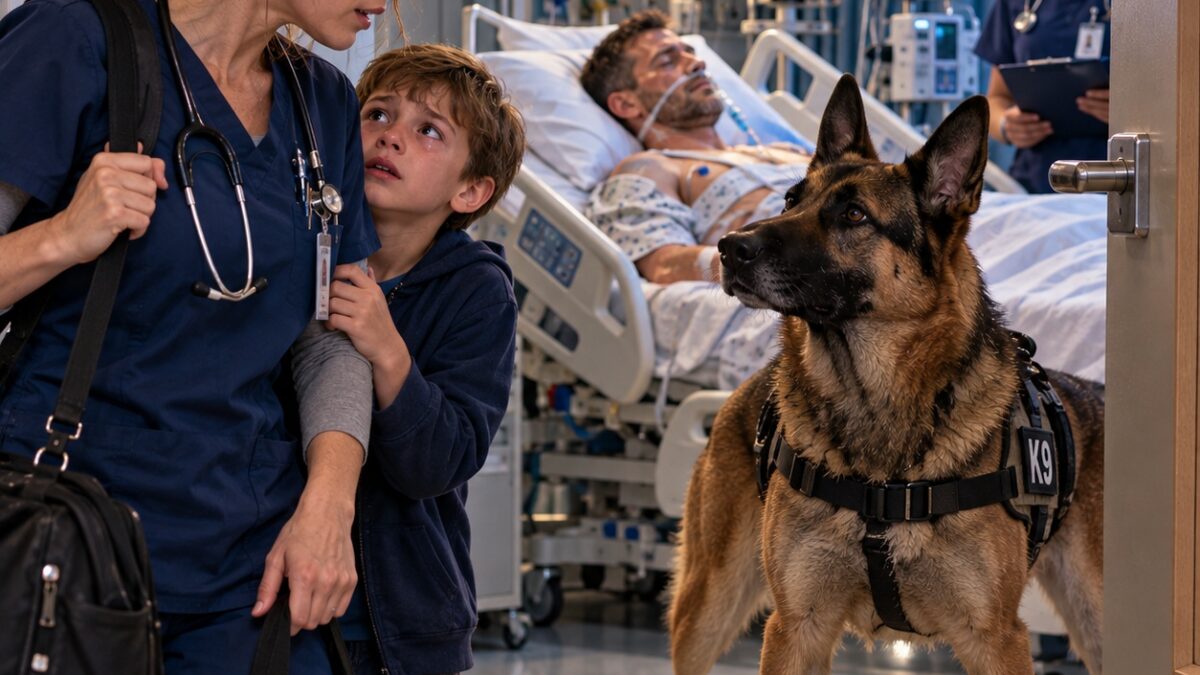
PART 2 and FULL ENDING  Thank you

The second portable oxygen reading dipped again.
Not dramatically.:
That was what made it dangerous.
People imagine medical emergencies announcing themselves.
Alarms.
Crashing numbers.
Somebody shouting.
Sometimes they do.
Other times the first warning is a difference so small that the easiest decision is to explain it away.
One point.
A breath slightly shallower.
A response delayed by two seconds.
The kind of thing that makes everyone in a tired hospital room want to say:
Probably nothing.
I had learned to respect probably.
Especially when probably was being used because everyone wanted to move on.
“Noah.”
I said.
“Stay by the chair.”
He obeyed.
No argument now.
One hand went automatically to Ranger’s shoulder.
The dog had moved away from the doorway only enough to remain between me and Ethan.
I increased Ethan’s oxygen support.
Checked airway positioning.
Then pressed the call button.
“I need Dr. Harris back in here for reassessment.”
The relief nurse glanced at the monitor.
“His pressure is still holding.”
“I know.”
I leaned toward Ethan.
“Captain Walker, squeeze my hand.”
Nothing.
Again.
“Ethan.”
His fingers moved.
Weak.
Late.
That was new.
I did not say:
He’s deteriorating.
I did not have enough evidence yet.
I said:
“Hold the handoff.”
The relief nurse looked at me.
“I’m keeping this assignment until we know why his responsiveness is changing.”
She hesitated.
Only one second.
Then rolled the workstation back toward the room instead of taking my badge report.
That small movement mattered.
She was no longer waiting for me to leave.
She was helping me stay.
Dr. Harris arrived wearing the expression of a physician who had already evaluated a patient and did not enjoy being asked to repeat himself without a clear reason.
“What changed?”
I showed him.
No speeches.
Portable oxygen reading beside the monitor reading.
Trend.
Delayed response.
Respiratory pattern.
“His saturation is drifting down on a separate sensor.”
I said.
“His respirations are shallower than ten minutes ago.”
“Responsiveness is decreased.”
Harris looked at Ethan.
Then at the monitor.
“Could be medication effect.”
“It could.”
I said.
“I want respiratory at bedside and a fresh blood gas before we assume that.”
He looked at me.
Then Ranger.
The dog had returned to the doorway.
Still no growling.
No agitation.
Just positioned there as though he had been given a post.
Harris frowned.
“What exactly is happening with the dog?”
Noah answered.
“He won’t let her leave.”
Dr. Harris looked at the boy.
Then me.
I corrected the frame immediately.
“Ranger is why I stopped walking out.”
I said.
“Ethan’s changes are why I’m staying.”
Harris’s expression sharpened.
That distinction mattered.
The dog was not diagnosing anyone.
I was.
Ranger had simply disrupted routine long enough for me to look again.
Harris repeated my neurological check.
“Captain Walker.”
Ethan’s eyelids moved.
Slower.
Harris pressed against his hand.
Response delayed.
He straightened.
“Call respiratory.”
The relief nurse was already moving.
I turned toward the supply cabinet.
Ranger shifted with me.
Blocked the doorway again.
This time I did not stop to analyze his motives.
“Noah.”
“Can Ranger move with you without leaving your dad?”
Noah nodded immediately.
“Ranger, heel.”
The K9 stepped to the boy’s side.
Precise.
Automatic.
Door clear.
Body still angled toward Ethan.
I crossed into the hallway.
Took the respiratory kit from the therapist approaching us.
Returned.
Ranger let me pass without hesitation.
Dr. Harris noticed.
I saw it.
No time to discuss.
Ethan’s breathing was visibly harder now.
Not dramatic.
Enough.
We positioned the mask.
Respiratory adjusted flow.
I moved Noah behind the chair where he could see his father without becoming part of the workspace.
“Is he getting worse?”
He asked.
I had always hated adults who answered children with lies because the truth made the adult uncomfortable.
I would not do that to him.
“He’s working harder to breathe.”
I said.
“We’re helping him before he has to work harder than he can.”
Noah’s fingers tightened into Ranger’s fur.
But he stayed exactly where I put him.
The blood gas came back.
Dr. Harris read it once.
Then again.
The room changed.
“All right.”
He said.
“We escalate monitoring now.”
He turned toward me.
“You called it early.”
Praise was irrelevant.
“Then let’s use the time.”
Harris nodded.
“Stay on him.”
“I’ll arrange step-up care.”
That was the consequence.
Not applause.
Not vindication.
A changed plan.
Ethan would no longer remain under routine observation.
And I would no longer be leaving after a simple handoff.
Staff arrived.
Portable monitor.
Oxygen.
Transfer equipment.
Ranger left the doorway and moved beside Noah.
Still watching me.
Noah looked up.
“You’re coming with him?”
My shift was over.
My formal responsibility should have ended.
The answer came anyway.
“Yes.”
“I’m coming.”
We began rolling Ethan’s bed toward step-up care.
I stopped it before we crossed the unit doors.
Not because of equipment.
Noah.
The boy had gone pale the moment he saw the long hallway open ahead.
Ranger pressed against his leg.
Alert.
Controlled.
Noah whispered:
“Can he come?”
I looked at the receiving nurse.
Then the corridor.
“Ranger stays with Noah unless he interferes with care.”
The receiving nurse opened her mouth.
Probably an objection.
Policy.
Space.
Animals inside higher-acuity areas.
Dr. Harris was already beside the chart.
“Make it work.”
He said.
Then stepped back.
That surprised me.
An hour earlier, he had been mildly impatient that I had called him back.
Now he was protecting the decision I had made instead of reclaiming the case as his.
I released the rail.
“That’s enough.”
Noah moved with Ranger.
Not behind us like an afterthought.
Beside us.
Inside the higher-acuity room, I gave report.
Only what mattered.
Change in responsiveness.
Respiratory trend.
Separate oxygen reading.
Blood gas.
Interventions.
Response.
No explanations about the dog.
No emotional details.
Clean handoff.
But I did not disappear after giving it.
I stood where I could see three things at once.
Ethan’s face.
Monitor.
Noah.
Respiratory adjusted support.
Ethan stirred.
Eyes opened for less than a second.
“Noah.”
His voice barely existed.
Noah started forward.
Stopped at the edge of the working space.
Good.
I moved the visitor chair closer to the bed.
No words.
Noah sat.
Ranger folded down beside him.
Ethan opened his eyes again.
Found me.
His lips moved.
“Son.”
I understood.
I turned the chair until Noah was directly inside his father’s line of sight.
Ethan’s hand shifted weakly across the blanket.
Noah reached for it.
Carefully.
Tubing.
Lines.
No disruption.
I stepped back.
A few minutes earlier, we had been organizing everything around Ethan’s numbers.
Now care was organizing around two responsibilities.
Watch the patient.
Do not erase his child from the room.
That mattered.
The receiving nurse checked the next reading.
Then looked at me.
“You’ve been with him since the change began?”
“Yes.”
“Stay bedside for the next assessment.”
“I’ll take transfer paperwork.”
She pulled the workstation away.
For the second time that night, someone else took administration away from me so I could keep watching Ethan.
I did not say thank you.
Not because I was ungrateful.
Because there was nothing ceremonial happening.
We were working.
I moved closer.
Ranger lifted his head.
When I crossed to the equipment cabinet, he stayed beside Noah.
When I came back, he settled.
That was the first time I understood how his internal line had changed.
Earlier, the doorway was the boundary he guarded.
Now Ethan was.
And somehow, I had been moved inside that boundary.
Dr. Harris stopped outside the glass before leaving.
He spoke to the receiving nurse.
“If Bennett says the pattern changes again, call me before you wait for the monitor to catch up.”
Then he left.
I never looked after him.
Ethan squeezed Noah’s fingers.
Weak.
Deliberate.
Noah’s shoulders dropped for the first time all night.
He did not ask me whether I was leaving.
He simply pulled the chair closer.
Ranger tucked himself underneath.
And I stayed.
Urgent imaging was ordered.
Nobody asked if I would go with Ethan.
The receiving nurse handed me the transport packet.
Respiratory attached portable support.
“CT is ready.”
I looked at Ethan.
Then Noah.
Then Ranger.
Noah was already standing.
“We’re coming.”
I shook my head.
“You can wait outside imaging.”
“Ranger cannot enter the scanner room.”
His face tightened.
Ranger rose instantly.
He read Noah faster than any adult in the room.
Until then, the dog had been two things.
Part of what kept Noah steady.
And part of what stopped me from leaving too soon.
Now progress meant separating the little group.
For the first time.
I crouched in front of Noah.
“Your dad needs pictures that show us what the monitor can’t.”
“I’ll stay with him the whole time.”
Noah looked at Ranger.
“He doesn’t like Dad going somewhere he can’t follow.”
“I know.”
I held out my hand.
“Ranger can stay with you while I stay with your dad.”
Noah looked at my hand.
Then did something I did not expect.
He placed Ranger’s leash into it.
“He listens better if Dad’s person holds it.”
The sentence lodged somewhere under my ribs.
Dad’s person.
I had no claim to that role.
No right to it.
But an eight-year-old boy had apparently decided I was safe enough to borrow it.
I closed my fingers around the worn lead.
Ranger’s eyes locked on me.
I guided him two steps toward Noah.
Placed the leash back into the boy’s hand.
Then touched Ranger’s shoulder once.
Briefly.
“Stay with him.”
Ethan’s bed started down the corridor.
Ranger followed three steps.
Noah tightened his grip without pulling.
“Ranger.”
The dog stopped.
His body leaned toward Ethan.
But he stayed with Noah.
I kept walking.
That decision meant more than any order.
Noah had let his father disappear around a corner because I was the one following him.
At the imaging suite, Ethan stirred.
His hand moved against the rail like he was searching.
I stepped into his line of sight.
“Noah’s safe.”
I said.
“Ranger is with him.”
His breathing eased.
Just enough.
Respiratory transferred him without adding more medication.
The scan itself did not take long.
Waiting for a scan always does.
I stood behind the glass.
Arms folded.
Watching.
The moment he came out, I moved back to his side.
When we returned toward the unit, Noah was exactly where I left him.
Ranger sat rigidly beside his chair.
Waiting.
The moment I appeared, both stood.
Neither rushed.
That struck me.
For a child terrified of losing his father, Noah showed extraordinary control.
Maybe because Ranger did.
Maybe because Ethan had taught both of them something about how to wait.
“He made it through.”
I said.
Noah searched my face.
“Did they find what’s wrong?”
“The doctor is reading it now.”
Not the answer he wanted.
He nodded.
Dr. Harris stepped out of the reading room.
Preliminary report in hand.
His face had changed.
No casual uncertainty.
“Clare.”
I turned.
“There’s enough here that I don’t want this managed as routine respiratory decline.”
“Continuous observation.”
“I’m calling the specialist.”
He placed the report directly into my hand.
I looked once.
Did not pretend to interpret beyond my role.
Enough findings to explain why he wanted escalation.
Enough to justify everything we had changed.
My shift bag was still beneath a counter two floors away.
My name was no longer on staffing.
None of that seemed relevant.
I took the report.
Walked back into Ethan’s room.
Ranger followed Noah to the doorway.
Then stopped.
On his own.
Ethan opened his eyes.
Clearer this time.
Found Noah.
Then Ranger.
The dog stood at the threshold.
Same disciplined posture that had stopped me from leaving.
Ethan noticed.
His fingers tightened against the blanket.
I stepped closer.
“Captain Walker.”
“Can you hear me?”
Small nod.
Noah moved toward him.
Stopped when he saw the oxygen mask.
Tubing.
Cables.
I could have told him:
Stay back.
Instead, I moved the chair into Ethan’s line of sight.
Created space.
Noah came forward.
Ranger remained at the door.
“Dad.”
Ethan looked toward me.
Voice rough.
“What’s happening?”
I did not say:
You’re fine.
I hated that phrase when it was not true.
“Your breathing changed.”
“The scan showed enough that Dr. Harris is bringing in a specialist.”
“You’re stable right now.”
“We’re watching closely.”
Ethan held my gaze.
He did not ask me to soften it.
Good.
Noah reached for his hand.
Ethan tried lifting his arm.
Could barely move it.
My instinct was to help.
I stopped.
He turned his wrist.
Managed the movement.
Rested his hand over Noah’s.
Ranger exhaled softly from the doorway.
Ethan looked at him.
Then me.
“He block you?”
A faint smile lived inside the words.
“He kept me from walking out.”
Recognition crossed Ethan’s face.
No surprise.
No confusion.
He knew exactly what Ranger had done.
Noah leaned closer.
“I told her not to leave.”
Ethan looked at his son.
Then his voice changed.
Weak physically.
Still command.
“Listen to her.”
Noah went still.
Ethan’s thumb moved once against his son’s hand.
“If she says move, move.”
“If she says wait, wait.”
I could have taken that authority.
Made my job easier.
Instead, I crouched in front of Noah.
“And if you’re scared or you notice something different, you tell me.”
“You don’t have to guess what I need.”
Noah looked between me and his father.
“Even if everyone else says it’s okay?”
I nodded.
“Especially then.”
Ranger left the doorway.
Walked to Noah.
Sat against his leg.
He was no longer guarding my exit.
Ethan watched him settle.
Then closed his eyes.
Hand still over Noah’s.
When Dr. Harris returned with the specialist, he did not ask me to step aside.
He handed me the new orders first.
“Walk us through what changed before imaging.”
I did.
Concise.
Timeline.
Nothing extra.
The specialist outlined options.
Noah watched the adults’ faces.
I turned the page slightly away from him.
Not hiding.
Reducing information he could not interpret.
“They’re changing how they treat your dad because of what the scan showed.”
I told him.
“You can stay while we decide the next step.”
“Or wait outside with Ranger.”
Noah looked at Ethan.
Then me.
“I’m staying.”
I pulled the chair closer to the wall.
Out of the working path.
Nobody asked me to remove him.
The specialist explained.
Wait and monitor with respiratory support.
Or intervene now while Ethan had reserve.
Risks either way.
Ethan listened.
Then looked at me.
Not the physician.
Me.
His breathing was steadier.
Every sentence still cost him.
“What would you do?”
The room went quiet.
That is a dangerous question for a nurse.
Not because we do not have opinions.
Because our responsibility is to know when our opinion becomes someone else’s decision.
I moved closer.
“You heard the options.”
I said.
“If you wait, they can keep supporting your breathing and watch.”
“If you move now, they can treat what the scan is showing before it forces the decision for you.”
Ethan’s eyes moved toward Noah.
His son sat rigid.
Ranger beside him.
Then Ethan looked back at me.
“What would you do?”
This time I answered.
“I would act while you still have enough reserve to choose the terms.”
Ethan closed his eyes for one breath.
Opened them.
“Do it.”
The specialist turned immediately.
Orders.
Preparation.
Everything moved.
Then the receiving nurse approached me.
“Clare.”
“We can take over from here.”
“You’ve been off shift more than an hour.”
For the first time since the night began, leaving was a real option.
Not routine.
Not forced.
Ethan had a higher-acuity team.
Specialist.
Respiratory.
Receiving nurse.
Nobody could say he was unattended.
I looked at Ethan.
Then Noah.
Then Ranger.
My lanyard still hung under my scrub top.
I reached beneath the neckline.
Unclipped it.
Handed it to the receiving nurse.
“Clock me out.”
She hesitated.
I continued.
“I’m staying through the intervention as support.”
“Not assigned bedside nurse.”
“You own medications.”
“You own chart.”
“Formal handoff is yours.”
That boundary mattered.
I was not extending the shift indefinitely because emotion had replaced judgment.
I was surrendering formal authority.
Choosing a different responsibility.
The nurse took the lanyard.
“I’ll carry the chart.”
I stepped away from the workstation.
Kept only what I meant to keep.
Continuity.
Ethan.
Noah.
What had happened in the room before everyone else arrived.
The team began moving Ethan.
Noah stood.
His hand went to Ranger’s collar.
Ranger did not block the doorway.
He moved toward Ethan’s bed.
Then stopped beside me.
Ethan noticed.
His fingers lifted weakly.
Pointed at Noah.
I understood.
I crossed to the boy.
Crouched.
“They’re taking your dad in now.”
“You wait here with Ranger.”
“I’ll go as far as they let me.”
“Then I come back.”
Noah’s jaw tightened.
“What if something happens?”
I held his eyes.
“Then you hear it from me.”
“Not from a hallway.”
He looked at Ethan.
Slowly released Ranger’s collar.
The dog stayed.
I walked beside Ethan’s bed.
Procedure doors ahead.
At the restricted line, the specialist looked at me.
Small shake of his head.
That was where my access ended.
I stopped immediately.
No argument.
No performance.
Ethan turned his head.
Found me.
I raised one hand.
Open.
Steady.
No false reassurance.
No promise.
The doors closed.
I stood there for two seconds.
Behind me, Noah had not moved.
Ranger sat at his feet.
Watching me.
Not the doors.
I looked toward the elevators.
They were maybe forty feet away.
The easiest exit I had been offered all night.
My shift was over.
Formal responsibility over.
No monitor.
No policy.
No clinical reason left to keep me.
I turned away from the elevator.
Walked back to Noah.
That choice belonged entirely to me.
I was halfway there when the procedure doors opened.
Dr. Harris stepped through.
Not running.
That told me more than his face.
“He’s stable.”
He said.
“The intervention worked.”
Noah’s knees nearly buckled.
Ranger pressed against his side.
Held him upright.
I reached them.
Did not fill the relief with words.
Harris added:
“He’ll be coming back shortly.”
I looked at Noah.
“You can see him when they bring him through.”
He nodded.
Both hands buried in Ranger’s fur.
I could have left then.
Medical crisis stabilized.
Formal role over.
The elevators waited.
I took one step toward them.
Ranger stood.
He did not block me.
That mattered.
He looked at me.
Then Noah.
The boy looked too.
“Are you going home?”
I looked toward the procedure doors.
“I can.”
Noah swallowed.
“Will you?”
That question was harder.
Earlier he asked because he thought his father might die without me.
Now Ethan was stable.
Professionals had the case.
Nothing catastrophic depended on my answer.
Staying would mean something else.
The doors opened.
Ethan’s bed appeared.
Face exhausted.
Breathing supported.
Easier.
Eyes open enough to search.
Noah stepped forward.
Stopped beside me instead of running.
Ranger stayed with him.
Ethan found Noah.
Then his gaze moved to me.
No alarm.
No medical question.
Recognition.
I turned away from the elevators.
“I’m staying until he’s settled.”
Noah exhaled so hard it almost became laughter.
He reached toward my hand.
Stopped halfway.
Uncertain.
I closed the distance.
Took it.
Together, we walked beside Ethan’s bed.
Ranger on Noah’s other side.
No one had assigned me a position.
I chose it.
Back in the room, the receiving nurse reconnected monitors.
I stayed outside the working space.
Answered history when asked.
Nothing more.
I did not take the chart.
Did not reclaim medications.
Did not slip back into the role I had formally given away.
Ethan watched that.
I noticed.
When the room settled, Noah moved toward the bedside.
I stayed near the door.
Ranger stood between us.
Then walked past me.
Lay beside Ethan.
The doorway stayed completely open.
The same dog who had once planted his body across it now left it unguarded.
Ethan looked toward me.
I could walk out.
Instead, I pulled an empty chair beside Noah’s.
Sat.
Ranger lowered his head.
Noah leaned into my arm without asking.
And for the first time all night, I stayed for no other reason than I wanted to.
Not because Noah begged.
Not because Ranger blocked the door.
Not because Ethan still needed my medical judgment.
Choice.
That was all.
The room emptied gradually.
Respiratory.
Dr. Harris.
Receiving nurse.
I sat beside Noah.
No badge.
No chart.
Nothing official connecting me to Ethan’s bed.
Ethan noticed.
“You’re off duty.”
His voice was stronger.
Still rough.
“I am.”
Noah shifted.
Suddenly aware his father could hear him.
Ranger lay with his chin across his paws.
One ear folded sideways.
Ethan looked at Noah.
“You asked her to stay?”
Noah glanced down.
“I thought you were going to get worse if she left.”
Ethan’s eyes moved to Ranger.
“And him?”
“He blocked the door.”
For one second, Ethan almost smiled.
Then he lifted two fingers.
“Ranger.”
The K9 stood instantly.
Ethan pointed toward me.
Ranger crossed the room.
Sat beside my chair.
I looked at Ethan.
No guard command.
No attempt to hold me.
Ethan rested his hand again.
“He doesn’t do that for people he doesn’t trust with us.”
I ignored the compliment.
Reached down.
Untwisted the leash from beneath Ranger’s front paw.
Ethan watched.
Then looked toward Noah.
“Come here, buddy.”
Noah went to the bedside.
Did not check with me first.
Good.
He climbed carefully onto the edge of the visitor chair.
Laid his forearms beside Ethan’s hand.
Ethan curled his fingers around one.
“You did good.”
Noah shook his head.
“Clare did.”
Ethan looked across the room.
“You listened.”
I glanced at Ranger.
“So did he.”
“Most people would have called him a problem.”
Ethan said.
I rubbed one thumb along the worn leash.
“He gave me a reason to look again.”
“What I did after that was my responsibility.”
Ethan absorbed that.
I saw that he understood the distinction.
Ranger had interrupted me.
He had not diagnosed respiratory decline.
Noah had asked me to stay.
He had not made a clinical decision.
Everything after the second look belonged to me.
Ethan shifted his hand.
Pointed weakly toward the bedside controls.
Then looked at Noah.
“You know what he needs if I fall asleep?”
Noah nodded slowly.
“If his breathing changes, I tell someone.”
“I don’t touch anything.”
“I get Clare or the nurse.”
Ethan nodded.
I did not correct him by saying:
I am technically not your nurse anymore.
Instead, I moved the call button closer to Noah.
Only adjustment.
The receiving nurse returned with medication.
Explained it to Ethan first.
Then looked at me.
“Anything I need before he sleeps?”
“No new change.”
I said.
“Noah knows what to watch.”
“And he knows to call you.”
The nurse turned to Noah.
“Then you and I are partners tonight.”
Noah sat straighter.
That mattered too.
He did not need me to be the only safe adult in the room.
That would not have been care.
That would have been dependency.
My job—formal or informal—was to make the room safer without making myself indispensable.
I leaned back for the first time in hours.
Ranger lowered himself beside my chair.
Ethan saw.
Did not call him back.
Closed his eyes.
Noah holding one hand.
Nurse owning the medical chart.
Me beyond the rail.
No one needed me to prove I belonged.
No one was asking me to stay.
I remained until Ethan’s breathing settled into the rhythm the receiving nurse wanted.
Slow.
Supported.
Stable.
Nothing in the room required me anymore.
That was what made standing difficult.
I looked at Ethan.
Noah.
Ranger.
My fingers rested briefly against the dog’s collar.
Then fell away.
I stood.
Reached for the jacket hanging behind the chair.
Noah noticed.
His shoulders tightened.
Old fear returning.
I did not promise anything.
Did not say:
I’ll stay.
I waited.
He looked at Ethan.
His father’s eyes were closed.
Hand resting where Noah could reach.
Then Noah looked toward the call button.
The receiving nurse outside the glass.
Ranger lifted his head.
I slipped one arm into my jacket.
Noah’s fingers moved toward my sleeve.
Stopped halfway.
That unfinished gesture almost made me sit back down.
Almost.
Instead, I stayed still.
Let him decide.
Slowly, Noah lowered his hand.
“You’re going home?”
“Yeah.”
His mouth tightened.
Then he nodded.
“Okay.”
I crouched beside him.
Not to change the answer.
“If something worries you?”
Noah looked at the call button.
“I tell the nurse.”
“One small nod.”
Ethan opened his eyes.
Heavy.
Looked from Noah to me.
He did not ask me to remain.
That mattered.
He reached across the blanket.
Placed his hand over his son’s.
Then looked at Ranger.
“Stay.”
Barely audible.
Ranger stood.
For half a second, I thought he might walk toward the doorway.
He didn’t.
He crossed the room.
Lay down beside Noah’s chair.
I picked up my bag.
Walked toward the open door.
Reached the frame.
Stopped.
Looked back.
Noah watched me.
Did not follow.
Ethan’s eyes were closing.
Ranger’s head rested across Noah’s shoes.
Door completely clear.
I gave Noah a small wave.
He returned it.
One hand.
The other stayed beneath his father’s.
I stepped into the hallway.
No paws followed.
No voice called me back.
The door remained open.
I kept walking.
That should have been the end.
In a way, it was.
The important part anyway.
Ethan survived the night.
The intervention held.
His respiratory status improved slowly over the following days.
No sudden miracle.
No dramatic morning where every line and mask disappeared at once.
Real recovery is boring compared to crisis.
Incremental.
One support level down.
Then another.
Longer stretches awake.
Better speech.
Enough strength to sit with assistance.
Noah returned every day.
Sometimes with Ranger.
Sometimes without, depending on where Ethan had been moved and what the unit allowed.
I checked his chart when I was on duty only if I had a clinical reason.
That boundary mattered.
I did not turn one unusual night into permission to insert myself into a patient’s life indefinitely.
Still, Noah found me.
The second afternoon, he appeared near the nurses’ station carrying two juice boxes.
He placed one in front of me.
“For you.”
I looked at it.
Apple.
“I’m working.”
“So?”
Fair.
I took it.
“Thank you.”
He leaned against the counter.
“Dad asked where you were.”
“I’m here.”
“I told him.”
“And?”
“He said good.”
That was all.
Then Noah ran back toward the elevator because whoever was supervising him called his name.
Three days later, Ethan transferred out of higher-acuity care.
Dr. Harris told me in the medication room.
“He’s doing well.”
“Good.”
Harris looked at me.
“You know, I almost let you leave.”
“You were not the one letting me.”
That made him smile.
“Fair.”
Then he became serious.
“If you hadn’t stayed…”
I interrupted.
“We don’t know that.”
He looked surprised.
“The team would have caught the decline eventually.”
“Maybe five minutes later.”
“Maybe fifteen.”
“We don’t know.”
“I’m not taking credit for an outcome that didn’t happen.”
Harris leaned against the counter.
“You really hate being praised.”
“No.”
“I hate turning clinical work into mythology.”
He laughed softly.
“You caught it early.”
“That is true.”
“Then let that be true.”
I considered.
“All right.”
That was harder than it should have been.
Nurses are strange about credit.
We are trained to document everything and narrate almost none of ourselves.
Maybe that is why one mistake feels enormous while a hundred correct decisions disappear into routine.
Ethan returned to the floor on day five for discharge planning.
I was not assigned to him.
I passed the room.
Saw Noah inside.
Ranger on the floor.
Ethan sitting upright.
Paler than normal.
Alive.
He looked through the doorway.
Saw me.
Raised two fingers.
Not a command.
Greeting.
I stopped.
“Captain.”
“Clare.”
His voice was almost normal.
Noah turned.
Grinned.
Ranger stood.
I entered only after Ethan gestured.
The dog walked toward me.
No blocking.
No tension.
He sat beside my leg.
Ethan watched.
“He likes you.”
“I think he likes competent continuity.”
Ethan laughed.
Immediately regretted it.
Hand went toward his ribs.
I raised an eyebrow.
“Excellent decision.”
“Don’t make me laugh.”
“Then don’t say inaccurate things.”
Noah giggled.
Ranger looked between us.
Ethan became serious.
“I owe you something.”
“No.”
“You don’t know what I was going to say.”
“I know I don’t want anything.”
“Not money.”
“I assumed.”
He nodded toward Ranger.
“That night.”
“I told him to stay with Noah before I lost consciousness.”
“I don’t remember much after that.”
“Noah told me.”
“I trained Ranger to block people only in specific situations.”
My attention sharpened.
“Which?”
“Protecting a stationary person when I can’t manage the environment.”
“Or holding a trusted individual in place until I can take over.”
I looked down at Ranger.
“So he interpreted me leaving as a threat to continuity.”
“Something like that.”
Ethan nodded.
“He doesn’t improvise often.”
“That night he did.”
“No.”
Ethan said.
“That’s the part I’ve been thinking about.”
“He followed training.”
“He just decided you belonged inside it.”
I did not know what to say.
So I looked at the dog.
Ranger leaned his shoulder lightly against my shin.
Noah smiled.
“He told you.”
Children like certainty.
Maybe he was right.
Ethan said:
“Noah asked me whether Ranger saved me.”
“What did you tell him?”
“I told him Ranger bought us a second look.”
I smiled.
Good answer.
“And the second look mattered because you knew what to do with it.”
Also fair.
No mythology.
A chain.
Child notices fear.
Dog interrupts movement.
Nurse looks again.
Doctor reassesses.
Respiratory arrives.
Imaging.
Specialist.
Intervention.
Team.
That is how hospitals save people.
Chains.
Not heroes.
Ethan was discharged two days later.
I happened to be at the nurses’ station when he passed.
Wheelchair.
Noah beside him.
Ranger in heel position.
Ethan stopped.
Looked at me.
“Shift over?”
I checked the clock.
“Not for three hours.”
“Good.”
He said.
“Stay.”
I laughed before I could stop myself.
Noah did too.
Even Dr. Harris, standing ten feet away, smiled.
Ranger looked completely unimpressed.
Ethan extended one hand.
I shook it.
“Thank you.”
“You’re welcome.”
No argument.
No deflection.
I had learned something too.
Accepting gratitude does not mean claiming the whole outcome.
It simply means allowing another person to name the part you carried.
They left.
Automatic doors opened.
Closed.
Ranger did not look back.
That also felt right.
Months later, I received a photograph.
No return address I recognized.
No note.
Ethan standing outside somewhere bright.
Noah beside him.
Ranger between them.
Three people—
yes, Ranger counted—
looking toward the camera.
Ethan looked stronger.
Noah looked eight again instead of forty.
Ranger wore no hospital tension.
On the back, one sentence.
He still blocks doors when I’m too stubborn to listen.
I kept it in my locker.
Not because I needed to remember the night.
I remembered.
Because the photograph reminded me what happened after.
Hospital stories often stop at the crisis.
That is unfair.
The crisis is not the life.
Life is the school morning after Dad comes home.
The dog sleeping under a kitchen table.
The child learning he can leave a room without somebody dying.
The patient eventually becoming tired of follow-up appointments.
Ordinary things.
That is what care is trying to return people to.
Ordinary.
My own life changed subtly after Ethan.
I became more careful about the line between staying and being unable to leave.
That sounds backward.
The night taught me both.
At first, staying was clinically necessary.
Later, staying was emotional choice.
Both could be good.
But I also had to leave.
Noah had to let me.
Ranger had to stop blocking the door.
Ethan had to trust the next nurse.
Continuity is not the same as permanence.
That mattered.
Nursing attracts people who can become addicted to being needed.
I had seen it.
Probably felt it myself.
You tell yourself staying is compassion.
Sometimes it is.
Sometimes it is fear of what happens when somebody learns they can continue without you.
That night would have become unhealthy if I had refused to hand over medications because Noah trusted me more.
Or insisted only I could interpret Ethan’s breathing.
Or made Ranger’s preference into evidence that I belonged there forever.
Instead, the strongest moment came at the end.
Noah lowered his hand.
Ranger lay beside him.
The door stayed open.
I walked out.
Everybody survived the leaving too.
That mattered as much as staying.
Dr. Harris eventually asked me to speak at a department education meeting.
Topic:
Subtle deterioration during shift transition.
I agreed.
With one condition.
“No dog story.”
He frowned.
“Why?”
“Because then everyone remembers the dog and forgets the clinical point.”
“What’s the point?”
“Transitions create bias.”
Harris nodded.
“People want a patient to remain what the handoff says he is.”
“Stable patient stays stable.”
“Discharge stays discharge.”
“Shift over stays over.”
“Anything that complicates the transition feels annoying.”
“That is exactly when tiny changes are easiest to explain away.”
So I taught that.
Second-source measurement.
Trend over snapshot.
Behavioral changes.
Family observations.
Compare the patient to himself, not only the monitor thresholds.
Document uncertainty.
Do not overstate.
“I don’t have enough to say it isn’t changing” can be more useful than pretending certainty.
Noah would have been disappointed.
Ranger appeared on exactly one slide.
A photograph of a Belgian Malinois silhouette beside a doorway.
Underneath:
A disruption is not a diagnosis.
It is a reason to reassess.
Dr. Harris laughed when he saw it.
“That’s definitely Ranger.”
“Generic dog.”
“Sure.”
The relief nurse from that night sat in the front row.
Afterward, she approached.
“I’ve thought about that handoff a lot.”
“Me too.”
“I almost pushed you to leave.”
“You didn’t.”
“I wanted to.”
“I know.”
She smiled awkwardly.
“Why didn’t you?”
“You said you weren’t sure.”
“And?”
“I’ve worked with nurses who pretend certainty.”
“You didn’t.”
That stayed with me.
Maybe the thing she trusted was not my conclusion.
I had none.
She trusted the fact that I knew I did not have one yet.
Clinical humility.
Not impressive.
Life-saving sometimes.
Noah sent a Christmas card.
Printed handwriting.
Ranger wearing reindeer antlers and looking betrayed.
Ethan apparently responsible.
The message inside:
Dad says you made Ranger a civilian.
I had no idea what that meant.
Then underneath in different handwriting:
He now believes blocking nurses is a legitimate medical intervention.
—Ethan
I laughed alone in the staff room.
Denise—another nurse on the unit—asked what was funny.
I showed her.
She looked at Ranger.
“You should frame that.”
“I’m not encouraging him.”
“Too late.”
Life moved.
Other patients.
Other shifts.
Different emergencies.
Some had worse endings.
That is hospital work.
You cannot use one saved patient as proof the next will be saved.
You cannot use one loss as proof you failed everyone.
You keep showing up.
There were nights I wondered whether staying with Ethan had been instinct or luck.
Then I realized that question did not help.
Clinical judgment often looks like luck from far away because the decision precedes the evidence.
The point is not always knowing.
The point is knowing when the available evidence is insufficient to stop looking.
That is different.
Years later, I still remembered the sound of Ranger’s nails crossing that room.
Two controlled strides.
Click.
Click.
Then his body across the doorway.
People who heard the story wanted to make that magical.
Dogs know.
Dogs sense death.
Ranger knew something the machines didn’t.
Maybe.
I preferred a more grounded explanation.
Ranger knew Ethan’s baseline better than most of us.
He knew his smell.
Movements.
Breathing.
Responsiveness.
He knew his handler had told him to stay.
He knew I had been the person consistently touching Ethan, speaking to him, repositioning him, answering Noah.
When I moved to leave, Ranger recognized a change in the pattern he had been guarding.
He interrupted it.
That was enough.
He did not need supernatural knowledge.
Attention is powerful enough.
Noah had it too.
He was eight.
Terrified.
Still noticed something.
“He wakes up when you talk to him.”
Was that medically precise?
No.
Was it meaningless?
Also no.
Families know patterns.
Nurses ignore that at their own risk.
Children especially are often dismissed because they cannot describe changes with adult vocabulary.
They say:
Mom looks weird.
Dad sounds wrong.
Something is different.
Not a diagnosis.
A reason to look.
I began asking families more directly after Ethan.
“What is different from normal?”
Not:
What do you think is wrong?
Different question.
Better answers.
One woman told me her husband normally complained constantly when in pain.
That day he was silent.
We reassessed.
Sepsis.
Another daughter told me her mother always made eye contact when annoyed.
That morning she would not.
Stroke.
Not every observation became an emergency.
Most did not.
That was fine.
Listening does not obligate you to agree.
It obligates you to consider.
Ranger taught nothing mystical.
He reminded me of something nursing should never forget.
Pay attention to the person who knows the patient when they tell you the pattern changed.
Even if that person is eight.
Even if that person has four legs.
The next time I saw Ethan was almost a year later.
Not at the hospital.
Grocery store.
Of all places.
I was standing near produce trying to decide whether avocados were supposed to feel that soft when I heard:
“Clare?”
Ethan looked different.
Civilian jacket.
No oxygen.
No hospital pallor.
He still moved carefully.
But well.
Noah stood beside him holding cereal he had apparently smuggled from another aisle.
Ranger wore a service harness.
Retired or semi-retired—I did not ask.
His ears lifted when he saw me.
Then he pulled.
Not hard.
Enough.
Ethan laughed.
“Apparently I’ve lost control.”
Ranger came straight over.
Sat.
I looked down.
“No doors.”
Ethan smiled.
“He’s matured.”
Noah rolled his eyes.
“He blocked the bathroom last week.”
“Operational concern.”
Ethan said.
“It was a spider.”
I laughed.
We stood in the produce section talking like ordinary people.
That was strange.
Hospitals compress relationships.
You know somebody’s oxygen needs before you know what music they like.
Know their son’s fear before their favorite food.
Then later you meet under supermarket lighting and realize the person has a normal life.
Ethan asked:
“You still at St. Catherine’s?”
“Yes.”
“Night shift?”
“Mostly.”
He looked toward Ranger.
“We owe night shift.”
“You owe a whole team.”
“I know.”
Then he became serious.
“Noah still talks about that night sometimes.”
I looked at the boy.
He was comparing cereal boxes.
Probably pretending not to hear.
“Is he okay?”
“Yes.”
“He used to panic if I fell asleep in the afternoon.”
“That stopped.”
“Ranger helped.”
“Therapist helped more.”
Good.
Ethan understood that.
I appreciated it.
“Noah remembers you staying.”
He said.
“I remember him letting me leave.”
Ethan looked at me.
That answer surprised him.
“It was important.”
I explained.
“He learned your safety didn’t depend on keeping one particular person in the room.”
“He learned the call button worked.”
“The next nurse worked.”
“Ranger staying with him worked.”
Ethan nodded slowly.
“Hard lesson.”
“Yes.”
“For adults too.”
I thought about nurses.
Patients.
Caregivers.
“Yes.”
We said goodbye.
Ranger stood.
No dramatic gesture.
No head against my leg.
Just one look.
Then he left with them.
I watched for half a second.
Went back to examining avocados.
That felt exactly right.
Years passed.
St. Catherine’s changed.
New equipment.
New staff.
Dr. Harris took an administrative position eventually, though he pretended he hated paperwork until the day he left clinical rotation.
The relief nurse from Ethan’s night became charge nurse.
Noah grew.
I knew only from occasional cards.
Ethan sent fewer updates after the first two years.
Good.
It meant we had become part of a story he no longer needed to revisit constantly.
Then one winter, an envelope arrived at the nurses’ station.
No return address.
Inside:
A photograph of Noah.
Older.
Maybe thirteen.
Sitting on a porch.
Ranger beside him.
Gray beginning around the dog’s muzzle.
On the back:
He finally lets people leave the room.
Most of the time.
—E.W.
I kept that one too.
Not because I wanted a collection.
Because the joke had become a measure of recovery.
Ranger’s original act had been necessary.
Then eventually unnecessary.
That is the ideal outcome of care.
Interventions should become unnecessary.
Oxygen comes off.
Lines come out.
Monitors disconnect.
Nurses leave.
People go home.
A door once blocked becomes a door nobody needs to guard.
That is success.
My own understanding of responsibility changed after Ethan.
Before that night, I thought responsibility was mostly about assigned roles.
My patient.
My medication.
My chart.
My shift.
Necessary.
Hospitals collapse without boundaries.
But responsibility has another layer.
Sometimes you see something at the edge of the assignment.
Your shift ended.
Handoff complete.
Technically someone else’s patient.
You still have one piece of information nobody else has yet.
What do you do?
The answer cannot be:
Always stay.
That destroys people.
Burnout disguises itself as virtue easily.
The answer is:
Do not use the boundary to abandon information.
Pass it cleanly.
Stay long enough to make sure it lands.
Then let the next person carry it.
That was what happened with Ethan.
I stayed too long clinically because the uncertainty was still mine.
Then I surrendered the chart.
Stayed personally.
Then I left.
Each phase required a different boundary.
People sometimes asked whether I broke rules by staying off the clock.
No.
I was explicit.
Clocked out.
No medication authority.
No independent charting after handoff except what policy required for my prior observations.
I stayed as support.
The distinction was not paperwork theater.
It protected everyone.
Patients deserve caregivers whose roles are clear.
Noah deserved an adult who could stay without pretending to still be the person legally responsible for the bed.
The receiving nurse deserved ownership of the care she had accepted.
Boundaries do not make compassion colder.
Done right, they make compassion sustainable.
Ranger understood boundaries in his own way.
Door.
Bed.
Noah.
Handler.
Stay.
Heel.
Clear commands.
Humans are the ones who make boundaries emotionally confusing.
One night, a new nurse heard the story.
She asked:
“Why didn’t security remove the dog?”
I answered:
“Because he wasn’t threatening anyone.”
“He blocked the doorway.”
“Yes.”
“What if you needed to leave?”
“Noah moved him.”
“What if he wouldn’t move?”
“Then security and trained handlers would have been involved.”
She seemed disappointed.
Maybe she wanted the dramatic version.
The K9 who controlled an entire hospital.
That was not what happened.
Ranger was disciplined.
Specific.
Responsive.
His behavior mattered because it was unusual for him.
Not because everybody surrendered to an animal.
That difference made the story more interesting to me, not less.
He had agency.
We had responsibility.
Both.
The anniversary of the night passed without me noticing.
The second year, I noticed because Dr. Harris brought coffee.
“Door-blocking day.”
He said.
“That is not a recognized holiday.”
“I put it in the calendar.”
“You are why administration hates doctors.”
He handed me coffee.
We sat in the staff room.
He asked:
“Do you ever think about what would have happened if you left?”
“No.”
That was a lie.
He knew.
“I do.”
He admitted.
“I would have reassessed when the monitor changed.”
“Yes.”
“How late?”
“No idea.”
“Do you think he would have been okay?”
“I don’t know.”
Harris nodded.
“That answer bothers me.”
“It should.”
We drank coffee.
Then I added:
“But don’t turn that discomfort into a fantasy where only one decision saved him.”
“You called respiratory.”
“The therapist changed support.”
“You ordered imaging.”
“The specialist intervened.”
“The receiving nurse took over.”
“Noah noticed.”
“Ranger interrupted the transition.”
“Everybody mattered.”
Harris looked at his cup.
“You’re exhausting.”
“I’ve heard.”
Then he smiled.
“Still glad you stayed.”
“Me too.”
That was enough.
Eventually, Ranger stopped appearing in cards.
I assumed age.
I did not ask.
Some relationships belong to a moment.
You can love what they meant without demanding updates forever.
Then one spring, nearly eight years after Ethan’s admission, a letter came addressed to me personally.
Handwriting unfamiliar.
Inside was a short note from Noah.
He was sixteen.
Ranger had died.
At home.
Ethan and Noah with him.
Old.
Peaceful.
The letter said:
He stayed with us until he didn’t have to anymore.
Dad said you’d understand.
I did.
I sat at the nurses’ station after shift.
Read the sentence again.
He stayed with us until he didn’t have to anymore.
Ranger’s life had been full of stay.
Commands.
Duty.
Protection.
That night at St. Catherine’s, he stayed beside Ethan.
Blocked me because something in his training and instinct told him continuity mattered.
Later, he stayed beside Noah while Ethan went behind closed doors.
Years afterward, Noah was there when Ranger finally did the one thing working dogs have to learn eventually.
Stop.
I wrote back.
One sentence.
He knew when his job was finished.
Then another.
So did you.
I did not know whether that was enough.
It was true.
By then, Noah no longer needed a nurse to tell him his father was stable.
No longer needed a dog physically holding the room together.
He had grown around the fear instead of remaining inside it.
I thought about the first moment he grabbed my sleeve.
Please don’t leave, Daddy.
He had been so scared he called me Daddy without realizing what the sentence sounded like.
Or maybe the words were for Ethan.
I never knew.
It did not matter.
Fear compresses language.
What he meant was:
Something feels wrong.
Do not let the people I trust disappear.
I stayed.
Then I left.
Both were necessary.
That is the piece I carried longest.
People tell stories about loyalty like staying is always the moral choice.
Sometimes leaving is the completion of loyalty.
Parents let children walk into school.
Nurses hand off patients.
Handlers retire dogs.
Dogs close their eyes.
Doors stay open.
Love is not measured by whether you can prevent every separation.
It is measured partly by what remains safe after you go.
The night Ethan deteriorated taught me that with unusual clarity.
The relief nurse could take over.
The receiving nurse could care for him.
Noah could press a call button.
Ranger could stay beside the boy.
Ethan could sleep.
I could go home.
That did not erase what I had done by staying.
It proved the staying had worked.
Years later, when I trained new nurses, I used one sentence more than anything else.
“Do not confuse continuity with ownership.”
Your patient does not belong to you.
The case does not belong to you.
The moment does not belong to you.
Carry it while it is yours.
Document.
Escalate.
Hand it forward.
If something feels wrong at the edge of a handoff, look again.
But when the next person is ready—
let go.
One nurse once asked:
“How do you know when it’s safe to let go?”
I thought about Ethan.
Noah.
Ranger leaving the doorway open.
“You never get perfect certainty.”
I said.
“You look for enough.”
“Enough support.”
“Enough understanding.”
“Enough redundancy.”
“Enough evidence that the next person knows what matters.”
“Then you choose.”
She frowned.
“That sounds uncomfortable.”
“It is.”
Most good boundaries are.
I stayed at St. Catherine’s another twelve years.
Saw hundreds of handoffs.
Thousands probably.
Some clean.
Some terrible.
I became the person younger nurses came to when they were not sure whether they were overreacting.
I rarely told them:
You are.
Or:
You aren’t.
I asked:
“What changed?”
“What was the baseline?”
“What evidence do you have?”
“What happens if you’re wrong in each direction?”
“Who needs to know?”
Questions create better clinicians than reassurance.
Noah had understood that instinctively at eight.
Even if everyone says it’s okay?
Especially then.
Not because everyone is wrong.
Because consensus is not evidence.
If you notice something, say it.
Then let people evaluate.
That was the night.
Not heroic.
Not magical.
A boy spoke.
A dog moved.
A nurse looked again.
A team changed course.
A patient survived.
Then the nurse eventually went home.
That is all.
And somehow it became one of the nights I remembered most.
Not because Ranger blocked the door.
Because eventually—
he didn’t.








