𝗙𝗨𝗟𝗟 𝗦𝗧𝗢𝗥𝗬:The Quiet Man at Table Six Had a Name Nashville Was Afraid to Say
FULL STORY CONTINUATION
He came back that Thursday.
Then the following Tuesday.
Then Thursday again.
Always around one-thirty.
Always table six.
Always with the enormous man standing nearby.
The reservation said Roman Black.
That was all I knew about him.
And honestly, I didn’t care enough to investigate.
My life was already crowded.
I had croissants to laminate, wedding cakes to build, invoices to check, a best friend named Darra Okafor who believed privacy was a personal insult, and Dennis Whitlock taking credit for every successful dessert I created.
I did not need a mysterious businessman added to the list.
Besides, Roman Black was entertaining.
Not intentionally.
That was what made it better.
The first afternoon, he complained that his coffee was too hot.
“You ordered it extra hot.”
“Yes.”
“So I made it extra hot.”
“It shouldn’t remove skin.”
“You could wait thirty seconds like a civilized person.”
The expression he gave me suggested that nobody had told him to wait for anything since the Reagan administration.
I walked away before I laughed.
There was also the issue of his eyes.
He had been holding the dessert menu farther and farther away from his face every week.
Finally, one Thursday in March, I couldn’t take it anymore.
I pulled a pair of cheap purple reading glasses from my apron and placed them beside his coffee.
He stared at them.
“What are those?”
“An intervention.”
“I don’t need glasses.”
“Of course not. You just prefer reading menus from another zip code.”
Behind him, the huge man made a choking noise.
Roman did not turn.
“Not one word, Teddy.”
“I didn’t say anything, boss.”
I looked between them.
“Teddy?”
The big man’s expression became almost shy.
“Yes, ma’am.”
I pointed toward the glasses.
“Make him put them on.”
“I value my employment, ma’am.”
Roman gave both of us a flat look.
Then, with the dignity of a man signing an international peace treaty under protest, he put on the purple glasses.
I covered my mouth.
Teddy suddenly found the ceiling fascinating.
Roman looked distinguished, dangerous, and completely ridiculous.
“They suit you,” I said.
“They are purple.”
“I noticed.”
“I will purchase my own.”
“You’ve been saying that for three weeks.”
He stared at me over the rims.
I stared back.
Finally, Teddy turned toward the wall because his shoulders were shaking.
That was the beginning of it.
Not romance.
Not yet.
Something smaller.
Routine.
Roman came in twice a week.
I gave him dessert.
He criticized the sugar bowls.
I criticized his refusal to eat vegetables.
He pretended not to enjoy arguing with me.
I pretended not to notice that his chair seemed to straighten whenever I came through the door.
The nickname happened by accident.
He was complaining one afternoon about something so meaningless that I have completely forgotten what it was.
I had three cakes waiting downstairs.
“Are you always this dramatic, old man?”
The words left my mouth before I could stop them.
Teddy froze.
I froze.
Roman slowly lowered the menu.
“I am fifty-nine years old.”
“That is what I said.”
His eyes narrowed.
For one terrible second I thought I had finally crossed some invisible line.
Then he put his purple glasses back on and returned to the menu.
He came back the next Tuesday.
That was when I knew the nickname was staying.
A week later, I caught him smiling.
Not that almost-smile he sometimes gave me.
A real one.
I was working late decorating a three-tier birthday cake for an eighty-year-old grandmother. The kitchen was mostly dark except for my station, and I was piping tiny sugar roses around the top layer.
I had music playing softly.
I was humming.
I probably had frosting in my hair.
When I finally looked up, Roman was standing in the doorway.
Smiling.
The expression changed his entire face.
For one heartbeat, I forgot he was nearly thirty years older than me.
Forgot the expensive suit.
Forgot Teddy.
Forgot whatever strange life had made him so guarded.
I only saw a lonely man standing in the half-light looking happier than he seemed to know how to be.
Then he realized I had caught him.
The smile disappeared.
I put down the piping bag.
“For an old man, you’re surprisingly easy to entertain.”
His eyebrows lifted.
“What did you call me?”
“You heard me.”
“I came back for my umbrella.”
I looked around.
“You didn’t bring an umbrella.”
He adjusted his cuffs.
“I’ve changed my mind.”
He walked away.
I laughed so hard I had to grip the counter.
Later, Teddy told me something I didn’t believe until much later.
Roman Blackwell had blushed all the way to the elevator.
Everything changed in April.
The Briarwood hosted the Nashville Builders Association luncheon, one of our biggest events of the spring.
Forty guests.
Three courses.
A dessert I had tested twenty-two times.
And one tree-nut allergy.
The banquet sheet was very clear.
Table one.
Seat one.
Nut-free dessert.
Green pick.
I made a lemon posset specifically for that guest and placed it in a little glass at the end of the pastry pass with the green marker.
I didn’t know who the guest was.
That didn’t matter.
Allergy requests were promises.
I treated them that way.
When service began, I counted plates automatically.
I had always counted.
Nana Joe taught me to.
Twenty-two tarts.
Eight cheese plates.
One lemon posset.
Something felt wrong.
I looked down.
The posset was still on my counter.
The servers had already gone into the dining room.
My stomach dropped.
I checked the tray.
One of the pistachio-crusted tarts was missing.
And so was the green marker.
I ran.
There was no decision.
One second I was at the pastry station.
The next I was pushing through the swinging doors into the Magnolia Room with flour on my sleeves and my hair coming loose.
Forty people turned toward me.
At the head of table one sat Roman.
A fork in his hand.
The green marker was stuck into a pistachio tart directly in front of him.
The fork was inches from his mouth.
“DON’T!”
I knocked it out of his hand.
Metal struck china.
The fork spun across the table and hit the carpet.
Silence swallowed the entire room.
Teddy came off the wall.
His hand disappeared inside his jacket.
I suddenly understood that I had just slapped food out of the hand of a man important enough to have an armed bodyguard.
My knees started shaking.
I made myself speak.
“Pistachio.”
Roman stared at me.
“Your dessert was supposed to be nut-free. That’s the wrong plate. The lemon posset is still downstairs.”
Teddy stopped moving.
Roman looked down at the tart.
Then at the fork.
Then at me.
I had never seen a human face become so still.
“Please,” I said. “Don’t eat it.”
Mrs. Margaret Ashby, who had owned the Briarwood for decades and could silence a ballroom merely by adjusting her cardigan, appeared almost immediately.
Dennis followed her.
So did a young waiter named Kyle, except Kyle tried to disappear toward the loading dock.
Teddy caught him.
Within minutes, the truth started coming apart.
Kyle had been paid five hundred dollars.
A stranger had handed him an envelope and told him to switch the green marker.
He had been told it was a prank.
He claimed he did not know Roman had a life-threatening allergy.
Mrs. Ashby managed the room while Dennis immediately attempted to blame “pastry-team disorganization.”
Mrs. Ashby didn’t even look at him.
“Mr. Whitlock, perhaps later you can explain how a plate left my kitchen in direct contradiction of your own event sheet.”
Dennis’s mouth closed.
Hard.
After the guests settled down, Roman found me in the service corridor.
My hands were shaking, so I shoved them into my apron.
“How did you know?” he asked.
“You told me.”
His expression changed.
“When?”
“February.”
I stared at him.
“You said tree nuts close your throat. Why wouldn’t I remember?”
He didn’t answer.
I frowned.
“Roman?”
“Nobody remembers things about me.”
I laughed once because I thought he was exaggerating.
He wasn’t.
“People remember what I can do for them,” he said. “They remember what I own. They remember who owes me money. They remember where I sit.”
His voice became quieter.
“They don’t remember that I can’t eat almonds.”
I didn’t know what to say to that.
So I did what Nana Joe would have done.
I went downstairs, put his lemon posset into a paper bag, and wrote on the top:
For the old man. Eat slowly.
He looked at the note for a long time.
An hour later, Teddy came into my kitchen holding a thick envelope.
“Boss said this is for you.”
“What is it?”
“I would advise not counting it in public.”
I pushed it back against his chest.
“Tell your boss I don’t accept tips for not letting customers die.”
Teddy looked terrified.
Not of me.
Of returning the envelope.
I took pity on him.
“You like cinnamon rolls?”
His face transformed.
“Ma’am.”
“Yes?”
“I love cinnamon rolls.”
I made him twelve.
He left carrying the pastries in one hand and Roman’s rejected money in the other.
For several weeks, things returned almost to normal.
Then Darra ruined everything.
Or saved everything.
Depending on how you look at it.
She came into the pastry kitchen one Friday evening holding her phone like it contained evidence of extraterrestrial life.
“Celia.”
I kept piping cream.
“I’m working.”
“Celia.”
“If somebody died, tell me.”
“Nobody died.”
“Then give me two minutes.”
She shoved the phone directly in front of my face.
A local news segment was playing.
A racketeering case had just collapsed for lack of evidence.
Outside the courthouse, surrounded by cameras, was a familiar man in a charcoal suit.
Teddy stood behind him.
Across the bottom of the screen were two words.
ROMAN BLACKWELL.
I stopped moving.
Darra lowered her voice.
“That is table six.”
I looked again.
The reporter talked about investigations.
River contracts.
Organized crime allegations.
Political connections.
Three failed indictments.
A family whose name had carried weight in Nashville for generations.
I turned the volume off.
“Everybody knows who he is?” I asked.
“Everybody except apparently you.”
I removed my apron.
“Where are you going?”
“To talk to him.”
She grabbed my arm.
“Absolutely not.”
“Darra.”
“He is Roman Blackwell.”
“I heard the television.”
“People lower their voices when they say that name.”
“Well, I’m going to say it at normal volume.”
“Celia.”
But I was already walking.
Teddy had once mentioned the street where Roman lived while eating his sixth cinnamon roll.
I took a cab.
By the time I reached the iron gates, the sun was dropping over a lawn large enough to have its own weather system.
Roman was standing on the front steps.
Waiting.
Maybe Teddy had called him.
Maybe Roman simply knew.
I stopped at the bottom.
“Why didn’t you tell me?”
He didn’t pretend he didn’t understand.
“Because I wanted one place where nobody knew.”
“That isn’t an answer.”
“It is the answer.”
He came down one step.
“I wanted one table. One hour. One person who told me my coffee was too hot, insulted my reading glasses, called me old, and didn’t watch the door every time I entered.”
“That doesn’t make lying okay.”
“No.”
That surprised me.
“I lied to you,” he said. “I am sorry.”
He looked almost uncomfortable saying the words.
“But I’m not sorry I wanted it.”
My anger did not disappear.
It shouldn’t have.
But I understood something then.
My whole life, people had looked at me and seen too much.
Too big.
Too loud.
Too opinionated.
Roman’s whole life, people had looked at him and seen one thing.
Power.
Neither of us was used to being seen correctly.
I folded my arms.
“If we’re going to keep talking, I have rules.”
He became very serious.
“What are your terms?”
“First, no more lying.”
He nodded.
“Second, nobody gets hurt in my kitchen.”
A pause.
“Agreed.”
“Third, when your doctor tells you to avoid sugar, you eat the sugar-free dessert instead of hiding lemon tarts in your briefcase.”
His face changed.
“How do you know about the briefcase?”
From somewhere behind a hedge came a faint sound.
I looked toward it.
“Teddy.”
Silence.
Roman closed his eyes.
“Teddy.”
A huge shape quietly retreated behind the shrubs.
I smiled.
Roman sighed.
“Agreed.”
That was how Roman Blackwell and I became friends honestly.
Or mostly honestly.
He had one additional secret.
He did not know how to text.
His first message arrived at seven on a Saturday morning.
Good morning, Roman.
Then:
This is Roman.
Then:
Blackwell.
I laughed so hard I spilled coffee on my blanket.
I sent him a donut emoji.
A minute later:
What does the round one mean?
Then:
Is this an insult?
I wrote:
It means I’m thinking about you, old man.
Then I stared at the message after I sent it.
Because suddenly the teasing didn’t feel entirely like teasing.
I put my phone face down.
I was thirty.
He was fifty-nine.
He had been married before.
I had nearly married someone who once told me he would love me more if I lost weight.
Roman was dangerous in ways I didn’t completely understand.
I was a pastry chef with debt, an apartment over a laundromat, and a habit of sleeping beside a recipe box.
None of it made sense.
That did not stop me from smiling.
Roman realized it before I did.
At least, that’s what Teddy claimed.
There was a chocolate salesman named Gavin who visited the Briarwood.
Gavin was handsome in a polished, harmless way.
Bright teeth.
Expensive shoes.
A tendency to lean against my counter while flirting.
One Thursday, he spent ten minutes telling me about single-origin cocoa and asking whether I ever went to dinner with vendors.
I laughed.
Across the room, Roman slowly lowered his coffee.
He took off the purple glasses.
Folded them.
Placed them in his breast pocket.
Then looked at Gavin.
That was all.
Gavin stopped talking.
He glanced over his shoulder.
“I just remembered another appointment.”
He left so quickly I didn’t even get the sample catalog.
I marched into the Magnolia Room holding a spatula.
“You cannot frighten the chocolate salesman.”
Roman looked offended.
“I did nothing.”
“You stared at him.”
“He was standing too close.”
“He was standing on the other side of a counter.”
“He was leaning.”
“That is what counters are for.”
Roman considered this.
“I did not like him.”
I stared.
His expression remained grave.
Then understanding hit me.
“Oh my God.”
“What?”
“You were jealous.”
“I was observant.”
“Of the chocolate man.”
“Celia.”
“You scared away a man who sells truffles.”
“I was concerned about the integrity of your counter.”
I laughed until my stomach hurt.
Even Roman finally smiled.
A real one.
Teddy walked away muttering something about witnessing miracles.
The humor made what came later harder.
In July, I found Roman in the cemetery.
Teddy had mentioned that Roman disappeared every month on the nineteenth.
I wasn’t spying.
At least, that is what I told myself.
I found him on a stone bench facing a simple gray marker.
Eleanor Marie Blackwell.
His wife.
Eleven years dead.
Roman didn’t seem surprised when I sat beside him.
For several minutes, we said nothing.
Cicadas screamed in the trees.
Finally he spoke.
“She baked.”
I smiled.
“Good?”
“Terrible.”
That startled a laugh out of me.
“The pear tart was the only thing she could make.”
He looked at the grave.
“She left the almond paste out because of me. Complained every time. Said a man allergic to almonds had no business marrying a woman who loved them.”
His mouth moved slightly.
Then the expression disappeared.
“I haven’t really let anybody into the house since she died.”
I looked at him.
“It gets very quiet, Celia.”
There was something about the way he said my name that made my chest hurt.
“I didn’t know a house could be that quiet.”
I didn’t tell him I was sorry.
People say that because they don’t know what else to say.
Sometimes grief doesn’t need language.
I moved my hand across the bench until it rested over his.
His fingers were cold.
He turned his hand over and held mine.
“My grandmother died four years ago,” I whispered. “I keep her recipe box above my bed.”
He looked at me.
“Sometimes I talk to it.”
My eyes burned.
“I’m not saying it’s the same.”
“It is.”
We sat there holding hands until the afternoon light turned orange.
Two people surrounded by the dead, quietly discovering that loneliness could recognize itself.
Two days later, Roman almost ruined everything.
He came into my kitchen carrying a letter.
A lawyer had prepared it.
The letter explained that the remaining balance of Nana Joe’s medical bills—just under sixty-one thousand dollars—could be paid immediately.
By Roman.
I read it twice.
“No.”
“Celia.”
“No.”
“It is money.”
“Exactly.”
“I have money.”
“Congratulations.”
His jaw tightened.
I held the paper up.
“This is mine.”
“The debt?”
“Yes.”
“You want debt?”
“No. I want to finish paying what I promised to pay.”
His expression hardened with frustration.
“You work yourself sick.”
“I know.”
“You live over a laundromat.”
“I also know where I live.”
“You could be free of this tomorrow.”
My voice shook.
“Roman, I don’t want to be rescued.”
That stopped him.
I pressed the letter back into his hands.
“I want to be seen.”
He didn’t speak.
“Do you understand the difference?”
For perhaps the first time in his life, a problem stood in front of Roman Blackwell that money could solve and he was being told not to solve it.
He looked at the paper.
Folded it.
Put it into his coat.
“I understand.”
And he did.
That mattered more than the money ever could.
Dennis, unfortunately, understood nothing.
Later that month, he called the pastry staff together.
He had landed another magazine article featuring the lemon-lavender tart Nana Joe and I had created.
His face was on the page.
His name was under the recipe.
He thanked everyone for “supporting his vision.”
Then he looked at me.
Not at my eyes.
At my body.
“Some of us,” he said with a smile, “might also want to be more careful with the staff meals.”
A few people laughed because they were uncomfortable.
Darra looked horrified.
For two years, I had imagined the speech I would give Dennis Whitlock when he finally pushed me too far.
I had clever answers.
Brutal answers.
Funny answers.
Instead, I said nothing.
I took off my apron.
Folded it.
Walked outside.
Roman’s car was waiting by the curb.
Teddy had apparently informed him something was wrong.
I climbed into the back.
Roman looked at me.
“Don’t.”
“I haven’t said anything.”
“I know.”
My chin trembled.
“Please don’t do anything.”
His face became very still.
“If you fix this for me, then it belongs to you. I need this one to belong to me.”
Every muscle in his body looked locked.
Then he asked the question that changed something between us.
“What do you need me to do?”
Not What do you want me to fix?
Not Who should I punish?
What do you need?
“Drive.”
So he did.
For an hour.
Around the river.
Through streets I barely noticed.
Eventually my head rested against his shoulder.
He put one hand very carefully against my hair.
He did not tell me I was beautiful.
He did not tell me Dennis was wrong.
He did not make promises.
He simply let me be hurt without trying to own the hurt.
That was when I fell in love with him.
I did not admit it.
But I knew.
And maybe that was why I began paying closer attention.
I have always counted when I’m anxious.
Orders.
Eggs.
Sheets of puff pastry.
Invoices.
Days.
In the little pastry office behind the kitchen, I kept a spiral notebook filled with every event order, delivery, vendor invoice, and schedule change.
Nana Joe used to say a baker who doesn’t know where her butter comes from will eventually discover she no longer owns a bakery.
One wet Thursday in August, I noticed something.
Every time Roman held a private meeting at the Briarwood, an extra delivery arrived.
Not our normal supply truck.
A produce van from a company called Delmare.
Same morning.
Same general time.
The driver unloaded almost nothing.
Sometimes one crate.
Sometimes nothing I saw at all.
And on those same dates, the Camellia Room beside Roman’s usual Magnolia Room was reserved by a company called Lanning & Pierce Development.
Party of four.
Lunch reservation.
They never ordered food.
Not once.
I stared at six months of records.
In fifteen years working in kitchens, I had never met four businesspeople who repeatedly booked a private dining room without ordering coffee, much less dessert.
I didn’t tell Darra.
I didn’t tell Roman.
Not yet.
I watched.
The Delmare driver was named Luis Herrera.
Quiet man.
Thin.
Polite.
One Tuesday, I found him sitting on the back step of his van crying.
He tried to hide it.
I sat beside him and handed him a lemon bar.
“Eat.”
He looked confused.
“You look like you haven’t eaten in a week.”
That broke something.
He told me about his daughter.
Marisol.
Nine years old.
A hole in her heart.
Surgery his family could not afford.
Eighty thousand dollars.
Insurance problems.
Bills stacked everywhere.
Then a man had approached him.
One small favor.
Watch the hotel.
Report when “the big man” used certain rooms.
Never hurt anyone.
Never carry a weapon.
Just watch.
Luis’s hands shook.
“I needed the money.”
I understood hospital bills.
Too well.
“Who hired you?”
“I never knew his name.”
“Describe him.”
“Older. Tall. Silver hair. Very polite.”
My skin went cold.
“Anything unusual?”
Luis thought.
“A ring. On his little finger. Gold. Old-looking. Like a crest.”
I pulled out my phone.
Roman answered on the second ring.
“Celia?”
“I need you at the hotel.”
His voice changed instantly.
“What happened?”
“Come alone.”
I looked at Luis.
Then pictured Teddy finding out later.
“Actually, bring Teddy.”
They met us in the pastry office.
Luis sat with half a lemon bar in his hand.
Teddy blocked the door.
Roman stood by the filing cabinet while I opened my notebook.
I showed him dates.
Deliveries.
Room bookings.
Meeting schedules.
Lanning & Pierce Development.
Roman stopped moving.
“Describe the man again.”
Luis did.
When he mentioned the ring, Teddy closed his eyes.
Roman walked to the window.
“That ring,” he said, “was a gift from my father.”
His hand touched the glass.
It trembled.
“To Victor.”
Victor Lanning.
His father’s friend.
Roman’s adviser.
The man who had stood beside Roman for decades.
The man who had held him upright at Eleanor’s funeral.
The man who called him Row because he had known him since he was young.
“Lanning & Pierce is his company,” Roman said. “I signed the incorporation papers myself.”
Luis started crying.
“Sir, I’m sorry. I have a little girl.”
Roman turned.
He stared at Luis for a long time.
Then he said, “Your daughter will have the operation this week.”
Luis froze.
“What?”
“The best hospital in the state.”
“No, sir, I can’t—”
“This is not payment. It isn’t a reward. It isn’t a trade.”
Roman’s voice softened.
“Your daughter needs surgery. Therefore your daughter will receive surgery.”
Luis covered his face.
That was the man Nashville never talked about.
Not innocent.
I never made him innocent in my mind.
Roman had done things I didn’t ask about.
He had built a life where fear was currency.
But he was not simple.
None of us were.
We pieced the rest together.
A Memphis operator named Dominic Varger had wanted control of Nashville’s river terminals for two years.
Victor had access to Roman’s meetings.
The Camellia Room had served as a listening post.
Luis’s van carried schedules and information away from the hotel.
The switched allergy plate in April might have been a test.
Maybe a warning.
Maybe something worse.
Whatever Victor and Varger had planned, they were getting close.
And now I had a notebook proving the pattern.
Roman looked at me.
“I want you out of Nashville.”
“No.”
“Only for several weeks.”
“No.”
“Teddy has family near Asheville. Nobody knows the property.”
“No.”
His voice hardened.
“Celia, I’m not asking.”
“I know.”
I stood.
“That is what I’m saying no to.”
His eyes darkened.
I was shorter than him.
Rounder.
Still wearing chef whites with flour on the front.
I probably looked absurd confronting a man entire courtrooms had failed to intimidate.
I didn’t care.
“You don’t get to send me away every time you’re scared.”
“I am trying to keep you alive.”
“I have been sent away my whole life.”
My voice cracked.
“My mother left. Brent decided I wasn’t the woman he wanted unless I changed my body. Dennis pushes me out of every room where my work gets praised. I am done disappearing because someone else thinks they know what is best for me.”
Roman said nothing.
“Trust me enough to stand beside you.”
His face changed.
Something in the fight went out of it.
“Beside me?”
“Yes.”
“Not in front.”
“Fine.”
“Not behind.”
I held out my hand.
“Beside.”
He took it.
“Beside.”
We planned for three nights in my apartment.
Roman Blackwell, one of the most feared men in Tennessee, sat at my tiny kitchen table above a laundromat while washing machines vibrated beneath the floor.
Teddy occupied most of my couch.
Maps of the riverfront covered my bed.
We drank an irresponsible amount of coffee.
The plan was strangely simple.
Roman would behave as though he suspected nothing.
He would answer Victor’s calls.
Eat dinner with him.
Trust him publicly.
And feed him one false piece of information.
On Friday night, Roman would supposedly meet with one of Varger’s men at the Briarwood to negotiate.
Teddy’s people would be waiting.
My notebook connected every meeting to every suspicious delivery and every room booking.
I promised Roman I would stay away from the confrontation.
I did not promise to leave the hotel entirely.
He noticed.
He disliked it.
He let it stand.
Then Mrs. Ashby called me Friday afternoon.
The Briarwood’s centennial reception had been moved forward.
Three hundred guests.
That night.
The six-tier anniversary cake I had been building for three weeks had to be finished by seven-thirty.
I texted Roman.
I have to stay. Centennial cake. I’ll stay in the kitchen. Teddy’s men are downstairs. I’m fine.
It took eleven minutes for him to answer.
I’ll come as soon as I can.
That evening, Roman had dinner with Victor.
I know what happened because Roman told me later.
They sat at the enormous table in Roman’s quiet house.
Victor told stories about Roman’s father.
He drank wine.
He laughed.
The old gold ring caught candlelight.
Roman listened.
And slowly realized Victor’s betrayal had probably begun long before the previous six months.
At ten, Victor received a call.
He excused himself.
Ninety seconds later, Roman walked into the hall.
The front door was open.
Victor was gone.
At the Briarwood, I knew none of that.
The centennial reception ended around ten.
The cake had survived.
Mrs. Ashby had kissed both my cheeks.
Darra left around ten-thirty.
Teddy’s men were supposed to be covering the lobby and loading dock.
I stayed behind to clean.
At eleven-fifteen, the kitchen was almost dark.
The coolers hummed.
I had a tray of leftover lemon tarts beside me.
Then I heard the service door click.
“Celia, my dear.”
I turned.
Victor Lanning smiled at me.
Silver hair perfect.
Gold ring shining.
My stomach tightened.
“Victor.”
“I’m sorry to startle you.”
He had eaten at Roman’s table dozens of times.
Once he told me my pecan sticky bun tasted like something his mother used to make in Chattanooga.
I had packed six for him to take home.
“Roman sent me,” Victor said. “He’s delayed. He asked me to check on you.”
He stepped into the kitchen.
Teddy’s men had let him through.
Of course they had.
Victor had spent eleven years walking through every door beside Roman.
Nobody questioned him.
“Roman would have called.”
Victor stopped.
“He’s busy.”
“He texts.”
A little sadness entered his face.
Then he sighed.
“All right.”
His voice became almost tender.
“I’ll be honest.”
He reached into his coat.
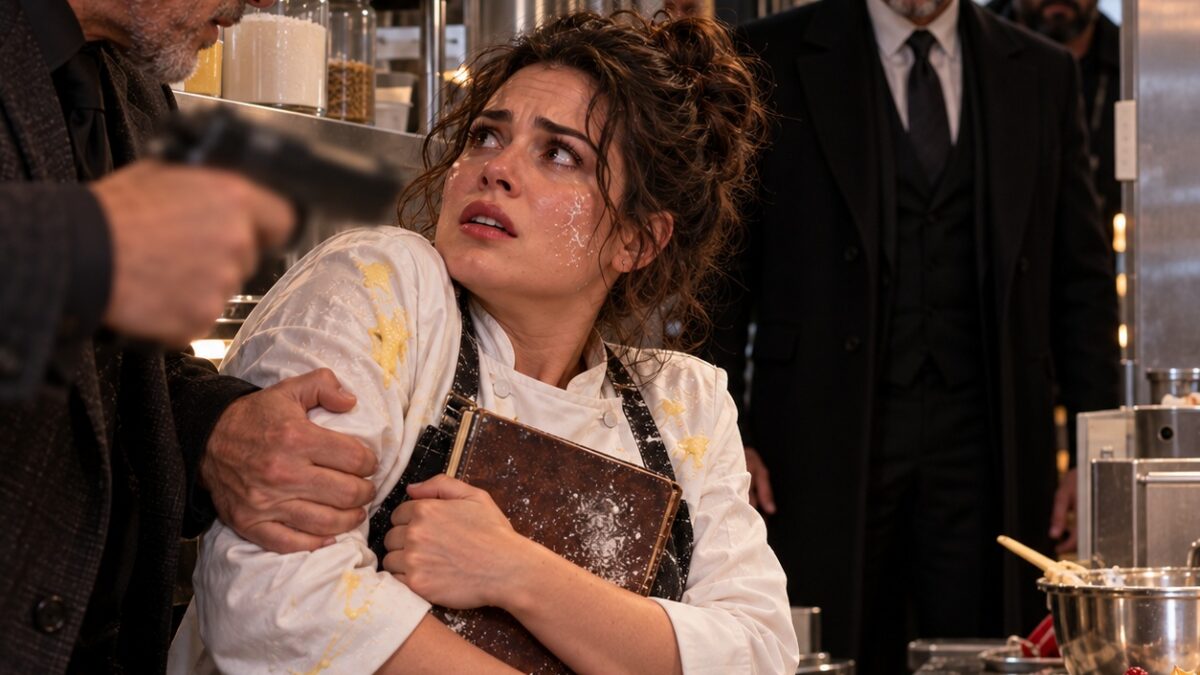
“I need your notebook.”
My mouth went dry.
“I don’t know what you’re talking about.”
“Yes, you do.”
His hand closed around my arm.
Then I saw the gun.
The world became incredibly quiet.
“Where is it?”
I looked at his face.
Not the weapon.
Faces tell you things.
Nana Joe taught me that too.
Victor looked tired.
Not frantic.
Not angry.
Decided.
That was worse.
“Who else has seen it?” he asked.
I swallowed.
“Victor.”
His grip tightened.
“You told me my sticky bun tasted like your mother’s kitchen.”
Something flickered in his eyes.
“You ate two.”
“This doesn’t have to happen.”
His mouth twisted.
“You don’t understand.”
“Then explain it.”
For a moment I thought he might.
Maybe some part of him wanted permission to confess.
“I’ve stood beside Roman for thirty years.”
The resentment in his voice was old.
Older than me.
“I cleaned up every ugly thing. Fixed every mistake. Took every insult. Buried his father. Held him up when Eleanor died.”
He looked almost ashamed.
“And he barely saw me.”
I thought of Roman saying nobody remembered anything about him except what he could provide.
Apparently Victor had felt invisible too.
But instead of asking to be seen, he had chosen betrayal.
“Then you came along,” Victor said.
I stared at him.
“A pastry chef.”
His laugh held no humor.
“Purple glasses. Ridiculous texts. Desserts. Suddenly Roman Blackwell smiles.”
His eyes hardened.
“Varger offered me half the river.”
“So this is about money?”
“No.”
His answer came immediately.
“It is about being second for thirty years.”
He raised the gun.
“I am sorry, Celia. Truly. You were never the target.”
“Then don’t make me one.”
“Where is the notebook?”
I lifted my chin.
Nana Joe’s voice lived somewhere inside me.
Never shrink to fit a room.
“No.”
The service door opened.
“Take your hand off her.”
Roman.
Victor turned.
The gun moved away from me.
That was his mistake.
I didn’t think.
Fifteen years of kitchen work had given me strong arms and stronger legs.
I drove every pound of myself into Victor’s gun arm.
The weapon jerked upward.
A shot exploded.
Plaster rained from the ceiling.
A light shattered.
Victor stumbled.
Then Teddy hit him.
I have never seen anything that large move that fast.
Victor went into the stainless-steel counter.
The gun skidded across the floor.
Teddy pinned him before he could breathe.
Roman stepped past everything.
Past the gun.
Past Victor.
Past thirty years of betrayal.
Straight to me.
“Look at me.”
His voice was ragged.
Both hands closed around my face.
They were shaking.
“Celia. Look at me. Are you hurt?”
Now that the danger had passed, I couldn’t stop trembling.
I covered his hands with mine.
“I’m okay.”
His forehead dropped against mine.
“I’m okay, old man.”
I started laughing and crying at the same time.
“I still have the notebook.”
He made a broken sound.
“Of course you do.”
“I wasn’t giving it to him.”
“I know.”
“You should know me better.”
“I do.”
His eyes closed.
“That is the problem.”
Behind us, Teddy hauled Victor upright.
Blood touched the corner of Victor’s mouth.
His beautiful coat was ruined.
Roman finally turned.
For a long time, neither man spoke.
Then Roman said, “Thirty years.”
Victor’s eyes glistened.
“I would’ve given you anything.”
“You would’ve given me a seat at the table.”
Victor looked exhausted.
“I wanted the head of it.”
His gaze moved toward me.
“She’s not wrong, Roman.”
Roman’s jaw tightened.
“Don’t talk about her.”
“I truly am sorry about her.”
Victor swallowed.
“It was always you.”
I expected Roman to become violent.
Instead he walked forward and placed one hand on Victor’s shoulder.
His voice became very quiet.
“You will leave Tennessee tonight with whatever is currently in your pockets.”
Victor stared.
“You will never speak my name again.”
Roman’s eyes went cold.
“And if you ever come within one hundred miles of her, the man standing here giving you the opportunity to walk away will no longer exist.”
Victor understood.
So did I.
Varger’s men arrived at the loading dock expecting a meeting.
Teddy’s people were waiting.
I never asked for details.
There are some parts of Roman’s world I chose not to make mine.
By two in the morning, I was sitting in the back of a car wrapped in a blanket with a thermos of tea.
Roman sat beside me without touching me.
He seemed afraid I might not want him to.
After several minutes, I leaned against his shoulder.
He stiffened.
“Don’t.”
His voice broke.
“Celia, I’m sorry.”
“Don’t you dare.”
He looked down.
“I stayed.”
I pulled the blanket tighter.
“That was my decision.”
His arm slowly came around me.
“You are the bravest person I have ever known.”
“And?”
He sighed.
“The most stubborn.”
“Better.”
I fell asleep against his coat.
The city exhaled afterward.
The Briarwood replaced the damaged ceiling and publicly blamed a minor electrical incident.
Dominic Varger suddenly discovered that Nashville was no longer a welcoming environment and returned to Memphis.
Luis Herrera’s daughter, Marisol, underwent surgery.
She came out asking for ice cream.
Luis spent most of the day crying.
Teddy sat beside him and cried too, although he later denied that part.
Dennis Whitlock’s downfall was quieter.
My notebook had raised questions that led Mrs. Ashby through the hotel’s records.
Dennis had been selling private event schedules for more than a year to cover gambling debts.
Victor’s people had used those schedules.
Police were waiting when Dennis was dismissed.
The magazine eventually printed a correction.
The lemon-lavender tart received its proper attribution.
Mine.
Mrs. Ashby called me into her office.
“I would like you to become the Briarwood’s executive pastry chef.”
I stared at her.
She named the salary.
I nearly stopped breathing.
Then she slid another folder across the desk.
Inside were documents concerning the old building on Gallatin Pike.
Nana Joe’s bakery.
I looked up sharply.
“Did Roman—”
“No.”
Mrs. Ashby adjusted her glasses.
“Mr. Blackwell has not asked me for anything.”
She paused.
“He did, however, mention that a particular property might interest you.”
My eyes narrowed.
“That sounds like asking.”
“Perhaps. But he did not buy it.”
She tapped the documents.
“I am willing to provide a legitimate business loan. Fair interest. Written terms. Your name. Your responsibility.”
I stared at her.
She smiled.
“A debt you pay yourself is the only kind worth holding, Miss Monroe.”
I laughed.
Because it sounded exactly like something Roman had learned from me.
I signed.
On a bright Saturday morning in October, Gallatin Pike filled with people.
The old bakery had been scrubbed, repaired, and painted.
The barber shop was still there.
So was the tire store.
Darra cried before we even unlocked the door.
Teddy stood near the entrance in a dark suit guarding a tray of cinnamon-roll samples as if they were state secrets.
There was only one problem.
The sign had not arrived.
I checked the time.
“Where is he?”
Darra wiped her eyes.
“You’ve asked four times.”
“He said ten.”
“Roman Blackwell is annoyingly punctual. He’ll be here.”
At exactly ten, a black car stopped at the curb.
A truck pulled in behind it.
Roman stepped out.
Two workers climbed down and began unloading something long and heavy.
I folded my arms.
“You’re late.”
“It is ten o’clock.”
“Barely.”
“I apologize.”
He looked toward the truck.
“It took longer to find than expected.”
The men carried a wooden sign toward the building.
The crowd went quiet.
I stopped breathing.
Weathered wood.
Faded red lettering.
Edges worn from decades of Tennessee rain.
JOE’S BAKERY.
Nana Joe’s original sign.
I couldn’t move.
Roman came closer.
“It was sold with the stools after the property auction.”
My throat closed.
“It spent four years in a salvage yard outside Murfreesboro.”
“How did you—”
“I hired someone to locate it.”
His voice became careful.
“I did not buy your building.”
I started crying.
“I did not pay your medical debt.”
More tears came.
“I found the sign. The owner named his price. I paid exactly that price and not one dollar more.”
That was Roman’s way of telling me he had listened.
He wasn’t rescuing me.
He was remembering me.
I crossed the sidewalk and threw my arms around him.
Roman held me so tightly my feet nearly left the ground.
I buried my face against his chest and sobbed.
“Thank you.”
His hand pressed against the back of my head.
“Thank you.”
The whole street watched.
When I finally lifted my face, I became aware of the crowd.
Reporters.
Neighbors.
Customers.
The barber.
The tire-shop owner.
Darra.
Teddy.
“Everyone is looking at us,” I whispered.
Roman glanced around.
“I know.”
“I don’t know what to do with my hands.”
“Neither do I.”
I laughed through my tears.
Then Roman took one of my hands.
He turned toward the crowd.
And raised his voice.
Roman Blackwell did not raise his voice.
The sidewalk became silent.
“I would like to say something.”
Teddy looked stunned.
Roman continued.
“I am not accustomed to saying things, so I will be brief.”
A few people laughed nervously.
Roman looked at me.
“I have spent most of my life being feared.”
His thumb moved against my hand.
“I am not particularly good at any other kind of attention.”
My heart started pounding.
“This woman has spent most of her life being underestimated.”
His voice hardened just slightly.
“That is an extremely foolish thing to do to Celia Monroe.”
I started laughing.
He wasn’t finished.
“Anyone who harms her answers to me. Anyone who mocks her answers to me.”
Then his eyes came back to mine.
“But she answers to no one.”
His voice cracked.
“Which is why I’m asking.”
I stared.
“You’re asking?”
“I am.”
“In front of everyone?”
His expression became almost offended.
“You object?”
“No. I’m trying to figure out whether you’ve finally lost your mind.”
Darra made a strangled sound behind me.
Roman ignored her.
“I am asking whether Celia Monroe—the only person I have ever met who seems physically incapable of being afraid of me—would consider choosing me of her own free will.”
The laughter left my throat.
His voice lowered so only I could hear.
“I have been looked at by juries.”
His fingers tightened around mine.
“I have been looked at by men holding guns.”
He swallowed.
“Nobody has ever looked at me the way you do.”
My eyes filled again.
“I am not going to apologize for wanting that.”
“Roman…”
“You are warm.”
He touched my knuckles to his lips.
“You are soft and strong at the same time. You are stubborn beyond reason. You are real in a world where almost nothing around me has ever been real.”
My breathing stopped.
“And I have been starving for you since a gray Tuesday in February.”
For once in my life, I had no clever answer.
So I gave him the truth.
“Kiss me, you stubborn old man.”
He did.
Right there on Gallatin Pike.
Under Nana Joe’s sign.
With a hundred people cheering.
One hand went around my waist.
The other disappeared into my hair.
And I kissed the most feared man in Nashville while cinnamon rolls cooled behind us.
When we finally separated, Teddy had somehow dropped an entire tray of samples.
He did not seem remotely concerned.
A week later, I went to Roman’s office carrying a white pastry box.
He was behind an enormous desk wearing the purple reading glasses.
I leaned against the edge.
“I brought you something.”
He looked suspicious.
“You baked these.”
“Outstanding detective work.”
I opened the box.
Twelve small pastries.
Golden.
Flaky.
A little powdered sugar.
A card rested in the center.
SUGAR-FREE. MOSTLY.
Roman read it.
His eyes lifted.
“Mostly?”
“You’re fifty-nine. Live dangerously.”
“I believe I already do.”
He took one.
Bit into it.
His whole face softened.
I watched him chew.
Then I tapped the box.
“Careful, old man. Too much sugar isn’t good for you.”
“I am aware.”
“I’d like to keep you around for a long time.”
His eyes moved to mine.
I smiled.
“Since you’re mine.”
The room became silent.
Roman slowly lowered the pastry.
“What did you say?”
“You heard me.”
“Celia.”
I climbed onto the edge of his desk and leaned closer.
His eyes darkened.
“Say it again.”
I smiled.
“You’re mine, old man.”
Roman went completely still.
Then something extraordinary happened.
He smiled.
Not the almost-smile from table six.
Not the private smile I had once caught while decorating sugar roses.
A full smile.
Happy.
Unprotected.
A little stunned.
“That’s what I thought you said.”
“You just wanted to hear it twice.”
“Yes.”
He took my hand.
“I have spent my entire life making people obey me.”
His thumb moved over my knuckles.
“I have never known what it feels like to be chosen.”
I leaned closer.
“Then get used to it.”
We stayed there while sunset turned the river gold, then violet, then black.
The pastry box sat open between us.
Outside the office, Teddy occupied a chair much too small for him and quietly ate one of the sugar-free pastries while pretending he was not crying.
Across town, Joe’s Bakery glowed beneath its old red sign.
And on a shelf behind the register sat Nana Joe’s recipe box.
I no longer kept it hidden above my bed.
I wanted it where people could see it.
For years, I had thought being loved meant somebody would eventually ask me to change.
My mother had taught me that people could leave.
Brent had taught me that affection could come with conditions.
Dennis had taught me that people could use your talent while making you ashamed of the body that created it.
Roman taught me something different.
Not because he saved me.
He didn’t.
I had spent too much of my life learning how to save myself.
He did something harder.
He listened when I said no.
He stayed when I asked him not to fix something.
He learned the difference between protecting me and controlling me.
And when I insisted on standing beside him instead of behind him, he made room.
That was what I had wanted all along.
Not rescuing.
Not worship.
Not somebody wealthy enough to erase every difficult thing from my life.
I wanted to be seen.
My strength without pretending I wasn’t soft.
My softness without treating it like weakness.
My body without seeing it as a problem.
My ambition without calling it arrogance.
My fear without mistaking it for surrender.
All of me.
Nana Joe used to tell me nobody expected a woman who smelled like cinnamon to be dangerous.
She was right.
What she never told me was that one day the dangerous part would not be how loudly I could fight.
It would be how completely I refused to disappear.
I was thirty years old.
Executive pastry chef of the Briarwood.
Owner of the reborn Joe’s Bakery.
Still paying my own debts.
Still using too much butter.
Still calling Roman Blackwell “old man” in front of people who nearly fainted every time I did it.
And loved by a man who had spent most of his life being feared and had finally discovered what it meant to be chosen.
For the first time, neither of us was a secret.
Neither of us was a shadow.
Neither of us had to earn a place in the room.
I had spent nearly my entire life being told, one way or another, to take up less space.
I never managed it.
And standing beneath Nana Joe’s old sign, with Roman’s hand wrapped around mine and the smell of cinnamon drifting through a bakery that belonged to me again, I finally understood why.
The room had never been too small for me.
I had simply spent too long surrounded by people who wanted me to believe it was.








