𝗙𝗨𝗟𝗟 𝗦𝗧𝗢𝗥𝗬:The Pro Fighter Mocked the Quiet Security Guard in Front of Everyone—Twenty Seconds Later, Nobody Was Laughing
FULL STORY CONTINUATION
Blake opened with a jab.
Quick.
Clean.
Nothing wrong with the technique.
He expected me to flinch backward.
I didn’t.
I moved my head a few inches outside the line of the punch and let it pass.
He followed with another.
Then a hook.
I stepped.
Nothing dramatic.
No counter.
No strike.
No attempt to embarrass him.
Blake reset.
The crowd became quieter.
“Lucky.”
“Maybe.”
He attacked again.
Faster.
His right hand came toward me.
I parried lightly.
Pivoted.
Let him turn past me.
He recovered before losing balance completely.
Still good.
Still athletic.
Still dangerous if this became a real fight.
I had no intention of letting it become one.
Blake looked at the timer.
Ten seconds.
His face changed.
He had expected a joke.
Security guard survives a few punches.
Everyone laughs.
Upload clip.
Millions of views.
Instead, nothing was happening the way he had planned.
He came forward harder.
That was pride.
Pride changes timing.
He reached.
I stepped inside.
Caught his wrist.
Turned my shoulder.
Redirected his weight.
For perhaps half a second, Blake’s feet crossed awkwardly.
He stumbled.
Someone in the crowd made a surprised sound.
Blake straightened immediately.
“Hold on.”
I lowered my hands.
“You wanted twenty seconds.”
He looked toward the phones.
That was the problem.
Not me.
The phones.
He saw what they were seeing.
Blake Rourke struggling to touch a middle-aged security guard.
His pride made the next decision.
He rushed.
Fast.
Too committed.
I moved inside his attack before he could build full power.
My left hand controlled the wrist.
My right guided his elbow.
My hips turned.
No throw.
No slam.
I simply placed him where his own momentum had already decided to go.
Suddenly Blake was bent forward with one arm controlled behind the line of his shoulder.
Not injured.
But trapped.
If he fought harder, he would hurt himself.
He froze.
“What—”
I said quietly:
“Stop moving.”
He tried anyway.
Bad choice.
The position tightened without me adding force.
His face changed.
“Stop.”
I loosened slightly.
“Then stop.”
He stopped.
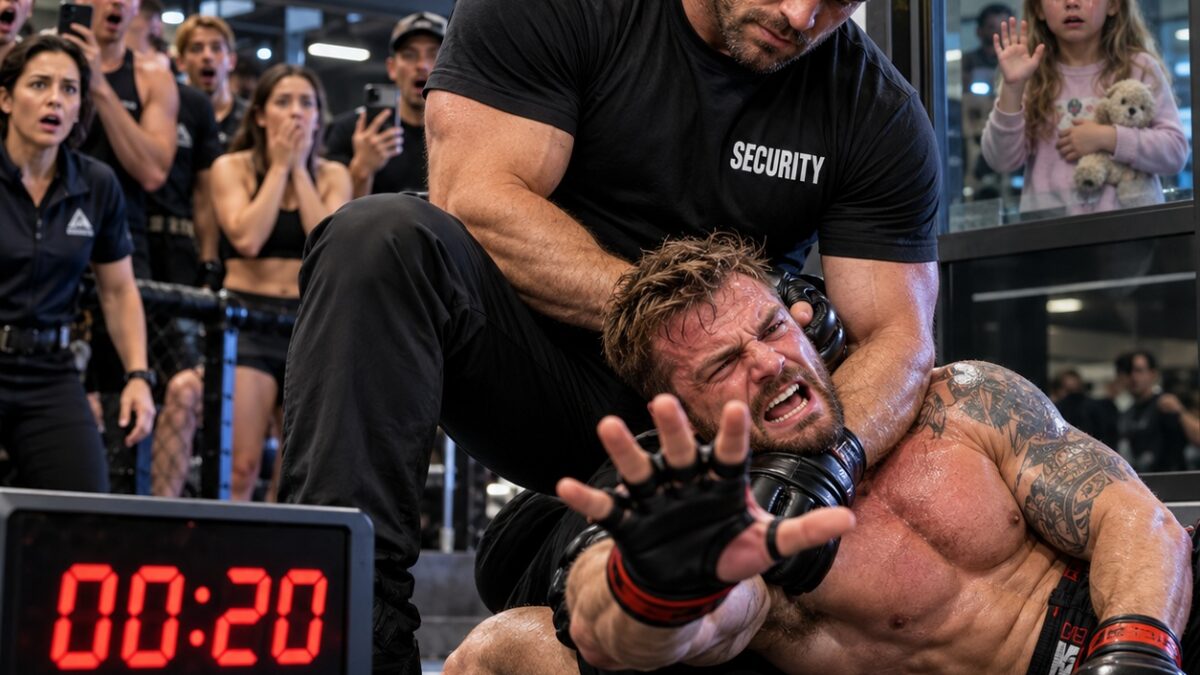
The timer beeped.
Twenty seconds.
Blake shouted:
“Let go.”
I released immediately.
Hands open.
Stepped backward.
The room had gone completely silent.
Blake turned.
Breathing hard.
Not exhausted physically.
Shaken.
He stared at me.
“What the hell are you?”
I picked up my jacket.
“Someone who asked you to stop.”
Nobody laughed.
That line bothered him more than anything I had done.
Because there had been no fight.
That was the part his ego could not process.
He had not lost an exchange.
I had refused to give him one.
Blake removed one glove.
“Who trained you?”
I put on my jacket.
“Doesn’t matter.”
“You’ve done this before.”
I didn’t answer.
Nina did.
She had been staring at me since the first slip.
Now she stepped closer.
“Wait.”
I looked at her.
She narrowed her eyes.
“Garrett Boone?”
I sighed.
“That’s my name.”
“No.”
Her face changed.
“Boone.”
I knew what was coming.
“Nina.”
“You fought under Boone?”
Several members looked confused.
Blake did not.
Professional fighters remember names.
Especially from people close enough to their own circuit.
He stared.
Nina continued.
“You were in the national qualifier years ago.”
I looked away.
“You withdrew after the shoulder injury.”
Blake’s mouth opened slightly.
Then closed.
Nina said:
“My old coach talked about you.”
“I’m sure he exaggerated.”
“You disappeared.”
“I stopped fighting.”
Blake pulled off the other glove.
“You could have told me.”
That question annoyed me.
I looked directly at him.
“Would you have treated me differently?”
He opened his mouth.
Nothing came out.
Exactly.
Before anyone could say more, a small voice came through the glass doors.
“Daddy?”
Everything else disappeared.
Maisie stood there.
Purple backpack on one shoulder.
A piece of paper in her hand.
She looked at Blake.
The gloves.
The crowd.
Then me.
I crossed the room immediately.
Knelt.
“Hey, sunshine.”
Her eyes stayed on the gloves.
“Were you fighting?”
I looked behind her.
The staff member from the children’s room was standing apologetically near the door.
“She finished early.”
“It’s okay.”
Maisie looked at me.
“Were you?”
I chose my words carefully.
“No.”
She frowned.
“You had gloves.”
“I know.”
“Then what happened?”
I touched the drawing in her hand.
“What is this?”
“Don’t change the subject.”
Elise.
Completely.
I smiled despite myself.
“I was showing someone something.”
“What?”
I glanced toward Blake.
He looked away.
I said:
“That we don’t have to hurt people just because they want us to.”
Maisie thought.
Children take simple sentences and test them more seriously than adults do.
Finally she asked:
“Did he try to hurt you?”
“No.”
Not really.
“He wanted to prove something.”
“Did you?”
“What?”
“Prove something?”
I looked at her.
“No.”
That answer felt important.
She slipped her hand into mine.
“Can we go home?”
“Yes.”
“I saved you half my cookie.”
I stood.
“That is the best offer I’ve had all day.”
We started toward the exit.
Blake followed.
“Garrett.”
I stopped.
Maisie stayed beside me.
Blake looked different.
Not transformed.
People do not become better men in twenty seconds.
But the performance was gone.
“I owe you an apology.”
I waited.
“I wanted a video.”
He glanced at the phones.
Some people lowered them.
“I thought it would be funny.”
I said nothing.
He continued.
“I wanted everyone to see me beat somebody without really trying.”
There it was.
Honest.
Ugly.
Better than excuses.
“And I used your job against you.”
“Yes.”
“And your daughter.”
My grip tightened around Maisie’s hand.
Blake looked at her.
“I’m sorry.”
Maisie looked up at me.
I let her decide whether to answer.
She didn’t.
That was fine.
Blake looked back at me.
“I didn’t think.”
“No.”
“I just wanted people to see I was stronger.”
I studied him.
“You wanted people to think you were strong.”
He looked down.
“But you didn’t care whether you made someone else feel small.”
He nodded slowly.
“No.”
“Then do something about that.”
He looked surprised.
No lecture.
No threat.
No demand that he make some public humiliation video apologizing to me.
I had no interest in becoming his next performance.
I left with Maisie.
That should have been the end.
It wasn’t.
On the drive home, she was quiet.
I knew questions were coming.
Five minutes passed.
Then:
“Dad?”
“Yeah?”
“Why did Nina know your name?”
I stared at the road.
“Because I used to train.”
“You said you worked out.”
“I do.”
“No.”
She shifted in the passenger seat.
“She said you fought.”
“Yes.”
“Like Mr. Blake?”
“Something like that.”
Her voice became small.
“Did Mom know?”
That hurt.
“Yes.”
“Why didn’t you tell me?”
“You were little.”
“I’m eight.”
“Still little.”
“I am not.”
I smiled.
“Debatable.”
She crossed her arms.
“Dad.”
I sighed.
“I fought professionally before you were old enough to remember much.”
“Were you famous?”
“No.”
“Were you good?”
I hesitated.
“Yes.”
She looked out the window.
“Then why did you stop?”
That answer mattered.
“My shoulder got hurt.”
“You said that.”
“Nina said that.”
“Yes.”
“That wasn’t the only reason.”
“What was?”
I thought about Elise.
Kitchen table.
Ice.
The sentence that changed me.
“I didn’t like who I was becoming.”
Maisie frowned.
“What does that mean?”
“It means I started thinking winning was more important than almost everything.”
“Even Mom?”
I swallowed.
“Sometimes I acted like it.”
She became very quiet.
Children know when an answer costs something.
“Did she get mad?”
“Yes.”
“Did you?”
“Yes.”
“Then what?”
“I learned.”
Maisie held the cookie bag in her lap.
“Is that why you didn’t hurt Mr. Blake?”
I looked over.
“Yes.”
Partly.
Then:
“And because you were there.”
Her eyes widened.
“Me?”
“You were watching.”
She did not say anything else until we reached home.
That night she fell asleep on the couch halfway through homework.
The cookie half sat wrapped in a napkin beside her.
I carried her to bed.
Pulled the blanket up.
Then returned to the living room.
The old part of me had been awake ever since Blake touched the gloves to my chest.
Not angry.
Remembering.
Muscle memory is strange.
Your body retains versions of you that your life has moved beyond.
I stood in the kitchen.
Closed my right hand.
Opened it.
The shoulder still carried damage.
The scar across my knuckle was pale.
For years, I had treated that old fighting life as if it belonged to another person.
That evening proved it didn’t.
It was still mine.
The question was whether owning it meant becoming it again.
My phone rang.
Iron Bridge manager.
“Garrett.”
“Yes.”
“I heard.”
“Of course.”
“We have video.”
“Of course.”
He sighed.
“Blake came to my office after you left.”
“What did he say?”
“He admitted he harassed you.”
I leaned against the counter.
“He asked whether he’s suspended.”
“Is he?”
“Formal warning. Review tomorrow. We need your statement.”
“Fine.”
“Are you okay?”
“Yes.”
“Your daughter?”
“Fine.”
Pause.
“I am sorry.”
“It wasn’t your fault.”
“Still my facility.”
I respected that.
“Blake asked if he could apologize publicly.”
“No.”
“Why?”
“I don’t want a public apology.”
“He humiliated you publicly.”
“No.”
I looked toward Maisie’s room.
“He tried.”
That difference mattered.
The manager accepted it.
The next morning, Blake returned early.
I was not there.
My shift started later.
He apologized to management.
To Nina.
To several staff members.
Accepted the warning.
Removed the sparring video he had been filming before the confrontation.
Then called me.
I did not answer immediately.
He left a message.
“Garrett, it’s Blake. I’m not calling to argue. I spoke with Nina. I want to organize something for kids at the club. Self-defense, but not fighting. More about confidence and avoiding trouble. She said I should ask whether you’d help. You can say no. I think I’m finally learning what that word means.”
That last sentence got me.
I called Nina.
“Was this your idea?”
“Half.”
“He serious?”
“I think so.”
“People think lots of things the day after getting embarrassed.”
“True.”
“What do you want from me?”
“Thirty minutes.”
“No sparring.”
“Agreed.”
“No promotional video with my face.”
“Agreed.”
“No story about the mysterious security guard who secretly—”
She laughed.
“Agreed.”
I sighed.
“One Saturday.”
“That’s all.”
So I went.
The workshop had twelve kids.
Ages ten to fifteen.
Blake stood near the back.
For once, not center stage.
Nina introduced me only as Garrett.
Security officer.
Former competitor.
Nothing more.
I started with the same question.
“What is the best fight?”
A boy raised his hand.
“The one you win.”
I shook my head.
“The one that never starts.”
Some of them looked disappointed.
Good.
We worked on awareness.
Distance.
Using a strong voice.
Getting toward exits.
Finding adults.
Protecting your head.
Breaking simple grabs.
Nothing glamorous.
Blake watched.
At the end, he asked:
“Can I add something?”
I nodded.
He stepped forward.
“Sometimes somebody will try to make you feel weak because you won’t fight them.”
Several kids listened.
He looked at me once.
Then continued.
“That doesn’t mean you’re weak.”
He swallowed.
“Sometimes it means you’re the only person thinking.”
That was better than an apology.
Behavior.
I went back to work.
Blake went back to training.
Life continued.
For several weeks, club members stared at me differently.
That irritated me.
People who had barely noticed me before now suddenly wanted conversations.
“Garrett, man, I heard you used to fight.”
“Yes.”
“Why didn’t you tell anybody?”
“Why would I?”
“You ever think about coming back?”
“No.”
“Could you still compete?”
“No.”
That one offended some of them.
Apparently the fantasy required me secretly wanting to reclaim glory.
I didn’t.
Professional fighting had given me good things.
Discipline.
Friends.
Travel.
Confidence.
It had also taken.
Time.
Health.
Pieces of myself Elise had helped me notice.
Walking away was not failure.
It was the first major decision I made because of who I wanted to become instead of what I wanted people to think.
Ironically, it took Blake years later to remind me.
Maisie became curious.
She found old videos online.
Of course she did.
One evening I walked into the living room.
There I was.
Twenty-six years old.
Shaved head.
Lean.
Angry-looking.
Walking toward a cage.
Maisie looked from the television to me.
“That is you.”
“Yes.”
“You had terrible hair.”
“Thank you.”
She watched a fight.
I almost told her to turn it off.
Then stopped myself.
That life existed.
Hiding it would make it more mysterious.
The younger version of me won.
Knockout.
Crowd screamed.
Maisie looked at me.
“Did that hurt him?”
“Yes.”
She frowned.
“Were you happy?”
“At the time.”
“Are you now?”
“About hurting him?”
“Yes.”
“No.”
She turned the video off.
Then asked:
“Do you miss it?”
That question took longer.
“Sometimes.”
“What part?”
“The focus.”
I sat beside her.
“When you’re competing, life becomes simple for a little while.”
“How?”
“One opponent. One job. One result.”
She considered that.
“Real life isn’t like that.”
“No.”
“Is that bad?”
I looked at her.
“No.”
Not anymore.
Real life was messy.
Mortgage.
Grief.
School field trips.
Laundry.
Broken HVAC units.
A child asking questions no opponent ever could.
That complexity had become the best part.
Months passed.
Blake changed slowly.
Not magically.
He still loved cameras.
Still loved attention.
Still talked too much.
But the cruelty faded.
When younger fighters refused extra sparring, he stopped pushing.
When members asked to film, he asked everyone in the background first.
Nina told me he had started calling out other fighters for humiliating beginners.
One evening I heard it myself.
A young amateur was mocking an overweight new member struggling with footwork.
Blake walked over.
“Stop.”
The amateur laughed.
“What?”
Blake pointed toward the door.
“You want an audience, find one somewhere else.”
The kid left.
Blake saw me watching.
“Don’t.”
“Didn’t say anything.”
“You were thinking something.”
“Maybe.”
He shook his head.
Progress.
About a year after our twenty-second disaster, Blake had a major fight.
Iron Bridge hosted a viewing event.
Maisie wanted to go.
So we did.
Blake fought well.
Won by decision.
Afterward, during the interview, the broadcaster asked whether maturity had changed his fighting.
Blake laughed.
“Yeah.”
Then said:
“I used to think being dangerous made me strong.”
I felt Maisie look at me.
Blake continued:
“Now I think being dangerous and knowing when not to be matters more.”
No mention of me.
Good.
The lesson had become his.
That was how it should be.
Maisie grew.
At nine, she stopped leaving drawings in every lunch bag.
Only sometimes.
At ten, she became embarrassed when I kissed her forehead in front of friends.
At eleven, she started calling my music ancient.
Cruel child.
I kept every drawing.
One evening she found the drawer.
Hundreds.
She stared.
“You kept all of these?”
“Yes.”
“Why?”
“Evidence.”
“Of what?”
“That you used to like me.”
She rolled her eyes.
Then hugged me.
Elise’s absence changed over time.
Not smaller.
Different.
At first grief occupied everything.
Then it became a room inside a larger house.
You could enter.
Leave.
Return.
Maisie asked about her mother more as she grew.
I answered.
Sometimes poorly.
Sometimes we cried.
Sometimes we laughed.
One night she asked whether Elise liked me fighting.
“No.”
“Did she come to fights?”
“Some.”
“Why if she hated it?”
“She didn’t hate fighting.”
“What did she hate?”
I thought.
“What it did to me.”
Maisie nodded.
“That’s why you stopped.”
“Yes.”
“Before she died?”
“Yes.”
“Good.”
That word almost broke me.
Because one of my deepest fears after Elise died was that I had changed too late for it to matter.
Maisie saw it differently.
Good.
Simple.
Maybe that was enough.
The athletic club promoted me eventually.
Security supervisor.
Small raise.
Better hours.
I argued against the better hours because change makes parents stupid.
The manager laughed.
“Go home, Garrett.”
So I did.
I became responsible for training new security staff.
No martial arts requirement.
We focused on communication.
De-escalation.
Calling police early.
Not chasing ego.
One new hire asked:
“You want us to just let people disrespect us?”
“Yes.”
He looked surprised.
“If disrespect is the only thing happening, absolutely.”
“What if they call me names?”
“Congratulations. You survived.”
He laughed.
I didn’t.
I told him:
“The job is safety. Not winning arguments.”
That was something I wished more people understood.
Security.
Martial arts.
Parenthood.
Leadership.
All of them go bad when ego gets confused with duty.
Blake’s mistake had been believing that because he could dominate someone physically, he was entitled to demand the opportunity.
My younger self had made similar mistakes in subtler forms.
That was why I could forgive him eventually.
Recognizing your old sins in another person makes hatred complicated.
Two years after the incident, Blake asked me for coffee.
We sat in the club café after closing.
“No camera?”
I asked.
He smiled.
“No.”
“What happened?”
“I’ve been offered a coaching contract.”
“Congratulations.”
“More money.”
“Good.”
“More responsibility.”
“Also good.”
He stared into his cup.
“I don’t know if I’m ready.”
That was new.
Old Blake never doubted readiness.
“What are you afraid of?”
“Becoming the kind of coach I hated.”
“Then don’t.”
He laughed.
“That’s your advice?”
“Yes.”
“What if I don’t notice?”
“Ask people who will tell you.”
He looked at me.
“Like you?”
“No.”
“Why not?”
“I’m busy.”
He laughed again.
Then serious:
“What made you leave fighting?”
I had told him pieces.
Never the whole truth.
I said:
“My daughter.”
He waited.
“And my wife.”
I told him about Elise’s sentence.
The strongest version of her father.
Blake listened.
When I finished, he said:
“She was right.”
“Yes.”
“That hurt?”
“Yes.”
“Good advice usually does.”
I smiled.
“Now you’re irritating.”
He took the coaching job.
Did well.
Made mistakes.
Corrected them.
Normal growth.
Maisie eventually joined a beginner martial-arts program.
That scared me more than I expected.
I almost said no.
She noticed.
“You don’t want me fighting.”
“I don’t want you becoming me.”
She crossed her arms.
“That’s dramatic.”
Again.
Elise.
I sighed.
“Fair.”
She trained with Nina.
That made it easier.
Nina taught technique without feeding ego.
Maisie loved grappling.
Hated striking.
Fine with me.
One afternoon I arrived early to pick her up.
Blake was helping with the youth class.
A boy had started crying after failing a drill.
Blake crouched.
No audience voice.
No performance.
He said:
“Nothing is wrong with you because you couldn’t do it today.”
The boy wiped his face.
“You keep coming back.”
I stood outside the room.
Listened.
Then left before Blake saw me.
He did not need applause for that.
That mattered.
Three years after the sparring incident, Iron Bridge hosted another youth workshop.
This time Maisie helped demonstrate.
Eleven years old.
Confident.
Still small.
Blake asked her to show a boundary exercise.
A volunteer approached.
Maisie put one hand up.
“Stop.”
He stopped.
Blake turned to the children.
“What happens if someone says stop?”
A boy answered:
“You stop.”
“Correct.”
Blake glanced toward me.
For just a second.
I nodded.
That was closure.
Not public apology.
Not revenge.
Not Blake losing a fight.
A man who once ignored no now teaching children that no ends the interaction.
People can change.
Sometimes being confronted helps.
Sometimes embarrassment helps less.
Sometimes the most useful thing you can do is let someone see himself clearly, then refuse to control what he does with the view.
I was glad I had not humiliated him.
He had done enough of that himself.
My old fighting history eventually became less interesting to the club.
Good.
New members didn’t know.
Older ones stopped caring.
I became Garrett again.
Security supervisor.
Dad.
Guy who could fix almost anything electrical but somehow never remembered to buy milk.
That last one according to Maisie.
I liked being ordinary.
People underestimate ordinary.
Ordinary means you made it home.
Ordinary means dinner.
Homework.
Laundry.
A quiet couch.
Elise and I never appreciated ordinary enough before we lost it.
I did now.
On the anniversary of her death, Maisie and I visited the cemetery.
She brought one of her drawings.
Not the yellow sun.
This one showed three people.
Her.
Me.
Elise.
She placed it near the marker.
“Think she knows?”
I swallowed.
“I don’t know.”
“About everything?”
“I’d like to think so.”
“Do you think she’s mad you sparred?”
I laughed unexpectedly.
“Yes.”
Maisie laughed too.
“What would she say?”
I used Elise’s voice badly.
“Garrett Boone, I leave you alone for three years and you’re fighting professional athletes at work?”
Maisie nearly fell over laughing.
I sat beside the stone.
For the first time, memory felt warm before it felt painful.
That was healing too.
Later that year, Blake lost a fight.
Badly.
First-round stoppage.
The old Blake would have disappeared or blamed something.
Instead, he returned to Iron Bridge on Monday.
Worked.
Coached.
Someone asked what went wrong.
He said:
“I got beaten by a better man that night.”
Simple.
No excuses.
I respected that.
After training, he saw me.
“Don’t say it.”
“Wasn’t going to.”
“You look like you’re thinking.”
“Always.”
He shook his head.
Then:
“You know what was worse than losing?”
“What?”
“Realizing it didn’t destroy me.”
I understood.
When your identity depends on winning, defeat feels like death.
When identity becomes larger, losing becomes information.
Blake had learned that.
So had I.
My professional record still existed online.
Wins.
Losses.
Statistics.
Old photos.
None of it mattered when Maisie called from school sick.
None mattered when a rooftop unit failed over a nursing home in July.
None mattered when I sat at Elise’s grave.
Skill mattered.
History mattered.
But identity was larger.
That was the mistake people made after learning who I had been.
They treated the old fighter as the real Garrett and the security guard as disguise.
It was the opposite.
The fighter had been one chapter.
The father was the whole book.
Years later, I still remembered those twenty seconds clearly.
Blake’s jab.
The crowd.
The shift in his balance.
The moment I felt how easily I could have hurt him.
That was the part nobody saw.
There was a second when his arm was controlled and his neck exposed.
Old instincts presented options automatically.
Sweep.
Drop.
Strike.
Submit.
My body knew.
I chose none.
That was what Elise had wanted me to become.
Not harmless.
Responsible.
There is a difference.
A harmless man may not hurt you because he cannot.
A disciplined man may choose not to because he understands the cost.
That distinction became central to the way I raised Maisie.
I never told her:
Never fight.
That would be dishonest.
Sometimes people must protect themselves.
Sometimes leaving isn’t available.
Sometimes force is necessary.
But force should be a tool.
Not identity.
Not entertainment.
Not revenge for embarrassment.
She understood earlier than I had.
At twelve, she came home upset because another girl had shoved her during gym.
“What did you do?”
“Backed up.”
“Then?”
“Told her to stop.”
“Then?”
“She pushed again.”
My stomach tightened.
“What did you do?”
“I moved her hand.”
“How?”
She showed me.
Clean grip release.
No strike.
“And?”
“Teacher came.”
“You okay?”
“Yes.”
“Good.”
She looked disappointed.
“That’s it?”
“What do you want?”
“I thought you’d be proud.”
I smiled.
“I am.”
She smiled too.
“Because I didn’t hit her?”
“Because you did what the situation required.”
She nodded.
That was better.
Not pacifism.
Judgment.
Blake’s free workshops continued every few months.
He became surprisingly good with kids.
Not soft.
Clear.
Demanding.
But respectful.
One afternoon, he asked the class:
“What is confidence?”
Hands went up.
“Being strong.”
“Not being scared.”
“Knowing you can win.”
Blake shook his head.
“Confidence is not needing every room to agree you’re strong.”
I stood near the door.
That one was mine.
Or maybe his now.
Lessons do not need ownership.
The last time Blake and I ever sparred was never.
People kept asking.
Charity exhibition?
No.
Friendly round?
No.
He joked about it sometimes.
“You’re protecting your record.”
“What record?”
“Undefeated against me.”
“I never fought you.”
“Exactly.”
That became our running argument.
Maisie sided with Blake because children are disloyal.
Years passed.
Iron Bridge expanded.
Nina became head instructor for youth programs.
Blake transitioned more into coaching than fighting.
I left full-time security eventually and opened a small HVAC service company with a former coworker.
I still did some contract security consulting for Iron Bridge.
Mostly emergency planning.
Access procedures.
Boring.
Perfect.
Maisie grew taller.
The drawings became less frequent.
Then stopped.
I still kept the drawer.
One day she found it again at fifteen.
“Dad.”
“Yes?”
“You really kept every one.”
“Yes.”
“This one is awful.”
She held up a yellow sun the size of a dinner plate.
“Masterpiece.”
“I had no sense of proportion.”
“You were five.”
“No excuse.”
She sat beside me.
Then found the half-cookie napkin.
I had kept that too.
She stared.
“You saved garbage?”
“Historical artifact.”
“You’re insane.”
“Correct.”
She smiled.
Then noticed the date.
The night of the Blake incident.
“You kept this because of that day.”
“Yes.”
“Why?”
I thought.
“Because that was the part I wanted to remember.”
“Not the sparring?”
“No.”
“What then?”
“Coming home.”
She looked at me.
That answer finally made sense to her.
For years, I had believed walking away from professional fighting meant I was abandoning part of myself.
That night at Iron Bridge taught me the opposite.
The old skills were still there.
Strength.
Timing.
Discipline.
Experience.
I simply no longer needed an arena to prove they existed.
Walking away had not made me less.
It had made room for other things.
Husband.
Then widower.
Father.
Worker.
Boss.
Friend.
Teacher sometimes.
Ordinary man.
Blake had looked at my uniform and assumed ordinary meant weak.
I had once made a similar mistake about myself.
Twenty seconds corrected both of us.
Not because I controlled his arm.
Because I released it.
Immediately.
The moment he said stop.
That was the whole lesson.
He had ignored my no.
I honored his.
Power reveals character most clearly when the other person cannot stop you.
What do you do then?
Keep going?
Punish?
Humiliate?
Or let go?
I let go.
Years later, Blake told me that was the part he remembered too.
We were sitting after one of Maisie’s belt promotions.
He said:
“You know when I knew I was wrong?”
“When you fell over?”
“I did not fall.”
“You almost did.”
“Not the point.”
“What was?”
“When I said stop.”
I waited.
“You didn’t hesitate.”
He looked toward the empty mat.
“I realized I’d spent five minutes refusing to give you the same thing.”
“No.”
“Choice.”
That was exactly it.
He had wanted control over the interaction.
I had wanted none.
Eventually, he learned.
So did I.
Maisie is older now.
Old enough to understand most of my past.
Not every detail.
Some things are mine.
But enough.
She once asked whether I was ashamed of fighting.
“No.”
“Then why don’t you talk about it?”
“Because not everything important needs an audience.”
She smiled.
“That’s very you.”
Probably.
Elise would say painfully so.
I still wear my wedding ring.
Worn.
Scratched.
Blake noticed it the day he mocked me.
He saw a quiet security guard with an old ring, a kid, and a paycheck he needed.
He assumed that meant I was trapped.
Weak.
Safe to use for entertainment.
He wasn’t entirely wrong about the paycheck.
I needed it.
People do.
That should never make someone easier to humiliate.
The question I asked him afterward remained the most important.
Would you have treated me differently if you knew who I used to be?
His silence answered.
Yes.
That is why I am glad I didn’t tell him.
Respect that depends on résumé is not respect.
The security guard deserved basic dignity before anyone knew he had fought professionally.
The janitor does.
The receptionist.
The cashier.
The kid working the front desk.
People shouldn’t need hidden prestige to earn humane treatment.
That lesson mattered more to Blake than losing balance ever could.
Today, when I visit Iron Bridge, new members rarely know the story.
Good.
Sometimes Blake introduces me.
“This is Garrett.”
That’s it.
No Boone.
No ex-fighter.
No twenty-second legend.
Just Garrett.
We shake hands.
Sometimes we talk.
Sometimes not.
The glass doors are still there.
The mat is still in the same place.
Nina still complains when equipment gets left out.
Life keeps moving.
Once, I stood near the entrance and watched Blake teach a teenage class.
One boy kept pushing too hard during drills.
Blake stopped him.
“Your partner said ease up.”
The boy nodded.
Then did it again.
Blake stopped everything.
“What part of no are you having trouble understanding?”
The boy looked embarrassed.
Blake softened.
“This isn’t punishment.”
He pointed toward the mat.
“Skill means responsibility.”
I stood there quietly.
Blake saw me.
For half a second, our eyes met.
No grin.
No joke.
Just recognition.
That was enough.
I left before class ended.
Maisie was waiting in the truck.
She was seventeen by then.
“Everything okay?”
“Yeah.”
“What took so long?”
“Watching something.”
She looked at the building.
“Mr. Rourke?”
“Yeah.”
“He still annoying?”
“Very.”
She smiled.
“Good.”
We drove home.
Same city.
Same roads.
Different life.
Sometimes strength looks dramatic.
Crowd.
Lights.
Gloves.
A man yelling stop.
Those are the parts people remember.
But the strongest moments in my life have usually been quiet.
Turning down one more fight.
Listening when Elise told me who I was becoming.
Walking away from a career I had built my identity around.
Getting up the morning after her funeral because Maisie needed breakfast.
Taking a security job nobody admired.
Saving field-trip money.
Accepting that my daughter needed a father more than the world needed another fighter.
Those things never earned applause.
Good.
They were not for applause.
When Blake shoved those gloves into my chest, he thought he was challenging the weakest version of me.
A security guard.
Single dad.
Man who couldn’t afford trouble.
What he actually met was the version of me that had finally learned what all those years of fighting were supposed to teach.
Control.
Not control over another man.
Over myself.
Blake eventually learned it too.
That’s why I don’t remember the twenty seconds as a victory.
I remember what happened afterward.
Maisie at the doors.
The cookie.
Her small hand in mine.
Blake admitting what he had done.
The walk home.
The quiet living room.
Her sleeping on the couch while unfinished homework waited nearby.
I sat beside her that night.
Kissed her forehead.
Whispered:
“I’m home.”
For years, I thought leaving professional fighting meant leaving part of myself behind.
I was wrong.
I brought the important parts with me.
Discipline.
Patience.
Awareness.
The ability to stay calm when somebody else couldn’t.
The ability to act when necessary.
And, finally, the ability to stop when it wasn’t.
That last one took me longest to learn.
Blake thought strength meant making people afraid.
My younger self had believed something similar.
Maisie never had to.
That alone made everything worth it.
If you ask me today what happened in those twenty seconds, I could describe every movement.
The jab.
The angle.
The wrist control.
The turn.
The position.
But none of those details matter as much as one simple fact.
I could have hurt Blake.
I didn’t.
He asked me to stop.
I stopped.
And somewhere between his laughter and that silence afterward, both of us were reminded of the same thing.
Real strength is not having the power to hurt someone.
It is knowing exactly when you don’t need to.








