𝗙𝗨𝗟𝗟 𝗦𝗧𝗢𝗥𝗬:The Night a Dying Navy SEAL Whispered Three Words That Turned My First Month as a Nurse Into a War Zone
FULL STORY CONTINUATION
For about two seconds, nobody moved.
The alarms were screaming.
Red emergency lights strobed across the walls.
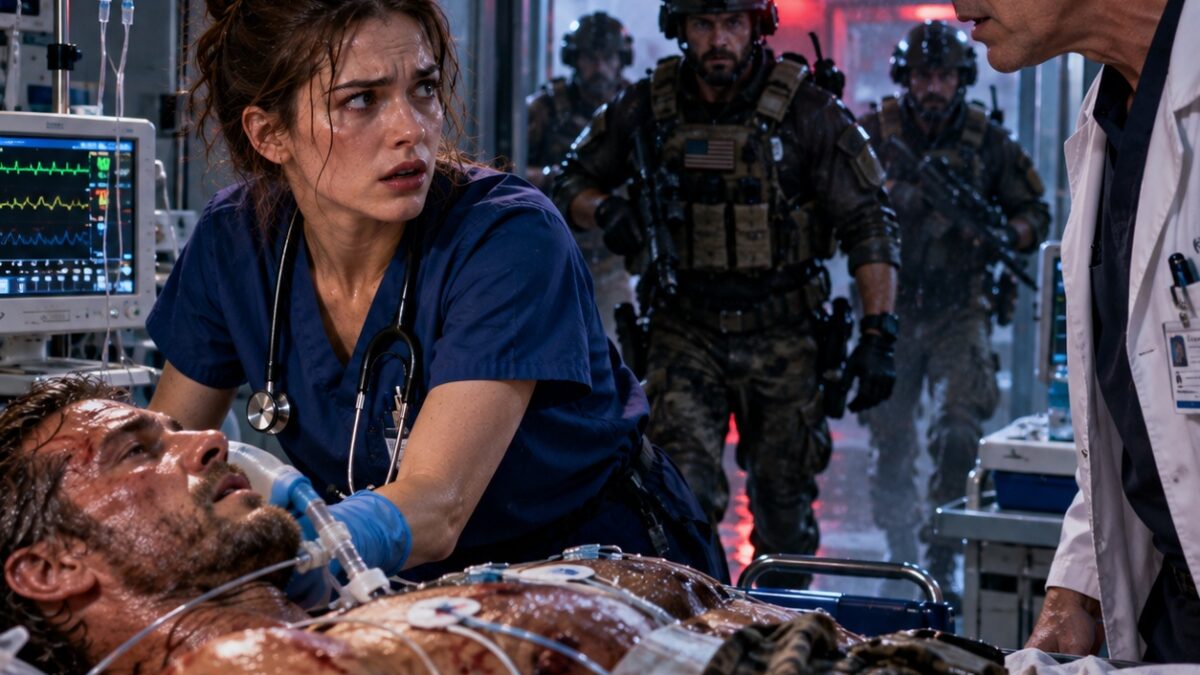
Rainwater dripped from the three men who had just forced their way into one of the most restricted areas in the hospital.
I stood beside Wyatt’s bed with blood on my gloves and my heart pounding so hard I could hear it.
Dr. Pendleton backed away.
“Code Silver,” he shouted into his radio. “Armed intruders in Wing Four.”
The man at the front didn’t even glance at him.
He was tall, broad-shouldered, and soaked through.
A jagged scar crossed his jaw.
His eyes moved once around the room.
Doors.
Corners.
Me.
Wyatt.
Everything.
The two men behind him did the same.
I didn’t know their names yet.
I would.
Commander Dominic Mercer.
Jackson “Bull” Miller.
Carter Dempsey.
The only thing I understood in that moment was that they belonged to Wyatt.
Not personally.
Something deeper.
They were a unit.
And units like theirs recognized their own.
Hospital security arrived from the opposite corridor.
Two guards.
Weapons drawn.
“Drop your weapons!”
Mercer slowly turned.
Nobody obeyed.
One guard moved closer.
What happened next was so fast my brain barely processed it.
There was a struggle.
A weapon hit the floor.
One guard went down.
The second was disarmed before I could even shout.
No one fired.
But suddenly both hospital security officers were on the ground and the three strangers were inside the ward.
Pendleton looked horrified.
I was too.
“Are you insane?” he yelled.
Mercer walked toward him.
“Doctor.”
Pendleton stopped talking.
Mercer’s voice wasn’t loud.
That somehow made it worse.
“You told command my chief was dead.”
Pendleton swallowed.
“You are violating quarantine protocol.”
“You told them the exposure was fatal.”
“It is.”
Mercer pointed toward Wyatt.
“Then explain that.”
Pendleton looked at the monitor.
Wyatt’s heart was beating.
Weakly.
But beating.
His oxygenation was improving.
The spreading discoloration in his veins had slowed.
Mercer’s expression changed.
He looked at the open emergency cart.
Then the discarded packaging.
Then at me.
“What did you give him?”
I hesitated.
Pendleton stepped forward.
“This nurse went rogue. She ignored orders and—”
Mercer turned on him.
“Stop.”
One word.
Pendleton stopped.
Mercer looked at me again.
“Did you treat him?”
My mouth had gone dry.
“Yes.”
“Why?”
“I think the exposure is neurologic.”
He frowned.
“Not chemical burns?”
“No. At least not the way Dr. Pendleton described them.”
Pendleton scoffed.
“She has been licensed for three weeks.”
Mercer ignored him.
I looked at Wyatt.
“He told me it was in the water.”
All three men changed.
Not dramatically.
But enough.
Bull looked toward Mercer.
Carter’s face tightened.
Mercer went very still.
“What exactly did he say?”
“Not a burn. Water. In the water.”
Mercer closed his eyes for half a second.
When he opened them, he looked at Pendleton.
“You knew.”
Pendleton’s expression hardened.
“That is ridiculous.”
“You knew what we found.”
“I know you were exposed to a dangerous contaminant.”
“You told command it was industrial.”
“That was the assessment.”
“No.”
Mercer stepped closer.
“You were sent here before we arrived.”
Pendleton said nothing.
“You knew Wyatt would be brought into this ward.”
“This is the designated facility.”
“You knew what he had been exposed to.”
“Commander, your paranoia is a symptom.”
Mercer stared at him.
“Paranoia.”
“Yes.”
Pendleton found some confidence again.
“You have all been exposed. Confusion, aggression, neurological deterioration—”
Carter collapsed.
The sound of his body hitting the floor cut through everything.
Bull turned.
“Carter!”
He dropped beside him.
Carter’s arms jerked violently.
His jaw clenched.
Dark fluid spilled from his mouth.
I moved before anyone told me to.
My fear didn’t disappear.
It simply moved behind the work.
I knelt beside Carter.
Airway.
Breathing.
Circulation.
His muscles were firing uncontrollably.
His skin was wet.
His pupils looked wrong.
His breathing was filling with secretions.
It looked disturbingly similar to Wyatt’s deterioration.
“He needs treatment now.”
Bull looked at me.
“Same thing?”
“I think so.”
Pendleton stepped backward.
“You cannot treat these men. They are under quarantine.”
Mercer grabbed the front of his coat.
“You told us there was no treatment.”
“There isn’t a cure.”
“You said Wyatt was going to die.”
“He should have.”
The room went silent.
Pendleton realized what he had said.
Too late.
Mercer’s face changed.
Not rage.
Something colder.
I stood.
“What do you mean, should have?”
Pendleton shook his head.
“That isn’t what I meant.”
“It sounded pretty clear.”
“You’re a novice nurse who has no understanding of classified medicine.”
Maybe three weeks earlier that would have shut me down.
It didn’t anymore.
Because Wyatt was alive.
Carter was deteriorating.
Mercer’s skin had started to turn clammy.
And Bull was breathing harder than he should have been.
Whatever they had encountered, it was affecting all of them.
Mercer released Pendleton.
Then he looked at me.
“Nurse.”
“Khloe.”
“Khloe.”
His voice had changed.
Less commander.
More human.
“They told us we were dead men walking.”
He removed his tactical vest and let it fall.
“We don’t trust command.”
He looked at Pendleton.
“We sure as hell don’t trust him.”
Then he met my eyes.
“We trust you.”
My stomach dropped.
“I’m twenty-three.”
Bull looked up from Carter.
“Congratulations.”
“I’ve been a nurse for three weeks.”
Mercer’s mouth twitched.
“Still more useful than him.”
Pendleton flushed.
I ignored both of them.
“I can’t promise I can save you.”
Mercer nodded.
“Don’t promise.”
That answer steadied me.
Good medicine isn’t promises.
It’s decisions.
I pointed toward the bed.
“Get Carter up here.”
Bull lifted him with surprising gentleness.
We moved him onto the second bed.
Then Mercer swayed.
Just slightly.
I saw it.
“Sit down.”
“I’m fine.”
“You’re sweating.”
“I came through a storm.”
“Your pupils are constricted.”
He stared at me.
“You’re getting sick too.”
His eyes moved away.
That was confirmation enough.
Bull said, “We were all in the same building.”
“Where?”
Mercer hesitated.
“Water treatment facility.”
The phrase landed hard.
Wyatt’s words came back.
In the water.
“What happened there?”
“We were told we were checking a suspected industrial theft.”
“Of what?”
“Equipment.”
“And instead?”
Mercer looked at Pendleton.
“Storage tanks.”
Carter convulsed again.
I worked to stabilize him.
Mercer continued.
“Unmarked chemical containers. Security that wasn’t supposed to be there. We found something connected to municipal treatment systems.”
Pendleton snapped.
“Stop talking.”
Mercer looked at him.
“Interesting reaction.”
“You are exposing classified material to a civilian.”
I almost laughed.
“I think that stopped being our biggest problem when people smashed through a restricted hospital door.”
Then another sound came from the corridor.
Metal grinding.
Not hospital security.
Not footsteps.
A powered saw.
Every SEAL in the room heard it.
Mercer turned.
Bull stood.
Even Carter, unconscious, seemed to disappear from their immediate focus for a fraction of a second.
Mercer asked, “Hospital security use breaching saws?”
Pendleton went white.
That told us the answer.
Bull dragged one of the heavy portable radiation barriers into the hallway entrance.
“What’s through that door?”
Pendleton said nothing.
Mercer grabbed him.
“What’s through that door?”
Pendleton’s voice trembled.
“Contractors.”
“Whose?”
Silence.
Mercer shoved him toward the observation glass.
Pendleton broke.
“Blackbrier.”
Bull looked over.
“Private security?”
Pendleton’s eyes darted toward the door.
“They’re cleanup.”
My blood went cold.
“Cleanup of what?”
Pendleton didn’t answer.
Mercer did.
“Us.”
The saw screamed louder.
Sparks sprayed through a widening cut.
My hands started shaking.
I looked around the ward.
Medicine cabinets.
Crash carts.
Monitors.
Oxygen.
A restricted pharmaceutical vault.
I had entered this place expecting a quiet classified patient.
Now four poisoned men were depending on me while armed contractors cut through the blast door.
This was absurd.
There was no nursing-school lecture for this.
No checklist.
No simulation.
I looked at Carter.
He was worsening.
Wyatt was still unstable.
Mercer was fading.
Bull had begun wiping sweat from his face.
Fear threatened to swallow me.
Then I remembered my instructor from school.
When everything becomes too much, identify the next correct action.
Not the next twenty.
One.
The next one.
Carter.
Stop the seizure.
Support the airway.
Treat the poisoning.
Then Mercer.
Then Bull.
Then Wyatt.
The door was their problem.
The patients were mine.
I turned toward Pendleton.
“Where is the antidote supply?”
He shook his head.
“There isn’t enough.”
“Where?”
“The secure vault.”
“Open it.”
“I can’t.”
Mercer stepped toward him.
“Why?”
“Controlled access.”
“Then control it.”
“It requires my biometrics.”
Bull shouted from the hall.
“About two minutes!”
Pendleton looked toward the sparks.
“If they come through, they might let us live if we cooperate.”
Mercer stared at him.
“You really believe that?”
Pendleton said nothing.
Mercer moved him to the scanner.
I looked away.
I did not want to know what threat convinced the doctor to cooperate.
I only cared that seconds later, the vault opened.
Rows of emergency medications filled the shelves.
I went through them fast.
The antidote used on Wyatt.
More supportive medications.
Fluids.
Equipment.
I found what I needed.
Not enough to make me comfortable.
Enough to act.
Bull called again.
“Ninety seconds!”
I ran back to Carter.
Treatment first.
Then airway management.
His seizure activity began to slow.
Too much.
For a moment he went frighteningly still.
Mercer looked at me.
“Is he dead?”
“No.”
“You sure?”
“Do you want me to check him or explain it?”
He stopped talking.
Good.
Carter’s breathing was weak but present.
I started what I could.
Then Mercer collapsed.
One second he was leaning against the counter.
The next he hit the floor.
“Dominic!”
Bull started moving.
“Stay where you are!”
My own voice shocked me.
Bull froze.
I pointed toward the breached door.
“You leave that position, whatever is outside gets all of us.”
He stared.
Then returned to cover.
I dropped beside Mercer.
His muscles were rigid.
His breathing shallow.
His circulation was collapsing fast.
I tried for a vein.
Nothing.
Again.
Nothing.
His body had clamped everything down.
The saw screamed.
Bull shouted, “Thirty seconds!”
My hands shook.
“I need access.”
Mercer’s eyes fluttered.
“Do it.”
“I can’t find a vein.”
“Then find another way.”
Another way.
My eyes moved toward the emergency-access kit.
I had practiced it.
On simulation equipment.
Once in clinical training under supervision.
Never like this.
But there was no time.
The next correct action.
I grabbed the intraosseous access device.
Mercer looked at what I was holding.
Even half-conscious, he understood.
“That gonna hurt?”
“Yes.”
“Great.”
I exposed the area below his knee.
Positioned the device.
My hands stopped shaking.
That happened whenever the decision was made.
Fear lives in indecision.
Once you commit to the work, there is only work.
I established emergency access.
Mercer grunted through clenched teeth.
I connected treatment.
“Come on.”
The door buckled.
Bull yelled.
“They’re through!”
The explosion threw me onto my back.
Sound vanished for a second.
Not silence.
Something stranger.
A high ringing tone.
My lungs refused to inhale.
Red lights flashed overhead.
Smoke spread across the ward.
Shapes moved inside it.
Three.
Gas masks.
Body armor.
Weapons.
A distorted voice said:
“Clear the room.”
Bull fired first.
I dropped.
Dragged Carter behind a concrete support.
Rounds struck metal somewhere above me.
Glass shattered.
I covered Carter with my body.
This wasn’t courage.
There was nowhere else to go.
I looked toward Mercer.
He lay exposed in the middle of the floor.
“Dominic!”
One of the contractors saw him.
A weapon came up.
For one horrible second, I knew I was about to watch another patient die.
Then Mercer’s eyes opened.
The treatment was taking effect.
Not fully.
Enough.
He moved.
Fast.
The first attacker went down.
Bull used the opening.
More shots.
More broken glass.
I kept my head low.
I wasn’t a soldier.
I wasn’t pretending to be one.
My entire job was to keep the wounded alive until somebody else stopped the shooting.
Pendleton suddenly emerged from behind the biohazard container.
His hands were raised.
“Wait!”
He ran toward the remaining contractor.
“I hired you!”
Every person in the room seemed to pause.
Pendleton looked desperate.
“I’m the one who—”
The contractor fired.
Pendleton jerked backward.
Then collapsed.
I stared.
The man who had ordered me to let Wyatt die lay on the floor bleeding.
There was no triumph.
No justice.
Only another human body becoming a medical problem.
But the fight wasn’t over.
Mercer fired.
Then everything stopped.
No gunfire.
Just alarms.
A damaged oxygen line hissing.
Wyatt’s monitor.
Our breathing.
Smoke.
I stayed on the floor.
My whole body trembled.
Bull leaned against his barricade.
“You alive, Doc?”
“I’m a nurse.”
My voice cracked.
Mercer sat up slowly.
“Not tonight.”
I looked at him.
He managed a weak smile.
“Tonight you’re chief medical officer.”
“That is not a real promotion.”
“It is now.”
Despite everything, I laughed once.
It came out almost like a sob.
Then we heard boots.
Many of them.
Bull lifted his weapon.
His face tightened.
“I’m almost dry.”
Mercer checked his magazine.
Not much left.
He looked toward me.
“Behind me.”
“No.”
“Khloe.”
“I have patients.”
His expression softened.
“I’m sorry.”
“For what?”
“Dragging you into this.”
I almost told him I had been dragged into it the moment Pendleton ordered me to give up on Wyatt.
Before I could, people flooded the broken entrance.
Different uniforms.
Federal markings.
NCIS.
FBI.
Medical personnel.
The man in front raised one hand.
“Hold your fire!”
Bull did.
Barely.
“Friendlies!”
Mercer lowered his weapon.
A federal agent approached.
“Commander Mercer?”
“Yes.”
“Special Agent Jonathan Reed.”
Mercer looked at the patches.
“Took you long enough.”
Reed ignored that.
“We found the distress beacon Chief Hayes triggered before your team went dark.”
Mercer looked toward Wyatt.
“He got it out?”
“Enough of a transmission.”
Reed lowered his voice.
“We hit the water-treatment site.”
Everything in the room stopped again.
“We found the stockpile.”
Mercer closed his eyes.
Wyatt had been right.
In the water.
Reed continued.
“Multiple containers. Delivery infrastructure. Records.”
He glanced at Pendleton.
“And evidence somebody was trying to erase the entire operation.”
Mercer looked at the dead contractors.
“Blackbrier?”
Reed nodded.
“Among others.”
I sat down against the wall.
Hard.
My legs had finally decided the night was over.
Federal medics moved toward Wyatt.
Another team took Carter.
Someone examined Bull.
Someone else approached Mercer.
I looked at Pendleton.
He was motionless.
For one second I wondered if I should go to him.
Then an agent checked.
There was nothing for me to do.
My hands started shaking violently.
Not the slight tremor from earlier.
Full-body shaking.
The kind that arrives when adrenaline leaves and your nervous system finally notices everything you forced it to ignore.
Blood.
Smoke.
Broken glass.
Dead men.
Wyatt alive.
Carter alive.
Mercer alive.
Me alive.
I sat in a cheap plastic chair.
Then I started crying.
I hated it.
I wanted to stop.
Couldn’t.
Someone crouched in front of me.
Mercer.
His face was gray.
His uniform was torn.
He had blood on one side of his neck.
He looked like a man who should have been on a stretcher.
Instead, he was kneeling in front of me.
“Khloe.”
“I’m fine.”
He actually smiled.
“No, you’re not.”
That made me cry harder.
“I think I’m going to lose my license.”
Of all the things I could have said, that was what came out.
Mercer stared at me.
Then laughed.
A low, exhausted laugh.
“You saved four Navy SEALs and you’re worried about hospital administration?”
“I violated medication orders.”
“You also survived armed contractors.”
“I’m serious.”
“So am I.”
He reached into a pocket.
Pulled out something small.
Heavy.
Bronze.
He placed it in my palm.
A challenge coin.
One side carried the Naval Special Warfare trident.
The other carried his team insignia.
I ran my thumb over it.
“What is this?”
“Our coin.”
“I know what a challenge coin is.”
“Then why’d you ask?”
“I mean why are you giving it to me?”
Mercer folded my fingers around it.
“Because command sent us here believing this place was where our story ended.”
My throat tightened.
“They thought Wyatt would die in the dark.”
He looked toward the bed where medics were preparing Wyatt for transport.
“They didn’t know about the rookie nurse working night shift.”
“I almost didn’t do it.”
“But you did.”
“I could’ve been wrong.”
“But you weren’t.”
“That doesn’t mean—”
He stopped me gently.
“Khloe.”
I looked at him.
“You defied an order because the patient in front of you didn’t fit the story somebody handed you.”
His eyes were red now.
“You kept Wyatt alive.”
He glanced toward Carter.
“You treated him.”
Then touched his own leg where the emergency access had been placed.
“You kept me conscious long enough to fight.”
“I was doing my job.”
“No.”
He shook his head.
“You were doing more than people expected your job to be.”
I looked at the coin.
“What does it mean?”
His answer came quietly.
“It means you’re family.”
My eyes filled again.
“Commander—”
“Dominic.”
I looked up.
“Dominic, I’m not a SEAL.”
“Thank God.”
Despite myself, I smiled.
He continued.
“It means if you ever need us, you call.”
“That seems excessive.”
“So was tonight.”
The federal medics started moving Wyatt.
Mercer stood.
His knees nearly gave out.
I grabbed his arm.
“You need treatment.”
“I know.”
“You’re terrible at acting like it.”
“I’ve had worse nurses.”
“You’ve known me for two hours.”
“Longest two hours of my life.”
I wiped my face.
Bull passed on a stretcher.
He pointed at me.
“Chief medical officer.”
“Shut up.”
He laughed and immediately regretted it because of whatever injury he had under his vest.
Carter followed.
More stable now.
Still unconscious.
I watched until all of them disappeared down the corridor.
The Ghost Ward looked destroyed.
Broken door.
Bullet damage.
Shattered lighting.
Blood on the floor.
Emergency equipment everywhere.
The observation booth window was cracked.
Pendleton’s tablet lay facedown beneath a chair.
Three hours earlier, I had entered that room worried that I was too inexperienced to belong there.
Now I wanted nothing more than to leave.
Special Agent Reed approached.
“Nurse Harding?”
“Yes.”
“I’m going to need a statement.”
I looked around.
“Can I shower first?”
He almost smiled.
“Yes.”
“Coffee?”
“I’ll see what I can do.”
“Then you can have whatever statement you want.”
I stood.
My knees shook.
Before walking away, I looked back at Wyatt.
One of the medics noticed.
“He’s improving.”
“You sure?”
“His vitals are responding.”
I nodded.
That was enough.
For now.
The next several hours blurred together.
Shower.
Clean scrubs.
Coffee that tasted like burned cardboard.
Federal interviews.
Hospital administrators.
Investigators.
More people with credentials than I could count.
I told the story exactly as it happened.
Pendleton’s order.
Wyatt’s words.
My decision.
The breach.
Blackbrier.
Everything.
Nobody congratulated me.
Not then.
The questions were too serious.
Why had Pendleton been assigned to Wing Four?
Who had authorized palliative status?
Why was the antidote locked in the secure vault if command had declared the exposure untreatable?
Why had Blackbrier contractors arrived?
Who had hired them?
What exactly had the SEAL team found?
I didn’t have those answers.
I was a nurse.
That remained true no matter what Mercer called me.
By sunrise, I walked out through the main hospital entrance.
Rain had stopped.
The sky over Alexandria was turning pale gold.
My scrubs were clean now.
My hair wasn’t.
I had not slept.
I hadn’t even finished my fourth week as a registered nurse.
In my pocket was a heavy bronze coin.
I kept touching it to make sure it was real.
My supervisor met me outside.
She looked like she had aged ten years overnight.
“Khloe.”
“Hi.”
She stared at me.
“I don’t know what to say.”
“Neither do I.”
“Are you okay?”
“No.”
That answer surprised both of us.
She nodded.
“Good.”
I frowned.
“I mean—I’m glad you’re not pretending.”
I almost laughed.
We stood there.
Finally she asked, “What happened?”
“I think federal agents will explain whatever they’re allowed to explain.”
“No. I mean you.”
I looked toward the rising sun.
“I don’t know yet.”
That was the truth.
My apartment felt strange when I got home.
Too quiet.
I turned on every light.
Then sat on the kitchen floor instead of the chair.
I took the coin out.
Set it in my palm.
The night replayed in fragments.
Wyatt’s hand around my arm.
In the water.
Pendleton’s order.
The first return of Wyatt’s heartbeat.
Mercer stepping through the breached doors.
Carter convulsing.
The saw.
Smoke.
Gunfire.
Pendleton falling.
Federal agents entering.
Family.
That word bothered me.
Not because it felt wrong.
Because it felt too large.
I had become a nurse because I wanted a life built around helping people.
That sounds noble.
The reality was less romantic.
My mother had spent years sick when I was growing up.
Hospitals scared me.
Machines scared me.
Doctors speaking in low voices terrified me.
But nurses made things understandable.
They explained.
They stayed.
They noticed when someone’s face changed even if the monitor didn’t.
I wanted to become that.
Not a hero.
Not somebody in a war story.
A nurse.
Three weeks into my career, I had somehow ended up in a classified ward surrounded by dying SEALs.
It felt like the universe had misunderstood my application.
I showered again.
Slept four hours.
Woke to twenty-three missed calls.
Most were hospital numbers.
Two from friends.
One from my mother.
One number I didn’t recognize.
I called my mother first.
She answered immediately.
“Khloe!”
“Hi.”
“Are you alive?”
“Yes.”
She started crying.
That was how I learned some version of the incident had already reached local news.
Not details.
Just an “armed security incident” connected to a restricted medical unit.
“You work there.”
“I know.”
“Were you there?”
“Yes.”
Silence.
“Are you hurt?”
“No.”
That was mostly true.
“Come home.”
“I can’t.”
“Yes, you can.”
“Mom.”
“Quit.”
I closed my eyes.
“I can’t quit.”
“Someone shot up your hospital!”
“The regular hospital is fine.”
“That is not helping.”
I almost smiled.
“I’m safe.”
“Promise?”
“Yes.”
That one I could promise.
For the moment.
My phone rang again after we hung up.
Unknown number.
I answered.
“Hello?”
“Chief Medical Officer.”
I groaned.
Bull.
“How did you get my number?”
“You gave it to the hospital.”
“That doesn’t answer the question.”
“We’re Navy SEALs.”
“Still not an answer.”
He laughed.
“How are you?”
“I should ask you that.”
“Bruised rib. Ego damage. Nothing important.”
“Carter?”
“Awake.”
I sat upright.
“What?”
“Confused, angry, wants food.”
Relief hit so hard I had to hold the phone away for a second.
“Good.”
“Wyatt’s conscious too.”
I stood.
“Wyatt is awake?”
“Barely.”
“Can he talk?”
“Enough to complain.”
That sounded promising.
“Mercer?”
“Being Mercer.”
“What does that mean?”
“Refusing to stay in bed.”
“Tell him I said he’s an idiot.”
“I will absolutely tell him.”
Bull paused.
“Khloe.”
“Yes?”
“Thank you.”
I looked at the coin on my kitchen counter.
“You already gave me a coin.”
“That was boss.”
“So?”
“I owe you mine too.”
“No.”
“Too late.”
“Bull—”
He hung up.
Two days later, a package arrived.
Inside was another coin.
And a note.
FOR CARTER.
YOU KEPT HIS HEART GOING WHILE WE KEPT THE DOOR CLOSED.
— BULL
I sat at my kitchen table staring at both coins.
Then I started laughing.
After that, things became complicated.
Pendleton’s involvement triggered a federal investigation that reached far beyond the hospital.
I was interviewed repeatedly.
Some information was sealed before I ever learned it.
That was fine with me.
I knew enough.
The team had been sent to investigate suspicious activity near a water-treatment facility.
The intelligence had been incomplete.
Someone inside the system had apparently expected the operation to end badly.
When Wyatt survived long enough to speak, that became dangerous to people who needed the exposure described as an accident.
Pendleton had been placed in the Ghost Ward under orders that were designed to look medically reasonable from a distance.
Terminal exposure.
No known treatment.
Comfort care.
If Wyatt had died quietly, nobody would have questioned it.
I had.
Not because I was brilliant.
Because he said three words.
And because I looked at him instead of the chart.
That distinction became important to me.
People later described what I did as instinct.
Courage.
Medical brilliance.
I rejected most of it.
I had training.
Basic recognition.
Enough knowledge to understand that the presentation didn’t match what I was being told.
And one patient conscious enough to give me information.
If Wyatt never opened his eyes?
I don’t know what I would have done.
That still bothers me.
I may have followed the order.
He may have died.
People prefer stories where the good person always knows the right choice.
Real life is not that generous.
Sometimes the truth arrives through three whispered words.
A week after the incident, the hospital asked me to meet with administration.
I expected discipline.
I wore my cleanest scrubs.
Brought a notebook.
Prepared myself to lose my job.
The boardroom contained six people.
Hospital counsel.
Chief nursing officer.
Medical director.
Administrator.
Two federal representatives.
Nobody smiled.
I sat.
The chief nursing officer began.
“Nurse Harding, we’ve reviewed your actions.”
My hands became cold.
“I understand.”
“You administered treatment outside the attending physician’s direction.”
“Yes.”
“You accessed a restricted emergency supply.”
“Yes.”
“You intervened against explicit orders.”
“Yes.”
Hospital counsel stared at me.
“You’re not going to defend yourself?”
“I will explain why I did it.”
“That’s what I mean.”
I took a breath.
“The order was inconsistent with the patient’s condition.”
The medical director leaned forward.
“Based on what?”
I explained.
Not every technical detail.
The clinical signs.
Wyatt’s statement.
The respiratory failure.
Why I believed the ordered comfort medication carried an unacceptable risk.
“What if you had been wrong?”
“I could have harmed him.”
“Lost your license?”
“Yes.”
“Been prosecuted?”
“I don’t know.”
One federal representative spoke for the first time.
“You knew the ward was under DOD control.”
“Yes.”
“And you ignored the physician designated to manage the casualty.”
“Yes.”
“Why?”
I looked at him.
“Because my patient was dying.”
He watched me.
“That simple?”
“No.”
I thought about it.
“But simple enough.”
The room stayed quiet.
Finally the chief nursing officer slid a folder toward me.
“No disciplinary action.”
I stared at her.
“What?”
“None.”
Hospital counsel added, “Given the circumstances and the findings of the federal investigation, termination would be inappropriate.”
My shoulders dropped.
I hadn’t realized how tense they were.
“Am I suspended?”
“No.”
“Restricted?”
“No.”
The chief nursing officer smiled faintly.
“You are being reassigned.”
My stomach tightened again.
“To where?”
“The emergency department.”
I stared.
“That’s where I worked before.”
“Correct.”
“No more Ghost Ward?”
The federal representative almost smiled.
“There is no Ghost Ward.”
Of course.
I nodded.
“Right.”
He stood.
“The lease on Wing Four has been terminated.”
“That fast?”
“Some places are useful until they are not.”
I thought about Pendleton.
“And Dr. Pendleton?”
Nobody answered directly.
I understood.
The meeting ended.
I walked into the hallway.
Mercer was leaning against the wall.
I stopped.
“How long have you been there?”
“Long enough.”
“You’re supposed to be in a hospital.”
“I am in a hospital.”
“A secure military hospital.”
“Technicality.”
He looked healthier.
Still pale.
But standing.
That was more than enough.
“What are you doing here?”
“Checking whether they fired you.”
“You came all the way here?”
“My team considers you an asset.”
“I’m not your asset.”
He smiled.
“Good.”
“Why good?”
“Assets are government property.”
“Comforting.”
He pointed toward the folder in my hand.
“Well?”
“I still have a job.”
“Good.”
“I’m back in the regular ER.”
“Better.”
“No classified patients.”
“We’ll try not to poison ourselves again.”
“Please do.”
He became serious.
“Wyatt wants to see you.”
I hesitated.
“Is he okay?”
“He’s going to live.”
Those words hit differently when someone finally said them plainly.
Going to live.
Not stable.
Not improving.
Live.
“When?”
“Now, if you want.”
I did.
Wyatt looked smaller in the military hospital bed than he had in the Ghost Ward.
That was strange.
On the stretcher, even dying, he looked enormous.
Maybe fear had made him larger.
He had tubes.
Lines.
Monitors.
But his skin had returned close to normal.
His eyes opened when I entered.
He stared at me.
Then his mouth moved.
“You.”
“That’s usually how introductions start.”
His voice was rough.
“You didn’t listen.”
I smiled.
“To Pendleton?”
He nodded.
“No.”
“Good.”
He closed his eyes again.
I sat beside the bed.
After a minute he said, “Water.”
“I remember.”
“Thought I was dead.”
“You almost were.”
“Mercer says you brought me back.”
“Mercer exaggerates.”
“No.”
His eyes opened.
“Mercer doesn’t.”
That told me more about their relationship than he realized.
I looked at him.
“You brought yourself back enough to tell me what mattered.”
He thought about that.
“Team okay?”
“Yes.”
“Carter?”
“Awake.”
“Bull?”
“Annoying.”
A weak smile.
“Normal.”
“Mercer?”
“Also annoying.”
“Normal.”
We sat quietly.
Then Wyatt asked, “You scared?”
I laughed.
“During all that?”
He nodded.
“Terrified.”
He seemed surprised.
“Really?”
“I’m a nurse, not an action hero.”
“You looked calm.”
“I was dissociating professionally.”
He actually laughed.
Then winced.
“Don’t make me laugh.”
“You asked.”
His eyes closed again.
Before I left, he said, “Harding.”
“Yes?”
“Good call.”
That meant more to me than every formal commendation that followed.
And there were commendations.
Too many.
The Navy sent a letter.
The hospital gave me an award.
My nursing school invited me to speak.
I declined.
Reporters requested interviews.
I declined those too.
Someone leaked enough of the incident that the story grew online.
Rookie nurse saves poisoned Navy SEALs.
That headline embarrassed me every time I saw it.
It erased everybody else.
Wyatt, who warned me.
Mercer, Bull, and Carter, who survived long enough for treatment to matter.
The federal agents who stopped the larger threat.
The medics who took over after me.
People prefer one hero because one face fits easily into a thumbnail.
Reality needs a group photograph.
I kept working.
The first shift back was awful.
Every alarm made me jump.
Every security announcement tightened my chest.
When someone dropped a metal tray behind me, I almost hit the floor.
Nobody laughed.
That was worse.
They treated me gently.
I hated it.
Finally, an older nurse named Denise looked at me during lunch.
“You want everyone to stop acting weird?”
“Yes.”
“Then stop acting like you aren’t.”
I frowned.
“You were in a shooting.”
“I know.”
“You watched people die.”
“I know.”
“You thought you were going to die.”
“I know.”
“So maybe your nervous system is allowed to be stupid for a while.”
That sentence saved me from weeks of pretending.
I started therapy.
I did not enjoy it.
That probably means I needed it.
The therapist asked why I felt responsible for things beyond my control.
I told her nurses were trained to anticipate.
She said anticipation and omnipotence were different.
I disliked her immediately.
Mostly because she was right.
The SEAL team stayed in my life.
Not constantly.
They were not suddenly hanging around my apartment or inviting me to classified missions.
Thank God.
But every few months, someone checked in.
Bull mailed stupid gifts.
A coffee mug that said CHIEF MEDICAL OFFICER.
A T-shirt three sizes too big.
A plastic toy stethoscope.
Carter sent fewer jokes.
More sincere messages.
Wyatt was quiet.
Sometimes I wouldn’t hear from him for months.
Then:
STILL NURSING?
I’d reply:
STILL GETTING POISONED?
He’d send:
NO PROMISES.
Mercer called once when my mother had surgery.
I hadn’t told him directly.
Bull had seen something I posted privately and apparently told the team.
Mercer said, “Which hospital?”
“Why?”
“Just asking.”
“You are not showing up with armed men.”
“Wasn’t planning to.”
“That pause was suspicious.”
“I’m offended.”
“My mother has gallbladder surgery. She does not need Navy Special Warfare.”
“Probably not.”
“Definitely not.”
“Call if you need anything.”
“I won’t.”
“I know.”
I hung up smiling.
The coin stayed in my pocket for months after the Ghost Ward.
Eventually, I moved it to my locker.
Then to a box at home.
Not because it mattered less.
Because I didn’t need to touch it every day to remember.
Two years passed.
I became a stronger nurse.
Not fearless.
Better.
There’s a difference.
I learned how to challenge physicians without making every disagreement a battle.
I learned which doctors welcomed questions.
Which resented them.
Which nurses could spot danger before monitors did.
Which administrators actually listened.
I became the person new nurses came to when they were afraid they had seen something wrong.
I gave them the same advice every time.
“Speak.”
One night, a brand-new nurse named Alyssa approached me.
Twenty-two.
Hands shaking.
“There’s something weird with Bed Twelve.”
“What?”
“The doctor says anxiety.”
“And you?”
“I don’t know.”
“What do you see?”
She described it.
I listened.
We checked.
She was right to worry.
The patient was deteriorating.
We escalated.
Treatment started.
Later, Alyssa apologized.
“For what?”
“For bothering you.”
I stared at her.
“Never apologize for making someone look twice.”
She nodded.
Then I realized I was repeating the lesson Wyatt gave me.
He had made me look twice.
That was why he lived.
Three years after the Ghost Ward, I received an invitation.
No return address.
Heavy envelope.
Inside was a card with only a date, location, and one line.
DINNER.
COME HUNGRY.
— M
I knew exactly who M was.
I almost didn’t go.
Then curiosity won.
The restaurant was ordinary.
Almost aggressively ordinary.
No private military compound.
No windowless briefing room.
A barbecue place.
Mercer sat at the back.
Bull beside him.
Carter.
Wyatt.
All four.
Alive.
That was the first thing I noticed.
Not uniforms.
Not scars.
Alive.
Bull stood when he saw me.
“Chief Medical Officer!”
Half the restaurant looked over.
I wanted to kill him.
“Sit down.”
He hugged me.
Bull was built like a refrigerator.
I disappeared.
Carter hugged me next.
Wyatt shook my hand.
Mercer smiled.
“Khloe.”
“Dominic.”
I sat.
“What is this?”
“Dinner.”
“That was established.”
“Anniversary.”
My smile faded.
Three years.
The Ghost Ward.
I looked around the table.
“You people celebrate that?”
“We celebrate walking away.”
That answer changed it.
We ordered too much food.
Bull told terrible stories.
Carter had left operational duty after the poisoning caused lingering nerve problems.
He was doing training work.
He seemed at peace with that.
Mostly.
Wyatt had returned to service.
Mercer refused to discuss his career.
Of course.
At dessert, Bull produced a small case.
I groaned.
“No more coins.”
“Not a coin.”
Inside was a photograph.
Security camera still.
The Ghost Ward after federal medics arrived.
I was sitting in that plastic chair.
Hair loose.
Scrubs filthy.
Mercer kneeling in front of me.
Coin in my hand.
I stared at it.
“I look terrible.”
“You did,” Bull said.
Carter punched his arm.
“What?”
Wyatt smiled.
Mercer pointed toward the bottom.
There was handwriting.
All four men had signed it.
Underneath:
SHE LOOKED AT THE PATIENT INSTEAD OF THE ORDER.
I couldn’t speak.
Mercer said, “That’s what we remember.”
I looked at them.
“Not the shooting?”
Bull shrugged.
“Seen worse.”
“Not breaking into a federal hospital ward?”
Carter said, “Technically we had reasons.”
“Not your commander threatening half the building?”
Mercer looked offended.
“I was polite.”
All three men laughed.
I looked at the photograph again.
The sentence beneath it stayed with me.
She looked at the patient instead of the order.
That was what the entire night had become in my mind too.
Not heroism.
Not rebellion.
Attention.
Medicine is full of authority.
Orders.
Protocols.
Hierarchy.
Most of it exists for good reason.
You cannot run a hospital where everyone improvises according to emotion.
But systems are built by people.
People can be wrong.
People can be corrupted.
Sometimes the chart lies because someone lied first.
That does not mean you ignore every order.
It means you never stop looking at the human being receiving it.
That night, Wyatt’s body contradicted Pendleton’s story.
Wyatt’s own words contradicted it.
I chose the patient.
Everything else followed.
Years later, the Ghost Ward itself no longer existed.
Wing Four was renovated.
The reinforced doors were removed.
The military lease ended.
Most new employees had no idea anything unusual had ever happened there.
I visited once.
The hospital had turned part of the old annex into administrative offices and storage.
The trauma room where Wyatt almost died was gone.
The observation glass too.
A supply room stood where Pendleton once took that secure call.
I expected to feel something.
Fear.
Grief.
Pride.
Instead, it looked small.
That shocked me.
In memory, the Ghost Ward was enormous.
A bunker.
A battlefield.
A place where my entire life changed.
Standing there years later, it was just a hospital corridor with bad lighting.
Trauma does that.
It expands a place until memory can barely contain it.
Then you return and wonder how so much terror fit inside such ordinary walls.
I walked to where Wyatt’s bed had been.
Closed my eyes.
I could still hear him.
Not a burn.
Water.
In the water.
I opened my eyes.
A maintenance worker pushed a cart past me.
He nodded.
I nodded back.
Life had reclaimed the space.
Good.
That was how it should be.
I still have Mercer’s coin.
And Bull’s.
The signed photograph is framed in my home office.
Not where guests immediately see it.
I never became famous.
That suited me.
I became charge nurse at thirty.
Later, I moved into emergency nursing education.
The first class I teach new nurses is not about classified toxins.
Or combat trauma.
Or gunfire.
It is about speaking up.
I tell them:
You are going to meet brilliant doctors.
Respect them.
You are going to meet experienced nurses.
Learn from them.
You are going to follow thousands of appropriate orders.
Do that carefully.
But never surrender your eyes.
If the patient in front of you does not match the story you have been given, ask why.
If something changes, say it.
If someone more powerful than you becomes angry because you noticed something important, let them be angry.
Their feelings can recover.
A dead patient cannot.
I never tell them the full Ghost Ward story.
Some know anyway.
Nursing students are excellent detectives.
Once, a student stayed behind after lecture.
She looked nervous.
“Ms. Harding?”
“Yes?”
“My dad was Navy.”
“Okay.”
“He told me a story.”
I sighed.
“Was there a rookie nurse?”
Her eyes widened.
“You know it?”
“I’ve heard versions.”
“He said she saved an entire team.”
“That sounds exaggerated.”
“He said the commander gave her a coin.”
I paused.
“That part might be true.”
Her mouth fell open.
“You?”
I smiled.
“Go study for your exam.”
“Wait—”
“Go.”
She ran out looking like she had just discovered her instructor was secretly Batman.
I laughed all the way to my office.
Some legends survive no matter how hard you try to make them reasonable.
Mercer retired before any of us expected.
He never told me exactly why.
He said it was time.
I suspected the poisoning had done more damage than he admitted.
At his retirement dinner, I sat with Bull, Carter, and Wyatt.
Mercer made a speech.
Short.
Of course.
He thanked the team.
The families.
The men who never came home.
Then, near the end, he said:
“And somewhere in this room is the nurse who taught me that trust doesn’t always come from rank.”
Every head turned.
I wanted to crawl under the table.
Bull stood and pointed at me.
“CHIEF MEDICAL OFFICER!”
The entire room laughed.
I covered my face.
Mercer smiled.
I forgave him eventually.
Afterward, he handed me one more envelope.
“No.”
“Open it later.”
“What is it?”
“Not a coin.”
“Good.”
At home, I opened it.
Inside was a photocopy of Wyatt’s original handwritten casualty statement from the investigation.
One line had been highlighted.
NURSE HARDING DISOBEYED THE ORDER THAT WOULD HAVE KILLED ME.
Underneath, Mercer had written:
GOOD NURSES FOLLOW PROTOCOL.
GREAT ONES KNOW WHEN THE PATIENT IS TELLING THEM THE PROTOCOL IS WRONG.
I sat at my kitchen table for a long time.
Then placed that page beside the photograph.
People still ask whether I was scared.
The answer is always yes.
I was scared when Pendleton ordered the morphine.
Scared when I threw it away.
Scared when Wyatt’s heart stopped.
Scared when the SEALs came through the door.
Scared when Carter seized.
Scared when the saw started cutting through the ward.
Scared when the lights exploded.
Scared when the armed men entered.
Scared after it ended.
Fear was there from beginning to end.
Courage did not replace it.
Courage was simply the next correct action taken while fear remained.
That’s less dramatic than people want.
But it is true.
The morning I left the Ghost Ward, Mercer told me the Navy would know how well I did my job.
He was wrong about one thing.
I didn’t need the Navy to know.
I needed me to know.
Before that night, I thought being new meant being powerless.
I thought authority came from years.
Titles.
Badges.
Experience.
And certainly those things matter.
But sometimes authority begins with attention.
You see something.
You understand something.
And suddenly the responsibility is yours whether you wanted it or not.
I was twenty-three.
Three weeks out of school.
Terrified.
And absolutely certain that if I pushed that syringe into Wyatt Hayes’s IV, I might become the last person who ever touched him alive.
So I didn’t.
That decision nearly cost me everything I thought my future depended on.
Instead, it gave me the kind of nurse I would become.
Years after the Ghost Ward closed, Wyatt sent me one final message about that night.
He had retired too.
The text contained a photograph.
A lake.
Fishing boat.
Wyatt standing beside it holding a ridiculous fish.
Caption:
FOUND WATER I ACTUALLY LIKE.
I laughed until I had tears in my eyes.
Then I replied:
TRY NOT TO GET POISONED.
He wrote back:
NO PROMISES.
That was Wyatt.
Alive.
Annoying.
Fishing.
Living a life Dr. Pendleton had decided he would never see.
I put my phone down and looked at the bronze coin on my desk.
For years I thought the most important moment of that night was when Wyatt’s monitor started beating again.
Then I thought it was when the federal agents broke through.
Later, when the truth came out.
Now I know better.
The moment that changed everything happened before the gunfire.
Before Mercer.
Before Blackbrier.
Before anybody knew there was a conspiracy.
It happened when a dying man grabbed the arm of a rookie nurse and tried one final time to tell someone that the official story was wrong.
And instead of assuming I knew better because the chart said otherwise, I listened.
That is the part I carry.
Not the violence.
Not the challenge coin.
Not the headlines.
Three words.
In the water.
Everything else happened because somebody finally believed him.








